|
| Oracle and Nightwing have feelings, in a few panels drawn by Walter McDaniel |
Reading
the recent The Joker: Death of the Family collection, which contained the hundreds of pages worth of tie-in material to the Joker-centric Scott Snyder/Greg Capullo "Death of the Family" arc in
Batman, my mind repeatedly wandered back to
Joker's Last Laugh, a previous crossover story that filled hundreds of pages of DC comics with stories of the Joker taking on a large swathe of the publisher's heroes.
The two storylines/events were quite different from one another, of course, with "Death" being smaller in scale and scope, and darker and more serious than "Last Laugh" was, but both feature The Joker fighting characters other than—or, more accurately, in addition to—Batman, and both feature The Joker using his chemical expertise to "Joker-ize" various characters.
"Last Laugh" was a 2001 event/story that ran through a six-issue miniseries entitled
Joker: The Last Laugh, and took over single issues of pretty much every comic in DC's DCU line at the time, although most of those comics—i.e. those not prominently featuring Batman or a member of the Bat-Family—had rather little to do with the main story, and were simply showing how the heroes of those books were dealing with their particular front on the war against Joker's poisoned army. I don't think DC ever attempted to collect all of the tie-ins, and, now that I think about it, I wonder how many actually made it into any collections, as those issues tended to have little to do with the story arcs preceding or following them. They did collect the main series itself into the trade
Batman: The Joker's Last Laugh, and that's the book I went to when I wanted to revisit the book in light of my recent Joker reading.
It was written by Chuck Dixon and Scott Beatty, the former one of the more prolific and influential Batman writers of the 1990s and early 00s, the latter his occasional collaborator on such excellent books as
Batgirl: Year One and
Robin: Year One. Each issue had a different art team (I want to say it was a weekly series) and, had you asked me about a week ago who drew it, the only artist I would have been able to remember working on it would have been Rick Burchett, who pencilled the last issue. That stuck with me for this dozen years or so because of how great Burchett's art was (it was the best in this series, for sure, even though I don't think he's the best artist to contribute to it) and because of how unusual the style was. Known at the time for his work on the comics based on the Batman cartoons (based on the comics), Burchett devised a sort of compromise style when drawing this issue, so certain characters had a hint of their "animated" selves about them (Harvey Bullock looked like cartoon Harvey Bullock around the eyes and mouth, for example), but were otherwise in a smoother, cleaner, DC Universe style. It was a great looking comic, and it had boggled my mind ever since that I didn't see Burchett get a monthly gig on a Batman book after that.
The other pencil artists involved were Pete Woods (whose work isn't even recognizable as that of the same Pete Woods working today), Marcos Martin (whose work wasn't quite as stylized as it would become, but, even here, the figure work looks like that of Martin), Walter McDaniel, Andy Kuhn and Ron Randall. All are good (well, I didn't care for McDaniel's work here), and several have rather compatible styles, but the book ends up looking like one drawn by six different guys (and inked by five additional guys; McDaniel, Kuhn and Randall inked themselves). It's pretty unfortunate, but at least most of the characters wear costumes through most of the book, so it's easy to tell who is who. The art style changes radically now and then, but it's always readable, so there's that.
The story eventually gets pretty silly at points—this is an incredibly cartoony Joker, and one prone to using props—but it has some solid character work, and represents some big moments in the ongoing character arcs of characters Batman, Nightwing and Barbara Gordon regarding their relationships with The Joker (It probably goes without saying, but I'll say it anyway: None of that matters anymore, as this storyline and those character arcs were rebooted out of existence with The New 52; that's one advantage this has over "Death" though; here, the characters all have
history with The Joker, whereas in "Death" we're told they have history between assurances that they don't
really).
The premise is this. After his last crime spree (Perhaps after the events of 2000's "Emperor Joker," a Superman storyline featuring The Joker as its main antagonist), The Joker graduated from inmate at Arkham Asylum to genuine supervillain, and is incarcerated along with all of the super-powered super-villains in The Slab, DC's super-max supervillain prison at the time (Now that would be Belle Reeve again). There, a doctor attempts to play a joke on The Joker, either out of spite or to try and shock him into not being such a maniacal mass murderer: He convinces The Joker that he has an incurable, inoperable brain tumor, and hasn't long to live.
Rather than mellowing The Joker out, it inspires him to to instigate his own Crisis-level crime. By manipulating the various chemicals that the screws at The Slab use to inhibit the super-powers of their inmates and control them, The Joker "Joker-izes" them all, so now there's an army of super-villains that have his sense of humor, and also have bleached white skin, green hair, red rictus grins and behave more-or-less like Joker knock-offs.
That's a pretty great idea, providing that alteration-on-the-familiar that we superhero comics fans so adore (see the success of Blackest Night, where various characters got various Lantern-inspired costume makeovers), although sadly the makeovers stopped at the physical (none of the villains started sporting purple, Joker-esque versions of their regular costumes, for example) and the available villains weren't exactly the cream of the crop of DC villainy; of the members of The Legion of Doom from
Super Friends, for example, I think only Luthor, Solomon Grundy and Gorilla Grodd appeared Jokerized (and none of 'em in the main series), and the characters appearing in here tend to be minor ones. The Joker's right-hand henchman, for example, is Rancor, a Neo-Nazi character created especially for this series. Other Joker-ized villains prominently featured in this trade included the likes of Hellgramite, Mammoth, Copperhead, Warp, Psimon, Black Mass, Spellbinder II and Doctor Polaris. Not exactly the A-List. Heck, not exactly the J-List.
So, The Joker stages a break out of The Slab, unleashing a small army of super-powered Jokers on the DC Universe (And this is where most of the many tie-ins come in; each tie-in featured the hero of the book dealing with a Joker-ized villain. So in
JSA, Stargirl and Jakim Thunder dealt with a Joker-ized Solomon Grundy; in
Orion, Orion dealt with the Joker-ized Deep Six, and so on).
 |
| Marcos Martin |
Meanwhile, Dick "Nightwing" Grayson had prevailed upon his then-girlfriend Barbara "Oracle" Gordon to go on a mini-vacation with him, in an act of extremely bad timing, keeping her from monitoring The Joker's cell, something she always does. They argue over the morality of killing The Joker, even before the escape gets underway: "It's not revenge so long as you don't kill? Funny, I'm the only one who joined this party without an axe to grind...And look how that turned out," she snaps at Grayson in one scene.
One by one, Black Canary, Blue Beetle II and, belatedly, Nightwing and then Batman try to break into The Slab to stop The Joker from making his escape, but they all fail, and barely escape before The Joker gives new meaning to the term prison escape, sending the entire, mostly emptied facility into a black hole created by Black Mass.
From there, the narrative splits into several different threads, most of which are picked up to some degree in some of the many tie-ins not included here. Inside the prison were Shilo Norman, the one-time protegee of super-escape artist Mister Miracle (who Grant Morrison would make the only Mister Miracle during his
Seven Soldiers event a few years later), an federal Marshal Dina Meyer (a minor character Dixon introduced in
Birds of Prey), and they have to figure out a way to get themselves back into reality with the help of Multi-Man and Mr. Mind (Dixon and Beatty write a great Mr. Mind), before they are devoured by the few remaining Joker-ized villains in the prison.
 |
| Rick Burchett |
Oracle and her agents frantically try to track down The Joker and find a cure for his venom, and this includes many side-missions like rescuing Harley Quinn (who The Joker has decided he wants to impregnate before he dies), having Robin Tim Drake infiltrate Arkham Asylum and so on.
Meanwhile, The Joker keeps escalating his plans, eventually having some of his new super-powered followers create a "crazy rain" weather phenomenon, in which Joker venom falls from the clouds—President Lex Luthor retaliates by declaring martial law and declaring war on The Joker.
It all comes to a head in Gotham Cathedral, where Nightwing beats Batman to the final confrontation, intent on finally doing what Barbara has convinced him they should have done all along—kill The Joker. He actually does so, at least technically, but Batman is able to resuscitate The Joker, in what has to be the ultimate example of Batman going out of his way not only to
not kill The Joker, but to save The Joker's life.
Much of the Joker's actions in this book are downright silly, and he does little himself in terms of hands-on evil, violence or mayhem, generally directing his army while wearing a variety of silly costumes.
The Shilo Norman bits, on the other hand, are all pretty entertaining, and given the way the book ended, with Norman becoming the temporary warden of The Slab, Multi-Man and Mr. Mind given slightly relaxed punishment and The Slab relocating to Antarctica, where The Joker is completely isolated, watched only by a single computer monitor (because without an audience, he's powerless, Norman says), it's sort of surprising this wasn't shortly followed up by a new series called
The Slab.
As for the Bat-Family, it was interesting to see Oracle and Nightwing playing the leads, while Batman is himself something of a supporting character (at least in this series within the larger event), not getting any more panel time than, say, Robin or The Huntress. Like any good crossover, it allowed the spotlight to shine on relatively little-seen corners of the DCU and dust off some under-used characters. It also ended with things not being exactly the same, with not only the status quos of some of the characters changed, but their opinions and thoughts changed. In other words, it didn't start and stop at Point A, nor did it simply set up the next crossover, it was a more-or-less complete story—or at least
as complete as the miniseries trunk of a tree-shaped crossover event story can ever really be.
Now let's look at some art, shall we?
First, here's Orca, the whale woman, delivering the only line she gets in the book:
 |
| Martin |
Created by Larry Hama and Scott McDaniel in 2000 (and killed about six years later during James Robinson's "One Year Later" arc "Face the Face" in
Batman and
Detective, and not resurrected in The New 52 yet, to my knowledge), I'm pretty sure she's Tom Spurgeon of
The Comics Reporter's all-time favorite Batman villain, based on how often he mentions her (Which isn't that much, but certainly more than he mentions, like, Mister Freeze or Clayface or The Penguin or whoever).
(Hey, did Orca show up in that
Beware The Batman cartoon? Because Orca would certainly fit the bill of "a Batman villain who has never previously appeared in a Batman cartoon").
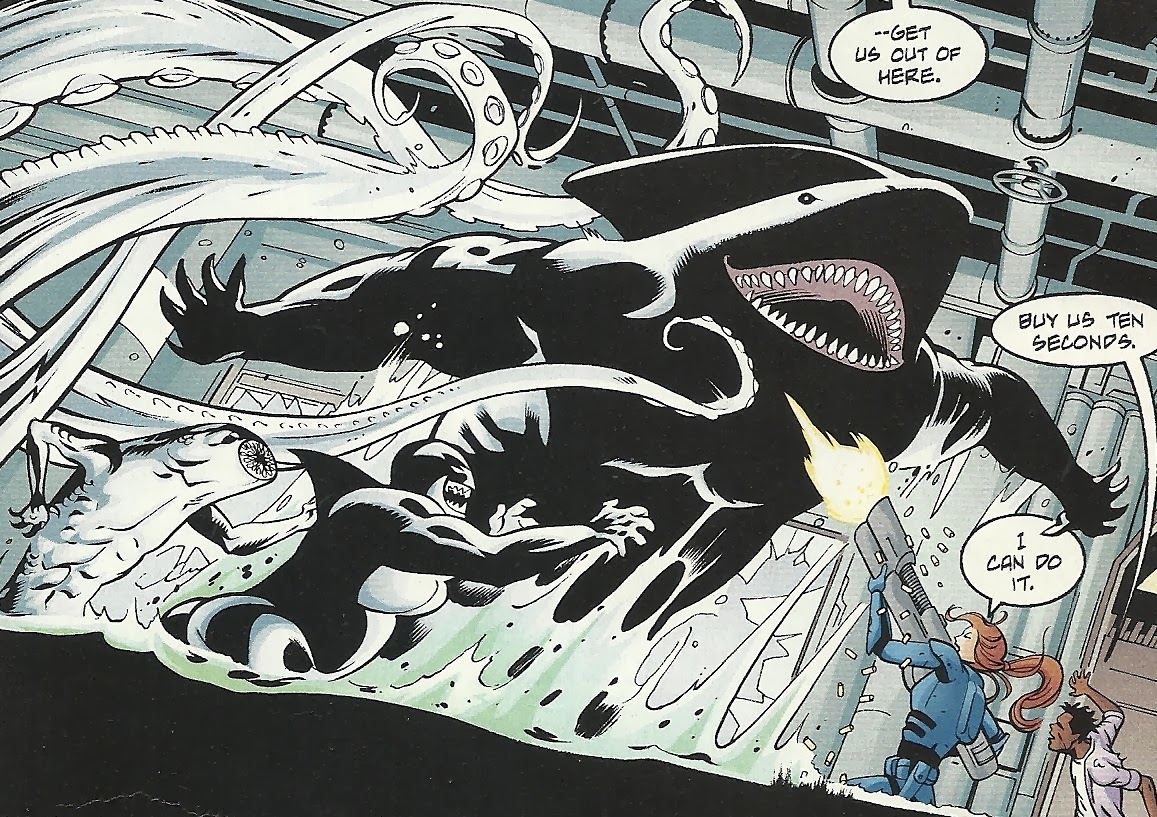
Here she is again, with the other "man-eaters" from the Aqua-Level of The Slab. I like this gigantic version of King Shark:
 |
| Martin again; I have no idea who the tentacles belong to, or who the sucker-faced guy is. |
He plays a very small role in the story, essentially just chasing Shilo and Dina around, but it's pretty remarkable how each artist draws him radically different, his size varying from, like, 20-feet-tall to 5-feet-tall.
I thought this particular panel, in which The Joker is wearing one of the many costumes he puts on throughout the story (He's dressed like Elvis during his battle-to-the-death with Nightwing, for example), was interesting in that it sort of prefigures what he wears throughout "Death of the Family," a sort of carpenter/handyman/repairman get-up:
 |
| Ron Randall |
Finally, the series was originally published about two DC logos ago, and so they still had a variation of their "bullet" logo, which is spherical enough that it works in this image by Brian Bolland, in which The Joker is tossing it up and town like a ball:
But when the trade was put together, DC had changed their logo to the new, more stream-lined bullet, which is smaller, sleeker and less ball-like, and thus doesn't quite look right, when DC swapped it into the Bolland image to replace the previous bullet:
Not sure
how they'd incorporate the current logo, if they published a new edition of this someday...