Showing posts with label darwyn cooke. Show all posts

Thursday, January 29, 2015

On a couple of Earths of interest:

Marcus To
The only new comic released today that I've read so far this week is The Multiversity: Guidebook #1, which was a huge surprise in that it contained a story just a few pages shorter than those of the other Multiversity books, contained some 35 extra pages detailing the Map of the Multiverse and these little profiles of 45 of the 52 Earths (seven of them are "Unknown" Earths at this point.

These were surprisingly fun, in large part because of how familiar so many of them were, and that the editors seemed to do a pretty decent job of at least making an attempt to match the settings and characters in each entry with the artist most associated with them.

So, for example, the Vampire Earth derived from Doug Moench/Kelley Jones trilogy of Vampire Batman books is drawn by Kelley Jones (I guess one reason Superman should wear shorts is to give Jones a good idea where to start and stop with his leg muscles).

Or, for another example, Darwyn Cooke draws the Earth assigned to his New Fronteir.

DC doesn't get a lot of the ideal candidates to draw these Earths. Alex Ross doesn't draw Earth-Kingdom Come, Dan Brereton doesn't draw Earth-Thrillkiller, Alcatena doesn't draw Earth-Detective Comics Annual #7, J.H. Williams III doesn't draw Earth-Justice Riders and so on, but there's a fair amount of very good art in this section, and flipping to and from the credits page at the back of the book is one of the many (many, many, many) pleasures the book offers.

The Earth I was probably most surprised to see was Earth-1:
So I guess that explains why those Earth One original graphic novels are all sub-titled "Earth One"—it is the universe within the current iteration of The Multiverse on which they take place. As for the main DCU, the Earth I've been calling "Earth-New 52"...? That's Earth-0, or "New Earth," as it was called post-Identity Crisis.

The entry, illustrated by Batman: Earth One artist Gary Frank, explicitly notes that the various characters all exist in the same world (There's been no indication in the books published so far that this was the case, and all three seemed to stand alone and divorced form one another). Also of interest is the inclusion of Wonder Woman, in the text and in the illustration, as she hasn't been introduced yet. It was announced that Greg Rucka would be working on a Wonder Woman: Earth One book, and then it was announced that Morrison would be doing it instead, but the title of Morrison's original graphic novel about Wonder Woman has since changed its title, losing the "Earth One" sub-title and, one assumes, its designation within the line and, one also assumes, its setting on this Earth. But one shouldn't really assume anything, should one? I, for example, assumed those books were not set on a new Earth-1 (Is it of interest that the parallel worlds that the main DCU of Earth-0 have had the most interaction with so far have been Earth-2 and Earth-3, rather than their closest neighbor, Earth-1...?)

Tuesday, December 16, 2014

Review: Harley Quinn Holiday Special #1

DC sure hasn't been shy about striking while this particular iron is hot. The new Harley Quinn solo series, the character's second, launched in November of last year with a #0 issue featuring one drawn-out fourth-wall breaking gag and drawn by a who's who of artists. It probably shouldn't have been a surprise that that issue was a hit, but, rather remarkably, the issues that followed also sold very well.

Perhaps it was the higher profile the already sorta popular character received thanks to various video games, perhaps it was the presence of cover artist and co-writer Amanda Conner, perhaps it was that the book was in the DC Universe line of books, while striking a very different tone and style than that of the other 51 or so books in "The New 52." Whatever the reason, Harley Quinn was working better than pretty much anything other than Scott Snyder and Greg Capullo on Batman.

And so in the last year DC has published Harley Quinn Invades Comic-Con International and Harley Quinn Annual #1, both with the sam basic different-artist-for-every-scene format as the #0 issue (the annual additional boasting the incentive of being a scratch 'n sniff rub 'n smell comic), and, just this last week, Harley Quinn Holiday Special #1.

It's a 36-page, three-story anthology, featuring two Christmas story and one New Year's story, which is why it's called a Holiday special and not a Christmas special, Kirk Cameron.

All three stories are written by the regular Harley Quinn writing team of Conner and Jimmy Palmiotti, and each drawn by a different artist, each of whom works in a much looser, more distinctive style than regular Harley Quinn artist Chad Hardin (At the rate they're going, I wonder if Harley will be the next DC super-character to get a digital-first anthology series following Wonder Woman, Superman and Batman).

The first of these, entitled "Bad Toy," is the longest, and at 19 pages is essentially an extra issue of Harley Quinn, albeit with guest art by Mauricet. Harley, who is apparently now a pet hoarder, failed to properly spay or neuter her many pets (Public service announcement: Spay or neuter your pets!), and they've been multiplying like rabbits. She and her friend Tony come up with a brilliant plan to get rid of them: They dress up as "Santa's Helpers" who volunteer to carry packages to the cars of shoppers and, if they think the shoppers will be good pet-owners, they hide a puppy or kitten in one of their bags.

But on Christmas Eve, Harley decides to check on one of them, and ends up getting busted Christmas morning. The cartoonishly bratty little girl of the house thinks Harley herself is the present, and so the girl's father bribes Harley into playing along for a while...but to make herself so undesirable a playmate that the girl gets rid of her of her own volition.

It reads much less complicated in-story.
Anyway, Harley eventually solves the family's problems by virtue of being immature, juvenile and a deranged lunatic with a heart of gold. It works surprisingly well as a Christmas story and a Harley Quinn story.

The art is pretty great. Mauricet has a highly kinetic, highly expressive style used to great effect throughout, The characters—human and animal alike—are highly expressive, and Harley is drawn as super-sexualized as usual, but with a good girl, cartoonish edge that bleeds toward parody.

That's followed by a shorter, sillier story entitled "Get Yer Cheer Outta My Ear," in which Conner and Palmiotti introduce us to the humbug, a tiny parasitic insect that embeds itself in the ear of a human host hums Christmas music directly into the brain of its victim. Then they introduce it into Harley.

She is saved by Santa Claus in a way that isn't as dirty as this panel might imply...
...who then takes Harley out to dinner at a kosher deli and expresses his thanks to "these great people" for not celebrating Christmas, and thus "making my job easier each year!"

This one is drawn by Brandt Peters, in a painterly, picture book style that reinterprets Harley as a big, bobble-headed doll.

Finally, there's "Killin' Time," drawn by Darwyn Cooke, who is probably the ideal Harley Quinn artist, at least this side of her creator Bruce Timm. Cooke's Harley is Harley as originally conceived and designed for her birthplace, Batman: The Animated Series, although Cooke renders her in her "New 52" look, with the bone-white skin and half-red, half-black hair. He additionally outfits her with a winter version of her costume (In Mauricet's story, she merely wears her regular duds, albeit more skimpy versions, with a jingle-bell collar and short leather jacket; in Peters', she puts a coat and furry boots oon over her roller derby uniform).
The story here is one of cartoonish insanity, made more cartoonish still by Cooke's suepr-flat, unapologetically 2D artwork (I imagine the jokes in the regular series would sing much better if they were always drawn in such a style). On New Year's Eve, Harley notices that she has a gray hair—not sure how that works, given her New 52 origin—and when her friends tell her about Father Time and the New Year's Baby, she becomes convinced that all she has to do to stop from growing older is track down a Mr. Harold Tyme, an elderly patient of hers in a nearby hospital, and either break his magical time piece and/or murder him.

No one gets murdered, and while Harley doesn't exactly learn a lesson in this one, she does get that gray hair taken care of.

I'm inclined to say that I wish Cooke was drawing Harley Quinn monthly, but then, I'd rather see him work on other, better comics, particularly ones he might be more passionate about. But then, if he's just going to waste his time on things like Before Watchmen projects and vigorously, ignorantly defending them in interviews with industry media outlets, well, he might as well be drawing Harley Quinn comics monthly, you know?

In-between the stories are a pair of Billy Tucci-drawn holiday pin-ups, both needlessly labeled "Pin-Up." The first features New 52 Harley in front of a wreath and dangling mistletoe above her head, the second features the Bombshell version of Harley (save this one has all-white skin) in front of the New Year's Ball.

I'm not really a fan of Palmiotti and Gray's take on the character, which amounts to little more than a sexy Halloween costume version of Marvel's Deadpool, but I enjoyed the looks of all three of these stories, and while some of the previously mentioned Harley comics feature more artists, this one is probably the best preview or gateway comic into what all the Harley Quinn hype is about, as it allows the regular writers to tell short, complete stories, each with talented artists who stick around long enough to make an impression, rather than just drawing a page or three.


***********************

Hey, any of you out there regularly Harley Quinn readers? If so, can you identify the...character in the below panel who appears to be a large egg in some kind of robot suit...?
That's not the New 52 version of obscure-ish Wonder Woman villain Egg Fu, who Grant Morrison and company resurrected for the weekly 52 series, as a giant-er egg in a big robot suit, is it...?

Just wondering. I checked out of the Harley Quinn monthly after about two issues, and have only read the specials since then.

Monday, March 11, 2013

Review: The Shade

It's hard to think of a single comic that was worse served by DC's "New 52" initiative than writer James Robinson's The Shade, a 12-issue series starring one of best and most colorful supporting characters from his critically-acclaimed and rather well-liked Starman, perhaps the single series in DC Comics history that made the most and best use of the publisher's long, sometimes tangled fictional history and the concept of legacy heroes (In Starman, being the superhero Starman was more-or-less the family business, and Robinson's story and huge cast of characters continually called back to that history).

Robinson kinda sorta returning to Starman was, of course, a good thing, and a rather big deal—trade collections of his run remain strong-ish, particularly for a character who isn't Batman or the Justice League—but it was completely knee-capped by the New 52 relaunch, which did away with the rich history that Starman was built of and most of the characters (or at least the stars) of the series. Timing, of course, didn't help; it was released in the fall of 2011, right at the height of DC's unprecedented PR blitzkreig proclaiming The New 52, with the implicit and explicit messaging that all of the comics DC published were no good and no one really wanted to read them (Starman and Robinson's Justice League of America run included), but these new comics by the same people as the old people (plus Greg Capullo, Rob Liefeld and Scott Lobdell!) were going to be awesome!

It's sales started off sluggish and, if I'm remembering correctly, took quite a tumble throughout the year, whether it was that fact that the book was jettisoned from the DCU and sold accordingly (note sales on DC's non-DCU Vertigo and kids comics), or Robinson's reputation suffering so horribly over the course of his last high-profile DC maxi-series, or simply DC's and DC's readers' attention being elsewhere at the time. (Todd Allen tried to puzzle out the exact reasons in this November 2011 post at The Beat, following warnings from Robinson that sales looked so poor he was no longer sure DC would allow the 12-issue series to last 12 issues).

I personally had, at that point, pretty much given up on James Robinson. Clearly DC editorial had a very heavy hand in his writing on almost every project since his 2006 return to regular writing for the company, with the "One Year Later" Batman story "Face The Face," as could be clearly demonstrated by how much his ongoing Justice League comic, originally meant to run alongside Justice League of America changed between the time it was announced and the time it became the miniseries Cry For Justice, or, how radically and jarringly his JLoA series could change from issue to issue, once he inherited the main title from the departing Dwayne McDuffie (Perhaps the best example of Robinson being jerked-around on that title was the fact that he introduced a big, new line-up in issue #41, only to have at least half of those characters taken out of the book with little to no in-story explanation within two issues, of which was a crossover with other goofy titles like the much-mocked Rise of Arsenal).


(Above: The Justice League that existed for about three issues, and then the League after it was almost immediately halved and, over the course of a story arc, picked up a few new members)

So while I enjoyed certain aspects of his JLoA, more of which I read in trade paperbacks borrowed from libraries than in monthly installments I bought the week of release, I know I wouldn't have been the least bit enthusiastic about his Shade series, were it not for the artists he would be working with: Cully Hamner, Javier Pulido, Jill Thompson (!!!), Darwyn Cooke (Back before Before Watchmen, when his byline didn't make me as queasy as it does now), Frazer Irving and Gene Ha.

I waited for the trade on it, and, just last Wednesday, the trade came out.

Whether because Robinson was back on very sure footing, or because DC editorial gave him a wide berth (nothing in this series "mattered," any longer, as it was already rebooted away) or some other reason, the Robinson who showed up to script this one seemed more like the Robinson of Starman and JSA then the one of Action Comics, Cry and JLoA (two of the three of which also featured Shade).

After having read it, I wonder if the serial structure might have further hurt sales. In the first issue, drawn by Hamner, we see Shade talking with the newest Starman, the blue alien one from Robinson's JLoA in Opal City, and talking with his lover Hope, name-checking many of the characters from Starman.
The end is of the shocking, gratuitous, gory kind—Deathstroke the Terminator, whose design looks like Cully Hamner's attempts to cover Simon Bisley's version of the New 52 'Stroke, first chops off The Shade's hands, and then beheads him. And that's the end of the first issue.

The Cry and Arsenal example of shock-seeking violence, the uncomfortable co-existence of The New 52 and the old DC continuity—I'm not sure how this book would have looked in October of 2011, but I'm pretty sure "promising" wasn't it.

As it turns out, the particular design of Deathstroke was the only aspect of The New 52 to intrude on the series. Otherwise, it is quite clearly a continuation or spin-off of Starman, featuring the exact same version of The Shade. This was simply an old-DCU comic that DC published right after they made a big deal about the old DCU being rearranged into The New 52U.

Deathstroke is, obviously, unsuccessful in his attempts to kill The Shade, but his attempt to do so sets the plot of the next ten issues in motion, after a first issue reintroducing us to The Shade and his particular tone of voice and his own supporting cast and home base of Opal.

Naturally, The Shade wants to know why someone hired one of the world's greatest assassins to kill him, and he begins a globe-trotting trip to find out just that, along the way flashing back to previous adventures involving his descendants, two of whom figure rather prominently in the attempt on his life. In a sense, this is a story about The Shade's dealings with his family over the decades, and learning that maybe it's better to keep in touch, if the results of not keeping touch involve any of them attempting the sort of evil that even he during his Golden Age worst would have never attempted.

He travels from Opal to Paris to Australia to Barcelona to London, and on several occasions the story travels back in time to the 19th century and, on one occasion, to the 1940s. The multiple artists are employed quite smartly, so that a change in artist coincides either with a change in place or a change in time (or both). There are obviously wide (troublingly so) gulfs between the styles of Hamner and Cooke and Ha, but the shifts smooth it over (Cooke, Pulido and Thompson all draw in a similar enough style that their art seems to belong grouped together, while Irving and Ha's realistic art similarly works in complimentary fashion; the editors group it smartl, so we move from Hamner to Pulido Cooke and Thompson and then, finally, to first Irving than Ha).

Robinson involves a fairly incredible amount of guest-stars, more of whom seem to be created by he and his artistic collaborators than pulled from the DC character stable something that, given the damage Robinson inflicted on that stable during Cry, is nice to see. There are actually quite a few of these, many of them international heroes, and I suppose I should do a more thorough Googling before declaring them all Robinson creations, as its possible they are simply extremely obscure DC characters (Robinson is the man who resurrected Jay Garrick's Golden Age sidekicks simply to ice them in Cry, for example, and used characters from DC's 1970s 1st Issue Specials prominently in his Action Comics run).

Barcelona's champions were probably my favorite, both springing from the Pulido-drawn sections of the book. These are La Sangre, a teenage (looking) vampire who is the city's beloved champion (and kinda sorta The Shade's adoptive daughter) and Montepellier, a snake-themed detective hero of the Batman mold, whose costume looks a little like a Frank Miller design from Dark Knight Strikes Again, a design just goofy enough to still be sort of cool.


(Above: Montepellier, by Pulido)

A handful of pre-existing characters do appear, of course, aside from the aforementioned Starman characters and Deathstroke.
During the Cooke-drawn adventure in the 1940s, there is a nice, dynamic scene involving the original Vigilante (I love that guy, by the way, and Cooke makes him look ten times more awesome than usual) and, surprisingly enough, Golden Age cross-dressing crimefighter Madame Fatal, whom I didn't realize DC actually had the rights to use (I last saw her appear in The Quality Comics companion, which I guess would make her a DC character now). Interestingly, rather than a little old lady, this Fatal is drawn as a busy amazon, albeit one with white hair.

The book is pretty great, featuring a very distinct lead with a very singular voice, and, as mentioned a series of great artists. It's not perfect, of course, and I'll always find something to complain about. Robinson's dialogue can occasionally be too precious, too obvious in its construction.

Format-wise, this is an eleven-issue story arc, with a tacked-on 12th issue, purporting to be the never-before-told origin of The Shade. The story is perfectly wrapped-up by the last page of the eleventh issue, and the twelfth begins with still perfectly human Richard Swift in the late 1830s, hanging out with his pal Charles Dickens, his own lovely family and a mysterious dwarf named Simon Culp. There's a ritual to invoke a goddess, at which Swift was to be a sacrifice, but instead he gained his Shade powers and his immortality. Exactly what went on to give him those powers isn't really discussed here, allusions are made to explanations existing elsewhere (likely in Starman or perhaps the four-issue, 1997 Shade miniseries; it's been a while since I've read either).

The only disappointing bit on the art side of the equation, which is mostly superlative, came during a section Pulido drew in which The Shade visits his elderly, dying great-grandson in Australia, and a conversation between the pair is illustrated in a two-page spread, assembled from a single drawing repeated over and over and over, slightly edited each time to try (and fail) to invoke a sense of differing panels; it's a clumsy, lazy trick I've seen in Brian Michael Bendis-written comics a lot, and generally employed because there's some time crunch with the books.

That is, thankfully, the only negative aspect of any of the art in this 12-issue storyline though (Well, I might have colored Shade's blood black rather than red in the first issue, when Deathstroke is chopping him into pieces, since the fact that The Shade doesn't possess blood any more is something of a plot point later in the series).

When finishing a shared-setting super-book like this, one of the most exciting aspects is imagining what will come next. I, for example, would really like to read more about some of these newer characters (and/or older characters, recreated or refurbished), and The Shade, like the Starman legacy, is exactly the sort of character-vehicle that would allow a writer like Robinson plenty of space to fill-in dozens and dozens of story (there's room for a lot of adventures between the years 1837 and 2013, after all).

Sadly though, the current state of the DC line would seemingly make something like, say, a sequel or a Shade ongoing by Robinson and Pulido unlikely, if not impossible. The publisher could continue to publish comics outside of their New 52 status quo, of course, but, thus far, they haven't been all that eager to do so, and, in the year and a half or so since the change, this remains one of—or only?—old-DCU comics stories they've published.

On it's own though, this was a really rather great little comic series, filled with great art from great artists who simply do not produce enough superhero genre stuff (It was such a treat, for example, to see Thompson working in the "straight" style of her old Sandman contributions, for example, or Cooke doing another DCU period piece).

It's also, by the way, a pretty compelling argument against a one-generation only DCU—there's just so much raw material to mine when you've almost the entire 20th century full of super-people, rather than restricting yourself to a superhero history that exists only from 2008-2013, you know?)

***********************

I thought it worth noting that James Robinson did not create The Shade, even if he quite thoroughly and completely recreated him over his years and years of writing him. According to Wikipedia, The Shade first appeared in a 1942 issue of DC-to-be National's Flash Comics, and his creation is credited to an E.E. Hibbard.

I'm having trouble thinking of another character who was adopted in the manner that Robinson adopted The Shade, essentially transforming the character so much that the later creator's creative stamp seems to have all but obliterated the original conception of the character.

I'm sure one could think of many if one spent a while doing so, though. Off the top of my head, Alan Moore and company's work on Swamp Thing and Grant Morrison, Jamie Delano and company's Animal Man spring to mind most immediately.

*********************

Hey, speaking of the New 52U's compressed superhero timeline, in which there weren't any superheroes until Superman started running around Metropolis in 2008, maybe late 2007. That's really, really weird when one considers the fact that All-Star Western features super-powered masked men like El Diablo and colorful, masked crimefighters with codenames like Nighthawk, Cinnamon and The Barbary Ghost, isn't it?

Basically, there were superheroes in the late 19th Century (and the Dark Ages, as per Demon Knights, but I'm not sure if they would count as superheroes, given the fact that they are all magical in nature), but not a single individual decided to wear a mask and fight crime between, say, 1900 and 2006...?

That has nothing to do with The Shade, of course. Only that this series' inclusion of The Vigilante, Madam Fatal, and the title character's 100+ year career as a super-human had me thinking about a fictional history of superheroes, and read while writing about a New 52 cowboy series sort of drove home the fact that there seems to be a very big and hard to account for gap in New 52U continuity.

Thursday, March 27, 2008

Review: Justice League: The New Frontier DVD


The adaptation of Darwyn Cooke’s 400-page epic comics story DC: The New Frontier into a direct-to-DVD animated movie seemed like one of those projects that was either going to be really great or really terrible.

The reason to hope for great? Well, before Cooke came to DC Comics, he was working for Warner Brothers animation on such projects as Batman: The Animated Series, and his animation work heavily inspired his comics style and storytelling. In a way then, the adaptation was something of a return rather than the movement of a story from one media to another.

Additionally, Cooke was supposedly heavily involved in the production of the film (his final credits are “creative consultant” and “additional material by”), and the animators he was working with involved a slew of people he had worked with before, including director David Bullock, writer Stan Berkowitz, executive producer Bruce Timm and even many of those cranking out designs and storyboards.

On the other hand, New Frontier is a huge story, with a good 20 or so important characters, and it was told through a complex series of vignettes spanning years, with the disparate plotlines slowly being weaved together over the hundreds of pages into a single story.

And that story, not unlike Kingdom Come, is on one level a pretty straightforward meta-story about comics. It’s a retelling of the forging of the Silver Age of comics, when the mostly forgotten detritus of the superheroes of the Golden Age and the manly-men war and adventure heroes of the ‘50s gave way to the bright, shiny, optimistic, futuristic heroes of the ‘60s.

And it was just jam-packed with in-jokes and allusions to DC’s publishing history and the real world history of the era, as if Cooke tried to use every single character DC had the rights to and put them in a single tale and apply historical forces upon them to see what he’d get.

But beyond all that, it was a story about aesthetics. About how cool the post-war vision of the future looked in terms of design and fashion.

If these guys had trouble making a movie about Superman and Doomsday beating each other to death not be awful, how were they gonna handle the gargantuan challenge of New Frontier? And do it in a run-time of just 75 minutes, which is ridiculously short, even by the standards of children’s films?

Well, I was pleasantly surprised. It didn’t turn out terrible or great, but for an insanely short adaptation of such a complex story, Bullock and Berkowitz did about as well as could be expected, and they manage dto evoke the most intangible virtue of Cooke’s comics—the aesthetic.

Berkowitz strips away the more nebulous bits of the comics version—a story as meditation on DC comics history from the outside looking in and the inside looking in—and gives it a focus that’s right there in the title. In the comic, the Justice League was the face of the future, appearing like an exclamation point after the ellipsis of the climax, but here they are the subject itself.

So everything else is trimmed back until what we’re left with is the story of Hal Jordan, The Martian Manhunter, Barry Allen/The Flash and, to a lesser extent, Batman, Superman and, to an even lesser extent, Wonder Woman, as they unite with some military he-men and some civilian tough broads to take on an enemy known as The Centre, which is here front and center throughout the entire story.

The running time seems to be by far the film’s biggest drawback. It’s not just what had to be cut, it’s the pacing of what’s left. Even if I had never read the comics, the running time would have seemed problematic. Far too few scenes have the proper room to breathe. A great deal of the dialogue seems rushed through, with conversations taking on a clipped, unnatural let’s-just-get-through-this feeling.

There are some fairly incredible scenes involving superpowers—Superman going mano a isla against The Centre, The Flash’s race through Vegas to collect bombs before punching out Captain Cold, The Martian Manhunter flexing his powers—but they too seem to end as soon as they begin. The same is true of quiet scenes, of silent character action and reaction, in which the greatest amount of the story is told most effectively.

As the film reaches the climax, wherein all of Earth’s heroes unite, there’s little impact to seeing Green Arrow or Adam Strange or The Blackhawks or Ray Palmer of Ivy University show up if you have no idea who they are. They’re cameos for DC comics fans, not elements in a film for people who aren’t already DC comics fans.

And that’s the biggest question I have about this film, and the Warner Brothers/DC direct-to-DVD film program in general. Are these meant for your hardcore direct market audience? If that’s the case, and it sure seems to be from the results of the last two films, why bother casting name stars to do the voices, instead of just reusing cheaper voice talents from the other cartoons? Why keep the running time and rating so kid friendly? The grown-ups who buy Absolute Editions of this stuff are going to spend whatever you charge for the DVD.

Admittedly, as a member of that audience, and as someone who has read the comics, the focus on the name superheroes and the super-short run time actually served my interests in the product well. I’d already experienced this particular story the way it was meant to be told, after all, so I’m mainly just watching the DVD out of curiosity, to see how well they’ll be able to use Cooke’s designs, what they’ll look like moving, to watch Martian Manhunter punch out a pterodactyl and so forth. This does function as something of a highlight reel then, hitting all the things a reader and fan will be curious about, story integrity/film experience be damned.

But then, that’s probably a necessary evil brought on by the timing issue…and/or the budget, which I’ve no clue about. There are several bravura sequences in this that are as good or better than any piece of DC-related animation to ever play on a screen, small or silver, so I can’t help but suspect that, given a freer hand than they had, Bullock and company could have done something really special here.

The opening sequence, with the Centre telling its story, followed immediately by the title sequence? The book end-like sequence at the end showing all the DC superheroes and supervillains that didn’t make it into the film? Ace Morgan and Hal Jordan’s flight into the mindwarping center of the Centre? It’s all beautiful, beautiful stuff, and I would have loved to see a whole movie like that.


What else?

Well, the DC geek in me was delighted to see things animated I wouldn’t reasonably ever expect to see on a TV cartoon series or a film-film (the kind they’d show in theaters, like, um, just Batman: Mask of The Phantasm so far). Things like…

—Barry Allen instead of Wally West, and Hal Jordan instead of John Stewart or Kyle Rayner (particularly with their Silver Age sweethearts).

—A big, busty, almost Rubenesque, J. Bone version of Wonder Woman instead of a slimmer, super-model-y looking one.

—A clean-shaven, red glove-wearing Green Arrow.

—A purple-gloved, curved-ear, first appearance-style Batman.

—Any Justice League movie where J’onn J’onnz has a bigger role than the Trinity.

—And I was glad I finally got to hear what the Blackhawks’ battle cry sounded like when shouted aloud instead of just read in my head (It sounds kinda lame, actually, but, well, curiosity satiated!).


Regarding the voice talent…

—The “girlfriends” are all uniformly great, all channeling some of that Old Hollywood leading lady type of brassiness and old school radio program melodrama flavor: Brooke Shields as Carol Ferris, Kyra Sedgwick as Lois Lane and Vicki Lewis as Iris West.

—Former Xena, Warrior Princess Lucy Lawless playing warrior princess Wonder Woman is probably the only instance of “stunt casting” here, but she does a pretty good job, and her voice sounds remarkably right coming out of such an unusual-looking Wonder Woman (unusual compared to her previous animated incarnations, anyway).

—David Boreanaz plays Hal Jordan, Miguel Ferrer plays J’onn and Neil Patrick Harris plays The Flash. They’re all fine, but relatively unremarkable. But then, none of those characters are quite as iconic as “The Trinity” characters, and thus I doubt many in the audience would have terribly strong feelings about how they “should” sound.

—Not like, Batman, anyway. Jeremy Sisto plays Batman. I’m so used to hearing Kevin Conroy’s version of Batman’s voice when watching cartoons, that whenever it doesn’t sound like Conroy, it strikes me as wrong and takes some getting used to…and in just 75 minutes, little of which involves Batman, you don’t get much time to get used to anything.

Sisto’s not-being-Conroy seems most wrong in the earlier scenes, where Batman’s face so closely resembles that of the one from The Animated Series.

In the commentary track recorded by Darwyn Cooke, he says Sisto sounds to him like what he imagines Adam West would sound like today if he was 30 and cool. I don’t know. He’s not particularly suave, dark, or scary sounding, and his line readings are a little flat, as if he’s reading lines instead of acting them. Midway through, Batman changes from his first-appearance gear to the more Dick Sprang-looking design. His long, horn-like ears become perky little stubs, his black cape and cowl become blue, and his sharp, triangle eyes become semi-circles. It’s a lighter, more friendly look, which Superman remakrs on when meeting with Batman and Robin, but Sisto’s voice hasn’t changed a bit from when he was in full-on creature-of-the-night mode.

—Kyle MacLachlan’s Superman sounds nice and dad-like, which is exactly how I like to think of Superman, especially the Silver Age Superman. I never would have thought of MacLachlan as Superman, but he sound absolutely perfect.

Saturday, February 09, 2008

A sharp dressed Man...hunter

As I mentioned in the post-mortem I wrote up on last December's theme month, I was awfully surprised about how much love J'onn J'onnz's current look got in the comments on the post in which Batman tried to trick him back into his old look. And by "how much love it got," I just mean "that it got any love at all," because I hate, hate, hate, hate, hate it. In that same post, I mentioned that in the near future I should really devote a post to looking at the many other look's of J'onn J'onnz, Manhunter From Mars, and, well, a month and a half later, I'm ready!

Are you? Cool. Then let's go!

Now, the Martian Manhunter is a pretty old character, created way back in 1955. In all that time, he's only really had one dramatic costume redesign, and has, in fact, changed the shape of his head more often than his clothes.


In the above image, in which we see J'onn giving Superman a tasty knuckle sandwich, imported all the way from Mars, we get a pretty good idea of his original look. Blue cape, boots and undershorts, held up by a belt, Superman-style. Pluse a red X-shaped harness across his chest, either to make him look slightly less naked, or to let us know, "Hey, I wear a harness. All the time. I'm totally up for whatever you earthlings want to do in the bedroom."

His head shape is at its most human at this point, too. Basically, he's got my head atop the body of Johnny Weissmueler. Only green.

Eventually, he'd get slightly more alien, looking, as seen on the cover of his 1996 one-shot:


Basically, his brow grew more prominent, and his eyes redder. In JLA: Year One, that's the look he had as soon as he went public, so that the smooth, human-shaped head didn't really exist Post-Crisi. In generaly, J'onn's look was explained as being a variation of Superman's and other superheroes, so that he wouldn't intimidate earthlings with a more alien look.

In John Ostrander and Tom Mandrake's Martian Manhunter monthly, they explained that the head-shape above was J'on's "public" form way back in the day when he lived on Mars. Martians had public and private forms; the public ones are what they wore to work and to meetings and grocery shopping; the private ones are what they wore around the house with their loved ones.

His look would change slighly from artist to artist and book to book, but only slightly. Sometimes he had human looking eyes, sometimes he had all red eyes, sometimes he had red eyes with black pupils. Whether his cape collar was folded under or pointed straight up may vary, as would the size of his boot cuffs, or his height (There doesn't seem to be any standard as to how tall characters are in relationship to each other in the DCU; of course, J'onn's shapechanging ability might render that moot anyway).

In the wake of Infinite Crisis' "One Year Later" drastic-changes-for-drastic-changes sake, J'onn got his new costume, the one I really dislike:


It keeps the color scheme of his original costume more or less in tact; in the first appearance it appeared black, but has gradually grown bluer and bluer.

The change seemed sudden and arbitrary to me, especially consdiering Ostrander's explanation of the original, as a Manhunter uniform from Mars, grown from the Zo'ok plant. Besides, the head-shape was wrong, a variation of his "private" head-shape, and the pointy ears and wrinkly chin looked a little too much like Marvel's shape-changing alien race the Skrulls, which we should all be quite sick of in two months time, thanks to the Skrull-centril Secret Invasion event series.

The new look was accompanied by a terrible eight-part miniseries, and a new bad-ass, grumpy attitude. Eventually it was explained that this attitude adjustment and costume change was the result of J'onn touching Black Adam's mind in World War III.

Now, while these are the main looks J'onn's sported during his career,he has adopted other looks, usually on a very limited, short-lived basis. Personally, I think they're all superior to his current neckbrace and bodysuit combo, but I'll submit them now for your approval. What do you think, should J'onn maybe switch to one of these looks permanent-like?

First, there's this charming little number:


That's his "J'oann J'onnz" look from a wonderful two-part arc in Justice League Task Force, courtesy of writer Peter David and penciller Sal Velluto. In it, a team of scientists stumble into a hidden underground world ruled by warrior women, and J'onn must lead an all-female task force in to retreive them. Of course, he'll have to disguise himself as a woman as well. Hilarity, naturally enough, ensues.

The advantage of this particular look should be quite obvious, particularly given DC's proclivity to sex their books up all of a sudden. If that were J'onn J'onnz's new look, it wouldn't be long before he was back on the Justice League, and Ed Benes was putting him front and center in each and every panel composition.

Ostrander and Mandrake's Martian Manhunter ongoing introduced quite a lot of new concepts to the character and his background, fleshing him (and the history and culture of Mars) out like never before. One of their innovations was that J'onn maintained more than one secret identity, which was traditionally that of Colorado policeman or private eye John Jones. He used his shape-changing and mind-reading powers to pose as lots of different people with lots of different backgrounds, in part to better understand humanity and in part to fight crime on a variety of different fronts (For example, one guise was as an agent within the Department of Extranormal Operations, another was as a dim-witted supervillain, others were actually the secret identities of other superheroes).

For example, J'onn was sometimes Japanese businessman Yuchiro Takata, who was secretly Bio Armor Jade Warrior, a gigantic, metallic superhero who defended Japan, and gave rise to a popular manga adaptation.

Here's J'onn in Japan, adopting the Bio Armor Jade Warrior look and tactics he saw in a manga to attack giant robot menace Antares, in Martian Manhunter #2:


As Bio Armor Jade Warrior also comes in gray:


Another identity of J'onn's from that series was The Bronze Wraith, a superhero who served on the half-forgotten team The Justice Experience, a retcon-created super-team that existed between the disbanding of the Justice Society, but before the founding of the Justice League. One the Wraith's teammates was Acrobat, a superhero who was the father of DEO agent Cameron Chase, form the even-shorter-than-Martian Manhunter-lived series Chase. She and The Justice Experience popped up in Martian Manhunter. Here's Mandrake's drawing of J'onn as The Bronze Wraith, from #17:


The costume itself isn't too bad. It's a tad dorky, and even less cool than J'onn's normal look, but I've certainly seen worse. What really bugs me about it is the name. If he were The Green Wraith or possibly The Blue Wraith, I could see that, but Bronze? I don't see any bronze on that costume. Maybe he's usually really tanned? The thing is, I can't really see that costume working on J'onn in his normal, non-disquised form. Because it's essentially just a costume that looks like his scantily clad costume, and would look super-goofy.

One of my all-time favorite J'onn appearances came in JLA, back when the Justice League comic wasn't horrible. The climactic story arc in Joe Kelly, Dough Mahnke and Tom Nguyen's run on the book was the six-part "Trial By Fire," in which J'onn quit the League for some much-needed rest and relaxation, which involved conquering his fears of fire and enjoying a romantic relationship with former Superman villain Scorch.

In JLA #84, Superman pays the vacationing J'onn a visit, and the latter grills them up some big steaks, while kicking it in his vacation clothes:


I love that image, off J'onn's crazy-huge biceps just exploding out of that orange golf shirt. (That is orange, right? It's not one of those colors that is kind of pink, is it?). Here's a full-body shot of what J'onn wears around his backyard:


Man, that's awesome. And something I didn't even notice until I scanned this panel:


Behold, the f'lipp f'loppz of J'onn J'onnz!

How cool would it be if J'onn started dressing like that all the time? Instead of the dark body suit and cape he's sporting these days, he started kicking ass and taking names while wearing a pastel golf shirt tucked into his dockers, rocking white flip flops? I think it would certainly make him a more menacing looking opponent. I mean, if he shows up to fight Despero dressed like he's headed to a Memorial Day picnic, Despero's gotta be thinking J'onn's not sweating bullets about the prospect of having to deal with him, you know?

A much less drastic redesign of J'onn's work clothes can be seen in "New Maps of Hell," the six-part story arc from JLA: Classified #10-#15, by Warren Ellis and Butch Guice. This was the last really good story arc in the now-cancelled JLA:C series; I remember being pretty down on it when I originally read it, but returning to it in trade recently, it was much, much, much better than I remembered. I guess that holds true for most of Ellis' writing though; when he writes for the trade, you're much better off waiting for the trade.

Anyway, here's what Guice put J'onn in throughout:


I imagine this is just an art mistake more than a conscious decision to change his look, but it's a pretty dramatic mistake, giving him those big, gold wristbands. Of course, Guice had Kyle Rayner wearing some weird-ass ring-generated armor throughout too. I like Guice's art in this story, and I like the way he draw's J'onn's shorts there, but I don't think the wristbands add anything of value to the costume. Other than making him look like a Wonder Woman wannabe (Sorry, Power Man!)

Finally, for another great alternate J'onn look, we need to look to an alternate continuitiverse, that pocket continuity where just about everyone is better designed than they are in the regular DCU, Darwyn Cooke's New Frontier.

When the captive J'onn J'onnz is finally released by his friend King Faraday, here's what he shape-changes into, once Faraday tells him that real men wear pants:


It can be complimented with a pair of sunglasses,


and, the tie and collar can be loosened in especially stressful situations.


Looking sharp, J'onn!

And those are most of J'onn's alternate looks. Tomorrow, we'll look at his very best one. Don't miss it!

Monday, October 01, 2007

So you want to get into Darwyn Cooke’s Spirit…


I recently concluded a thorough analysis of all available sales data pertaining to the North American comic book market (I, um, spent about 90 seconds googling the sales charts), and I uncovered a shocking, appalling fact: Only about 20,000 people buy an issue of The Spirit each month.

If that seems like a lot of people to you (despite the fact that I prefaced it with the world “only,”), for comparison’s sake, it’s only one-sixth the number of people who have tuned in each month for a comic book about the Justice League’s board meetings, and one-twelfth as many who have tuned in each month to watch the Incredible Hulk punch people in the face.

And while board meetings and face-punches surely have their appeal, what makes the disparity of these numbers (as I remember them…from that thorough research mentioned two paragraphs ago) mind-boggling is the fact that whatever the merits of the Justice League and Hulk comic books, The Spirit is roughly a thousand times better. Wait, let me check my math…No! I forgot some zeroes! The Spirit is roughly one million times better than both of them…combined!

So why does it sell so poorly? Is it because everyone who buys comics except me and 19,999 other people are fools?

That’s a possible explanation. But surely there are other, less obnoxious and potentially offensive explanations (Particularly in case you aren’t currently reading The Spirit because, dear reader, I know you seem like an intelligent person with great taste and that shirt? It looks great on you).

I’m thinking that maybe, just maybe everyone wants to read The Spirit, that they harbor an innate understanding of its inherent awesomeness, but find themselves a little intimidated by the fact that the character is so long-lived and so revered, and therefore they aren’t sure where to start. I mean, DC, who now owns the character, have published like 20 over-priced archive additions of his adventures, can anyone just pick up an issue of current Spirit monthly comic book and bask in its awesomeness without first steeping themselves in arcane, nerdy knowledge?

Yes! Yes, they can! One of the great virtues of Cooke’s Spirit series, now in its tenth issue (and third-to-last issue, before Cooke leaves for greener pastures, and new creators come on), is that every single issue has been a complete, easy to read, highly accessible story.

And the latest issue, which was released just last Wednesday? It was probably the most accessible story yet. But since some of you still aren’t reading The Spirit, perhaps you need a little extra push.

So get ready to feel a firm pressure from behind dear readers, because after that interminably long and meandering introduction, Every Day Is Like Wednesday is pleased to answer all your questions in tonight's feature, which we're calling...


A BEGINNER’S GUIDE TO THE AWESOMENESS OF DARWYN COOKE’S THE SPIRIT, PARTICULARLY #10, WHICH IS ESPECIALLY AWESOME


1.) Who or what is "The Spirit," exactly?

The Spirit is a masked mystery-man crime-fighter who, despite the colorful name and the domino mask, eschewed the Superman model of superheroes, sticking closer to the model of detective novel and pulp fiction protagonists.

Young big city detective Denny Colt was “killed" by a mad scientist, and immediately came back to life in a cemetery, getting a new lease on life after his supposed death. Making his new spooky surroundings his base of operations, he added a mask to his fedora and blue suit ensemble, and began battling crime with his fists and wits.

As a character, he wasn’t all that inspired a creation—you’d have a hard time picking him out of a line-up of similarly garbed crime-fighters—but his creator was such a talent that the execution of The Spirit’s adventures gave the character a long, long life (Sixty-seven years and counting).

That creator was Will Eisner, who was perhaps the greatest thing that ever happened to comics. Eisner is widely credited with writing the first graphic novel, the first aesthetic study of comics and beating Paul Bunyan and Davy Crockett in a fistfight in 1956. Comics’ version of the Oscars are named the Eisners after him, and when he died in 2005, he left behind an unrivaled body of work, having worked in the comics industry as long as there was a comics industry.

The Spirit, Eisner’s most iconic creation, starred in a weekly newspaper comic strip and a special pull-out section for over a decade, as well as in comic book-comics. The strip only sort of a crime drama, as Eisner infused the stories with a sense of humor and a restless sense of experimentation. Unlike most hero-centric strips of the day and today, The Spirit never completely committed to a single genre, and thus stayed a lot fresher than even strips featuring more popular characters (many of whom wore capes).

The strip became known for its playful integration of the logo into title pages, its colorful character names (Bond girls have nothing on Spirit girls), and its regular guy hero, who might always get the girl and beat the bad guys, but often got his ass kicked pretty bad in the process.


2.) And who’s this Darwyn Cooke character?

Cooke is a Canadian comics writer/artist responsible for some of the most awesome comics of the 21st century (But it is early yet).

That his comics feature stripped-down, powerful designs and a highly cinematic feel is likely due in no small part to the time he spent in animation, having worked on Batman: The Animated Series, Superman: The Animated Series and Batman Beyond (this here’s all him), three series that together comprise a high point in American television animation (He also worked on a Men in Black cartoon I’ve never seen a single frame of, so I can’t vouch for it).

Much of his comics work can be a little hard to find, as it tends to be a single issue here, a miniseries there, and the occasional graphic novel.

In 2003, Cooke began an epic project entitled DC: The New Frontier, a sly meta-narrative about how the Golden Age superheroes gave way to post-war cynicism, with only the most popular surviving in a sea of men-of-action, post-superhero manly men heroes like The Challengers of the Unknown, The Blackhawks and their ilk, before the optimism of the 1960s gave birth to a new era of superheroics, the bright, happy, shiny Silver Age (Indisputably the company’s glory years).

In 2006 he took on monthly comics duties with The Spirit, a title he would both write and draw, with artist J. Bone lending inks, and Dave Stewart colors.


3.) Wait, wait, wait... If The Spirit’s adventures were only awesome originally because of Eisner, how could Eisner-free Spirit stories possibly awesome?

Hey, good question!

I wouldn’t have expected an ongoing, Eisner-less Spirit effort to be worth a damn, personally, but, as it turns out, Cooke’s Spirit revival is going to be abbreviated, lasting only about 10-12 issues (He’s on through #12, but #7 was an anthology style fill-in by three different creative teams, and I think another such fill-in is slated shortly), which now makes it seem more like an a long tribute rather than an ongoing attempt to exploit the Spirit brand (which, to be fair, currently doesn’t have all that much juice in it anyway. The character may have lasted a long time, but he's not moving action figures and DVDs the way Spider-Man or Superman are, you know?).

But Cooke and his collaborators managed to be respectful of Eisner’s creation (Will Eisner’s signature is on every cover, dotting the “i” in “Spirit”), keeping the, um, spirit of the original strip in tact while updating the elements that didn’t age so well (like wince-inducing sidekick Ebony White), and moving the whole franchise into the 21st century. A 1940s cartoon noir figure might seem out of place in a world of satellites and cell phones, but Cooke makes it all work.


4.)What’s this crap about a Spirit move?

Yeah, they’re making a movie based on The Spirit, because apparently everything that’s ever been a comic book will be turned into a movie until films based on comics stop making money. Which is really another reason you hold-outs need to get on The Spirit now; why wait until the movie comes out and everyone's talking about The Spirit? Start reading now, and get out in front of the trend. Your friends will think you're ahead of the curve, plus you'll have the background necessarry to complain online about the casting choices with the same sense of entitlement as the rest of us.

The film is currently slated for a 2009 release, and it’s being written and directed by Frank Miller, who has extremely limited film experience, although movies based on his comics have recently made several gazillion (Sin City, 300) at the box office, and that's probably the only experience he needs to be accepted by Hollywood.

If you’ve read many of Miller’s comics, particularly his more recent totally insane ones, then you’ve probably noticed that he seems like the Anti-Eisner. And maybe he is, but the dude does have mad respect for Eisner, so maybe the film won’t totally suck. (At the very least, it will have some appropriately extremely curvy women in it).


5.) So, am I up to speed now?

Hell yeah you are! Let’s take a look then at The Spirit #10, a typically great issue of Cooke’s volume of the comic, one which accentuates his ability to make the character’s adventures completely current without sacrificing any of its attributes. Cooke’s Spirit is both timely and timeless, and this one a little more so of both.


What makes it so timely? Well, Cooke uses youtube.com as a narrative device, taking the comic book panel-like square image familiar from users of the site and importing it into his comic to introduce the victims and suspect in the murder mystery.

And it’s a murder mystery that taps into the zeitgeist, dramatizing for our escapist delight the dream of all American media consumers: The brutal murders of cable television punditry.

This being Cooke doing a Einser-inspired Spirit however, these familiar faces have been simplified to cartoon character elegance, and their names scrambled into delightful little punning poems that retain their original sounds, only slightly out of order.

Of course, despite the fact that they look like real world pundits, and that they have names similar to those of real world pundits, and that they have personalities and schticks just like those of real world pundits, they are, in fact, totally not really based on any of those, so neither Cooke nor DC can be sued by the likes of Ann Coulter or Rush Limbaugh.

To make sure of that, The Spirit’s girlfriend Ellen Dolan and sidekick Ebony White (who no longer resembles the hideous, lawn jockey-looking caricature he did when Eisner first drew him in the ‘40s) visit a lawyer in the first scene to get him to sign off on the adventure...


And what does this adventure entail?

Well, Central City Police Commissioner Eustace Dolan (that's him above cajoling the supporting cast to join him in the rest of the story), TV reporter Ginger Coffee and The Spirit are investigating the spectacular murder of Dandy O'Lyon, "the left wing lesbian day-time chat monster." Upon leaving posh restaurant Fugli, O'Lyon, who can't possibly be based on Rosie O'Donnell since Rosie has brown hair and Dandy's blonde, was apparently burned to death in her car.

Who could have killed her?


Perhaps Trust Wimbag, the overweight, far-right talk radio gas bag who had recently launched into an on-air diatribe against O'Lyon?


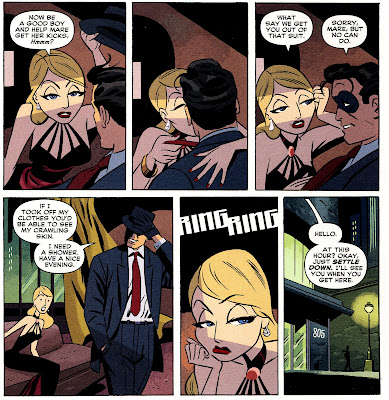
Or perhaps Mare Nolty, a skinny blonde with an incredible temper who's prone to act like a maniac in public to cynically exploit self-created controversy to boost her own Q-rating? After all, she apparnetly attempted to throttle Dandy in public recently.

Now, when you heard the words "skinny," "blonde" and "prone to act like a maniac in public to cynically exploit self-created controversy to boost her own Q-rating," you probably thought of Ann Coulter, right? Well, that can't possibly be Coulter. I mean, not only did the lawyer on page one say that any similarities between the characters and real people are completely coincidental but, well, Mare Nolty is pretty hot, and, well, Ann Coulter is, you know, Ann Coulter.

Anyway, The Spirit thinks she's a good lead, and he sneaks into her apartment to question her. He doesn't find her quite as hot as I do, though....


Hmm, maybe it is Coulter after all...


What about "The King of Cable News," the host of Wally's Report, Wally O'Bellows?


Or Stewart Flober, a pretend pundit who "pokes fun at cable news" by pretending to be an O'Bellows-like blowhard and has a habit of referring to his audiene as "Nation?"


Soon, some of these supsects begin getting bumped off, leading to a scene where familiar looking and sounding cable news personalities report on "The Cable Killer," often times just before they themselves fall victim to him (or her or them).

By the way, Mustachio Hernandez? I'm totally naming my first son that.

Cooke's not just having fun caricaturing the human caricatures that populate cable news, of course. There's also a Very Serious Message, which Rush Limb--, er, Trust Wimbag vocalizes during a car chase with the killer...


And Ginger summarizes thusly:


There, I think we all learned something from that. Not only about the corrosive effect of the punditocracy on our mediascape, but also about how awesome Darwyn Cooke's Spirit is.

Saturday, February 24, 2007

Dear Darwyn Cooke,

Please make this happen:


Thanks!

Sincerely,
Caleb

P.S. A scene featuring a bucking bronco formed from the word "crime" wouldn't be mandatory, although it would be appreciated.