Showing posts with label fraction. Show all posts

Tuesday, January 07, 2014

Review: Fantastic Four Vol. 2: Road Trip

I was pretty excited when they originally announced the "Marvel NOW!" plans for the Fantastic Four books: Writer Matt Fraction handling the plotting and scripting for Fantastic Four, featuring the original team taking children Franklin and Valeria Richards on a field trip through time and space as penciled by Mark Bagley, and FF, featuring a fun, fill-in Fantastic Four taking over teaching the Future Foundation kids while the First Family are away, drawn by EDILW-favorite Mike Allred.

One writer I like on a two books full of characters I like, one drawn by an artist I like pretty well, the other drawn by one of my all-time favorite comics artists.

Well, after a somewhat problematic first issue, and a few more not-so-good issues, I dropped the Fantastic Four book, figuring I'd check it out again later in trade, and simply stuck with the generally excellent FF, which featured the wild, fun, funny spirit of old Fantastic Four comics, and even featured art that seemed more in line with what I expect from the old World's Greatest Comics Magazine, even if the cast of characters were completely different...but similar in some ways. The villains, locations, supporting cast members of the Fantastic Four were all to be found in FF, not Fantastic Four.

As to what I didn't really care for in the Fantastic Four title proper those first few issues, I would have a hard time defining it exactly, at first, but the tales seemed a little lifeless, bloodless and uneventful. Big things were happening, of course, in one issue, they land on a planet that is a sort of lure for a titanic space predator, for example, but it read more like a plot outline for a comic book than an actual comic book story.

The characters all behaved like they should, but they seemed to be play-acting themselves, like under-contract actors who have been at it too long, delivering catch phrases and going through the motions for a pay check.

Unfortunately, reading the title in a different format—a free, six-issue trade in one sitting vs. serially published, $3 issues about once a month or so—didn't really improve the reading experience. The book still seemed to be missing...something, despite being generally well-plotted, full of incident and full of cosmic super-science adventures. I'm actually having a hard time putting my finger on it, which makes me wonder if it's the book or if it's me, but I don't really feel any connection to the characters.

Reed Richards remains the remote scientist always so lost in thought and so far removed from his own emotions that he irritates and alienates his loved ones; here he's concocted a cosmic field trip as a cover for the search to a cure for a mysterious disease that seems to be killing him and will, perhaps, also infect the remaining Fantastic three. Sue Storm is the bad-ass grizzly mom and uber-mother, long-suffering from her husband's poor social skills and aware of the secrets he thinks he keeps. Johnny and Ben bicker and play pranks on one another, but their few interactions here seem forced and unfunny; Ben is struggling with feelings and his own medical problem he is trying to keep secret (The fact that, at least in one panel, he semi-reverts into his evil hammer-possessed form from the Fraction-written Fear Itself might present a clue that his problem differs from that of Reed's).  The kids talk like little kids, albeit ones with minds like their father and some ill-defined powers of their own.

The Bagley-drawn five issues (inked mostly by Mark Farmer, although Andrew Hennessey and Joe Rubinstein each ink an issue apiece) feature a done-in-one issue where the family visits a planet that worships them and, in particular, Sue (thanks to some screwing around with a time machine that Reed does) and he decides to tell Sue about the problem with his powers; another where they visit Ancient Rome in time to witness the death of Julius Caesar, and meet the "pink cloud alien" that replaced Caesar (which will become a character in FF); two issues where they go to witness the Big Bang and end up having to deal with Blastaar (one of my favorite names to type) both there and at the end of time; and, finally, an issue in which Ben Grimm decides to spend his one day a year in human form on Yancy Street, circa the 1940s or so—and he ends up Thing-ing out before it's all over.

It's all drawn well enough, and written competently, but there don't really seem to be much in the way of new ideas, at least not in terms of riffing on the characters in new ways or from different angles. It just seemed to be going through the motions.

Now, this volume does contain Fantastic Four #5AU, a Fantastic Four tie-in issue to the Age of   Ultron crossover series; rather than publishing a miniseries or allowing the Age of Ultron storyline to "take over" the monthly ongoings for an issue, Marvel decided to publish extra issues of many monthlies, with one of them devoted to the event series tie-in. So Marvel published both Fantastic Four #5, drawn by regular artist Mark Bagley and continuing Fraction's story from the monthly series, and something entitled and numbered as Fantastic Four #5AU, a second fifth issue of the series, tying-in to Age of Ultron.

Yeah, I don't really get it either. Surely Fantastic Four: Age of Ultron #1 or Age of Ultron: Fantastic Four #1 would have worked just as well, right?

That issue, drawn by Andrew Araujo in a more detailed, more illustratorly style, featured the grown-ups leaving the kids alone so they could answer a distress call on Earth, which is being overrun by golden-colored Ultron robots. They leave holographic goodbyes to the children, and then fight to their deaths on Earth, and the comic alternates between the kids watching a character's hologram message, to that member of the Fantastic Four getting killed by Ultrons, with only Invisible Woman surviving (It's my understanding she plays a decent-sized role in the Age of Ultron series proper, teaming up with Wolverine at one point, which is nice, but the way it plays out is that her survival mainly relies on each of the male character heroically giving his life to save her and the others one at a time).

The most interesting idea emerges in this story: Ben's hologram confesses to the children that he thinks he might have been responsible for creating Doctor Doom. Near the end of the collection, Fraction picks up on that idea, as both children remember the events of that night as a dream, while I assume whatever happens during Age of Ultron mostly un-happens, as it was a possible alternate future dystopia kind of story.

I do want to see where Fraction goes with that particular idea, and to see if or how the book changes when Fraction leaves the scripting duties to Karl Kesel (as he left the scripting of FF to Lee Allred in order to focus on other, bigger and likely more lucrative Marvel comics).  But as of the tenth issue of this series I really expected to really like, I remain oddly, surprisingly disappointed.

Tuesday, June 04, 2013

Meanwhile, at Robot 6 ...

Is it me, or does everything sound so much more dramatic in Spanish? I mean, I really enjoyed Invincible Iron Man, but I imagine El Invencible Hombre de Hierro would have been much, much more dramatic.

So as you may have noticed, the presence of new content on EDILW the last week or so has been far from daily-ish (which is, of course, my goal), and the reason why is that I've been contributing a series of articles about Matt Fraction and Salvador Larroca's five-year, 60-issue run on Invincible Iron Man to Robot 6.

If that's something you're interested in reading, and for some reason you've missed it (You do know you really should read Robot 6 every day if you're interested in comics at all, right?), here are all of the entries:

*Re-reading 'Invincible Iron Man,' Part 1: What's so great about 'Invincible Iron Man'?

*Part 2: 'Five Nightmares' to 'Stark: Disassembled'

*Part 3: 'Stark Resilient' and 'My Monsters'

*Part 4: 'Unfixable' and 'Fear Itself'

*Part 5: 'Demon' to 'The Future'

Saturday, February 02, 2013

Young Avengers Catch-up: Young Avengers Presents (2008)

Marvel's Young Avengers characters have been an interesting group of characters to keep one's eyes on over the past half-decade or so. That's because of how the company's publishing decisions regarding them have illustrated the tensions between respecting a particular creator's vision and wishes for creations generated but not owned by the creator and the company's ever-present desire to sell more comics to people who want to buy them.

For years, Marvel has been remarkably cool (as in admirable, not cold) in its deference to Young Avengers co-creator Allen Heinberg, essentially leaving the half-dozen or so teenage superheroes he created (and, in some cases, re-created) with artist Jim Cheung alone, waiting for the TV writer who dabbles in comics to find time to return to them.

To recap: Way back in 2005 Heinberg and Cheung created an "ongoing" series entitled Young Avengers that introduced a half-dozen super-characters, each a teenaged version of an Avengers character, that lasted 12 issues, comprised of three story-arcs.

Then Heinberg got busy with other stuff, and, despite demand for the characters, then-Marvel Editor-in-Chief Joe Quesada always answered questions about them with something along the lines of "They'll be seen in This-or-That-Series, but we want to make sure we get the characters right, so we'll be waiting for Allen to come back and finish the awesome story he started." Heinberg eventually did, but not until 2010, when the nine-issue Avengers: The Children's Crusade launched. It finally wrapped up just last year, in 2012 (No, it shouldn't take two years to publish nine issues).

In the years between those two series, Marvel essentially found a happy medium between letting someone else write a Young Avengers comic and not publishing any Young Avengers comics until Heinberg could get around to writing them, publishing various miniseries checking in with the characters in relation to various line-wide crossover event stories: 2006's Civil War: Young Avengers & Runaways, 2008's Secret Invasion: Runaways/Young Avengers, 2009's Dark Reign: Young Avengers and a 2010 special Siege: Young Avengers. Plus a 2008 Young Avengers Presents miniseries, a six-issue anthology issue in which different creative teams checked in on each of the members of the Young Avengers for their post-Civil War/"The Initiative" status.

That no doubt sounds like an awful lot of comics, but it's far fewer comics than Marvel would have produced (and sold!) if they just kept Young Avengers going monthly for the four or five years the franchise was left fallow-ish, and it's probably worth noting how Marvel treated Heinberg's Young Avengers vs. writer Brian K. Vaughan's similar Runaways, which were also new, young heroes that were either new creations or derivative of pre-existing Marvel characters. Runaways passed into other writers' hands almost as soon as Vaughan left, and didn't cease publication until sales sunk too low.

Either because Heinberg finished the story he wanted to tell at the conclusion of Children's Crusade or because Marvel decided Heinberg-less Young Avengers is better than only publishing annual miniseries, Marvel just last week launched a new Young Avengers ongoing by Kieron Gillen and Jamie McKelvie and Mike Norton (which I wrote about at some length here).

I liked it an awful lot, and it reminded me that I haven't followed the characters at all since the early half of Heinberg and Cheung's first run on the characters (I lost interest when about the time Heinberg did, but didn't regain it when he did). The new Young Avengers only features three of the original cast-members—Wiccan, Hulkling and Hawkeye, who is also appearing with the other Hawkeye in Hawkeye—and adds three other young Marvel characters—Marvel Boy (The Grant Morrison/J.G. Jones version), Loki (last seen in the Gillen-written Journey Into Mystery, which I wasn't interested in, being adverse to Asgardian stuff) and a new Miss America that I'm not sure has ever appeared anywhere else or not.

I got online and started seeing what other Young Avengers material was out there, and will be reviewing it in a series here, as I did with Marvel's Fear Itself tie-in collections, although not as frequently. I'm going to start with Young Avengers Presents.

********************

As stated above, this is a six-issue anthology series, with each issue featuring a different member of the Young Avengers team (although most guest-star other members in some capacity or other), each by a different creative team, each featuring a pretty neat cover by Jim Cheung showing the Young Avenger before a collage of head-shots of the "old" Avenger that inspired them and almost all of them featuring the Young Avenger meeting up with a grown-up Avenger one way or another.

The series is set after the events of Civil War, during which the Young Avengers sided with Captain America's anti-registration faction, and the war's aftermath, including Cap's apparent assassination. Un-registered superheroics were outlawed, so the team was in semi-retirement, with only Stature legally allowed to superhero (She was appearing in the since-canceled Avengers: The Initiative series at the time).

The art can get a big dodgy in terms of consistency (Hawkeye's costume is constantly changing, for example), and I liked some styles much better than others, but overall it's a very competently-produced series, and not a bad introduction to the characters, even if their exact circumstances requires a bit of other reading (or at least asking a friend or Wikipedia what the hell happened during Civil War, I guess). Given the nature of the book, it's probably best to take it issue by issue.

"Patriot" by Ed Brubaker, Paco Medina and Juan Vlasco

After a rough day at school, in which Eli Bradley gets in a fight with a fellow student after he's heckled for writing about the Tuskegee experiments ("If it's so bad here, why don't you move to Russia-- or Iraq?"), Eli returns home to find James "Bucky" Barnes, the former Winter Soldier who is about to take over being Captain America during the original Cap's temporary death, leaving his house. Eli is the grandson of Isaiah Bradley, the kinda sorta first Captain America, the black one (As seen in the excellent, Kyle Baker-illustrated Truth).

Wanting to track Bucky down for...whaetever, Eli suits up as Patriot and teams with Hawkeye and Wiccan to find Bucky and ultimately have an off-panel heart-to-heart regarding the death of Captain America and the original Patriot (I didn't even know there was an original Patriot). A bigger deal probably could have been made regarding the Young Avengers meeting Bucky—in Young Avengers #1, it was explained the reason why there are no real sidekicks in the Marvel Universe was the apparent death of Cap's sidekick Bucky, but dude apparently didn't die after all.

I liked the art in this one pretty well, and it reminded me how much I liked Patriot's costume (one he lost the full-face mask) and overall design. It kinda made me wish he was in the new Young Avengers series, although I suppose they don't want more than one patriotic, star-spangled hero on the line-up. I assume he'll at least guest-star at some point though.

"Hulkling" by Brian Reed and Harvey Tolibao

I was somewhat surprised to see the floating heads behind Hulkling belonged to Marvel's original, dead-from-cancer Captain Marvel, and not the Hulk. I mean, half-Kree, half-Skrull shape-changer Teddy Altman took his name and look from founding Avenger the Hulk, not Captain Marvel, right?

Well, apparently Teddy is that Captain Marvel's son...? And this story is set during the time between when this Captain Marvel randomly came back to life in a panel of Civil War and whatever happened to him during Secret Invasion happened to him (I didn't read any of those Wait, what's up with Captain Marvel being back? comics because, being under 50, I didn't much give a shit about Captain Marvel...at least, not that Captain Marvel. The Fawcett/DC one is a different story, because that Captain Marvel rules). So it is essentially just a heart-to-heart between the two characters.

It did make me wonder why Hulkling didn't go by Marvel Boy or...something with the word Marvel in it, in large part because I hate his look, which is essentially short Hulk with bleached blond hair, crustacean arm action in the shoulder region and veiny pterodactyl wings. I also don't like Teddy's "civilian" look, with all those dumb earrings. Feh.

Tolibao's art is fine, and looks an awful lot like Steve McNiven's, and I really enjoyed how muscley and vein-y he made Cap and Teddy look, the former through his clothes. I imagine it was meant to look cool, but I imagine Tolibao drawing them sarcastically, and it made me giggle.
(This is my favorite panel; check out Marvel's posture)

(By the way, here's Tolibao's Hawkeye; her costume has two sleeves in his version rather than one, but he and this art team is one of the few which draws human breasts with nipples on them)

"Wiccan & Speed" by Roberto Aguirre-Sacas and Alina Urusov

I don't really get these two, although the story of Young Avengers and "Avengers Disassembled" and House of M and Brian Michael Bendis' New Avengers run and about a decade of X-Men comics and much of the events of the Marvel universe over that same time have kinda sorta involved them. They were the magically imaginary children that Scarlet Witch thought she had, but didn't really, but I guess maybe did, since now they are teenagers?

I don't know. One is magic character designed to originally make YA readers think he had something to do with Thor, rather than Scarlet Witch.

The other has the lamest speedster name this side of The Whizzer, and looks almost exactly like Impulse villain Inertia,
who looks exactly like Impulse/Quicksilver amalgam Mercury,
who of course looked a bit like Scarlet Witch's speedster brother Quicksilver.
(sheesh).

His personality is also essentially that of a slightly more edgy Impulse.

In this story, they go looking for the Scarlet Witch and don't find her. It has some of the nicest art in the book, and that which is stylistically furthest from the media on the book. There's a abstracted nature to the design, and the images are smooth, clean and clutter free—it's quite suggestive of cels of animation.

Urusov even makes the Hulkling character, who I just stated I didn't like the look of, look kind of cool, giving him a truly hulking size and physique and fewer nooks and crannies. His hair also looks bleached to the point of being whitish, a more exotic look for a huge green space alien dude.

"Vision" by Paul Cornell, Mark Brooks and Jaime Mendoza

Though this is The Vision's story, it's just as much Stature's. This Vision, by the way, isn't The Vision that was torn vertically in half in "Avengers Disassembled," but the brainwaves of "Iron Lad", whose real identity was a secret in the first YA story arc, housed in a rebuilt android Vision body or...I don't know. Some of these characters sure are complicated for ones who have only starred in like 25 comics altogether, huh?

Anyway, it's not The Vision, but a new, younger Vision with the old Vision's powers but another Young Avenger's mind or whatever.

He has a crush on Stature, the size-changing heroine daughter of Ant-Man II Scott Lang. He goes to visit her at Avengers Initiative HQ, where she's in training to be part of Civil War victor Iron Man's well-regulated, federal army of superhero draftees, and talk about their relationship, which is weird (She was into the guy whose mind is in Vision's body).

Some AIM guys attack. There's a fight.

While I like teen angst and melodrama, this is more of the Crying Robot flavor than the true teen flavor, and I'm not really into Crying Robots (One nice thing about The New 52? No Red Tornado. Or at least not anywhere that I've noticed).

My favorite part was a panel of the AIM guys—those are the standard issue Marvel villains who dress a bit like beekeepers—on some sort of stake-out, in which Brooks draws four dudes in big, yellow beekeeper suits just sitting in a parked car by the curb.

"Stature" by Kevin Grevioux and Mitch Breitweiser

The next issue sticks with Stature, whose powers are apparently reflective of her emotional state (a very Marvel touch) and, at story's opening, she's feeling so "small" she's in danger of shrinking out of existence. Hawkeye has her placed, in the fetal position, on a microscope slide, and Wiccan and Patriot get called to talk her back to size.

She's apparently feeling small because she accidentally fell on her mom's cop boyfriend, whom she doesn't like, and might have killed him.

It's a nicely done done-in-one, with a predictable, cheesy—but not too cheesy—ending. Breitweiser's art is the most realistic in the book, but it doesn't enter into that weird wax dummy, photorealism realm that a few Marvel artists like to work (Greg Land, Salvador Larocca, etc). Bretiweiser probably has the best costuming in the book too, with people generally wearing clothing that looks like clothing one might see on the street. I was kind of surprised at how "in-style" Cassie Lang looked when not dressed as Stature.

"Hawkeye" by Matt Fraction, Alan Davis and Mark Farmer

Hey, it's Matt Fraction! Writing Hawkeye Kate Bishop and Hawkeye Clint Barton, the two Hawkeyes who star in his critically acclaimed Hawkeye series! I wonder if this particular comic doesn't merit a more thorough look-see from Hawkeye fans in light of that?

It also features probably the biggest and best art team in the collection, the veteran Davis/Farmer team.

This story features Kate on a date with Patriot, when they are suddenly attacked by their horse-drawn carriage driver—Ronin in a top hat!
Does that bring back memories? Ronin? Remember Ronin? "He" was a mysterious ninja in a vest character from the beginning of Bendis' New Avengers run that was either supposed to be A) Daredevil or back-from-the-dead Hawkeye (one of the first violations of then-EIC Quesada's vow that dead would mean dead while he was in charge) in a disguise who was later changed to Echo-in-a-padded man suit because too many people too easily guessed the surprise or B) was meant to be Echo all along, but artist David Finch either didn't know it and thus drew Ronin as a big hulking man or just sort of sucked at drawing.

Anyway, Ronin was at this point Clint Barton, and he challenged Hawkeye to visit the New Avengers' secret base to have an archery contest over possession of her bow, which was his bow, but Captain America gave it to her while Clint was temporarily dead, but now Clint was alive and Captain America was temporarily dead, so he wanted his bow back (Jesus, I guess these stories are all a lot more complicated than I thought while reading; I guess a good way to tell just how Byzantine continuity is in a particular super-comic is to try summarizing it in a few paragraphs).

Davis and Farmer's art is really nice, as smooth and dynamic as always, although they dress the boys like they're grown-up stock brokers on dates: Patriot wears a suit and tie, Speed a blazer.
I liked Kate's second dress though, which featured the same pattern as one of Hawkeye's goofier costumes.

Fraction's script is pretty clever, and the Hawkeyes sound like they would a few years later in Hawkeye; the comic is much more straightforward in construction and lay-out though, and offers a nice indication of exactly what it is that David Aja is bringing to the table in Hawkeye (that, and/or it's an indication of the difference in Fraction's writing the just sixth-issue of an anthology series versus scripting his own series).

It made me kind of which Fraction was writing the new Young Avengers, or at least got to write these characters at some length somewhere between then and now.

It also made me wish that instead of titling Hawkeye Hawkguy, Marvel instead changed the name to either Hawkeyes or Hawkguys.

It also also made me dread the possibility that the two Hawkeyes might hook up at some point. The first issue of Young Avengers has Kate musing on how hot Bucky is and Patriot admonishing her that "he is way too old for you", and this final issue certainly demonstrates how teenage the Young Avengers are versus how middle-aged the New Avengers are (even if Hawkeye and his peers are drawn more like twenty-somethings than the thirty- or forty-somethings they probably actually are...I'm 35, but was in junior high during the Gulf War, which I think has replaced Vietnam as a time-marker in the Marvel Universe sliding timeline...or has it slid to Afghanistan already? Because that seems too drastic a slide...)

Anyway, she's only 18 now right? That would be legal but gross Fraction—don't do it!

And that's Young Avengers presents: Some really good stories, some pretty good stories, some decent-but-no-worse-than-that stories. It's kind of a weird tour of the Marvel universe too, and read a few years later, it's remarkable how things have changed and how drastically. Even if you just look at who is dead and who is alive at what point (Since then, the then-dead Captain America, adult Vision and Ant-Man II came back to life, "Captain Marvel" died again and Bucky died and came back to life.

Sunday, December 02, 2012

Review: Fear Itself

Odin's evil twin—an ancient, forgotten god who feeds on human fear the way other gods might feed on human worship—has awoken, and he drops a bunch of Thor-like hammers to earth. There, they fall into the hands of various Marvel heroes and villains, mostly of the big, strong guy-capable-of-lifting-heavy-objects variety (The Hulk, The Thing, Juggernaut, Attuma, etc), and the hammers proceed to possess and redesign them, and the characters set about wreaking as much havoc as possible, in order to create more fear, in order to make their boss, who is known as The Serpent, stronger.

Odin's plan for stopping the Serpent is burning the village in order to save it, destroying all life on earth to cut off the Anti-Odin's source of power. Thor would prefer to team up with his pals Captain America and Iron Man, rally the Avengers and all the heroes of Earth. Everyone fights, the tide ultimately turning when Thor and company give a select group of good guys Thor-like weapons, temporarily redesigning them and powering them up from superheroes to ultra-superheroes capable of taking down the Serpent's powered-up guys.
The plot of the Matt Fraction-written, Stuart Immonen-penciled Fear Itself is as simple and straightforward as that of Greg Pak and John Romita Jr.'s 2007 World War Hulk, the Marvel event/crossover series which it most closely resembles. Just as Pak did with World War Hulk, Fraction chooses a pretty small core cast of characters, tightly focuses attention on them, tells the entirety of the story within the series itself (rather than leaving important bits to be covered in one of the sundry tie-ins) and is able to maintain a level of accelerating spectacle—big, dumb action scene followed by bigger, dumber action scene—without breaking any of the characters or the "rules" of their Marvel Universe setting.

In other words, like Pak, Fraction doesn't really need to cheat in order to get his story over, and that is likely one of the reasons this reads like the best of these types of stories since Marvel started publishing them in 2005.

Of the others, Mark Millar wrote just one, 2006's Civil War, in which the writer used the characters like toys, and had them behaving randomly in order to force whatever story beats he wanted to occur, leaving it for the rest of the publisher's writer and editors to make sense of it over the course of the next year (a period in which much of Marvel's output consisted of little more than their editorial staff and freelancers publishing attempts at No-Prizes).

Brian Michael Bendis wrote the remainder, 2005's House of M, 2008's Secret Invasion and 2010's Siege, the last of which I'm still not convinced even qualified as a story, and while the popular writer has his strengths, beginning and ending stories are not among them, nor is pacing, or giving any of the often quite-talented artists he works with anything interesting to draw.

In other words: Fear Itself is one of the good ones of this type of story (I haven't read the one that followed it yet, this year's Avengers Vs. X-Men, which tried a new strategy of having different writers script different sections of the book, so although one of those writers was Bendis, I suppose it's possible that that particular story will read better than some of the previous ones written by the guy who has written 50% of all of Marvel's modern event/crossover stories).

The collection I read includes a prologue that appeared in Fear Itself: Book of the Skull, written by Ed Brubaker and drawn by Scot Eaton and Mark Morales. It's not terribly interesting, and involves the Red Skull's daughter, also called The Red Skull, seeking one of those evil Thor hammers The Serpent sent to Earth, and a flashback to Captain America, Bucky and Namor in World War II. Eaton's drawings are nice, but the panel-to-panel continuity isn't perfect (consecutive panels in action scenes occur in a setting that morphs, characters the dialogue said had the skin of their backs removed are shown with the skin on their backs not removed, etc). The plot isn't essential, but it does tie the event more directly to Captain America (Actually, the Captains America, as at the time this was published, Bucky Barnes was Captain America, and Steve Rogers was going by "Commander Rogers," and was Marvel's then-current Boss Of All Superheroes, a roll previously filled by Norman Osborn, Tony Stark, Maria Hill and Nick Fury).

The rest of the collection is simply the seven issues of the Fear Itself miniseries, and it barrels ahead in a straight line, no zigging and no zagging. Mention is made of various big events that happen off-panel, like the entire city of Paris dying, for example, events that were probably covered in the many, many tie-in series, but all of the important story beats occur here; Fear Itself the event may be the same big, sprawling maze that all of these sorts of stories are, but Fear Itself #1-7 is a corridor, and one can have a pleasant walk through it without exploring any of the twisting hallways it opens into if one doesn't want to.

Wisely, and, one imagines, market-savvily, the story's main protagonists are the stars of Marvel Studios' big three franchises, and the ones that featured prominently in The Avengers: Iron Man, Captain America and Thor. Thor's part in the story especially echoes his part in his movie, dealing with his conflict with his father regarding the worth of humanity, and his friendship with particular Asgardian warriors. Fraction distills Iron Man/Tony Stark down to a core trait in one of the series' biggest, crowd-pleasing attempt moments (see below).
Among the changes (or illusions of change) that occur in the series, the "The Marvel Universe Will Never Be The Same!" and the "long-term repercussions" bits, are the deaths of Bucky Barnes (which leads to Rogers resuming his old costume and codename) and of Thor, neither of which must have stuck very long, as they are both hale and hearty and starring in their own comics as I type this.

The other Avengers barely appear—Hawkeye and Luke Cage get a few lines, while some characters, like Red Hulk, literally just stand in the background. Spider-Man has a very weird scene or two. Thing and Hulk appear mostly as antagonists. The X-Men are completely absent, save for Wolverine being one of the heroes who gets powered-up at the climax (and, naturally, he's on the cover of the collection).

I imagine a large part of why this felt so successful to me as a reader was that I waited until now to read it, and did so as a collection, so I didn't have to wait a month between installments to pick things apart, unlcear events in one chapter were resolved in the next, rather than just hanging there, nagging at me for another month, and I wasn't distracted by any of the tie-ins.

I remember reading complaints online about certain plot-points as they occurred. When Bucky is killed (or "killed") in the third issue, for example, it's not at all clear that he is killed (the lay-out of the two pages in which Sin/The Red Skull kill/"kill" him are probably the weakest in the book, as Immonen's lay-outs are otherwise crystal clear), but the fourth issue is, of course, just a page-turn away, and there he is, laying on a slab, a couple of characters declaring him dead.
Similarly, Spider-Man declaring the fight too hard and the odds too much against them and swinging off to see his family before the end of the world (rather than fighting with all his strength against the end of the world) left a lot of readers with a bad taste in their mouths; in the collection, it's followed a few pages later by Aunt May telling Spidey to Spider-Man-up and get back in the fight, so the taste certainly doesn't linger.
Immonen's art is fine. He draws the whole thing (save the aforementioned prologue), and while it's done in a rather tired "widescreen" format and much of the imagery seems a bit tired, following so close on the heels of another Asgard-related Marvel crossover, and while the powered-up looks for many of the characters are rather uninspired (The Thing's evil mode was the only design that really popped out at me), he gets the job done, and in his usual elegant manner.
He might not have been given all that much cool stuff to draw, but what he does drawn is drawn well, and the action is handled much better than that in Siege, which featured many of these same characters and settings in similar fights, with a great deal of motion in the dynamic artwork (Maybe it helped that the characters here were fighting with hammers, while much of the fighting in Siege involved the unexplained Sentry's vague, unexplained powers doing vague things...?). A big strong guy with a hammer hitting another big strong guy with a hammer, or a lightning bolt hitting a guy with a shield and throwing him across a page are just more conducive to cool comic book drawings than, say, an explosion in the distance.
If Marvel is planning to continue doing stories like these, and I see no reason why they would stop based on how well Avengers Vs. X-Men sold, I do hope future ones are more like this and less like most of the others. Having Fraction write 'em instead of Bendis, and Immonen draw 'em instead of, say, Steve McNiven or Olivier Coipel might be a good place to start.

*********************

By far the strangest part of the book occurs in the first issue of Fear Itself, when Commander Rogers and an ally are at a protest that turns into a riot in New York City.

I vaguely seem to recall there being some snark and complaints about this scene when it was originally published, and that it was thought to have something to do with the ginned-up, fake controversy of the "Ground Zero Mosque" (or "Islamic center, blocks from Ground Zero," as it might be more accurately described), but, if so, Fraction, Immonen and Marvel are hilariously vague in the scene, with only phrases like "Let them build it" and "tragic site, a sacred site" and "nothing should be built here...this place should mean something" offering clues.

The signs the protesters carry simply say things like "Is Nothing Sacred?" and, my favorite, "YES!" Fraction makes very, very vague allusions to the Tea Party movement at one point, and many more concrete references to the economic downturn in these early parts of the stories, but it makes for a reminder that if you're going to play it safe, you probably shouldn't bother with politics in the first place.

Because the manufactured "Ground Zero Mosque" controversy is so long passed at this point, it's difficult to remember it while reading this story—I honestly only thought of it because I remember online chatter—and because it is quickly followed by Tony Stark's announcement that he is going to rebuild Asgard, it makes it seem as if the protesters were arguing over that.

Additionally, the protests eventually devolve into a riot, with police officers in riot gear shooting mace and tear gas at bottle and brick throwing protesters; obviously at this point, a New York City riot over the "Ground Zero Mosque" seems fanciful, now that we've seen so many images of police using pepper spray and tear gas on demonstrators and protesters in the Occupy Wall Street movement in New York City, and it's many off-shoots (And damn, did you see those sickening videos of demonstrators at University of California of Berkley being hit with batons? Certainly everyone's seen videos and photos of the cop pepper-spraying the seated, peaceful protesters at the Davis campus).

Anyway: That scene looks as alien and disconnected from reality as any of the stuff set on Asgard or Nazi polar castles or the Serpent's magic underwater prison when read in December 2012, dating the story and simultaneously making the creators and publishers look timid, half-assing an attempt to ground their story in reality.

Otherwise? Pretty good event comic, guys.

Thursday, November 15, 2012

Meanwhile, at Robot 6...

I wrote a few million more words about Fantastic Four #1, in the context of the book as part of Marvel's "Marvel NOW!" initiative. You can go read those millions of words here, if that's the sort of thing you're into.

Reading through the comments that were posted so far, I see that someone noticed a pretty dramatic error in the script: When diagnosing a mysterious injury, Reed "Mr. Fantastic" Richards says that it looks like the unstable molecules that gifted the Fantastic Four with their powers are starting to break down, and may ultimately kill them. In actuality, the FF's "unstable molecules" refers to the material that their costumes are made out of, and was long ago given as an explanation as to how their costumes can stretch, and turn invisible and appear and disappear when one flames on and off, I guess. The Fantastic Four themselves are not made out of unstable molecules.

Makes me feel extra silly for worrying about when dinosaurs became extinct in the Marvel Universe but missing that. But I guess I shouldn't feel too bad about it; I'm just some guy critiquing the book, it's not like I was paid a large amount of money to write the story or edit the book or anything...

Sunday, September 12, 2010

Review: The Order #1-#10

I was pretty thrilled to find all ten issues of the short-lived, 2007 Marvel series The Order in a fifty-cent bin the other day, as the trade collection of this Internet-beloved, market-rejected Matt Fraction/Barry Kitson series has long been on my To Buy, Someday list (Also in that bin? The first two issues of DC Universe: Legacies and issues #1 and #3 of Siege, two title I passed on due to their ridiculously high cover prices, but I perhaps foolishly passed ‘em up since the weren’t complete runs. That was one fine fifty cent-bin though.)

The above panel is from the second issue of the series, in which the two leaders of the new Marvel super-team seek to engage a publicist, and she rather prophetically explains why this title wouldn’t be long for the world.

Prior to reading, I knew two things about the book.

First, that it was originally announced as The Champions, reviving the team-name of Marvel’s previous left coast super-team, but that name had to be changed when Heroic Publishing claimed that violated their trademark on the name. Marvel settled on The Order, a revival of the name of a Defenders off-shoot team but it was an exceptionally poor choice, having ominous, negative connotations that were the opposite of those evoked by “The Champions.” (In retrospect, they probably should have went with West Coast Avengers, or even Defenders).

And second, it was prematurely canceled, leading to a lot of teeth-gnashing and/or clucking about how unreceptive the current market is when it comes to new characters and concepts.

Having now read the book, I was a bit surprised at just how new it really was. It spun out of Mark Millar, Steve McNiven and company’s massively popular Civil War series, having gotten a brief conceptual cameo there. Part of Tony “Iron Man” Stark and his allies’ list of ways to improve the world, The Champions/Order team was to be one of the fifty Fifty-Stat Initiative Avengers teams, this one filled out by artificially-created super-teams given names, powers and roles based on the idea of the mythical Olympian pantheon (An aside: In other words, Millar’s big idea here was to have another writer base a series around something Grant Morrison once referred to an a Newsarama interview about how he decided on the line-up for his JLA run…?).

The fact that this book spins out of that scene in Civil War, some occasionally guest-spots by Tony Stark, and old Iron Man supporting character Pepper Potts on the team is the extent of the Marvel Universe buttressing the book had (And, oddly, the whole Greek god thing is referenced in the first issue, and then completely ignored: None of the heroes have code names, costumes and, in most cases, powers derived from Olympian inspiration).

Perhaps that ended up being a factor in The Order’s quick cancellation, but the fact that Fraction and Kitson came up with so many brand-new characters and tried to give a new book a go with them is in itself rather admirable. New-ness is, or course, relative, and as superheroes, these characters aren’t the most original lot, as a glance at the cover there will attest: Giant robot guy, Superman analogue, Flash-powered guy who looks like he’s wearing Gravity’s costume, a blonde in a belly shirt with a frighteningly elongated torso a la DC’s 2005 version of Supergirl, etc.

The codenames all sounded mostly like they could have been members of an early nineties Image Comics team that appeared in a series that only had one issue—Heavy, Anthem, Pierce, Maul, Calamity, Mulholland Black (sounds like Manchester Black). The costumes are, individually, quite uninspired and seemingly cut from the same cloth as way too many of the post-Ultimates superhero costumes have been (although Kitson or whoever was responsible did a pretty neat job of trying to make them look like team uniforms through colors and logos without actually making them uniform) and, for the most part, the powers are overly familiar and easily assigned as inspired by those of previous superheroes.

As individual superheroes then, this is a pretty lame collection, and it’s hard to imagine most of them carrying a book of their own.

That is, of course, completely beside the point though, since they don’t have to carry a book of their own; they were created to be a team in a team book, and it’s therefore more important how they function as pieces of a whole rather than as individuals.

And while the superhero personas of the various characters are mostly derivative and uninteresting, the characters themselves are all pretty interesting, Fraction have invested a lot of work into making well-rounded characters with big, exciting, diverse backgrounds chockfull of potential future sub-plots to be explored (Of course, given that most of them barely get introduced before the story and the title ends, it almost seems like an unfortunate waste that Fraction did give so many characters so much personality).

The way Fraction reveals theses characters is clever; “clever” meaning perhaps “cutesy” or perhaps “smart,” depending on how generous you’re feeling or, perhaps, what kind of mood you’re in when you’re reading the comics. I read them all in two big chunks, so it didn’t strike me as tiresome—perhaps it would have if I was reading it one issue a month over the course of the better part of a year though.

Each issue is structured to open and close with a different character talking directly to the reader or a camera, reality show “confessional” style, while an unseen, off-panel interviewer asks them questions. Long, horizontal “widescreen” panels offering silent images to back up or contradict the characters’ dialogue appear at regular intervals during pauses in the conversations. It’s an awful lot of telling rather than showing, but there’s enough showing thrown in that it reads like a subversive form of info-dumping.

This is only one part of the strict format structuring in the series; after these introductions, each issue also features a trio of related quotes to set the mood or reflect the action (A note on my personal preferences: I’m not a fan of quotes in comics), similar lay-outs for each issue, and rather intriguing last pages, with several small panels of conversation rather than the typical, Geoff Johns-style “Oh shit!” splash-image cliffhanger.

Overall, I rather liked it.

The benefit of an all-original, no-name cast like this is a lot of the rules readers come to expect in their super-comics don’t apply, and thus everything is much more suspenseful. If Batman’s caught in a death trap, no reader worries that he might get killed off and, in the rare instances in which he actually might die, the reader can rest assured the death is temporary. Is there sexual tension between Aquaman and Wonder Woman in an issue of JLA? Maybe, but they’re probably not going to ever hook up, get married or have any kids or anything. Dick Grayson’s not going to betray Batman. The Punisher’s not going to quit shooting dudes to retire and open a bakery.

But with a bunch of characters who have only existed a month or so, and who were created specifically created to put through this particular melodrama/action wringer? Anything goes yo.

As I said, Fraction has created some extremely interesting characters (for super-comics), and he manages to instill each issue with the perfect balance of a zaniness, real-world relevance and character-danger that seems realistic for the Marvel Universe as we’ve come to know it. In one issue the team might fight for their lives against zombie hobos (“Zobos,”) but they also have to deal with zoning issues, city and national politics and inter-personal conflicts.

Ten issues isn’t very many issues, but it seems awfully respectable in retrospect, as more recent Marvel series haven’t lasted that long, despite the benefit of longer-lived characters more ingrained in the Marvel Universe (Aside form the Iron Man cameos, Namor is the biggest-name guest-star, and he appears in a single issue).

Captain Britain and MI-13 lasted 15 issues, but it had some name recognition and some characters people had actually heard of before. The last stab at Exiles lasted six issues; they just canceled the latest attempt at an Agents of Atlas series at, what, five issues? Doctor Voodoo: Avenger of the Supernatural and S.W.O.R.D. lasted five a piece.

So ten issues of The Order? Not bad, guys. It’s somewhat unfortunate that the book didn’t last longer though, in large part because some of the initial premise seemed to be tied up in the fact that the various heroes would only have superpowers for on year’s time due to a flaw in the artificial superpower creation process. The characters had no choice but to burn out then, and there would have eventually been an element of urgency and desperation in their careers as superheroes, but we didn’t get to see any of that in action yet, nor much in the way of what would happen to the characters after they lost their powers (we do see some bitter, ex-Order members who have their powers prematurely stripped, however).

Would The Order occasionally get an entirely new cast? Would Fraction have written it in “Seasons” as if it were a TV show? Would the old characters stick around once they lost their powers?

It might have been interesting to find out.

In the seventh issue, Namor spends much of the issue being a prick to team leader Anthem, and talks about his own longevity in the world of superheroes and Marvels:Four years? Anthem and The Order didn’t even last four more months. I wasn’t paying close enough attention to know for sure, but I imagine if I reread the series, I’d be able to pick out the exact moment at which Marvel realized they’d be canceling the title, as Kitson’s presence seems to decrease the longer the title goes on, and more and more artists get involved.

He gets an “art by” credit in the first three issues, while Mark Morales gets an inking credit. For the fourth issue, Jon Sibal joins Morales on inks. For the fifth issue, Kitson is just providing layouts, while Khari Evans pencils (I love Evans’ work, but he draws nothing like Kitson).

For the last three issues of the series, Kitson handles breakdowns, and the credits as well as the bylines start changing from issue to issue. Order #8 finishes by Kitson, Stefano Guadiano, Paul Neary and Jon Sibal. Order #9 has penils by Javier Saltares and inks by Guardiano and Serek Fridolfs. For #10, there are pencils and finishes; Saltares for the former, Scott Hanna, Olazaba and Nelson for the latter.

So when the book reaches its halfway point, Kitson seems to arbitrarily recede, and then briefly return, before the book visually disintegrates. The rather rigid formatting of each issue that I discussed earlier helps redeem the book—the line work and character designs start to vary widely, but the book looks and reads the same due to the layouts—but The Order’s lame duck status can be read quite clearly on the pages of it’s last few installments.

It was well worth the $5 I paid for it, although I’m pretty sure I would have been sorely disappointed had I paid $26 for the two $13 trade paperbacks collecting the series. It’s certainly an interesting book to look at and consider though, for the way it illustrates a valiant attempt to try to sell new-ness to the Marvel audience and to capitalize on one of Millar’s ideas for a new series seeded into Civil War (This and Avengers: The Initiative were really the only brand-new series launched out of concepts in Civil War, right? The rest of “The Initiative” branded books were just tweaks of status quo, right?) and, I think, ultimately as a signpost in Fraction’s career. At the very least, the start of his Invincible Iron Man can be seen in the book, and a couple of elements—the setting, the prominence of Namor—prefigure some of what he’d do with the X-Men franchise.

Friday, June 04, 2010

In which I review two Uncanny X-Men collections, one of which I liked and one of which I did not.

The image above is one I took on my cell phone the other day. It’s of the graphic novel section at the library in the next town over from me.

The library serves a pretty small community—at the time of the last census, the town it’s in had a population of about 12,500—so it’s not really much of a surprise that their graphic novel section is pretty small. All of their sections are small. But jeepers creepers, three shelves isn’t very many shelves.

The last time I visited there, I noticed that the X-Men seemed to be pretty well represented on the shelf, including an awful lot of Wolverine comics and just about a full run of Ultimate X-Men trades.

There were at least five Uncanny X-Men trades checked in, and I grabbed all of them that I figured I’d be able to stand reading, which, after you eliminated the House of M tie-in trade, the one featuring the grotesque photo collage stylings of Greg Land, and two from the ‘90s, left two trades—both by pretty exciting writers.

Now I’m going to write long, meandering reviews of them.

Uncanny X-Men: The Extremists contains an arc from Ed Brubaker’s run on the title, specifically issues #487-#491, all of which were drawn by Salvador Larroca.

Brubaker was, I think, a very interesting choice for the X-Men franchise, give that he’s primarily known for his work in the crime genre and, at Marvel, for his reinvention of the Captain America title, moving it away from straight-ahead superheroics and towards a much greater emphasis on past war-fighting and modern espionage.

I know from working with Newsarama.com that Brubaker’s X-Men comics resulted in a lot of conversation among fans, and I know I was curious enough to check out a few trades from the Columbus libraries before, but I didn’t care for any of the trades of his X-work I’d read before at all. In fact, I’m having a hard time remembering much about them at this point.

I read one about Charles Xavier being a slightly more manipulative jerk than usual, in which it was revealed he had an extra X-Men team between his first two famous ones. I think I read something about Banshee getting run over by an airplane.

And then were was a whole bunch of space stuff, which always seemed like a weird aspect of the X-Men comics to me—like, I’ve always just assumed that those stories only existed because Chris Claremont and whoever wanted to do some space opera stuff one month, but they were stuck on the X-Men comic so just did it there instead of a more appropriate book. If the creators had been working on The Avengers or Man-Thing at the time, Tony Stark would have been dating the lady with the hair pyramid from the Shi’ar Empire and Rory Regan’s dad would have ended up being a space pirate. (Reminder: I know very, very little about the X-Men, and never read the “good” stuff by Claremont and Byrne, so keep in mind if it sounds like I have no idea what I’m talking about when I talk about the X-Men, it is because I have no idea what I’m talking about).

As with the other Brubaker X-Men stories I had previously read and forgotten, this one didn’t impress me much at all.

The antagonists are the Morlocks, the sub-set of mutants that live in the sewers, and I have to assume they are an extremely tired group of X-Men antagonists, because I hardly ever read any books with the letter X in the title, and I’ve seen variations of this Morlocks story—complete with Storm freaking out due to claustrophobia—a good 40 times or so, across various media.

What’s fresh(er) about Brubaker’s approach is that he uses them as a vehicle to tell a story that is kind of sort of about religious extremism and terrorism, but I found the whole endeavor sort of tasteless and overly obvious, with a moral amounting to nothing more specific or relevant than stating that terrorism is bad, that violence is bad, that it’s possible to take religion too far, that religion is no excuse to commit violence and so on.

Maybe it’s just me. Perhaps another reader would find the fact that Brubaker has taken an extremely basic, almost generic plot that could quite easily have been about any of many real-world conflicts and just X-Men-ed it up to make it X-Men-specific for the X-Men comic inspired. Certainly that sort of ham-handed obviousness in attempts at relevance is part and parcel to the X-Men franchise, historically. At least from what I know of it.

Me, I kept wondering what the point of it was—why can’t the religious terrorists be jihadists or Zionists or a Christian militia, instead of some weird made-up mutant religion ?

But no, it’s sort of a Mad Libs thing.

The blank space marked “good guys” is filled in by the X-Men (Well, Storm, a Morlock, a Native American mutant who is actually named Warpath, and Cyclops’ space-pirate father’s ex-girlfriend who is an alien cat lady left over from a preceding space opera story arc).

The “bad guys” space is filled by a splinter group of Morlocks who take their crazy new mutant religion too far. The religion is a prophecy-based one more or less invented by a mutant Morlock named after a type of keyboard.

The religious-inspired terrorism isn’t bomb or even death-based, but instead involves making innocent subway commuters look like mutants (one of the bad guys has the mutant ability to fuck up people’s faces by touching them).

It’s quite competently plotted, and it certainly supplies the necessary amounts of melodrama and action to be mediocre, but it was really hard for me to get over just how stupid the whole thing seemed.

Larocca’s art didn’t help at all, either. I’ve grown used to his work on Invincible Iron Man, where the copious amounts of photo reference and computer usage is somewhat more tolerable given the high-tech settings and amount of images that involve Iron Man armor, but most of this book takes place in darkened tunnels, so the characters themselves almost constantly in super-sharp relief against their settings, forcing the eye to consider them in great detail.

And most of them look like photos of people run through filters, with superhero costumes layered on top of them.

I know this sort of superhero comics art has its fans—and presumably a lot of them, given how popular it is at Marvel these days—but I just can’t stand the style, and generally find myself reading the story in spite of it, not because of it.

It’s really hard to give one over to the drama of a pissed off, claustrophobic Storm lightning-ing her way out of a coffin and telling the bad guys she’s going to kick their asses now when you can’t help noticing the artist is using a different model for her face on this page then he did on the last page, you know?

I wouldn’t recommend this comic.

Leaps and bounds better was Uncanny X-Men: Lovelorn, which consists mostly of Uncanny X-Men #504-#507 by Matt Fraction, Terry Dodson and Rachel Dodson, with the Fraction-written, Mitch Breitweiser and Daniel Acuna-illustrated Uncanny X-Men #2 awkwardly grafted on to the back of the book.

Like Brubaker, Fraction is another unlikely choice for an X-Men writer, which, of course, makes him a great choice for an X-Men writer. I’ve liked an awful lot of the Matt Fraction comics I’ve read over the years, and probably would have added this book to my regular single-issue reading diet when he took over the title, were it not for the fact that one of the artists he’s been working with is Greg Land, whose art I can barely bring myself to look at anymore, let alone read or pay money for.

In fact, I had to scan the credits on this book before even checking out to make sure it was Land-free.

To be fair to Brubaker, I suppose it’s worth noting that Fraction is working with a much better art team here, one that constructs images and page layouts as if they were drawing comics (which they are) and not trying to trick the eye into thinking it’s looking at something other than comic art.

And also that Fraction’s stories are further removed from the House of M/M-Day/“No More Mutants” bullshit than Brubaker’s were, so he doesn’t have to waste as much time jumping through the hoops involved with it (During Brubaker’s arc, the Xavier School is a sort of prison camp guarded by Sentinels and the X-people aren’t allowed to leave it, but they do all the time anyway, so space must be devoted to them fighting with Sentinels and arguing with government administrators throughout their adventures).

The status quo Fraction’s working with here is after all of that nonsense, and finds the X-Men now living in San Francisco, with Cyclops in the leadership position instead of Charles Xavier. It seemed a lot fresher to me, in large part because I have never experienced X-Men stories in this setting or with this particular status quo.

The title story arc follows a few different X-Men through a few different engaging sub-plots, which eventually crisscross at various points.

Colossus is feeling pretty pouty, a mood demonstrated by the fact that he keeps trying to get a tattoo to remember his dead-again girlfriend by on his skin, but he keeps turning into a giant metal dude during the process and breaking the tattoo artists’ needles. Cyclops and Emma Frost tell him to get his head on straight, so he goes out and gets involved in some solo superhero stuff in the local Russian community, which just so happens to involve a bad guy from his own past.

Cyclops is feeling pretty stressed out and having a hard time explaining things to Emma, so she psychically visits his head, presented as a hotel populated entirely by, as she tells him, “your memory of every woman you’ve ever cast a furtive glance upon,” giving the Dodsons and excuse to draw all the sexy X-ladies they want, wearing whatever costumes strike their fancy (Here’s the cover to #504, for an idea of what the inside of Scott’s head looks like here).

Meanwhile Beast and Angel are trying to put together a team of super-scientists to help them crack the mutant population problem that resulted from the House of M/M-Day/“No More Mutants” bullshit I referenced earlier.

(An aside: That particular plot point, that the Scarlet Witch used her magical powers, or mutant powers that mimic magic I guess, to suck the X-gene out of all the mutants on Earth that weren’t popular X-Men never made a whole lot of sense to me. If Marvel Editor-in-Chief Joe Quesada simply wanted to make mutants seem more unusual and thus “special” in the Marvel Universe, he could have simply had editors, writers and artists quietly quit introducing new ones—and stop using the more obscure ones—without having to do a sort of cosmic “fix.” He’s referred to this as one of the genies he wanted to put back in the bottle, but, much like the Spider-marriage, you can’t really put genies back in bottles, and doing so has only created storytelling hurdles and barriers. Tim O’Neil had an interesting essay about the “No More Mutants” problem, essentially arguing that it’s turned the X-Men into their own villains; from my perspective as a casual reader, the main thing it did was create a bunch of new problems I had to wrestle with whenever I think about Marvel’s mutants in an attempt to fix a problem I hadn’t even realized existed).

However here that fall-out is being used as a source of storytelling potential (the X-Men’s science guy is going to put together a Justice League of scientists to solve a big science problem), rather than a storytelling roadblock that needs to be hopped over or tunneled under (a scene of a tense stand-off between a government employee in piloting a Sentinel and an X-person added into every issue).

It no doubt helps that not only is Fraction approaching the mutant de-population as storytelling opportunity rather than an anchor dragging him down, but that he’s having so much fun with it. Beast and Angel track down three mad science types, of various levels of madness.

The first is someone named Dr. Nemesis, whom I liked so much I had to Wikipedia, and I guess he’s a public domain hero who appeared in some Invaders stories in the second half of the last century…? Fraction basically writes him like an arrogant, mad scientist version of Warren Ellis’ online persona though, so, you know, that’s fun. The final one is a Japanese dude who built some crab monsters and a Godzilla to protect himself, so the story arc’s climax can juxtapose two battles of various levels of seriousness and silliness.

In one, Emma Frost and an unarmored Colossus battle Russian gangsters who were attempting to sell immigrants as sex slaves, while in the other Angel turns blue and gets metal wings to fight Godzilla.

That right there is good superhero comics. By all means, use real world crime, even X-Men it up a little bit (The Russian gangster has super-mutant tattoos that swirl around and reveal secrets or some such), but don’t forget to include the occasional mad scientist, giant monster and some jokes.

It also helps if the comic book is drawn and looks like part of the wonderful tradition of cartooning that makes the medium so special, instead of something that looks like it was put together inside a computer by someone who finds lines on paper shaped like amazing people doing amazing things to be irrelevant and joyless compared to making Storm look like a photo of a real woman.

I would recommend this comic.

Oh yeah, and then there’s the Annual, which was decently written and interestingly drawn (Breitweiser drew the modern scenes in the sketchy, gritty style you see from the likes of Gabriel Hardman, while Acuna draws the flashbacks in his sorta slick, plastic-y, overly textured style, although it’s modulated to be more cartoony than some of his past work). It’s a Dark Reign tie-in, and is basically the history of Namor and Emma Frost’s relationship, which naturally includes them fucking, because Emma Frost has did it with everyone in the Marvel Universe…or at least she eventually will have, once they do enough stories retconning more and more Marvel heroes into her sex life.

It wasn’t as fun or interesting as the lead story, the colors were darker and less bright, and the artwork less clean and bold in style than that of “Lovelorn.” And it reads like a weird detour, as it has next to nothing to do with the story that preceded it, aside from having Emma Frost in it. Also, Namor didn’t commit enough acts of incredible violence or act as massively prickishness as I would have liked him too. But then, this is my favorite Namor story, and I know they can’t all have Namor slapping mayors and throwing the Empire State building at babies.

Monday, May 03, 2010

My Free Comic Book Day, and reviews of what I got

This past Saturday was the very first Free Comic Book Day I spent in a city other than Columbus, Ohio, so it was the first Free Comic Book Day I didn't observe at my former local comic shop, The Laughing Ogre (which I'd highly recommend to any Columbusites looking for a good comic shop!).

My new "local" comics shop is a bit of a drive from my current base of operations, and since there are only a single comic currently waiting for me in my pull file, I didn't think it was worth a visit just to celebrate my hobby's national holiday this year.

I was thinking I'd probably just sit this one out, but late Saturday morning decided that FCBD might provide a good excuse to visit a new shop, for exploration's sake.

According to the FCBD locator at freecomicbookday.com, the nearest participating shop to me was Comics and Friends in the Great Lakes Mall in Mentor, Ohio. So I decided to take a little field trip.

Mentor is a town of about 50,000 somewhere around 15 to 30 minutes east of Cleveland, and is the one-time home of 20th president of James Garfield, as well as home to the urban-legendary monsters known as the Melonheads (which I've discussed in some detail in this 2008 posts about some Ohio monsters).

I haven't been to The Great Lakes Mall since, I don't know, high school, and I don't recall there having been a comics shop there the last time I was. Comic shops in malls are probably fairly common, but seemed a little...weird to me, and put me in mind of Mallrats. As in the movie, there was a lot of activity around the shop.

Some sort of police show thing was going on, so the center of the mall was filled with police vehicles, and right in front of the comics shop there was a display of various police uniforms and riot gear. Maybe they were recruiting...? Also in front of the shop was a person in some sort of cow furry suit with a young woman passing out fliers. I think they were from that chicken place that has cows encourage people to eat the flesh of chickens instead of the flesh of cows.

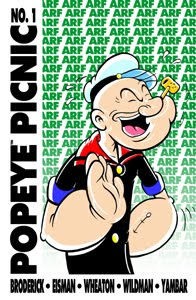
Comics and Friends had a comics pro doing a signing this FCBD. Simpsons comics writer Chris Yambar of Youngstown, Ohio (about an hour and twenty minutes south of Mentor) was seated behind a table with plenty of his wares near the entrance (I'm unfamiliar with Yambar's Simpsons writing, but he's a frequent visitor to Columbus' Mid-Ohio Con, and I have a couple of trades he's written, one a licensed comic based on the TV show I Dream of Jeanie, the other a funnybook about El Mucho Grande, a gigantic, rather round lucha libre).

Also near the entrance were two tables, each full of stacks of specially produced Free Comic Book Day free comics. One table was for all-ages stuff, the other for the less kid-friendly stuff. I didn't see every single FCBD offering available—I heard one mother searching in vain for "the Toy Story" comic, and I didn't see the Oni offering, but they sure seemed to have everything else. The signs standing atop the two tables which mentioned the age appropriateness said that visitors could choose any two comics.

A young woman behind the counter was dressed as Harley Quinn, and there was a 50% off sale on trade paperbacks and collections for club members, which I assume are customers with pull-lists there.

That seemed to be the extent of the FCBD celebration there. Like I said, it was my first time at the shop, but it seemed like a pretty nice one. They had a ton of trades, and it seemed like it was more graphic novel oriented than comic book-comic book oriented. A crowded back wall had all of the new single issue comics stuffed on it, and there were some back-issue long boxes, but most of the store was devoted to shelves of trades, as well as some toys and comics-related books and magazines and the like.

I'm no expert on comics retail or anything, but they seemed to have a pretty good set-up in terms of displaying things. I noticed a lot of kid-friendly, all-ages stuff as soon as I walked in and in the most accessible and visible areas, the superhero stuff all shelved along the wall, and some grown-up, pin-up art books behind the counter. There were also some spinner racks in the back with Dell and Gold Key comics in plastic with backing boards, selling above cover price (I saw an Uncle Scrooge comic for about a $11 or so).

If I lived closer to Mentor, and/or had occasion to visit there a couple times a month or so, I'm sure I'd be happy to visit the shop and make it my regular stop, despite not really liking the idea of having to go through a shopping mall to get to it.

Anyway, here are reviews of everything I got there on Free Comic Book Day, including the books that weren't free...


Free Comic Book Day 2010 (Iron Man/Thor #1)

I was kind of torn between the two Iron Man team-up comics Marvel was publishing this year. The Iron Man/Nova book featured a script by EDILW favorite Paul Tobin, and a plot involving The Red Ghost and his Super-Apes, but I ultimately went with this one because a) it featured John Romita Jr. art, and I was curious to see him draw these two characters given that he’ll soon be drawing them monthly as the regular artist of one of Marvel’s 17 new Avengers books and b) I wanted to see how Marvel would be presenting these two characters to a potential new audience excited by the Iron Man movie, as comic book Iron Man has had very, very little in cartoon with movie Iron Man for the bulk of the last four years or so (The main thing Iron Man the movie and The Invincible Iron Man have in common is that they’re both pretty good).

This book is presented in a smaller format than the standard modern comic book; it’s nine-inches high and six-inches wide, rather than the standard ten-inches-by-six-and-a-half-inches.

It sure looks dinky sitting there before you, but once cracked open, it reads just fine; I didn’t notice the lack of an inch here and a half-inch there at all, and realized I could easily get used to reading comics of this size. I suppose it’s too late now, but if Marvel had to start trying to increase their profits by a ridiculous amount in the past few years, saving money by reducing the trim instead of rocketing the price up 33% would have been a less pain-less way to go.

The script is by Invincible Iron Man writer Matt Fraction, which is of course a pretty great choice, considering Invincible Iron Man is certainly the place to point readers who dug the first movie (and, I imagine, the second one). It’s a pretty straightforward, all-ages-friendly, no-continuity-knowledge-needed done-in-one, emphasizing Tony Stark as a cocky, charming genius always seeking to make amends for his time spent developing weapons and Thor’s otherworldliness.

The Earth’s weather system is going a little nutty, and not listening to storm god Thor’s commands. Meanwhile, a bunch of rich folks are terraforming Earth’s moon for condos, using a weather weapon Stark once developed, and the two Avengers team-up to set things right. This includes a whole bunch of robot fighting.

Romita’s art is just as good as I expected, maybe even better. I’ve never really gotten used to the “New Look” Thor, but Romita really sells it, and I love the way his Thor exudes power through his posture, expression and casually flexed muscles.
Romita’s one of the only Marvel artists currently working regularly for the publisher whose work provides a clear, straight-line link back to the work of Jack Kirby, Steve Ditko and, yes, John Romita Sr.; JRJR’s art is Marvel Comics art at its purest, looking both current and classic at the same time.

And damn, he draws some nice Thor-smashing-shit-with-a-hammer panels: House ads: A teaser as for the X-Men vs. vampires thing that Marvel stole from Mark Millar’s dreams while he was sleeping, featuring a blood-splattered X over a yellow background and the cryptic “We are the X-Men, July 2010, Marvel”; an ad for The Art of Iron Man 2 book; an ad for Brian Michael Bendis, JRJR and Klaus Janson’s Avengers series, which launches this month; an ad for a ten-foot-long, $35 poster featuring The New Ultimates by Frank Cho, which seems a silly ad for this audience (if you were going to advertise a ten-foot-long, $35 poster to a “lay” audience, shouldn’t it be one featuring characters the readers are more likely to be familiar with?); an ad for “Brand New Day” collections of Amazing Spider-Man; an ad for Astonishing X-Men: The Motion Comic on iTunes; an ad for Invinicible Iron Man #25, which, like JRJR’s upcoming Avengers, is a natural place for people who dig this to look for more like it; an ad for the first collection of JMS and Olivier Coipel’s run on Thor, and a full-page ad saying “Iron Man and Thor Appear In…Invincible Iron Man #25 On Sale Now!…Thor #610 On Sale 5/26!”


Yow! Drawn & Quarterly Presents A John Stanley Library Grab-Bag for Free Comic Book Day 2010

Yes, that’s the title of D&Q’s offering, according to the fine print. There were a lot of fairly exciting comics out this FCBD, and, honestly, I would have been at least curious to at least scan just about all of them, but this is the one I just plain had to have.

Which is perhaps silly of me, since I imagine many of these stories will be available in the eventual John Stanley Library collections and I’ll read them all eventually anyway, but I really wanted to take the opportunity to read all of these strips in an actual comic book-comic book format for once, rather than in a handsome collection. Just to experience them in their native habitat, I suppose.

Seth’s cover promises a sort of crossover of characters from various Stanley comics—Melvin Monster, Tubby, Judy Jr. and Nancy—all drawn in Seth’s stripped-down, super-simplified, off-model style. I also like the mystery of the cover. Not only am I unsure why Nancy’s so thin and has eyeballs around her pupils, I have no idea what’s going on in this cover. Are they all running and crying? Screaming? Singing?

The contents, printed in full-color on pulpy paper, are as follows: A Nancy strip in which our heroine visits Oona Goosepimple’s crazy house and encounters some of her relatives, a Tubby story in which Tubby wakes up one morning to discover he has grown a real moustache in his sleep, a Judy Junior story in which she terrorizes poor Jimmy Fuzzi (I don’t like Judy Junior strip at all; like Witch Hazel stories in Little Lulu, for some reason I just can’t stand them despite loving everything around them), a second Nancy story in which she flees from tough guy Spike, a Melvin Monster story in which Melvin is followed home by a Thing, and a Choo-Choo Charlie story involving Choo-Choo Charlie and his, um, Choo Choo…?

With the possible exception of the Judy Junior story (and, it’s worth noting, that’s more of a personal taste thing than a These Are Bad Comics kind of thing), they are all a lot of fun, and it’s a nice sampler platter of Stanley’s range. It’s really something to see that last page of the Melvin Monster story next to the first page of the Choo-Choo Charlie one, for example, and realize the same talent is behind two comics with such extremely different visual styles, character designs and types of gags.

This was my first exposure to Choo-Choo Charlie, whom a quick Internet search tells me was actually a mascot for Good and Plenty candies (which I’ve never been able to cotton too; I like the way they look, but I hate the taste of ‘em), and the designs in the comic look very little like those from other Stanley books (although I suppose he didn’t design either the Nancy characters or the Little Lulu one’s himself, huh?). The narrative is also quite random and silly compared to the slow-building, usually grounded in the real world gags found in Stanley’s most popular comics.

But at the end of the day—well, the end of the 45 seconds or so I spent glancing between the tables trying to decide which free comic books to grab—what ultimately sold me on Yow! was the Tubby story.

It might take me some deep thinking and some serious writing to determine and then properly communicate why I love Tubby so much, but, since I met him in a volume of Dark Horse’s Little Lulu reprints, he’s become one of my favorite comic book characters, and this story is just fantastic, featuring scenes of the entire world freaking out because a little boy has grown a mustache, upsetting the balance of nature,and a scene where Tubby’s mom tells him she just doesn’t love him.(By the way, you can download the entire seven-page Tubby story from Yow! here)

I’m sure it doesn’t really make economic sense for D&Q to do so, or they would already be doing it, but, for whatever it’s worth, I would love to be able to read a John Stanley kids comics anthology comic book like this on a regular basis. Preferably monthly, but quarterly would work as well.

Also, more regularly appearing comics along these lines might mean more letters pages like this:

House ads: A full-page ad for the upcoming fifth volume of Tove Jansson’s Moomin (and the publisher’s Moomin line in general), featuring a blurb from Neil Gaiman; a half-page ad for Who Will Comfort Toffle?, the next Tove Jansson storybook set in the world of the Moomins, this oen featuring a quote from Jeff Smith; a half-page ad for Doug Wright’s Nipper 1963-1964, with a blurb from Lynn Johnston; and, finally, a full-page, back cover ad for the John Stanley Library collections, including an upcoming collection I think I may have heard about, rejoiced over, and then forgot about, because when I saw this ad I turned a cartwheel:You know how I said I loved Tubby earlier? He’s my favorite part of the Little Lulu comics. So this? This is kind of like…you know how when you’re a little kid, you love sugar at the exclusion of all else? So a bowl of Lucky Charms with nothing but marshmallows sound delicious rather than disgusting to you? Well, that’s what an all-Tubby collection sounds like to me.

I’m curious about this books existence, as I would assume Dark Horse had the rights to Tubby comics as well as Little Lulu ones, but I guess not.

Anyway, there’s another reason to look forward to summer…


********************


Now, I always end up spending a lot more money than I mean to when I go to the comic shop on Free Comic Book Day, even though it’s usually the second time I’ve been there that week.

I guess I feel guilty for going to a shop and getting something for nothing, especially since I’m already a regular, die-hard comics consumer, rather than the sort of “civilian” or casual reader the day is designed to hook on comics. That is, surely there are people the FCBD organizers, comics publishers and retailers would rather have picking up these The First One’s Free, Kid bait books, and I feel like everyone I get is sort of a waste.

So I usually end up impulse buying a graphic novel or two while I’m in the shop.

This year was no exception. I picked up a couple of things from Yambar’s table, and a cheap graphic novel on my To Buy, Someday list. In an effort to make this already interminably long blog post ridiculously long, I'll review those too...


Lucha Pop! (Airwave Comics)

I would have passed on this 64-page, “prestige format” comic were Yambar selling it at its $8.95 original price, but he’d knocked it down to $5, so it seemed a safe gamble: How bad could a book of stories about Mexican wrestlers be?

Inside are four stories, each written by Yambar, penciled by George Broderick Jr. and inked by Ken Wheaton.

The first features “Major Smackdown, Lord of the Ring” (Who doesn’t have a terribly Mexican sounding name) and his understudy Understudy in “Quest For The Blue Tiger Diamond.” The pair board a plane taking the titular magical diamond to evil figurehead type Fire Dragon’s hideout in the Himalayas, and attempt to stop the bad guy from doing something bad with it. Broderick and Wheaton work in a Bruce Timm-inspired, “animated” style, and the tone of the script is remarkably…straight, given the zaniness of the material.

This art style re-appears in a later story, featuring “Sainto, God’s Own Wrestler” in a two-page origin story and a sci-fi/lucha libre/private eye mash-up entitled “…Then She Walked In,” which has a much lighter tone to the script.

There are also two comedy stories featuring El Mucho Grande, drawn in a much looser, more cartoony style. The first of these features EMG attempting to rescue his pal, a mute Chupacabra, from the clutches of its evil monster-making creator. The second of these teams El Mucho Grande with a couple of other Yambar creations, in which a recurring villain traps El Mucho Grande and company in some old Harvey comics. To avoid copyright infringement, Casper, Lil’ Hot Stuff and the others appear with black bars over their eyes, although Broderick otherwise draws them all spot-on.

Rounding out the volume is a long-ish prose piece entitled “The Secret, Sordid History of Santo USA,” detailing Yambar’s frustrated, ultimately fruitless efforts to get a Santo licensed comic book going, starting with his first introduction to Mexican wrestling and continuing through his efforts to find other real-life luchadores to work with after the Santo thing fell apart. It’s pretty interesting reading, actually, and it also explains the weird tone of the Major Smackdown and El Sainto stories—they are apparently repurposed from the first issue of a completed but never published El Santo comic.

It was a pretty fun read, although if you wanted to start with a Yambar-written Mexican wrestler comic, I’d suggest an all-El Mucho Grande one.


The Muppet Show Comic Book: The Treasure of Peg-Leg Wilson (Boom Kids)

This trade collects the second of cartoonist Roger Langridge’s Muppet miniseries for Boom, the last before they launched an ongoing by the creator.

Give the sub-title and the cover, I expected this to be a very different sort of book than the original miniseries, which essentially recreated The Muppet Show TV show as a comic book (which is, of course, no mean feat, given the difference between puppetry and television and comics). But, remarkably, Langridge was able to maintain the TV-show-as-a-comic-book format, while simultaneously telling a series of plots that carry from issue to issue.

The result is book much like the original miniseries, only instead of one-per-issue storylines broken up by the on-stage sketches, this volume contains bigger, more ambitious storylines between the bits.

Dr. Honeydew and Beaker have been performing a “civilizing” experiment on Animal, which has successfully transformed him into a polite, soft-spoken, well-dressed and intelligent member of society, but with one sad side effect—he’s lost his ability to drum like a wild Animal (This plot is particularly affecting, given the parallels it suggests between Animal’s situation and the challenge that faces a lot of creative folks with mental or behavioral problems when they first consider pharmaceutical treatment). Kermit the Frog has hired the only celebrity impersonator devoted to him, Kismet the Toad, who, despite looking exactly like Kermit, is different from him in almost every other way. And, in the storyline that gave the series its subtitle, Scooter finds a pirate treasure map suggesting there’s treasure buried somewhere in the Muppet Theatre, and Rizzo and his rats begin tearing the place apart to find it.

The treasure storyline is something to behold. Langridge starts it out as a running background gag, with rats in miner’s caps with shovels and pick axes busy behind or off-to-the side of much of the action in the foreground of the panels, and yet he builds it up into something genuinely dramatic and emotionally satisfying.

Boom’s Muppet mini-series casting the characters in adaptations (Muppet Robin Hood, Muppet King Arthur, etc) can be pretty hit or miss, but these Langridge comics are simply great comics. I really can’t recommend this highly enough.


Popeye Picnic #1 (Premium Pop Comics)

I should really devote more attention to this then a short entry in a multi-comic post like this, given the usual nature of the book. Yambar and his regular co-creators George J. Broderick Jr. and Ken Wheaton created this 30-page, black-and-white comic book in 2009 to mark Popeye’s 80th birthday, and the 30th anniversary of Chester, Illinois’ annual Popeye Picnic celebration.

Chester is the birthplace of E.C. Segar, and thus the birthplace of Popeye.

There are two connected stories within. In the first, Popeye and his supporting cast—Bluto, Olive Oyl, Swee’pea, Wimpy and the Sea Hag—are enjoying a picnic when a can of spinach lands on Popeye’s head and knocks him out. When he loses consciousness, he travels back in time to meet his maker, Segar, who shows him around Chester and introduces him to the real-life residents who inspired Wimpy, Olive and Popeye himself.
In the second half of the book, these half-dozen characters head to modern day Chester for the Popeye Picnic celebration, and there they’re met by Castor Oyl. Alice the Goon, Eugene the Jeep and The Whiffle Hen all cameo.

It’s an interesting book. The history lesson and tour of town have an unfortunate, perhaps unavoidable “edutainment” vibe about them, although there are some funny gags sprinkled throughout (I particularly liked Popeye’s real-life inspiration punching Popeye so hard that he send him into the future or reverse knocks him out, depending on how you want to read his unconscious journey to meet Segar).

Probably the biggest treat is seeing Broderick’s take on the characters. They all look bigger, rounder, smoother, cleaner and more three-dimensional than Segar’s, and its fun to see them interacting with “real” people (who are also cartoony drawings, but done in a different style) and the modern world.

The production values, sadly, leave a lot to be desired. The lettering is pretty poor, and ill-serves the dialogue, which perfectly captures the peculiar voices of each of the characters. Maybe making it look more Segar-like would have been too difficult, but it certainly didn’t have to look so computerized. The balloon tails also make it difficult to tell who’s talking in certain panels. The writing and art are highly professional, but the lettering looks pretty amateurish. So too does the pixelated pin-up art by Hy Eisman, and the ads from local businesses, which are laid out so as to resemble those you’d find in a high school year book, church bulletin or restaurant place mat.

Even still, it’s a one-of-kind comic book experience, and one I imagine anyone terribly interested in comic strip history would enjoy at least taking a look at.


********************

There was a second comic shop listed on the FCBD locator near Comics and Friends which I attempted to also visit that afternoon, but I was unable to locate it, and I ended up just driving around wasting gas in Lake County for a while. My plans for exploring the area's comic shops was only half-successful then.

I did find a fantastic library though, featuring the biggest and most up-to-date manga selection I've ever seen in a single public library location. They had an awful lot of American comics too, mostly of the book publishers YA offerings and classic superhero comics reprints, but there manga section was to die for.

This is what I hauled home from there, as modeled by my new roommate Yogi, The World's Most Active Labrador Retriever:
Expect a lot of manga reviews in the near future, and maybe some posts about Bigfoot drawings.