
Showing posts with label hobos. Show all posts
Showing posts with label hobos. Show all posts
Friday, May 23, 2008
Tubby + Hobos = Comedy Gold
There's only one way to improve upon the inherent hilarity of Tubby, and that's to have him dress up like a hobo, complete with bindle:


Thursday, February 07, 2008
Captain America, lesbian superheroines, Spoiler, X-Men and hobos (but no kitchen sink)
—Waste not, want not. Here’s a piece on the latest issue of Captain America that got bumped out of the paper for space, and won’t be relevant any more before the next issue. So I figured I might as well post it here, rather than let it go to waste. It’s written for a general audience, rather than the regular EDILW readers, who tend to consist of Newsarama readers and contributors and women with crushes on The Winter Soldier...

Marvel's Captain America comic got another jolt of mainstream media attention—Good Morning America! NPR! The Colbert Report!—with last week's release of #34, the issue in which a new character inherits the still-dead Steve Roger's shield and superhero identity.
It's often amusing (and sometimes cringe-inducing) to watch the “civilian” media react to the goings-on within the wonderful world of comics in the occasional instances that they notice.
In the case of last April's "death" of the original Captain America, it lead to tons of media coverage and a rush of people to comic shops snapping up what they were sure would be a collector's item, the last issue of the 67-year-old superhero Captain America's comic book.
Of course, superheroes die pretty regularly, and they tend to come back to life. Death has relatively little meaning in stories in which superpowers, clones, time travel and magic are so heavily involved.
When a big-time superhero does die, he of she is often replaced by another hero using his or her name, and often times the new character is a darker version of the original. Rather than a noteworthy event, then, the intro of the new Cap is really just Marvel following the well-established formula in the superhero cycle of death and rebirth.
What is fairly unique about this case, however, is how well writer Ed Brubaker has been able to maintain the quality of the monthly book after the title character was removed from it.
Almost a year has passed and, if anything, the book's gotten stronger and stronger, as Brubaker focused on Cap's traditional second bananas and antagonists, making it more of an ensemble drama. Brubaker’s completely mastered potboiler thriller and espionage, to the point where even when things happen exactly as one expects them to, they’re still exciting anyway.
Captain America #34 sees Cap’s former sidekick Bucky finally becoming the new Captain America, something that seemed a foregone conclusion the second the original was declared dead. The new Captain has a new costume, and a gun, which he uses to kneecap his terrorist enemies.
While the symbolism of a guy named “America” switching from a defense-only shield to a shield and gun combo may be groaningly obvious, this same issue sees Brubaker proving himself eerily prescient.
It opens with CNN talking heads decrying the price of oil, the sub-prime mortgage crisis, and the sudden sharp downturn in the economy. In the Marvel Universe, this has all lead to street demonstrations and rioting outside the White House.
What's behind this economic chaos? Captain America’s archenemy, the incredibly well preserved Nazi villain known as The Red Skull. Considering the lead time in comics—generally six months—Brubaker is either damn good at trend-spotting, or the real world is more and more following the gloomy imaginations of fiction writers purposely trying to think of melodramatically negative scenarios. Either way, it’s disturbingly in tune with today’s headlines.
In the ‘40s, Captain America used to punch out Hitler on the covers of his comics. I look forward to a cover in which the new Captain punches out the sub-prime mortgage crisis.
—Okay, anyone who wants to give Matt Brady and crew shit for laying into creators during profiles and interviews at Newsarama, please turn your attention to this Advocate article on all the lesbian superheroines in the DCU (Link totally stolen from Dirk Deppey’s Journalista).
It starts out on the wrong foot, mentioning Judd Winick’s gay-bashing issue of Green Lantern as the start of gay characters in super-comics in the DCU (I probably would have mentioned Vertigo easing super-comics readers into it, but whatever).
Most of it consists of talk about Renee “The Question” Montoya and Kathy “Batwoman” Kane, who appear in little-read miniseries Crime Bible: The Five Lessons of Blood, and some questions with Dan DiDio.
The writer does seem passably familiar with the DCU, saying this:
Batwoman and the Question aren’t the only sapphic superfolks stalking the streets of the DC Universe, either. Lovers Knockout and Scandal are both members of the Secret Six, while Amazonian powerhouse Grace and the density-altering heroine Thunder have a sexual relationship in the pages of The Outsiders. And when Catwoman, now more of an antihero than a villainess, retired to raise her newborn child, her lesbian friend Holly took on the guise of the ferocious feline.
Are these queer avengers here to stay—and stay gay? Knockout was recently murdered and, in a recent issue, it looked like Thunder was evicted from the Outsiders. But DiDio promises both Question and Batwoman will have "prominent roles" in 2008, after the current Crime Bible series wraps in February.
Hmm. I don’t know that Batwoman and the Question are exactly terribly prominent. Batwoman in particular seems to have disappeared. Cameos in Countdown and a guest-appearance in Crime Bible aside, she has a very low-profile for a hero who was set to appear in her own monthly, one that two different writers worked on at some point and a logo was already designed for. It’s odd that a character with a bat on her chest is less-seen in the modern DCU than, say, Booster Gold or the Metal Men or Geo-Force or Mogo the Green Lantern who is also a planet, you know?
Knockout and Scandal appeared in two miniseries; the former is at least temporarily dead (Although, unlike some of the Fourth Worlders, she’s a minor and modern addition, and not exactly guaranteed to return in the same way that, say, Orion and Mr. Miracle are). There are no plans for another Secret Six series announced at this point, and the team’s writer seems too focused on Wonder Woman for other books at this point, having dropped the rest of her workload.
Grace and Thunder are pretty awful examples of lesbian heroes, as both were just suddenly announced as gay; the former having had several sexual relationships with men prior, and a rather icky sexual history that I don’t imagine many gay advocates would be happy to hear about (“What are you trying to say, DC? That being repeatedly raped as a child turns you gay?”). They’re also both being written by one of the few mainstream super-comics writers who has actually came out and announced he foun gay content in super-comics to be completely inappropriate.
And Catwoman II was only temporarily carrying the Catwoman monthly; she’s been stripped of her cat-suit and sent to co-star in Countdown, a rather severe punishment for any DC superhero.
So, I don’t know…hooray for Sapphic superheroes?
As Deppey also snidely points out, they’re all buxom, Barbie doll-figured women in skintight costumes, with the exception of Montoya, who is a buxom, Barbie doll-figured woman in a trenchcoat. I was pretty disappointed to see how poor Holly swelled up into a cookie-cutter smexy super-girl in the pages of Countdown and in Adam Hughes’ Catwoman covers, as she used to be short, thin and rather gamine.
—Speaking of Dirk, everybody already read this essay of his, right? The one about the comics blogosphere’s sometimes misplaced feminist causes and superhero decadence and the super-comics markets? I’m afraid that a lot of the good points he makes are going to go unread or undiscussed simply because it is a long piece which a few pundits who should know better seem to have either not read or not understood and/or because some of the people who get name-dropped are going to take some personal offense to it, and respond to that stuff instead.
I think, for the most part, Deppey’s analysis is right…or at least seems right to me. However, Lisa Forturner, who provided the quote that got Deppey’s rhetorical ball rolling, is right about something too—DC is definitely paying attention.
Between Dan DiDio’s Christmas list, Chuck Dixon’s current Robin story arc, complete with memorial case gripe, and Grant Morrison and Tony Daniel’s one-panel case appearance in a dream sequence, it’s pretty obvious that DC hears this group of fans and is making attempts to respond.
Does it matter? I suppose that depends on who’s answering the question. (I said my piece on it here). Certainly it’s a drop in a bucket, and perhaps not a very important one, but, again, it depends on the person. Personally, I’d be happier to see less of Ed Benes drawing Wonder Woman and Black Canary, and a gradual shift towards returning more of the DCU line to books that are truly all-ages, with perhaps a couple reserved for more grown-up stories (Like, remember when New Titans, Green Arrow, Legends of the Dark Knight and a few others were kind of more for grown-up fans, but most of the line would be fine for a ten-year-old to read?)
See, I don’t mind people being torn in half in the comics I read, or rape being a plot point, but I really don’t think Superman, Robin or Mary Marvel need to be in those comics. I think it’s rather telling that probably the two best comics that DC published featuring superheroes last year were Grant Morrison and Frank Quiteley’s All-Star Superman and Jeff Smith’s Shazam!: The Monster Society of Evil, both of which were all-ages in the truest sense of the word.
—If I were the person at DC responsible for deciding what old comics get released at what point in time, I would have made damn sure 1988 miniseries Millennium was in comics shops just before Marvel’s big Secret Invasion storyline kicked off.
I don’t remember Millennium being a terribly good story, and like Armageddon 2001, it’s really weird to read it this deep into the 21st century, but despite its disastrous ending (Has any new initiative ever fallen as flat as fast as The New Guardians?), it’s still head and shoulders above the worst of the DCU crossovers (Genesis and Countdown, by my reckoning). Plus, Ian Gibson does the finished art, and man, you haven’t seen the Martian Manhunter until you’ve seen Ian Gibson draw him.
The plot involves a centuries old scheme by the Manhunter robots, the Guardians’ first attempt at a universal police force before they decided on the Green Lanterns, infiltrating the DCU with sleeper agents, all timed to strike at once, so that the supporting characters that our heroes had come to trust over the years suddenly revealed themselves to be alien menaces.
In addition to the eight issues of the main miniseries, I believe just about every single DC comic at the time tied into it, even All-Star Squadron, which was set 40 years in the past. So a trade would have a lot to choose from, but I’m sure there’s a lot of unimportant chaff that wouldn’t be needed (Maybe a trade would look like the one for DC One Million, with the main series and then the more important tie-ins included).
Now, I don’t think Brian Michael Bendis found these in a dollar bin and was suddenly, “Hey, a great idea! Yoink!” or anything, but the surface similarities are such that DC could give their rival a good nose-tweaking by getting it out there and letting the partisan crowd draw their own conclusions. (And, besides, DC’s hardcore fans are all atwitter about things involving the Guardians, GL Corps and suchlike at the moment, aren’t they?)
Of course, if I were in charge of those things, I would have rushed to make sure Legends, in which the U.S. government outlaws superheroes, was available in trade ASAP as soon as I heard the first rumors about Civil War, and that The Flash: Hell To Pay was in trade as soon as I heard the first rumors that Peter Parker was contemplating selling his marriage to the devil in “One More Day.”
—This new X-Men cartoon looks pretty cool. My introduction to the characters was in an episode of Spider-Man and His Amazing Friends and then that pretty awful ‘90s one, which I loved in the way that one loves horrible cartoons. Like, every single character’s voice in that show was absolutely hilarious to me…it was a guranteed twenty-minute giggle-fest.
I thought X-Men: Evolution was pretty great. It took me a while to get used to it—or else it got more awesome towards the end.
This looks like a neat mixture of the two.
The ‘90s version had much better music, though:
In fact, the only way to improve upon that theme song would be, I don’t know, to sing something in Japanese, and set a bunch of images of speed-lines and gravity-free battles to it:
—Wonkette column “Cartoon Violence” is always worth a read, but this hobo-centric column is triply so. I may not know much about comedy (as the attempts at humor on this page should readily attest), but I do know that there is nothing funnier than hobos. Hell, just the word is hilarious.
Speaking of which, I believe this is a very strong contender for my occasional attempts to isolate the greatest Captain Marvel cover of all time:

Tuesday, June 27, 2006
Delayed Reaction: Wimbledon Green
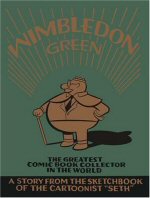
Wimbledon Green: The Greatest Comic Book Collector in the World (Drawn and Quarterly), by Seth
Why’d I Wait?: Sheer ignorance. I honestly had no idea this book even existed until I saw it sitting on a cart at the library I work part-time at, waiting to be put back on the shelf.
Why Now?: With a title like that, what comic book enthusiast could pass it up once they were made aware of its existence?
Well?: Thank Daniel Clowes for coining a term we can use to discuss this work—like Clowes’ Ice Haven, Wimbledon Green is a “comic strip novel,” comprised of individual comic strips of varying length and style which each contain a small part of a an overall, novel-length story.
The technique is not used as successfully here as it was in Ice Haven, yet if this doesn’t exactly feel like an extremely important work, that may be because it wasn’t supposed to be: The cover proclaims it “A Story From The Sketchbook of the Cartoonist ‘Seth’,” and in his foreword, said cartoonist Seth explains “it’s just a send up of comic book collectors.”
And while it lacks the power and depth of Clowes’ best work—and the acid zing of Clowes’ sense of humor—if Wimbledon Green is Seth’s idea of a dashed-off lark, it’s certainly not apparent from the quality of the art. It’s a beautiful looking book, most of the well-designed pages are simply jam-packed with 20-panel grids and colored in different shades.
The title character is a sort of Scrooge McDuck-type of wealthy eccentric, traveling the world on quests to find the oldest, rarest and most valuable comic books. Seth invents plenty of rival eccentrics for him to race to issues of fictional books like The Green Ghost #1 and Corns Bunion. The rich subculture Seth invents feels both real and charmingly alien at the same time, with his comic book aficionados all having collecting pseudonyms that recall the handles of old gangsters—Ashcan Kemp, R. Saddlestitch, “Cuts” Coupon, Pulpy Wise, and so on.
Most of the book is done in a mockumentary style format (a format that’s grown tiresome from it’ over-usage in film comedy), dealing with a legendary collecting scandal and the collectors’ flailing attempts to connect Wimbledon Green to one “Don Green.”
These are broken up with adventure-style strips that include an epic battle over the Green Ghost #1, a detailed account of Wimbledon Green’s queer, Howard Hughes-like personal habits and a delightful section where Green elucidates the virtue of fictional hobo humor series Fine and Dandy (I’m a sucker for hobo humor).
If the whole of Seth’s “comic book novel” is less than transcendental, and it’s overall story rather mediocre, some of the strips that make up that whole are pretty fantastic in their own right. Seth’s natural audience, the comic book community, will especially appreciate “Young ‘Cuts’ Coupon –1949” and “Jonah: A Brief Profile by Ashcan Kemp.”
In the former, a young, foreward-thinking Coupon tells the readers that he understood that “there was deep meaning in these tales of masked men and anthropomorphic animals…while on the surface ‘comic books’ appear to be half-witted stories for sub-normal boys…my ten years of study has revealed much more.” In just 16 panels, Seth distills all the joys and frustrations that come with a life dedicated to comics about as perfectly (and certainly as humorously) as anyone before him as managed.
In the latter, Kemp has equally true, if more cynical, thoughts on the community itself: “For a bunch of guys who like good-over-evil stories…you sure meet a lot of morally bankrupt assholes.”
But its worth the feelings of frustrated societal misunderstanding articulated by Coupon and the morally bankrupt assholes Kemp sees for those brief feelings of nostalgic peace Don Green found in used bookstores and dusty attics. And of course, top notch hobo humor.
Would I travel back in time to buy it off the rack?: Funny I should mention time travel at all, as there’s an intriguing undercurrent of melancholy to the work, about the collectors’ desire to reclaim pieces of their childhood, and how that impulse, in the case of the single-named character “Jonah,” the world's greatest comic book theif, turned him from collecting to villainy.
Subscribe to:
Posts (Atom)
