Showing posts with label the joker. Show all posts

Monday, December 01, 2025

Review: 1997's The Spectre #51

While DC editorial was able to get it together well enough to schedule the Spectre as a guest-star in the pages of Batman and Batman in the pages of The Spectre in January of 1997, they didn't necessarily get the details right. 

On the second page of John Ostrander and Tom Mandrake's The Spectre #51, Batman is swinging from a New York City rooftop, thinking about how he has come in pursuit of The Joker. 

"This is the second such trip made here recently," the Dark Knight thinks, "Last time brought me up against The Spectre.*"

The asterisk refers readers to "Batman 450-451." But, as we know because we just read those issues, Batman did not make a trip to New York City in them, bringing him up against The Spectre. Rather, the New York City-based Spectre journeyed to Batman's Gotham City, where the two clashed...at least in words, if not physically.

Odd.

That aside, this issue, one of the handful of issues of the series I had read off the rack when it was still being published serially, is just as I remember it: A fairly strong done-in-one in which the two caped heroes argue about sin and punishment regarding The Joker, with a terrifying moment in which the madman gets ultimate power (as he apparently occasionally does*) and the villain ultimately being defeated in the same way he will soon be in a JLA story. 

Having just read the Batman crossover, I of course wanted to read this issue, which will presumably be collected in a future The Spectre by John Ostrander and Tom Mandrake Omnibus 2. Luckily, DC included it in their 2019 collection The Joker: His Greatest Jokes, which my library had a copy of (Interestingly, this issue of The Spectre is the only story included from a book that isn't one of the Batman line of books. You would think they would have included a Joker vs. Superman story in there, at least...)

It's a tightly-written 22-pager, with no time to waste on anything but the central conflict, only a few lines of dialogue really devoted to what's going on in the pages of the book at the time (Jim Corrigan really is, as he seemed to be in those issues of Batman, on the police force again, and partners with Nate Kane. Apparently, he has recently been injured by the Spear of Destiny again and is hiding out inside Nate's body. Oh, and there's a passing reference to the events of the previous fall's line-wide crossover, Final Night...which I'd love to see DC collect into a DC Finest volume or two...I remember it being one of the better such crossovers). 

The Joker is already in New York City as the book opens, and Batman has obviously already shown up too. Kane takes a report on the Batman foiling a mugging from his superior, thanks to Corrigan/The Spectre temporarily controlling his body.

Both Batman and Kane have the same concern about The Spectre meeting The Joker. "Based on our last meeting, if Spectre encounters The Joker first there won't be much of him left to return to Arkham," Batman thinks to himself. "Moonface, there better be someone left for me to question when I get there," Kane shouts after The Spectre, as the spirit flies off toward the sight of The Joker's attack. 

As for that attack, it too seemed familiar to me at this point. Someone in the city had the bright idea to open up a Joker-themed nightclub, where all the patrons dress up like The Joker (an off-hand remark by a club-goer makes this sound a bit like a comic book world's version of a goth club, where patrons dress a bit like vampires). It's kind of remarkable to read this and realize it was written almost 30 years ago, given how often the last few decades of comics have presented us with various iterations of the fans-of-The Joker or Joker-as-charismatic-figure stories. 

The story I immediately thought of, though, wasn't a comic book one at all, but an episode of the original Batman: The Animated Series, wherein a casino owner opens up a Joker-themed club called Joker's Wild, drawing the attention and the wrath of The Joker himself (For what it's worth, that episode of the show, also called "Joker's Wild", aired in 1992...that said, I suppose it's possible it was based on an older Batman comic I never read, as many episodes of the show were inspired by comics storylines).

Here an emcee announces The Joker on stage and is nervously taken aback when the Clown Prince of Crime seems less than flattered by the club's existence. "You mean, the idea of bedwetting little twits turning me into a fad?" Joker says, reaching to shake hands with the emcee. "What's not to like?"

The Joker then proceeds to electrocute his victim with a deadly joy buzzer ("They also know better than to fall for that in Gotham!" he laughs), and he then turns to spray the club with gas, his henchmen having welded the doors shut and filing in wearing gas masks.

That's when Batman shows up. The Joker immediately sics his fans-turned-victims on the Dark Knight. And then The Spectre appears, materializing out of the gas being shot by The Joker. 

Spec makes short work of The Joker's men in his own inimitable way—

—much to the delight of The Joker. 

Honestly, if you made a Venn diagram, The Spectre's sense of humor and The Joker's sense of humor probably overlap more than a little. Both seem to like dark jokes that end with someone violently dying. 

Before The Spectre can do something like turn The Joker into a giant playing card and rip him in half, though, The Batman makes a case for sparing him.

"The Joker himself is some kind of unholy innocent--a sociopath!" Batman argues. "He has no real concept of good and evil!" He argues that The Joker is sick and needs treatment, and, perhaps appealing to The Spectre's sense of mission, he says that if God created The Joker in this way, how can The Spectre punish him for being that way?

It's only a few panels, but it's an interesting little comic book debate, and with the characters bringing in God, making for a slightly more nuanced than the usual "executing killers makes you no better than them" sorts of arguments Batman can get into with characters who use deadly force (See, for example, his brief fight with The Punisher in 1994's Punisher/Batman: Deadly Knights #1 over how to deal with The Joker).

To get to the truth of the matter, The Spectre enters The Joker's eyes to investigate his mind in person, something we've seen him do repeatedly before, with characters alive and dead, in the pages of The Spectre. Of course, when he does so, he loses the upper hand, the person whose mind or soul he is visiting having the ultimate home court advantage.

This time it goes disastrously wrong. From the other side of the glass in a funhouse mirror within his mind, The Joker tells the Spectre, "Love the cape. And the hood. Mind if I try them on?"

And just like that, The Joker switches places with Corrigan, and the madman is suddenly in control of The Spectre's powers, appearing as a white-skinned grinning giant with a flower on the "lapel" of his giant green cape.
I was at this point rather struck by potentially how big a threat The Joker-with-The Spectre's-powers would be to not only Batman and the city, but to the whole world. Not for the first time while reading Ostrander's Spectre this month, I realized that Ostrander had come up with a plot that could very easily be an epic story arc or even big crossover event, but it was instead just used for an issue or three in the pages of the book. (The other Spectre plot it's easiest to imagine DC having exploited is the conclusion of the arc in which the United States seeks a Spectre counter-measure, ultimately arming Superman with the Spear of Destiny and sending him to confront the Spectre, leading to a sequence in which Superman fights the whole DC Universe and declares himself a sort of king of the world—where have I heard that before?—although much of it is a sort of fantasy that The Spectre presents, Ghost of Christmas Future-style, to Superman.) 

And so, the giant Joker uses Spectre's powers to attack Batman and/or anything within striking distance, the Dark Knight trying to keep the now god-like Joker's attention on him rather than on any other possible victims. 

Meanwhile, Corrigan explores the inside of The Joker's head, where there are a bunch of labeled electrical power boxes in a dilapidated maintenance shack behind a fun house. Just as Batman said, the one labeled "Conscience" isn't hooked up at all, and Mandrake draws it empty but for a crumbling skull.

Corrigan notes that, when it comes to conscience, "I got that in spades," and then he proceeds to stick a handful of glowing electrical cables into his open mouth, essentially hooking up The Joker's mind to Corrigan's conscience. (These scenes occurring in the mind, the sets, props and actions are all visual metaphors, of course.)

"Have a taste, Joker!" Corrigan shouts, his own head now enveloped in electric blue light. "Here's what a sense of right and wrong feel like!"

This has the desired effect as, over the course of a page and a half or so, The Joker is forced to think about and truly understand what he's done in his lifetime of killing:
Oh no!

OH NO!


All those lives! All those precious lives...!

DEAR GOD, WHAT HAVE I DONE?!
As The Joker freaks out, Mandrake draws a crowd of faces, apparently those of his countless victims, washing over his own screaming face like a wave. While they mostly appear to be just random civilians, one is quite recognizable as Robin Jason Todd. 

The Spectre leaves The Joker's body, and the villain collapses into a fetal position. 

"He has tasted his own guilt and it has proven too much for him," The Spectre explains to Batman. "He has slipped into catatonia."
Thus, The Joker's threat has been stopped, and Spectre concedes the argument over properly judging the maniac killer to Batman, the Joker expert.

As I alluded to earlier, this turn of events being a bit familiar to something that happened in Grant Morrison's JLA

In 1998's JLA #15—so well after this issue of Ostrander and company's Spectre—in the concluding chapter of the "Rock of Ages" story arc, The Joker gets his hands on the philosopher's stone/the Worlogog, a four-dimensional map that gives whoever bears it control over time and space**. So yet again a DC writer has put power over reality itself in the hands of The Joker. 
He doesn't get much of a chance to play with it, though, as the Martian Manhunter uses his mental abilities to telepathically order the information in The Joker's brain, forcing him into a temporary sanity, during which The Joker realizes he's done terrible things. 

I don't think Morrison necessarily swiped this brief scene from Ostrander, any more than I think Ostrander was inspired to create his Killing Joke club by Batman: The Animated Series, but it's interesting to note how often these stories rhyme one another, as various writers over the decades all might come to similar ideas. Like, for example, how scary would it be if a crazy villain like The Joker had god-like powers? 

In a fun little stinger of an ending, The Spectre turns to face the crowd of clubgoers who had dressed up like The Joker and had been patronizing The Killing Joke club. A few weeks later the club has reopened under the name The Wrath of God, a sort of BDSM club with naked people dressed in hooded green cloaks and green underpants, one of them apparently spanking others with a rod and preaching of sin and punishment. 


*In 1997's DC Special Series #27, better known as "Batman vs. The Incredible Hulk", the Shaper-of-Worlds grants The Joker his reality-writing powers at the climax (I wrote at length about that crossover here). And in the 2000 "Emperor Joker" crossover in the Superman line of books, The Joker gained access to Mr. Mxyzptlk's nigh omnipotent powers to alter reality. Those are the stories that immediately leapt to my mind, but perhaps there are others...?


**I read "Rock of Ages" when it was originally released in 1997 and 1998, when I was still in college, and thus relatively early in my exploration of the comics medium...and the DC Universe and its history. I had always just assumed that Grant Morrison had created the Worlogog, as it sure seemed to be of apiece with the sort of big, crazy ideas that punctuated his JLA run. 

It wasn't until 2018 or so that I was reading the collection of Jack Kirby's 1984 Super Powers series that I realized that Kirby had actually created the Worlogog. I practically fell out of my chair when I read the word in that comic. 

I have long since realized that much of which seems big and crazy in Morrison's super-comic writing is basically just old-school comic book craziness—especially that of the Silver Age—repurposed into the more sophisticated, more realistic presentation of more modern comics. (Which I don't think is a bad thing! In fact, it's a great strength, that Morrison doesn't just take characters or plot points from DC history like other writers but also manages to imbue his comics with the spirit of those past comics.)

Oh, and speaking of the Worlogog, it also showed up in the 2019
Teen Titans Go Vs. Teen Titans cartoon crossover, of all places, where it was part of the mechanism allowing for the two universes to intersect. There's even a brief musical number based around its pronunciation.

Wednesday, February 26, 2025

DC Versus Marvel Omnibus Pt. 12: Batman & Captain America #1

John Byrne returns for another DC/Marvel crossover, this one pairing Batman and Captain America, although not in the obvious, expected way. Rather than teaming the current versions of the characters, Byrne sets his story in 1945. 

It was an unusual enough effort that DC apparently felt the need to include an "Elseworlds" logo in the lower right corner of the cover, and include the Elseworlds spiel—"In Elseworlds, heroes are taken from their usual settings and put into strange times and places..."—on the back of the wraparound cover. 

The setting makes this one of the most unusual of the many DC/Marvel crossovers...and one of the better ones. 

Byrne, who at this point in his career had certainly found, defined and perfected his own personal drawing style, takes inspiration from the earlier artists to work on the characters, most obviously Cap's creators Joe Simon and Jack Kirby and Batman artist Dick Sprang, and filters their styles through his own. The result is something of the ultimate "What if..." story, not simply a "What if...Batman met Captain America in the 1940s?", but more like "What if...DC and Timely had collaborated on a Batman/Captain America crossover in the 1940s?"

It might have gone something like this...although I think it's worth noting that as much as Byrne takes his characterization and design notes from the war-time comics, the storytelling is in a contemporary style. He doesn't try to ape the less-sophisticated format of those earlier years of the medium.

Byrne certainly draws the hell out of this book. When we discussed his first entry in the omnibus, I noted how few Byrne comics I had actually read, and I wasn't too terribly impressed with is take on Kirby's '60s and '70s designs and characters in Darkseid vs. Galactus: The Hunger. His work here seems head and shoulders above that, perhaps because of his synthesis of various styles with his own (There's even a brief appearance by Sgt. Rock and Easy Company that has the look of Joe Kubert's renderings of the characters). Or perhaps the real world, historical setting just gives readers an easier purchase into the visuals than a story sending Galactus and the Silver Surfer to Apokolips can manage.

In any case, I was impressed from the first page, a splash depicting a low-angle view of old-looking skyscrapers reaching up into the Gotham sky, their top floors all in shadow, and the bat-signal hanging above them all (These are far more stylish and detailed looking buildings than the boxier ones on the cover, by the way.) 

Perhaps I'm so used to seeing the backgrounds and skylines taken from photographic reference, sometimes just dropped straight into the art via computer, that I am now easily impressed by an artist just, you know, drawing buildings, but Byrne got me with this first page.

We first meet Batman and Robin in the midst of a car chase, in which The Joker is fleeing in his Jokermobile, with the Batmobile in hot pursuit. The Clown Prince of Crime makes an unexpected getaway thanks to an ejector seat, while Batman picks up an unusual clue from the remains of his booby-trapped vehicle.

And then it's over to the frontlines in Europe, where Captain America is fighting alongside Easy Company, although he takes the lead in tackling and defeating a giant Nazi "war wheel", like that which once menaced the Blackhawks (And which is here revealed in a splash panel showing off its great size). Cap and Bucky are ordered back to the United States, to be given a new, more urgent assignment. 

On their way back, they come across a hijacked plane, which Cap attempts to rescue by jumping onto it from his own plane, but he misjudges and is about to fall to his death...when Batman, hanging from the Batplane's rope ladder, grabs him, and together the two take on the bad guys and rescue...Robert Oppenheimer? 

"Then this priority flight is connected to the Gotham Project?" Batman asks, which readers should recognize as this comic's answer to the real-world Manhattan Project. That project to develop the atom bomb is key to the comic's plot.

The Joker has apparently been targeting elements of the project, and the U.S. Army suspects "he's just a pawn in this business...being manipulated by someone higher up." Their suspect? Millionaire playboy Bruce Wayne, who's so clean it seems suspicious. (Readers will of course realize that the idea of Wayne as the bad guy is ridiculous; the actual higher-up ordering The Joker around is on the back cover, Cap's archenemy The Red Skull.)

To get to the truth, the army assigns Private Steve Rogers as Bruce Wayne's bodyguard, cramping both men's styles, and ultimately leading to a scene where a suspicious Rogers jumps through Wayne's penthouse window and the two fight for a few panels, before they come to the realization that they are fighting one another in their secret identities, ultimately shaking hands as Batman and Captain America. 

Some investigating follows, in which the two heroes swap sidekicks, and it all leads to a climax in which the four heroes board the Batplane to give chase to the Red Skull's plane, which is loaded with the Gotham Project's "Fat Boy" bomb and racing to Washington D.C., where the Skull plans to drop it. 

Obviously that plan is ultimately thwarted, thanks, at least in part, to The Joker. The villains in these things often don't get along nearly as well as their heroic counterparts and end up having some kind of falling out. Here, though, The Joker's disagreement with the Skull comes from his...patriotism? 

Upon meeting the Skull in person for the first time, The Joker is shocked to learn he has been working with a Nazi. 

"I may be a criminal lunatic, but I'm an American criminal lunatic!" he says, reaching for his gun of Joker gas. (The pair end up blasting one another simultaneously with their respective poison gases but discover they're each immune to the gas of the other). 

Ultimately, the Skull has the Joker konked on the head and placed aboard his plane, and the two end up fighting atop the bomb until it's dropped, both plunging out of the plane after it. 

A two-page epilogue, which a "special thanks" box credits Roger Stern with suggesting, is set twenty years after the events of the comic and further moves the book into real Elseworlds territory...at least on the Batman side of the equation. The Captain America side is in keeping with his own history, although it is here presented with a twist specific to this crossover. 


Next: 1997's Daredevil/Batman #1

Wednesday, January 29, 2025

DC Versus Marvel Omnibus Pt. 9: Spider-Man and Batman #1

By the fall of 1995, DC and Marvel had collaborated on about a half dozen crossover comics, and yet somehow two of their most popular had yet to meet: Batman and Spider-Man.

They would rectify that the 48-page one-shot Spider-Man and Batman #1 and, if you're wondering why Marvel's webslinger gets top-billing, just wait; they will re-team two years later in another one-shot, this one titled Batman & Spider-Man #1.

These two make for a much more drastic contrast than did Superman and Spider-Man, who teamed-up in the publishers' first two crossovers, both aesthetically and as characters. Additionally, although Spidey obviously out-powers Batman by a great deal, the pair tend to be engaged in adventures of a similar scale in their solo adventures, tackling villains from a wide and recurring rogues gallery in defense of their home cities, rather than being regularly involved in globe-trotting, space travel or world-saving. 

Doing the honors for this particular outing was writer J.M DeMatteis and pencil artist Mark Bagley, the latter inked by Scott Hana and Mark Farmer.

DeMatteis was no stranger to either character. He had written runs on both The Spectacular Spider-Man and The Amazing Spider-Man and, while he had less experience with Batman, he did write the 1995 "Going Sane" arc of Legends of the Dark Knight and had of course written the Caped Crusader during his five-year run with Keith Giffen on DC's Justice League titles. 

Bagley, meanwhile, was and is primarily known as a Spider-Man artist. By 1995 he had drawn The Amazing Spider-Man, Venom: Lethal Protector, contributed to the "Maximum Carnage" and "Clone Saga" stories and co-created popular symbiote-derived villain Carnage. He had never drawn Batman before this particular assignment, though.

Their story "Disordered Minds", which gets a "Stan Lee Presents" atop it on the title pages, zeroes in on two commonalities between the two heroes.

First, both were victims of gun violence. 

Young Bruce Wayne's parents were, of course, shot to death before his eyes when he was still a child, the inciting incident that led him to devote himself to crime-fighting and ultimately become Batman. Meanwhile, shortly after a teenage Peter Parker gained his miraculous spider-powers, his beloved Uncle Ben was gunned down by a burglar. The event was made more tragic still when Parker realized the gunman was someone he had seen committing a crime earlier and could have stopped, but he had decided not to intervene. This too led to Spider-Man becoming a superhero.

DeMatteis replays both events as nightmares awakening first Peter Parker and then Bruce Wayne in the first pages of the book, in four-page sequences that repeat beat for beat for each hero, with each of them talking briefly to the loved one who shares their secret upon awakening (Mary Jane Watson for Peter, Alfred Pennyworth for Bruce), and then suiting up and going into action in their city, their superheroic figures revealed in a splash page by Bagley and company. 

I should here perhaps pause to note how weird it was for me seeing Bagley's adult versions of Peter Parker and MJ. Of course, I wasn't reading Spider-Man comics in the '90s; I'm sure they looked perfectly natural to Spider-Man fans in 1995. 

Me, my first exposure to Bagley's Spider-Man characters was from 2000's Ultimate Spider-Man, and I became quite familiar with his teenage version of the characters over the course of his long seven-year, 111-issue run with writer Brian Michael Bendis. So it was pretty jarring to see a tall, well-muscled (maybe over-muscled?) Peter Parker, with his John Romita Sr. hairstyle growing out into an almost-mullet, and an equally big, big-haired MJ. 

Even Bagley's Spidey looked a bit off to me, with more pronounced musculature and a head that, well, fit his body, rather than having the slightly-too big, extremely round, almost bug-like head of Bagley's Ultimate Spider-Man.

As for Bagley's Batman, it's fine. As mentioned previously, the character was by this time wearing his all-black, briefless costume, the one he'd wear from roughly the end of "KnightsEnd" and the beginning of "No Man's Land."

He's bigger, blockier and more imposing a figure than Spider-Man, although they are rarely standing side by side. Usually they are in action, and, even when they're talking to one another, Spider-Man might be clinging to a wall in a crouched position or jumping around. Bagley gives his Batman the big, pointy ears and the billowing black cape that were popular at the time. 

The other commonality between the two heroes that DeMatteis organizes his story around is the fact that they both have totally insane, unrepentant mass murderers in their respective rogues' galleries. Batman, of course, has The Joker (making his fourth appearance in the Omnibus), while Spider-Man has Carnage.

The latter is, in this story, being held in some sort of high-tech cage in the Ravencroft Institute, while psychotherapist Ashley Kafka tries to get through to him, with Spider-Man on hand in case anything goes wrong. Something does, of course, but a new player thinks she has a permanent solution to Carnage's bloodthirstiness. 

That player is Cassandra Briar, who has developed a "bio-technic cure for insanity", which involves implanting a computer chip in the subject's brain, a sort of high-tech lobotomy. It seems to work on Carnage, the symbiote seemingly withdrawing and going dormant within human host Cletus Kasady.

The next killer on her list is, obviously, The Joker. (Oddly, The Joker being temporarily cured of his insanity was also the premise of DeMatteis' LDK arc). It works just as well on the Clown Prince of Crime.

After Briar holds a Gotham City press conference showing off the now docile serial killers, Kasady suddenly reverts to his Carnage form, attacks her and kidnaps The Joker. Apparently his symbiote counteracted the implant right away, and he was just playing possum the whole time in a bid to get to meet and team-up with The Joker, whose body count he has long admired.

Batman and Spider-Man are both there when Carnage strikes, the former rather amusingly revealing himself by shedding a disguise he wore over his full costume, cape, pointy-eared cowl and all. Still, Carnage gets away, The Joker in tow. He'll soon use his symbiote powers to remove The Joker's chip, restoring him to his normal self as well.

Batman and Spider-Man don't get along at first, of course, with Batman rebuffing Spidey's offer to help with his usual lines about not wanting another hero operating in his city or getting in his way. (They don't come to blows though, so there's no answer as to who would win in a fight, Batman or Spider-Man...but it would probably be the super-powered Spider-Man, huh?).

After some time apart, Batman realizes his own rigorous research of Kasady is no substitute for Spider-Man's first-hand experience with the killer, and he relents and decides to team-up with the wallcrawler, even ferrying him about in the passenger seat of the Batmobile (Spidey makes a joke about how all the big heroes turn to him for help, saying "I keep waiting for Superman to call," which is perhaps funny given their team-ups in earlier crossovers, although those pre-Crisis comics likely weren't considered canonical in 1995.)

Meanwhile, Carnage and The Joker's relationship has the opposite trajectory. Carnage is eager to, as he says, "hook up with" The Joker, shaking his hand and enthusing, "You get the joke!...That life is utterly meaningless...totally absurd -- and madness is the only sane response!" But the two quickly realize they have different approaches to killing; The Joker suggests an elaborate mass-poisoning plot, while Carnage prefers violent, gory and immediate killing.

The Joker tells him, "I always thought of myself as the Orson Welles of crime and chaos" while dismissing Carnage as a David Hasselhoff, later revising his assessment to sub-Dolph Lundgren (These aren't the only celebrity names DeMatteis drops in the dialogue; earlier, he has Spider-Man say, "Kasady's more in love with the sound of his voice than Rush Limbaugh!"). They quickly turn on one another.

Their conflict doesn't last long, however, as Batman and Spider-Man arrive almost immediately—at just 48-pages, there's not a lot of time for the story to do anything other than rush forward—to take them down, with each trading archenemies. Batman (somewhat improbably, perhaps) defeats Carnage, simply beating him into unconsciousness, never having to resort to a gadget or gimmick. And Spider-Man corners The Joker and contemplates killing him as Batman has seemed to do in their every encounter since "A Death in the Family," but he ultimately just punches him out.

And that is that. 

Fast-paced, straightforward, and with little in the way of an agenda aside from getting the two heroes and their two villains in the same story, it's an effective, if not terribly ambitious, entry in the now steadily humming ongoing DC/Marvel collaboration. 

During a two-page denouement, the two characters shake hands and then pose for a last-page splash, while DeMatteis' melodramatic narration tells us that, "Under the light of the Gotham moon, a friendship is born -- and even if these men never meet again... ...it is a friendship that will survive... And thrive... ...as long as the legends of Spider-Man and The Batman... endure."

They will, of course, meet again, as was previously mentioned. That wouldn't be for a couple more years though and, in the meantime, DC and Marvel would produce two more crossover specials—oddly, both featuring the Silver Surfer—as well as their big crossover event series, 1996's DC Versus Marvel.


Next: 1996's Green Lantern/Silver Surfer: Unholy Alliances #1


Wednesday, December 18, 2024

DC Versus Marvel Omnibus Pt. 4: DC Special Series #27

Superman and Spider-Man made perfect sense as candidates for a DC/Marvel crossover. Both were the flagship characters of their respective publishers; not only the most popular, but something of signature characters, each representing elements common to their respective fictional universes. 

They also had similar elements in their backgrounds, like the fact that their secret identities both worked for big city newspapers, for example, that made them somewhat fun to compare and contrast.

Batman and The Incredible Hulk, on the other hand, were an odd pairing, not only a particularly unbalanced match-up physically, with Hulk being one of comics' most powerful characters while Batman didn't even have any superpowers, but seemingly having nothing in common with one another aside the first name "Bruce." 

So how was it that the two became the focus of the third DC/Marvel crossover, the first to not feature Superman and Spider-Man...?  

The answer is, apparently, quite simple: They were, according to Paul Levitz in his introduction to the DC Versus Marvel Omnibus, "perceived at the moment to be the next most familiar characters to the general public."

In other words, it was basically a popularity contest, with Batman and the Hulk both coming in second behind Superman and Spider-Man.

However it came about, it worked, a fact for which we can probably credit the book's creative team.

This one was a DC in-house production, being officially published in 1981's DC Special Series #27 in an over-sized, "treasury" format, the same larger size afforded to the two DC/Marvel crossovers that preceded it. 

DC's Julius Schwartz had apparently approached writer Len Wein to handle the script, a smart choice given that Wein had by that time written runs on both characters (In fact, in his introduction to the crossover, reprinted from the pages of 1991's Crossover Classics, Wein says that his two longest regular runs were on those particular characters, and he counts them as his favorite from each publisher).

As for the artist, DC chose the incomparable Jose Luis Garcia-Lopez, an artist so good that, the following year, DC would have him draw their official style guides. He would be inked by Dick Giordano (who also served as editor on the book). Giordano had previously inked the initial Superman vs. The Amazing Spider-Man crossover five years earlier, a task he was chosen for because, in the words of Levitz, he was "regarded by both companies and most of his peers as the premier inker in the field."

Obviously the book would look good then, and, with Wein at the helm, the two lead characters should be accurately depicted and feel true to their past characterizations...however it was that Wein ultimately decided to bring them together.

Just as integral to these crossovers as the heroes and creators are, of course, the villains, and for a Batman foe, Wein chose the most obvious one, The Joker. As for a Hulk antagonist to feature, Wein went with a far less likely choice, The Shaper of Worlds, who first appeared in the pages of the Incredible Hulk in 1972. 

If you're wondering why Wein didn't choose a more popular Hulk villain, like The Abomination or The Leader, do note that both did in fact appear briefly in the proceedings; the Shaper's particular powers seem fairly integral to the plot, and his status as a godly cosmic being made him somewhat more compatible with The Joker...or, at least, their alliance made sense in this story, and it's not always easy to make sense of The Joker as a team player.

As with the previous crossover, the book opens with two parallel columns of text with black and white illustrations, here detailing the origins of the two Bruces (I thought it odd that a sentence of Batman's origin was devoted to his proficiency with disguises, saying "He devoted himself to the art of disguise, until he was virtually a human chameleon who could assume a thousand different faces--", but throughout the story Batman adopts several disguises). 

After the title page depicting the characters facing off, with the villains in the background and the title ("The Monster and the Madman") and credits below, the 64-page story officially began, opening with two bizarre scenes. 

In the first, a Gothamite is thinking cool thoughts to help himself fall asleep on a 90-degree summer night, only to awaken to find his apartment was now full of snow and his nightclothes replaced by the sweater, parka and boots he was previously wearing in his fantasy. (Look closely at his walls, and you'll see a Superman poster hanging on one, and a Captain America on the other; this story, like the first two DC/Marvel crossovers, apparently takes place in a shared world, rather than either of the respective universes, the borders of which have apparently not yet solidified.)

And then the scene shifts to a movie theater, where two young lovers are occupied by making out and completely ignoring the monster movie playing on the screen in front of them...only to disengage and find themselves surrounded by bizarre monsters.

It's an intriguing beginning, and one that will eventually be made clear to the reader, but not for some time.

Meanwhile, The Joker, wearing a purple overcoat and wide-brimmed hat over his classic ensemble, is gathered in a waterfront warehouse with his gang, negotiating with someone kept off-panel, the tails of the unseen character's dialogue bubbles terminating in darkness ("You must act quickly--the pain is growing unbearable!", the voice says and, later, "Go quickly, Joker--Time is running out!")

Though Wein and Garcia-Lopez play coy about who the voice belongs to, with one of Joker's men referring to the character as "that freak in the warehouse" once they're outside, a blurb on the cover has already spoiled readers to the fact that The Shaper of Worlds would be in this story, and the character is briefly depicted, if not named, on the title page.

A splash page then introduces us to "Dr. Robert Bruce Banner", working undercover doing grunt work at the Gotham branch of Wayne Research, where the scientists are working with an experimental gamma-gun, which Banner hopes can be his "ultimate salvation!

Though working under an assumed name and wearing a uniform shirt and security badge, that shirt is tucked into a pair of Banner's signature purple pants, so perhaps it's not the greatest disguise in the world.

Suddenly, everyone starts laughing uncontrollably, and the quick-witted Banner dons a radiation suit with its own air supply, curing him of the sudden urge to laugh himself. In strolls the Joker and his men, intent on stealing the gamma-gun, and Banner manages to sound an alarm before he's tackled and wrestled to the ground, violence which, of course, summons his worse half.

Hulk's emergence is followed two pages later by the arrival of Batman—a svelte, athletic, dynamic figure under Garcia-Lopez's pencil—and Joker is able to talk The Hulk into smashing Batman. "If anyone around here is your enemy, Hulk," Joker says pointing, "it's HIM!!"

That, of course, brings us to the The Two Heroes Fight One Another part of the crossover ritual. The Hulk vs. Batman should not be a very interesting fight, as Hulk could and should crush Batman the second he gets his big, green mitts on him. And, remember, this is the 1981 Batman, not the 2024 Batman; this is a version of the character that far predates the prepared for any eventuality, master-planner version of the character who seems to have always manage to pak his utility belt with whatever he'll need to take on any character he might have occasion to throw hands with, including some Kryptonite should he need to take on Superman.

Of course, the one-sidedness of the fight is exactly what makes it so fun, as Batman is clearly facing an opponent he can't overpower. It only lasts about four pages, but they are fairly panel-packed pages, with Batman's racing thoughts appearing in clouds above his head, narrating about just how much trouble he's in.

He dodges Hulk's assaults ("You are fast, Pointy-Ears-- --But Hulk is strong!"), throws a few useless punches as he searches for Hulk's non-existent weak spot and, after an exceedingly close call, ultimately resorts to sleeping gas from his utility belt, a surprise kick to Hulk's solar-plexus forcing the jade giant to breathe it in. That knocks him out...for a few moments, anyway.

As to why The Joker wanted the gamma-gun at all, it is because The Shaper of World requested it, thinking it could heal him, as he is currently losing his dream-absorbing powers, and his mind. The Shaper, a character I am meeting here for the first time, is a pretty weird character, especially for a Batman narrative. 

In appearance, he looks something like a giant vampire from the waist up, although some of his body parts seem mechanical. From the waist down, he's a big square of mechanical parts, perhaps meant to resemble the 1970s idea of a giant, high-tech super-computer...? 

He explains his powers, origins and current predicament in a three-page sequence; the gist of it is, he has the power to manipulate reality, but he personally lacks any form of imagination, and thus siphons off the dreams of others to power his creations (The weird fantasies that became realities at the beginning of the book? That was obviously his doing). Caught in a supernova, he found himself losing his ability to absorb dreams properly, and thus a way to guide his creation powers. He struck a bargain with The Joker—who has "a mind unique in all the universe!"—to help him, in exchange for...well, we'll find out.

The next attempt at a cure for The Shaper's condition is to kidnap The Hulk, who also possesses potentially healing gamma energy. The Joker's men eventually succeed, finding Banner working in a special lab on a boat three miles offshore of Gotham, a lab outfitted to him by Bruce Wayne, who is funding his search for a cure for The Hulk (Wayne has even lent Banner the aid of Alfred, who is present on the boat to help police Banner's temper and keep him from Hulk-ing out.)

Capturing Hulk and holding him are two different things though, and Hulk escapes, with The Joker eventually turning to Batman to help him track down the green goliath (Their teaming up here reminded me of the recent-ish miniseries Batman & The Joker: The Deadly Duo, and I wondered if its creator Marc Silvestri had read this crossover before...although Batman and The Joker have of course teamed-up on several other occasions, too). 

This leads to another, brief Batman/Hulk battle, one which the Dark Knight manages to survive but not win, before Batman and The Joker eventually resort to trickery to get The Hulk to return to The Shaper, this time with Batman at his side. 

On the way, The Shaper's out-of-control powers summon manifestations of the pair's villains, which appear to fight them for the space of two pages. It is here we see The Abomination and The Leader, as well as Marvel's The Rhino and Batman villains Two-Face, Scarecrow and...Killer Moth? Huh.

Anyway, this time The Shaper is able to absorb enough of Hulk's gamma radiation to restore his powers and mind, and to fulfill his bargain with the Joker. "Whatever The Joker now dreams," The Shaper intones, "I shall make live!"

That's right, The Joker gets the power to alter reality to suit his whims. "From this moment on--," he screams as his attire transforms into that of particularly fancy court jester, "I'm KING OF THE WORLD!!" (For a second time, I found myself thinking of much later comics and wondering if the writers were inspired by this one, in this case the Jeph Loeb and company Superman story arc from 2000, "Emperor Joker," wherein The Joker acquired near omnipotent reality-altering powers from Mr. Mxyzptlk.)

Though brief in terms of page-count, the sequence is a bravura one, allowing Garcia-Lopez to cut loose with some really fun artwork, as The Joker sails above our heroes on a magic carpet, turning them into clown versions of themselves. And then, responding to Batman's attempts to manipulate him, he gives the world an Alice's Adventures in Wonderland-inspired look, complete with "Tweedle-Bats" and "Tweedle-Hulk." Then there are a few pages of art-inspired transformations that homage Escher, Dali, surrealism and cubism, with a Batman and Hulk that look like they could blend into the crowd of characters in Guernica

Finally, Batman's goading the Joker on and on forces the madman into a brief enough fit of creator's block that Batman is able to punch him out.

"It is over," The Shaper declares, "The bargain has been fulfilled!" He then leaves Earth, The Joker and our heroes behind. Forever. (Or, perhaps, forever-ish, as I guess it's possible he met The Hulk in some future story I have never read.)

The Joker ends up in a straitjacket in a padded cell, and Batman tells Commissioner Gordon that he decided to let Banner go, to face his "living nightmare!"...which he will, but not in this or any other DC comic book. 

The final panel contains a little orange block containing the words "The End-- For Now!", which might have made 1981 readers hopeful that there might be a sequel, but this is the last time Batman and The Hulk would appear in the same story, at least until the '90s, when both would be players in the DC Versus Marvel miniseries (Although they, obviously, wouldn't be opponents in that series of inter-company match-ups).

Beautifully illustrated by Garcia-Lopez and Giordano, this book features what must be the Platonic ideal of Batman art, and I can only imagine how it must have blown minds all those decades ago, appearing on over-sized pages. (My favorite image is probably that on page 29, where Batman strokes his chin and thinks out loud, his other hand on his hip and his foot resting on the pile of criminals he has just knocked out...although those pages at the climax where the Joker is control of reality sure are something).

Their Hulk ain't too shabby looking either, although the Gotham setting and the appearances by Batman's supporting characters Alfred and Gordon make this read a bit more like a Batman comic book, or at least a Batman team-up, then it does a true DC/Marvel crossover (Hulk supporting characters General Ross and Doc Samson do appear as well, but only for a panel).

Overall, this is a pretty great comic, one that, perhaps, feels even greater given how random the very idea of a Batman/Hulk crossover feels...and must have felt at the time.

For the next DC/Marvel crossover, which would come the very next year, the publishers would choose two teams of heroes that seemed to have a lot in common in terms of make-up and their place in the comics market of the time.


Next: 1982's Marvel and DC Present Featuring the Uncanny X-Men and the New Teen Titans #1

Saturday, December 11, 2021

A little bit more on Guillem March's Joker Vol. 1...

1.) Guillem March draws several "cover" images of panels and scenes from The Killing Joke. Because writer James Tynion IV and artist Guillem March's The Joker is about the title character but uses former commissioner James Gordon as its protagonist, the book revolves quite a bit around the relationship between the two character, particularly the villains many and varied attacks on Gordon and his family over the years.

Naturally, Alan Moore and Brian Bolland's 1988 Batman: The Killing Joke is therefore repeatedly referenced, being not only one of the most widely-read and influential Joker stories, but also because it was specifically about The Joker's attempt to drive Gordon "mad", in part by attacking and torturing his daughter, Barbara Gordon. 

The Joker Vol. 1 is very much a comic book in conversation with other comic books, particularly The Killing Joke, but there are other conversations happening as well (like, for example, Tynion seemingly criticizing the climax of Tom King's run on Batman by having The Joker offer his professional criticism on how best to hurt Batman to Bane, as previously mentioned in my review of the book). 

Because the events of The Killing Joke are so often referenced, we get the opportunity to see March draw scenes from that storyline in his own style, and, from a certain perspective, it is certainly interesting to see how March does so, having to be clear in what he's referencing while also making the imagery his own.

Above is a scene from the first issue of The Joker, offering a pretty direct "cover" version of a Bolland image of the Joker, right down to mimicking the pose.

Bolland
It's fascinating to compare the two images, to see what March considered important to keep and what he felt free to change. 

March's Joker looks less...happy, his lips contorted in a smile, but his teeth forming more of a grimace and the rest of his face looking angry. There's also a highly textured cragginess about The Joker's face as March draws it, with seemingly every ince of it spider-webbed with contorting muscles. 

In general, I think March's Joker owes more to that of Jim Aparo than to Bolland's.

2.) I think March is the best artist who is currently drawing Batman on a regular basis. Don't get me wrong. I still think Norm Breyfogle drew the ultimate version of the character, and Kelley Jones' version is still my favorite version, and I still think Jones is the greatest living Batman artist (although there's much to be said for Tim Sale, too). But among all the artists who draw the character regularly, or even semi-regularly? March has my vote.

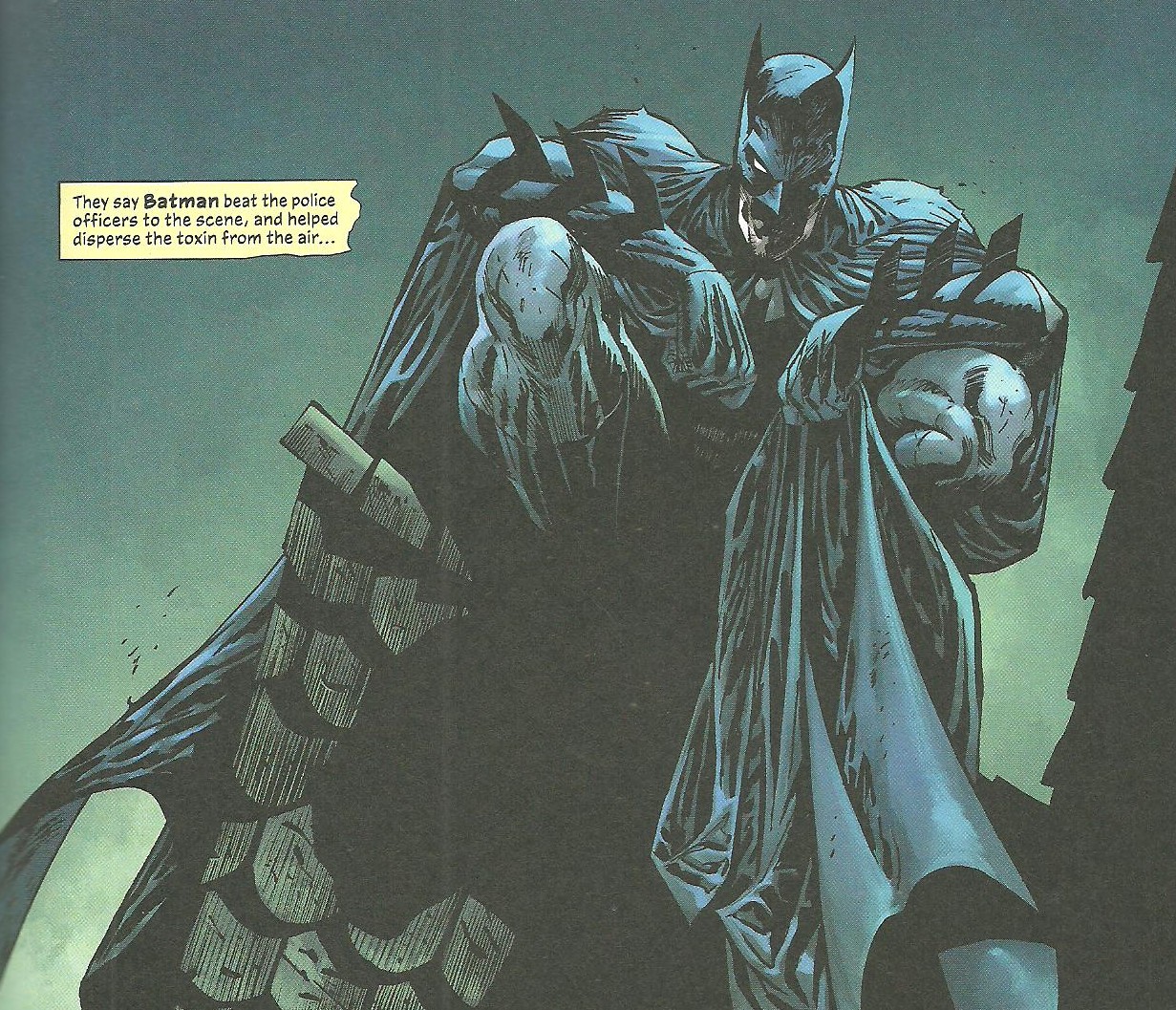
Batman doesn't appear as often as one might expect in The Joker, his appearances in the first collected volume mostly clustered around the beginning as the premise of the series is set up, but here's his first appearance in the book, crouching like a gargoyle on a bit of Gotham architecture, as is his wont. 

It's a pretty nice image of Batman doing something extremely Batman-ly, in which he looks quite causal doing it, as if it's just an everyday part of his job, which I suppose it is. March has the ability to find the right balance, I think, between Batman as a real flesh-and-blood human being and a bigger-than-life, almost cartoonish creature of the night. (Note the musculature of his legs and shoulders on the one hand, and the blank eyes, too-big cape and the bleeding-into-shadow on the other hand.) That is, in my mind at least, exactly how Batman should appear. 

3.) Look at this scary-ass Joker. Gordon's narration makes much of the fact that he basically sees The Joker every time he closes his eye, and that the character seems to haunt him. The artwork shows several examples of this, but March isn't content just to draw phantom Jokers leering at Gordon through windows or above his bed while he sleeps.

When Gordon visits the grave of his son, we're presented with this nightmare version of The Joker, with multiple limbs, faces and facial features, like the character is boiling. 

It certainly drives home the extent to which terrifying imagery has permeated Gordon's life, that such visions of The Joker are basically just background noise for him now.

4.) March draws a good Batgirl, too.
 So I've repeatedly talked about how I think Breyfogle's Batman was the ultimate version of the character, as he drew Batman as a thoroughly human, athletic figure—in peak physical condition, sure, but still recognizably human—that wore the Batman persona, as from the neck up his face was constantly transforming into angry white triangle eyes and bared teeth over a field of black, and his billowing cape forming the shape of bat-wings or an angry, jagged cloud, or trailing him like a comet. 

I haven't seen much of March's Batgirl, but he does something similar with her here, and I think his depiction of the Cassandra Cain version of the character is exactly right: A female silhouette, a too-big, billowing, expressive cape, a cartoon bat from the neck up. He even has her oversized utility-belt pouches flopping while she's in action, just as her co-creator Damion Scott used to draw her. 

5.) Here's another scary-ass Joker. Relatively late in the first volume, Gordon and other characters are caught in a blast of what The Joker calls a nerve gas, which obviously influences the way Gordon sees and experiences The Joker. 

Note the multiple visions of him in the same panel, which seems to echo the earlier vision Gordon had of him, and  how March is able to exaggerate some of the character's features in the lower panel of the page, despite how exaggerated his design for the character—and, indeed, pretty much everyone's design for the character—already is.

In this story, The Joker's right eye has been replaced with a glass eye, Harley Quinn having shot his eye out at the climax of "The Joker War" story arc, and March makes good use of it throughout as just one more weird and off-putting detail of the character's face. In theat final image, it positively bulges out like it's about to pop. 

Tuesday, August 28, 2018

The five best parts of Scott Peterson, Kelley Jones and Michelle Madsen's Batman: Kings of Fear #1

1.) The first panel. That image above is the very first panel of Scott Peterson and Kelley Jones' first issue of Batman: Kings of Fear. It's also a splash page. So you open the cover and you are immediately confronted with that.

What is it? Well, you won't know for sure until you turn the page, but that's The Joker's eye. He is peering into a hole in an empty crate in a warehouse--in other words, just peering into the dark--and calling out Batman, who he knows is lurking in the dark somewhere nearby, waiting to make his grand entrance.

That is one scary eye. Not just in the detail of the human eye itself, which is, of course, a weird and awful thing to look at too closely or in too much detail, but in the black furrows in The Joker's white skin around the eye. He is making a very intense, very emotional anger smile, as is apparent from the wrinkles in the area around his eyes.


2.) Batman's fight with The Joker's henchmen. Wow. That's all one page. The fifth page to be exact. So, as you'll already know if you've read the issue, the first page is a splash page featuring The Joker's huge staring eye looking directly at the reader through the jagged hole in the wooden crate. That's the page pictured above this one. The second and third pages are a double-page splash, showing the wide-mouthed Joker staring into the hole from the outside of the crate and worming his index finger into it, his henchmen gathered and posing all around him and he calls out to Batman. The fourth page has him summoning Batman through a sudden act of violence. And then you get this page. So after several pages devoted to scene-setting, the action starts, and we get a page crowded with all of these little panels, detailing Batman's battle against a roomful of opponents, each of which he dispatches with a single, discrete act of violence delivered in super-rapid succession. If the first four pages are timed to show a moment or so apiece, this page shows explosive action split-second by split-second.


3.) Batman's gas mask-holder-up mechanism. A little context might be required here. So after Batman knocks out a warehouse full of tough guys, he similarly dispatches The Joker in the space of just two panels. We then cut to the Batmobile, where The Joker is restrained in the backseat, talking Batman's gigantic pointy ear off until the Dark Knight has ultimately had enough, and so he decides to fill the interior of the Batmobile with some kind of knockout gas, after first putting on a gas mask. But rather than reaching down to his utility belt or his glove compartment to grab a gas mask, Batman has outfitted his car with a special button that, when pressed, extends a gas mask on a little arm (see the third panel above) that then holds the gas mask in front of his nose and mouth.

It's one of those almost Rube Goldberg-esque, overly-complicated things that Jones is always so good at emphasizing and detailing, but are inherent in the character. Seriously, just stop and think for a moment about how unnecessarily melodramatic and complex basically every single thing Batman does is. No artist makes that as readily apparent as effectively and as efficiently as Jones does.


4.) Batman's giant ear. The most immediate signifier of Kelley Jones' Batman versus Everybody Else's Batman is the ears. Jones gives Batman very long, sometimes ridiculously long ears, so that they more closely resemble demon horns or even rabbit ears than those of Batman's animal namesake. This is a fact not lost on Jones. Which makes this bit so cool. Just how long are Batman's ears? So long that they don't even fit in that panel, but break its borders and extend into the panel above it...and ultimately break that panel's borders too and comes out the top of it.


5.) Batman punches everyone. The one-page, 24-panel fight scene on page five is actually just the first of the 22-page issue's action scenes. At the climax of the issue, just as Batman has returned the captured Joker to Arkham Asylum and is arguing with one of its doctors about whether it's cool that he tracks down, beats up and then drops off any criminally insane escapees on a regular basis or not, there's a mass breakout of name villains. This leads to a five-page fight scene in which Batman simultaneously battles Killer Crock, Mister Freeze, Bane, The Riddler, The Joker, Poison Ivy, Two-Face and The Penguin. About halfway through, we get the above absolutely perfect panel, in which Batman rolls through them all like a big, black wave, seemingly striking them all with his fist in a single, wide, arcing punch.

It's...it's a really beautiful image, and the sound effects are unfortunate, as they only serve to block out some of the art, and distract from the fluid motion of the Batman figure, suggesting stops and starts to his attack in that panel, as opposed to him flying through his villains like a big, black comet, fist-first.

Anyway, they should take the sound effects out of that image, blow it up, frame it, take down the Mona Lisa and throw it in the garbage, and hang this in its place, as it is the best thing ever.

Tuesday, September 19, 2017

On Harley Quinn 25th Anniversary Special #1

If you're struggling with the math--or, like me, marveling at how fast time seems to pass once you reach 40--it should perhaps be noted that DC Comics is celebrating the 25 years that have passed since Harley Quinn's first appearance on Batman: The Animated Series in 1992. She wouldn't actually debut in comics until 1993, in an issue of cartoon tie-in comic Batman Adventures, and she wouldn't join the DC Comics Universe proper until 1999's Batman: Harley Quinn special. Perhaps because of the character's non-standard path--originating in a cartoon adaptation of the comics, then gradually working her way into the comics--it's appropriate that the Harley Quinn 25th Anniversary Special tackles various versions of the character.

I'm actually a little surprised at how slim a package it is though, given the character's seemingly exponentially growing popularity. It's just a $4.99 floppy, with four short stories totaling 32 story pages and six pin-ups. In terms of size and number of high-profile contributors, it's not much bigger than any of the many Harley Quinn one-shots and special issues DC put out when it was clear that they had a hit on their hands with the post-Flashpoint, second volume of Harley Quinn (Because DC relaunched all their titles during their "Rebirth" initiative, however, we are now on our third volume of a Harley Quinn ongoing series, although the creators and direction have remained the seam between the second and the third).

Of those pin-ups, my favorite is definitely the one contributed by Babs Tarr, who draws her own hybrid Harley with her old Gotham City Sirens co-stars Catwoman and Poison Ivy.
Tarr's an amazing talent, and particularly good at drawing sexy ladies. The issue is almost worth five bucks for her pin-up alone. The others are by Annie Wu (whose image prominently features Harley's pet hyenas, engaged in helping her wreck a psychiatrist's office), Bengal, Dustin Nguyen and Greg Tocchini, Kamome Shirahama (Looking at these reminded me of the old Gallery one-shots that DC used to publish, but have long since abandoned; I imagine with the price of comics now being what it is, it would be harder to make those seem like they were worth whatever the publisher sold them for, but I used to really enjoy seeing so many different artists' takes on particular characters in 1992's The Batman Gallery, 1994's The Sandman: A Gallery of Dreams and A Death Gallery, 1997's JLA Gallery and so forth).

The first of the four stories is set firmly in current continuity, and is by the regular Harley Quinn writers Amanda Conner and Jimmy Palmiotti, with Conner also drawing it, something that happens far too infrequently (although, truth be told, the Harley Quinn monthly and its spin-offs have all generally had pretty good art, certainly better than that of your average DC Comic).

I had a hard time getting through this story, having skipped it the first time through the book and having to try two more times before I read it. As much as I like Conner's art, when it comes to Conmiotti's Harley comics, I am not a fan. This one has their character Red Tool--pronounce it "Deadpool," but with an "R" instead of a "D"--right there in the first panel, and when I see him my eyes roll so hard it makes reading comics somewhat difficult for a while afterwards. He is in a two-page framing sequence with Harley, between which is a "lost scene" from their 2015 Harley Quinn Road Trip Special co-starring Poison Ivy and Catwoman, probably most notable for all the great artists who contributed to it (like Moritat and the too-rarely-seen-at-DC-these-days Bret Blevins and Mike Manley).

Killing time before killing some dudes, Harley tells Deadpool Red Tool about how Vegas casino owner Yosemite Sam offered the three of them an ell-expenses paid stay in one of his hotels, and they got thrown out of it.

Harley's co-creator Paul Dini scripts the next story, "Birthday Blues," which seems to be set in The Animated Series continuity, or at least adjacent to it. Rather than being paired with Bruce Timm, the noticeably absent other creator of the character, Dini is working with regular Harley Quinn artist Chad Hardin. It's a pretty fun little story with the meta angle of Harley celebrating her 25th birthday, and how The Joker and Poison Ivy are involved in said celebration. There's a twist within a twist at the end, and as short as it is, those twists serve to pretty perfectly define all three characters and their relationships.

As great as it would have been to see Timm or someone who worked on Batman Adventures draw this, it was actually really interesting to see Hardin drawing the costumes from the TV cartoon, adapting the designs into his own style, which is very different than that of Timm (And, if you've spent as many hours of your life as I have on that show, it's fun picking out which designs from which season Hardin chooses, and to what extent; his Catwoman, for example, is wearing a costume that looks like a compromise between that of the first season and her more recent Darwyn Cooke-designed comic book cat suit. The Joker has the hairstyle and pointy-nose of TAS's redesigned Joker, but not the weird eyes; Killer Croc looks as he did on the cartoon, but with spikes. And so on.)

The most surprising stories are the two that follow. The first of these is by writer Daniel Kibblesmith and artist David Lafuente (a great artist who I really wish I could see more of, preferably on a regular, ongoing basis). Entitled "Harley Quinn & Friends In...Somewhere That's Green!", it is perhaps a little too timely in its reference to a deadly hurricane bearing down on the city (New York here, not Gotham).

Gal pals Harley and Ivy are in a grocery store to get supplies, when Swamp Thing grows out of the produce stand. He needs Ivy's help because of her connection to The Green, and Harley basically invites herself along. The Swamp Thing/Harley Quinn rapport was interesting enough that I kind of wish DC hadn't cancelled Harley's Little Black Book, as I wonder if it was fun watching those two interact because the short space here meant Kibblesmith could squeeze in all the potential good bits, or if the characters really could have the chemistry to carry a whole over-sized comic story.

If nothing else, Kibblesmith gets Swamp Thing in a raincoat and rain hat for a few panels; that's awesome.

As I mentioned, I really liked Lafuente's art, but it was especially good in this story, which had enough of a comedic tone that he could fill the backgrounds with loose, cartoony, caricature-like drawings, and go pretty wild with Swamp Thing. (Colorist John Rauch deserves some props here too, particuarly given his way with Harley's hair.

The final story was probably my favorite, and it came from the unlikely team of writer Chip Zdarsky and artist Joe Quinones, who are more Marvel guys than DC guys at this point (much to DC's detriment, if you ask me!). Entitled "Bird Psychology," this is the first story in the book to involve Batman, and, of course, Robin.

It's set somewhere...unclear-ish. Harley's look here is unique to this story, not lining up with that of TAS, The New 52, or the Margot Robie-in-Suicide Squad inspired "Rebirth" redesign. There's a Robin heavily involved, but the costume doesn't really give us any clues; it looks closer to Tim Drake's original than any other design, but then, the TAS Dick Grayson's suit looked a lot like Tim's comics costume, and the post-Flashpoint Dick also wore a more Tim-like costume...this one has some of the weird elements of Dick's New 52 Robin get-up but, like Harley's costume, is unique to this story (Based on the dialogue, in which Harley intuits that he's an orphan, it is probably meant to be Dick). The Joker and Batman both look like their TAS selves or their post-Crisis, pre-Flashpoint selves, but neither of them is too terribly easy placed in any particular milieu by their duds alone. All that said, the red skies, the black buildings and the particular designs and costuming of Commissioner Gordon, Harvey Bullock and Renee Montoya all definitely suggest that this is supposed to be a Quinones-ized TAS story.

This is, in broad strokes, a Batman and Robin vs. The Joker and Harley Quinn story, in which the superhero and his archvillain do battle, assigning their sidekick and moll to fight. The Joker underestimates Harley as per usual, and she ends up choosing to do good and play hero on the sly, because as crazy a bad girl as she might be, she's not, like, evil. Harley, and, to a lesser extent, Robin, are the focus of the story.

As well constructed as Zdarsky's plot is, it was the little elements that I really dug; he does a fine job of making The Joker seem like a completely insane criminal without having to, like, dwell on his homicidal tendencies. The story just cuts from The Joker at his work bench, plotting, to his plot already in progress, where Batman and Robin are fighting goons in adult pajamas, The Joker is wearing an old timey night shirt and night cap with sheep oven mitts on his hands, and there's a giant, angry Batman Tsum Tsum with a mouth full of striped missiles...? The creators do a pretty good job of nailing '90s Joker, particularly TAS-style Joker, where he could be menacing, scary and completely insane, without also having to be, like, Freddy Krueger or whatever.

Quinones is a fine artist, and this particular script allows him to pack in all sorts of great details; every available space of The Joker's hideout has an Easter Egg to some previous Joker story from some previous medium in it.

So while I didn't love all of this, the good in it definitely outweighed the bad, and it's certainly a reliable purchase for the casual Harley Quinn fan.

Monday, October 12, 2015

On Batman Vol. 7: Endgame

Batman Vol. 7: Endgame collects writer Scott Snyder, pencil artist Greg Capullo and inker Danny Miki's five-issue story arc of the same name, which ran from issues #35 through #40 of their ongoing monthly Batman title (plus 14 wildly divergent variant covers in a gallery in the back). Marketed, sold and told as a sort of last Batman story, or a last Joker story, or at least a last Batman versus The Joker story, it featured the unexpected (by the characters, not the readers) return of The Joker for a final, apocalyptic showdown against the Batman, one that could literally destroy Gotham City and actually begins with The Joker taking the entire Justice League off the board (A one-issue Batman vs. The Justice League story that also served the purpose of explaining why Batman didn't just call his friend Superman in to save the day at the climax...as well as presenting a cool Batman vs. The League fight, and letting Capullo draw some of the other iconic DC characters. This made up the bulk of the special issue DC and comic shops were giving away for free on last month's "Batman Day").

Constructed as a deliberate parallel of Snyder and company's own "Death of the Family," it features The Joker with a brand new joke–an elaborate "Is he telling the truth, or is he lying?" mind-fuck for Batman and the Bat-Family–and ends with the same single syllable phrase that "Death" ended with. I actually really liked the "joke" here, and the way that Synder sells it so completely, so that a reader can read it the same way Batman might–Either The Joker is telling the truth, and he's actually an extremely different character with an extremely different nature than anyone ever thought, or he's lying to mess with Batman, but doing a damn fine job of doing it and getting under Batman's skin. The way I read the ending, The Joker revealed that he didn't believe his own story (the same way it fell apart at the climax of "Death of the Family" when Batman confronted him with it), whereas Batman seemed to at least believe a part of it, although he was also clearly taunting The Joker (sorry I'm being vague; I'm trying not to spoil it too much).

I think this is somewhat undermined by the early chapters of "Endgame," however. In "Death," The Joker was convincing Batman's allies that he knew who Batman really was and who they all were, thanks to having infiltrated the Batcave during a very early battle with Batman. Batman, who knew it was impossible for an ordinary human being to infiltrate the cave in that manner–it would have involved swimming a great distances underwater, longer than anyone could hold their breath–knew The Joker was lying, but the lie nevertheless helped drive a wedge between him and his allies.

However, in "Endgame" we find out that The Joker, contrary to the events of "Death" (both the climax where the book of secrets is shown to be blank and the denoument wherein Batman told Alfred how he knew The Joker didn't know, or even care, who he really was), really does know who Batman really is.

I wanted to share a few thoughts and observations I had while reading the story, which is an extremely engaging one, that, like Snyder's best Batman stories, really sunk its hooks in me, and I couldn't stop reading once I started. I've tried to stay spoiler-lite in the above paragraphs, as I don't really believe in spoilers (I mean, you are reading someone discussing the book and all), but I'll include a warning just because it seems to be superhero comic-writing-about-etiquette: I'm going to discuss specific plot points below, so if you haven't yet read "Endgame" serially or picked up the recently-released collection, and don't want to know what occurs within its pages, don't read the rest of this post. Please come back after you have read "Endgame" though; it should still be here.

A Joker-ized Justice League vs. Batman is actually something I've thought about before, in a "Hey, that would be a cool story kind of way." Probably at least since the Joker's Last Laugh event, in which Joker uses a specialized version of his venom/gas to "Joker-ize" various villains, creating a bunch of bad-buys with his sense of humor and look (I've noted before that I really like temporary, story-specific character re-designs, as those in Blackest Night; there's something cool about seeing a very familiar costume or character in a fresh color or look).

In my mind, a Joker-ized Justice League would of course wear purple and green instead of their normal colors, but that wouldn't really work here, as the drama in that first chapter is the slow reveal of why the Justice League is suddenly trying to murder their colleague Batman for no reason, and it's only at the very end that we learn that it's The Joker behind it. Superman is the only one standing long enough to reveal other symptoms of Jokerization, including whitening skin and a rictus grin.

It was amusing to see Batman break out his Justice League Fighting Protocols here, and see that they are so different from past Justice League Fighting Protocols, like those Mark Waid helped him think up in the "Tower of Babel" story arc from Waid's JLA run, or the more recent ones from Geoff Johns' Justice League/Forever Evil (in which Batman kept a special briefcase stamped with each Leaguer's logo containing an item to take them out with.

The Joker's elaborate joke/lie here is that he's not exactly human, and is something of an immortal...or at least centuries old, and able to recover from the most grievous mortal wounds (he grew his own face back, for example). This is first revealed through a series of historical newspaper photos, in which a pale or grinning man appears at the scenes of various Gotham City tragedies: The Joker as Slender Man, I suppose. (The character explaining all of this alludes to Vandal Savage and Ra's al Ghul without naming them, although Capullo draws them; the idea is that The Joker discovered a very rare, naturally occurring substance in pre-Gotham that grants a form of immortality, and internalized it...the substance in the Lazarus pits is a degraded form of the substance).

The Joker takes it very far, even saying he had to use make-up and muscle-relaxers while The (original) Red Hood, as this new origin of his would predate his original "origin," and this explains his decades-long ability to constantly escape death, and is in keeping with Grant Morrison's conception of him as an ever-evolving villain, with a different schtick and portrayal during successive appearances.

Again, Snyder keeps it ambiguous here, with Julia Pennyworth noting that if the pictures were doctored, they were done so better than any other photo-doctoring she had seen (Which is, of course, just another way of saying they could be doctored). Batman is fairly convinced, by the climax, that The Joker is just messing with him, although he does seem to equivocate a bit during his "last" words. The Joker, for his part, doesn't seem to buy it; after suffering mortal wounds, he desperately tries to crawl to a pool of the substance, with Batman holding him back, telling him he doesn't need it, since he's internalized it (So: Either the Joker discovered this pool centuries ago, and is an immortal, infernal entity haunting and harming Gotham throughout its entire history, or he discovered this pool shortly after the end of "Death," and then used it to heal his face and wounds...and then concoct this elaborate plan).

–This story, by the way, should make whatever Geoff Johns is planning in "Darkseid War," wherein Batman learns the Joker's true identity thanks to the Moebius Chair of Metron, interesting. Assuming, of course, that Johns is planning on doing something with that revelation, other than having Batman ask, find out, and then later forget when he's inevitably separated from the chair and loses his surely temporary godhood.


–It should probably go without saying at this point, but this is one of the many, many stories that would actually have worked far better in the old, pre-New 52 DC Universe. There, Batman and The Joker had been fighting one another for what would have seemed like forever to readers (at least ten years, in-continuity, perhaps longer in various readers' "head" continuity). Here though, Batman and The Joker have only been doing their dance about seven years now, and that's if you include the Bruce Wayne/Red Hood Gang conflict from "Zero Year."

We've only seen a few Joker vs. Batman stories actually dramatized–"Death of The Family," whatever the hell Tony Daniel was doing in Detective #1, a few flashbacks in other Batman adjacent books–and we know The Killing Joke and "A Death In The Family" still happened...or at least the events in them happened, just in different ways than in the stories themselves (goddam stupid reboot; these would be two good examples of DC's new "secret" continuity, wherein stories tell us that some stories happened, but in drastically altered ways that differ from the stories you can still find, buy and read in pre-Flashpoint comics and collections). Even though the outcome of both stories was reversed. Andy Kubert even drew variant covers for issues of this story arc depicting The Joker's roles in those two stories, for what it's worth (see above).

The Penguin, Man-Bat, Killer Croc, Poison Ivy, The Mad Hatter, Clayface, Bane and Mister Freeze have all fought Batman at least three times more often than The Joker in post-reboot Batman history; The Scarecrow has probably fought Batman ten times as often as The Joker.

–What ringtone has Jim Gordon assigned to Batman on his cellphone...? Well, it includes the lyrics "I fought the law," so it is either The Bobby Fuller Four's 1966 "I Fought The Law", or The Clash's 1979 cover of it or the 1987 Dead Kennedys cover of it.

I would imagine Gordon was more of a Bobby Fuller man, but maybe in the New 52, wherein we have a younger, fitter Gordon, he's more into The Clash.

I can't imagine it's the Dead Kennedys version, although I suppose it's possible. The major difference between their version and the earlier versions–well, one difference–is that the original line of "I fought the law, and the law won" is changed to "I fought the law, and I won." Given their version's real-life inspiration, I suppose it's possible that at this point in Gordon's career–in which he just spent a long-ass time in Blackgate prison for a crime he didn't commit–he's a bit down on the justice system.

–So, were you wondering if and when DC would update goofy villain Crazy Quilt, originally created by Jack Kirby in Boy Commandos, and then later adopted by Blackhawk and Batman as a villain, into a darker, grimmer, grittier version? Wonder no more!

There were two guys named Crazy Quilt; Kirby's original one from the 1940s and a later one that surfaced in the 1970s and '80s in Gotham City. That second one had a helmet that restored his messed-up vision and shot laser beams and controlled minds and stuff, because why not?

Snyder and Capullo's reinvention of the character is about as banal as can be: He's a crazy guy who wears a quilt.
They never even use the name "Crazy Quilt," making his appearance in the comic something of an Easter Egg or inside joke. When Batman talks to Dick Grayson about him via Bat-radio, Batman refers to a Dr. Paul Dekker, and Grayson responds, "Huh. Paul Dekker? AKA--"

Batman cuts him off before Grayson can say whatever was meant to follow "AKA"–"Crazy Quilt," presumably–by saying "Yes" and continuing his explanation.

–Probably my unintentionally favorite part of the book after the introduction of Dark Crazy Quilt came during Batman's talk with Grayson.

"Joker knows who I am," Batman tells him grimly, to which Grayson responds, "It's over, then. I mean...over. There's no staving it off. No barrier to it."

Guys, I'm pretty sure everyone in the whole world knows that Batman is really Bruce Wayne now. Remember Forever Evil, when The Crime Syndicate publicly unmasked Batman ally and Gotham-based vigilante Nightwing as Bruce Wayne's ward Dick Grayson on live television, putting his driver's on the screen and everything? I know Lex Luthor is the only one who came out and said it, but how hard would it be to connect Nightwing's friend and sponsor to Batman, especially since Bruce Wayne is publicly known to fund Batman?

Still, they both act like this is a big deal, and not, like something anyone with a television set or Internet access would have put together months ago.

–As the story reaches its climax, Joker's new toxin, which essentially turns people into Joker-themed zombies, is spreading throughout the city, and he takes to the streets at the head of a big, weird parade, the various floats assembled from stolen trophies from the Batcave, and skull and skeleton-themed costumes.

As far as I can recall at the moment, this is the first and only direct allusion to the climax of the parade sequence in Batman '89; Capullo even draws a few parade balloons in a vaguely Tim Burton-designed style, like those in the Nicholson Joker's parade.

No Prince music, though.

–So Alfred Pennyworth, attempting to defend the Batcave from The Joker's infiltration, has his right hand chopped off with a meat cleaver. I...did not care for this scene, which didn't really serve any real purpose other than adding another notch in the Joker's belt of scarring Batman's allies (although Jason Todd came back to life and Barbara Gordon regained the use of her legs, so those notches aren't as deep as they were pre-New 52).

What I most dislike about the maiming, however, is the scene at the end of the book. Alfred is laying in a bed–presumably a hospital bed–two weeks after Batman/Bruce Wayne seemingly dies in a battle to the death with The Joker, and his daughter Julia mentions his hand to him.

"I know this isn't what you'd like to talk about, but your hand. They've managed to preserve it until now, but if you don't--"

Alfred cuts her off, saying "No. There's no one to mend anymore."

Okay, so he believe Batman Bruce Wayne is dead at that point. And he believe Dick Grayson, who replaced Batman as Batman II after the events of "Batman R.I.P."/Final Crisis (still in-continuity, in that kinda sorta "secret continuity" way) is dead. And Robin Damian Wayne is still dead.* Still. If Alfred really thinks the only point of having two hands is to mend the wounds of Batmen, well, he has to assume Jason Todd or Tim Drake are going to start dressing like Bats within a few weeks.

And even if he's not thinking about the fact that he's going to need to stitch up any of Gotham's vigilantes, it's a really weird, defeatist attitude for Alfred to have, no matter how depressed and defeated he must feel. Hell, maintaining that mustache is going to be rough with just one hand...

–As Batman believes the main ingredient needed to concoct a cure to The Joker's gas attack is The Joker's own spinal fluid, he prepares to storm The Joker's parade, which means taking on an army of Joker zombies (referred to as "Gigglers" by Batgirl at one point).

He assembles his allies and...that's it? Okay, so Dick Grayson is faking his death and Robin Damian is apparently actually still dead at this point, but what a paltry turn out! Where's Batwoman? Catwoman? Spoiler? Talon? (Is Talon dead? I haven't seen or heard from him in a while.) Batwing/Luke Fox? Jim Corrigan? Anyone from Batman, Inc? Tim's equally badly dressed allies?

For comparison's sake, here's who showed up to help Batman against the Final Boss in the final issue of Batman Eternal:
(If you didn't read Batman Eternal, and are wondering who the guy laying on the ground is, that's Batman; he had to make a makeshift mask after having his costume cut off of him.)

–Batman does call in some more help than the four shown in that above panel, though. He talks these guys into pitching in, too.
I liked this panel, in large part because it gave Capullo a chance to draw a healthy swathe of Batman's rogue's gallery.

It's a motley lot, to be sure, but it's easy enough to see Killer Croc, who helped Batman out in Batman Eternal, and Poison Ivy, who did a recent stint with the New 52 version of Birds of Prey, pitching in. Mister Freeze and Bane are also bad guys who aren't that bad, on the scale of Batman villain bad-ness, anyway.

The Penguin I could only really see pitching in out of self-interest, but one might expect him to have the soldiers in his organization do the actual fighting.

The Scarecrow is the only one who seems to be completely out of place here, as it's hard to imagine him lifting a finger to save Gotham City, especially if it meant risking his own life as it does.

I don't like Capullo's version of The Scarecrow here, which seems to mix the standard New 52 re-design with that of those Arkham videogames, and I kind of hate his Penguin. I don't get why so many artist draw that character simply as a little fat guy in a nice suit or tux all the time. Where's the monocle? The tophat? The umbrella? The guy is packign tons of heat, even a utility belt, but he's leaning on some kind of machine gun, rather than an umbrella-shaped machine gun? For shame, Capullo; for shame.

To be fair, at the opening of the next chapter, we do see The Penguin in the fray, fighting with an umbrella.

...

Wait, how the hell did all of these guys get out of Arkham Manor and/or Blackgate at the same time...?

Oh Batman, you are the worst crimefighter.


–"Here's the facts"...? Surely Batman would say "Here are the facts" instead, wouldn't he?


–I am enjoying the aftermath of this storyline, which you probably all know, even if you haven't been reading Batman. To fill the void left by Batman, who did die a death of sorts at the climax of "Endgame," The Gotham City Police Department hired James Gordon to wear a high-tech Batman battle-suit with dumb ears to be the new, officially-sanctioned Batman of Gotham City.

I like this because it was and is so incredibly unexpected. Rather than Dick coming back to don the suit, or Jason or Tim taking a turn, or even Julia Pennyworth (my first guess for who the new Batman would be, when DC first teased images of the robot Batman suit), Snyder went with one of Batman's oldest allies...and the least likely to ever go masked crimefighter. (Well, least likely aside from Alfred Pennyworth.)

It's outside the box, but it's outside the box in a completely unexpected way. Like, I would have imagined Superman, Aquaman, J'onn J'onnz or El Gaucho putting on a Batman suit before I would have imagined a Jim Gordon-as-Batman-by-way-of-Robocop scenario.

What you might not know if you've only paid marginal attention is that Bruce Wayne did not physically die, but came back to life...albeit with a sort of amazing amnesia. Essentially, his brain is completely different than it was before he "died." I think his wounds must have been healed by the miracle goop in the pool beneath Gotham somehow, but a side effect is that Bruce Wayne has no memory of having ever been Batman...and has lot all of his fighting and detective skills to boot.

But he got a beard in the bargain.

The result is that, as I believe Snyder has framed it a few times, a story about "What if Batman died, and Bruce Wayne came back to life?"

Not only does it mean that Snyder, Capullo and company are doing something completely different and new with Batman, but they've painted themselves into the same kind of corner that the Superman office has done with the other half of the World's Finest, by revealing Superman's secret identity to the world. It should prove incredibly challenging to un-do.

In both cases, I have to imagine they already have their outs planned, as Gordon can't be Batman forever, nor can Superman's secret identity be publicly known forever, but, as a reader, it's difficult to imagine easy solutions that are still dramatically satisfying for these problems, which is something of a feat. The characters have been around so long that there's no real tension or suspense in whether or not they'll ever die during their many dangerous adventures against deadly foes, and even if these particular situations are known to be temporary, the hows they get out of them does make for genuinely compelling questions.


*You know, I actually have no idea how Damian's resurrection must fit into this story. Damian is clearly not present in the story at all, so he is presumably still dead, or dead-ish, during the events of "Endgame." But since Batman "dies" during the "Endgame," then his resurrection story in the pages of Batman and Robin must have occurred prior to this, right? Huh. I haven't read those trades yet, so I'm not exactly sure of the hows of Damian's return to life, but I can't synch these two story arcs up.