Showing posts with label thor. Show all posts

Thursday, June 19, 2025

Golden Age antecedents to Marvel characters

C.C. Beck and Bill Parker's Captain Marvel debuted in 1940's Whiz Comics #2 and would go on to become one of the most popular characters of the Golden Age superhero boom. Because he bore more than a passing resemblance to the other caped strongman who started that boom, the company we now know as DC Comics sued Captain Marvel's publisher Fawcett, and the litigation dragged on until superhero comics were no longer popular, and so Fawcett settled in the 1950s, and the character went into limbo for about 20 years.

During that time, Marvel Comics created their own Captain Marvel character, a super-powered alien warrior with the unlikely real name of Mar-Vell, and they quickly copyrighted "Captain Marvel", so that by the time the Distinguished Competition finally revived the original Captain Marvel, DC couldn't use that name in the titles of any of their books. 

This is why since the 1970s, all of DC's Captain Marvel-starring books (and a 1970s TV show, and the 21st century pair of feature films) have gone by some formulation of "Shazam" instead (and the publisher has tried to change the character's name to "Shazam" in the last few decades, with limited success), while Marvel continues to publish books entitled Captain Marvel (and, of course, their film starring one of their Captain Marvels was able to use that name in the title). 

Marvel's Captain Marvel is by far the most obvious and famous case of the publisher using the name of a Golden Age hero for one of their characters, but as I've been learning, it wasn't the first or the last time.

I've been working my way through Lou Mougin's Secondary Superheroes of Golden Age Comics (McFarland; 2019), which is a defunct publisher by defunct publisher survey of the various superheroes who didn't survive the 1940s, which here seems to mean the various heroes who weren't published (or later acquired) by the company that would become DC or the company that would become Marvel.

Thanks to publications as various as Dynamite's Project Superpowers comics, Image's "Next Issue Project", Paul Karasik's efforts with the works of Fletcher Hanks and others, even casual modern readers will likely know the names and stories of many of these also-ran characters (Mougin notes many of these later revivals, of which AC Comics seems to be responsible for a lot of, along with Project Superpowers).

The other reason that several of these lesser Golden Agers' names will be familiar, of course, is that they have since been applied to Marvel heroes (And, to be fair, some DC characters as well). Let's take a look at some of them, shall we?

We just discussed the case of Daredevil recently. That was, of course, the name of a fairly popular hero from Lev Gleason Publications who wore a striking two-color costume divided vertically, wielded a boomerang, fought The Claw and Hitler and who was worked on by such Golden Age greats as Jack Cole and Charles Biro. 

He was around for a remarkable 16 years, not calling it quits until 1956...just eight years before Marvel's Daredevil would make his debut (And, as pointed out in the previous post, there's a chance—a "legend" in Mougin's words—that Marvel's Daredevil was pretty directly inspired by Lev Gleason's, the result of Stan Lee being asked by publisher Martin Goodman to revive the original guy).(UPDATE: Commentor kevhines pointed me to this 2020 post by Tom Brevoort, discussing the creation of Marvel's Daredevil, his story noting Goodman's interest in possibly reviving the Golden Age version.)

The next most popular Marvel hero with a Golden Age forebear was a pretty big surprise to me, as I had never heard of him, although there's a pretty good chance you might have, given how recently he was revived and by whom. 

I am talking about Doctor Strange.

The Marvel character by that name is, of course, a literal doctor whose surname was literally "Strange," a surgeon who, after a humbling car accident, an epic journey and the tutelage of a wise master, became Earth's Sorcerer Supreme, engaging in various mystic adventures. Steve Ditko created him in in 1963. 

The other Doctor Strange debuted in 1940's Thrilling Comics #1 from Nedor Comics, in a long action-packed story that Mougin refers to as "a 37-page marathon." Writer Richard Hughes and artists Alex Koster's Doctor Strange was "a powerful, brilliant scientist who didn't shy away from duking it out with villains," as Mougin puts it, and the character seemed to have far more in common with the Doc Savage of the pulps than the guy who would become the far more famous Doctor Strange a few decades later.

After happening upon a kidnapping plot and being shot, Strange prepares a dose of Alosun, a super-power granting "distillate of sun-atoms" that made him into something of a Superman in terms of speed, strength and invulnerability. A later refinement of his formula apparently also bestowed upon him the power of flight. Though he never adopted a cape or chest-symbol or went in for tights, by the eighth issue of Thrilling he adopted a uniform of sorts: A tight-fitting red shirt and a pair of blue jodhpurs. 

He also shortened his name to "Doc Strange" after just ten issues as "Doctor Strange," which is perhaps one reason he's not thought of as a contender for the more famous superhero appellation.

His adventures lasted a respectable eight years before he faded away, not to be revived until AC Comics decided to do so in a 1991 issue of Femforce. (I've never really found the covers of that series particularly appealing, but, after reading Mougin's book, I'd really like to check it out; sadly, as long-lived as it is, it doesn't appear to have ever been collected into any trades.)

But it was Alan Moore's revival that is probably better known. See, Nedor also published 31 issues of a book called America's Best Comics between 1940 and 1949, and that was, of course, the name of Moore's 1999 WildStorm imprint, under which he wrote the books The League of Extraordinary Gentleman, Tom Strong, Promethea, Top Ten and other features. 

Apparently leaning into the Nedor connection, Moore reintroduced the Golden Age Doc Strange as Tom Strange in the pages of a 2001 issue of Tom Strong, wherein the older character was presented as an alternate Earth counterpart of the similarly pulp-inspired hero (It was a fortunate coincidence that Doc's first name was previously revealed to be Tom in the Golden Age comics).  

Eventually other Nedor heroes, all of whom had long since lapsed into public domain, showed up alongside Strange, starring in a pair of Terra Obscura miniseries in 2003 and 2004. 

Even more surprising than a character named Doctor Strange appearing in the 1940s, though, was one named Thor. Like the later Marvel one created by Jack Kirby and Stan Lee in 1962, he was a mortal empowered by the real Norse god and fought with the mythical Mjolnir (Marvel's Thor, of course, gradually dropped the mortal aspect of Donald Blake as time went on). 

This first Thor appeared in the pages of Fox Comics' 1940-launched Weird Comics, the first few covers of which seem appropriate for the title. (I put that of the second issue above, because it's slightly weirder than that of the first issue. You can seem 'em all on comics.org, of course; Thor doesn't seem to have ever been featured on one, but such caped weirdos as Dart and Ace and The Eagle and Buddy eventually replaced the mad scientists and scantily clad ladies of the first few issues.)

Here's how he dressed, showing considerably more skin than Marvel's later Thor ever would. 

According to Mougin, Fox's Thor was really mild-mannered mortal Grant Farrel, who was berated by his girlfriend for "his lack of adventurousness" at a night club before a "masher" cut in on them. Later, Grant is visited by the real Thor of mythology, who takes him back to his home realm to train him, telling him, "The lightning will be your servant, my magic hammer your weapon."

After his training, Grant saw his girlfriend trapped by spies, descended back to Earth, downed the plane she was on, smashed enemy tanks with his hammer and rescued her, returning to Thor afterwards to get an attaboy: "You have well earned the right to my name and my magic hammer...They are yours to keep."

Obviously, he didn't keep them long, as this Thor's feature lasted only five issues of Weird, although it's interesting to wonder if Goodman, Lee or Kirby might have encountered the feature and saw some potential in it, either filing it away in the back of their heads or completely forgetting about it except, perhaps, on some subconscious level. 

There are several other familiar names in Mougin's book. The most prominent of these is perhaps The Black Panther, a power-less, origin-less, secret identity-less character in a cat costume who appeared in a single story by artist Paul Gustavoson in a 1941 issue of Centaur Comics' Stars and Stripes. 

Like Fox's Thor, he never appeared on a cover, but you can see his skimpy costume (I do like the tail) in the above splash, which I swiped from Tom Brevoort's blog (You can read the whole story there, by the way; as Brevoort notes, this guy doesn't really seem to have anything at all in common with Marvel's much later T'Challa, save for the name).

There's also...

•The Banshee, a masked and caped Irishman from 1941 who pre-figured the 1967 mutant with a sonic scream that would become part of the extensive, wider X-Men cast (although the second Banshee lacked a "The" in his name)

•The Black Cat, a rather long-lived character from Harvey Comics who was a Hollywood actress/superheroine who debuted in 1941, long before the Spider-Man villainess-turned-love interest of the same name, who appeared in 1979 (You may have seen Harvey's Black Cat in 2018's Mystery Science Theater 3000: The Comic, which repurposed some of her original comics for riffing purposes.)

•Boomerang, a 1944 hero who fought crime alongside an archer named Diana, unlike the same-named character from 1966, who used the weapon for ill

•A couple of different Chameleons, a heroic master of disguise from 1940 and a crook from the 1940s; the Spider-Man villain from 1963 therefore seems to combine elements of both

•Dr. Doom, a civilian supporting character in the feature The Echo from Chesler's 1941 Yankee Comics. He would seem to have been a waste of a perfectly good villain's name, a name that Kirby and Lee's formidable character would begin putting to far better use in 1962

•Hydroman, a Bill Everett-created hero from a 1940 issue of Eastern Color Publishing Company's Reg'lar Fellers Heroic Comics who could, like the 1981-debuting Spider-Man villain, turn himself into water, not unlike a reverse Human Torch. Spidey's adversary would, of course, add a hyphen to the name

•At least two different guys named "Wonderman", one-word, a Fox Comics hero from 1939 who was very Superman-like and a Nedor Comics hero from 1944 who appeared in a feature called "Brad Spencer, Wonderman". Marvel's Wonder Man Simon Williams would debut in 1964, distinguishing himself from those prior Wondermen by separating his name into two words.

I'm sure there were other recycled names, but those are the ones that jumped out at me while reading. 

As for DC Comics, they too would later debut names that had previously been applied to Golden Age characters, though far fewer and none so famous as Captain Marvel, Daredevil, Doctor Strange or Thor. This is perhaps because so very many of the Golden Age's original characters ended up being absorbed into the DC comics line, and the attendant DC Universe shared setting.

Among the Golden Agers whose names DC fans might recognize are...

•Amazing-Man, an Everett-created hero from 1939 whose abilities are owed to training in Tibet; the green-and-yellow clad African-American hero that Roy Thomas introduced in a 1983 issue of All-Star Squadron had a different origin and powers, but his secret identity revealed his debt to the earlier hero: Will Everett

Multiple Black Orchids, including a 1943 Harvey Comics character and 1944 Tops Comics character. Both were masked females with no powers, though the latter had a gimmicked ring. The 1973 DC character would sport a far more elaborate flower-inspired costume than either of her forebears, as well as array of superpowers. At this point the DC character is probably better known for the incarnation from disgraced writer Neil Gaiman and artist Dave McKean's 1988 miniseries, presaging her later, '90s absorption into the Vertigo "universe"

•Black Spider, a costumed detective from 1940 who fought crime with, in Mougin's description, "a cache of poisonous spiders along with his dukes and a gun." He therefore wasn't much like the Batman villain who debuted in 1976 at all

•Cat-Man, a cat-themed hero from 1940 who seemed to be a Batman riff with various cat powers, including, at the outset, nine lives. Like the Batman villain introduced in 1963, the hyphen in his name seemed to come and go (The Golden Ager just reappeared recently in a Jeff Parker-written Cat-Man and Kitten comic from Dynamite, by the way)

•The Mad Hatter, an intriguing-looking, hat-less caped hero who wore purple and spoke in rhyme and debuted in 1946, pre-dating the much more famous Batman villain of 1948 by just a few years

•The Unknown Soldier, Ace Comics' masked, patriotic-themed hero debuted in 1941's Our Flag Comics #1, and seemed to be in the mold of The Sheild and Captain America more than that of 1966's disfigured master of disguise from Star Spangled War Stories and, later, his own comic

Tuesday, October 20, 2015

Review: Thor Vol. 2: Who Holds The Hammer?

(I wrote about a single aspect of Jason Aaron and Russell Dauterman's Thor series for Comics Alliance this week; if that sounds like something you'd like to read, you can find the piece here)

This second and final volume of Jason Aaron and Russell Dauterman's short-lived, eight-issue Thor series completes their story arc, finally answering the question of the sub-title...in the very last panel of their storyline, frustratingly enough (So I guess they really did make readers of the serially-published comic book series spend eight months and about $32 before telling them who the new Thor was, then).

Don't worry though, this isn't the end of the creators' run or their excellent new version of Thor. Marvel simply "cancelled" the book while taking a good chunk of 2015 off of their regular publishing schedule to make room for Secret Wars and its dozens of tie-in miniseries. Aaron, Dauterman and the new Thor will return in The Mighty Thor #1 next month.

Yeah, that's right, they're relaunching the book with a new number one and a new title, despite retaining the same creators, character and direction, for maximum confusification (So if you start reading the saga of the new, female Thor in trade in the future, you'll be reading Thor Vol. 1, Thor Vol. 2, The Mighty Thor Vol. 1 and so on; make sure you get the right Thor Vol. 1 and the right The Mighty Thor Vol. 1, though, as there are a bunch of collections with those titles! But let's not get into all that again so soon after last night).

This collection includes the final three issues of the Thor series and, because that's not enough to fill a $25 hardcover collection, there's some filler material, with varying degrees of relevance to the preceding story. The first is Thor Annual #1, featuring three short stories by an all-star creative line-up, and an issue of What If? from the year I was born, which actually spoils the identity of the new Thor, so if you've managed to not find out who it is by this point–hey, congratulations!–you might want to stop reading now, as I am going to discuss the reveal in a bit.

As for the climax of the story arc, it is every bit as solid as the issues that preceded it, although in keeping with the fact that Aaron has been writing a great superhero/Norse myth mash-up comic but a lousy mystery, there's a rather desperate, last-minute attempt to make it seem as if SHIELD Agent Roz Solomon were really the new Thor–even going so far as to rearrange the timeline so that she's staring at the hammer and thinking about how great it would be if she were Thor–shortly before Thor appears at a place Solomon was headed, Thorring it up.

We learn Roxxon CEO Dario Agger's origin story as he and Malekith do a deal that is amusingly one-part comic book super-villain, one-part real-world corporate raider ("Roxxon will receive the mineral rights to all realms you conquer, from now until the end of time").
Odin unleashes The Destroyer (like in the movie!), controlled by his brother, upon the new Thor, in an attempt to bring her down and take Mjolnir back from her and the Old Thor finishes up his investigation, finally deciding that it must be Agent Solomon on the other end of his magic hammer (but it's not!).

In the penultimate issue, he rounds up his almost his entire suspect list and leads them to Thor's side, finally overwhelming The Destroyer and making Odin realize the war against his own wife isn't on he can win.
As far as resolutions go, it's a rather weak one. Old Thor never does learn who holds the hammer, as New Thor is about to tell him her identity when they are interrupted, but we do. It is, of course, Jane Foster.
This is a pretty intriguing choice because while she's disappeared from the ongoing mega-story for years upon years at a time, she was a part of it from the very beginning, and is in that respect the most likely candidate, even if she's also in many other ways the least likely candidate. For one thing, she's currently dying of cancer and refusing all Asgardian super-science or magic medicinal aid, and using Mjolnir is somehow only accelerating the sickness.

The other intriguing reasons have less to do with this comic and more to do with Marvel Studios' movies. Jane Foster is a bigger presence in the Thor movies than she has been in the Thor comics for years, and hey, if this leads to Natalie Portman playing Thor in a future movie, I'm all for that; it's a role that would seem to suit her far better than the living maguffin she played in Dark World.

And so the series ends about halfway through the second trade, complete with a little "There is Only Secret Wars" tag in the last panel, as you can see above.

The annual features a story of King Thor at the end of time, by Jason Aaron and Timothy Truman (!!!), another of the current Thor by Noelle Steenson (!!!) and Marguerite Sauvage (!!!) and, finally, a flashback to "Young Thor" by CM Punk and Rob Guillory.

The Aaron/Truman story, set "Untold Eons From Now" has the now-ancient Thor's scantily-clad granddaughters Frigg, Atli and Ellisiv ("The Girls of Thunder") trying to come up with the perfect birthday gift for the old man. They finally do so, and it's a a very fitting one that turns into a sort of creation story, appearing where such a story might be least expected–in a sense, it echoes the concept of Ragnarok as a sort of cyclical event, an un-creating and re-creating of the world. It's only 10 pages, but that's 10-pages worth of glorious Tim Truman art.

It's followed by a ten-pager by the dream team of Noelle Stevenson and Marguerite Sauvate, the former writing and latter drawing and coloring. In this story, the new, female Thor meets the old, male Thor's best bros, The Warriors Three. After a bonding bar-fight, the Warriors take this Thor out to "test" her, which turns out to be little more than a night of shenanigans, culminating in a one-page montage.
It's basically just Thor making friends and having fun with Fandral, Hogun and Volstagg...and readers get to tag along. No surprise that Sauvage's art is great, but I was a little surprised at what a fine job she does on the Warriors, as I'm so used to seeing her draw female rather than male characters. In a perfect world, Stevenson and Sauvage would be doing a Thor and The Warriors Three ongoing series, with Stevenson filling in on art occasionally, but ours is not a perfect world (besides, Sauvage is already pretty busy drawing the hell out of DC Bombshells.)

The final section of the annual is written by professional wrestler CM Punk (one of his earliest, if not first, comics scripts) and drawn by Rob Guillory of Chew. A comedic piece, it is set in Thor's old, pre-Mjolnir days as an arrogant carouser. He's attempting to prove his worth, and doing so by out-drinking everyone in the realms. A time-traveling Mephisto shows up, and Loki ropes him into going toe-to-toe...er, mug-to-mug with the Odinson.

It's mostly just drinking humor, but I snickered at The Odin's Beard...
...and the last panel is a pretty amusing way to end the story.

Sure, it's silly, and somewhat sophomoric in its humor–particularly compared to that of the preceding stories–but it's not bad or anything (especially considering its writer is new to the medium) and it presents a nice opportunity to see a handful of Marvel characters filtered through Guillory's distinct style.
The final 35 pages of the collection are filled by 1977's What If? #10, which tells the story of What If Jane Foster Had Found The Hammer of Thor?

It's sort of unfortunate that this is here at all, because, if it wasn't, I sure as hell wouldn't have known it even existed. Now that I do know it exists, I can't help but wonder if or to what degree it might have inspired Marvel and/or Aaron to pursue their current storyline.

On the other hand, the story, by writer Don Glut, pencil artist Rick Hoberg and inker Dave Hunt, does show how far the publisher has come in terms of treating female characters as, you know, characters in the past 38 years. From a strictly compare and contrast angle, it's a fascinating read...although I think I would have preferred one very big, eight-issue (plus the annual) collection of Thor, rather than having the single story arc split into two collection, with Marvel relying heavily on this old reprint to make the second collection seem like less of a rip-off.

Like most of the old What If? comics, this one begins with The Watcher asking the reader an inane question, and then looking into one of the infinite parallel realities to find a world which will answer his question. It begins with Thor's original origin recapped across a two-page spread, and then we plunge back into his origin, now tweaked to include Jane...and to have her find the hammer and become Thor instead of Donald Blake...who I guess was Thor, but in disguise...?

I don't really understand how this works at all, to tell the truth.

Anyway, when Jane gets her hands on Mjolnir, she transforms, getting bigger and blonder. Thor's costume gets sexier for her, like a "naughty Thor" Halloween costume for a college girl, and so rather than having leggings, her legs are bare. Also, those weird dots on Thor's tunic? Two of them become big, metal bullets that encase her breasts. Since Thor is a boy's name, she decides to call herself "Thordis." Why? "I remember from nursing school a NOrwegian girl named Thordis; that has a nice sound to it!"

The remainder of the story is over-wordy in the way of the comics of the day, as Glut needs to rush through pretty much the entire history of Thor up until that point, before settling on a rather unsettling ending.

My favorite part may be when Thordis first journeys to Asgard and meets The Warriors Three; it's a pretty different meeting than in the Stevenson/Sauvage story, as they all just hit on her. Here she deals with Fandral The Dashing, by dashing him against the ground:
Whatever you do, don't look too closely at Hogun's expression in the first panel.
I sure hope she grabbed him by the goatee when she judo tossed him over her shoulder.

Eventually, Odin takes the hammer from Thordis and awards it to Don Blake, who becomes the male Thor for the first time in the story. To make it up to her, Odin grants Jane immortality, making her a goddess. She's pretty bummed though, since that only means she'll have to live forever knowing the man she loved–Don Blake–doesn't love her, but is instead into Sif.

Odin has another, grosser idea for Jane, though:
Having just realized that the love of her life is lost to her forever, Jane decides to marry his hairy old dad instead.

They all live happily ever after...although one has to imagine Odin lives a lot more happily ever after than poor Jane does.

Saturday, July 04, 2015

Review: Thor Vol. 1: The Goddess of Thunder

I liked this run of comic books an awful lot, and found it to be a very well-made, very fun story set in the traditional milieu of Marvel's Thor comics, but finding something new and exciting to do within that milieu.

That said, I'm fairly certain the fact that I enjoyed it as much as I did had to do with the fact that I'm reading it now (just last night, in fact), collected into a five-issue trade long after the individual issues were originally published. The true identity of the new Thor has already been revealed, so before even reading the first panel of this collection I knew the actually secret secret identity of the woman in the mask on the front cover. So I didn't concentrate on the mystery aspects of the comic while I was reading, an aspect that is a large part of what seems to have been driving the Jason Aaron-written, Russell Dauterman-drawn Thor series.

Had I been reading this series serially, I'd be pretty damn outraged that Marvel was selling the story as the shocking replacement of Thor by a female character (which was apparently garbled here and there, as I recall it being reported that Thor himself was actually being turned into a woman, rather than a woman was getting Thor's hammer and thus his powers and title), and then keeping that character's identity out of the first issue. And the second. And third, fourth and fifth. I haven't really been keeping up with it, but I believe it might have been a full eight issues until the identity of the new Thor was revealed (it's not done so in this collection), and by that point a reader has spent the better part of a year and over $30 on the story.

It is a good story, but it must have been frustrating as hell to show up month and after month to spend $3.99 on a "Who Is Thor?" story...and never get an answer, or even much of a clue.

See, as far as mysteries go, there are actually two of them in Thor, one of which leads to the other. At the climax of Marvel's Original Sin event story (also written by Aaron), Nick Fury whispers something in Thor's ear, which causes the Odinson to drop his hammer and from then on be unable to lift it. Whatever Fury whispered to Thor, the hearing of it somehow rendered Thor unworthy.

How would that work, exactly? What kind of secret knowledge instantly nullifies one's worth, upon being made aware of it? I don't know. That mystery doesn't get solved here either. Thor spends the majority of the first issues on the moon (where the hammer fell) trying in vain to lift it, and talking to it while ignoring his parents and the other Asgardians trying to talk to him. Later, upon getting very drunk in a tavern, he talks about the whisper, but is too drunk or too unwilling to elaborate on it when his friends ask.

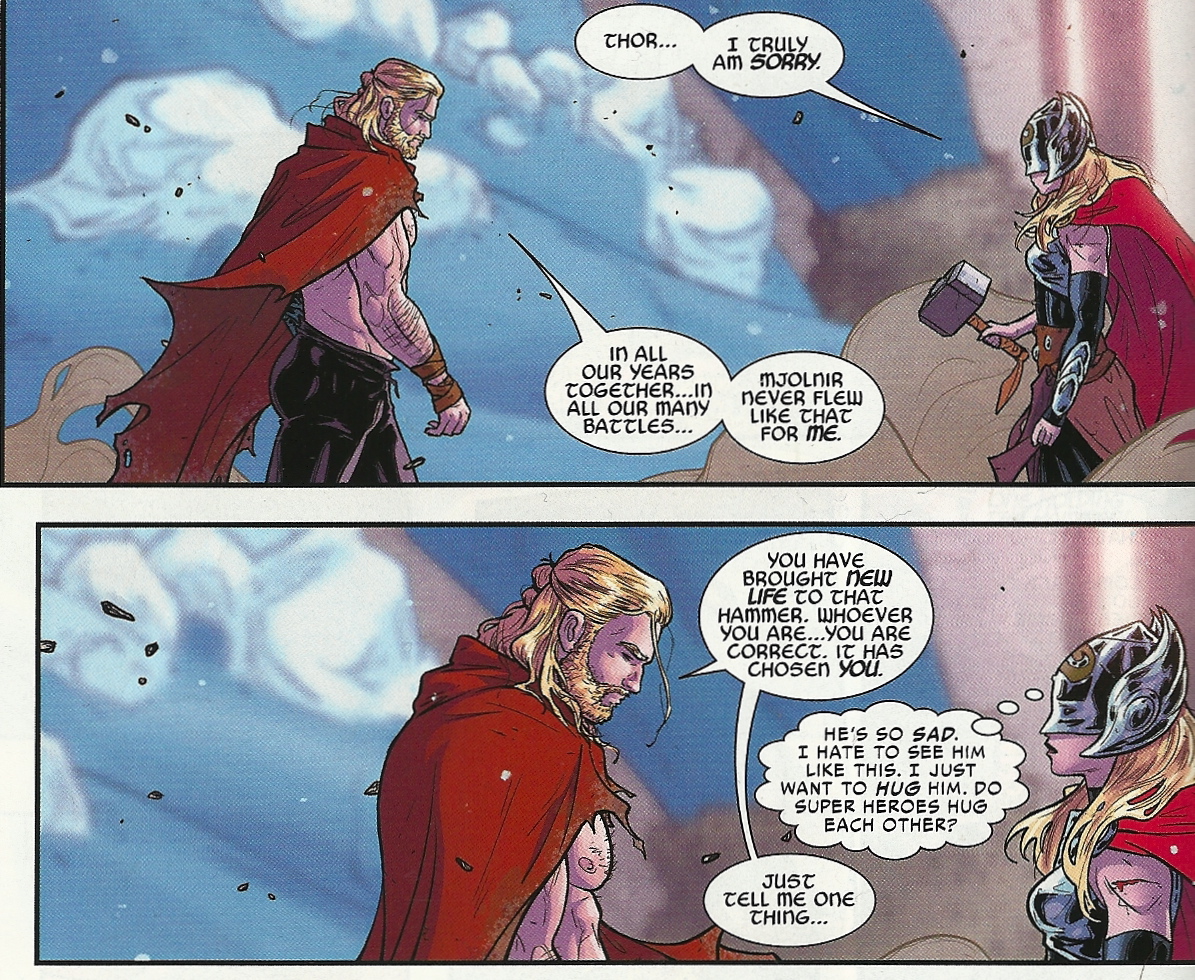
So that's why there's a new Thor. Unable to lift Mjolnir, Thor's still Thor, but he's not as Thor as he is with it, you know? At the end of that issue, a woman off-panel walks up to the hammer, says "There must always be a Thor," and then reaches for the handle. An "S" appears before the "he" part of "Whosoever holds this hammer, if he be worthy, shall possess the power of...Thor," and we gt a splash page revealing the new, female Thor.
I won't even pretend to know how Thor's powers "work." Originally (like, in the '60s), it was a lame doctor named Donald Blake who, upon lifting the hammer, became the Asgardian god Thor in a classic superhero transformation, but that was decades ago. I didn't understand that exactly, in terms of whether Thor and Blake were two completely different people, and what happened to the other when one was on-panel, so I certainly haven't been keeping up with the rules of Thor's transformations over the years.

With Blake, he changed appearances fairly completely, but in the other examples I've seen of people being able to lift Mjolnir, they can simply lift it, they don't transform into Thor, or buffer, blonder versions of themselves. So I won't get into whether this woman should become a man when lifting the hammer or anything.

I do wonder why she has a mask; she says she needs it, but there's no evidence of why she might within this volume. If Mjolnir changes the person holding it so completely–and she does get rather radically physically altered when she transforms–she really shouldn't need a mask. It's just there to give He-Thor something to wonder about, I guess; Dauterman is a fine artist, but all of his female's faces look enough alike that if She-Thor weren't wearing a mask, it's not like one would recognize her anyway

(Additionally, the lady who is really Thor doesn't have, like, an eye-patch or jagged scar or anything that would distinguish her from Generic Looking Comic Book Lady; every Marvel artist draws every Marvel woman their own way, and most of them seem to draw them all alike, so there's nothing by which to distinguish, say, Sue Storm from Emma Frost from Magik save their costumes.)

He-Thor doesn't seem to get too serious about sussing out the identity of She-Thor until the fifth issue, when he pulls an adorable scroll full of suspects out of his belt and crosses off a name with a quill pen.
As a mystery, Aaron's Thor is a bum one. There's only one woman (i.e. suspect) in the first issue, prior to She-Thor becoming She-Thor, and that's He-Thor's mom, Freyja. Later, She-Thor kisses He-Thor in a very un-motherly way, thus convincng the Odinson that it wasn't his mom who took his hammer.

The only other suspect in these five issues is Sif, who denies having the hammer, but wouldn't be above kissing He-Thor like that, even if she does seem pretty unhappy with him during their scene together (the climax of which is in the above panels).

Now, mystery aspects aside, like I said, I enjoyed this a lot, and found it to be a very well-made comic.

The power struggle between the two Thors mirrors that of Odin and Freyja. The All-Father left Asgard, now a floating city called Asgardia, for, um, reasons, and he left Freyja in charge as The All-Mother. Upon his return, he wants to be the boss again, which doesn't sit too terribly well with Freyja. Aaron's Odin is a wonderfully one-note character, all anger and bluster and more anger; he's even made amends with his long-lost brother, the bad guy from Fear Itself (Aaron's Odin is, essentially, the J. Jonah Jameson of Thor now).

While the Asgardians bicker, an army of frost giants marches on an undersea facility belonging to Roxxon, and while He-Thor can't get his magic hammer up, he eventually gets his shit together enough to grab his magic axe, mount one of his giant flying goats, and go to the bottom of the ocean to kill giants.
They have an unexpected ally in dark elf Malekith, who chops off Thor's arm and leaves him for dead.

It is then up to the new Thor, She-Thor, to try and save the day. Malekith (who both looks and acts infinitely cooler than the completely generic, personality-free villain he was in Thor: The Dark World) and the giants march on a flying Roxxon base, intent on getting a maguffin from Roxxon CEO (and shape-changing magic minotaur) Dario Agger. They've taken out The Avengers off-panel, leaving it to the new Thor to save the day.

She's almost there when the old Thor shows up, now outfitted with a dwarven-forged Uru robot arm, to fight the new Thor for his hammer. In classic Marvel style, the pair fight and then team up to defeat their common foes.

That is, in essence, the events of the first four issues, a fine introduction to a fine new direction. Aaron and Dauterman both excel at not only depicting the super-gods of the Marvel Universe in a way that makes them seem alien (from one angle) or mythic (from another), but also matter-of-fact. The delivery is deadpan, but that doesn't make it seem any less funny, or any less natural; a war-like society of space-gods on a flying city orbiting the moon is just the way things are, you know? Just as a private school for mutants run by superheroes is just the way things were in Aaron's Wolverine and The X-Men.

I really liked the new Thor almost immediately. Aaron writes her as almost two people in one. She talks in Thor-font, and with a heroic certainty, but thought clouds generally appear between her dialogue bubbles, questioning how she knows something or other, or why she said what she just said, or if superheroes should act in a particular way or another. It fits in nicely with the character, but, again, if I didn't know who the new Thor was, I imagine this would just read as a little weird (It does seem to eliminate Freyja and Sif though, who are perfectly comfortable in the world of Thor, and signal that whoever the new Thor may be, she's a normal woman from Earth, and not another superhero like, I don't know, Valkyrie, or is Thor Girl from The Initiative still alive?).

I also liked her desgin, and the way Dauterman draws her. The costume is even more "realistic" than that of previous Mjolnir-wielders, with only the red cape looking particularly superheroic. The mask, as odd as it seems that Thor would wear a mask, actually looks pretty cool, and immediately distinguishes the character from other Thors–because it's part of a helmet, and one with the upswept wings of the original Thor helm, it looks functional rather than a disguise.
I also like how relatively slim and little Dauterman draws the new Thor. She's not musclebound like the male Thor (and why would she be? Her super-strength comes from magic, not her muscles), nor is she a buxom default superheroine. Rather, she has to tilt her head to look up at Thor, she's got toned but slim arms, small breasts and generally looks too small to be doing many of the things she's doing–which makes for a particularly good contrast for her foes, actual giants, and, for a few pages, the old Thor himself, and makes it all the more visually dramatic when she wins those fights

(The variant cover artists don't stick to Dauterman's design. Sara Pichelli, Fiona Staples, Esad Ribic, Phil Noto and Arthur Adams all draw a very big and very buxom female Thor. In Adams' case, it was certainly to be expected, but dam it looks weird that they're encased in metal but are so...breast-y. The worst of all is probably Andrew Robinson's. And by "worst" I simply mean "at keeping true to the design of the character in the book. See below.)
The fifth issue in the collection features a guest-artist (at least, I hope it's just a guest artist; I really like Dauterman's work here) in Jorge Molina (He drew the panels with Sif and the scroll earlier in the post). The issue reads like an epilogue to the arc that fills up most of the collection, by the end of which He-Thor tells She-Thor that not only is she worthy of the hammer, but she should also use the name "Thor," so now I will quit calling them He-Thor and She-Thor, and resigns to go by "Odinson" himself.

On Earth, er, Midgard, Thor fights The Absorbing Man and Titania in Times Square, while in Asgardia Odin and his evil bro plot to find out who this new Thor is, and the Odinson very clumsily plays detective, but man, I love his scroll of suspects.

If the lady who is now Thor is going to keep being Thor for a while (and the post-Secret Wars Avengers line-up seems to indicate that she is), then I hope The Odinson moves to Midgard, rents an office and starts working as a private investigator.

Tuesday, November 12, 2013

I just saw Thor: The Dark World.

Whoever dressed Alexander for the premiere was more daring and imaginative than whoever designed Sif's costume for the movie.
THE BAD:

—The general, action-driving plot really seemed like it was still in pre-first draft, "just spit-balling here" form. As I understood it, long, long ago in a Lord of the Rings-style, Anthony Hopkins-narrated prologue, an army of space orcs had gotten their hands on a powerful, existence-ending weapon, but before they could use it, Odin's dad and his army wiped them all out. This one guy was like, "Hey, should we destroy this weapon or something?" But Odin's dad was all like, "No, let's just hide it somewhere no one will ever find it."

Instead of putting it in the Asgard weapons vault where they kept the maguffin from the first Thor movie—The basic plot of the two movies was pretty much identical, right? Ill-defined ancient weapon from their super-viking ancestors falling into the wrong hands?—or even a safety deposit box or a rented storage unit or a high school locker with a combination lock from K-Mart, they just stuck it in the middle of an abandoned warehouse in a dodgy part of London?

And then the weapon gets stuck inside Thor's girlfriend and the space orcs awaken from hibernation and want to get it back and so there's a bunch of fighting.

—Both Thor movies have big, expansive, awesome supporting casts...and little for any of them to do. Renee Russo as Thor's mom has a lot more to do here (I just had to check IMDb to see if she was even in the first movie), as does Idris Elba as Heimdall, but poor Sif (Jaimie Alexander; see above) and the Warriors Three don't have any more to do then they didn't have to do last time. Each gets at least one decent, several seconds-long scene, and Zachary Levi's Fandral gets a few quips, but they're all fairly wasted. Poor Hogun the Grim's entire contribution to the film is telling Thor early on that he's pretty much gonna sit this film out, thanks.

I guess Marvel will have to do a spin-off if The Warriors Three are ever really going to get their due. Given how much people seem to love Tom Hiddleston's Loki, maybe they'll eventually do a Loki or Tales of Asgard movie, just featuring Hiddleston, Sif and the Warriors Three, with Thor and Odin sitting the movie out...?

Ooh, or maybe they could do a Sif and The Warriors Three show on cable? That would certainly be a lot less boring than Agents of SHIELD show looks, right? Marvel meets Game of Thrones, winds up somewhere in the vicinity of Hercules: The Legendary Journeys/Xena: Warrior Princess...?

—I thought the Cursed (Or was it spelled Kursed?) looked pretty dumb. His mask reminded me a bit of the one the Predator wears, which is kinda weird, because the alien runes flashing in the space orc ship look like the red alien writing that appears in Predator ships.

—As with Iron Man 3, and, I suspect, all of the post-Avengers Marvel "Cinematic Universe" films from here on out, this one suffered a bit from leaving unanswered the question of just where the hell the rest of the superheroes were.

I mean, there was a straight-up alien invasion of London, and no one shows up but Thor and two fighter jets? Where was Iron Man? Where was the Hulk? Where was Nick Fury and SHIELD? Once you establish the fact that these guys all know each other and occasionally get together to defend major cities from alien invasions (and repeatedly make reference to that throughout your film), it feels a little...weird when no one shows up to help Thor save London from alien invasion.

—Needed more shirtless Hemsworth.

Yes, he looks good shirtless or in a cape and armor, but he cleans up nice too.
THE GOOD:

—I liked the creepy white masks the space orc footsoldiers wore. High-five, whoever designed those!

—Pretty much all of the performances were either really good, or rather effective for conveying what little emotional content they were called on to portray.

Hiddleston stole the show; the audience I saw it with laughed at pretty much every line of dialogue he was given. Kat Denning was a definite highlight, and, I think, was to Natalie Portman's Jane Foster what Hiddleston's Loki was to Hemsworth's Thor: Someone more vibrant and engaging you would prefer to see a movie about (Really glad they not only had her return, but gave her more to do this time around).

Portman was good, and gave the movie some star power and all (ditto Anthony Hopkins), but her character seemed almost crowded out of the film. There's just not enough room to explore her character and her character's relationship with Thor, even though that's meant to be the emotional core of the film franchise. Ah well.

I do kinda wish Hopkins wasn't playing Odin though; I would love to see what a Liam Neeson Odin woulda been like.

—The big battle sequence in which the space orcs attack Asgard was pretty awesome. I liked their ships, and the way those ships moved around, and the mixing of the sci-fi and fantasy elements into something that felt appropriate, like if you squinted one eye and titled your head, you could see how all of these figures would have seemed like gods and monsters to some, and if you squinted the other eye and maybe tilted your head the other way, they just seemed like space aliens.

The battle, with its whizzing, rotating space ships that resembled giant flying swords, really reminded me of Star Wars, and the entire sequence had a sort of Star Wars + Lord of the Rings aesthetic and feel to it.

—I think they managed to find an Iron Man-like tone to this film a bit better than in the original. There's a lot of quipping and sarcasm, sure, but there's a light touch to almost everything, including the apocalyptic battle between the forces of light and dark at the end of the film. Despite the serious, even grim title, Thor: The Dark World was fun.

—Thor hanging his hammer on the coat rack was maybe my favorite part of the film. That was the point where I thought, "Yes, this $5 bill and few hours of your life was well spent, Caleb!"

—Stellan SkarsgÃ¥rd nude scene!

How weird is it that for all the gorgeous human beings in this movie that millions of people would enjoy seeing, and happily pay money for the opportunity to see, in various states of undress—Hemsworth and Hiddleston for the ladies, Portman, Denning and Jaimie Alexander for the gentleman—it was SkarsgÃ¥rd who had the only nude scene, and plays  the only character that spent the majority of the film not wearing any pants?


Oh, and let's make sure Denning's character appears in that Thor-less spin-off movie I was imagining earlier, okay?
SO, THAT MID-CREDITS TEASER?

Honestly, I was kind of hoping for Rocket Raccoon, but I have to admit to being surprised to the point of shock with that particular character appearing. I'm assuming that's setting up something in Guardians of the Galaxy or Avengers 3, but, well, that's just not one of the top, say, 75 Marvel characters I would think to see appearing in a movie in any capacity at all.

The scene is short, but holy smokes it really seemed like part of an entirely different Cinematic Universe than the one all the Marvel Studios films up until this point have shared.

Tuesday, May 10, 2011

Some thoughts on Thor (the movie), in which spoilers will likely be mentioned

1.) I read and loved the first half of Roger Langridge and Chris Samnee’s recent, all-ages Thor: The Mighty Avenger series. In 2004 I read that Garth Ennis Max miniseries Thor: Vikings. And, of course, I came across the characters in The Ultimates, DC Vs. Marvel and various crossover stories, but that’s about it for my Thor comics experience.

Unlike most superheroes or comics characters to make it to the big screen, I don’t really have a favorite version or take, nor do I have any strong feelings regarding the character. Hell, I barely have any feelings about him.

2.) My expectations were set very, very low. There’s a…pointlessness to a Thor movie in 2011 that made me somewhat apathetic about the whole thing. From where I sit (in front of a computer, reading and writing about comics all goddam day), it really only seemed like they were making a Thor movie so people would know who the character was when he showed up in the Avengers movie.

3.) I liked the movie. It’s not a great one, and no, it’s probably not even a very good one, but I can really only point to one major problem with it, and nearly everything else I was dissatisfied with seemed to fall into a “I would have done it differently” or “I think it might have been cooler if they did it this way” sort of category of criticism.

Unlike a lot of superhero movies, it is neither terrible nor a mixed-bag. I think Spider-Man, X-Men and Iron Man were all superior films, but Thor was certainly closer to those three than the rest of the movies based on Marvel comics.

I’d recommend it to anyone who asked me if they should see it.

4.) That major problem? It was structural. The movie felt too short to me. Maybe it was short, maybe it just felt that way, but the conflicts that didn’t involve hitting seemed to resolve themselves far too quickly, and while I could suspend my disbelief for all the magic, mythology and super-science, I didn’t really believe that Thor and Natalie Portman had time to get to know each other, let alone love one another. I didn’t believe that Thor had time to actually learn his lesson. The entire time spent on earth seemed relatively too short, if that is supposed to be the emotional crux of the thing. (And it is).

I’m not entirely sure how to resolve this, without adding plenty of running time. Less time could have been spent in Asgard and the space-Norse realms in general, which might have made for better drama and a better film, but that would have meant fewer fight scenes, and, I imagine, a cut the studio would not quite care for.

Thor really only does one heroic thing on planet Earth; there’s only one real fight there, and it’s not really much of one.

5.) I thought Chris Hemsworth did a really good job as Thor. I wonder how much it helped that he was an unknown actor (to me). Often times when the guy playing the lead hero is a well-known quantity, it can be hard to separate the character from the actor. For example, I keep forgetting the name of Natalie Portman’s character (It’s Jane Foster), because whenever I see her I just think of her as Natalie Portman (this doesn’t at all hurt the movie, mind you; I imagine bleeding-edge astrophysics and cosmic storm-chasing are the sorts of things Natalie Portman really does all the time, when she’s not showing Jason Schwartzman her bum, overthrowing fascist Britain or putting up with that Anakin douchebag).

Hemsworth is a handsome man, and I think they should have had him in states of undress a little more often, in order to increase the film’s appeal to the ladies.

6.) I thought Portman was okay too, but man, she didn’t really have much to do.

There’s one neat scene between the two where she’s in her living place and he comes to visit unexpectedly and she gets totally flustered that’s really charming (It’s also the sort of thing you usually see in movies with the roles reversed; that is, a supernaturally hot lady makes our plucky male hero act like a crazy person in her presence). As I said before, the two don’t really spend much time together.

7.) Hemsworth and Portman make a great couple, visually. Like, just the way they look together, physically, accentuates the whole “from two different worlds” thing. I would have loved to see them banter and flirt in more will they or won’t they scenes of the sort that made The Mighty Avenger comics so fun.

8.) Kat Dennings is in Thor! Why didn't anyone tell me Kat Dennings was going to be in this movie? Surely with all these comics-related blogs covering every tiny bit of news regarding every superhero movie, I should have read about her being in the movie at some point before I saw her in it. Or did I already read that Dennings was going to be in Thor, and it just didn't register with me because at that point I hadn't yet seen Nick and Norah's Infinite Playlist (which is really great) and Defendor (which is also pretty great)?

Yes, it turns out that that is indeed the case.

I like Dennings.

This role's no great shakes or anything, but I thought it rather interesting that she played it, as the funny, geeky sidekick character she plays here seems like the sort that would typically be played by a male actor.

9.) I thought it interesting that the filmmakers plucked Thor’s visual appearance and the way he’s perceived from Mark Millar, Bryan Hitch and Paul Neary’s The Ultimates—long hair, scruffy little beard, folks think he’s
probably crazy–and that’s about it. One of the genuinely suspenseful and dramatic elements of The Ultimates, perhaps Millar’s last good comic, was the ongoing subplot of whether Thor was really the Norse god of Thunder, or just an insane superhero who thought he was. That, and the way a religious cult sprang up around him, and he used his political influence to try and effect changes he believed in.

10.) I’m sorely disappointed that a live-action film based on Marvel’s Thor was made, and at no point did he say “I say thee nay.” Also, I don’t recall hearing “verily” at all. (The screenwriters did, as the Thor action figure in the little video “JustSomeRandomGuy” explained, “toneth things down substantially for thine MTV generation” in terms of the fake Shakespearean dialog (Fakespearean?). Mostly, the gods just have English accents.

11.) I was also a little sad not to see Thor’s goats. Sleipinir did make an appearance, for which I was grateful—and a little surprised, given that the gods mostly just teleport from place to place.

This is off-topic, but I’ve actually spent a long time thinking about what the eight-legged horse should look like, design-wise. They put an extra set of legs between each of the normal set of legs.

12.) This film marked the first time I had ever heard the word “mjolnir” pronounced out loud. I always pronounced it “muh-jolnir” in my head, because
that’s what it looked like, even though I suspected either the m or the j was silent.

When Dennings first said it, it sounded like “Mew-mew” to me, and I thought she said it like that because here character was purposefully mispronouncing it for comedic effect. But no, I guess that’s how they pronounce it.

13.) I saw it in 3D, because the only theater in my hometown was only showing it in 3D. That hampered my enjoyment a bit, as I had to pay more, wear a pair
of glasses over my glasses and the film didn’t really seem intended to be seen in 3D. The effects didn’t really add anything, and actually just subtracted from the coherence of some of the action scenes, making them look even faker and sillier.

14.) This was the first time I had ever seen a Kashi brand cereal receive product placement. There’s a shot in Foster’s trailer that seems set-up
specifically to reveal the Kashi logo on a box of cereal in the foreground, and it looks extra-obvious in 3D. That was actually the only 3D component that really struck me—the product being product-placed seemed to be closer to me than usual.

15.) Let’s talk about design for a bit.

It’s really a damn shame that for all the superhero movies of the past decade, none has really been devoted to trying to translate Jack Kirby’s particular, peculiar, powerful aesthetic to the medium. I think Thor would have been the perfect film to do so, as I’ve always had the sense that it was one of the nearest and dearest characters/properties he worked on, especially given the way he would return to the gods as superheroes theme over and over during his career.

Therefore, it would have been nice to see Kirby’s Asgard, Kirby’s bifrost, Kirby’s Asgardians—funny hats, brilliant colors, nonsensically filigreed technology and all.

We don’t get that here (Maybe a Fourth World movie will give it to us, if the superhero film boom doesn’t bust before Warner Brothers works their way down the superhero hierarchy to reach Mister Miracle or Orion).

I also wouldn’t have minded a more straight-outta mythology take on Asgard and the Asgardians, in large part because while I’ve seen Greek myth adapted to the screen over and over and over, Norse myth is still mainly missing from the big screen—at least, it’s never had its Clash of the Titans-style showcase in pop Western cinema.

Unfortunately, because Thor is set in the same “universe” as the two Iron Man movies and The Incredible Hulk, it has to adhere to the aesthetic of those films. That is, Thor’s costume has to look like it belongs in the same movie as Iron Man’s.

That’s part and parcel to a shared universe, or, at least, it is in a purposefully created to be a shared universe shared universe, but it erects a lot of barriers and puts plenty of constrictions on the imagination.

The two biggest and longest-lived pop culture shared universes, the Marvel and DC universes, emerged slowly over time and often at random, which gives them their peculiar charm. Making such a universe on purpose can prove troubling(look no further than Marvel’s problems maintaining the once well-managed and constantly manicured Ultimate Universe).

While I would have loved to see Thor go Full Kirby, or even for the producers to do their own Norse Myth-as-21st Century Superhero Saga from scratch, they do achieve a decent enough balance of comics adherence, faithfulness to the look established in Iron Man and passable movie costuming.

16.) Asgard is a pretty underwhelming place. It’s strangely underpopulated—Thor, Sif, The Warriors Three, Loki, Odin, Heimdal, Odin’s wife, two guards…I think that’s everyone there—and when crowds or random people appear, it is only in all-CGI longshot. The scenes in Asgard proper mostly look like scenes from the second Star Wars trilogy, only without all of the movement and people/aliens/wildlife sucked out. It looks…cheap, I guess the word is.

17.) The Warriors Three are pretty awesome. Fandral especially looks true to his original design, and I really wanted to see more of him and the others as Thor’s running crew. Hogun was missing his hat, but otherwise looked good; Volstagg was pretty off-model, unless “big guy with a beard” is enough.

I did hear reference to "Fandral The Dashing" and "Hogun The Grim", but I don’t recall hearing “Volstagg The Voluminous” at all.

I would rather see a Warriors Three or Thor and The Warriors Three than a Thor 2 at this point, to be honest.

18.) Loki seems more like The God of Passive-Aggressiveness than The God of Mischief.

19.) I didn’t care for the look of the Frost Giants. They basically look like Lord of the Rings orcs, with Iceman powers they use to create ice swords and maces on their fists. On first appearance, they don’t look very big either.

Their world is pretty drab and uninspired too. It’s very dark and murky looking, and all gray rock and ice. The biggest action scene of the film is set there, and the darkness coupled with the 3D and all the CGI made it about as easy to scan as a Transformers action scene.

It’s too bad, because it’s the main showcase for the Warriors Three, and the scene in which Thor does most of his hammer-swinging.

20.) The Avengers/Marvel movie universe tie-ins were fairly well handled, I thought, and didn't really derail the proceedings to the extent that they messed with Iron Man 2. There's another Avenger in here, but he has little more than a cameo, and only gets a few lines, so it's not like Sam Jackson and Scarlett Johansson commandeering scenes for themselves (Please note, I have never not been happy to see either Jackson or Johansson show up on a movie screen for any reason, but I think their characters' inclusion in Iron Man 2 hurt the overall narrative).

By the way, I can't wait to see what they do with Hawkeye. Will he just be some dude standing around with a bow for some reason? Will he have the lame Ultimates "costume" of, um, sunglasses? Will he be in purple, with a loincloth and a big stupid H on his hat/mask/hood? There are so many poor choices to choose from, I can't wait to see which they go with!

21.) I stayed all the way through the credits to see the Avengers tease.

As they scrolled by, I saw a line that said “Thor will return in The Avengers.” The credits for 1983 Dan Aykroyd vehicle Doctor Detroit promised that Doctor Detroit would return in a sequel, and he never did.

22.) So, about that ending—what the fuck was that supposed to be, anyway? The Cosmic Cube? It was a pretty lame tease.

Thursday, November 25, 2010

Big-Two super-comics that sold worse than Thor: The Mighty Avenger

You've no doubt already heard that Roger Langridge and Chris Samnee's recently all-ages Thor: The Mighty Avenger series is about to be canceled.

If you haven't heard, then you must not read much about super-comics on the Internet, as it was one of the top topics of conversations over the course of the last week or so. (Exhibit A, B, C, D, E, F and G, for starters).

Shortly after all the chatter climaxed and started to die down a bit, The Beat posted their regular, monthly features analyzing the available data regarding comic book sales from DC and Marvel in a given month.

These numbers, remember, don't reflect reality in a one-to-one relationship, but are estimates, and are associated with the number of copies of comics that retailers ordered through Diamond distributors in order to attempt to sell them to customers. That means the numbers are more valuable in determining the relative success of particular titles to one another, rather than determining how many people are buying a particular issue of any particular comic.

Given that Thor: The Mighty Avenger just got the axe, something rather unusual for an all-ages book like that, since they all do pretty terrible in the direct market (presumably selling better outside the direct market, either through subscriptions or in trade format later down the road), I thought it might be worthwhile to look at how it sold in comparison to other titles that haven't yet been canceled.

First, here's Paul O'Brien's Beat column looking at Marvel's month-to-month sales for September, the latest numbers available. O'Brien notes that September's issue of Thor: The Mighty Avenger #4 placed at #177 on the top 300 list, with 10,887 units. His only comment? "Better than usual for an all-ages book."

That is a pretty decent number for one of the Big Two's kid-friendly, continuity-lite titles, although maybe the fact that the first issue had around 20,000 units ordered was the significant factor here, since the title's sales seem to have plummeted by 50% in just a few months. Was it the rate of decline more than the actual units being ordered that doomed the book?

It's also possible that maybe Thor: The Mighty Avenger wasn’t being viewed by Marvel as an all-ages book, and, compared to a Marvel Universe title, it was selling quite abysmally?

Or maybe Marvel simply got what they needed from the book already, and it didn't really matter if they stopped producing new issues of it or not. By the fourth issue, they would have had enough for a trade, and I suspect the reason for the Thor glut now wasn’t necessarily to get four-to-ten Thor comics into the hands of readers each month so much as to guarantee a big enough stockpile of solid, modern Thor comics on hand that Marvel could package enough of ‘em in to trade to sell to people who have their interest piqued when the movie comes out (I assumed this is why Dynamite has been aggressively publishing Green Hornet comics like there’s no tomorrow…once the movie window closes and "The Sterling Effect" takes effect, there effectively is no tomorrow for Green Hornet comics. At least, not a half-dozen in a half-dozen different Green Hornet continuities anyway).

Here are the Marvel-published titles released in September that charted worse than Thor: The Mighty Avenger: Halo: Boot Camp #1, Iron Man 2: Agents of SHIELD, Hercules: Twilight of a God, Anita Blake: Vampire Hunter: Circus, Hit Monkey, X-Campus, Cassanova, Gorilla-Man, Rawhide Kid, Marvelman Family’s Finest, Spider-Man (Only 5,779! That’s around half of Thor!), Super Hero Squad (5,304!) and Sky Doll: Lacrima Christi.

Other than Spider-Man and Super Hero Squad, those are all reprints, miniseries or defacto ongoings in the form of a series of miniseries. It’s difficult to see what the difference between the all-ages Thor and the all-ages Spider-Man comics might be, especially given Thor’s far, far superior sales. Does the Spidey team just work half as cheap as the Thor team or something?

And because it's so much fun and perfectly healthy to turn every discussion of mainstream superhero comics into a DC vs. Marvel thing, why don't we also look at Marc-Oliver Frisch's column on DC's month-to-month sales for September of 2010.

At DC and its Vertigo and Wildstorm imprints, these are the books that were selling worse than Thor: The Mighty Avenger in September: The X-Files/30 Days of Night, Doom Patrol, The Spirit, Hellblazer, Sweet Tooth, Azrael, Daytripper, House of Mystery, Tiny Titans, Northlanders, God of War, Tom Strong and the Robots of Doom, The Authority, Batman: The Brave and The Bold, DMZ, Scooby-Doo, Where Are You?, The Mighty Crusaders, Ratchet and Clank, Fringe, Wildcats, DV8, Wetworks: Mutations (Just 5,083), Greek Street. That’s mostly Vertigo and Wildstorm and the unofficial "Johnny DC" imprint books, plus many of them are limited projects.

Still, there are plenty of ongoing concerns, notably a few them that are both on the DC Comics imprint and part of the DCU line, like Doom Patrol and Azrael, both of which seem safely uncanceled through February at least.

DC is therefore more reluctant to axe low-selling titles...is that a good thing or is that a fault?

Certainly it doesn’t seem likely that either Azrael or Doom Patrol are suddenly going to catch fire and reverse their downward trends—super-comics hardly ever reverse their downward trends in sales and, when they do, it's generally something that happens for a month or two. The goal, based on years of reading these charts, is apparently to lose sales very, very slowly, or to maintain the same sales, rather than improve them.

Looked at that way, Marvel's ruthlessness in cutting a title like Thor: The Mighty Avenger seems to make better business sense, however from a creator's point of view I'd imagine DC's reluctance to pull plugs is seen as a better situation. When DC finally does cancel Doom Patrol or Azrael, for example, those involved shouldn't be the least bit surprised or resentful that the publisher never gave the book's a chance.

Well, farewell Thor: The Mighty Avenger! I'm sorry I trade-waited you, now!

Monday, May 03, 2010

My Free Comic Book Day, and reviews of what I got

This past Saturday was the very first Free Comic Book Day I spent in a city other than Columbus, Ohio, so it was the first Free Comic Book Day I didn't observe at my former local comic shop, The Laughing Ogre (which I'd highly recommend to any Columbusites looking for a good comic shop!).

My new "local" comics shop is a bit of a drive from my current base of operations, and since there are only a single comic currently waiting for me in my pull file, I didn't think it was worth a visit just to celebrate my hobby's national holiday this year.

I was thinking I'd probably just sit this one out, but late Saturday morning decided that FCBD might provide a good excuse to visit a new shop, for exploration's sake.

According to the FCBD locator at freecomicbookday.com, the nearest participating shop to me was Comics and Friends in the Great Lakes Mall in Mentor, Ohio. So I decided to take a little field trip.

Mentor is a town of about 50,000 somewhere around 15 to 30 minutes east of Cleveland, and is the one-time home of 20th president of James Garfield, as well as home to the urban-legendary monsters known as the Melonheads (which I've discussed in some detail in this 2008 posts about some Ohio monsters).

I haven't been to The Great Lakes Mall since, I don't know, high school, and I don't recall there having been a comics shop there the last time I was. Comic shops in malls are probably fairly common, but seemed a little...weird to me, and put me in mind of Mallrats. As in the movie, there was a lot of activity around the shop.

Some sort of police show thing was going on, so the center of the mall was filled with police vehicles, and right in front of the comics shop there was a display of various police uniforms and riot gear. Maybe they were recruiting...? Also in front of the shop was a person in some sort of cow furry suit with a young woman passing out fliers. I think they were from that chicken place that has cows encourage people to eat the flesh of chickens instead of the flesh of cows.

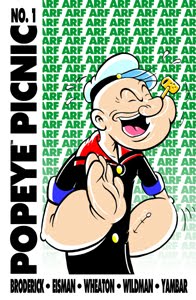
Comics and Friends had a comics pro doing a signing this FCBD. Simpsons comics writer Chris Yambar of Youngstown, Ohio (about an hour and twenty minutes south of Mentor) was seated behind a table with plenty of his wares near the entrance (I'm unfamiliar with Yambar's Simpsons writing, but he's a frequent visitor to Columbus' Mid-Ohio Con, and I have a couple of trades he's written, one a licensed comic based on the TV show I Dream of Jeanie, the other a funnybook about El Mucho Grande, a gigantic, rather round lucha libre).

Also near the entrance were two tables, each full of stacks of specially produced Free Comic Book Day free comics. One table was for all-ages stuff, the other for the less kid-friendly stuff. I didn't see every single FCBD offering available—I heard one mother searching in vain for "the Toy Story" comic, and I didn't see the Oni offering, but they sure seemed to have everything else. The signs standing atop the two tables which mentioned the age appropriateness said that visitors could choose any two comics.

A young woman behind the counter was dressed as Harley Quinn, and there was a 50% off sale on trade paperbacks and collections for club members, which I assume are customers with pull-lists there.

That seemed to be the extent of the FCBD celebration there. Like I said, it was my first time at the shop, but it seemed like a pretty nice one. They had a ton of trades, and it seemed like it was more graphic novel oriented than comic book-comic book oriented. A crowded back wall had all of the new single issue comics stuffed on it, and there were some back-issue long boxes, but most of the store was devoted to shelves of trades, as well as some toys and comics-related books and magazines and the like.

I'm no expert on comics retail or anything, but they seemed to have a pretty good set-up in terms of displaying things. I noticed a lot of kid-friendly, all-ages stuff as soon as I walked in and in the most accessible and visible areas, the superhero stuff all shelved along the wall, and some grown-up, pin-up art books behind the counter. There were also some spinner racks in the back with Dell and Gold Key comics in plastic with backing boards, selling above cover price (I saw an Uncle Scrooge comic for about a $11 or so).

If I lived closer to Mentor, and/or had occasion to visit there a couple times a month or so, I'm sure I'd be happy to visit the shop and make it my regular stop, despite not really liking the idea of having to go through a shopping mall to get to it.

Anyway, here are reviews of everything I got there on Free Comic Book Day, including the books that weren't free...


Free Comic Book Day 2010 (Iron Man/Thor #1)

I was kind of torn between the two Iron Man team-up comics Marvel was publishing this year. The Iron Man/Nova book featured a script by EDILW favorite Paul Tobin, and a plot involving The Red Ghost and his Super-Apes, but I ultimately went with this one because a) it featured John Romita Jr. art, and I was curious to see him draw these two characters given that he’ll soon be drawing them monthly as the regular artist of one of Marvel’s 17 new Avengers books and b) I wanted to see how Marvel would be presenting these two characters to a potential new audience excited by the Iron Man movie, as comic book Iron Man has had very, very little in cartoon with movie Iron Man for the bulk of the last four years or so (The main thing Iron Man the movie and The Invincible Iron Man have in common is that they’re both pretty good).

This book is presented in a smaller format than the standard modern comic book; it’s nine-inches high and six-inches wide, rather than the standard ten-inches-by-six-and-a-half-inches.

It sure looks dinky sitting there before you, but once cracked open, it reads just fine; I didn’t notice the lack of an inch here and a half-inch there at all, and realized I could easily get used to reading comics of this size. I suppose it’s too late now, but if Marvel had to start trying to increase their profits by a ridiculous amount in the past few years, saving money by reducing the trim instead of rocketing the price up 33% would have been a less pain-less way to go.

The script is by Invincible Iron Man writer Matt Fraction, which is of course a pretty great choice, considering Invincible Iron Man is certainly the place to point readers who dug the first movie (and, I imagine, the second one). It’s a pretty straightforward, all-ages-friendly, no-continuity-knowledge-needed done-in-one, emphasizing Tony Stark as a cocky, charming genius always seeking to make amends for his time spent developing weapons and Thor’s otherworldliness.

The Earth’s weather system is going a little nutty, and not listening to storm god Thor’s commands. Meanwhile, a bunch of rich folks are terraforming Earth’s moon for condos, using a weather weapon Stark once developed, and the two Avengers team-up to set things right. This includes a whole bunch of robot fighting.

Romita’s art is just as good as I expected, maybe even better. I’ve never really gotten used to the “New Look” Thor, but Romita really sells it, and I love the way his Thor exudes power through his posture, expression and casually flexed muscles.
Romita’s one of the only Marvel artists currently working regularly for the publisher whose work provides a clear, straight-line link back to the work of Jack Kirby, Steve Ditko and, yes, John Romita Sr.; JRJR’s art is Marvel Comics art at its purest, looking both current and classic at the same time.

And damn, he draws some nice Thor-smashing-shit-with-a-hammer panels: House ads: A teaser as for the X-Men vs. vampires thing that Marvel stole from Mark Millar’s dreams while he was sleeping, featuring a blood-splattered X over a yellow background and the cryptic “We are the X-Men, July 2010, Marvel”; an ad for The Art of Iron Man 2 book; an ad for Brian Michael Bendis, JRJR and Klaus Janson’s Avengers series, which launches this month; an ad for a ten-foot-long, $35 poster featuring The New Ultimates by Frank Cho, which seems a silly ad for this audience (if you were going to advertise a ten-foot-long, $35 poster to a “lay” audience, shouldn’t it be one featuring characters the readers are more likely to be familiar with?); an ad for “Brand New Day” collections of Amazing Spider-Man; an ad for Astonishing X-Men: The Motion Comic on iTunes; an ad for Invinicible Iron Man #25, which, like JRJR’s upcoming Avengers, is a natural place for people who dig this to look for more like it; an ad for the first collection of JMS and Olivier Coipel’s run on Thor, and a full-page ad saying “Iron Man and Thor Appear In…Invincible Iron Man #25 On Sale Now!…Thor #610 On Sale 5/26!”


Yow! Drawn & Quarterly Presents A John Stanley Library Grab-Bag for Free Comic Book Day 2010

Yes, that’s the title of D&Q’s offering, according to the fine print. There were a lot of fairly exciting comics out this FCBD, and, honestly, I would have been at least curious to at least scan just about all of them, but this is the one I just plain had to have.

Which is perhaps silly of me, since I imagine many of these stories will be available in the eventual John Stanley Library collections and I’ll read them all eventually anyway, but I really wanted to take the opportunity to read all of these strips in an actual comic book-comic book format for once, rather than in a handsome collection. Just to experience them in their native habitat, I suppose.

Seth’s cover promises a sort of crossover of characters from various Stanley comics—Melvin Monster, Tubby, Judy Jr. and Nancy—all drawn in Seth’s stripped-down, super-simplified, off-model style. I also like the mystery of the cover. Not only am I unsure why Nancy’s so thin and has eyeballs around her pupils, I have no idea what’s going on in this cover. Are they all running and crying? Screaming? Singing?

The contents, printed in full-color on pulpy paper, are as follows: A Nancy strip in which our heroine visits Oona Goosepimple’s crazy house and encounters some of her relatives, a Tubby story in which Tubby wakes up one morning to discover he has grown a real moustache in his sleep, a Judy Junior story in which she terrorizes poor Jimmy Fuzzi (I don’t like Judy Junior strip at all; like Witch Hazel stories in Little Lulu, for some reason I just can’t stand them despite loving everything around them), a second Nancy story in which she flees from tough guy Spike, a Melvin Monster story in which Melvin is followed home by a Thing, and a Choo-Choo Charlie story involving Choo-Choo Charlie and his, um, Choo Choo…?

With the possible exception of the Judy Junior story (and, it’s worth noting, that’s more of a personal taste thing than a These Are Bad Comics kind of thing), they are all a lot of fun, and it’s a nice sampler platter of Stanley’s range. It’s really something to see that last page of the Melvin Monster story next to the first page of the Choo-Choo Charlie one, for example, and realize the same talent is behind two comics with such extremely different visual styles, character designs and types of gags.

This was my first exposure to Choo-Choo Charlie, whom a quick Internet search tells me was actually a mascot for Good and Plenty candies (which I’ve never been able to cotton too; I like the way they look, but I hate the taste of ‘em), and the designs in the comic look very little like those from other Stanley books (although I suppose he didn’t design either the Nancy characters or the Little Lulu one’s himself, huh?). The narrative is also quite random and silly compared to the slow-building, usually grounded in the real world gags found in Stanley’s most popular comics.

But at the end of the day—well, the end of the 45 seconds or so I spent glancing between the tables trying to decide which free comic books to grab—what ultimately sold me on Yow! was the Tubby story.

It might take me some deep thinking and some serious writing to determine and then properly communicate why I love Tubby so much, but, since I met him in a volume of Dark Horse’s Little Lulu reprints, he’s become one of my favorite comic book characters, and this story is just fantastic, featuring scenes of the entire world freaking out because a little boy has grown a mustache, upsetting the balance of nature,and a scene where Tubby’s mom tells him she just doesn’t love him.(By the way, you can download the entire seven-page Tubby story from Yow! here)

I’m sure it doesn’t really make economic sense for D&Q to do so, or they would already be doing it, but, for whatever it’s worth, I would love to be able to read a John Stanley kids comics anthology comic book like this on a regular basis. Preferably monthly, but quarterly would work as well.

Also, more regularly appearing comics along these lines might mean more letters pages like this:

House ads: A full-page ad for the upcoming fifth volume of Tove Jansson’s Moomin (and the publisher’s Moomin line in general), featuring a blurb from Neil Gaiman; a half-page ad for Who Will Comfort Toffle?, the next Tove Jansson storybook set in the world of the Moomins, this oen featuring a quote from Jeff Smith; a half-page ad for Doug Wright’s Nipper 1963-1964, with a blurb from Lynn Johnston; and, finally, a full-page, back cover ad for the John Stanley Library collections, including an upcoming collection I think I may have heard about, rejoiced over, and then forgot about, because when I saw this ad I turned a cartwheel:You know how I said I loved Tubby earlier? He’s my favorite part of the Little Lulu comics. So this? This is kind of like…you know how when you’re a little kid, you love sugar at the exclusion of all else? So a bowl of Lucky Charms with nothing but marshmallows sound delicious rather than disgusting to you? Well, that’s what an all-Tubby collection sounds like to me.

I’m curious about this books existence, as I would assume Dark Horse had the rights to Tubby comics as well as Little Lulu ones, but I guess not.

Anyway, there’s another reason to look forward to summer…


********************


Now, I always end up spending a lot more money than I mean to when I go to the comic shop on Free Comic Book Day, even though it’s usually the second time I’ve been there that week.

I guess I feel guilty for going to a shop and getting something for nothing, especially since I’m already a regular, die-hard comics consumer, rather than the sort of “civilian” or casual reader the day is designed to hook on comics. That is, surely there are people the FCBD organizers, comics publishers and retailers would rather have picking up these The First One’s Free, Kid bait books, and I feel like everyone I get is sort of a waste.

So I usually end up impulse buying a graphic novel or two while I’m in the shop.

This year was no exception. I picked up a couple of things from Yambar’s table, and a cheap graphic novel on my To Buy, Someday list. In an effort to make this already interminably long blog post ridiculously long, I'll review those too...


Lucha Pop! (Airwave Comics)

I would have passed on this 64-page, “prestige format” comic were Yambar selling it at its $8.95 original price, but he’d knocked it down to $5, so it seemed a safe gamble: How bad could a book of stories about Mexican wrestlers be?

Inside are four stories, each written by Yambar, penciled by George Broderick Jr. and inked by Ken Wheaton.

The first features “Major Smackdown, Lord of the Ring” (Who doesn’t have a terribly Mexican sounding name) and his understudy Understudy in “Quest For The Blue Tiger Diamond.” The pair board a plane taking the titular magical diamond to evil figurehead type Fire Dragon’s hideout in the Himalayas, and attempt to stop the bad guy from doing something bad with it. Broderick and Wheaton work in a Bruce Timm-inspired, “animated” style, and the tone of the script is remarkably…straight, given the zaniness of the material.

This art style re-appears in a later story, featuring “Sainto, God’s Own Wrestler” in a two-page origin story and a sci-fi/lucha libre/private eye mash-up entitled “…Then She Walked In,” which has a much lighter tone to the script.

There are also two comedy stories featuring El Mucho Grande, drawn in a much looser, more cartoony style. The first of these features EMG attempting to rescue his pal, a mute Chupacabra, from the clutches of its evil monster-making creator. The second of these teams El Mucho Grande with a couple of other Yambar creations, in which a recurring villain traps El Mucho Grande and company in some old Harvey comics. To avoid copyright infringement, Casper, Lil’ Hot Stuff and the others appear with black bars over their eyes, although Broderick otherwise draws them all spot-on.

Rounding out the volume is a long-ish prose piece entitled “The Secret, Sordid History of Santo USA,” detailing Yambar’s frustrated, ultimately fruitless efforts to get a Santo licensed comic book going, starting with his first introduction to Mexican wrestling and continuing through his efforts to find other real-life luchadores to work with after the Santo thing fell apart. It’s pretty interesting reading, actually, and it also explains the weird tone of the Major Smackdown and El Sainto stories—they are apparently repurposed from the first issue of a completed but never published El Santo comic.

It was a pretty fun read, although if you wanted to start with a Yambar-written Mexican wrestler comic, I’d suggest an all-El Mucho Grande one.


The Muppet Show Comic Book: The Treasure of Peg-Leg Wilson (Boom Kids)

This trade collects the second of cartoonist Roger Langridge’s Muppet miniseries for Boom, the last before they launched an ongoing by the creator.

Give the sub-title and the cover, I expected this to be a very different sort of book than the original miniseries, which essentially recreated The Muppet Show TV show as a comic book (which is, of course, no mean feat, given the difference between puppetry and television and comics). But, remarkably, Langridge was able to maintain the TV-show-as-a-comic-book format, while simultaneously telling a series of plots that carry from issue to issue.

The result is book much like the original miniseries, only instead of one-per-issue storylines broken up by the on-stage sketches, this volume contains bigger, more ambitious storylines between the bits.

Dr. Honeydew and Beaker have been performing a “civilizing” experiment on Animal, which has successfully transformed him into a polite, soft-spoken, well-dressed and intelligent member of society, but with one sad side effect—he’s lost his ability to drum like a wild Animal (This plot is particularly affecting, given the parallels it suggests between Animal’s situation and the challenge that faces a lot of creative folks with mental or behavioral problems when they first consider pharmaceutical treatment). Kermit the Frog has hired the only celebrity impersonator devoted to him, Kismet the Toad, who, despite looking exactly like Kermit, is different from him in almost every other way. And, in the storyline that gave the series its subtitle, Scooter finds a pirate treasure map suggesting there’s treasure buried somewhere in the Muppet Theatre, and Rizzo and his rats begin tearing the place apart to find it.

The treasure storyline is something to behold. Langridge starts it out as a running background gag, with rats in miner’s caps with shovels and pick axes busy behind or off-to-the side of much of the action in the foreground of the panels, and yet he builds it up into something genuinely dramatic and emotionally satisfying.

Boom’s Muppet mini-series casting the characters in adaptations (Muppet Robin Hood, Muppet King Arthur, etc) can be pretty hit or miss, but these Langridge comics are simply great comics. I really can’t recommend this highly enough.


Popeye Picnic #1 (Premium Pop Comics)

I should really devote more attention to this then a short entry in a multi-comic post like this, given the usual nature of the book. Yambar and his regular co-creators George J. Broderick Jr. and Ken Wheaton created this 30-page, black-and-white comic book in 2009 to mark Popeye’s 80th birthday, and the 30th anniversary of Chester, Illinois’ annual Popeye Picnic celebration.

Chester is the birthplace of E.C. Segar, and thus the birthplace of Popeye.

There are two connected stories within. In the first, Popeye and his supporting cast—Bluto, Olive Oyl, Swee’pea, Wimpy and the Sea Hag—are enjoying a picnic when a can of spinach lands on Popeye’s head and knocks him out. When he loses consciousness, he travels back in time to meet his maker, Segar, who shows him around Chester and introduces him to the real-life residents who inspired Wimpy, Olive and Popeye himself.
In the second half of the book, these half-dozen characters head to modern day Chester for the Popeye Picnic celebration, and there they’re met by Castor Oyl. Alice the Goon, Eugene the Jeep and The Whiffle Hen all cameo.

It’s an interesting book. The history lesson and tour of town have an unfortunate, perhaps unavoidable “edutainment” vibe about them, although there are some funny gags sprinkled throughout (I particularly liked Popeye’s real-life inspiration punching Popeye so hard that he send him into the future or reverse knocks him out, depending on how you want to read his unconscious journey to meet Segar).

Probably the biggest treat is seeing Broderick’s take on the characters. They all look bigger, rounder, smoother, cleaner and more three-dimensional than Segar’s, and its fun to see them interacting with “real” people (who are also cartoony drawings, but done in a different style) and the modern world.

The production values, sadly, leave a lot to be desired. The lettering is pretty poor, and ill-serves the dialogue, which perfectly captures the peculiar voices of each of the characters. Maybe making it look more Segar-like would have been too difficult, but it certainly didn’t have to look so computerized. The balloon tails also make it difficult to tell who’s talking in certain panels. The writing and art are highly professional, but the lettering looks pretty amateurish. So too does the pixelated pin-up art by Hy Eisman, and the ads from local businesses, which are laid out so as to resemble those you’d find in a high school year book, church bulletin or restaurant place mat.

Even still, it’s a one-of-kind comic book experience, and one I imagine anyone terribly interested in comic strip history would enjoy at least taking a look at.


********************

There was a second comic shop listed on the FCBD locator near Comics and Friends which I attempted to also visit that afternoon, but I was unable to locate it, and I ended up just driving around wasting gas in Lake County for a while. My plans for exploring the area's comic shops was only half-successful then.

I did find a fantastic library though, featuring the biggest and most up-to-date manga selection I've ever seen in a single public library location. They had an awful lot of American comics too, mostly of the book publishers YA offerings and classic superhero comics reprints, but there manga section was to die for.

This is what I hauled home from there, as modeled by my new roommate Yogi, The World's Most Active Labrador Retriever:
Expect a lot of manga reviews in the near future, and maybe some posts about Bigfoot drawings.