Showing posts with label catman. Show all posts

Monday, June 22, 2015

You know, I think I actually kind of like this new Catman costume okay.

Dale Eaglesham
I don't know if I would go so far as to say that it is better than any of the old Catman costumes (of which Norm Breyfogle's early 90s redesign was my favorite), but if the character has been so radically reinvented in the post-Flashpoint, New 52 continuity that the magical cloth his cape is made from is no longer an aspect of his origin, nor was Batman an inspiration for his own costumed identity, then there's really no reason to have him wearing a cape or so closely resembling Batman.

This new cat-mask that Secret Six artist Dale Eaglesham has drawn is pretty damn creepy, and the tight brown leather costume and the vaguely Michael Jackson-esque jacket may look like the sort of things that a costume designer on a TV show or a film might cook up for the character (One of my biggest complaints about modern superhero costume design, particularly in the post-Flashpoint DCU, is that the costumes seem like they are those that would be worn in superhero films and TV shows, rather than superhero comics), but I think it works well in the context of this series.

Especially as I don't think this series is long for this world, and this Catman may very well end up being a temporary, out-of-continuity Catman, like that in the 1993 Legends of The Dark Knight story arc. Between the unfortunate delays–this month's issue is only the third since the series launched way back in December of last year–the unlikeable (mostly) new(-ish) characters and writer Gail Simone's dimming star as a direct market sales draw, I won't be surprised if this new iteration of Secret Six dies a quiet death in six months or so.


That said, the last panel of this issue is pretty explosive, including a surprise reveal of the true identity of the current Mockingbird (Hint: It's a character tied to DC's best-selling franchise!) and an unexpected secret identity for one of the Six.

I don't know that will be enough to save the book, and hell, if they can stay on schedule form here on out it might be, but whatever happens, I'd like to take a moment to appreciate that very creepy, very different take on Catman.

Sunday, December 07, 2014

The so-so first issue of Secret Six 4.0

This week DC launched their fourth iteration of the Secret Six concept since E. Nelson Bridwell and Frank Springer first used the name for a team of covert military types in a short-lived, 1960s series by the name. This new version of The Secret Six is the third time the team starred in a comic book of their own, and the second time a Secret Six book was written by fan-favorite Gail Simone.

After the Bridwell/Springer version concluded after seven issues, the concept was mothballed until the late 1980s, when Martin Pasko and Dan Spiegel revived it for a regularly featured strip in the then-weekly Action Comics. This was as much a sequel as a reboot, using the same basic concept and some of the same characters. (Also? I found it to be really, really dull, but that's just me.)

The concept next came out of the vault in 2005 for a miniseries entitled Villains United, written by Gail Simone. A chaotic but transformative time for the publisher's shared-universe setting, the book was one of several meant to lead up to Infinite Crisis, each of which was intended to explore a particular genre or aspect of the DC Universe. As the title suggested, Villains United focused on the villains, which were all being organized into some kind of mega-union. A few rebellious ones refused to join—Catman, Deadshot, Cheshire, Ragdoll II, Scandal Savage and an Apokolyptian Paradeon—and ended up working for a mysterious benefactor codenamed Mockingbird, ala the previous incarnations of the group.

That series lead to a one-shot, a Secret Six miniseries and, eventually, an ongoing series entitled Secret Six, written by Simone and featuring a basic core cast of characters—Catman, Deadshot, Ragdoll and Scandal—with the other two slots on the team going to various villains who would come and go, usually going by way of either betraying the team, or being betrayed by the team or, occasionally, defecting or dying. It was a pretty good series, although the premise—that The Six were mercenary villains available for hire—was somewhat undercut by the fact that they rarely actually ever pulled any jobs or completed any contracts. Instead, they mostly fought each other and dealt with other, worse villains Simone threw at them. Even in a villain book, villains can only be so villainous, apparently.

That series, which lasted a very respectable 36 issues, was one that—somewhat surprisingly—did not make the cut when DC rebooted it's line post-Flashpoint. While I know the book wasn't a super hot-seller, it sold respectably, and, it turned out, much better than a lot of the first class of New 52 books did. From the outside looking in, I would guess the book's cancellation and failure to relaunch in The NEw 52 had more to do with Simone focusing her energies on writing the new Batgirl (and taking on the herculean task of selling Barbara Gordon as the one and only Batgirl in a new, rebooted universe, after Barbara Gordon had spent over 20 years as Oracle and "Batgirl" became a legacy coename carried by two different characters, both of whom were popular enough to do something Barbara Gordon hadn't been able to do up until that point: sell a Batgirl series).

Well that and the fact that once you excise the back-story and history from all of your characters, it makes telling stories about them sort of difficult. The roster as of Secret Six #36 consisted of Catman, Deadshot, Scandal, Bane, Ragdoll II and Jeanette. Deadshot was to appear in Suicide Squad, Bane and Catman were Batman characters whose origins and natures were likely up in the air as the New 52 hurriedly took shape behind the scenes, Scandal and Ragdoll were similarly questionable given their fathers were both villains (and ones from the Golden Age, whose characters were mostly to be relegated to a new, parallel Earth-2, although ultimately Vandal Savage remained on Earth-New 52, and I believe Ragdoll was introduced sans any mention of his Golden Age villain father). That pretty much just left Jeanette, a banshee that Simone had created for the series. And with a new Suicide Squad featuring its own villain team, perhaps two villain team books seemed redundant.

(I suppose I should also mention 1997 one-shot Secret Six #1, by Chuck Dixon and Tom Grummett? Part of the Dan Jurgens-lead effort in trademark renewal known as the "Tangent" line, it like its fellow one-shots re-purposed several old comics titles along with some still in-use, giving the character names to brand-new characters with little to nothing in common with the originals. For an alternate universe, it proved surprisingly popular, and Tangent characters till pop up now and then...much more often than, say, New Blood characters, created during a concerted effort on the publisher's part to create a new generation of superheroes.)

And that brings us to this week's Secret Six #1, by Simone and the art team of Ken Lashley, Drew Geraci and Jason Wright (Lashley pencils and inks, Geraci also inks and Wright colors). The concept here is, thus far, very different from that of all the previous incarnations, and the only character hold over from Simone's last run is Catman, referred to only by his real name, Thomas Blake.
Blake is our point-of-view character, and we first meet him in a desolate New Mexico roadhouse, where he's being pawed by an attractive young woman and an attractive young man. Simone, here free to recreate the character post-reboot, is apparently playing up a characterization of him as bi-sexual in the minds of fans of the previous Secret Six series, where his friendship with Deadshot was rather regularly seen as something more of a romance than a bromance. He's apparently supposed to be quite handsome, as even the agent who approaches him refers to him as "smolder boy" (Lashley draws all the men and women as attractive though, so he doesn't stand out that much; maybe some manga-style sparkling eyes and teeth would have helped...? The only "ugly" characters are the ones Lashley gives ugly signifiers, like big beer guts and long, unkempt beards and so on).

They attempt to arrest Blake, but he realizes they're not really the government agents they claim to be, an he fights back, apparently using some cat-like super-powers. Not only is he very fast, but he grows claws of some kind at some point (unless he slips them on between panels? They look artificial*). He also loses his shirt and makes an angry cat-face on the title-page.
I read it as Blake catting-out in the way that Bruce Banner Hulks-out, but the words don't explain it, and Lashley's drawing of the character in the scenes are close enough that it's hard to read it as a definitive transformation on his part.

He awakens in a dark room, looking at the vagina of one of the five people in the room with him. So let's see, 1 + 5 = 6! Yes, this must be the Secret Six!

The room is, the script said, shaped like a coffin, although we're never presented with any visual evidence of this. These other are all Simone creations or co-creations, some of them brand-new, others not so much. These are:

—Black Alice from the pre-Flashpoint DCU, who I believe made her New 52 debut in that godawful DC Universe Vs. The Masters of The Universe miniseries I can't believe actually saw print. She first appeared during Simone's pre-Flashopoint Birds of Prey run, and was one of the villains to join the Six's roster during the pre-Flashpoint Secret Six

—Strix, one of the Court of Owls' Talons, who is pretty Cassandra "Batgirl II" like and who appeared in both Simone's Batgirl and the now-cancelled New 52 Birds of Prey book by...whoever; it wasn't by Simone, I know that

—The Ventriloquist II...well, she'd be Ventriloquist III all together. The New 52, she's The Ventriloquist II; following Arnold Wesker, as Paul Dini and Don Kramer's Peyton Riley doesn't seem to have exited in New 52 continuity. This Ventriloquist is the Simone-created character that looks like the girl from The Ring and whose ventriloquist dummy is actually a fully-articulated, string-less marionette puppet, which looks like the puppet from the Saw movies and has weaponry akin to that of some puppets from The Puppet Master movies. As the premise of this issue might suggest, Simone liked those Saw movies an awful lot.

—Porcelain, an apparently new character who is a thief and whose power is to make hard substances brittle and breaking (good for cracking safes...literally)

—Big Shot, a private eye who can Hulk-out, and, if I was betting money on this, will be the first character to die, as he seems to be the less interesting of the two new ones

Here are Black Alice, Strix and an extremely awkwardly-posed Porcelain, all hiding their feet; there appears to be a bunch of tables or bleachers in the room for a story reason, and here Lashley uses them to not draw feet, but, as you can see with Porcelain on the right, he just sorta decided not to draw her left foot, and Geraci must have decided "Well, if Lashley's not going to pencil her foot, I'll be damned if I'm gonna draw it for him," and Wright decided, "Jeez, I know we can do a lot with computers these days, but I'm not fucking adding a foot in just because these two lazy bastards can't be bothered to draw one."

Once in the room, Blake meets the other characters and we get a few snippets of characterization, as well as the premise which, true to the book's name, is somewhat mysterious. Who captured all these people? (Well, probably someone called "Mockingbird," but, if so, who is Mockingbird really?) Why? What do they have in common?

First clue? Two locked boxes that a voice commands them to open. One contains six masks, the other a badly mangled corpse. Then a there's a message that appears asking "What Is The Secret?" The Six have five minutes to answer, or one of them dies.

And that's the first issue. Blake makes a discovery about the location of the room, and that would seem to be a bigger deal than the cliffhanger ending, in which The Ventriloquist introduces her puppet to her co-hostages (and, I suppose, to new readers who were fortunate enough to not read Ventriloquist II/III's previous appearances)...
...but that's the ending Simone went with. Oh God, that lady who looks like the girl from The Ring in this comic book that seems an awful lot like the first Saw movie has a puppet like one from the later Saw movies, and he's got fucking drills like a killer puppet from The Puppet Master movies! This comic has way more homages to horror movies than I would have imagined!

Given the relatively limited page count and the mysterious nature of the premise, the first issue more-or-less has to be little more than a limited introduction to certain surface aspects of the characters and a few clues, which isn't really enough to help a reader decide whether said reader wants to try Secret Six #2 or not. And that alone seems, to me anyway, a good reason to decide not to. Fans of Simone's will likely want to stick around though, and she has enough of 'em to keep the book going for quite a while, I suppose. (If you're really on the fence about the book, or just curious rather than committed to whatever Simone writes, I'd recommend waiting for the first trade paperback collection).

Lashley's art is harder to judge. It's of relatively high quality in design and rendering, but not so hot in story-telling, at least when it comes to revealing visually information that the reader is either told verbally, or meant to imply from the verbal components. So, basically, it fails as good comics art, but it looks really nice, and this art team's all-around quality makes all the pages look pretty great, even if they don't work as they should. For a film metaphor, think of a superb cinematographer working with a poor director, whose film is based on decent if generic genre script.

As a fan of DC's characters, the book failed to interest me in at least two instances. Neither Catman nor Black Alice seem the least bit visually interesting, at least not in this issue. The former doesn't have a Catman costume, of course, and the comic seems to suggest he may be some sort of were-cat rather than a bored, rich jerk who finds a magical cloth he thinks gives him super-luck and decides to dress up like a amalgam of Batman and Catman just to prove he's good enough to play with the super-people of Gotham City. And Black Alice only uses her power, which is to "borrow" the powers of DCU magic-users temporarily, once in this issue, but, when she does so, the visual component of temporarily appearing in a sexy pop-goth version of that magic-users costume isn't employed, so that here she's just a magic-borrower who...borrows magic. That's fine and all, but it's not as interesting looking as a magic-borrower whose clothes change into goth cover versions of various superheroes, you know? (Of course, here she borrows magic from Zatanna who, in The New 52, often just dresses like Black ALice always does in her default mode so maybe a New 52 Black Alice is a lose/lose prospect...?).

Great Snakes and Ladders cover by artist Dale Eaglesham, though.

*********************

The weirdest thing about this comic book though? There's an ad for the comic book you're reading in the comic book you're reading!
I wonder, is this some sort of slick marketing trick that works on just enough people to make it worth the publisher's effort to use? Is there a certain percentage of readers, like, .007%, that will see that ad and think, "Secret Six by Gail Simone and Ken Lashley? That sounds like exactly the sort of comic I want to read! I'll set down this comic book I'm reading at the moment and go to the comic shop and buy that comic book right this instant!" And then they do so, before they realize that they are actually already reading that comic book?

Or is it just a matter that no one advertises in comic book anymore**, and they have to put something on there, so it might as well be a house ad for the product that the customer has already purchased because otherwise, DC would have to go to the trouble of creating a new house ad for, I don't know, Klarion or collections of Simone's The Movement or something, and that would be too much work.

There's also an advertorial encouraging readers to buy Secret Six #1 that appears in the back of Secret Six #1, which is pretty weird, but more understandable, as DC only does one advertorial per week, and to ask an editor or assistant editor to write a 250 pages about how something is awesome might be too taxing, especially if it's only going to appear in the one book (This advertorial, about how Secret Six #1 is awesome, would appear in the other forty-some "New" "52" books, of course).


*I didn't notice this when I read the book the first time, but when looking more closely for art to scan, I did: Blake is sometimes wearing gloves, and sometimes not. Whether he takes them on and off throughout the issue, or if there are just a lot of coloring mistakes or what is not clear. I just re-read the whole comic just looking at Blake's hands, and I can't tell who—penciler, inker or colorist—is making which mistake in which panel, but the whole glove thing is pretty fucked up.

On page two, Blake has no gloves. Go ahead and look; I scanned the panel above. On page three and four, he has brown gloves on, the fingers of the right glove pointed into claws. On page six—the title page, also scanned above—he appears to have a very light brown glove on his right hand (note the claws), which his left hand is flesh-colored. From page eight on, the entire scene in the mysterious room, he doesn't have gloves on, although there are a few panels where he's clawing at stuff, his fingers having points to them again.

Studying the linework, every panel of his arms does have a horizontal line around where a glove would meet the forearm, but it's not always a solid line, and, after the first action scene, his hands are rarely colored brown. It seems weird he'd be wearing clawed gloves just chilling in a bar being pawed at in that first scene, though. Maybe he put them on in a split-second between talking to the agents and jumping them? And presumably they'd strip him of his claw gloves before sticking him in that room, but he still has claws...?

I can't really make sense of it, but apparently there are a lot of mistakes. Don't make me come over there and edit your damn comics for you, DC! What's that? You're moving to LA? Oh, fuck that—that's too far and I'm afraid of flying. Whatever then. I'll still complain about this shit on the Internet, though.


**No, for real. There are 15 ads in this comic, between the one on the inside front cover and the one on the back; that's a lot of ads for a book containing just 20 pages of comics. The ads are for, in order, an ad for a TV show based on a DC Comics character (the one that's semi-canceled already), and ad for a company selling apparel featuring DC Comics characters, an ad for another TV show based on DC Comics characters, an ad for a card game that looks like it may have actually earned the publisher a few dollars as it is not a house ad of any kind, an ad for another TV show based on DC Comics characters, an ad for the NBA on TNT (also not a house ad? Or does Warner Bros, which owns DC, also own TNT?), a house ad for Secret Six #1, an ad for a DC Comics hardcover collection, an ad for a DC Comics miniseries, an ad for DC Comics one-shot, a two-page ad for one of the comics previously advertised, an advertorial for Secret Six, an ad for the fourth and final live-action TV show based on a DC Comics character that is currently airing, and, finally, an ad for a video game based on DC Comics characters.

Sunday, November 10, 2013

My favorite part of that Alan Grant/Tim Sale Shadow of The Bat arc

I scanned this for the post I did on Tales of The Batman: Tim Sale that I did the other day, but I ended up not having any room for it. In this scene, Catman has just brought new recruit Chancer back to the hideout to meet the rest of the gang, which, of course, includes Calendar Man.

I love everything about that sequence, from Calendar Man's explanation that the reason he screamed  was that he doesn't like cats (and not that a huge black panther just snuck up on him roared in his ear), to Catman's puns, to Calendar Man's framing of costume choice as something akin to a civil right (and the fact that he gets angry at Catman rather than firing back with cat-puns) to the way Sale draws those wonderful costumes and looks on their faces.

It occurs to me that this kind of story is something of a casualty in an era of more "realistic" comic books, wherein supervillains now generally have complicated motives involving revenge and life and death situation and psychological trauma (rather than, you know, "I happen to like dates"), and they've largely abandoned goofy costumes in favor of body armor and the like (See The Wrath from the 1980s and The Wrath from the current story arc of Detective Comics for a good example).

While this Catman's costume is still fairly bad-ass (and itself a more serious revision of his original costume, with a big C on the chest), the Catman of Secret Six wore one with obvious signs of tinkering: He didn't have a big cat face on his chest, but instead a bloody claw wound symbol. He fought with vicious, razor weapons he used like claws, and had an incredibly bleak origin story involving child abuse. He also didn't hang out with a panther named Sasha.

The last Calendar Man story I read, in the digital-first-and-then-print Legends of the Dark Knight, featured an iteration the tattooed version of the character (ironically, designed by this very artist) wearing an Uncle Sam suit appropriate to his Fourth of July terrorist plot.

The storyline this image is from, "The Misfits," was about a group of minor, sad-sack Silver Age villains trying to gain respect in a world that's left them behind. Tonally, it has some overlap with that Neil Gaiman/Bernie Mireault Riddler story from 1989's Secret Origins Special #1, or an issue of one of the JLI-era League books guest-starring Flash villains Captain Cold and Heatwave.

I suppose these sorts of stories haven't completely gone away, Superior Foes of Spider-Man is definitely telling a long-form version of one (although their costumes are all pretty updated and cool-looking, save for The Shocker), but I do lament DC's knee-capping of their possibility.  I understand the drive to make every villain more modern, more serious, more evil and more like something you might see in a video game or movie adaptation, but there's certainly something to be said for, say, just letting Kite Man be Kite Man, you know?

Saturday, May 05, 2012

Pre-New 52 review: Secret Six: Cats in the Cradle

This trade collects issues #19-#24 of Secret Six, which includes the four-issue story arc it takes its title from, and two done-in-one, space-filler stories. "Cats in the Cradle" refers to a 1974 folk rock song by Harry Chapin about a father's poor relationship with his son, and how such prioritizing work over family can be passed down like other genetic traits or family traditions. Writer Gail Simone apparently chose it because Taken was already taken.

If you've not read Secret Six, it's a comic book about a six-person team of mercenary villains including Batman villains Catman and Deadshot, an original version of Ragdoll, Scandal Savage (the daughter of Vandal Savage) and other characters who come or go to replace the ones that get killed off or betray the team.

It was written by Gail Simone, who introduced the team in the 2005 Villains United miniseries, and it lasted until 2011's thirty-sixth issue. When it launched, it featured art by Nicola Scott, but J. Calafiore took over at one point, the point at which I stopped reading the book, not being a fan of Calafiore's artwork, which I find, rough, ugly and full of way too many lines.

In this story, the Secret Six—of which there are actually seven, including Bane and Simone creation Black Alice—attempt to destroy Brother Blood's cult at the behest of a rich, eccentric old man. Said rich, eccentric old man also hires a team of killers to kidnap Catman Thomas Blake's infant son from his supervillain mother Cheshire (the fertile supervillain who is also Roy Harper/Speedy/Arsenal/Red Arrow's baby mama), and, over the phone they threaten to delay killing the boy for one year for each and every member of Blake's team that Catman is able to kill.

Catman thinks a moment, remembers Taken (or at least its trailer), and responds as Liam Neeson did to the captors of his daughter:
Catman then goes AWOL, tracking the three men who took his son in order to brutally murder the fuck out of them, while his fellow killers-for-hire track him in order to help him or stop him or something. During the course of this, Simone flashes back to Catman's "secret origin," in which we learn his abusive, big game-hunting father was a huge asshole who killed his mom, and who Catman then killed in retaliation.

Secret Six has always been one of the modern DC Comics' most violent and decadent series not written by Geoff Johns, but it's also been the one where all that violence and decadence fits best, rather than feeling inappropriately grafted on, like some kind of debilitating tumor, as the very premise of the series is that it's about some of the worst supervillains regularly fighting the absolute worst supervillains. The book should wallow in darkness; the characters should be fairly unlikeable, even morally abhorrent.

That said, darkness and decadence and amoral protagonists aren't exactly what I want to read about in the DC Universe, so I tired of the book pretty quickly, especially when its main redeeming quality—Scott's art—was stripped away. Simone can be a pretty funny writer at times, but at other times she can take a good joke too far by simply telling it over and over again. A good example in this storyline comes at the beginning, when Ragdoll is asked what he's thinking, and he delivers a few-sentence long monologue about how devastating the abuse he suffered as a child was, and then non-sequitirs into "But then I thought...'I wonder what it's like to ^%$# a butterfly?'"...and then he keeps talking about fucking a butterfly long after the surprise has worn off (And yeah, they can't say "fuck" in the book, although a naked Cheshire can bite a man's lips off and, later, Catman can bite a guy's eyeballs out of his head).

Call me crazy, but I prefer a Catman who is a bored wealthy socialite big game hunter who one day decided to dress up in a cat costume to fight Batman for kicks and who also wore a magic luck cape, or even one who simply commits cat-themed crimes and occasionally uses a giant robot cat, to one who is a sadistic killer with a fucked-up childhood.
I was rather pleasantly surprised by Calafiore's artwork in this storyline. It seemed a lot smoother and more accomplished than the last time I had seen it—Gotham Underground—and the ugly character designs and over-usage of lines and the shadows they create actually seems appropriate for the content of a book like this, telling a story like this.

The final two stories of the book are pretty weird. One is "Predators," which is basically "The Most Dangerous Game," featuring the Secret Six as the prey, and it reads, looks and feels like the inventory story it no doubt was. It was written by John Ostrander, and drawn by R.B. Silva and Alexandre Palamaro. I read it when it was originally published in comic book form, and wrote about it the night I read it here.

The final story is by the Simone and Calafiore creative team, back after their one-issue break, and it's called "Unforgiven", so apparently Simone didn't even bother to disguise this one's film inspiration. It's essentially a done-in-one Elseworlds story, in which the members of the team appear as Old West versions of themselves, in the Old West. Also, The Trigger Twins are in it. It's interesting enough, but pretty random, and I'm not sure what point it served, beyond killing another issue.

My absolute favorite aspect of this entire collection, however, is the cover of the trade, which was taken from the cover of Secret Six #21. Catman is triumphantly holding a dead mouse...but he's all beat to hell himself. I like the way the cover implies that there was just an epic battle between Catman and the mouse and, while Catman ultimately defeated the mouse, the mouse put up a terrific fight, and kicked six kinds of shit out of Catman before finally falling to Catman's superior size and strength.

Secret Six was one of several DC titles that didn't survive the New 52 purge of September 2011. Sales on the title were always fairly low, based on the estimates those of us who aren't DC Comics have access to, and it was at cancellation level, but the gigantic boost the New 52 gave all of the titles might have kept it alive longer, essentially resetting it's dial from the cancellation level it was shipping at in the summer of 2011 to the hit levels of so many New 52 books.

I suppose it's possible it was cut on account of continuity—I'm not sure how Bane has been changed by the reboot, for example, or if Deadshot and Catman still have their ex-Batman villain cache in tact—but it's also possible that Suicide Squad was designed to take Secret Six's place as the darkest and most violet DCU book, the one dealing with bad guys fighting worse guys, so having Suicide Squad di>Secret Six running simultaneously might have seemed redundant.

It's also possible Simone gave it up in order to take on new assignments too, and they thought it wouldn't be worth doing without Simone. When the New 52 launched, she was moved to the new Batgirl and was co-writing The Fury of Firestorm, although she's no longer working on the latter title.

I don't think Calafiore is currently drawing anything for DC, but I'm not positive about that.

Sunday, May 17, 2009

Nicola Scott appreciation post

I'm a big fan of Nicola Scott, the pencil artist for DC's Secret Six book, and, before that, Birds of Prey. Scott's not the world's greatest cartoonist, and I rarely find myself completely lost in her linework, too busy appreciating the beauty of the individual panel to tear myself away and read the next one. Nor is her style so singular or flashy that I'd be able to pick it out of a line-up of other artists, the way I might other favorite artists, like, say, Kelley Jones or Tom Mandrake or Mike Allred.

But she's a really, really good comic book artist. She knows how to construct a panel, how to construct a page, how to construct 22 consecutive pages. She knows how to design a character. She knows what human beings look like under their costumes and clothing, and how their bodies work. She knows they differ from one another. She knows how to act through her drawings. She knows how to draw backgrounds. She even knows how to meet deadlines, with only one full fill-in required during her nine-issue run on Secret Six.

Team titles are notoriously difficult on some creators, on account of how much work goes into them. A Batman comic, for example, has one superhero for an artist to design and draw, and maybe a sidekick or villain. But drawing Batman in the Justice League, suddenly there are seven times as many heroes. Here Scott has to draw at least six super-villains per issue, and, unlike some artists, she makes them all distinct from one another ways.

I don't think I've ever heard anyone, critic or message board poster, ever say anything bad about Scott's work, but I also never hear anyone call attention to how good it is either. So I thought I'd take tonight's post to do just that: Hooray for Nicola Scott!

Her skill was more apparent than usual to me during this latest issue of Secret Six (which I talked about a bit on Wednesday night when reviewing my new super-comics).

In it, Catman, Bane and Ragdoll run around Gotham City fucking up a kidnapping ring full of what look like characters from one of those Tom Clancy videogames. Let's look at some panels, shall we?

Perhaps it's not really that remarkable that Scott distinguishes her characters so much from each other, given how different they actually are. Bane and Ragdoll, seen above on either side of Catman, are pretty divergent physical types, after all.

Ragdoll is visually a rather exceptional character (This would be Ragdoll II, a new version of the Golden Age Flash villain; I'm not sure who designed him, but J.G. Jones was the first to actually draw him his first appearance in 2005's Villains United). He's a contortionist who has had all manner of different surgeries done to his body to effectively make it so that he's something like quadruple-jointed...in every single joint. He wears a mask with a blank, frozen expression and a wig of doll-like yarn hair attached, but underneath he's bald and scarred, with big expressive eyes and a weird grin.

I assume he must be really fun to draw, and Scott rarely has him standing, sitting or walking like a normal person with a normal skeleton might, as you can see above.

Here he is killing one of his foes, in a manner I'm not sure I quite understand. obviously he's snapping his neck with his right hand, but he's also breaking other parts of him; perhaps he's using each of his limbs as a little python, and crushing his prey?
(Oh, I suppose I should also note that he's not wearing his usual costume; he's wearing a Robin costume over his usual costume, since this story takes place in Gotham City and all).

Here's a whole page, and it's a pretty great one. Click on it to make it bigger.

I love seeing several consecutive panels in which the "camera" is fixed on the same scene, with differences in the characters' positions and/expressions communicating that time is passing, and at what rate, as in the first three panels.

Note Ragdoll throughout those six panels too, and how wild his flailing motions are. In the second panel, he's a gangly cartoon character long, sharp limbs, then Bane is wearing him as if he were a feather boa, and then he's like a crouching insect crawling down the fire escape.

Also of note is the fourth panel, in which there's a nice sight gag allusion to the '60s TV show's Batman and Robin climbing up the side of a wall.

Here's an example of Scott's aptitude for violence and gore, a necessary skill in the modern DCU:
Ooh, that guy's arm is just hanging there. That's not even the goriest panel—the one before it, where Bane breaks the arm, is probably worse, as is a scene later where Bane tosses two severed heads through a window to spook the enemies on the other side of it.

I'm sure you've heard me complain about the violence of DC comics like Green Lantern and Teen Titans and JLoA before, but I don't mind it one bit in Secret Six, as it is a title full of obscure evil, psychopathic villains fighting even more obscure evil, psychopathic villain. Here torn-off heads fit in with the characters, and, let's face it, the Secret Six can't possibly be very high on the list of DC Characters Kids Would Really Want To Read About.

Because Scott draws people so well, the violence visited upon their bodies often seems quite effective, as it is immediately apparent from the way something is drawn what's happened, without her needing to resort to a geyser of blood. For example, on page five there's a panel of Catman driving his elbow into an opponents throat, and it's apaprent from the way Scott draws his spine that everything between the cin and chest has been shattered; she doesn't need to draw the spinal column ripping out the back of the neck to convey the fact that Catman's victim won't be getting up again.

Let's see, what else have got here... Oh, how about this?
Male superhero cheesecake! Or, wait, is that what the term "beefcake" applies to? I don't know for sure since I never see it in superhero comics. That's Nightwing telling the villains that they better be gone before he turns around, or there's going to be trouble. He says. I think he just wanted to show Catman and the others his butt. You know the reason Nightwing doesn't wear a cape anymore is because he wants everyone to see his butt all the time, right?

As much as I dig Scott's work, and liked this issue's art in particular, I didn't love every single panel. For example, i don't like her Catmobile design: I suppose it says "cat" as much as some of Batman's more abstract Batmobiles say "bat," but my favorite Batmobiles are the ones with giant bat heads on them and serrated wing-shapes on them, so I'd prefer a Catmobile with a big-ass cat head on the front, or at least painted on the hood.

And this isn't a bad panel by any means, but it got me thinking:
How come Bane doesn't have any armpit hair? We could assume he shaves or waxes, but look at all the hair on his chest and arms. Of course, it looks kind of stubbly, as if he had shaved his chest and arms at some point, and it just grew out. So maybe he does shave his armpits?

At any rate, Bane is gross; he either needs to embrace his hairiness and let it grow out, or, if he's going to shave and wax, he needs to keep up with maintenance when he goes out in public. Or maybe just wear a shirt with sleeves.

Yes, Bane is gross and Nicola Scott is awesome. And that's the end of my Nicola Scott appreciation post.


UPDATE: Johanna Draper Carlson at comicsworthreading.com also wrote about this issue of Secret Six today, and also has some kind words regarding Scott's skills. Check it out here. Carlson's praise is significant I think because she's pretty picky when it comes to what super-comics she reads, and I think may be even less enamored of gore and violence in her superhero comics than I am.

Sunday, November 19, 2006

Actually Essential Storylines: Catman


This week’s 52 back-up story feature the origin of Thomas Blake, a.k.a. Catman. The fact that the cat-themed Batman foe who wasn’t Catwoman got this special spotlight so relatively early in the game (he’s merely the 17th DC character to be featured thusly) is a testament to just how well writer Gail Simone and artists Dale Eaglesham and Brad Walker were able to rehabilitate him in the last year or so.

Let’s ignore the Silver Age Catman, whose motivation involved wooing the old yellow and red-wearing, utility purse-carrying Batwoman, since he (and she) are no longer in continuity anyway, and focus instead on the post-Crisis Catman.

Blake was a Bruce Wayne like wealthy playboy whose boredom led him to big game hunting and gambling. Having mastered the former (and lost his forturne in the latter) he turned to Batman for inspiration and decided to wear a cape and cowl with pointy ears, his tracking and hunting experience coming in handy in his life of crime.

According to this new Mark Waid-written, Eaglesham-drawn, post-Infinite Crisis origin he’s a big game “trapper” (hunting big game is illegal now, yo) who became a Gotham super-villain out of boredom, wearing a “magic African cloth that gave him nine lives.” That’s panel one. Panel two is devoted to his Green Arrow appearances, panel three and four to what happened between then and Villains United, panel five and six to recapping VU and Secret Six.

Now, we’re told, Catman “hunts and punishes those who he believes abuse their power…whether hero or villain.” That sounds cool; hopefully it will actually be the case the next time we see him.

Under “Essential Storylines,” which is probably a bit of a misnomer since there’s no such thing as an “essential” Catman “storyline,” although there are some good reads involving the man who walks like a cat, here’s what DC recommends…


Detective Comics #311: Yes, by all means, this 43–year-old, out-of-continuity story is absolutely essential. If this were a Secret Files & Origins entry on Catman, this book would be listed under “First Appearance,” which it is. Essential storyline? Not so much. I’d still love to have it collected in a graphic novel though. This is the book whose cover features Cat-Man, still using the hyphen back then, astride a giant robot cat. He also carries a “kit-bag,” drives a Cat-Car (the engine even purrs…literally!) and calls his hideout his Catacomb. Before you hit the back issue bins and eBay for this golden oldie, you may want to visit the good people at Scans_Daily.

Green Arrow: The Archer’s Quest: This six-issue Green Arrow story by Brad Meltzer, Phil Hester and Ande Parks is undoubtedly a great Green Arrow story—hell, it’s one of the best—but it’s not really a Catman story. He does appear in two issues of it, but Meltzer’s depiction has little to do with any previous versions of the character. Not only is he a fat slob who wears his old costume around the house under a bathrobe (a costume he lost in a previous appearance, by the way) and have two little dogs, but his hair is the wrong color and he’s apparently in the witness protection program, for ratting out the Brotherhood of Evil off-panel somewhere. Simone did a great job of incorporating this out-of-character appearance into Catman’s subsequent appearances in her Villains United miniseries and the Infinite Crisis: Villains United special, making it all make sense and explaining away what might otherwise have simply seemed like lazy superhero universe writing on Meltzer’s part (For example, he obviously dyed his hair as part of his witness protection program-given new life). It’s available in trade.

Villains United: Simone does the seemingly impossible in this “Countdown to Infinite Crisis” miniseries, making Catman into one of the DCU’s baddest bad-asses. If you missed it, a cabal of villains lead by Lex Luthor (actually, Alexander Luthor in holographic disguise) is organizing every villain on earth into a massive trade union of sorts, killing most of those who won’t play along. These include six villains like Catman, who are organized by the mysterious Mockingbird into the Secret Six, operating out of the House of Secrets. Catman is one of the lucky members to survive the Luthor vs. Mockingbird war, and these survivors decide to band together for, um, some reason. They’re next seen in Villains United: Infinite Crisis Special #1, also by Simone and Eaglesham, mostly avoiding the big superhero vs. supervillain “Battle of Metropolis” seen in Infinite Crisis #7. VU is currently available in trade paperback, and the one-shot special is collected in Infinite Crisis Companion and it’s easily the best of the four stories within.

And here’s what they missed…

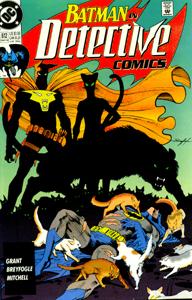
Detective Comics #612: As far as my longboxes can tell, Catman’s first post-Crisis appearance was in this 1990 story by Alan Grant, Norm Breyfogle and Steven Mitchell. Simply titled “Cats,” it was a jam-packed, elegantly written, beautifully designed and illustrated one-issue story of one bad night in Batman’s life. Grant’s tale involves Catwoman, Catman, a runaway man-eating tiger, a couple of guys collecting stray cats to sell to a lab and even an old-fashioned cat burglar, all of which gives Grant an opportunity to lay out an encyclopedia’s worth of trivia about cats and the superstitions surrounding them. When one of Blake’s exotic pets escapes and makes a meal out of some poor sap in a park, the sensationalistic media blames Catwoman, who seeks to clear her name. The three masked rooftop dwellers all search for the tiger simultaneously, and it climaxes with Batman fighting the beast hand-to-paw, and Catwoman pitching Catman off a roof. The story was never collected into trade, like so much of the superlative Grant/Breyfogle run on the Bat-books, but once again Scans_Daily comes through. Note the awesome-ness of the Breyfogle designed costume, with the Wildcat-esque floppy ears and the cat-symbol on the chest. I think this one puts the newer costume to shame, but hey, that’s just me.


(And while I’m linking to Scans_Daily like mad, check out Catman being defeated by a Hostess cupcake. Now, I’m no supervillain, but I’m fairly certain it’s just not good strategy to immediately stuff into your mouth any food offered to you by a foe in the middle of a fight. What if Robin had injected that cupcake with rat poison?)

Batman: Shadow of the Bat #7-#9: This three-part 1993 story by Alan Grant featured art by a then still up-and-coming, pre-Long HalloweenTim Sale, and interlocking painted covers by Brian Stelfreeze. Entitled “The Misfits,” it followed losers Killer Moth, Calendar Man and Catman as they form an alliance to gain the respect they were always unable to earn on their own. Into the fold they welcome new character Chancer, whom I don’t think we’ve seen since. Their plot is a three-way kidnapping and ransom scheme, in which they nab Mayor Krol, Commissioner Gordon and Bruce Wayne. Since Batman can't come to the rescue, it’s up to Robin and Nimrod the Hunter (I know how it sounds, but it’s actually a biblical name, I swear) to save the day. Catman swears to Gordon’s wife that no harm will come to the captives once he collects the money, and is pissed at Moth for trying to renege on the deal and murder them anyway. This story isn’t in trade yet either, which seems odd considering the rising star of the artist. Maybe DC will give us a Sale omnibus someday collecting his many shorter stories.

The Secret of the Universe: Man, if you weren’t for Alan Grant, would we ever see a Catman story? This 1995 three-part crossover between Grant’s then-regular title Shadow of the Bat (#43 and #44) and Catwoman #26 might as well have been entitled “Rats, Bats and Cats,” as that pretty much sums up the plot. Catman and Batman battle atop the Cat and the Fiddle (seen in Catman’s first appearance!), while the religious leaders of the island cat cult that Thomas Blake robbed to get his magical cloth hire Catwoman to steal it back for them. Meanwhile, the Ratcatcher—an insane former exterminator who got a severe case of Stockholm syndrome and switched sides in the war between rodents and humans—has a crazy scheme to poison every human being in Gotham and give birth to a super-evolved races of rats he calls “Rattus Sapiens” (See? Crazy.) Catwoman beats Catman up again, and she makes off with his cape. He and his pet panthers give chase, and they all run smack dab into the Ratcatcher’s army of rats. The rodents prove no match for the big cats and cat-people, and Rattus Sapiens are apparently smart enough to realize the ‘catcher is a nutcase, and leave him to his fate. Catman gets hauled off to jail, while Catwoman makes off with his cape and his pets, saying she’ll give him the magic cloth back in a year or so (Blake is next seen rotting away in Gotham's Blackgate Prison during the earthquake that rocked the city in "Cataclysm" and plunged it into "No Man's Land;" Blake appears sans costume in 1998's unfortunately titled Batman: Blackgate, Isle of Men #1).

The story is probably most notable for it’s unique art, which really irritated me back in the day (I’m sure there’s a pissy letter from me about it in the back of a later issue of Shadow of the Bat). Barry Kitson provided the art for the SOTB issues, but the editors chose to highlight Kitson’s unique art process by skipping the inks and coloring the “high contrast” second step of his unique penciling process (Apparently, at the time Kitson would pencil an issue, then go back and re-pencil it to focus on the use of light and shadow during a second pass). It’s kind of cool-looking, making for a highly impressionistic story that would have fared better on a different story (his hordes of rats just look like little brown balls in the last chapter), or at least a story that didn’t feature a middle chapter penciled by Jim Balent, in the regular pencilled, inked and colored method. You could seriously get whiplash reading this story. The SOTB chapters also feature interlocking painted covers by Stelfreeze.There’s just something about Catman that inspires Stelfreeze to want to do interlocking covers, apparently.

Green Lantern 80-Page Giant #1: Catman’s most unlikely modern appearance was in this 1998 GL special. The book was structured as a sort of Green Lantern version of Cantebury Tales, with retired Lanterns Alan Scott, John Stewart and Guy Gardner gathering at Warrior’s to tell tales of their ring-slinging exploits. Though Hal Jordan, Kyle Rayner and G’Nort weren’t present, they each star in a story within the book, as told by one of the others. In “Whatever Happened to G’Nort?” written by Ty Templeton and drawn by Steve Ellis , we learn that the caninanoid Lantern is down and out in New York City. When he spies cat burglar Catman with a dufflebag full of loot trying to jimmy open a window on a fire escape, he assumes he just got locked out of his house, but some instinct deep within him stirs him to chase Catman. “My God! There’s a yeti after me!” Blake exclaims and runs, while G’Nort calls after “Hold on! Stop! I’m not trying to catch you! I’m only trying to chase you!” G’Nort eventually trees Catman, who is then taken down by firemen. Not exactly an essential Catman story, but a fun one.

Secret Six: There’s still one issue of this six-part miniseries left to go, which may explain why it wasn’t on the list of “Essential Storylines” yet. Simone is once again at the helm, but with a new art team consisting of penciller Brad Walker and inker Jimmy Palmiotti (they take some getting used to; I loved Walker's pencils as inked by Troy Nixey during the Bat-books’ “War Games” story, and obviously Palmiotti does awesome work with a lot of the pencillers he’s inked, but I don’t think the pair meshed all that well). There’s also a new Six, as Catman, Deadshot, Scandal and Ragdoll welcome Superboy villain Knockout and Batman villain the Mad Hatter to the fold. The series is a lot of fun, and Simone writes a hell of an awesome Hatter, but it’s also a little confused. It’s unclear if this story is “One Year Later” or not. If so, then it follows right on the heels of VU; if not, one wonders why these guys are all still living together, as they lack the clear mission statement Waid gives them in the 52 back-up. They mostly just play defense, as they fend off attacks from Cheshire, Vandal Savage and Dr. Psycho. If you missed it, don’t worry; a trade collection has already been solicited.