1.) Believe Bridesmaid
2.) Quarter Queen
3.) Backyard Bottomslash
4.) Blackberry Brown
5.) Beyond Birthday
and, my favorite,
6.) Blues-harp Babysplit
Japanese author NISIOISIN sure has some strange ideas of what American names are like.
Showing posts with label death note. Show all posts
Showing posts with label death note. Show all posts
Sunday, April 27, 2008


Friday, April 25, 2008
More methadone for the Death Note addict

If re-experiencing the epic Kira vs. L. and company battle of wits in the Death Note anime or reading through all the completely inessential bonus material of Death Note Vol. 13: How to Read hasn’t completely satiated your desire for more Death Note, Viz has another, wordier option: Death Note Another Note: The Los Angeles BB Murder Cases, a prose novel (and perhaps best regarded as apocryphal) prequel to Death Note.
I found myself in an odd position when regarding this book. In general, I’m awfully leery of these sorts of expansions of pop stories that seem completely complete, particularly when they begin expanding beyond the original medium.
For example, we probably didn’t need those last three Star Wars movies, let alone the, what, hundreds of novels and comic books playing in the Star Wars “universe.” Of course, that’s me as a jaded, cynical 31-year-old, post-being a film critic. As a little kid, I watched those goddam stupid Ewoks movies. And the Ewoks and Droids cartoons, and would have taken any more Star Wars I could have gotten at the time*.
So, in principle, I would think a prose novel adaptation of any kind of Death Note would seem a bit silly, were I not still so enraptured of the original. That is, my fannish feelings toward the franchise are still fresh, and I do still feel that lingering, “Oh, did it have to end…?” that came at the end of Vol. 12, so, as terrible an idea as the novel might seem in theory, in practice I couldn’t wait to read it.
Well, the Columbus Metropolitan Library finally got a copy, so I had a chance to sit down and read it.
Another Note is the work of someone credited as “NISIOISIN,” an apparently popular Japanese novelist who is listed in library catalogues as “Ishin Nishio.” Manga-makers Tsugumi Ohba and Takeshi Obata get credited with “Original concept by,” while Obata provides art. There are eight black and white pieces by Obata, each coming before the start of a chapter, and depicting random scary things that don’t pertain to the plot concretely. There’s also a full-color title page piece depicting the two leads, which looks much like the covers for the Death Note collections.
The book takes the most obvious route for franchise expansion. Since L. is a world-renowned super-detective known for solving thousands of impossible cases without ever revealing his face in Death Note, he obviously had many adventures before he first went after Kira in the manga, giving writers plenty of potential to work with, so long as they work backwards.
There are several connections to the Death Note manga, some much more strained than others. It's set in Los Angeles, some years before the events of the manga, and features an almost ludicrously complicated serial killer mystery. This is the clue-leaving kind of serial killer that Batman might deal with, but rather than a single riddle or single joke per crime, he leaves a half-dozen or so extremely complicated and subtle clues at each crime scene.
As the story opens, three victims have been killed so far, and mysterious super-detective L. wants to make sure a fourth doesn't occur. To do this, he enlists an FBI agent currently on a leave of absence. Her name is Naomi Misora, whom you may remember from a rather brief appearance in the manga, briefer even than her boyfriend FBI agent Raye Penbar's.
Investigating the first crime scene, she encounters a weird private detective who introduces himself as Rue Ryuzaki . He has several quirks that will immediately identify him to Death Note fans. He has dark circles under his eyes, and an extremely stooped posture. He likes to sit with his knees drawn up to his chin, and he eats a diet that seems to consist almost exclusively of sugar.
As complicated as the killer's clues are, the book is fairly straightforward—pages and pages devoted to Ryuzaki and Misora at the first three crime scenes, trying to unravel the clues that might lead them to the killer.
As I said, some of the Death Note connections are pretty strained. The killer has shingami eyes for some reason, although he's never met a shingami or possessed a death note. The narrator is also a character from the manga, presenting the book as notes on the case, although how this particular character would know the bulk of the information contained in the story isn't apparent, nor does writing a few hundred pages in a novel-like format on a case of L.’s seem like something that particular character would devote his or herself too.
Additionally, Wammy's House is involved to a certain degree, and there's an oblique reference to the agents L. employed in he and Light's investigation of the Yotsuba Corporation.
The prose is very simple and straightforward. There is virtually no description of any kind regarding the characters or the settings—despite what's needed to discuss the clues—and the dialogue is similarly dry, with a lot of "..."s indicating...someone not talking?
While this doesn't exactly make for a transcendental read or anything, it does keep things short, simple and focused more on the mind-games of the killer and the detectives. And, perhaps more importantly, it reduces the time a reader might spend on trying to make sense out of why the killer has shingami eyes or any of the goofier aspects.
In other words, it moves extremely quickly.
NISIOISIN does an admirable job of recapturing the cerebral struggle aspect of the manga, while pulling off a pretty interesting twist and another, final Death Note reference as a kind of O. Henry punchline to the whole thing. (I admit to an out-loud “Heh” upon reading the last paragraph).
I doubt it would be too terribly well-received by a reader who has no previous experience with the franchise, as the narrator's mentioning of the events and characters of the manga go unexplained throughout, but given the number of Death Note fans in the English-speaking West, that probably won't present much of a problem for Viz. Death Note fans should find plenty to like in it; certainly less than there is to dislike.
Given L.'s history, and the nature of mystery book franchises in the U.S. market, there's certainly potential for this to go one for a long while yet, if the market is there for it. The narrator mentions having at least two more cases to discuss, one of which is a "detective" war between L. and other detectives whom he has defeated over the years and assumed the identities of.
I'd be interested in reading another Another Note or two, although, thanks to this and How To Read, I've been able to successfully wean myself off of my addiction without any major withdrawal symptoms.
*I thought the Cartoon Network Clone Wars series was totally awesome, by the way. And while I haven’t read many of Dark Horse’s comics, I did like many of the stories in the Star Wars Tales anthology collections.
Saturday, April 05, 2008
Methadone for the Death Note addict
Manga series Death Note might have gone on a little longer than it needed to, but, at the same time, at just 12 volumes long, it also could have gone on for a lot longer, too.
The nature of the story and the finality that awaits defeated characters (it’s right there in the title) dictated that our hero—er, protagonist Light Yagami would have to either die or become the ruler of the world at some point in the story, but it was certainly possible to keep going for a while. There were a good handful of characters who survived by the last few pages of that twelfth volume, the Shingami who appeared and survived are all more or less immortal, and another death note could have fallen into another human’s hands in the future and started up a whole new cycle of events.
Plus, super-detective L. and his agents seemed to have had some implied adventures before they ever encountered Light and the death note, so there are certainly fertile grounds for prequels, if a Death Note Z or Death Note: The Next Generation seems overly crass.
At any rate, Death Note is, at least for now, over, and yet I imagine there’s still some demand for more of it. I know I was a bit disappointed when it ended, simply because I had no more volumes to look forward to.
Now, don’t get me wrong, I prefer a story like this to have an ending, and for the creators to move on to other, fresher projects than to keep squeezing money out of the idea as if it were a Western superhero franchise or whatever, but, well, the strength of the series was in its ability to get readers straight up hooked on it, and, when you’ve reached the end of volume 12 and are forced to go cold turkey, withdrawal symptoms can set in.
I suppose the desire to meet fans’ demand for more Death Note/the money to be made by doing so and exploiting their addiction is what lead to Viz’s Death Note Vol. 13: How To Read, a weird, unofficial thirteenth volume which amounts to the comic book equivalent of DVD extras for the series.
It’s certainly why I sought it out at the library. And looked for the laboriously titled Death Note Another Note: The Los Angeles BB Murder Cases prose novel by Ishin Nishio, which stars L. and appears to be a prequel to Death Note. I’ve only found one library and the state that carries it so far though, and I don’t think I’m interested enough to pay to read it.
So How To Read was all that was available to deal with my Death Note addiction.

It’s a strange book, a mixture of things I’m genuinely interested in and irritatingly over-detailed facts that I couldn’t imagine anyone being that interested in.
It reminded me a bit of a combination of an old Wizard magazine, one of those one-shot fan magazines you’d see for super-popular geek shows (X-Files, Buffy, whatever) in grocery stores, and an Official Guide to the Marvel Universe or Who’s Who in the DC Universe type of book. Only all pertaining to Death Note.
Among the “Who actually wants to read this?” stuff are the character profiles (I didn’t even know all those Shingami had names), a lists of all the “truths” in the storylines, the explanation for all of the chapter titles, a flow chart of the forces involved in the Kira investigation and how they relate, 89 individual tricks Light and other characters pull off and some silly stuff that is perhaps of the sort I’d appreciate more if I were closer to the target audience’s age (A shopping list breaking down the cost of Near’s various toys, for example, or a list of all the sweets L. consumes in the course of the series).
Of greater interest, to me anyway, were the long but not incredibly revelatory interviews with writer Tsugumi Ohba and artist Takeshi Obata, some looks at Obata’s character designs, and the process by which Ohba’s breakdowns became the finished product and, the crown jewels of the collection, a few pages of four-panel, light-hearted Death Note gag strips and the “pilot” story which preceded the decision to go ahead with the final version of the story.
The gag strips aren’t necessarily that funny, but they are more Death Note comics, and it’s kinda fun to see all the characters still alive and engaged in more light-hearted pursuits than trying to murder their opponents or rule the world or whatever.
Here’s three-fourths of one featuring Ryuk:

The pilot is fascinating for how different it is from the finished product. It’s about 50 pages long, and it crams a whole story into those 50 pages, start to finish, although obviously it’s a very, very, very different story.
Ryuk looks almost the exact same, although his eyes look a little straighter and less scary. The protagonist isn’t cold-hearted super-genius maniac high school student Light Yagami, but young, bullied boy Taro Kagami.
Here’s the cover for it:

Taro tries the note out on a lark, killing some bullies, which prompts two police detectives to investigate. A second student finds a note, and Ryuk gives Kagami the “death eraser,” which brings people back to life when their names are erased from the note. This brings about some extremely silly plot twists (For example, when five boys who died mysteriously of heart attacks are just as mysteriously brought back from the dead two days later, they go right back to school, as if nothing happened).
I wouldn’t recommend purchasing How To Read, as there’s not much in it that you’re going to need to refer back to or anything, but it was well worth a library-borrow, if only to learn more about where the story came from and how it was put together. And, of course, to fight off any lingering withdrawal you may feel upon completing the series.
Tuesday, April 01, 2008
Monthly manga reviews
Minima! Vol. 1
Del Rey Manga
Here’s the high-concept pitch for Minima!, a darling high school comedy from manga-ka Machiko Sakurai: Shy, quiet Ame and her classmates take a field trip to an amusement park, and there she acquires a cute little stuffed animal that almost immediately begins talking to her. Its name is Nicori, and it turns out that all dolls can talk to humans, there’s simply a rule forbidding it.
I was pleasantly surprised that Sakurai didn’t go the expected route with the concept, and have Nicori’s animated, Japanese-speaking status be a secret shared only with Ame. Rather, Nicori is out and proud, immediately chatting up his new owner’s friends and enemies, granting media interviews, entertaining sponsorship deals, and making his feelings known to the mean girls who talk about Ame behind her back, and the chicken stuffed animal character whose popularity far exceeds Nicori’s own.
There’s a tangle of relationships introduced at the beginning that took me embarrassingly long to straighten out—I blame the fact that the Japanese kids call each other alternately by their first and last names, depending on how close they are, in effect being introduced twice a piece—but Ame seems to be neighbors with a boy named Midori, who is friends with Sasaki, the cute boy in school all the girls adore (including Ame), who is friends with Kei, a pleasant, tomboy-ish girl.
Once Nicori enters the picture, everything gets solidified nicely, and Sakurai has great fun playing with the animal characters burgeoning prima donna attitude—he laps up the attention being a talking stuffed animal affords, he’s jealous of Sasaki’s popularity with his public, he’s insanely jealous of that chicken character, he’s insulted when people can’t figure out what kind of animal he’s supposed to be, and so on.
His stuffed-animal perspective on human relationships gives a somewhat fresh angle to the more rote crush romance story elements to the book, and there seems to be a great deal of potential to his trying to figure them out, which apparently causes plenty of problems.
(Oh, and I don’t understand the title. I asked the only two people I know who speak Japanese—one of whom is a native speaker—and neither had a guess. “Mini-Mama” was the best they could come up with).
Short Sunzen! Vol. 1
Tokyopop
Aya Sendou hates to see his classmate Satsuki Kurokawa fight, because he is secretly in love with her, and he’s both unwilling and unable to confess it, since he's a teenager just coming to grips with his feelings for the opposite sex.
Plus, there seems to be a really good chance she would either laugh at him or think he's a sissy, since Satusuki loves to fight. "Tomboy" doesn't really seem to cover her; she's a brawler who can out-arm-wrestle everyone in school and is quick to come to the aid of the bullied, seemingly as much because she enjoys punching people in the face as because of some sort of noble, protect the weak impulse.
It's a pretty cool conflict to drive a high school romantic comedy, ensuring the requisite melodrama and mushy stuff will also occasionally involve scenes of, say, Satsuki jumping out of a second story window to land knees-first on the head of an evil upper classmen.
Manga-ka Susugi Sakurai introduces the leads in an opening chapter that plays a bit like the Prince and The Pauper. Satsuki and Aya go to Tama High, the toughest school in the Kansai region, a school so widely-known for it's violent and ill-mannered student body that its uniform alone is enough to strike fear in the hearts of other local teens. So after Satsuki rescues a rich girly-girl from Narujo High from attackers, the two girls secretly change uniforms for the afternoon.
Establishing a pattern, Satsuki offers to walk around with Aya and pretend to be his girlfriend, so he'll look cool with a rich girl from a respectable school on his arm, unaware that he would be happier with her as his girlfriend.
The next chapter jumps back to show how they met, and there are a few more adventures involving he two in this volume. In one Satusuki masquerades as a boy to join the school’s male cheerleading squad, and in the other Satsuki takes Aya to an all girls school to check out the chicks, but he only has eyes for her.
That brings us to what I guess you'd call a back-up feature (in old school Western super-comic parlance), which switches to another cast, but tells a similar story of young almost love.
In “Girl Boy,” Abe and Komugi are the two tallest kids in their school and have always been friends, on account of their shared height (every time they look across a crowded room, they can't help but see each other). But once they begin spending more time together outside of school, that friendship looks like it could be becoming something more.
Neither relationship is completely resolved this volume, and good thing. The Satsuki/Aya story at least has the potential to go on for a few more volumes before it gets too frustrating. (“Girl Boy” might have simply have had an open-ending ending; I guess we’ll see next volume).
Finally, the book includes a few fun little stories about the author’s deadline troubles. One multi-part story tells of her trip to Tokyo to hand in her assignment, which includes working on it on the bullet train there. And the volume ends with a short piece called “Lights out Sunzen!”, in which Satsuki and Aya stop by Sakurai’s house to help her work on her manga starring them. It’s pretty cute stuff, and a head and shoulders above the more typical stories by manga creators, in which they portray themselves as weird little animals or whatever.
As for the art, Sakurai's figure work is pretty quirky. Her characters all have long, elongated bodies with gigantic hands the size of their heads and sometimes way too-small faces. The anatomy isn't always perfect (that is, of course, within the confines of the style), but the panel layouts are all easy to read and Satsuki at least is a nice character design, which Sakurai has fun designing outfits for (there are even paper dolls). The early chapters look pretty rough, but by volume’s end Satsuki seems to have found her footing.
(As for the title of this one, “sunzen” is apparently Japanese for “on the verge” or “just in front of,” and “short” is English, so…? My friend guesses “To Be Close To Short Out.”)
Yozakura Quartet Vol. 1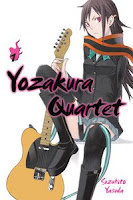
Del Rey Manga
Hime is a sixteen-year-old schoolgirl superhero, using her super-strength, superior fighting and a lacrosse racket to defend her city. And I do mean her city; see, Hime is also the town’s mayor. She works with Ao, a cat-eared girl who can read minds, and Kotoha, a busty, bespectacled girl with the power to create things by saying magic words.
Together they’re some sort of heroes-for-hire organization operating out of the Hizumi Life Counseling Office under the leadership of Akina, an 18-year-old guy who’s pretty much just a guy; he’s the Charlie to their Angles, but he doesn’t seem to bring anything to the table besides his courage and friendship.
They’re often accompanied by food delivery girl Rin and Hime’s brother, who, like her, has two-toned hair and fearsome powers. Although his are kept in check by magic shackles. Because he’s a demon, I think. And maybe Ao’s older brother is too; he has ears and powers, at any rate, and seems to be pretty evil.
Suzuhito Yasuda’s manga boasts some very well designed and interesting characters. I know they all sound pretty stereotypical as explained above, but Yasuda sure makes them all look pretty great, particular Hime, with her always-angry eyebrows, who is often pictured standing atop a street light, watching over her city.
Only Hime and Ao get much exploration in this volume, and while the latter’s conflicts simply revolve around doubts about her powers and missing her older brother, Hime’s are somewhat complex, as she places so much import on the greatness of her town and the safety of its people (Civic pride’s just not a motivation you see much in comics anymore).
The rather casual, gradual introduction to the characters, their relationships and their situation made getting into the book a lot harder than I would have liked (I thought Hime and her brother were the same person for a while, and I had to keep counting characters because while the title promised a foursome, there were usually five or six people seemingly on the team and in each scene).
The cases they take on run the gamut between super-serious and small potatoes, but I liked the insular, small-town feel of their endeavors. In one story they face a guy shooting the place up, in another they try to figure out why a little schoolboy is so sad. Later they try to find the parents or owners of an orphaned corgi puppy, only to end up fighting it when it becomes possessed by a demon.
By the volume’s end, after I’d spent a few hundred pages hanging out with the characters, I started to like being around them, but, like I said, it takes the book a while to get going. The two stories that really stand out are the one with the puppy—who is incredibly adorable—and one in which the characters spar using their super-powers, thanks to the novel uses of “magic words” Yasuda comes up with (Basically, the characters are throwing block-lettered words at each other and sifting through discarded spells and sound effects for particular words to hold up and communicate with).
Oddly enough, the story I think I liked the most was the space-wasting one in the end, in which Yasuda, in the form of a funny-looking animal, tells us of how the feature came to be and interacts with the cast.
(Oh, "yozakura" is "cherry blossoms at night," so this one's pretty self-explanatory).
Death Note Vols. 7-12
Viz
I’m not normally one to give spoiler warnings here, since I figure if you’re reading about a comic, then you’re already actively seeking information about it, but this is one of those cases where I feel the need to do so, as when you take out the surprises of Death Note, you pretty much ruin the series. So, if you haven’t read Death Note yet, and I highly recommend that you do, you can stop reading now, okay?
So despite my freakout about the unforeseen, game-changing event that happens about 3/4ths of the way through Vol. 7, I got sucked right back into the series, and was satisfied by the ending, if disappointed that it did, in fact, actually end.
While the Light vs. L conflict is what was making Vols. 3-7 so addictive, and the goofy-ass jump into the future in which Kira was suddenly a popular enough force that whole countries were surrendering to him (which conveniently ignored things like, oh, how Light finished college), L’s heirs slowly grew on me to the point where I was actively rooting for Near at the end, just as I was actively rooting for L earlier.
L is still a superior character I think, particularly in terms of design (I just like looking at and reading his posture and expressions, as much as anything else), but Near’s toy habit was pretty endearing. The bit with the Kurbricks near the end, especially.
Tsugumi Ohba and Takeshi Obata recovered the loss of momentum with the change in the conflict pretty well, I thought—if The Event in the second half of Vol. 7 came at the very end of that particular volume, I could have easily seen myself losing interest in the series (particularly if I were reading it as it was originally released, rather than now that all 12 volumes were available to be read one after the other), but the kidnapping cliffhanger ensured I’d be picking up Vol. 8, and they continued to wring real suspense out of the various set-ups that followed.
Also, Sidoh? I love that guy, particularly when he was passing out fliers in the Shingami realm, and this panel, in which he finally recovers his lost Death Note:


Del Rey Manga
Here’s the high-concept pitch for Minima!, a darling high school comedy from manga-ka Machiko Sakurai: Shy, quiet Ame and her classmates take a field trip to an amusement park, and there she acquires a cute little stuffed animal that almost immediately begins talking to her. Its name is Nicori, and it turns out that all dolls can talk to humans, there’s simply a rule forbidding it.
I was pleasantly surprised that Sakurai didn’t go the expected route with the concept, and have Nicori’s animated, Japanese-speaking status be a secret shared only with Ame. Rather, Nicori is out and proud, immediately chatting up his new owner’s friends and enemies, granting media interviews, entertaining sponsorship deals, and making his feelings known to the mean girls who talk about Ame behind her back, and the chicken stuffed animal character whose popularity far exceeds Nicori’s own.
There’s a tangle of relationships introduced at the beginning that took me embarrassingly long to straighten out—I blame the fact that the Japanese kids call each other alternately by their first and last names, depending on how close they are, in effect being introduced twice a piece—but Ame seems to be neighbors with a boy named Midori, who is friends with Sasaki, the cute boy in school all the girls adore (including Ame), who is friends with Kei, a pleasant, tomboy-ish girl.
Once Nicori enters the picture, everything gets solidified nicely, and Sakurai has great fun playing with the animal characters burgeoning prima donna attitude—he laps up the attention being a talking stuffed animal affords, he’s jealous of Sasaki’s popularity with his public, he’s insanely jealous of that chicken character, he’s insulted when people can’t figure out what kind of animal he’s supposed to be, and so on.
His stuffed-animal perspective on human relationships gives a somewhat fresh angle to the more rote crush romance story elements to the book, and there seems to be a great deal of potential to his trying to figure them out, which apparently causes plenty of problems.
(Oh, and I don’t understand the title. I asked the only two people I know who speak Japanese—one of whom is a native speaker—and neither had a guess. “Mini-Mama” was the best they could come up with).
Short Sunzen! Vol. 1

Tokyopop
Aya Sendou hates to see his classmate Satsuki Kurokawa fight, because he is secretly in love with her, and he’s both unwilling and unable to confess it, since he's a teenager just coming to grips with his feelings for the opposite sex.
Plus, there seems to be a really good chance she would either laugh at him or think he's a sissy, since Satusuki loves to fight. "Tomboy" doesn't really seem to cover her; she's a brawler who can out-arm-wrestle everyone in school and is quick to come to the aid of the bullied, seemingly as much because she enjoys punching people in the face as because of some sort of noble, protect the weak impulse.
It's a pretty cool conflict to drive a high school romantic comedy, ensuring the requisite melodrama and mushy stuff will also occasionally involve scenes of, say, Satsuki jumping out of a second story window to land knees-first on the head of an evil upper classmen.
Manga-ka Susugi Sakurai introduces the leads in an opening chapter that plays a bit like the Prince and The Pauper. Satsuki and Aya go to Tama High, the toughest school in the Kansai region, a school so widely-known for it's violent and ill-mannered student body that its uniform alone is enough to strike fear in the hearts of other local teens. So after Satsuki rescues a rich girly-girl from Narujo High from attackers, the two girls secretly change uniforms for the afternoon.
Establishing a pattern, Satsuki offers to walk around with Aya and pretend to be his girlfriend, so he'll look cool with a rich girl from a respectable school on his arm, unaware that he would be happier with her as his girlfriend.
The next chapter jumps back to show how they met, and there are a few more adventures involving he two in this volume. In one Satusuki masquerades as a boy to join the school’s male cheerleading squad, and in the other Satsuki takes Aya to an all girls school to check out the chicks, but he only has eyes for her.
That brings us to what I guess you'd call a back-up feature (in old school Western super-comic parlance), which switches to another cast, but tells a similar story of young almost love.
In “Girl Boy,” Abe and Komugi are the two tallest kids in their school and have always been friends, on account of their shared height (every time they look across a crowded room, they can't help but see each other). But once they begin spending more time together outside of school, that friendship looks like it could be becoming something more.
Neither relationship is completely resolved this volume, and good thing. The Satsuki/Aya story at least has the potential to go on for a few more volumes before it gets too frustrating. (“Girl Boy” might have simply have had an open-ending ending; I guess we’ll see next volume).
Finally, the book includes a few fun little stories about the author’s deadline troubles. One multi-part story tells of her trip to Tokyo to hand in her assignment, which includes working on it on the bullet train there. And the volume ends with a short piece called “Lights out Sunzen!”, in which Satsuki and Aya stop by Sakurai’s house to help her work on her manga starring them. It’s pretty cute stuff, and a head and shoulders above the more typical stories by manga creators, in which they portray themselves as weird little animals or whatever.
As for the art, Sakurai's figure work is pretty quirky. Her characters all have long, elongated bodies with gigantic hands the size of their heads and sometimes way too-small faces. The anatomy isn't always perfect (that is, of course, within the confines of the style), but the panel layouts are all easy to read and Satsuki at least is a nice character design, which Sakurai has fun designing outfits for (there are even paper dolls). The early chapters look pretty rough, but by volume’s end Satsuki seems to have found her footing.
(As for the title of this one, “sunzen” is apparently Japanese for “on the verge” or “just in front of,” and “short” is English, so…? My friend guesses “To Be Close To Short Out.”)
Yozakura Quartet Vol. 1

Del Rey Manga
Hime is a sixteen-year-old schoolgirl superhero, using her super-strength, superior fighting and a lacrosse racket to defend her city. And I do mean her city; see, Hime is also the town’s mayor. She works with Ao, a cat-eared girl who can read minds, and Kotoha, a busty, bespectacled girl with the power to create things by saying magic words.
Together they’re some sort of heroes-for-hire organization operating out of the Hizumi Life Counseling Office under the leadership of Akina, an 18-year-old guy who’s pretty much just a guy; he’s the Charlie to their Angles, but he doesn’t seem to bring anything to the table besides his courage and friendship.
They’re often accompanied by food delivery girl Rin and Hime’s brother, who, like her, has two-toned hair and fearsome powers. Although his are kept in check by magic shackles. Because he’s a demon, I think. And maybe Ao’s older brother is too; he has ears and powers, at any rate, and seems to be pretty evil.
Suzuhito Yasuda’s manga boasts some very well designed and interesting characters. I know they all sound pretty stereotypical as explained above, but Yasuda sure makes them all look pretty great, particular Hime, with her always-angry eyebrows, who is often pictured standing atop a street light, watching over her city.
Only Hime and Ao get much exploration in this volume, and while the latter’s conflicts simply revolve around doubts about her powers and missing her older brother, Hime’s are somewhat complex, as she places so much import on the greatness of her town and the safety of its people (Civic pride’s just not a motivation you see much in comics anymore).
The rather casual, gradual introduction to the characters, their relationships and their situation made getting into the book a lot harder than I would have liked (I thought Hime and her brother were the same person for a while, and I had to keep counting characters because while the title promised a foursome, there were usually five or six people seemingly on the team and in each scene).
The cases they take on run the gamut between super-serious and small potatoes, but I liked the insular, small-town feel of their endeavors. In one story they face a guy shooting the place up, in another they try to figure out why a little schoolboy is so sad. Later they try to find the parents or owners of an orphaned corgi puppy, only to end up fighting it when it becomes possessed by a demon.
By the volume’s end, after I’d spent a few hundred pages hanging out with the characters, I started to like being around them, but, like I said, it takes the book a while to get going. The two stories that really stand out are the one with the puppy—who is incredibly adorable—and one in which the characters spar using their super-powers, thanks to the novel uses of “magic words” Yasuda comes up with (Basically, the characters are throwing block-lettered words at each other and sifting through discarded spells and sound effects for particular words to hold up and communicate with).
Oddly enough, the story I think I liked the most was the space-wasting one in the end, in which Yasuda, in the form of a funny-looking animal, tells us of how the feature came to be and interacts with the cast.
(Oh, "yozakura" is "cherry blossoms at night," so this one's pretty self-explanatory).
Death Note Vols. 7-12

Viz
I’m not normally one to give spoiler warnings here, since I figure if you’re reading about a comic, then you’re already actively seeking information about it, but this is one of those cases where I feel the need to do so, as when you take out the surprises of Death Note, you pretty much ruin the series. So, if you haven’t read Death Note yet, and I highly recommend that you do, you can stop reading now, okay?
So despite my freakout about the unforeseen, game-changing event that happens about 3/4ths of the way through Vol. 7, I got sucked right back into the series, and was satisfied by the ending, if disappointed that it did, in fact, actually end.
While the Light vs. L conflict is what was making Vols. 3-7 so addictive, and the goofy-ass jump into the future in which Kira was suddenly a popular enough force that whole countries were surrendering to him (which conveniently ignored things like, oh, how Light finished college), L’s heirs slowly grew on me to the point where I was actively rooting for Near at the end, just as I was actively rooting for L earlier.
L is still a superior character I think, particularly in terms of design (I just like looking at and reading his posture and expressions, as much as anything else), but Near’s toy habit was pretty endearing. The bit with the Kurbricks near the end, especially.
Tsugumi Ohba and Takeshi Obata recovered the loss of momentum with the change in the conflict pretty well, I thought—if The Event in the second half of Vol. 7 came at the very end of that particular volume, I could have easily seen myself losing interest in the series (particularly if I were reading it as it was originally released, rather than now that all 12 volumes were available to be read one after the other), but the kidnapping cliffhanger ensured I’d be picking up Vol. 8, and they continued to wring real suspense out of the various set-ups that followed.
Also, Sidoh? I love that guy, particularly when he was passing out fliers in the Shingami realm, and this panel, in which he finally recovers his lost Death Note:

Saturday, March 01, 2008
Monthly-ish Manga Reviews, or, Damn you Tsugumi Ohba and Takeshi Obata, you evil, evil jerks I hate you so much I could just ghaahh!!!!!1!!
 A while back I decided once a month I’d post a round-up of reviews of all the manga I read during that past month, either links to books I reviewed elsewhere, or brief, rambling reviews original to EDILW. And then, after making that decision, I promptly proceeded to read less and less manga (Even at the wonderfully affordable popular $9.99 price point, those digests are expensive, and review copies seem to few and far between for stingy readers/reviewers like me).
So, it’s the first of a new month, and a good time to post reviews of all the manga from the previous month. Except I didn’t really read any manga in February, save one particular series.
Death Note has been pretty much consuming a lot of my manga reading time the past few weeks—in fact, it’s been consuming a lot of my reading time in general (I think a spider has actually decided to start spinning a we off the pile of neglected prose books sitting on my end table).
As I mentioned in the early February post about super-popular comics I took my sweet time finally getting around to reading, I was kind of luke warm on Death Note up until the very end of the first volume, at which point I was rather curious about what happened next.
And then I checked out the second volume, and that mild curiosity turned into something more urgent. Holy crap, was this story exciting all of a sudden! Once “L” fully enters the series, and the crazy intense high-stakes game of cat and mouse between he and Light develops in earnest, the story got about as thrilling as any comic I’d ever read, and Ohba and Obata just kept upping the stakes, getting L and Light closer and closer, until they are literally spending all of their time in one another’s faces.
Things seemed to stumble a bit once the first two Kiras lost their memories, which seemed like a bit of a cheat (both on the part of the creators and on the part of Light) since the potential memory-loss wasn’t laid out to the same degree as the other “rules” of the Death Notes in the earlier volumes. I was even a little disappointed in the introduction of the third Kira at first too, since it distracted from the Light vs. L fight, but the longer that plot progressed, the more clear it became that it was actually central to their duel, and the conclusion of volume 6 was seriously intense. I kept catching myself sitting up and getting more and more anxious as the protagonists closed in on the third Kira.
And then, about half way through volume 7, The Event happened, and I could not actually believe it actually happened. Years of reading superhero comics have made me somewhat suspicious of such events, but the weird shift in time did make The Event seem pretty final.
And, man, it just sucked all the adrenaline out of the story. I can’t remember the last time I was so bummed about the fate of a fictional character, and I caught myself being a bit angry at Ohba and Obata for doing that to me—which is a good thing, for creators to get a reader that invested in a story that you can be that pissed off at them doing what they did. Damn them.
On the downside, at the close of Volume 7, I’m kinda back where I was at the end of Volume 1. I’m curious about where the story ends up, but the urgency of the narrative seems to have drained out of it, and it’ shard to believe there are five more whole volumes to go, despite the fact that what has so long been the central conflict has been so altered.
So goddam you Tsugumi Ohba and Takeshi Obata. Damn you for creating such an awesome fucking series and making me like it as much as you did, and then doing what you’ve done. I hate you both. And look forward to reading the rest of the series. And your other work. Jerks.
Sunday, February 03, 2008
Catching up on comics everyone else in the entire world has already read
Like most everybody, I really like to be on top of things when it comes to pop culture, or at least the elements of it I’m interested in. I like to see movies the weekend they’re released (if I haven’t already seen ‘em for review purposes), I like to hear about the cool bands before they sign their big record contracts and appear on Letterman or Saturday Night Live, and, whenever possible, I like to read comics and graphic novels on Wednesday afternoons.
However, there’s certainly something to be said for coming to something—particularly serial entertainment like comic strips, books or TV series—long after the rest of the world. Sure, it might mean that you can’t always participate in the water cooler conversations at work the next day, and you might lose some with-it points or geek cred, but, on the other hand, the thing you’ve been missing out on for years has had time to pile up, so that when you’re ready for it, there is a lot of it to be enjoyed.
For example, my lack of interest in/ability to afford premium channels meant I missed Curb Your Enthusiasm until five seasons of it were available on DVD, but I could watch it pretty much all at once—an episode or two or three a day. I was too young to “get”Twin Peaks when it was on TV, but on DVD, I could follow the entire Laura Palmer investigation in the course of a week or three. The instant gratification that comes from being able to watch, say, Neon Genesis Evangelion or Boston Legal without having to wait for commercials, week’s between episodes or new seasons to start is a wonderful, wonderful pleasure.
The same goes for comics. Some of my favorite reading experiences have involved catching up on completed series I’ve never read a bit of, like Preacher, which I didn’t even start reading until after the last issue shipped, or Starman, which I started reading in trade as the last arc was winding down in the monthlies. It’s a neat feeling, knowing the cliffhanger between stories or volumes will last only as long as you allow it to, and being able to read a single, complete, several thousand pages long story in the course of a few weeks, you know?
This past month, I’ve set myself to catching up on a few comics, of varying kinds and off varying degrees of my being way behind of. The four comics below have pretty much nothing in common, except from the fact that they’re all things I took a little too long to sample for myself, and that I’m cramming them all into the same long-winded post.
The first is the biggest work, and the one I was farthest behind on and, not coincidentally, the one I’m the most embarrassed—hell, ashamed—it took me so long to experience and appreciate. Particularly considering that one of my jobs and one of my—I don’t know, what is this site? A hobby?—hobbies is talking about comics.
But here goes: I never really read Achewood until the dawn of the new year.
 (Ray, Onstad and Roast Beef, in an image that ran with this Onion AV Club interview)
I have an excuse, of course, but it may not sound like a very good one, particularly since I’m making it on a web log, but I’m a straight-up old-fashioned Luddite, and have a pretty strong aversion to web comics. The problem with web comics, you see, are that they’re on the web. And thus reading them involves using a computer, and that’s something I associate with work, not comics reading.
As much time as I spend in front of computer screens, when I want to read a comic, I want it to be something I can hold in my hands, or take in the bathroom or bathtub with me. I want it to be something I don’t mind eating while reading, or falling asleep with my face on. And I’d like it to be something that won’t give me cancer or hurt my eyes.
My resistance to computers is slowly breaking down, of course.
There was a time (the late ‘90s), when I still did all my writing with pen and paper, and would later transcribe it on my typewriter, or, later, a computer, although I’ve since learned to write right on the keyboard.
I used to read newspapers, now I get all my news from the computer.
And the fact that none of the papers around me carry some of my favorite comic strips has slowly gotten me used to reading strips online.
The other thing that kept me from Achewood was that it was a little overwhelming—look at how much information there is available on the page and, also, that I didn’t have a clue what it was about.
I’ve heard about how awesome it was for a long time, of course, and would occasionally follow links back to it. I remember the Comic Sans strip making the rounds, for example, and the one about Ray’s nephew's little pants, but I was having some conceptual difficulties.
Why was it called “Achewood,” for example? What were the various animals…bears or cats? Why did Todd not have any features? If he was a squirrel and Roast Beef was a cat, how come Todd was so much smaller, as if Beef were human-sized? And how come everything is scale to the cats, except when it’s not? And what’s up with that all-white, angel thing that’s sometimes with Todd? If Phillipe is only five, why doesn’t he live with his mom?
I tried reading several strips in a row on a couple of occasions to make them make sense, but these questions still bugged me. (I’ve similarly tried to force myself to enjoy a lot of newspaper strips over the years in this same way; like, “If I just read Mary Worth long enough to know who everyone is, it will eventually start being entertaining.” It never worked).
Okay, yes, these are all stupid-ass questions, and, looking back, I can see thinking about these things casts me in the befuddled old man role of, say, my grandfather trying to make sense of an episode of Aqua Teen Hunger Force he’s just walked in on, or, I don’t know, Walt Disney’s grandfather having his mind blown by his grandson’s day job (“Why isn’t that duck wearing any pants? Why’s the mouse have pants, but not shirt?”)
The critical mass of critical praise Achewood and its creator Chris Onstad was racking up as ’07 turned into ’08 inspired me to give it another try and this time really work at it. It was ultimately Lev Grossman’s top ten list for Time that framed it in a way that dispelled all my lingering confusions:
Achewood defies categorization or description, but a brief, futile attempt at a synopsis would go something like this: A bunch of cats, some robots, a bear and an otter who's 5 years old, live together in a fictional neighborhood called Achewood, which you might usefully think of as a grown-up, suburban, stoned version of Pooh's Hundred Acre Wood.
Man, it was light bulb city after I read that description, and armed with that and Dirk Deppey’s statement in his best-of the year list that “Achewood’s strengths are also its biggest drawback, as you really won't get much of the humor without reading six months or so of archived strips,” I returned to achewood.com, clicked on the “Jump To Story Arc” buttons, and spent the better part of my January evenings reading every goddamned strip I could.
And now ? Well, I’ve seen the light. I hate to even waste anybody’s time here talking up Onstad’s strip, particularly since I’m apparently one of the last people with an interest in comics and a web connection to get into it, but it truly is an incredible achievement in sequential art, serial narrative and funny-ass jokes.
It’s almost scary how fully-realized Onstad’s world is—I mean, ten of his characters have blogs that update more regularly than most comics blogs—and how realistic all of his characters are, despite the fact that they may be, for example, a cat in a thong Speedo and sunglasses, or a squirrel with a drug problem and a tiny little van.
It’s as powerful an argument as you can make for comic strips, I think, regarding the idea that spending a little bit of time on a regular basis with the fictional characters slowly, gradually increases the effectiveness of the entire endeavor. For an extreme example, think of Peanuts—some of us have been reading it our entire lives; some people have read it for fifty years. That shit all added up, to the point where Snoopy could just walk on-panel and you’d crack a smile.
And Onstad’s not working with every day things like dogs and kids, he’s working with a bunch of cats, teddy bears and robots; that is, rather than starting with the familiar and making it more and more familiar, he’s starting with the out-there and making it seem everyday.
If he quit making Achewood tomorrow, I imagine comics historians would look back on it as an astonishing achievement. If he keeps it up as long as Bill Watterson did Calvin and Hobbes or Schulz did Peanuts? My God, man. Future histories of comics are going to have a lot to say about Achewood.
Me, I’m insanely late to the party, but I don’t much mind—after all, I got to spend the last month or so reading them all at once, and it’s made for a great last month or so.
 I’m only a few months rather than a few years late when it comes to reading Shaun Tan’s The Arrival (Levine Books) which is, I’m sure you’ve heard elsewhere, really, really good.
I’m not sure if it would have cracked my top ten from last year if I’d managed to read it before December 31st, but it definitely would have made it into the bigger, to-be-considered-for-best-of-the-year list. Tan did an incredible job telling the rather oft-told, classic immigrant story, using essentially the American version of the experience, albeit by inventing a bewilderingly alien culture to plunge the reader into, making the experience easily relatable to American readers, despite the fantastic nature of so much of the story.
I’m of two minds about the art. The designs of the new land our immigrant hero starts his new life in are incredible, and after reading it, I quickly started over, just following Tan’s linework, and sitting in mute amazement at the way he shaped all those little marks into such incredible images. (The pages of the giants with the vacuum guns are really haunting; check ‘em out below).

At the same time, I didn’t much care for the human characters. The expressions often seemed too much like photographs, as if they were more photo than drawing. They’re exceptional drawings, but, as a matter of personal aesthetic taste, I find drawings that look too realistic off-putting sometimes. I do see how this served the story well though, putting all of the fantasy elements in sharper relief.
 On the eve of a recent Wednesday, a couple of bloggers mentioned how incredible it was that Dark Horse Comics’ reprint program of the old Little Lulu comics had reached Volume 18 already. Clearly, it’s a publishing initiative that’s working pretty damn well, and it’s high time I at least gave the comics a look.
I checked one out from my local library more out of curiosity than anything else, and I was immediately hooked, racing through all the volumes they carried (Vols. 7, 12 and 13) and then pointing my browser to the next nearest library to find more. Not only are they well-made, fun comics, they’re incredibly addictive (And at the standard manga price point of only $9.99 per volume, they’re a pretty good value, too).
John Stanley and Irving Tripp’s cartooning is incredible and, like those Essential and Showcase Presents reprint volumes, I think the black and white format really accentuates that (although, I should note, the Little Lulu collections are on higher quality paper).
While the character designs of the kids and their parents are sharp, what I really dig about the cartooning is the random adults passing through the panels, the passersby and their reactions to the outsize emotions of the kids and their often strange behavior.
And the expressions on the characters’ faces are just amazing. They all have plain old dots for eyes, but Stanely and Tripp wring an amazing amount of emotion out of them, by merely adding slanted eyebrows, just like you learned to draw mad people when you were a little kid. (Mike Sterling had a great post accentuating the kids’ angry faces recently).
The childhood that Little Lulu, Tubby and the gang share is one I have no real first-hand experience with, and I suspect neither do my parents—I’m removed from it by more than one generation, if it ever actually existed. It seems to be the same golden neighborhood childhood you see in Peanuts, Dennis the Menace and some of the old Archie comics.
And yet I still felt a tinge of nostalgia while reading it. Maybe it’s nostalgia for those other works that the Little Lulu comics reminded me of, or maybe it’s that no matter how different the specifics of their childhoods vs. my own, Stanley, Irving and company capture the essential relationships and emotions of being a little kid.
As much as I enjoyed the kids’ adventures—particularly those involving Tubby as a detective busting Lulu’s dad for some crime, real or imagined—I hate the chapters in which Lulu tells stories to little pest character Alvin. I don’t know why, exactly, as these often give Stanley and Tripp the opportunity to draw dragons, dinosaurs, giants, monsters and the like, but they bug the hell out of me, and I have a hard time getting through them. Maybe it’s the often redundant narration, or just the lack of Tubby action, but I don’t cotton to the imaginary story sequences.
 Finally, I finally got around to reading Death Note Vol. 1 (Viz), fully realizing I’m, like, years behind on this multimedia juggernaut. It’s popularity alone always made me curious about it, but there always seemed to be a manga series I was more interested in, and so I just managed to not read it until a couple weeks ago.
Having done so, I’m a little surprised to hear it’s supported a dozen volumes, as the premise doesn’t immediately seem like it would lend itself to too long a series—although I suspect there’s quite a bit of growth possibility in extending the mythology involving the death gods and other character’s touching Light’s notebook.
And I can also see exactly why it’s so popular. Light is a fairly unique-ish protagonist for a manga series (or, you know, any kind of serial fiction), and the fact that it’s so hard to root for or against him (or any of the other characters in the first volume) makes it a very interesting read.
It also has a set of simple “rules” governing it, like a lot of the more popular manga/anime imports (Cardcaptor Sakura, Dragon Ball, Yu-Gi-Oh!, etc.), and is pretty damn suspenseful. By the time I finished the first volume, I was really curious about what happened next, and how the high-stake game of wits between Light and “L” turned out.
Now I think I’m going to go look into this “Watchman” book by Alan Moore and Dave something-or-other I’ve heard so much about…
Subscribe to:
Posts (Atom)