Showing posts with label gregg hurwitz. Show all posts

Saturday, April 19, 2014

The good, the bad and the ugly of Batman: The Dark Knight Vol. 3: Mad

(Okay, let's try this again.) Please forgive the title for this too-long-in-the-works blog post. I'm not crazy about it, but it seems apropos given the subject matter: The collection of a Gregg Hurwitz-written, Ethan Van Sciver and Szymon Kudranski-drawn story arc from Batman: The Dark Knight. You can't tell from the cover that DC chose for the collection, but the story arc details the origin of, and an epic confrontation with, the villain The Mad Hatter, so the "Mad" of the sub-title refers to a Victorian brand of insanity, and not the child-like angry emotion the grumpy Batman posing on the cover seems to be projecting.

There's an awful lot of solid craft on display throughout the book, and, for the most part, Hurwitz's script is inventive, fairly tightly-plotted and boasting a few original ideas and even some nice, sharp writing. It has its problems though, probably more and bigger problems than it has attributes, and it read to me like a very strong second-to-last draft to an excellent Batman story arc, with those problems in the script being rather easily repaired after a conversation with an engaged editor (Mike Marts, the book's editor, apparently didn't see or have the same problems with the story that I did...and I imagine successful prose novelist and professional comics writer Hurwitz wouldn't place much value on the criticisms offered by a semi-professional comics critic he's never heard of, but I'm going to go ahead and write them up anyway).

I previously reviewed Batman: The Dark Knight Vol. 3: Mad at Robot 6, and that short-ish, eight-paragraph review accurately reflects my reading and opinion of the book, but I did want to re-address it here, as I can devote more time, space and attention to it—as well as share some images from it—in a way that wouldn't have been quite as feasible at Robot 6.

This format also for a better enumeration of the books many virtues, its many more problems and, of course, its occasional ugliness. It's one thing to talk about how poor Kudranski's artwork is in places, but it's much easier and more effective to show you an image and say, "Look at how ugly this is."

So....


THE GOOD


1.) I really, really like how Ethan Van Sciver draws Batman's cape. Van Sciver has drawn Batman on several occasionas in the past, at greatest length in the 2004, two-part miniseries Batman and Catwoman: Trail of the Gun.

The Batman he draws here is technically dressed in the over-fussy New 52 costume, complete with huge metal gauntlets (with grooves corresponding to the scallops on the forearms) and the bat-shaped kneepads.

Van Sciver sells the armored-up Batman costume pretty well in general, though. There's a scene where we see Batman suiting up, and what used to be his cowl is shown to be a standalone helmet and neck brace now, complete with a visor that lowers the mask portion over his face.
Where Van Sciver deviates is in the drawing of the cape, which, like the one he's drawn on Batman in the past, resembles enormous bat-wings. Now, having Batman's cape flare out like giant bat-wings is an artistic flourish that pretty much everyone who has ever drawn Batman has engaged in before, but Van Sciver goes a step further, drawing the cape with umbrella-like structures running through it, as if it were built by Batman to resemble bat-wings, rather than simply being a cape that an artist can draw to look more like bat-wings during dramatic scenes.
Additionally, Van Sciver's Batman can wrap his cape around himself, occasionally resembling a bat with its wings folded around itself. I think that looks pretty cool.

2.) Van Sciver's adventurous lay-outs. Did you know that Batman has been dating a concert pianist named Natalya Trusevich since...well, for about two years now? (Our time; about a year his time). If you haven't been reading Batman: The Dark Knight, chances are you didn't. While I haven't been reading all of the Bat-books religiously, I think I'm pretty well caught up on them all at this point, and I don't recall Trusevich appearing anywhere other than Dark Knight.

About halfway through the first issue of this story arc, Bruce Wayne and Natalya have an intense conversation in which she expresses her displeasure at his secretive lifestyle and apparent unwillingness to commit; she also hints that she might know what his big secret really is. Eventually, they decide to part ways. The entire three-page sequence is layed-out in two tiers, with smaller, square panels running across the tops of the pages, and the rest of the page dominated by a close up drawing of piano keys, with the white keys serving as additional panels, broken up by the black keys.

I don't know that it necessarily worked better than it might have otherwise, but it was interesting at any rate, along the lines of what J.H. Williams III was always doing in Batwoman.

There's another sequence later, a two-page splash in which Batman is seated at the Bat-computer, surrounded by floating holographic "windows" representing different pages or screens, akin to what Tony Stark was using in the Iron Man movies, in which Van Sciver draws the scene from a high angle, looking down, and we see Bruce in the middle of this whirlpool of data and he does his computerized detective work.

Say what you will about Van Sciver's work (I generally like it, myself), but here it's exceptionally interesting looking.

3.) Hurwitz and Van Sciver fairly completely re-create The Mad Hatter, for a highly original take. Hurwitz similarly gave new, not-really-needed origin stories to The Penguin (in 2011's The Penguin: Pain and Prejudice miniseries with Kudranski) and The Scarecrow (in 2012 Batman: The Dark Knight story arc "Cycle of Violence," with David Finch).

Debuting way back in 1948, The Mad Hatter is actually one of the oldest and vital of the Batman villains one's likely to see in usage these days. While his portrayal has changed over the decades and from medium-to-medium the same way so many of the other Batman villains of a similar vintage have, he was generally a man obsessed with committing crimes having to do with hats (his desire to possess Batman's distinctive cowl being one source of their conflicts), or having to do with Lewis Carroll's Alice books, or some combination of the two.

As for his modus operandi, he's an ingenious scientist who has created a means of effecting limited mind-control, generally by putting a mind-control device near the head of another person. Like in a hat, for example.

The Carroll obsession has been the dominant portrayal for the last few decades, perhaps owing to the influence and success of the Batman: The Animated Series episode that served as his origin story ("Mad as a Hatter," which is right up there with the Mr. Freeze episode in my esteem). Jeph Loeb and Tim Sale gave him an origin story in 1994's Batman: Madness—A Legends of the Dark Knight Halloween Special (collected in Batman: Haunted Knight), in which it was rather heavily implied that he was a pedophile and in which the character was dramatically reduced in size.

As for other Hatter stories, he played a minor role in the two Loeb/Sale "Year One" epics Long Halloween and Dark Victory, hearned an arc in the Greg Rucka-written, limited color pallete of Detective Comics (2001's #758-760), was spotlighted in the second Joker's Asylum miniseries and Gail Simone used him in one of her early Villains United/Secret Six stories, mostly to make jokes about him having sex with hats.

Hurwitz's new origin finds young Jervis Tetch as the good-hearted son of a good-hearted Gotham City haberdasher, who one day hopes he will take over the family business. He has a lot of friends, including a beautiful blond girl named Alice Dee, with whom he shares on perfect little-kid date. When he reaches adolescence however, it becomes apparent that he's just not growing as fast as his peers, and Alice only likes him as a friend.

He starts wearing a top hat and lifts to look bigger, and he starts taking an experimental drug to make him grow. It doesn't work, but it does have some pretty dramatic side-effects, including making him irrationally angry and causing him to start losing his hair at a young age.

He grows up to become a Gotham City supervillain, of course. His grand scheme here is to use his mind-control technology to stage a grand re-creation of that one perfect day he spent with his Alice, which means sets need constructed and actors need cast. Despite his ability to control minds, he also coerces people through threats and violence.

In addition to his origin tweaks and his new-ish, altered appearance—which include eyes that don't look in the same direction at the same time—Hurwitz's Mad Hatter drinks various teas, each of which creates a particular effect on him. For example, before his climactic battle with Batman, he blows a handful of "Special Tea Psycho" in Batman's face, making the Dark Knight hallucinate. The Hatter drinks the same blend to give him adrenaline and get him ready for a fight.

I don't necessarily like all of the differences between this Mad Hatter and previous ones, in the same way I don't think Hurwitz improved either The Penguin or The Scarecrow by his tweaks to those characters, but I appreciate the fact that he is taking advantage of the New 52 reboot to reinvent characters, to do something new instead of simply doing something over.

4.) Van Sciver's covers are really good. You can't really tell from the one that DC used for the cover of the collection, which is really only the right half of the cover from the issue that shipped during gatefold cover month, which they almost called "WTF? Certified" month.

But a few of them are full of creepy, crazy, sometimes grotesque imagery. For example:


I particularly like the little "Cheshire Bat" in the second of those covers above, the one for issue #17 (Wow, looking at the covers as published, DC sure covered up a lot of Van Sciver's art with text, didn't they?)

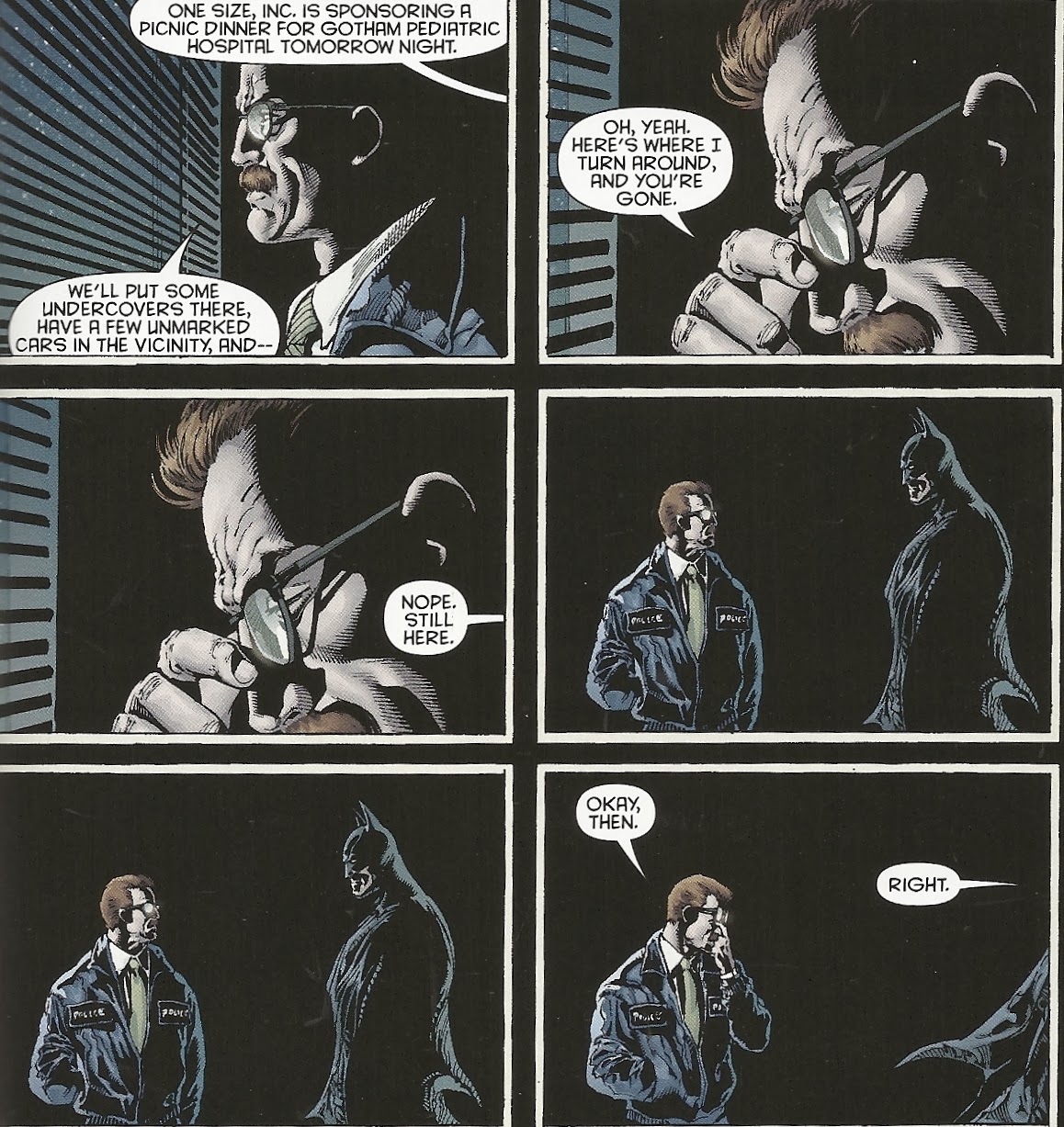
5.) I thought this was funny. Even if I have a hard time imagining Batman saying "nope" when a "no" would do just as well.

6.)"Bata-Mining." The second issue opens with the perviously mentioned two-page spread of Batman in the middle of a maelstrom of glowing, holographic computer windows, with Alfred approaching to deliver a cup of steaming hot tea.

"There's no record of Jervis Tetch anywhere, but the Bata-Mining software traced a few wire transfers from his account before he disappeared."

When Alfred responds, "Down the rabbit hole?" and Batman shows that he's not in the mood with a simple e of "Alfred," our favorite super-butler responds with the barb, "Apologies. But is it really worse than 'Bata-mining'?"

I love the idea of Batman as an obsessive-compulsive brander, slapping Bat-logos on everything and making his tools and possessions his by adding the prefix "Bat-" to them. That said, when I first saw the word "Bata-mining," I thought it was a typo, because "data" is a real word, and Batman's usual pattern would be to simply refer to what he's doing as, say, "Bat-data-mining."

But it was just a set-up for an Alfred zinger, so that's cool.

7.) "He's a freakin' pterodactyl." In the final issue of the story arc, Batman arrives at police headquarters and finds his Natalya Trusevich's corpse embedded in the glass of the Bat-signal (more on that in the "bad" portion below). After taking an entire panel to mourn for his murdered girlfriend...
...Batman grits his teeth, leaps to the roof, dashes across it in a Neal Adams-style run, his cape stiffening around him like bat-wings while an enormous bolt of lighting fills the night sky.

"I've never seen him like that," Commissioner Gordon says to one of the several anonymous police officers around him.

"He was like a stealth bomber," one of them replies, offering a simile that makes no sense at all (Other than the fact that Batman and a stealth bomber both have wings and are black in color, I guess...?). "The Bat's gone insane."

"He's not a bat anymore," Gordon says. "He's a freakin' pterodacytl."

That bit of dialogue reminded me of Geoff Johns' writing, as it occupies that same rather dumb/sort of awesome territory that Johns' writing so thoroughly owns. I can't tell if Hurwitz means it to be funny, I can't tell if if he means it to be funny in the precise way that I find it to be funny and I can't tell why exactly I find it so hilarious, but the "he's a freakin' pterodactyl" line cracked me up.


THE BAD

1.) The Tweedles as henchmen. Golden Age Batman villains who have been around even longer than The Mad Hatter (and The Riddler), the Tweedles debuted in 1943. They don't actually have a lot going for them; they were basically identical twin criminals who fought Batman and Robin by rolling and bouncing around on their fat bodies. I can't really recall reading many stories to feature the Tweedles, let alone good stories (Garth Ennis/John McCrea's four-part Demon arc "Hell's Hitman" featured them in a minor role, and Paul Dini and Dustin Nguyen's TEC #841, featuring "The Wonderland Gang," was nicely drawn and kinda clever). So it's really not that big a deal that Hurwitz here reduces them to mere muscle—Van Sciver has drawn them as big, bulky, egg-shaped men resembling slightly more realistic, tougher-looking versions of the Tweedles in the Tim Burton directed Alice In Wonderland—but it still seems, at least conceptually, off or wrong to so demote the characters.

2.) The savagery of The Hatter. In this story arc Hurwitz essentially turns The Mad Hatter into a differently-themed Joker; a soul-less mass murderer with a three-figure body count who kills calmly, casually and on a frequent basis (All of Batman's rogues seem to be turning into Joker-like mass murderers these days, which really rather stretches one's ability to suspend disbelief regarding the state and federal government's willingness to keep passing out not guilty by reason of insanity verdicts to men and women who are no longer just serial killers, but mass murderers and terrorists. Hell, even Harley Quinn recently murdered what had to be scores of people when she bombed children all over Gotham City in the pages Detective Comics #23.2).

In a flashback, The Mad Hatter kills a pet rabbit as a child. During the "casting" process for his memory re-enactment he guns down anyone whose forced audition he doesn't like. He snaps the neck of one underling with his bare hands. In one particularly memorable scene, he has the Tweedles set a stepladder down in front of one of his underlings, and then climbs up it and plunges his thumbs into the man's eye-sockets.

When he finally tracks down Alice Dee and finds that she's now a middle-aged wife and mother of three, smoking a cigarette while ironing laundry in front of the television, he beats her to death with the iron (This scene is actually staged somewhat tastefully, as Van Sciver draws the Hatter striding away from the murder scene still clutching the gory iron, blood splatter on his face, while the bashed-in head of the corpse on the floor in the background is obscured by The Hatter in the foreground. Yes, that actually counts as tasteful for DC Comics in the 21st century).

At one point in the narrative, he orders all of his mind-controlled thralls to drown themselves. When Batman asks how many, Gordon responds, "Hundreds. All ages, genders, ethnicities. And kids, too. Children.."

And, of course, The Hatter has Batman's girlfriend Natalya Trusevich killed. He kidnaps her and tries to beat Batman's secret identity out of her, calling in one of the Tweedles to take over punching her for him (This scene is drawn by Kudranski, so its dark, blurry and doesn't make much in the way of realistic visual sense, so it's not as upsetting as it could be. There are a few red panels with black blood splatter, and the sound effect WHAM!, and then we see an image of Trusevich with liquid, presumably blood, on her face.)

Finally, they throw her out of a helicopter with terrific aim, her body landing directly atop the Bat-signal on the roof of police headquarters.

3.) The cliches of Natalya's death. So the reason superheroes usually give for justifying the fact that they keep their identities secret is that, if their villains ever discovered their true identities, they would immediately go after their friends and loved ones, hurting these innocent associates as a way to get at the heroes. In Batman comics and other stories, this is usually played as a sort of tragic, romantic tension: Aflred and others worry that Bruce Wayne will never truly fall in love or find a romantic partner with whom to spend his life, Bruce always meets amazing women and comes close to forming a real relationship with them, only to pull back, not wanting to jeopardize his life's work of dressing up like a bat to fight crime and/or endanger them.

Sometimes he does actually share his secret identity, and then the women totally get killed.

As mentioned previously, Batman breaks up with Natalya early in this arc because his secret life is coming between them.

Later, Batman has a creepy dream or memory about his parents, in which his mother tells him that what the really wants for him, above all else is "to be known. Really known, by another person." Like, Biblially? "There's a fear in showing all the parts of ourselves to someone else," but when you do, and they accept you, "that's the most wonderful thing in the world."

So Bruce Wayne gets in his Batplane, flies over to Natalya's, drags her to the window, where he's left it in park and flies her to the Batcave, saying "THis is who I am" over and over again.

They then do it in the Batcave. This is another Kudranski-drawn passage, so there's no telling where or what they did it on—does Batman keep a mattress or Bat-futon down there for such occasions? Is there a big bed behind the giant penny? Who knows?

Natalya frets that she's late for her concert performance, and that she'll never make it in time, but Batman flies her there in his Batplane and drops her off—one of the perks of being Batman's girlfriend.

But wait, what's this? One of The Mad Hatter's many hat-wearing, mind-controlled spies has seen Natalya exiting the Bat-plane, and he calls it in. The Hatter sees Natalya, and immediately thinks she would be the perfect person to play his Alice in his memory re-creation. So he kidnaps her.

And, as previously stated, attempts to cajole and beat the secret of Batman's identity out of her, tortures her and, ultimately, kills her. So, in, like, a matter of hours Hurwitz reenacts the worst case scenario justifying Batman never telling anyone his secret identity: Better to simply bang broads and keep secrets from them.

It's cliche and it's a bizarre example of fridging a supporting character to one of the few superheroes who has absolutely no need to be motivated by the death of a lover or loved one because that's kinda sorta always been his whole deal and it makes Alfred and Batman's mom look like a couple of dumb a-holes for suggesting Batman pursue a relationship not built completely on lies sometime.

The speed of this whole cycle of events really makes the cliches seem even worse, too. There's no drama, this isn't something anyone struggles with; Batman shares his secret identity, and before the day's over the woman he shared it with is totally dead.

4.) Batman on the warpath. Also as previously stated, when Batman sees what The Hatter and Tweedles have done to Natalya, he loses his shit, turning into a "freakin' pterodactyl" (Hundreds of anonymous victims? That's sad and all, but it's not the same and losing your lover, I guess).

He hops in his Batplane and flies straight from the murder scene to The Mad Hatter's secret base. When Alfred suggests that Batman maybe wait a bit, as he's in no state of mind to tackle the villain, Batman responds, "Let me be clear, Penny one. If you try to stop me, I will run you over."

What a dick.

So Batman beat the shit out of a bunch of mind-controlled muscle, and brutally attacks the Tweedles: One he shoots with some kind of Batarangs-on-a-Batline bolo thingee that pins him that entwines him in wire and pins him to the wall, leaving him begging "Please...the pain...don't..."

The other he punches so hard that he knocks his jaw off, leaving it dangling grotesquely by the skin.

And then he gets to the Mad Hatter who, remember, despite all his evil acts, is still a spindly, four-foot-tall guy wearing platform shoes.

Our hero flying kicks him. He picks him up and throws him. The Hatter starts to crawl away on his knees, and Batman kicks him in the face, dislodging two of his teeth. "P-Please!" Hatter begs, and Batman gets on top of him and just starts pounding him in the face; The Hatter cries and begs him to stop, Alfred shouts in Batman's ear piece "Good God. You're going to kill him!" And Batman's angry face is covered in the Hatter's sprayed blood.

Batman gives him one more uppercut, sending him flying unconscious into a nearby pool, where the bleeding villain begins to sink face first. Batman turns away, and Alfred starts cajoling him through his earpiece:
Pull him out.

This isn't you!

You don't do this!

You can't. You can't do this. Because then it will be true. Then you'll be no different than them.
It's that last bit that apparently got through to Batman, as it caused him to stop, then turn around and dive into the water to rescue The Hatter.

Having Alfred talk Batman out of killing a foe in a vengeful rage is all well and good, but Alfred's particular argument here isn't very compelling, and it's hard to imagine that getting through to Batman at that particular point in time.

Alfred is essentially finding equivalency between The Hatter (and his ilk's) killings and Batman killing The Hatter. But, remember, The Mad Hatter has killed hundreds of innocent Gothamites, including children, for no reason. The Batman, had he gone through with killing the Hatter, would have killed one—just one—person, a person who had murdered hundreds of innocent people and would, in all likelihood, continue to kill. The scales aren't exactly even in this case, Alf.

A police officer would have shot The Hatter the moment the fight began. The President of The United States would have ordered a remote controlled drone to fire a missile at him for killing far fewer Americans, had he done so in a different country. Batman drowning the Mad Hatter here, even under these circumstances—in which Batman clearly has the upper-hand and comes across more as a bully than a righteous warrior—is hardly in the same ballpark as what The Hatter has done.

I know "Should The Batman Kill?" is a popular topic of conversation for comics fans and Batman fans, and I'm strongly in the "Hell no, never" camp. Practically, it doesn't make a lot of sense, as if Batman did kill, his rogue's gallery would end up looking more like The Punisher's than that of, say, Spider-Man and The Flash. Personally, my explanation for why the Batman shouldn't kill would be that he swore an oath to his dead parents, maybe as a child, that he would never take a human life, never put anyone through what he went through (even if The Hatter or The Joker deserve to die, maybe they have friends and family?); I imagine that as he faces more and more evil, Batman will realize the practicality of occasionally having to kill his most monstrous foes, but he would take that vow to his parents so seriously that he wouldn't bend or break it, no matter how illogical it might seem (Because Batman's crazy; I used to like the "broken" conception of the character, but Grant Morrison andDean Trippe and other's have convinced me that Batman-as-crazy person may not be as good or even as likely a reading as the Batman-as-super-sane person, so now I think of Batman as an extremely mentally healthy genius, with only two real manifestations of insanity: His obsessive-compulsive need to label everything with a bat, and his pathological refusal to kill under any and all circumstances, up to and including doing really crazy shit, like resuscitating a dying Joker).

Anyway, Batman got so mad he almost killed someone here, which is fine—we've seen that happen, what, 9,000 times before? This instance struck me as a little apalling mainly because of what a mismatched fight it was—The Hatter, like The Penguin, isn't exactly in Batman's weight class, and here he doesn't even have any weapons or get in any good blows; it's a beatdown more than a fight. And because of the particularly false-sounding rhetoric that Alfred used to talk him out of it; surely a "What would your parents think if they saw you now?" or something in that vein would have been better than a "If you do kill this one mass-murderer, you're practically committing an act of terrorism." (Alfred, unlike Gordon or any of the Robins or the folks that generally talk Batman out of beating people to death when he's really pissed off is actually in the unique position to be able to effectively evoke the memory of Batman's parents).

5.) Batman doesn't do anything to stop The Mad Hatter. The weirdest thing about this story, for me anyway, was that once Batman learned that it was The Mad Hatter behind the rash of kidnappings discussed on the very first page of the story arc, and that he knows the Mad Hatter is using his mind control technology to "take" people, Batman doesn't sit down and start working on a way to counteract the mind-control tech.

They never really get in to how it works (radio waves? Wi-fi?), but a signal is sent from somewhere to all the other where's, giving The Hatter control of the actions of anyone wearing one of his hats. Batman figures this out pretty quickly, but he doesn't sit down at his work bench with some generic circuit boards and a little electrical tool with a blue light on the tip of it as expected, coming up with a countermeasure—some way to block are override the signal.

Instead, he spends him time searching for The Hatter via raiding warehouses and interrogating a Tweedle (why, couldn't he track the hat-signals?), and then going on a date.


THE UGLY

Van Sciver draws four of the six issues in this arc, and Kudranski the remaining two (The collection also includes Dark Knight Annual #1 by Hurwitz and Kudranki, in which Batman psychologically tortures but doesn't capture or arrest villains The Penguin, Scarecrow and Mat Hatter).

Kudranski is fucking terrible.

Beyond that, though, his art doesn't look the least bit like Van Sciver's, and he doesn't even stick to the designs Van Sciver has established for the characters, so no one and nothing looks alike in the two distinct views we're given within the storyline.

I think this might have been the very worst part of the story; if you haven't read this comic, what do you make of this rorschach of a comic book panel?
Did you guess that it's obviously a bunch of drowned corpses being washed out of a drainage pipe...? If so, you sure made sense out of that image quicker than me. I had to puzzle over it for a while, eventually gave up and read the narration and dialogue for clues, and then went back to figure it out.

Compare it to Van Sciver's drawing of the same thing, from one of the covers to the story arc:
The human bodies washing out of a drain pipe are a little easier to recognize there, huh? Even though on the cover t hey are merely a bit of background design and not, you know, the whole point that the image is devoted to conveying.

Here is a bad scan of the maybe the worst of Kudranski's work in the book, which is from the annual that serves as a sort of back up to "Mad":
If you need context, Batman has tricked The Penguin, The Mad Hatter and The Scarecrow to meeting at The Arkham Detention Facility For Youth.

There, Batman scares the bejeezus out of them through various means; I think he doses them with Crane's fear gas, but it's not entirely clear. At any rate, after they relive their greatest fears and aspects of their new, Hurwitz-conceived origin stories, they all end up unconscious at the bottom of a big, grand staircase. The above page shows them waiting for the night to end and the sun to come up.

As you can see, Kudranski just dropped the same image of the background in, and then placed the same image of the three characters atop it, only altering them slightly in the last panel (and messing with the lighting).

What he doesn't do is position them in anyway that makes any sense. So that The Penguin, supposedly lying on his back, is levitating above the floor. The Hatter, in the backgorund, is drawn as if kneeling on his knees, but, as you can see, he's actually floating above the ground as well.

That is not a good page. It's not even a bad page. It's...well, I went with ugly, because "The Good, The Bad and The So Appalling I Can't Believe It Even Saw Print" didn't have the same ring to it...

Friday, March 07, 2014

Review: Vengeance of The Moon Knight Vol. 2: Killed, Not Dead

The second trade collection of the Gregg Hurwitz-written Moon Knight monthly, Vengeance of The Moon Knight is on much surer footing than the previous one, with shorter, sharper stories, each of which features at least one more-popular-than-The Moon Knight guest star, and each of which pull a little further back from the Moon Knight Is A Bloodthirsty Lunatic Trying Not To Kill plot line.

If the first six issues of the series made for a tradepaperback of Moon Knight comic books about other Moon Knight comics, than the next four issues, collected in this second volume, were Moon Knight comic books about action adventure in the Marvel Universe, a marked improvement (I think that’s one of the reasons the Bendis/Maleev Moon Knight comic was more palatable to me than the first Vengeance of...; it was a Moon Knight comic about the Marvel Universe setting as seen through one character’s experiences, and not a Moon Knight comic about old Moon Knight comics).

I think it also helps that here Hurwitz is paired with two different artists than his first partner, both with clearer, cleaner styles, and both markedly better about some of the basics of telling stories in comic book form. At least this time out, I’ve seen clear shots of some of the character’s faces, and could now identify Samuels and Frenchie on sight. Still not sure about Marc Spector/Jake Lockley, Moon Knight’s secret identity/-ies. There’s only two panels in this featuring his face, I think. (Which is better and more panel-time than his girlfriend, what’s-her-face, gets; she only appears in a single panel, as a pair of naked legs rising out of the soapy water of a bubble-bath, and a come-on line of dialogue, coming from a head somewhere off-panel.)

The first two issues, which tell the story from which the collection takes its sub-title, are drawn by Tan Eng Huat. His style has changed quite a bit since editor Andrew Helfer introduced him the North American direct market in one of the (many) doomed Doom Patrol launches way back in 2001, but even as he grows more experienced and comfortable drawing superheroes and tuning his style closer to the standard superhero wave-length, his artwork retains a sense of weird, awkward energy.

The guest-star in these Huat issues is Deadpool, and he’s taken a contract on a very old man dying of stage four colon cancer in a hospital; the lady who hired Deadpool wants the man killed violently, not dying peacefully, in revenge for his ordering the kidnapping and murder of her child (Thus the story and collection title, "Killed, Not Dead"). It is something this terrible very old man has done a lot of over the years and, in fact, he has a kidnapped child waiting to be ordered killed as the story takes place.

In traditional Marvel style, Moon Knight and Deadpool meet and fight. But instead of teaming up, they simply continue to fight. Oddly, neither character seems to know who the other is. Neither are at the top of the heap of Marvel’s character hierarchy obviously, but they’re not the most obscure characters either. I guess I just assumed every character had met every other character, by this point.
Huat
The art’s a little weird here, with some of the action not quite working right, and Deadpool somehow managing to beat blood out of The Moon Knight’s face without getting any on the face mask it must have come through, but it’s a better-looking couple of issues than those in the first volume, and one that manage to retain the same level of darkness and gritty, over-lined work.

The last two issues are drawn by Juan Jose Ryp, a better artist still. His is the smoothest, cleanest art we’ve seen on the series so far, and he has the strongest, clearest figurework and design of the three. His The Moon Knight gives readers the best look at The Moon Knight and his new, over-armored The Moon Knight costume we’ve seen (and really the ninth issue of an ongoing monthly series probably isn’t the ideal time to have a good artist start introducing the character visually).
Ryp
Ryp also uses a lot of lines, including that almost pointillist form of cross-hatching he does to imply texture and shadow. But his lines are careful, giving every panel a really remarkable amount of detail and breakground, without subsuming the figures into it. A Hurwitz/Ryp series would have really been something to see.

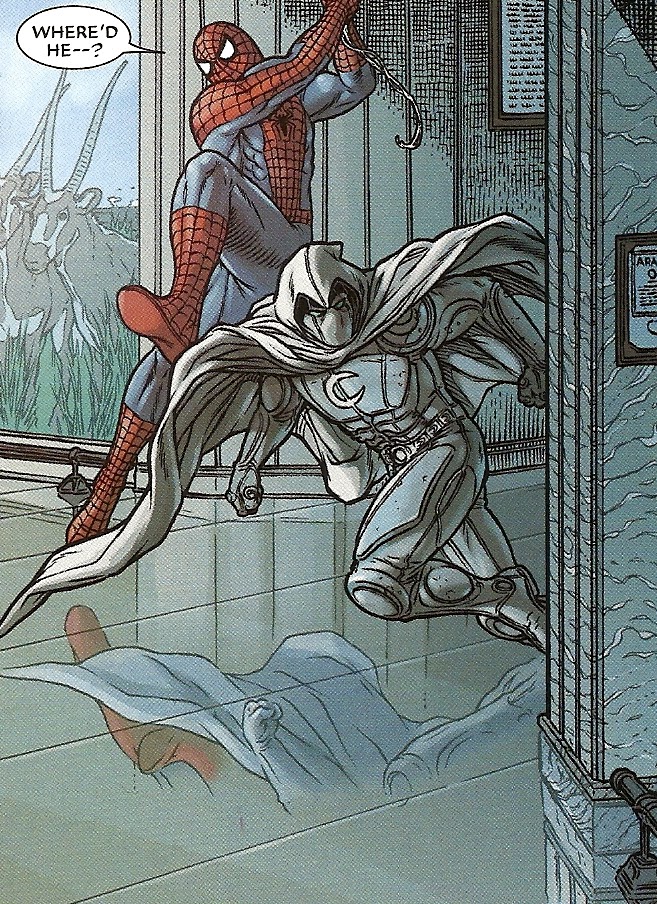
Ryp draws two done-in-one issues. The first of these is a Spider-Man team-up (where the cover comes from), and the second is a Secret Avengers team-up (Moon Knight joined the Secret Avengers, after all; this issue opens with former Captain America Commander Rogers, who had taken over Norman Osborn’s job as Boss Of All Superheroes after the events of Siege, and takes us along on a mission with them, as seen through The Moon Knight’s eyes and read through his narration.

The Spider-Man team-up has the pair trying to stop a robbery by The Sandman, who makes his escape in a gigantic form. I can’t think of an artist better suited to drawing the Sandman, a character literally made up of the little, grainy dots Ryp likes to dapple his work with, and there is just scene after scene of Sandman moving like a sandstorm and reforming. There’s a particularly cool scene set in a museum, where the heroes quietly stalk through taxidermied animals, seeking the hidden and disguised Sandman.

For the Secret Avengers issue, we see Rogers approach Moon Knight, then flashforward to a mission briefing and an attempt to rescue hostages from modern pirates, the leader of which is armed with a pair of super-weapons, one of which they were expecting and one of which they were not. Unlike the later Warren Ellis-written Secret Avengers stories, there’ s no science or espionage really needed on this mission, and nothing clever about its construction or what it asks of the heroes. They basically function as a superhero SWAT or SEAL team, dropping onto the boat and non-lethally but extremely violently dealing with the pirates.

This gives us an opportunity to see Ryp draw not only The Moon Knight and Commander Rogers, but also an Ant-Man, Beast, Valkyrie, War Machine and Black Widow.
Ryp
Ryp comes up with a nice solution to the zipped or unzipped question when it comes to Black Widow, first drawing her almost completely unzipped, but in the act of zipping up, as she will remain for the rest of the story. Cake and eating!

There’s not a whole lot to this aside from a big fight scene, of course, but it sure is a well-drawn fight scene, and The Moon Knight takes a weird shot with a bow and arrow that I didn’t think anyone in the Marvel Universe outside of Hawkeye would or should be able to make.

When speculating on possible reasons for the relative not-very-good-ness of Vengeance of The Moon Knight Vol. 1, I mentioned that it launched as part of the “Dark Reign” status quo, and thus had to tie itself into the overall Marvel Universe mega-story of the time. Here, “The Heroic Age” branding initiative started during the Deadpool team-up.

Like “Dark Reign,” “The Heroic Age” wasn’t a storyline so much as a branding initiative, a temporary dawn after the dark, stormy night of the previous cycle of crossover stories. During "The Heroic Age," Captain America Steve Rogers came back to life, helped the heroes defeat the villains that were running the world, and then became The Boss, replacing Osborn (who had replaced Iron Man, who had replaced Maria Hill, who had replaced Nick Fury I). The idea was to get back to basics, back to business-as-usual super-heroing, which is why I think we see a story as simple as Spider-Man and Moon Knight team-up to stop The Sandman from stealing a diamond, or even The Secret Avengers beat the shit out of some bad guys and that's the whole story kind of story.

Sunday, February 23, 2014

Review: The Vengeance of The Moon Knight Vol. 1: Shock and Awe

As I've recently been reading some Gregg Hurwitz Batman comics that have ranged in quality from not-too-terrible to too terrible, I thought maybe I should look at some other comics Hurwitz has written. Maybe it's not Hurwitz, I thought. Maybe it's not even me, I thought further. Maybe it's Batman.

So I went looking for some other comic books Hurwitz, whose day job is apparently a fairly successful writer of prose mysteries or thrillers, and found this collection of one of the recent-ish attempts at a new Moon Knight ongoing, a 2009 series entitled Vengeance of The Moon Knight. Not the vengeance of Moon Knight, damn it, or a Moon Knight, but The Moon Knight. There's only one Moon Knight! And this is his vengeance!

(For those of you who are not super well-versed in superheroes, Moon Knight is a very rich, obviously quite eccentric man who wears a cape, mask and costume to fight urban crime; he compensates for his lack of super-powers with superb fighting ability and a variety of elaborate and expensive gadgets, vehicles and weapons designed around his chosen nocturnal theme. So he's basically Batman, but instead of dressing like a bat, he dresses like the moon. A crescent moon, of course, not a full moon—that would just be silly.)

This fifth try at an ongoing Moon Knight series followed the 30-issue 2006 attempt, simply titled Moon Knight, which had a rather similar creative team: It's writer, Charlie Huston, also had a day job writing not-comic books, and its artist David Finch (who Hurwitz worked on Batman: The Dark Knight with) has a great deal in common with Vengeance of The... artist Jerome Opena. This Hurwitz/Opena effort only lasted a little more than half as long as the Huston/Finch one (18 issues), but it did outlast the sixth volume, by artist Alex Mallev and writer BRIAN MICHAEL FUCKING BENDIS, by six issues. So maybe Moon Knight's just not cut out for an ongoing monthly series any more? (Marvel's set to launch volume seven, by Warren Ellis and Declan Shalvey, any day now, as part of their "All-New Marvel NOW!" branding initiative).

It is not a very good book, but it's not all Hurwitz's fault. The scripts are functional, and at this earlier point in his career the man obviously has the writing of comic books down pat in a way that eludes some professional writers-who-are-new-to-writing-comics for a while.

The main problem with the story side of this particular book seems to be that it is so heavily reliant on The Moon Knight's byzantine origin and continuity (I was mostly kidding when I compared him to Batman, who he is quite derivative of; one notable difference is that Batman's a pretty straightforward, easy-to-get character, whereas Moon Knight has a large supporting cast of characters who aren't as iconic and instantly distinguishable as "sassy British butler" and "smart-mouthed teenage sidekick").

The Moon Knight Marc Spector has returned to New York after being elsewhere (he mentions the West Coast, although this pre-dates his relocation to the West Coast in his next, Bendis-written monthly), now intent on being a proper superhero, and not killing or mutilating his enemies the way he used to (Oh, that's another thing that separates him from Batman; Moon Knight is really for-real insane, with, like, multiple personalities and hallucinations and suchlike. I guess he cut the face off of his archenemy at some point in the past. I know The Joker recently had his face cut off, but it wasn't Batman who cut it off; a third party cut off The Joker's face.).

No one believes in The Moon Knight though, and they're unsure if he's a villain or a Punisher-like anti-hero or what.

He foils a robbery with several million dollars worth of weird vehicles and weapons, including a white motorcycle that emerges from a white meteor that crashes into the street, a white moon-shaped flying device and a pair of pistols that shoots bolos.

The Sentry, Marvel's Superman analogue that, like the Batman analogue whose book this is, has severe mental problems, shows up to to tell The Moon Knight he's watching him (Jeph Loeb beat Hurwtiz to the Moon Knight/Sentry team-up by about ten months, during his Hulk run, in which he had Moon Knight, Sentry and Ms. Marvel team-up against Red Hulk and Wendigos in an issue entitled "World's Finest").

Norman Osborn, The Hood and some other villains menace The Moon Knight, going so far as to to hire a Scarecrow to break everyone out of Arkham Ravencroft Asylum, lobotomize all the inmates with an ice pick  and unleash them on the city, lead by the magically resurrected archenemy of The Moon Knight, the one who had his face cut off in the past.

Spider-Man shows up—Hurwitz writes a nice scene where a chatty Spider-Man talks a criminal's ear off while he's swinging him to the police station, like an over-eager taxi driver who keeps turning around to talk to you while driving—to let The Moon Knight know that he doesn't believe in The Moon Knight either.

Meanwhile, The Moon Kngiht's craziness now manifests itself as the bird-skull headed Egyptian god Khonshu who, I don't really want to get into all that, but Khonshu is the god of vengeance and the moon that is kind of key to The Moon Knight's origin. Hurwitz touches on it here. And Moon Knight's supporting cast—ex-girlfriend, butler, ex-Moon Copter pilot, etc—show up, talking about past events from past comic books, each of them poorly introduced by Opena.

I think Opena's art might actually be a bigger problem with this book than the scripting, something that surprised me, given that Opena has done other (later) work I really rather liked, and he's not David Finch, who I did compare him to some paragraphs back.

What Opena shares with Finch is a rather dark, gritty style, with lots of blacks and lots of lines; there's not a lot of actual grit—I didn't get much of a sense of texture from the work—but the illusion of grit. This may be because Opena was trying to emulate Finch's work on the previous Moon Knight series a bit, or it may be simply because Opena felt the material called for it.

It's not that clear, though. It's rather frustrating in that this isn't Batman, so better introductions to the characters—I don't know what The Moon Knight looks like when he's not wearing his costume, as Marc Spector's face is always in shadow or tilted away or nondescript and devoid of individual characteristic or expression. I know he has brown hair, but that's about it. If he beat me up and stole my copy of The Vengeance of Moon Knight Vol. 1: Shock and Awe—No, wait, that's a library book!—I wouldn't know what to tell the police sketch artist. "He had brown hair, Officer, so I know it definitely wasn't Bruce Wayne."

All of the characters are drawn like that. Frenchie, the ex-pilot, looks a little like Silver Age Tony Stark. The girl is a girl. Spider-Man, The Sentry, The Hood, The Scarecrow—their costumes tell me who they are. Osborn has that Osborn hair (to be fair to Opena, during this period of Marvel Comics' output, Norman Osborn was in every single issue of every single comic, and no two artists drew him anything alike; you just knew it was Osborn because he had that hair that looks so damn weird when drawn in a modern, realistic style, and he was wearing a suit and yelling and people were calling him "Osborn" in the dialogue).

Similarly, a lot of the vehicles and Moon stuff aren't really introduced visually. The first time I see Moon Knight walk into the new Moon Cave or whatever he calls it, I'd kinda like to see all his Moon shit, not just the corner of a Moon Copter or Moon Plane or whatever that big, silver, curved thing just off-panel is supposed to be.

And then there's the action, which doesn't flow, and is confusing and hard to read. There's a brutal fight between Moon Knight and his foe, the undead Bushman, at the climax, and it's the sort of fight scene one needs to read repeatedly to make sense of. Little crescent moon-shaped shuriken or darts appear in Bushman's forehead without Moon Knight ever actually throwing them at him, then they disappear—Opena having forgotten to draw them or the colorist having colored over them—and then two of them are back. Like that.

But hey, let's not blame everything on the creators. Another problem with the book may have been the premise. Set during the post-Secret Invasion, pre-Siege period branded "Dark Reign," when Norman "Green Goblin" Osborn was the Boss Of The Superheroes, and his Dark Avengers (and other villains) were regarded as heroes and the real heroes all regarded as villains, a large part of this book seems to be the marriage of The Moon Knight's personal struggles with killing—his past, pre-The Moon Knight history as a paid assassin, his connection to a god of vengeance, his The Moon Knighting that killed people—to the up-is-down, down-is-up world of "Dark Reign," when villains are heroes and heroes are villains. As an anti-hero, what's that make The Moon Knight now? An anti-villain?

The status quo the book launched in was a temporary one, and perhaps it was just too closely tied to it...I'd have to read the rest of the series to know for sure, but reading these early issues collected in this trade, much of the plot seemed very dated. In fact, the entire conflict outside of The Moon Knight's head is Osborn and his lieutenant and his lieutenant's lieutenants efforts to stop Moon Knight from setting up shop as an honest-to-goodness superhero in New York City during the "Dark Reign."

Saturday, February 15, 2014

@#$%ing @#$ @#$% @#$%^& @#$%ing @#$%ing @#$%s!

So hey, what did you guys do this afternoon? I spent, oh, a few hours writing an incredibly long post about Batman: The Dark Knight Vol. 3: Mad by Gregg Hurwitz, Ethan Van Sciver and Szymon Kudranski. It was in a list format, discussing the several positives (like the scene above) and many, many negatives of the storyline, its conception and execution. I had actually started it Friday night, by re-reading the collection and taking some notes, and then spent this afternoon filling in the list with paragraphs of commentary, including a few digressive mini-essays about some of the issues raised by the story.

I saved repeatedly, but I guess there was some broken HTML in there somewhere, and I told myself I'd find it before posting—I didn't think that was enough to block saving, but apparently so. Anyway, I then spent a little more time scanning images, and broke for dinner. When I tried opening NPR in another window for company while I cooked, the computer completely froze and I had to forcibly close my browser. "Are you sure you want to do this?" the computer asked, "You will lose any unsaved changes." But since I had been saving my changes, I figured I'd be okay.

A few hours later, dinner cooked and eaten, part of a Godzilla movie watched while I digested and my over-heated laptop having spent some time cooling off, I returned to the computer in order to insert the images and post the piece when, to my horror, I discovered the last three-fourths of it were lost. Then I spent another 45 minutes of my day trying to figure out a way to recover it, but I was completely stumped and could find no answers on the Internet or through the "help" areas. It wasn't in my history and blogger, so far as I can tell, doesn't save drafts the way some other blogging whatchacallthems do (I've idiotically, accidentally erased pieces I wrote for Robot 6 and Good Comics For Kids in the past, for example, but been able to find previous drafts, minimizing the re-writing needed).

Now, I could have re-written the post. I still had my notes, after all, part of it was saved, and, having just written it, I remembered the gist of what I was trying to say. In fact, if I rewrote it now, it would more likely than not be a better post, as I would have actually written a second draft of it, which is something I never do (As you can probably tell from the less-than-sterling quality of the writing). But I've already wasted, let's see, the majority of one entire Saturday on talking about a mediocre comic book for a few thousand words, and don't really want to spend/waste any more of my life on it.

So this is basically just a post explaining why there's not a bigger, better post here in its place.

Sorry! But trust me, I'm much more irritated about it than anyone else could possibly be.

Tuesday, September 03, 2013

Some notes on Batman: The Dark Knight Vol. 2—Cycle of Violence

•This is the second volume (as in collection) of the second volume (as in times they've published a comic book with this exact same title) of Batman: The Dark Knight, collecting issues #10-#15 and #0, rearranged so that the zero issue follows the story arc formed by the other issues (as originally published, the "Cycle of Violence" story arc was interrupted by a month for the zero issue, which had to be published during DC's "Zero Month," which happened to fall exactly between the first and second halves of "Cycle of Violence")

•You may recall that The Dark Knight was the new Batman title launched specifically to be a David Finch showcase book. It was to be written and drawn by Finch, and its manifesto was basically "Whatever Finch wanted." That first volume lasted only long enough to fill a single collection (Batman: The Dark Knight Vol. 1—Golden Dawn).

Then the book was relaunched along with the rest of the DCU line during the "New 52" reboot, and the book's raison d'etre shifted slightly, so that now Finch would be co-writing the book with the experienced, veteran writer Paul Jenkins. Their short collaboration filled the previously discussed Batman: The Dark Knight Vol. 1—Knight Terrors, during which you could actually witness it dissolving by reading the credits for each issue. That storyline was essentially David Finch's "Hush," a guest-star, guest-villain filled story arc in which Batman bounced off of various presumably fun-to-draw characters for the length of an extremely convoluted plot.

With this arc, new writer Gregg Hurwitz teams with David Finch, who is just drawing rather than co-writing or co-plotting, and the focus of the book seems to have shifted again. This arc is a six-issue story arc about The Scarecrow, re-telling his origin amidst a present-day battle with The Batman. It would be followed with a yet-uncollected arc featuring The Mad Hatter. The issues currently on the racks feature Clayface (and new artist Alex Maleev). So apparently at about the one-year point, Dark Knight became a sort of villain showcase book under Hurrwitz's instigation.

•It's actually rather impressive how disconnected this collection is from the one it follows, as Hurwitz dropped all of the Finch/Jenkins sub-plots like they were burning coals. The White Rabbit, whose secret identity was dating Bruce Wayne, has disappeared and is never mentioned again. A sub-plot involving an Internal Affairs investigation of Commissioner Gordon by an over-zealous IA officer? Evaporated. Batman's concerns about pushing the aging Alfred too hard? Gone. There isn't even mention of what Batman just went through, the over-complicated plot by Bane to conquer Gotham City using a super-drug developed and distributed with he help of The Scarecrow, Poison Ivy and The White Rabbit.

•Most impressive of all though is the fact that this story arc is about The Scarecrow, who Batman just fought, defeated and one imagines sent to Arkham Asylum about four issues ago. Is that a record for a recurring Bat-villain to recur? It's gotta be awful close.

•This is the first page of the first issue contained herein (it was the one with this gross cover). Check it out:
That's kind of weird and gross, right?

The guy who sewed his lips shut while singing to himself then approaches a crying little girl who sobs to him to leave her alone and then asks why he's doing this and who he is. He answers, "I'm the Bogeyman," and I thought, for a second, that perhaps this was a new villain with a fear schtick called "The Bogeyman," and that The Scarecrow would show up to come into conflict with him for stepping on his turf, right? That's something that happens in comics more often than you might imagine; villains, like heroes, care a lot about turf and branding and their spheres of influence.

But then he goes ahead and says he's going to teach her about "FEAR" and shoots gas at her, and I got a sinking feeling.

So this is The Scarecrow, now sewing his own lips shut and kidnapping little kids. Awesome.

•We turn the page and see Bruce Wayne hanging out with a lady post-coitus. David Finch draws her to resemble Jaina Hudson, the woman Bruce Wayne was dating in the previous story arc (and who was secretly The White Rabbit), that I assumed it was her. But it's actually a new character (I think; or at least new to this comic), a Ukranian concert pianist named Natalya.
I think it speaks to Finch's lack of fundamental comics making skills (like, you know, character design) that he's tasked with drawing two different girlfriends for Bruce Wayne within the space of a few issues, and the half-English, half-Indian Jaina and the Ukranian Natalya look so similar.

It's probably asking a little much that he give them, say, mildly different body types or figures, but I don't know, different color hair? Glasses? Something?

•Bruce breaks off his date when the Gotham City Police Department recovers "another" little girl. Apparently the bad guy (whom they don't yet know is The Scarecrow) has been kidnapping little kids off playgrounds and the like, which is certainly different than his usual M.O.

•Here's another example of Finch not being very good:
How does that giant Batman fit into that tiny window? And he manages to get uncontorted fast enough to stomp on that break and bring that car to a complete stop, before it hits the maternity ward of a local hospital, which is in a street-level, glass encased storefront right off of the street, for some reason.

•When we next see Scarecrow, he's wearing a beard of blood from the self-inflicted wounds to his lips. At first I was curious as to why having his lips sewn together didn't seem to effect his speech at all, but then I started wondering why he hadn't bled to death yet.

•Oh hey, is that why Scarecrow's so skinny? Because he shows his mouth shut?

•This story arc offers an all-new, all-different origin for The Scarecrow.

I thought that was kind of funny because not long ago DC released a miniseries entitled Year One: Batman Scarecrow that was a new, retconned version of The Scarecrow's origin story, and, at the time, I thought that was pretty completely unnecessary (though it turned out to be a pretty good comic, thanks largely to the contributions of artist Sean Murphy).

Now here's an even unnecessarier one—er, more unnecessary—origin.

At least in this case, Hurwitz has the excuse of having had a universe-wide continuity reboot between his origin and the previous one (written by Bruce Gordon). While Hurwitz doesn't deal with the first encounter between Batman and Scarecrow, he does deal extensively with Jonathan "The Scarecrow" Crane's childhood.

In this version, his father was a mad scientist studying fear, and using his own son as a guinea pig, which resulted in some pretty serious and extensive child abuse, mostly involving throwing him down a dark trapdoor for long periods of time.

•Hurwitz contrasts these experiences of the child Crane's with those of the child Bruce Wayne, and adds some wrinkles to familiar elements of the "Batman: Year One" origin that don't exactly sit all that well, including a part where young Bruce has his parents leave the showing of The Mark of Zorro early because he was scared of it, and, therefore, his own fear contributed to them being in the wrong place at the wrong time and getting murdered.

•And that is why Scarecrow is apparently capturing kids for subjects now. As his father discovered, the sweat of horrified children has something special in it, and can be used as a potent secret ingredient in fear toxins, I guess.

•My favorite part is when one of the little girls he's collected fear sweat from diagnoses the villain with a severe case of loneliness, and draws him a picture:
Seriously; that's my favorite part of this comic.

•So eventually The Scarecrow captures Batman, strips him down to his cowl (which he can't remove, because Batman's so damn clever he rigged it so his cowl couldn't be removed), subjects Batman to a new fear gas, and there's about an issue's worth of Batman processing his worst fears, which are dramatized much differently than usual here, and in a way that is rather dramatically conveyed, although in a way that is perhaps not the best match for Finch's skill set.

Eventually, Batman manages to escape, just as The Scarecrow goes to get a rather wicked looking scythe, which has a spinal column on the handle.

An incredibly brutal battle ensues, in which Batman gets stabbed rather deeply in his right shoulder blade with the scythe, which then breaks, leaving the blade coming out the other side of his arm.

So Batman shoots him in the face with his grappling hook gun.
Remarkably, no one dies. Batman crawls away with a scythe blade in his shoulder, stumbling through the city until Robin picks him up.

The Scarecrow hangs from his jaw for a while, then rips himself off the ceiling, his jaw almost completely torn off. He rescues his super toxin and his captive, and manages to escape his hideout before it explodes.

•The Scarecrow, his almost severed jaw still bleeding profusely, goes to The Iceberg Lounge, where he interrupts The Penguin in the middle of his destroy-your-whole-world-around-you schtick that Jason Aaron inserted in a one-shot to show how wicked The Penguin could be, and which Hurwitz later made as integral to The Penguin's crime career as umbrellas and birds.

•The Penguin has built an admittedly cool-looking airship with which The Scarecrow can distribute his new super fear gas during the Gotham City Christmas Parade (During his first appearance in the Batman: The Animated Series, the episode "Nothing To Fear," The Scarecrow also seeks to distribute his gas en masse via blimp; I'm not sure if Hurwitz's using that scheme here is a nod to the show, or if the fact it's now turned up in two such different places means it has its origins in a much older comic book that predates both of these uses). The whole city's going nuts, rioting and suchlike, and there doesn't seem to be any antidote, since the only person who has ever metabolized this particular super-toxin is Batman.

•This is a nice place to pause and remind ourselves not to think about Batman comics as being things that necessarily take place in, say, the Batman line of comics, or in the DC Universe.

Like, right now I'm reading another Batman collection called Batman: Night of the Owls, in which the Court of Owls unleash an army of assassins on Gotham City, and Alfred sends out a "Calling all Bats, Calling all Bats!" signal that has Nightwing, Batgirl, Robin, Red Hood and The Outlaws, The Birds of Prey and I don't know, maybe even Red Robin and the Teen Titans (I haven't finished it yet).

This seems like a good time to maybe call in some former sidekicks doesn't it? Or your pals in The Justice League? Superman and/or Green Lantern could suck up all that gas and down that ship lickety-split.

It was a little harder to try to read this particular comic while making that mental act of recontextualizing the setting, however, because in the story arc immediately preceding this one Batman called on The Justice League to help him deal with a break out of Arkham Asylum, but here he goes solo.

•His plan doesn't really make a lot of sense to me, but then, I'm not a doctor. It involves hooking tubes into his arms and then flying the Batplane over Gotham City, dusting it in a cloud of his own blood (presumably incredibly diluted and mixed with, you know, stuff) to serve as a makeshift cure for the toxin.

Once a cloud of Batman blood lands on the fear-crazed populace, they go back to normal.

•When Batman gets better and the GCPD are able to find The Scarecrow, Batman kicks in the door to apprehend his foe, who collapses at the site of him. Perhaps he's scared, perhaps he feels defeated because the little girl who drew him the picture and understood his loneliness helped lead the cops to him, or perhaps it's simply because of blood loss: He's still pouring blood from that grappling-hook wound to his face and, before having his jaw nearly torn off, he spent most of the arc bleeding from his own self-inflicted needle wounds.

In addition to their use of fear as a weapon and their conquering their childhood fears by wearing costumes, that's another thing Batman and The Scarecrow have in common: The ability to survive incredible amounts of blood loss.

•The zero issue is written by Hurwitz, and drawn by a trio of different artists. Mico Suayan and Juan Jose Ryp penciled it, and Vicente Cifuentes inked at least half of it (with one of the pencil artists presumably inking their own work).

•It opens with a pretty neat image, of pearls falling all over Gotham City like rain in a rain storm, in young Bruce Wayne's imagination.

•This is the story of young Bruce's childhood investigation of his parents' murder, and his confrontation as an angry 18-year-old with their killer, who is once again Joe Chill.

Whether or not Bruce Wayne/Batman would ever discover the identity of his parents' killer and/or confront the killer has changed a few times over the years, and been a surprisingly heated point of debate, with some arguing that not knowing is a prime motivator for Batman to continue fighting crime, as any criminal he apprehends may be the one who started him on this path.

I think he confronted Joe Chill back in the Silver Age, that was written out of continuity during Denny O'Neil's tenure as Batman editor, and Grant Morrison restored it during his run. Obviously, in New 52 continuity, teenage Wayne did find Joe Chill, and even considers shooting him to death(as in Batman Begins), but opts not to.

•It was weird spending so long—although it was just 20 pages—with Bruce Wayne as a child in Gotham City. I guess I never really considered what happened between the few weeks after his parents' murder and his going to walk the world; I assumed he left Gotham almost immediately to start studying and training, but, according to this, he was in Gotham City at least through high school graduation.

Tuesday, November 27, 2012

Review: Penguin: Pain and Prejudice

In 2008, DC published a series of one-shots featuring various Batman villains by different creative teams, under the umbrella title of Joker's Asylum. Jason Aaron wrote the Penguin installment, a twisted little 22-page story that explores the character's weird relationship with women and zeroes in on the more recent portrayal of the character as someone who looks legit in public, but is evil underneath: Gallantly freeing a woman from slavery and wooing her with his wealth and attention, we see him turn those same resources the complete and utter destruction of someone he only imagines slighted him.

It was a pretty effective demonstration of why someone like The Penguin, a "legitimate businessman" style criminal rather than the serial killers that the rest of Batman's rogues gallery has evolved into, can still be seriously scary, and it certainly helped that Aaron had the strong cartooning skills of Jason Pearson illustrating the story.

Crime novelist-turned-comics writer Gregg Hurwitz took that one passage of Aaron's story and repurposed it for the 110-page "Pain and Prejudice," a new, "New 52" origin story for the Penguin published as a five-issue miniseries—presumably because DC couldn't decide which of the five monthly Batman books to stick it in.

Hurwitz draws Aaron's scene out, and while the latter writer had a neat little one-page reveal in which the Penguin's girlfriend learns of it—in keeping with the EC horror comic vibe of the Joker's Asylum series, it is presented as a twist—Hurwitz devotes several scenes of his story to the Penguin similarly taking people's lives apart behind the scenes. It's apparently a "thing" of his, like his obsessions with birds and umbrellas, and while its sort of tiresome to see a writer so thoroughly quoting another, it grows even more tiresome the more times Hurwitz re-quotes it. (In case you missed Aaron and Pearson's shorter, sweeter, better-drawn version, it's actually included in the trade paperback collecting Pain and Prejudice, as if it were a back-up story).

Which isn't to say that Hurwitz doesn't add his own touches to The Penguin's story. He does, and some of them are pretty dramatic, even, I'd argue, out of left-field.

In this version, the Penguin was still a funny-looking, terribly bullied child who loved birds, and he grows up to be a Gotham City crime boss who runs a club called The Iceberg Lounge. This new Penguin was part of a large family of healthy, normal-looking brothers, and, one-by-one, he murders each of them (and his father) while still a child, sparing only his mother, whom he continues to care for as adult, when she has grown so old and frail that she seems to be in a semi-vegetative state.

Oh, and he's also an ingenious robotics expert now because, um, why not...?

Extremely brutal, he not only goes to great lengths to completely destroy his enemies—usually by killing their friends and family—he also hires thieves to steal jewelry in showy, ultra-violent ways that don't seem all that efficient (a celebrity's earrings are stolen by ripping her ears off as she walks past paparazzi and fans with her bodyguards; a society maven's necklace is stolen by beheading her with a machete as she steps out of a limousine, etc).

As in Aaron's story, The Penguin is trying to woo a decent woman with whom he cares for more deeply than any of the other beautiful women he uses his money and power to surround himself with, and he's doing so by hiding his true self—in a particularly melodramatic twist, this woman is blind, and he won't let her touch him, so she can't judge him by his physical qualities.

He's also built a bunch of penguin-shaped guided missiles that emit some kind of bird-controlling sounds that cause birds to flock and attack children. Batman doesn't appear until the last page of the first issue/chapter, and Hurwitz and artist Szymon Kudraski try to keep him off the page as much as possible, generally showing only parts of him in each panel, although as the story progresses, naturally Batman appears more and more, as good has to ultimately triumph over evil, which means Batman has to stop Penguin from having all of the children of Gotham City pecked to death by flocks of wild birds.
In a weird running gag, The Joker apparently has a room in The Penguin's house, and The Penguin will periodically walk in on him doing something strange and unexplained (wearing a bra, stockings and apron while feather dusting the corpse of a goat or throwing knives a young Danny DeVito, for example). The Joker never speaks, and The Penguin never speaks to hm, usually just turning and walking away with little more than a "Really?". Hurwitz never explains what that's all about—at the climax, Batman assaults Penguin's mansion, but we don't see The Joker at all—but it's the one welcome bit of weirdness for weirdness' sake in this otherwise grim and rather rote story.

Kudranski's artwork is of the photo manipulation variety, with everything so heavily photo-referenced and with so many bits of the images dropped-in that few pages of the comic look drawn instead of assembled. Paired with the dark, murky coloring, it is not a nice-looking comic by any stretch of the imagination, but, beyond that, it's barely legible.

Here, for example, The Penguin slips on what I believe is supposed to be his own boutonniere, which fell off when he jumped in surprise at Batman jumping through his skylight:
His slips, falls backwards and...lands on his knees...?

Here is the end of his first encounter with Batman:
The goal was apparently to show as little of Batman as possible, although I don't know why the last two panels were framed with the Penguin essentially standing in front of "the camera," nor can I imagine how Batman got so small or The Penguin got so bit between panels that the latter completely obscures the former. It's hard to tell at first, but those are Batman's hands on the grappling hook gun there; that's not in fact The Penguins left arm, although the positioning and coloring make it difficult to discern (also, what's up with the timing? That thug in the hat is inches away from Batman, and his grapple just left the nozzle of his gun).

This is the worst part. I literally have no idea what happened. To set it up, Cassandra is on The Penguin's bed, thinking he's playing a videogame while he's controlling his The Birds bombs (Hey look, those pigeons lifted a car in the third panel. And then Batman...does...something...?
As near as I can tell, Batman dropped himself like a bomb out of his Batplane, landed on The Penguin's gate and then exploded...?

Is that right...? It's awful, awful artwork, a sort of anti-comics that makes any of the weakness of the writing, plotting or conception seem trivial.

Who cares how goofy The Penguin building a robot penguin to provide home health care for his mother is, or how depressing it is that a clever, trifle of a story from five years ago was expanded into a dark, turgid melodrama when the guy putting the penguins on the page can't even be bothered to move them slightly between panels...?
What really boggles my mind though is that these are paid professionals who make this stuff, in the year 2012, and that there's an editor—maybe more than one!—who read these comics before they were published and shipped, nodded to him or her or themselves and thought, "Yes sir, this isn't at all a piece of shit! I approve. Now let's send this to the printers..."

And that person or those people? Paid professionals too.