Showing posts with label captain marvel. Show all posts

Wednesday, February 25, 2026

Rex and Bobo cameo in 1995's Guy Gardner: Warrior #29...as does seemingly the rest of the DC Universe.

Detective Chimp and Rex the Wonder Dog next appeared in 1995's Guy Gardner: Warrior #29, and they were hardly alone. This is the issue that featured the grand opening of Guy's Planet Hollywood-style superhero bar in New York City, Warriors. The event drew quite a crowd.

In fact, there's a whole crossover event's worth of guest-stars and cameos in the issue, all lovingly rendered by pencil artist Phil Jimenez, one of only a handful of artists who could handle so many characters and do so with such aplomb.

Bobo and Rex only appear in a single panel, and each get a single line of dialogue. It's a very small panel, though, so I scanned the whole tier to post above. Their inclusion should give you a sense of just how wide a swathe of the DC Universe ended up in the book, as does the panels around them. 

In addition to the two animal heroes we've been following in recent posts, above we see also See Orion, Plastic Man, Tiger-Man, Supergirl, Steel, Angel and the Ape, the monster from Stanley and His Monster, Jade, Sentinel Alan Scott, Green Lantern Kyle Rayner, Captain Marvel and Lobo.

At this point in the book, we've seen a conflicts of varying degrees of seriousness simmering in the background, but Guy has just morphed his right hand into a big spiky mace and sent Captain Atom flying out the bar. Two pages later, Lobo arrives, unconscious Captain Atom under one arm, and the Czarnian bounty hunter immediately gets in Guy's face. A bar brawl quickly erupts.

As for Rex and Bobo, the former's line is simply, "Humans!", apparently said—er, thought—in a dismissive, perhaps exasperated tone. ("Humanoids" might have been more exact though, given how many of the patrons are aliens, robots, animals and not-quite-humans.)

And Bobo seems to be running from Sam Simeon, the ape in Angel in the Ape, protesting that he was not hitting on Angel. 

You'll note that Rex is thinking his line, rather than saying it, so the power of speech he gained as a result of Hector Hammond and Gorilla Grodd messing with the meteorite in Green Lantern/Flash crossover "Gorilla Warfare" seems to have worn off by his very next appearance. 

And Bobo is speaking his line out loud, not projecting his thoughts, but speaking in a regular dialogue balloon like all of the other talking characters in the book do. I believe this is the very first time we've seen Bobo speak out loud like a regular human being—unless he did so during his appearances in 1985-1986's DC Challenge series, most of which I haven't read—and he would continue to do so in all future appearances (I suppose it's possible here that he's meant to speaking in some kind of ape language though, given that here he's directly addressing a gorilla rather than a human being).

As for the rest of the comic, which was written by Beau Smith and inked John Stokes and Dan Davis, I found it to be surprisingly good. (Of course, I've pretty much always been surprised by the relative quality of Guy Gardner: Warrior whenever I read a back issue; given that the title character's famous for being an insufferable asshole and, at this point, he had a garish design that might have been the worst of any DC character of the '90s and that his powers at this point were dumb and gross, I never expect much from an issue of Warrior. Usually, the art is a weak point, but then, that's obviously not the case in an issue drawn by Jimenez.)

Does this issue's surprising quality have anything to do with how little Guy appears, given that this is his book? And how much of the book is devoted to DC characters mostly just mingling, rather than engaged in fighting supervillains or doing various super-feats? I mean, maybe.

It opens with Darkseid and Desaad looking in on the event from a giant monitor on Apokolips, curious about "a gathering of heroes without the purpose of battle." Guy, dressed in a white tuxedo, welcomes various guests. All goes fairly well, until first Captain Atom and then Lobo arrive and a brawl breaks out, but it ends happily enough, Lobo having drank himself unconscious. Then there's a cliffhanger leading to crossover with Superman in Action Comics.  

As I said, hose panels above probably give you a good sense of how wide a net Smith and Jimenez cast for cameos and guest-stars—and I do find myself now wondering if Smith called for each and every character to appear in the background, or if Jimenez just filled the crowd scenes with whoever he felt like drawing. At any rate, the crowd at Warriors includes the likes of Cave Carson and Sea Devils, a bunch of New Bloods (those in the short-lived team Blood Pack even recommending their reality show to Cat Grant) and a few characters that were appearing in DC Comics at the time, but now seem even more obscure than Cave Carson (Anyone remember Technocrat from the 1993-1995 Outsiders, for example?)

Two were obscure enough that I didn't recognize them, and had to do a bit of research to figure out who they were. These were Fastbak (whose design at least pointed me in the direction of Jack Kirby's New Gods) and Black Thorn, whose identity took me far longer to suss out (A character from the 1983-1988 Vigilante series, I don't think I've ever actually read a story with her in it before).

There are some interesting interactions among all the pleasantries, like Aquaman worrying how people will react to his new harpoon hand only to find Guy ignore it completely and bust his chops about his long hair instead("First Superman and now you...What's the deal with all this long hair stuff?") or Guy's old Justice League teammate Rocket Red Dmitri Pushkin giving him a bear hug.

There were also some genuinely surprising interactions, ones of such note that I was surprised they were happening in a couple of panels of Warrior, rather than elsewhere.

For example, Kyle meets Arisa, former Green Lantern and Hal Jordan's problematic ex-girlfriend:

And as tensions rise and the brawl becomes imminent, Donna Troy, at that point a Darkstar, introduces herself to then-Wonder Woman Artemis, apparently in order to start some shit:
Anyway, Warrior #29 a pretty good comic, one that is well-drawn, takes full advantage of DC's huge character catalog and engages in something I particularly enjoy seeing, the publisher's superheroes just hanging out together, rather than fighting or saving the world as they usually do when they get together in any real number. 

Oh, and of course, 30 years later, it serves a great time capsule of the DC Universe circa 1995.

Now, why Guy and his staff decided to invite a chimpanzee and a dog to the grand opening of a bar, well, your guess is as good as mine...

*********************

Two more quick things before I move on from this issue.

First, remember when we recently revisited 2005's Day of Vengeance, and Captain Marvel said this...?
At the time, I pointed out that he was in a bar in L.E.G.I.O.N. '91 #31, the War of the Gods tie-in where he found himself in a space bar, ordered a milkshake and fought Lobo (A comic which was collected in 2015's Shazam!: A Celebration of 75 Years). 

Well, here he is in another bar. Jimenez draws him quite prominently arriving in a two-page splash along fellow fliers like Donna, Kyle, Steel and Sparx, and he appears in a few panels within Warriors as well, helping Nuklon and Obsidian hang a hammer on the wall, talking to one-time Dmitri about how Guy's jaw is as big as Jay Leno's (?) and then getting dismissively tossed aside by Lobo in the panel at the top of this post (A callback to their L.E.G.I.O.N. fight, I wonder?).

So that's two bars you've been in by my count, Captain Marvel.

Second, remember how I said that Warriors seemed to be based on Planet Hollywood, what with the superhero memorabilia on the walls and in display cases? Well, Smith pays debt to that inspiration with some unnamed cameos from Planet Hollywood's founders, a scene that wouldn't have worked if Smith wasn't here teamed with an artist capable of drawing such likenesses so well:
Oh, and if you're wondering, Planet Krypton, the Planet Hollywood-like superhero themed restaurant introduced in Kingdom Come, debuted in 1996, after Warriors opened. 

Thursday, June 19, 2025

Golden Age antecedents to Marvel characters

C.C. Beck and Bill Parker's Captain Marvel debuted in 1940's Whiz Comics #2 and would go on to become one of the most popular characters of the Golden Age superhero boom. Because he bore more than a passing resemblance to the other caped strongman who started that boom, the company we now know as DC Comics sued Captain Marvel's publisher Fawcett, and the litigation dragged on until superhero comics were no longer popular, and so Fawcett settled in the 1950s, and the character went into limbo for about 20 years.

During that time, Marvel Comics created their own Captain Marvel character, a super-powered alien warrior with the unlikely real name of Mar-Vell, and they quickly copyrighted "Captain Marvel", so that by the time the Distinguished Competition finally revived the original Captain Marvel, DC couldn't use that name in the titles of any of their books. 

This is why since the 1970s, all of DC's Captain Marvel-starring books (and a 1970s TV show, and the 21st century pair of feature films) have gone by some formulation of "Shazam" instead (and the publisher has tried to change the character's name to "Shazam" in the last few decades, with limited success), while Marvel continues to publish books entitled Captain Marvel (and, of course, their film starring one of their Captain Marvels was able to use that name in the title). 

Marvel's Captain Marvel is by far the most obvious and famous case of the publisher using the name of a Golden Age hero for one of their characters, but as I've been learning, it wasn't the first or the last time.

I've been working my way through Lou Mougin's Secondary Superheroes of Golden Age Comics (McFarland; 2019), which is a defunct publisher by defunct publisher survey of the various superheroes who didn't survive the 1940s, which here seems to mean the various heroes who weren't published (or later acquired) by the company that would become DC or the company that would become Marvel.

Thanks to publications as various as Dynamite's Project Superpowers comics, Image's "Next Issue Project", Paul Karasik's efforts with the works of Fletcher Hanks and others, even casual modern readers will likely know the names and stories of many of these also-ran characters (Mougin notes many of these later revivals, of which AC Comics seems to be responsible for a lot of, along with Project Superpowers).

The other reason that several of these lesser Golden Agers' names will be familiar, of course, is that they have since been applied to Marvel heroes (And, to be fair, some DC characters as well). Let's take a look at some of them, shall we?

We just discussed the case of Daredevil recently. That was, of course, the name of a fairly popular hero from Lev Gleason Publications who wore a striking two-color costume divided vertically, wielded a boomerang, fought The Claw and Hitler and who was worked on by such Golden Age greats as Jack Cole and Charles Biro. 

He was around for a remarkable 16 years, not calling it quits until 1956...just eight years before Marvel's Daredevil would make his debut (And, as pointed out in the previous post, there's a chance—a "legend" in Mougin's words—that Marvel's Daredevil was pretty directly inspired by Lev Gleason's, the result of Stan Lee being asked by publisher Martin Goodman to revive the original guy).(UPDATE: Commentor kevhines pointed me to this 2020 post by Tom Brevoort, discussing the creation of Marvel's Daredevil, his story noting Goodman's interest in possibly reviving the Golden Age version.)

The next most popular Marvel hero with a Golden Age forebear was a pretty big surprise to me, as I had never heard of him, although there's a pretty good chance you might have, given how recently he was revived and by whom. 

I am talking about Doctor Strange.

The Marvel character by that name is, of course, a literal doctor whose surname was literally "Strange," a surgeon who, after a humbling car accident, an epic journey and the tutelage of a wise master, became Earth's Sorcerer Supreme, engaging in various mystic adventures. Steve Ditko created him in in 1963. 

The other Doctor Strange debuted in 1940's Thrilling Comics #1 from Nedor Comics, in a long action-packed story that Mougin refers to as "a 37-page marathon." Writer Richard Hughes and artists Alex Koster's Doctor Strange was "a powerful, brilliant scientist who didn't shy away from duking it out with villains," as Mougin puts it, and the character seemed to have far more in common with the Doc Savage of the pulps than the guy who would become the far more famous Doctor Strange a few decades later.

After happening upon a kidnapping plot and being shot, Strange prepares a dose of Alosun, a super-power granting "distillate of sun-atoms" that made him into something of a Superman in terms of speed, strength and invulnerability. A later refinement of his formula apparently also bestowed upon him the power of flight. Though he never adopted a cape or chest-symbol or went in for tights, by the eighth issue of Thrilling he adopted a uniform of sorts: A tight-fitting red shirt and a pair of blue jodhpurs. 

He also shortened his name to "Doc Strange" after just ten issues as "Doctor Strange," which is perhaps one reason he's not thought of as a contender for the more famous superhero appellation.

His adventures lasted a respectable eight years before he faded away, not to be revived until AC Comics decided to do so in a 1991 issue of Femforce. (I've never really found the covers of that series particularly appealing, but, after reading Mougin's book, I'd really like to check it out; sadly, as long-lived as it is, it doesn't appear to have ever been collected into any trades.)

But it was Alan Moore's revival that is probably better known. See, Nedor also published 31 issues of a book called America's Best Comics between 1940 and 1949, and that was, of course, the name of Moore's 1999 WildStorm imprint, under which he wrote the books The League of Extraordinary Gentleman, Tom Strong, Promethea, Top Ten and other features. 

Apparently leaning into the Nedor connection, Moore reintroduced the Golden Age Doc Strange as Tom Strange in the pages of a 2001 issue of Tom Strong, wherein the older character was presented as an alternate Earth counterpart of the similarly pulp-inspired hero (It was a fortunate coincidence that Doc's first name was previously revealed to be Tom in the Golden Age comics).  

Eventually other Nedor heroes, all of whom had long since lapsed into public domain, showed up alongside Strange, starring in a pair of Terra Obscura miniseries in 2003 and 2004. 

Even more surprising than a character named Doctor Strange appearing in the 1940s, though, was one named Thor. Like the later Marvel one created by Jack Kirby and Stan Lee in 1962, he was a mortal empowered by the real Norse god and fought with the mythical Mjolnir (Marvel's Thor, of course, gradually dropped the mortal aspect of Donald Blake as time went on). 

This first Thor appeared in the pages of Fox Comics' 1940-launched Weird Comics, the first few covers of which seem appropriate for the title. (I put that of the second issue above, because it's slightly weirder than that of the first issue. You can seem 'em all on comics.org, of course; Thor doesn't seem to have ever been featured on one, but such caped weirdos as Dart and Ace and The Eagle and Buddy eventually replaced the mad scientists and scantily clad ladies of the first few issues.)

Here's how he dressed, showing considerably more skin than Marvel's later Thor ever would. 

According to Mougin, Fox's Thor was really mild-mannered mortal Grant Farrel, who was berated by his girlfriend for "his lack of adventurousness" at a night club before a "masher" cut in on them. Later, Grant is visited by the real Thor of mythology, who takes him back to his home realm to train him, telling him, "The lightning will be your servant, my magic hammer your weapon."

After his training, Grant saw his girlfriend trapped by spies, descended back to Earth, downed the plane she was on, smashed enemy tanks with his hammer and rescued her, returning to Thor afterwards to get an attaboy: "You have well earned the right to my name and my magic hammer...They are yours to keep."

Obviously, he didn't keep them long, as this Thor's feature lasted only five issues of Weird, although it's interesting to wonder if Goodman, Lee or Kirby might have encountered the feature and saw some potential in it, either filing it away in the back of their heads or completely forgetting about it except, perhaps, on some subconscious level. 

There are several other familiar names in Mougin's book. The most prominent of these is perhaps The Black Panther, a power-less, origin-less, secret identity-less character in a cat costume who appeared in a single story by artist Paul Gustavoson in a 1941 issue of Centaur Comics' Stars and Stripes. 

Like Fox's Thor, he never appeared on a cover, but you can see his skimpy costume (I do like the tail) in the above splash, which I swiped from Tom Brevoort's blog (You can read the whole story there, by the way; as Brevoort notes, this guy doesn't really seem to have anything at all in common with Marvel's much later T'Challa, save for the name).

There's also...

•The Banshee, a masked and caped Irishman from 1941 who pre-figured the 1967 mutant with a sonic scream that would become part of the extensive, wider X-Men cast (although the second Banshee lacked a "The" in his name)

•The Black Cat, a rather long-lived character from Harvey Comics who was a Hollywood actress/superheroine who debuted in 1941, long before the Spider-Man villainess-turned-love interest of the same name, who appeared in 1979 (You may have seen Harvey's Black Cat in 2018's Mystery Science Theater 3000: The Comic, which repurposed some of her original comics for riffing purposes.)

•Boomerang, a 1944 hero who fought crime alongside an archer named Diana, unlike the same-named character from 1966, who used the weapon for ill

•A couple of different Chameleons, a heroic master of disguise from 1940 and a crook from the 1940s; the Spider-Man villain from 1963 therefore seems to combine elements of both

•Dr. Doom, a civilian supporting character in the feature The Echo from Chesler's 1941 Yankee Comics. He would seem to have been a waste of a perfectly good villain's name, a name that Kirby and Lee's formidable character would begin putting to far better use in 1962

•Hydroman, a Bill Everett-created hero from a 1940 issue of Eastern Color Publishing Company's Reg'lar Fellers Heroic Comics who could, like the 1981-debuting Spider-Man villain, turn himself into water, not unlike a reverse Human Torch. Spidey's adversary would, of course, add a hyphen to the name

•At least two different guys named "Wonderman", one-word, a Fox Comics hero from 1939 who was very Superman-like and a Nedor Comics hero from 1944 who appeared in a feature called "Brad Spencer, Wonderman". Marvel's Wonder Man Simon Williams would debut in 1964, distinguishing himself from those prior Wondermen by separating his name into two words.

I'm sure there were other recycled names, but those are the ones that jumped out at me while reading. 

As for DC Comics, they too would later debut names that had previously been applied to Golden Age characters, though far fewer and none so famous as Captain Marvel, Daredevil, Doctor Strange or Thor. This is perhaps because so very many of the Golden Age's original characters ended up being absorbed into the DC comics line, and the attendant DC Universe shared setting.

Among the Golden Agers whose names DC fans might recognize are...

•Amazing-Man, an Everett-created hero from 1939 whose abilities are owed to training in Tibet; the green-and-yellow clad African-American hero that Roy Thomas introduced in a 1983 issue of All-Star Squadron had a different origin and powers, but his secret identity revealed his debt to the earlier hero: Will Everett

•Multiple Black Orchids, including a 1943 Harvey Comics character and 1944 Tops Comics character. Both were masked females with no powers, though the latter had a gimmicked ring. The 1973 DC character would sport a far more elaborate flower-inspired costume than either of her forebears, as well as array of superpowers. At this point the DC character is probably better known for the incarnation from disgraced writer Neil Gaiman and artist Dave McKean's 1988 miniseries, presaging her later, '90s absorption into the Vertigo "universe"

•Black Spider, a costumed detective from 1940 who fought crime with, in Mougin's description, "a cache of poisonous spiders along with his dukes and a gun." He therefore wasn't much like the Batman villain who debuted in 1976 at all

•Cat-Man, a cat-themed hero from 1940 who seemed to be a Batman riff with various cat powers, including, at the outset, nine lives. Like the Batman villain introduced in 1963, the hyphen in his name seemed to come and go (The Golden Ager just reappeared recently in a Jeff Parker-written Cat-Man and Kitten comic from Dynamite, by the way)

•The Mad Hatter, an intriguing-looking, hat-less caped hero who wore purple and spoke in rhyme and debuted in 1946, pre-dating the much more famous Batman villain of 1948 by just a few years

•The Unknown Soldier, Ace Comics' masked, patriotic-themed hero debuted in 1941's Our Flag Comics #1, and seemed to be in the mold of The Sheild and Captain America more than that of 1966's disfigured master of disguise from Star Spangled War Stories and, later, his own comic

Sunday, January 05, 2020

Compare and contrast these pages from 1987's Shazam: The New Beginning and 2012's "Shazam!"

A CYNICAL BILLY BATSON RELUCTANTLY SAYS "SHAZAM" AT THE WIZARD'S INSISTENCE:


BLACK ADAM RETURNS TO THE PRESENT, MEETS SIVANA AND HOLDS HIM ALOFT BY HIS COLLAR:


BLACK ADAM FLIES SIVANA TO THE TOP OF A HIGH STRUCTURE SO THEY CAN DISCUSS THEIR ALLIANCE:


In 1987, DC Comics had writer Roy Thomas reintroduce C.C. Beck and Bill Parker's Golden Age superhero Captain Marvel to their DC Universe shared setting. This followed the 1986-1987 Crisis On Infinite Earths limited series, in which that shared setting was refreshed and recreated, with older characters being reinvented for more modern times. Thomas and co-writer Dann Thomas wrote the four-issue Shazam: The New Beginning, which was penciled and inked by Tom Mandrake and colored by Joe Orlando. In 2017 it was collected along with another Thomas-written story from the era and re-released in a hardcover format as Shazam: The New Beginning 30th Anniversary Deluxe Edition.

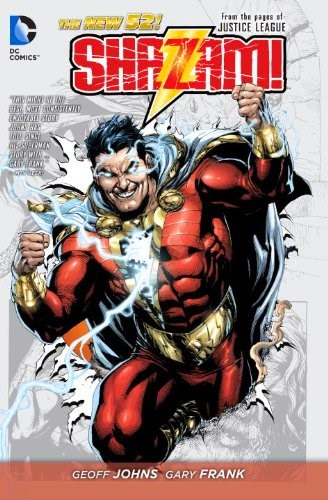
In 2012, DC Comics had writer Geoff Johns reintroduce Captain Marvel, now re-named "Shazam," to their DC Universe shared setting. This followed the 2011 Flashpoint miniseries, in which that shared setting was rebooted and recreated, with classic characters being reinvented for more modern times and introduced to readers as if for the very first time. Johns wrote a "Shazam" strip as a back-up in his Justice League ongoing series. It was penciled and inked by Gary Frank and colored by Brad Anderson. It was later collected into a trade paperback under the title Shazam Vol. 1 and, later, republished as Shazam: Origins. It was the basis of the 2019 film.

Interestingly, in rather broad strokes, the two miniseries, which had identical mandates, resembled one another in terms of their plots. In both, scientist Dr. Sivana frees the Wizard Shazam's first champion, Black Adam, from his centuries-old imprisonment and the two villains become allies. Meanwhile, orphan Billy Batson is given a magical word by the wizard in order to transform himself into a superhero. Both stories even end with the teasing introduction of another of Captain Marvel's most colorful villains, Mr. Mind.

Despite the similarities of the broad shape of the two Captain Marvel reintroductions, they differ quite a bit in the details (Thomas' story posited Sivana as Billy's uncle, and included versions of the pre-existent characters Uncle Dudley, Magnificus and Beautia and even Hoppy, The Marvel Bunny; Johns', meanwhile, included versions of Mary Marvel, Captain Marvel Jr., Mr. Tawky Tawny and Ibac...plus three new "lieutenant" Marvels).

Still, I was struck by the degree to which certain scenes in the Johns/Frank comic so strongly echoed scenes from the Thomas/Mandrake take. Obviously, Johns and Frank drew inspiration from their predecessors, even as their Captain Marvel/Shazam story was quite different in tone, emphasis and in so many of the particulars.

Sunday, December 16, 2018

Let's talk at greater length about Shazam! #1

•Last Wednesday finally saw the release of Geoff Johns' follow-up to his 2012-2013 Captain Marvel/Shazam strip from Justice League, in the form of a new monthly series drawn by Dale Eaglesham and colored by Mike Atiyeh. I reviewed it here, if you'd like to read a full, formal review of the debut issue. If you would not like to, then I can tell you here that the first issue is pretty good: It's certainly not the Captain Marvel/Shazam comic I would have written, nor is it of the sort I would most like to read (both Multiversity: Thunderworld Adventures and Convergence: Shazam were closer to what I would have wanted to read; if they could do that in the DCU, I think they'd be all set). But it is probably the comic DC had to do at this particular point, to follow up on Johns' strip-turned-graphic novel with Gary Frank, which appears to be the basis of the upcoming Shazam movie.

So while there are still some strange, half-embarrassed elements from that New 52 relaunch of the character and franchise present, we do see Johns pulling back in some of his previous attempts to make the story more "realistic" or, well, gritty I guess, like Billy Batson no longer being the asshole teen he was when we first met him, but having genuinely changed as a person, becoming a protagonist that a reader might not mind being in the same room with.

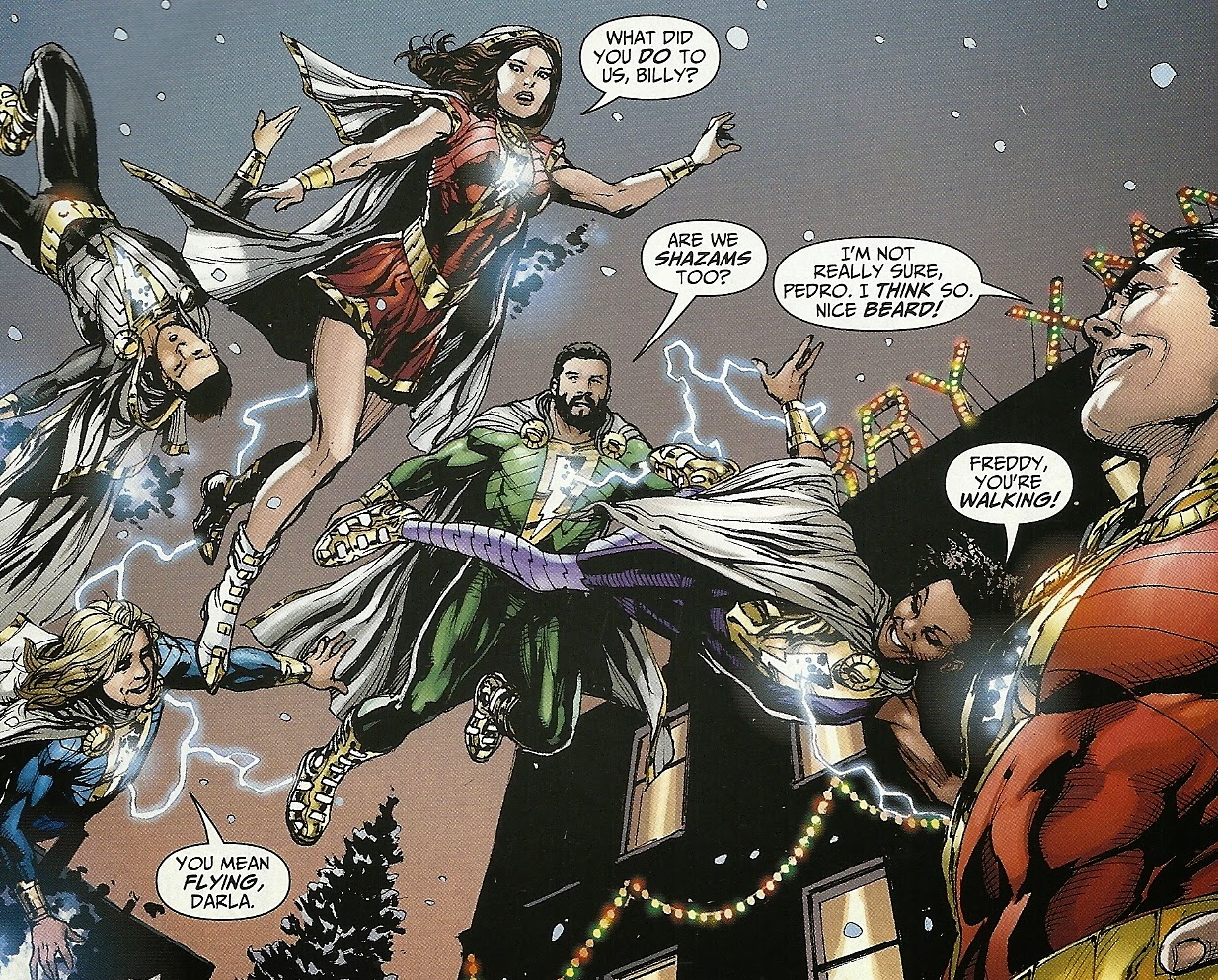
Eaglesham was probably the ideal artist for the book at this point, too, as he can bridge the gap between Franks' style and still work in images that are light and fun. Like the above, which packs the whole Shazam Family--the transformed versions of Billy, Mary, Freddie and the three "Lieutenant Marvels"--into a single panel, providing them with a range of expressions that recalls Kevin Maguire's JLI comics.

•With his hood down, the biggest, most glaring change between Cap's traditional costume and his New 52 one is that he and his siblings all have perpetually shining lightning bolt logos on their chests. In the trailers for the movie we've seen so far, it simply glows all the time, as if actor Zachary Levi is wearing a neon sign embedded in the chest of his goofy-looking muscle suit. In the comics, the bolts shine with an electric blue light that interrupt the red/yellow color scheme, and further suggest a hollowness to the characters' torsos, as if they are living batteries with lightning bolt-shaped holes in their chests that the magic lightning emanates from. I'm...not a fan of the look.

That impression may be more suggestion than reality, but the lighting glowing from within a chest logo reminds me of Alex Ross's Kingdom Come Green Lantern (and the character's last redesign before The New 52-boot; there's a nice image of that in this survey of Alan Scott costumes), whose green armor forms a power battery of sorts around him, and, to a lesser degree the Alpha Lanterns from Johns' run on the Green Lantern titles.


•In both of the above images, you can see that the Shazam lightning logos are alive with Kirby dots. I...don't like that. While Jack Kirby was such a prolific superhero creator and comics artists for both of the Big Two comics publishers (and plenty of other publishers), Captain Marvel was a superhero character he did not create, and it seems weird that every appearance of the hero should be accompanied by a visual element that has long since become synonymous with Kirby.


•The teenage superhero confronting the gang of gunmen wearing cheap, store-bought masks of the universes preeminent superhero team made me a little uncomfortable. Coincidence or homage, you would think someone somewhere along the line would have noticed how closely resembles the scene from Spider-Man: Homecoming and felt at least as uncomfortable, and suggested maybe changing their masks.

•I was a little surprised that Billy alludes to his superhero alter-ego's difficulty with a name not once, but twice in the same comic, both in the panel where Captain Marvel/Shazam first appears, and the one in the above panel, where he mentions his name. As I assume anyone knows who has read this deeply into a blog post of mine knows, the character's name is "Captain Marvel," although DC has experimented for years in trying to change it to Shazam and, briefly, just "Marvel", which doesn't really help at all (In terms of the latter, Captain Marvel Jr. was going to become the new Captain Marvel, and take the name "Shazam," while the former Captain Marvel was going to take the place of the wizard, and go by "Marvel").

The idea of changing Captain Marvel's name to Shazam seems to be that since DC hasn't been legally able to name TV shows, comics and now movies "Captain Marvel" for so long, due to the existence of a succession of lesser Marvel Comics characters who have tossed the codename around like a hot potato seemingly just to keep Fawcett's superman down, a lot of people who don't read comics have just assumed Shazam was the name of the hero, rather than the name of the wizard. The problem, of course, is that since "Shazam!" is Billy's magic word, and the saying of it is so key to the character's basic story, that every time the character introduces himself, he should revert to Billy, and any time Billy tried talking about the hero, he would transform into the hero (that latter was more of a problem when Billy was a boy reporter; so far, this Billy doesn't have a job, although I guess I won't be at all surprised if he becomes an amateur podcaster or does a youth podcast for the local radio station WHIZ).

That's the problem he alludes to when he decides not to announce himself to the gunmen, and that the whole Shazam Family stumble into when they meet with the police after the fight. That it's apparently been a year since the events now collected in Johns and Frank's Shazam trade paperback and the characters still don't have names, and here we see Billy making a reference to the hero's "real" name before being cut off makes me wonder if DC and/or Johns are rethinking the name of the character, or are just acknowledging the difficulty in the change.

I guess it will be unlikely for them to not call him Shazam, given the upcoming release of the film, but it's not impossible. Maybe they will settle on something like Captain or The Captain or even Captain Shazam...? I don't know; I remain curious about Mary and Freddie's alter egos, as "Mary Marvel" and "Captain Marvel Jr." seem out, and "Mary Shazam" and "Shazam Jr." sound so silly.
And then there's the matter of the new Lieutenants, who we can be certain will not be Tall Marvel, Fat Marvel and Hill Marvel (Maybe they will have names referencing their powers of strength, super-speed and the ability to talk to machines, like Captain Thunder, Lighting Girl and...The One Who Talks To Machines...?)

•This issue ends with a back-up story about how Mary joined the Vasquez family, where she was the second foster child, to follow Freddie (introduced reading a book about making your own fireworks, with the words "For Adults only" visible on the cover). It's drawn by Sen, whose style seems far better suited to a kid-friendly comic than Eaglesham's (Like most DCU books though, this is rated "T for Teen", and DC thus doesn't really find it appropriate for most kids, even if it has so far been free of Black Adam tearing people limb from limb or anything).

Sen's Mary and Darla still look youthful when transformed; Mary does seem to "age up" now like Billy when she transforms, but Darla is supposed to retain her youthful look, even though Eaglesham draws her as if she too ages up.

But forget all that. Yes, Sen's art is great, and yes, it did make me want to see what this comic or the Shazam/Captain Marvel relaunch might have looked like had she drawn the whole shebang instead of Franks and Eaglesham (as well as what the characters might have looked like had they been redesigned in a more classic-looking direction than into the New 52 aesthetic; think Miriam Marvel and Black Adam's redesigns from the pages of Bombshells, for example). The important thing is this: Look, that rabbit has received Marvel-ous powers when the girl's transform!

This version of Hoppy is brown and white, like Art Baltazar's version from Tiny Titans and the DC Super-Pets franchise, rather than the pink of the original Hoppy. Not the shape of the brown of his fur after his transformation, too. I hope this wasn't just a one-off gag appearance and that we'll see more of Hoppy in the future. And I hope he will get a little costume, rather than just being a lightning-powered rabbit in the way that the first story arc's Tawky was just a magically powered-up tiger rather than a talking tiger wearing a suit. we'll see.

Tuesday, January 06, 2015

Review: Shazam! Vol. 1

There's a very telling scene about midway through Shazam!, Geoff Johns and Gary Frank's retelling of the story of C.C. Beck and Bill Parker's first-wave superhero for the mass media adaptation hungry 21st century comic book market, when the young protagonist Billy Batson comes face to face with the wizard who gives him the magic word that enables him to transform into the caped strongman Captain Marvel.

In the original, Golden Age story, Billy Batson is a homeless orphan boy lead by a mysterious stranger to a subway tunnel where he catches an equally mysterious magical train to the sanctum of the ancient wizard Shazam, who awards the boy with the powers of six heroic patrons and makes him his champion.

Johns' version is infinitely more cynical. When Batson, a sarcastic 15-year-old foster child appears before the now nameless wizard (who he at first thinks may be a child molester [?!]), it's as part of a sort of magical abduction experience the wizard has been repeating for decades, in a fruitless attempt to find a human being who is pure good, and thus worthy of the fantastic powers of Shazam.

Batson tells the wizard off, steamrolling the wizard's insistence that there is such a thing as a pure good person:
I'm only fifteen and I already know there's no such thing as a pure good person...People are horrible. They disappoint you. They let you down. I've spent my life learning that...Good people get swallowed up. They get taken advantage of. They disappear...You're searching for something that doesn't really exist.
It's a very cynical take on the characters, and yet it's the very heart of what proves to be an important, even pivotal scene. Not only does Billy insist that there's no such thing as a purely good person, and that good can't survive in the long in the real world, but he actually convinces the wizard with this argument, and, out of desperation—a very powerful threat is coming, and only a magically empowered champion stands a chance of saving the world—the wizard grants Billy the powers of Shazam.

"I have no other choice, do I?" the wizard says to himself, "There's no more time." And he therefore reluctantly settles for Billy Batson, seeing that the boy at least has the potential to be good, which is better than nothing.

Is the scene told a bit more naturally, and with some greater dramatic sophistication then the storybook-simple Golden Age version? Sure. Is it more realistic? Of course. But it also introduces moral relevance into a milieu where it rests very uncomfortably. Because Captain Marvel was so incredibly popular in the 1940s Golden Age before disappearing for most of the Silver and Bronze Age of comics, the character and his stories saturated the medium for a while, but they never went through the growing-up period that all the similarly prevalent characters and comics did, and, as a result of that,  and of various creators glomming on to the idea of the character's secret identity being that of a child rather than a man or woman (and, I'd argue, the basic fairytale-like elements of the story), the franchise has never really been able to successfully shake its aura of childishness and old-fashioned-ness.

That is not a negative, although it is generally treated by DC Comics as if it were, which is why the company so very rarely tells Captain Marvel stories, but is always trying to reinvent the character.

Johns, an apparent fan who has written the character extensively in the past (although not as much as he's written his evil opposite, Black Adam), and artist Gary Frank go full-throttle in their attempts to update Captain Marvel, make him more distinct from DC's other caped strongman superhero and make the character's story more "realistic," and that, naturally enough, leads to a lot of rather cynical, extremely calculated and often quite uncomfortable creative choices.

But, it's well worth noting, this is not as bad as one might expect a Geoff Johns-written, New 52-line reinvention of Captain Marvel to be. As much as Johns and his higher-ups at DC have changed the character—including renaming him "Shazam" instead of "Captain Marvel" (tweaking the rules of his transformations in the process), giving him a new, heavily-redesigned costume and assigning him the DC Universe magic "beat" to patrol—this isn't as godawful as, say, Countdown's dark versions of Mr. Mxyzptlk or, more relevantly, Mary Marvel, or all the gory, horror and war movie motifs and aesthetics that Johns brough to the Green Lantern franchise (Which, to be fair, did transform the once-struggling Green Lantern book into a whole line of incredibly successful monthly comic books;  I might not always like Johns' creative choices, but I suppose there's no arguing with financial success in the mainstream comics industry).

In other words then, while Shazam's many reconfigurations of pre-existing elements may be off-putting—I was struck, for example, by how much a certain section of the book reminded me of Superior, Mark Millar and Leinil Yu's Marvel-published, creator-owned story about a 12-year-old boy who becomes Supermanior—it could have been much, much worse.

Despite the the high-profile creative team, and DC's burning need to keep somewhere close to 52 monthlies in print all the time, the publisher adopted a strange strategy for releasing Shazam: Rather than as a miniseries or ongoing monthly, or as an Earth-One graphic novel, where its thorough reinvention and film/TV pitch-nature would seem more at home, it appeared as a back-up strip in the Johns-written Justice League comic book, occasionally taking over the pages of Justice League altogether.

It was front-loaded with some of the more off-putting elements, so that I was scared away from the story by some of the images in the very first, short installment.

There was the new costume, with its hood, glowing chest-emblem and constant aura of lightning...

There was the new Dr. Sivana, a big, brawny tough guy rather than the wizened little old man, no bigger than the child Billy...
(A few installments in, Sivana gets a lightning bolt-shaped scar over one eye, allowing him to "see magic.")

And there was Billy himself, a smart-ass who calls a nice young couple who want to adopt him a "a couple of idiots" as soon as they're out of earshot...

That was more than enough to have me recoil from Justice League in dread, and I never checked back in with Johns and Frank's Shazam serial until it was collected, and could be read in the whole form it was created to be experienced as (That is, it reads like an original graphic novel, not a collection of a serially published back-up strip).

There would be more similar attempts to make the Marvel Family and villains more realistic and/or bad-ass as the series progresses, like the new look of the former Seven Deadly Enemies of Man, now called The Seven Deadly Sins...

And Mr. Tawky Tawny, who is no longer a talking tiger who comes to America to join polite society, but is a zoo tiger Billy feels a certain amount of affection for and, at one point, gifts with Shazam powers.

Here is the story of Johns and Frank's Shazam, which really does read like a comic book version of a PG-13 superhero movie based on the Captain Marvel character (and reads better when regarded as such, I think; compared to the characters as they appear in the recent The Multiversity: Thunderworld Adventures, everything here seems wrong-headed, but as a self-contained Captain Marvel/Shazam story, it works just fine).

Scientist Dr. Sivana is researching magical abductions in an attempt to track down the fabled Rock of Eternity, in order to discover and harness real magic, which he believes can help save his family where science has failed (As to what's going on with his family, that's not detailed, and would presumably be a plot point if and when Johns and Frank continue their storyline).

Meanwhile in Philadelphia, unpleasant young man Billy Batson has conned a trusting couple into taking him in as a foster child, which would make him their sixth.

They already foster white kids Mary and Freddy (who are of course the secret identities of Mary Marvel and Captain Marvel Jr. in the pre-New 52, original stories; this version of Freddy has long, blonde hair for some reason). There are three "new" characters, too: Smart Asian stereotype Eugene, chubby, dumb Hispanic kid Pedro, and an effervescent young black girl named Darla. I say "new," because the three of them were all introduced during Johns' Flashpoint story, in which the six kids each possessed one of the attributes of Shazam, and could combine to form the composite hero Captain Thunder (ala Captain Planet).

Billy doesn't get along too well with his new family, and they don't care for his shitty attitude either, but they start to warm to him a little bit at school the next day, when he defends them from bullies...sons of a rich, powerful grown-up bully who seems straight from central casting, who he's not afraid of:
Sivana and Billy's storylines begin to intersect when Sivana's research leads him to the Iraqi tomb of Black Adam, who he releases. The wizard summons Billy to the Rock of Eternity, and they have their little fight about whether there's such a thing as a really good person or not, with the wizard giving Billy the word and the powers.

At first, Billy and Freddy use their powers for fun and games (this is the bit that reminded me of Superior, a stretch of which involves the newly-empowered 12-year-old protagonist in an adult's body abusing his powers with his best friend), but things eventually get real when Black Adam, Sivana and the Seven Deadly Sins come to town, tearing the place apart while searching for Billy. Billy holds the rest of the wizard's power, you see, and Black Adam wants all of the Shazam powers for himself.

Will Billy do the right thing and fight Black Adam and his evil entourage, or will he stand down and let the villains destroy everything?

Well, it is a superhero comic, so naturally the day will be saved via violence.

Near the climax, Johns and Frank have Billy sharing his powers with his five siblings.
Mary Marvel and Captain Marvel Jr. both appear, although they don't have codenames and obviously won't use those ones if they ever get them (although Freddy does call himself "King Shazam" in one panel), both wearing costumes that look a bit like New 52 versions of their original ones. Pedro gets a beard and green costume, apparently turning into Marvel's Hercules. Darla gets a purple costume and Euguene gets a black one. Who has what powers isn't entirely clear, but Darla has super-speed and Eugene can now talk to machines (?). Additionally, everyone seems to age a little by the transformations, but to various degrees. Billy and Pedro are completely unrecognizable, for example, while Darla looks like she only gains a year or four. Mary and Freddy, who used to retain their child-like forms when they gained their powers, now also age, but their transformations don't render them as unrecognizable as Billy and Pedro's transformations do (As weird as the color schemes and some of these choices may be, I suppose this is a much more palatable take on the Lieutenant Marvel concept than Tall Marvel, Fat Marvel and Hill Marvel would have been).

After the climactic battle, things settle into a status quo that, were this the film it reads like, would be laying groundwork for the sequel.

Black Adam is killed off (not sure how he appeared in Forever Evil, exactly), The Seven Deadly Sins flee to appear in Trinity War and Trinity of Sin: Pandora, the kids and various townspeople all laugh at that one asshole's penis...
...Sivana has been shrunken and shriveled by his exposure to magic, leaving him in a more familiar form, and Billy decides he kinda likes his new family after all.

Oh, and on the last two panels, Sivana meets Captain Marvel's other greatest archenemy, a talking caterpillar who introduces himself as Mr. Mind.

For all its faults in terms of conception, it's difficult to argue with its execution; even Frank's designs and artwork stand out as head-and-shoulders above the bulk of The New 52 line (especially during those first two years or so, when this was published, prior to some of the more interesting hires of late). Whatever one might think of the book's goals, it meets and fulfills them successfully, and works perfectly well on its own terms.

As a longtime reader and fan of Captain Marvel, this all feels wrong to me, an attempt to fix something that isn't broken, and it all feels extremely awkward when considered as part of the larger DC Universe as it currently stands, but, if you can divorce the book itself from its publishing history and from the shared universe in which it is apparently set, it's an accomplished, even interesting take on Captain Marvel.

That is, it's a pretty good Elseworlds story, and would have been a great addition to DC's Earth One line of graphic novels.
Shazam gives it two thumbs-up, but then, he would.

Monday, September 29, 2014

So, who's this Captain Marvel character...?

Captain Marvel was a Golden Age caped strongman-style superhero created in 1939 by C.C. Beck and Bill Parker and published by Fawcett Comics. One of—and at times the—best-selling comic book heroes of the 1940s, he seemed at first blush to be a pretty straightforward Superman rip-off—especially if one only looked at the covers of comic books featuring the two heroes rather than reading the stories about them under those covers. The two characters were actually quite different, however, and even engaged in a sort of creative cross-pollination, with Marvel Family characters like Mary Marvel inspiring Superman Family characters like Supergirl.

Fawcett published various Captain Marvel and Marvel Family comics until 1953, when they folded as a comics publishing concern (in part because DC was suing them for copyright infringement).
Captain Marvel was also the name of a short-lived Silver Age character who appeared in a short-lived series from short-lived publisher M.F. Enterprises, appearing in four issues in 1966-1967. This one was an alien android with the power to separate his body parts to act independently.

Captain Marvel was also the name of a superhero created by Stan Lee and Gene Colan for Marvel Comics in late 1967; an alien military officer from the Kree Empire, his real name was Mar-Vell.

A few years later, DC Comics started licensing the original Captain Marvel character and his supporting cast from Fawcett, so both DC Comics and Marvel Comics both had Captain Marvels, neither of which attained the popularity the original enjoyed in the 1940s, given that comics in general weren't as popular in the 1970s and 1980s as they were in the 1940s.

Then Marvel's Captain Marvel died of cancer, and the name Captain Marvel was adopted by Monica Rambeau, who had different powers and was unrelated to her predecessor in any way other than her code name.

She later gives the name to Marvel's Captain Marvel's son Genis-Vell, who becomes Captain Marvel III, while Rambeau takes the name Photon (which Genesis-Vell also later takes) and then she takes the name Pulsar. And then she just goes by Monica Rambeau for a while. And now I think she's called Spectrum.

Marvel's fourth Captain Marvel is kinda sorta Captain Marvel III's younger sister, although she later renames herself Martyr and dies, I think....?

The name then goes on to Captain Marvel V, actually a Skrull sleeper agent who thinks he's the original Marvel Captain Marvel. He dies.

Next up is Marvel Boy II Noh-Varr, who briefly took the name Captain Marvel and a modified version of the original's original costume, before changing his name to The Protector, leaving the name Captain Marvel up for grabs again, until it was claimed by Carol "Ms. Marvel" Danvers, a one-time (original) Captain Marvel supporting character who gained Cpatain Marvel-like powers through an energy fusion of Kree DNA back in 1969.
In 2012, she dropped the "Ms" and became Marvel's seventh character named Captain Marvel.

While Marvel's Captain Marvelss were engaged in a decades' long game of hot potato with the name, DC Comics assumed ownership of the original Fawcett Captain Marvel in the early '90s, and published a variety of books featuring that particular family of characters, none of which ever had the name "Captain Marvel" in the title, although he kept the name within the comics themselves.

Since then DC has renamed their Captain Marvel, the original Captain Marvel, Shazam (in most instances; an upcoming issue of Grant Morrison's The Mutliversity project refers to the character as "Captain Marvel"). Because of that, Carol Danvers is currently the only Captain Marvel with her own comic book series. That said, she's only one of ten superheroes that have gone by the name "Captain Marvel," and she's only had the name for about two years now.

And that's why Marvel Studios will never make a Captain Marvel movie. Because when anyone hears the name, they think of at least two or three different characters.

But then, I assumed Fin Fang Foom would have been the first Lee/Kirby monster to appear in a major motion picture, but Groot was part of the Guardians of The Galaxy ensemble and is now a fucking household name, so hey, what do I know...?

**********************

Discussing female superhero movies with a friend the other day, the Carol Danvers problem came up. In addition to how nebulous and polluted the name "Captain Marvel" is, I think it unlikely that Marvel Studios would make a movie featuring a character with the name of the studio in her name. It just sounds weird  to my ear, Marvel's Captain Marvel.

She noted that a more interesting movie would be one starring the current Ms. Marvel, Kamala Khan, and while I think Ms. Marvel sounds just as off as Captain Marvel for the title of a Marvel Studios movie and assume there's still that Carol Danvers/Captain Marvel problem (as Kamala takes that codename because Danvers was her hero, and Danvers abandoned "Ms. Marvel" for "Captain Marvel," as discussed above), she rightly noted they could just de-couple Danvers and Kamala Khan for the purpose of the movie, and then the only name problem is the fact that Marvel's Ms. Marvel sounds goofy to me.

Of course, Marvel Studios seems to have some difficulty making a superhero movie that doesn't star a buff, white, blonde guy named "Chris," so I suppose the chances of them making a movie about a character who is a Muslim, Pakistani-American teenage girl are pretty slim, no matter what her name is.

Monday, March 05, 2012

Breaking: New Captain Marvel is...

DC revealed the new look of Captain Marvel, who is now to be called Shazam, in today's issue of The New York Post, the comics medium's paper of record (If you click over to their website now, it's the seventh story on the left-hand side of the page, just scroll past the story about Kim Kardashian's wedding and Whitney's secret Jermaine Jackson affair...and the story about Olivia Munn and Christina Hendricks denying that supposed nude pics of them on the Internet are of them and the story about someone who looks like Madonna named "Madge"...and the one about Chrstine Brinkley's divorce and Lindsay Lohan's dinner...There is is!)

He looks dark and angry and like he's trying too hard, which isn't the best look for Captain Marvel, but then, given how drastic some of the New 52 costume redesigns have been—take Superman, for instance—I'm actually kind of relieved he doesn't look worse. The Spectre-style hood doesn't really work for the character, but I'm hoping Frank and all involved will realize that early on and Cap—er, Shaz (?) just opts to wear it down all the time.

Monday, January 30, 2012

Meanwhile, at ComicsAlliance...

Hey, did you guys hear DC is officially changing Captain Marvel's name from his name, Captain Marvel, to his catchphrase, "Shazam", as part of Geoff Johns and Gary Franks' New 52-ization of the character in the upcoming "Curse of Shazam" strip?

Well they are.

Wednesday, April 14, 2010

There's only one reasonable explanation.

If you've read any of my past posts in which I excitedly blogged my way through certain episodes of the Batman: The Brave and the Bold cartoon, then you know I'm a pretty big fan of the series.

In addition to being a really fun, really funny, really well voice-acted cartoon seemingly aimed at both little kids and the most obsessive adult DC Comics fans, the show consistently marries the particular design skills of many of the great artists to work for DC over the decades (particularly Dick Sprang and Jack Kirby) into a seamless, consistent whole while retaining the individual artists' personal aesthetics. It also seeks out the weirdest and most obscure DC-owned characters available as guest stars, demonstrating how contrary to popular fan opinion even the wackiest characters have modern resonance and potential kid-friendly commercial appeal. It presents a Batman we haven't really seen in any non-comics media since the seventies or so, a life-loving, wise-cracking Bob Haney-style Batman who is nevertheless the ultimate bad-ass, know-it-all detective and obsessed crime fighter we've come to know and love since the mid-eighties or so.

There was a point during the first episode I saw—in which Batman teamed up with Plastic Man to fight Gentleman Ghost, and then crash-landed on Dinosaur Island where Batman got turned into a gorilla, that I wondered if maybe they weren't just making the show just for me. How else to explain the disproportionately large roles given to Plastic Man and Aquaman, two of my favorite superheroes, who aren't exactly at the top of many fans' Favorite Superheroes lists?

That suspicion eventually passed, when I realized how many other folks out there love the show just as much—if not more—than I do.

I haven't been watching it too regularly, as I lack cable and I'm not much of a TV person—90210 and Dancing With The Stars excepted—and I just recently caught up with the second season.

Now I know they weren't making this show for me. Instead, I apparently found a magic lamp at some point during the past few years, and accidentally rubbed it, unbeknowest to me releasing a wish-granting genie. Since I released it unawares and thus didn't actually make a wish, the genie must have read my mind, and then went off to Hollywood, got a job in animation and helped developed Batman: The Brave and The Bold's second season in an effort to duplicate my un-asked for, unconscious desires.

How else to explain a run of episodes that included
Plastic Man's pal Woozy Winks,


Captain Marvel fighting a Dr. Sivana that looks like he leapt right out of a C.C. Beck comic (oh, and the Sivana kids and Black Adam, too),


Aquaman packing Mera and a sullen Arthur Jr. (wearing his dad's 1986 miniseries costume!) going on an RV vacation of the surface world,


The Teen Titans as little kids,


Batman flying the killer skies with Enemy Ace,


The Batman of Zur-En-Arrh (!!!),


Batman wearing Plastic Man as a giant boot...in order to kick a Bigfoot in the face...in the middle of a fight scene against an entire gang of Bigfoots,


Batman wearing the Metal Men as a Batman costume...


...allowing him to use their fantastic metallic powers to do battle with their foes,


and Doc Magnus undercover as a space pimp (wearing his Metal Man Gold as false gold teeth)

And that's before we even get into in what is perhaps the greatest episode of anything on TV ever, "Death Race to Oblivion," in which someone—probably that genie I was talking about—had the great idea to splice DC super-comics with Wacky Races and Death Race 2000, resulting in an episode in which Mongul eschews the whole forced gladiatorial combat thing for an every person-for-themself road race between various superheroes and supervillans in their various super-vehicles.

So you've got Batman and Joker in the Batmobile and Jokermobile (respectively), Green Arrow in his Arrow Car, Gentleman Ghost in a souped-up hearse, Steppenwolf in a monstrous polluting tank thing, The Huntress on a purple motorcycle, Black Manta in a big War of the Worlds-looking manta crab walker thing, Green Lantern Guy Gardner in a ring-generated muscle car,


Woozy Winks driving Plastic Man in the form of a race car,


and Catwoman in her Catmobile, with cat-scratching action!

Who wins? Who loses? And how do the heroes defeat Mongul? Well, it involves Batman transforming the Batmobile into a giant robot battle suit and, oh my God,Batman in a Batmobile that is also a Transformer!

Thank you mind-reading, wish-granting genie in the animation industry! Keep up the good work!