
Showing posts with label cassandra cain. Show all posts
Showing posts with label cassandra cain. Show all posts
Wednesday, April 01, 2026
Batgirl on a horse!


Thursday, March 13, 2025
Reviews: Birds of Prey: End Run, Birds of Prey: The Death of Oracle, Batgirls Vol. 3 and Spirit World
Birds of Prey: End Run. Birds of Prey: The Death of Oracle. Batgirls Vol. 3: Girls to the Front. Spirit World.
What do these four comics collections have in common?
Well, they are all published by DC Comics. And they are all written (or co-written) by female (or non-binary) writers. And they all star female (or non-binary) heroes.
But the reason I read them all in the last month or so, and the reason I decided to group reviews of them all together in a single post, is that they are all comics I decided to read during the course of writing about the first year or so of writer Kelly Thompson's run on the new Birds of Prey series.
*********************************
DC relaunched Birds of Prey in 2010, just about a year after the first volume of the series was canceled. They did so as part of their "Brightest Day" initiative, an event which included a bi-monthly, year-long series with that tile, and various branded tie-in series, of which BOP was one (At least, the first five issues, and the first collection, included the "Brightest Day" branding on their covers).
The premise of the series and its tie-ins was that, after the events of "Darkest Night," a dozen dead superheroes and supervillains had been resurrected for mysterious purposes and they would have to discover what those purposes were.
In a sign of just how erratic DC's planning was at that point, that particular Birds of Prey series only lasted 15 issues, before it was cancelled and then re-relaunched as part of the New 52 initiative, which—temporarily, at least—rebooted the entire DC Universe continuity and all the extant books were relaunched with new #1 issues.
The real sales hook of the 2010-2011 Birds of Prey though was that it marked the return of fan-favorite writer Gail Simone, who had a four-year, 52-issue run on the original series. And, for some fans I suppose, it also featured the return of artist Ed Benes, who was the first artist to work with Simone on that earlier run.
While I confess to having quite enjoyed Benes' work on BOP in the early '00s, when his style was much looser and more obviously manga inspired, I had since tired of it by 2010, due largely to his tendency to draw all of his characters exactly the same (with two body types, male and female) and the exploitive nature of his drawing of female characters, which could, at times, be wholly contrary to the tone of the story he was drawing (His brief run on the troubled 2006-2011 Justice League of America was the breaking point for me).
His presence on this volume of Birds of Prey is almost certainly why I had skipped it when it was originally released, although I guess 2010 Caleb need not have worried: He ended up only drawing most of the first four issues, before other artists took over.
Reviewing the history of this team book in my post on Kelly Thompson's run, I remembered that I had never actually read this short iteration of Birds of Prey, one that I imagine is now probably neglected by newer readers, being so incredibly short—filling just two trade paperbacks—and coming between two much longer runs.
Luckily, there are public libraries though, and I was able to find collections of it quite easily.

Oh, and another bird-themed character, The Penguin, plays a major role in the first story arc, as a kinda sorta ally of the Birds.
While Oracle deals with one of those villains, who comes at her in the Batcave, the rest of the team deal with the other two, fleeing the police carrying the wounded Penguin to the Iceberg Lounge, where a Gotham SWAT team lays siege to them.


 Spirit World (2024) is the work of writer Alyssa Wong (probably best known for her 40-issue run on Marvel's Star Wars: Doctor Aphra, although she has done some writing for both of the big two superhero publishers), and artist Haining. (Both creators are credited both by these names and in Chinese characters, as are the colorists and letterers).
I do wonder if including Hawk and Dove in the book was Simone's idea, or an editorial mandate, given that Hawk had been resurrected as part of the "Blackest Night"/"Brightest Day" storyline, and thus maybe needed a home or status quo somewhere outside of the Brightest Day limited series. Reading the first collection of the 15-issue series, Birds of Prey: End Run (2011), it's not really that hard to imagine Simone, Benes and the other artists telling the exact same story without Hawk and Dove in it, their roles either eliminated or taken by other—really, almost any other—heroes.
For the most part, the focus is on the core team, their relationships to one another and their pasts. Hawk and Dove are the focus of just a few pages of the first issue/chapter, a two-page fight scene followed by two pages of them in plainclothes at a bar, Lady Blackhawk Zinda Blake arriving there to recruit them for Oracle.
For the most part, the focus is on the core team, their relationships to one another and their pasts. Hawk and Dove are the focus of just a few pages of the first issue/chapter, a two-page fight scene followed by two pages of them in plainclothes at a bar, Lady Blackhawk Zinda Blake arriving there to recruit them for Oracle.
The rationale for her doing so seems to be that they need Oracle more than she needs them, "And your boy don't look like he's gonna make it without her," Zinda tells Dawn after giving her a card. The pair will spend the majority of the first, four-part story arc from which the collection gets its title in the background, Dove carrying the wounded Penguin around, while Hawk acts as occasional muscle.
That first issue introduces us to the rest of the team (their first appearances each heralded by a block of text announcing their names and skills or powers, which will get tiresome quickly, as these intros continue throughout each issue/chapter of the entire collection). They have all continued to do superhero or vigilante stuff, but solo, after...whatever happened to break them up in the last issues of the previous series (I, um, didn't read those either...or, if I did, I have now completely forgotten them).
That first issue introduces us to the rest of the team (their first appearances each heralded by a block of text announcing their names and skills or powers, which will get tiresome quickly, as these intros continue throughout each issue/chapter of the entire collection). They have all continued to do superhero or vigilante stuff, but solo, after...whatever happened to break them up in the last issues of the previous series (I, um, didn't read those either...or, if I did, I have now completely forgotten them).
Oracle, now operating out of the empty Batcave, calls them all back together to announce a terrible new threat facing them: Someone has sent her extremely detailed files containing all of their secrets and those of many of their allies. Not just their secret identities, but the names and addresses of their loved ones too.
This seems to be happening simultaneous to an elaborate plot to frame the Birds as bad guys, an extremely skilled martial artist having killed someone Canary recently fought with a rare technique few know (Canary being one of them), and later (and on panel), a new player lures them to a particular location, grabs one of Huntress' crossbow bolts, and stabs The Penguin in the throat with it, just as the pre-called police arrive.
That new player turns out to be another extremely skilled martial artist by the name of White Canary, who Benes draws in what looks like a long white coat over lingerie skimpy enough to make Black Canary's bathing suit-and-fishnets get-up look like business attire. She is working with two other surprise players, one with a long history with the Birds and another an old Batman villain, but she seems to be the driving force behind the plot...as well as being intent on betraying her partners after she gets what she wants.
While Oracle deals with one of those villains, who comes at her in the Batcave, the rest of the team deal with the other two, fleeing the police carrying the wounded Penguin to the Iceberg Lounge, where a Gotham SWAT team lays siege to them.
As an excuse to get the team back together and recruit Hawk and Dove, the plot works well enough (After the scene in the bar with Zinda, Hawk and Dove appear as Oracle-sent back-up, there to save Black Canary and Huntress from White Canary, who is kicking their asses pretty badly). It also seems to set up a new status quo for the team, that of outlaws, although it's not clear if this will stick—or even have time to. After "End Run", there are only 11 more issues left in the series, and only nine of those will be written by Simone.
The art is...well, it's as predicted.
Benes is still drawing just two different body types (with the short, round Penguin an unusual departure for him), and his women are all exact clones of one another, their big-breasted, well-muscled forms all identical to one another, with only their hair colors and costumes distinguishing them (In an amusing scene, Hawk refers to Zinda as "the blonde with the legs", although she, of course, has the exact same pair of legs as all the other characters).
Benes is also drawing the already mostly skimpy costumes as skimpy as possible, so that Zinda's skirt is so short that it barely covers his ass, and Canary and Huntress's costumes similarly revealing as much ass as editorial would probably let him get away with (Although he does seem to have pushed it pretty far, here; if you look closely at all of the images of Huntress he draws, there's often no ink line between her exposed stomach and the purple panels covering her breasts; colorist Nei Ruffino is responsible for filling in the white portions of the costume there).
I don't think it's great work, although I suppose the Charlie's Angels-esque premise of the book excuses a high degree of cheesecake. Simone also seemed to be encouraging this tendency in Benes' art, as the third issue contains an eight-panel sequence in which The Penguin, apparently hallucinating due to blood loss, imagines the Birds all coming on to him, stripping out of their costumes and, in Huntress' case, straddling his lap and kissing him. (Hawk is there in the hallucination too, but merely tells The Penguin, "Hey. Don't look at me, man.")
While Benes manages the entire first issue himself, by the second, fill-in art is needed, and this arc includes a lot of really sloppily constructed and rendered work. There are no credits for each issue in the trade—they could reproduce those introductions of each character issue after issue for the trade, but not the credits?—and, instead, all of the artists are simply listed at the beginning of the collection. A few minutes at comics.org, however, will reveal that Benes got help on the pencils for the second, third and fourth issues from Adriana Melo and on inks by Mariah Benes.
It looks pretty rough, and like Melo didn't get much time to work on those issues at all. There are quite a few panels that it's kind of surprising DC even published, like ones where characters might be having conversations, but one of the participants won't be drawn at all, their dialogue bubbles coming from off-panel, or a few in which the figures are just unbelievably wrong and amateurish (If you happen have a copy of the collection in your hands for some odd reason, see, for example, Black Canary on page 62, panel 1).
The collection also includes a two-part story, "Two Nights in Bangkok," which flows directly from the first. It mostly stars Black Canary, Huntress and Lady Blackhawk (Oracle is mostly busy setting up a new base for the Birds in a Gotham City building owned by Ted Kord with her re-recruits Savant and Creote, and Hawk and Dove are in the hospital—Hawk does get a scene related to his "Brightest Day" status quo here, though, appearing in a "White Lantern" costume and conversing with his dead brother Don Hall, the original Dove, in a dream sequence).
White Canary has convinced Black Canary to travel with her to Bangkok and face Lady Shiva in a fight to the death to save her kinda sorta adopted daughter Sin (here, still very young; writer Kelly Thompson, who states her age as 16 in the current Birds of Prey, must be assuming a lot of time has passed since this series). While Black Canary wouldn't have much of a chance against Shiva under the best of circumstances—no matter what Tom King might have to say on the matter 15 years later—here she has a broken wrist and is wearing a sling around one arm. The fight is a death sentence.
Huntress intervenes, forcing Shiva to fight her instead, and Huntress is even less of a match for the world's greatest martial artist (Or second greatest if you count Cassandra Cain...or third greatest if you count Richard Dragon). She wins anyway...or at least survives through a mix of belligerence and dirty tricks long enough that the rationale for the fight expires before she does.
Huntress intervenes, forcing Shiva to fight her instead, and Huntress is even less of a match for the world's greatest martial artist (Or second greatest if you count Cassandra Cain...or third greatest if you count Richard Dragon). She wins anyway...or at least survives through a mix of belligerence and dirty tricks long enough that the rationale for the fight expires before she does.
These two issues are drawn by Alvin Lee and Melo, with inkers Jack Purcell and J.P. Mayer. It seems a vast improvement over Benes' arc...not necessarily because of style, but because of consistency. (Lee and/or Melo are also very cheesecake-focused; there's a panel where Huntress is shown zipping up her top in which her breasts are falling out, even though it isn't clear her top had a zipper there)
It's pretty clear that Simone had no idea that the New 52 was coming at this point—one wonders how many folks at DC did, including editorial—as she is here still setting up a new status quo for the team, but it would turn out that her run was already about half over at this point.

The volume collecting the rest of the series, Birds of Prey: The Death of Oracle (2011) provides more evidence of this fact still. The four-part title story arc has Barbara Gordon showing elements of her new base off to the recently resurrected Batman, as well as initiating a new plan that involves faking her own death as part of an effort to reduce the number of people who actually know about her existence and work (At that point, she had become the "infojock" serving pretty much the entire superhero community; after the events of the story, she has shrunk her circle of operatives and allies down to just the Birds and most of the Bats).
Heck, the very last issue that Simone writes, the thirteenth of the series' fifteen issues, ends with the Birds having been defeated by a terrifying new enemy, and Oracle vowing to go back after her and bring her down. But that doesn't go anywhere, obviously. The last two issues of the series wouldn't follow up on that plot. Instead, writer Marc Andreyko would write what reads like a two-part inventory story (Another portentous scene in this volume, in which Hawk visits The Penguin for some secret business that is never revealed to the readers, would also go unresolved anywhere).
In "The Death of Oracle", Barbara provokes a battle with The Calculator, a particularly goofy old supervillain that writer Brad Meltzer had previously transformed into a villainous analogue of Oracle, playing the same role she does in the superhero community for DC's supervillains. Their conflict apparently hinges on something that happened in the pages of Batgirl (the Stephanie Brown-starring series), at least according to an asterisk and an editorial box, but essentially wants to convince him that he has successfully killed her.
This involves The Calculator sending his agents Mammoth, new characters Current and Mortis and a host of H.I.V.E. soldiers to abduct the female Birds, who are celebrating Dove's birthday at a strip club.
That story is followed by two more Simone-written ones. The first, a done-in-one, focuses on The Huntress, and Catman's elaborate efforts to manipulate her into not liking him anymore, while the second, a two-parter, involves most of the Birds trying to infiltrate a mysterious building that turns out to be the base of Junior, the daughter of the Golden Age Rag Doll (and thus the brother of Secret Six's Rag Doll) while The Huntress attempts to recruit Question Renee Montoya to the team.
Again, Simone doesn't really have an artistic partner in this volume either (You'll note hers is the only name on the cover above), but the art is at least much better this time around. Ardian Syaf pencils the first issue of "Death", Guillem March the second and Inaki Miranda the third and fourth. Pere Perez draws the Huntress/Catman issue, and Jesus Saiz and Diego Olmos each draw an issue of the last story arc.
Stylistically, the art is all over the place, but it was a treat to see March's work here. Like Benes, he seems to have a special interest in drawing sexy women, but he's much better at it, giving his figures a slightly more cartoony sheen, and he's able to pull off a variety of body types (He also does a wonderful Penguin, and draws the hell out of Batman in a few panels). I also like Miranda's work here quite a bit.
The Andreyko-written issues are drawn by Billy Tucci and Adriana Melo, both of whom contribute to both issues and, like most of the issues in the first volume, the art looks pretty rushed.
These Andreyko issues are completely disconnected from the stories that precede them. The original, Golden Age Phantom Lady, now a senior citizen, joins Lady Blackhawk and Black Canary in an event for World War II veterans organized by her granddaughter Kate Spencer (secretly Manhunter).
Flashbacks to a 1950 adventure Phantom Lady, Lady Blackhawk and Canary's mom detail an encounter with a Nazi mad scientist in Argentina, and he and his followers return in the present to seek their.
The story itself is fine, if weird in how free-floating it is, not being connected to the preceding series in anyway and, unfortunately, not reading at all like it was the last Birds of Prey story of the post-Crisis continuity.
The story itself is fine, if weird in how free-floating it is, not being connected to the preceding series in anyway and, unfortunately, not reading at all like it was the last Birds of Prey story of the post-Crisis continuity.
And with that, the short-lived second Birds of Prey ongoing reached its conclusion.
The series would be relaunched in November of 2011 in a new, third ongoing by Duane Swierczynski and Jesus Saiz, the new line-up consisting of Black Canary, Poison Ivy, Katana and new character Starling. As for the other characters from the 2010 Birds of Prey of series, Barbara Gordon would appear in a new Batgirl series written by Gail Simone that reverted the character back to the role she abandoned back in 1988 and Hawk and Dove would appear in Hawk & Dove by Sterling Gates and Rob Liefeld, which lasted all of eight issues.
All three series looked pretty terrible to me, and I didn't read any of them.
*********************************
In discussing my immediate reactions to the new Birds of Prey, based solely on that first Leonardo Romero image that was released, I mentioned that, upon seeing Cassandra Cain, I wondered how her being on the team would square with where I had last seen her.
That was, of course, in the pages of the (very) short-lived Batgirls series, which, despite its weaknesses, was at least a great status quo for Gotham City's three Batgirls: All active heroes, working together as partners and living together as friends.
Of course, that reminded me that I never actually finished reading Batgirls...and thus I had no idea if the team had, like, broken up or something at the end of it. I wasn't overly enamored with the series, which I found quite wanting, despite my affection for the characters and my agreement with the basic premise, but, as a Cassandra Cain fan, I figured I should at least do my due diligence and read the final issues of the series. (I talked about the first volume, in regard to trying to fathom why it did so much more poorly than past Batgirl series, here, and then reviewed the second one in this column.)
Of course, that reminded me that I never actually finished reading Batgirls...and thus I had no idea if the team had, like, broken up or something at the end of it. I wasn't overly enamored with the series, which I found quite wanting, despite my affection for the characters and my agreement with the basic premise, but, as a Cassandra Cain fan, I figured I should at least do my due diligence and read the final issues of the series. (I talked about the first volume, in regard to trying to fathom why it did so much more poorly than past Batgirl series, here, and then reviewed the second one in this column.)

I was glad to see that my hope that the book would continue to get better, with each new volume being better than the one that preceded it, was met. Despite the rather...un-Batmanly story that opens the collection, Batgirls Vol. 3: Girls to the Front (2023) is the best-written collection of the 19-issue series. Although I guess that trend line doesn't matter too much; sure, a potential fourth volume would seem to accordingly be even better still, but, well, there's no fourth volume coming.
The rather stuffed 144-page collection opens with the sole Batgirls annual, drawn by artist Robbi Rodriguez, who contributed some art to the previous volume (As for the artist who launched the book with writers Becky Cloonan and Michael W. Conrad, Jorge Corona, he remains on cover duty only).
There's a sizable change to the status quo in its story, with Barbara Gordon moving out of the team's loft in Gotham neighborhood The Hill and back into her Clocktower headquarters (which has apparently been rebuilt after being destroyed in the earlier issues of the series), but the main focus is on Cassandra Cain and Stephanie Brown expressing their interest in trading places with one another, if only for a day.
This casually articulated wish actually comes true, thanks to a magical coin that a mysterious old lady hands Steph after she rescues a cat from a tree, and the two junior Batgirls swap bodies, Freaky Friday style (Or Ultimate Spider-Man #66-67 style, I guess; I don't know, has this also happened in other superhero comics I haven't read, too...?).
This casually articulated wish actually comes true, thanks to a magical coin that a mysterious old lady hands Steph after she rescues a cat from a tree, and the two junior Batgirls swap bodies, Freaky Friday style (Or Ultimate Spider-Man #66-67 style, I guess; I don't know, has this also happened in other superhero comics I haven't read, too...?).
The timing could be better. While Babs, Batman and magical consultant Zatanna try to figure a way out of the problem for the girls, their supervillain parents both come calling simultaneously, with Lady Shiva asking Steph-in-Cass' body to board a helicopter, and Cass-in-Steph's body being drugged and delivered to Cluemaster. For reasons never made clear, Steph doesn't try to explain to Shiva what happened at first but tries to trick her into believing she is actually the real Cassandra.
In this volume, one story leads to the next pretty organically. When their minds revert back to their correct bodies, Cass knows the danger Steph is now in, and she goes to rescue her from Cluemaster, who I guess has recently been brought back to life...? (Odd; I don't remember him dying...at least not this time. I do recall him dying in the short-lived 2001 Suicide Squad relaunch, but not this particular death. Did he get killed at the end of Batman Eternal, which I totally read, and I simply forgot about it...?). At any rate, the now-alive Cluemaster is holding his daughter captive and forcing her to play along in a game show he's set up in a remote, trap-filled cabin.
(Oddly, the body-swapping shenanigans focus completely on Steph-in-Cass'-body. Cass-in-Steph's-body spends the entire time tied-up, gagged and in the backseat of a car).
Cluemaster reveals that The Mad Hatter brought him back from the dead, and so then the next issue focuses on the girls battling the Hatter.
Only the last story, the three-part "From Hill's Heart", doesn't flow from the preceding issue. In that one, there's a mysterious sniper targeting random civilians in The Hill, a sniper with an apparent vendetta against the Batgirls. It turns out to be minor, Chuck Dixon-created villain Gunbunny (who, to my knowledge, has never even met any of the Batgirls). She, in turn, is confronted by a counter-sniper, who appears to be her dead partner Gunhawk, but is actually Batgirls villain Assisi from the first volume, disguised as Gunhawk for, um, some reason...?
Obviously, Cloonan and Conrad's scripting still leaves much to be desired, even if the series has gotten much better at getting inside the girls' heads and exploring Steph and Cass' friendship as it progressed.
There is, as unfortunately seems to the case far too often now, no regular artist on the series. Rodriguez draws the annual and issues #17-#19 ("From Hill's Heart). Jonathan Case draws issues #13 and #14 (the rest of the body swap story that starts in the annual). Neil Googe, who contributed art to the second volume, draws issue #15 (The Cluemaster story). And Geraldo Borges and Rico Renzi draw issue #16 (the Mad Hatter story).
All are excellent artists, and I like each of their styles just fine (despite Rodriguez's reliance on using manipulated photographs for backgrounds), but none of them go particularly well together, and the book suffers in the most basic, panel-to-panel continuity. Case, whose style is the most dramatic departure, gives Cassandra a radical new hairstyle, in which she seems to have cut three to six inches off between issues, for example, and while one issue ends with a captive Steph covered in electrodes, the next picks up without any electrodes on her (as Case also colors and letters his own work, his issues are an especially sharp departure from what precedes and follows them).
All are excellent artists, and I like each of their styles just fine (despite Rodriguez's reliance on using manipulated photographs for backgrounds), but none of them go particularly well together, and the book suffers in the most basic, panel-to-panel continuity. Case, whose style is the most dramatic departure, gives Cassandra a radical new hairstyle, in which she seems to have cut three to six inches off between issues, for example, and while one issue ends with a captive Steph covered in electrodes, the next picks up without any electrodes on her (as Case also colors and letters his own work, his issues are an especially sharp departure from what precedes and follows them).
To answer the question I had before reading this volume though, no, the team doesn't break up or anything at the end. The two junior Batgirls jump off a building together, presumably on their way to their next adventure, in the last panel of the series, with only Cloonan and Conrad's omniscient, third-person narration indicating that the series is ending.
********************************

Near the climax of Birds of Prey Vol. 2: Worlds Without End, in which the team is trapped in an ever-changing pocket dimension that can be manipulated by their thoughts, Batgirl Cassandra Cain comes up with a plan to defeat the villain pursuing them. This involves making the dimension resemble "Spirit World", which an asterisk leading to an editorial box reminds readers she visited in the 2023 miniseries Spirit World.
This reminded me that I had never read Spirit World, despite my affection for the Cassandra Cain character.
Spirit World's star, Xanthe Zhou, also appears briefly in the story, called in by the Birds' ally John Constantine to help investigate the mysterious portal that the team disappeared into. When the Birds and the story's villain all emerge from that portal, zhou helps them fight the villain with their giant sword (Xanthe, by the way, is, like their co-creator Alyssa Wong, non-binary).
Luckily, DC made it easy to catch up on the six-issue Spirit World in a collected edition, which also contains its 10-page prologue "The Envoy" from one-shot anthology Lazarus Planet: Dark Fate #1 by the Spirit World creators and an eight-page Batwoman team-up from the pages of DC Pride 2023 by Jeremy Holt and Andrew Drilon. I'm pretty sure that means it has all of Xanthe Zhou's appearances up to the point that the book was published, then.
And as for that book?

It introduces a brand-new character to the DC Universe, the codename-less Xanthe Zhou, who serves as a sort of go-between for the real, living world and the title locale, an afterlife inspired by Chinese beliefs. They also have magical superpowers similarly inspired by Chinese superstition: They can make folded paper constructions into the objects they represent, most often a giant sword.
It's an always welcome effort by the publisher to introduce a new character and expand the DC Universe.
In the 2023 "Lazarus Planet" crossover storyline, a volcano on Lazarus Island erupted, ultimately causing magical storms and rain all over the world that have strange, unpredictable effects on the people and characters. The events played out in a variety of "Lazarus Planet"-branded specials, like the aforementioned Lazarus Planet: Dark Fate. These events are apparently what Wong and Haining use to incite the introduction of Zhou, who hails from Gotham City's little-visited Chinatown.
Zhou is visiting the grave of her grandmother in a Gotham cemetery when they are suddenly set upon by jiangshi, the hopping vampires readers might be familiar with from kung fu movies or other pop culture; the creatures have apparently awakened by the magic rain.
Zhou is soon joined in battle by Batgirl Cassandra Cain, who helps them put the undead attackers down by kicking them in the head and affixing magical pieces of paper (talismans) to their heads. The pair are soon joined by a rather unlikely third character, making for a rather eclectic cast for the Spirit World story that is being set up in this short: John Constantine.
After the vampires are all vanquished, a new threat emerges: A "collective" of angry spirits, which take the form of a scary tree; it is the "necromantic" energy of this which had drawn Constantine to the cemetery. Zhou manages to exorcise it and send it back to the underworld, but not before it grabs Cassandra in a branch-like limb and drags her with it.
And thus the plot for the series to follow is established: Cassandra Cain is trapped in the spirit world, and it's up to Zhou and Constantine to mount a rescue mission.
There's a slight hiccup as the short, Lazarus Planet prologue leads into the Spirit World series proper, as the story essentially restarts, and some amount of time seems to have passed since Cassandra was taken and Zhou and Constantine re-meet one another, the urgency of the situation somewhat downplayed by their having separated in the first place.
Wong and Haining start off the narrative on parallel tracks. There's the characters in the living world trying to find their way to get to spirit world, which involves a meeting with Zhou's family, who have been mourning their loss since they first ventured into spirit world (Zhou's own status is somewhat ambiguous throughout much of the story; they are apparently simultaneously alive and dead, able to travel between the two worlds when presented with a portal or other opportunity to do so).
And then there's Cassandra in the Chinese underworld, where the various undead are irresistibly drawn to her as a living being, and seek to eat her. She luckily finds allies in the form of Po Po and Bowen, friends of Zhou's who help her mask her presence with a new, temporary costume and some magical tea.
When the heroes finally all reunite, they find themselves facing a new threat to the underworld, in the form of another collective (or is this the same on that they saw surface in Gotham?), one that once attempted to absorb Cassandra during her short trip to spirit world years ago, and is now currently absorbing other innocent spirits at an alarming rate in an attempt to challenge the remote gods who rule this afterlife.
(Don't remember Cass visiting spirit world? You wouldn't, as it wasn't actually depicted in the comics at the time, but remember when she dies* near the Andersen Gabrych-written end of her series in 2006, before Lady Shiva resurrects her in a Lazarus pit? Wong posits that her spirit briefly visited spirit world, and Haining draws highlights of her trip. Cassandra is, remember, part Chinese).
At Spirit World's climax, which involves our unlikely trio of heroes battling both the now giant collective and an honest-to-goodness god, it is Zhou who manages to save the day, with both their understanding of what ultimately drives the dead of this particular underworld, and a bit of negotiating and deal-making that reminded me a bit of some past Constantine storylines.
Xanthe Zhou proves to be a unique and compelling character, and one that I hope sticks around the DC Universe. They seem to be doing well so far, appearing not just in Birds of Prey, but also, apparently, in an early issue of the new Mark Waid and Dan Mora Justice League Unlimited.
I was quite taken with Haining's art, which, based on her online credits, I must have seen a few times before in other books. I was especially impressed with the fact that the artist drew the entire six-issue arc, as that is, quite unfortunately, something of a rarity today, even on miniseries.
I suppose that, at a glance, the big-eyed character designs will suggest manga art, but it actually suggested Chinese comics art to me, as little of that as I've actually read (Publisher ComicsOne published some Crouching Tiger, Hidden Dragon collections in the first years of the new millennium, before I had even started EDILW, which I quite enjoyed at the time).
The layouts and panel-flow don't suggest Asian comics at all, though; this reads very much like a traditional Western superhero comic, if one with more dynamic, creative layouts than some others (Which lead me to wonder how the team made the book; if it was done "Marvel style", or in a more rigorously scripted manner).
Given how much of the book is set in a fantasy underworld, there is obviously a lot of cool stuff for Haining to draw, and the book is filled with weird characters from Chinese folklore and, one imagines, the creators' own imaginations.
I'm...not 100% sure how I feel about Constantine's smoking here. He almost always has a cigarette in his mouth, which he lights with a burst of magic energy from his fingertip, and he rarely seems to take it out, even to hold in his hand. It looks really unnatural, but, as the book went on, it gradually started to become endearing to me, as if Constantine is so committed to smoking that he never spits out his cigarette, no matter how dangerous the circumstances or pitched the battle (And this is very much a more superheroic DCU Constantine than the Vertigo one I'm more familiar with, constantly summoning, using and fighting with magic like Dr. Strange in a trench coat).
Haining's Xanthe Zhou and Cassandra Cain are both beautiful, the latter looking quite a bit younger, perhaps because her bigger, wider eyes. As I was reading, I did question why Zhou's shaven head never seems to grow out any—they spend three straight days unconscious at one point in this adventure—and I did wonder if they were ever going to change clothes, given that they don't wear a costume, just (admittedly cool-looking) street clothes. But then I realized Constantine's constant stubble never seems to grow either, and he seems to be wearing the same damn outfit he's been wearing since 1985.
An extremely well-made, beautifully drawn comic that introduces a great new character, a cool new corner of the DC Universe and proves a nice showcase for one of my favorite characters, I was quite pleased I finally got around to reading Spirit World.**
The end of the Spirit World mini-series isn't the end of the Spirit World trade paperback, though. There's still that DC Pride short story. I was a little surprised to see that it wasn't by Wong and Haining, but by writer Jeremy Holt and artist Andrew Drilon.
In their story, Xanthe Zhou, still wearing the same outfit as in the previous series and short story, is in the world of the living, and is bored, narrating about how living their life can feel like a burden. They eventually break into a cemetery after dark and practice folding objects out of paper. Suddenly, vandals with ridiculously high-tech equipment—gauntlets that generate what look like laser Wolverine claws—arrive to attack the Kane family mausoleum, and Batwoman promptly appears to defend it from them.
The two team-up to fight the bad guys and rather swiftly drive them off, and they then have a three-page conversation, in which Batwoman seems to rather randomly reveal her secret identity to this person she just met (Or, at least, she tells Zhou her late mother's name, which is pretty darn close to doing so).
There's a bit about relationships with the dead, and birth families versus found families. And the story seems to indicate that Zhou might like women. "Batwoman?! Okay. Stealth is officially hot," they narrate when Kate Kane first appears. Later, Kate says "If I didn't know better, I'd say you're... ...flirting with me," although I saw no indication that Zhou was.
Like many of the shorts from such anthologies, there's not really much to it, but I suppose it's good that they included it in the collection, making it easier for readers who want to have all of Xanthe Zhou's appearances in one place able to do so.
Of course, now they have to also track down two issues of Birds of Prey and at least one issue of JLU...
*I'm actually unclear on this point, as it's been almost twenty years since I read that story (It, um, wasn't so good that it was one I ever revisited). Here, Haining draws Shiva holding a gun and shooting Cassandra through the chest, and later, after a two-page spread depicting her journey through Spirit World, Cass exclaims, "My mother. She killed me. Then brought me back." But checking Wikipedia, it says that Cass was actually mortally wounded by a character trained by her father David Cain, known as Mad Dog. I am too lazy to go dig through long boxes just to settle the question for myself at this point. I don't suppose anyone has a trade paperback of Batgirl: Destruction's Daughter handy, do they...?
**If, like me, you enjoyed the book, and the various bits of Chinese myth, legend and folklore seen throughout it, from the setting to the rules and practices involving the dead, I would heartily recommend you also check out Remy Lai's exellent 2023 graphic novel Ghost Book, which I reviewed here.
Although the tones and art styles of the two books are quite different, both seem to be drawn from the same well of inspiration, with Ghost Book's two heroes trapped between the two worlds similarly to Xanthe Zhou, and much of Lai's book also being set in the Chinese underworld. There's even some slight overlap of characters. While psychopomps Oxhead and Horseface have more substantial roles in Lai's work, they do make a brief cameo in Haining's art, appearing in the spread where Cass remembers her first trip through the spirit world.
I wondered if Ghost Book might have provided any inspiration to Wong's Spirit World, but it looks like the first issue of the latter shipped in July of 2023, while Ghost Book was released in August of 2023, so the two came out pretty much at the same time, and Lai and Wong and Haining must have all been working on their stories at around the same time.
Monday, February 17, 2014
New 52 vs. DC Super-Pets: Batgirl
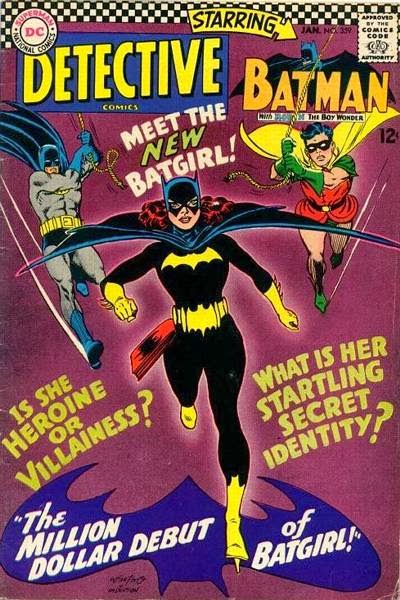 |
| Carmine Infantino's cover for 1967's Detective Comics #359 |
When she first appeared, she was waring the costume above, and it changed little over the 20 years between her debut and her 1988 retirement.
 |
| Mike Mignola and Karl Kesel's cover for 1988's Batgirl Special #1. I bought this comic from a back-issue bin specifically for the cover, and all I remember about it was that its insides were not as good as the cover. |
A few more Batgirls eventually followed in the comics. In 1999's Batman: Shadow of the Bat #83, part of the "No Man's Land" storyline, a mysterious new Batgirl in a new, all-black costume that hides her entire face appears. She's eventually revealed to be The Huntress, having adopted a bat-costume in an attempt to fill the void left by Batman, who was MIA from Gotham at the start of the story.
 |
| Damion Scott |
 |
| Phil Noto |
Here's what her new, New 52 costume looks like.
 |
| Adam Hughes |
The inside of her cape is also purple now, and, on that first cover at least, she seems to have her cape affixed with some sort of bat-brooch...that, or she's just wearing a bat-pin on her cape.
It seems that the design has ben finessed a little big already, as the underside of her cape eventually became yellow, rather than purple.
 |
| Ed Benes |
Here's how artist Art Baltazar dresses Batgirl, in the pages of the DC Super-Pets Character Encyclopedia:

Baltazar's main innovation here is that he changes her tunic into a dress—that, or she's wearing a skirt and a tunic. Baltazar's artwork is so simple and flat that it doesn't really suggest textures, so it's difficult to say exactly what material she might be wearing or how thick it might be, and therefore I can't tell if she's wearing tights or leggings under the skirt (good), or wearing pants under her skirt (bad...and weird).
As un-Batgirly as the skirt or dress might be, I actually kind of like it in the way it evokes the original Bat-Girl costume, and the way it differentiates this look from the original Batgirl costume (The costume from The Batman that I like is actually a dress over tights).
I don't think this is the best possible Batgirl costume, and I don't think the design is quite the home run that Baltazar's Animal Man costume is, but I don't like it any less than I like The New 52 design and, with some tweaks, I think Baltazar's basic design could make for a far superior costume than The New 52 costume.
***********************

Wednesday, March 07, 2012
This is kinda weird:
 DC's new website is apparently "currently in beta status," which I think means there are still some bugs to be worked out.
Here's one!
If you visit the "Characters" page, you'll see images of some of their most iconic characters (Plus Swamp Thing and Cyborg!) and, if you click on them, you'll find little biographies of the characters. I clicked on "Batgirl" out of curiosity, to see how they were handling Barbara Gordon's rebooted history and the other Batgirls (Cassandra Cain and Stephanie Brown).
It's a short, three-paragraph bio, but it doesn't mention Gordon's time as Oracle, nor does it mention Cain or Brown. But! One of the two images they use to illustrate the piece features not Barbara Gordon, but Batgirl II Cassandra Cain.
 It's a portion of James Jean's cover for 2003's Batgirl #45, from the volume of Batgirl that starred Cain. In that particular issue, Cain tries going out for a night of nocturnal crime-fighting wearing original Batgirl Barbara Gordon's costume, rather than her own.
That's likely why whoever put that image there decided to put it there, even though you can clearly see that Batgirl has black rather than red hair.
I found the mistake particularly amusing because the official DC argument for making Barbara Gordon Batgirl again—one that editors and others were making years before the publisher actually decided to reboot their continuity with last September's New 52boot—was that Barbara Gordon was the most icon version of the character, the one everyone pictures when they think of Batgirl.
Except whoever designed that page, apparently, and of all the images of Barbara Gordon as Batgirl in existence, they chose one of Cassandra Cain as Batgirl.
Fans probably shouldn't read too much into those bios in terms of what they say about the current state of DCU continuity. I didn't read them all, but I saw no mention of Martian Manhunter in the "Justice League" entry (despite using the term "Big Seven," it ends its listing of those seven with "Cyborg, a half-man/half-robot outfitted with the world’s most advanced technology"), the entry for "Robin" includes all the Robins except for you-know-who (who may not even exist in there current New 52 U) and the "Teen Titans" entry mentions Raven and Beast Boy as Titans, and pictures Aqualad, Kid Flash Wally West, Wonder Girl Donna Troy, Wonder Girl Cassies Sandsmark, Cyborg and a green Beast Boy—the images are a "Year One" image full of characters that may or may not exist anymore, and one from Geoff John's run, which the current volume of Teen Titans seems to be over-writing.
Then I stopped reading the characters' entries, because it was irritating my brain to try to make sense of them, given what I know about the DCU as it was and as it now is.
Wednesday, March 30, 2011
Some follow-ups to some recent posts
 Yesterday I ran a panel from Fred Van Lente and Ryan Dunlavey’s Comic Book Comics #5, a panel which I thought offered a nice, elegant response to the “The Families of Creators Comics Published Once Ripped-off Are Greedy Evil For Pursuing Their Legal Rights And Thus Maybe Endangering My Steady Stream of Superman and X-Men Stories!” line of argumentation that seems a staple of comment threads.
One of the many, many pleasures of the pair's Comic Book Comics series has been their portrayal of comics creators, often by using their characters as stand-ins. For example, in a panel discussing Neil Gaiman and Todd McFarlane’s legal battles over Marvelman/Miracleman, Dunlavey drew Morpheus and Spawn each tugging on a different arm of the contested Marvelman character.
Sometimes they hybridize character and creator. For example, their Walt Disney usually appears as Mickey Mouse with Disney’s human face in place of Mickey’s saucer eyes and mouse snout, and their Jerry Robinson has the hairstyle and wardrobe of The Joker in some panels.
One creator they always draw more-or-less straight is Alan Moore, whose Old Testament hair and beard and intense eyes make him one of the comics creators who is every bit as visually interesting as many of the characters he has written.
In the story “1986 AD” from Comic Book Comics #5, Moore appears repeatedly, as a child selling LSD to a police bobby, as a janitor, riding upon a rocket ship with Dave Gibbons, working as a janitor and so on.
Here are two of my favorite pictures. Moore and Gibbons pursuing Moby Dick, who is cosplaying as Rorschach…
 …and this image of Moore as a child…

**********************
In the comments to Monday’s post about IDW’s recent collection of the old DC/TSR Forgotten Realms, commenter “A Hero” pointed out this post regarding the collection on writer Jeff Grubb’s blog.
In it, Grubb talks a bit about how he found out about the collection, how it apparently came together, and his dealings with all of the parties to see if he would be getting paid anything since they were reprinting the stories he wrote.
Here’s Grubb’s recommendation for how those interested should proceed, keeping in mind that it doesn’t look like he or Rags Morales or the other creators are making any more money off the collection:
So now what? Call my horde of fans to block this horrible trammeling of a contract? Protest in the streets? Fight for creative rights? Camp out in the state capital? Call for a boycott?
Nope. Instead I’m going to recommend you BUY a copy.Is it okay if I just do it here?
…
THEN, of course, I want you to write to IDW (and Hasbro) and tell them how WONDERFUL the story and art is. And how they should (sparing no expense on their part) HIRE the talented team of Grubb and Morales, who obviously understand how the D&D universe works and are fine examples of writer and artist and a shining addition to ANY comic book line.
Okay, here goes.
Dear IDW,
I greatly enjoyed your recent collection of the old TSR/DC Forgotten Realms comics, which I think are the best Forgotten Realms comics ever (I didn’t much care for that business with the Drow elf who has all the z’s in his name that I think Devil’ Due published a few years back).
In fact, I liked them so much, that I bought some of ‘em twice, the second time from you.
The story was wonderful. The art was also wonderful. You should totally hire the talented team of Jeff Grubb and Rags Morales, who would be a shining addition to any comic book line. Especially a fantasy comic book series, and especially a fantasy comic book series based on Dungeons & Dragons business.
I probably wouldn’t buy the books that resulted in their serially published format—Sorry, I can’t afford $4 comics on a freelance writer-about-comics’ “salary”—but I swear I’ll buy the trade collection. Probably form Amazon.com. And then I’ll write about it on the Internet, like I’ve written about this collection like eight times already.
Sincerely,
J. Caleb Mozzocco
P.S. You know what else you should do with that D&D license? A Bizarro Comics/Strange Tales-style anthology series.
P.P.S. If you want to read a pitch for a G.I. Joe miniseries in which Polly, Timber, Junkyard and Freedom team-up to save the Joes from a nefarious Cobra plot, just let me know!
Dear Hasbro,
Thank you for inventing Hulk Hands. Those things are the best.
Your pal,
J. Caleb Mozzocco
P.S. The story and art in those old DC/TSR Forgotten Realms comics IDW just collected are WONDERFUL—all caps, in bold, that’s how wonderful they are—and you should (sparing now expense) HIRE the talented team of Grubb and Morales, who obviously understand how the D&D universe works and are fine examples of writer and artist and a shining addition to ANY comic book line.
Hope that helps, Mr. Grubb!
********************
Grubb also talked about some behind-the-scenes business with those old DC/TSR comics and how they originally came about in this post on his blog. This is basically the exact sort of thing I would have liked to see in an introduction to the Forgotten Realms trade.
I didn’t pay much attention to credits back then, but it turns out Grubb wrote one of my favorite arcs on the AD&D book, the “Catspaw Quartet” four-parter in which Onyx and Timoth adventure in the sewers of Waterdeep, before launching the Forgotten Realms monthly.
Here’s how he describes the approach to the books:
Big thing about the AD&D and FR comics – these were fantasy books about characters that knew they lived in a fantastic universe. They were aware and capable of handling their situation. This wasn’t part of a “points of light” where sinister stuff lurked over the next hill. It wasn't a dark fantasy world. Those are cool, but the Realms ran off the assumption that its heroes were smart enough to know about their world.I think that likely contributed to the generally light-hearted feel of the books. While there were some very serious issues in AD&D—slavery, betrayal and war came up a couple of times—the bulk of that series was really fun fantasy adventure.
Grubb also discusses the end of the TSR/DC alliance and the cancellation of the books. I always assumed it was because they sold poorly, which was the reason most comics get canceled. Turns out there were some poor business choices made. Now I wonder how much longer the books might have lasted on the merit of their sales alone. The books were all ended right about the time the comics market was entering into it’s crazy 1990’s speculation boom phase.
********************
I seem to have been one of the few comics readers who didn’t mind the TV Wonder Woman costume as it was first revealed all that much. Part of the reason, I think, is that the standards for live-action television superhero costumes are soooooo much lower than they are for live action movie superhero costumes.
For example, remember Smallville’s JSA costumes? Or have you seen TV Guide’s reveal of the new Blue Beetle’s costume as it will appear on Power Range—Er, Smallville?
Look at the Wonder Woman costume. Then look at the Blue Beetle costume. Then look at the Wonder Woman costume again. See, that Wonder Woman costume doesn’t look so bad anymore, does it?
Speaking of which, you can see newer, better images of the costume here. It looks tweaked here and there, like giving her back her red boots (to my dismay), and pants that look more like pants than something cobbled together from blue raspberry Fruit Roll-Ups.
I suppose I should note that the Booster Gold costume looks pretty good in that single image released, as a real-world version of his costume. It even has the little Nascar-like patches, as seen on J.G. Jones’ covers for 52.
********************
 It looks like Kevin Maguire is referencing his own references of his own cover from 1987's Justice League #1 for the cover of Justice League: Generation Lost #24 (as revealed in this Source blog post on upcoming variant covers).
For some reason, DC has had Maguire, the artist best associated with the characters starring in the series, providing variant covers to JL:GL, while other artists provide the normal covers. Some of those artists and their covers have been pretty rotten, particularly right at the outset, although since first Cliff Chiang and then Dustin Nguyen took on the gig, they’ve all been pretty swell.
Still, if I had the choice, I’d almost always choose the Maguire covers. I haven’t had a choice though. I’ve been reading the series and enjoying it, largely due to the bi-weekly schedule. In retrospect though, I wonder if I maybe shouldn’t have trade-waited it, if only to be able to (presumably) get all the Maguire covers that way.
It is my strong belief that DC should hire Maguire to draw each new iteration of the Justice League line-up in that looking up at the reader as a group pose. I don’t think I’ve seen it since he did the Morrison JLA on the cover of an issue of Fanboy, though.
 I sure would have liked to see him do the Meltzer/Benes League, or the current Congorilla and friends League…
*******************
Speaking of covers, as I’ve mentioned before, I always enjoy reading Kelly Thompson’s “Cover Solicits in Three Sentences Or Less…” features, which she recently tweaked so that she writes them while drunk now (Here’s her latest DC column, and here’s her latest Marvel column.)
Part of the reason I like them is because they’re funny and offer a perspective I don’t normally think too much about (like whether the artist seemed to be looking at a model with fake breasts or real ones when drawing a particular cover, a topic which got much discussion in this month’s round; Hey, Kelly, if you’re reading, can we tell if the new TV Wonder Woman has fake breasts or not looking at the action shots of her running in her costume? Because if they hired an actress with fake breasts to play Wonder Woman that strikes me as kinda sad…).
Also, Thompson’s rules keep her observations very tightly focused on the cover images, whereas every time I write about the DC and Marvel solicitations I always end up getting distracted and going off on long tangents about continuity and publishing strategies.
Also also, I always notice things when I re-look at the covers in her columns that I missed the first few times I saw the cover.
For example, you know that book Fear Itself: The Fearsome Foursome, which features both Man-Thing and Howard the Duck on the cover?
 There are five characters on the cover!
(Also, Howard the Duck is still wearing pants? What’s the point of Marvel selling to Disney if they can’t take Howard’s Disney-mandated pants off yet? Can they at least compromise and give him shorts?)
June’s cover for Herc features the title hero battling a tentacle monster. He seems to fare differently than the ladies from Heroes For Hire did when they fought tentacle monsters:


***********************
 Alan Kistler’s latest Agent of S.T.Y.L.E. column at Blog@Newsarama focused on DC’s Batwoman character. While discussing the costumes of the two Kate Kanes, Kistler mentioned the Batwoman costume from the 2003 direct-to-DVD Batman: The Animated Series movie, Mystery of The Batwoman. I rather liked that costume, in part because of how different it was from most other feminine versions of a Batman costume (It even had pink in it! Pink!)
The one it most closely resembled was, of course, the Cassandra Cain Batgirl costume. When thinking about fixes for that costume, which can look fantastic or dreadful, depending on who was drawing it, my mind would often return to this animated Batwoman’s look. I think if Cassandra’ Cain’s costume were to bend in the direction of this costume, it would retain some of it’s most appealing elements (As I’ve said before, I think that Batgirl costume, particularly as drawn by Damion Scott, featured the best aspects of both Batman and Spider-Man), while smoothing out some of the more difficult elements, like the stitching on the face and the black eye lenses in a black mask.
I don’t really understand how animated Batwoman’s mouth works—I watched it once a long time ago, and now I don’t recall where the costume came from…I think it was just fabric, with a whole cut perfectly in the shape of the mouth around the mouth, but I don’t know, maybe it was some kinda sci-fi smart cloth, nanite thingee.
Anyway, turn that Batwoman costume black, replace the pink with yellow and/or black, and give Cass back her big, goofy utility belt (Is it weird she has the biggest utility belt pouches of all the various Bat-people, but used the least amount of weapons and gadgets? Maybe they’re full of sandwiches?), and I think that would be a fine Cassandra Cain Batgirl costume that it would be very difficult for artists to not draw well.
Because I’m not computer-smart enough to just recolor existing images—and because I need something to do with my hands and the part of my brain the TV show fails to engage while I’m watching Dancing With the Stars—I drew Batgirl over and over in my sketchbook the other day.
This is a lame-o sketch of her original costume, although I think her bat-symbol is usually just an outline of yellow, not solid yellow:
 If you took out the stitches and gave her white eye lenses for something approaching animated Batwoman, I think you’d get something like this:
 Then I wondered what she’d look like if you kept Batwoman’s pink in her costume:
 (The pose, by the way, is swiped from Scott’s cover to Batgirl #25). Cassandra Cain isn’t exactly a pink-wearing kind of girl, but then, maybe that in itself would be a reason for her to try out some pink. Like, a self-conscious attempt to try and be more stereotypically girly…?
Before I colored those in, I got to wondering how the costume might look if instead of yellow or pink, she went with white. I suppose that would make it sort of Punisher-y, but white is such an anti-Batman color, as much as pink is, that I thought it might look interesting:


 (The last pose is another swipe from Scott, from the cover of Batgirl #20, featuring Batgirl and Spoiler on it. Scott is about the only artist who drew Spoiler in a way that her design actually seemed sort of cool to me).
Of course, in real-life the gloves would be caked brown around the hands, from dried blood bad guys would spit when getting punched and from the grime one gets from climbing around on Gotham City fire escapes and rooftops all night. Surely Alfred would forbid white in any Bat-costume he had to launder.
Cassandra Cain hasn’t shown up much in the comics at all lately. I heard there was an appearance in Red Robin in which she explained that she didn’t want to be Batgirl or was on sabbatical or something, but I didn’t read it—I gave up following characters a long time ago, and that’s not a book I was reading.
The last time I saw her was in Tiny Titans #33, the “all-Robin issue,” which introduced Tiny Cassandra:
 I suppose Tiny Titans is an unlikely place to look for DC superhero costume redesign ideas, but I kind of liked Baltazar’s version of that Batgirl costume. Not only did he simplify the stitching quite a bit to give the costume more of homemade feel (and I kinda dig the stitches-as-eyelashes bit around the eyes), but his Cassandra Cain has a skirt on.
 Now obviously Cassandra isn’t much of a skirt-wearer, so this Batgirl in a costume that includes a skirt no doubt seems out of character.
But then I started thinking about it, and how much harder it would be to fight in a skirt than it would be in a pair of tights.
I don’t know if many of you have read the later Dragonball comics or watched Dragonball Z, but there are a couple of parts where it’s revealed that grown-up Goku and Piccolo wear heavily-weighted costumes as part of their training, so you know they’re either getting really serious or are in over their heads in a fight when they remove their weights, so they are suddenly much faster and stronger.
So I could sort of see Cassandra Cain wearing a kick-restricting skirt as a form of self-imposed handicap, either to help her train or to artificially weaken her to make fighting more rewarding. After all, she has a body language-reading ability that borders on a superpower, and can fight as well or better than Batman and Lady Shiva (and she’s still a teenager), so day-to-day mugger and henchman-fighting is probably pretty boring for her.
If I had to assign a motivation for her current costume, I would think fighting-ability handicapping might be a good rationale. Why else wear a mask that reduces visibility, a big, long, dragging cape, and those big utility belt pockets? (Maybe they’re full of weights?).
So while it doesn’t really seem to be in character for Cassandra Cain’s Batgirl to ever rock a skirt, I think it could certainly be rationalized. Hell, high heels too!
Although under Baltazar’s pen, I assume he put her in a skirt just because it looks cute.

Sunday, October 24, 2010
If you only buy one superhero comic this week, make sure it's Tiny Titans #33
After all, it's the only one that's got Tiny Cassandra in it: 
That's right, Cassandra: AKA, Batgirl II:

 I know that Dan DiDio and other DC types have mentioned plans for the Cassandra Cain Batgirl in the near future, and always stress that they want to make sure they get the character right this time.
Well I hope those plans are letting Art Baltazar and Franco do pretty much whatever they want with Batgirl, because it doesn't get much righter than this.

That's right, Cassandra:
 AKA, Batgirl II:

 I know that Dan DiDio and other DC types have mentioned plans for the Cassandra Cain Batgirl in the near future, and always stress that they want to make sure they get the character right this time.
Well I hope those plans are letting Art Baltazar and Franco do pretty much whatever they want with Batgirl, because it doesn't get much righter than this.
Sunday, April 18, 2010
Quick, Kick-Ass-related question


Forgive me if this is a ridiculous question, but I only made it about two issues into Mark Millar and John Romita Jr.'s gay-panicky, casually racist, delay-plagued eight-issue miniseries Kick-Ass, so I never made it to the part where pre-teen death-dealer Hit-Girl's secret origin is revealed.
I have read a lot of reviews of the new movie though, which sounds like it scrubbed the more questionable content of the comics while still managing to make the same existential error (premising a story on a realistic take on a popular fantasy genre, and then devolving into an extremely fantastic story with next to no grounding in anything approaching the real world).
Most of those are most focused on the character Hit-Girl, in particular her swearing and her ability to inflict Uma Thurman-in-Kill Bill casualties. Many of these reviews mention who she is and how she came to be, and, well, it sounds almost exactly like the origin of the 2000-2008, Cassandra Cain version of DC Comics' Batgirl.
According to the nation's film critics, Hit-Girl was trained in martial arts by her father since birth, subjected to crazy amounts of child abuse like being shot in order to learn to take a bullet, all for the purpose of turning her into a perfect killer.
Cassandra Cain was trained in the martial arts by her father since birth, subjected to crazy amounts of child abuse like having the shit beat out of her, getting stabbed and shot in order to learn how to take all sorts of damage, all for the purpose of turning her into a perfect killer.
The main difference between the two origins is that the one from the Batman comics seems a lot more realistic since a) Cassandra Cain paid a huge developmental price for all of that abuse, never learning to speak or understand English until long after she escaped from her father, and b) her father was one of the world's greatest professional assassins and spent years perfecting a training-kids-to-be-assassins program, where as Hit-Girl's father is apparently just an ex-cop.
Am I being unfair and oversimplifying their similarities, and they're actually much more dissimilar than they seem? I suppose I'll borrow a Kick-Ass trade from the library eventually, and then I'll see for myself...
Subscribe to:
Posts (Atom)
