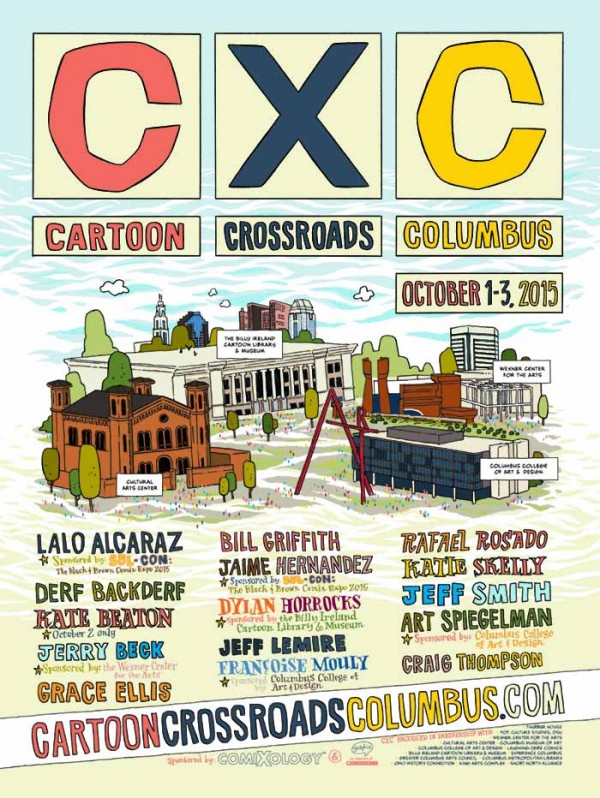
This weekend was the very first of what will hopefully be many
Cartoon Crossroads Columbus conventions. If you missed it entirely this year, I'd definitely urge you to consider attending next year.
I have a kind of weird relationship with the city of Columbus, which I lived in from 2000-2010, and have only been back a handful of times in the last five years; now doing so has the same sort of surreality of returning to your old high school or college campus years after graduating. Because of that, and the fact that when CXC was first announced, this year's version was expected to be a somewhat small, trial balloon-like scrimmage of a convention, I had only planned on attending one of the three days. I decided to go on Saturday, as that was the day Kate Beaton was going to be there, and she was the first announced guest that I was most interested in seeing and hearing (and had not seen or heard previously).
Well, I regretted not better planning my trip almost immediately upon arrival. As I said, I only attended one day–four events total, which was less than half of those that occurred on that day–and they were all great. There were at least two instances where, when an event ended, I felt like running out of the room, jumping in my car, speeding the two hours and five minutes it takes me to get from my current home in northeast Ohio to Columbus (and vice versa) and leaping to my dust-covered drafting table to start making comics (This was in sharp contrast to the way my relationship with comics started that very day; I woke up at 8:30, took a quick click around the comics Internet, and was so disgusted by much of what I saw that I seriously reconsidered what I was doing with my life, exactly, and maybe just quitting writing and reading about comics altogether. The lesson? Maybe I should only read the comics Internet once a year, or attend events like CXC daily;
one.)
Now, because I lived in Columbus for such a large percentage of my life, and because I
haven't been there for any great length of time for so very long, I keep getting tempted to write about the city, and myself and how both have changed, which I realize isn't really of any great interest to anyone, particularly in this post. So I keep starting and re-starting this post in my head (I started this post on Saturday; I am just now posting it at 2 a.m. Monday night/Tuesday morning, though; I expect it to be riddled with typos). I'll try my best to stick to comics here, though, and do it in a lazy, bullet-point format.
But the most important thing I wanted to stress is that I attended just a fraction of the events, and even that small sub-division of the event was one I found enormously rewarding and inspirational, so I can only imagine what the entire package would be like...especially if, unlike me, you are more of a socializer (I introduced myself to one of the two people I know of only as presences online; I
almost introduced myself to Tom Spurgeon a couple of times, but in each case he was talking to someone else. I've never spoken to Spurgeon, but I read his site daily, and it's like, one of the last places on the Internet devoted to comics exclusively...in addition to being well-written and a good resource of comics news. There were a couple of parties planned though, where you could presumably tell Art Spiegelman you like his vest or that he's been spelling word "mouse" wrong for
years now and mingle with cartoon and comics enthusiasts and professionals).
So, bullet points:
–This was my first visit to the
Billy Ireland Cartoon Library & Museum. When I was based in Columbus, I went to the Ohio State University's cartoon library exactly once, when the Wexner Center and the museum collaborated on a big Jeff Smith/
Bone/cartooning exhibit (
Jeff Smith: Bone and Beyond). I remember it feeling like the library was, at the time, a rather crowded hallway piled high with stuff. Now it's a nice, big, modern-looking building, named after a Columbus newspaper cartoonist who I wrote about
at least once before on the blog (and who information on was incredibly hard to come by in public libraries and/or the Internet at the time).
There's a replica of Billy Ireland's signature–a shamrock–in a stone on the floor right by the entrance. There's a reading room, for research purposes. There's a big gallery,
where there are currently two shows going on (
What Fools These Mortals Be: The Story of Puck,
Seeing The Great War and an ongoing
Treasures From The Collection... exhibit), and a few classrooms, one of which (named The Will Eisner Seminar Room) was being used for a series of presentations they were calling "Talk and Teach Classroom Presentations").
–I attended the second "Talk and Teach" presentation, presented by cartoonist
Katie Skelly, an emerging favorite of mine, whose work includes
Nurse Nurse,
Operation Margarine, a mini-comic my friend brought me back from SPX last year entitled
My Pretty Vampire and a mini-comic my friend brought me back from SPX
this year,
Agent 9. The subject of her talk was "Influence As Education."
–I always expect cartoonists to look like their drawings, whether they are autobiographic cartoonists or not, at least until I see them (Yes, when I used to imagine "Rob Liefeld" I saw a hulking, screaming figure in spandex sitting at a drawing table, a gigantic gun leaning in the corner while he drew). Skelly therefore did not meet my mental picture at all. She did was not smoking a cigarette, wearing a leather jacket or bad-ass boots; she did not enter on a motorcyle.
–After a brief intro by OSU's Jared Gardner, mostly consisting of Skelly's bibliography, Skelly plunged into her presentation, which included a few slides, but was mostly a
talk-talk. If you've read her works, you'll note that they are all rather heavily inspired and influenced by other works, mostly from other mediums. She talked a bit about the process of using influcene as it's applied to those works; for example, with
Nurse Nurse, she took the "shell" of something she really liked (
Barbarella), but then hollowed it out, and injected stuff she liked better, stuff that was
her stuff into it, transforming it.
–Much of what she discussed is the sort of things that everyone does somewhat subconsciously, but she broke it down into a somewhat rigorous, step-by-step process, that one can apply and follow in a conscious manner: Looking at things you like and figuring out
what you like about them, so you can borrow that element; looking at things you
don't like and figuring out what you don't like about them, so you can avoid those elements; looking at two examples, one thing you like and one you don't, side-by-side (She chose
Female Trouble and
The Royal Tennenbaums) and picking out what you like about one vs. the other, to help narrow down your approach to making your own stuff.
–She recommended looking at fashion photography. Those are very powerful images specifically created to communicate a direct and convincing message to the viewer ("Buy this stuff"), and thus good examples of direct, visual communication.
–She also jokingly referred to how it's totally okay to steal from fashion photography, since they're trying to sell you a $3,000 coat or something, so to hell with them.
–She shared an anecdote about being 13 and working in her parents' newsstand and looking at the magazines, struggling to make sense of the fashion lay-outs. She would see the sequences of related images, but would always have trouble finding a "story" in what was happening between the images, that lead from one to another. At the time, she didn't know that "buy this stuff" pretty much
was the story, and approached them as sorts of frustrating visual puzzles to be mulled over.
–I didn't do a headcount as I likely would have if I were covering this event for the paper I used to work for when I lived in Columbus, but it seemed like an okay crowd. We almost filled the room. It seemed to be rather equally divided to people like me (grown-up cartoon/comics enthusiasts), art teacher of one kind or another and art students, identifiable by their extreme youth and colorful fashions. Most of these were sketching. I noticed that I was probably the only person in the room without an open notebook and writing utensil. Almost everyone else, particularly the younger folks, were scribbling notes and sketches throughout the entire presentation.
–Skelly was immediately followed by
Dylan Horrocks, whose presentation was on "creative blockage." The Museum's Caitlin McGurck facilitated, although once more this mostly consisted of an introduction, during which she praised Horrocks'
Hicksville as an all-time great work, and noting that she and her fellow Billy Ireland employees have found a way to essentially live in a version of Eltingville (just in case you weren't already convinced they had someof the best jobs in the world). Horrocks also wrote a decent run on
Batgirl (Cassandra Cain version) and one of Vertigo's several attempts to spin an ongoing out of
The Books of Magic. He referred to
Hunter: The Age of Magic as "Harry Potter on steroids" and
Batgirl as "pretty much just steroids."
–Horrocks, who hails from New Zealand, had a rather soft-spoken voice with a hint of an accent. He didn't look much like his drawings either, but maybe a little closer to his character designs than Skelly to hers. I really liked the sound of his voice, and it made his mostly deadpan jokes all the funnier.
–He presented seven points, each illustrated with examples from his own career, which I really wished I would have taken notes on, as that would make this "report" all the more valuable. Let's see if I can remember them:
1.) You
can draw
2.) You might not be able to draw the way you'd like, but you can draw.
3.) No one else can draw exactly like you.
4.) You draw with your whole body.
5.) Drawing is a collaboration.
6.) Nope, I can't do it...I forget this one...Maybe it was "draw comics"...? (See below).
7.) Enjoy.
As for five, he was referring to the fact that drawing isn't just something that takes place between your head and hand, but also involves your body, your pen, your paper, your desk, your mood, the room you're in and so on. There are innumerable factors that can impact and effect your drawing, for better or worse.
As for the final one, he pointed out that if you're not
enjoying what you're doing, don't do it. It takes an incredible amount of time and energy to draw, and it shouldn't be something that makes you miserable to do. Otherwise, why are you doing it.
–He noted that he sees lots of students who, when he asks to see their work, will show him their portfolio–or, more often than not these days, open up Deviant Art or Tumblr on their phones–and they show him character drawing after character drawing. These are often great drawings, but they're not comics. And if you want to draw comics, you should draw comics, meaning you should draw image after connected image, telling stories.
–He shared some advice from a comic...that I was sure I would remember the name of and the creator of, but I do not. In it, a young girl character is upset because she wants to read a particular book that doesn't exist, so she realizes it's up to her to write it, but she doesn't think she's good enough a writer to attempt it. Her older brother advises her, "If something's worth doing, it's worth doing badly." This, like Horrock's "You
can draw" bit, reminded me of what James Kochalka wrote in his
Cute Manifesto. This was the first time of the day I felt like rushing home to just start making comics.
–When Horrocks opened it up for questions, I was tempted to start asking a bunch of questions about
Batgirl, because I thought that would be funny, but I did not.
–I retreated to a few blocks north, looking to see the few places that
hadn't been eaten, digested and transformed by the super-gentrification that's occurred in the area over the last decade–Used Kids is still there, so's Bernie's–to Buckeye Donuts, one of the places I miss most about Columbus. I drank coffee, ate doughnuts, read from a book about Bigfoot and looke dout the window at college kids rushing back and forth in the cold rain for about two hours.
–The next event I attended was one of the few ticketed events (and the only one I attended). It costs $5 to see Tom Spurgeon in conversation with Jeff Lemire–or a dollar more than most of Lemire's superhero comics cost.
–I was a little surprised to find the auditorium, the Film/Video Theater in the Wexner Center From The Arts, a one-minute walk from The Billy Ireland, wasn't fuller than it was. Lemire got his start as an indy/art/literature/non-genre cartoonist, but has since become a prolific writer of sueprhero and science-fiction comics for DC, Marvel and Valiant. I therefore expected to see a lot of folks here who might not have been interested in the other stuff, but, now that I think of it, while Lemire has written a lot of genre stuff, it's mostly been second or third-tier: pre-New 52
Superboy, New 52
Frankenstein, Agent of SHADE,
Green Arrow, post-Fraction
Hawkeye and so on. With a pair of X-Men-related books in the wings, Lemire's profile might rise even higher, but for whatever reason–time of day, focus of the festival–this audience was more of an
Essex County than an
Animal Man one.
–Lemire did not look like I imagined him to look (the protagonist of
The Underwater Welder, basically), but was well-dressed, quiet, humble and handsome. Spurgeon looked almost exactly like the Sam Henderson drawing on
Comics Reporter, which is awfully damn weird, as Henderson's style isn't exactly representational. That's a testament to Henderson's cartooning skills, I guess.
–Lemire did not have a Canadian accent. I'm always disappointed that Canadians aren't as exotic in real life as they seem in my mind.
–Spurgeon asked several questions about Lemire's incredible workload, which has included working on as many as eight monthly books at a time (as a writer), plus drawing. Lemire's output
does seem incredible, and the number of books he writes or has written at various points was large enough that he had to count on his fingers when answering which book's he's writing at the moment, or how many he was writing at the height of his output, and so on. When an audience member asked which books Lemire had written for DC, other audience members had to chime in to remind him of a few he had written.
–Lemire seemed awfully ambivalent about a lot of the writing he did, saying he usually only has about one good story for each superhero that he's written, and would prefer to get to write that one and get out, when it comes to such assignments.
–He noted the difficulty involved in writing for corporate superheroes, and that the importance of getting a good editor. There can be two kinds: The editor that wants you to be you and write your story, and the editor who would rather be the writer themselves, and, obviously, the latter can be very difficult to work with, as everything is a struggle. (For
Sweet Tooth, Lemire had three different editors; he wasn't talking about that book in particular, but the question arose because Spurgeon noted that seemed like a lot of different editors to work with on a book).
–He also noted that the way DC Comics is set up now is very writer-oriented, and that a book would first go to a writer, and then the writer might have to fight to get a good artist, as if they get a bad one, it can really sink the book. He used Andrea Sorrentino, his
Green Arrow partner, as an example of a good artist he worked well with, and one he had to fight to get on that particular book. I was kind of surprised to hear that, only because I dislike Sorrentino's art so much, and find the books he's drawn (including
Green Arrow with Lemire), all but unreadable.
–Regarding the number of books he writes, he said it's not a financial decision to simply take as much work as he can, and that he does in fact turn work down if he can't think of a good take on a character. There was one really big book he recently turned down, one that he thinks a lot of people would think he was crazy for turning down. Spurgeon asked what it is, and while Lemire considered for a few seconds, he eventually said he'd better not say.
–The corporate superhero books, despite some of the hassles, are easy and fun to write, Lemire said, because as a writer you get a good amount of the story already done. Like, the character already exists, is pretty well defined, and so on. He liked inheriting the pieces, and then trying to assemble them into something he found interesting. He didn't use this expression, but the way he was describing the process, I thought of it as something like a Lego kit.
–He did say he's getting close to the point where he won't take on so many superhero books and hopes to, eventually, be like Warren Ellis, where he just writes six issues of a Marvel comic every five years for fun.
–Spurgeon and he both conjured an image of Warren Ellis jumping up in bed in the middle of the night and declaring, "That's it! Karnak! I have to write Karnak for six issues!"
–Lemire is drawing a graphic novel for Scott Snyder–Scott Snyder's first original graphic novel, and his first non-genre comic–that Lemire says Snyder is writing specifically for him, and that plays to the strengths of both creators. I don't think I had heard this before, nor had I realized how rare it is for Lemire to draw for another writer, but he said he'd only done it once or twice, and the
Legends of the Dark Knight 10-pager he did with Damon Lindelof.
–After that event, I power-walked the mile and half between the Wexner Center and a flower shop my friend works at in the Short North in the cold and rain to visit her, marveling at the changes in that stretch of High Street. The entire city block that the house I lived in for much of my time in Columbus–the setting of my first mini-comic–has been leveled, and is now a construction site. I stopped for bubble tea (if they sell that anywhere in Cleveland, I don't know where), to buy a new man-purse from Cousins Outdoor Army Navy Store (I bought my
last one there 15 years ago, and it's just now falling apart) and to check and see if Adriatico's was still on campus (It is, thank God).
–I took advantage of some downtime to look at the museum's exhibits. Man, the drawings in the
Puck exhibit were just plain amazing. Presidents Taft and Theodore Roosevelt are some of the best damn political cartooning subjects in the history of U.S. Presidents, I should think. I mean, George W. Bush and Barack Obama have big ears, but those two had
everything. I particularly enjoyed the few cartoons they appeared in together. The above image is a 1910 one by Joseph Kepler Jr. entitled "Goodness Gracious I Must Have Been Dozing!" Kepler has another great one from 1912 called "Stop! Look! Listen!" in which a giant Taft sits upon a throne like a Buddha while a giant Roosevelt runs at him, head down, like The Flash; the gag is something about an irresistible force and an unmovable object.
–The final event I attended was the evening presentation, "A Conversation With Kate Beaton and Craig Thompson." This was held in Mershon Auditorium, connected to the Wexner Center. I had previously seen Ani DiFranco and Belle and Sebastian play in the venue, which is a pretty decent sized one with folding, theater-like seating.
–When I arrived, a man that turned out to be Craig Thompson was seated at a table signing books for a handful of people, while a woman who turned out to be Kate Beaton was standing at the front of a sizable line of people of all ages, clutching books. Apparently, Beaton stood and went to the line, in order to work through it faster as the time of the talk approached (from what I heard, she
did sign everyone's stuff).
–Before the scheduled event, some representative of the U.S. Postal Service were there to unveil the
Peanuts Christmas special forever stamps, on sale now.
 |
| Note to self: Bring your camera next year, too |
–Jeff Smith conducted the talk, so it was essentially Smith, Beaton and Thompson. Those are three very different cartoonists with three very different perspectives, careers and modes of work. All three were groundbreakers of different kinds though, and it was interesting to see how they happened to be staggered in terms of where they fall in the recent history of the industry and medium.
–Kate Beaton is short. Her feet did not touch the ground when she sat in the big comfy chair, and so she scooted a coffee table in front of her to hide her shame. She did not have an accent either.
–Smith started out asking them each specific questions related to their work, and then they sort of all three started reflecting on the same subjects.
–Beaton was a very fun and funny presence, even when she wasn't talking. It was interesting to watch her face, as she tended to make very big expressions in reaction to what Smith and Thompson said. When Smith was talking about how exhausting cartooning can be, describing his process, she interjected at one point, "Wow, you guys work too hard."
–Smith said that when they were casting about for names for CXC, one they thought of and rejected early on was "Arch City Comics," as Columbus has been trying to re-brand itself with the nickname "The Arch City," which it was once referred to long ago. But after saying "Arch City Comics" out loud about ten or fifteen times, they noticed the problem with that name.
–Thompson talked a little about the creation of his
Carnet de Voyage, which he drew on what was supposed to be his post-
Blankets vacation. His plan was to spend a few months in Europe resting and recharging, but his European publishers co-opted his travel plans to turn them into what was essentially a three-month book tour. When he talked to his U.S. publishers about doing
Carnet de Voyage, they apparently loved the idea–and solicited it almost instantly, before Thompson had even started. He ended up assembling and proof-reading it with two people who didn't speak English as a first language before sending it to the states for publication, thinking that it probably should not be published. It turned out really well though, I thought,
especially given the circumstances.
–This was the second event of the day in which Warren Ellis came up. Beaton, in talking about her career trajectory, noted that he mentioned her on his blog or newsletter or whatever one day, and suddenly she had 7,000 more followers. That's all it takes to get famous in comics, a nod from Warren Ellis, they noted.
–In talking about how they each got into comics, Beaton shared an anecdote about how small her school was, and the fact that everyone there knew everyone. She recalled being in kindergarten and trying to read a
Calvin and Hobbes collection there, but being told by a classmate that it was "for boys only," and she couldn't read it. Same went for
Mad magazine, so she had to read
Cracked instead. Because she's still friends with some of her classmates, she asked one of them if he remembered not letting her read these comics because she was a girl and he said, 'No, I was a five-year-old. But that's cool you've kept a weird grudge about it all these years.'
–Smith apparently got into comics as a young adult at Monkey's Retreat in the Short North. He didn't mention it by name; just a seedy comic shop in the Short North with a cat in the widow, some porn over here, some weird art books over there and comics in the back. Monkey's Retreat jut closed down within...what, the last two years?
–Plenty of time was left for questions. The point I found most interesting was when someone asked a general question about where the three thought comics were going, which lead to Smith reflecting on the battles he himself had seen in comics, as when he started comics–comics like
Bone–could
only be sold in comics shops. Librarians and book stores had to be gradually, slowly won over and, one of the last battles was with literary critics (that is, book critics outside of the comics press), which they did (and which Smith credits
Blankest with). This lead to a moment where all three said they appreciated comics as a scrappier, outsider medium and, for the first time, I really found myself thinking about the fact that comics is losing, if it hasn't
already lost that.
Is that important to the medium? The art form? The industry? I don't know. I guess we'll see...
–As time ran out, Smith announced they would take three more questions, then added, "Well, four more, as I see the last one's a kid." Two microphones were set up on stands, and questioners had stood in the aisles before the microphones waiting to ask questions. Hearing that, a pre-teen stood up and went to stand in the other line.
–The first last kid's question was if they ever drew a character really well the first time, but then had trouble drawing it as good the second time. I was surprised to find I knew exactly what he was talking about from being his age. They each said a few encouraging words about practicing, and sympathizing with that frustrating feeling, with Thompson rather seriously saying that sometimes it takes a lot of drawings just to figure out what a character will look like, and you might have to draw them for 500 pages before you know what they look like, and then you have to go back and re-draw their faces on all the earlier pages.
"But you won't have to worry about that for a while," Beaton said.
–The last last kid, the one who stood up upon hearing Smith was making an exception for kid questions, asked the trio about Marvel's
Secret Wars, but he did so without ever actually saying
Secret Wars, just that Marvel was "flipping over" all their characters and starting over again.
Smith had started to say "Well, that's all we have time for," after the previous last kid's question, but Beaton had noticed this kid and said, "Wait, wait, we have one more." There was a second where I'm sure they wished they had not called on the
Secret Wars kid.
Thompson asked if this had something to do with Thor being a lady, and the kid clarified yes, but that they would be doing it for all of the characters. They all struggled to answer rather charmingly. Thompson said something about continuity, which he pronounced "continue-itty." Smith said, "Well, what do
you think?" And Beaton asked if they were making Wolverine a lady too, and when the kid responded that yes, actually, they were, she said "All right!" and Smith stood up, faux indignant, and ripped off his microphone, throwing it to the ground.
–Then I went back to Buckeye Donuts, bought a hummus falafel, french fries, large coffee and chocolate frosted doughnut, ate it in my car and drove two hours and five minutes back to Mentor, missing all the cool shit that went on the
next day (including a tabled event where there was going to be a bunch of stuff for sale, so it's probably good I didn't go) and Smith repeating the format of Friday night's event with Art Spiegelman and Francoise Mouly about
Raw, as well as spotlight talks with Grace Ellis, Jaime Hernandez, Horrocks, Thompson and Derf Backderf.
–While at the flower shop, I asked my friend if I could stay with her for the whole weekend next year. You should look into it to. Not staying with my friend–they've only got the one guest bedroom, and I've called dibs–but visiting Columbus for the weekend.
UPDATE: Spurgeon has started assembling his "Collective Memory" post of links regarding the show, which you can find
here. That should provide a good source to better posts than the one you just got done reading here.