Showing posts with label sasquatch. Show all posts

Sunday, June 27, 2010

Not comics: Ben Patrick's illustrations for The Monster Spotter's Guide to North America

The Monster Spotter's Guide to North America (How; 2007) is one of those books that has such a strong book design that the design itself was enough to get me to pick it up off the shelf and give it a looksee (Grace Rign gets credit for the design). The conceit of the book is a rather simply one, and rather simply executed, but it's a fun one. As the back cover says, it's "Like a bird-watching guide...only for monsters."

The book is a tall, skinny rectangle (About 7.8-inches high and 4.6-inches wide), and author Scott Francis breaks it up into geographically defined ranges ("Monsters of the Northeast," "Monsters of the South," "Monsters of Canada," etc). Within each chapter, monsters are broken into seven categories ("Sasquatch and Hairy Monsters," "Flying Monsters," "Folklore Monsters, etc.), each with its own little icon/symbol (You can see these all on the cover...I espcially like the Sasquatch one). Francis offers other info as well, including an introduction explaining the hobby of monster-spotting (much safer than monster hunting), what tools you'll need, and some appendixes (one dealing with famous monster corpses, another giving a time line of North American monster history).

If you're looking for original or very specific information on the various cryptids and monsters that some believe share our continent, or some occasionally see on our continent, or folks told stories about on our continent, then this probably isn't the book for you.

Every monster in here I've heard of in another book, generally in much greater detail (As you may have noticed, I've been on a bit of a monster kick in my prose reading recently—Mothman Prophecies sent my reading in that direction, and I'm currently reading Loren Coleman's Mothman and Other Curious Encounters and re-reading Keel's Complete Guide to Mysterious Beings...many of the monsters in this guide are covered in both of those books).

That's not necessarily a failing of Francis' book, however. It's not that kind of book—the publisher's library subject suggestions are "monsters" and "folklore," and suggests the Dewey decimal number for folklore, but the bookstore shelving suggestion on the back cover is "pop culture/humor."

I think it works as a nice survey of American monster lore though, an easy-to-read, single-sitting introduction to a fairly massive monster menagerie that an interested reader can use as a springboard into more detailed reading. The "resources" appendix, for example, lists ten books—four by Coleman, two by Keel—and a dozen websites. Maybe springboard's not the best metaphor...The Monster Spotter's Guide is like a nicely-designed, well-furnished lobby at the entrance of the huge, labyrinthine complex that is the body of writing on the subject of monsters cryptozoological, mythological, paranormal and folkloric.

It's also full of illustrations, which is a large part of why I picked it up (You can read about The Flatwoods Monster of West Virginia, but it's so bizarre it's hard to actually "see" with one's mind), and why I'm bothering to write about it on a comics blog at all.

As a lifelong Ohioan (give or take a few years of college in Pennsylvania) with a lifelong interest in monsters (particularly those native to the Buckeye state!), I was excited to see that the book is the work of Ohioans. Francis was born in North Carolina, but currently resides in Cincinnati (Not to from Loveland, where the Frog Men live, or Dayton, where they keep the alien bodies), and Patrick is a native Ohioan.

So as we previously did with Rick Spears' illustrations for Tales of the Cryptids, let's take a closer look at Patrick's work.

He doesn't draw every single monster listed in the book—some of the lake serpents don't get full entries, let alone illustrations, perhaps due to how little some of the details change from example to example—but the bulk of them get drawings. Most of these are fairly simple black and white with little in the way of background, and the use of grays and lines sort of suggests pencil drawings, although many have very thick black lines.

Some aim for realism, like the Bessie image I'll post in a moment, or the second drawing of the Piasa Bird, which resembles a prehistoric monster more than the sphinx-like first drawing. Most lie somewhere between quick sketch and cartoon—albeit a more representational than expressive cartoon—reminding me of the sort of art I used to see in role playing game guide books (Yes, I used to be one of those people too).

I don't know that I'd run out and buy the book for the art—I borrowed it from a library, which is I suppose how I'd suggest interested readers first experience it—but as is probably obvious by now, I'm fairly fascinated with the way different artists present the same characters or creatures. However I may feel about the art or the subject, I like looking at drawings of things lots of other people have drawn before.

First, let's check out some of Patrick's drawings of some Ohio monsters.

Here's his Bessie, the Lake Erie sea monster that, in my limited experiences, seems to have more hoax and tourism-boosting sightings than real ones: Patrick gives it a Tyrannosaurus-like appearance, with which I can't quibble. Despite growing up—and currently living—on the coast of Lake Erie, I've never seen the beast, which is more locally known as South Bay Bessie and said to dwell further east, closer to Cleveland. She did inspire the name of the Cleveland-based minor league hockey team, the Lake Erie Monsters (they have a pretty sweet logo, by the way).

Here are Patrick's Loveland Frogmen, which look awfully froggy:


Other Ohio monsters covered are our old friend Orange Eyes and the Charles Mill Lake Monster of Mansfield, but neither of them get illustrations (presumably because of their Bigfoot-ishness, as there are several other big, hairy monsters illustrated already).

Next, let's look at my favorite of Patrick's drawings.

Here are his Devil Monkeys:If you've read many books on cryptozoology in the U.S., you've no doubt heard of the Devil Monkeys, which seem to reside in the overlap in a Venn diagram with "hairy humanoids" in one circle and "phantom kangaroos" in the other.

Accounts of them vary pretty wildly, but, in general, they seem sort of baboon-like, sort of kangaroo-like (particularly in their locomotion) and to be real dicks, attack cars and generally be pretty aggressive for animals that refuse to be caught or shot.

I like the ridiculousness of Patrick's version of them, where they literally have the heads of mandrills atop kangaroo bodies.

And here's The Mulberry Black Thing:It's a folkloric monster from Kentucky. It's a shape-changer, so Patrick depicts it in a state of potential, as any of three different forms simultaneously. It's a good way to approach the subject, and it also looks pretty weird and scary in that form.


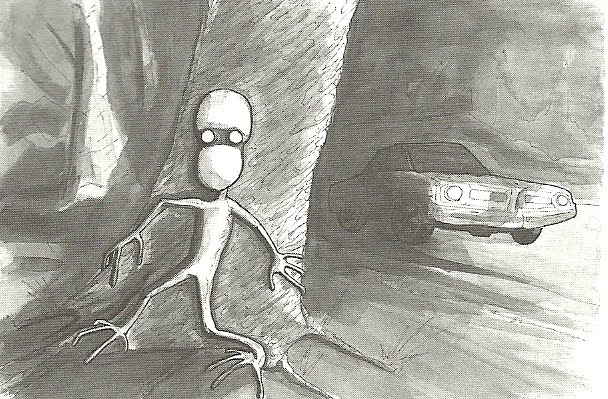
Finally, I wanted to note Patrick's depiction of the Dover Demon. Another classic case of UFO lore and maybe-it-exists monster lore, the Dover Demon was only seen by a handful of witnesses on several nights in 1977 in Massachusetts. It's striking physical appearance is probably best known from these images:
Despite the demonic moniker, early theories as to just what the hell the creature actually was have gravitated toward some sort of UFO or alien explanation. Maybe it came from a flying saucer, or is some sort of ultraterrestial from a different dimension. Others have wondered if it might not be some sort of creature native to this world, as it bears some resemblance to the fairy-like, mythological Mannegishi of Cree legend. Among the more mundane explanations are that it was perhaps a misidentified newborn moose calf or, of course, a hoax.

Patrick's depiction of the Dover Demon implies another explanation for the creature's true identity:Obviously it was a ninja.

Saturday, April 10, 2010

A short review of something that isn't a comic book: The Vermont Monster Guide

The Vermont Monster Guide (University Press of New England; 2009) is apparently of only very limited interest outside of the state of Vermont, as it took me about six months to find a library willing to loan a copy to an Ohio library.

I suppose that’s not all that unusual, given that the book’s local interest factor is right there in the title, and, after having finally read it, I suppose I’d agree that it’s probably of the greatest interest to Vermonters. So why was I, a lifelong Ohioan, looking for it so long, and why am I bothering to mention it on a comics blog?

That’s easy. It features illustrations by Stephen R. Bissette, of Swamp Thing and Tyrant fame.

And it features a lot of them. There are about 60 different monsters included in the Guide, and almost every single one rates a black and white illustration by Bissette, generally printed at somewhere between half-a-page and a full-page in terms of size. Monsters are, of course, a specialty of Bissette’s, and author Joseph A. Citro, who previously collaborated with Bissette on a couple of Vermont ghost guides, gives him a wide variety of different beasts to draw here.

I wasn’t terribly impressed with the book as a package or object, however. It’s designed by Eric M. Brooks, and it’s about the size of a standard trade paperback graphic novel…perhaps a few inches wider. It seems as if the size and page count were determined first, however, and the prose and pictures fit into the pre-established parameters. That is, the book looks as if it the contents serve the design, rather than the design serving the contents, so there’s a lot of empty white, wasted space, a few blank pages and a rather amateurish look to the book.

In the write-ups, Citro seems to have been striving toward cataloging the monsters rather than writing about them, resulting in a thankfully wide and surprisingly rich variety of subjects, with what reads like original reporting on many of them, but not very much detail. Many accounts consist of no more than a single anecdote or source, which can make some of the entries frustrating—they can be just enough to intrigue you to want to learn more, but not long enough to satiate the curiosity they inspire (This can’t be for a lack of material on all of them, either; one of the monsters included is Lake Champlain’s monster Champ, one of the most famous cryptid creatures in North America).

The Guide is broken up into three sections: Earth, Water and Air, and each entry gets a Bissette illustration, the monster name in a ‘50s/’60s horror movie font, notations of the location and date of the monster’s sightings, and then a few paragraphs about them.

These monsters include some well-known ones familiar to anyone who reads much about cryptozoology, as reports of them are nationwide: phantom big cats, giant snakes, lake monsters, Bigfoot and other such “BHMs” (Big Hairy Monsters), Thunderbirds, werewolves, the Wendigo, vampires and space aliens (these last are given an entry entitled “Monsters from Outer Space”).

There are plenty of more localized and thus more unique monsters, however, like the self-explanatory sounding Pigman, the bulletproof buck Old Ironsides and the murderous, bodiless, self-animated, Thing-like Purple Hand. And there are a few which are so weird and specific that they sound real, if only because they don’t sound like the sort of thing someone would make up, like the Long-Lggedy Cats (alley cats with very long legs) or Steggy (a small, stegosaurus-shaped mammal).

Of course, both groups of monsters provide interesting opportunities to study Bissette’s artwork—specifically his creature design chops. His Champ, shown on the cover, provides an example of Bissette’s rendering of your typical sea serpent/lake monster (there’s a more reptilian version on the inside as well), and he provides several variations of long-necked, water-going reptiles, as The Moore Lake Monster, The Mysterious Memphre and the Willoughby Wisp are of the same basic type as Champ (to help distinguish them, each drawing is staged a bit differently; the Moore Lake Monster, for example, is shown as a vague shape with bright eyes in the gloom within the background of a piece, while the focus is on two human victims in the foreground).

Similarly, the Bigfoot entry allows Bissette to make the most popular and most-often illustrated of North America’s cryptid’s his own, and he provides a slim, somewhat elongated erect beast with long arms and a very gorilla-like face, walking knee-deep through water in the rain. As with the various water monsters, there are several of Bigfoot’s cousins in here, and it’s interesting to see Bissette differentiate them with different facial structures, expressions and/or staging—the Windigo, The Forest Wanderer, The Hopping Horror and the Goonyak all fit the same basic description, but are presented as entirely different species in very different illustration pieces.

Where The Guide works best, I think, are the few instances where Citro has a very unique sounding monster or story about a monster, but relatively little detail, and Bissette has enough room to make up his own visual details, resulting in a single image that tells a dramatic story of its own and, when read along with the prose, suggests a very specific track for one’s imagination to travel down, the pace and distance left up to the individual reader, and how they react to the image and the few details written beside it.

For example, there’s Fanny’s Fiend, the name given to some sort of water-going monster 12-year-old Fanny Allen saw speeding toward her out of the Connecticut River, described only as being “of extraordinary size and horrid shape” and having “an aspect more fierce and terrible than the bear or world from the forest.” Bissette draws a huge, bulbous, orb-shaped head so big that it’s vacant eyes are larger than the girl’s head. Only part of it is visible above the water, and it looks nothing like any animal species one could name.

(Also of special note are Bissette’s werewolf, which is simply a wolf standing on it’s hind legs and looking remarkably creepy with that single change; The Green Swamp Monster, which fans of another green swamp monster Bissette has drawn may be especially interested in; and The Man-Eating Stone, which is similar to Fanny’s Fiend in how much it suggests with a single drawing and only a few sentences of explanation).

If one lives in Vermont and is interested in folklore and/or cryptozoology, then The Vermont Monster Guide is probably a must-read. Certainly if one’s a big fan of Bissette’s, it’s a must-read. Otherwise, I’d give it a somewhat qualified reccomendation—it’s insubstantial enough that you can plow through it in a single sitting, which makes for an okay introduction to a varied cast of creatures, but likely won’t satisfy anyone too terribly interested in the subject.

(Bissette's illustration of Pigman, a man-sized monster with the head of a pig that was active in the early '70s)

Monday, November 30, 2009

Review: Hairy Things #1

Apparently there was a 2007 comic book series by Jay Carvajal and Marc Borstel entitled The Miasadventures of Clark & Jefferson, and it was about cowboys fighting some sort of aliens.

I know this because I just looked it up on the Internet. I didn’t know it before reading Hairy Things #1 (APE Entertainment), the first issue of a three-part miniseries subtitled “The Misadventures of Clark & Jefferson,” and it didn’t matter a bit.

The characters in the story obviously all knew one another, and they alluded a few times to having recently had rather unusual adventures involving creatures from the sky, but Hairy Things was perfectly new reader friendly. As I read, I got the sense that I may have missed out on something more than the sense that I missed my chance to get into something.

Hairy Things opens with the sub-titular characters, just-retired sheriff Clark and his just-retired deputy Isaiah Jefferson leaving town with their friends, Mary and Giving Bird.

They’re not on the road long when they find an abandoned stage coach, all of the people missing, lots of signs of struggle—including plenty of blood—and none of the valuables touched.

They take it into the next town they see, where they learn the locals have been being captured and eaten by what Giving Bird calls “Chiye-Tanka,” or “Big Elder Brother.” We’d call ‘em Bigfoot.

So that’s what Hairy Things is about—Cowboys vs. Bigfoot. As high concepts go, that’s one that’s right up my alley.

There’s a little bit more to it than that, with a small army of Bigfeet closing in on the town, and the townspeople far from blameless in provoking the ire of the creatures, but that’s the gist of the story.

A great deal of attention is paid to the characters, specifically their interaction with one another, which results in a pretty fun, chummy atmosphere.

I’m not crazy about the artwork, which reminds me quite a bit of that of Steve McNiven (It’s good in the same ways that McNiven’s is good, and weak in some of the ways that McNiven’s is weak). Some of the character designs are on the wonky side (Particularly regarding Mary, who looks like an unfortunately air-brushed Barbie doll), and their panel-to-panel consistency can feel unnatural, particularly in the way they emote.

On the other hand, it’s a well-written Western comedy adventure about cowboys fighting Bigfoot (that's just as fun as it sounds), so it has that going for it.


********************

Dammit. I just realized this doesn’t actually come out until January. I wouldn’t normally have reviewed it this far in advance, but I already read and wrote this up, so what the hell. Something to think about ordering in advance if you like westerns and/or Bigfoot, I guess.

Thursday, June 04, 2009

I know this is just a prose book, but it's still a pretty cool looking one

I'm not sure why exactly I'm interested in Bigfoot, a so-called cryptid animal that I don't believe in (surely the advent of the cellphone camera signals the end of all belief in him, doesn't it?) and yet I love reading about him. In his new book Bigfoot: The Life and Times of a Legend (University of Chicago Press; 2009), author Joshua Blu Buhs talks about why the creature has proven so attractive to so many people over the years, and I don't really meet any of those criteria.

I do know why I picked this particular book up, though: It's fantastic looking. A Matt Avery is responsible for the overall design of the book and the jacket, and the illustrations are credited to a Lauren Nassef, whose work is quite nice in general (Check it out).

Here's the front cover of it:

I love that image. It's a great standalone image, and one that not only catches the eye, but actually captures the contents of the book remarkably well.

Buhs isn't a believer either, and explains he was originally drawn to the subject because in his previous work on fire ants he found that he greatly enjoyed writing about an animal subject's interaction with human culture, but was rather frustrated with all of the deep science involved with learning about the animal's actual behavior. An animal that didn't actually exist then seemed to suit his needs perfectly.

The hoaxing involved in the legend of Bigfoot, from people making fake tracks to at least one fake suit, is suggested by Nassef's cover, as is the the concept of people projecting themselves inside Bigfoot, something Buhs talks about quite a bit.

Here's the back cover:

The fur extends to the spine of the book as well, and thus this thing looks cool from whatever angle—face front on a coffee table or nightstand, shelved spine out or even absently left laying on its cover.

You can't really tell from the scan, but the front cover also has a faux wooden look, seeming as if the front cover was actually made out of wood. The inside covers and the first and last pages are also wooden looking, although darker, and with a palpable, groove-filled texture. I'm not generally one to fetishize book design, but damn, this is one nice looking book.

In addition to that nice cover image and the field of fur pattern, Nassef also provides an illustration that appears at the very end of the book, after the notes and bibliography, a parting sighting of the subject matter:

My scan's rather poor, owing to not wanting to badly mangle a library book, which accounts for the shadow there, but you get a pretty good idea of what a nice drawing of Bigfoot Nassef has made. (Especially if you click it. Clicking the images makes 'em bigger; you knew that, right?)

The book itself, by the way, is really great, maybe the best Bigfoot book I've read, replacing Where Bigfoot Walks: Crossing the Dark Divide by Robert Michael Pyle, which addressed the same subject—the cultural history of Bigfoot divorced from the is he or isn't he real debate—from the perspective of a nature writer and environmentalist who was hiking through Bigfoot country. If someone asked me to suggest a book about Bigfoot to them two weeks ago, I would have suggest Pyle's; if you asked me today, I'd suggest Buhs'. Not only is it a good book, but it's a beautiful object as well.

Saturday, March 28, 2009

Review: Proof #18

I’ve never read an issue of Proof, the Image Comics series that seems to be about Bigfoot and other cryptid creatures (i.e. Things That Are Awesome), despite having had it recommended to me on several occasions (Like by Mr. M. Ampersand, in the comments section of a post about Fanta’s latest Beasts! book).

This past week’s issue of the series, its eighteenth issue, seemed like a pretty good place to start since 1) Its cover featured what looked like a picture of Bigfoot dressed like Abraham Lincoln, 2) It said “A New Era Begins!” on the cover, and, of course, 3) I was emailed a PDF of the issue to peruse.

Obviously, starting out on the eighteenth issue is a less than ideal place to start a serially published, ongoing comics series, but I resisted the temptation to do any research about the book’s background, like looking for a Wikipedia page or something, so I could better assess it as a standalone issue.

Well, a new era may or may not be beginning, but it didn’t strike me as a particularly great jumping on point for the series. There was certainly a lot to like about the comic, but by the last page I was still finding my footing, and was still pretty uncertain about just who was who and what was what.

The book opens with one of those recap-type pages that all of Marvel’s books now has, explaining that Proof is the name of a sasquatch (Huh, Word does not acknowledge “sasquatch” as a real word) that met Lewis and Clark in 1805 and joined a “joint agency of the American and Canadian governments” in 1969 and that the time in between remains a mystery.

The story begins in London, 1859, where a lady is running around frightened of something and bumps into the chest of a rather large man, who actually looks like the Bigfoot on the cover (Aw, I guess he wasn’t dressed like Lincoln, he was just dressed like a mid-nineteenth century gentleman in a top hat, and sasquatch facial hair just sorta naturally resembles that of our greatest president).

From there we jump to “the present,” where a Bigfoot in a big white suit and a woman visit an old Norwegian man in a basement full of curiosities, and they collect what looks like the preserved remains of a female alma.

And then its back to the mid-nineteenth century London for the rest of the issue, where the hairy ape-woman named Julia performs in a circus as The Baboon Lady, singing (for her pleasure) and disrobing (for that of the rubes). Also in the circus are two other giants—the top hat rocking sasquatch from the title page and a less hairy guy of about the same size—who are called upon by a police detective to help him catch “the most notorious criminal in London,” Springheel Jack.

When I mentioned there being a lot to like about the comic? This is mostly what I was talking about. Springheeled Jack, let the record show, was awesome, which, if you’ve read about him before, you already know. If you haven’t, I’m just going to link to The Internet’s own Dave Campbell, who wrote a typically funny post about S.H.J. which also contains plenty of useful links.

Unlike Bigfoot or the Loch Ness monster, the sightings of Jack were so varied and so relatively few and localized that there isn’t really a consensus image of the figure that would make him or it immediately recognizable, nor is there a single popular theory (or handful of theories) to explain him/it. So when he shows up in comics, he always looks pretty different.

And the version of him that shows up in Proof #18? It looks incredible. It’s probably the coolest looking Springheeled Jack I’ve ever seen.

He’s got a big gold, horned, grinning, metallic-looking mask over his face, completely hiding his features, although little red dots glow in the shadow obscuring his eyes. He has a long shock of dark hair or a wig flowing behind the mask, which gives him the look of an anime-esque Japanese feudal demon. He’s dressed in period clothing—tight coat with tails, ascot-looking thing coming out of his popped collar, tight britches—and his legs are some sort of metal contraptions that look like brass robot satyr legs, explaining the jumping.

Apparently, he’s the thing that was chasing the girl in the opening pages, and there are several scenes of him running and jumping around, looking all badass. He lurks on the circus grounds, he evades the Bigfoot (Proof?) and the big dude and the police guy, and he goes to visit Julia.

If I pick up Proof #19, it will be to see more of Alex Grecian, Riley Rossmo and Dave Casey’s Springheeled Jack, and to see how all of this ties together.

While I’m still a bit lost on the who’s who and what’s what, I should note the characters are all well drawn and fairly well-designed (although I’m confused if the present and past Bigfoot are both Proof or not, and if that giant, hairless dude is also supposed to be a monster of some sort), and the writing is sophisticated enough to define the relationships between the characters in a subtle, naturalistic way.

I can’t say that I’m hooked—at $3.50, Proof, like a lot of Image Comics, seems like a comic better purchased in trade—but I’m definitely curious.


Related: Image has a preview of the first four pages here. I didn’t realize it until just now when I was looking for links to their sites, but Grecian and Rossmo’s previous work includes the AiT/Planet Lar book Seven Sons, which I liked a lot when I read it a while back; that I wholeheartedly recommend.

Thursday, March 20, 2008

Wannabeasts!: The Ohio monsters that won’t be in Beasts! Vol. 2

(Note: This post might be slightly NSFW, depending on where you work and how uptight your boss is. There are two rather poor drawings of breasts further down the post).

As regular readers of Every Day Is Like Wednesday are well aware, I'm not exactly what you might call an "artist." Or even a "cartoonist." Or a "guy who can draw better than the average 14-year-old after half a bottle of shop-lifted NyQuil."

But I like to draw, and I do a heck of a lot of it, in part because if I want to tell a joke about Darkseid fighting a J'onn-J'onnz-disguised-as-a-cat or Black Lightning meeting the Ghost of General J.E.B. Stuart from The Haunted Tank, it's more expedient to draw it on my kitchen table that night than, like, hire an artist to draw a cartoon to amuse me and the eight-to-20 EDILW readers who will see it.

Nevertheless, when Beasts! editor Jacob Covey sounded the clarion call for entries to fill a one-beast hole in the second volume of the beautiful bestiary series, I didn't give it too much thought before I sat down at my kitchen table (My drafting table is in a room that's so cold, I don't enter it during winter). I even eschewed my regular materials—index cards and colored pencils—for actual paper-paper (thanks for the Christmas present, W.!), a really nice ink pen, and a Crayola brand twistable mechanical colored pencil.

See, Covey said, "Bonus points for creatures from recent times (such as the chupacabras, Beast of Bray Road, sasquatch, Loch Ness monster—but not those because they've been depicted by other contributing artists)."

So I figured I could, at the very least, score the bonus points because the beasts I was thinking of were of more modern vintage, falling closer into the "cryptid" category than the "completely made-the-fuck-up" category, but still pretty far from “likely to exist.”

Remote as my chances were then, I figured I’d do some drawing and send an entry in, as it would give me a chance to evangelize on one or more of the great state of Ohio's great monsters, whether to whoever reads Beasts! 2 (if it made it in), or just Covey and cohorts if it didn't and, of course, all of you who would end up reading this EDILW entry.

Now, we Ohioans are kinda used to being the butt of the East and West Coast establishment's jokes, but, in the monster department, I think we hold our own pretty well against the likes of New England, California and New York. We've got the various Lake Erie monsters, we share the Mothman with West Virginia, we’ve got phantom cats, kangaroos and even a phantom python, we've got the Loveland Frogmen, the Branch Hill Trolls, and good God, do we have Bigfoots. The Grassman, The Minerva Monster, The Mifflin Monster, The Mill Lake Monster, The Cedar Bog Bigfoot, Ol’ Red Eyes, The Stick Man, Mow Mow, The Wood Devil—local names for variations of the Sasquatch creatures that allegedly make their homes in Ohio.

I'm not entirely sure why Ohio has so many sightings, nor am I sure why it is one of the leading states of Bigfoot research. Given the amount of development in the state, and how surrounded we are by other equally or more developed states (there are no ocean coasts or rainforests for large unknown species to hide in), I would expect that if anyone ever does find a Sasquatch type creature in North America, they'd be far more likely to find it in the Pacific Northwest than here in the the Buckeye State*.

(If I had to hazard a hypothesis as to why there have historically been so many sightings, I would say it has to do with the amount of time many Ohioan's spend outdoors at night, as people are wont to do in places where there's nothing to do, and a certain paranoid energy in the air in a few locales, like the shore of Lake Erie and weird areas of Southern Ohio where the Moundbuilders plied their mysterious trades centuries ago).

Now the first monster that crossed my mind for a possible Beasts! submission was of the Bigfoot family (I think cryptozoologists and monster hunters refer to them as "Hairy Humanoids" as a class, although this one also falls under the category of "Monsters of Lover's Lane.") Basically, he's described like most Bigfoot-type creatures are, with two differences. One is his gigantic size—eleven feet tall. And the other is the feature for which he's namde—his bright, orange eyes, capable of lighting up the night around him.

Orange Eyes, as the monster is known, was said to have made a habit of lurking around parked cars in secluded places, spying on the young lovers engaged in necking, making out and um, the things young lovers do in parked cars. In other words, Orange Eyes was a gigantic Sasquatch-like voyeur.

There aren't a whole lot of stories about Orange Eyes, and they tend to overlap in the major details.

The creature was first sighted near Mansfield in central Ohio in March of 1959. Despite it’s Mansfield sightings, it was popularly believed to have lived for at least a generation in a tunnel near Cleveland’s Riverside Cemetery, but was driven out by post-war highway construction, and it made its home in a forest behind the Cleveland Zoo.

In 1968, a huge group of teenagers went out to catch or kill it, armed with baseball bats, flashlights and ropes, and were believed to have driven it off once and for all.

In the rather tongue-in-cheek book The Field Guide to North American Monsters (Three Rivers Press; 1998), author W. Haden Blackman writes, “The montser has been known to drool on windows and howl with delight at the sight of naked flesh. Frightened lovers have stabbed, shot and driven over the creature, but none of these attacks seem to have injured the beast.”

I really like a lot about this story, and I think it would have the makings of a great horror movie. Or graphic novel I guess, since movie-making’s for suckers. Aside from the monster itself, you've got a ready-made excuse for nudity and sexy imagery (I've heard sex sells), some great settings (graveyard, zoo, tunnel), a readymade climax (in which the monster, horrifying one-on-one, becomes pitiable when hunted by a crowd; not unlike Frankenstein going from scary to sympathetic in the latter half of the 1931 classic), and even a bit of a message, what with the development moving him out of his home, forcing this symbol of the natural world into conflict with humanity, which ultimately defeats him. Man, I’m tearing up just thinking about it…

So, that was the first monster I thought of when thinking of a beast for Beasts!.

I messed around drawing faces for a while, finally settling on a no-neck, mop-like version. This was my first sketch:

I gave him little hair horns, a tail and quadraped-like hindquarters just because they were more fun to draw than the normal hairy Bigfoot-type body.

Then I thought a stronger image might be one that incorporates the beast’s point of view and the lovers’ point of view better. So I thought about a scene from inside the car. That would be scarier. And easier to draw.


The first sketch had a much too small monster, using the car window for scale, so I tried again:


Ultimately, though, I liked the first idea best, so this is what I submitted to Covey:

Obviously, it didn’t make the cut. Covey received over 200 submissions, after all and mine is, well, it’s not exactly the work of a pro, you know? Covey was kind enough to respond with a nice email though, which was very cool of him, particularly considering the amateur quality of my submission.

Here’s the image that will ultimately fill the open hole:

It’s of some nymphs by Jennifer Tong, and it’s damn pretty. Covey has posted some of the beautiful runners-up here. You can see a bunch of the other submissions posted here. I’m glad I didn’t see any of these while I was drawing mine, or I wouldn’t have even bothered—there is some nice art there, and I can't imagine how hard it must have been for Covey and company to narrow it down to just one.

Among my favorites of the other wannabeasts are the turtle town, kick-ass Chimera, the pissed-off Skunk Ape, the Maryland Goat Man (another Monster of Lover’s Lane), the Vegetable Lamb of Tartary (I coulda sworn it was in the first volume, but maybe that was just a similar lamb/plant hybrid) and the Batsquatch (Hey DC Editorial, I just go a great idea for a Batman Confidential pitch). If you've already checked out the flickr images, you might want to check back. Every time I click on the link, the images multiply.

I never completed my drawing of the other Ohio monster I was thinking about, which is, rather than a single monster, a race of monsters: The Melonheads.

Despite the funny name, they are some scary-ass customers—feral, possibly cannibal diminutive humanoids with gigantic hairless heads that roam the woods and lonely roads around Kirtland, Ohio, one-time home to real-life monster Jeffrey Dahmer.

The Ohio Melonheads have very well defined stomping grounds—Chardon-Windsor Road in Chardon, and Wisner Road and around the Holden Arboretum in Kirtland. The area’s about 45 minutes from the town I was born in and grew up in, and about two hours or so from Columbus; I drive through it whenever I go home to visit. I’ve never gone looking for Melonheads though, and haven’t actually been in the woods in the area since I heard of them. In high school I used to spend a lot of time running around the area though, so I’m kinda glad I didn’t hear of them until I transplanted to Columbus.

The most popular version of the Melonhead story goes like this. Around the time of World War II, a Dr. Crow or Dr. Crowe or Dr. Kroh or Dr. Crower, who was an evil or benevolent scientist, was given a brood of normal children or children suffering from a rare form of hydroencephalism to take care of or experiment upon or to give a rare form of hydroencephalism. He inejected their heads with water or chemicals or radiation, and it mutated them or caused them to mutate them further. He may have abused them physically and mentally until one day they revolted, attacking and killing him and burning down the lab or orphanage in which they were kept. Or he was kind to them, and it was burnt down in a fire that also claimed the doctor and/or his wife, leaving the despised Melonheads to fend for themselves.

The Melonheads that now roam Lake County are either the originals, or the descendants of the originals or possibly the ghosts of the originals. They are either filled with vicious hatred of normal-headed people, and will attack, kill and eat them on sight. Or they are deeply ashamed of their misshapen looks and will try to scare people away before they can get a good look at them. Or they are shy and docile and will try to avoid any and all contact with others at any costs.

There are a couple of other more radical variations, including one in which The Crows are nineteenth century farmers or settlers who gave birth to a brood of disfigured children, and retreated to the woods to raise them in secret, far from prying, judgmental eyes, and, when the couple passed on, their children became feral.

The other version, which I’ve only encountered in Weird Ohio (Sterling Publishing; 2005), has the doctor performing illegal abortions out in the woods, and he’d bury the (sometimes deformed) bodies around his cabin. Implying that the Melonheads are the ghosts of aborted, deformed fetuses…?

Abandoned structures and ruins found in the area—barns, shacks, houses—are often said to be the place where the Crows lived or raised their kids or performed their experiments.

The Internet is absolutely lousy with Melonhead stories, and Weird Ohio has a few pages devoted to the subject, including a handful of personal accounts. I understand that both Michigan and Connecticut have their own version of the Melonheads, which sure makes them seem a lot less likely to be real. I mean, how many races of diminutive feral creatures with giant heads can there be hidden on this half of the continent?

The scariest stories I’ve heard or read involving Melonheads have to do with people encountering them by accident. Pulling over on the side of the road near the woods so someone could get out to take a piss, or parking by a dead end somewhere to make out for a while. And, while they’re out of the car or the car’s engine is turned off, a Melonhead or a group of them will appear in the headlights or come slowly wobbling through the underbrush at the teller of the tale.

So I imagined an image of someone running away from a group of Melonheads, coming out of the woods and about to clamber over a guiderail to get at the victim.

At first I thought about drawing a trio of them, each with an actual melon for a head. Like, one would have a watermelon head, one would have a honeydew head and one would have a cantaloupe head. I was thinking of the logo for Lemonheads candy, and thought about a “cute” version of the Melonheads.

For a few seconds, anyway. Then I realized I can’t draw melons to save my life. At least, not without photoreference.


So then I settled on something more akin to giant babies with huge heads

and got this far with a final piece

Before February was about to turn into March, and the deadline expire, so I stuck with the Orange Eyes drawing.

And there you have it: A guided tour of my Beasts! submission thought and drawing process, and just about everything I know about two of the coolest creatures in Ohio’s monster menagerie.

Now if you’ll excuse me, I’m off to go redesign the hell out of Iron Man…


*Since writing the first draft of this post, I’ve read Bigfoot In Ohio: Encounters with the Grassman by Christopher L. Murphy (Pyramid Publications; 1997), and apparently as of 1992, 81% of Ohio's total 41,000-square mile area was “rural or forest in character.” Researcher Rene Dahinden, who wrote the introduction, said “Ohio, like numerous other states, certainly has sufficient wilderness regions to support a Bigfoot creature…Would these creatures venture into Ohio’s rural areas as numerous witnesses claim? Such is not beyond reason.” So there you go. That’s what the experts say.