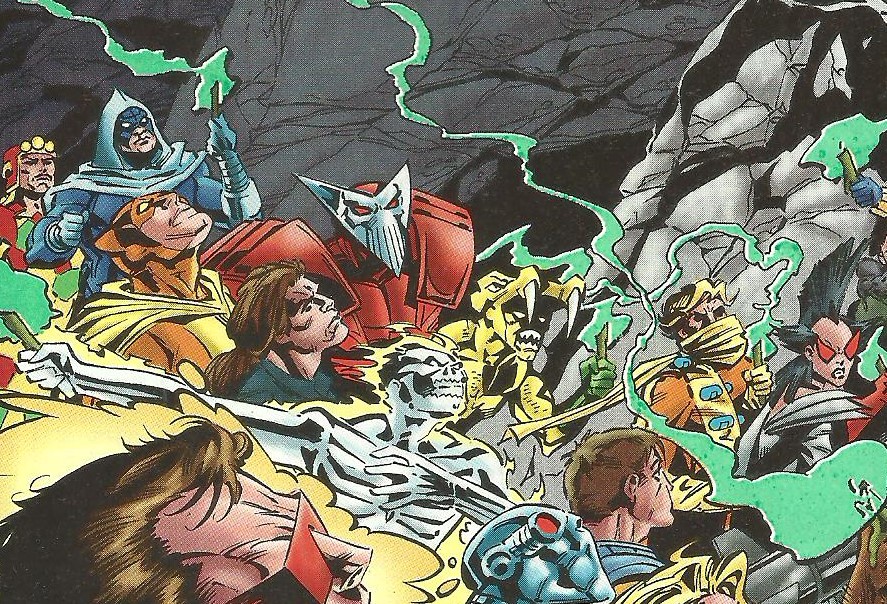
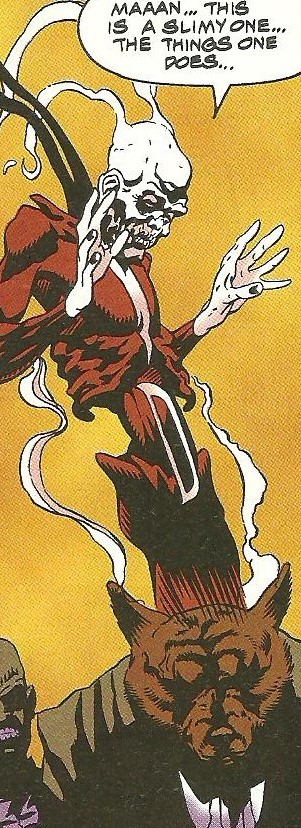
In the final scene, after all of the other villains have left, there's an unexpected arrival: Blue Devil.
2.) The Un-revampable Rainbow Raider. Trickster tricks his way into hell in order to meet Neron, stealing the Rainbow Raider's black candle from him. The downside of this is that it means we never get to see what a revamped, powered-up, more bad-ass Rainbow Raider might be like (Later, Neron will tell Trickster that it was never his intention to invite Raider—"Really... How well do you think a paramecium like the Rainbow Raider would fit in here?"—but that he that he had actually only given him a candle specifically to get it into Trickster's hands).
Geoff Johns, who had a habit of trying to bad-ass-ify villains in the same way that Mark Waid makes fun of in his 1998 afterword, would eventually kill off the Rainbow Raider in 2002 during his run on The Flash, replacing him at one point with "The Rainbow Raiders," a team of color-coded villains. The Raider was one many to return as a Black Lantern during Johns' Blackest Night event/crossover.
I ended up thinking about Johns a lot during this series, not only because he would go on to write so very many of these characters himself, but because so much of the intent of this series—that is, making DC Comics IP seem more dark or serious—is what so much of Johns' career would entail.
3.) "I'm a man of wealth and taste." Well, that allusion flew right over my head when I read this at 18. The first line of dialogue clearly attributable to the Satan figure in this comic book is, "Please allow me to introduce myself," and having never listened to any Rolling Stones, a favorite band of my mom's, I was able to read that line of dialogue and not hear it in Mick Jagger's voice and enunciation. Not this time.
4.) Joker's drink ware. Something
else I didn't notice the first dozen or so times I read this book...? The skull that The Joker is drinking his umbrella drink out of isn't just
any skull, but that's apparently supposed to be
Jason Todd's skull.
For whatever reason, I never noticed the tiny crowbar sticking out of it as a garnish, but once I did I realized that it's not just weirdly drawn, but that it's wearing a domino mask with white triangle eyes, like the Robins might have worn (although I don't think we see the straps of it very often; it just sort of hangs around their eyes as if affixed with spirit gum).
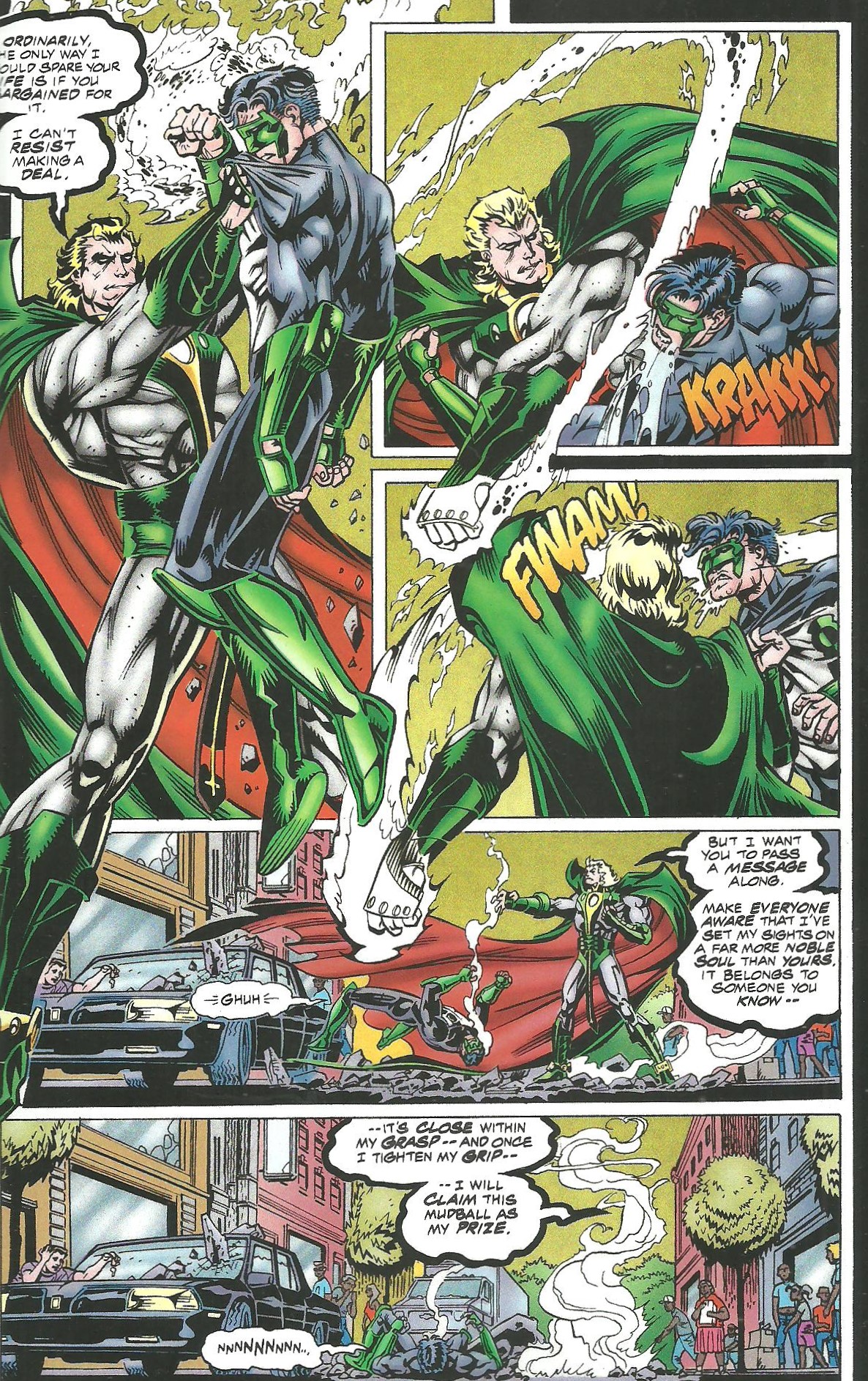
Well, it's not Jason Todd's actual skull. As Neron explains to the guests on his high council at one point, before leaving them alone in his hell dimension, "this realm is responsive to your slightest desire and will provide you with whatever small comfort you wish." So The Joker apparently summoned that drink, in the same way that Circe summoned a plate of fruit, or, later, The Joker summons a plate of Batman-shaped cookies to bite the heads off of.
Jason kinda sorta appears in this series, though. In issue #2, when Neron confronts various superheroes and tempts them with their heart's desire, he appears to Batman in a cloud of neon green ink, asking him what he would give "to have alive again the boy you let die?"
Jason appears in a panel and asks, "Bruce...?", before Batman says no, and Jason shuffles off into the darkness.
At that point, I hadn't yet been reading comics five years, but I bet that scene was at least the tenth or twentieth I had read that reinforced what a great tragedy Jason Todd's death was, and why it was an important part of Batman's life story, making him the superhero that he was. I would probably read another 25-50 examples before DC finally had Judd Winick resurrect Jason in an extremely unsatisfactory way in 2005 Batman story arc "Under The Hood."
5.) We apparently just missed a were-cat version of Catman. Howard Porter drew Catman no less than three times during the villains-gathering-in-hell scene. Perhaps Porter just really likes the character. Or the costume. Catman doesn't appear to make a deal with Neron, though, as he doesn't reappear in the series at all after this scene concludes.
Oddly enough, the very same month that Underworld Unleashed #1 was published, Catman was appearing in a three-part Shadow of The Bat/Catwoman crossover by Alan Grant, Barry Kitson and Jim Balent entitled "The Secret of The Universe."
Catman would eventually get a bit of a redesign (or at least a new costume) and a level-up in the pages of Gail Simone and Dave Eaglesham's 2005 Villains United, which eventually lead to Secret Six, but they merely seemed to play the character as more calm, confident and competent. And make him sexy.
Who knew that was a route to improving villains that were widely perceived as being lame? They didn't have to be scarier or more powerful; fans just wanted them to be sexier. Simone and Eaglesham could have done for all these guys what Neron promised them, without even having to trade their souls.
6.) Big Todd McFarlane energy on Neron's cape here. There are a couple of other examples of Neron's cape being particularly big, flappy, pointy and McFarlaney later in the series, but this instance from the first issue, inked by Dan Green, is the McFarlanest.
7.) We interrupt this crossover for a not-very-important tie-in. After the conclusion of the first issue of the miniseries, the trade paperback then includes the one-shot tie-in Underworld Unleashed: Apokolips—Dark Uprising. It...has nothing at all to do with the story, although Neron appears in it.
Written by Paul Kupperberg, pencilled by Stefano Raffaele and inked by Steve Mitchell, it's set on Apokolips after Darkseid seems to have died, having disappeared into The Source in some other previous comics not directly referred to by any editor's notes that I saw.
Darkseid's high court of treacherous evil gods—Desaad, Granny Goodness, Doctor Bedlam, Kalibak, Virman Vundabar, Steppenwolf—all seek to replace him by doing in their rivals to the throne before they themselves can be done in. Meanwhile, a hunger dog from the Armagetto feels the seeds of rebellion growing within himself, and is able to start a little revolution when his fellows see that the Parademons and other enforcers no longer seem as concerned with policing them as usual.
Neron's relatively small role in the story is to help stir the pot among the various villains—he doesn't make a pitch to them like he did in UU #1, and no Fourth World villains appeared in that issue—but it hardly seems like the pot needs stirred at all anyway. He ultimately does aid one of them, but the reader isn't made privy to the details of that deal, and the entire issue feels more like an interruption rather than a part of the Underworld Unleashed story (the same can be said for Devil's Asylum; both seem to be included simply for the sake of completeness, but, unlike Hell's Sentinel, they don't really seem to move the story forward in any appreciable way, or get referred back to later in the series, they just show what's happening elsewhere in the DC Universe. In retrospect, it might have been more valuable to include issues like The Spectre #35 or Fate #13 or Primal Force #13 featuring Neron, Blaze or Satanus, for example).
It might have been more interesting to see Neron strike a deal with the rebellious hunger dog than to mess with Darkseid's court. But then, nothing terribly interesting seems to happen in this one-shot. Nothing looks the least bit interesting, either. Apokolips looks like a completely dull setting, one barely glimpsed in the background filled with figures.
I skipped this tie-in in 1995, and, reading it now, I see I made the right decision. I would have preferred the 40-pages of this trade it fills go to just about any two issues of any of the many tie-ins, almost all of which seem to have more direct bearing on the storyline than this odd side-story does.

8.) It kinda looks like Neron is bludgeoning The Ray with Blue Devil's soul here, doesn't it? Blue Devil's task seems benign enough: Destroy an unmanned power station in California that doesn't seem to be providing power to anything critical. That's all he has to do for Neron, and in exchange he will get a successful film career. So he does it...only to find out later that doing so will cause a helicopter crash that kills his friend Marla Bloom. Who could have imagined the devil would have been such an unreliable partner?! (There's actually a pretty affecting scene in here where Blue Devil learns exactly what he's done, and just sits in an easy chair in shock in front of news of his friend's death, while his answering machine starts blowing up with messages from agents and producers wanting to work with him. It still works quite well, even though answering machines are a relic of the distant past).
Neron leaves Trickster with his council in his hell while he runs some errands on Earth. They are in the midst of threatening his life when Trickster suggests they investigate Neron's soul jar, as it seems to be the source of his power. They do so, and The Joker and Luthor trick the other three into trapping themselves in the soul jar. That's the last we see of the World's Foulest duo, unfortunately, and I'm unclear how they get from this Point A to wherever they would show up next in the DCU as their Points B.
As to Neron's errands, he tempts Flash, Batman, Superboy and Green Lantern, all the while suggesting to them that he's after Superman's soul. For some reason, he beats the hell out of Kyle (perhaps as a bone thrown to the boneheads in H.E.A.T., which I guess was a real thing in those days), while his visits with the other heroes were mostly just to mess with their heads. There's also a montage in which we see Neron making deals—or attempting to make deals—with other heroes, but presumably we need to read the tie-in issues of The Ray to find out what happened with The Ray, and, I don't know, maybe Justice League Task Force to find out what happened with Triumph...?
After his battle with Neron, GL speaks before a gathering of heroes in the Justice League satellite, an interestingly eclectic group that includes not only members of the Justice League, Extreme Justice and the Justice League Task Force (in their matching jackets), but also Green Arrow Conner Hawke, The Huntress, Damage, Amazing Man and Black Condor.
The heroes decide to split up, with a now pissed-off Blue Devil brandishing his candle and leading a group to hell to take the fight to Neron.
Speaking of whom, Trickster gets a glimpse of Neron's true form, and finally realizes Neron's the honest-to-God Satan, not just some other random if powerful supervillain. Readers only get to see the shadow of Neron's true form cast on a wall, and it seems to be suggest a fairly Lovecraftian shape, a blob of writing tentacles on two legs.
9.) Literally no one does this. I once heard
Paul Pope deliver a talk at the Wexner Center for the Arts in Columbus in which he discussed his work on
Batman: Year 100. He showed a panel of his Batman eating a protein bar or something like that, and Batman had taken his gloves off to do so. Pope noted that in superhero comics, the heroes are constantly shown eating with their gloves on, which is something no one ever does in real life, and, ever since then, I've never been able to
not notice it.
So here's Kadabra pulling meat off of some sort of roast poultry with his gloves on.
His white gloves!
10.) Wait, I'm still not done talking about that green ink. When Neron turns his attention to Green Lantern, he first surrounds him in a tunnel of neon green flame, which is the point in the book where the coloring change is most literally obvious, as you can see that Kyle is reacting to "green flames," but these flames are colored white in the trade collection. As the pair battle over the course of the next five pages, during which Neron tempts Kyle by saying he can bring his late girlfriend Alex back to life, they blast one another with their energy beams, and the neon green of Neron's powers is contrasted against the normal green of Kyle's force field and energy beams.

I'm not sure which looks better, when I look at them side by side—which you do need to do in real life, since, as I've noted, the neon ink loses a degree of its luminescent quality when scanned—but I think at the climax, when Neron is punching Kyle with his green, fiery knuckles, actually looks just as cool, or maybe cooler, with the white fire of his knuckles. Something about the way the white looks atop of the black lines of his fists gives it a more present and grounded look, I think...
However, on the page before that fight, Kyle's blasting of Neron directly in the face with a force beam from his ring draws blood from Neron, and Neron basically just flies his way straight through the beam before he grabs Kyle's ring and then punches him in the face. In the original, Neron's blood is that same color as all the other neon greens-colored stuff in the book, but here it is...not.
It is instead white.
In the first image, there just seems to be lines all over Neron's face, but, in the second, when we get closer to the villain, we see that he is bleeding from his nose and mouth...but here the blood is white, and thus looks more like saliva or baby spit-up than the soul-blood it is apparently supposed to be.
So while it didn't strike me as such a big deal when re-reading Underworld Unleashed in the trade collection, having looked at scenes back-to-back, I think the green coloring is better than the white, and DC probably should have done something to adjust the coloring in the trade to at least suggest the coloring of the originals, if the exact quality couldn't be reproduced.

11.) Have you heard the good news about Underworld Unleashed: Hell's Sentinel—The Abyss? It's probably hard for me to overstate how much I enjoyed this issue in 1995 and in the years immediately following. To date, when I would think about the Underworld Unleashed event, this is what I would think of, and, like so many of the first comic books I've read, I've continued to hold this one in high regard in the years that followed, even if it's been at least fifteen years, maybe longer, since I've re-read it (This came out back during my letter hack days, but if a letter to the editor regarding it that I wrote, and thus chronicling what 18-year-old Caleb thought of it in real time, exists, I can't imagine where it would have been published, if at all).
It was my first introduction to the work of Phil Jimenez, who would eventually become a favorite artist of mine, and, re-reading it today, I notice that now the names of his collaborators are also quite well-known to me—Scott Peterson wrote it, and J. H. Williams III drew the second half of it—but at the time, I didn't know who they were, nor did their work on this book impact me the way Jimenez's did. Hell, reading this today, it still boggles my mind that this didn't turn Jimenez into the industry's next Jim Lee or something. This art is incredible.
The most noticeable thing is, of course, the level detail. Outside of maybe some of George Perez's pages from War of The Gods or some backgrounds in Dave Sim and Gerhard's Cerebus, at that time I had never seen comic book art anywhere nearly as detailed as Jimenez's art is here. It's positively baroque. It's not just that he drew every fold in Sentinel's cape, and every whorl in the tree the hero is crucified upside down upon in the first few pages, or the maniacal attention to detail in the Gotham City skyline or the scores of candles on page ten, but if you look at the designs given to the various monsters and demons he draws, it's...well, it's practically mind-boggling.
Is it an unnecessary level of detail? Well, probably. But I read this comic for the first time back in the days when I bought extremely few comics, which meant more often than not I would re-read them all repeatedly in the weeks and months after I read them the first time and, man, this was a comic that rewards re-reading, as there are just so many details to drink in.
There's a splash that I'll show you a bit of later that has a good half-dozen scenes of various heroes engaged in various struggles, and not only does Jimenez seem to suggest a half-dozen interesting stories, but the way he draws the scenes, the spread has a good half-dozen issues worth of action packed into it.
Now, beyond being my first introduction to Jimenez's work, this was also my first introduction to many of the characters who appear, and, to the concept of a "Sentinels of Magic" super-team, which never really got off the ground...at least, not until 2006's Shadowpact, followed by 2011's more to-the-point Justice League Dark, wherein the idea of a super-team of DC's magic-users finally reached fruition.
I've often considered this book the best pilot for a comic book series that never actually got around to being launched, as this was the first time I saw DC gathering a group of magicians to form a sort of occult answer to the Justice League...although now I realize that Neil Gaiman's "Trenchcoat Brigade" from the original Books of Magic miniseries pre-figured and probably inspired this book, and that was pre-figured by Alan Moore's Crisis On Infinite Earths tie-in in the pages of Swamp Thing.
What made this different than those stories, though, and those that followed, was that it had Alan Scott at its center. That is, for all the magical types—here, Zatanna, Phantom Stranger, Deadman, Fate and John Corrigan—there was an honest-to-goodness, bank robber-catching, supervillain-punching superhero as the axis the team could revolve around. And not just any superhero, but one of the originals, and a founding member of the original superhero team, the Justice Society of America.
It is so easy to imagine a Sentinels of Magic monthly following Underworld Unleashed (although I think the name Hell's Sentinels would have appealed to my teenage self better), wherein once Alan escapes from Hell, he re-gathers some of his allies here, explains that they worked well together, and that while he doesn't know much about magic and hell, he does know teamwork, and he gets them to work together.
His fish-out-of-water status is alluded to a couple times in the pages of this book, and there's at least one neat scene where we see him basically willing Fate into joining with the others to help them, as he just glares at him and shames him into helping out.
Almost all of these characters would reappear in various covens or groupings of DC's magical heroes in other crossover events and, later, in Shadowpact and Justice Leaguer Dark, but, unfortunately, the premise suggested here, of Golden Age Green Lantern-turned-Sentinel Alan Scott leading a team of occult heroes, never came to be.
12.) So, what the Hell happened here? Alan Scott awakes from a vivid—and beautifully drawn!—nightmare to find himself and his wife Molly being attacked by sentient vines in their Gotham City bedroom. Alan, who at this point had a youthful body thanks to the influence of "the starheart" that his ring and lantern were fashioned from being integrated into his body, fights them off and then goes to patrol the city, looking for other such goings-on (He finds some).
When he returns, he finds that his wife, the former Golden Age villainess Harlequin, has had her youth restored, but seems to be a soulless husk of her former self; while he was gone, she did a deal with Neron to have her youth restored. (Aside: I honestly can't believe there has yet to be a Harlequin/Harley Quinn comic created yet. Surely someone must have pitched it. Maybe after DC gets its continuity straightened out again, and the original Harlequin and Harley Quinn exist in the same space-time continuum again it will happen...)
Alan heads to the original JSA headquarters to start shouting for The Spectre, in the hopes that his former teammate could help him get his wife's soul back from hell. Instead, he's met by The Phantom Stranger, and together they gather some allies and then go to Hell. There they encounter some bad guys—Dementor, Blaze, Etrigan, Blackbriar Thorne—and they fight them.
When Neron comes to find out what all the commotion in hell is about, Alan offers to hold him off while the other make their escape, and Neron captures Alan, turning him into a little necklace (a ring woulda been a better, more ironic fate, Neron; that's the difference between The Spectre and Neron though, I guess).
And...that's it, really. It's basically a fight comic. But, as I've mentioned, it sure is a well-drawn one.
13.) Well there's a body part you don't see every day in a superhero comics... When Alan Scott suits up and flies out to patrol Gotham City for more such supernatural happenings, he finds three young men in baseball caps brandishing a knife and fleeing a body. "You've gotta save us from that thing!" one of them screams, "We didn't think the
brujeria would work!"
The "brujeria", or witchcraft, did work, though, and it summoned some bizarre and, as Jimenez drew it, terrifying creature that looks like a blob of a dozen or so different human beings all smooshed together, its form shifting from panel to panel, at one-point growing a head that resembles Alan's own head exactly to taunt him.
When Sentinel sends some ring constructs to destroy it, Jimenez appears to have drawn a few naked breasts among its mass of body parts, and the nipples, in the language of today's Internet censorship, appear to be female-presenting.
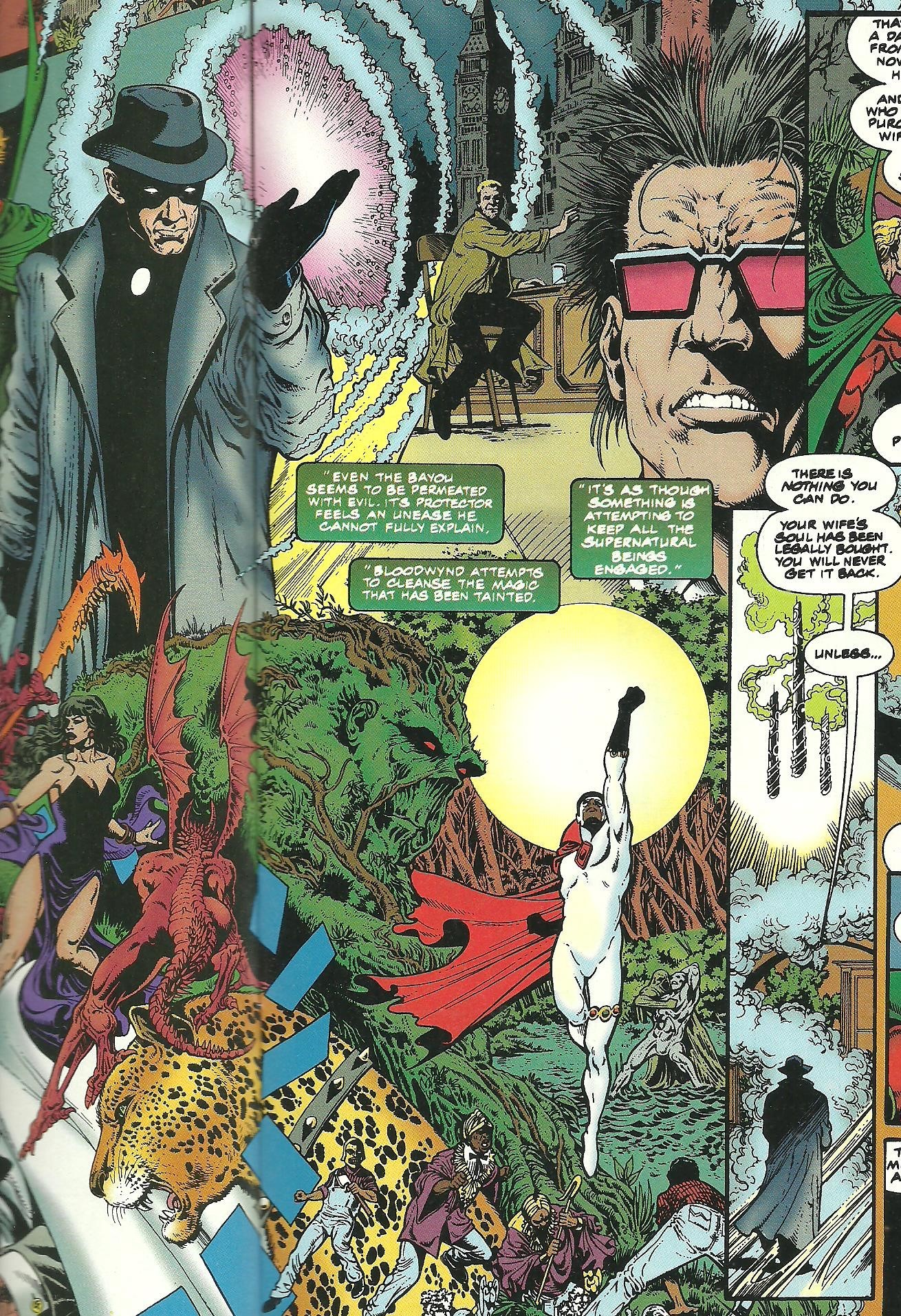
14.) Back when Swamp Thing and Constantine weren't speaking to the Justice League. When The Phantom Stranger appears to Alan and starts explaining what's going on, there's a rather bravura spread that takes up about a page and a half. The Stranger's dialogue explains what some other prominent magical characters are up to at the moment, presumably explaining why none of them appear in this book, and Jimenez dutifully draws them all: Dr. Occult, Primal Force, Madame Xanadu, Baron Winters of Night Force and the Justice League's Bloodwynd.
Jimenez also draws some unnamed characters too, though, who a reader would recognize, even though the Stranger doesn't name them: John Constanine and Swamp Thing, both then starring in long-running mature-readers books from DC's Vertigo imprint, and Mister E, who Neil Gaiman used in his initial Books of Magic miniseries, after which point he became a recurring character in various Vertigo series.
The dialogue seems to cover these three with "It's as though something is attempting to keep all the supernatural beings engaged," but it's interesting that Jimenez can draw Swamp Thing right there on the page, but he's not referred to by name. Instead, the Stranger's narration notes, "Even the bayou seems to be permeated with evil. It's protector feels an unease he cannot fully explain."
Obviously DC was operating under some hazy rules in which certain DC-turned-Vertigo characters couldn't cross the border between the two "universes", and Jimenez and company seemed to get a little more latitude with this book than creators on others might have gotten. Phantom Stranger, for his part, appeared in many of the same Vertigo comics that Mister E did, but he headlined only a single Vertigo comic—1993's Vertigo Visions: The Phantom Stranger #1 by Alisa Kwitney and Guy Davis. That apparently wasn't enough to make him a Vertigo character, though, and he was apparently still seen as more of a DCU character than a Vertigo one (It looks like Jimenez drew the particular design from the Vertigo one-shot, though).
15.) Wait, what's the plural form of Deadman? Deadmen or Deadmans....? As the issue reaches its halfway point, Deadman makes his appearance, with Jimenez drawing a few panels featuring him before the baton is passed on to Williams. Jimenez's Deadman looks like Carmine Infantino's original version, or the versions drawn by Neal Adams or Jim Aparo; he's essentially a pretty buff, fit,
vital human being in appearance, his white skin and pupil-less eyes the only indications that he's, you know,
dead.
Williams, on the other hand, drew Deadman as Kelley Jones had redesigned him in the pages of miniseries Love After Death and Exorcism, as a skeletal, rotting corpse in an ill-fitting, exaggerated costume.
The radical shift in his design works quite well in the context of the story, though.
When he first appears to the reader, it's after Fate notices the invisible Deadman, and the Stranger instructs Sentinel to "cast your flame above us, and all will be made clear." When Sentinel does so, Deadman appears for all of the characters—as well as the reader—to see and hear. He even mentions that "This green fire's got some kick. I haven't felt this great in a while."
On the next page, however, he follows the ad hoc team to Tannarak's Bar, where he's seen floating above them like Jones' spectral corpse version. There he uses his "power" of possessing a body.
The overall implication is that maybe Deadman's appearance is fluid, and he looks more "dead" when he's using his ghost powers. That, or the influence of the superhero's super-powered green flame restores him to a more super hero-like build and appearance.
16.) Williams' McCrea's Kirby's Demon. One of the real treats for me re-reading this comic in 2020 was realizing not only that the guy who drew the non-Jimenez portions was J.H. Williams III, who would go on to some renown, but that the version of The Demon he drew was essentially John McCrea's version of Etrigan from the last twenty issues of the 1990-1995
The Demon.
If you squint at those images, you can actually see McCrea's design, which featured a thinner, more wiry build, longer and more exaggerated ears and horns and more gnarled, claw-like hands than the version drawn by artist Val Semeiks, who McCrea took over for on The Demon, or creator Jack Kirby.
While Williams' Demon is clearly modeled on McCrea's strung-out Dr. Seuss character version, complete with long, torn cape that looks like something between a flag and dish rag, he also draws him a bit more realistically, filling in the unlikely physique with well-rendered flesh and muscle. It actually makes the character much scarier than most versions of him, as McCrea's more exaggerated, cartoonier version is, under Williams, so well-rendered as to accentuate everything wrong about it.
Etrigan is here allied with the bad guys in Hell and spends his scenes engaged in what is basically a street fight with Fate, a character I know almost nothing about, other than what I've read here (he starred in a 1994-1996 23-issue series that began during DC's "Zero Month," and was an attempt to create a more post-modern, "badass" version of Dr. Fate; this Fate wielding a big-ass knife and throwing ankhs made from the melted-down helm of Nabu).
The appearance is very much in keeping with Alan Grant and Garth Ennis' take on the character, and he is finally defeated when Fate unbandages his weird-ass right arm, which is a creature of chaos or...something. By way of surrender, Etrigan reverts back to Jason Blood but, sadly, Blood and Corrigan don't get any scenes together.
17.) The Spectre is a Harryhausen fan. Or, at least, Williams is. When The Spectre has finally had enough of Dementor's shit, he creates a giant fist out of the ground to hold him in place and sics some two-headed vultures on him. When I originally read this, I just thought, "Huh. Two-headed vultures. Cool." Now I can't help but think of
The Seventh Voyage of Sinbad.
18.) Time for another interruption. The Abyss is immediately followed by another of the tie-in one-shots,
Underworld Unleashed: Batman—Devil's Asylum, a 40-page one-shot written by Alan Grant and drawn by the unusual team of Brian Stelfreeze and Rick Burchett, the former's credit reading "storytelling" while the latter's reads "artist." This particular issue is probably worth looking at
just to see what a Stelfreeze/Burchett joint looks like and reads like. I have to say, the style looks more Burchett-like, but you can definitely see Stelfreeze in some of the poses and, especially, in the Batman (Readers of this comic would have been very familiar with Stelfreeze's Batman, thanks to his run as the cover artist on
Shadow of The Bat).
Although plenty of Batman villains appear in Underworld Unleashed and its many, many tie-ins, this one is set in Arkham Asylum, and so Two-Face, The Riddler and some lesser villains all play small roles, while the likes of The Joker, Scarecrow and Mister Freeze are off appearing elsewhere. The main villain is an original one, Kryppen, a master poisoner. He's seen making a deal with the devil in the very first pages, although the neat thing about the way Grant and company portray it, this can absolutely be read as a delusion that is all in Kryppen's head (Indeed, we see him talking to his own shadow on the wall of his cell while he's carrying on his conversation with Neron). In other words, this book can be read own without any other knowledge of Underworld Unleashed; in fact, it doesn't necessarily even have to be read as a tie-in at all.
Dr. Jeremiah Arkham narrates the story through his journal entry. It's a particularly tense night at the asylum, which Arkham thinks may have something to do with the electrical storm raging outside. Things get worse when another original creation of Grant's, "a small-time arsonist, a pathetic wretch who believes the ghost of Benjamin Franklin drove him to his crimes" kills himself and causes a black-out in the process.
A riot breaks out, and Kryppen makes good on his deal with the devil, poisoning everyone in the asylum, and promising Batman he will give him the antidote—but only if he consents to kill any one inmate first. Batman does not, and is able to solve the problem anyway.
Through Kryppen, then, Neron (or the devil, as he's called here almost entirely throughout) tempts Batman for a second time in this collection—as well as Arkham, whom we see briefly indulging in fantasies of ways to psychologically torture the inmates in his care in revenge for the riot, during which he has his nose broken.
Like Apokolips, this is completely unnecessary to the Underworld Unleashed plot or story, but it's a well-made book, and a pretty decent Batman story.
19.) And one last interruption. Aside from the
Apokolips special, the one-shot
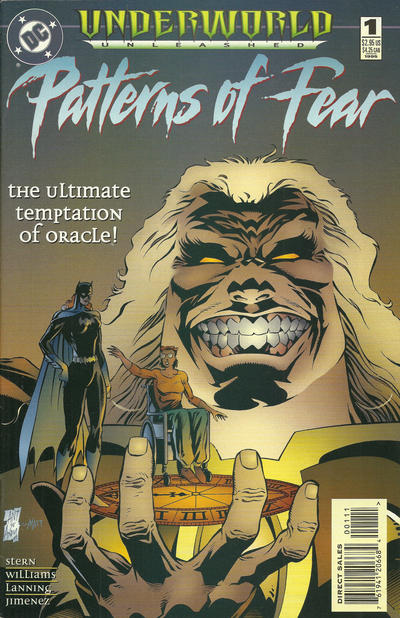
Underworld Unleashed: Patterns of Fear is the only other part of this collection I had not encountered in 1995, and was therefore reading for the first time here. It was written by Roger Stern with art by Anthony Williams and Andy Lanning, and is an interesting hybrid between a comics story and a
Who's Who-type book, or, more directly, the
Secret Files & Origins specials that would be commonplace at DC in the late '90s.
There are 13-pages of comics, during which Neron appears in Oracle's clock tower headquarters and alternately terrorizes and tempts her with his powers, first appearing in a white suit before ultimately resuming his goofy-looking supervillain get-up when she uses his name.
Neron is apparently there on a fact-finding mission, to see how much Oracle and the heroes know of him and his operation, and so between pages of their banter, we see Oracle's "files" on various villains who took Neron's deal. At first these appear as computer documents with "Police composite" sketches credited to artists like Flint Henry, Tony Harris, Rick Burchett and Jimenez. Eventually, the format will shift a bit, and we'll also see news clippings and memos, a wanted poster and sticky notes of Barbara's on other villains.
All together, these account for 25 pages, and seem to account for just about every villain who took Neron's deal and appeared in the tie-ins, although there may be some missing (and there are no files on the heroes who did, like Blue Devil, The Ray or Triumph).
In terms of the way the book flows, it's obviously somewhat awkward, as each file on each villain will take far longer to read than any handful of pages of the comics pages, and so it's a book that proceeds in fits and starts, at least if one reads it exactly as printed (It reads much better if one skips over the files the first time through, and then returns to them after the story is over).
As for "The Ultimate Temptation of Oracle!" alluded to on the cover, it's not too difficult to figure out what that is. He offers to restore her mobility, allowing her to walk again, or even become Batgirl again.
"In fact, I'm prepared to sweeten the deal!" Neron offers, although personally I find this a bit much. "I am willing to give you power on par with Superman! Power--and invulnerability!" In return, he asks not for her soul, but her "occasional services as my librarian."
Barbara obviously turns him down, but I've got to admit, I find this idea kind of intriguing, and certainly a more interesting way of getting Barbara out of the wheelchair and into her Batgirl costume again than what DC ultimately did in late 2011, when they just...rebooted her years as Oracle away with the New 52, and then gradually started fussing around so that maybe they still happened in some form, just not in the same way they did in the comics originally, and also she still got shot by The Joker and was temporarily paralyzed, she just got better.
I mean, I'm glad DC didn't have Oracle do a deal with the devil—although it probably could have worked, if she managed to outsmart him in a particularly clever way that allowed her to wriggle out of having to serve him on some technicality, while enjoying her returned mobility—but then, I find the character much more engaging and valuable as Oracle than I do as Batgirl, and, were it up to me, she never would have gotten out of her chair or resumed the role of Batgirl.
At the very least, there's a decent Elseworlds story embedded in this one-shot, or, perhaps, one of those What If...?-style one-shot Tales of The Dark Multiverse specials that DC has been publishing of late, each of which is tied to some DC crossover event like Underworld Unleashed. Of course, were it one of the Tales, it would have to go disastrously wrong, which would necessitate Oracle not being able to trick Neron and get the better of him, but even still, a Superman-strong Batgirl in 1995 Gotham whose day job is Hell's librarian would make for a pretty cool comic, I think...
20.) Well, I like it. We hear a lot about Superman's post-death hair in the '90s, and everyone's quick to crack a joke about Nightwing's mullet, but we never hear all that much about Gotham City's second most famous mullet: Barbara Gordon's. Now, that might just be because she's so rarely drawn with one, but Anthony Williams sure gave her one.
I think it looks pretty good and, depending on how much product she uses, could actually be a pretty cool look for Babs.
21.) The Church of James Gordon...? At one point early in their encounter, Oracle, realizing Neron was some sort of evil supernatural being, brandishes a cross. He merely plucks it from her hand: "I'm no cinema vampire that can be overcome by religious icons... ...no matter what the denomination." With those last words he transmutes the previously bare cross so that there's a tiny little version of her father, Commissioner James Gordon, crucified upon in, and calling her name.
In the next panel, we can't see the crucified Gordon, but note the blood that starts gushing from where the nail in his wrist would be.
These comics are pretty fucked up, huh?
I mean that as a compliment, of course.
22.) All good things must come to an end. So must Underworld Unleashed. Well, we made it to the end of the collection! The final issue features a cover in which our heroes are almost literally being consumed by the magical green ink of
Underworld Unleashed.
In this final issue, the Blue Devil-lead strikeforce begins battling its way through hell in order to get to Neron. The Ray, Firestorm, Wonder Woman, Maxima, Martian Manhunter, Warrior, Green Lantern, The Flash and Captains Marvel and Atom are there at the beginning, although they gradually drop off one by one as they get closer and closer to Neron.
Back on Earth, things are in bad shape, and the world seems to be on the verge of ending from a variety of different ways. Waid globe hops a bit, doing that list-of-atrocities bit, as well as providing panels checking in with various heroes:
At twilight in Paris, every deco gargoyle sprang to life in hopes of nourishing itself on the tourists. Only Mystek, Triumph and Gypsy defend the city of lights from darkness.
In Metropolis, the dawn brought with it famine--a ravenous hunger that could not be sated. Booster Gold and Blue Beetle face off against the storming crowds like hummingbirds against a hurricane.
And so on.
The most sustained action on Earth involves Blockbuster, Grodd and Metallo attempting a heist of some nuclear weapons being transported through Gotham by truck, and Batman, Robin, Black Canary and Huntress showing up to foil their attempt.
When the heroes finally make it to Neron's throne in Hell, they suddenly all turn on Captain Marvel, "an effect of the locale," as Neron explains. With the help of the Trickster, Cap is able to break the spell on the heroes and then offer Neron a deal: His soul in exchange for the release of his friends and Earth...and that's it.
Unable to not make a deal, but also unable to properly digest a soul from a deal that was "purely altruistic," Neron briefly resumes his true form of a mass of green tentacles on legs, then explodes in a huge green ink/white fireball, which sends all of the heroes back to Earth.
In a coda, Trickster seems to be thinking of turning over a new leaf and joining the superheroes' side of the DC Universe' eternal game, as, in his words, "when I someday pass from this mortal coil, I'd better have made some friends in Heaven, 'cause after this... ...I don't dare go to Hell..."
23.) This is a coincidence, I assume. Earlier this year I read Evan Dahm's
The Harrowing of Hell (reviewed
here), and among the denizens of his Hell are these creatures with vaguely clam-like heads that are basically all mouth. These echo the hellmouth entrance to Hell in the book.
I was therefore a little surprised to turn a page in this collection and see the heroes punching their way through monsters that look an awful lot like them:
There are some pretty obvious differences in the two designs, of course, but the similarities are kind of uncanny, too. It was enough to make me wonder if it was a coincidence, or if, perhaps, there is a common inspiration that both Porter and Dahm took for their designs of these creatures...although I doubt it.
24.) I think this is the first time I've seen this thing Porter does, but I'm not sure. Throughout his JLA run, Porter would occasionally draw the heroes as semi-silhouettes, highlighting particular, identifying aspects of their costumes. For example, Superman's S-shield and cape might be in color, while the rest of him was all-black. It probably saved Porter a little drawing here and there, but it was also a very dramatic artistic choice, and I always thought it looked pretty cool.
I am certain without double-checking that he did this often to the title character during his run on The Ray, as that character's powers were such that, when he was using them, he always appeared as a semi-silhouette in a field of light, suggesting a photo negative-like effect caused by his light powers.
I'm not sure if this is the first time Porter used the effect on heroes other than The Ray, but it is certainly the first time I had seen him do so (I'd eventually read chunks of The Ray that I'd purchased from back-issue bins; I'd love to see that series completely collected, but I don't hold out much hope that it ever will be).
Interestingly, David Marquez seems to be doing something similar on his cover for the upcoming Justice League #59.
25.) Okay, I guess the green really is better than white. In the above scene, Neron tries to take the soul of Captain Marvel and ingest it, but is having difficulty because it was a pure soul altruistically given to him, untainted by the sorts of greedy requests that usually accompany all such deals-with-the devil.
This is the scene scanned from the original; in the trade, everything that's green in the above page is colored white, with the exception of Neron's costume. You can see how Captain Marvel's white soul is a different color than Neron's "power," as seen in the color of his eyes, the cavities in his chest plate, and the energy emanating from his hands.
Now, in the original series, every soul we have seen on the page, and every instance of some sort of "soul energy" had been colored that neon green, whereas Captain Marvel's soul was white, showing what a sharp contrast it was to all the other souls Neron had traded in.
But in the collection, everything is white, and therefore there's no visual signifier that there's anything different about Cap's soul versus the corrupted ones.
This, then, is one scene in which the decision to color the trade differently is quite noticeable, and of an overall detriment to the story.
26.) A funny thing about Mark Waid's afterword... It is incredibly hard to read Waid's afterword—originally penned, remember, in 1998—and not read it as an indictment of an ever-present drive at DC Comics to make their light-hearted, Silver Age-borne creations darker and more serious...more often than not making them goofier in the process. This is an impulse probably best exemplified by Geoff Johns, who, during his run on The Flash, set about basically Batman-ifying the book, or heck, look what he did to various Green Lantern characters like Hector Hammond or Black Hand during his run on Green Lantern.
I remember reading an interview with Johns at one of the comics "news" sites, Comic Book Resources or Newsarama, wherein the interviewer was discussing Johns' work at revamping villains, and asked how he might go about making, say, Kite-Man into a terrifying villain. Johns responded by saying perhaps his Kite-Man might make kites out if his victims' bones and skin.
I was thinking about that as I read Waid's words. For example:
Probably the single strongest creative motive governing comics over the last 10 years has been embarrassment. You know it. You've seen its ruinous effects. Knuckleheaded, well-intentioned creators ashamed of corny old characters have been, for most o f a decade, dragging half-forgotten heroes and villains kicknig and screaming into their little hardware stores of creativity. There, haunted by a guilty fear that these ancient superdoers aren't kewl enough for a generation of video game-entranced readers, said kunckleheaded creators graft big guns and armored suits and homicidal personalities and grotesque deformities onto these poor costumed naifs and thus fool themselves into thinking they're doing them a good turn by bludgeoning all the innocent charm and colorful individuality out of them.
Again, that was written in 1998, long before Johns' rise to fame at DC, where he eventually became chief creative officer, and almost 15 years before The New 52, the line-wide initiative in which the publisher decided to drag the entirety of the DC Universe into the hardware store of creativity for some knuckleheaded, if well-intentioned, bludgeoning.
But wait, Waid gets more prophetic:
"Oooh! Let's turn Heat Wave into a living pillar of fire." "Oh, I know! Crazy Quilt should be made up of undulating, shifting patches of human skin!" Man, I thought I was so smart. Of course any villain created before Watchmen was pathetic and needed fixing, right?
See what I mean?
26.) I imagine I'll have to hit the back-issue bins if I ever want to read the whole story. Unless this trade collection ends up selling gangbusters, I can't imagine we'll end up getting any further Underworld Unleashed collections, although, like I said, there is a lot of it left uncollected—about 50 issues of tie-ins, according to Wikipedia.
On the off chance that we do get more Underworld Unleashed, I imagine it will be similar to the way that we got additional Zero Hour comics collected—that is, with Batman's help. Just as there was a Batman: Zero Hour collecting all of the Bat-Family tie-ins to that crossover event series, a Batman: Underworld Unleashed could include Detective Comics #691-692 (introducing a new Spellbinder), Batman #525 (the resurrection of Mister Freeze), Robin #23-24 (in which Killer Moth mutates into—sigh—Charaxes), Catwoman #27 (featuring Gorilla Grodd) and Azrael #10 (featuring the Jean-Paul Valley version of Batman)
And even though Superman himself was off-planet throughout the events of the three-issue mini-series, there are certainly enough Super-books for a
Superman: Underworld Unleashed collection (including issues of
Superman,
The Adventures of Superman,
Superman: The Man of Tomorrow, Steel and
Superboy). Also easy enough would be a
Justice League: Underworld Unleashed collection (
Justice League Task Force #30,
Justice League America #105-#106,
Extreme Justice #10-#11, maybe issues of
The Ray,
Green Lantern or
The Flash...although now that I am typing this, I am remembering
who wrote
Justice League America at the time, so I imagine we're no more likely to see those two issues get reprinted than we are to get future volumes of
Wonder Woman and Justice League of America collecting
Justice League America #93-113).