Showing posts with label aquaman. Show all posts

Thursday, May 06, 2021

Aquaman Is Fair.

Aquaman Is Fair (Picture Window Books; 2018) is a book by writer Christopher Harbo and artist Otis Frampton about Aquaman, and the many ways in which he is fair. Would you like to learn some of the ways in which Aquaman is fair...?

Aquaman went to the barber and said "Give me 'The Namor,' please." 


Aquaman is king, playing this sport—I'm going to say underwater polo?—with his subjects, so, given the power imbalance, I question if it's even possible for them to play this game fairly.

Does Aquaman do his share of the work? Because it really looks like he's just delegating his share to some dolphins.

Forget fair, Aquaman is downright courageous if he plans on mediating an argument between his wife and his lover. 

Tough but fair, if the punishment here is being eaten alive by sharks. I'm not sure what Ocean Master did exactly to deserve punishment, but it must have been bad since, again, that punishment is being eaten alive by sharks. 

Sunday, March 25, 2018

On a few collections of DC comics from the '90s: Aquaman, Green Lantern, Robin and Superboy

Aquaman By Peter David Book One

Peter David started writing Aquaman almost as soon as the previous ongoing series had ended. The thirteenth and final issue of the Shaun McLaughlin-scripted series shipped in 1992, while Peter David's four-part miniseries, Aquaman: Time and Tide, was released in 1993, paving the way for David's ongoing series, which began in 1994.

So hardly any time at all had really passed between the end of one series and the start of another, and yet reading David's Aquaman, it felt more like an entire age had passed, he so completely reinvented the character. His Arthur Curry--whose real Atlantean name Orin is used more and more--is a brooding, grumpy, self-pitying misanthrope, a former king more or less forced to continue his career as a superhero, because no one will leave him alone.

It is the visual shift that occurs in the early issues of Aquaman that are best-remembered, though. This is when Aquaman grew his hair long and grew a beard--it's more or less impossible to imagine Jason Momoa having been cast to play Aquaman in the Warner Bros live-action movies without this run of Aquaman comics having been published--and it's when he lost his left hand in perhaps the most ironic fashion imaginable, replacing it with a harpoon. By the end of this first collection of David's run on the character, he is wearing his new costume, too, his makeover complete.

The visual changes were all quite intentional, signalling not only a break with the character's clean-cut, Silver Age past, but an attempt by David, as he has his protagonist explaining within the scripts, to come up with an iconic symbol of his own, in the form of a weapon...specifically a weapon that surface-dwellers used against the creatures of the sea, repurposed and turned back on them by the sea's greatest defender.

Say what you will about the darker, more bad-ass take on Aquaman, it certainly worked. The series was the longest-running one Aquaman has ever had (David left after the 46th issue, but it continued under writers Erik Larsen and then Dan Jurgens, making it all the way to 75 issues). It was also, in my opinion, the best. This is the version of Aquaman that appeared throughout Grant Morrison's JLA, and has been around ever since...to a degree. During the New 52, Geoff Johns reasserted the character's original, Silver Age origins over those of David, Robert Loren Fleming and other Aquaman writers of the 1980s--in addition to upping his power levels to Golden Age Superman levels--but otherwise kept much of the character's chip-on-his-shoulder surliness.

Much of the strength of David's run came from neither reinventing the wheel--this isn't the self-conscious, revisionist, "Ultimate Aquaman" of Johns' more recent run, for example--nor jettisoning continuity, but rather of picking the character up where he was last left, giving him something new and life-changing to deal with (not the hand thing, so much as his discovery of The Atlantis Chronicles and coming to terms with what he learned in them), while fashioning for him interesting adventures dependent on interpersonal drama and as much mythology as superheroics. David never fell into the trap of recycling Aquaman's rogue's gallery--in this volume, Ocean Master and Black Manta both only appear briefly, and in flashbacks or dream sequences--or thinking of him as a reactive superhero who had to deal with, like, sea-going crime.

There was also a great deal of rewarding long-term plotting, some of which you can see here, as the events of Time and Tide inform those of the first year or so worth of the ongoing, as well as just good old-fashioned, shared-setting comic book scripting. The first issue of Aquaman I read monthly was #26, although I was easily coaxed into the series by well-executed guest appearances, each of which felt organic to an ongoing narrative, while also doing the job of drawing eyeballs to the book (For example, in this volume, Aquaman fights Superboy in one issue, and Lobo in another; the former is there because his turf is Hawaii, where there happens to be a pretty big naval base that Aquaman has business with, while the latter comes to Earth in order to avenge some dolphins, the only thing he cares about in the universe).

It also helped that David had a hell of a creative partner in Martin Egeland, the pencil artist who draws the bulk of this collection. I really liked Egeland in the 1990s, and his work remains pretty solid today, too. His characters are all quite expressive, and though he is prone to the excesses of the era--and there's an image or two where the muscles get out of control  and one shouldn't look too long at them or one will wonder why said pages were ever even allowed to go to print--there's a nice, fluid grace to the characters' implied movements. There are some incredibly dynamic scenes of Aquaman and Aqualad swimming, leaping and, in one memorable image, sort of skipping along a tunnel.

Looking back form 2018, I see a bit of Todd McFarlane in Egeland's style, although his fundamentals seem far better than McFarlane's ever were. (Does anyone know whatever happened to Egeland? I searched the name on comics.org after finishing this volume, and found relatively little beyond Aquaman and some superhero work from that time. Did he quit comics, or is Egeland a pseudonym, or...?).

This Book One collection begins with Time and Tide, which was drawn by pencil artist Kirk Jarvinen and inker Brad Vancata. The premise of the series was that Aquaman had retreated to his Aquacave in an attempt to continue the Atlantis Chronicles by writing about his own life, leading to a series of flashbacks. The first issue depict his first encounter with a superhero--The Flash Barry Allen--at the dawn of the Silver Age.

The second is devoted to his childhood, in which he is rescued from Mercy Reef as an infant by Porm, a friendly dolphin, who raises him as her own among her pod. It's a very Tarzan of The Apes sequence, and, in fact David takes quite a bit of inspiration from Tarzan in his portrayal of Aquaman, who he sees as something of an Atlantean answer to Lord Greystoke.

In the third, he is a teenager, and visits an Inuit village in Alaska, where he befriends--and inadvertently makes a baby with--a young woman named Kako. He also fights a polar bear and the first of the mythological deities he'll face during David's run.

And finally, in the fourth, we see Aquaman and Aqualad at the height of their Silver Age status quo, as they encounter Ocean Master who, at that point, is just another supervillain to Aquaman.

When Aquaman begins, Garth pulls Aquaman out of his cave--where he's sprawled like Conan on a throne of coral--to help him investigate a downed nuclear submarine for the US Navy. It turns out to be a trap set by new, short-lived villain Charybdis, who has already captured a minor DC aquatic adventurer, Dolphin. It's in this battle with Charybdis that Aquaman ultimately loses his hand.

After he's slightly healed--or at least has managed to affix a harpoon to the stump--he and his new running crew head to Pearl Harbor in order to get answers about the trap the Navy sent them into, where they have to fight Superboy (whose Spider-Man-like fight chatter makes him a better fit for David than Aquaman, whose jokes sometimes feel out of character). Before they get their answers, they are sent to Japan in order to rescue Porm, and there meet Lobo.

The last four issues of the collection are an arc of sorts in which Aquaman returns to Kako's village with Dolphin, only to discover the son he never knew he sired--Koryak, who will become a supporting character in the series--and a group of Fourth World villains, The Deep Six. Meanwhile, Garth goes off on a mission of his own, to follow a lead that he thinks might indicate that his late girlfriend Tula (or Aquagirl, as you and I know her) is still alive, meeting Letifos, who will play a role in the Tempest miniseries. It's during these issues that Jim Calafiore's work appears for the first time; he's just there to fill-in for an issue or so, but he will eventually take over as the series' primary artist...to the detriment of the series, if you ask me.

This collection, which includes 13 issues altogether, also includes a new introduction from Peter David, in which he describes how he approached the series and how he tried to sell it. I was glad to read it; as I always say, all trade collections should have introductions. If they don't deserve introductions, then maybe they don't deserve to be collected at all, you know?


Green Lantern: Kyle Rayner Vol. 1

I was a fan of the Kyle Rayner version of Green Lantern, DC's sole Green Lantern for much of the 1990s and the one that was featured in the Grant Morrison, Mark Waid and Joe Kelly runs on JLA. I could go on at some length about the virtues of the character versus that of his predecessor, Hal Jordan, but the two main things that attracted me to the character was that 1) he was new and debuted around the time I started paying attention to the DC Universe outside of Gotham City and 2) a coffee-obsessed, twenty-something, freelance artist based in New York City was a lot more appealing to me than a middle-aged, former test pilot-turned-space cop from a blandly generic imaginary city.

I never quite understood the vehemence with which so many Hal Jordan fans hated the change at the time. Of course, the very first issue of Green Lantern I read was 1996's Green Lantern #76, which featured Kyle Rayner soaring through the sky above Gotham City, the bat-signal in the background. This was the first issue in the three-part "Hero Quest," in which the green Green Lantern went from city to city seeking some form of guidance from his more established peers: Batman and Robin in Gotham, then Captain Marvel in Fawcett and, finally, Wonder Woman in Gateway (He had already met Superman, The Flash, Donna Troy and the Titans in his adventures).

That issue, for what it's worth, was a good 20 issues of Green Lantern into Kyle's career, plus Zero Hour and several issues of New Titans and whatever other appearance he made in his first two years or so wearing the ring. While I read earlier issues too, I did so out of back-issue bins, meaning out of order. I had never read Kyle Rayner's first year or so as Green Lantern in the way it was meant to be read, the way it was published. DC is making that possible though, collecting his adventures into Green Lantern: Kyle Rayner, which begins with his very first appearance...that means three issues of "Emerald Twilight," in which Hal Jordan was still officially the Green Lantern of the title.

These issues are rough. It's not until #57, when Kyle moves to New York City, that the book starts to feel like the Green Lantern I knew, and thought the book was; that's a good six issues into his time as Green Lantern. Writer Ron Marz is the poor guy who had the job of turning stalwart Silver Age hero Hal Jordan into a cosmic-scale villain, doing away with the Green Lantern Corps and The Guardians of the Universe and all the trappings of the franchise from the past few decades and introducing a new character--in just three issues.

He doesn't do as good a job in the space allotted as I always assumed he had done, but then, I think Dan Jurgens also did a lot of the work in (retroactively) justifying Hal Jordan's heel turn in the pages of Zero Hour. I guess I had just filled in the blanks in my imagination, or imagined that they were filled in in the pages of Green Lantern.

So the book begins with "Emerald Twilight." The first issue, penciled by Bill Willingham and inked by Romeo Tanghal and Robert Campanella, is really quite good. In the crater that was Coast City, utterly destroyed in the events of "Reign of The Supermen," Hal uses his wish-granting ring in an attempt to bring it back...although this mostly amounts to his conjuring holograms or hard-light constructs of it as he remembered it, and having conversations with his loved ones...though he's essentially just talking to himself through the medium of his ring. Anyway, it's all handled pretty well; I've always thought having your city completely erased from existence, including just about everyone you know except your friends from work (with "work" being "the Justice League" and "The Green Lantern Coprs") is as good as any other contrivance to drive a fictional character mad more-or-less overnight.

In the last few pages of part one, the Guardians tell Hal to quit fucking around and come back to Oa. Pissed at them, them streaks off to comply, while Kyle makes his first appearance; seeing Hal in the distance, he thinks he sees a shooting star.

The next two chapters? Things get dicey. (Visually, as well as in the story. Part two is penciled by a Fred Haynes, in a very '90s style with lots of splashes. Darryl Banks, who draws much of the rest of the book and is the artist most closely associated with Kyle, comes on during the third chapter)

During the second chapter, Hal is confronted by a series of allies from the Corps, each trying and failing to either calm him down or beat him up, as at this point it's pretty clear his trip to Oa isn't going to be a friendly one. He fights and defeats eight Lanterns, stealing each ring and adding them to his own fingers, increasing his power as he collects rings. When he gets to Oa, he's faced with Killowog. He tells Killowog that he didn't kill any of the Lanterns, but left them with enough power to survive. The two of them fight though, and The Guardians play their last, desperate attempt to stop Hal: They release Sinestro, newly empowered with a GLC power ring.

The bulk of the last issue is a fight to the death between Hal and Sinestro, with our hero breaking his archenemies neck and then killing Kilowog and destroying the main power battery and, apparently, The Guardians...?

In the last pages, the lone surviving Guardian, Ganthet, meets Kyle Rayner in an LA alley, seemingly at random, and hands him the last power ring in the universe, then disappears forever or so.

And the torch is thus passed.

Regarding "Emerald Twilight," what surprised me most is how few Lanterns Hal actually faces. It was my understanding that he killed the entire Green Lantern Corps which would have meant some 3600 Lanterns, right? Although I have absolutely no idea what was going on in Green Lantern comics just prior to this storyline, so maybe there were only a handful of Lanterns left at that point...? Or did destroying the battery somehow kill everyone? I have no idea.

Things stay rough for the next five issues, the first of Kyle's career. These issue's are pretty notorious, mostly because of what happens to Kyle's girlfriend, Alex DeWitt--this is the storyline from which the term "women in refrigerators" came from. And while it doesn't read any better in 2018, I do now wonder if perhaps this story wasn't a sort of necessary evil? Like, if it wasn't so egregious that it served as a sort of straw-that-broke-the-camel's back, drawing so much attention to the trope, giving it a name, that it was easier for other creators to avoid in the future? (Not that the phenomenon of killing off or visiting violence upon the female loved ones of male heroes as a way to motivate their actions went away afterwards, of course, but it's always easier to address a problem once that problem has been named.)

I'm also a little curious about how on-the-fly these decisions were made (This comic book series at this time in comic book history is a nexus for so many aspects of the mainstream comics industry and fandom that followed, that I think there could probably be a book written about it). The Kyle Rayner that seems to be getting introduced in the first few issues is a completely different one then the one who emerges a few issues later. When we first meet Kyle, he's a slacker in LA with a girlfriend trying to break into news photography, making for yet another superhero-with-a-media girlfriend pairing (Superboy, introduced just before Kyle, would also get a media girlfriend, in the form of Tana Moon).

She is killed off-panel and infamously stuffed inside of a refrigerator within issues of her first appearance, however, and after Kyle contemplates killing her killer in an act of vengeance, he ultimately leaves the city to begin a new life, at which point what would emerge as steady aspects of his turn as the main Green Lantern would emerge: His job, his city, his landlord, his relationships with super-women (First Donna Troy, then Jennifer-Lynn "Jade" Hayden). It makes me wonder if the sharp change in direction was intended to be subversive, or if Marz was making it up as he was going along, reacting to input from his editors.

In the middle of all that, DCU events intervene. Kyle briefly meets long-haired Superman and teams up with him against Mongul, the guy responsible for Coast City's destruction in the first place. Directly after Alex's death, Kyle finds Green Lantern Alan Scott--or perhaps he was Sentinel Alan Scott at that point?--waiting for him in his dark apartment, wanting to recruit him into helping with the whole Zero Hour thing (He does, but you have to read Zero Hour for that; here Scott does give Kyle a quick history of the Green Lantern Corps, told across four very full pages).

In Green Lantern #0, which seems to follow immediately on the heels of Zero Hour, Kyle and Hal battle on Oa, and there's a pretty interesting fake-out where it seems like Kyle might return the ring and legacy back to Hal, as if maybe his time as Green Lantern was meant to be more story-line specific, like when Jean-Paul Valley replaced Bruce Wayne as Batman, rather than when Wally West replaced Barry Allen as the Flash.

The collection includes two issues of New Titans, part of a crossover with that series that initiated Kyle's brief stint as a Titan (This era of Titans comics weren't all that great, but that was honestly my favorite line-up of Titans, with the possible exception of the Devin Grayson-written team), and the first issue of REBELS '94.

I suspect the next volume will be when the series starts to get pretty good, but these issues are all still intensely interesting, particularly from the perspective of what was going on with DC comics in the early 1990s, and various trends that were waxing and waning. Knowing how things have changed since only make some elements of these comics even more interesting too. For example, it's easy to imagine a young Geoff Johns reading these comics and getting pissed off, daydreaming about one day being able to undo all of the changes Ron Marz wrought.

And young Geoff Johns' dream came true!


Robin Vol. 5: War of The Dragons

One problem with these complete packages of particular series is evident from the first pages of the fifth issue of Chuck Dixon and company's long, healthy run on the Tim Drake version of Robin. This particular collection covers Robin #14-22, Robin Annual #3 and Detective Comics #685 and #686. Robin #14 was part of the four-part "Troika" story that introduced Batman's then-new costume and ran through the four main Batman books of the time. Actually, Robin #14 was the fourth part of it, so this collection opens with the conclusion of a story; it's beginning and middle somewhere else, probably uncollected (The solution, I suppose, would have been to either stick the first three chapters in here, or just collect "Troika" as its own, 90-ish page trade).

There's another multi-book arc collected in this trade, the title one, but the two Detective Comics chapters of "War of The Dragons" are included, perhaps because that entire arc was written by Dixon, who was then writing 'Tec as well as Robin, or because of how Robin-y that story was, as the warring dragons were King Snake, Lynx and The Ghost Dragons, the villains from the very first Robin mini-series.

So after the opening, in which Robin must try and hold his own against The KGBeast, there's a two-part story penciled by Tom Grummett featuring Batman, The Spoiler and Cluemaster; the three-part "War" featuring art by penciller Steve Lieber and inkers Klaus Janson and Enrique Villagran (Huntress and Nightwing put in guest-appearances, and The Silver Monkey is introduced) and then the volume contains the transition from Grummett to new pencil artist, the late, great Mike Wieringo, which accompanies a series of extremely well-made shorter one and two-issue stories, which are something of a relief after the relative chaos of the Bat-family titles up to that point, with their years worth of inter-book crossover epics.

The unfortunately also late, but also great Mike Parobeck and Stan Woch draw "The Mouse That Ate Gotham," in which Robin meets an unlikely foe that causes chaos by attacking key points of key infrastructure. Ringo then takes over as penciler for a two-parter involving the return of The General (a badly bowlderized version of whom has been appearing off and on in the James Tynion-written Detective), which is followed by a second two-parter, this one sending Tim undercover to infiltrate a ninja-themed summer camp in order to stop a string of robberies by faux ninja second-story men (and women).

The final chunk of the book is the third Robin annual, one of 1994's Elseworlds-themed annuals. In this one, Batman is a samurai in feudal Japan, and Robin is his orphaned apprentice, who must try to complete his final mission after Batman is killed off. There are a clan of cat-eared female ninja , but beyond those Batmanly touches, it is mostly just a pastiche of samurai flicks. Villagran handles the art.

Reading and/or re-reading all these comics today--the annual, The Mouse and the ninja camp stories were the only ones I hadn't read when they were originally published--what seems most striking to me is how much effort Dixon put in to trying to make the teenage characters seem semi-realistic as crime-fighters. Batman was very protective of Robin, and Tim had to be very careful about who he fought and how, so as not to risk his life needlessly; when he confronted someone like The KGBeast, it stuck out as a dramatic moment because it was so relatively rare. In this volume, for example, he mostly deals with younger opponents, and/or the sorts of crimes that might not necessarily warrant Batman's undivided attention.

Dixon's Spoiler is as different from Tynion's Spoiler as his Tim Drake is; rather than hyper-competent, she's very much an amateur and work-in-progress, and it's a lot more fun to see her arguing with the Dynamic Duo, as, on the one hand, she's totally right to call Batman and Robin out for being sanctimonious jerks to her, but, on the other hand, they're proven right that she's really not ready to be a crimefighter (as when Robin takes two in the chest due to her recklessness, for example; thank God for Kevlar!)

I was also struck by how much The General--a ridiculously brilliant and mature military strategist who just so happens to still be a little kid--seems like a precursor to Damian, right down to his look. Here he basically looks like Damian with a different haircut. All of which kind of makes me want to read a comic featuring the current Robin and the original version of The General, although I suppose the New 52 reboot and Tynion's version of The General would make that impossible-ish.

Robin was in pretty great hands with Grummett handling the art for so much of the first year or so of the book, but Ringo was pretty much born to draw the character, and it is great to see the energy he pours into these early issues. I can remember being a teenager and finding myself much more excited about the book when Ringo's art started appearing under the covers. My esteem for all of these artists have only grown in the years since then, but yeah, there's a pretty clear line in the book's look as Grummett gave way to Ringo.

Looking ahead, it looks like the next dozen or so issues will contain the "Underworld Unleashed" tie-in (during which Killer Moth becomes Charaxes, something I recall hating and writing a letter to the editor about), a few issues of "Contagion" and probably "Legacy" tie-ins, and guest-appearances by Green Arrow Conner Hawke and Wildcat.


Superboy Book 1: Trouble In Paradise

DC begins its perhaps belated collection of the 1994-2002, 100-issue Superboy series with this 270-page, 11-issue trade paperback. The particular Superboy in question is, of course, the '90s one, the clone who was introduced in the post-"Death of Superman" 1993 storyline "The Reign of The Supermen" and then graduated to his own title, by his creators writer Karl Kesel and artist Tom Grummett.

This volume makes for some curious reading, as it starts off with what appears to be four issues of a very solid ongoing comic book series, then detours into four issues of almost impossible to make sense of crossovers, before getting back on track for a few issues.

Kesel writes all 11 of the issues included herein, and Grummett pencils most of them, usually inked by Doug Hazelwood. As for those first four issues, they are most remarkable in for how quickly they establish a premise for the series, which needed a pretty dramatic form of differentiation from the then-four Superman monthlies, and how quickly the creators start filling out Superboy's cast with new characters.

That differentiation turned out to be geographic, as Superboy, his manager Rex Leech, his manager's teenage daughter Roxy Leech, and Superboy's Cadmus-appointed chaperone Dubbilex, a psychic "DNAlien", arrive in Hawaii for the next leg of their "Superboy National Tour," an attempt to turn a buck on Superboy merch, and they more or less decide to stay...in large part because Superboy's crush Tana Moon has relocated there from Metropolis, where she firstmet and was covering Superboy for a time.

We immediately meet Sidearm, a low-level bad guy whose gimmick is a couple extra robot arm attachments; Silversword, the curator of a Hawaiian cultural museum who comes into the possession of a super-powered "animetal"; The Scavenger, a collector of mystical and super-powered artifacts (not to be confused with the Aquaman villain of the same name) and, of course, Knockout, a super-powered stripper who develops a sort of Batman/Catwoman sort of relationship with the Teen of Steel. In the first issue we also meet Sam Makoa, a federal agent working on the islands to combat villainous organization the Silicon Dragons.

Again, all of those new characters appear in just the first 80 or so pages. Then things get a little messy. This is a problem with all of these collections. On the one hand, if the goal is to make them complete collections, then naturally they should include all of the issues of the series. On the other hand, because comics of the time so frequently included crossovers to other books--and Superboy, like Robin, would find this happening a lot, as in addition to line-wide crossovers like Zero Hour, it would also participate in the family-specific crossovers--that means including random chapters of larger stories that sometimes don't make much sense when read alone.

So by the fourth issue, Superboy is showing signs of the "clone plague," and heads to Metropolis to participate in "The Fall of Metropolis" crossover in the Superman books (there is no participating issue of Superboy though; he just heads off to Metropolis in one issue, and then the story picks up with Superboy cured).

Then there are two issues from "World Collide," the 14-part, 1994 Superman family/Milestone crossover that ran through seven different titles, and a one-shot. The third and eighth parts appear here, and they don't really make much sense at all read like this; the first of these is mostly intelligible, involving Superboy and Superman fighting The Parasite in the ruins of Metropolis, but the latter finds the storyline in full-swing. Superman and The Blood Syndicate are dealing with the results of a towering, omnipotent giant's attack on one side of a dimensional rift between the DCU's Metropolis and Milestone's Dakota, while Superboy teams up with Static and Rocket to tackle the giant head-on. There's some nice interaction between The Kid and his fellow teen heroes from the Milestone-iverse, but plot-wise? It reads a lot like the eighth issue of a 14-issue storyline. (I'm not sure what the market for it would be, but if DC's going to go ahead and publish these little slices of it, they might as well release "Worlds Collide" as a trade paperback of its own.)

And then we get two issues of Zero Hour tie-ins. As I've noted before, as tie-ins to line-wide crossovers, the Zero Hour tie-ins are generally pretty easy to read on their own, as most of them deal not with the plot mechanics of the main miniseries per se, but with the fall-out of those mechanics, which mainly means a standalone story in which the title character must deal with time going crazy. Those issues were then immediately followed by loose, thematic tie-ins--#0 issues recapping the heroes' origin stories and setting up future storylines. They were, essentially, jumping-on point comics.

For the tie-in, Kesel and Hazelwood introduce Superboy to the original Superboy; pre-Crisis Clark Kent when he was a boy. That Superboy arrives in Smallville, Kansas just as a plane carrying Dubbilex and our Superboy crashlands outside of town, and his Smallville occasionally appears and overwrites modern Smallville. It's a pretty great comic, really, and includes my favorite page in this whole book. Clark is confronted with the modern Superboy, and then walks off panel saying "Excuse me. I'll be right back." Just as our Superboy turns to the adult Lana Lang to ask what's up with Clark, he comes streaking back on to the scene, now in his Superboy costume, and clocks his modern incarnation. It's a wonder that guy even had a secret identity so long...

For the zero issue, Superboy has a rematch with Sidearm, and then he and Tana Moon spend some time with vacationing Metropolis super-scientist Emil Hamilton, who runs tests on Superboy as his origin is retold...including his first encoutner with Sidearm, from Metropolis on his first night outside of Cadmus. This is the issue in which Superboy acquires his special sunglasses--the first bit of tinkering with what would prove to be a very flexible costume--which gives him X-Ray vision, as well as approximating other Superman powers (Remember, at this point, Superboy was a clone whose sole super-power was tactile telekenisis, which he used to approximate Superman's strength, speed, invulnerability and flight, but didn't grant him Superman's various visions; Geoff Johns would later retcon the character to be an actual clone of Superman, with all of Superman's powers).

It is there that the series resumes the momentum Kesel had planned for it, free of crossovers. The final two issues collected herein introduce King Shark, one of the characters most formidable and, perhaps, longest-lived villains (although Kurt Busiek, Gail Simone and others would rather radically change his personality and, ultimately, his design, in the next decade or so), and a shape-changing character named B.E.M., who can transform into monsters based on whatever the last thing he touched was. These two issues were penciled by Humberto Ramos, whose style was a sharp departure from that of Grummett's, and was, at this point in his career at least, still rather rough. Ramos would get a lot better rather quickly though, and would eventually become a favorite of mine.

These comics are now almost 25 years old, and it certainly shows. The art, particularly that of Grummett, aged quite nicely...if anything, it looks better today, compared to what you might see in too many other DC Comics on the shelves at the moment (seriously, compare this to the insides of the New 52 Superboy or Teen Titans, originally starring a new version of this character, for example). The costume design, well, that's another matter. Superboy's fashion choices look downright bizarre now, and if you scan the covers of the series on comics.org, you'll see him gradually adopting differing costume elements as artists try to find something less 1994 for him to wear. Other than the main character, though, most of the other new characters look more or less timeless; certainly compared to the Milestone heroes, almost all of whom look as early 1990s as super-characters can look (Even poor Icon, who should have a pretty iconic costume, has that weird thing going on around his eyes).

Kesel's use of slang--and Superboy was very much in the constantly chattering, Spider-Man mold of quipping superhero--is dated to the point where it can be kind of crige-worthy, although, perhaps ironically, we are now so far removed from 1994 that it's easy to assume that maybe that's just how people all talked back then...? Like, when I read Silver Age Stan Lee-written comics, I just assume every one in the 1960s talked like, say Benjamin Grimm and Johnny Storm, you know?

Somewhat intriguingly, this collection is more thoroughly designed than the others in this post. While the figure of Superboy on the cover is re-purposed from Grummett and Hazelwood's image from Superboy #1, the background of that image is removed, the figure is enlarged so that his extremities extend beyond the borders of the space, and even the logo has been redesigned. There's a sort of Trapper Keeper aesthetic to the collection, which is...well, which is appropriate.

I had previously only read two of these 11 issues--Superboy #1 and Superboy #0; my comics budget was a lot more limited in 1994 than it is now--and I enjoyed this book immensely. I do hope DC continues collecting Superboy. Looking ahead, it appears that the next 11 issues includes "Watery Grave," a Suicide Squad story, in which Superboy, Knockout, King Shark and Sidearm work alongside Captain Boomerang and Deadshot, and, depending on whether or not they include Superboy Annual #1, guest-appearances by New Blood Loose Cannon, Green Lantern Kyle Rayner and maybe The Legion of Super-Heroes.

Thursday, August 17, 2017

Is there a science teacher in the house?

Before I discuss one of this week's weirdest comic books, I'm afraid I just have to get this out of my system first, if you will all indulge me.

So the above image is a single panel of Dark Nights: Metal #1, written by Scott Snyder, penciled by Greg Capullo, inked by Jonathan Glapion and colored by "FCO" Plascencia. In this panel, we see the entire Justice League flying through outer space together. Green Lantern Hal Jordan is wearing a Green Lantern Corps ring, which encases him in a force field and allows him to travel through space. Presumably, it either traps enough oxygen in there with him to allow him to breather, or it generates oxygen. It's a pretty versatile piece of super-alien technology. The three other human members of the League--Batman, The Flash and Cyborg--are similarly allowed to travel through space thanks to the ring. As you can see, they are in a ring-conjured construct in the shape of a spaceship.

The remaining three members--Superman, Wonder Woman and Aquaman--are shown flying alongside of Jordan, outside of the ship. The only thing they have to protect them from the vacuum of space is a little see-through mouth guard like thing; these likely supply them with oxygen, as well as allowing them to speak to one another.

So here's my question: Are Superman, Wonder Woman and Aquaman able to travel through a vacuum like that without dying...? Please correct me if I'm wrong, and I likely am wrong, since all I know about what happens to organisms exposed to space comes from movies, comics and mostly-forgotten comments made by barely-remembered grade school science teachers, but I thought if one was in a vacuum, the lack of oxygen and the extreme cold were only some of the things that could kill you. I thought the vacuum would also suck out all of the air inside of you, and maybe all of the liquids inside of you and maybe the organs inside of you...? It was my understanding that you would basically explode if you were in a vacuum.

Superman seems cool. While I've seen him wearing full space-suits before, I've also seen him wearing a little mask like the one above and I've also seen him flying through space with no protective wear at all. I'm assuming he's simply so strong that his body can withstand the rigors of space travel and hold itself together. The cold wouldn't be cold enough to hurt him, since almost nothing can hurt Superman. And he doesn't really need to breathe oxygen, since his body is powered by solar energy, rather than the chemical processes that keep humans alive. Also, he can fly, so propulsion shouldn't be a problem for him.

Wonder Woman though, that seems like a stretch. Sure, she's plenty strong and has a high degree of stamina and invulnerability, but it's not comparable to Superman. Even if we imagine that her demi-god powers are such that they would allow her body to keep itself functional in one piece in space, and even if we imagine that she's strong enough that the cold of space wouldn't freeze her, she still needs oxygen to breathe. Even if the mouth piece is pumping oxygen into her mouth and nose, wouldn't it just get sucked right back out of her ears and pores and so on...? Like Superman, she too can fly, so there's no problem for her there (Unlike Superman, I'm having trouble thinking of a single instance of Wonder Woman flying through space without the benefit of a ship or a giant kangaroo).

And then there's Aquaman. I know he was massively powered-up by the New 52 reboot, to the point where he is basically as strong as Golden Age Superman, but no matter how tough and how strong they say he is these days, his body can't possibly be strong enough to survive a vacuum, can it? (The excuse for his super-strength and high degree of invulnerability is that Atlanteans basically hyper-evolved to survive in their environment, so that he must be super-strong and nigh-invulnerable to survive and even flourish at depths where the pressure of the ocean would crush just about anything.) Similarly, while he is fairly immune to heat and cold, space is, like, really cold; can Aquaman really withstand the cold of space? Aquaman also needs oxygen to breathe, whether he gets it from the air or from water. Again, the mask might be giving it to him, but how's he keeping it...? Finally, Aquaman can't fly; how is he moving through space...?

Now, all of this is easy enough to no-prize away. I imagine that Green Lantern is actually projecting a field around all of them, despite the fact that we can't see it...the Lantern rings can project and construct light constructs that a comic book reader's eye can't always see. In fact, they have to be all under the influence of the ring to a certain degree, as otherwise they couldn't travel through space in that manner very far (I think it was Geoff Johns who introduced the idea of the Lanterns' rings opening wormholes to allow them to travel through deep space in an efficient manner, but maybe someone had thought of that before). So maybe there's a giant field of oxygen all around all of the heroes, and Capullo and company just didn't render it visible (It's also possible that those face masks create super-thin, sheathe-like space-suits that can't be seen by the human eye, not unlike the ones in Guardians of the Galaxy 2).

So I'm not really arguing with the panel, I just want to know what the vacuum of space does to human beings. And Superman, Wonder Woman and Aquaman.

Thanks in advance for any help you might be able to offer in setting my troubled mind at ease.

Friday, March 22, 2013

I call bull@#$%.

Normally, I'd call "bullshit", but, since 2008's Super Friends #3, which Capstone just reprinted as a hardcover and I just read, is a kids comic, I'll stick with "bull@#$%" instead.

The plot for this comic involves Felix Faust making magical finger puppets of the Super Friends, through which he can control their actions by issuing a direct command to them. So that means the Super Friends are forced to serve the evil wizard in his quest to gather the jar, bell and wheel and thus rule the world.

The Friends come up with a plan to stop him though.

They arrive at the dingy apartment Faust is using as a base of operations with the magical artifacts. Pay special attention to Wonder Woman in those panels, okay?
He looks at Superman and commands, "You--Superman! Tie up the Super Friends and lock them in my basement. To which Superman simply says, "No." Confounded by how Superman is resisting his magical commands, Faust argues with him, long enough that The Flash could remove his puppets at super-speed.

How was Superman resisting...?
They all dressed up as one another, of course! Now I'll buy Superman and Batman switching costumes, as the big, brawny, black-haired besties look pretty similar. I suppose I could even go with Batman fitting a life-like Superman mask on over his bat-cowl, or Flash a John Stewart mask over his cowl. And mmmaaaybe Wonder Woman could get away with dressing as Aquaman, if she had some kinda broad-shouldered, rubber-muscled man-suit on.

But Aquaman in a Wonder Woman costume? Look at that panel again—her waist, her hips, her ehourglass figure, her tiny neck and slim arms. That's Aquaman in a Wonder Woman costume...?

Bull@#$%.

*********************

Speaking of Aquaman wearing a Wonder Woman costume, remember when Chris Samnee drew this, after Wondy's much publicized ditching of her costume in favor of the pants and jacket ensemble she wore during the short-lived, abandoned-by-its-own-writer J. Michael Straczynski run on the character...?

Tuesday, February 14, 2012

PSA: Don't miss Valentine's Day at ComicsAlliance

It's still Valentine's Day for another two hours or so, and if you haven't visited ComicsAlliance yet today (Say, why haven't you visited ComicsAlliance yet today), then I'd like to call your attention to a couple of neat, holiday-specific features there today.

First, there's Chris Sims' "New 52"-themed valentines (One of which is pictured above), and then there's a set of homemade superhero valentines from EDILW favorite Carolyn Main. She did an Aquaman one too......but you can click on over to CA to read the joke on the bottom half of it. And for more of Main's comics, cartooning and illustration, do yourself a favor and spend some time on her website.

Sunday, March 27, 2011

Geoff Johns to rescue Aquaman...?

So I guess DC's most popular writer, Mr. Geoff Johns, is going to be writing a new Aquaman series of undetermined length, with an unnamed artistic team.

I think that's pretty great news, as an Aquaman fan, and I'm honestly quite surprised to hear it.

Now, I've been thinking DC should probably have Geoff Johns write Aquaman for about five or six years now. After taking on first The Flash (a long stretch on the title with Wally West in the red suit, followed by the recent Barry Allen revival) and then Hawkman (in both JSA and then a short-lived Hawkman monthly) and then Green Lantern Hal Jordan, Johns demonstrated not only skill but, more importantly, success at being able to take a tired, sometimes even retired Silver Age great and making them work again.

I'm not going to argue that the comics cited above were always great ones or anything—I only read his Flash run sporadically, and dropped Hawkman pretty quickly, and Green Lantern is a book I love sometimes in spite of itself—but they all strove to communicate the writer's affection for a character and concept, and did so effectively enough that the characters usually seemed more relevant, cool and exciting, and the market (mostly) supported them.

Let's review...

THE FLASH: Geoff Johns took over the Flash book in 2000 with issue #164, with the art team of Angel Unzeta and Doug Hazelwood (and covers from Brian Bolland). His run was long and influential, reinventing old villains, inventing plenty of new ones, and generally fleshing out The Flash's world, with the help of Scott Kolins and Howard Porter, two artists who stuck around for quite a while. Johns himself wrote the book through 2005, making it about five years even.

The title didn't survive his departure. It was canceled in with issues #230, to make way for a new Flash title starring a new Flash (Former Impulse turned Kid Flash turned Flash IV, Bart Allen, hyper-aged into young adulthood) and written by some guys who worked on an old, semi-forgotten Flash television show—that lasted only 13 issues. So then DC brought back Mark Waid, a long-time Flash writer who preceded Johns on the book, who in turn brought back the Wally West Flash, now the father of two super-kids. His run resumed the numbering of the previous series, but only lasted 17 more issues.

Finally, in 2009's Final Crisis, Grant Morrison brought back the Silver Age Flash, Barry Allen, after the hero having been dead since 1986, a fairly controversial move at the time (Wall West, the third Flash, had been the Flash for literally an entire generation of time at the point at which the Silver Age Flash came back to resume the role). That was followed by the six-issue Flash: Rebirth series by Geoff Johns and Ethan Van Sciver and the current Flash ongoing series, starring Barry Allen and written by Johns once again.

The title is set to be canceled shortly, after the events of Flashpoint, a big company crossover/event series spinning out the events of the series, although it will presumably be relaunched with a different writer shortly after that.

Looking back at the last ten years of Flash comics, it looks like the franchise has yet to really recover since Johns left it the first time, as DC has been relaunching it with different lead characters, different creative teams, and different concepts on a regular basis ever since.

HAWKMAN: In 2002, after reintroducing the original Carter Hall in the pages of JSA and mostly making sense out of his complicated origins and giving the character a new premise, Johns launched a Hawkman ongoing title with the superlative creative team of Rags Morales and Michael Bair. Johns left after 25 issues, with the writing team of Jimmy Palmiotti and Justin Gray keeping the book going until #49 in 2006. At that point, the title changed its name to Hawkgirl (but kept the numbering), Walter Simonson and Howard Chaykin took over as writer and artist, respectively, and it lasted 16 more issues. The title far outlasted any previous attempt at a Hawkman or -girl monthly.

The characters lost their way a bit in the years since, with Jim Starlin among those who have messed with their origins a bit, but despite the fact that the monthly didn't last, the two Hawks have been front and center in the DCU ever since, with the pair serving on the JSA for a while, Hawkgirl temporarily joining the Justice League, and both characters often appearing in various crossover and event stories. Johns returned to the characters in Blackest Night, where he killed them off once again, and then again in Brightest Day, where they were given one of the four or five major plot-threads running through the book.

GREEN LANTERN: I would say it's pretty much impossible to overestimate the value of what Johns did with this franchise for DC. Unlike Superman, Batman and Wonder Woman, Green Lanterns is a character who hasn't always been able to support his own title, and in the mid-nineties the Hal Jordan character had become so unpopular DC decided to turn him into a super-villain and, when fans rebelled to the move, to eventually give him a heroic death, while the ring passed to a new character.

After a few years of messing around with both the new Green Lantern Kyle Rayner and, especially, Hal Jordan—who even did a stint as The Spectre, carrying his own book by that name for a while—Johns and Ethan Van Sciver brought Hal Jordan back to life in 2004 in a six-part Green Lantern: Rebirth miniseries.

In the process, they made the other, retired Earth Green Lanterns official GLs again (making four GLs total, five if you counted the Golden Age GL), and brought back the Green Lantern Corps and many elements of the Silver and Bronze Age comics the character once starred in that had since fallen by the wayside.

After that, Johns and a series of different artists launched a new Green Lantern monthly in 2005, a series that is still ongoing, and is currently up to issue #64. Since then, two regular, ongoing Green Lantern spin-off titles have launched, Green Lantern Corps in 2006 and Green Lantern: Emerald Warriors in 2010.

The Johns-directed franchise also featured a very popular event series, Sinestro Corps War, followed by Blackest Night, which DC expanded to include their entire line, and the current Brightest Day limited series and branding exercise, which is somewhat derived from the concepts Johns introduced during his Green Lantern run.

Today, Green Lantern is one of DC's most successful titles, and the character and concept is the only one that seems to be dependably popular with direct market fans and able to sustain line expansion, with the perennial exception of Batman.

Aquaman, a character who has had trouble keeping a monthly series going since writer Peter David left the 1994 volume of the series in 1998. That series was canceled at issue #75 in 2001, surviving about 25 issues and two different creative teams after David.

The next attempt was made with a new volume of the series written by Rick Veitch and mostly drawn by Yvel Guichet and Mark Propst, an attempt that gave Aquman a magic water hand, a new costume and a haircut, and restricted him to fresh-water adventures. After only 12 issues of that, writer Will Pfeifer came in with artists Patrick Gleason and Christian Alamy in 2004 to give Aquaman another makeover and set his adventures in "Sub Diego," a portion of San Diego that sank into the sea. Pfeiffer lasted about 9 issues, and then a few more writers were called in to bring the book all the way up to issue #39.

At that point, its name changed to Aquaman: Sword of Atlantis, although the numbering remained the same, and writer Kurt Busiek and artist Butch Guice introduced a new, younger "Aquaman" character and played up the fantasy elements of the premise. Busiek stuck around ten issues (Guice even fewer), and writer Tad Williams and artists Shawn McManus arrived to keep the book going eight more issues, until it was finally canceled in 2007.

Like the Flash franchise, then, Aquaman has been doing little more than flailing, rarely settling into a single creative team or a single take on the character for an entire year, only Aquaman's been flailing for longer—well over a decade at this point.

And like the other three characters discussed above, Aquaman is a Silver Age stalwart in need of some tender loving creative care, of the sort Johns and co-writer Peter J. Tomasi have been lavishing on him and the other stars of Brightest Day. That's the only reason I'm really surprised to hear Johns is doing an Aquaman comic—it seemed like DC had decided that rather than do an Aquaman: Rebirth, they would have Johns and Tomasi do it along with a Martian Manhunter: Rebirth and Firestorm: Rebirth within the pages of Brightest Day.

I suppose it's also sort of surprising in that Aquaman is not only a relatively unpopular character, he's a historically difficult one to make work for very long, and it thus seems like an incredible challenge with poor odds for Johns to take at this point of his career. I'm glad he's doing so though. I think it shows quite a bit of creative chutzpah, and a willingness to challenge himself and lend his considerable popularity to a franchise that needs it.

Let's face it, DC would be foolish to not let Johns do whatever he wanted for the company at this point, and he could totally be writing a Batman book right now if he wanted to, which comes with guaranteed popularity, sales and, thus, royalties and prestige. (Hell, the Bat-office is just giving away Batman vanity titles these days). Instead, Johns is apparently going to take try to rehabilitate Aquaman.

If we look at Johns' past efforts at character rehabilitation as a guide, then if Johns fails, at worst, Aquaman could end up like Hawkman—getting a relatively short-lived monthly, but also a popular, consistent "take"—and, if it succeeds, then in five years time we could be reading three Aquaman books a month and looking forward to an Aquaman feature film.

Now if only Grant Morrison would take on Wonder Woman...

Oh, before I quit babbling about Johns and Aquaman, while reading and thinking about Johns efforts on Hal, Wally/Barry and Hawkman, I've noticed a few patterns. Essentially, Johns Batmans up the franchises by a) Making the city and/or setting a unique, highly individualized city that contrasts sharply to other DC locales, but has as much personality as a Gotham or Metropolis or Opal (Johns may have learned this trick from the Batman franchise, or he may have admired the way James Robinson built his Opal City in Starman), b) creating colorful villains and working to make the older villains seems more outrageous, more deadly, more evil and more motivated (Busiek already beat him to The Fisherman during the Sword of Atlantis run), and c) working to give the character a deeper supporting cast (this seems well underway in Brightest Day, where Johns created a new Aqualad and continues to give Mera increased prominence).

Monday, March 21, 2011

A little more on Project: Rooftop's Aquaman redesigns

Project: Rooftop, the superhero design site, posted the winners and runners-up of their "Aquaman: Sea Change" contest a few weeks ago, and I wrote a bit about them in relation to a long post on Aquaman, Plastic Man, why I like the characters so much and all of the great images of the pair that had popped up on the Internet in the course of a last few weeks.

One aspect of the P:R project that I found incredibly interesting was the way it acted as a sort of naturally occurring survey of how a bunch of smart, talented folks thought Aquaman "should" look, a question Aquaman's corporate masters at DC Comics have been wrestling with since the early '90s, when they changed up his classic, 50-year-old look pretty drastically. Since 1998 or so, they've been changing aspects of the costume fairly regularly, sometimes lurching in opposite directions.

The fluidity of Aquaman's design over the the last few decades is probably most evident in his cartoon appearances during that period, as starting with Superman: The Animated Series in 1996 straight through the just-debuted Young Justice, each version of Aquaman looked pretty different, as various animation producers tried to find the right Aquaman for their audience.

In that last post on the subject, I counted up the number of artists who used particular elements in their designs. Now Project: Rooftop has posted their honorable mentions, so I thought it worth doing again, and adding up the results.

There were 36 Aquamen in this post.

Of those, 23 were trident-bearing Aquamen (A couple of others had some kind of whip, including a few swords and one of them actually had a whip made out of water). Eleven of these Aquamen had some sort of beards. Only three of them were missing a hand; two of them had the magic water hand and only one had a hook, which was here an actual, literal hook, unlike the harpoon-style hooks comic book Aquaman sported. Again, the scuba suit seemed to be a popular source of inspiration for the shape and cut of these Aquamen's costumes; I counted 14 that seemed to be be derived from some kind of scuba or surf suit to me.

Only one person decided to stick Aquaman in a gold fish suit......Mr. Joel Carroll (Who also draws one hell of a cute Grimlock).

If we factor in the Aquamen from P:R's winners post, then there are 56 total Aquamen. (Unless I counted wrong. Which is entirely possible.) Of those...

—34 had some form of trident (60%)

—18 had some form of beard or facial hair (32%)

—5 had some sort of prosthetic hand, either a hook, robot hand or water hand (8.9%)


***********************

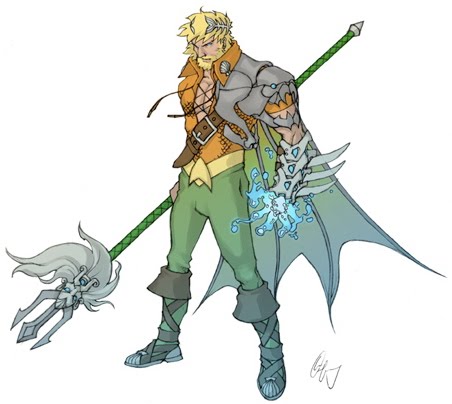
That's probably my favorite of this round of designs at the top of the post, Lee Chen Fang's. It's not necessarily a design I could see the official DC comics Aquaman actually wearing in an Aquaman or Justice League comic book; that is, I can't imagine that look ever one being adopted by the "real" Aquaman, but it sure is a cool design (I like every little detail, from the pagan/Shakespearean crown to the sea shell-tipped boots, even the water hand, which isn't something I really like in general). And the artwork sure is fantastic.

My favorite little bit is the trident though. Lee Chen Fang's is one of several of the redesigns that included some sort of cool, transforming trident:Chen Fang's transforms from a spear to a trident, and the face on it grows angrier when it turns into a trident. Cool.

James Mosingo has a trident that telescopes from a hand held, sai-like weapon into a full trident: And Matt Grigsby designed a trident which also has a telescoping staff, for easy storage in a holster: Those are all pretty neat, and the "real" Aquaman could easily appropriate any of these for use in his adventures.


************************

Finally, here are some super-cool Aquaman hair styles......from Fernando Rofe-Bouso, Giovanni Costa and Teemu Matinlauri, respectively.

Friday, March 11, 2011

In which I talk about Aquaman, Plastic Man, why I like them and a bunch of great artists who drew them recently.

I assume most of you already visit Project: Rooftop, the superhero design and redesign site, on a fairly regular basis. If you’re an editor at DC and Marvel, I hope you do, and are always taking notes on creator contact info, because the quality of art and, especially, the quality of costume design there often surpasses what shows up in the super-comics I see.

So chances are, you’ve already seen the results of their “Aquaman: Sea Change” redesign contest, which were posted on February 28. I’ve been meaning to point them out and blab about them for a while—on account of Aquaman being one of my favorite superheroes and on account of my interest in character design—but was waiting until a day when I had a few hours to kills reading through all the comments and pontificating.

Seeing The Beat’s link to these swell Plastic Man images a week or so later reminded me that the “Sea Change” thing was something I had been meaning to blog about. Waking up today and opening my curtain to see my neighborhood completely covered in snow, with a strong wind blowing the snow sideways, so that every inch of every available surface, including the sides of houses, was covered in snow, convinced me that sitting in front of a warm lap top with a cup of coffee writing about Aquaman and Plastic Man might be a more pleasurable way to spend a few hours than digging up my car and driveway.

So, let’s talk Aquaman and Plastic Man.


*********************

Plastic Man is pretty much a perfect corporate superhero character.

He boasts a unique, powerful visual identity; he has fantastic powers ideally suited to demonstration within comics medium and if they’re not quite unique (stretchy guys and shape-changers abound), he used them uniquely; he is closely tied to the work of his creator (no one’s ever done him better, and no one’s managed to radically change him for long), and yet he’s survived as a sort of not-quite-living legacy of that creator, a constant visual reminder in the background of some big DC crossover comic that “Jack Cole was here”; he’s incredibly versatile, and can fit into just about any genre of story or emerging medium well.

As an added benefit, despite being as old and, in some ways, as iconic as the other Golden Age superheroes still popping up in super-comics—Superman, Batman, Wonder Woman, Captain America, Captain Marvel, Namor, The Human Torch—he’s not as popular. Plastic Man and Police Comics are long cancelled, not shipping comics with their issue numbers in the high hundreds like Superman and Action Comics.

That makes Plastic Man a bit more pure of a character than some of the others (he hasn’t been messed with as much as them, if that makes sense), and it also makes it cooler to like him. Superman and Batman are New York Times bestseller; Plastic Man is an obscure poet the cool girl in class recommends to you. Wonder Woman and Captain America are radio pop songs; Plastic Man is punk rock.

I never need an New Yorker Art Spiegelman essay or a Chip Kidd-designed book to tell me how cool Plastic Man was, although I’m sure that helped solidify my affection.

As one of the Golden Age heroes popular at the dawn of comics and less so as time went by, Plastic Man existed in my imagination for a while as a teenager as interested in comics and their history as I was who Batman was fighting this month; I took my grandfathers’ generation’s word for it that he was awesome.

I associated him pretty strongly with Jack Cole, whose biography—while ultimately tragic—was in many ways also inspirational, and certainly one of the more compelling of the early comic book creators, who were in many ways just as colorful and exciting as the super-characters they created.

When I finally read a Plastic Man story that wasn’t from a library-borrowed DC Archive collection or by Jack Cole, it was in Grant Morrison’s JLA, which remains my favorite superhero comic book (Not necessarily the one I think is best, mind you, but my favorite).

So, for me, Plastic Man had the benefit of existing as one of those mostly unknown and unknowable Golden Age characters who existed primarily in my imagination (when he didn’t exist in a Cole story from half-a-century ago) to a Grant Morrison character in the middle of a massive, important-feeling, years-long superhero epic.

The way I perceived him, then, was a character who was the best of both worlds.

I should note that I didn’t always like Morrison’s portrayal of the character—I didn’t even understand a lot of the jokes Morrison put in Plas’ mouth, but the way he used him and his powers was pretty amazing (Particularly the take down of the Justice Legion’s Flash, where Plastic Man turned into a room). Many of the writers to use him after Morrison dusted him off were even worse, exaggerating his clownish qualities and using his powers mostly for un-funny puns.

That’s okay. Plastic Man is resilient enough to survive dozens of mediocre talents and years of bad stories (although, with the exception of Kyle Baker’s too short-lived monthly, its worth noting that the post-JLA Plastic Man rarely had his own stories, but simply scenes in other characters’ stories). That’s how strong Cole made him.

********************

As for Aquaman, my affection for him is probably a bit more shallow, although its gotten deeper over the years due to reasons that have little to do with the comics themselves.

I knew Aquaman long before I knew of Plastic Man, as some of my earliest television memories involve Super Friends episodes. I never really developed an antipathy towards Aquaman from those shows, but really did seem like a bit of a hanger-on, as he was usually around but rarely doing anything.

Looking back, I blame this on his inability to fly and the fact that he didn’t own his own jet like Wonder Woman and Batman. Unless the Super Friends were having an adventure near a body of water, Aquaman was the only Super Friend who never traveled under his own power, but had to be carted around in the backseat of Wonder Woman’s jet or whatever.

In 1996 I was enjoying DC’s Final Night crossover event enough that I checked out a few titles I wasn’t familiar with just to get more of the crossover (The premise was strong; the sun was going out, and no one knew exactly how to reignite it, so the story was as much about the heroes saying goodbye and dealing with not saving the day as it was about anything else—at least until the end, anyway. I bought Aquaman #26 by Peter David and J. Calafiore, and although I had no idea what the hell was going on, I was curious enough to try back issues and future issues.

David and DC made it easy to sample Aquaman at the time, as there were quite a few done-in-one stories featuring guest-stars one might be more familiar with: Superboy, Lobo, Green Lantern Kyle Rayner, Wonder Woman’s pre-JLA Justice league, Swamp Thing, even the Vertigo version of Animal Man…

Anyway, I ended up reading the series backwards and forwards from there, from the back-issue bins and the new comics racks, and really dug it. This, by the way, was the long-haired, bearded, harpoon-handed Aquaman.

It was my first prolonged exposure to David’s writing, and while some of his tendencies have long since started to grate, I really liked that series, and it definitely made me think Aquaman was cool and important and, dare I say it, bad ass.

Of course, much of that was simply because David was telling me that through the mouths of other characters, but there was certainly plenty of adequate demonstration of those facts too.

David’s Aquaman, and thus Aquaman at that time, was grumpy, moody and too-old-for-this-shit. He also had a sense of humor, could be kind of a douche but not as douchey as Namor, and seemed more human than other superheroes. Like, I’m pretty sure he was the only member of the Justice League that admitted to himself that he wanted to fuck Wonder Woman, for example.

David’s run was also pretty fluid in terms of genre—it was fantasy, it was sci-fi, it was superhero, it was pulp, it was myth. It depended on the story or the scene, but Aquaman’s background and purview was such that all of that fit in there pretty well.

DC eventually fucked up the book beyond repair, handing the title over to Erik Larsen and then Dan Jurgens before it was canceled. They’ve been wrestling with figuring out what to do with Aquaman ever since David left the book in 1998, actually, although I suspect that once Brightest Day ends, he’ll be back more or less in the same form he was during the Bronze Age, only with more souped-up powers and a more bad-ass attitude grafted on.

In other words, he’ll probably be like the Aquaman in Alex Ross’s various Justice League comics—he’ll look like the Silver Age Aquaman, but he’ll have the power level and attitude of the Peter David/Grant Morrison conception of the character.

Oh yeah, Grant Morrison. That’s another reason I like Aquaman. He was, of course, one of the main characters in Morrison’s JLA run too, and Morrison followed through with David’s vision of the character—a veteran, battle-heartened superhero who kind of hated the life and pretended to hate his co-workers, but actually kind of loved it.

As with every member of Morrison’s League, Aquaman seemed important and powerful simply because he was in that League, but Morrison repeatedly gave him unique opportunities to shine. Perhaps Morrison’s greatest strength as a Justice League writer was continually writing plots in which all of the characters had roles to play—roles only they could play—but without making any aspect of those plot seemed forced or transparent.

That is, in retrospect, it seemed like that was what Morrison was doing, but if it was, it wasn’t something immediately obvious (and thus distracting) when reading the stories the first few times.

I suppose there’s also an element of the underdog in my early affection for the character as well. Like with Plastic Man, since Aquaman was relatively unpopular to his peers, it made liking him seem more appealing.

He’s also an underdog within the stories he appears in, too; at least, the Justice League stories. Of the Big Seven, the only character physically weaker and more limited is Batman, so there’s something sort of exciting when you see Aquaman fighting the evil Green Lantern from a parallel universe or killer angels or superheroes from the 853rd Century. It’s easier to get caught up in the drama of Aquaman in danger, and easier to root for him in a fight.

Anyway, the character’s been a bit of a mess for a good ten years or so now in the comics themselves, with each new, post-David writer trying a radically different approach, often back to back. His supporting cast, setting, goals in life and even the number and nature of his hands would change from writer to write.

For a while the obvious fix seemed to be to let him lie fallow for a bit and then hand him to Geoff Johns to rehab as he did Green Lantern and Flash and, to a lesser extent, Hawkman. Instead of a Aquaman: Rebirth, however, we got Brightest Day, which seems to also be functioning as a Martian Manhunter: Rebirth and Firestorm: Rebirth type of story.

I started to like Aquaman more and more over the years though because the more I read of other stuff, the more potential the character seemed to have. Like, reading H.P. Lovecraft, or anything about Atlantis or the Hollow Earth, or sea life, or the ocean, or certain myths and fairy tales, once I started thinking about Aquaman on a monthly basis, I was constantly seeing things in my prose reading that seemed to apply to the character, so that if I’d read about a newly discovered prehistoric sea-going reptile of monstrous size, I’d think, “I wonder what would happen if it fought Aquaman?” and so on.

Anyway, Aquaman—Maybe DC’s most versatile, potential-filled, A-List superhero who also happens to be a bit of a grumpy jerk sometimes. I love that guy.

********************

As I said, Aquaman has been a bit of a mess for a good 12 years or so now. This is what he looked like circa 1998: Later he would add a tiara with a seashell on it, and replace his gold harpoon hand with either a gold robot hand or a morphing gold liquid metal robot hand.

Then he got a haircut, shaved his beard and left some stubble, took off his shirt, got a new pair of pants, started wearing a shark tooth necklace and had a magic water hand.Then they let him have his shirt back, and he was allowed to wear his old pants again. I like this look the best, particularly when accessorized with his green gloves, since when he had a glove over his left hand, you didn’t really have to think about whether it was magic water or flesh or liquid metal or gold robot or what—out of sight, out of mind.

Also, with a trident. He looks cool with a trident.

Then they made him look like this.

Not in the middle there; on the left, in a cloak and covered in tentacles. That’s Aquaman; the guy in the middle is Joseph Curry, Aquaman II. I read that whole series, and now I don’t remember exactly what the deal was. I think Curry was a clone with part of Aquaman’s soul in it or something…? It was complicated, went on too long, and was resolved too quickly. I don’t even remember what happened to the little Aquaman. I assume he’s dead, but I don’t remember.His look was pretty cool though: Then Aquaman sort of died or something, and then he was a zombie Black Lantern, and then he came back to life wearing a mock turtleneck I hate: Oh, then they cut off his hand and killed him again, but I think he’ll come back to life in like a week or three, since the whole cast of Brightest Day seems to be getting killed off abruptly.

Trade in the mock turtleneck for the shirt he was wearing right before he turned into a tentacley guy in Sword of Atlantis, and he’d look perfect, if you ask me.

But let’s not ask me. Let’s instead see how the various talented folks who contributed to “Sea Change” solve the problem of Aquaman’s chaotic costume design.

There are 20 redesigns up at Project: Rooftop, and it was interesting to look for common themes among them, as I think it gives a decent picture of how people view the character.

For example, in the comic books, Aquaman wore a beard between 1994 and 2003, just under a decade of his 70 years of existence. In other media, television Aquaman was clean-shaven through all the incarnations of Super Friends and Superman: The Animated Series (And on Smallville), but he wore a beard in 2001’s Justice League, Batman: The Brave and The Bold and this year’s Young Justice, so, again, about a decade, or one-seventh of his career.

Of the 20 Aquamen, seven of them have facial hair of some sort (I really like that on Yasmin Liang’s Aquaman; it looks more royal and 19th or 20th century, although less puffy, more close-cropped beards seem to be the favored direction for Bearded Aquaman).Aquaman lost his hand the same year he grew his beard, and had a prosthetic harpoon and/or golden hand until 2003, at which point he got a magic water hand, which lasted up until at least “One Year Later” in 2006, when he mutated into The Dweller-of-the-Depths in Aquaman: Sword of Atlantis. In the cartoons, the only Aquaman to not have two hands was the one in Justice League; he wore a harpoon-like prosthetic.

The alternate hands don’t seem to have stuck with the artists the way the facial hair did, though. They all have both hands, save for Otoniel Oliveira’s bad-ass design, which has the harpoon, and Zoe Maxine’s, which has the water hand. Eleven of the Aquaman are carrying traditional tridents of some kind, while one carries a harpoon, another has a little trident on a wrist-mounted cannon and another wears a sword on his hip. The designers seem to have formed a consensus on whether Aquaman should accessorize, and how.

I don’t always like the designs of the tridents he’s shown carrying, which vary from artist to artist in the comics, but, in general, I think he looks cooler with one. It gives him something to do with his hands, it gives him a way to look threatening or royal or in charge (raising it, pointing it, banding it on the ground) and it gives him a sort of visual icon or motif beyond the colors of his costume. Aquaman has a symbol like the other Justice Leaguer’s, but it’s small and on his belt, and thus not as arresting as a Bat-symbol or S-Shield. (David wrote some stories about a particular trident, which belonged to Poseidon or Neptune and had special powers and inflicted a toll on the person who carried it, but I think Abnett and Lanning were the only ones who ever touched on that idea, and that Aquaman’s been toting generic tridents since).

It may also be worth noting that a majority of the artists seemed to think of various types of wetsuits when designing their Aquamen—I would guess about 13 or 14 of the designs depend heavily on realworld wet-suits to some degree—none more obviously than Jordan Gibson’s and Daniel Heard’s.

It’s easy to guess why a costume designer’s mind might drift that way, but if Aquaman wore a wetsuit derived costume, he would do so more because he wanted to than he needed too. The Aquaman of the comics is evolved to be able to stand the cold temperatures of the depth, and thus doesn’t need insulation, and he swims like a porpoise, undulating his body subtly and sort of rocketing through the water, so he doesn’t really need a sleek costume or flippers and suchlike (although some of his official costumes have included fins on the legs and fin-like gloves).

***********************

I really like the drawing of Daniel Mikah Govar’s winning entry; it’s very dramatic and slightly romantic. (Good trident, too!) I love the costume form the waist up, and wouldn’t mind seeing Comic Book Aquaman wearing that shirt in place of his old one. It lacks the green gloves, which I’d probably keep at least until his hand issues are made up.

I don’t care for Govar’s pants though, particular the webbed frog feet. As stated above, Aquaman doesn’t need ‘em, and I think they give him a frog or duck-like look that seems somewhat inappropriate. Just as Superman doesn’t need wings to fly, Aquaman shouldn’t need webbed toes or fins to swim.

My overall favorites are probably the aforementioned Liang’s, which is very realistic, pretty fashionable, and retains just enough of Aquaman’s visual signatures while to still say “Aquaman,” despite it being completely stripped down and different (Wonder Woman-like bracelets, black instead of green), and Zoe Maxine’s, which similarly strips down the traditional look while keeping the signatures. I like her addition of a Sword of Atlantis-like should-pad and royal-looking sash, too. Either of these, and a few others—Mike Maihack’s, Sean Izaakse’s, Chad Maupin’s, maybe Govar’s—look like ones we could actually see turn up in the regular, in-continuity comics as new Aquaman costumes. A few others look like great costumes for younger or older, maybe out-of-continuity Aquaman costumes.


The most unusual designs are those from Chris King and Nate Bellegarde. Both are so unusual, that it’s hard to imagine either ever actually showing up in the comics, but that doesn’t mean they’re not cool in their own right. King’s does show that Aquaman would probably look good in a light blue chain mail top over navy pants instead of the traditional orange and green, and I like the sword a lot too. The A-symbol is cool, but looks too much like Amazing Man’s to me, even if it's more suggestive of it than close to it. Nate Bellegarde’s is all-around incredible, and I think it’s somewhat fortunate that it’s so far divorced from the traditional Aquaman—that means Bellegarde should be able to use it somewhere else some day. I’d certainly want to read a comic book with that guy swimming around in it.

Finally, I just wanted to call attention to this one by Meghan Murphy—I love it. The costume is aces, although it’s hard to imagine Aquaman wearing that to fight Starro or whatever in, but I can see him wearing it to meetings are around the Aquacave.

What I really like about it though is the hairstyle and the look on his face. Along with Erica Henderson’s and Zoe Maxine’s, I like the way the facial expression suggest so much of the character. They don’t really suggest the Aquaman I know and love, but they suggest someone pretty cool nonetheless.

Plastic Man wasn’t up for a P:R redesign, although I’d actually kind of love to see that. Other than having long pants, I have a hard time recalling anyone ever messing with Plas’ costume design much at all—even when he appeared in Elseworlds type stories like Frank Miller’s Dark Knight Strikes Again and All-Star Batman and Robin, The Bow Wonder or Mark Waid and Alex Ross’s Kingdom Come or Waid and Frank Quitely’s The Kingdom: Offstpring, he was wearing his original duds.

No, he was simply chosen as the subject for the artists who contribute to comictwart.com, which, according to comictwart.com, features “A different character every week drawn by a bunch of twarts!”

So go look at Plastic Men by Dave Johnson, Ron Salas, Mitch Breitweiser, Francesco Francavilla, Chris Samnee, Mike Hawthorne, Patrick Stiles and Mitch Gerads.

Here’s Johnson’s:If you read JLA, then you probably remember the fill-in by Mark Waid which included a scene where Plas pulled a similar trick on Big Barda. Johnson’s piece really blew my mind, because as much as I’ve thought about Plastic Man over the years, I have never, ever, ever thought about what happens to his weight when he changes shape.

I don’t think I’m equipped with the scientific knowledge to understand how weight would work when applied to a person who had complete control of their body at a molecular level, but unlike the Martian Manhunter, Plas doesn’t control his own mass, so, um, huh, maybe Plas’ weight is constant…?

Huh.

Oh, and while there are eight different drawings of Plas, it’s worth noting that two of them have Plas clinging to curvy women, and a third has him using his powers to engage in an act of voyeurism.

********************

Related: As I was writing this, Chris Mautner wrote a short installment of “Collect This Now” on Robot 6 devoted to Jack Cole’s Plastic Man comics.