A CYNICAL BILLY BATSON RELUCTANTLY SAYS "SHAZAM" AT THE WIZARD'S INSISTENCE:
BLACK ADAM RETURNS TO THE PRESENT, MEETS SIVANA AND HOLDS HIM ALOFT BY HIS COLLAR:
BLACK ADAM FLIES SIVANA TO THE TOP OF A HIGH STRUCTURE SO THEY CAN DISCUSS THEIR ALLIANCE:
In 1987, DC Comics had writer Roy Thomas reintroduce C.C. Beck and Bill Parker's Golden Age superhero Captain Marvel to their DC Universe shared setting. This followed the 1986-1987 Crisis On Infinite Earths limited series, in which that shared setting was refreshed and recreated, with older characters being reinvented for more modern times. Thomas and co-writer Dann Thomas wrote the four-issue Shazam: The New Beginning, which was penciled and inked by Tom Mandrake and colored by Joe Orlando. In 2017 it was collected along with another Thomas-written story from the era and re-released in a hardcover format as Shazam: The New Beginning 30th Anniversary Deluxe Edition.
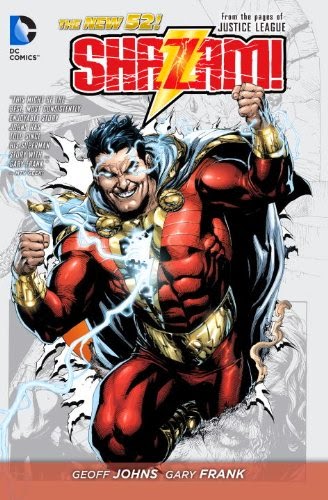
In 2012, DC Comics had writer Geoff Johns reintroduce Captain Marvel, now re-named "Shazam," to their DC Universe shared setting. This followed the 2011 Flashpoint miniseries, in which that shared setting was rebooted and recreated, with classic characters being reinvented for more modern times and introduced to readers as if for the very first time. Johns wrote a "Shazam" strip as a back-up in his Justice League ongoing series. It was penciled and inked by Gary Frank and colored by Brad Anderson. It was later collected into a trade paperback under the title Shazam Vol. 1 and, later, republished as Shazam: Origins. It was the basis of the 2019 film.
Interestingly, in rather broad strokes, the two miniseries, which had identical mandates, resembled one another in terms of their plots. In both, scientist Dr. Sivana frees the Wizard Shazam's first champion, Black Adam, from his centuries-old imprisonment and the two villains become allies. Meanwhile, orphan Billy Batson is given a magical word by the wizard in order to transform himself into a superhero. Both stories even end with the teasing introduction of another of Captain Marvel's most colorful villains, Mr. Mind.
Despite the similarities of the broad shape of the two Captain Marvel reintroductions, they differ quite a bit in the details (Thomas' story posited Sivana as Billy's uncle, and included versions of the pre-existent characters Uncle Dudley, Magnificus and Beautia and even Hoppy, The Marvel Bunny; Johns', meanwhile, included versions of Mary Marvel, Captain Marvel Jr., Mr. Tawky Tawny and Ibac...plus three new "lieutenant" Marvels).
Still, I was struck by the degree to which certain scenes in the Johns/Frank comic so strongly echoed scenes from the Thomas/Mandrake take. Obviously, Johns and Frank drew inspiration from their predecessors, even as their Captain Marvel/Shazam story was quite different in tone, emphasis and in so many of the particulars.
Showing posts with label sivana. Show all posts
Sunday, January 05, 2020
Tuesday, January 06, 2015
Review: Shazam! Vol. 1
There's a very telling scene about midway through Shazam!, Geoff Johns and Gary Frank's retelling of the story of C.C. Beck and Bill Parker's first-wave superhero for the mass media adaptation hungry 21st century comic book market, when the young protagonist Billy Batson comes face to face with the wizard who gives him the magic word that enables him to transform into the caped strongman Captain Marvel.
In the original, Golden Age story, Billy Batson is a homeless orphan boy lead by a mysterious stranger to a subway tunnel where he catches an equally mysterious magical train to the sanctum of the ancient wizard Shazam, who awards the boy with the powers of six heroic patrons and makes him his champion.
Johns' version is infinitely more cynical. When Batson, a sarcastic 15-year-old foster child appears before the now nameless wizard (who he at first thinks may be a child molester [?!]), it's as part of a sort of magical abduction experience the wizard has been repeating for decades, in a fruitless attempt to find a human being who is pure good, and thus worthy of the fantastic powers of Shazam.
Batson tells the wizard off, steamrolling the wizard's insistence that there is such a thing as a pure good person:
"I have no other choice, do I?" the wizard says to himself, "There's no more time." And he therefore reluctantly settles for Billy Batson, seeing that the boy at least has the potential to be good, which is better than nothing.
Is the scene told a bit more naturally, and with some greater dramatic sophistication then the storybook-simple Golden Age version? Sure. Is it more realistic? Of course. But it also introduces moral relevance into a milieu where it rests very uncomfortably. Because Captain Marvel was so incredibly popular in the 1940s Golden Age before disappearing for most of the Silver and Bronze Age of comics, the character and his stories saturated the medium for a while, but they never went through the growing-up period that all the similarly prevalent characters and comics did, and, as a result of that, and of various creators glomming on to the idea of the character's secret identity being that of a child rather than a man or woman (and, I'd argue, the basic fairytale-like elements of the story), the franchise has never really been able to successfully shake its aura of childishness and old-fashioned-ness.
That is not a negative, although it is generally treated by DC Comics as if it were, which is why the company so very rarely tells Captain Marvel stories, but is always trying to reinvent the character.
Johns, an apparent fan who has written the character extensively in the past (although not as much as he's written his evil opposite, Black Adam), and artist Gary Frank go full-throttle in their attempts to update Captain Marvel, make him more distinct from DC's other caped strongman superhero and make the character's story more "realistic," and that, naturally enough, leads to a lot of rather cynical, extremely calculated and often quite uncomfortable creative choices.
But, it's well worth noting, this is not as bad as one might expect a Geoff Johns-written, New 52-line reinvention of Captain Marvel to be. As much as Johns and his higher-ups at DC have changed the character—including renaming him "Shazam" instead of "Captain Marvel" (tweaking the rules of his transformations in the process), giving him a new, heavily-redesigned costume and assigning him the DC Universe magic "beat" to patrol—this isn't as godawful as, say, Countdown's dark versions of Mr. Mxyzptlk or, more relevantly, Mary Marvel, or all the gory, horror and war movie motifs and aesthetics that Johns brough to the Green Lantern franchise (Which, to be fair, did transform the once-struggling Green Lantern book into a whole line of incredibly successful monthly comic books; I might not always like Johns' creative choices, but I suppose there's no arguing with financial success in the mainstream comics industry).
In other words then, while Shazam's many reconfigurations of pre-existing elements may be off-putting—I was struck, for example, by how much a certain section of the book reminded me of Superior, Mark Millar and Leinil Yu's Marvel-published, creator-owned story about a 12-year-old boy who becomes Supermanior—it could have been much, much worse.
Despite the the high-profile creative team, and DC's burning need to keep somewhere close to 52 monthlies in print all the time, the publisher adopted a strange strategy for releasing Shazam: Rather than as a miniseries or ongoing monthly, or as an Earth-One graphic novel, where its thorough reinvention and film/TV pitch-nature would seem more at home, it appeared as a back-up strip in the Johns-written Justice League comic book, occasionally taking over the pages of Justice League altogether.
It was front-loaded with some of the more off-putting elements, so that I was scared away from the story by some of the images in the very first, short installment.
There was the new costume, with its hood, glowing chest-emblem and constant aura of lightning...
There was the new Dr. Sivana, a big, brawny tough guy rather than the wizened little old man, no bigger than the child Billy...
(A few installments in, Sivana gets a lightning bolt-shaped scar over one eye, allowing him to "see magic.")
And there was Billy himself, a smart-ass who calls a nice young couple who want to adopt him a "a couple of idiots" as soon as they're out of earshot...
That was more than enough to have me recoil from Justice League in dread, and I never checked back in with Johns and Frank's Shazam serial until it was collected, and could be read in the whole form it was created to be experienced as (That is, it reads like an original graphic novel, not a collection of a serially published back-up strip).
There would be more similar attempts to make the Marvel Family and villains more realistic and/or bad-ass as the series progresses, like the new look of the former Seven Deadly Enemies of Man, now called The Seven Deadly Sins...
And Mr. Tawky Tawny, who is no longer a talking tiger who comes to America to join polite society, but is a zoo tiger Billy feels a certain amount of affection for and, at one point, gifts with Shazam powers.
Here is the story of Johns and Frank's Shazam, which really does read like a comic book version of a PG-13 superhero movie based on the Captain Marvel character (and reads better when regarded as such, I think; compared to the characters as they appear in the recent The Multiversity: Thunderworld Adventures, everything here seems wrong-headed, but as a self-contained Captain Marvel/Shazam story, it works just fine).
Scientist Dr. Sivana is researching magical abductions in an attempt to track down the fabled Rock of Eternity, in order to discover and harness real magic, which he believes can help save his family where science has failed (As to what's going on with his family, that's not detailed, and would presumably be a plot point if and when Johns and Frank continue their storyline).
Meanwhile in Philadelphia, unpleasant young man Billy Batson has conned a trusting couple into taking him in as a foster child, which would make him their sixth.
They already foster white kids Mary and Freddy (who are of course the secret identities of Mary Marvel and Captain Marvel Jr. in the pre-New 52, original stories; this version of Freddy has long, blonde hair for some reason). There are three "new" characters, too: Smart Asian stereotype Eugene, chubby, dumb Hispanic kid Pedro, and an effervescent young black girl named Darla. I say "new," because the three of them were all introduced during Johns' Flashpoint story, in which the six kids each possessed one of the attributes of Shazam, and could combine to form the composite hero Captain Thunder (ala Captain Planet).
Billy doesn't get along too well with his new family, and they don't care for his shitty attitude either, but they start to warm to him a little bit at school the next day, when he defends them from bullies...sons of a rich, powerful grown-up bully who seems straight from central casting, who he's not afraid of:
Sivana and Billy's storylines begin to intersect when Sivana's research leads him to the Iraqi tomb of Black Adam, who he releases. The wizard summons Billy to the Rock of Eternity, and they have their little fight about whether there's such a thing as a really good person or not, with the wizard giving Billy the word and the powers.
At first, Billy and Freddy use their powers for fun and games (this is the bit that reminded me of Superior, a stretch of which involves the newly-empowered 12-year-old protagonist in an adult's body abusing his powers with his best friend), but things eventually get real when Black Adam, Sivana and the Seven Deadly Sins come to town, tearing the place apart while searching for Billy. Billy holds the rest of the wizard's power, you see, and Black Adam wants all of the Shazam powers for himself.
Will Billy do the right thing and fight Black Adam and his evil entourage, or will he stand down and let the villains destroy everything?
Well, it is a superhero comic, so naturally the day will be saved via violence.
Near the climax, Johns and Frank have Billy sharing his powers with his five siblings.
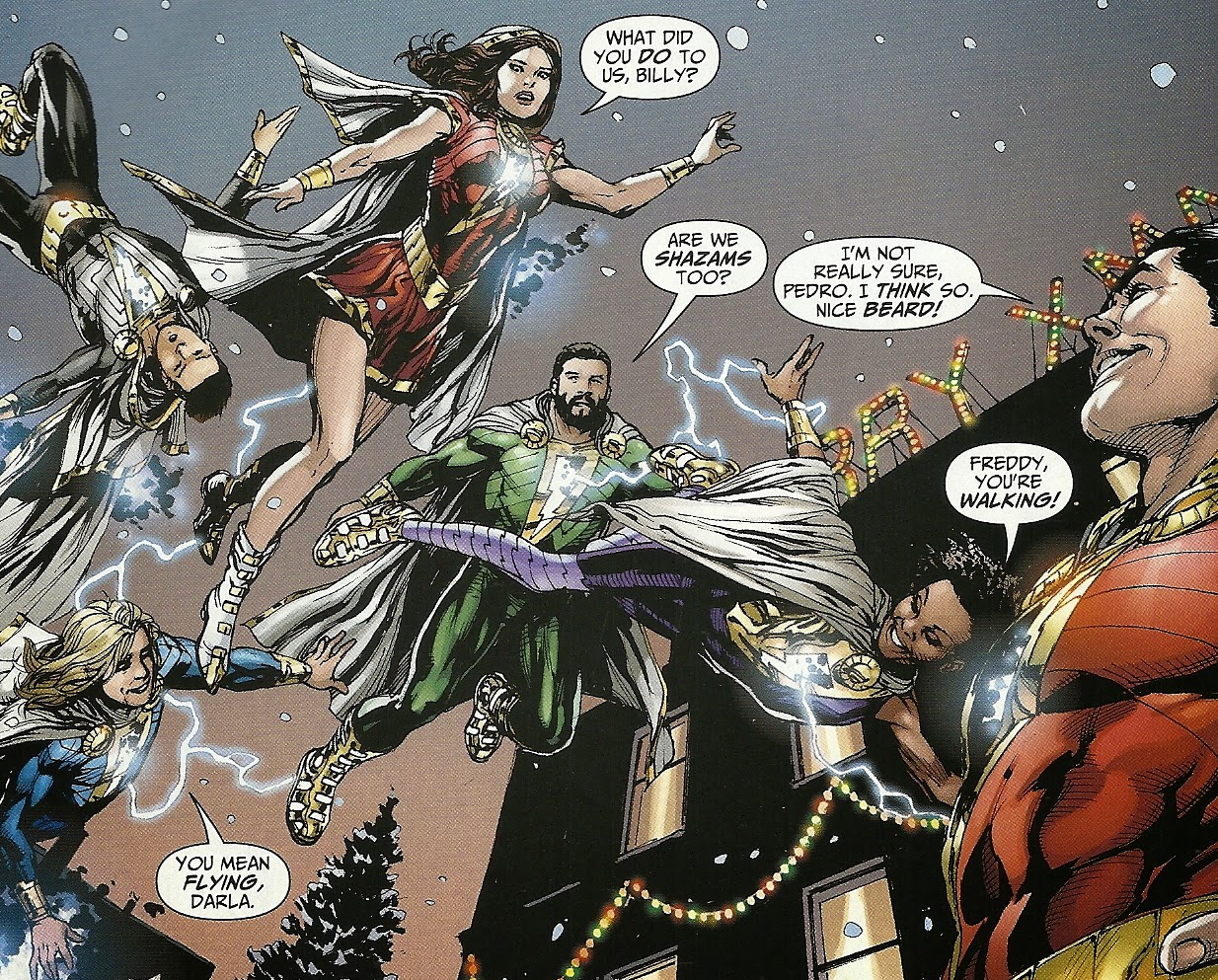
Mary Marvel and Captain Marvel Jr. both appear, although they don't have codenames and obviously won't use those ones if they ever get them (although Freddy does call himself "King Shazam" in one panel), both wearing costumes that look a bit like New 52 versions of their original ones. Pedro gets a beard and green costume, apparently turning into Marvel's Hercules. Darla gets a purple costume and Euguene gets a black one. Who has what powers isn't entirely clear, but Darla has super-speed and Eugene can now talk to machines (?). Additionally, everyone seems to age a little by the transformations, but to various degrees. Billy and Pedro are completely unrecognizable, for example, while Darla looks like she only gains a year or four. Mary and Freddy, who used to retain their child-like forms when they gained their powers, now also age, but their transformations don't render them as unrecognizable as Billy and Pedro's transformations do (As weird as the color schemes and some of these choices may be, I suppose this is a much more palatable take on the Lieutenant Marvel concept than Tall Marvel, Fat Marvel and Hill Marvel would have been).
After the climactic battle, things settle into a status quo that, were this the film it reads like, would be laying groundwork for the sequel.
Black Adam is killed off (not sure how he appeared in Forever Evil, exactly), The Seven Deadly Sins flee to appear in Trinity War and Trinity of Sin: Pandora, the kids and various townspeople all laugh at that one asshole's penis...
...Sivana has been shrunken and shriveled by his exposure to magic, leaving him in a more familiar form, and Billy decides he kinda likes his new family after all.
Oh, and on the last two panels, Sivana meets Captain Marvel's other greatest archenemy, a talking caterpillar who introduces himself as Mr. Mind.
For all its faults in terms of conception, it's difficult to argue with its execution; even Frank's designs and artwork stand out as head-and-shoulders above the bulk of The New 52 line (especially during those first two years or so, when this was published, prior to some of the more interesting hires of late). Whatever one might think of the book's goals, it meets and fulfills them successfully, and works perfectly well on its own terms.
As a longtime reader and fan of Captain Marvel, this all feels wrong to me, an attempt to fix something that isn't broken, and it all feels extremely awkward when considered as part of the larger DC Universe as it currently stands, but, if you can divorce the book itself from its publishing history and from the shared universe in which it is apparently set, it's an accomplished, even interesting take on Captain Marvel.
That is, it's a pretty good Elseworlds story, and would have been a great addition to DC's Earth One line of graphic novels.
Shazam gives it two thumbs-up, but then, he would.
In the original, Golden Age story, Billy Batson is a homeless orphan boy lead by a mysterious stranger to a subway tunnel where he catches an equally mysterious magical train to the sanctum of the ancient wizard Shazam, who awards the boy with the powers of six heroic patrons and makes him his champion.
Johns' version is infinitely more cynical. When Batson, a sarcastic 15-year-old foster child appears before the now nameless wizard (who he at first thinks may be a child molester [?!]), it's as part of a sort of magical abduction experience the wizard has been repeating for decades, in a fruitless attempt to find a human being who is pure good, and thus worthy of the fantastic powers of Shazam.
Batson tells the wizard off, steamrolling the wizard's insistence that there is such a thing as a pure good person:
I'm only fifteen and I already know there's no such thing as a pure good person...People are horrible. They disappoint you. They let you down. I've spent my life learning that...Good people get swallowed up. They get taken advantage of. They disappear...You're searching for something that doesn't really exist.It's a very cynical take on the characters, and yet it's the very heart of what proves to be an important, even pivotal scene. Not only does Billy insist that there's no such thing as a purely good person, and that good can't survive in the long in the real world, but he actually convinces the wizard with this argument, and, out of desperation—a very powerful threat is coming, and only a magically empowered champion stands a chance of saving the world—the wizard grants Billy the powers of Shazam.
"I have no other choice, do I?" the wizard says to himself, "There's no more time." And he therefore reluctantly settles for Billy Batson, seeing that the boy at least has the potential to be good, which is better than nothing.
Is the scene told a bit more naturally, and with some greater dramatic sophistication then the storybook-simple Golden Age version? Sure. Is it more realistic? Of course. But it also introduces moral relevance into a milieu where it rests very uncomfortably. Because Captain Marvel was so incredibly popular in the 1940s Golden Age before disappearing for most of the Silver and Bronze Age of comics, the character and his stories saturated the medium for a while, but they never went through the growing-up period that all the similarly prevalent characters and comics did, and, as a result of that, and of various creators glomming on to the idea of the character's secret identity being that of a child rather than a man or woman (and, I'd argue, the basic fairytale-like elements of the story), the franchise has never really been able to successfully shake its aura of childishness and old-fashioned-ness.
That is not a negative, although it is generally treated by DC Comics as if it were, which is why the company so very rarely tells Captain Marvel stories, but is always trying to reinvent the character.
Johns, an apparent fan who has written the character extensively in the past (although not as much as he's written his evil opposite, Black Adam), and artist Gary Frank go full-throttle in their attempts to update Captain Marvel, make him more distinct from DC's other caped strongman superhero and make the character's story more "realistic," and that, naturally enough, leads to a lot of rather cynical, extremely calculated and often quite uncomfortable creative choices.
But, it's well worth noting, this is not as bad as one might expect a Geoff Johns-written, New 52-line reinvention of Captain Marvel to be. As much as Johns and his higher-ups at DC have changed the character—including renaming him "Shazam" instead of "Captain Marvel" (tweaking the rules of his transformations in the process), giving him a new, heavily-redesigned costume and assigning him the DC Universe magic "beat" to patrol—this isn't as godawful as, say, Countdown's dark versions of Mr. Mxyzptlk or, more relevantly, Mary Marvel, or all the gory, horror and war movie motifs and aesthetics that Johns brough to the Green Lantern franchise (Which, to be fair, did transform the once-struggling Green Lantern book into a whole line of incredibly successful monthly comic books; I might not always like Johns' creative choices, but I suppose there's no arguing with financial success in the mainstream comics industry).
In other words then, while Shazam's many reconfigurations of pre-existing elements may be off-putting—I was struck, for example, by how much a certain section of the book reminded me of Superior, Mark Millar and Leinil Yu's Marvel-published, creator-owned story about a 12-year-old boy who becomes Super
Despite the the high-profile creative team, and DC's burning need to keep somewhere close to 52 monthlies in print all the time, the publisher adopted a strange strategy for releasing Shazam: Rather than as a miniseries or ongoing monthly, or as an Earth-One graphic novel, where its thorough reinvention and film/TV pitch-nature would seem more at home, it appeared as a back-up strip in the Johns-written Justice League comic book, occasionally taking over the pages of Justice League altogether.
It was front-loaded with some of the more off-putting elements, so that I was scared away from the story by some of the images in the very first, short installment.
There was the new costume, with its hood, glowing chest-emblem and constant aura of lightning...
There was the new Dr. Sivana, a big, brawny tough guy rather than the wizened little old man, no bigger than the child Billy...
(A few installments in, Sivana gets a lightning bolt-shaped scar over one eye, allowing him to "see magic.")
And there was Billy himself, a smart-ass who calls a nice young couple who want to adopt him a "a couple of idiots" as soon as they're out of earshot...
That was more than enough to have me recoil from Justice League in dread, and I never checked back in with Johns and Frank's Shazam serial until it was collected, and could be read in the whole form it was created to be experienced as (That is, it reads like an original graphic novel, not a collection of a serially published back-up strip).
There would be more similar attempts to make the Marvel Family and villains more realistic and/or bad-ass as the series progresses, like the new look of the former Seven Deadly Enemies of Man, now called The Seven Deadly Sins...
And Mr. Tawky Tawny, who is no longer a talking tiger who comes to America to join polite society, but is a zoo tiger Billy feels a certain amount of affection for and, at one point, gifts with Shazam powers.
Here is the story of Johns and Frank's Shazam, which really does read like a comic book version of a PG-13 superhero movie based on the Captain Marvel character (and reads better when regarded as such, I think; compared to the characters as they appear in the recent The Multiversity: Thunderworld Adventures, everything here seems wrong-headed, but as a self-contained Captain Marvel/Shazam story, it works just fine).
Scientist Dr. Sivana is researching magical abductions in an attempt to track down the fabled Rock of Eternity, in order to discover and harness real magic, which he believes can help save his family where science has failed (As to what's going on with his family, that's not detailed, and would presumably be a plot point if and when Johns and Frank continue their storyline).
Meanwhile in Philadelphia, unpleasant young man Billy Batson has conned a trusting couple into taking him in as a foster child, which would make him their sixth.
They already foster white kids Mary and Freddy (who are of course the secret identities of Mary Marvel and Captain Marvel Jr. in the pre-New 52, original stories; this version of Freddy has long, blonde hair for some reason). There are three "new" characters, too: Smart Asian stereotype Eugene, chubby, dumb Hispanic kid Pedro, and an effervescent young black girl named Darla. I say "new," because the three of them were all introduced during Johns' Flashpoint story, in which the six kids each possessed one of the attributes of Shazam, and could combine to form the composite hero Captain Thunder (ala Captain Planet).
Billy doesn't get along too well with his new family, and they don't care for his shitty attitude either, but they start to warm to him a little bit at school the next day, when he defends them from bullies...sons of a rich, powerful grown-up bully who seems straight from central casting, who he's not afraid of:
Sivana and Billy's storylines begin to intersect when Sivana's research leads him to the Iraqi tomb of Black Adam, who he releases. The wizard summons Billy to the Rock of Eternity, and they have their little fight about whether there's such a thing as a really good person or not, with the wizard giving Billy the word and the powers.
At first, Billy and Freddy use their powers for fun and games (this is the bit that reminded me of Superior, a stretch of which involves the newly-empowered 12-year-old protagonist in an adult's body abusing his powers with his best friend), but things eventually get real when Black Adam, Sivana and the Seven Deadly Sins come to town, tearing the place apart while searching for Billy. Billy holds the rest of the wizard's power, you see, and Black Adam wants all of the Shazam powers for himself.
Will Billy do the right thing and fight Black Adam and his evil entourage, or will he stand down and let the villains destroy everything?
Well, it is a superhero comic, so naturally the day will be saved via violence.
Near the climax, Johns and Frank have Billy sharing his powers with his five siblings.
Mary Marvel and Captain Marvel Jr. both appear, although they don't have codenames and obviously won't use those ones if they ever get them (although Freddy does call himself "King Shazam" in one panel), both wearing costumes that look a bit like New 52 versions of their original ones. Pedro gets a beard and green costume, apparently turning into Marvel's Hercules. Darla gets a purple costume and Euguene gets a black one. Who has what powers isn't entirely clear, but Darla has super-speed and Eugene can now talk to machines (?). Additionally, everyone seems to age a little by the transformations, but to various degrees. Billy and Pedro are completely unrecognizable, for example, while Darla looks like she only gains a year or four. Mary and Freddy, who used to retain their child-like forms when they gained their powers, now also age, but their transformations don't render them as unrecognizable as Billy and Pedro's transformations do (As weird as the color schemes and some of these choices may be, I suppose this is a much more palatable take on the Lieutenant Marvel concept than Tall Marvel, Fat Marvel and Hill Marvel would have been).
After the climactic battle, things settle into a status quo that, were this the film it reads like, would be laying groundwork for the sequel.
Black Adam is killed off (not sure how he appeared in Forever Evil, exactly), The Seven Deadly Sins flee to appear in Trinity War and Trinity of Sin: Pandora, the kids and various townspeople all laugh at that one asshole's penis...
...Sivana has been shrunken and shriveled by his exposure to magic, leaving him in a more familiar form, and Billy decides he kinda likes his new family after all.
Oh, and on the last two panels, Sivana meets Captain Marvel's other greatest archenemy, a talking caterpillar who introduces himself as Mr. Mind.
For all its faults in terms of conception, it's difficult to argue with its execution; even Frank's designs and artwork stand out as head-and-shoulders above the bulk of The New 52 line (especially during those first two years or so, when this was published, prior to some of the more interesting hires of late). Whatever one might think of the book's goals, it meets and fulfills them successfully, and works perfectly well on its own terms.
As a longtime reader and fan of Captain Marvel, this all feels wrong to me, an attempt to fix something that isn't broken, and it all feels extremely awkward when considered as part of the larger DC Universe as it currently stands, but, if you can divorce the book itself from its publishing history and from the shared universe in which it is apparently set, it's an accomplished, even interesting take on Captain Marvel.
That is, it's a pretty good Elseworlds story, and would have been a great addition to DC's Earth One line of graphic novels.
Shazam gives it two thumbs-up, but then, he would.
Wednesday, April 14, 2010
There's only one reasonable explanation.
If you've read any of my past posts in which I excitedly blogged my way through certain episodes of the Batman: The Brave and the Bold cartoon, then you know I'm a pretty big fan of the series. In addition to being a really fun, really funny, really well voice-acted cartoon seemingly aimed at both little kids and the most obsessive adult DC Comics fans, the show consistently marries the particular design skills of many of the great artists to work for DC over the decades (particularly Dick Sprang and Jack Kirby) into a seamless, consistent whole while retaining the individual artists' personal aesthetics. It also seeks out the weirdest and most obscure DC-owned characters available as guest stars, demonstrating how contrary to popular fan opinion even the wackiest characters have modern resonance and potential kid-friendly commercial appeal. It presents a Batman we haven't really seen in any non-comics media since the seventies or so, a life-loving, wise-cracking Bob Haney-style Batman who is nevertheless the ultimate bad-ass, know-it-all detective and obsessed crime fighter we've come to know and love since the mid-eighties or so.
There was a point during the first episode I saw—in which Batman teamed up with Plastic Man to fight Gentleman Ghost, and then crash-landed on Dinosaur Island where Batman got turned into a gorilla, that I wondered if maybe they weren't just making the show just for me. How else to explain the disproportionately large roles given to Plastic Man and Aquaman, two of my favorite superheroes, who aren't exactly at the top of many fans' Favorite Superheroes lists?
That suspicion eventually passed, when I realized how many other folks out there love the show just as much—if not more—than I do.
I haven't been watching it too regularly, as I lack cable and I'm not much of a TV person—90210 and Dancing With The Stars excepted—and I just recently caught up with the second season.
Now I know they weren't making this show for me. Instead, I apparently found a magic lamp at some point during the past few years, and accidentally rubbed it, unbeknowest to me releasing a wish-granting genie. Since I released it unawares and thus didn't actually make a wish, the genie must have read my mind, and then went off to Hollywood, got a job in animation and helped developed Batman: The Brave and The Bold's second season in an effort to duplicate my un-asked for, unconscious desires.
How else to explain a run of episodes that included
Plastic Man's pal Woozy Winks,
Captain Marvel fighting a Dr. Sivana that looks like he leapt right out of a C.C. Beck comic (oh, and the Sivana kids and Black Adam, too),
Aquaman packing Mera and a sullen Arthur Jr. (wearing his dad's 1986 miniseries costume!) going on an RV vacation of the surface world,
The Teen Titans as little kids,
Batman flying the killer skies with Enemy Ace,
The Batman of Zur-En-Arrh (!!!),
Batman wearing Plastic Man as a giant boot...in order to kick a Bigfoot in the face...in the middle of a fight scene against an entire gang of Bigfoots,
Batman wearing the Metal Men as a Batman costume...
...allowing him to use their fantastic metallic powers to do battle with their foes,
and Doc Magnus undercover as a space pimp (wearing his Metal Man Gold as false gold teeth)And that's before we even get into in what is perhaps the greatest episode of anything on TV ever, "Death Race to Oblivion," in which someone—probably that genie I was talking about—had the great idea to splice DC super-comics with Wacky Races and Death Race 2000, resulting in an episode in which Mongul eschews the whole forced gladiatorial combat thing for an every person-for-themself road race between various superheroes and supervillans in their various super-vehicles.
So you've got Batman and Joker in the Batmobile and Jokermobile (respectively), Green Arrow in his Arrow Car, Gentleman Ghost in a souped-up hearse, Steppenwolf in a monstrous polluting tank thing, The Huntress on a purple motorcycle, Black Manta in a big War of the Worlds-looking manta crab walker thing, Green Lantern Guy Gardner in a ring-generated muscle car,
Woozy Winks driving Plastic Man in the form of a race car,
and Catwoman in her Catmobile, with cat-scratching action!Who wins? Who loses? And how do the heroes defeat Mongul? Well, it involves Batman transforming the Batmobile into a giant robot battle suit and, oh my God,
Batman in a Batmobile that is also a Transformer! Thank you mind-reading, wish-granting genie in the animation industry! Keep up the good work!
Labels:
animation,
batman,
captain marvel,
enemy ace,
metal men,
plastic man,
sivana,
woozy winks
Monday, June 16, 2008
Jules Feiffer's Superheroes Week: On Captain Marvel
“Villains ranged from mad scientist Dr. Sivana (the best in the business), who uncannily resembled Donald Duck, to Mr. Mind, a worm who talked and wore glasses, to Tawky Tawny, a tiger who talked and wore a business suit. A Disney land of happy violence. The Captain himself came out dumber than the average super-hero—or perhaps less was expected of him. A friendly fullback of a fellow with apple cheeks and dimples, he could be imagined being a buddy rather than a hero, an overgrown boy who chased villains as if they were squirrels.”
—Jules Feiffer, The Great Comic Book Heroes
Tuesday, November 06, 2007
Deep within a bleak and dismal swamp...
"Aheh-hem. Gentlemen, this organization was created to advocate on behalf of any and all bald men in any aspect of the comics industry—hero, villain, creator, commentator, retailer and even reader, alike. Whether we've lost our hair due to a genetic trait inherited from our ancestors, or if our hair was stolen from us by by some caped clod, we are all here because we are all bald men and, occasionally, bald men need one another's help to reach their goals..."

"That's me, on the cover of 2004's Superman/Batman #6. Fellow member Jeph Loeb and Ed McGuinness saw fit to dress me up in this...abomination. It is, of course, ridicuslous looking, but I was not in my right mind at the time that I donned it. I think I was supposed to be driven mad by Kryptonite poisoning or...something, and it was clouding my judgement. Okay fine, whatever. I was insane for a few pages, and my outfit reflected it. If that were the end of it, than fine, I'd live it down. BUT! Here I am in Infinite Crisis..."

"Still wearing it! In Supergirl, by Loeb again, and Ian Churchill, I was wearing it still. In my 52, Action and Superman appearances, they allowed me to wear my normal attire, a smart business suit or a lab coat, depending on whether I was in my penthous office or my lab. But two years after Infinite Crisis, Dwayne McDuffie takes over JLoA, to tell a story in which I am the main villain. What am I wearing in that? Let's see..."


"It's aesthetically unappealing—although I do like the color scheme—in addition to being extremely impractical. Look at that image from JLoA #13...how am I supposed to walk with boots that big? I can understand if some editors and creators at DC want to evoke nostalgia for my glorious past as a villain in the eighties, but, that suit looked like this..."

"How exactly did they pervert that costume, ridiculous as it is, into the gigantic version I've been forced to wear for the last few years? Why can't I just stick to a suit, or lab coat, or the 'action outfit' they gave me in the later seasons of the Justice League cartoon? And if I must wear a 'supervillain costume,' why can't I at least wear this?"

"Or why not this?"

Labels:
bald men of the...,
didio,
ed mcguinness,
jeph loeb,
lex luthor,
long posts,
sivana,
sketchbook,
steel,
super-fashion
Subscribe to:
Posts (Atom)