Showing posts with label new avengers. Show all posts

Tuesday, March 10, 2015

Review: New Avengers Vol: 3: Other Worlds and New Avengers Vol. 4: A Perfect World

I've been catching up with Jonathan Hickman's run on the Avengers books—Avengers, featuring the official line-up of Marvel's premier superhero team, and New Avengers, featuring The Illuminati—and I can't begin to tell you how much I've been enjoying the story, particularly this chunk of it, collected in these two collections (11 issues of New Avengers, from #13-#32).

In fact, that was me attempting to begin to tell you how much I've been enjoying it. See? I didn't do that very well at all.

When Brian Michael Bendis first came up with the idea for The Illuminati of the Marvel Universe, its make-up consisted of some of the most influential good guys in the fictional shared universe, all secretly teaming up behind-the-scenes in order to run the world without anyone outside of the group, including their respective teammates and those in their respective spheres of influence, finding out. Generally, they were engaged in pretty murky stuff, the blowback of which usually caused as many huge problems as the group solved, problems that would need a big event story/line-wide crossover to deal with: Shooting The Hulk into space lead to World War Hulk, for example, while destroying a Skrull ship full of Skrulls lead to Secret Invasion, and so on.

The current version of The Illuminati, which has been starring in this book, apparently named New Avengers because that is a more salable title than The Illuminati, consists of Mister Fantastic Reed Richards, Iron Man Tony Stark, Dr. Stephen Strange, Namor, The Black Panther, Black Bolt and Henry "The Beast" McCoy, who has taken his dead mentor Charles Xavier's chair on the team (and Beast is actually a better fit; he may be less of a cunning, scheming bastard than Xavier could be, but he's also another super-genius, able to finish sentences of guys like Richards and Stark).

The single conflict the team has been engaged in since its reformation in the Hickman-written title—aside from interpersonal conflicts, like Black Panther's vow to kill Namor and Namor's not really giving a fuck about The Black Panther, because he's Namor, The Sub-Mariner, "Imperius Rex!!!!"—has been the one of the "incursions."

If you haven't been reading—and you should start doing so immediately; this review will still be here when you're done—here's what that involves. "Everything dies," Reed Richards explains the problem at the beginning of the series (that's actually the title of the first volume, and a phrase one reads over and over and over again in Hickman's books), and everyone accepts that, but Richards refuses to accept the death of the world, the universe and/or the multiverse at an artificially accelerated rate, which seems to be exactly what is currently happening.

The deal is that alternate Earths regularly appear in the skies above other Earths; if the two Earths collide, then both they and their entire universes are destroyed. If one of the two Earths is destroyed, then both universes are spared, at the staggering cost of an entire world.

This puts The Illuminati in something of a spot, as they have to not only solve the problem behind the incursions, but repeatedly stop them from occurring to their own Earth, which, of course, means choosing to destroy a world (and the billions and billions of lives upon it), in order to save their own universe, as well as an alternate universe. And it's not a one-time problem; the incursions are chronic and will keep happening until our protagonists can figure out what exactly is wrong with the Multiverse that is leading to the incursions and then how to fix it.

Theoretically, the math is easy: Kill billions to save trillions and trillions and trillions of others. In practice, it's an awful lot harder than that. The team, made-up of some characters of already rather murky moral alignment (see Civil War, for example) has been dreading the moment when they actually have to choose to destroy a world in order to save two universes, but they have been preparing to do so, stockpiling world-destroying bombs and other weapons, interrogating extra-dimensional prisoner The Black Swan for more information and, thus far, having been lucky enough not to have to pull the trigger to actually end a world. The incursions they have so far faced were all able to be averted by one means or another (The first one, for example, they prevent by using The Inifinity Gauntlet, although that destroyed the Infinity gems in the process).

In the issues collected in these two volumes, their luck runs out, and they are all forced with the impossible choice they've been preparing to make.

While the series has been incredibly consistent, and consistent with Hickman's other, related series—Avengers and Infinity, basically–the art has been less so, for the simple fact that it's easier and less time-consuming to write a comic book script than it is to draw one. So these eleven issues feature the work of four different primary artists, all of whom are good, even great artists, but none of whose style quite blends with that of the others: Simone Bianchi, Rags Morales, Valerio Schiti and Kev Walker (I suppose it helps, however, that there's a lot of jumping around in the Multiverse so, for example, in Bianchi's issues, he draws multiple Illuminati teams on multiple Earths, each with slightly different make-ups).

Bianchi is the first at bat, drawing the first three of these 11 issues. These show the parallel events on different worlds, and how those groups of Illuminati stave off, or attempt to stave off their own incursions. They begin with Reed Richards delivering his "Everything dies" speech, but the groups are slightly different. One Illuminati has two Black Panthers (T'Challa and Shuri) on it, as well as Magneto, not-dead Professor X and not-dead-from-cancer Captain Mar-Vell, for example; another has Hank Pym, Dr. Doom, two Captains Britain and Emma Frost joining constant members like Reed and Stark.

During these Bianchi issues, the Swan instructs the super-geniuses in the group to try and build some sort of way to monitor the Multiverse, which they figure out how to do pretty quickly, and they thus are able to start viewing incursions occurring between other universes that do not involve their own, to see how the potentially infinite versions of themselves solver or, more typically, fail to solve the problem.

Dr. Strange, meanwhile, goes about trying to solve the problem in his own way: Selling his soul to a supernatural entity in exchange for power enough to stop the incursions. Bianchi was an excellent choice for these issues, as he draws pretty good goat-headed creatures and other scary shit.

It's through the monitoring device, however, that our heroes discover a world where they find The Justice League, who, being the Justice League, are, of course, able to avert these apocalyptic incursions, and to do so repeatedly (three times, in fact).
Morales
Morales draws the first batch of these issues, as is probably appropriate, given his history with the DC stable of characters. So Superman (solar-powered, spit-curled, caped strongman "Sun God"), Batman (powerless human being garbed as a dark knight, "The Rider"), The Flash (super-speedster dressed in red and yellow with a lightning bolt motif to her costume, "Boundless"), Martian Manhunter (green-skinned, shape-changing alien "The Jovian"), Green Lantern (flying, light and energy empowered Doctor Spectrum, the Green Lantern analogue from The Squadron Supreme, and the only pre-exising member of The Society) and Dr. Fate (caped and helmed magic-user, "The Norn") are a seemingly unbeatable team, refusing to back down from the impossible problem of the incursions, and triumphing repeatedly.

And then The Illumanti sees something they probably wish they hadn't. Their monitor allows them to see the recent past or future, and they glimpse themselves, in conflict with The Justice League.
Namor, Hulk and Strange? I prefer to think of this as New Defenders, rather than New Avengers.
That takes us into Vol. 4, A Perfect World, in which the events of Avengers Vol. 5: Adapt or Die (Bruce Banner being brought into The Illuminati) and Avengers Vol. 6: Infinite Avengers (Captain America and the rest of Stark's The Avengers finding out about The Illuminati and vowing to take them down) occurred. So the tension is amped up even further.

Not only are they now forced into the position they've been dreading—to destroy a world in order to save their own universe, as well as that world's surrounding universe—they also have to deal with The Justice League in order to do so, and Captain America and The Avengers are going to be coming for them pretty much any minute now.

After an issue spent preparing for the encounter with The Justice League, the new Illuminati meet them on their Earth, and try to figure out how the hell they're going to save both worlds and both universes in a very short period of time or, if that's impossible, which world they'll destroy and how to save the must people (Like, do they evacuate the Justice League's world and move as many inhabitants as possible to Earth-616, or vice versa, or...?).

Tensions are high, especially when the League figure out that The Illuminati happen to have a bomb ready to blow up their world, just in case, and Namor ultimately decides for everyone by hurling a trident at Batman The Rider.
Schiti
And then things get bananas, for four straight issue, each one getting crazier and crazier, ultimately unbelievably so (to the point where I suspect that Secret Wars may very well have a reset button of some sort attached, even if it involves a soft continuity reboot, as one of The Illuminati apparently goes about as far to the dark side as one can go; like, Hitler didn't kill as many people as he does bad).

So, spoilers. Obviously.

After Namor starts the fight, there's no longer any chance of the two teams working together, so they are forced to fight to the death—of one of their worlds, probably. Strange unleashes what he earned while trying to sell his soul, a big-ass Lovecraft-esque, black tendril monster able to push the worlds apart and decimate the Justice League—only Sun God survives it's touch, but he's in a bad way, and Doc Spectrum is off-planet by then—but it's just not enough.

So the time comes to push the button that destroys the other world, and the trigger mechanism is passed from character to character, none of whom can bring themselves to actually use the doomsday device they created. The inconceivably hard choice, even though it sounds easy on paper, or as a hypothetical, is just too much for any of them to actually go through with.

Except, of course, for Namor, who pushes the button as soon as he grabs the trigger mechanism.

The others go from shock to being pretty damned pissed off about it, and Panther seems angry enough to punch Namor...not too surprising, as Panther's ghost dads have been telling him to kill Namor for months now.

And, after a few rounds of fighting, Namor tells The Panther about what he did during Infinity: He told Thaos' forces that the Infinity Gems were hidden in Wakanda, thus bringing destruction to Wakanda (In retalliation for a Wakandian attack on Atlantis, which was in retalliation for Namor's attack during Avengers Vs. X-Men, etc).

Black Pantehr obviously loses his shit, and the two kings fight for reals until The Hulk and the others break them up.

I like this part:
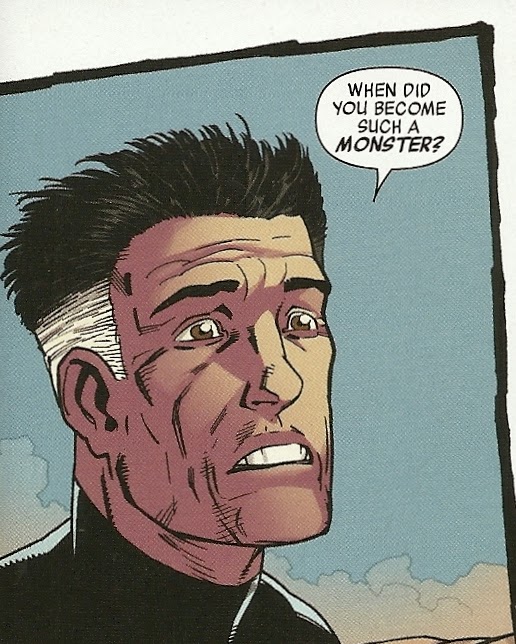
Walker
Um, I don't know, 1939...? Did Reed not read the story where Namor basically beat just beat up New York City and then threw the Empire State Building at a lady holding a baby? (To be fair to Namor, here's his defense: "How dare any of you put yourself--your damned morals--above the lives of every living thing? Thre truth is, you people aren't worth that...and neither am I. Our lives are a pittance." I think that's a large part of what makes Hickman's storyline so compelling. All of the characters are all always right...and always wrong.)

So they've killed a group of all-around decent superheroes, destroyed an alternate world in order to save themselves and another universe and Namor told The Panther about how he kinda sorta sicced an evil alien's invading army on his people and how he can kill them whenever he wants and so they kick Namor out of the club and they realize that when it comes right down to it, none of them is actually strong or cold enough to do the very thing they've spent months preparing to do.

It can't get any worse, can it?

Of course! The last panel of that second-to-last issue shows Reed's incrusion alarm going off: In less than 8 hours, they have to face the exact same dillemma all over again!

In the final issue, thoroughly demoralized and finally realizing that despite the weapons they have to destroy worlds, they can't bring themselves to use them, the members go about preparing for the end of their lives and the end of the world in various, personal ways.

It's a rather elegant issue, which Kev Walker draws quite well, offering some downright poignant scenes, as well as some that are pretty alarming (Is Stark preparing to kill himself?).

But when the doomsday clock runs down, nothing happens. And when they try to figure out why not, Blackbolt asks an obvious question: "Where's Namor?"

Oh, you know, just starting his own Illuminati, one which makes his post-Secret Invasion villainous Illuminati look downright pedestrian:
Walker
Holy shit, Namor just destroyed a second world in an eight-hour period, and is apparently prepared to keep on ending worlds.

So, um, where do we go from here?

I honestly have no idea, which makes this Hickman's Avengers comics even more exciting. I kind of wish I had never even heard of Secret Wars, as it certainly seems to suggest a solution to the incursion problem, which otherwise I wouldn't have thought possible from what we've seen in the books so far, and the "heroes" of New Avengers just keep digging themselves deeper and deeper into holes.

Now, for example, they've got the unsolveable incursion issue to deal with, they also have The Avengers gunning for them (I guess? Or did Captain America's old man-ification give them a stay of fight execution?) and a Namor/Thanos team-up team to fight.

*********************

It's not all fighting, doom, dread and apocalypse in New Avengers, however. As I said, there are some pretty poignant scenes in here, and even a few funny ones. I particularly liked the emergence of sassy Namor during these issues.
Namor sasses Sun God, in a sequence drawn by Schiti
********************

New Avengers #17 was published in April of 2014, almost a year ago now, right? In January of this year, DC published Superman #38, which the publisher publicized as being the first occurrence of a brand-new power for Superman, "super flare." How does it work?

Well, essentially Superman releases all of the solar energy his cells have stored up at once, in the form of a gigantic explosion of energy with a devastating effect.

It also has the side-effect of completely draining Superman, and rendering him powerless while he recharges.
Morales
It's also basically what Sun God does in a scene in New Avengers #17, by Hickman and Morales. When fighting the Mapmakers—nigh invincible, super-adapting machine intelligences—during an incursion, Sun God takes them all out by flying above them and releasing a huge burst of solar energy that destroys everything around him, save his teammates huddled under a forcefield.

Now I'm not accusing Geoff Johns or anyone at DC of lifting the idea from this issue or anything. These sorts of overlaps occur pretty much constantly in DC and Marvel's respective, cross-pollinating superhero lines. And, it's well worth noting, Sun God and his whole team are not-even-veiled analogues to DC's Superman and The Justice League.

I'm just noting how odd it was to see Sun God apparently win the battle using Superman's brand-new power, is all.

***********************

And on that subject, check out the term The Black Priests use to refer to the apparent future smooshing together of various worlds from The Multiverse in New Avengers #13, drawn by Bianchi:
Bianchi
"Convergence," huh?

***********************

I was maybe halfway through Vol. 3 before I realized that one of the more unlikely characters I could imagine being involved in these sorts of cosmic matters and apocalyptic decision-making has been hanging around for some time now, and is thus at least tacitly complicit in everything The Illuminati does:
Bianchi
Like Blackbolt's brother Maximus The Mad, Lockjaw has been hanging out in The Illuminati's secret headquarters in Necropolis!

Forget what The Avengers, X-Men and Fantastic Four are going to think when they find out about all this, what are The Pet Avengers going to think?!

Monday, January 07, 2013

Review: Fear Itself: Avengers

This Fear Itself tie-in collection features five issues of The Avengers and three issues of The New Avengers—since Brian Michael Bendis was writing both books, the collection manages to have a consistent voice and point-of-view, even if the art is a bit on the chaotic side.

Chris Bachalo pencils two issues of Avengers, which are inked by a whopping six different inkers, and these more-or-less altrnate with issues drawn by John Romita Jr. and inked by Klaus Janson. The three issues of New Avengers that close out the collection are all created by Mike Deodato using…whatever method he uses now.

Bendis has never seemed as interested in telling stories (something he has managed to avoid doing for much of his 10+ years at Marvel) or writing characters as much as he is interested in writing dialogue and creating scenes (at least in his mainstream Marvel Universe work), so he’s a writer who’s actually quite well-suited to these sorts of event tie-in comics, especially when he’s not the guy writing them (That’s pretty infrequent really, as he’s written or co-written all but three of Marvel’s event series since House of M).

Tie-ins like these are, by their very nature, inessential bits of the actual story, which is being told in the main title (here, Matt Fraction’s and Stuart Immonen’s actually rather good Fear Itself); they're scenes between the important scenes, side-stories and filler providing texture, expansion or merely curiosity-satiating content explaining what Squirrel Girl or Daredevil were up to when those Nazi mechas in the second issue were attacking New York City or whatever.

Bendis event tie-ins can be extremely irritating if read serially, as Bendis, more than any other Marvel writer, treats the title or logo on the covers of his comics as more-or-less suggestions, and he often just writes about whoever or whatever he feels like, but collected like this, they’re not so bad.

This is, in essence, a bunch of vignettes starring characters from the writer’s two main Avengers titles that scan a bit like deleted scenes from Fraction and company’s Fear Itself series.

Unfortunately, Bendis, being Bendis, decided upon a framing device that allowed him to take even the most rollicking superhero premise—big, bruiser-type supervillains and a few heroes are given evil Thor hammers that power them up and force them to destroy everything in their path—into something that can be told mainly through talking heads.

The framing device here is that someone—who is never explained between these covers—is making a book of some sort about Avengers history, and, as part of that, they have regularly been meeting with Avengers throughout Avengers history and interviewing them on camera.

The result is panel-packed pages featuring Avengers—from different eras—talking about themselves, each other and various events, while looking right at the camera/reader in a series of headshots.
It’s…not the most exciting way to tell a superhero comic, really. It certainly adds a lot of texture, and slows down stories that would otherwise be over within a few minutes, but is just this side of deadly dull, and seems like the sort of thing someone writing a Bendis parody would come up with to spoof Bendis (There’s an off-putting reality show element to this form of storytelling, as it seems like little more than edited scenes of participants talking directly to the camera about the events the producers are depicting between such scenes).

Bachalo does the most interesting work with these scenes, using extreme close-ups and varying angles to keep the panels from getting repetitive, and while his attempts make 12-panel grids of superheroes talking more fun to read, it also breaks with the premise, as it suggests an artsy filmmaker behind the camera, rather than a static camera on a tripod set up to record material for a books.

Deodato’s talking heads keep up that illusion, and Romita’s fall somewhere in-between: All three end up recycling the same images over and over, and aren’t terribly subtle about the shortcut-taking.

The artwork, particularly on the first eight issues, is all top-notch, but none of it really goes together. Bachalo’s highly cartoony art helps hide all the ink-slingers involved (it looks pretty consistent, considering), and his slightly-abstracted, super-expressive designs make for some particularly lovely superhero work.

Romita is Romita, a perhaps slightly more acquired taste: Personally, I love his work, and when I think of Marvel Comics, when I think of Marvel heroes, his is the artwork that first comes to mind (Like, if you walked up to me and said “Spider-Man,” an image of JRJR’s Spider-Man would appear in my head). He gets to draw the most action-packed scenes, including Red Hulk and Thorred-Up Thing brawling in Manhattan, and a Captain America vs. Lame Old Captain American Villains battle. Lots of rubble.

I like Deodato’s work the least, and his style clashes most with those of the other two (who have a fairly substantial stylistic gulf between ‘em anyway). He’s adept at dynamic, action-packed layouts, and I kind of like his muscular, twisted human figures, but his artwork is so heavily photo-referenced and/or computer-aided that I have a hard time seeing past the “cheats” enough to take it at face value, and there’s an unsettling chimeric quality to the awkward melding of hand-drawn and photo-referenced material.

Let’s look at the stories, one by one, just to make this post even more too-long than it probably already is:

Avengers #13

I sort of wish I hadn’t returned the Fear Itself collection to the library already, so I could refer back to it and know for sure which specific issue of it these various issues of the Avengers comics are set during. This one seems to be set during the first issue.

After three pages (and 36-panels!) of talking heads sort of meandering around to provide a narrowing-focus on the Fear Itself events in the broad context of Avengers history, Bachalo draws a huge, two-page splash of a half-dozen of those Nazi mechs blowing the fuck out of a corner in NYC, while some army guys run around on the ground.

This is, oddly enough, the only time I laughed-out-loud during the read. See, in the 12th panel of the pervious page, there’s a tight-close up on Ms Marvel’s very serious looking right eyeball, and she says “They’re calling it The American Blitzkrieg.”
Then you turn the page to see the two-page splash, which would normally be a pretty effective transition of scale and importance (although the events aren’t really that big of a deal in the context of Avengers comics). The caption in the upper left corner reads “Blitzkrieg U.S.A.”, making a liar out of Ms. Marvel.
There’s also a scene of The Red Hulk eating raw eggs, shells and all. That’s pretty fun.
The rest of the issue is mostly talking heads, with a few short breaks involving this Avengers team hanging out in the kitchen on morning, another in which they hang out with the Asgardians and Spider-Woman and Ms. Marvel talk about boys before the former flirts with Hawkeye, and then there’s are two-pages set at Iron Man’s “I’m going to rebuilt Asgard because whatever” press conference.

And that’s it. The Alan Davis cover showing Thor standing above a bunch of knocked-out Avengers that he either konked with his hammer or is trying to defend from whoever’s outside the borders of the image who did konk them out, has nothing to do with the contents.

Avengers #14

This one’s a Romita and Janson issue. It’s divided between talking head panels and an almost completely silent fight between The Hammer-ed Thing and The Red Hulk, which results in Avengers Tower being knocked down and The Red Hulk being hit out of a NYC like a baseball going over the centerfield wall in during a homerun.

It’s a 22-page comic; two full-pages are nothing but the talking-heads, 12 pages are mostly dialogue-free fighting over three-to-four-panel pages, and the remaining eight pages feature one or two big panels of fighting, with strips of talking heads running along the sides of bottom of the spreads.
It should come as no surprise that the World War Hulk artist does a pretty great job of two Hulk-like monsters beating the stuffing out of one another and tearing up a few city blocks in the process.

Avengers #15

Back to Bachalo. This issue is structured the same as the previous one, although the superhero fight is a bit more interesting and involves a lot more talking, as the heroes involved have more interesting and diverse power-sets.

The talking heads are all talking about Spider-Woman Jessica Drew, what she brings to The Avengers, how she gets a big moment in this outing.

It zeroes in on the part in Fear Itself where the Hulk (like, the regular, green one) gets his hammer and immediately pursues his girlfriend Red She-Hulk through Brazil.

An Avengers team consisting of The Protector (the Bendis-mangled remains of the Grant Morrison/J.G. Jones version of Marvel Boy from their acclaimed Marvel Knight series), Ms. Marvel, Hawkeye and, of course, Spider-Woman, fight the Hammer-ed Hulk and temporarily slow him down a little bit, which is a big victory.

Avengers #16

Romita and Janson again. This story focuses on how Steve Rogers, the former Captain America who was now running SHIELD as Commander Rogers, reacts to the news that his protégée Bucky Barnes, who was currently going by Captain America, had just been killed in action fighting the new hammer-wielding Red Skull. (Bucky gets better, of course, just as he did the first time he died).

When Rogers gets a lead on the Red Skull’s whereabouts, he picks up his shield and goes looking for a little payback, SHIELD agents Maria Hill, Sharon Carter, and the lady with the red-streak in her hair in tow.

Turns out it’s a trap, and they run into a bunch of old Cap villains, including one with a sweet beard and mustache and another who apparently fights with a bed sheet tied in knots.
There’s a lot of shooting, fighting and explosions, all drawn by Romita. There is nothing at all wrong with that.

Avengers #17

The last of the Avengers issues in this collection, this one is another Romita-and-Janson drawing a bunch of action and destruction one.

Hammer-ed Red Skull and her Nazi Mechs are Blitzkrieg-ing the ruins of Avengers tower, and Hawkeye, Spider-Woman, Ms. Marvel and the The Protector are fighting her. Then The New Avengers show up to help fight her.

And, um, that’s the issue, really. This part was the only one as funny as the scene where Ms. Marvel and the captions disagree about what “they’re calling” Red Skull’s attack on the U.S.:
Um, are there any other letters that make the “Buh” sound that the word “Barnes” begins with, Cap?

Grief makes men say stupid, stupid things, I guess.

New Avengers #14
Twenty panels of Mockingbird talking to the camera! Then a scene of The New Avengers arguing over breakfast at Avengers Mansion! Ten more panels of Mockingbird talking to the camera! Nine pages of The New Avengers fighting Nazi mechs! One-page of Mockingbird collapsing with grief as she sees Avengers Tower crumble! Ten more panels of Mockingbird talking!

This issue, like the rest of those in this collection, are all drawn (and, in some cases, “drawn” by Deodato).

New Avengers #15
In this issue, all the talking-to-the-camera panels feature Squirrel Girl, the nanny of Luke Cage and Jessica Jones’ baby. It’s about her fighting her way through the Blitzkrieg from college campus to Avengers Mansion, where she’s supposed to start baby-sitting so the Cage family can join the other New Avengers in fighting.

New Avengers #16

There’s more variety to this issue’s talking heads, which includes all of the New Avengers. And Daredevil. They spend the duration of the issue talking about Daredevil. The “action” portions follow Ol’ Hornhead as he fights the Blitzkrieg, and then heads to Avengers Mansion to help Squirrel Girl protect Baby Cage. He’s rewarded by Daddy Cage with induction into the New Avengers.

And that’s the contents of this collection. It’s hit-or-miss, but there are certainly pleasures to be had within its covers and, unlike a few of the other Fear Itself collections, every story in it does tie-in to Fear Itself.

As for those others, there were four more that interested me, and I’m going to be reviewing one a day for the rest of the week. So come back tomorrow for Fear Itself: Deadpool/Fearsome Four.

Monday, March 01, 2010

Poor Luke Cage.

They took his codename. They took his hair. They took his tiara. They took his bracelets. They took his yellow silk shirt, and forced him to start wearing off-the-rack street clothes to Avengers meetings and superhero battles.

Now they've taken those shirts, and, apparently, his nipples.

No wonder he's scowling. At this rate, he'll be fighting crime in the nude and hoping to hang on to the rest of his anatomy by this time next year.

Thursday, February 08, 2007

“…And if you see my ex-girlfriend, please kick her in the vagina for me."

Hey Internet, what’s up?

Okay, I’m not sure if I’m reading this right or not, so I wanted to post it here and get some second opinions.

This is a passage from New Avengers #27, written by Brian Michael Bendis and drawn by Leinil Yu.

If you haven't read it yet, I'll set the scene. The woman on the left is the world’s greatest assassin (and former Daredevil flame) Elektra. The man on the right is super-strong, nigh invulnerable Luke Cage, nee Power Man. His superhero team just invaded her ninja team's base, and they're in the middle of a fight.


Sooo, did Cage really just kick Elektra in the crotch?

And the sound Bendis decided best represents the sound of a super-strong man kicking a woman in the vagina is “FOOM?”

And are we to believe Matt Murdock really told Cage, “Oh, hey, you guys are going to Japan to fight The Hand ninjas? Cool. Hey, if you see Elektra there, can you kick her in the vagina for me?”
