Despite the occasional hand-wringing within the comics industry about the state of DC Comics' performance in month-to-month sales to direct market comic shops, and whether their near-constant reboots and refreshes do more harm than good (a new round of which began when an Internet rumor-mongerer began mongering rumors), the fact remains that DC has an incredible back catalog of great comics, and a generally excellent track record for keeping their best books in print. A modern DC fan could probably ignore the publisher's monthly serial comics output in favor of collections of older material, and be very, very happy for a long time.
There are, of course, holes in their catalog of trade collections, some of which they seem to just now be starting to fill (The 1987-1992 Suicide Squad being one of the better examples; it apparently took the upcoming movie to kick them in the pants to get the good run of Suicide Squad available in trade*).
I am extremely excited about this, as books like Suicide Squad, the Garth Ennis/John McCrea 1993-1995 run on The Demon and Norm Breyfogle-drawn Batman comics are series I've spent years trying to track down in single-issue format from bargain bins, never managing to complete the runs, and, inevitably, getting and reading them out of order.
That excitement is tempered with fears of my own mortality, however, as some of those books are ones I remember seeing on the new comics rack every Wednesday, during a time well before DC and Marvel collected everything they published serially in trade format later, and only did so for big, important or classic stories and runs. While I'm glad that the Chuck Dixon-written Robin miniseries and ongoing are being collected, for example, or that the original, mostly Dixon-written Birds of Prey comics are finally being reprinted, the fact also makes me feel the specter of death breathing down my neck. The first Birds of Prey special is 20 years old? The first Dixon/Tom Lyle Robin miniseries is 25 years old?!
My God, I'm old!
I'll likely skip the first few volumes of DC's Robin reprints, as I have the first three mini-series and the first few issues of the monthly already (although I guess buying the trades would reduce the number of old comics in my comics midden, which I will someday bequeath to my nieces and nephew, in the most annoying inheritance possible: "And finally, to my beloved nieces and nephew, I leave these thousands and thousands of old, worthless comic books, none of which ever actually appreciated in value in any way that would even be worth your trying to sell, even those I thought would be solid investments, like 'The Death of Superman' and Spawn #1. Enjoy lugging all these decrepit, disintegrating longboxes to the recycling center!"
But Birds of Prey is a different matter entirely.
When the Black Canary/Oracle: Birds of Prey #1 one-shot was released in 1996, I was in my freshman year in college, and on a pretty limited comics-buying budget, my only discretionary spending coming from the extremely part-time jobs I had at that point. I got my Gotham-based vigilante crime-fighter needs filled by a handful of Batman comics, and skipped this, as well as all of the comics contained in the first volume collecting the original, pre-Gail Simone Birds of Prey.
She's the writer most associated with the title at this point, having written the ongoing series from 2003-2007, about 50 issues, and then returning for the first 13 issues of the short-lived, 2010-2011 second volume of the series. Prior to this, just about every Birds of Prey collection available was from Simone's run, or that of her successors Sean McKeever, Tony Bedard and Marc Andreyko, or from the third, New 52 volume of the series by...well, actually, let's continue to pretend that volume doesn't exist, shall we?
Dixon wrote all of the pre-monthly one-shots and mini-series, as well as the first 46 issues of the 1999-launched ongoing series. Without doing any math, I'm pretty sure Simone therefore has Dixon beat in terms of pages of BOP comics scripted, as well as time on the franchise, but Dixon deserves a ton of credit for the franchise, credit he doesn't always get. With original editor Jordan B. Gorfinkel, Dixon created the Birds of Prey (if not the two individual stars), and capitalized on Kim Yale and John Ostrander's transformation of the former Batgirl into hacker and information broker Oracle to make Barbara Gordon a key player in the Batman franchise and the wider DC Universe (even joining the Justice League for a while).
So now, finally, the first Birds of Prey comics are collected, giving a new generation of fans (and those of us who missed them the first time around) a chance to read them, and giving Dixon and his collaborators a spotlight they missed out on back in the day by virtue of the trade collection market not really existing in its current form (not to mention, one hopes, plenty of well-deserved royalties). Dixon's earliest Birds of Prey comics were published previously in a pair of trades, from 2002 and 2003, which collected everything in this volume, plus the first six issues of the ongoing. Those are out of print now, and this seems like the start of a concentrated effort to collect the pre-Simone comics...as well as being part of a revival of interest in Dixon's '90s Bat-office work, when one takes into consideration these new volumes will be released alongside the Robin collections.
So, what do we have here?
Dixon wrote all of the above save for the 18-page "Birds of a Feather" story, which was the cover story in Showcase '96 #3; that one is written by Gorfinkel, who edited the rest of the books in this collection and who is credited as a co-creator of the Birds of Prey team, (at least according to Wikipedia).
As for the art, there are quite a few more cooks in the kitchen. Gary Frank, Stefano Raffaele and Dick Giordano and an all but unrecognizable Greg Land each pencil one one-shot apiece (Seriously, you should check out Land's art in this; if you know it's Land ahead of time, you can kind of see hints of the Land of the last decade or so in it, but he appears to have actually drawn-drawn his art back then, and it looks perfectly fine). The four-issue miniseries Manhunt features pencils by Matt Haley, with a couple different inkers and, on the final issue, layouts by Sal Buscema. The Showcase team-up featured layouts by Jennifer Graves, an artist of whom I know almost nothing, aside from the fact that she drew at least one of my favorite issues of Robin (and that I wished she was the ongoing artist) and finishes by Stan Woch.
Of these, the first special is likely to be of greatest interest, as it shows the origin of the Black Canary/Oracle team-up, or at least their first time working together in a book of their own. It also marks a major turning point in the history of the Black Canary character, as she goes from being a supporting character in Green Arrow and Justice League comics to being the co-star of what would end up being a long-running series. At the beginning of the issue, she's still rocking her classic look, complete with fishnets and blonde wig. A few pages in, she decides to dye her hair blonde and suits up in a new costume that Oracle has designed for her.
Canary is in a rut when we meet her in Seattle, and Oracle not only recruits her for a mission (via answering machine; this was the '90s, remember), but also acts as her life coach, giving her new direction and new duds.
The plot, like most of Dixon's at the time, is pretty boilerplate, action movie type stuff, with little of the character work that would go into his Batman or Robin comics. There's a shady businessman who is supposedly helping various leaders of third world countries who keep falling prey to terrorists...a group he is in cahoots with. For protection, he has hired Lynx of the Ghost Dragons, a Dixon creation who first appeared in the original Robin miniseries (and a character I always liked; although she got killed during the bad old days of "War Games"-era Batman comics). He takes Canary on as an additional bodyguard as well, and, naturally, she foils his schemes.
More so than any other comic in this collection, Frank's artwork plays up the cheesecake aspects of Black Canary (and the other female characters). There is a lot of sexy art in this book, with Canary in various states of undress...although we should probably keep in mind that her superhero costume was basically a state of undress. When she takes off her wig and jacket to take a cab or go to an airport as Dinah Lance rather than Black Canary, she's basically just wearing lingerie and boots.
The threats of the other stories are similarly non-super; they may not be exactly realistic, but they're the sort you might find in an action movie rather than a superhero comic. They're rarely imaginative, but Dixon was always pretty adept at making up realistic-ish, generic bad guy types with bad guy plots.
There's an international criminal and con man with an elaborate plan to seek refuge in an incredibly inaccessible land of bad guys hiding out, there's a cola company-sponsored revolution in Santa Prisca (home country of Bane!) and Dinah finds herself running from the Ukranian mob while Barbara deals with muggers and home invaders. It's not until the very last issue in the collection that we see any real supervillains, in the form of Spellbinder III and, in one panel, Blockbuster (at that point reinvented to basically be the Wilson Fisk of the DC Universe).
The collection's cover shows the trio that would form the heart of the team during Simone's run, but the stories inside revolve around the somewhat strained relationship of Black Canary and Oracle (who never meet one another at any point in these stories). There are plenty of guest-stars though. The Showcase Story has a Canary teamed up with very badly dressed Lois Lane, Manhunt has Canary teaming with Huntress and Catwoman (and, in the climax, fighting Lady Shiva) and, in the final story, Batgirl Barbara Gordon appears, along with pretty much Batman's entire rogue's gallery, but only via illusion (Um, spoiler alert).
These guest-stars highlight what would become a hallmark of Birds of Prey, that what was originally a partnership would become, eventually, a friendship and then a constantly expanding and retracting team, in which characters that couldn't command their own monthly series (at least, not for long) would find the strength in numbers to do just that. Which actually reflects the in-comic storylines too, since Canary and Oracle need each other, and other occasional partners, to accomplish things they can't manage solo.
None of these are really great comics, although there are things to recommend them (Particularly good art here or there, easily accessible stories, etc). The greatest pleasure the collection offers, really, is in reading (or re-reading) these rather basic, run-of-the-mill action adventure comics with the knowledge of what they lead to in the future.
*Sorry, Everyone Involved With The New 52 Suicide Squad, but that book has been just this side of unreadable since it launched, and no amount of creative team changes have been able to change that so far. In your defense, the New 52 reboot sort of hobbled the general appeal of the concept, I realize, because rather than allowing you guys to pick and choose great and/or expendable super-villains and bad-guys from throughout DC history, you were basically stuck with brand-new, history-less characters that had absolutely nothing in common with their previous iterations other than their codenames
Showing posts with label oracle. Show all posts
Monday, February 15, 2016
Monday, December 02, 2013
Review: Batman: The Joker's Last Laugh
![]() |
| Oracle and Nightwing have feelings, in a few panels drawn by Walter McDaniel |
The two storylines/events were quite different from one another, of course, with "Death" being smaller in scale and scope, and darker and more serious than "Last Laugh" was, but both feature The Joker fighting characters other than—or, more accurately, in addition to—Batman, and both feature The Joker using his chemical expertise to "Joker-ize" various characters.
"Last Laugh" was a 2001 event/story that ran through a six-issue miniseries entitled Joker: The Last Laugh, and took over single issues of pretty much every comic in DC's DCU line at the time, although most of those comics—i.e. those not prominently featuring Batman or a member of the Bat-Family—had rather little to do with the main story, and were simply showing how the heroes of those books were dealing with their particular front on the war against Joker's poisoned army. I don't think DC ever attempted to collect all of the tie-ins, and, now that I think about it, I wonder how many actually made it into any collections, as those issues tended to have little to do with the story arcs preceding or following them. They did collect the main series itself into the trade Batman: The Joker's Last Laugh, and that's the book I went to when I wanted to revisit the book in light of my recent Joker reading.
It was written by Chuck Dixon and Scott Beatty, the former one of the more prolific and influential Batman writers of the 1990s and early 00s, the latter his occasional collaborator on such excellent books as Batgirl: Year One and Robin: Year One. Each issue had a different art team (I want to say it was a weekly series) and, had you asked me about a week ago who drew it, the only artist I would have been able to remember working on it would have been Rick Burchett, who pencilled the last issue. That stuck with me for this dozen years or so because of how great Burchett's art was (it was the best in this series, for sure, even though I don't think he's the best artist to contribute to it) and because of how unusual the style was. Known at the time for his work on the comics based on the Batman cartoons (based on the comics), Burchett devised a sort of compromise style when drawing this issue, so certain characters had a hint of their "animated" selves about them (Harvey Bullock looked like cartoon Harvey Bullock around the eyes and mouth, for example), but were otherwise in a smoother, cleaner, DC Universe style. It was a great looking comic, and it had boggled my mind ever since that I didn't see Burchett get a monthly gig on a Batman book after that.
The other pencil artists involved were Pete Woods (whose work isn't even recognizable as that of the same Pete Woods working today), Marcos Martin (whose work wasn't quite as stylized as it would become, but, even here, the figure work looks like that of Martin), Walter McDaniel, Andy Kuhn and Ron Randall. All are good (well, I didn't care for McDaniel's work here), and several have rather compatible styles, but the book ends up looking like one drawn by six different guys (and inked by five additional guys; McDaniel, Kuhn and Randall inked themselves). It's pretty unfortunate, but at least most of the characters wear costumes through most of the book, so it's easy to tell who is who. The art style changes radically now and then, but it's always readable, so there's that.
The story eventually gets pretty silly at points—this is an incredibly cartoony Joker, and one prone to using props—but it has some solid character work, and represents some big moments in the ongoing character arcs of characters Batman, Nightwing and Barbara Gordon regarding their relationships with The Joker (It probably goes without saying, but I'll say it anyway: None of that matters anymore, as this storyline and those character arcs were rebooted out of existence with The New 52; that's one advantage this has over "Death" though; here, the characters all have history with The Joker, whereas in "Death" we're told they have history between assurances that they don't really).
The premise is this. After his last crime spree (Perhaps after the events of 2000's "Emperor Joker," a Superman storyline featuring The Joker as its main antagonist), The Joker graduated from inmate at Arkham Asylum to genuine supervillain, and is incarcerated along with all of the super-powered super-villains in The Slab, DC's super-max supervillain prison at the time (Now that would be Belle Reeve again). There, a doctor attempts to play a joke on The Joker, either out of spite or to try and shock him into not being such a maniacal mass murderer: He convinces The Joker that he has an incurable, inoperable brain tumor, and hasn't long to live.
Rather than mellowing The Joker out, it inspires him to to instigate his own Crisis-level crime. By manipulating the various chemicals that the screws at The Slab use to inhibit the super-powers of their inmates and control them, The Joker "Joker-izes" them all, so now there's an army of super-villains that have his sense of humor, and also have bleached white skin, green hair, red rictus grins and behave more-or-less like Joker knock-offs.
That's a pretty great idea, providing that alteration-on-the-familiar that we superhero comics fans so adore (see the success of Blackest Night, where various characters got various Lantern-inspired costume makeovers), although sadly the makeovers stopped at the physical (none of the villains started sporting purple, Joker-esque versions of their regular costumes, for example) and the available villains weren't exactly the cream of the crop of DC villainy; of the members of The Legion of Doom from Super Friends, for example, I think only Luthor, Solomon Grundy and Gorilla Grodd appeared Jokerized (and none of 'em in the main series), and the characters appearing in here tend to be minor ones. The Joker's right-hand henchman, for example, is Rancor, a Neo-Nazi character created especially for this series. Other Joker-ized villains prominently featured in this trade included the likes of Hellgramite, Mammoth, Copperhead, Warp, Psimon, Black Mass, Spellbinder II and Doctor Polaris. Not exactly the A-List. Heck, not exactly the J-List.
So, The Joker stages a break out of The Slab, unleashing a small army of super-powered Jokers on the DC Universe (And this is where most of the many tie-ins come in; each tie-in featured the hero of the book dealing with a Joker-ized villain. So in JSA, Stargirl and Jakim Thunder dealt with a Joker-ized Solomon Grundy; in Orion, Orion dealt with the Joker-ized Deep Six, and so on).
![]() |
| Marcos Martin |
Meanwhile, Dick "Nightwing" Grayson had prevailed upon his then-girlfriend Barbara "Oracle" Gordon to go on a mini-vacation with him, in an act of extremely bad timing, keeping her from monitoring The Joker's cell, something she always does. They argue over the morality of killing The Joker, even before the escape gets underway: "It's not revenge so long as you don't kill? Funny, I'm the only one who joined this party without an axe to grind...And look how that turned out," she snaps at Grayson in one scene.
One by one, Black Canary, Blue Beetle II and, belatedly, Nightwing and then Batman try to break into The Slab to stop The Joker from making his escape, but they all fail, and barely escape before The Joker gives new meaning to the term prison escape, sending the entire, mostly emptied facility into a black hole created by Black Mass.
From there, the narrative splits into several different threads, most of which are picked up to some degree in some of the many tie-ins not included here. Inside the prison were Shilo Norman, the one-time protegee of super-escape artist Mister Miracle (who Grant Morrison would make the only Mister Miracle during his Seven Soldiers event a few years later), an federal Marshal Dina Meyer (a minor character Dixon introduced in Birds of Prey), and they have to figure out a way to get themselves back into reality with the help of Multi-Man and Mr. Mind (Dixon and Beatty write a great Mr. Mind), before they are devoured by the few remaining Joker-ized villains in the prison.
![]() |
| Rick Burchett |
Meanwhile, The Joker keeps escalating his plans, eventually having some of his new super-powered followers create a "crazy rain" weather phenomenon, in which Joker venom falls from the clouds—President Lex Luthor retaliates by declaring martial law and declaring war on The Joker.
It all comes to a head in Gotham Cathedral, where Nightwing beats Batman to the final confrontation, intent on finally doing what Barbara has convinced him they should have done all along—kill The Joker. He actually does so, at least technically, but Batman is able to resuscitate The Joker, in what has to be the ultimate example of Batman going out of his way not only to not kill The Joker, but to save The Joker's life.
Much of the Joker's actions in this book are downright silly, and he does little himself in terms of hands-on evil, violence or mayhem, generally directing his army while wearing a variety of silly costumes.
The Shilo Norman bits, on the other hand, are all pretty entertaining, and given the way the book ended, with Norman becoming the temporary warden of The Slab, Multi-Man and Mr. Mind given slightly relaxed punishment and The Slab relocating to Antarctica, where The Joker is completely isolated, watched only by a single computer monitor (because without an audience, he's powerless, Norman says), it's sort of surprising this wasn't shortly followed up by a new series called The Slab.
As for the Bat-Family, it was interesting to see Oracle and Nightwing playing the leads, while Batman is himself something of a supporting character (at least in this series within the larger event), not getting any more panel time than, say, Robin or The Huntress. Like any good crossover, it allowed the spotlight to shine on relatively little-seen corners of the DCU and dust off some under-used characters. It also ended with things not being exactly the same, with not only the status quos of some of the characters changed, but their opinions and thoughts changed. In other words, it didn't start and stop at Point A, nor did it simply set up the next crossover, it was a more-or-less complete story—or at least as complete as the miniseries trunk of a tree-shaped crossover event story can ever really be.
Now let's look at some art, shall we?
First, here's Orca, the whale woman, delivering the only line she gets in the book:
![]() |
| Martin |
(Hey, did Orca show up in that Beware The Batman cartoon? Because Orca would certainly fit the bill of "a Batman villain who has never previously appeared in a Batman cartoon").
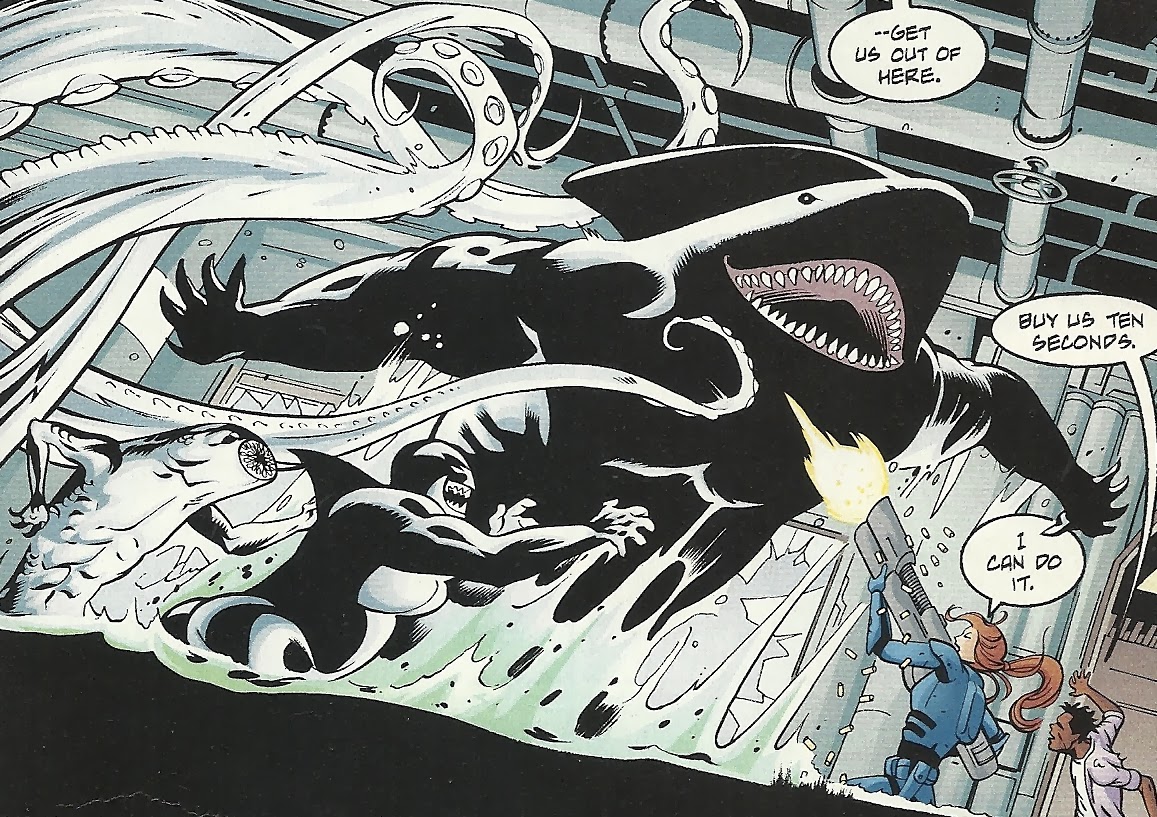
Here she is again, with the other "man-eaters" from the Aqua-Level of The Slab. I like this gigantic version of King Shark:
![]() |
| Martin again; I have no idea who the tentacles belong to, or who the sucker-faced guy is. |
I thought this particular panel, in which The Joker is wearing one of the many costumes he puts on throughout the story (He's dressed like Elvis during his battle-to-the-death with Nightwing, for example), was interesting in that it sort of prefigures what he wears throughout "Death of the Family," a sort of carpenter/handyman/repairman get-up:
![]() |
| Ron Randall |
But when the trade was put together, DC had changed their logo to the new, more stream-lined bullet, which is smaller, sleeker and less ball-like, and thus doesn't quite look right, when DC swapped it into the Bolland image to replace the previous bullet:
Not sure how they'd incorporate the current logo, if they published a new edition of this someday...
Labels:
chuck dixon,
marcos martin,
nightwing,
oracle,
scott beatty,
the joker
Friday, October 21, 2011
Monday, June 06, 2011
I can't think of a single good thing about this.
So I guess the Batman books are going to be completely fucked up as a line starting in September. That's the plan?
DC has been trickling out news of their post-relaunch plans for the franchise, and if the TEC/Batman announcement confused and saddened me, these new ones are making me downright turn-off-the-Internet-and-just-ignore-DC-till-they-implode depressed.
1.) Batman: The Dark Knight and Batman and Robin will retain their creative teams but get new #1's, although the latter will now feature Bruce Wayne as Robin Damian Wayne's Batman partner, instead of Dick Grayson.
2.) Dick Grayson will put on a new, fussier Nightwing costume based on Chris O'Donnel's Robin costumes from the first cycle of Batman movies and star in Nightwing, drawn by Eddy Barrows, one of my least favorite artists (and a DC mainstay over the last five years), while Jason Todd will get another new, worse Red Hood costume and star in a team book with former Titans Roy Harper and Starfire, to be written by Scott Lobdell.
3.) Grant Morrison's multi-year Batman arc, currently playing out in Batman Inc., will go on hiatus for at least three months, and finish up sometime in 2012...and creations of his like Damian Wayne/al Ghul and Batwing are still going to be around and prominently featured so...DC's just jumping ahead of the last 12 chapters of Morrison's storyline, or...?
4.) And then there's this news, regarding the "Women of Gotham City." Catwoman gets a third volume of a solo series by perennial DC writer Judd Winick and current DC artist Guillem March; Birds of Prey is going to be written by Duane Swierczynski, feature a mostly-new cast and have the ugliest Black Canary costume in the entire history of the character; the long-delayed Batwoman series will finally launch (and now we know the reason for the latest delay; DC was waiting for this line-wide relaunch) and, the worst news of all, Barbara Gordon will be giving up her Oracle identity to become Batgirl again for the first time since, I don't know, 1988, was it?
That's the thing I was referring to in the title of this post.
"Fixing" Barbara Gordon so she can go back to being one of the dozens of lieutenant Batmen seems even dumber than resurrecting Jason Todd or Flash Barry Allen after decades of their being dead (both of which DC has already done). There's nothing about this that makes any sense at all, and nothing about it that can be construed as a positive.
If anything, DC has one Batgirl too many right now, with Stephanie Brown and Cassandra Cain, characters fans have clearly demonstrated so much devotion to that DC seems unable to kill or otherwise write them off. Barbara Gordon makes three.
In direct opposition to their stated goal of bringing more diversity to the DCU, this would kick their only wheelchair bound character of note out of her chair and into a role that, in-story, the character had outgrown so long ago that she had retired from it long before she was even paralyzed. Now I guess Niles "The Chief" Caulder is the DCU's greatest, most prominent differently-abled hero...?
This also puts Barbara Gordon in a bizarre, regressive position, as low person on the Bat-totem pole. Dick Grayson doesn't have to be Robin anymore, he gets to be a grown-up who has at least semi-emancipated himself from Batman's mentorship. Same with former Robin Tim Drake, now Red Robin. And with DC simultaneously publishing a Batwoman book, Barbara Gordon's Batgirl wouldn't even the primary, adult, female version of Batman with red hair in the DCU Universe and publishing line!
That is so insane I can't even wrap my head around it. (It's interesting to remember that the new Batwoman's costume was based in large part on the original Batgirl costume Barbara Gordon used to wear, and that she was given red hair to fill the perceived need for a red-headed, female Bat-person in the DCU).
Ugh. I don't even want to sift through all the angry and hurt reaction I know this is going to cause among fans, or hear any of the justifications for it. Batgirl retired in the comics 23 years ago. That Batman TV show that prominently featured her, and made her popular in the first place, stopped production 43 years ago.
I can't even fathom what audience this move is expected to attract. Alex Ross, maybe? How many Alex Rosses are there in the potential comics-buying world, anyway? I have a hard time imagining it's any more than currently read the low-selling but stead Birds of Prey, featuring Barbara Gordon as Oracle.
The new Batgirl book will, of course, be written by long-time DC writer Gail Simone and drawn by a pencil artist who has been working on DC for a while now, making it yet another example of a a "new" DCU from the same old folks.
DC's idea of infusing new talent into their seems to be, based on the titles and creative teams announced so far anyway, seems to be hiring long-time Marvel writers e (Lobdell, Swierczynsk) or, in the new Batman artists's case, Image Comics.
Ugh.
Fortunately, I happened to receive a package in the mail today containing a few trades I ordered from an online retailer (Sorry direct market; the nearest shop is a 45 minute drive away!).
I'm going to go metaphorically rub this like salves on my metaphorical wounds, sustained from hearing DC's PR today.
DC has been trickling out news of their post-relaunch plans for the franchise, and if the TEC/Batman announcement confused and saddened me, these new ones are making me downright turn-off-the-Internet-and-just-ignore-DC-till-they-implode depressed.
1.) Batman: The Dark Knight and Batman and Robin will retain their creative teams but get new #1's, although the latter will now feature Bruce Wayne as Robin Damian Wayne's Batman partner, instead of Dick Grayson.
2.) Dick Grayson will put on a new, fussier Nightwing costume based on Chris O'Donnel's Robin costumes from the first cycle of Batman movies and star in Nightwing, drawn by Eddy Barrows, one of my least favorite artists (and a DC mainstay over the last five years), while Jason Todd will get another new, worse Red Hood costume and star in a team book with former Titans Roy Harper and Starfire, to be written by Scott Lobdell.
3.) Grant Morrison's multi-year Batman arc, currently playing out in Batman Inc., will go on hiatus for at least three months, and finish up sometime in 2012...and creations of his like Damian Wayne/al Ghul and Batwing are still going to be around and prominently featured so...DC's just jumping ahead of the last 12 chapters of Morrison's storyline, or...?
4.) And then there's this news, regarding the "Women of Gotham City." Catwoman gets a third volume of a solo series by perennial DC writer Judd Winick and current DC artist Guillem March; Birds of Prey is going to be written by Duane Swierczynski, feature a mostly-new cast and have the ugliest Black Canary costume in the entire history of the character; the long-delayed Batwoman series will finally launch (and now we know the reason for the latest delay; DC was waiting for this line-wide relaunch) and, the worst news of all, Barbara Gordon will be giving up her Oracle identity to become Batgirl again for the first time since, I don't know, 1988, was it?
That's the thing I was referring to in the title of this post. "Fixing" Barbara Gordon so she can go back to being one of the dozens of lieutenant Batmen seems even dumber than resurrecting Jason Todd or Flash Barry Allen after decades of their being dead (both of which DC has already done). There's nothing about this that makes any sense at all, and nothing about it that can be construed as a positive.
If anything, DC has one Batgirl too many right now, with Stephanie Brown and Cassandra Cain, characters fans have clearly demonstrated so much devotion to that DC seems unable to kill or otherwise write them off. Barbara Gordon makes three.
In direct opposition to their stated goal of bringing more diversity to the DCU, this would kick their only wheelchair bound character of note out of her chair and into a role that, in-story, the character had outgrown so long ago that she had retired from it long before she was even paralyzed. Now I guess Niles "The Chief" Caulder is the DCU's greatest, most prominent differently-abled hero...?
This also puts Barbara Gordon in a bizarre, regressive position, as low person on the Bat-totem pole. Dick Grayson doesn't have to be Robin anymore, he gets to be a grown-up who has at least semi-emancipated himself from Batman's mentorship. Same with former Robin Tim Drake, now Red Robin. And with DC simultaneously publishing a Batwoman book, Barbara Gordon's Batgirl wouldn't even the primary, adult, female version of Batman with red hair in the DCU Universe and publishing line!
That is so insane I can't even wrap my head around it. (It's interesting to remember that the new Batwoman's costume was based in large part on the original Batgirl costume Barbara Gordon used to wear, and that she was given red hair to fill the perceived need for a red-headed, female Bat-person in the DCU).
Ugh. I don't even want to sift through all the angry and hurt reaction I know this is going to cause among fans, or hear any of the justifications for it. Batgirl retired in the comics 23 years ago. That Batman TV show that prominently featured her, and made her popular in the first place, stopped production 43 years ago.
I can't even fathom what audience this move is expected to attract. Alex Ross, maybe? How many Alex Rosses are there in the potential comics-buying world, anyway? I have a hard time imagining it's any more than currently read the low-selling but stead Birds of Prey, featuring Barbara Gordon as Oracle.
The new Batgirl book will, of course, be written by long-time DC writer Gail Simone and drawn by a pencil artist who has been working on DC for a while now, making it yet another example of a a "new" DCU from the same old folks.
DC's idea of infusing new talent into their seems to be, based on the titles and creative teams announced so far anyway, seems to be hiring long-time Marvel writers e (Lobdell, Swierczynsk) or, in the new Batman artists's case, Image Comics.
Ugh.
Fortunately, I happened to receive a package in the mail today containing a few trades I ordered from an online retailer (Sorry direct market; the nearest shop is a 45 minute drive away!).
I'm going to go metaphorically rub this like salves on my metaphorical wounds, sustained from hearing DC's PR today.
Tuesday, April 27, 2010
Two Oracles
(SPOILER ALERT, I guess. Don't read this post if you haven't read last week's Brave and the Bold #33 yet but intend to in the new future, and want to be surprised by its ending)
The other day I talked a bit about The Brave and the Bold #33 by J. Michael Straczynski and Cliff Chiang, featuring a story entitled "Ladies' Night" about Wonder Woman, Zatanna and then-Batgirl Barbara Gordon going out for a night on the town.
In one of those weird juxtapositions one sometimes finds in super-comics, the very last page of the story (which is set in the present, after Barbara Gordon had given up her Batgirl identity to become Oracle), is on a page facing a house ad for the new volume of the series Birds of Prey.
The result is that readers get to see the character drawn in two very different styles by two very different artists at the same time.
Here's a better look at the house ad, featuring Benes' muscular, buxom Oracle, with a face completely identical to that of Black Canary (They even have the exact same little identation between their upper lips and noses, which catch the light in the exact same way!):
And here's Chiang's Barbara Gordon from within the story:
I don't really care for Benes' work much, but it's kind of neat to see his version of the character side by side with Chiang's like this. They look like the same person, so its not like either artist did anything radical in terms of character design, and yet the two artists render the character completely differently.
That is, both Barbara Gordons look like Barbara Gordon, but through very different aesthetic lenses.
(By the way, if you haven't read the issue and have no interest in ever doing so, at least read the dialogue JMS wrote for Oracle in that last panel, and try not to laugh).
The other day I talked a bit about The Brave and the Bold #33 by J. Michael Straczynski and Cliff Chiang, featuring a story entitled "Ladies' Night" about Wonder Woman, Zatanna and then-Batgirl Barbara Gordon going out for a night on the town. In one of those weird juxtapositions one sometimes finds in super-comics, the very last page of the story (which is set in the present, after Barbara Gordon had given up her Batgirl identity to become Oracle), is on a page facing a house ad for the new volume of the series Birds of Prey.
The result is that readers get to see the character drawn in two very different styles by two very different artists at the same time.
Here's a better look at the house ad, featuring Benes' muscular, buxom Oracle, with a face completely identical to that of Black Canary (They even have the exact same little identation between their upper lips and noses, which catch the light in the exact same way!):

And here's Chiang's Barbara Gordon from within the story:
I don't really care for Benes' work much, but it's kind of neat to see his version of the character side by side with Chiang's like this. They look like the same person, so its not like either artist did anything radical in terms of character design, and yet the two artists render the character completely differently. That is, both Barbara Gordons look like Barbara Gordon, but through very different aesthetic lenses.
(By the way, if you haven't read the issue and have no interest in ever doing so, at least read the dialogue JMS wrote for Oracle in that last panel, and try not to laugh).
Wednesday, July 02, 2008
ORACLE
Subscribe to:
Posts (Atom)