
Showing posts with label batgirl. Show all posts
Showing posts with label batgirl. Show all posts
Wednesday, April 01, 2026
Batgirl on a horse!


Wednesday, July 12, 2023
On Batgirls Vol. 1: One Way or Another

Well this certainly sounded like a slam-dunk of an idea for a Batman-adjacent series.
Batgirl Cassandra Cain starred in a solo series that lasted 73 issues between 2000 and 2006; in it, original, retired Batgirl Barbara Gordon served as her mentor. That was later followed by a new Batgirl series in which Stephanie Brown, aka Spoiler, took up the mantle from her friend Cassandra (this required some unconvincing hand-waving to get the costume off of Cass and forcing her into story limbo for awhile). In that volume of Batgirl, which lasted 24 issues between 2009 and 2011, original, retired Batgirl Barbara Gordon once again served as the new Batgirl's mentor.
Then, when "The New 52" happened, Gordon returned to the Batgirl role for awhile, starring in a series that lasted 53 issues between 2011 and 2016, and then immediately relaunching for a new volume that lasted another 50 issues, into 2021. By that time, both Cassandra and Stephanie were both reintroduced into the Batman universe, with Cassandra resuming her Batgirl codename and costume after going by "Orphan" for a while.
What to do with all these Batgirls? Why not put them all together in a new series, the premise of which would be the obvious one, of the older, original Batgirl Barbara—who had been gradually drifting back towards her pre-New 52 status quo as computer expert and information broker Oracle—serving as the mentor of the two teenage vigilantes?
That was the idea behind the new series Batgirls, which launched in 2022 after the team-up concept was tried out in some back-up stories in the pages of Batman, during writer James Tynion IV's big "Fear State" crossover storyline. As I said, it sounds like a good one, and given the relative success of the three heroines in solo series throughout the 21st century, putting them all on a Birds of Prey-like team together seemed like an obvious move, one that would bring with it three different fandoms.
Oddly, it only lasted 19 issues, fewer than any Batgirl's solo series to date.
What went wrong? I don't know, beyond the obvious fact that it's pretty hard to sell an ongoing comic book series these days.
I was a faithful reader of the original Batgirl series, a big fan of the Cassandra Cain iteration of the character, and an advocate for this very premise for a book, and I wasn't reading it, for a variety of reasons (The New 52 essentially having broken the contract between me as a reader and the DCU as an ongoing setting, comics costing more than $3 a pop now, my not reading enough titles to justify journeying to a comic shop each Wednesday any more, etc).
I can't speak for the rest of the potential Batgirls readership, though.
The title had officially been cancelled by the time I got around to reading the first volume of the series, Batgirls Vol. 1: One Way or Another, by the creative team of writers Becky Cloonan and Michael W. Conrad and artist Jorge Corona. Having finally done so, I suppose I can offer some guesses, the main one of which the title just wasn't very good.
Extremely plot-heavy with little attention to character, characterization or ideas, it wasn't really a book about anything more than our heroes fighting some villains, the sort of comic of which there is and has always been dozens and dozens of similar books, many of which offer more than just fight scenes.
(I wonder to what extent the series' launch being tied to "Fear State" might have been a factor. That was a fine storyline by Tynion and company, but it's credibility-straining villains weren't so great as to justify much in the way of tie-ins or the involvement of characters from throughout the extended Bat Family. That said, Bat events have long been used to introduced new Batman-adjacent titles, including the original Batgirl series, which came in the wake of "No Man's Land".)
The Magistrate from "Fear State" are hunting Batgirl Cassandra Cain and Spoiler Stephanie Brown, the latter of whom has apparently recently altered her costume so that he has a purple bat on her chest and is also going by "Batgirl" now (Should Stephanie have resumed wearing her own Batgirl costume if she was resuming the Batgirl name...? I don't know; I personally prefer her original Spoiler costume to this more ninja-like, detail-heavy version.). The Magistrate are presumably doing so because of doctored footage showing a Batgirl killing someone that was released to them.
This leads to The Magistrate, which you presumably already know all about because you were reading Batman—remember, the series started in the pages of Batman as back-ups, which, again, may or may not have been a factor in the series' failure to catch on—targeting sometimes-Batgirl, sometimes-Oracle Barbara Gordon's clocktower headquarters. At the same time, an anti-Oracle of sorts, known as Seer, has targeted Babs, corrupting her information network.
This leads to the two teens having to lie low for a few days, while Barbara sets-up a new status-quo for them and, of course, the new series: The three of them move into a loft together in a new neighborhood, The Hill, and become something similar to a Batgirl-only version of the Birds of Prey, with Stephanie and Cass going out and doing the leg-work of Batgirling, while Babs stays behind-the-scenes, doing the Oracle-ing.
They're immediately set upon by a series of villains, none of whom, I'm afraid, are terribly engaging, which is sort of unfortunate, as Cloonan and Conrad focus on these and their conflict above characterization of the girls and their relationships with one another. (Where were Cass and Steph living before they moved in with Babs? What were their previous status quos? I have no idea; the book offers no clues).
There's the aforementioned Seer, who can hack his or her way into Oracle's networks and seems to have an unexplained grudge against Babs and the Batgirls. There's Tutor, a prolific spray-paint artist with an anti-society bent and some sort of mind-control abilities that turn victims into mindless zombies that do his bidding. There's Tutor's patron, the latest villain to go by the name Spellbinder (The third, by my count). And there's The Saints, former, radicalized members of The Magistrate who resemble cartoonier versions of Peacekeeper-01 (you did read "Fear State", right?) and are each named after a different saint: Tarsus, Valentine and Assisi. And then there's the Hill Ripper, an unknown, unseen serial killer who seems to be stalking the girls' new turf, though they don't come into direct contact with him or her this volume, despite Steph's certainty that it is a neighbor, based on some Rear Window-esque suspicions.
If that seems like a lot of moving pieces for the first six issues of a new series, it's mostly just Tutor and Spellbinder who are involved. Seer makes an attack and some taunts but is mainly a background player until they're surprise appearance at the cliff-hanging ending, and the Saints, seemingly manipulated by Seer, attack a couple of times, but they aren't the focus of the storyline either.
It's all...fine, but it's also light on substance, and what I'd expect from the series, with, as I said, no real focus on the characters or their relationships with one another.
The art by Corona is pretty great, and it's hard to imagine fans being turned off by it. His Cass highlights her visual characteristics, of being something of a creepy cross between Batman and Spider-Man, in a tight, little, slightly feminine package (There's one great splash panel, near the climax, where her arms blend into her cape, giving the appearance of a monstrous bat). The other two Batgirls are less visually interesting in conception, but nevertheless well-rendered, as are all three characters when they are out of costume.
I'm curious about what went wrong with the tile, exactly, and interested enough in the characters to follow the rest of the series in trade, but, with only the first third to go on, I would guess the low-calorie approach to comic book storytelling didn't retain enough eyeballs on the book to make it as successful as any of the girls' solo outings to date.
Saturday, December 11, 2021
A little bit more on Guillem March's Joker Vol. 1...

Naturally, Alan Moore and Brian Bolland's 1988 Batman: The Killing Joke is therefore repeatedly referenced, being not only one of the most widely-read and influential Joker stories, but also because it was specifically about The Joker's attempt to drive Gordon "mad", in part by attacking and torturing his daughter, Barbara Gordon.
The Joker Vol. 1 is very much a comic book in conversation with other comic books, particularly The Killing Joke, but there are other conversations happening as well (like, for example, Tynion seemingly criticizing the climax of Tom King's run on Batman by having The Joker offer his professional criticism on how best to hurt Batman to Bane, as previously mentioned in my review of the book).
Because the events of The Killing Joke are so often referenced, we get the opportunity to see March draw scenes from that storyline in his own style, and, from a certain perspective, it is certainly interesting to see how March does so, having to be clear in what he's referencing while also making the imagery his own.
Above is a scene from the first issue of The Joker, offering a pretty direct "cover" version of a Bolland image of the Joker, right down to mimicking the pose.
 |
| Bolland |
It's fascinating to compare the two images, to see what March considered important to keep and what he felt free to change.
March's Joker looks less...happy, his lips contorted in a smile, but his teeth forming more of a grimace and the rest of his face looking angry. There's also a highly textured cragginess about The Joker's face as March draws it, with seemingly every ince of it spider-webbed with contorting muscles.
In general, I think March's Joker owes more to that of Jim Aparo than to Bolland's.
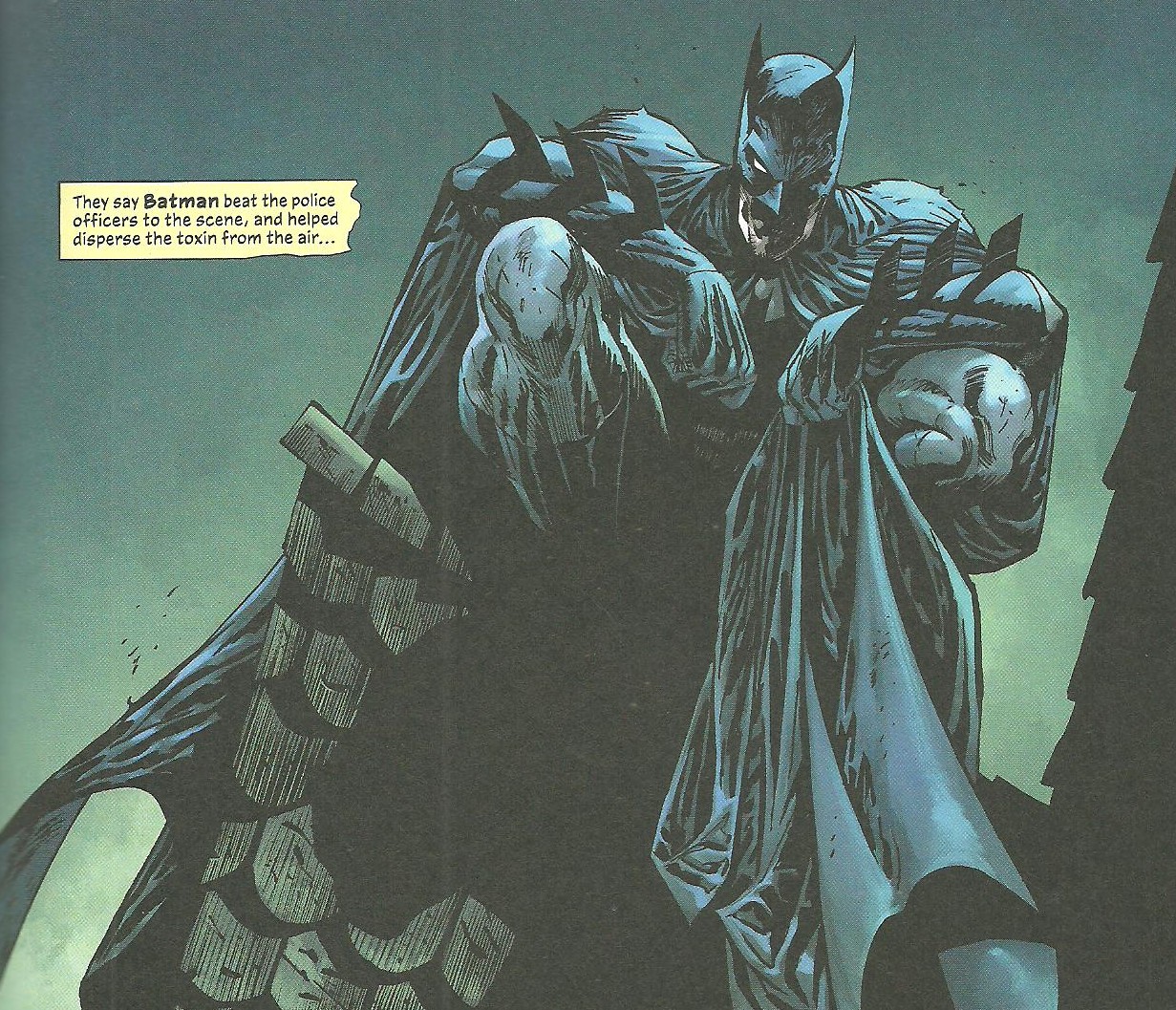 |
Batman doesn't appear as often as one might expect in The Joker, his appearances in the first collected volume mostly clustered around the beginning as the premise of the series is set up, but here's his first appearance in the book, crouching like a gargoyle on a bit of Gotham architecture, as is his wont.
It's a pretty nice image of Batman doing something extremely Batman-ly, in which he looks quite causal doing it, as if it's just an everyday part of his job, which I suppose it is. March has the ability to find the right balance, I think, between Batman as a real flesh-and-blood human being and a bigger-than-life, almost cartoonish creature of the night. (Note the musculature of his legs and shoulders on the one hand, and the blank eyes, too-big cape and the bleeding-into-shadow on the other hand.) That is, in my mind at least, exactly how Batman should appear.

When Gordon visits the grave of his son, we're presented with this nightmare version of The Joker, with multiple limbs, faces and facial features, like the character is boiling.
It certainly drives home the extent to which terrifying imagery has permeated Gordon's life, that such visions of The Joker are basically just background noise for him now.

I haven't seen much of March's Batgirl, but he does something similar with her here, and I think his depiction of the Cassandra Cain version of the character is exactly right: A female silhouette, a too-big, billowing, expressive cape, a cartoon bat from the neck up. He even has her oversized utility-belt pouches flopping while she's in action, just as her co-creator Damion Scott used to draw her.

Note the multiple visions of him in the same panel, which seems to echo the earlier vision Gordon had of him, and how March is able to exaggerate some of the character's features in the lower panel of the page, despite how exaggerated his design for the character—and, indeed, pretty much everyone's design for the character—already is.
In this story, The Joker's right eye has been replaced with a glass eye, Harley Quinn having shot his eye out at the climax of "The Joker War" story arc, and March makes good use of it throughout as just one more weird and off-putting detail of the character's face. In theat final image, it positively bulges out like it's about to pop.
Sunday, August 30, 2015
Batman vs. Tiger Vs. Batgirl vs. Tiger


What bothered me about it the most was the fact that Barbara Gordon is pretty small. I don't know how tall she is or how much she weighs, but artist Babs Tarr and others generally draw her as small-ish; she's certainly under six-feet-tall, and I would guess she weighed somewhere between 100-135 pounds. Tigers, on the other hand, are really fucking big, and really fucking strong. The writers don't give us the stats on this particular tiger, but tigers can weigh anywhere from 200-600 pounds, and Tarr draws this one as obviously bigger than Babs.
Now, that doesn't mean Batgirl couldn't take a tiger in a fight, of course, but I was thoroughly unconvinced by the way in which she defeated the tiger. She goes a round with it using pure brute strength (not terribly convincing), and then tricks it into a locked room (convincing).
Perhaps the creators of the issue were trying to spend as little time as possible on the fight, or perhaps their was miscommunication between writers Cameron Stewart and Brenden Fletcher and Tarr in terms of fight choreography. But here, again, is how that fight went down.
A tiger is loose in an office building after dark, stalks an computer programmer, and then pounces at its fleeing victim. Batgirl tackles it mid-leap (see above). This is the very next page:

The sequence might be meant to be read as Batgirl intercepting the tiger and knocking it off balance, shifting her position mid-air at incredible speed to get under it, and then using the tiger's own weight and momentum to throw it, using some kind of super-fast gymnastic judo move. That's not precisely how it's drawn, though. It looks more like she just girl-handled a tiger.
As for the rest of the fight, after it bats Batgirl away and resumes stalking it's prey, she yells "Hey, Frosty Flakes!" ("Frosty Flakes" being the Earth-0 equivalent of Earth-33's Frosted Flakes), and when the tiger rushes at her, she flips over it and it charges into an empty conference room, which Batgirl proceeds to lock it in.
I think a large part of the reason the scene bugged me was I so vividly recalled a scene in which another Bat-person fought another tiger, and I recall it being much more difficult for that Bat-person, despite his being bigger, stronger and a more experienced fighter of jungle-cats. I am referring, of course, to Batman, and this comparison gives me a good excuse to write at some length about 1990's Detective Comics #612 by Alan Grant, Norm Breyfogle and Steve Mitchell (with Adrienne Roy coloring and Todd Klein lettering), one of my favorite comics from one of my favorite runs by one of my favorite creative teams.

It is a 600-pound Siberian tiger named Rasputin, a pet of Thomas Blake, aka Catman, that has escaped from his estate. Catman was, in 1990, a rather obscure Batman villain that Grant apparently took a liking to. This is the first of at least three Catman stories Grant wrote (including "The Misfits" in Shadow of The Bat and "The Secret of the Universe" in a three-part Shadow of The Bat/Catwoman crossover). Breyfogle gave the character a striking costume design that I liked and like a whole lot; it's my favorite of all his costumes, although it would be greatly altered when writer Gail Simone started using the character as a regular in her Secret Six comics, at which point the character reached probably his highest Q-rating in the DC Universe.
Anyway, there's a tiger loose in Gotham City, Catman is looking for it, Catwoman is being accused of the mauling by a sensationalistic media, a pair of kids are driving around town in a van marked "Shrodinger Delivery" capturing alley cats in butterfly nets to sell to a lab for ten bucks a cat (while exchanging cat trivia in the course of their conversation) and Rasputin's next victim is, of course, a cat burglar. The attack takes place–where else?–but the Hottin Roofing Company.
Batman arrives on the scene as the cat is dragging the burglar's unconscious body away, and he interrupts it by swinging into its midsection (that's the panel at the top of the post, in which Breyfogle draws the force of the kick shattering the panel; not that, despite how powerful Batman and his kick look in that panel, the tiger looks merely irritated, and is only moved a few inches by the blow).
Upon discovering that the crook is already dead, Batman dodges the tiger using his rope, planning to avoid its claws while working up enough momentum to try kicking it again, when Rasputin's master Catman arrives, slicing the Bat-rope with a Catarang and knocking Batman out cold.
When he awakes, he finds himself forced into a fight against Rasputin.


While Batman and Rasputin are fighting, Catwoman arrives on the scene, and notices Catwoman. "I might have known if there was trouble, that chump would be involved," she thinks, and then takes Catman out of the fight without saying a word to anyone.

Batman realizes he can't fend off a tiger for much longer, as he's torn up, dripping blood and ready to drop while the cat is unfazed, so he decides on daring, drastic, awesome action:

He doesn't simply try to break it the way a cowboy might a mustang, though; instead, he uses the Bat-rope to try and choke it into unconsciousness:

Of the two Gotham City tiger fights that I can think of at the moment, the one in 'TEC is by far my favorite, and the more realistic of the two, at least in terms of depicting how hard it is for people to fight tigers (Batman riding a tiger, even if only for a panel or two, probably doesn't seem all that "realistic" to many readers though, huh?).
Which isn't to say that issue of Batgirl was a bad one, or to impugn the abilities of Tarr (one of my favorite artists currently drawing for DC Comics at the moment), or writers Fletcher and Stewart. It's just one poorer-than-it-should-have-been (I would have just had Batgirl shoulder or kick the pouncing tiger down, and then skip ahead to the luring/flipping/trapping sequence). And holding almost any Batman artist to Breyfogle's standard when it comes to drawing action scenes almost seems unfair. He's one of, if not the, best artists to ever draw Batman in action, as the panels above should make fairly clear (even if the pages they're printed on are now yellowed).
Sunday, December 28, 2014
DC vs. The Dewey Decimal System, Round Two

Entitled "Bats, Books and Crazy Crooks," this Jeff Parker-written, Richard Case-drawn comic is a lot of fun. Bookworm and his beatnik henchmen muscle their way in to the Gotham Public Library at closing time in an attempt to steal its rarest book, The Cleoveritas, "a repository of occult knowledge." His plan is to force Gordon to open the display case for him, but she runs off into the stacks, in order to transform into her crimefighting alter-ego.
There's just one teensy-weensy problem with the story, which, if you are a librarian yourself, you may notice in the panel below:

Now 681 is the call number for "precision instruments and other devices," although it's standard for the number to have a subdivision added to it (681.1, for example, would be the Dewey number for clocks). The book Bookworm is holding in his hand is entitled How Locks Work; locks would fall under call number 683, for "hardware and household appliances" and "comprehensive works on manufacture of hardware or building supplies."
Specifically, it should be in 683.3, "locksmithing," where you'd find books on locks that would include diagrams and detailed information on how they work.
So that brings us to the important question—who is as fault here? Did Bookworm bring that particular book with him, and just misspoke when he said it belongs under the call number of 681? As we've seen in the past, Bookworm has a rather idiosyncratic way of cataloging and organizing books when he's the one in charge of doing so.
Or did Bookworms find that book on the shelf at GPL, and it was therefore head librarian Barbara Gordon's fault that a book that should be under 683.3 was under 681? This seems unlikely, as Gordon is a conscientious enough a librarian that even when she's forced to throw books into the mouths of giant monster beatnik silverfish-men in order to keep them from devouring her, she's careful to use the activity as an excuse to weed the collection a bit.

The other alternative? Maybe writer Jeff Parker just goofed, and editor Jim Chadwick missed it. That seems most likely, but oh so preventable, as anyone can call or walk into any public library and ask the reference librarians there what the Dewey Decimal number for locks would be...
Monday, February 17, 2014
New 52 vs. DC Super-Pets: Batgirl
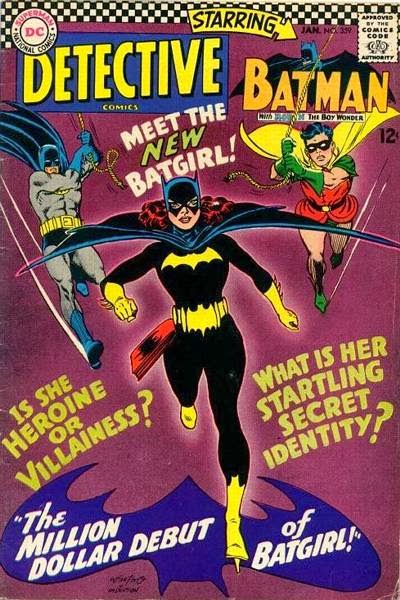 |
| Carmine Infantino's cover for 1967's Detective Comics #359 |
When she first appeared, she was waring the costume above, and it changed little over the 20 years between her debut and her 1988 retirement.
 |
| Mike Mignola and Karl Kesel's cover for 1988's Batgirl Special #1. I bought this comic from a back-issue bin specifically for the cover, and all I remember about it was that its insides were not as good as the cover. |
A few more Batgirls eventually followed in the comics. In 1999's Batman: Shadow of the Bat #83, part of the "No Man's Land" storyline, a mysterious new Batgirl in a new, all-black costume that hides her entire face appears. She's eventually revealed to be The Huntress, having adopted a bat-costume in an attempt to fill the void left by Batman, who was MIA from Gotham at the start of the story.
 |
| Damion Scott |
 |
| Phil Noto |
Here's what her new, New 52 costume looks like.
 |
| Adam Hughes |
The inside of her cape is also purple now, and, on that first cover at least, she seems to have her cape affixed with some sort of bat-brooch...that, or she's just wearing a bat-pin on her cape.
It seems that the design has ben finessed a little big already, as the underside of her cape eventually became yellow, rather than purple.
 |
| Ed Benes |
Here's how artist Art Baltazar dresses Batgirl, in the pages of the DC Super-Pets Character Encyclopedia:

Baltazar's main innovation here is that he changes her tunic into a dress—that, or she's wearing a skirt and a tunic. Baltazar's artwork is so simple and flat that it doesn't really suggest textures, so it's difficult to say exactly what material she might be wearing or how thick it might be, and therefore I can't tell if she's wearing tights or leggings under the skirt (good), or wearing pants under her skirt (bad...and weird).
As un-Batgirly as the skirt or dress might be, I actually kind of like it in the way it evokes the original Bat-Girl costume, and the way it differentiates this look from the original Batgirl costume (The costume from The Batman that I like is actually a dress over tights).
I don't think this is the best possible Batgirl costume, and I don't think the design is quite the home run that Baltazar's Animal Man costume is, but I don't like it any less than I like The New 52 design and, with some tweaks, I think Baltazar's basic design could make for a far superior costume than The New 52 costume.
***********************

Tuesday, December 10, 2013
I liked Yanick Paquette's Batgirl design from "Rotworld: The Green Kingdom"

One thing I did like though was that when Swamp Thing and Animal Man get separated for a while in Rotworld, Swamp Thing finds his way to what's left of Gotham City, and there he meets Barbara "Batgirl" Gordon. She has survived the rotpocalypse thingee by injecting herself with Kirk Langstrom's Man-Bat serum, making her at least part animal and giving her a connection to "The Red," the mystical life web that binds all animal life (Yeah, I know, humans are animals too; writers Jeff Lemire and Scott Snyder didn't really address why humans didn't count as animals in the context of this story).
On the last page of the collection, DC shares a couple of Paquette's designs for the story, including a character design for Poison Ivy, and these two pages, devoted to Gordon or, as he refers to her here, Man-Bat-Girl:


Additionally, Paquette gave some thought into what sort of clothing would fit on a body like that, on that, in this case, can change back and forth, so that sometimes it has huge bat-wings and sometimes it doesn't. So he designed her costume around that. Again, another nice solution to the problem and one that, incidentally, gives Pacquette an excuse to draw a particularly sexy Gordon with a great deal of her flesh exposed.
Here's how his Barbara Gordon looked in the final story, when in human form (Note that these pages are non-consecutive, and I'm just posting them here to look at, not read, as they don't really make much sense if you do read them like this):


Wednesday, March 07, 2012
This is kinda weird:
 DC's new website is apparently "currently in beta status," which I think means there are still some bugs to be worked out.
Here's one!
If you visit the "Characters" page, you'll see images of some of their most iconic characters (Plus Swamp Thing and Cyborg!) and, if you click on them, you'll find little biographies of the characters. I clicked on "Batgirl" out of curiosity, to see how they were handling Barbara Gordon's rebooted history and the other Batgirls (Cassandra Cain and Stephanie Brown).
It's a short, three-paragraph bio, but it doesn't mention Gordon's time as Oracle, nor does it mention Cain or Brown. But! One of the two images they use to illustrate the piece features not Barbara Gordon, but Batgirl II Cassandra Cain.
 It's a portion of James Jean's cover for 2003's Batgirl #45, from the volume of Batgirl that starred Cain. In that particular issue, Cain tries going out for a night of nocturnal crime-fighting wearing original Batgirl Barbara Gordon's costume, rather than her own.
That's likely why whoever put that image there decided to put it there, even though you can clearly see that Batgirl has black rather than red hair.
I found the mistake particularly amusing because the official DC argument for making Barbara Gordon Batgirl again—one that editors and others were making years before the publisher actually decided to reboot their continuity with last September's New 52boot—was that Barbara Gordon was the most icon version of the character, the one everyone pictures when they think of Batgirl.
Except whoever designed that page, apparently, and of all the images of Barbara Gordon as Batgirl in existence, they chose one of Cassandra Cain as Batgirl.
Fans probably shouldn't read too much into those bios in terms of what they say about the current state of DCU continuity. I didn't read them all, but I saw no mention of Martian Manhunter in the "Justice League" entry (despite using the term "Big Seven," it ends its listing of those seven with "Cyborg, a half-man/half-robot outfitted with the world’s most advanced technology"), the entry for "Robin" includes all the Robins except for you-know-who (who may not even exist in there current New 52 U) and the "Teen Titans" entry mentions Raven and Beast Boy as Titans, and pictures Aqualad, Kid Flash Wally West, Wonder Girl Donna Troy, Wonder Girl Cassies Sandsmark, Cyborg and a green Beast Boy—the images are a "Year One" image full of characters that may or may not exist anymore, and one from Geoff John's run, which the current volume of Teen Titans seems to be over-writing.
Then I stopped reading the characters' entries, because it was irritating my brain to try to make sense of them, given what I know about the DCU as it was and as it now is.
Sunday, April 18, 2010
Quick, Kick-Ass-related question


Forgive me if this is a ridiculous question, but I only made it about two issues into Mark Millar and John Romita Jr.'s gay-panicky, casually racist, delay-plagued eight-issue miniseries Kick-Ass, so I never made it to the part where pre-teen death-dealer Hit-Girl's secret origin is revealed.
I have read a lot of reviews of the new movie though, which sounds like it scrubbed the more questionable content of the comics while still managing to make the same existential error (premising a story on a realistic take on a popular fantasy genre, and then devolving into an extremely fantastic story with next to no grounding in anything approaching the real world).
Most of those are most focused on the character Hit-Girl, in particular her swearing and her ability to inflict Uma Thurman-in-Kill Bill casualties. Many of these reviews mention who she is and how she came to be, and, well, it sounds almost exactly like the origin of the 2000-2008, Cassandra Cain version of DC Comics' Batgirl.
According to the nation's film critics, Hit-Girl was trained in martial arts by her father since birth, subjected to crazy amounts of child abuse like being shot in order to learn to take a bullet, all for the purpose of turning her into a perfect killer.
Cassandra Cain was trained in the martial arts by her father since birth, subjected to crazy amounts of child abuse like having the shit beat out of her, getting stabbed and shot in order to learn how to take all sorts of damage, all for the purpose of turning her into a perfect killer.
The main difference between the two origins is that the one from the Batman comics seems a lot more realistic since a) Cassandra Cain paid a huge developmental price for all of that abuse, never learning to speak or understand English until long after she escaped from her father, and b) her father was one of the world's greatest professional assassins and spent years perfecting a training-kids-to-be-assassins program, where as Hit-Girl's father is apparently just an ex-cop.
Am I being unfair and oversimplifying their similarities, and they're actually much more dissimilar than they seem? I suppose I'll borrow a Kick-Ass trade from the library eventually, and then I'll see for myself...
Thursday, March 18, 2010
Meanwhile, in Las Vegas...
 I have short reviews of Dylan Horrocks' must-read Hicksville and Simon probably-should-read 100 Days of Simon in the last two issues of Las Vegas Weekly. You can go read them if you like.
By the way, did you know the Dylan Horrocks who wrote and drew Hicksville is the same Dylan Horrocks who had a short run on DC's previous volume of Batgirl, which kicked off with the cover above? It's true! I suddenly want to break out that longbox and re-read that run now, knowing the guy who wrote Hicksville wrote it.
I really rather liked pencil artist Adrian Sibar's weird art work, but I would have loved to see what a Batgirl run written and drawn by Horrocks would have looked like...
Tuesday, January 05, 2010
How am I supposed to read this comic when all the characters keep shouting at me?!
 It-- It is? Did I say that? How did Batgirl hear me...?
 Okay if you say so Batgirl, but-- Wait, what?
 Superman?! Grab hold to what--? Wh-- Buh-- Can you guys see me out here or what?! AAAaaaaaa!!
(Superman, Batgirl and Caleb—a fat, bald, bearded gold prospecting/hobo type in a tuxedo and cummerbund—face the awesome bird-headed villainy of Dr. Horus and his interdimensional, evil-emanating house in DC Comics Presents #19 by Denny O'Neil, Joe Staton and F. Chiaramonte, which is handily collected in Showcase Presents: DC Comics Presents—The Superman Team-Ups Vol. 1, which I promise to quit blogging about, since three posts in as many days is probably kind of pushing it, huh?)
Tuesday, September 08, 2009
Is 2008's Batgirl #1 the worst comic ever?
It's definitely a contender. Here are three consecutive pages from the comic, which was written by Adam Beechen, pencilled by J. Calafiore and inked by Mark McKenna (and I hope they're all ashamed of themselves): 

 I suppose it's technically possible for those pages to be worse. Beechen could have spelled half of those 1,500 words wrong, for example, or Califiore could have drawn the characters without necks, or perhaps even less symmetrically than he already did or something, but man, the "creative" team would really have to put some effort into making worse comics pages than these. Because that? That's about as wrong as you can possibly get a comic book.
If you read through all that dialogue—and I wouldn't recommend it—you'll see the characters aren't even really communicating throughout the second and third pages, they're merely summarizing the events of other comic books in which Batgirl appeared over the course of the last two years, occasionally adding details that happened off-panel by way of explaining the many inconsistencies between those comics and the Batgirl appearances that preceded them. It's the type of information you'd find in an Official Guide to the Marvel Universe entry, or perhaps a very thorough Wikipedia page, only put in dialogue bubbles.
That isn't comics, it's Adam Beechen trying to explain and apologize for a bunch of other shitty comic books, many of which he himself also wrote. It cost $17.94 as part of a six-month payment plan, or $19.99 to get it all at once.
New Batgirl costume to include utility garter
When DC released their solicitations for their November releases a few week's back, the cover of Batgirl #4, had the title character blotted out, so all one could see was her silhouette. At that point, the identity of the new Batgirl hadn't yet been revealed, and if they showed her hair color, it would have spoiled the surprise.
At the time, I feared I saw a bulge around her left thigh, which worried me, as utility belts-worn-around-the-thigh are hardly a sign of quality costume design:
Well, today DC revealed that I had good reason to worry. DC's Source Blog revealed the un-blotted out cover by Phil Noto (looks an awful lot like Christopher Kent's Nightwing Costume, as Noto draws it), and Lee Garbett revealed his redesign on his blog:
 Yes, her costume does have a utility garter on it. I hate those things. Not simply because they seem kinda dumb and impractical (Can she sit down wearing it? Can she run? And does she have so many Bat-gadgets they don't fit in her over-sized belt that looks like it's going to slide off her hip if she moves at all that she needs a utility garter?). No, I dislike them mostly because they seem like such a Jim Lee/Rob Liefeld circa 1992 design element. (In fact, it was right about that time that the last Bat-person who decided the best place to wear a utility belt would be his thigh tried that look out).
It's the superhero fashion equivalent of unlaced white high top sneakers.
As for the rest of the costume, I suppose it looks more realistic and more functional than a lot of superhero costumes, which I don't necessarily consider a virtue—do people read about teenage superheroines for the realism?—but I can understand why some would value that. Personally, I'm in the less-is-more camp of costume design, and the ribbing on the sides of this thing just reminds me of the old Ultimates designs, which even the Ultimates themselves have since abandoned.
Of course, I really liked Cassandra "Batgirl II" Cain's costume, which I understand was pretty unpopular, mostly on account of the creepy mask. Granted, different artists drew it quite differently, but I dug the way Batgirl pencil artist Damion Scott made it look after he hit his groove on the title. I liked the way it blended attributes of Batman's and Spider-Man's costumes: The pointy ears, scalloped cape and the spiky design on the gauntlets from the former, the bulbous, bug-like head, one-piece spandex suit and detail-free mask of the former. You could remove the more fetish-y aspects of the mask—the stitching around the mouth, switch in pupil-less white eye lenses for the black ones—and it'd still be a pretty nice look.
Additionally, it was probably the least sexualized superhero costume you could get. It was still skintight, wrapped in a cape, you wouldn't even know that Batgirl was a girl. Most of the time, she just looked like a petite Batman.
The new Batgirl costume keeps the new Batgirl covered-up, so she's not all Huntress-ed out or anything, but it does make the long, flowing hair and lips an integral part of the costume design again.
I'm not arguing that they should have kept the Cain costume, mind you. I think a new Batgirl deserves a new costume, and what worked about the Cain costume worked because of the character who wore it, but wouldn't have been transferable.
I'm just saying I don't much care for this costume...especially the utility garter.
But that's just me. If I've learned anything from the Internet, it's that there are a lot of different ways to draw a Batgirl.
At the time, I feared I saw a bulge around her left thigh, which worried me, as utility belts-worn-around-the-thigh are hardly a sign of quality costume design:
It looks like they’re going with one of those blacked-out covers, showing Batgirl in what must be a new, secret identity-spoiling costume fighting some Dark Knight Returns extras. Take special note of her thighs, particularly the left one. Is she wearing utility belts around her legs…? (?!) Oh man, I hope that new costume isn’t as bad as the presence of thigh-bandoliers would indicate…
Well, today DC revealed that I had good reason to worry. DC's Source Blog revealed the un-blotted out cover by Phil Noto (looks an awful lot like Christopher Kent's Nightwing Costume, as Noto draws it), and Lee Garbett revealed his redesign on his blog:
 Yes, her costume does have a utility garter on it. I hate those things. Not simply because they seem kinda dumb and impractical (Can she sit down wearing it? Can she run? And does she have so many Bat-gadgets they don't fit in her over-sized belt that looks like it's going to slide off her hip if she moves at all that she needs a utility garter?). No, I dislike them mostly because they seem like such a Jim Lee/Rob Liefeld circa 1992 design element. (In fact, it was right about that time that the last Bat-person who decided the best place to wear a utility belt would be his thigh tried that look out).
It's the superhero fashion equivalent of unlaced white high top sneakers.
As for the rest of the costume, I suppose it looks more realistic and more functional than a lot of superhero costumes, which I don't necessarily consider a virtue—do people read about teenage superheroines for the realism?—but I can understand why some would value that. Personally, I'm in the less-is-more camp of costume design, and the ribbing on the sides of this thing just reminds me of the old Ultimates designs, which even the Ultimates themselves have since abandoned.
Of course, I really liked Cassandra "Batgirl II" Cain's costume, which I understand was pretty unpopular, mostly on account of the creepy mask. Granted, different artists drew it quite differently, but I dug the way Batgirl pencil artist Damion Scott made it look after he hit his groove on the title. I liked the way it blended attributes of Batman's and Spider-Man's costumes: The pointy ears, scalloped cape and the spiky design on the gauntlets from the former, the bulbous, bug-like head, one-piece spandex suit and detail-free mask of the former. You could remove the more fetish-y aspects of the mask—the stitching around the mouth, switch in pupil-less white eye lenses for the black ones—and it'd still be a pretty nice look.
Additionally, it was probably the least sexualized superhero costume you could get. It was still skintight, wrapped in a cape, you wouldn't even know that Batgirl was a girl. Most of the time, she just looked like a petite Batman.
The new Batgirl costume keeps the new Batgirl covered-up, so she's not all Huntress-ed out or anything, but it does make the long, flowing hair and lips an integral part of the costume design again.
I'm not arguing that they should have kept the Cain costume, mind you. I think a new Batgirl deserves a new costume, and what worked about the Cain costume worked because of the character who wore it, but wouldn't have been transferable.
I'm just saying I don't much care for this costume...especially the utility garter.
But that's just me. If I've learned anything from the Internet, it's that there are a lot of different ways to draw a Batgirl.
Monday, June 22, 2009
PSA: Attention Ohioans! Your libraries need you!
 If you don't live in the great state of Ohio, this likely won't matter to you at all, but I know a lot of you guys do, so I figured I'd post this here. If you do live in Ohio, then you've probably heard that the state is in a pretty dire budget crunch, and needs to pass it's biennial budget by July 1. There's currently a $3 billion gap that needs closed. Among Governor Ted Strickland's plans for closing that gap is to cut $227 million from the money being allotted to state libraries.
That is an awful lot of money. The way libraries in Ohio are funded is that they receive 2.2-percent of all tax money the state collects, but because tax revenue has fallen so sharply in the rough economy, they've already been receiving less and less money from the state each month—$30,000 here, $75,000 there, and so on.
In other words, most Ohio libraries are having an extremely bad year funding-wise, and were bracing for an extremely bad rest-of-the-year, before these new rounds of cuts were made.
Now, I'm no economist, and don't have any advice for Strickland and the state legislature as far as what might be better to cut, or how they could maybe make some more money (Beyond the obvious, "Hey, maybe you guys oughta raise taxes on something other than cigarettes once in a while?"). But I'd really, really, really rather them not cut any more funding from the state's libraries, especially at the levels they're talking.
This is mostly for a very selfish reason. As some of you know, my day job is working part-time at a local library; that's how I keep a roof over my head, food in my belly, electricity in my lap top and a handful of comics in my lap every Wednesday afternoon. Most (if not all) libraries would have to cut hours of operation if their funding is cut too severely, which will likely be pretty bad news for folks like me, who are eking by on the few hours a week we work.
Also, it likely means libraries will take a hit in their materials ordering budgets, and as I mention fairly frequently, a significant amount of the graphic novels I review here tend to come from the Columbus Metropolitan Library system (which I don't work for, but they're the biggest system in town, and order pretty much any graphic novel that gets published). So I guess, in that respect, it might affect you too. At least, it would jeopardize my ability to review collections of comics too terrible or too expensive for me to pay to read (like, Jeph Loeb comics, or anything Marvel publishes at their evil $3.99 price point).
Oh, and the scanners I use to put images on my site and on Blog@ are the ones at my local library. I don't have a scanner of my own, and won't be buying one any time soon. So if my local library loses hours of operations...Christ, blogging's gonna get a lot harder.
Less selfishly, as a person who lives in Ohio, I think everyone in the state benefits from having a healthy and thriving library in their neighborhood. Free books, free graphic novels, free movies, free music, free access to computers, free research assistance—libraries offer an awful lot for very little, and are especially important in tough times like this.
So, what can you do?
Well, you can visit the Ohio Library Council's website, olc.org. You'll find plenty of info about what the hell is up exactly, from people who communicate such things a lot more clearly than I do. For example, here's how the site frames the problem:
Libraries could close or face significant reductions in operations as a result of the Governor's proposal. With some 70% of the state's 251 public libraries relying solely on state funding to fund their operations, the reduction in funding will mean that many will close branches or drastically reduce hours and services.
The Governor's proposed funding cuts come at a time when Ohio's public libraries are experiencing unprecedented increases in demands for services. In every community throughout the state, Ohioans are turning to their public library for free high speed Internet access and help with employment searches, children and teens are beginning summer reading programs, and people of all ages are turning to the library as a lifeline during these difficult economic times. Ohio's public libraries offer CRITICAL services to those looking for jobs and operating small businesses. Public libraries are an integral part of education, which Governor Strickland says is critical to the state's economic recovery. But it is unlikely that many of Ohio's public library systems, especially those without local levies, can remain open with these proposed cuts.
You'll also find suggestions of who to call or email (the governor, your elected representatives) and what to say when you do.
Anyway, if you live in Ohio and care enough to have read this far into this post, please take the five minutes or so it takes to poke around the OLC site and fire off a few emails.
********************
Meanwhile, here's what a typical night at a typical library is like:
What delightful, dynamic destruction!
Saturday, May 17, 2008
Strike while the iron is ice cold!

This past Wednesday DC debuted the first part of a new six-issue miniseries, Huntress: Year One, by Ivory Madison, Cliff Richards and Art Thibert. It's a pretty perplexing release, and retailer/reviewer Brian Hibbs lists some of the reasons in his Savage Critic review.
As Hibbs pointed out, it can't be a book that DC thought would sell terribly well. The Bat-family solo spin-offs—Nightwing, Robin, soo- to-be-cancelledCatwoman—are all doing less than stellar these days, and the Huntress isn't even part of the Bat-family proper any more. The book she calls home—Birds of Prey—only sells in the 20K neighborhood, a bit bettter than Catwoman and there's she's part of an ensemble, not carrying the book herself.
The artists attached are pretty good, and while Madison is an unknown quantity, she's the sort of unknown quantity I imagine readers will be curious about (I was pretty amused to see that her website referred to this comic book series as "a graphic novel;" perhaps it's just shorthand to communicate to "civilians" and/or the book industry, but it denotes a certain amount of shame and/or sensitivity about the word "comics"). But none of them are the sorts of big names that would move a Huntress book in big numbers, so DC can't be thinking these creators will move such a book where the character won't.
One could also raise the question of relevance, but then, that's been the case for all of DC's recent Year One miniseries.
Green Arrow: Year One re-told an origin that gets pretty regularly re-told, but boasted an interesting creative team (The Losers' Andy Diggle and Jock), came at a time when DC was clearly trying to promote the character (around the time of his wedding to Black Canary), and filled the publishing gap between the end of Green Arrow and the launch of Green Arrow/Black Canary.
Teen Titans: Year One similarly tells an origin that isn't very mysterious and which there are no questions about, but makes a certain amount of sense within DC's nonsensical attempts to flood the market with Titans books (Teen Titans, Titans, Tiny Titans and solo minis for Wonder Girl, Raven and soon Cyborg).
And then there was Metamorpho: Year One, the origin of a bit player in low-selling team title The Outsiders by a not-exactly-hot creative team.*
Of course, Huntress: Year One is unlike the others above in that it falls squarely in the shadow of another six-part Huntress origin miniseries, 2000's Batman/Huntress: Cry For Blood, which has the benefit of a higher profile writer, a high profile guest-star (and branding in the title), and being, at the time, much more relevant to other books (Greg Rucka was then writing Detective and was thus part of the Batman office's stable of creators, and Huntress was pretty firmly ensconced in the Bat-family, rather than in Birds of Prey).
From this side of things, it's impossible to tell why DC greenlights certain projects and not others, of course. Perhaps sales on the recent-ish Huntress: Dark Knight Daughter trade paperback (collecting the old pre-Crisis Huntress stories) were brisk enough that DC's data suggested the existence of a bigger Huntress market than seems apparent from where I'm sitting.
What I find most perplexing about all of this, however, is that DC decided to greenlight a miniseries telling the origin of a masked, caped, female, Gotham vigilante, and they went with the Huntress and not, oh, I don't know, Batwoman.
Remember her? The sensational character find of 2006? New character introduced to much fanfare in 52? Often said to be getting her own series (most recently here), a series that never actually materializes? Origins completely shrouded in mystery? Only had a handful of appearances?
She seems like a better candidate for a Year One mini, doesn't she? Her origin is certainly virgin territory, giving a creative reason for such a book's existence, and the fact that she has the word "Bat-" in her name guarantees a higher level of sales than a Huntress series, no matter who the creators are.
Huntress: Year One isn't the only new miniseries starring a masked, caped, female, Gotham vigilante that's not Batwoman, of course. A Batgirl miniseries is also in the works, starring Cassandra Cain. She had formerly starred in an ongoing solo series, which DC canceled not due to sales as much as to streamline the Bat-family and their line of books (presumably to make room for Batwoman and Batwoman). But since that never materialized, they've gone years without selling Batgirl or Batwoman books, and are now trying to sell a Batgirl miniseries. The fact that it is from a writer who is widely perceived as having "ruined" the character and an artist most-associated with Countdown and related projects, makes it another sure-not-to-be-a-hit book.
How did both of these books beat Batwoman out the gate? And why is DC waiting until any and all interest in Batwoman has dwindled before trying to capitalze on her now two-year-old high-profile debut? I honsetly don't know, but these not-Batwoman projects keep raising those questions.
*Meanwhile, top-tier characters whose origins could actually use post-Infinite Crisis/52 rejiggering clarification, like Superman, Batman, the JLA and, most especially, Wonder Woman, get none. I don't think we necessarily need four official Year One minis featuring those characters—certainly they'll never do another book called Batman: Year One—but stories dealing with their new origins would certainly make sense.
Thursday, December 27, 2007
Misc.
 Meanwhile, in Las Vegas…: This week’s Las Vegas Weekly comics review column features two new miniseries offering up new spins on ancient myths, The Infinite Horizon and Hybrid Bastards.
Marvel vs. DC, Round 946: Quick question—What’s a common one-word term used to refer to the artist who provides pencil-only art for a comic book, to later be inked by an inker?
Okay, yes, that’s right.
Now, how do you spell it?
DC spells penciller with two l’s in their credit boxes, whereas Marvel spells penciler with one l. My spellcheck always underlines them both in red to let me know they’re spelled wrong (it also underlined “spellcheck” just now). I always assumed that it was because it was comic book jargon and not widely enough used to pop up in a spellcheck program.
But why do Marvel and DC differ on the spelling?
I’ve been finding myself writing it out as “pencil artist” so as to avoid finding a definitive answer. I haven’t pulled out my long boxes and done and exhaustive search or anything, but, just casually looking at my usual Wednesday stacks of super-comics, and now, just double-checking the past week’s, it seems Marvel and DC are purposely spelling the word differently.
Has anyone else noticed this? Does anyone know how long this has been going on? Or why this is going on?
If anyone has any further information on this matter, do let me know. It’s stuff like this that keeps me up at night.
And on the subject of spelling, is the term “the direct market” a proper noun or not? Should I capitalize the d and the m or no?
And how come so few comics bloggers capitalize the I in “internet” when referring to “the Internet?” That is a proper noun, unless it’s being used as an adjective, right?
 As a comic book writer, she makes a fine prose novelist: I finally got around to reading Jodi Picoult’s entire five-issue Wonder Woman run, recently collected in a pretty thin $19.99 hardcover. (I had previously only read Picoult’s first, very disappointing issue before I decided to just wait until I could read it for free from the library, as “nothing at all” seems to be the amount of money the story would be worth).
It doesn’t get any better after that first issue, however, and it’s actually pretty surprising how bad it all is. I really can’t fathom how this all came about; did DC really think a name writer with the kind of book store/library cred as Jodi Picoult would be best applied to tap-dancing between the continuity points established by Allan Heinberg and the Amazons Attack! crossover?
It’s a really nicely designed trade, and has an introduction from Picoult herself, which Tom Spurgeon noted “feels like a defense attorney's opening statement.”
 The art throughout is mostly pretty solid, although there are some badly choreographed scenes that look like they had dialogue rearranged or something the night before deadline (Note the panel on the right). But it’s a really uncomfortable amalgam of plot points culled from continuity (Max Lord’s murder, Hippolyta’s death, Circe’s history, what’s up with the Amazons post-Infinite Crisis, Amazons Attack!, who the hell is Everyman, etc.) and characterization made up wholesale by Picoult.
Her Wonder Woman as fish-out-of-water comedy, flirting with Nemesis-as-TV’s-Steve-Trevor might have made for a great original graphic novel or Elseworlds or All-Star type story, but for a relevant DCU event bridging crossovers? Come on.
Rereading her intro after the story arc itself, this part grabbed my attention:
I decided to undertake the challenge for a few reasons—because it was something I’d never done before; because I’d always been a fan of Wonder Woman (who hasn’t?); because I’d admired other writers who’d seamlessly moved between fiction and comic books (Brad Meltzer foremost); and because I would be only the second woman to write the comic book in its long history.
The fact that she chose Meltzer as an example of someone who had “moved seamlessly moved between fiction and comic books” instead of, say, Greg Rucka, is pretty telling. (Perhaps just as telling? She uses the word “fiction” instead of “prose;” “comic book” is a medium, “fiction” designates whether a work is true or not. Meltzer’s prose novels and comic book work are all works of fiction, just as Picoult’s prose novels and Wonder Woman work are fiction).
Like Meltzer, Picoult over-narrates her comic books a bit too much, although it’s worth noting she sticks with one narrator per issue, making her five comics a bit more clear and easy to read than some of Meltzer’s twenty-some comics.
She also seems to view writing serial comics as a sort of relay race, in which a writer need not resolve their own story, but simply stop at some point and hand the characters and the subplots they’ve introduced on to the next writer.
Meltzer’s done this with everything he’s written. “Archer’s Quest” had a pretty dramatic turn in the relationship between Oliver Queen and Connor Hawke that was introduced but left unexplored. Identity Crisis was really nothing but turns in characters and plots, few if any of which were ever resolved, and which DC writers have been working at making sense of ever since. Similarly, his four-story JLoA run was full of changes and sub-plots he had no intention of resolving; he was simply seeding the book for future writers.
Picoult’s run takes that concept to a more dramatic level, as she doesn’t even resolve the main conflict in an equivocal, open-ended way. The graphic novel ends with one character holding a knife to our heroine’s throat. Her love interest is poisoned and dying. There’s a nuclear missile pointed at the island home of the Amazons. The U.S. military and JLA are still warring with the Amazons in Washington D.C.
And that’s the end of the book.
When I’d read Spurgeon’s review a while back, he noted that it ends with “a ridiculous cliffhanger ending that asks readers to buy yet another book after dropping 20 bucks on this one,” I assumed he was simply referring to the book leaving some subplots unresolved. But no, it doesn’t resolve anything at all, and it doesn’t merely end with a “to be continued” in the last panel, but the last page is actually a full-page ad reading, “Find out what happens next in Wonder Woman: Amazons Attack.”
What a thoroughly despressing book. This had the promise of one which could help evangelize the medium, bringing new readers to comic books, and now I fear all it will accomplish is making sure any who do pick this up as their first graphic novel to simply swear them off for life.

And speaking of Spurgeon and crappy Wonder Woman stories… Spurgeon recently interviewed Catwoman writer Will Pfeifer, the man responsible for Amazons Attack!.
It’s a pretty interesting and wide-ranging interview, one which reminded me how much I liked the 1999, Jill Thompson-illustrated Vertigo mini Finals, which was apparently Pfeifer’s comics debut.
He seems pretty honest about the nature of Amazons Attack! and t he frustrations of writing books like it:
I've worked on a few crossovers before, but this is the most closely I've been involved. It was almost a year ago exactly that I went to the DC offices for a weekend. We sort of plotted out the whole six-issue series, and we talked about all the tie-ins and this and that. When you're working on a big crossover like this, a lot of the plotting is just connecting the dots in a way. This is going to happen here, we'll deal with this here, and then over in Teen Titans this will happen, and then we'll deal with this, and then we'll deal with that. Readers may not like it, and in some ways it can be a pain to write, but that's what a lot of modern comic books are. The big ones that sell and the big ones that people seem to like are the ones that have crossovers crossovers crossovers. When you're writing it, the object is to hit those plot points. As a writer you try to work in those human emotions and twists and surprises and fun and action along the way. But you have to hit point A, B, C, and D because in another book, somebody's going to be hitting it.
It’s pretty funny watching him and Spurgeon sort of make sense of it all:
I think at its most basic, people have an idea about whatever superhero or character they love and have their ideal version of that character somewhere in their head. When you go against that version, some people are going to react very strongly. Amazons Attack! is right there in the title. They kill that guy and his kid on the very first page. People were really upset about that. But it was supposed to be shocking. It was supposed to be upsetting. It wasn't supposed to be a triumphant moment for the Amazons. People who have been reading Wonder Woman for however long they've been reading Wonder Woman —and some of them have been reading for a long time —they didn't like the fact that the Amazons were attacking and were evil. They also didn't like the fact that in Amazons Attack! that there wasn't enough Wonder Woman, and that Wonder Woman wasn't driving the plot along. The reason for that is that there's another book called Wonder Woman [Spurgeon laughs] where all that was happening.
While I don’t think anyone really wants to read superhero comics about people slaughtering innocent children on the first page, I doubt that (or the lack of Wonder Woman in the story) are the reason people reacted so negatively. I think it was more the fact that the story wasn’t any good, and didn’t make any goddam sense, not only within the context of the DCU and its history, but within the pages of the series itself.
Was that Pfeiffer’s fault, or the person who asked him to hit A, B, C and D? Because, B didn’t go with A and C, and D kinda cancels out A, and you can’t have B and C in the same story at the same time and expect it to make sense.
Regardless, this is one of those instances where it’s hard to feel too sorry for a comic book writer who wrote some shitty comics and then said it wasn’t entirely his fault (like JMS recently did with One More Day). Nobody makes you write these comics, and accepting the embarrassment that comes from writing bad ones—whoever’s bad ideas are ultimately fueling them—is part of the process. The writer’s name appears on the cover of the book, just like it does on the paycheck.
The cardinal is the state bird, the Pekar is the state curmudgeon: My fellow Ohioans, have you seen this political cartoon collaboration by Harvey Pekar and Nick Bertozzi yet? No? Then go read it. I love the use of the shape of the state as a lay-out, and I’ll be damned if Bertozzi doesn’t draw the scariest Pekar I’ve ever seen (I really like that Pekar is a lot like Batman; every artist finds a slightly different facet of the character). I would totally buy a set of postcards based on the “Greetings From Ohio” part, with the weird close-ups of a glaring Pekar in each letter…

This has very, very little to do with comics: Chris Ware designed the logo and poster for writer/director Tamara Jenkins’ latest movie, The Savages .
It doesn’t have anything to do with comics beyond the fact that Ware designed these, however. (The aesthetic of the film, and its melancholic sense of humor, sort of aligns with that seen in Ware’s work, though). It opened in Columbus on Christmas; if you’re so inclined, you can read my review of it here.
The other movie that opened in Columbus this week that’s well worth a trip to the theater? Juno, in which J. Jonah Jameson’s teenage daughter Kitty Pryde gets pregnant, and decides to have the baby and give it up to Elektra for adoption. That’s reviewed here.
 Fanboys For Pele: I love comic books. And I love the music of Tori Amos. So the announcement of a an Image Comics-published anthology of short comics stories based on or inspired by her work should be something I’m really pumped about.
And while I can’t wait to read it, I’m not going to get my hopes too high at this point. Image’s Put the Book Back on the Shelf, which did the same with the songs of Belle and Sebastian, another favorite, was a pretty mixed bag—some stories were great, some were interesting, some were godawful. Since Amos’ work seems to be much less narrative than Belle and Sebastian’s, I’m really curious to see how it will translate to adaptation—it should definitely give creators a bit more leeway.
Thinking back, I can recall relatively little about the Belle and Sebastian anthology, with only the very best stories and the very worst sticking in my head. I do recall it being a really fun reading experience though, as I broke out all the Belle and Sebastian CDs and read the stories while listening to the songs. I look forward to doing the same with the Tori Amos anthology.
As with any anthology, the contributors will make or break it more than the concept. News of who’s involved is still trickling out, but at the very least, it will include work from Hope Larson, Colleen Doran, Lea Hernandez, Chris Arrant and Star St. Germain, and Columbus’ own Tom Williams.
One of the first places I saw the project announced was at The Beat, and man, there are times when I have no idea what Heidi MacDonald is talking about:
Amos is one of early adapters in the comics/media crossover trend, due to her friendship with Neil Gaiman (the two were introduced by Hoseley) resulting in many lyrical and comical mentions of one another over the years.
What exactly is “the comics/media crossover trend?” Comics is a medium. Is she referring to Amos’ music as “media” and comics as “comics?” And regardless, I don’t understand the implication that Amos is “one of the early adapters.” Amos has never written or drawn any comics, and these are the first comics stories based on her music. She read comics and was friends with Neil Gaiman, who is rumored to have based Delerium’s final look and personality on Amos, but does that make one an “earl adapter?”
Sometimes I get a real “Biff! Bam! Pow! Holy Watchmen Batman, Comics aren’t just for kids anymore!” vibe from The Beat, which is odd, given that it’s a comics-specific blog, you know?
And speaking of Tori Amos and comics… I’ve been enjoying the hell out of Nathan Rabin’s “My Year of Flops” series at The Onion AV Club. It’s exactly what I think criticism should be—so well-written and entertaining to read, it doesn’t matter if you’ve seen or plan to see the film being discussed, because the review itself has great value in and of itself. Anyway, Rabin gets around to one of the worst comic book adaptations of all time, Howard the Duck.
And he points out that Tori Amos was up for the part of Beverly.
Which means this could have been Tori Amos:
Or, worse yet, this:
Rabin also spends some verbiage belittling Y Kant Tori Read, Amos' pre-solo career rock band that really wasn’t so bad. I kind of liked that album! In fact, I liked more songs on it than on Scarlet’s Walk. And I’m not ashamed to admit it.
Well, I’m a little ashamed, but not so ashamed that I won’t admit it anyway.
 Dear Dan DiDio.... Last week’s “DC Nation” column saw Dan DiDio in teasing mode, presenting an annotated Christmas list from various DC characters.
Let’s parse it at exhausting length, shall we?
Superman— A new place to call home.
Lately it seems like Superman goes through Fortresses of Solitude like water, but since Geoff Johns and Kurt Busiek so recently gave him his latest (basically the one from Johns’ sometimes co-writer Richard Donner’s Superman movies), I’m going to guess he’s keeping those digs for a while.
And I doubt he’ll be moving out of Metropolis any time soon, as Busiek’s done a lot of work building the city up, with new geography and city services and such like.
So, I’m going to guess this refers to some sort of New Krypton, as the two Superman writers seem very interested in new Kryptonian history.
Superman Prime— A time to call my own.
I don’t care. Sorry.
Batman— More time.
I’m assuming this is just a joke about how busy Batman is, and if it’s a tease of some kind, it’s pretty vague. I mean, at any point in his fictional career Batman could have asked Santa and/or Paul Levitz for the exact same thing.
Robin— A memorial for Stephanie Brown
This is the one that has clearly set the most tongues a-wagging, or at least fingers a-typing. The request is of course scratched out, with the words “Can’t Do!” atop of it. For someone who claims not to pay too much attention to the messageboards and blogosphere, DiDio sure knows how to tweak the online fans, doesn’t he? Assuming he’s not just being a dick, this seems to be another strong indicator that Spoiler’s on her way back to life.
Does that mean the godawful costume the girl going by the name “Violet” in upcoming Robin solicits is a resurrect Spoiler? Ugh. If that’s what she’s going to be wearing, maybe she should stay dead.
Come on Mr. DiDio, didn’t you see Project Rooftop’s redesign Stephanie Brown thing a few months back? Particularly Dean Trippe’s wonderful design?
Anyway, I’m more interested in the fate of Spoiler as an observer than a fan at this point. I never much cared for her outside the pages of Batgirl. The fact that she died at all, or that Batman never gave her a monument never really upset me, certainly not as much as I was upset by the fact that she died in a terrible story that didn’t make a lick of sense, and that she died from being tortured within an inch of her life and then from having Bruce Wayne’s lifelong friend and pacifist Doctor Leslie Thompkins deny her care to teach Bruce a lesson.
God…
I like the idea of Robin asking for a memorial for his dead ex-girlfriend for Christmas from Dan DiDio, though. If Tim Drake wants a memorial to Stephanie, then it’s easy to imagine some pretty uncomfortable conversations around the table at Wayne Manor, with Tim being all like, “Sooooo, have you given any more thought to erecting that memorial to Stephanie yet?” and Bruce being, “Oh look, it’s the Bat-signal! Gotta go! We’ll talk later!”
Batgirl— My very own mini-series
This one made me laugh. Assuming they’re talking about the current Batgirl, Cassandra Cain, she had her own monthly ongoing series which was selling adequately (not great, but not any worse than much of DC’s DCU line) but it was cancelled to…I forget the exact phrasing, but it was along the lines of streamlining the Bat-books (Apparently by just two titles; Batgirl and Gotham Knights).
So a new miniseries featuring a character who, just a few short years ago, was strong enough to carry her own title, seems like an odd move. After all, DC spent the last few years chasing away her relatively few fans and sabotaging the character as much as possible*, and now they’re looking to capitalize on the severely diminished returns for 4-6 months?
Red Tornado— A new body and a family to call my own
As Patrick pointed out in the comments section the week I reviewed JLoA #15 (the issue in which Red Tornado’s body was destroyed), his body is supposedly indestructible.
And that’s not, like, some obscure trivia from mentioned in a single issue of the pre-Crisis volume of Justice League of America or anything, but it was, like, the whole point of Brad Meltzer’s first arc on this very series, “The Tornado’s Path.” The new, smart Solomon Grundy wanted to put his brain into Red Tornado’s immortal android body precisely because it couldn’t be destroyed, and thus Grundy would never have to die and return to life again.
I find it almost as amusing as it is irritating that not only did Dwayne McDuffie, the JLoA writer who followed Meltzer, not really read Meltzer’s stuff too closely, but neither, apparently, did DiDio.
Not sure what to make of the “a family to call my own” comment. Does that mean in addition to Red Tornado’s wife and daughter, who also appeared throughout “The Tornado’s Path?” That story was just last year. It was the best-selling thing DC published. Surely DiDio read it, right?
Green Arrow— My son back
Black Canary— My husband’s son back
Man, this list of teases is terrible for my blood pressure!
Here’s hoping that having the stars of Green Arrow/Black Canary ask for Green Arrow’s son Green Arrow back means that Connor Hawke isn’t really dead, and/or that these items tease a story about bringing him back and are not, in fact, intimating that the next few months of Green Arrow/Black Canary will be devoted to mourning his death.
Whether he’s dead-dead or just temporarily dead, in either case it shows writer Judd Winick’s lack of imagination. When Connor Hawke was shockingly killed at the end of the last issue, he either seemed to die but will be back soon (like Oliver Queen in the Green Arrow/Black Canary Wedding Special of a few months ago), or he actually died, like all those characters in Judd Winick’s Titans East Special #1 from a few weeks back.
Darkseid— The Fifth World
Don’t care to the point in which this is part of Countdown, but may start caring if this is an element of Final Crisis, as the writer of the latter, Grant Morrison, mentioned the coming of the Fifth World back during the climax of his JLA run.
The Rogues— Revenge!! (A sentiment shared by all the villains in SALVATION RUN)
Revenge? For what? Instead of giving them the death penalty or putting them in jail for life for the murder of Bart Allen (in addition to any and/all other crimes they might have committed), The Rogues were handed their favorite clothes, their very powerful weapons, and then sent to a planet free of superheroes to do whatever the hell they want until one of the many super-brilliant mad scientists there figures a way to spring them all. I really fail to see the drama—or logic—in Salvation Run.
Mongul— A ring collection
The last issue of Green Lantern Corps ended with Mongul getting a Sinestro Corps ring, and I imagine he’ll therefore be fighting some ring-slinging Green Lanterns soon.
DiDio’s end of the year interview with Matt Brady at Newsarama was illustrated by a piece of art depicting Mongul with three different colored rings.
The rings in the image all have the Green Lantern symbol, rather than the various pictograms the new rings are supposed to bear. Because of that, it reminded me of the Mark Waid masterminded epic The Silver Age from a few years back, in which Lex Luthor and his villainous allies created their own special power-rings, which looked and worked like Green Lantern rings, but were different colors.
I’m really surprised that event hasn’t been collected into trade yet, given how many great/popular writers and artists were involved, and that so much of recent DC history has been driven by the characters it featured (The Silver Age League including Green Arrow and Black Canary, Elongated Man, The Secret Society of Supervillains and so on, plus a one-off iteration of the Seven Soldiers of Victory).
(An aside: I’m apparently not the only one who noticed the similarity between Geoff Johns’ rainbow corps and Waid’s Silver Age story, or the fact that the later is overdue for trade collection. I am, however, the slower to post about it one).
Geo-Force— Rock samples from another planet
Don’t really care at all, but I wonder if this will have anything to do with GF’s mysterious power problems Meltzer introduced but never resolved in JLoA.
The Question— A visit from an old friend
The real Question coming back to life? Nah, probably just Batwoman appearing in one of the issues of the Crime Bible series…
Speaking of which, I don’t see Batwoman requesting her series starting any time soon. Or Manhunter requesting her series resuming any time soon, either.
Booster Gold— The Blue and Gold back in action
Seconded!
Looks like that’s what we’ll be getting in the next few issues of Booster Gold, March’s issue of JLU and March’s issue of Blue Beetle.
I get the feeling Ted Kord won’t actually be coming back for real at the end of this upcoming Booster Gold story, but, as I’ve said before, I hope he does because it’s only a matter of time before someone brings him back to life, so better to have it happen through the agency of a time-travelling Booster Gold than via something silly like, I don’t know, magic herbs, as in colleague Ice’s recent silly resurrection.
Lord Satanus— Control of Hell
Neron— Control of Hell
DiDio’s notation has arrows pointing to their requests, with the words “Uh-oh, this could be a problem.”
Sounds like this refers to Keith Giffen’s upcoming limited series about a war for control of hell, which he discussed with fellow Columbusite and Newsaramite Vaneta Rogers during an interview posted the other day.
Giffen’s an experienced storyteller, but man, I’d kinda hate to have an assignment like this. After all, stories of power struggles in DC’s Hell have been previously told by the likes of Garth Ennis, Alan Moore and Neil Gaiman.
*Batgirl appearances since the end of her own series, but before this month’s Outsiders #2?Robin: Boy Wanted written by Adam Beechen, who left the title shortly afterwards; “Titans East” by Geoff Johns and Beechen, the conclusion of which (by Beechen alone) is in the running for the worst DC story ever published (I think it’s a tie with JLoA #10, the conclusion of “The Lighting Saga”), a few pages of World War III by Keith Champagne and/or John Ostrander and/or whoever gave those poor bastards a set of plot points and said, “Here, make a script of some kind out of this, would ya?”, and the issue of Supergirl in which this happens:

Subscribe to:
Posts (Atom)



