Showing posts with label bissette. Show all posts

Monday, February 09, 2026

Some non-comics books I've read recently.

Flywheel, Shyster, and Flywheel: The Marx Brothers' Lost Radio Show (Pantheon Books; 1988) What an unexpected treasure this book was. I forget exactly how I came across it. It was either mentioned in Noah Diamond's Gimme a Thrill: The Story of I'll Say She Is, The Lost Marx Brothers Musical, and How It Was Found (BearManor Media; 2016), or it came up in a library catalog search for Diamond's book (You'll note the titles share the words "Marx Brothers" and "lost"). 

The book consists of the scripts for the 26 episodes of a 1932-1933 radio show starring Groucho and Chico Marx entitled Flywheel, Shyster, and Flywheel, wherein Groucho played lawyer Waldorf T. Flywheel and Chico played his shiftless assistant, Emmanuel Ravelli (The show was originally, briefly called Beagle, Shyster, and Beagle, until a real lawyer named Beagle complained).

While radio was of course extremely popular at the time, the industry wasn't in the habit of recording each episode of each show for posterity, and so Flywheel was never recorded. Hence the show being lost. As to how it was found, the scripts were submitted to the copyright office of the Library of Congress, where they were put in storage...and apparently unearthed by this book's editor, Michael Barson. 

As to why it was just Groucho and Chico, well, Harpo's silent schtick obviously wouldn't have translated to radio very well. It's possible to imagine him in the show, I suppose, making the occasional honk on one of his horns to let the audience know he was there, but his character would have mostly been talked to and talked about, with the actor not actually having much of anything to do. (As for Zeppo, he was technically still part of the act at that point, but I guess they didn't need a regular straight man for the show.)

That means the entire show was, for the most part, like the occasional Groucho/Chico scenes from the Brothers' filmography. Lots of wise cracks and lots of puns—the latter usually followed immediately by Chico declaring "That's a some joke, eh?", preempting groans. The book may just constitute the longest and most dense example of Marx Brothers humor, certainly of the verbal variety. It's also among the densest comedies of any kind I've encountered, with almost every line of dialogue containing a joke of some kind; they are not all great jokes, mind you, but they sure are frequent. 

The basic law office premise lasts for a while, but as the show goes on, more and more often the characters find themselves in different situations and settings, some vaguely related to the legal business, others not so much (taking a walking trip vacation, going camping, stowing away on a cruise ship ala Monkey Business, etc.). 

It is thus a rather unusual sort of situation comedy, one in which the particular situation rather frequently changes, while the characters remain the same; it is the characters, after all, from which the humor emanates, rather than the particulars of the situation.

And for anyone who has seen much of the Marx Brothers' filmography, the characters here are extremely familiar. Groucho and Chico, of course, don't play Flywheel and Ravelli so much as they play Groucho and Chico, the same characters they play in all of their films. (If one hasn't seen any of their films, I wonder what they would make of the scripts in this book, as familiarity with the Marx Brothers' work makes it easy to imagine them physically in the stories of the show and to hear their voices in one's head; of course, if one wasn't a prior fan of the Marx Brothers, I'm not sure that one would even have any interest in reading this book.)

Some of the jokes will also sound awfully familiar to Marx Brothers fans. Again, the show was on the air from 1932-1933, which means after their Broadway success and their films The Cocoanuts, Animal Crackers and Monkey Business, during the same years as Horse Feathers (1932) and Duck Soup (1933) and before A Night at The Opera (1935) and A Day at the Races (1937).

Some specific jokes heard in their films, both those released before the radio show and those released after, show up, with whole sections of The Cocoanuts and Animal Crackers being repurposed for the show, accounting for about two and a half whole episodes. (If you've seen those films dozens of times as I have, these episodes of the show will read somewhat tediously, although it is interesting to see the familiar routines slightly tinkered with, as with new stand-ins for the films' characters appearing, or with Chico assuming lines previously spoken by Zeppo or, more oddly still, Groucho himself.) 

The show works both ways, though. While jokes from some films are repurposed here, some of the specific gags used in the show appear in later films...and an entire film seems to have been based on the scenario of an episode of Flywheel

In one episode, Flywheel and Ravelli take over the management of a failing department store for one of their clients, who goes on vacation and leaves it in their care. This, of course, tracks pretty closely to the premise of 1941's The Big Store, wherein Groucho and Chico's characters are also named Flywheel and Ravelli, respectively. 

Though the Marx Brothers are, of course, immortal in the world of comedy, not all of their jokes are timeless, and this show contains some that have aged especially poorly.

The Brothers' treatment of women in their comedy is well known and, perhaps, even notorious. There's only one recurring female character in the show, Flywheel's secretary Miss Dimple, who is mostly there by necessity. When she's not serving as the occasional straight woman to bounce gags off, she's there to set the scene and move the plot along. Most shows open with her at her typewriter answering a phone; in the later episodes where the Brothers' characters are in a setting other than the office, she answers the phone and tells whoever is on the other line that they are not in, and where they are, setting up that scene.  

Almost all of the other women to appear are Margaret Dumont stand-ins (sometimes quite literally, as some of these characters take on her role from the sequences lifted from The Coconuts or Animal Crackers). They are of course subjected to barbs about being old, unattractive, overweight, lacking in intelligence or otherwise undesirable, the inherent cruelty of these jokes somewhat mitigated by the class differences between these ladies, who are inevitably rich society ladies, and the Brothers' characters, who are (here, especially) low-class, poor and even criminal (Especially Chico's Italian immigrant persona).

There are a few rather unfortunate, even ugly sections of racial humor too, of the sort that never really made it into the movies (two examples to the contrary to follow). There are two sequences that make some fun of Indian characters, and by "Indian" I mean both those from India (as in one episode where the characters are thrown off a train in their nightshirts, and are thus mistaken by a society lady as Indian spiritual leaders in their ceremonial robes) and Native Americans (as in a scene from an episode where Flywheel and Ravelli go camping and have an "Indian guide" named Chief Pain-in-da-Face). One joke in the latter scenario, a pun based on smallpox, actually shocked me.

There are also a few more fleeting racial jokes, including one about a Native American and another that refers to the yellow skin of Japanese people. 

The most interesting of them all, however, is a Groucho joke that echoes a rather notorious punchline of his from Duck Soup

After mentioning he may have been a little "headstrong" to another character in that film, he continues: "But I come by it honestly. My father was a little headstrong. My mother was a little arm strong. The headstrongs married the armstrongs and that's why darkies were born."

The reference to "darkies" here often comes up in discussions of the Marx Brothers' more controversial humor and whether it could be racist or not (The other scene pointed to by critics? The brief scene in 1937's A Day at the Races where they smear grease all over their faces and try to blend into a crowd of Black characters. There are certainly some other cringe-worthy moments in their oeuvre, but these two seem to be the most cited).

It's not hard to see why Groucho's reference to "darkies" would be offensive, especially coming as it does following a line about two families mixing, suggesting miscegenation. In fact, it seems the only way to read it. For years it was censored during television rebroadcasts of the film. 

The actual reference is probably lost on most people hearing it today (and long was to me until I read more about the Marx Brothers in adulthood), but Groucho was, rather nonsensically, referring to a now mostly forgotten popular 1931 song, "That's Why Darkies Were Born." That song, by the way, sure sounds pretty racist, its lyrical content evoking the problematic image of the happy slave. It was also originated in a Broadway revue where it was performed by a white singer in blackface.

The reference may still be racist, of course, but, at the time, it wasn't as completely random as it now seems.

Anyway, Groucho again makes a reference to "That's Why Darkies Were Born" in one of the Flywheel episodes. In this particular scene, Flywheel and Ravelli are acting as movie producers, and they pitch a scenario about a young woman's tragic story to a studio man named Blitzen.

CHICO: Boss, da rest of the story comes to me like a flash. Da wife, she feelsa very bad. She goes into mourning. She sits in da house all day long playing da piano. 

BLITZEN: In mourning and she plays the piano? 

CHICO: Well, she plays only on da dark keys.

GROUCHO: Certainly. That's why dark keys were born.

The joke doesn't really make any sense unless you're familiar with the song, as the radio audience of the time would have been. Today, it makes no sense, as the phrase isn't at all common. In fact, I only recognized it as a joke at all because I've read so much discussion of the Duck Soup reference. 


The Monster's Bones: The Discovery of T. Rex and How it Shook Our World (W.W. Norton and Company; 2022) As the sub-title states, David K. Randall's book is about the discovery of the first  Tyrannosaurus rex skeletons in 1900 and 1902, and naming of it in 1905. But it's a 235-page book, so it covers a lot more ground than that.

Randall bookends his novel-like non-fiction story meditations on "the monster" of the title, a prologue set at the American Museum of Natural History, and an epilogue about its place in our culture. 

Between them, is what is essentially the biography of the man who discovered those first skeletons in Wyoming, Barnum Brown, who led a big, bold life full of exciting adventures that spanned the last decades of the 19th century and most of the 20th. Travelling the world in search of dinosaur fossils and those of other prehistoric creatures, a writer could hardly ask for a better subject. 

And it also contains quite a bit of set-up, retelling the story of European science's discoveries of the true age of the Earth and of the first dinosaurs and other prehistoric animals, and the gradual grappling of such concepts as deep time and extinction after centuries of accepting the Bible's Book of Genesis as authoritative.

Thus, readers who have previously read books on the early years of the discovery of dinosaurs and early paleontology will encounter plenty of old friends within this story of Brown and the T. rex, a diverse set of historical characters that includes Mary Anning, P.T. Barnum, Edward Drinker Cope, Arthur Conan Doyle, Georges Cuvier, Charles Darwin, Benjamin Waterhouse Hawkins, Thomas Henry Huxley, Charles Knight, Othniel Charles Marsh, Richard Owen and more...even Merian C. Cooper and Willis O'Brien, both of whom we will get to in a bit.  

While all of that is quite interesting, Randall's focus remains on the life of Brown and the discovery of the T. rex, the latter put in the context in various philanthropists and museums racing one another for bigger and better dinosaur bones to exhibit to the public, a race which initially seemed focused on the huge sauropods...until Brown found the biggest carnivore that ever lived. 

In this respect, Randall's book is both a thorough, well-written and quite readable retelling of the story of humanity's discovery of the dinosaur that is simultaneously the story of Brown and his most historic discovery.  

Quite surprising to me, as I neared the end of the book, I found that it dovetailed with something I had spent a lot of time thinking and writing about over the course of the last few years, the giant monster movie. See, for all his other accomplishments, Brown also advised "a former newspaper cartoonist turned marble cutter named Willis O'Brien." 

Today we know O'Brien for his later career, as a film special effects maestro who bought the title character and his dinosaur neighbors to life in 1933's King Kong

In 1914, O'Brien wrote to Brown for advice on dinosaurs, and the latter advised him on the subject, for what became O'Brien's The Ghost of Slumber Mountain, which Randall says was "the most realistic dinosaurs yet displayed on film" and was also the first time that a T. rex was "a screen villain."

O'Brien would later bring dinosaurs to life for 1925's The Lost World (in which Arthur Conan Doyle's allosaurs from the book are replaced with a T. rex) and then Kong, which famously featured the giant ape battling a T. rex. 

While Randall doesn't say so in his book, I think it's safe to say that the T. rex played an integral role in the development of the giant monster genre, given its prominent appearances in foundational films King Kong and Lost World...and, as I've read in another book during my research of giant monster in film, the T. rex also played a role in the development of the character we now consider the genre's standard-bearer. Along with the stegosaurus and the iguanodon, the bipedal T. rex, especially the upright standing one conceived and popularized artist Charles Knight, was an essential element in the creation of our old friend Godzilla. 


The Paranormal Ranger: A Navajo Investigator's Search for the Unexplained (William Morrow; 2024) In some parts of the world of paranormal investigation, a witness who has had multiple sightings or encounters can sometimes raise a red flag. After all, if creatures like Bigfoot or mysterious flying vehicles with inhuman pilots are so rarely seen, what are the chances that a single individual may do so twice, thrice or a half-dozen times?

Stanley Milford Jr., a retired Navajo Ranger who had spent over 20 years in law enforcement before writing The Paranormal Ranger, is one such individual who has had many encounters of various kinds. 

He has seen UFOs and, as a child, experienced unusual, equivocal phenomenon in his house that he attributed to the supernatural. He also saw what he believes was a skinwalker running alongside his car one night, and, years later, a strange, shadowy entity that confronted him while he was sleeping. He saw Bigfoot. An investigation into a haunted office building yielded plenty of activity, including a strange phenomenon that followed him around for years. And, most troubling to me, one night he awoke paralyzed in his bedroom to find a creature meeting the classic description of a "Grey" alien standing at the foot of his bed, apparently after it had examined him (He noticed his clothes were on inside out after the encounter).

That's...a lot, even spread out over a lifetime. But does Milford having experienced all of that himself necessarily provide reason to doubt him? Well, he was actively investigating the paranormal throughout much of his career, and if one goes looking for Bigfoot and ghosts and aliens, is it really that unusual that one will eventually find them? 

Among his other law enforcement duties, Milford and his partner Jon Dover pretty much accidentally became his department's go-to investigators of paranormal activity, a sort of real-life, southwestern Native American answer to The X-Files

Apparently, at one point an older woman had called the rangers regarding a Bigfoot sighting on her property—the creature apparently stepped into her sheep corral and walked off with one of her sheep in its arms—and the rookie officers sent to follow-up with her didn't treat her particularly well. She ended up filing a complaint with the department about them.

During a meeting, Milford writes that the chief stressed the proper behavior of Navajo Rangers as public servants. "From now on, reports like this are going to be investigated properly, and you two guys," he said, pointing to Milford and Dover, "are going to oversee these cases."

So this was their first investigation of the paranormal, following up with the woman, searching her property for signs of the creature and, above all else, making sure she felt heard, believed and cared for. 

Many other such investigations would follow, Milford breaking them up by subject throughout the last two-thirds or so of the book ("The San Juan River Bigfoot", "Cryptids, Curses and Cons", "The Old Man and the UFO", "The Window Rock Haunting"). 

Not all of these yielded tangible results for Milford. In fact, in some cases, he is relating the sightings or encounters of others that he investigated well after the fact, and what they did afterwards. In the case of the San Juan River Bigfoot, for example, they launched a large manhunt—er, Bigfoothunt, I guess—for the creature multiple people in the area had seen repeatedly, but no one from law enforcement managed to lay eyes on the creature, nor come up with any more compelling evidence than the same sort of incidental evidence typical of such searches. 

In the case of "The Old Man and the UFO," they mostly just listened to his amazing story, about a UFO landing near his house, and its occupants seemingly searching for something around his property. 

I'm of two minds when it comes to believing Milford, as I so often am when I am reading books about the paranormal, particular of UFOs and aliens, which, for whatever reason, have always scared the hell out of me.

Part of me wants to believe him. He certainly sounds reasonable and sincere and, after all, giving one the benefit of the doubt seems to be the polite thing to do. Besides, Milford repeatedly stresses that part of the reason he wrote this book, and part of the reason he shared his own encounters with the paranormal (particularly in the case of the being in his bedroom), is that so often people who have had such experiences feel particularly troubled and alone, feelings that are only compounded by the fact that no one seems to believe them (and/or they fear no one will believe them), and he wants to stress that this is not the case. In other words, these things really happen to people, and their experiences and feelings are valid.

Another part of me though, a selfish part, wants to dismiss the experiences of Milford and some of the witnesses (again, particularly in the case of the being in his bedroom), because I don't want such sanity-strainingly terrifying experiences to be real. I don't want anyone to have to suffer such otherworldly fear and helplessness, and the thought of it happening to me fills me with an overwhelming dread. (I confess that, for the first few nights after reading that passage about the invader in Milford's bedroom, I was a little nervous going to sleep, repeatedly opening my eyes and glancing to the foot of my bed.) 

For that reason, I sincerely hope that Milford didn't actually have that experience, and perhaps instead had been suffering from sleep paralysis accompanied by a particularly vivid scary dream (He does mention sleep paralysis in that chapter but dismisses it as an explanation for what happened to him). 

Essentially a memoir centering on his own, personal encounters with the paranormal and his professional investigations into that world, The Paranormal Ranger tells of Milford's childhood, his parents' divorce leading to him being raised in two worlds, the more heavily Navajo world of his father (with its attendant superstitions and beliefs and practices regarding the supernatural world) and the more Western world of his mother, his early interest in law enforcement and his journey to qualifying for a career in it, and then, ultimately his experience with the paranormal, much of it secondhand, some of it firsthand.

One gets the sense that Milford probably has many other stories to tell (and thus other books in him), as this book focuses on only a handful of the more colorful investigations, in several broad categories of the paranormal.

Interspersed throughout Milford's life story at regular intervals are tales from the Diné Bahaneʼ, or "Navajo Emergence", a creation story that details the people's journey through several worlds. This will take on greater relevance in the final chapter, "Theories of a Navajo Ranger", wherein Milford outlines his own, personal unified theory of the paranormal. 

Essentially, he believes the universe consists of multiple dimensions occupying the same space, and that these dimensions can intersect with one another...or at least that particular entities can travel between these dimensions. 

This would explain how Bigfoot, for example, can seem to come and go without necessarily having the same sort of physical presence of other animals, or necessarily leaving the same sort of evidence behind that they do. In fact, Milford uses his own personal sighting of Bigfoot, in which the creature is unquestionably there in front of him, but then suddenly disappears, as an instance that solidified the idea for him in this chapter.

This theory is, of course, not a unique invention of Milford's, but his culture's creation story as well as his own experiences have reinforced this, and contributed to his current worldview, that, when it comes to the paranormal "there is no line," and that it's not so much a matter of belief, but of reality.

"Clearly, something in our human culture has gone wrong," he writes.
These paranormal events—UFO visitations, Bigfoot sightings, and hauntings—are happening at unprecedented rates for a reason. I have come to see them as a wake-up call for humankind—an awakening. Our planet is in crisis, multiple countries are at war, we have mass drug-overdose epidemics, and so many people are suffering. We must recognize how out of balance our world and lives are, how grotesque our treatment of the earth and one another is. And we must live better. We must do better. We must come back into balance with our environment and find clarity of purpose.  
I'm unsure to what degree I agree with this assessment, as, for the most part, it sounds like something one could have said about our planet at any time in the last century, maybe century and a half or so (Although it is true that the earth is in greater danger than ever before now, thanks to global warming and the climate crisis).

But then, I haven't had the experiences Milford has—thankfully; hopefully, I never will—and trying to find meaning in them seems to be a natural, healthy response. 

Given Milford's personal perspective, both as a Navajo and as a member of law enforcement, his take on the various phenomenon discussed in the book is particularly interesting and his book offers something of a new point-of-view not commonly written about realms of the paranormal, be they cryptozoology, ufology, ghosts or witchcraft. 


Weirdumentary: Ancient Aliens, Fallacious Prophecies, and Mysterious Monsters from 1970s Documentaries (Feral House; 2025) Well it's probably not hard to figure out what attracted me to this book. I mean, just look at that cover!  The title of the book or the subject of the book could have been just about anything, and I would have still paused to investigate given the presence of a Bigfoot-like silhouette...and that's before we even get to the old-timey UFO and the pyramids!

Writer Gary D. Rhodes tackles a very specific, but surprisingly large, genre of documentary film, that addressing some aspect of the paranormal, a genre which seemed to boom in the 1970s (And likely had a lot to do with all of the Bigfoot sightings of that decade). 

Though the credulousness of the filmmakers and the rigor with which they approach their chosen subject varies wildly from film to film, they are all essentially taking the posture of telling a "true" story. That might mean investigating or interrogating a subject, or it might seem to take the form of revealing something, but in each case, audiences were meant to at least take the possibility of the reality of something incredible like, say, aliens visiting Earth thousands of years ago to influence human development, or that there's something in the North Atlantic off the coast of Florida that endangers planes and ships, or that an unrecognized species of large, hairy humanoids might roam the wilds of North America.

Rhodes himself is not very credulous, and his writing in this sort of field guide to a particular type of film is filled with jokes about the subjects, questioning the likelihood of their reality and questioning those that may believe in them. Despite the often jocular tone, though, Rhodes is obviously a knowledgeable fan, and he's incisive in his analysis, admiringly discussing the gravitas of some celebrity hosts (Orson Welles, Rod Serling, William Shatner, Leonard Nimoy), the sometimes impressive quality of the cinematography and the effectiveness of the music (In some instances, his references to a film or series' music were compelling enough that I found myself seeking taht music out online to hear it for myself).

In his introduction, Rhodes talks a bit about his thought process for what to call these movies, and how he landed on "Weirdumentary"; apparently, he had considered "Crockumentary," which, in addition to having the benefit of rhyming with the word documentary, offered an assessment of how reliable they might be, but decided it was a little too judgmental. 

The book offers a brief look at some 45 weirdumentaries, from 1970's Chariots of the Gods (based, of course, on Erich Von Daniken's book about ancient aliens) to 1981's The Man Who Saw Tomorrow (about Nostradamus and his prophecies).  

Rather than tackling the films chronologically, Rhodes breaks them into sub-genres that he explores in chapters devoted to each, including ones on prophecies, the Bermuda Triangle, monsters, speculative (often Biblical) history, ancient aliens and UFOs (And yes, those last two each get their own chapters).

Each gets a full-page illustration, of either a poster or image or images from the film, and then at least a page's worth of a write-up. 

The format thus encourages flipping-through and grazing perhaps more than reading straight-through. That, coupled with its size—it's eight-by-eleven inches—makes it a good coffee table book, or perhaps one you leave in your car or bag and turn to when you need something to read in a restaurant or on a lunch break or something.

The section I was most interested in was, of course, that on monsters. And here "monsters" just means the Himalayas' Abominable Snowman or Yeti, North America's Bigfoot or Sasquatch and Scotland's Loch Ness Monster. Other than that popular triumvirate, the only monsters mentioned in these films seem to be the Fouke Monster (which, of course, mostly sounds like a Bigfoot-type creature, save for some reports of three-toed tracks) and a couple of North American lake monsters. 

What a change from today, when cryptid creatures are apparently numerous enough and well-known enough that they can fill books, command a TV series like 2007-2010's MonsterQuest and the likes of Mothman are now pop culture icons (I think it was when Build-A-Bear started selling Mothman plush toys that I realized the West Virginia monster had officially gone mainstream).

In addition to the official weirdumentaries that account for the bulk of the page count, Rhodes begins his book with a chapter on what I guess we'd consider the proto-weirdumentary. These stretch back as far as 1923's Is Conan Doyle Right?, and include a discussion of the extremely unsavory-sounding but apparently quite lucrative 1930 pseudo-documentary Inagi, which involved a passage in which gorilla-worshipping African natives are said to sacrifice human brides to gorillas (A film which may or may not have had some influence on King Kong; it certainly seems like Inagi could have been one of the films in the back of Merian C. Cooper's mind while imaging his plot...or, perhaps, on the minds of the studio executives who greenlit Cooper's woman-imperiled-by-a-gorilla film). 

The book also includes a comic book connection that surprised me (despite, I noticed later, it being noted right there on the cover; I guess I was distracted by the Bigfoot). Weirdumentaries contains a lengthy foreword from Stephen Bissette, who is a film critic and scholar with particular affection for and expertise in weird low-budget horror films and Vermont films...although we know him best as a great comic book artist, having drawn much of Alan Moore's seminal run on Swamp Thing and created the masterful dinosaur comic Tyrant (Soon to be resurrected in an oversized collection, apparently).  

I was born in 1977 and thus missed what Rhodes dubs weirdumentaries the first time around, although I certainly saw (and was scared by) some of these in TV rebroadcasts and, curiously, played for us in grade school in the 1980s. I clearly remember the In Search Of... episode on the Loch Ness Monster, anyway (And I distinctly remember seeing something that discussed the Kecksburg UFO incident, but looking it up now, I think that might have been an episode of Unsolved Mysteries, one of the TV series that seems to be pretty directly descended from the weirdumentary).

Therefore, I was quite thankful to find this book, and to now be able to benefit from Rhodes' work. I might not have been around for the genre's boom decade, but at least now I have a catalog of sorts to guide me in pursuing its more interesting entries.    

Tuesday, May 14, 2019

Some notes on IDW's Teenage Mutant Ninja Turtles: The Ultimate Collection line

Eastman's cover for Ultimate Collection Vol. 5
I was looking for a particular image from Kevin Eastman and Peter Laird's original Teenage Mutant Ninja Turtles comics the other day, and checked out one of IDW's Ultimate collections from the library and, before long, I fell into something of a rabbit hole--well, turtle hole, I guess. I ended up reading the first six volumes of the publisher's Ultimate line--there's a seventh volume, apparently just featuring covers, on the way--as well as re-reading Mirage's full-color, short-lived second volume of TMNT in comic book form.

These ultimate collections are nice-looking books, and I'd certainly like to own copies of my own some day, but I'm at the point in my life where I think I need to buy a house in order to fill it with bookshelves in order to fill those with graphic novels. My one-bedroom apartment is just about at capacity now, and I really shouldn't try to squeeze six or seven atlas-sized collections of comics I already own in several formats in here if I can avoid it.

The books are about 8.5-by-12 inches in size, so the comics within are presented at a notably larger size than usual. The many splash pages and double-page splashes of the earliest TMNT comics are basically big enough to be placed in frames and hung on walls like piece of fine art. Only the covers for the individual issues aren't blown-up within these collections, which I found to be sort of irritating (although if that seventh volume is going to be devoted to collecting the covers, maybe that was the reason why they are presented so small within).

Each collection features a new, original wraparound cover by Kevin Eastman, who is still working surprisingly closely with IDW on their fifth volume of the comic. These covers are all essentially collages of the contents of the volume. These are kind of fascinating in that they reveal the way Eastman draws the characters now, without the visual input of Peter Laird or any of the other Mirage artists he would collaborate with (like Jim Lawson and Eric Talbot, for example), and while his style hasn't changed too drastically over the last three decades or so--that is, Kevin Eastman's artwork is still immediately recognizable as Kevin Eastman's artwork--it is interesting to note those changes.
Also, it's fun to see him draw characters he had no or little input into before. So, for example, the cover for the second volume features his drawing of the Kirby character from 1986's Donatello, which Laird did much of the work on (and comparing the Kirby in the comic to that on Eastman's cover makes this clearer still), and the third volume (above) has Eastman's "cover" versions of Doctor Dome, the Domeoids and the Justice Force superheroes from 1988's TMNT #15, an Eastman-free Laird and Lawson issue.

Aside from the blown-up size and the original covers though, the comics are also all annotated by Eastman and Laird, with every issue being followed by a page or more of memories, reactions and behind-the-scenes notations from the two creators. If you've read these comics at least once before, then the ultimate collection probably provide the ideal way to re-read them, as the effect is a little like having Eastman and Laird reading along over your shoulder, and volunteering their commentary.

All of that stuff is pretty fascinating, and, I'll be honest, sometimes a little shocking. For example, when I was reading these comics as a teenager--I think 1991's TMNT #37 was the first issue I bought new at a comic shop, and after that point I started hunting for back issues while keeping up with new stuff as it was released--I had no idea the pair ever had a falling out of any kind.

They don't detail the ins and outs of their disagreements herein, although they allude to not speaking to one another or being unable to be in the same room with one another quite a bit. That was pretty surprising to hear, although I guess it explains why their collaborations dwindled to almost nothing for a while.

So after 11 issues of Teenage Mutant Ninja Turtles (and the four character-specific one-shot "micro-series" and sundry short stories)  published over the course of  three years in which the pair worked as an exceptionally entwined creative team, Teenage Mutant Ninja Turtles #12 was a Laird solo issue. TMNT #13 an Eastman solo issue (with Talbot assisting on inks). TMNT #14 was the first of many fill-in issues,  and then  #15 was Laird and Lawson, #16  was another fill-in issue and then #17 was Eastman and Talbot. It wasn't until #19-#21 that Eastman and Laird collaborated again--that was the "Return To New York" story arc--and even then it wasn't just the two of them, as Lawson and Talbot were heavily involved in those issues.

Despite the now decades-old disagreements though, the pair seem quite effusive in their praise for one another's respective skills throughout (although Laird never seems to miss an opportunity to point out when there's a typo), and neither seem too terribly eager to re-litigate their conflicts. I guess I'll wait to their biographies (And man, I do hope someone is writing their biography, and that they are both gradually working on their own autobiographies, because what a fascinating story those two lived!).

A couple of things that occurred to me while reading this volumes, and re-reading the comics within for, like, the hundredth time...
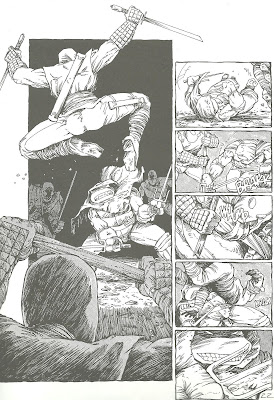

Laird's inks on Lawson's pencils over Eastman's layouts in 1989's TMNT #19
I've talked before about the fact that one of my favorite aspects of these comics were how homemade they feel, and the fact that the particular, long-mysterious-to-me system that Eastman and Laird employed in their creation meant that each issue had a sort of alchemical style, a fusion of each of their significantly different personal styles...sometimes with those of other studio mates also transmuted into the resultant comics.

Sometimes it's quite clear who did what, and thus how each artist's style might have impacted the art--the three-chapter "Return to New York," for example, were inked by Laird, Talbot and Eastman respectively--other times, it seems like two-to-four pencils and pens were involved with every page, and a comic might have a "Mirage Studios" style rather than anyone's personal style.

The notes detail that Eastman and Laird did have a system, although it is interesting to hear them discussing the very earliest issues, particularly TMNT #1, in which neither is exactly clear on who inked a particular page, and it seems that both of them contributed pencils and inks to each page.

The system they ultimately settled on seemed to be this, according to Laird:

1.) They would initially "write" the story in conversation with one another, hammering out a plot together.
2.) Eastman would handle the layout, on which he would include rough dialogue.
3.) Laird would do finished dialogue.
4.) They would pencil the comic based on Eastman's layouts and, after the final dialogue was lettered--originally by them, later by Steve Lavigne--they would ink the art and add toning (that last bit is something I never realized was involved with the construction of these comics, and helps explain the gritty, textured look of the black and white art).
As Laird explained it, they were ideally communicating throughout the entire process, so even though layouts might have been Eastman's "job" and finished dialogue Laird's, they both had and took opportunities to address any and all concerns as they were going.

In the earliest issues especially, Laird said, they tried to make sure they each penciled and inked a piece of each page or panel, and that this would take place by the pair literally handing pages back and forth between them in order to get a true blend of their styles.

Repeatedly throughout these annotations they each note that when they would meet readers at conventions, they were always being asked about how they worked together and who did what. Comics readers in the early 1980s apparently couldn't get their heads around the idea of two writer/artists working on a comic book together as writer/artists, perhaps because so much comics production fell into either the assembly-line method established in the Golden Age (with a writer handing a script to a penciler, who handled his pencil art to an inker, who then gave the finished art to the colorist, etc) or a solo cartoonist doing everything herself.

It is an unusual method, though, one that requires pretty much constant proximity to one another--which I suppose was likely a factor in the eventual strain in their relationship.


Eastman and Laird's final page of 1984's TMNT #1
•The focus of these books is the issues of the original series that Eastman and Laird worked on, to the exclusion of all the fill-in issues. It was striking to see how many times throughout that relatively short run of comics by the pair themselves--just 38 issues total including the one-shots, out of the 62 issues that the first volume of TMNT ultimately ran--that Eastman and Laird seemed to reach natural, organic would-be, could-be endings for their series.

It's pretty common knowledge that they never really anticipated TMNT lasting longer than a single issue, and despite the fact that they both desperately wanted to succeed as comics creators, they were caught off-guard by how successful that lark featuring a silly idea and elements of parody and homage of Frank Miller's Daredevil work ended up being, and how much market demand there was for what such a weird concept.

Re-reading 1984's TMNT #1 with that thought placed in your mind, it's abundantly clear that the comic was created as a 40-page complete story unto itself. There's no cliffhanger, no dangling plot lines, no questions yet to be addressed. In those pages, the pair thoroughly introduce and explain the characters' origins (built atop the origin of Marvel's Daredevil, of course), the history of the enmity between their master and his archenemy and then there's a huge, action-packed, 10-page ninja battle ending with the death of their enemy and the resolution of the conflict that we are told was their life's mission.

Yeah, it's a pretty complete story, and it's not hard to imagine that, had it not caught the imagination of comics readers and, eventually, cartoon-watchers and toy-players-with, it might have just ended up being a strange stepping stone to other endeavors by two talented creators.

Once they committed to a second issue though, a story arc quickly emerged. In issue #2, the TMNT met their first human friend April O'Neil and their father/sensei Master Splinter went missing, all a result of villain Baxter Stockman's robotic mousers. In the following five issues, the guys move in with April and search for Splinter, unwittingly uncovering details about their origins, travelling to outer space and having a rather wild, pulpy adventure that concludes with a reunion with Splinter and the formation of a new configuration of a family, now including April.

It is very easy to imagine Eastman and Laird's TMNT ending with issue #7 then, too, as #1-#7 tell a pretty complete story that ends happily (Raphael, which came out between #2 and #3, doesn't really play into that arc at all, but is more of a side story focusing on his personality...and introducing Casey Jones, who wouldn't play a part in the series for a while yet).

After that, there are some done-in-one stories, including the Michaelangelo and Donatello one-shots, the epic 45-page TMNT #8 featuring a crossover with Dave Sim's Cerebus (and introducing Renet and Savanti Romero), and a rather Splinter-centric flashback to the Pre-Teenage Mutant Ninja Turtles in #9.

A continuing story arc reemerges in Leonardo, the most action-packed issue up until that point, as it is basically one long fight scene, which leads directly into #10, an unexpected rematch with the supposedly dead Shredder and the Foot Clan, featuring a last-minute save by Casey Jones, who at that point joins the team and their narrative on a permanent basis.
Eastman's cover for 1987's TMNT #11
TMNT #11, set at the farmhouse in Northhampton, is another natural "ending" to the story, as it has the various characters struggling to process what just happened to them in New York City, and, gradually, all making their peace with it to some extent. It has a pretty happy ending, and it's not a bad place to end the story, really, although it does suggest that our heroes have lost...at least in terms of their battle against the Foot Clan, if not at life in general.

The first time I read these comics--hell, the first 40 times I read these comics--it was in a big, fat, phone book-sized collection featuring the four micro-series and the first 11 issues of TMNT. It's easy to see why they collected them in this fashion, as they do read as a complete (even completed) unit.

Then, after a series of adventures mostly set in rural New England as opposed to New York City--the previously mentioned efforts by the then sort of split-up Eastman and Laird team of #12, #14, #15 and #17, plus fill-in issues  by Michael Dooney, Mark Martin and Mark Bode that aren't included in the ultimate collections--Eastman, Laird and their Mirage Studios partners reunite for "Return To New York." That three-issue arc really resolves our heroes' defeat at the hands of the Foot in #11. They have re-killed The Shredder, this time once and for all--the resurrected Shredder isn't quite the same one they killed in #1, of course, as is explained--and they have re-fulfilled their mission in life and are able to move on. At that stories end, the four brothers are in New York, burning the body of The Shredder, and are apparently now free to go wherever they like or do whatever they want.

Again, this too seems like a natural ending point for Eastman an Laird's TMNT narrative. And, in a way, it was. The title kept going, of course, but it would be another three years and 26 issues before Eastman and Laird returned to the book, and for the rest of the 62-issue volume they would only draw a single issue issue together and then share writing credits on 14 issues, the job of drawing the turtles now falling to Lawson, with new inker Keith Aiken, and assists from Talbot and a few others.

The end of that epic storyline would, of course, be another natural ending point--and finally was. The book ended when the 12-issue "City At War" did, only to be relaunched for an ill-starred, 12-issue, full-color run that now seems to be even more forgotten than the Image series was.


Veitch's cover for 1989's TMNT #24
•Because the focus of the ultimate collections is the Eastman and Laird issues of Eastman and Laird's Teenage Mutant Ninja Turtles, that means that many issues of the series are left out. So Dooney's #13 Martin's #16 and Bode's #18 aren't here. And none of the issues that fell between the end of "Return To New York" and  the two-part "City At War" lead-in story arc "Shades of Gray" are included here. That's a lot of TMNT, and a lot of great comics: Two more Mark Martin issues, Rick Veitch's three-issue "The River" arc and a later done-in-one, Michael Zulli's gorgeous but weird "Soul's Winter" story arc, a three-issue arc by Rich Hedden and Tom McWeedy, comics by Steve Murphy, Michael Dooney and Keith Aiken, Dan Berger, Rick Arthur, A.C. Farley, Mark Bode and, my favorites, #37 and #42 by Rick McCollum and Bill Anderson and #41 by Matt Howarth.

There is some reason to quibble with the curation of these ultimate collections.

Some of these guest comics are pretty far afield of those told by Eastman and Laird, the more "canonical" ninja turtles stories, and are best read as the Mirage equivalents of Marvel's What If...? or DC's Elseworlds or Silver Age "imaginary stories." Just before and for a long time after "Return to New York," TMNT was basically an anthology series, akin to Legends of The Dark Knight. Like LDK though, if some stories strayed too far to be considered in continuity, others fit in perfectly well with Eastman and Laird's stories. Many of the above stories are set in and around the New England farmhouse, for example, and others have the characters re-encountering characters from earlier in the series, like Renet, Savanti Romero, Romero's previously unrevealed wife and the superheroine Radical and supervillain Carnage.

By excising all of these from the ultimate collections, there is a rather strange compressing of time, and a reader doesn't get the sense that the characters were ever really lost in the wilderness, trying to figure out their next move after their defeat in #10. When Raphael starts fighting with his brothers in the first chapter of "Return," complaining about how long they have been hiding out in New England while Shredder and The Foot are alive and well in New York City, here only some 186 pages and four issues, instead of twice that.

And even less time passes between the conclusion of "Return To New York" and the beginning of "City At War"; in fact, because "Shades of Gray" is basically an unofficial first two chapters of "City At War," both of the big, Eastman and Laird-written storylines about the turtles returning to New York City to sort out matters with the Foot Clan happen back-to-back in these collections.

I don't know what, exactly, would have been a better solution, I just know the series reads very differently when presented with all of the fill-ins excised like this.

Talbot's cover for 1988's TMNT #17
That said, I thought the inclusion of #17 was somewhat surprising. That's the Eric Talbot solo issue, the bulk of which is a rather weird, random stream-of-conscious fantasy story set in in feudal Japan and starring a version of Michaelangelo....although it turns out to be a dramatization of a story Michaelangelo himself is writing. Eastman is credited as a writer on it, both in the collection and on Mirage's website, but Eastman himself seems surprised by the credit in his annotations of the issue, and doesn't remember having done enough work on the book to have deserved the credit.

Meanwhile, Eastman did contribute to the Mark Bode issues--#18, which he co-wrote and helped ink, and #32, which he helped ink--but neither of those are included herein (Those are both really fun ones, too, sending the Turtles overseas to Hong Kong, where they kinda sorta team-up with a Bruce Lee stand-in, and to Egypt, where they fight Anubis and other characters of Egyptian mythology. I really liked Bode's Turtle designs, and the way he handled dialogue, the balloons and sound effects all appearing above the panels).

I suppose both of those issues lean pretty hard away from the canonical Turtles, of course, but if the organizing principle here is the complete Eastman and Laird TMNT and co-writing #17 was enough, to qualify, well...


Splash page by Lawson and Aiken from 1992's TMNT #51
•When we get to #48 in Ultimate Collection Volume 4, Jim Lawson has become the official Teenage Mutant Ninja Turtles artist and, in fact, it is his art we will see for every issue included in the next two volumes, with the brief exception of the 42 pages of TMNT #50, in which Eastman and Laird reunite on both story and art.

I remember it being a real treat at the time the book came out--I had signed up for a subscription of the book at the time, and that was and remains the only time I ever had a subscription to a comic book series--although looking at it now, it sure is jarring to see the Lawson art get replaced by the infinitely darker, busier, more textured Eastman/Laird art, only to give way almost immediately to Lawson's more streamlined, abstract and expressive art (Confession: I used to hate Lawson's TMNT art. Now he's one of my favorite TMNT artists).
Lawsons' cover for 1987's Tales of The TMNT #2, introducing Nobody
"Shades of Gray" sticks out a bit in this curation of the series, if only because the character Nobody plays a rather significant role. A more traditional vigilante/superhero based in Springfield, he was introduced in Tales of The Teenage Mutant Ninja Turtles #2 (written by Eastman and Laird and drawn by Lawson and Ryan Brown), and, because no issues of Tales are collected here, isn't really introduced to the narrative properly, but rather just appears.

Still, those two issues--TMNT #48 and #49--are pretty important, as they include the events that kick off the splintering of the TMNT family that sets up "City At War." The first official chapter of which, #50, is silent.


Eastman and Laird's cover for 1992's TMNT #50
•"City At War" is an extremely unusual story arc for even this extremely unusual comic, lasting 12-14 issues, depending on if we count "Shades", and dwarfing the longest sustained story arcs from the book's previous 50 issues. (Remember, "Return to New York" was just three issues, albeit 40-ish page issues, and the unofficial search for Splinter arc was just about six issues).

It was also probably the most emotionally mature of the TMNT stories, with Eastman, Laird and Lawson splitting the characters up into four different units, each experiencing their own story arcs. In the case of the two human characters, their storylines are positively mundane--Casey moves away, meets a woman, falls in love and tries to settle into a normal-ish domestic relationship with her, while April moves to Los Angeles to live with her sister and start a life free of mutant ninjas and their attendant secrets.

Meanwhile, Splinter finds himself in extremely dire straits and faces death alone, and the Turtles themselves return to New York City and find themselves trying to sort out a massive gang war involving warring factions of The Foot Clan...the result of their having cut off the head of the organization when they killed Shredder for the second time.

And then there's a random New Yorker who was caught in an explosion during the Foot's initial war against itself, and we follow his recovery throughout, a somewhat frustrating element because a reader keeps expecting him to turn out to be someone important to the plot somehow, but he is instead just there to dramatize a real person who suffers during wars in general--a point that was made in the first issue, and thus didn't really need 11 more issue's worth of example.s

I recall finding the story somewhat frustrating the first time through, read in monthly installments--again, this story was a huge change from the 50 or so TMNT comics that preceded it, as they were mostly big done-in-one adventures--and even the second time through, but this time I found it pretty engrossing. I started it late at night, with the intention of reading the first few chapters, and ended up staying up late enough to read the whole thing in a fit of pure can't-put-it-down-ism, blowing way past my bedtime.

It's kind of striking how unusual the story felt for a TMNT comic, given how basic, even generic elements of April and Casey's plot lines were, and how simple what Eastman, Laird and Lawson ended up doing really was. While the A plot was basically that of the ninja turtles doing ninja turtle stuff and questioning their purpose in life more than ever, starting to come of age in a way that felt uncomfortable in the context of everything that came before, the overall purpose of the story was simply to break up the characters' extended family, send them off in different directions to learn why they are together in the first place, and then reunite them via soap opera like events and coincidences.

This storyline gave us the character Karai, who isn't too terribly well-developed here, but would play a pretty large role in TMNT mass media adaptions in the 21st century, and Shadow, who would be a recurring character in Laird's fourth volume of the TMNT title...a character with a lot of potential that I don't think ever ended up being met (Actually, I suspect there's a lot of unrealized potential in the space between the time jump of TMNT Vol. 2 #12 and TMNT Vol. 4 #1, a great deal of which was explored in Tales... Vol. 2, which ran alongside TMNT Vol. 4. (I mean, a teenage girl named Shadow raised by sports equipment-wielding vigilante Casey Jones, with four ninja masters for uncles and a fifth ninja master as her grandfather...? She'd basically be a blend of the Casey and April characters, with skills on par with the mutant ninjas).


Eastman and Laird's cover for 1987's Anything Goes #5
•Now Eastman and Laird made a lot of comics between the time 1984's TMNT #1 became a hit and when issue #62 shipped in 1993. Even if one ignores all the comics they merely had a hand in, while other Mirage Studio artists did the heavy lifting, the early days of their characters saw them contributing short stories to a variety of anthologies and original content to the Teenage Mutant Ninja Turtles and Other Strangeness role-playing games source books (which I liked better than Dungeons & Dragons back in the day; it's been a while since I looked closely at RPGs, but I remember the Palladium system being a lot easier and more intuitive than what was then the TSR Advanced Dungeons & Dragons system).

In figuring out how to collect all that stuff, IDW apparently opted to publish it all after the stories that ran in the main TMNT title (and the four one-shots). Thus, the first five volumes collect the most Eastman and/or Laird-heavy issues of TMNT, while the sixth, epilogue-like volume is stuffed with about 30 short comics of various short lengths, all produced between 1985 and 1989.

They're culled from all over, too: Back-ups from TMNT reprints, the Palladium source books, the Mirage-published anthologies like Turtle Soup, Shell Shock and Gobbledygook, a Grimjack back-up, the Fantagraphics-published Anything Goes and some benefit books.

In addition to the guys who have their name on the cover, there are comics included in here from many Mirage Studios regulars, like Lawson, Talbot, Michael Dooney and Ryan Brown, all working in various configurations in terms of who was doing what and with whom. There are also some stories by artists not as closely associated with the characters, like Stephen Bissette, who writes and draws an extremely eight-page story entitled "Turtle Dreams" (and those dreams are much scarier than the those in Matt Howarth's TMNT #41); Michael Zulli, working solo on one story and with his Puma Blues partner Steve Murphy on another; and Richard Corben, who inked a four-page Eastman-written and -penciled story that was created specifically so that Eastman could work with Corben (Zulli and Corben would both later do more TMNT, of course; the former drawing the aforementioned "Soul's Winter" arc featuring the most dramatically distinct version of the Turtles to ever appear in their own comic, and Corben collaborating with Jan Strnad on TMNT #33).

I've read many of these, but there were a few that were brand new to me, and thus quite welcome surprises. For example, there's a 10-page turtle-less Triceratons story by Laird that appeared in a Mirage anthology entitled Grunts that I had never heard of, and an Eastman and Laird collaboration entitled "Casey Jones, Private Eye" from a Mirage mini-comics project that I was similarly ignorant of. The latter's nothing special, really, and the format doesn't flatter artwork obviously created to be read much smaller, but the Triceratons story was pretty interesting, and introduces a race of humanoid bears that oppose the Triceraton Empire. I'm actually a little surprised they didn't show up in the last TMNT cartoon, given how diligently it scoured the comics for inspiration.

While the first six volumes of this series were devoted to following the canonical Turtles story of their creators as closely as possible, focusing on the work they themselves did more than the many, many comics they simply had a hand in or sanctioned, this volume really gives a good sense of what the title was like for a portion of its run, what the studio's output was like, and just how fertile the characters and concept were as a springboard, and how generous Eastman and Laird were with their creations and their work.

In a sense, this is actually a good volume to start with, as it is the one that gives the best idea of what the original Teenage Mutant Ninja Turtles comic was like and what Mirage Studios was like. I mean, it's probably a pretty lousy place to start in terms of the story of the TMNT, but it's a perfect place to get a feel for the Turtles and the guys that made them.

And to return to that aspect of the Mirage Studios comics that I mentioned earlier, regarding the who-did-what-where nature of their output, and how first Eastman and Laird and then as many as a dozen different collaborators would conceive of a flexible Mirage "house style" that slid along a particular spectrum, this is practically a text book for that, as there are so many different combinations of the Mirage Studios artists, all appearing within the same covers.

Some of these shorts absolutely fit into the "real" TMNT story, being the work of Eastman and Laird and tied closely to the events of the monthly--there are several set during their time in space, for example--others are of the sort of off-to-the side larks or riffs of Tales or the micro-series, and some need to be massaged into the narrative, but nothing herein seemed to really not fit in with the extremely broad mandate of the Mirage Studios Teenage Mutant Ninja Turtles comics which, at it's most basic was basically just, "Whatever, just so long as it has at least one teenage mutant ninja turtle in it."

Among the stories I most enjoyed reading or re-reading in the sixth volume were the Eastman/Laird Anything Goes story in which the guys go on a secret stealth mission...to see Aliens at the drive-in, which I long ago managed to find at a garage sale in Ashtabula after many summer afternoons of studying the Overstreet Price Guide for TMNT appearances; the Eastman/Laird Grimjack back-up story which I recalled similarly looking for but never actually finding; the Eastman/Corben collaboration; the Laird story "Technofear" from 1986's Gobbledygook, which featured what I guess is now vintage computer art; and Zulli and Bissette's strange versions of the characters.

I'm looking forward to the seventh volume, and am curious if there will be a volume eight or beyond. After all, for volume four, Laird did much of the writing, and, for IDW's volume five, Eastman was rather heavily involved, although IDW has plenty of collections of that already...

Anyway, let's meet back here to discuss volume seven once that's released, and maybe we can talk about the 12-issue TMNT series that immediately followed the conclusion of this one, since that's still pretty fresh in my head.

Tuesday, August 26, 2014

On Mirage and IDW's collections of the first volume of Tales of The Teenage Mutant Ninja Turtles

When initially perusing the Mirage site in order to avail myself of what stock of old Teenage Mutant Ninja Turtles comics they have left, now that Nickelodeon owns the characters and IDW Publishing holds the license for producing comics starring the characters, I initially balked at the price of The Collected Tales of The Teenage Mutant Ninja Turtles, Mirage's original 1989 trade paperback collection of the seven-issue series that launched in 1987.

The price was $40, which translates into about $5.71 per issue, according to my calculator, and considering that I already owned Tales of... #6 and #7, $40 seemed like a particularly steep price just to get the first five issues in a reader and collector-friendly trade format.

But then I saw how IDW was collecting and selling the same material. They split the seven issue series into two volumes, both of which cost $19.99 (IDW's first collection contains four issues, their second only three, so they were re-selling each issue at $4.99 or $6.66). In other words, getting trade collections of the material would cost the same either way, and the main choice was between the original black and white version (which included a 10-issue bonus story and a four-and-a-half-page introduction by Stephen R. Bissette, who contributed a tiny bit to the final issue) or the badly-colorized IDW trades (which lacked the bonus story and the Bissette piece, but did have a one-page intro by Kevin Eastman in the first trade, and two new covers by Jim Lawson).

So I went with the Mirage version for my bookshelf, but I also ordered the IDW volumes from a library, so I could see how they stacked up.

The cover for the original collection is penciled by Lawson, inked by Peter Laird and colored by Steve Lavigne, and features a rooftop scene of the title characters and the many enemies (The Monster/Rat King, Complete Carnage, a living idol, Savanti Romero riding a pterosaur) and allies (Superheroes Radical and Nobody, fellow mutant Leatherhead, returning character Renet) they encounter in the stories in one big, wrap-around scene.

Lawson's career as a cartoonist has been fascinating to follow, and he's one of the few artists whom I've read just about everything he's produced, at least from these 1987-produced images to his 2013 Kickstart-ed original graphic novel Dragonfly (which I plan on reviewing here in the near-ish future). Many of the characters on the cover look incredibly rough, and the title characters themselves vary greatly from the more standardized versions of Lawson's Turtles that would eventually emerge.

You can see bits of Lawson's later versions of them here, in Leonardo and Raphael's faces, for example, but it's somewhat difficult to believe the artist who drew this cover is the same one who drew the stories inside, and would go on to draw the 13-part "City at War" storyline, or Paleo and Dragonfly, or even those covers on the IDW collections (which you can see below).

Not only was Lawson's artwork growing and changing, becoming more refined as he found his own style over the years and decades, but the Mirage art of this period was really a studio effort, with Kevin Eastman, Peter Laird, Jim Lawson and Eric Talbot, for example, changing duties in terms of lay-outs, pencils, inks and black-and-white tones, sometimes in what seemed like a story-by-story basis. Some of my favorite art of the original volume of Teenage Mutant Ninja Turtles came during the "Return to New York Storyline" (in TMNT #19-21 or The Collected Teenage Mutant Ninja Turtles Book 4), where those four artists seemed to be working in some sort of jam style that looks a bit like the work of each of them, but not entirely the work of any one of them.

This collection begins with the first page of Bissette's intro, which jumps to conclude at the end of the book. Each issue issue begins with a small, black and white reproduction of the issue's wrap-around cover on a page consisting of mostly white space (Here is one place the IDW collections beat the Mirage collection; they include the wraparound covers at full-size, and with Lavigne's original coloring. The other area in which they one-up the Mirage collection is that they include the post-story pin-ups from each issue; these aren't generally all that great, but there are some fairly nice ones, including a Laird drawing of a turtle carving a jack o'lantern with a katana and a still black-and-white "Leatherhead Portfolio" featuring images of the character by Steve Lavigne, Eastman, Laird, Bissette and Michael Gaydos).

From there, each issue opens with a pin-up splash page of a ninja turtle, usually in some form of thematic costume or setting, offering a brief introduction that always ends with "Let me tell 'ya a story..." and then the issue itself launches.

Let's briefly take 'em one by one.

The first issue features an Eastman intro splash (that's it at the top of the post), and Eastman and Laird are credited with the writing, Lawson with the lay-outs and pencils and Ryan Brown with the inks (Tales was mostly Lawson and Brown's book). Set during TMNT #11, according to an asterisk, the issue involves Casey, April and the Turtles settling in at the farmhouse they fled to after The Foot Clan kicked Leonardo's ass and destroyed April's building in New York City. Casey's cousin and some of his friends pay an unwelcome visit, threatening April and Casey with a gun, hoping that Casey will confess where their grandfather, a crook who hid a quarter million dollar score somewhere, hid his loot. It's up to the Turtles to take them all out without being seen, and there's a nice twist ending that resolves the Casey's-cousin-as-antagonist plot from ever boiling up again.

Tales of... #2 introduces Nobody, one of the first superheroes in the TMNT milieu, a cop-by-day, masked crimefighter (with ridiculously large cape)-by-night in Springfield, Massachusetts (which the art team of Lawson and Brown make look fairly identical to the brick building-filled New York City of the earlier issues of TMNT, complete with chimneys, stairway doors and water-towers everywhere). Eastman and Laird are again credited with writing this story. (The opening splash is again drawn by Eastman, but his work is fairly transformed by Brown into something much smoother and brighter).

The Turtles visit the city, and soon become embroiled in Nobody's case, which involves gun-dealers moving heavy armaments illegally. It's Leondardo who gives the vigilante his codename, since he never identifies himself. It's not a bad one, and compared to those of the other superheroes in the TMNT-iverse, it's probably the best (The competition consisting of the likes of Radical, Metalhead, "Stainless" Steel Steve and so on).

The third issue opens with a Turtle in a graveyard, a hand rising from a grave marked Edgar Allen Poe, pencilled by Lawson and appropriately heavily inked by Talbot. This story, entitled "All Hallow's Thieves," doesn't have any writing credits, but the art team is the same as the previous issues. Perhaps Lawson and Brown also wrote it...? Set during the Turtles' time in New York City, it features an occultist who wishes to become the magical king of thieves. To do so, he must steal an idol from April's Second Time Around Shop (which naturally involves the Turtles). He then summons a horde of looting little gremlins, and turning the six-armed idol into a nigh-unbeatable foe for the Turtles to work out how to beat.

The next issue opens with Brown and Eastman drawing a Turtle working over a monster in the style of Jack Kirby (the credits read "Thanx Jack") and contemplating the nature of monsters.

In this story, which Lawson receives both story and pencil credits for (with Brown still inking), we meet a clearly deranged man who has covered himself like a hobo mummy in swathes of rags, and believes himself to be some kind of monster. Those who only know the Turtles from the original cartoon series will recognize him immediately as The Rat King, a name he doesn't actually give himself until the very end of the story. He haunts and abandoned factory complex, and apparently goes through phases where he pretends to be various types of monsters (On the first page, he's "a shambling moss-encrusted mockery of a man," and, later, when Michaelangelo muses aloud that he almost wishes ghosts were real, the proto-Rat King thinks to himself, "That was last year.")

"The Monster" menaces the exploring Casey and the Turltes for a while, ultimately trapping them in a room which fills up with ravenous rats. Our heroes fight the swarm of rodents in a pretty amusing fight scene. My favorite image of this battle is probably Casey going to the trouble of picking up two rats just to "BONK" their heads together.
I'm hardly an expert when it comes to life-and-death, hand-to-hand combat against hordes of rats, but I don't think that's the most efficient method of rat-killing.

Nor is breaking their spines one-by-one with a well-placed karate chop:
Oddly, none of the five characters, four of whom have spent their entire lives being raised and trained by a giant anthropomorphic rat, say anything at all about Splinter throughout this whole issue.

The story ends with Leonardo thinking he's killed the wannabe monster, throwing a shuriken into his chest and knocking him from a great height, after they've safely escaped the bad guy's clutches. But the monster, who renames himself The Rat King upon realizing the rats aren't trying to eat him, survives the wound and fall. Or does he...? Read "City At War" to find out!

Tales... #5 is the Radical/Complete Carnage issue. Eastman and Laird's sole credits here are in "Eastman and Laird present: A Lawson/Brown/Lavigne Prod," and it's Lawson who draws the opening splash, of a "Super Turtle."

Again set during their earlier NYC days, the story consists of the Turtles riding around with April in her Volkswagen van (Vanity license plate? "TMNT"). They almost run over a daring young bike messenger who is promptly attacked by a hand reaching out of the road to grab her bike tire. The messenger is secretly Radical, NYC's resident superhero, who can fly and shoot energy blasts and other cool stuff, but has a pretty lame-ass superhero costume. The hand belongs to her archenemy, Complete Carnage, who looks like a gargoyle in a cape and speedo, and who has the power to move through and absorb any man-made material.

The penultimate issue of Tales... opens with a moody Brown/Talbot image of a Turtle fishing off the side of a boat "here on the bayou," while alligators break the black surface of the water, a snake coils in his direction, and a long-legged, crane-like bird takes flight in the background. This is the Leatherhead issue, in which an amoral hunter of endangered species ("You did it, Mr. Marlin! You shot the last Madagascan Blue Elephant!" an assistant shouts congratulations to him) hunts the mutant alligator. This one too has no writing credits, just art credits.

The poacher Marlin decides to hunt an urban myth, a large alligator sighted in the sewers of New York, and while down there he runs into the Ninja Turtles, who were between skirmishes in a running battle with the Foot Clan. Two more players enter the fray, including Leatherhead (a sewer-dwelling alligator mutated by the Utrom/TCRI Aliens' mutagen that gave birth to Splinter and the Turtles, and is thus much smarter and more bipedal then the gator Marlin was looking for), and an unnamed man who hunts Marlin, ultimately severing the tendon that controls his trigger finger with a throwing knife.

It's strange how different the character of Leatherhead and his relationship with the Turtles is here—in the original cartoon and toy line, he was a villain—just as it's strange he didn't ever play a larger role in the first volume of the comics, not returning in any sizable capacity until TMNT #45.

The final issue of the series sees Peter Laird returning, getting credit for story and layouts, while Lawson pencils, Brown inks and Bissette and Talbot both get thanks for "toning assistance" (In addition, Bissette drew the opening splash, of a turtle atop a grazing triceratops, while pterosaurs fly in the background).

While April—whose skin is more darkly toned than that of the Turtles, and here appears like she might actually be a black woman—and the disguised Turtles are in a museum, a fossil rearranges itself into the gloating head of Savanti Romero, the sorcerer villain from TMNT #8 (the Cerebus team-up issue).
Romero challenges the turtles to face him in the Cretaceous period, where he was exiled, and just as they're pondering how they're supposed to do that, apprentice Time Lord Renet arrives, now outfitted with a digital version of the Sands of Time scepter (and he clocks that once dangled all over her costume and helmet have now been replaced by little digital time pieces).

She takes the Turtles back in time with her, and there we get ninja turtle vs. dinosaur action! Michaelangelo and Donatello take on a couple of deinonychus, while Raphael and Leonardo face off against a Tyrannosaur, atop of which sits Romero. Leo mounts a triceratops, the official dinosaur of Eastman and Laird's Teenage Mutant Ninja Turtles, and goads it into helping them dispatch the T-Rex.

This was and may actually remain one of my favorite Turtles comics, in large part because of the way it suggests so many other adventures that there just aren't room to squeeze into a single issue. When Romero is seemingly killed and the scepter lost, Renet and the turtles spend three months in dinosaur times which, honestly, sounds about as interesting as any other Turtles premise I've encountered in any medium.

Just one thing, though. This is the Cretaceous period, right?
So where the hell did they get all of those mammal skins to make their caveman outfits from?

I suppose Renet and some of the guys' fur coverings (wait, why are the turtles wearing clothes at all? They usually just wear masks and wristbands and kneepads, but are otherwise nude) could have been made from killing, skinning and sewing together the pelts of dozens of tiny little mammals, but one of them is clearly wearing some sort of leopard skin.

Anyway, let's move on.

The 10-page bonus story is another Nobodoy story with a rather sharp, if perhaps open to interpretation, political statement at the end (although I'm thinking it's a lot more anti-gun then pro-gun, given the other parts of the the book, and the TMNT comics in general). Nobody looks much better here, his black costume a much more solid black. Also, this story involves one of the turtles in a wig, glasses and dress, pretending to be an old lady and then kicking a dude's ass. Oddly enough, that's the second time that's happened in a short story in the characters' first half-decade of existence.

Here are the covers for the IDW collections.

As you can see, they are also by Lawson and have the same basic idea—put most of the characters from the stories on the covers with the Turtles in one big scene—but, the stories having been divided into two collections, there are fewer characters per cover (That's Casey's cousin clutching what he hopes is a treasure box on the cover of the first issue, if you're wondering).

The IDW collections are much clearer in terms of who wrote what. The first three issues were by Eastman and Laird, the fourth by Lawson, the fifth by Lawson and Brown, the sixth by Brown and the seventh by Laird. No one is credited for the coloring of these issues, not even "Digikore," the company that's colorized the other TMNT collections from IDW I've seen.

Among the dubious coloring choices are the decision to render these 3-D glasses one of the guys wears in #2 and #3 as red and pale, almost-white blue, and then just making them into regular, albeit opaque glasses, in the next issue. Then there's April's constant wearing of ugly pink sweaters (and, on one instance, an ugly turquoise sweater), giving Leonardo a golden rather than silver colored shurkien, the use of that brown-ish red or red-sh brown that Gnatrat and his "The Fannywhacker" identity were both given in TMNT Classics Vol. 2 to the "Super Turtle" pin-up...
...and I'm not sure how I feel about this red and gray look for the Foot Clan:
While The Shredder did originally apparently wear red, and the Foot have often been depicted in Hand-like red early on, more often than not they were depicted in blue or black.

For example, here are the earliest Foot Clan color appearances from the Mirage comic book era I can find, ranging from a reprint of 1984's TMNT #1 to 1992's TMNT #52. (The image with no text on it is the back cover of the Teenage Mutant Ninja Turtles and Other Strangeness role-playing game source book, published in 1985).


It looks like IDW's mysterious colorist, whoever that is (Nobody, now retired from the force and making ends meet by coloring, perhaps?) went with the First Comics color-scheme for the Foot uniforms, at least as is evident from that First cover (I've never read those collections, so I'm not sure what The Foot wore on the interiors).

I see no reason to give The Foot glowing eyes though.

Oh, and the heavily-toned panels of April from Tales... #7, a few of which I included above, look pretty terrible in the IDW collection, as the tones weren't removed, a light, Crayola peach crayon color was just added atop them, so April's got black lines all over her face for some reason in the final product.

Finally, regarding the IDW collections, I was somewhat intrigued by the little starbursts on the cover reading "Ages 13 and Up Recommended," and a disclaimer on the title pages:
These reprints of 1980s-era comics were inteded for mature audiences, and do not reflect today's values or those of Nickelodeon or IDW Publishing. Except for the addition of color, the comics are presented here as originally published.
I can understand the caution, given that Nickelodeon does have a children's cartoon currently airing, and IDW is printing and/or reprinting two Turtles-for-kids books (I think? I can't keep up), and the general confusion of the audience for Ninja Turtles (a confusion quite evident in the latest film).

I was a little surprised by the "today's values" bit though, as that seems like the sort of disclaimer one might find before, say, a Will Eisner Spirit collection or a Osamu Tezuka book with their offensive stereotypes of black folks or Native Americans, maybe a reprint of classic Disney material, which can read pretty racist.

But I'm not sure what it might refer to here. There are no people of color in the books. The one man from the original stories who seems to be black, the man hunting Marlin, seems to have been re-colored into yet another white guy.


I don't recall any uses of derivations of the words "retard" or "gay" or "fag," words used much, much more often in the 1980s then now (if my experiences in grade school were representative); now they are used probably far less than even "the N-word," which at least some people have sought to retake and make their own.

I thought the word "bimbo" might have been employed to refer to April or Renet at some point, as it cropped up an awful lot to basically mean a not very smart woman in the page of a slightly later vintage of Mirage comic I also read this week, but I couldn't find any instance of that either.

So perhaps they were simply referring to the fact that it was more acceptable to kill rats, dinosaurs and crazy hobo mummies in 1980s narratives then it is today...? Or perhaps that's just a legal, blanket disclaimer appearing in all of IDW's TMNT reprints after a certain point (It wasn't in the only IDW reprint book I've bought so far, Classics Vol.1).