Showing posts with label spider-marriage. Show all posts

Monday, July 06, 2015

"In a perfect world, this was how it was always meant to be": Amazing Spider-Man: Renew Your Vows #1

While many of Marvel's Secret Wars tie-ins have taken their titles and parts of their plots from past stories set in different realities or alternate futures and timelines, Amazing Spider-Man: Renew Your Vows is one of the few that is based on a previous status quo. And, it's worth mentioning, a pretty popular status quo that many fans were unhappy that Marvel changed on what amounted to an editorial whim.

Without getting too deep into the death of the Spider-Marriage, here's the short-ish version. Previous Marvel Editor-In-Chief Joe Quesada didn't like the fact that Spider-Man Peter Parker was happily married to Mary Jane Watson, as he felt it unnecessarily aged the character, but un-marrying him didn't really solve the problem, as making Peter Parker a widower or a divorcee wouldn't exactly make him younger. This was one of three "genies" in the Marvel Universe that Quesada wanted to find a way to re-bottle.

He found a way, but it was a terrible, terrible way: A soft reboot that only affected Spider-Man continuity. When perpetually dying old lady Aunt May was on her deathbed yet again, Mephisto–i.e. Satan himself, essentially–appeared to Peter Parker and told him he would restore his beloved aunt to health in exchange for his soul. No, not his soul! Don't be silly! Why would you think the devil would want to render services to someone willing to sell their soul to him? No, Mephisto wanted Spider-Man's marriage. As in, he wanted to manipulate the time-stream to make it so that Peter and Mary Jane were never married.

This was really cool of the devil, and worked out pretty great for all involved. Because while he claimed that he wanted Spider-Man's marriage because it represented Spider-Man's happiness, the devil was also going to strip away all memory of the marriage from Peter Parker, so he won't have any reason to be sad about losing the marriage. What a nice guy, that devil is!

Now, this was problematic for a lot of reasons, the fact that Spider-Man did a deal with the devil to supernaturally extend the life of his elderly aunt being just one of them. (Why would the devil do that, anyway? Why would the devil want that? Would Spider-Man really want that? Would Aunt May have wanted Peter to make that decision? Isn't death a natural part of life? Is Spider-Man going to put together the Infinity Gauntlet and challenge the entire Marvel Universe the next time Aunt May gets cancer? Why does having an unmarried 30-something Peter Parker matter, anyway–issn't that why Marvel created the Ultimate line?).

In addition to undoing the marriage, the devil basically just did a random reboot of Spider-Man continuity, rebuilding Aunt May's house, seemingly brining Peter Parker's dead best friend back to life, that sort of thing–it was bad enough a story that J. Michael Straczynski (who has, remember, wrote some real stinkers in his career), argued with Quesada about the scripting of the One More Day miniseries in which this nonsense occurred, ultimately asking to have his name removed from the issues and publicly disavowing it as it was being released).

I guess people got over it pretty quickly, though. I quit reading Amazing Spider-Man at that point, but I would have quit not long after, when they jacked the price up. Marvel started publishing ASM about three times a month, and they hired a slew of great writers and artists to work on it. One of them was Dan Slott, pretty much the idea Spider-Man writer, and that guy is still writing Spider-Man. Hell, he's writing this very comic.

I'm not a fan of reboots, myself, and I hate these sort of soft reboots the most, as they don't work well in a shared universe; they essentially punish fans for knowing too much about the setting and history. DC's increasingly frequent re-settings of their continuity are annoying too, but at least those have been across the board, and generally done in-story in a way that makes a modicum of sense. The devil didn't cosmically annul Superman's marriage at any point; rather time itself was disrupted so badly by The Flash and Reverse Flash's attempts to alter it in Flashpoint (and Pandora's still un-explained attempt to strengthen the universe by blending it with two different alternate realities) that it completely changed all of history, not just a marriage (DC has done its share of dumb soft reboots too, including a John Byrne-lead one of The Doom Patrol and a Jeph Loeb/Michael Turner-lead one of Supergirl, but both were made irrelevant quickly by people either not reading/caring or later, universe-wide reboots.

Anyway, let's read Spider-Man: Renew Your Vows #1, the first issue in a comic book set in an alternate reality where Joe Quesada never managed to convince anyone to reboot the Spider-Man franchise, an alternate reality that is now part of "Battleworld: A massive, patchwork planet composed of the fragments of worlds that no longer exist, maintained by the iron will of its god and master, Victor Von Doom!"

THE COVER
There's a lot of verbal information on this cover, but if you take a quick glance around it, you'll note how important Marvel apparently thinks the Spider-Man and marriage parts are compared to the Secret Wars-iness of it.

The ASM logo is at the top, the same size as it usually would be, long with the sub-ttile and an oversized "#1." The Secret Wars logo, in contrast, is tiny, about the size of the creator credits or the tag letting us know that this is a Marvle comic book and that we get a "bonus" digital edition because we are over-paying for this $3.99, 21-page comic.

The image is by Adam Kubert, as the large pink "Adam Kubert" signature next to it makes clear. It features an unmasked Spider-Man standing next to Mary Jane, a little girl that looks more like MJ than Peter sitting on his shoulders. Is this the long-lost Parker baby, grown up? Yes, yes it is.

Behind them is an oddly elongated version of the Spider-Heart that appeared on the wedding issue. I'm not sure why Kubert would have drawn it in that particular shape, as drawing it out like that obscures it so much behind the logo. I have to assume it was simply because there was some miscommunication between artist and publisher regarding the final lay-out of the cover, or because Kubert screwed it up but didn't want to or have time to go back and change it.

I like Adam Kubert's art okay, but like his brother, he's not really the sort who handles deadline pressure well. Or at all.

TITLE PAGE

The spiel about Secret Wars is repeated here: "The Multiverse Was Destroyed! The Heroes of Earth-616 and Earth-1610 were powerless to save it!" and so on. The page ends with a big "The Amazing Spider-Man" logo (sans the "Renew Your Vows" subtitle), and some of the credits, starting with the letterer and ending with the executive producer.

PAGES 1-3

The first page opens with a narration box designated by a Spider-symbol as Peter Parker's: IN a perfect world, this was how it was always meant to be." Oh, snap!

Behind it are framed photos hanging on the wall, including one of the Parkers on their wedding day and another in the hospital, MJ and Peter posing with what looks like a tiny Wilson Fisk swaddled in a pink blanket.

"Renew Your Vows Part 1: Why We Can't Have Nice Things" fills the over-sized gutter between the page's two panels, along with the missing credits from the first page: Writer Dan Slott, pencil artist Adam Kubert, inker John Dell and colorist Justin Ponsor.

At a cramped table in a cramped-looking kitchen, a shirtless Peter Parker tinkers with his web-shooters, while MJ feeds their poorly drawn daughter, whose age seems to change from panel to panel. Kubert may draw great superheroes, but toddlers are not his strong suit.

It appears to be sometime in the late 1980s, maybe early '90s. The Parkers trade jokes a bit, and Peter mentions that he seems to be picking up the slack of other New York City costumed vigilantes, as it seems he's been fighting his villains and there's lately.

PAGE 4

Peter rushes into the Daily Bugle office to sell some photos, where he learns that some superheroes have been showing up dead ("Punisher, Moon Knight, a boy going by the name Night Thrasher") and others with powers have gone missing ("Daredevil, Iron Fist").

Is it weird that any time a creative team gets the opportunity to do an alternate reality story of any kind, they almost always resort to killing everyone off? I mean, it makes some degree of sense, given the fact that killing everyone off is something they can't normally do, so maybe they just have some pent-up bloodlust for superheroes they need to release somewhere, but you never read an alternate reality story where some of the good guys just retire or something...

SPECIAL PULL-OUT ADS SECTION

This being a modern Marvel comic book, there have already been two ads, but here we get the first pull-out section of house ads. There are four ads for four different Secret Wars tie-in comics, all printed on a glossy, heavier paper stock, and which a reader can unfold as if they were going to be a poster or something cool.

Nope, just ads. One for Secret Wars #5, one for Spider-Island #1, one for Age of Apocalypse #1 and one for Hail HYDRA #1.

PAGES 5-7

Spidey makes all haste to Avengers mansion, where Jarvis lets him in and lets him know they've been expecting him–"and anoyne else left standing."

Inside, he finds "The Avengers, New Warriors, Hulk and Namor." We can tell this is an alternate timeline because Captain America has a star on his forehead and an A on his chest. Totally different. Also, I think The Vision is wearing an all-white costume with just a yellow diamond shape on his chest, and thus look 98% less stupid than usual.
Cap is in the middle of a debrief, explaining that many superheroes have gone missing lately, including all of the X-Men. Iron Man and Spider-Man gossip in the corner, ignoring Captain America, while Shellhead offers to move Spidey and his family into the Mansion for safety's sake. Peter calls home on a very, very large phone to ask MJ about this, while in the background Cap reveals their best lead, the CEO of a company researching "super-human abilities and bio-technologies" with the perfectly villainous-sounding name of Augusts Roman Then Hawkeye reports in from the field, noting that there's a full-scale prison break at Ryker's and that "Everyone's broken out!"

Cap's just all like whatever.

"Sorry Clint," he says. "But I'm calling it. Roman's an omega-level threat. We need all hands!"

MJ told Spidey to hold on, as someone was at the door, and then she didn't answer again. Could the two things have something to do with one another?

Yes!

PAGE 8

Master tactician Captain America is in the process of loading every single superhero left into a single Quinjet with which to launch an assault on Roman, when Spidey bugs out of there, jumping through his own apartment window with a KSHHHH.

"Well, look at this..." says someone off-panel in a white on black dialogue balloon that either represents a slightly drunk Morpheus or...

PAGE 9
...Venom! He's sitting comfortably on Peter's busted love seat, holding the baby in one hand (and one tentacle, his other arm (and several tentacles) around MJ.

Now I believe this is a reference to an earlier story in which something, for lack of a better term, rapey either happened, or at least was strongly implied as having happened. (I actually tried reading that part of Todd McFarlane run in a library-borrowed trade in the very early '00s, and I just couldn't do it; like the Chris Claremont/Jim Lee X-Men, they were just too bad for me to force myself to read them; spending a few minutes online researching, the official line is apparently that Venom "terrorized" Mary Jane. Those of you who lived through Todd McFarlane's Spider-Man run can feel free to set the record straight in the comments section.)

Scanning the full-page splash for clues, there's no real strong implication of that here. MJ's no more naked than she was previously, the rips in her jeans all in the same places they were during the dinner scene. Aside from Venom's long, dripping tongue curling in her direction, there's nothing terribly suggestive going on here.

I do like the fact taht Kubert drew a stuffed Hulk doll with its arms ripped off. Venom clearly smashed the door in, tore up a pillow and part of the couch and ripped the arms off of Annie's toy.

What a jerk!

PAGE 10

Venom starts talking to Spidey, but he doesn't listen, punching him so hard in the face that he breaks bones in his hand while Venom's in mid-sentence. Why Venom didn't bite his own tongue off, I don't know. Just like I don't know why Venom's voice is so clear, despite talking with his tongue out of his mouth all the time. Shouldn't he sound more like Daffy Duck...?

Peter tells MJ to get the baby out of there, while he punches the hell out of Venom.

PAGES 11-12

MJ runs out to the street, and see the Avengers fly over head, attempting to hail them, but they're busy, flying straight at Roman's headquarters, Empire Unlimited. He has been expecting them, as he has "telepathy, like Professor X," and introduces himself. He's a big, robotic-looking Darkseid type, with his company logo as a chest emblem, pink energy emanating from his flying form.

"From this day on, call me REGENT," says Augustus Roman, CEO of Empire Unlimited. See, he did indeed capture all the missing superheroes, and he's managed to extract their powers and put them into his own body, and now he's ready to fuck up The Avengers.

PAGES 13-14

MJ thinks about Venom's powers and weaknesses out loud, and then she jumps on to the back of a speeding fires engine, hanging on with one hand while holding her baby in teh other.

Venom jumps out the window, in pursuit, followed by Spidey.

Spider-Man looks briefly in the direction of the glowing pink explosions around the Empire Unlimited skyscraper, but heads off to save his family.

"The Avengers..." he rationalizes "...will be just fine."

Will they?

Regent is boasting, telling Cap that this is "literally a show of force" and that he can evade and counter anything they can throw at them. And then The Hulk jumps at him.

PAGE 15
I'm not 100% sure what happens here. The art's a bit murky. Regent grabs Hulk's arm, shoots Cyclops' energy beam and then BAMFs away, clutching The Hulk's severed arm.

It's unclear if he cut it off with eyebeam and then teleported away with the severed arm, or if he severed it via teleportation.

Either way, I don't think Hulk's, Cyclops' or Nightcrawler's powers should work like that, but whatever, this isn't a Hulk or X-Men comic, it's a Spider-Man one.

...

...Oh! Hey! Remember a few pages ago, when Kubert drew a stuffed Hulk doll with its arms torn off? Maybe that wasn't a little clue that Vemon was a big mean bully and jerk; maybe it was foreshadowing this very moment.

PAGE 16

The firemen notice MJ on teh back of their truck with a baby as they pull up to a burning building. They start to give her grief, but are soon distracted by the giant black tongue monster rushing them. MJ lifts a line from what has to be somewhere in the neighborhood of 1,000 different comic books and movies (Venom: There's nowhere left to go! And notheing left to do... ...except scream!" MJ: Yeah? You first.")

MORE PULL-OUT ADS

A turn of the page brings us a half-page ad for Secret Wars: Civil War and a half of a page explaining how to redeem your code for a free digital copy of the paper comic you over-paid for. Next to it is a second pull-out section of house ads, including one for the third issue of this series, showing Spider-Man in his black costume and the tag "The Most COntroversial Spider-Man Story of The Year Continues!", plus ads for Old Man Logan #3, The Infinity Gauntlet #3 and Star Wars: Lando #1, which is not a Secret Wars tie-in, but man, if they were collapsing the whole Multiverse into Battleworld, there really should be a Star Wars tie-in. Maybe ones featuring the characters from Castle, Once Upon a Tim, those Oz comics and the Jane Austen adaptations as well.

PAGES 17-20

The sirens do indeed cause Venom to scream–"AAARGHHH!"–as sound is one of his weaknesses. Then Spider-Man arrives and starts wailing on Venom, each blow pushing him back further and further until they're within the burning building.

MJ asks a fireman if there's anyone left in the building aside from the two spider-themed super-people, and when she learns that it is, MJ shouts that the building is empty, "You're the only ones in there! Do you understand?!"

He does. God help him, he does. He pulls down a support column and brings the whole burning building down on top of them. OMG! Spider-Man just killed one of his villains!
As you can see, Spider-Man emerges from the burning rubble, but Venom? Not so much. He is apparently dead. Or maybe just "dead." I guess we'll find out.


PAGE 21

It's sometime later, and Peter Parker is helping his now much older-looking daughter–she has long red hair as she does on the cover–cross the street. Off-panel, someone shouts, "Help! My purse! That man's flying away with my purse!" And, behind an oblivious Peter Parker, we see The Vulture successfully flying away with a purse.

"It's not a perfect world," Peter narrates over the last panel, where billboards and bus signs indicate that REgent has taken over the city/Battleworld domain, "But, I look after me and mine. And that's...good enough."

This makes for a nice, parallel to Spider-Man's origin story. You'll recall that he decided to use his super-powers to fight for good after choosing not to help stop a criminal, a criminal who then went on to murder his beloved uncle shortly afterwards. In the course of this story, he finds that by using his super-powers to fight for good, he was actively endangering his family members, and must now make the opposite choice–to selfishly not fight crime to keep his family members alive.

This story, then, shows the Spider-Man story coming full-circle. Now, we already know Spidey probably isn't going to not be Spider-Man for too long–that ad for ASM: RYV #3 in this very issue appeared to show Spider-Man in a Spider-Man costume, Spider-Manning, but it's interesting to see Slott doing something interesting with the opportunity to do an out-of-continuity Spider-Man story.

I made much of the first line of the book, the bit about in a perfect world, Spider-Man and Mary Jane would have been married, but I suppose that could be read as an ironic statement, rather than Slott meta-endorsing the previous, pre-devil deal continuity. After all, how "perfect" is this world...? Every superhero except Spider-Man is apparently dead, Spider-Man is retired, a super-villain rules the city/world/Battleworld domain and animal-themed super-villains are free to snatch purses with impunity (Although, there are flying cars and hover buses in Regent's New York City, so it's not all bad).

I've only read four Secret Wars tie-in books yet–I haven't written about the fourth one, X-Men '92 yet–but this was certainly the best of those four.

Thursday, September 25, 2008

Links, and commentary about them

I spent a really long time looking at this site (and so should you): You probably recognize that silhouette above as that of a Teenage Mutant Ninja Turtle, but do you know who drew it? Believe it or not, that’s an Eric Talbot drawing.

I used to love the Mirage-published black and white TMNT comics; in fact, they were among the comics that really got me into the reading comics regularly in the first place (along with DC/TSR’s Advanced Dungeons & Dragons and Alan Grant and Norm Breyfogle’s Batman comics).

And Talbot was one of my favorite artists working on them.

He was a frequent collaborator with Kevin Eastman, and handled inks and tones on a lot of TMNT stuff, bringing a dark, scratchy line that covered the art in a palpable layer of grit. Without consulting a long box, I remember Talbot worked on #17 and #20 of the original series, and I believe he worked on the Casey Jones story in Plastron Café, but my memory is hazy), and pin-ups and ads for things he drew were sprinkled throughout a lot of Mirage publications.

For some reason, I was pretty surprised by Talbot’s style as seen on his sketch blog. I don’t know if, in the back of my brain, I had always assumed something that was actually Eastman/Talbot was what Talbot/Talbot looked like, or if his artwork has evolved a bit in the last, oh, almost 20 years or so, or both, but it’s really great stuff, and I particularly love his big, white-eyed turtles and, especially, his pointy-nosed Splinter.

Here’s a taste:


In addition to a lot of ninja turtles and characters from their comics, you’ll also find sketches of Batman, Two-Face, Hellboy, Usagi Yojimbo, Mr. Miracle, Wolverine and a whole lot of tentacles, stitches, skeletal faces and pages and pages of silhouette sketches like this:

So go look around for a while. I’ll still be here when you get back.


The worst thing about DC’s fantasy presidential election comic DC Universe: Decisions?: Too few people read it.

I was looking forward to an Internet-wide, Ultimates 3-style drubbing of it by critics. But I suppose that was silly of me. People actually liked and looked forward to Ultimates and Ultimates 2, and were thus really looking forward to seeing what would happen when a new creative team—including known crazy person Jeph Loeb and that guy who perfected the art of missing deadlines—took over the franchise for a third volume.

But who cares which fake-ass, made-up candidate Green Arrow is endorsing in the cloud cuckoo land of the DCU (Probably some liberal guy, because as Denny O’Neil has shown us in decades past, bowhunters are the Democrats’ most reliable base), or if Lois Lane is supposed to be Republican or Libertarian based on the political beliefs she states in the story (despite the statistical unlikelihood of a big city investigative reporter being either).

Yes, who really cares about any of that nonsense, particularly since the real-world election is getting so completely insane that no writer could even make this stuff up*.

Thank God for Nina Stone of The Factual Opinion then: She at least was brave enough to take on DC Universe: Decisions #1. Go give it a read, and then join me in a prayer that she and/or Tucker Stone and/or a civilian they rope into reading comics and reporting back to them will read the next three issues as well.


And speaking of…: After twelve seconds of research—i.e. asking my local comic shop-keep if they received copies of DC Universe: Decisions along with the now-infamous All-Star Batman and Robin, the Boy Wonder and the OMG Superman drinking beer maybe! issue of Action Comics—I’ve developed a theory as to why it wasn’t shipped as originally scheduled.

My shopkeep said they received issues of the swearing comic and the drinking comic, but not the “political” comic. Decisions just didn’t show up at all that week.

Perhaps then it wasn’t recalled and pulped like ASB&RtBW and Action, but was instead simply delayed a week? It was scheduled to come out on Wednesday, September 10, which, if I’m doing my math right, is only one day before September 11. Since terror attacks on presidential candidates are central to the plot, maybe DC wanted to avoid risking someone being offended if they published a comic book about that during that particular week.

If this was the case, I think they overreacted. Simply avoiding real-world politics, they’ve ensured that no one would even notice the book outside the direct market-audience for Judd Winick and Bill Willingham books, and nothing offends those readers anyway.


Too bad it’s not Chuck BB illustrating the lyrics of Chuck D: I don’t normally publish press release type info here, since so many other places on the Internet do a much better job of it, but I’ll make an exception based on how cool this particular project looks.

Boom Studios will be publishing a new version of H.P. Lovecraft’s prose poem Nyarlahotep.

Now, the only thing more boring than prose or poetry is prose poeery, but this $15, 32-page book has something going for it that most prose poetry (and prose and poetry) lacks: Full-color illustrations by Black Metal’s Chuck BB.

They look like this:

I’m not sure when the in-store date for this is exactly, but if you follow the link above, you can get the Diamond order code and bug your comic shop about ordering you a copy (and see a few more illustrations).


What is wrong with Marc Guggenheim?: A lot, apparently. On Tuesday Dorian Wright noted a particularly insane-sounding couple of paragraphs in an interview with Guggenheim that coupled the issue of gay marriage to the Spider-Man continuity reboot for…some reason.

The original interview, written up by longtime writer-about-comics Jennifer M. Contino, is a pretty basic sort of Creator Talks About His Projects type of interview, common throughout much of the comics press.

He talks about his work on the Amazing Spider-Man almost-weekly, his TV show and a superhero movie script he’s apparently working on.

And, in discussing the fact that a lot of people don’t like the new Spider-Man direction on the basis that it is really stupid, he says this:

"Here's my attitude, if anyone is upset about the marriage going away, then they must all be pro gay marriage," he continued. Because if you're pro gay marriage, you understand the distinction between a marriage and a civil union -- that a civil union is not equal to a marriage. We downgraded Mary Jane and Peter to a civil union. If that bothers you, then you're pro gay marriage."

I’m kind of disappointed that Contino didn’t take the opportunity to say, “I don’t understand what you mean. Could you explain that?” Perhaps she didn’t notice how insane it was until she sat down to transcribe the interview…?

Wright mentions some of the obvious problems with that quote that I won’t repeat here (Go read Wright’s). But there are a lot of problems with it. (Feel free to skip down to the next item if you don’t want to read about Spider-Man continuity and comic book writer dumb-assery for a few hundred words).

It’s been interesting to watch just how defensive some of the writers involved with the new Spider-Man direction have been regarding how they got there. One of the main problems with the J. Michael Straczynski/Joe Quesada “One More Day” storyline, in addition to it being poorly written, poorly drawn, over-priced and behind schedule, was that it didn’t make a lick of sense.

Repeatedly in interviews creators like Quesada and now Guggenheim have stated that nothing changed in Spider-Man’s timeline (what we mean by “continuity”) beyond the fact that Peter Parker and Mary Jane Watson weren’t married for the decades during which they were married. Something happened on their wedding day that prevented the consumption of their engagement, but, otherwise, everything else remained the exact same, Quesada had maintained.

This isn’t true. At all. In addition to their not ever having been married, Spidey and MA weren’t dating as of the beginning of the “Brand New Day” storyline. Aunt May was no longer on her deathbed in the hospital dying of an assassination attempt on her nephew, but was perfectly well again. Her house, which was destroyed, was now un-destroyed. The knowledge of Peter Parker’s secret identity, which was known to Aunt May and everyone else in the world, was suddenly forgotten by May and everyone else in the world. Harry Osborn was no longer dead; he was just in Europe.

Those are some pretty big changes right there, beyond the “they just weren’t married.” It gets even harder if you follow the Marvel Universe in general, not just the Spider-Man title, because Spider-Man and his family lived in Avengers Tower, all of the Avengers knew his secret identity and his family, his secret identity reveal was a pivotal part of Civil War, a storyline that defined the entire state of the Marvel Universe. Changing just the unmasking and the marriage changes all of that. And, for the hundreth time, continuity between consecutive events is the entire point of serial storytelling like that of Spider-Man comics.

So no, Guggenheim. False. That is not the only thing that changed.

By reducing the changes to a single change, Guggenheim can then go on to state that if you don’t like the post OMD/BND direction of Spider-Man, you must not like the marital statue reboot. But you could also dislike all the other reboots, or the idea of any kind of reboot at all, or the weekly format, or you could think the writing is awful, or you could hate the art. There are a lot of reasons to dislike particular comics (I’ve only read two story arcs, so I’m not endorsing any of those opinions; I loved Marcos Martin and John Romita Jr.’s art, and Dan Slott’s writing was pretty decent in those arcs).

Then Guggenheim jumps to the, if you object to the reboot of the marriage, you must be pro-gay marriage bi, “Because if you're pro gay marriage, you understand the distinction between a marriage and a civil union -- that a civil union is not equal to a marriage. We downgraded Mary Jane and Peter to a civil union. If that bothers you, then you're pro gay marriage."

Wright and a few others see this as Guggenheim gay baiting; if you don’t like my comics, that makes you a fag.

I’ll give Guggenheim the benefit of the doubt and assume that’s not what he meant (although he’s a huge ass for comparing his Spider-Man comics to the gay marriage debate at all, and thus getting himself into the position where he could be accused of gay-baiting).

I’m pro gay marriage personally and understand there is a distinction between the two. This personal belief has nothing to do with Spider-Man’s love life. I’m also pro civil union. (Here in Ohio, we don’t even have civil unions. In fact, most of the country doesn’t. That seems to be step one here. Until the latter is actually commonplace, advocating the former over the latter seems a little silly in places like Ohio. Is marriage better than a civil union? Yes. Is a civil union better than nothing? Yes.)

Spider-Man and Mary Jane not being married but living together and sharing a bed doesn’t mean they suddenly have a civil union. It means they’re dating; cohabitating; “living in sin.” A civil union is something between that state of affairs and an actual marriage; did they go to the trouble of trying to get a civil union? (I don’t know the state of civil unions in New York state; is it even possible at the moment?) If so, why the fuck did they do that? Why didn’t they just get married? They’re straight people; there’s no law against them getting married! A civil union is the consolation prize for people who can’t get married. It’s the next best thing.

Finally, let’s look at that last bit one more time: “We downgraded Mary Jane and Peter to a civil union. If that bothers you, then you're pro gay marriage."

Like I said, I haven’t been reading a whole lot of ASM, but I’m pretty sure Marvel didn’t actually downgrade them to a civil union. Quesada said they just didn’t get married on their wedding day for some reason, and I don’t remember seeing any covers marked “Collector’s Item: The Civil Union Special!”

I should point out that there are many thousands of people in the U.S. who are bothered by civil unions, but definitely aren’t pro-gay marriage. They’re bothered by civil unions because they hate gay people, or are grossed out by them, or think they should always be treated as second-class citizens, or are afraid gay couples are trying to gain special rights to game the system and use tax dollars to fund gayness initiatives, or because they’re crazy coo-coo banana birds, or because they’re super-ignorant. A lot of the people who are bothered by civil unions are even more bothered by gay marriage.

So brilliant bit of anti-marketing, Mark Guggenheim! Now when I see a new comic book with the name Guggenheim on the cover, I won’t be able to think, “Oh, it’s the guy who wrote that great Blade series that was unfortunately cancelled,” but “Oh, it’s that defensive dumb-ass who said some pretty ignorant shit about civil unions and gay marriage when trying to convince people to read fucking Spider-Man comics.”


Art contests are fun: If you’re reading this, that means you read comics blogs on the Internet, and that means you probably also read Chris Sim’s The Invinicble Super-Blog which, while perhaps technically not invincible (that is, vincible), is in fact super.

If not, that means you’re probably a friend of mine who only reads this because you know me, or you’re someone who got here by accident after googling “Justice League Ice Cream” or something. Either way, you should probably be reading Chris Sim’s Invincible Super-Blog.

Especially posts like this, which featured the results of the ISB unconventional nunchuk contest (inspired by a drawing of Batman with nunchuks made out of sharks, which was in turn inspired by Sims’ own post involving Lego Batman’s sharkchuks, the only weapon capable of defeating evil wizard Shaquille O--look, I can’t explain this stuff. Just follow the link).

I pretty much laughed through the entire Batchuk results post; it’s one awesome design after another. It’s pretty remarkable how Sims-spefic so many of the designs are, using as raw materials things Sims loves, loathes or talks about all the time. The only thing missing was, as he pointed out himself, OMAChuks and, perhaps, nunchuks made out of Lucy and Lois Lane or out of John Workman-lettered KRAKK-A-DOOM! sound effects.

Meanwhile, in Canada, our enemy to the north, Rachelle Goguen (who, oddly enough, made a guest-appearance in one of the most random Batchuk contest entries), had a sketch contest of her own, involving entries combining two of her favorite things: superheroes and hockey.

The winner was frequent EDILW poster Sally, whose entry unsurprisingly involved both Green Lanterns and their butts.


Speaking of both Sims and Batman: Today the former has an examination of the one time the latter almost murdered The KGBeast.

I never read that story, but I remember it being referred to in the Batman: Year Three/ “A Lonely Place of Dying” era that immediately preceded the introduction of Tim Drake as a Robin-in-waiting, cited as evidence that Batman was totally losing it in the late ‘80s without a kid in a cape around to keep him from killing dudes.

KGBeast was never put to very good use again after that story though, was he? I know he showed up a lot in 90’s Batman stories, but he was always just kind of a big guy with a stump for an arm who talked funny, and I believe he’s dead now (at least the bad guys in Nightwing were recently robbing his grave of the big one-handed corpse in it…that’s usually a sure sign of a character being dead, even in super-comics). The end of the Cold War wasn’t very kind to the soviet assassin…too bad he didn’t live to see the dawn of our new Cold War, Cold War II: The En-coldening…

This man liked Identity Crisis: Devan MacPherson has a pretty good review of Identity Crisis up here. And by “pretty good” I mean both the way it was written as well as the overall assessment of one of my least favorite comics of the last 2,000 years.

MacPherson notes that he’s not a member of the read-new-superhero-comics-every-Wednesday crowd, so he wasn’t too tied up in knots about any of the continuity issues (unlike some people I know), and he seems to have read it in the final, collected trade rather than in the monthly installments.

I wonder if it’s easier to like/harder to hate if originally experienced all at once rather than read chapter by chapter over the better part of a year. I know those of us who read it in seven sittings had a lot longer to puzzle over the murder mystery aspects, and thus had more time to notice holes in the story (Why did the killer bring a flamethrower with her if she didn’t mean to kill the victim? Why was she in disguise if she was going to be invisible to her victim anyway? And so on).

And, of course, if you don’t plan on seeing Green Arrow, Hawkman and Black Canary next Wednesday, do you really care how far they went to protect a friend’s loved one, or how far they went to keep a secret? If you weren’t planning on seeing Dr. Light fighting scantily clad teenage girls in the near future, would you think his being retconned into a rapist was such an inappropriate thing?

I don’t know, but I like reading well-articulated opinions that are completely different than mine, as it helps remind me that not everyone who disagrees with me is a dodo bird.


Don’t read this one if you don’t live in Columbus: Death Note II: The Last Name, the second live-action Death Note movie, will be playing in town on October 15 and 16 only. The AMC theaters at Lennox and Easton will be hosting showings, as will three other area theaters I’ve never been to and wouldn’t be able to find without a compass and Google Maps. Event info here. Make sure you read the manga first though, as it is the greatest thing ever.


Minx no more?!: Wow, I was surprised to hear that DC’s pulling the plug on their Minx line so fast. here’s a Blog@ post that includes a round-up of reactions. As usual, Tom Spurgeon and Dirk Deppey have some of the best analysis. (UPDATE: Not to mention Kevin Church).

My reaction, if anyone honestly wants it, was intense surprise followed immediabley by disappointment. I liked just about every Minx book I read (I only skipped three) on some level, and some of them quite a lot. There was a lot of criticism right out of the gate about the way Minx’s editors were talking about it (“comics for YA readers” would have sounded a lot less patronizing than “comics for girls”) and the relative lack of female voices involved, and I realized a few of the books that appealed to 31-year-old male Caleb might not appeal equally to teen girls (Josh Howard and Ross Campbell’s sexy girl art in Clubbing and Water Baby, for example) , but by and large the books were positioned to appeal to all comers: Art comics fans, YA readers, manga readers.

Was DC expecting an overnight success here? From my view, the line received an incredible amount of press coverage, overwhelmingly positive criticism (Some did receive mixed reactions, but some were pretty much universally praised) and a lot of library penetration (at least in central Ohio), but I don’t know how they were selling, how much of the (fairly incredible) amount spent on marketing them was being recouped, and how much the creators were being paid.

Obviously the people who do know all this did the math and concluded that it wasn’t worth it, but, like I said, I’m surprised. I assumed this was more of a five-year investment than a two-year investment.

So does this mean copies of Minx books are going to skyrocket in the back-issue market now?


Well, it’s about time: Marvel Comics decided to finally take advantage of the fact that a Very Famous Celebrity Who Likes Plugging Things That Have To Do With Him, the one with a half-hour show on cable television four days a week, is running for president in the Marvel Universe.

The initial press release states that Kevin Maguire will provide a variant cover (I state that he should be doing interior art too; who better to capture Colbert’s raised eyebrows?). I hope it’s a costs-the-same-as-the-standard-cover type of variant and not a costs-several-dollars-more-than-the-standard-cover type of variant…

And don’t forget, if you don’t pre-order this comic, that means you support gay marriage.


It happens to all comic book characters eventually: Has Mickey Mouse ever died and come back to life? What about Donald Duck?


*Although, to be fair, Judd Winick is no writer. Zing!

Thursday, April 03, 2008

Here are some links:

(Get it? There’s more than one Link in that picture? Ha ha!)


—I thought this was funny. Hell, I’d buy a comic about that guy.


—Why are people complaining about Dr. Doom calling Ms. Marvel a whore in the pages of Mighty Avengers?


He didn’t say she was a whore; he just said that she had a whore’s heart. That’s totally different.


—I don’t like Mary Marvel’s new costume design. The black lightning symbol on the white field reminds me of Little Debbie’s Zebra Cakes. And that makes me hungry.

Adam Kubert’s demonstrates his nuanced understanding of drapery on the human figure:


A still-life oil painting of a Little Debbie Zebra Cake:


Incidentally, you can see more still-life oil paintings of Little Debbie snack cakes here. And why the hell is Kubert drawing covers that anyone with a naked Barbie doll for reference could draw? Shouldn’t he be putting the finishing touches on that Superman story from a few years ago he still hasn’t finished yet?


—Speaking of the Marvel family, 17 months after it launched, monthly 12-part series The Trials of Shazam finally wrapped up yesterday. The result? In an effort to clear up the confusion of why books starring Captain Marvel can’t be called Captain Marvel but instead must have the word “Shazam” in the title, writer Judd Winick and his editorial enablers decided the best course of action would be to rename Captain Marvel “Marvel” and have him look more like Shazam and rename Captain Marvel Jr. “Shazam” and have him look more like Captain Marvel. Clear?


—And speaking of DC super-comics I picked up and flipped through in the store without buying yesterday, I came this close to buying my first issue of Supergirl in like forever yesterday, when I saw who that special guest-star who looks like it’s The Phantom Stranger on the cover but whom the blurb said that “you’ll never guess who this is!” is. It was certainly an out-of-left-field guest star…at least until I realized that his old, cancelled comic did crossover with the old, cancelled Supergirl comic. It caused me a lot of angst back in the day, because I wasn’t sure if I should file the issue with my copies of his comic, or with my Superman spin-off comics.


—Rich Johnston’s latest Lying in the Gutters col at Comicbookresources.com included a scan of an afterword to a collection of the “One More Day” storyline by Stan Lee.

Guess what? You may not believe this, but the man who co-created most of the Marvel Universe (or at least the lucrative parts of it), the man who still collects hefty checks from Marvel, said he…get this… liked it!

Of course, reading Lee’s couple paragraphs on the subject, I get the distinct impression that he never actually read “One More Day.”

“Sometimes readers forget that a series can’t continue going down the same road forever,” Lee writes. “Think about it. In real life, people may make friends, lose friends, stay single, get married, get divorced, get sick, die, whatever. All the Bullpen is brilliantly doing is giving you characters whose lives are as full of surprises as your own.”

Yes, but the Bullpen didn’t brilliantly have the characters get divorced or one of them die, as happens in real life; they had them do a deal with the devil to magically, randomly alter their lives.

And speaking of CBR, make sure you check out their new and improved design, as well as their new and improved comics critic.


—Check out Matthew J. Brady’s review of Adam Warren’s Empowered. I always find it incredibly challenging to put my finger on what precisely Warren is doing that makes his super-comics so much better than just about everyone else’s (aside from the obvious of drawing them so well or making them so funny), but Brady really rather nicely sums up a large part of that particular book’s appeal. It’s something that’s run through Warren’s previous work on the Gen 13 property and some of his Dirty Pair work too.


—I really like the term “punch-a-bunch,” as Abhay Khosla uses it in his quite excellent review of Secret Invasion #1, which is about twenty times better written than Secret Invasion #1 and about a thousand times more fun to read. I also like that he refers to the Mighty Avengers as the “Badly Written Avengers,” and that he boils the Marvel Universe vs. the Skrulls plot down to a ham-fisted analogy about Marvel vs. Islam.

That didn’t occur to me while reading—I was too busy sighing at that title page quoting a Skrull holy book to make the connection—but I guess it’s all there if you want to see it, right down to the Skrull acts of terrorism being “blowback” from the Marvels attack on them in New Avengers: Illuminati.

I was already looking forward to Hercules vs. the Skrull deities in the pages of The Incredible Hercules but, viewed through the lens as dumb-ass fantasy world metaphor for the dumb-ass real world “My God is bigger than your God” bullshit, it could take on a whole new level of meaning.


—Do DC superheroes benefit from some kind of affirmative action type plan?

I only ask because if you look at Marc-Oliver Frisch’s breakdown of DC’s February sales, you’ll note that Shadowpact has dipped down to the low 15K mark and has already been cancelled, while Blue Beetle and The All-New Atom are selling even worse (14,378 and 13,560 on this chart), and neither of them have been cancelled yet.

Shadowpact stars a bunch of white characters (although Zauriel’s kinda grayish, I guess) and a chimpanzee, while Blue Beetle stars DC’s only Hispanic character with his own book and Atom stars DC’s only character of Asian descent with his own book.

Okay, I’m just being silly, at least about Shadowpact being kept down due to their whiteness, but I am genuinely surprised that those other two aren’t cancelled yet, and I do wonder if a concern with diversity plays a role. As poorly as they’re selling, after all, I expect them to start selling even more poorly soon.

Blue Beetle is getting a new writer to replace John Rogers. Rogers isn’t exactly a marquee name at the moment, but he is the guy responsible for making it such a great comic, and I imagine a lot of those few thousand people are going to miss him. His replacement is Will Pfeifer, who also isn’t a marquee name, and will be dragging the chains of Amazon Attacks behind him like the ghost of Jacob Marley for a while yet.

Likewise, Atom’s new writer Rick Remender is pretty talented, but as far as I can tell, he’s less beloved among super-comics fans than Gail Simone, and as vocal as her fans are, her books don’t tend to sell all that great either. And with the Atom II returning, will fans of shrinky DC superheroes need this title for their fix, or will they just find it over in James Robinson’s new Justice League book?

It seems like Blue Beetle III and The Atom III are about ready to join Aquaman II, Firestorm II and Flash IV in Failed Attempt At Legacy Character Land…

On the subject of DC sales charts, how insane is it that a Booster freaking Gold series is currently outselling The Flash, Supergirl, Robin, Nightwing, Legion of Super-Heroes, a Green Arrow book and two Batman books (Confidential and Gotham Undergound, but still)? Do people just love the Geoff Johns or what?


—Over on his blog, Marvel editor Tom Brevoort deftly and gracefully sidesteps a question that amounts to “Hey, how shitty do you think it is that this shitty piece of Greg Land art is so shitty?”

Before he goes back and answers it anyway:

The history of comics is cluttered with artists who'd swipe their way to fame and glory. Now, today, the technology makes it all the easier to pull from all sorts of other sources as well--photographs or 3-D models or digital images or whatever. But it's really all in how you use it. I wouldn't hire a guy I didn't think could draw the story effectively, but if the guy can do it, then he can do it. A buddy of mine from my art school days had a saying about art that I still use today: "If it looks good, then it IS good." There's more to what a guy like Greg Land brings to his page than his scrap, and that's evidenced by the sales of the projects he draws--if the readership unilaterally decided to turn on him because of the way he uses sources in his artwork, then he'd probably have to approach things another way. But that hasn't happened--there's a tempest-in-a-teapot among a small group of people online, but that's about it.

There’s some discussion about it there, and at Blog@Newsarama.com.

I find it hard to believe that a guy as smart as Brevoort who’s been in comics as long as he has actually believes that Greg Land must be a good artist simply because of “the sales of the projects he draws.” Avoiding the temptation of getting into film, television, popular music and politics for a few thousand counterexamples of the implied “popularity proves quality” statement here, surely Brevoort knows that the best-selling comics aren’t always, usually or ever the best comics period.

In his random comics news story round-up today, Tom Spurgeon links to Brevoort’s blog entry and notes an important element Brevoort’s (hopefully just off-the-cuff) comment overlooks:

[C]onsumers of comic books don't suddenly buy or decide not to buy based on single elements. Both comic book buying generally and series comic book buying specifically are habitual practices that tend to stop when enough dissatisfying elements accrue that it no longer seems worth the investment of time and money. We always talk about the straw that broke the camel's back, but that doesn't mean how all the rest of that straw got on that back isn't just as important.

So Marvel Comics readers aren’t going to “turn on him because of the way he uses sources in his artwork,” because Land’s artwork is a single element in the comics he’s assigned.

His last series for Marvel was Ultimate Power, which was written by very popular writer Jeph Loeb and featured the very popular Ultimates characters in a heavily-promoted cross-over with the cast of Supreme Power.

Before that, he worked on Ultimate Fantastic Four with Mark Millar, probably Marvel’s most popular writer, and an Ultimate book back when the line still had a degree of heat (It was this run that introduced the concept of the Marvel Zombies as a throwaway idea in one arc, to give you an idea of how popular/influential it was at the time).

His next project is going to be one of the flagship X-Men titles.

In all three cases, these are books pretty much guaranteed to sell really well. Put Land on She-Hulk or Amazing Spider-Girl or Black Panther or even Iron Man, or on a creator owned project and see how it does if you really want to gauge his sales-power.

As Spurgeon pointed out, there are a lot of considerations that go into the purchase of a comic book than who the artist is, particularly with these sorts of corporate super-comics with a fanbase that’s followed them for years. Who’s the writer? Who’s the character? What’s the direction of the book? Is the story in-continuity, and will it impact another two-to-twenty comics I’m reading?

The other odd thing about Brevoort’s statement is his statement, “I wouldn't hire a guy I didn't think could draw the story effectively, but if the guy can do it, then he can do it.”

Sooo, did someone else hire Land or what? Because whether you think its ethical to use celebrity likenesses and/or other people’s photos and drawings as “scrap” or not, I think it’s pretty indisputable that Land can’t draw sequential stories effectively (Or, if not can’t, then certainly won’t).

I muddled through his UFF run, but it got increasingly difficult to do so, because the characters were so inconsistent from panel to panel that it was often difficult to tell them apart—they would change facial structure, build and height from panel to panel, depending on the “scrap” being used—and Land is probably the worst “actor” of any comics artist I could think of. Since the reference dictates the emotion he draws in his characters’ expressions and postures, they seem to overact like mimes or silent movie stars, with every panel offering an explosive emotion, because the photo reference being used is from single images meant to convey a single, exaggerated emotion. This is why so many of his characters have what the Internet calls “porn face” or come hither expressions or melodramatic rage.

So, just to reiterate, Greg Land's art isn't very good. But it does lend itself to hilarious, if not quite safe for work, re-dialogue-ing, as Christopher Bird has so ably demonstrated.

Thursday, January 03, 2008

OMD v. HtP

One of the common complaints about the “One More Day” storyline in the Spider-Man comics has been that it’s just not a very Marvel Comics kinda story (Savage Critic Brian Hibbs made it the case pretty well the other day), but in its cosmic continuity fussing it is much more of a DC Comics story.

As has also been pointed out repeatedly, it’s actually like a pretty specific DC story, Mark Waid and Brian Augustyn’s late-90’s mini-epic “Hell To Pay” from The Flash #127-#128. The similarity is pretty striking. The DC Comics version of the devil makes a deal with a young superhero and his significant other, exchanging a cosmic favor for their love for one another. (Not to be confused with the Geoff Johns story from a few years later, in which The Spectre cosmically removes Flash Wally West’s long-outted secret identity from the minds of everyone on earth, essentially putting that genie back in its bottle which, obviously, also seems similar to “One More Day,” wherein an all-powerful religious figure removes the memory of Spidey’s secret identity from the public at large).

Given the similarity to the old Flash story, I was kind of surprised that DC didn’t rush out a trade paperback version of “Hell To Pay” the second they heard Marvel’s diabolical reboot option rumored (I think Lying in the Gutters had rumored Mephisto’s involvement and the marriage trade months before the story actually started running).

If they moved at the rumor stage and the Mephisto reboot-for-marriage deal is what happened, then DC would have put their story back in the public consciousness and kind of took some of the air out of Marvel’s sure-to-be-a-sales-juggernaut story (and/or at least just tweaked their rival Joe Quesada).

If it didn’t come to pass as rumored, they would have published a Flash trade from a very popular writer guest-starring the JLA, which would have made a pretty good trial balloon for starting to collect the Waid Flash run. And right after this storyline, Grant Morrison and Mark Millar would come on to co-write a 12-part run; considering their popularity, two Flash trades by the pair seem like a slam dunk, don’t they? ( “Hell To Pay” is only three-issues long, which would make for a pretty slim trade, but the plot actually begins a few issues earlier; #123-#129 or #125-#129 would collect rather seamlessly into a complete story).

At any rate, since superhero deals with devils have obviously been on my mind a lot this week (and I’ve got one more “One More Day” post coming and then I swear that’s the last you’ll hear on the subject from me…probably), it seemed like a good time to go back and revisit the Waid/Augustyn story, which was illustrated by Paul Ryan and John Nyberg, and featured one cover by J.H.Williams III and Mick Gray, and two by the late, great Mike Wieringo, a man who was born to draw The Flash.

It’s well worth noting that, for the few similarities to the J. Michael Straczynski and Quesada story, the Waid/Augustyn one is much bigger in terms of scope and stakes, with a great deal many more characters and scenes, more believable motivations and, refreshingly, heroes being truly heroic.

That’s not just a slam on Marvel; DC has likewise kind of forgotten the key to superheroes is that they are both a) heroes who b) have superpowers. From the DC heroes torturing, mind-wiping, snapping necks and generally all acting like a Dark Knight Batman too often to the weird fascist dystopia that the Marvel Universe has become the last few years, it’s not often enough that I see heroes being heroic in my stack of Wednesday purchases.

Anyway, way back in 1997, The Flash had been exiled from his hometown of Central City, whose new mayor had campaigned that his presence attracted supervillains there. So Flash set up shop in the city of Santa Marta, until Major Disaster flooded and destroyed the city. No one died (mass death wasn’t as common back thenn), but the city was destroyed, and Flash was feeling pretty bummed about it.

His fiancĂ©e, Linda Park, was still working as a TV reporter in Central City, and she had a lot to report on when The Rogues—Captain Cold, Heat Wave, Weather Wizard, Captain Boomerang and Mirror Master—began destroying it.

This was significant because The Rogues were, at the time, dead, having lost their lives in the first part of Waid’s 1995 crossover series Underworld Unleashed, and because they were never much more than colorful bank robbers (Johns would darken them all up during his run, making them more serious threats at home in the darker, more serious DCU he was working in at the time).

Apparently, the Rogues were now soulless husks with greater power than ever before and no morals. They were also unkillable and unstoppable, shattering like glass when struck, only to reform. Casualties from their rampage, we’re told, were already in the “low four figures.”

Flash turns to his friends, reformed rogues Trickster and Piper, who get him an audience with Neron, the DC Devil (well, one of them). Neron was introduced by Waid in Underworld Unleashed; he was a demon that looked like a poorly designed supervillain (I think his look is Howard Porter’s fault, as Porter penciled UU; props to Marvel for a much better looking devil) and who embodied the devil-as-dealmaker aspect of the concept. The story itself was about his giving lame-ass old supervillians new powers and scarier looks in exchange for their souls, and generally tempting the heroes, like offering Barbara Gordon her legs back, or Batman Jason Todd back, and so on (It’s actually a pretty decent story, as far as these things go).

It quickly dawns on Flash that this was all a set-up to get him to the bargaining table—Neron had Disaster destroy Santa Marta, he sicced the Rogues on Central City—and Neromb offers to give the Rogues’ undead bodies their souls (and consciences) back to stem the destruction, if Flash will trade him something.

But he doesn’t want his soul, he wants his heart—his love for his fiancĂ©e Linda.

Now, I’m not going to accuse JMS and Quesada of lifting this from the Flash story. While a devil wanting something other than a soul does seem a little weird, and therefore a pretty strange coincidence, the history of DC and Marvel comics is one of weird, often innocent coincidences (See Man-Thing/Swamp Thing and Doom Patrol/X-Men for the weirdest).

But the DC version of this particular plot element certainly works better. For one, Neron isn’t an out-of-left-field character. This Flash story is a semi-sequel to Underworld Unleashed, in which the Flash himself played a small-ish role, but the Rouges played a major role (The Trickster was essentially the hero of Underworld Unleashed). And this was just a couple years afterwards.

Mephisto coming to Spider-Man, though? He’s not really a Spider-Man villain, belonging more to the Silver Surfer, Ghost Rider or Dr. Strange. Sure, Mephisto and Spider-Man share the same fictional setting, but it’s a big fictional universe, and they belong to different corners of it. I’m sure the two have faced off in the past, but not since I’ve read Spider-Man comics.

I also preferred the way Neron made his pitch. Mephisto had some funny line about wanting Spider-Man’s love, wanting his marriage, which sounded a bit like a proposal. Neron just points out to the Flash that he and Linda really love one another; “It annoys me. I want you… to stop it.”

But he actually has a motivation for it, which becomes clear as things go on. See, the Flash gets his super-speed from an extra-dimensional energy source called “The Speed Force,” a kind of Valhalla for speedster superheroes. It’s where Barry Allen and Johnny Quick went when they died. Neron doesn’t tell Wally this at the time, but he wants to remove Wally’s love for Linda from the equation because it’s that love and that relationship which ground Flash, which keeps him part of the real world instead of being pulled into the Speed Force. With Wally’s anchor gone, Neron will have access to the Speed Force and, incidentally, the demons he’s sent to attack Central City will have access to it, thus being powerful enough to level it and, I don’t know, the world (It’s worth noting they’re doing a pretty good job of it; at this point, the Morrison era JLA is helping out, and they’re getting creamed).

So not only does this devil have a motivation for his deal, he’s also—in true devil tradition—planning to totally screw over the person doing the deal with him. He’ll take something from Flash, he’ll give him something he doesn’t really need or want, Flash will technically get what he asked for but not what he really wants, and Neron will have this Speed Force route to perhaps attack heaven through.

What’s Mephisto get in exchange for the Parkers’ love? He says that, “There will be a very small part of your soul that will remember, that will know what you lost. And my joy will be in listening to that part of your soul screaming throughout eternity.” Later, he mentioned God (without using His name) will be irritated if the marriage between Peter and MJ is undone, and that’s a win for Mephisto.

Now, Mephisto is the devil, so I guess Just To Be A Dick is reason enough for him to do anything, but it really doesn’t seem all that bad a deal for the Parkers. May lives, Harry comes back to life, Peter, MJ and May are no longer fugitives from the law—there doesn’t seem to be a downside so far. But the Parkers really got the best of him here. Since he erased their memories—and everyone else’s?—of their marriage and the baby they’ll now never have, it’s not like they even have anything to be broken up about. Just that small part of the soul will be a wreck, I guess.

Also, Waid and Augustyn have Linda and Wally already bickering quite a bit throughout the story, so there’s actually a bit of realistic tension to their relationship. Or as realistic as it can be when one of them wears what Flash wears and runs at light-speed. And they do their deals with Neron (unbeknowest to one another) for realistic reasons. Or as realistic as can be, considering the super-opera of the story.

If Flash doesn’t get the Rogues’ souls back, thousands, maybe millions of people will die, including all of his friends, his teammates, and his fiancĂ©e Linda. How can he measure his own happiness against all that? And if he really loves Linda, won’t he give up loving her in exchange for her life? Linda, meanwhile, gives up her love in exchange for Neron’s promise not to take Flash’s soul.

In “One More Day,” there are no real stakes. It’s the life of an elderly woman dying of natural causes (bullets are natural, right?) versus decades of life and memories, the entire past, present and future of marriage. With the secret identity de-outting thrown in at the last minute. But what it comes down to is Peter Parker’s guilt. I was awestruck in the early part of the story when he says he can’t live with her dying if it’s his fault; if she died of old age, that’s one thing, but if she died because of him? Unacceptable.

In the Flash story then, the protagonists’ decision comes about as altruistic: they give up their love to save each other’s lives—and the lives of countless innocents. In the Spider-Man story, MJ gives up her love, marriage and memory of it to spare Peter’s feelings, and Peter gives up his as well to do the same. (One of the dozen or so better ideas for “One More Day” I’ve read online would have been if MJ had been the one shot and dying; at least then Peter would be giving up his marriage to her to save her, and there would have been that whole he loved her enough to sacrifice that love for her going on).

The very best part of the Flash story, however, is that it adheres to superhero comics at their most basic—good triumphs over evil—but not necessarily in an overly simplistic way. Good as an abstract force is more powerful than bad as an abstract force, but the Flash doesn’t win because he’s stronger or faster than Neron. Instead, there are several clever little twists to the thing, including the greedy devil biting off more than he can chew.

There are some fun little scenes in which the presence of love in hell starts gumming up the works for Neron, and he finds himself slowly becoming more compassionate—first it’s just the screams of agony becoming grating rather than seeming like a beautiful symphony, then he’s putting out burning souls and feeding the damned who haven’t eaten in millennia. Soon, he wants Wally and Linda to take their love back from him before it completely destroys him, but they refuse, forcing him to a do a deal—they’ll only accept their love for one another back from him if he undoes all the carnage and destruction wreaked upon Central City, including bringing all those murdered back to life (so even those deaths in the four digits are undone).

And that is, I suppose, another key way in which the Flash story seems superior to the more recent Spider-Man one. It’s a victory for the good guys and a progression of the story, rather than a victory for the editor and a weird, diagonal regression of the story, as in “One More Day.” Taken on its own, “Hell To Pay” reads like a comic book story, but “One More Day” is impossible to make sense of without taking into consideration Quesada’s publishing plans and PR efforts. I think a pretty basic rule of thumb for a super-comic is that if you need to publish two-to-four pages of fictional character history and reprint old comics in the back of each issue just so readers know who the hell the story is about and why they should care, then you’re falling down in telling the story.

Rather than the deal with the devil being the end of the Wally/Linda marriage, it was actually the beginning, as they would get married shortly after they defeated the devil. Just after the Millar/Morrison fill-in year, Waid and Augustyn returned to marry their stars off. Wally would later have all memory of Linda and his relationship wiped away—temporarily—but not as part of this story. So, oddly enough, “One More Day” seems to pluck elements from three different Flash stories and use them in service of a Crisis-like reboot.

It’s just too bad Quesada and company didn’t make their story more like the Flash one—then it might have actually been good.

Wednesday, January 02, 2008

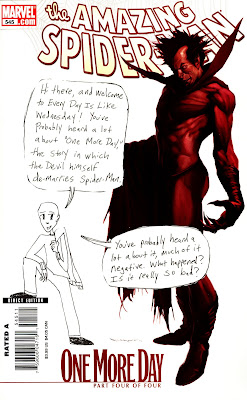
A guided tour of "One More Day"

(As always, just click on the images to make them bigger if you can't read the tiny, tiny dialogue)