Showing posts with label sean mckeever. Show all posts

Sunday, September 15, 2013

Review: Avengers: Mythos

Despite the title, this collection is only partially composed of the Mythos origin one-shots by Paul Jenkins and Paolo Rivera, with the remainder of the stories filling it being five Avengers Origins one-shots, each by a different creative team. Regardless of which publishing initiative the comics originally came from, the main throughline is that each of the seven stories deals with the origin story of an Avenger, from founders like Thor and Ant-Man to relative newcomer Luke Cage, and as a whole the book functions as a sort of Avengers 101, a helpful guide to some of the characters you'll likely encounter when reading any of Marvel's many Avengers books or big crossover/event stories.

In most cases, better versions of the stories can be found elsewhere, but not packaged altogether so conveniently.

Let's break them down story by story, and of the whole simply say that it is of professional if unremarkably quality, a good, solid bit of escapism that points to other, better comics and readies the curious for immersion into bigger, wilder stories featuring the same characters.

Mythos: Captain America
By Paul Jenkins and Paolo Rivera

Marvel's Mythos line was one of several attempts to package their most popular characters in a way that would be new-reader friendly, with "most popular" meaning those that were or were most likely to be adapted into films. Jenkins wrote them all, condensing the characters' origins and careers in general into single one shots, while the incredibly talented Rivera drew them, working in a painted style that suggested a certain amount of prestige, but tended to lack the virtues and vitality of his drawn work.

The motley crew that earned the treatment, which repeated some of the goals of the Ultimate line (only in-continuity, and in a one-off instance instead of an ongoing one) and pre-figured the goals of the Season One original graphic novels), included not only Cap and The Hulk, but also Spider-Man, The Fantastic Four, the X-Men and Ghost Rider (These are all collected together in the Marvel: Mythos, which may or may not be in print any longer because, you know, Marvel).

This one's from 2008, and the premise features a still-young Steve Rogers in the year 2008, strolling across a street to a VFW and, on his way, remembering his life story, which he narrates to readers along the way. This is the story you're probably already pretty familiar with, whether from the comics from the 2011 movie.

Skinny, 4-F kid willing to be a lab rat, successful experiment granting him super-soldier status, spy plot making sure he'd be the last such super-soldier, PR effort and real soldier, ally Bucky, the last adventure which (seemingly) ended both of their lives, re-discovery by the nascent Avengers team, finding his place as the leader of the current generation of superheroes, calling on the experience and knowledge gained during World War II.

He's at a veterans dinner at the VFW, talking to a fellow veteran during all this time. It's a very talky story, with a lot of telling (or reminding, really) rather than showing, but it gets it's job done pretty quickly and efficiently. The main innovations Jenkins adds are to spend a considerable amount of time on Cap's incredibly depressing childhood (they didn't call it The Depression for nothing!) and on his interaction with the other veterans at the dinner.

I'm curious about the Captain America stories of the future, in, say, another ten years or so, when almost all of those who fought in the war aren't around anymore. There will come a time pretty soon when Captain America is the last surviving soldier of World War II (with the exception of some other Marvel characters, of course), and stories like these will be impossible to tell in quite the same way.

Mythos: Hulk
By Paul Jenkins and Paolo Rivera

The 2006 Hulk issue was an all-around stronger piece of comics, with Jenkins focusing on a single incident of the Hulk's life—his birth in the Gamma Bomb test, and what went on just before and just after—and mostly ignored narration for letting the already modern mythic events tell the story all by themselves.

Jenkins pays special attention to the relationship between the angry, acid-tongued scientist Bruce Banner, the imperious General "Thunderbolt" Ross and his daughter Betty Ross, who the two men fight bitterly over. General Ross clearly goes out of his way and takes things rather far to make life miserable for Banner and to keep him from Betty, but the way Jenkins writes Banner, it makes Ross' actions understandable, if not relatable. Banner is pretty insufferable, and its Betty who deserves the readers' sympathy—she's the one who has to put up with these two.

Again, you know exactly how things go down here, with Banner impulsively but heroically rushing out on the testing site to save Rick Jones (here an intern doing some painting, listening to "It's Not Easy Being Green" on his walkman, and thus oblivious to what's going on around him), and being turned into the monstrous Hulk.

Rivera's Hulk takes many cues from Jack Kirby's, and while that character's depiction has changed quite a bit over the years—rather remarkably so, given the fat that his basic design is simply "big, green, muscular guy in torn purple pants—Rivera's retains the broad, thick body and large, square-like head that gave Kirby's Hulk his distinct look, the look most artists to follow him deviated rather dramatically from.

Avengers Origins: Ant-Man and The Wasp 
By Roberto Aguirre-Sacasa and Stephanie Hans

I really rather enjoyed writer Fred Van Lente's take on Ant-Man's origin way back in Marvel Adventures Superheroes #6 and Roger Langridge's portrayal of the character and The Wasp during his short run on Thor: The Might Avenger with Chris Samnee. It was hard not to contrast this with those other stories of the early Ant-Man, and thus find this one a little wanting.

Aguirre-Sacasa's script has some lighter, funnier moments to it—as in an instance where a shrunken-for-the-first-time Henry Pym wonders what to do next while a gigantic mouse looms behind him, or when he has a flustered conversation with Janet Van Dyne through a cracked doorway, trying to hide the giant ant tugging at his pant-leg—but the story is told with a more-or-less straight face, which isn't the easiest face to keep while discussing the origins of the character called "Ant-Man."

The funniest parts may not have been intentional. The writer repeatedly asks rhetorical questions about insects before answering them in the narration and the story: "Do insects dream?" and "Do insects have a destiny?" and so on. It ends with "Do insects love? Yes...these two do."

The story seems to take place within and around the early Ant-Man stories, which I've yet to read, despite having my eye on an Essentials volume containing them for literally years now, detailing Pym's early scientific successes in the fields of shrinking and ant-controlling and his romance with Jane Van Dyne, who, here at least, borders on stalking him. (If they ever finish and release an Ant-Man movie, it's easy to imagine her in a magic pixie girl role in it or its sequel).

I didn't really care for Hans' realistic, painterly work; it matches that done by Rivera in the previous story, but while those dealt with elements of the fantastic occasionally intersecting with the real world, this story is set in fantastic locales, and is chock-full of giant ants, a giant monster, a shrinking man, a shrinking woman, and it has more than one super-costume in it.  Hans likewise has a hard time selling some of the comic moments, which play in one's imagination more than on the page, as the art and words combine to suggest them, not detail them.

Avengers Origins: Vision
By Kyle Higgins & Alec Siegel and Stephane Perger

The origin of maybe my least favorite Avenger of all time! There are few things I hate to read about more than androids with the emotional lives of teenagers; I like The Vision even less than The Red Tornado, only in that The Vision has a more garish and ugly costume (I like Golden Age Vision's look okay though).

This story seems to be set almost entirely within an issue, or part of an issue, of The Avengers, of which I've never read. Ultron builds, grows and teaches The Vision, programming him with powers to take down a fairly weak squad of Avengers, and then sicks Vision on them.

Then it's The Vision vs. The Wasp, Pym as Goliath (Hoo boy, did their relationship change between these two stories!), Hawkeye and The Black Panther, and not only should the powerful android mop the floor with these guys, he does—the only reason he doesn't kill them is that he's introduced to the concept of love through much of the fight, and then turns on his creator Ultron.

As an all-fight action comic, there's little to complain about here, and, as a hater of emotional androids, I was relieved that at no point did The Vision shed any tears. Perger's art was pretty nice, maintaining the painted look, and while the backgrounds disappear almost constantly, much of the issue is set outside at night in the rainstorm, and or there are bright flashes of light, so that The Vision's sports-team color scheme is muted and, on the whole, he looks much more dramatic than usual, with Perger lengthening his cape when necessary and often blotting out the features of his face (or at least his eyes) in order to give him a mysterious, stoic, not-really-there look.

Avengers Origins: Luke Cage
By Adam Glass & Mike Benson and Dalibor Talajic

The major outlier among the other origin stories, Luke Cage's origin is of relatively recent vintage (he was created by Archie Goodwin, John Romita Sr. and George Tuska in 1972; the next most recent character included in this volume is The Vision, who was re-created in '68, but was based on a Golden Age Timely character from 1940). He's also the only one in the book to join the Avengers after the 1960s; in fact, he didn't join the team until 2005's New Avengers.

Glass and Benson's script follows Jenkins' Captain America script rather closely in form, telling Cage's origin story (which bears some parallels to Cap's) from prison to experiment to escape to flirtation with crime to Hero for Hire, ending in the modern day, with a sort of coda in which Cage continues to try and atone for a mistake he made during his life of crime and being forgiven by his victim.

Having never read the original stories this one is based on, once again I'm uncertain as to how faithful it's being, but given that Cage's archenemy on the outside is named Stryker-with-a-Y, it sure seems like it's a re-telling of something from the 1970s.

From here on in, the book loses its painted style, save for the covers, slivers of which are used as the cover for the collection. Talajic's art is perhaps the best in the book. It's certainly the most straightforward in terms of comic bookishness, and he does a pretty good job of updating the time period during the story (It seems like this Cage grew up in the '80s, rather than the '60s).

Avengers Origins: Scarlet Witch & Quicksilver
By Sean McKeever and Mirco Pierfederici 

Okay, they may technically be Avengers, but they're mutants, and they got their start with the Brotherhood of Evil Mutants, which makes these two X-Men characters, which makes them confusing and annoying.

McKeever tells their story from childhood until their debut as Avengers, with the bulk of attention spent on their relationship with Magneto, whose secret connection to them wasn't yet known to all parties at the time (although Quicksilver suspects). Their main conflict comes from not really having their heart in the whole "Evil" part of the Brotherhood of Evil Mutants.

As with the Cage story, the artwork in this oen is particularly comic-book-y, but perhaps in a more generic, less stylized way.

The story stands out as particularly complicated, but that's due more to the fact that their story is particularly complicated, coming out of the soap operatic X-Men franchise, and their inclusion in the Avengers by second-generation Marvel creators, while so many of the other Avengers getting the origin treatment here were originally created as stars of their own features, and thus had a pretty straightforward, simplicity to their powers and origins.

The question about Scarlet Witch that has always haunted me remains unanswered: What exactly is that thing she wears on her head and, like, what's it's deal, exactly...?

Avengers Origins: Thor 
By Kathryn Immonen, Al Barrionuevo and Michel Lacombe & Mark Pennington

The bulk of this story stars the young Thor and the young Loki, and it's set in Asgard. Odin commissions the creation of Mjolnir and a few other trinkets, and the hammer sits there, un-pick-up-able, while Thor and Loki have their various interpersonal conflicts and. When shit finally goes down, Thor finds the inner-strength he needs (and the right motivation) to pick up Mjolnir and start kicking ass. But he kicks so much ass, and does so in such an arrogant way, that he gets cast down to Midgard and, well, I'd suggest you pick up Thor: The Mighty Avenger for more of his adventures on Earth.

Immonen wisely starts and more-or-less completes her story before the story of the Marvel Thor really begins, with his time on Earth, and Barrionuevo's pencils are fine, evoking a bit of Brian Hitch, but are nothing remarkable, and his Asgard seems more like a Xena, Warrior Princess set than the sort of sci-fi fantasy realm of Kirby's creation.

On further reflection, the line-up of characters chosen for inclusion here is a rather odd one, isn't it? The Avengers Origins series is from 2012, the same year as the movie, but movie Avengers Iron Man, Hawkeye and Black Widow are absent, while the only movie Avenger who had an Avengers Origins issue produced was Thor. And The Hulk, who is in the movie, is included here, even though he's never really been a member of the team for any great length of time, and was merely present at their origin (As was Iron Man who, again, isn't represented).

And, again, Cage sticks out as being the odd Avenger out, although perhaps they decided to produce an origin issue focusing on him instead of, say, Hawkeye or Iron Man, simply because his origins is much more obscure than that of, say, Tony Stark.

All in all, it's a decent enough intro eight Marvel superheroes. None of the stories stand out as being particularly great ones, but then, none of them are at all poor ones either.

Monday, February 18, 2013

Young Avengers Catch-Up: Siege: Young Avengers #1 (2010)

This one-shot by writer Sean McKeever, pencil artist Mahmud A. Asrar and inkers Scott Hanna and Victor Olazaba was a brief check-in type story tied to Marvel's completely nonsensical event series Siege, a bizarrely written story by chief Marvel Universe architect Brian Michael Bendis that, as I've previously noted, doesn't make a lick of sense on its own.

The event was climax of the "Dark Reign" period of the Marvel Universe, in which former Green Goblin Norman Osborn has donned a red, white and blue Iron Man suit to become Iron Patriot and lead his own team of Avengers made up of villains-posing-as heroes and his own SHIELD-like government agency HAMMER. For reasons never explained, Osborn decides he needs to conquer Asgard, which he attacks in defiance of the his boss President Barack Obama, and ends up in an all-the-heroes vs. all-the-villains fight on the floating city of Norse-derived Kirby space-gods.

The Young Avengers special was apparently intended as a part of a suite of one-shots, as its cover is part of a single, multi-part image by Marko Djurdjevic, and it gets collected along with four more one-shots in Siege: Battlefield, which is where I found and read it. (We'll look at those other comics in a bit).

One rather admirable aspect of writer Allen Heinberg and artist Jim Cheung's creation of the Young Avengers characters is how many aspects of the wider Marvel Universe he was able to tie into the various characters, as it makes them incredibly easy to plug into just about every Marvel event series imaginable. This event, for example, revolves around Asgard, and one of the Young Avengers characters was inspired by Thor to kinda sorta pose as a Thor-like sidekick at the outset, even going so far as to go by the name Asgardian (Changed later, of course, to "Wiccan," which can't so easily be corrupted into "ass-guardian").

The plot consists entirely of what the various team members are doing during the Everyone Vs. Everyone fight on Asgard, specifically after the part of the battle (which was not a siege) where The Sentry knocked the floating city down.

Wiccan and Hulkling, whose magic and gross green veiny pterodactyl wings spared them from the crash, find The Wrecking Crew trying to super-loot the ruins for Asgardian treasure, and fight them. Patriot and Hawkeye, meanwhile, are trapped in the rubble and fighting for survival, ala Red Arrow and Vixen in that one Meltzer issue of Justice League of America, ala Nicolas Cage and The Guy Who Wasn't Nicolas Cage in World Trade Center. And Speed runs around looking for survivors in the rubble. No sign of Stature and Vision.

It's a fairly well constructed fight comic, with each of the three character or character groups going through a distinct arc in which they reach a point of hopelessness and than rally, the issue ending with a splash page of Speed leading the charge to have them rejoin the fight.

It's completely inessential of course, but then, that's what it was supposed to be all along, the answer to a question a certain sub-set of Marvel readers might have wanted to know the answer to (Hey, what were the Young Avengers doing during the Battle of Asgard?), and a bone thrown to the would-be Young Avengers audience awaiting the return of the characters creators/re-creators to finish up their story.

The artwork is quite impressive and, in certain panels, looks like the work of Cheung (particularly on a re-flip-through. If Marvel had decided to go forward with a Young Avengers monthly sans Heinberg and Cheung in 2010, this would have been a fine creative team to do so with.

******************

As I said, this issue was collected in Siege: Battlefield, which contained a handful of Siege one-shots, connected only by their interlocking cover images and the fact that they had something or other to do with Siege. These are they...

Siege: Loki #1 by Kieron Gillen and Jamie McKelvie

This particular creative team is of particular note for this particular series of reviews, as these are the guys who will go on to create the next volume of a Young Avengers ongoing series, the one that sparked this endeavor on my part.

The star is Loki, part of Osborn's cabal of villains secretly running the "Dark Reign", who is here restored to his original, male form, after having spent much of the previous "Dark Reign" cycle in the form of a buxom woman, for reasons I never understood (It happened in an issue of a Thor comic I didn't read, I imagine).

In the Gillen/McKelvie Young Avengers, he appears in the form of a little kid. I think they should probably keep him male and grown-up, personally because a) McKelvie draws him so well and b) all the ladies I know who dug the Avengers movie  really seemed to like sexy Tom Hiddleston's sexy Loki.

Their story is set before and behind the scenes of the battle that occurs in Siege,basically showing Loki as a wicked and clever manipulator moving in a world of Marvel's evil power players—we see him taking a call from Doctor Doom and meeting with Mephisto and Hel, for example—to get what he wants, which here seems to be the destruction of Asgard and release from his destined place in Hel's hell (which may be spelled "Hel").

It's pretty great stuff, light on the superhero business (Osborn appears on one page) and heavy on the mythological and, tonally, it felt like an early issue of a pre-Vertigo Vertigo series: Mature storytelling devoted to mythology and fantasy extrapolated from old-school trashy super-comics which were themselves inspired by classical mythology. While reading, I kept thinking this creative team would probably do a knock-out Doctor Strange series.

I can't say enough good things about McKelvie's clean, smooth, pristine, perfectly-acted artwork: That guy's the best. This is by far the best-looking chapter of the book.

Props go to the pair also for their five-panel sequence involving Loki and Osborn. That's the first time that it was made clear to me that it was Loki speaking to Osborn through his Green Goblin mask, as his Green Goblin persona, in an effort to convince Osborn to attack Asgard because that's what Loki wants him to do. In a lot of the other "Dark Reign" and Siege related comics I've read, this isn't at all clear, and Osborn is usually presented as either a complete lunatic attacking Asgard just-because, or being talked into it by Loki, who doesn't really offer any compelling reason to convince him to do so. Here, it seems the compelling reason is that Osborn thinks his dominant if buried persona is telling him to do so.

Siege: Spider-Man #1 by Brian Reed and Marco Santucci

Spider-Man and Ms. Marvel fight Venom, who, at the time, was former Scorpion Mac Gargan in the alien symbiote suit, who spent the majority of "Dark Reign" (and the Bendis-written series Dark Avengers) disguised as Spider-Man.

That, obviously, annoyed Spider-Man.

This issue, then, is devoted to the climax of their fight over that particular conflict, with the pair tumbling out of the still airborne Asgard to the city below (Broxton), where Ms. Marvel swoops in to give Spidey an assist and fly him back up to Asgard so he can participate in the events of Siege.

It's a decent enough story and the art is similarly decent. It is about as pure a fight comic as you can get without excising the dialogue, which hear consists mainly of Spider-Man quips and Venom's chatter about eating people.
The most striking and memorable image is a panel in which Ms. Marvel separates Venom from Gargan by sticking her hand down the former's throat and yanking the naked latter out its mouth.

Siege: Captain America #1 by Christos N. Gage and Federico Dallocchio

The artwork on this one made it very hard for me to read. It was clear enough that it was easily legible, I just didn't like looking at it. Very photo-reference-y, with poses and renderings that look, if not traced from photos, then at least rigorously imitating images of real people, with costumes and fantastic action set atop of them.

It's all very awkward looking, as in a terribly uninspired two-page splash page of a bunch of heroes fighting a bunch of villains. One of the Captains America, in this image, appears to be both simultaneously kicking Taskmaster's shield and firing his gun at the shield, and seems badly in danger of literally shooting himself. Also, Dr. Fate seems to be there, for some reason.

Gage deviates from the all-fighting, all-the-time mandate that dominates most of these stories by introducing a family of civilians on the outskirts of the conflict, who provide an element of extra danger for the Captains, as well as some folks to be inspired by them.

Then current Captain America James "Bucky" Barnes and returned-to-life former Captain America Steve Rogers are participating in the big fight on Asgard and, after Sentry knocks it down, they find themselves fighting Razorfist, perhaps the least believable of all of Marvel's many fantastical villains (He's the guy who has had both of his hands replaced with huge, razor-sharp blades, and his costume consists of a sort of skin-tight ski mask with ear holes that I can't imagine how he puts on—dude must have an intern to dress him. (Also, Razorfist...? Dude can't make a fist, as he doesn't have hands).

The Captains beat the shit out of him, and then run back to the crossover story. See a pattern forming? These are kind of fun in how straightforward they are, as the majority of them are little narrative cul de sacs, where the characters leave the events of Siege, run through the conflict of a single issue tie-in, and then return to the events of Siege, usually declaring, "Well, that's the end of our one-shot tie-in; back to the main series!" (I'm paraphrasing; here it's actually "Let's go... ...We're needed."

This one's followed by Siege: Young Avengers.

Siege: Secret Warriors #1 by Jonathan Hickman and Alessandro Vitti

This series, Secret Warriors, is a kinda sorta years-later spin-off of that weird Bendis-written Secret War miniseries that truly kicked off his Avengers and Marvel Universe writing, and ended with one of the worst and laziest issues of a comic book I've ever read.

The premise of Secret Warriors was that an off-the-grid Nick Fury was leading his own team of secret superheroes, all of whom eschewed costumes in favor of classic SHIELD uniforms, for maximum boring-looking character design. I never read any of it, but Marvel might have tempted me to read the first issue had they instead titled it Nick Fury and his Howling Secret Warriors (I'm a big fan of howling).

So did you read Siege...? If not, there's this one gross-looking panel where Sentry grabs Ares the god of war and rips him vertically in half, just like She-Hulk did to Vision in "Avengers Disassembled," except Ares isn't a robot, so there's a bunch of gore and viscera in the panel (Bendis wrote both scenes, so he's not stealing from another writer, just repeating himself).

Well, on of the Secret Warriors is Phobos, the son of Ares (who is also a little kid). The issue opens with him watching a bank of monitors in which panels from Siege appear, including the gross one of his dad getting torn in half.

While Nick Fury joins Captain America for the assault on Asgard, Phobos flashes back to hanging out with his dad, then picks up a couple of swords, enters the White House through a secret passage, and silently slaughters Secret Service agents throughout the issue in order to, as he finally explains once President Barack Obama is safely aboard Marine One and flying towards safety, "to deliver a message."

The message isn't metaphorical, but literal though, as the last panel of the issue sees him sitting down at Obama's desk, the Oval Office littered with dead agents, to write a letter:
It's not every day that a human finds himself responsible for the death of a god and then on that very same day escapes facing another...
But before you wash your hands of my father's blood, I would encourage you to reflect on what brought us to this point: You sacrificed honor for expediency. You traded intent for quick action. You were wrong...and we all suffered for it.
It's a pretty weird comic. At least when Garth Ennis had The Punisher threaten to kill President George W. Bush, he did so without killing a bunch of innocent guys, and the president was a little more directly tied to the crime.
Obama's guilt for the death of Ares is fairly indirect, in that he put Osborn in charge of the superheroes, Osborn hired Sentry and Ares and Osborn ordered them both to attack Asgard, where Ares rebelled against Osborn and got torn in half. I realize the buck stops with the president and all, but Siege made it pretty clear that Osborn had "gone rogue" and was acting against the will of the president and, um, the entire United States government when he attacked Asgard, acting on the advice of his Green Goblin mask/other personality/Loki.I'm not a fan of the art in this one, although there's nothing really wrong with it. The style just didn't do much for me. There is a pretty neat panel of Obama sitting behind a desk, his face in shadow, his hands calmly folded in front of him, with the Joint Chiefs of Staff lined up behind him and a small army of gun-toting Secret Service agents between them and the reader. It's maybe the clearest image of Obama-as-supervillain I've seen in a comic book.

You know, between Bush's handling of the events of Civil War, "The Initiative" and Secret Invasion and Obama's handling of "Dark Reign" and Siege, as horrible as the choices these guys make in our universe might so often seem, they're both a hell of a lot better than their 616 counterparts...

Wednesday, April 14, 2010

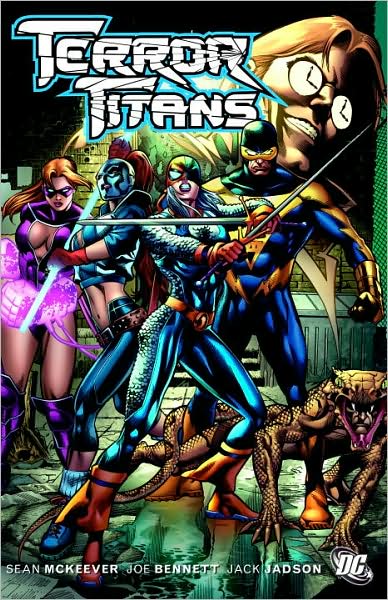
Some thoughts on Terror Titans

Having recently read a couple of collections of Sean McKeever’s run on Teen Titans, I figured I might as well read the trade collection of his spin-off miniseries Terror Titans as well, and thus finish off all of the trades produced during McKeever’s Titans.

The book follows Rose “Ravager” Wilson, who had just quit the Teen Titans team, infiltrating the ranks of new Clock King’s team of teenage legacy villains, the so-called Terror Titans.

Clock King uses them to help him capture and sell teenage super-people to The Dark Side Club, a place where bad guys organize and bet on gladiatorial death matches between superheroes.

It’s not a very good work, but I didn’t find myself necessarily incensed about its poor quality in such a way that I felt motivated to give it a formal review either.

So instead, here are some random thoughts on it.


—Aside from a few weak points, including an unclear beginning (borne of this book being a spin-off, no doubt) and a somewhat nonsensical climax (more on that later), the series is plotted very well. Almost every issue opens with an eight-panel, silent sequence featuring the life story of one of the Terror Titans, which does a fair job of showing up that they’re all life-long psychopaths in a quick, efficient manner, and writer Sean McKeever manages to demonstrate The Clock King manipulating each of the four title characters somewhat subtly. By the book’s climax, it’s made clear that the various conflicts between the main characters have all been engineered by the Clock King for a purpose.

Additionally, McKeever does a good job of sketching out the characters of the Terror Titans, although the series’ hero and its villain remain ciphers.


—The violent content that was so off-putting in a book featuring Robin, Wonder Girl and Marvin and Wendy works much better here in a more standalone title than it did in Teen Titans. Like Secret Six, this is a book consisting mostly of bad guys and worse guys (and a bunch of mind-controlled victims, I guess), so depravity of any kind is a lot more at home here.

I personally don’t like DC’s often juvenile, trying-to-have-it-both-ways approach to mature content, in which they neither commit to actual mature readers content, but don’t produce all-ages material either. Terror Titans, like the Teen Titans series about the time this spun out of it (and plenty of other DC Comics of the last few years), reads a bit like an R-rated movie in which the studio kept making one tiny edit after another until they had snipped away enough content that the MPAA granted them a coveted PG-13 rating.


—While his motivations are never made clear and his plans don’t make a whole lot of sense, McKeever’s Clock King is certainly built up as a formidable, scary villain. The fact that McKeever manages to do so without any of the usual cheap tricks—like, say, having Clock King defeat The Joker or Prometheus off-panel to prove what a bad-ass he is—but instead by spending time revealing his brutal nature slowly, action by action, line by line, the old-fashioned way, makes him doubly so.


—I’m of two minds about the art, which is penciled by Joe Bennett and inked by Jack Jadson. I don’t think it looks very good, personally, but I’m unsure of whether or not it’s good.

Like Eddy Barrows, who was occasionally drawing Teen Titans during the time this spun out of it, they draw muscled human bodies in tortured, agonized poses pretty well, so a great deal of the book is appropriately ugly and painful looking. I could feel stress emanating from the pages, and that’s a good thing, given the content.

It’s not unreadable, and, sadly, “not unreadable” actually qualifies as a positive when talking about current Big Two super-comic art, although it could certainly be more clear. Particularly during the fight scenes, of which there are many, it is difficult to tell who is doing what to whom, and who actually wins and loses the fights (Of course, these end with boxes declaring the winner, which helps in cases where the poses and rendering simply show two identical super girls in similar, painful-looking, eyes-squinting, mouth-open poses).

They draw awful clothes though. There’s a scene where Ravager and the Terror Titans are all wearing street clothes, and…and there was a blazer over a t-shirt tucked into jeans…and- and an off-the-shoulder peasant blouse belly shirt…and a micro tank top and tiny shorts with white piping and…

Well, let’s just say if there were a DC superhero named Fashion Police Woman who caught the villains in the lair, she would have been more than justified in using lethal force on the team.


—That said, I do like the character design of The Clock King. And… No actually, that’s the only nice character design in this book.


—I can’t think of a better illustration of how out of control DC’s legacy-itis has gotten than this book. The very first scene of the book features our villainous protagonists Disruptor II, Copperhead II, Persuader III* and Dreadbolt (son of Bolt) attacking a group of teen heroes consisting of Aquagirl II, Terra III**, Star-Spangled Kid III, Zatara II, Offspring (son of Plastic Man) and Molecule, the only non-legacy character of the bunch.


—I had to eventually throw my hands up and give up on trying to figure out how this fit in with Final Crisis. The Dark Side Club is, at the series’ opening, run by characters with names familiar from Jack Kirby’s Fourth World mythology—Desaad, Steppenwolf, Bernadeth and so on. They are all in mundane human forms though, similar to the way Grant Morrison imagined them in Seven Soldiers: Mister Miracle and the early parts of Final Crisis.

I couldn’t tell if this series was set before or after Final Crisis though, as the characters refer to “Boss Dark Side” and Granny Goodness having died, and the prophecy concerning the dark gods arriving on Earth having failed to come to pass.

Oh, and Clock King kills two of the New Gods, too.


—There’s a strange bit of dialogue during a meeting between Clock King and the evil New Gods about the direction of the Club which I’m not sure I understood, but it seems like McKeever either used the wrong word or someone in editorial should have spiked that word.

“I realize you feel your Caesar act is in some way, engaging, Vundabarr,” Clock King says to Vundabarr, “But you and your co-chair have to accept that you aren’t packing in the sodomites like you used to.”

The next few sentences, if that helps provide context: “The crowds you’ve managed to keep, they don’t spend. They don’t bet. They don’t get terribly excited anymore.”

So, um, what was that about sodomites, and what on earth does that have to do with anything here?


—A couple of super-nerdy nitpicks: How does Dreadbolt punch out Offspring in the opening scene, if the latter is made out of living plastic? And how is Miss Martian able to retain her shape-changed disguise when Fever defeats her by bathing her in fire?


—That said, hoo boy is this a pretty gory comic. In addition to all the blood-spitting face punches and broken necks and bones, there’s a panel of two people having their heads bisected by Clock King’s little Phantasm balls (one vertically, one horizontally), there’s a sequence of the character Hardrock (What if the Thing were a teenager, with a dumb name?) tearing Young Frankenstein (Get it? Like the movie) into three pieces, a character having her flesh melted off while being blown apart with her entrails flailing about, and, in the scene that surprised me the most, a character with explosive fingertips having all ten of her fingers chopped off…by our hero Rose Wilson…the only character fighting in the tournament who’s not being mind-controlled into fighting.

It is, or course, not marked mature readers, because no one says “the F-word” and all of the nipples remain covered by spandex or clingy cotton.


—There are an awful lot of characters killed for such a short span of issues. Not counting civilians, New Gods in human forms and characters created specifically for this series (Pristine and TNTeena, I think). These include Molecule, a “missing year” Teen Titan only seen in 52 (and Tiny Titans!), who gets chopped in half; Bolt, a late-eighties Blue Devil villain, who gets teleported into a stone chimney; and Fever, a new hero created for John Arcudi and Tan Eng Huat’s short-lived 2001 Doom Patrol series , who gets shot with a shotgun after our heroine Rose Wilson knocks her unconscious in a tournament bout.


—Clock King’s big plan doesn’t really make a whole lot of sense. As the series draws to a close, we learn that the scheming villain hasn’t just been brainwashing the captured teen heroes to fight one another in the arena, but he’s been programming to serve as his own personal army in some undefined, goal-less terror campaign (Other than mentioning unleashing chaos a few times, he doesn’t seem to have any concrete political or personal goals for his plot).

He calls them “The Martyr Militia,” and he sets them loose in LA to tear up the street, attacking empty vehicles and buildings for a few pages…? There’s nothing to it other than random, victimless violence, and since there doesn’t even seem to be any casualties, it doesn’t even seem like terrorism.

In our world, it would probably be kind of scary, but in the DCU, unleashing a dozen Y-List teenage heroes to tear up a city block seems kind of small potatoes, doesn’t it? Something Superman or The Flash or Green Lantern could take care of between the panels of their own, regularly scheduled adventures?


—Who on Earth thought the ideal way to introduce Milestone’s Static into the DCU was to have him show up in the second half of a violent Teen Titans spin-off in which Ravager is the biggest name character?


*Well, I’m going to go ahead and call her Perusader III, because she’s the third character with that name and schtick in DC’s comics, but chronologically along the DCU timeline, she’s Perusader II. The original Persuader is a Legion villain, so he exists a thousand years in the future, making the second and third Perusaders more “pre-gacy” than “legacy” characters. Ah, comics!


**Or Terra II, depending on whether or not the Team Titans Terra was Terra II or Terra I who temporarily thought she was Terra I…I lost track of that plot point

Thursday, March 11, 2010

Review: Teen Titans: Deathtrap

You know those occasional issues of super-team comics which focus on the changing of the line-up? Where the plot more or less stalls for 22 pages while the writer checks in with the various characters, who take turns explaining to one another why they’re leaving the team, or why they’re joining the team?

After slogging through two trade paperbacks’ worth of Sean McKeever’s disappointing run on Teen Titans, I realized that during that period the series had begun to seem like an entire regular, monthly series comprised of nothing but issues like that, or perhaps a single changing-of-the-line-up issue decompressed into a year’s worth of comics, McKeever’s plotting and characterization too often taking a back seat to explaining changes in the cast.

So I was quite surprised when I got to Teen Titans: Deathtrap to find out just how focused and tightly-plotted a book it was. It collects a crossover between three different titles—Teen Titans, Titans and Vigilanted—and featured McKeever and Marv Wolfman taking turns writing chapters, and yet it was the most consistent, straightforward and accessible of the Titans trades I’ve read recently.

I won’t go so far as to say that it’s a good comic book, but it is a more-or-less complete story, but it’s definitely a better chunk of comics than On The Clock and Changing of the Guard. It has a beginning, a middle and an end. I could make sense of it without having to consult Wikipedia, creator message boards and interviews, and my memory of past DC solicitations. It was also the only one of the three that seemed to know where it was going from chapter to chapter.

It’s got a lot of problems, big and small, but it doesn’t dare you to keep reading it, the way those other Teen Titans trades did, and, as an added benefit, there’s less splatterstick gross-out gore and creepy sexual bits.

The most apparent problem is probably just how ugly a comic book this is; if the scripting seems better thought-out here than in the Teen Titans trades immediately preceding it, the art is just as slap-dash and drawn-by-whichever-artist-had-a-hole-in-his-schedule as the earlier chunks of the title. There are five artist credited as pencillers, and six as inkers, and it shouldn’t surprise you to learn that very few of them have anything approaching similar styles.

What surprised me most about the art were the fairly obvious mistakes sprinkled throughout, which not only passed the original editors of the various titles unnoticed, but apparently that of the editors assembling this trade collection as well (Unless they were noticed, but the general philosophy is something along the lines of “Eh, fuck it—no one buys these trades for the art anyway, it’s just not worth redrawing a half-dozen panels.”) These include the smooth, bald head of Cyborg sprouting hair between pages, Static changing his costume design during a plane ride and Eddie changing clothes three times during the same flight, including taking off his street clothes to don his old Red Devil costume, complete with the red skin he wore under it….? Or Something?

Perhaps less apparent, but somewhat fundamental, was the slow realization that it’s rather weird that this is story is collected as Teen Titans: Deathrap instead of Titans: Deathtrap (The spine has the number “11” on the cover too, so this is apparently Teen Titans Vol. 11). The teen team, the one appearing on the cover of the trade, is the focus of only the first chapter of the book, in which Cyborg apparently tries to kill them all using the high-tech defenses he built into their headquarters.

After that, they jump into a jet plane to fly to New York City and join the adult Titans in their hunt for the hero-turned-villain Jericho, and don’t reappear until near the climax of the book. So there’s about 100 pages or so which are Teen Titan-free, and focus on the grown-up Titans and Vigilante trying to track down Jericho—the Titans to apprehend him and save him from himself, Vigilante to kill him.

Perhaps Teen Titans trades sell better than Titans ones, and thus that was simply the best way to brand the book? I don’t know; it was simply something that confused me (And, I admit, disappointed me a bit, since that is such a weird and interesting line-up, and it seemed to be composed of characters that McKeever would have more-or-less exclusive control over, making future issues of his smoother and less likely to have to explain comings and goings).

Here’s the story: After Cyborg, working through Titans Tower, tries very hard to kill the new and improved Teen Titans team, it’s revealed that someone is possessing Cyborg and that someone is Jericho, the body-possessing Titan who went from being the second-hairiest character during the classing Marv Wolfman/George Perez run to being a crazy maniac attempting to kill all the made-up presidential candidates in DC’s ill-advised, chicken-shit piece of garbage 2008 miniseries DC Universe: Decisions (A book so damn bad that DC never even collected it…? They collected Countdown!).

The new Vigilante, Vigilante IV? (…or V? Maybe VI…?) is on Jericho’s trail for…some reason. He also has a back-story and motivations I never really figured out, as this storyline seemed to run parallel to several ongoing sub-plots of his own title that crossed over with the two Titans books here. It wasn’t a negative type of confusion I felt when these elements would come up, though. That is, I knew what I didn’t know, and I knew why I didn’t know it and where I could learn about it if I cared to, and it was made clear I wasn’t missing anything important—for all intents and purposes, all one needed to know was that this Vigilante was of the Punisher-type, rather than the original singing cowboy type. (Well, I didn’t understand why the Vigilante narrated all of the chapters of the story featuring him, but not the other chapters, which were narrator-less…I’ll never understand why so many comics are written with inconsistent points-of-view like this).

Jericho’s deal is that all of the body-possessing of villains and other’s that he’s done over the years has left psychic residue in his own mind, so he picks up bits of other people’s personalities, including an awful lot of villains’ personalities. He wants to prove himself the world’s greatest assassin, one-upping his father Deathstroke by killing all of the current Titans, and he plans on doing it with a really stupid death trap.

The idea is to create an elaborate hostage situation, get all of the Titans in the same room with him and the hostages and then—wait for it—blow them all up. With dynamite.

It’s a pretty Wile E. Coyote kind of plot, and it falls apart if one thinks about it too long (that is, at all). I got the impression that Wolfman and/or McKeever came up with the nature of the death trap first, and then plugged whatever Titans were on the teams at the time into the scenario, but it’s the sort of trap that you might spring on, say, Batman and Robin, but the Titans?

Regardless of how much dynamite you use, it wouldn’t be enough to blow up Miss Martian (who is invulnerable and can turn intangible) or Bombshell (who absorbs energy). I don’t know for sure, but I would expect Blue Beetle’s armor and or force fields could protect him. I think Donna Troy’s as strong as Wonder Woman, and can take an explosion. Raven can teleport herself…and everyone else. The Flash could outrun and explosion, or vibrate through the concussive force. Or, um, just run everyone out of range of the explosion in a split-second before it goes off.

Obviously the Titans don’t all get killed anyway, but it’s a pretty drama-free climax, given the mundane nature of the threat and, more disappointingly for me, the lack of imagination in its creation. If you’re going to be using The Flash in your comic, you really have to at least think of half-assed, comic book science explanations for why it might be possible to hurt someone who can move at light speed, you know? Sure, it ain’t always easy, but seeing writers wriggle through the obstacle course previous writers have established for them is at least part of the fun of reading corporate, serial super-comics that have been around for decades.

Not that the Flash plays a very big role in the story. Few of the characters actually do…in fact, most of the characters are lucky to even get a few lines. Cyborg, Beast Boy, Donna Troy and Vigilante have fairly large roles, and Ravager gets a bit of a spotlight near the end, but after the first, Teen Titans-focused chapter, it’s very much a Vigilante vs. Jericho story, with a few of the Old New Teen Titans in supporting roles.

So Teen Titans: Deathtrap? Not very good—but much less not very good than some of the other Teen Titans trade paperbacks one could read instead.

Tuesday, February 23, 2010

Review: A couple of very violent Teen Titans trades

The new library I’ve been going to doesn’t have much in the way of a graphic novel collection. There are none among the adult shelves of the library; everything is shelved in the teen portion of the youth section, along with all the YA novels.

Unsurprisingly, the bulk of the graphic novel space is comprised of popular manga series, and what little superhero franchises are represented at all generally only have a few books a piece. I was somewhat surprised to find a pair of recent Teen Titans collections there…at least until I stopped to think about it.

It is, after all, the only superhero comic with the word “teen” right there in the title…if you didn’t know all that much about comics but were in charge of spending the graphic novel budget picking out books for teens, wouldn’t you naturally gravitate toward that? Especially if you saw Robin and Blue Beetle, star of those YALSA honored books, on the cover?

I hope whoever ordered Teen Titans: On the Clock and Teen Titans: Changing of the Guard read them both before putting them on the shelves though, because hoo boy are these some nasty, violent, icky, decadent super-comics, even by the standards of post-Dr. Light-raping-Sue Dibny DC Comics.

Among the things featured in these two books are…

—A full-page splash detailing the horrific wounds Kid Devil suffered while being gang-beaten by the Terror Titans:
—Ravager beating Copperhead II’s face into a bloody pulp

—Miss Martian about to be raped in a bathroom stall by two men

—Adult supervillain Clock King in bed with his teenage girlfriend

—A gory spread in which a supervillain version of Miss Martian shows the superhero version images of her killing the Teen Titans, including choking Wonder Girl with her own lasso, tearing out Blue Beetle’s spine, putting a sword through Ravagers head and ripping Kid Devil’s head in half by his horns:

—Kid Devil being tortured on-panel

—Robin being stabbed and his face beaten into a bloody pulp

—“Wonder Dog” killing Marvin before stalking a terrified Wendy through the halls of Titans Tower and mauling her

—Bombshell unconscious in a morgue, her throat slashed and bloody…three panels before an image of Wendy, scarred and bandaged, unconscious in a hospital bed

—Wonder Dog exploding, showering the team with gore

—Kid Devil’s desiccated corpse

—Brother Blood ripping someone’s arms off

—Short-lived character The Face being impaled

Not only is it a lot of violence for about a year’s worth of a comics series, it’s all presented as blatantly as possible, and with as much blood as possible, and the fact that it is almost all violence for violence’s sake gives it an exploitive, snuffy vibe.

It’s not like the violence ever leads to anything like, say, character development, or some sort of message—Teen Titans is almost entirely devoid of plot or characterization.

The first book opens with Supergirl quitting the team, flying away from Titans Tower while another Titan stands on the rooftop. It’s a scene that will be repeated over and over during the course of these two books—comprising 15 issues of the monthly series—with Miss Martian, Ravager and Robin similarly leaving the team one-by-one.

If I had to take a stab at what Teen Titans was about, I would guess it was about how hard it is to produce the comic Teen Titans. The cast is constantly in flux—only three characters from the first issue of the trades are still on the team in the last issue—and the team’s biggest conflict seems to be maintaining a roster of more than four heroes, as fretting over how few members they have and how hard it is to keep people on the team seems to be all the characters ever talk about.

It would be unfair to blame writer Sean McKeever, who wrote all of these issues save the final one, Teen Titans #61, which originally shipped without a writer credited, as there were clearly problems producing the book. These fifteen issues have seven different pencil artists and eight different inkers, and the narrative is quite regularly interrupted by things occurring in other books, adding to the chaotic, almost arbitrary feel of the book.

Halfway through the second trade, for example, Robin quits the team, because of whatever was going on in the Batman line of books at the time these issues were produced.

Similarly, the Clock King/Terror Titans arc is a Final Crisis tie-in, and despite the fact that those characters torture a couple of Titans and almost kill some of the others, the team moves on to other things, because if you want to find out what happens, you’ll presumably have read Final Crisis and the Terror Titans miniseries.

Given the speed at which characters arrive, depart or radically change, the fact that McKeever and his team of artists manage any thing resembling a throughline to the book is in itself rather remarkable.

And, for Teen Titans’ many, many, many faults, it’s not as if it’s a creative black hole or anything—there are enough glimmers of quality here and there to make the book’s poor quality seem almost tragic. Every now and then there’s a clue that maybe, given different circumstance, Sean McKeever and a single art team might have made a decent, fun comic book about teenage superheroes.

As two of the three Titans to stay on the roster throughout these fifteen issues, Blue Beetle and Kid Devil get the most attention, and are the most consistent. McKeever gives them distinct voices and relationships to one another and their various teammates and, unlike Wonder Girl and Robin, they are a bit more mutable, particularly Kid Devil, whose only appearances were in this book (and thus McKeever as the only writer writing him).

The book’s lightest, brightest moments seem to revolve around these characters, perhaps my favorite being a scene in which Robin dresses Kid Devil down over a communications device, looking all angry and bad-ass in Kid Devil’s computer screen, but the next panel cuts away so that we see Robin in his bedroom in his socks and boxers, wearing his mask and clutching his cape around him…he’s only Robin from the neck up, and a silly kid play-acting from the neck down.

Such moments are, of course, overshadowed by the book veering into torture porn or horror territory in the Clock King arc or the Wonder Dog-eats-Marvin-and-Wendy issue, and the artwork is always there to make this ugly content all the uglier.

And the artwork is, of course, horrible, but that’s to be expected with the artists changing so frequently…characters morph from page to page, and if it weren’t for dialogue clues, it would be difficult to keep them straight.

I think Eddy Barrows is supposed to be the “regular” pencil artist, and he seems to be doing most of the drawing here. I’m not a big fan of his style, although it’s well-suited for the material. His women all share the same body, so that computer geek Wendy has the same big-breasted, pinched-waist, well muscled limbs as the chemically-enhanced super-ninja Ravager, and he dresses them in the ugliest street clothes imaginable, but he draws decent enough gore, and he’s fairly gifted with facial expressions.

He’s not given much opportunity to draw anything other than ugly sneers and grimaces—which he draws well—but I like what he does with Kid Devil and Blue Beetle’s faces in their lighter moments, and he draws a neat one eye narrowed, one eye wide open confused look on Robin sometimes.

Looking at this mess after the fact, and taken in all at once instead of in the monthly drip-drip of serial comics plotting, it’s hard to imagine why DC even collected these issues—they read incredibly poorly, and, in fact, almost refuse to be read like this at all. I had to continually stop and remember what else was going on in other DC books during the time of publication just to make sense of why Character A had Secret Identity B for six pages in the middle of one of these things, or why Granny Goodness was a black woman with a sideways ball cap, or how the hell Kid Eternity and Static Shock got into the DCU.

If this were going to be a good comic, it would have had to been given a lot more leeway, like a cast stable enough to last, say, an entire year perhaps, rather than being tied so closely into DCU continuity that Teen Titans can hardly even stand on it’s own. But much like Justice League of America during the same time, Teen Titans seems to have sacrificed everything simply to line up better with whatever events were going on in the wider line at the time, which perhaps made sense to folks reading all of DC’s comics as they were released each Wednesday, but, revisited later in trade (you know, the way the stories will live on with a longer than 30-day shelf-life) make for some awful, awful comics.

Basically, Teen Titans could have used some space from the DCU line. And a real, regular art team. And a lot less torture, violence, gore and adults doing it with teenagers. Then DC might have really had something here.

Thursday, August 28, 2008

Poorly organized thoughts on Virgin Comics, the decadence of DC and some links


So, Virgin Comics, huh? Word on the street (and by “street” I mean “Internet”) is that the company’s calling it quits. Here’s a Publishers Weekly story. Here’s retailer and Savage Critic Brian Hibbs on the collapse from his perspective. Here’s Dirk Deppey. And here’s Dirk Deppey again.

From my perspective, I thought Virgin did a very good job of selling their comics, and if they failed to be sell enough of ‘em to keep doing it, it seems to be simply because not enough people wanted to buy them vs. some fault of the publisher’s staff.

When I was writing weekly comics reviews for Las Vegas Weekly, the PR folks at Virgin were all extremely easy to work with, and were always volunteering review copies of all their new series and offering whatever assistance I might need.

The books had the benefit of being extremely easy to write about for a mainstream, outside-of-comics medium, too. There was the initial novelty—Richard Branson, Deepak Chopra, Indian mythology, blah blah blah—and then the matter of the names tied to them. A book “created by” Nicolas Cage or Guy Richie or John Woo might not be any good at all, but it’s something that your average, civilian reader might care to hear more about. “John Woo? Doing a comic with John Woo fan Garth Ennis? Tell me more…”

The production values and the art were also extremely high. The books looked good as serial comics; certainly better than, say, Boom or Dynamite books (just in terms of trade dress and production value). The art was in many cases extraordinary, certainly better than the bulk of DC’s output over the last two years, and in a more comic book-y style than a lot of Marvel’s MU content over that same period of time.

That said, the comics tended to not be very good. I tried the first issues of the bulk of the series Virgin put out, and would usually lose interest by the second or third issue. I lasted maybe five issues of Snake Woman and Seven Brothers, and four of Dan Dare; those were the books I stuck with longest. I liked those series, but I’d inevitably miss an issue or two, realize that I’d forgotten to buy them and didn’t really miss-miss them, and thus never put in the effort to catch back up.

Most of them, however, were just pretty straightforward; nothing I wasn’t already getting from DC or Marvel or Dark Horse or Image or Tokyopop or Viz, with the exception of featuring characters I was less interested in than Batman or Spider-Man or Conan or Empowered, or with less visual snap and aesthetic appeal than in whatever manga series I happened to be reading.

Additionally, I think there was something noticeably “wrong” about a lot of the comics, which was apparent by their peculiar branding. John Woo and Garth Ennis collaborating on a comic sounds like a dream come true, but it wasn’t clear how much Woo was contributing (Seven Brothers sure read like any other Ennis comic, of which there were quite a few available concurrently). What exactly did Nic Cage and his son contribute to Voodoo Child if Mike Carey was credited as the writer?
And so on.

I’m still curious how some of these celebrity-branded comics were created exactly, and if that process had anything to do with Virgin’s overhead. Like, were each of the Cages getting paid as much as Carey for each issue of the book?

I’m also curious why Virgin went down so fast, but Boom and Dynamite Entertainment are both still around; both of those companies did pretty good jobs of getting their books in front of critics, and offering books that folks outside the Direct Market would conceivably be interested in hearing about as well. I think Virgin’s production values tend to be higher, however, the art more polished, and they had bigger name creators—not just the Hollywood folks, but the comic folks as well. Did Virgin just start out bigger than Boom and Dynamite, with a line that wasn’t sustainable unless the comics started doing big numbers right away? (I only single out Boom and Dynamite because they seemed to occupy about the same place in the publisher hierarchy as Virgin, and started making noise around the same time).

I think Deppey’s original sarcastic remark about “the Wednesday Crowd” (hey, that’s me!) not being interested in books not featuring Batman and Wolverine is true to a certain extent; if I’m going to read a book about a caped, masked vigilante crime fighter, I’m definitely going to choose Batman over a brand new Indian Batman (probably a bad example, as I don’t think Virgin had a Batman-like character; a couple of Witchblade-like characters and at least one Constantine-like character, yes, but not really a Batman). I do tend to follow Batman in the same way that my dad follows the Cleveland Browns or grandfather followed Jesses James and Wyatt Earp in Western movies.

Hibbs also had a good point in his original reaction, noting that it was somewhat unclear what exactly Virgin was doing and what the Virgin brand meant. Call it the Wildstorm problem.

But I think there’s a simple explanation for why Virgin Comics has failed that I haven’t heard anyone else suggest yet: Divine retribution for having published Jenna Jameson’s Shadow Huner.


—Speaking of virgins, Nina Stone’s Virgin Read column attempts to explain Achewood, a big chunk of which is now available in hard copy thanks to Dark Horse’s publication of The Great Outdoor Fight.

As someone who’s tried very, very hard to articulate how great a comic Achewood is, I appreciated Stone’s review attempt. By most objective criteria, Achewood doesn’t appear to be good at all, but there’s…something ineffable about it, some weird alchemy that makes it click at a certain point, a line a reader has to cross to get from “What the fuck is up with that cat in the Speedo blogging about his day while wearing a crown?” to laughing one’s ass off and embarking on the seemingly impossible task of explaining the series to others.

I didn’t pick up the trade yet, although I’m anxious to see what Achewood is like on paper rather than on my computer screen. I do plan on getting it though, despite having already read it for free. The book should make Achewood evangelism much easier, as its easier to lend someone a book and say, “Here read this, you’ll love it” than to ask them to go to achewood.com and read 10-30 strips.


Here’s Jog reviewing Final Crisis: Superman Beyond. It’s a sharply written, dead-on review, which also happens to be full of some pretty funny imagery of the author in his car in a parking lot reading his comic with 3-D glasses.

I just used my 3-D glasses from the League of Extraordinary Gentleman: The Black Dossier graphic novel; is that cheating? Did I miss something by using those instead of the “4-D Overvoid Viewers?” I imagine I would have been more disappointed in Superman Beyond if I had devoted five to ten minutes cutting out and assembling a pair of 3-D glasses just to be able to read it…


—Today was Jack Kirby’s birthday. Several folks have nice tributes up; I really like Tom Spurgeon’s, which is simply a collection of Kirby covers, panels and details, showing the man’s unparalleled visual power and versatility.


—At Eye On Comics, Don MacPherson reviews DC Universe: Last Will and Testament, and posts both of the covers. They’re identical save for one difference; the one on the right has a foreground image of Geo-Force posing behind a giant rock hand. The one on the left is the one that was originally solicited, and it has a big, fat lighting bolt occupying the center of the image. When it was originally solicited, I assumed that space would be filled in with something later; that it was intentionally left empty to keep a surprise a surprise.

Was the surprise simply that this is a Geo-Force-centric comic, and DC didn’t want to tip their hand on its contents too early, assuming it would hurt orders for the issue since no one likes Geo-Force?

I don’t know; that’s what I was thinking when I saw the Geo-Force variant though. They’re both pretty terrible covers; the one with the empty lightning bolt seems too lightning bolt-centric, and the one with Geo-Force crams his figure on top of the other image, which also features Geo-Force.

What a weird cover…


Colleen Coover draws a naked lady for Eric Reynolds. (Via Blog@Newsarama)


—Tuesday night I mentioned Sean McKeever and company’s introduction of Super Friends’ Wonderdog into DCU comics continuity, as a springboard into a brief discussion about Alan Scott’s wonder dog Streak, and in the comments section for that post, and for yesterday’s weekly haul, several of you mentioned how awful the issue introducing the new Wonderdog actually was.

Well today at Comicsworthreading.com Johanna Draper Carlson has a brief discussion of the issue (in a post entitled “Teen Titans #62—Wonderdog Did What?!?”) that links to scans of the issue’s climax. Between those scans and those at Newsarama.com, you can read 16 of the issue’s 22 pages, including the what the fuck is wrong with you people?! ending.

And man, it is awful. I dropped the book somewhere in the middle of the “Titans Tomorrow” arc because it wasn’t very good then, but it’s gotten much, much worse. On top of just how juvenile and nasty the Wonderdog bit is, it’s also extremely poorly assembled—the dialogue is mostly just references to other books, Eddy Barrows anatomy and costuming are a series of bad choices, and characters appear and disappear from panel to panel, with no sense of visual continuity.

It really makes the blurb in Teen Titans: Year One encouraging readers to check out Titans and Teen Titans for more Titans stories that I made fun of yesterday seem even more tragic. The only things Teen Titans: Year One and Teen Titans seem to have in common is two words in the title; in every other respect, they are completely antithetical to one another.

Anyway, if you didn’t read this week’s Teen Titans but are interested in the state of DC’s animal sidekicks, check out Carlson’s post to see just how far into superhero decadence DC continues to descend. At the rate they’re going, I’m predicting Robin turning tricks on the street for the sheer thrill of it, Wonder Girl joining the pornography industry and Blue Beetle coming out as a cannibal by the 75th issue.

Saturday, May 27, 2006

Delayed Reaction: MegaMorphs


MegaMorphs Digest (Marvel Comics), by Sean McKeever and Lou Kang

Why’d I Wait?: Good question. In general, I usually buy just about anything written by Sean McKeever, since he lives in the same city as me, shops at the same comic shop and is an all-around nice guy—the kind of guy who’s dreams of comic book writing you really want to support (He also tends to be at the shop on Wednesdays, so maybe I just feel like I have to buy his books or he’ll notice and feel bad).

And it’s not like buying Sean McKeever books is a chore or anything—McKeever’s name-making Waiting Place is a great series, and I’d recommend much of his Marvel work to anyone who likes simple, straightforward superheroics (Particularly Gravity, Mary Jane and Sentinel).

But MegaMorphs was a hard, hard sale, as it was based on a pretty stupid-sounding toy line: Marvel superheroes piloting giant mecha that look like them and have their powers, and can transform into vehicles. Plus, one of those superheroes was the Hulk. The Hulk…piloting a complicated robot vehicle? Who could wrap their heads around that?!

Why Now?:It was just this side of an accident. I was in a shop and wanted to buy a single $2.99 comic book, but all I had was a credit card, and it seems like a waste to use credit for such a measly sum, so I threw in McKeever’s “MegaMorphs.”

Well?:The opening chapters are culled from the little comic books that were included with every MegaMorph toy, which reminded me fondly of the little He-Man comics that introduced me to the medium when I was just a wee lad.

Unfortunately, the quality of the free MegaMorph comics are about the same of those inane He-Man comics were. Tony “Iron Man” Stark invented mechas powered by superpowers, and he sends a team of Marvel heroes after Dr. Octopus, who is using a similar giant robot, one at a time. They each get defeated until they team-up and overwhelm Dock Ock with superior numbers.

Things pick up considerably when the digest gets to collecting the issues of the tie-in series that Marvel published. Sure, it’s still sort of silly to see the Hulk in a robot shaped like the Hulk, but it’s silly fun. The line-up of the MegaMorph team is probably the best line-up of any Marvel team thus far—Spider-Man, Iron Man, Captain America, Wolverine, The Hulk and Ghost Rider—and while this may not be the “real” versions of the characters, McKeever writes them all as if they were. If you like Spider-Man’s quips, dumb Hulk’s dumb ranting or Wolverine’s bad-assed-ness, then you’ll like ‘em just as well here. The relationship between Spidey and the vengeance-obsessed Ghost Rider is pretty cute, too.

Lou Kang’s art is fine but not spectacular, and, like all Marvel digests, the presentation is pretty poor (the art and letters, created for full-size comics, is small and smooshed to fit the digest dimensions), but it’s a surprisingly fun read for Marvel fans (particularly considering the value—152 pages for $7.99)


Would I travel back in time to buy the original issues off the racks? Nah. The bulk of the book, the story culled from the Marvel miniseries rather than the toy story that serves as a prelude to it, is cheesy fun, but the lack of suspense of any kind means it works much better as one, continuous story instead of chapters read serially—If I had picked up MegaMorphs #1 off the racks the Wednesday it saw release, I doubt I would have picked up #2.