Showing posts with label black lightning. Show all posts

Saturday, November 04, 2017

Black Lightning, White Knight

The first issue of a new, six-part Black Lightning miniseries came out this week, perhaps the most significant element of it being that it is written by the character's co-creator, Tony Isabella. That is pretty significant given that Isabella and DC Comics haven't been on the best of terms in a very long time, but they seem to have finally gotten on the same page regarding Black Lightning, just ahead of an in-development Black Lightning TV show. That's good; I hope everything worked out to Isabella's satisfaction, and that it continues to be an agreement he's happy with. DC doesn't exactly have the greatest track record in terms of not going out of their way to be dicks to creators who have gifted them with extremely valuable intellectual property decades ago, you know...?

I found a few things about the first issue a little ponderous. First and foremost is, of course, its very existence: I'm not entirely sure what the point of comic book miniseries is anymore in the age of almost instant trade collection. It's one thing if it's a big, status quo-altering event miniseries like Marvel's Secret Empire or DC's Dark Nights: Metal, where fans feel a pressure to read it just to keep up with what's going on, but for a character-specific, quasi-canonical series like this? I have a hard time imagining that Black Lightning has a big enough fan base to make publishing a six-issue, $3.99-a-pop minseries worthwhile (I suppose the idea is to have a trade collection available to sell when the TV show comes out, of course, and maybe DC wanted it to be something newer than Jen Van Meter, Cully Hamner and company's not-so-bad 2014 Black Lightning: Year One (although according to Amazon, it looks like a new volume of that is slated for January, so I guess DC wants multiple, contradictory Black Lightning trades in print, for some reason?). Or perhaps soliciting new Black Lightning work from Isabella was part of their negotiations to patch things up.

The second thing is the weird title: Black Lighting: Cold Dead Hands. I'm not sure why on Earth they would attach a phrase associated with late actor-turned-NRA spokesman Charlton Heston's defense of his right to have whatever the fuck kinds of guns he wanted for whatever reasons, but maybe it will become apparent in future issues. There are some firearms in here, but they are, of course, of the alien tech variety. The police threaten and take shots at BL a few times, and there is some not-so-subtle references to police attitudes towards black men in the issue, but that's about it for gun-related content in the issue.

The third (and rather frustrating) thing is where this fits in with DC's fluid--and growing more fluid?--continuity. I know they already introduced Black Lightning into the post-Flashpoint, rebooted New 52 continuity. That was in the extremely short-lived DC Universe Presents series--you may have already forgotten that existed--in which Marc Andreyko, Robson Rocha, Oclair Albert and others introduced him alongside Blue Devil (Black and Blue--get it?).
He had a cameo or two in the pages of Justice League, too*. I'm not entirely sure if this Black Lightning is meant to be the same one or...what. Like most comics readers, I didn't read a single issue of DC Universe Presents, so I don't know for sure. Isabella has his BL referring in narration to a move he learned from Cyborg, the fact that The Flash told him he kept his costume in his ring (Huh...does New 52 Barry Allen do that...?) and, most weirdly of all, he mentions a character I never heard of, and says that character was defeated by The Red Bee. The Red Bee! A Golden Age character, The Red Bee shouldn't exist at all at present in the DC Universe, should he...?

Regardless, it seems that this version of Black Lightning is at once new, being an unknown element in the new city he's operating in, but also extremely experienced, with a variety of applications for his powers. And he and the book refer to things that have happened before in the past, like another Tobias Whale who isn't the real Tobias Whale.

Anyway, this is yet another example of a worst-of-both-worlds DC comic vis-à-vis continuity, in which the work tries to take advantage of the shared universe and its many characters, concepts and previous stories that originated on the other side of a reboot specifically designed to sever all of that very connective tissue and start fresh. The book it reminded me the most of was the recent Ragman relaunch, another limited series re-introducing a character that was previously introduced into the current continuity, and in such a way to make me wonder which story is meant to be canonical, if they contradict one another so sharply).

Black Lightning is a character I actually have a fair degree of fondness for, although I always found a few aspects of the character problematic. They were exactly the sorts of things that could have--and should have--been fixed in a reboot, but neither has been. At least, not entirely.

One is the costume, which for all its iterations rarely features black-colored lightning bolts on it anywhere. Same goes for this one. There is some black in the costume, and there are some lightning bolt shapes, but those are blue and yellow (The two blue lightning bolts one either side of his chest do frame the black in the middle as a kind of black-colored lightning bolt, or at least a portion of it, extending from his neck to his waist, but it's missing the tip of the lightning bolt shape).

The other is the name of the character. It is cool-sounding name, and works great for a character introduced in 1977, when blaxploitation was a film genre of the only very recent past. But in the 21st century? Especially if we're meant to believe Jefferson Pierce got his electricity powers within the last few years--hell, during the Obama administration:? Why is he calling himself "Black" anything, instead of, I don't know, Lightning Man...?

My solution was to give him black-colored lighting, so he could plausibly use the name, while it would refer to his power, rather than his race. Said lightning could either be literally black, or perhaps a purplish color, like that of the "black" light that emanates from black lights.

Well, no dice. Black Lightning is still shooting electric blue lightning.

So looking at the dude, it really seems like he should be named Blue Lightning. Unless you are going by the color of his skin, which, in 2017, isn't really the way we should be naming our superheroes. I don't know though, this is Isabella's first chance to write his 40-year-old creation in a long time; perhaps he will get to why Black Lightning is called "Black Lightning" in the remaining 100-pages or so of the story.

Despite what likely reads like a lot of complaining and nitpicking, I actually thought this was a surprisingly solid first issue. As a native northeast Ohian who now resides a half-hour from the city, I am obviously excited to see the series is set in Cleveland, where it appears that Jefferson Pierce is going to be the new resident superhero (Isabella, by the way, is a Cleveland native). There are some mentions of Cleveland-specific details, but I don't know that pencil artist Clayton Henry necessarily nailed down the look and feel of the city. That said, I'm curious to read it--well, in trade someday--for the location alone. I mean, it's not going to be as Cleveland a comic book as, say, anything Harvey Pekar ever wrote, but it is and will be fun to see the city filtered through a corporate comics lens.

I thought the costume was pretty decent...Black Lightning has certainly worn worse ones over the years. I think the essential design is okay--even if I prefer black lightning bolts in there somewhere instead of blue ones, and I think the costume that Jefferson Pierce and I designed in the early days of this blog in the previously linked-to post is better--and its only really major flaw is the "functional" look, including seams and padding and armor. (Oh, and the dumb-looking visor, which looks a lot different on the inside of the comic.) This, of course, is the problem with pretty much every post-Flashpoint costume in the DC Universe.

Henry's a strong artist though. While the work is not so dynamic or stylized or original that this is a comic book that one needs to read for the art alone, the storytelling is strong and there's nothing wrong with any of the panels on any of the pages.

Aside from the name-dropping mentioned earlier, and how unmoored this feels in the shared setting, the writing is fine.

All in all, I thought the first issue turned out a lot better than I feared it might.

I would feel weird recommending a book I myself wouldn't buy, but if you like the character and don't mind dropping $3.99 on a single issue knowing it will be collected in a few months time, well, I guess you should buy this.

I have now read the first two issues of Batman: White Knight, Sean Gordon Murphy's Elseworlds-style miniseries in which The Joker breaks good and it seems to be that Batman is gradually being set up as the bad guy.

Murphy is an excellent artist, and it was his artwork more than the concept that attracted me to the pages (I know he's written comics before too, but this is the first of them I've read). He is playing with some very interesting ideas here--in fact, I would say some of them go beyond interesting, and are compelling and, in some cases, relevant.

There's the metatextual criticism that the way in which The Joker has been treated as both a criminal and a person with mental health problems in Batman narratives doesn't make any sense; there's the idea of the wealthy monetizing Gotham City's crime and profiting from Batman's war on it; there's the idea of Batman as an attack dog for the one-percent (a modern-day take on the superhero-as-fascist theme); there's the idea of the police department's tolerance and encouragement of Batman is a form of police brutality and a violation of the justice system.

This week's issue, in which a Batman: The Animated Series-inspired Harley Quinn shows up to defend the cured-and-reformed Joker from a Suicide Squad movie-inspired Harley Quinn was interesting; Murphy's take was the reason the two Harleys are so different is that they are actually entirely different women; The Joker was just too crazy and obsessed with Batman to ever even notice the change.

Something about the series didn't quite feel right to me as I was reading it though, and, at this point, it is more of a feeling than something I am positive I can identify and articulate, but, by the end of the second issue, I think I might have a pretty decent idea of what it is.

In the solicitation text and promotion of the book, it seems like an easy enough, elevator-pitch of an Elseworlds comic: What if...The Joker were the good guy, and Batman were the bad guy? The thing is, that's not quite what it is. Although it might slowly be heading in that direction, it hasn't arrived there yet by the end of the first 40 or so pages. At the start of the book, Batman is quite clearly in his good guy role, and Murphy even provides him with a pretty plausible explanation for acting slightly more unhinged than usual.

I think the thing that bothers me about the book is that it's unfocused in its story. That is, the best Elseworlds stories, and before them, "imaginary stories," can generally be boiled down into something very, very specific. Marvel's most historically prevalent version of this, the "What If...?" stories, actually makes that clear. The story should start from a clearly recognizable point or place, and then diverge in a way simple enough to be described in a single sentence; in the Marvel formulation, a single question.

The most influential and enduring of the alternate takes on Batman is, of course, Batman: The Dark Knight Returns, which basically just extrapolated a possible future for the character after a retirement. (It's not the fact that it's an alternate future for the character that made it what it was, of course, so much as the way the story was told.) After Brian Augustyn, Mike Mignola and P. Craig Russell's "What if Batman was around to fight Jack The Ripper?" comic, 1991's Gotham By Gaslight, DC created their Elseworlds imprint. At that point, alternate takes on Batman came at an almost dizzying pace: What if Batman fought Dracula, and then became a vampire? What if Batman was a cowboy? What if Batman was a pirate? What if Batman was Frankenstein's monster? What if Batman was Green Lantern? What if Superman was Batman? And on and on.

I'm not saying all of these stories were great ones, but the better of them and their ilk were simple in their conception. White Knight, by contrast, doesn't start with a familiar place, and so when it comes to its defining deviation--The Joker going sane and becoming a heroic champion for Gotham City--it feels muddled amid all the other little deviations.

That became most apparent to me while reading this second issue, as its conclusion involves a gathering of Batman's rogue's gallery. Its make-up is essentially that of the villains who appeared in Batman: The Animated Series, something solidified by the presence of Baby-Doll, and even a pair of references to the "Almost Got 'Im" episode (That and the fact that none of the villains who appear didn't also appear on the cartoon show). They are all rather radically redesigned though, and while it's a bravura scene of design work, the fact remains that for all its suggestion of that particular Batman narrative, the series quite clearly isn't "What if The Joker from Batman: The Animated Series became a good guy...?"

Batman works with Nightwing and Batgirl; there is no Robin. There was a Robin, and he was Jason Todd. The Joker kidnapped him at some point and brutally tortured him, but Todd went missing, and no one knows where he is now (So he'll probably put in an appearance before the end of the series).

Mr. Freeze, who is working closely with Batman on a project, is here about two generations older than Bruce Wayne, and became Mr. Freeze sometime in the 1950s or so.

The Joker has a more-or-less definitive sounding origin. His real name is Jack Napier (as it was in the first Batman film), and rather than his appearance being the result of an accident at a chemical factory, it's make-up (as it was in...I don't know; the 1960s TV show, maybe? Or The Dark Knight...?).

That's a lot of little differences, but they add up. I think that is why something feels off about this comic series so far, and I wonder if this might have been an all-around stronger book had the starting point of Murphy's story were more rigorously worked-out at an earlier part of the development process.

Visually, it's a great comic so far. Underneath the pages, though? It leaves something to be desired.


*The Outsiders appeared very briefly during Grant Morrison's Batman, Inc and, more recently, in one of the lead-ins to Metal; I'm afraid in both cases I can't remember if Black Lightning was shown next to the other members of the Outsiders in either instance or not, though.

Monday, January 26, 2009

Unfortunate Black Lightning costume choice alert!

On Wednesday the long-awaited (by me) Batman: The Brave and the Bold series debuts, based on the new Batman cartoon of the same name, which I've only seen one episode of, but totally loved.

The cover looks pretty great, and is triply great if it presages all the team-ups that writer Matt Wayne has planned for future issues. But there's at least one DC star not exactly looking his best on it.


See the tiny little head between Wildcat's jawline and the edge of Guy Gardner's bowl cut? The fellow with brown skin and what looks like a hood striped with lightning bolts? That's gotta be Black Lightning, right? He's black, he has a lightning motif going on, and it would be weird if they included Static or Black Vulcan on the show instead of Black Lightning. Plus, he's posed next to fellow Outsiders Katana and Metamorpho.

It's only a head shot, so maybe the rest of his costume looks totally ace from the neck down, but I'm not feeling what I see of it so far. Looks an awful lot like Cloak from Cloak and Daggers hood, only with lightning bolts instead of black stripes. Actually, my first thought was the sort of robe a boxer might wear into a ring, or something from a community theater production of Joseph and the Amazing Technicolor Dream Coat where the budget only allowed for two colors in the dream coat.

At any rate, there's one more reason to look forward to the series—to see how they redesign Black Lightning's costume.

UPDATE: The comments section sets me straight on what B.L.'s costume looks like in the show, which he's apparently already appeared on. There's a link to an image of it in the comments as well.

Wednesday, January 07, 2009

Weekly Haul: January 7th

Black Lightning: Year One #1 (DC Comics) If any of DC’s super-comics were to be held sacrosanct, Black Lightning wasn’t likely to be one of them.

There is no story from any creator that is seen as so influential and so special that DC will leave it alone forever. They’ll leave Barry Allen or Jason Todd dead, but only for a few decades; Mary Marvel can be a slutty, murderous Suicide Girl wannabe; a Justice League villain can rape a Justice Leaguer’s wife on the meeting table while Superman cries about it on the cover; Neil Gaiman’s Sandman can end when the writer wants it too, but spin-offs will continue indefinitely.

So it would obviously be pretty naïve to expect the short-lived, eleven-issue, 1977 Black Lightning series by Tony Isabella and Trevor Von Eeden to receive any kind of special protection from being messed with by other writers.

Still, it’s always somewhat frustrating when other editors, writers and artists start overwriting past stories, in large part because it compromises the contract between DCU comics readers and makers—that we treat the characters as if they are more or less real people with real lives that progress logically and chronologically. Examples? Well, when Judd Winick introduced Anissa “Thunder” Pierce, 22-year-old daughter of Jefferson “Black Lightning” Pierce, who had never previously had a daughter. Or when Geoff Johns later introduced Black Lightning’s never-before-mentioned wife and second daughter.

Like I said, Black Lightning the book and Black Lightning the character (who outlived his first series, appearing in Batman and The Outsiders and a second, slightly longer-lived 1990’s solo book), don’t really have any special retcon immunity, and yet sometimes it feels like they should, if only because of the character’s status as the first black superhero from the comics publisher that originated the concept of the superhero. Black Lightning is basically the Jackie Robinson of the DCU, and as poor as the stories featuring him may be relative to the rest of DC’s output in the years since, there’s still something kind of special about them (even if not special enough to exempt them from being made irrelevant).

None of this is to say that there’s necessarily anything wrong with DC re-telling Black Lightning’s origin story; if anything, the out-of-left field changes Winick and Johns introduced all but necessitate one. There are other problems with the character, which I kind of sort of addressed in this 2007 post that I don’t really want to get into again here, beyond noting that the character is very much a product of his times (note the name), and yet because the DCU operates on a sort of sliding timeline, where the heroes never age more than a few years, and Black Lightning has thus never been Black Lightning more than ten years or so into the past, a product of the ‘70s in our world is now a product of the ‘90s in his world.

So rebooting Black Lightning and rewriting his story? A necessary evil at this point, thanks both to moves made by a couple of writers and the nature of DCU comics. I don’t begrudge DC doing this series, nor writer Jen Van Meter for writing it, although I do wish she would have taken the opportunity to “fix” his codename (by making the color of the lightning he shoots either black-black, or black light black—that is, purplish) and that she adhered a bit closer to the character’s first year as it was originally presented.

This is only the first sixth of the story, of course, so maybe what seem like drastic changes now will seem less so as the rest of it unfolds, but one significant change—beyond giving Pierce a wife and a little girl named Anissa—is that his powers now seem to be natural, something he was born with. In his original series, he wore a special belt that gave him his lightning powers (making him more of a Batman, Steel or Mister Terrific type character who was a self-made, inherently bad-ass hero augmenting his crime-fighting with a super tool, rather than a Superman, Flash or Wonder Woman-like superhuman character). It wasn’t until later that his “latent meta-gene” activated and he internalized his powers. (It could be that Van Meter just hasn’t gotten to fully explaining all this yet; she’s already introduced the man who helped him invent the belt, so maybe it will turn out that he still uses it to regulate and focus an inherent power).

Is this way too nerdy for you? Sorry; I just find Black Lightning pretty fascinating, as he embodies so many of the problems of a shared setting “universe” like the DCU (or Marvel Universe) that I (obviously) find so interesting.

Enough background I guess, how’s the actual comic book?

Pretty darn good, actually. It’s a surprisingly full comic book, it took me about three times as long to read as any other super-comic in my stack this week, in large part due to the simple fact that the pages were relatively panel-packed (eight-panel pages are not uncommon here). It’s not super-dense or anything though. Van Meter has Jeff’s wife narrate, and her familiar with his history without actually having been present for all of it point-of-view makes her a perfect character to tell readers about him; she’s essentially introducing us to her husband.

Van Meter has taken a lot of what was in the original version of the story—Suicide Slum, The 100, Tobias Whale, tailor Peter Gambi—and added in the characters that Winick and Johns would later retcon into Black Lightning’s life.

There’s a somewhat unnecessary three-page action scene at the beginning, and then we flash back a bit to Jefferson Pierce moving his family back to Suicide Slum to work at a school and, hopefully, reclaim his neighborhood from the unusual level of gang violence. Van Meter introduces a lot of characters here, and gets quite a lot done in the issue. It reminded me a little bit of a superhero Lean on Me, if Morgan Freeman vaulted fences and delivered flying kicks to thugs’ faces in that movie.

I mean that in a good way, by the way.

The art is by Cully Hamner, and while he’s not an artist I would have thought of as perfect for the book—Von Eeden or Eddy Newell springing most immediately to mind; I bet Damion Scott would have been an interesting choice, given how Van Meter introduces the character and Scott’s use of graffiti-influenced graphics in the past—he does a hell of a job here. The art is, simply put, perfect; there’s not a damn thing wrong with it.

Sadly, there was no answer to the question I’m most curious about—will Black Lightning still wear a special afro wig attached to his mask to disguise his true identity? I guess I’ll have to keep reading to find out. I won’t mind; this was a surprisingly good read.


Blue Monday: Thieves Like Us #1 (Oni Press)It seems like forever since I’ve seen my fake friends from Jefferson High School, so its great to have Chynna Clugston back for another go round of teenage dramedy (In fact, it’s been so long that I think the last time I read a Blue Monday mini, I was able to download all of Clugston’s suggested soundtrack tracks from Napster or a Napster-like file-sharing thingee).

This apparently picks up where Clugston left off long ago, and yet the few minor romantic developments in Bleu’s circle of friends were all so minor that nothing seems to have changed at all (One could probably start with this issue having never read any previous Blue Monday comics before).

At Bleu’s instigation, they spend the day at the zoo, where our heroine is dismayed to find that every animal she looks at seems to start having sex (Victor blames it on her “super-pheromones or something”). Sex is actually on her mind a lot, and, by book’s end, she decides she needs to lose her virginity before she can finally land the object of her crush, teacher Mr. Bishop.

Hilarity, and some touching shojo-like moments of romantic drama, will likely ensue.


El Diablo #5 (DC) I haven’t read another issue of this six-part miniseries by Jai Nitz, Phil Hester and Ande Parks since the first one, which I didn’t hate, but didn’t like enough to follow it above the gazillion other superhero comics choice available (Looking back at what I said after the first issue last September, I thought the Hester/Parks team was as sharp as always, and that “writer Jai Nitz… does a perfectly adequate crime story in this first issue, and if the direction isn’t terribly original…Nitz doesn’t do anything wrong here either.”)

I decided to check back in with the series this week simply because it was a very, very light of new releases that I was at all interested in, and this issue featured The Freedom Fighters, characters I kind of like, even if I couldn’t make it through this new incarnation’s first miniseries.

Anyway, there are worse uses of $2.99 than 22-pages of Hester and Parks drawing Uncle Sam and his friends fighting some funny-looking dudes.

This being mostly just a big fight issue, it wasn’t really that hard to follow. El Diablo III or IV (I lost count) is sick of his job of avenging the dead that The Spectre, Ragman and Crimson Avenger II don’t avenge, and asks some guy in a terrible costume with the terrible codename of Vorpal who has a sword for an arm to cut off his head. Then The Freedom Fighters show up and kick the shit out of them for a while, until El Diablo starts kicking the shit out of them, and then we cut away to a two-panel flashback to El Diablo’s trial, and then we cut away to two panels of a sexy devil lady pouring a goblet of blood in the eye of a devil guy and announcing her pregnancy. The end.

I’m going to go ahead and call this a disappointment, but only because Uncle Sam fails to say “consarn” at any point, and I like when he says that.

I should also note that the lettering is really great. Lettering is one of those things that I never really notice unless it’s really great or really bad, so I just wanted to point out that Sal Cipriano’s lettering is really great…it looks hand-written, which gives the book a nice, comic book-y feel that is too often lost today in this era of kids with their computers and their loud music and their rollerblades and their baggy pants.


Essential Man-Thing Vol. 2 (Marvel Comics) I haven’t read a single word of this yet, aside from the table of contents to check its Gerbericity and Ploogosity, but I did buy it at the shop today, so on the list it goes. I guess I can at least judge it by its cover, and note that they’ve apparently changed the design of the Essentials, which makes me sad. Now the spine of Vol. 2 won’t match the spine of Vol. 1, and this will cause me some level of psychic distress for the rest of my life.


Secret Six #5 (DC) So, I guess this “Faces of Evil” thing is more a design cover scheme than anything else, then? This issue bears a “Faces of Evil” logo along the bottom, and has the name “Deadshot” stamped in white in the same font over the dimmed logo, with the cover bearing a portrait-esque image of Deadshot over a black field.

The contents are simply part five of writer Gail Simone and artists Nicola Scot and Doug Hazlewood’s ongoing story arc. In the past when DC did these sorts of cover schemes— the post-Zero Hour #0 issues, “Big Head” Month, Eisner-esque logo month—the stories tended to be either done-in-ones or the beginnings of new arcs, perfect jumping on point type stories for readers attracted by the marketing scheme.

Not that that’s a bad thing of course; Secret Six is one of DC’s most consistent books at the moment, and probably the best team book they’ve got going. It just seems like a bit of a lost opportunity is all.

This chapter seems to the penultimate one of the current story arc, in which the extremely creepy villain Junior has hired a bunch of random super-villains to steal one of the more imaginative maguffins in modern super-comics from our titular team. It ends with the (quite surprising) surprise identity of Junior, as he disrobes to confront The Six. What precedes it is Junior and his man torturing a narrating Bane—by tying him up and throwing bricks at him—and Deadshot narrating as he and his teammates recover from being poisoned last issue.

I know I spend/waste a lot of verbiage decrying how dark, dreary and inappropriately violent and ghoulish super-comics are today, especially DC’s super-comics, but what seems horribly out of place in Green Lantern or Teen Titans works quite well in a book like this which is, after all, a book about nasty villains who fight nastier villains. It also helps that Simone is a really good writer who can sell such nastiness in a way that makes it seem integral to the story rather than exploitive SHOCK!! tactics, and that Nicola Scott can draw human beings.

Quick question to anyone with a better memory than me: Can King Shark talk when he’s out of water? I thought he explained in Sword of Aquaman that he couldn’t, which is why he was just a berserk monster in all his Superboy appearances. According to Wikipedia, he has spoken in other stories, but Jeph Loeb wrote those, so I think that means they occurred on Earth-WTF? Just curious. He talks an awful lot in this issue.


Spider-Man: Fear Itself #1 (Marvel) Hey Marvel, what’s up? I have a question for you, if you don’t mind. What exactly is up with your pricing these days? Because, looking at some of your releases lately, it seems like you’re still trying to figure out what you should put in a $3.99 comic book. Your Max, Marvel Knights and most of your miniseries are $3.99 for 22 story pages, and a cardstock cover. That seems pretty outrageous, and is too rich for my blood.

But then in a book like this week’s Punisher #1, the one in which Punny fights The Sentry, you charge $3.99 for just 22 story pages, but you throw in a bunch of bonus material, which, if my memory of my two-second flip-through is correct, was some kind of history of The Punisher. Nothing anybody needs to read or anything—he’s a guy who fights crime by shooting criminals to death, the end—but I guess something for that extra $1 is better than nothing.

But this $3.99 book is a 34 story pages long. And Wolverine: Switchback, which also came out this week, is 32 story pages long.

So what gives exactly? Are you guys still experimenting, or what? If so, I’m not sure if this is the best way to do it, as other factors will determine which format sells the most (that is, Secret Invasion is going to outsell a Namor miniseries, a Wolverine one-shot and a Spider-Man/Man-Thing one-shot by the virtue of being a big crossover story, regardless of price point). If you’re taking a vote, I’ll pay $3.99 for a 32-to-34 page comic.

Anyway, this is an odd little one-off branded as an Amazing Spider-Man story* and set in the main book’s continuity, but relegated out of the almost-weekly series because…well, I don’t know why, exactly. Perhaps because there’s a four-month jump between two scenes of this book that wouldn’t quite gel with the almost-weekly soap opera format.

It’s written by Stuart Moore and features gorgeous art by Joe Suitor which you really oughta check out (it’s much better than the cover art, by Mico Suayan and Frank D’Armata.

Suitor’s Man-Thing is massive…just gigantic, and rather than the made-of-muck version I’ve been reading about in Essential Man-Thing, he’s more Swamp Thing-y in that he’s made out of plants. He’s got mushrooms growing out his head, bits of large, barky trees growing out of him, and even some thorns for skin-piercing..

His Spider-Man is very yong and youthful looking, with a bulbous head atop a skinny but somewhat athletic body. The only other super-character he draws is a glimpse or two of The Lizard, and this wonderful image of Spidey turning into a Lizard that appears in Spidey’s eye at one point .

As for the story, it opens with a cute young Peter Parker wearing super-thick glasses and water wings clutching a huge bug jar while asking Aunt May about fear, then flashforwards to a fight between Spidey and Manny in the Everglades, and then jumps four months ahead again, when Peter is in New York City, and being stalked by Man-Thing.

Moore’s script somewhat ambitiously (or, put negatively, pretentiously) addresses the nature of fear, and the various ways Peter Parker processes it and he does so successfully, although its hard to imagine anyone who reads a Spider-Man/Man-Thing crossover much caring about the psychological life of Peter Parker. There’s a bit at the climax that I really loved, in part because of just how melodramatic it was: The Man-Thing experiences fear and since whatever knows fear burns at the Man-Thing’s touch, he explodes into flame.


Trinity #32 (DC) The front, Busiek and Bagley story is set on Egg World, and it is just hilarious this week. It starts with the Egg Worldian Bat-god holding his bird creature dressed like Robin and named “Rabat” all A Death In The Family trade cover style and screaming “RABAAAAAAT!” at the heavens, then the Claymation-looking aliens call each other by their hilarious full names (“They are visitors from a far place, Shevri Bird-Herder**,” “Out of respect for you, Korsan Net-Wielder,” and like that), and it climaxes with them accusing She-Lane Lo-Is and her friends of being "Machinists! MACHINISTS AMONG US!"

The back-up, this time drawn by Mike Norton and Ande Parks, is mostly a quieter scene involving Tomorrow Woman and Triumph heroically fighting to restore the “real” DCU, even though they secretly know it will cost them both their own lives. Pretty old-school superhero pathos, but well done.


Wolverine: Switchback (Marvel) I’m glad I decided to flip through this Wolverine one-shot this week (again, it was a light week), as I otherwise would have missed it completely, thinking I’ve already read all the Wolverine stories I need to read.

Marvel didn’t exactly do anything to help sell the damn thing. The original solicitation, which is still up on their website, only mentions the title story by writer Joseph Clark and artist Das Pastoras. There’s actually an eight-page back-up written by Gregg Hurwitz and artist (and EDILW favorite) Juan Doe.

I ended up buying it for the Doe art, but the lead story was the one I enjoyed the most.

That’s essentially just another riff on the Wolverine goes on a trip somewhere and ends up killing someone who needs killing story (You know, for a guy on, like, seven superhero teams, he sure seems to take a lot of vacations), although Clark does a pretty good job executing it, always erring on the side of underplaying and understating things, building up the anticipation for the expected claw-popping and dude-killing. There’s really no suspense in this sort of story, so the writer’s real challenge is to make the trip to the foregone conclusion an interesting one.

Driving by a mountain road, Wolvie smells a suspicious area where a lot of folks have apparently died horribly in car crashes, and he stops in nearby Pottsville to investigate. The clues point toward the sheriff, and Wolverine drives into the trap to get the proof he needs and get close enough to kill the bad guy.

Pastoras’ art is pretty sensational, much more than the rather ugly cover image of Wolverine in his silly gimp-suit would indicate. The art looks painted, and may very well be painted, the sets and backgrounds looking somewhat photorealistic without being photo dependent. The character designs are fantastic, and Pastoras’ Wolverine is actually a really beautiful characters. Despite the sever widow’s peak, the Ogami Ito eyebrows and sideburns than give way into some kinda Wolfman hair helmet, he has striking blue eyes, smooth skin and sharp features. There’s something puckish, even Peter Pan-ish about Pastoras’ Wolverine; he looks “right” (small, hairy, etc.), but, drawn like this, it’s not as hard as usual to wonder why so many beautiful women are always trying to sleep with him.

His villain is similarly well designed. A big, doughy, swollen man stuffed into a brown uniform, a man so pale he seems to emit light from his moon-sized face.

I’m always shocked when I read a really, really good Wolverine story, which happens just enough that I shouldn’t really be shocked any more, yet it’s always nice to find one, and be reminded of why exactly this character is so popular in the first place.

(I do always find it amusing when the characters in these Logan’s-just-passing-through type stories never seem to know who Wolverine is. Are there that many four-foot-tall bad asses with Wolfman hair in the Marvel Universe? Does Wolvie not show up on film somehow, and that’s why civilians don’t seem to recognize the Avenger and X-Man who must be on the news on a nightly basis?)

The back-up, the reason I bought the book, was incredibly stupid, although Doe’s art, colored all in red and brown with splashes of a creamy, almost yellow off-white, is pleasant to look at, more highly abstracted than usual.

The story, scripted by Gregg Hurwitz, is entitle “Punching Bag” and it starts out just fine. Wolverine’s had a long day, and wants a drink, but he keeps finding trouble. When a carload of rapists/murderers abduct a woman and take her to a cave, he pops his claws and runs at them. One of them punches him so hard that he flies up to the ceiling of the cave, his claws above his head, and they bury themselves in the roof of the cave and stick so tightly he can’t retract them, leaving them hanging there like a punching bag.

Even forgiving the likelihood of a 300-pound guy like Wolverine (that metal skeleton’s heavy, remember) getting punched Popeye style to the top of a cave so hard that his long-ass claws are driven into the stone like nails into wood, there’s really no reason he couldn’t just cut his way our by pushing ‘em forward through the stone (admantium, cuts through anything, etc.), or pull himself up and use his feet to push his claws out of the stone (have you seen the abs on that guy? Surely he can do a pull-up)

Instead, he decides to taunt the rapists into punching him over and over until they eventually hit him so hard they break him free. This means Wolverine telling a “Your Momma’s so ugly” and a “Your Momma’s so fat” joke.

It made me sad to read, and a little embarrassed for Hurwitz.

Probably the most interesting part of the story is the t shirt one of the thugs is wearing. There’s a white circle in the middle of his shirt with what looks like a red swastika in it, but one of the “arms” has been removed, so it’s actually three-fourths of a swastika. But it’s centered in the circle as if it was originally a full swastika, and the fourth arm was digitally removed somehow (I’ll try and post some scans of it at some point [UPDATE: I did. Here). I guess Marvel decided to have Doe alter it so as not to have a swastika in the art? I’m exactly sure why; the book doesn’t have a Marvel rating on it, but does say “Parental Advisory,” and, hell, aren’t there like 50 swastikas per issue of Captain America…?


*Well, the cover says “the Amazing Spider-Man” in ASM’s logo font, but the fine print refers to it as Spider-Man: Fear Itself.

**Wait, large groups of birds aren’t called “herds,” they’re called “flocks.” Why doesn’t that guy go by Shevri Bird-Flocker, as if I didn’t know?

Sunday, August 19, 2007

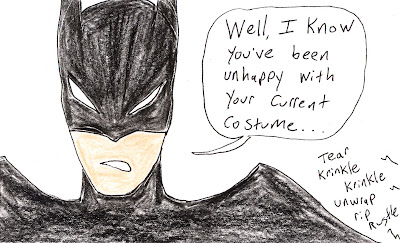
Black Lightning would like to discuss his costume


Not a bad rationale, really. Not bad at all. Of course, it only really works if the DCU was set in real time, and Jeff got his start in 1977.

The problem is that it's now 2007, so Black Lightning has either been an active superhero for 30 years—making him around 54 years old or so, and making Superman, Batman and all of the other characters to debut before him even older—or else he simply debuted later than that.

See, the DCU used to be set on a sort of sliding timeline, formalized in great detail during the Zero Hour series (which even included a year by year timeline). Rather than assigning events in the DCU dates, which would anchor them to particular years, the Zero Hour timeline established a length of time ago that they occurred. So Batman didn't start fighting crime in 1939 or 1989, but rather "ten years ago." (This is also why his 1987 origin story was called "Batman: Year One" rather than "Batman: 1977")

Zero Hour posited a ten-year-old DCU, beginning around the Silver Age. Some things that would artificially mark the passage of time, like the number of Halloweens Batman experienced during his first year on the job, or how many Christmases Lois and Clark have celebrated since marriage, we all have to kind of agree to ignore as not really counting. Big changes, however—the birth of Lian and Cerdian, Tim Drake becoming Robin, etc.—will inevitably artifically move the timeline forward.

Since Zero Hour occurred in 1994, everything that happened in the DCU between then and Infinite Crisis obviously can't fit into a single year, but we still want to err on the side of too little time passing instead of too much.

So, at the least, when Infinite Crisis occurred, eleven years had passed since Superman started superhero-ing (at the most, maybe 13 years).

Then came the "One Year Later" jump, which added an entire year onto the timeline. So now, if this week's comics are set as soon as, like, two weeks after 52 #52, we're still looking at a DCU that's at least 12 years old.

(Of course, in the months before Infinite Crisis, and then during that missing year, the entire history of time in the DCU was damaged repeatedly by Superboy punches, Alexander Luthor's rejiggering of the DCU into a "New Earth" and then Mr. Mind's random alterations to the new, 52-world multiverse. So anything on the Zero Hour timeline could be changed—maybe Superman debuted 20 years ago, or five years ago—but there hasn't been any kind of formal declaration. We know a few things that are different, like Wonder Woman appearing in the U.S. ten years before Zero Hour instead of four years before Zero Hour, but for the most part we know what hasn't changed, not what has. And nothing that pertains to Black Lighting. So Jeff and I are going to have to work with the most recent info available, which was provided right after Zero Hour).