Showing posts with label young avengers. Show all posts

Monday, February 25, 2013

Young Avengers Catch-Up: Civil War: Young Avengers & Runaways (2006) and Secret Invasion: Runaways/Young Avengers (2008)

Marvel's big line-wide event/crossover stories generally provide the publisher with the opportunity to pump up their output for a few months, and a positive side effect of that is that it allows for book-less characters to appear. That was the case with the Young Avengers characters during both Mark Millar and Steve McNiven's super-successful Civil War (in which heroes fight heroes over 9/11 metaphors) and Brian Michael Bendis and Leinil Francis Yu's less-successful Secret Invasion (in which heroes fight Skrulls over gross, clumsily executed fear-of-Muslims metaphors). In both instances, the characters met up with Marvel's other team of young, created-this-century heroes, The Runaways.

Their very first meeting came during the so-called Civil War, during which Iron Man wanted every single super-powered person in the United States to register with the government and then be drafted/press-ganged into a huge superhero army to make sure Speedball never accidentally makes an explosion-powered supervillain blow-up near a school again. And he felt so strongly about it that he was willing to murder his former teammates and imprison them without trial in extra-dimensional concentration camps.

Captain America disagreed.

The Young Avengers sided with Captain America (although Stature would eventually come around to Iron Man's position, after the conclusion of this series), while The Runaways were essentially conscientious objectors, seeking to avoid this conflict as they generally seek to avoid all of the Marvel Universe's conflicts. Conflict finds them, of course, as it usually does—otherwise, Runaways wouldn't have been much of a Marvel comic.

So when a TV camera catches The Runaways being attacked by SHIELD agents and their android member Victor Mancha is badly injured, the Young Avengers track them down and try to recruit them to Cap's side. In the might Marvel manner, they fight before realizing there's been a misunderstanding, and they're all on the same side.

Meanwhile, a sinister SHIELD agent sics a brainwashed and reprogrammed Marvel Boy (the Grant Morrison/J.G. Jones version from 2000's Marvel Boy) on both teams, but instead of capturing them all, he's ordered to simply retrieve a handful of aliens for his controller to experiment upon.

Zeb Wells wrote this one, and Stefano Caselli drew it. Typically of Wells, it was very well-written (Or is that Wells-written..? Ha!), and organically funny. There are jokes in here, but they are jokes made by the characters—it's funny because the characters are being funny, not because the writer is manipulating them.

The story doesn't really go anywhere in terms of status quo, at least not in terms of the Civil War. The Young Avengers are still with Cap at the end of the story, and The Runaways remain determined to stay out of it. Wells does manage to come up with some interesting suggestions for relationships between some of the characters—most unexpected being the friendship between Speed and Molly—and to move a few emotional arcs forward. Similarly, Marvel Boy is put right back where Morrison left him at the end of Marvel Boy, but in a rather triumphant manner.

Caselli's art is excellent, and he handles the straight superhero designs of the Young Avengers and the street-clothes of the Runaways with equal aplomb. He does a fine job of juggling some dozen or so characters, and making each distinct. He also does remarkably strong work with his "acting" through the characters.

This was an odd one to re-read after reading Young Avengers #1, as Marvel Boy is apparently being added to the cast of the new, ongoing Young Avengers title, and, in fact, the book opens with Hawkeye Kate Bishop waking up in Marvel Boy's bed after having spending the night with him.

She casually refers to the events of this series—she apparently didn't recognize Marvel Boy until she sobered up the next morning with "Oh, yeah! You kicked all our asses that one time! Billy, Teddy, everyone!"
In fact, he beat the living hell out of both teams, killing one of the Runaways (who was a shape-shifting Skrull, and thus able to recover from a broken neck), capturing Billy, Teddy and Karolina and delivering them to his boss for a few hours of torture and he began strangling Kate until he was interrupted by Nico, and started strangling her instead.

In other words, whatever Kate was drinking the night before Young Avengers #1, it must have been some strong stuff.

In Secret Invasion: Runaways/Young Avengers, the two teams once again meet, this time on the Avengers' home turf of New York City (The Runaways were still visiting there after recently returning from the 19th century with a new member in tow).

The actual events of Secret Invasion are so nonsensical that I don't think I can recount them in a way that makes a whole lot of sense. Essentially, a bunch of religious fanatic Skrulls think their gods promised them Earth as their homeland, and want to take it over; they've been taking it over by secretly infiltrating it for years, and then they simultaneously try a PR push to convince the Earthlings to join their religion while also violently invading New York City with spaceships and an army of Super-Skrulls.

The two teen teams are there when the Super-Skrulls attack and, as it turns out, both teams have their own Super-Skrulls on their teams. Teddy/Hulkling of the Young Avengers is a half-Skrull, half-Kree who was prophesied as a savior meant to unite the various warring factions of Skrulls, while Xavin of the Runaways was a Skrull prince and Super-Skrull in training who ran away.

The plot of this series focuses on Xavin's efforts to infiltrate the infiltrators, providing cover for his superhero team to get safely out of New York City, and to try and rescue Hulkling. Both Xavin and Hulkling are targeted for special attention by the invading Skrulls, since the former betrayed them and the latter's existence could maybe sway some Skrulls from their Skrullegion.

Despite the prominent roles played by several characters from both teams—mainly Xavin, Hulkling, Wiccan and Speed—this isn't really much of a Young Avengers comic. Many of the team barely cameo, with Patriot and Hawkeye barely getting a line or three. The Runaways don't fare much better, but they are certainly more of the focus of this story, as their Xavin is the de facto star, and the story starts with their point of view.This one is written by Christopher Yost, and features art by Takeshi Miyazawa. It's Miyazawa's art that is probably the most noteworthy aspect of this collection. It's rare to see teenage superheroes actually look this young, but Miyazawa actually draws them all to resemble children, rather than shorter than usual adults.

That the Secret Invasion mini seems the weaker of the two in terms of its scripting may have something to do with how short it is (it's just three issues), and the fact that the premise of the story its tied to makes it more difficult to expand the focus too far from the Skrull-related characters.

Yost's effort isn't as all around strong as Wells', but there are some fun moments in this—Speed's rescue of Molly and the Runaways' newest recruit is particularly memorable—and Miyazawa's charming art goes a long way towards making this well worth a read.

Saturday, February 23, 2013

Young Avengers Catch-Up: "What If The Runaways Became The Young Avengers?"


This story was published in five installments, each of which ran as a back-up in one of 2008's suite of What If...? specials (What If? Secret Wars, What If? Captain America: Fallen Son, etc), as an enticement to buy them all. It can be found in collected form in Runaways: Homeschooling, the volume that contains Kathryn Immonen and Sara Pichelli's high quality, but unfortunately truncated run on Runaways.

The title isn't terribly accurate, and the story has almost nothing at all to do with the Young Avengers. This isn't the story of how the five surviving original Runaways take on the names or identities of the Young Avengers characters, or teenage versions of any Avengers (That is, Nico doesn't become Wiccan or Scarlet Apprentice, Gert doesn't become Patriot or Lieutenant America, etc). Nor do they take the place of the Young Avengers in a Young Avengers story, or meet any of those characters.

For the most part, then, this is just a Runaways story with a catchy title, and a single shared plot-point with the first story arc of Young Avengers. Iron Lad, the disguised teenaged version of Kang The Conqueror, has come back in time to recruit a team of young super-heroes, and, instead of choosing the characters who would become the Young Avengers, he chooses the Runaways. Teen Kang is the only Young Avenger character to appear at all, unless you count a one-page cameo from a future version of The Vision.

Teen Kang trains the Runaways, gives them new, more superheroic spandex costumes (The Runaways just wore street clothes), has them using their superhero codenames (which the characters all came up with early in creator Brian K. Vaughan and Adrian Alphona's run on the book, but then almost immediately discarded) and collectively calling themselves The Young Avengers.

When we meet them, they're fighting apparently ubiquitous Marvel bad guys The Wrecking Crew, training to take on Victor Mancha, whom Iron Lad tells them will grow up to be Victorious, a super-villain who decimates The Avengers in the future (As Runaways fans know, Mancha is actually the "son" of Ultron who joins The Runaways). There's a twist, a betrayal and multiple versions of Kang and Mancha show up for the big showdown fight.

As a Young Avengers story, it's really not, not in anything but name, anyway. As a Runaways story, it's interesting enough; writer C.B. Cebulski's plot is fairly generic, and his big moments are merely repeats of those other Runaways writers had previously used, but he gets their voices right, and gives them a few of those Whedon-esque smartasseries that Vaughan was so fond of. As a What If...? story, it's pretty weak, as the variation from the "real" Runaways story is so very slight, and really little more than a matter of cosmetics (their team name and wardrobe, basically).

The artwork is provided by penciler Patrick Spaziante and inker Victor Olazaba. Stylistically, its closer to the work of Young Avengers's Jim Cheung than to any of the artists to have worked on The Runaways...it's certainly quite different than Pichelli's art, as a flip-through the rest of Homeschooling on the way to this story will attest.

It looks an awful lot like Barry Kitson art, with maybe a hit of J. Calafiore in the faces. I wasn't crazy about it, but there's nothing wrong with it either. It just looks rather dark, cluttered and overly-rendered, particularly when compared to the work of Pichelli or Alphona or Humberto Ramos or other Runaways artists

I do like the story's title, and wouldn't mind reading a What If...? story in which the characters from The Runaways joined up with the characters from Young Avengers and formed some sort of super-sized super-teen team, but then, there probably wasn't room for Cebulski to even consider it, give the relatively short page-count (32) that the story's original format demanded.

Monday, February 18, 2013

Young Avengers Catch-Up: Siege: Young Avengers #1 (2010)

This one-shot by writer Sean McKeever, pencil artist Mahmud A. Asrar and inkers Scott Hanna and Victor Olazaba was a brief check-in type story tied to Marvel's completely nonsensical event series Siege, a bizarrely written story by chief Marvel Universe architect Brian Michael Bendis that, as I've previously noted, doesn't make a lick of sense on its own.

The event was climax of the "Dark Reign" period of the Marvel Universe, in which former Green Goblin Norman Osborn has donned a red, white and blue Iron Man suit to become Iron Patriot and lead his own team of Avengers made up of villains-posing-as heroes and his own SHIELD-like government agency HAMMER. For reasons never explained, Osborn decides he needs to conquer Asgard, which he attacks in defiance of the his boss President Barack Obama, and ends up in an all-the-heroes vs. all-the-villains fight on the floating city of Norse-derived Kirby space-gods.

The Young Avengers special was apparently intended as a part of a suite of one-shots, as its cover is part of a single, multi-part image by Marko Djurdjevic, and it gets collected along with four more one-shots in Siege: Battlefield, which is where I found and read it. (We'll look at those other comics in a bit).

One rather admirable aspect of writer Allen Heinberg and artist Jim Cheung's creation of the Young Avengers characters is how many aspects of the wider Marvel Universe he was able to tie into the various characters, as it makes them incredibly easy to plug into just about every Marvel event series imaginable. This event, for example, revolves around Asgard, and one of the Young Avengers characters was inspired by Thor to kinda sorta pose as a Thor-like sidekick at the outset, even going so far as to go by the name Asgardian (Changed later, of course, to "Wiccan," which can't so easily be corrupted into "ass-guardian").

The plot consists entirely of what the various team members are doing during the Everyone Vs. Everyone fight on Asgard, specifically after the part of the battle (which was not a siege) where The Sentry knocked the floating city down.

Wiccan and Hulkling, whose magic and gross green veiny pterodactyl wings spared them from the crash, find The Wrecking Crew trying to super-loot the ruins for Asgardian treasure, and fight them. Patriot and Hawkeye, meanwhile, are trapped in the rubble and fighting for survival, ala Red Arrow and Vixen in that one Meltzer issue of Justice League of America, ala Nicolas Cage and The Guy Who Wasn't Nicolas Cage in World Trade Center. And Speed runs around looking for survivors in the rubble. No sign of Stature and Vision.

It's a fairly well constructed fight comic, with each of the three character or character groups going through a distinct arc in which they reach a point of hopelessness and than rally, the issue ending with a splash page of Speed leading the charge to have them rejoin the fight.

It's completely inessential of course, but then, that's what it was supposed to be all along, the answer to a question a certain sub-set of Marvel readers might have wanted to know the answer to (Hey, what were the Young Avengers doing during the Battle of Asgard?), and a bone thrown to the would-be Young Avengers audience awaiting the return of the characters creators/re-creators to finish up their story.

The artwork is quite impressive and, in certain panels, looks like the work of Cheung (particularly on a re-flip-through. If Marvel had decided to go forward with a Young Avengers monthly sans Heinberg and Cheung in 2010, this would have been a fine creative team to do so with.

******************

As I said, this issue was collected in Siege: Battlefield, which contained a handful of Siege one-shots, connected only by their interlocking cover images and the fact that they had something or other to do with Siege. These are they...

Siege: Loki #1 by Kieron Gillen and Jamie McKelvie

This particular creative team is of particular note for this particular series of reviews, as these are the guys who will go on to create the next volume of a Young Avengers ongoing series, the one that sparked this endeavor on my part.

The star is Loki, part of Osborn's cabal of villains secretly running the "Dark Reign", who is here restored to his original, male form, after having spent much of the previous "Dark Reign" cycle in the form of a buxom woman, for reasons I never understood (It happened in an issue of a Thor comic I didn't read, I imagine).

In the Gillen/McKelvie Young Avengers, he appears in the form of a little kid. I think they should probably keep him male and grown-up, personally because a) McKelvie draws him so well and b) all the ladies I know who dug the Avengers movie  really seemed to like sexy Tom Hiddleston's sexy Loki.

Their story is set before and behind the scenes of the battle that occurs in Siege,basically showing Loki as a wicked and clever manipulator moving in a world of Marvel's evil power players—we see him taking a call from Doctor Doom and meeting with Mephisto and Hel, for example—to get what he wants, which here seems to be the destruction of Asgard and release from his destined place in Hel's hell (which may be spelled "Hel").

It's pretty great stuff, light on the superhero business (Osborn appears on one page) and heavy on the mythological and, tonally, it felt like an early issue of a pre-Vertigo Vertigo series: Mature storytelling devoted to mythology and fantasy extrapolated from old-school trashy super-comics which were themselves inspired by classical mythology. While reading, I kept thinking this creative team would probably do a knock-out Doctor Strange series.

I can't say enough good things about McKelvie's clean, smooth, pristine, perfectly-acted artwork: That guy's the best. This is by far the best-looking chapter of the book.

Props go to the pair also for their five-panel sequence involving Loki and Osborn. That's the first time that it was made clear to me that it was Loki speaking to Osborn through his Green Goblin mask, as his Green Goblin persona, in an effort to convince Osborn to attack Asgard because that's what Loki wants him to do. In a lot of the other "Dark Reign" and Siege related comics I've read, this isn't at all clear, and Osborn is usually presented as either a complete lunatic attacking Asgard just-because, or being talked into it by Loki, who doesn't really offer any compelling reason to convince him to do so. Here, it seems the compelling reason is that Osborn thinks his dominant if buried persona is telling him to do so.

Siege: Spider-Man #1 by Brian Reed and Marco Santucci

Spider-Man and Ms. Marvel fight Venom, who, at the time, was former Scorpion Mac Gargan in the alien symbiote suit, who spent the majority of "Dark Reign" (and the Bendis-written series Dark Avengers) disguised as Spider-Man.

That, obviously, annoyed Spider-Man.

This issue, then, is devoted to the climax of their fight over that particular conflict, with the pair tumbling out of the still airborne Asgard to the city below (Broxton), where Ms. Marvel swoops in to give Spidey an assist and fly him back up to Asgard so he can participate in the events of Siege.

It's a decent enough story and the art is similarly decent. It is about as pure a fight comic as you can get without excising the dialogue, which hear consists mainly of Spider-Man quips and Venom's chatter about eating people.
The most striking and memorable image is a panel in which Ms. Marvel separates Venom from Gargan by sticking her hand down the former's throat and yanking the naked latter out its mouth.

Siege: Captain America #1 by Christos N. Gage and Federico Dallocchio

The artwork on this one made it very hard for me to read. It was clear enough that it was easily legible, I just didn't like looking at it. Very photo-reference-y, with poses and renderings that look, if not traced from photos, then at least rigorously imitating images of real people, with costumes and fantastic action set atop of them.

It's all very awkward looking, as in a terribly uninspired two-page splash page of a bunch of heroes fighting a bunch of villains. One of the Captains America, in this image, appears to be both simultaneously kicking Taskmaster's shield and firing his gun at the shield, and seems badly in danger of literally shooting himself. Also, Dr. Fate seems to be there, for some reason.

Gage deviates from the all-fighting, all-the-time mandate that dominates most of these stories by introducing a family of civilians on the outskirts of the conflict, who provide an element of extra danger for the Captains, as well as some folks to be inspired by them.

Then current Captain America James "Bucky" Barnes and returned-to-life former Captain America Steve Rogers are participating in the big fight on Asgard and, after Sentry knocks it down, they find themselves fighting Razorfist, perhaps the least believable of all of Marvel's many fantastical villains (He's the guy who has had both of his hands replaced with huge, razor-sharp blades, and his costume consists of a sort of skin-tight ski mask with ear holes that I can't imagine how he puts on—dude must have an intern to dress him. (Also, Razorfist...? Dude can't make a fist, as he doesn't have hands).

The Captains beat the shit out of him, and then run back to the crossover story. See a pattern forming? These are kind of fun in how straightforward they are, as the majority of them are little narrative cul de sacs, where the characters leave the events of Siege, run through the conflict of a single issue tie-in, and then return to the events of Siege, usually declaring, "Well, that's the end of our one-shot tie-in; back to the main series!" (I'm paraphrasing; here it's actually "Let's go... ...We're needed."

This one's followed by Siege: Young Avengers.

Siege: Secret Warriors #1 by Jonathan Hickman and Alessandro Vitti

This series, Secret Warriors, is a kinda sorta years-later spin-off of that weird Bendis-written Secret War miniseries that truly kicked off his Avengers and Marvel Universe writing, and ended with one of the worst and laziest issues of a comic book I've ever read.

The premise of Secret Warriors was that an off-the-grid Nick Fury was leading his own team of secret superheroes, all of whom eschewed costumes in favor of classic SHIELD uniforms, for maximum boring-looking character design. I never read any of it, but Marvel might have tempted me to read the first issue had they instead titled it Nick Fury and his Howling Secret Warriors (I'm a big fan of howling).

So did you read Siege...? If not, there's this one gross-looking panel where Sentry grabs Ares the god of war and rips him vertically in half, just like She-Hulk did to Vision in "Avengers Disassembled," except Ares isn't a robot, so there's a bunch of gore and viscera in the panel (Bendis wrote both scenes, so he's not stealing from another writer, just repeating himself).

Well, on of the Secret Warriors is Phobos, the son of Ares (who is also a little kid). The issue opens with him watching a bank of monitors in which panels from Siege appear, including the gross one of his dad getting torn in half.

While Nick Fury joins Captain America for the assault on Asgard, Phobos flashes back to hanging out with his dad, then picks up a couple of swords, enters the White House through a secret passage, and silently slaughters Secret Service agents throughout the issue in order to, as he finally explains once President Barack Obama is safely aboard Marine One and flying towards safety, "to deliver a message."

The message isn't metaphorical, but literal though, as the last panel of the issue sees him sitting down at Obama's desk, the Oval Office littered with dead agents, to write a letter:
It's not every day that a human finds himself responsible for the death of a god and then on that very same day escapes facing another...
But before you wash your hands of my father's blood, I would encourage you to reflect on what brought us to this point: You sacrificed honor for expediency. You traded intent for quick action. You were wrong...and we all suffered for it.
It's a pretty weird comic. At least when Garth Ennis had The Punisher threaten to kill President George W. Bush, he did so without killing a bunch of innocent guys, and the president was a little more directly tied to the crime.
Obama's guilt for the death of Ares is fairly indirect, in that he put Osborn in charge of the superheroes, Osborn hired Sentry and Ares and Osborn ordered them both to attack Asgard, where Ares rebelled against Osborn and got torn in half. I realize the buck stops with the president and all, but Siege made it pretty clear that Osborn had "gone rogue" and was acting against the will of the president and, um, the entire United States government when he attacked Asgard, acting on the advice of his Green Goblin mask/other personality/Loki.I'm not a fan of the art in this one, although there's nothing really wrong with it. The style just didn't do much for me. There is a pretty neat panel of Obama sitting behind a desk, his face in shadow, his hands calmly folded in front of him, with the Joint Chiefs of Staff lined up behind him and a small army of gun-toting Secret Service agents between them and the reader. It's maybe the clearest image of Obama-as-supervillain I've seen in a comic book.

You know, between Bush's handling of the events of Civil War, "The Initiative" and Secret Invasion and Obama's handling of "Dark Reign" and Siege, as horrible as the choices these guys make in our universe might so often seem, they're both a hell of a lot better than their 616 counterparts...

Monday, February 04, 2013

Young Avengers Catch-up: Dark Reign: Young Avengers (2009)

As the pre-colon part of the title indicates, this five-issue miniseries by writer Paul Cornell, pencil artist Mark Brooks and a quartet of inkers was part of Marvel's "Dark Reign"...which wasn't a story, event or crossover so much as it was a status quo (akin to "The Initiative"), accompanied by a branding effort that placed "Dark Reign" banners atop all of the participating books and featured content somehow related to the new status quo that was in place between event/crossover stories Secret Invasion and Siege.

That status quo? Due to his inability to prevent a mass infiltration of earth by shape-shifting aliens, Tony "Iron Man" Stark was demoted from his post-Civil War job as Boss Of All Superheroes, a job that instead went to former supervillain Norman "The Green Goblin" Osborn, a convicted multiple-murderer and crazy person. With a villain now running the show, almost all of the superheroes are defying the government's registration act, and Osborn is promoting villains to serve as heroes. He had his own Avengers, for example, which consisted almost entirely of villains wearing hero costumes.

Cornell wrote a miniseries about Osborn's "dark" X-Men team, and here he checks in with the Young Avengers team, setting up a "dark" version of them comprised of teenagers who have the names and in some cases powers of Masters of Evil, echoing the way then-New Avengers/Dark Avengers writer Brian Michael Bendis created an Avengers team of villains posing as heroes ("Thunderbolting," is the verb, I think) and setting the real Young Avengers against them, ideologically (to start) as well as physically.
These new Young Avengers are The Enchantress, an Asgardian-themed character with magical powers who often uses "Thee" wrong; Big Zero, a white supremacist with the Stature-like power of growing to gigantic proportions (and a cool haircut); Egghead, an android character presumably around to give The Vision someone to fight; The Executioner, a gun-wielding vigilante who models himself after The Punisher; Melter, the costume-less would-be leader with the power to melt stuff; and Coat-of-Arms, the actual leader who wears a special coat that gives her two extra set of arms (get it?!) and is pursuing superheroics as an art project. She's an artist who is seeking performance as a type of social experiment to see what it means to be a superhero or a supervillain in a time when The Green Goblin is the chief good guy.

She's also probably the most interesting of the new (I think they're new; they're all new to me) characters, and a way for Cornell to rather easily insert meta-narrative into an otherwise schedule hole-filling fight comic and make it about something.

I think he succeeds rather well. He gives each of the new characters a story arc of differing levels of creativity and relevance, each has a personality and each wrestles with moral alignment questions in different ways and comes to different conclusions (If "wrestle" isn't too strong a word, as Big Zero is a racist at beginning and end, and she programs her boyfriend android to be more and more racist and all-around bad).

As for the original Young Avengers, they find themselves in the exact same position the actual Avengers were when the Young Avengers first debuted (in Young Avengers). They see a group of strange kids using their name, and they must decide whether they're okay with that and what to do—what they can do if they're not. So they fight. Then talk. Then team-up to see what these new guys are made of. Then decide who if any of them they want to cherry-pick for their own team, where they can train them. And, of course, they fight some more.

Oh, and then the Dark (grown-up) Avengers show up, so they can fight everyone too.

Overall, it's another impressive performance from Cornell, turning out a remarkably enjoyable story with strong, new characters that fulfills all of its obligations (lost of superheroes, lots of fights, "Dark Reign" content) while still managing to make a coherent, somewhat independent whole.

Brooks' work is fairly strong, too. I don't care for many—any, actually—of the new characters' looks (with the possible exception of Big Zero's haircut, and Coat's coat), but Brooks sells them admirably, and renders all of the Marvel characters perfectly well while managing to tell the story with the art. (The only parts I didn't care for? A dropped-in photo background of a street scene for the big splash page introducing the new Young Avengers, and a weird page in the third issue that's divided into five tall, skinny vertical panels in which Executioner and Hawkeye are weirdly positioned and angled for all five, barely-changing panels).

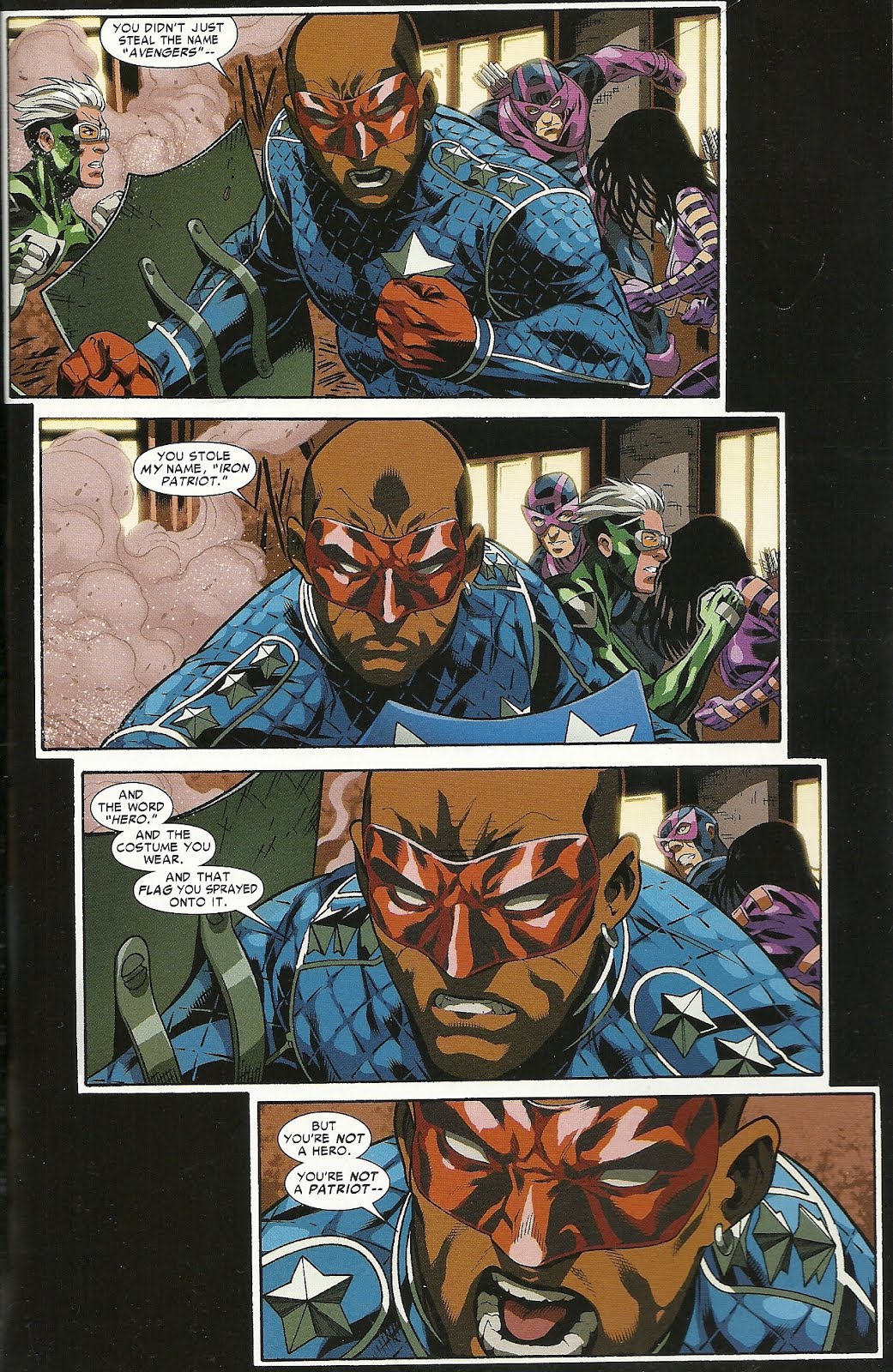
The climactic battle is a lot of fun, as Osborn (as Iron Patriot) brings Daken-as-Wolverine and Bullseye-as-Hawkeye to fight the Young Avengers alongside the Young Dark Avengers, and, surprisingly, the Young Avengers whip their asses, even ejecting The Sentry from the fight. That aspect of the battle could have used a little better resolution, given that Osborn and two of his more phsycho-killer-y teammates are allowed to leave when they're at the Young Avengers' mercy, but the entire fifth issue is a nice escalation of stakes, with everyone screaming at one another about what it means to be an Avenger, and Cornell even manages to tuck the new characters away for possible future use ("Some of them will do the right thing," Patriot says, "Either that, or we'll end up fighting them.")

There's also a pretty nice moment where Patriot gets to tell off Osborn—
—and sock him in the iron jaw, Captain America-on-Hitler style.
(Shame Brooks positioned the punch differently, though).
There's a pretty good use of a George Michael song in here, too. I had never heard "Shoot The Dog" and had to look it up on YouTube to listen to it and better understand a scene or two in this comic. I felt my my cultural horizons expand.

Saturday, February 02, 2013

Young Avengers Catch-up: Young Avengers Presents (2008)

Marvel's Young Avengers characters have been an interesting group of characters to keep one's eyes on over the past half-decade or so. That's because of how the company's publishing decisions regarding them have illustrated the tensions between respecting a particular creator's vision and wishes for creations generated but not owned by the creator and the company's ever-present desire to sell more comics to people who want to buy them.

For years, Marvel has been remarkably cool (as in admirable, not cold) in its deference to Young Avengers co-creator Allen Heinberg, essentially leaving the half-dozen or so teenage superheroes he created (and, in some cases, re-created) with artist Jim Cheung alone, waiting for the TV writer who dabbles in comics to find time to return to them.

To recap: Way back in 2005 Heinberg and Cheung created an "ongoing" series entitled Young Avengers that introduced a half-dozen super-characters, each a teenaged version of an Avengers character, that lasted 12 issues, comprised of three story-arcs.

Then Heinberg got busy with other stuff, and, despite demand for the characters, then-Marvel Editor-in-Chief Joe Quesada always answered questions about them with something along the lines of "They'll be seen in This-or-That-Series, but we want to make sure we get the characters right, so we'll be waiting for Allen to come back and finish the awesome story he started." Heinberg eventually did, but not until 2010, when the nine-issue Avengers: The Children's Crusade launched. It finally wrapped up just last year, in 2012 (No, it shouldn't take two years to publish nine issues).

In the years between those two series, Marvel essentially found a happy medium between letting someone else write a Young Avengers comic and not publishing any Young Avengers comics until Heinberg could get around to writing them, publishing various miniseries checking in with the characters in relation to various line-wide crossover event stories: 2006's Civil War: Young Avengers & Runaways, 2008's Secret Invasion: Runaways/Young Avengers, 2009's Dark Reign: Young Avengers and a 2010 special Siege: Young Avengers. Plus a 2008 Young Avengers Presents miniseries, a six-issue anthology issue in which different creative teams checked in on each of the members of the Young Avengers for their post-Civil War/"The Initiative" status.

That no doubt sounds like an awful lot of comics, but it's far fewer comics than Marvel would have produced (and sold!) if they just kept Young Avengers going monthly for the four or five years the franchise was left fallow-ish, and it's probably worth noting how Marvel treated Heinberg's Young Avengers vs. writer Brian K. Vaughan's similar Runaways, which were also new, young heroes that were either new creations or derivative of pre-existing Marvel characters. Runaways passed into other writers' hands almost as soon as Vaughan left, and didn't cease publication until sales sunk too low.

Either because Heinberg finished the story he wanted to tell at the conclusion of Children's Crusade or because Marvel decided Heinberg-less Young Avengers is better than only publishing annual miniseries, Marvel just last week launched a new Young Avengers ongoing by Kieron Gillen and Jamie McKelvie and Mike Norton (which I wrote about at some length here).

I liked it an awful lot, and it reminded me that I haven't followed the characters at all since the early half of Heinberg and Cheung's first run on the characters (I lost interest when about the time Heinberg did, but didn't regain it when he did). The new Young Avengers only features three of the original cast-members—Wiccan, Hulkling and Hawkeye, who is also appearing with the other Hawkeye in Hawkeye—and adds three other young Marvel characters—Marvel Boy (The Grant Morrison/J.G. Jones version), Loki (last seen in the Gillen-written Journey Into Mystery, which I wasn't interested in, being adverse to Asgardian stuff) and a new Miss America that I'm not sure has ever appeared anywhere else or not.

I got online and started seeing what other Young Avengers material was out there, and will be reviewing it in a series here, as I did with Marvel's Fear Itself tie-in collections, although not as frequently. I'm going to start with Young Avengers Presents.

********************

As stated above, this is a six-issue anthology series, with each issue featuring a different member of the Young Avengers team (although most guest-star other members in some capacity or other), each by a different creative team, each featuring a pretty neat cover by Jim Cheung showing the Young Avenger before a collage of head-shots of the "old" Avenger that inspired them and almost all of them featuring the Young Avenger meeting up with a grown-up Avenger one way or another.

The series is set after the events of Civil War, during which the Young Avengers sided with Captain America's anti-registration faction, and the war's aftermath, including Cap's apparent assassination. Un-registered superheroics were outlawed, so the team was in semi-retirement, with only Stature legally allowed to superhero (She was appearing in the since-canceled Avengers: The Initiative series at the time).

The art can get a big dodgy in terms of consistency (Hawkeye's costume is constantly changing, for example), and I liked some styles much better than others, but overall it's a very competently-produced series, and not a bad introduction to the characters, even if their exact circumstances requires a bit of other reading (or at least asking a friend or Wikipedia what the hell happened during Civil War, I guess). Given the nature of the book, it's probably best to take it issue by issue.

"Patriot" by Ed Brubaker, Paco Medina and Juan Vlasco

After a rough day at school, in which Eli Bradley gets in a fight with a fellow student after he's heckled for writing about the Tuskegee experiments ("If it's so bad here, why don't you move to Russia-- or Iraq?"), Eli returns home to find James "Bucky" Barnes, the former Winter Soldier who is about to take over being Captain America during the original Cap's temporary death, leaving his house. Eli is the grandson of Isaiah Bradley, the kinda sorta first Captain America, the black one (As seen in the excellent, Kyle Baker-illustrated Truth).

Wanting to track Bucky down for...whaetever, Eli suits up as Patriot and teams with Hawkeye and Wiccan to find Bucky and ultimately have an off-panel heart-to-heart regarding the death of Captain America and the original Patriot (I didn't even know there was an original Patriot). A bigger deal probably could have been made regarding the Young Avengers meeting Bucky—in Young Avengers #1, it was explained the reason why there are no real sidekicks in the Marvel Universe was the apparent death of Cap's sidekick Bucky, but dude apparently didn't die after all.

I liked the art in this one pretty well, and it reminded me how much I liked Patriot's costume (one he lost the full-face mask) and overall design. It kinda made me wish he was in the new Young Avengers series, although I suppose they don't want more than one patriotic, star-spangled hero on the line-up. I assume he'll at least guest-star at some point though.

"Hulkling" by Brian Reed and Harvey Tolibao

I was somewhat surprised to see the floating heads behind Hulkling belonged to Marvel's original, dead-from-cancer Captain Marvel, and not the Hulk. I mean, half-Kree, half-Skrull shape-changer Teddy Altman took his name and look from founding Avenger the Hulk, not Captain Marvel, right?

Well, apparently Teddy is that Captain Marvel's son...? And this story is set during the time between when this Captain Marvel randomly came back to life in a panel of Civil War and whatever happened to him during Secret Invasion happened to him (I didn't read any of those Wait, what's up with Captain Marvel being back? comics because, being under 50, I didn't much give a shit about Captain Marvel...at least, not that Captain Marvel. The Fawcett/DC one is a different story, because that Captain Marvel rules). So it is essentially just a heart-to-heart between the two characters.

It did make me wonder why Hulkling didn't go by Marvel Boy or...something with the word Marvel in it, in large part because I hate his look, which is essentially short Hulk with bleached blond hair, crustacean arm action in the shoulder region and veiny pterodactyl wings. I also don't like Teddy's "civilian" look, with all those dumb earrings. Feh.

Tolibao's art is fine, and looks an awful lot like Steve McNiven's, and I really enjoyed how muscley and vein-y he made Cap and Teddy look, the former through his clothes. I imagine it was meant to look cool, but I imagine Tolibao drawing them sarcastically, and it made me giggle.
(This is my favorite panel; check out Marvel's posture)

(By the way, here's Tolibao's Hawkeye; her costume has two sleeves in his version rather than one, but he and this art team is one of the few which draws human breasts with nipples on them)

"Wiccan & Speed" by Roberto Aguirre-Sacas and Alina Urusov

I don't really get these two, although the story of Young Avengers and "Avengers Disassembled" and House of M and Brian Michael Bendis' New Avengers run and about a decade of X-Men comics and much of the events of the Marvel universe over that same time have kinda sorta involved them. They were the magically imaginary children that Scarlet Witch thought she had, but didn't really, but I guess maybe did, since now they are teenagers?

I don't know. One is magic character designed to originally make YA readers think he had something to do with Thor, rather than Scarlet Witch.

The other has the lamest speedster name this side of The Whizzer, and looks almost exactly like Impulse villain Inertia,
who looks exactly like Impulse/Quicksilver amalgam Mercury,
who of course looked a bit like Scarlet Witch's speedster brother Quicksilver.
(sheesh).

His personality is also essentially that of a slightly more edgy Impulse.

In this story, they go looking for the Scarlet Witch and don't find her. It has some of the nicest art in the book, and that which is stylistically furthest from the media on the book. There's a abstracted nature to the design, and the images are smooth, clean and clutter free—it's quite suggestive of cels of animation.

Urusov even makes the Hulkling character, who I just stated I didn't like the look of, look kind of cool, giving him a truly hulking size and physique and fewer nooks and crannies. His hair also looks bleached to the point of being whitish, a more exotic look for a huge green space alien dude.

"Vision" by Paul Cornell, Mark Brooks and Jaime Mendoza

Though this is The Vision's story, it's just as much Stature's. This Vision, by the way, isn't The Vision that was torn vertically in half in "Avengers Disassembled," but the brainwaves of "Iron Lad", whose real identity was a secret in the first YA story arc, housed in a rebuilt android Vision body or...I don't know. Some of these characters sure are complicated for ones who have only starred in like 25 comics altogether, huh?

Anyway, it's not The Vision, but a new, younger Vision with the old Vision's powers but another Young Avenger's mind or whatever.

He has a crush on Stature, the size-changing heroine daughter of Ant-Man II Scott Lang. He goes to visit her at Avengers Initiative HQ, where she's in training to be part of Civil War victor Iron Man's well-regulated, federal army of superhero draftees, and talk about their relationship, which is weird (She was into the guy whose mind is in Vision's body).

Some AIM guys attack. There's a fight.

While I like teen angst and melodrama, this is more of the Crying Robot flavor than the true teen flavor, and I'm not really into Crying Robots (One nice thing about The New 52? No Red Tornado. Or at least not anywhere that I've noticed).

My favorite part was a panel of the AIM guys—those are the standard issue Marvel villains who dress a bit like beekeepers—on some sort of stake-out, in which Brooks draws four dudes in big, yellow beekeeper suits just sitting in a parked car by the curb.

"Stature" by Kevin Grevioux and Mitch Breitweiser

The next issue sticks with Stature, whose powers are apparently reflective of her emotional state (a very Marvel touch) and, at story's opening, she's feeling so "small" she's in danger of shrinking out of existence. Hawkeye has her placed, in the fetal position, on a microscope slide, and Wiccan and Patriot get called to talk her back to size.

She's apparently feeling small because she accidentally fell on her mom's cop boyfriend, whom she doesn't like, and might have killed him.

It's a nicely done done-in-one, with a predictable, cheesy—but not too cheesy—ending. Breitweiser's art is the most realistic in the book, but it doesn't enter into that weird wax dummy, photorealism realm that a few Marvel artists like to work (Greg Land, Salvador Larocca, etc). Bretiweiser probably has the best costuming in the book too, with people generally wearing clothing that looks like clothing one might see on the street. I was kind of surprised at how "in-style" Cassie Lang looked when not dressed as Stature.

"Hawkeye" by Matt Fraction, Alan Davis and Mark Farmer

Hey, it's Matt Fraction! Writing Hawkeye Kate Bishop and Hawkeye Clint Barton, the two Hawkeyes who star in his critically acclaimed Hawkeye series! I wonder if this particular comic doesn't merit a more thorough look-see from Hawkeye fans in light of that?

It also features probably the biggest and best art team in the collection, the veteran Davis/Farmer team.

This story features Kate on a date with Patriot, when they are suddenly attacked by their horse-drawn carriage driver—Ronin in a top hat!
Does that bring back memories? Ronin? Remember Ronin? "He" was a mysterious ninja in a vest character from the beginning of Bendis' New Avengers run that was either supposed to be A) Daredevil or back-from-the-dead Hawkeye (one of the first violations of then-EIC Quesada's vow that dead would mean dead while he was in charge) in a disguise who was later changed to Echo-in-a-padded man suit because too many people too easily guessed the surprise or B) was meant to be Echo all along, but artist David Finch either didn't know it and thus drew Ronin as a big hulking man or just sort of sucked at drawing.

Anyway, Ronin was at this point Clint Barton, and he challenged Hawkeye to visit the New Avengers' secret base to have an archery contest over possession of her bow, which was his bow, but Captain America gave it to her while Clint was temporarily dead, but now Clint was alive and Captain America was temporarily dead, so he wanted his bow back (Jesus, I guess these stories are all a lot more complicated than I thought while reading; I guess a good way to tell just how Byzantine continuity is in a particular super-comic is to try summarizing it in a few paragraphs).

Davis and Farmer's art is really nice, as smooth and dynamic as always, although they dress the boys like they're grown-up stock brokers on dates: Patriot wears a suit and tie, Speed a blazer.
I liked Kate's second dress though, which featured the same pattern as one of Hawkeye's goofier costumes.

Fraction's script is pretty clever, and the Hawkeyes sound like they would a few years later in Hawkeye; the comic is much more straightforward in construction and lay-out though, and offers a nice indication of exactly what it is that David Aja is bringing to the table in Hawkeye (that, and/or it's an indication of the difference in Fraction's writing the just sixth-issue of an anthology series versus scripting his own series).

It made me kind of which Fraction was writing the new Young Avengers, or at least got to write these characters at some length somewhere between then and now.

It also made me wish that instead of titling Hawkeye Hawkguy, Marvel instead changed the name to either Hawkeyes or Hawkguys.

It also also made me dread the possibility that the two Hawkeyes might hook up at some point. The first issue of Young Avengers has Kate musing on how hot Bucky is and Patriot admonishing her that "he is way too old for you", and this final issue certainly demonstrates how teenage the Young Avengers are versus how middle-aged the New Avengers are (even if Hawkeye and his peers are drawn more like twenty-somethings than the thirty- or forty-somethings they probably actually are...I'm 35, but was in junior high during the Gulf War, which I think has replaced Vietnam as a time-marker in the Marvel Universe sliding timeline...or has it slid to Afghanistan already? Because that seems too drastic a slide...)

Anyway, she's only 18 now right? That would be legal but gross Fraction—don't do it!

And that's Young Avengers presents: Some really good stories, some pretty good stories, some decent-but-no-worse-than-that stories. It's kind of a weird tour of the Marvel universe too, and read a few years later, it's remarkable how things have changed and how drastically. Even if you just look at who is dead and who is alive at what point (Since then, the then-dead Captain America, adult Vision and Ant-Man II came back to life, "Captain Marvel" died again and Bucky died and came back to life.