Showing posts with label teen titans. Show all posts

Wednesday, December 25, 2024

DC Versus Marvel Pt. 5: Marvel and DC Present Featuring the Uncanny X-Men and the New Teen Titans #1

While I was quite enthusiastic about the DC Versus Marvel Omnibus, it was more so about the collection as a whole, and of finally having access to all of the comics within it, rather than genuine excitement for each and every story contained within. In fact, some of the stories I wasn't really looking forward to at all, and I ended up approaching them with the same sense of anticipation that I used to have for doing homework. 

One of those particular crossovers was Marvel and DC Present Featuring the Uncanny X-Men and the New Teen Titans #1, a 1982 special produced in-house at Marvel that would bring together the two publishers then quite popular team of young-ish heroes. 

Why the reluctance on my part? Well, while the teams and their respective comic books may have been pretty popular with the readers of their time, they weren't popular with me personally, as I wouldn't even start reading comics for about another decade after this was published (I was only five years old in 1982).

I have of course read some X-Men runs in the years since, but only ones that tended to try and reinvent the concept and reach new readers. Think the millennial Ultimate X-Men and Grant Morrison and Frank Quitely's New X-Men and then, later, Jeff Parker and company's X-Men: First Class and Jason Aaron's Wolverine and the X-Men. I made a few attempts in the early years of the new millennium to get into the classic, Chris Claremont iteration of the team, via an Essential volume and other comics borrowed from the Columbus Metropolitan Library, but I just couldn't do it, and so much of my understanding of X-Men epics and various tropes came secondhand, filtered through the 1997 cartoon and the various films.

Similarly, I've never read any of the Marv Wolfman-written, George Perez-drawn Titans comics; I am far more familiar with and affectionate for the weird-ass, post-Zero Hour Arsenal-lead team that Wolfman was writing in the pages of New Titans #0-#130 (of which I wouldn't mind a trade of, by the way!) in the late '90s than of the previous iterations. Certainly DC has done a decent job of keeping those Wolfman/Perez comics available to new readers over the years—there's a DC Finest collection of The Judas Contract scheduled for a February release—but I never felt the urge to pick any of them up.

Basically, both teams are somewhat unfamiliar and unwelcoming to me, so the thought of them teaming up in one comic didn't do much for me personally.

You know what that means, of course. My expectations for the book were quite low going into it, and therefore I had managed to set myself up nicely to be quite pleasantly surprised. The story, unimaginatively titled "Apokalips...Now" (But maybe it was the first to make that particular allusion...?), and weirdly, almost randomly featuring Darkseid as the villain of the piece, turned out to be a quite well-made comic book.

In the end, it didn't matter that I wasn't a fan of any of the characters, or that I wasn't clued in on the various ongoing soap operas that I associated with the two teams. Their crossover was accessible and ultimately enjoyable, expertly drawn by the great Walt Simonson, here credited as penciler "Walter Simonson", with Terry Austin credited as "Finisher".

As to how Simonson got the job, it sounds like there may have been a wee bit of nepotism involved. The writer was Chris Claremont, one of the two most obvious choices for the gig given the fact that he was then currently writing one of the two starring teams. In his introduction to the story, written like so many of these for the pages of 1991 collection Crossover Classics and reprinted in the new omnibus, Claremont said he was in the middle of explaining his idea for the story to editor Louise Simonson when Walt, Louise's husband, poked his head into the office and said, "Did somebody mention Darkseid?" He followed that up fairly quickly with another question, "Need an artist?"

And so Marvel had its assignment to bring the two teams together, the outline of a plot and its creative team all lined up.

What did they come up with? 

Well, as mentioned a few times already, Claremont chose to use Darkseid as his villain. This was not an obvious or even likely choice. Though Jack Kirby had created the character and made him into one of DC Comics' most potent and compelling villains in his 1971-launched suite of comics which would come to be known as his Fourth World saga, he was far from a Titans villain. 

Even almost a decade after his creation, he hadn't yet met the Titans or any of their members, who don't seem to have any experience with the forces of Apokolips here, being confused by the appearance of a detachment of Darkseid's Parademons.

Darkseid faced off against the Justice League in a three-issue arc of their title in 1980 after a 1977 Gerry Conway-written revival of Kirby's New Gods storyline, but it would be a few more years before he appeared in kids' television sets as part of 1984's Super Friends: The Legendary Super Powers Show. In 1982, then, he was still very much a New Gods, Justice League or maybe Superman villain, rather than the sort of all-purpose DCU villain he would eventually become, as Kirby's mythology became more and more ingrained in the DC Comics line. 

Regardless, he was a cool character, and one Claremont apparently wanted to write badly enough to include him here, that inclusion being somewhat justified by the cosmic nature of the plot. After all, the X-Men villain chosen was, as seen on the cover above, was the Dark Phoenix, here resurrected via Darkseid's otherworldly technology.

Claremont did of course include a more traditional Titans foe in the proceedings, with Darkseid hiring mercenary Deathstroke, The Terminator to lead his Parademons on their mission.

After reading the story, I do wonder to what degree it was Darkseid's presence that drew Walt Simonson into the project. An obvious Kirby fan, one of the most notable works on his resume was his years-long run on Thor, which he began relatively shortly after this book was published and, of course, in 2000 he would write and draw a short-lived Orion ongoing series for DC.  Of the many artists to follow in Kirby's footsteps, drawing the characters, worlds and technology that Kirby originated, Simonson is undoubtedly one of the best, and Claremont's tale gives him plenty of opportunities to offer his own spin on Kirby staples.

The book opens, in fact, with the tiny, almost microscopic Darkseid and Metron on a small asteroid before the Source Wall, which fills much of the page, the former speechifying, "Behold the Promethean Giants--"

It's a great page, and it's really too bad that though this is the fourth official DC/Marvel crossover, it is also the first to not be printed in tabloid or "treasury" format but was instead a regularly sized comic book (albeit a longer, 64-page one). In addition to those New Gods and the Parademons, Simonson would get to draw Boom Tubes, several splashes of the Source Wall, the Omega Effect, dog soldiers and Apokolips itself, as seen from space.

That's all in addition, of course, to the Titans/X-Men business.

After striking his bargain with Darkseid, Metron attempts to pierce the Wall, leaving his throne-like flying chair (which Charles Xavier has claimed on the cover), floating behind while Darkseid makes a fist and fills a panel with big, red "HA HA HA"s. 

On Earth, we meet the X-Men at Professor Charles Xavier's School for Gifted Youngsters, while Colossus, Wolverine and Nightcrawler train in the Danger Room (and Simonson draws a great fastball special, with Wolvie attaining a pretty perfect sphere shaped). Kitty Pryde, Cyborg and Storm are all introduced in quick succession, with Claremont and Simonson demonstrating each of their superpowers in the process.

That night, a mysterious figure with a strange apparatus on his gloved hand appears in each of their rooms, extracting thoughts of the late Jean Grey from each. Kitty wakes up in the process, glimpsing a grinning Darkseid above her and screaming, and the various pajama-clad X-Men all rush into action, with Cyclops ultimately being visited by an apparition of Jean. 

Meanwhile, no one's resting all that easy at Titans Tower, either. Oh, by the way, this is yet another DC/Marvel crossover that just assumes that the various characters' adventures take place in the same world, our own, and that they have just never crossed paths before. Claremont, like Shooter in the second Superman/Spider-Man team-up, even has a character remarking on it, as when Cyborg swings by skyscraper that "got trashed by the X-Men" and he thinks to himself, "I wonder why the Titans have never tangled with 'em?"

Anyway, Raven wakes up Starfire and Changeling in the tower when she has a nightmare about a giant cosmic bird of flame, which Starfire recognizes as the entity Phoenix, a danger to all life in the universe (Coming from outer space, she's apparently familiar with it). An emergency meeting is called, and the various other Titans introduced: Kid Flash, Wonder Girl, Cyborg and, lastly, Robin, who is unable to answer the summons after discovering a "Para-Demon" and briefly fighting Deathstroke. (Yes, there's a hyphen in Parademon here, and there seems to be one on every instance of the word.)

The Titans decide to start their search for the Phoenix with the X-Men, as "a woman code-named Phoenix used to be affiliated with them." They storm Xavier's school but are soon attacked by a contingent of Parademons and captured. 

Meanwhile, the X-Men visit Jean's parents, who also saw an apparition of her, and then visit sites where Jean had previously exhibited her Phoenix powers, running into Deathstroke and another contingent of Parademons there. They too are beaten and captured. (If you're wondering who would win in a fight between Wolverine and Deathstroke, they have a two-panel fight here, wherein Wolverine knocks him down but not out; Wolvie is eventually felled by a Parademon-thrown "toxi-cloud grenade.")

Both teams of hostages are Boom Tubed to a floating piece of rock before the Source Wall, where they are put in an elaborate machine, and Darkseid reveals what he's been up to with gathering the essences of Phoenix, ultimately resurrecting her and then taking her hand. He monologues for about a half-dozen panels about how he plans to use her and her power to create a new, second Apokolips out of Earth. He will do so using her vast cosmic powers for...manual labor, I guess, as she will be tunnelling through the Earth to form fire pits (Claremont uses the term "Apokolips Pits") to kickstart the Apokolipsification of the world. 

While the bad guys split and leave our many heroes in outer space to perish, the two teams wake up, free themselves, set eyes on one another and...completely fail to come to blows. Instead, there's a splash page where the two teams face one another, Robin and Cyclops shaking hands. "I suggest an alliance," Cyclops says. "My sentiments, exactly," Robin responds.

That's...unusual, and not what we've come to expect either from the standard superhero team-up, or the cross-company ones we've gotten so far. After some working together, which seems to include Kitty and Changeling flirting ("She seems very attracted to Changeling-- I did not think that would upset me so," Colossus thinks to himself), they find Metron's Mobius Chair and Xavier realizes it can be controlled telepathically.

Soon, they arrive on Earth, and travel underground for their big showdown with the bad guys. It's a pretty fun, well-drawn sequence, and it was genuinely kind of shocking to see the various characters dogpiling Darkseid, who is so far out of...well, all of their weight classes, really. 

The battle is finally resolved when Dark Phoenix starts to dissipate and takes a physical form by possessing Cyclops: "Come my once and former love-- --Embrace your destiny!" she says as she flies into him, and his costume transforms, gaining a Phoenix sigil on its chest.

Ultimately, the Phoenix-possessed Cyclops whips off his visor and fires a huge ruby-colored bird of flame at Darkseid, who stands there with his hands behind his back. There's a terrific explosion, and then both he and the Phoenix are gone, the giant bird streaking into space with a tiny Darkseid in her talon. 

He'll end up embedded in the Source Wall with the Promethean Giants...and not for the last time, though it is a fitting "final" fate for the character...and it certainly seems like that is exactly what it is here. 

Meanwhile, the two teams get a few panels of quiet hang-out time. 

They were apparently destined to meet again. Marv Wolfman wrote in his 1991 Crossover Classics  introduction to "The Heroes and the Holocaust" from Marvel Treasury Edition #28 that he was slated to write a second Titans/X-Men team-up, "but just before we were supposed to go into production, DC and Marvel decided to end the crossovers for the foreseeable future."  

What happened, exactly? It doesn't seem like it was because "Apokolips...Now" was a bad story, certainly not that I could tell from reading it some four decades later, so it was presumably something behind the scenes, and, one can intuit from a prose piece Mike Carlin contributes to the omnibus about the resumption of the inter-company crossovers almost a decade later, it had to do with the leaders at the respective publishers in 1982 and their "us vs. them" mentality.*

It's kind of too bad, as not only would it have been interesting to see what Titans writer Wolfman could have done with the X-Men characters, but his collaborator on New Teen Titans was slated to draw it. Together with the proposed and aborted Justice League of America/Avengers crossover, that makes two DC/Marvel super-team crossovers with Perez art we almost got. (Unlike the JLoA/Avengers project, though, Perez apparently never produced any art for the X-Men/Titans one.)

Whatever happened exactly, it was the end of a brief era for DC and Marvel. But not the final end. Thirteen years later, in 1994, the crossovers would resume, with the very, very weird pairing of Marvel's Punisher with DC's...Jean-Paul Valley, the guy filling in as the new Batman...?


Next: 1994's Batman/Punisher: Lake of Fire #1


*It doesn't take too much Googling to turn up information on why cooperation on crossovers from the two publishers fell apart around that time. I don't want to provide any links, because the last thing I want to do is get involved in any such conversation about disagreements that publishing executives, editors and comics creators might have had while I was in kindergarten, but from what I've read, it certainly appears to be a matter of the publishers not being able to come to an agreement on the Justice League/Avengers comic in a timely enough fashion to save it when things started going wrong.

Tuesday, September 08, 2015

Oh yeah, Nite Owl from Watchmen is also totally in an episode of Teen Titans Go! too

As Ashton Burge noted in the comments section to my previous post on Watchmen characters cameoing via signature in an episode of Teen Titans Go!, Watchmen character Nite Owl did one better and actually appeared on-scren for a split-second in the episode "Real Boy Adventures."

I was surprised to learn that, if only because I had just watched that episode within days of seeing the "Yearbook Madness" episode. If you haven't seen "Real Boy Adventures," and you should, the plot is this: Cyborg is disappointed that his mostly-robot body doesn't allow him to enjoy hot tubs, so Raven uses her magic to make him "a real boy" again. No longer a cyborg, he's forced to change his name from "Cyborg" to "Fleshy Guy," one of the many negative consequences to being a real boy.

Robin, a fellow real boy, tries to cheer him up by taking him on a "real boy adventure," which includes a musical number. That's the part where Nite Owl appears, chanting the chorus to the song along many other comics characters and historical figures. I didn't notice him the first time through, probably because I was so distracted by Batman's guitar solo after the lyrics ("You can dance all night in the rain real boy/Did you know Bruce Wayne is a real real boy?").

I'm fairly certain either Beast Boy or Robin also has a Nite Owl poster hanging in his bedroom, but I didn't check for screen-capping purposes.

Tuesday, September 01, 2015

The best two seconds in DC animation history (and the most unexpected Watchmen crossover of them all)

Teen Titans Go! is often jam-packed with allusions and in-jokes to the wider DC Universe, far beyond the cast of characters that regularly appear or cameo in the series. The episode "Yearbook Madness" from season two, however, features an insane amount of allusions and in-jokes–so many that they are impossible to even take in, unless you, I don't know, are watching it on DVD and decide to pause a few seconds from the climax frame by frame and thoroughly study every centimeter of the screen.

In this particular episode of the show, Cyborg and Beast Boy decide to make yearbooks for the Teen Titans, which brings out Robin's hyper-competitive side, and he attempts to win the yearbook by appearing in the most photos. When the books finally arrive, he finds that he has failed, appearing only in a single photo on a single page–that's gotta be particularly devastating when the whole "class" consists of only five people.

Trying to snatch a victory from the jaws of defeat, he goes off to try and collect more signatures in his yearbook than any of the other Titans, and after cajoling and beating various characters into signing his yearbook, he returns only to find the other Titans have filled their books with signatures.

It is this that leads to the greatest two seconds in DC animation history, as dozens of DC heroes and villains–even two characters from Watchmen–appear to have signed Starfire and Raven's yearbooks.

Robin looks at Starfire's book, and then shouts increduously, "Green Lantern? Aquaman? Haunted Tank?"

And these images flash on the screen in rapid succession:


The first time I saw this two seconds of Teen Titans Go!, I was just amused by the fact that Robin counted Haunted Tank among the "popular" heroes, and then I really got to thinking about how The Haunted Tank would sign a yearbook. Who did the actual signing, and drew that little Haunted Tank cartoon? Was it a member of the tank crew? If so, why did they sign it "Haunted Tank," rather than their name? Was it the ghost of General J.E.B. Stuart? And, if so, again, why did he sign it "Haunted Tank" rather than his name?

And then when I went back to look for clues, I saw the glory of those three images: Starfire getting signatures from all three GLs (I love Hal's smiley face ring, and the fact that Kyle included a sketch of Star with his), Alfred's classy signature, Batgirl and Damian involving themselves in the non-existent Robin/Starfire romance and so on.

The crazies bit by far, however, was the one to the right of Aquaman's signature: "Time is meaningless and so are you...Have a great summer. –Dr. Manhatten." Okay, sure, the name may be spelled wrong, but clearly that's meant to be Dr. Manhattan, making this the first crossover between Watchmen and any version of the DC Universe in pretty much forever, right? And on Teen Titans Go! of all places!

Being so thoroughly defeated in the signature-gathering as well naturally only drives Robin further into Yearbook Madness, to the point that he asks Raven to use her magic to literally transport him inside the yearbook. When she refuses, he asks to sign her book instead, and have her read what he wrote. She does, and it turns out to be her all-purpose magic words, "Azarath Metrion Zinthos."

And so Robin is teleported within the pages of the yearbook, where he runs around joyfully. At the climax, he appears as an animated sketch on her "Autographs" page, and we get to see more DC character signatures. Raven, being Raven, has quite a few different friends and fans among DC's characters than Star does, with Darkseid, Ra's al Ghul and Etrigan all signing her yearbook. Here are two screen caps of Robin rising up on her autographs page, so you can see all of the signatures:

Look who signed right below Bizarro, and to the right of the magic words Robin scribbled in. There appears to be a drawing of a butterfly or your parents fighting or a woman unfulfilled after having sex with you (or whatever you might see in the image), and the message, "I will be watching you. –Rorshach." His name is spelled wrong too, as if they were intentionally skirting using the exact names of characters from Watchmen, but dang, Teen Titans Go!...those are some hardcore unexpected Watchmen allusions semi-hidden in your silly, absurdist comedy show for little kids and grown-ups who like things that are awesome (Teen Titans Go! is the only television show that both I and my four-year-old nephew are equally enthusiastic about).

Friday, August 28, 2015

Teen Titans Go #11: Perfect cover, okay comic

I don't regularly read the Teen Titans Go comic book. Not because I don't like Teen Titans Go the TV show or anything; I actually kind of love it, and it's one of my favorite things on television. No, I don't normally read it because the specific charms of the show don't generally translate into the silent, static media of comics well. That said,  this issue sold itself to me on its cover alone.

I'm not a poster guy, and I don't make enough money to consider collecting original art or anything any more, but I would frame and hang a poster of that image on my wall. I'd consider dropping a $150 or so on the original art behind that masterpiece (drawn by Teen Titans Go designer Dan Hipp).

It kinda sorta refers to the story that fills the first half of this particular issue, in which Cyborg attempts to grow a mustache and it immediately gains sentience and tries to take over his body.

Raven is immediately opposed to the idea of facial hair on Cyborg, pointing out that facial hair is a villain thing. And...damn, she's right.

Trying to to think of superheroes with facial hair of any kind, I found the list to be extremely short. DC's Green Arrow (who has been clean shaven for about four years now) is probably the DC hero who has facial hair the longest. Beyond that, the list gets really short. Uncle Sam, if he counts as a DC hero? Warlord? Aquaman went through a beard phase, but that's all it was, really a phase.

Meanwhile at Marvel, Iron Man Tony Stark has always rocked at least a mustache, but he's not exactly the paragon of heroics, is he? In fact, for a few years there he was the greatest villain in the Marvel Universe, and generally deals with moral relativism. Hell, he just went through another evil phase in the pages of the short-lived Superior Iron Man series.

The other mustachioed Marvel is, of course, Doctor Strange, who has spent most of his career on the side of the angels, but can occasionally be something of a douchebag (particularly back when he was a surgeon) and has turned to the dark side a few times.

Anti-hero Wolverine has some severe side-burns, Thor had a  beard phase and...that's all I can think of among the Marvels.

But you don't have to have visible facial hair like Slade Wilson, Deadshot, The Mandarin or The Leader to be a bad guy. As Robin points out, the 100% completely bald, facial hair-free Lex Luthor is a villain, but Raven has an explanation for that too;

Hmm...as a bald man, I would object, but then I am a bald man with a bear, so I've already been maligned by this comic book.

Cyborg's mustache, which quickly grows into a beard with its own mustache and big, bushy eyebrows, obviously doesn't agree. He/It offers a list of the many things men and their beards can do together and...hey, those all sound pretty lame. I don't do any of those things. I would be a lumberjack (I mean, I like pancakes and flannel shirts), but it sounds like way too much physical labor, and I'd feel bad cutting down trees.

Man, why do I have a beard? Oh right, I don't like shaving my chin. Anyway, Teen Titans Go #11: It's mustachtacular!

Friday, November 21, 2014

Meanwhile, at Robot 6...

It's the cute little skull belt-buckle I think that makes Teen Titans: Earth One's Slade Wilson the best Slade Wilson (Well, that, and I like how different he is from the other ultra-bad-ass versions of the character. He's like a super-assassin gone to seed here, and a poor schmuck in over his head trying to be a good dad. That's obviously a pretty different take). You can read my review of the book here, if you're so inclined.

As with the previous books in the line, it doesn't make sense on, like, an existential level--for example, I'm not sure why this wasn't The New 52 Titans relaunch, save for the fact that Cyborg and Starfire were already assigned roles in Justice League and Red Hood and The Outlaws, I guess--but, unlike those books, it's actually quite good.

Thursday, July 10, 2014

"#in_your_face_this_July!"

I am madly in love with the ads for the new relaunched New 52 Teen Titans, which looks to be the exact same as the previous Teen Titans—terrible costumes, terrible logo, practically the same line-up—but with a new #1 and a new, better creative team. And a new ad campaign!

Who calls the Teen Titans "weapons"...? Is it the Justice League? I'm assuming it's the Justice League, since Red Robin is holding a burning copy of Justice League #1 in his hand there (You know what would be really edgy, Tim? If you were burning a copy of Action Comics #1).

 I'm vaguely aware of the fact that there was a storyline somewhere—maybe a Teen Titans and Ravagers crossover?—that maybe had something to do with clones or teenage superheroes being grown or used as weapons or something. I never read any Teen Titans. It was by Scott Lobdell and Brett Booth, and it looked a little like that, only a thousand times worse. It looked like a joke of what a rebooted, started-from-scratch Teen Titans comic book in the second decade of the 21st century might look like.

Anyway, I kinda dig the whole weapon/tool joke. It sounds like a joke from eight years ago, which feels about right for a New 52 Teen Titans comic.

In addition to the "This Is..." house ad, DC also has a six-page preview of Teen Titans in the backs of some of their books this week, a sequence which includes the cover for the first issue, festooned with funny Twitter Chirper hashtags:
Social media! That's what teens are into!

I do like that they added the names next to the characters, since they don't look much like their pre-New 52 incarnations, or like the characters appearing in such cartoons as Teen Titans, Young Justice or Teen Titans go, with the exception of Beast Boy, who was previously introduced as red rather than green in the pages of Ravagers.

So we've got Wonder Girl, who is a blonde girl with huge breasts, gold, metal claws and a length of glowing red Spider-Man webbing. We've got Red Robin, still looking like a "Heroes Reborn" version of Robin. We've still got Bunker, the new character with can-make-glowing-bricks-appear powers. And we've got Raven, who wears a cloak of huge, blue, reptillian scales and a mask that obscures her head and face made out of...knives? Bones? Coral? You know, like a raven.

That's followed by five pages featuring panels of the various characters in action, saving a school bus from high-tech terrorists, while their names appear next to them, and we get little snippets of narration or dialogue, saying things like, "...see, that's the thing. I don't have a relationship with her" and "You look like you could use a little excitement."

This is really great. It really looks like someone at DC called a meeting, and everyone sat around for a while trying to figure out what they could to "fix" the Teen Titans title, and all they came up with was hashtags and adding at least one character who resembles a character from the cartoons.

At least Rocafort is a good artist.

Some of those other "This is..." house ads are pretty amusing, but still not in the same class as the Teen Titans one.

There's the dick-joke ad for Grayson...
That's pretty good. That's probably what I would have come up with if they asked me for suggestions on advertising a new Dick Grayson series. In fact, whenever anyone asks me for suggestions on just about anything, I generally suggest that they try more dick jokes. I am 100% supportive of dick jokes in almost every context.

And then there's this one for New Suicide Squad...
...in which DC tailors the "Keep Calm and Carry On" meme to Deathstroke, the Terminator, who, of course, carries a big sword.

Tuesday, September 04, 2012

Wednesday Comics vs. New 52: Teen Titans

Two generations of teenaged heroes face a surprisingly powerful new version of the villain Trident, a villain with surprising connections to several of their greatest adversaries, in a fight-heavy adventure with superior character design (and sub-par visual clarity), by Eddie Berganza and Sean Galloway.


Batman's former sidekick Red Robin teams with "the mysterious and belligerent powerhouse thief known as Wonder Girl and the hyperactive speedster calling himself Kid Flash...a few other tortured teen heroes" to combat a mysterious organization targeting young meta-humans, by Scott Lobdell, Brett Booth and Norm Rapmund.

Wednesday, June 08, 2011

Okay, now DC is just acting out.

Included among today's announcement of new DC titles are an all-new, all-different Teen Titans, the solicitation of which seems to suggest that at least some of the titles and characters will be completely divorced from their post-Crisis, pre-Flashpoint continuity.

After you've had a good look at Brett Booth's rendering of some of the ugliest costume designs I've ever had the displeasure of encountering—I'm not a violent man, nor do I believe that violence is the answer to almost any problem, but Jim Lee deserves slapped very, very hard for each and every one of those character designs—peruse this copy from DC's announcement of Teen Titans:
Tim Drake is forced to step out from behind his keyboard when an international organization seeks to capture or kill super-powered teenagers. As Red Robin, he must team up with the mysterious and belligerent powerhouse thief known as Wonder Girl and a hyperactive speedster calling himself Kid Flash in TEEN TITANS #1, by Scott Lobdell and artists Brett Booth and Norm Rapmund.
That looks and sounds like a "Heroes Reborn" Teen Titans, and has to appeal mainly to the same people. Can you imagine a fan of the Teen Titans or Young Justice cartoon seeing that image and deciding they want to start reading that book?

I experienced a brand-new feeling while looking at that image: Aesthetic pain.

And then there's this:
It’s up to the living avatars of war and peace to root out the hidden forces who look to plunge the country into a deadly civil war in HAWK AND DOVE #1. The exciting new series will be written by Sterling Gates and illustrated by legendary superstar comics artist Rob Liefeld.

A comic that seems designed specifically to appeal to the Rob Liefeld fans who liked his earlier work, before he started drawing mutants for Marvel and starting and abandoning comics of his own for Image. (His brief run on Hawk and Dove was in 1988, when I was 11).

I like how they announced Liefeld as the artist, too, as if he's going to get more than one, maybe two issues out before this goes on hiatus or fill-in or replacement artists are called in. As with Jim Lee on Justice League and David Finch on a second volume of his Batman: The Dark Knight series, this is one book that seems guaranteed to go off schedule immediately.

UPDATE: I wonder if the whole point of this post on The Source from Jim Lee was to assure the panicked fans who saw the Teen Titans cover above that it was mostly Brett Booth's fault, and that he was just a sounding board? If that's the case, then I think Lee deserves slapped once for each of those costumes, but, after each slap, he should be instructed to "Give this to Booth for us."

Sunday, February 20, 2011

A not-too-terribly-focused post about Bill Walko, Titans and some Super Friends sidekicks

Depending on how long and with what intensity you've been reading DC comics, you may or may not know what the above image depicts, exactly. That's actually a Titans line-up, featuring, clockwise from 11 o' clock, Supergirl, Green Lantern Kyle Rayner, Darkstar Donna Troy, Damage, Impulse, Rose Wilson, Terra, Arsenal, Mirage and Minion.

The team was actually sort of short-lived, being introduced in New Titans #0 right after DC's big 1994 Zero Hour event, and lasting until the end of the already in-progress New Titans series, with 1996's New Titans #130. About 16 issues and an annual, all together. And all of those characters weren't in all 16 issues; they were quite gradually introduced, with some of them coming and going, throughout the course of that time.

I really liked that particular line-up, and that particular point in the franchise's history. It was still being written by Marv Wolfman at that point, and he did quite an admirable job of assembling a team of heroes that blended the various approaches a Titans title could have taken in the mid-90s. There were a couple of original teen sidekick characters in their grown-up personas (Arsenal, Darkstar), a couple of hold-overs from Wolfman's own attempt at an all-new Titans spin-off (Team Titans's Mirage and Terra), actual pre-existing teenage superheroes of the era (Supergirl, Damage, Impulse) and an honest-to-God new character, Minion. Plus, having Green Lantern on the team was just kind of weird and exciting, like, I don't know, having Aquaman on The Doom Patrol or something.

I liked the characters so much because so few of them were the traditional Wolfman/Perez Titans, and I didn't feel like I'd walked into a 30-year-long movie 25 hours too late, the way I too often do with some of those characters (Most of them do appear in this run, however, generally as bad guys or at the "ends" of their stories...although other writers would naturally un-end their ends).

Part of it was likely my youth and enthusiasm for the medium, the genre and the potential I would see in characters and settings like these and the DCU back-then, but I enjoyed those 16 issues an awful lot, despite knowing that they weren't exactly great comics.

Wolfman was Wolfman, and was doing what he's always been doing—I imagine he could write series of Titans comics in his sleep at this point, and they'd always be at least pretty decent. The artwork was pretty poor, mostly provided by pencil art William Rosada and a few others, but hey, it was 1994, and it seems deeply unfair to hold 1994 against any artist.

It always looked a lot better, and a lot less 1994, than this, at least:Unfortunately, it never, ever looked as good as it does in the image at the top of this post, which was drawn by artist Bill Walko, who is apparently quite a Titans fan.

Walko's stripped down, simplified, only-the-necessary-lines approach highlights how strong an awful lot of those costumes are (Tell me Rose Wilson didn't look cooler back then than she does now!), and even makes the gaudier, more over-adorned ones like Donna's or Minion's look pretty cool (of course, he drew Minion in the act of putting on his big, goofy liquid metal battle suit that made him look a bit like the Hulk wearing the Silver Surfer's skin).

Walko, of course, has the advantage that comes with this amount of distance from the year 1994, but none of his characters suffer from steroidal, tree trunk + Liefeld anatomies, the all look pretty human, if exaggerated to show off the fact that they are idealized humans. Plus, the teens look like teens and their expressions vary to the extend that you can tell that, say, Mirage and Terra have pretty different outlooks on life and being Titans, and that Impulse and Damage probably don't agree on all that much.

The art boasts a sense of style, of youth, of energy and, well, coolness that was lacking in covers like that of the sole New Titans Annual featuring these characters. Certainly, the art was produced in two different eras, but even in the '90s, covers like that one were things I had to look past in order to read New Titans; artwork like Walko's makes me want to read...whatever he's drawing.

Okay, that's the one that grabbed me, simply because I have a spot of affection for that particular Titan line-up, and it's so rare to see it anywhere other than in a few issues in back issue bins.

Walkos' art, in general, is great. I first encountered it at Project: Rooftop, the indispensable superhero design site where Walko has contributed pretty frequently. I had pulled his redesigns for the two groups teenage sidekicks the Superfriends had on their shows, The Wonder Twins and Marvin and Wendy, ages ago, saved 'em on my desktop, and have been meaning to post something about Walko's versions vs. DC's published redesigns for...well, for months now, I guess (Not years, I hope!) A recent Comics Alliance Walko appreciation by Brian Warmouth ("Classic Teen Heroes Boogie Down in the Art of Bill Walko") reminded me that I had been planning on doing that (Be sure to click on the link to that CA post; it includes Walko drawings of a couple different Titans line-ups, Spider-Man and his Amazing Friends, the "First Class" X-Men and more).

So let's get to it.

These are the Wonder Twins, and their blue space monkey pet/partner Gleek, which you already know if you've watched cartoons at all in the last 30 years or so:Wikipedia says they first appeared on The All-New Super Friends Hour and remained on the Justice League of the various Super Friends cartoons through multiple iterations of the show.

The purple-clad pair were Zan and Jayna, humanoid aliens from the planet Exor who could change shape upon touching one another and announcing their catchphrase. Zan could transform into any type of water, solid, liquid or gas, while Jayna could transform into any kind of animal, real or imaginary. (Zan got gypped pretty hardcore in the power department, didn't he?).

DC would eventually introduce the characters into the DCU proper, in a 1995 issue of Extreme Justice (Which was one of three Justice League comics being published at the time; the most extreeeeeeeeeme one). They appeared in a couple of issues, and they looked like this:
They didn't seem much different from the original, Super Friends version (beyond their difference in appearance, of course), although their back story was a lot more fleshed out and and they were much more powerful.

Extreme Justice didn't last too long, no doubt buckling under the weight of the word "Extreme" in the title (Sadly, the book actually got much better the longer it went on, and had a decent cast, although it was hard to see past the adjective in the title and the usually terrible, Image-inspired artwork*). The Wonder Twins went into character limbo after its cancellation; the only place I can recall seeing them since was cameo-ing among the many other teenage superheroes in an arc of the original Young Justice series.

Okay, so you've seen how the characters were redesigned for inclusion in the DCU, presumably by the first ones to draw them,pencil artist Al Rio and inker Ken Branch (although others would draw them as well) in the pages of Extreme Justice.

Here's what Walko did with the characters: Costume-wise, Walko seems to be taking cues from their Young Justice appearance (drawn by Todd Nauck), in which they had on more casual-looking clothes:Walko took it even further, making the clothes look even more casual and more personalized. The two look like pretty cool-looking teenagers, and the only clue they are the Wonder Twins is the fact that they have their logos on their shirts. (Well, that and their elf-ears and blue monkey companion).

This look is also in keeping with the modern DCU teen trend of forgoing a formal spandex, mask and cape costume for something much more casual, like Superboy's S-shield t shirt or a couple of Wonder Girl's similar logo-on-her-top, street clothes looks.

If this were a Wonder Twin redesigning contest, than Walko won it hands-down. The Extreme Justice Wonder Twins just look like two generic aliens or super-folks; the Walko Twins look like cool kids I want to read more about.

Of course, Walko again had the advantage of "competing" against work done in the prominent style of the nineties ("shitty," I believe the term is). So let's compare and contrast what he did with some decades old Superfriends characters versus what DC did with them just a few years ago.

Okay, here are Wendy, Marvin and Wonder Dog: They first appeared as the viewer-identification characters on 1973's Super Friends (Hey, I thought that was what Robin was for!), and provided comedic relief (Relief of any kind was sorely needed for anyone watching Super Friends; after that theme song it was all downhill).

I don't remember knowing or liking anything about them, but you should check out their entry on Wikipedia, just to see how incredibly complicated their potential origins are. Like, Wendy was either the niece of one of Batman's trainers or the Earth-1 version of Hourman I's wife? And Marvin was the original Diana Prince's son? What the fuck?

Okay, so, naturally they appeared in the Super Friends comic (a good thing to Showcase Present, DC!)and in 2006 the pair were introduced into the DCU proper, as part of then-writer Geoff Johns' post-Infinite Crisis, "One Year Later" story arc of Teen Titans. This Wendy and Marvin were twins and computer geniuses, and they had joined the Titans team as something between an IT staff and HQ caretakers. Design-wise, they just look like two average kids—at least the way the various Teen Titans artists drew average kids. Marvin didn't wear a cape, and looked kind of like a greaser sometimes. Wendy wore the super-tight, flesh-exposing outfits that all the girls on the team wore when they weren't in costume.

They didn't last all that long. In 2008's Teen Titans #62, "Wonder Dog," a dog in a green cape like their mascot from the cartoon series, is introduced. They let him into the tower and, that night, he transforms into a giant hellhound that eats Marvin alive and, after stalking Wendy through the tower in a scene that seemed heavily indebted to bad horror movies, he mauls Wendy**. She lived, although she was in a coma for a while and is now paralyzed and in a wheelchair.

So, uh, that's what DC did with Wendy, Marvin and Wonderdog. (In terms of who did what, Marvin and Wendy's first appearance was in Teen Titans #34, by Johns and artists Tony Daniel, Kevin Conrad and Art Thibert. The demon-dog-eats-'em issue was written by Sean McKeever and drawn by Eddy Barrows and Ruy Jose; Barrows is responsible for the above cover, featuring Marvin, Wendy, whatever the hell Wendy's wearing (denim panties and a skintight tube-top with sleeves...?), and Wonder Dog.

Now, here's what Walko did with the characters:Again, they look like normal teenagers (so I guess they would have been way out of place in Teen Titans). Their clothing is quite similar to what they wore in their original medium, although it looks modernized; even their hairstyles seem true to the early '70s and the '00s simultaneously. It's also clear from the image which of them is the more competent and serious of them, and which is the goofy one who causes more trouble. And note Wonder Dog, about to get into a scrape, like the rascal he is.

Walko wins again!

Now here's hoping the good people at DC have seen the same Project: Rooftop and Comics Alliance posts I have, come to conclusions similar to my own—This Walko fellow is awesome, Jim Lee should declare to Dan DiDio, We should pay him lots of money to do comics for us, preferably ones where we let him design his own characters, since his designs are vastly superior to our own versions of the same characters!—and we get to see more Walko art with much greater frequency...


*For much, much more on Extreme Justice, I'd recommend the series of posts entitled "Darling, I Don't Know Why I Go to Extremes" on 4thletter.net: Part one, part two and part three. Hundreds of words! At least a dozen scans! All about Extreme Justice!

**If you're interested, this issue is discussed at greater length as part of this post, surveying two of the collections that came out of that particular run on the title

Tuesday, August 31, 2010

I recently learned something new: Beast Boy was originally totally awesome

Here's a brief history of the DC Comics character Beast Boy: Introduced in a 1965 issue of Doom Patrol by writer Arnold Drake and artist Bob Brown, the green-skinned teenager with the ability to transform into any animal joined the ranks of "The World's Strangest Heroes." He survived the cancellation of the title (and the deaths of the rest of team), and in 1980 he changed his name to Changeling and became part of the cast of Marv Wolfman and George Perez's New Teen Titans, one of the decade's bigger hits and more influential books.

During the soap operatic run of the book, and various iterations of Titans comics that followed, Beast Boy/Changeling had the sort of biography typical of post-Silver Age superheroes.

While on the Titans, he became a wise-cracking, comedy-relief character, only his bravado masked his insecurities about being lame, green and less awesome than Robin and the cooler Titans. He became tight with Cyborg, whined a lot, had a rather ill-fated attraction to Terra, the teenager who would betray the Titans team in one of their more famous storylines.

After the run peaked, Changeling grew a mullet, became an evil villain, went off in to outer space, returned to earth to help start a new iteration of the Titans (1999's Titans), changed his name back to Beast Boy, left the team to have his own miniseries (2000's Beast Boy), founded a new Titans team that only appeared once in a single special (Titans West, in Titans Secret Files and Origins #2), joined another new version of the Titans (2003's Teen Titans), left to join a new version of the Doom Patrol that didn't have its own book, joined another new version of the Titans (2008's Titans), and then left that Titans team to re-join the Teen Titans team that he'd left to join the Doom Patrol.

By the time I had started reading comics, the glory days of the Wolfman/Perez New Teen Titans were ending, Changeling looked like this, and, from his appearances during crossovers and in the back issues I'd find in fifty-cent bins, I gathered that he was basically a lame character design with a visually interesting superpower who told corny jokes, moped about being green and was secretly in love with Cyborg.

I certainly didn't see any indication that, when he was first introduced in the pages of Doom Patrol, Beast Boy was totally awesome.

I owe this discovery to Showcase Presents: The Doom Patrol Vol. 1, which reprints the six issues of My Greatest Adventure, the title the DP first appeared in, and the first seventeen issues of The Doom Patrol. These include the first three comics to feature Beast Boy.*

The issues Beast Boy appear in are split into two stories apiece, and he's featured in one of each of the stories in each issue. What's his deal? Basically, he breaks into the DP's headquarters to kick their asses, tell them all off and then get them to make him a member.

It's maybe not the most effective way to join a team, but it does sound a little like the sort of plan a teenager might come up with, and it's certainly a lot more fun to read than one of those try-out issues you see on a semi-regular basis in DC super-team comics these days.

I like the tossed-off, cavalier, casual approach that Drake and Brown (and, in the second and third appearances, Bruno Premiani) take to introducing the character. There's something, at the risk of sounding corny myself, precious about the first appearance of a new superhero in old comics. At that early point, the throwing-stuff-at-the-wall-and-waiting-to-see-if-it-sticks stage, of many long-lived superhero's histories, there's a sort of danger about the characters. The creators have no idea if the character is going to appear a second, third, 33rd or 333rd time, let alone if they'll be starring in movie serials or TV cartoons and selling sticker, toys and t shirts. Nor do they really care. It's simply a matter of trying something new and seeing what happens (This happens a few times in this volume; not only in the introduction of the original Doom Patrol, but about halfway through the book the character Mento is introduced, tested for a while, and then forgotten for the next few hundred pages).

Anyway, the plan with Beast Boy seems to have been to introduce an asshole teenager to the team. As I said, his plan for getting on the team is to break into DP HQ. On his first attempt he trashes a room, a mess that Robotman reacts to by declaring, "H-H-Holy Hannah! What hit this joint--a Beatles fan convention?" Brown lovingly renders the trashed room, including little details like a spare Robot Man head on the mantle, with an axe in it, and a framed portrait of Rita "Elasti-Girl" Farr on the back wall, tilted and a mustache drawn on its face.

Beast Boy comes back the next night, and the trio use their fantastic powers to capture him. Here's the first panel in which he actually appears: Then he turns into a lion, mauls Robotman while calling him an overgrown jukebox and an "Alumni-numb skull," turns into a kangaroo to make a fool of Negative Man and call him an old man and turns into a fish to elude Elasti-Girl, with a "hang up your crutches, Grandma!" When they finally pin him down, he calls the bearded Professor Caulder Santa Claus.

Since he's a "freak" like them, the DP let him tag along on a mission, protecting some jewels from some high tech jewel thieves, and then send him on his way, with a box at the end cajoling readers to write National Periodicals and let them know if they want to see more Beast Boy.

In the next issue, he walks into headquarters, makes fun of the Doom Patrolers, then fights Robotman for a page before storming out. This time we learn the extremely complicated origin of Beast Boy, and the Doom Patrol come to him, when his amazing (and scientifically suspect) superpowers are used as the fuel for a mad scientist's plan to resurrect dinosaurs to help him pull off bank heists.

And in the next issue, Beast Boy learns his legal guardian has taken out a hit on him, so he goes to the Doom Patrol to demand their help, and fights Robotman for another page. Before they can look into his story about his foster father trying to off him, the Chief sends them all off to fight Kranus, The Emperor of Robots, a giant robot with a crown and scepter whose "every part...can live and kill--separately!"

When they do investigate Beast Boy's claims about a hit being put on him, they don't find any evidence to support his claim, and basically tell him to fuck off. (Negative Man's actual words are, "Now get off our backs and stay off," but that's 1966, Comics Code Authority-approved way of saying, "Fuck off, kid").

So that's what Beast Boy was like at the beginning, apparently—an annoying, know-it-all, disrespectful a-hole teenager whom the Doom Patrol hated on sight and tried to avoid.

Another awesome thing about the original Beast Boy appearances, beyond the fact that he acted like an all-ages version of one of James Kochalka's SuperF*ckers characters, was the way his transformations were portrayed. From at least Perez on—and perhaps much earlier—Beast Boy's animal transformations tended to look like realistically rendered animals, only green. But Brown and Premiani draw each animal he transforms into with elements of his human appearance—they all have either his hair cut, or his nose and eyes, or, in a few cases, his whole head. He turns into animals, but never more than, like, 95% animal. He always retains enough of himself to look like himself.


I liked this a lot better, perhaps in large part because it was different than the way his transformations are usually portrayed in comics. That is, although this is the original, 45-year-old way of illustrating Beast Boy turning into animals, it seemed fresher, because it's so different from the way these acts have been illustrated over the course of the last 30 years.

********************

Finally, the second Beast Boy appearance features a scene with an exploding dinosaur: As awesome as a scene of superheroes throwing high explosives into a dinosaurs mouth and blowing it up from the inside is, it's worth noting that, like so many awesome things in comics, Jack Kirby did it first.


********************


*I should perhaps note that I'm talking about the comic book version of Beast Boy. It was apparent from the very first episode of 2003 cartoon series Teen Titans that that Beast Boy was awesome. He was wonderfully designed (I love the little snaggle tooth), wonderfully voiced and was now an honest-to-God vegetarian cartoon superhero.

Wednesday, April 14, 2010

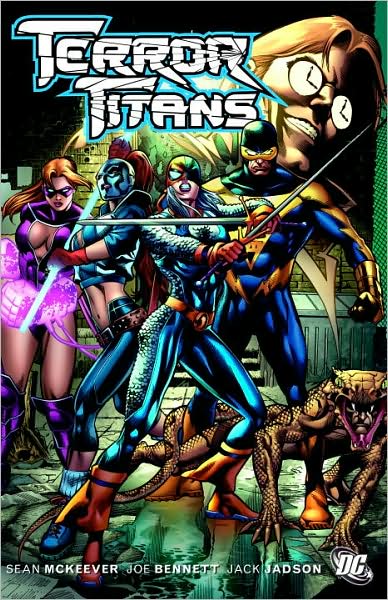
Some thoughts on Terror Titans

Having recently read a couple of collections of Sean McKeever’s run on Teen Titans, I figured I might as well read the trade collection of his spin-off miniseries Terror Titans as well, and thus finish off all of the trades produced during McKeever’s Titans.

The book follows Rose “Ravager” Wilson, who had just quit the Teen Titans team, infiltrating the ranks of new Clock King’s team of teenage legacy villains, the so-called Terror Titans.

Clock King uses them to help him capture and sell teenage super-people to The Dark Side Club, a place where bad guys organize and bet on gladiatorial death matches between superheroes.

It’s not a very good work, but I didn’t find myself necessarily incensed about its poor quality in such a way that I felt motivated to give it a formal review either.

So instead, here are some random thoughts on it.


—Aside from a few weak points, including an unclear beginning (borne of this book being a spin-off, no doubt) and a somewhat nonsensical climax (more on that later), the series is plotted very well. Almost every issue opens with an eight-panel, silent sequence featuring the life story of one of the Terror Titans, which does a fair job of showing up that they’re all life-long psychopaths in a quick, efficient manner, and writer Sean McKeever manages to demonstrate The Clock King manipulating each of the four title characters somewhat subtly. By the book’s climax, it’s made clear that the various conflicts between the main characters have all been engineered by the Clock King for a purpose.

Additionally, McKeever does a good job of sketching out the characters of the Terror Titans, although the series’ hero and its villain remain ciphers.


—The violent content that was so off-putting in a book featuring Robin, Wonder Girl and Marvin and Wendy works much better here in a more standalone title than it did in Teen Titans. Like Secret Six, this is a book consisting mostly of bad guys and worse guys (and a bunch of mind-controlled victims, I guess), so depravity of any kind is a lot more at home here.

I personally don’t like DC’s often juvenile, trying-to-have-it-both-ways approach to mature content, in which they neither commit to actual mature readers content, but don’t produce all-ages material either. Terror Titans, like the Teen Titans series about the time this spun out of it (and plenty of other DC Comics of the last few years), reads a bit like an R-rated movie in which the studio kept making one tiny edit after another until they had snipped away enough content that the MPAA granted them a coveted PG-13 rating.


—While his motivations are never made clear and his plans don’t make a whole lot of sense, McKeever’s Clock King is certainly built up as a formidable, scary villain. The fact that McKeever manages to do so without any of the usual cheap tricks—like, say, having Clock King defeat The Joker or Prometheus off-panel to prove what a bad-ass he is—but instead by spending time revealing his brutal nature slowly, action by action, line by line, the old-fashioned way, makes him doubly so.


—I’m of two minds about the art, which is penciled by Joe Bennett and inked by Jack Jadson. I don’t think it looks very good, personally, but I’m unsure of whether or not it’s good.

Like Eddy Barrows, who was occasionally drawing Teen Titans during the time this spun out of it, they draw muscled human bodies in tortured, agonized poses pretty well, so a great deal of the book is appropriately ugly and painful looking. I could feel stress emanating from the pages, and that’s a good thing, given the content.

It’s not unreadable, and, sadly, “not unreadable” actually qualifies as a positive when talking about current Big Two super-comic art, although it could certainly be more clear. Particularly during the fight scenes, of which there are many, it is difficult to tell who is doing what to whom, and who actually wins and loses the fights (Of course, these end with boxes declaring the winner, which helps in cases where the poses and rendering simply show two identical super girls in similar, painful-looking, eyes-squinting, mouth-open poses).

They draw awful clothes though. There’s a scene where Ravager and the Terror Titans are all wearing street clothes, and…and there was a blazer over a t-shirt tucked into jeans…and- and an off-the-shoulder peasant blouse belly shirt…and a micro tank top and tiny shorts with white piping and…

Well, let’s just say if there were a DC superhero named Fashion Police Woman who caught the villains in the lair, she would have been more than justified in using lethal force on the team.


—That said, I do like the character design of The Clock King. And… No actually, that’s the only nice character design in this book.


—I can’t think of a better illustration of how out of control DC’s legacy-itis has gotten than this book. The very first scene of the book features our villainous protagonists Disruptor II, Copperhead II, Persuader III* and Dreadbolt (son of Bolt) attacking a group of teen heroes consisting of Aquagirl II, Terra III**, Star-Spangled Kid III, Zatara II, Offspring (son of Plastic Man) and Molecule, the only non-legacy character of the bunch.


—I had to eventually throw my hands up and give up on trying to figure out how this fit in with Final Crisis. The Dark Side Club is, at the series’ opening, run by characters with names familiar from Jack Kirby’s Fourth World mythology—Desaad, Steppenwolf, Bernadeth and so on. They are all in mundane human forms though, similar to the way Grant Morrison imagined them in Seven Soldiers: Mister Miracle and the early parts of Final Crisis.

I couldn’t tell if this series was set before or after Final Crisis though, as the characters refer to “Boss Dark Side” and Granny Goodness having died, and the prophecy concerning the dark gods arriving on Earth having failed to come to pass.

Oh, and Clock King kills two of the New Gods, too.


—There’s a strange bit of dialogue during a meeting between Clock King and the evil New Gods about the direction of the Club which I’m not sure I understood, but it seems like McKeever either used the wrong word or someone in editorial should have spiked that word.

“I realize you feel your Caesar act is in some way, engaging, Vundabarr,” Clock King says to Vundabarr, “But you and your co-chair have to accept that you aren’t packing in the sodomites like you used to.”

The next few sentences, if that helps provide context: “The crowds you’ve managed to keep, they don’t spend. They don’t bet. They don’t get terribly excited anymore.”

So, um, what was that about sodomites, and what on earth does that have to do with anything here?


—A couple of super-nerdy nitpicks: How does Dreadbolt punch out Offspring in the opening scene, if the latter is made out of living plastic? And how is Miss Martian able to retain her shape-changed disguise when Fever defeats her by bathing her in fire?


—That said, hoo boy is this a pretty gory comic. In addition to all the blood-spitting face punches and broken necks and bones, there’s a panel of two people having their heads bisected by Clock King’s little Phantasm balls (one vertically, one horizontally), there’s a sequence of the character Hardrock (What if the Thing were a teenager, with a dumb name?) tearing Young Frankenstein (Get it? Like the movie) into three pieces, a character having her flesh melted off while being blown apart with her entrails flailing about, and, in the scene that surprised me the most, a character with explosive fingertips having all ten of her fingers chopped off…by our hero Rose Wilson…the only character fighting in the tournament who’s not being mind-controlled into fighting.

It is, or course, not marked mature readers, because no one says “the F-word” and all of the nipples remain covered by spandex or clingy cotton.


—There are an awful lot of characters killed for such a short span of issues. Not counting civilians, New Gods in human forms and characters created specifically for this series (Pristine and TNTeena, I think). These include Molecule, a “missing year” Teen Titan only seen in 52 (and Tiny Titans!), who gets chopped in half; Bolt, a late-eighties Blue Devil villain, who gets teleported into a stone chimney; and Fever, a new hero created for John Arcudi and Tan Eng Huat’s short-lived 2001 Doom Patrol series , who gets shot with a shotgun after our heroine Rose Wilson knocks her unconscious in a tournament bout.


—Clock King’s big plan doesn’t really make a whole lot of sense. As the series draws to a close, we learn that the scheming villain hasn’t just been brainwashing the captured teen heroes to fight one another in the arena, but he’s been programming to serve as his own personal army in some undefined, goal-less terror campaign (Other than mentioning unleashing chaos a few times, he doesn’t seem to have any concrete political or personal goals for his plot).

He calls them “The Martyr Militia,” and he sets them loose in LA to tear up the street, attacking empty vehicles and buildings for a few pages…? There’s nothing to it other than random, victimless violence, and since there doesn’t even seem to be any casualties, it doesn’t even seem like terrorism.

In our world, it would probably be kind of scary, but in the DCU, unleashing a dozen Y-List teenage heroes to tear up a city block seems kind of small potatoes, doesn’t it? Something Superman or The Flash or Green Lantern could take care of between the panels of their own, regularly scheduled adventures?


—Who on Earth thought the ideal way to introduce Milestone’s Static into the DCU was to have him show up in the second half of a violent Teen Titans spin-off in which Ravager is the biggest name character?


*Well, I’m going to go ahead and call her Perusader III, because she’s the third character with that name and schtick in DC’s comics, but chronologically along the DCU timeline, she’s Perusader II. The original Persuader is a Legion villain, so he exists a thousand years in the future, making the second and third Perusaders more “pre-gacy” than “legacy” characters. Ah, comics!


**Or Terra II, depending on whether or not the Team Titans Terra was Terra II or Terra I who temporarily thought she was Terra I…I lost track of that plot point

Thursday, March 11, 2010

Review: Teen Titans: Deathtrap

You know those occasional issues of super-team comics which focus on the changing of the line-up? Where the plot more or less stalls for 22 pages while the writer checks in with the various characters, who take turns explaining to one another why they’re leaving the team, or why they’re joining the team?

After slogging through two trade paperbacks’ worth of Sean McKeever’s disappointing run on Teen Titans, I realized that during that period the series had begun to seem like an entire regular, monthly series comprised of nothing but issues like that, or perhaps a single changing-of-the-line-up issue decompressed into a year’s worth of comics, McKeever’s plotting and characterization too often taking a back seat to explaining changes in the cast.

So I was quite surprised when I got to Teen Titans: Deathtrap to find out just how focused and tightly-plotted a book it was. It collects a crossover between three different titles—Teen Titans, Titans and Vigilanted—and featured McKeever and Marv Wolfman taking turns writing chapters, and yet it was the most consistent, straightforward and accessible of the Titans trades I’ve read recently.

I won’t go so far as to say that it’s a good comic book, but it is a more-or-less complete story, but it’s definitely a better chunk of comics than On The Clock and Changing of the Guard. It has a beginning, a middle and an end. I could make sense of it without having to consult Wikipedia, creator message boards and interviews, and my memory of past DC solicitations. It was also the only one of the three that seemed to know where it was going from chapter to chapter.

It’s got a lot of problems, big and small, but it doesn’t dare you to keep reading it, the way those other Teen Titans trades did, and, as an added benefit, there’s less splatterstick gross-out gore and creepy sexual bits.

The most apparent problem is probably just how ugly a comic book this is; if the scripting seems better thought-out here than in the Teen Titans trades immediately preceding it, the art is just as slap-dash and drawn-by-whichever-artist-had-a-hole-in-his-schedule as the earlier chunks of the title. There are five artist credited as pencillers, and six as inkers, and it shouldn’t surprise you to learn that very few of them have anything approaching similar styles.

What surprised me most about the art were the fairly obvious mistakes sprinkled throughout, which not only passed the original editors of the various titles unnoticed, but apparently that of the editors assembling this trade collection as well (Unless they were noticed, but the general philosophy is something along the lines of “Eh, fuck it—no one buys these trades for the art anyway, it’s just not worth redrawing a half-dozen panels.”) These include the smooth, bald head of Cyborg sprouting hair between pages, Static changing his costume design during a plane ride and Eddie changing clothes three times during the same flight, including taking off his street clothes to don his old Red Devil costume, complete with the red skin he wore under it….? Or Something?

Perhaps less apparent, but somewhat fundamental, was the slow realization that it’s rather weird that this is story is collected as Teen Titans: Deathrap instead of Titans: Deathtrap (The spine has the number “11” on the cover too, so this is apparently Teen Titans Vol. 11). The teen team, the one appearing on the cover of the trade, is the focus of only the first chapter of the book, in which Cyborg apparently tries to kill them all using the high-tech defenses he built into their headquarters.

After that, they jump into a jet plane to fly to New York City and join the adult Titans in their hunt for the hero-turned-villain Jericho, and don’t reappear until near the climax of the book. So there’s about 100 pages or so which are Teen Titan-free, and focus on the grown-up Titans and Vigilante trying to track down Jericho—the Titans to apprehend him and save him from himself, Vigilante to kill him.

Perhaps Teen Titans trades sell better than Titans ones, and thus that was simply the best way to brand the book? I don’t know; it was simply something that confused me (And, I admit, disappointed me a bit, since that is such a weird and interesting line-up, and it seemed to be composed of characters that McKeever would have more-or-less exclusive control over, making future issues of his smoother and less likely to have to explain comings and goings).

Here’s the story: After Cyborg, working through Titans Tower, tries very hard to kill the new and improved Teen Titans team, it’s revealed that someone is possessing Cyborg and that someone is Jericho, the body-possessing Titan who went from being the second-hairiest character during the classing Marv Wolfman/George Perez run to being a crazy maniac attempting to kill all the made-up presidential candidates in DC’s ill-advised, chicken-shit piece of garbage 2008 miniseries DC Universe: Decisions (A book so damn bad that DC never even collected it…? They collected Countdown!).

The new Vigilante, Vigilante IV? (…or V? Maybe VI…?) is on Jericho’s trail for…some reason. He also has a back-story and motivations I never really figured out, as this storyline seemed to run parallel to several ongoing sub-plots of his own title that crossed over with the two Titans books here. It wasn’t a negative type of confusion I felt when these elements would come up, though. That is, I knew what I didn’t know, and I knew why I didn’t know it and where I could learn about it if I cared to, and it was made clear I wasn’t missing anything important—for all intents and purposes, all one needed to know was that this Vigilante was of the Punisher-type, rather than the original singing cowboy type. (Well, I didn’t understand why the Vigilante narrated all of the chapters of the story featuring him, but not the other chapters, which were narrator-less…I’ll never understand why so many comics are written with inconsistent points-of-view like this).

Jericho’s deal is that all of the body-possessing of villains and other’s that he’s done over the years has left psychic residue in his own mind, so he picks up bits of other people’s personalities, including an awful lot of villains’ personalities. He wants to prove himself the world’s greatest assassin, one-upping his father Deathstroke by killing all of the current Titans, and he plans on doing it with a really stupid death trap.

The idea is to create an elaborate hostage situation, get all of the Titans in the same room with him and the hostages and then—wait for it—blow them all up. With dynamite.

It’s a pretty Wile E. Coyote kind of plot, and it falls apart if one thinks about it too long (that is, at all). I got the impression that Wolfman and/or McKeever came up with the nature of the death trap first, and then plugged whatever Titans were on the teams at the time into the scenario, but it’s the sort of trap that you might spring on, say, Batman and Robin, but the Titans?

Regardless of how much dynamite you use, it wouldn’t be enough to blow up Miss Martian (who is invulnerable and can turn intangible) or Bombshell (who absorbs energy). I don’t know for sure, but I would expect Blue Beetle’s armor and or force fields could protect him. I think Donna Troy’s as strong as Wonder Woman, and can take an explosion. Raven can teleport herself…and everyone else. The Flash could outrun and explosion, or vibrate through the concussive force. Or, um, just run everyone out of range of the explosion in a split-second before it goes off.

Obviously the Titans don’t all get killed anyway, but it’s a pretty drama-free climax, given the mundane nature of the threat and, more disappointingly for me, the lack of imagination in its creation. If you’re going to be using The Flash in your comic, you really have to at least think of half-assed, comic book science explanations for why it might be possible to hurt someone who can move at light speed, you know? Sure, it ain’t always easy, but seeing writers wriggle through the obstacle course previous writers have established for them is at least part of the fun of reading corporate, serial super-comics that have been around for decades.

Not that the Flash plays a very big role in the story. Few of the characters actually do…in fact, most of the characters are lucky to even get a few lines. Cyborg, Beast Boy, Donna Troy and Vigilante have fairly large roles, and Ravager gets a bit of a spotlight near the end, but after the first, Teen Titans-focused chapter, it’s very much a Vigilante vs. Jericho story, with a few of the Old New Teen Titans in supporting roles.

So Teen Titans: Deathtrap? Not very good—but much less not very good than some of the other Teen Titans trade paperbacks one could read instead.