Showing posts with label jeff smith. Show all posts

Saturday, April 06, 2024

A Month of Wednesdays: March 2024

 BOUGHT: 

Thorn: The Complete Proto-Bone College Strips 1982-1986 and Other Early Drawings (Cartoon Books) My sole comic book purchase for the month of March came not from a comics specialty shop or from an online bookseller like Amazon or Barnes and Noble, but rather from a Kickstarter campaign: The complete collection of Jeff Smith's mid-eighties comic strip from Ohio State University's student paper The Lantern, a strip that would eventually evolve into the comic book series Bone, the impact of which on the direction of the comics industry—or should that be "graphic novel industry"?—is hard to overstate.

When the book was last mentioned here on EDILW, it was in the context of wondering if there was some failure in the traditional comics publishing industry of the moment that Jeff Smith (and Matt Wagner and Kelley Jones) would have to turn to crowd-funding to get a project off the ground. Having now seen the final product, it's a little more clear why Smith might have gone this route. Not only has he been self-publishing his work for a long while now, but this is a very personal, somewhat niche project, and one imagines Smith relished the complete control over what it included, beyond what's in the title—the entirety of his Thorn strip.  Also, it looks like Cartoon Books is following the Kickstarter campagin release with a wider release...?

Not merely a curio for fans of Bone and where exactly the cartoon-character-in-an-epic-fantasy-world came from—and given how early Smith drew Fone Bone, it's safe to say it was a story he had spent his whole life building up towards—this edition of Thorn contains pretty much everything you could possibly want from such a collection, and it therefore serves as an important artifact in Smith's career as a cartoonist and storyteller...and also one of note in the areas of Lantern history and Columbus comics history. It is, in other words, essential reading for someone like me...and, I assume, like many of you.

The thing that is most immediately noteworthy about Thorn is just how sophisticated it is. It's a student strip in a college paper—although, thanks to taking a few years off after high school, Smith was a little older and thus, we can assume, a bit more accomplished than your average freshman cartoonist—but it's remarkably well-made. 

The artwork is head-and-shoulders above what you might see from a typical college strip (and there are examples here-in, as when Smith's Thorn crosses over with its comics-page neighbor, Steve Spencer's 50% More Absorbent Comix, or the final strips, in which Thorn hosts a goodbye party that the other Lantern comic strip characters all attend). Its visuals seem inspired by Walt Kelly's Pogo (a few characters of which make an off-panel cameo in one strip) and even, I hazard, the not-that-visually-dynamic Doonesbury by Gary Trudeau (I see it in the way the dragon's cigarette dangles, I think). 

As far as a comic strip goes, it's rather remarkable to see the early, first draft version of the Bone epic play out, with characters Fone Bone, Phoney Bone, Thorn, Gran'ma Ben, Ted the bug, the dragon, The Hooded One, the Rat Creatures, Roque Ja and, quite belatedly, Smiley Bone all appearing as part of the cast, and many of the same story beats playing out, but in the context of a daily comic strip that seems to vacillate between a continuity-strip adventure and a daily gag strip tackling politics and culture in a way that evokes the aforementioned Pogo and Doonesbury, not to mention Berkeley Breathed's Bloom County, with which Thorn seemed to share a bit of its DNA. 

So between the drama of the Rat Creatures and the Hooded One's interest in the Bone cousins and what we might now think of as "the Bone stuff," there are storylines  in which Thorn falls in with her world's version of Jerry Falwell and the Moral Majority, Cold War politics as played out at a picnic knife-fight with a socialist pig with a Russian accent, and, in the most curious section, a satire of the 1986 election, in which a clownish dwarf king named "Ronnie Doody, The Talking Puppet" tries to make Thorn his running mate. 

Smith himself also enters the strip at various points, after it is established early on that the characters could visit him at his drawing board. And so he kinda sorta helps save the day when the Rat Creatures have Thorn and Fone Bone surrounded at one point and, later, he hires Fone and Phoney to work at the ice cream factory where he has a summer job. Then there's the aforementioned crossover with 50% More Absorbent Comics, where Smith basically pals around with the strip's star for a couple of weeks, wandering around campus...and even meeting Brutus Buckeye, or at least having a vision of Brutus Buckeye.

If all the book contained was a four-year run of Jeff Smith's college comic strip, the laboratory where he would eventually work out his seminal graphic novel saga Bone, the book would be well worthwhile. But there's a lot more to it than that. What else, is there...? Well...

•A foreword by Lucy Shelton Caswell, the founding curator of the Billy Ireland Cartoon Library & Museum at Ohio State University and co-founder of Cartoon Crossroads Columbus (as well as one of Smith's teachers and, to a degree, a mentor).

•An introduction by Smith.

•The final, post-Lantern strip from the pages of The Sundial (Think of it, as Smith did, as a Thorn Sunday strip).

•Five installments of a strip called Mickey & Rudy, about a young woman and her talking cat.

•An interview with Guido WeiBhahn, whose name I can't reproduce correctly here as it has a non-English character I don't know how to make in it (I just used a capital "B", which is wrong).

•A two-page remembrance by Smith's fellow Lantern cartoonist Derf, now better known as Derf Backderf, about the time a young Smith tried to call out racism...and ended up getting accused of racism himself. The particularly controversial strip prompted a guest column by Smith apologizing for the offensive content (the column is also reproduced herein).

•A "Tales From The Inkwell" section showing the evolution of Smith as an artist...and Fone Bone and other Bones' evolution right alongside him. This section includes plenty of art, including from Smith's childhood—he first drew Fone Bone at age 5, after all—plus some barbarian stuff, some superhero stuff, and the extremely intriguing possibility of another alternate version of Bone, one inspired by Smith's love of Frank Frazetta and Heavy Metal. The period, Smith writes, didn't last long, and "I never got it organized enough to send anything to the magazine Heavy Metal (thank goodness!)"

•An afterword by Smith's best-friend and one-time business partner, Jim Kammerud.

•A section comparing scenes from Thorn with scenes from Bone, many of which are beat for beat the same, but quite differently drawn (as polished as Thorn seemed for a college strip, Smith's later work on Bone looks almost like the work of an entirely different artist). 

It's an awful lot, really.

The book is currently on Amazon and in Previews for a July release, so apparently it will be more widely available then to those who didn't jump on the Kickstarter. (I don't understand how publishing works, I think it's safe to say.) This being a Kickstarter release, however, there were several "stretch goal" prizes that came along with the book, including three versions of a cast portrait (in blue pencil, inks and full color), "evolution" of Fone Bone and Thorn drawings, showing the two key characters at different points in their visual development, a Ted the bug drawing and, most weirdly, a trio of "mini-comics", publishing Bone adventures that Smith created between the ages of 9 and 14. 

I have no idea what to do with any of these things.  

Whether or not you're a particular fan of Bone or even Smith, I'd still recommend Thorn as a good place to start exploring both. Hell, it's where Smith himself started.


BORROWED:

Superman: Action Comics Vol. 1: The Rise of Metallo (DC Comics) I came for the jackets. Dan Mora's collection cover, featuring a now expansive Superman "family", all rocking a new uniform of sort in jackets rather than capes, intrigued me enough to check out what's going on in Superman comics at the moment.

That Superman family includes Supergirl, Superboy Conner Kent/Kon-El, former Superboy Jonathan Kent, Chinese "New Superman" Kong Kenan, Steel John Henry Irons, Steel Natasha Irons and the "Super Twins," newly acquired Kent adoptees from War World. 

It's a huge cast, and somewhat unwieldly, although writer Phillip Kennedy Johnson does a pretty good job of juggling them all to the extent possible, coming up with a threat in this volume that requires a large number of super-people.

 It turns out the jackets aren't really the best idea visually, though, as the characters can be hard to tell apart, given how similar so many of them look; their original, caped costumes popped more than the subtle differences in jacket style or "S" font do here.

As the sub-title indicates, much of this volume is devoted to the return of villain Metallo. The Steels are about to open a new Steelworks facility in Metropolis, and not everyone is happy, particularly the new "Blue Earth" protest movement that is opposed to the infiltration of aliens into Earth society (I guess the fact that Superman has his own little army of super-people now doesn't help them feel any better about his presence on Earth). 

Metallo tries to sabotage the grand opening, at the behest of a holographic Luthor...although it will be revealed that it's actually another Superman archfoe pulling Metallo's strings. As to why Metallo is so eager to help, it turns out his little sister has been kidnapped by the villain, and he won't release her until Metallo succeeds in killing off the whole Super-family...a rather tall order. 

Raffa Sandoval and Max Raynor handle the art, and they do a pretty good job, especially considering how many similar-looking characters they have to draw, in and out of costume (the Super-family all reconvene at the Kent household a few times for plainclothes hang-out sessions; it wasn't entirely clear from the proceedings, but I think Superman may have his secret identity back after Brian Michael Bendis outted him, although I have no idea how that was achieved.)

I'm not sure for how long a super-family focused book like this will be tenable, as with so many characters few of them get a chance to make much of an impression other than fill in crowd scenes, but it's still nice to see DC attempt to use all of these characters, and, given the nature of the threat here—with Metallo building a small army of drone cyborgs—it works pretty well. 

Maybe this will eventually lead to a Wayne Family Adventures style Superman book. 

Speaking of which...


Wayne Family Adventures Vol. 3 (DC) CRC Payne, Starbite and company's Web Toon series returns for another collection. This volume's highlights include Oracle discovering Jason Todd's Tinder profile (which says Jason's only 19? That can't be right; is he really only a year older than Tim?), Damian trying to avoid messing up his hair on picture day, Nightwing and Huntress trading weapons for a night, a long discussion between Tim Drake and Damian about their differences, Duke teaching Jason and Cass that sometimes entering through the door is the best tactic and Stephanie and Damian practicing fighting in high heels. Guest-stars include Zatanna, Poison Ivy and Harley, and, somewhat surprisingly, the version of Vixen that appears in another Web Toon series (and who works with Grace Choi, for some reason...?) 

The series remains one of my favorite super-books, in large part because of how well Payne is able to balance silly, humorous vignettes with serious explorations of the characters, as well as ensuring a spotlight for

Batman's wide and deep supporting cast. Wayne Family Adventures remains, as far as I am concerned, the most essential Batman comic. 


Zom-100: Bucket List of the Dead: Vols 12-13 (Viz Media) I apparently missed volume 12 when it originally came out, as when I picked up volume 13, I had no idea what was going on. I rectified that immediately, however, and so this month got a double dose of Haro Aso and Kotaro Takata's zombie survivalist comedy. 

Volume 12 opens with Akira and Shizuka washing up on a desert island after falling overboard during the zombie outbreak on the pleasure yacht at the climax of volume 11. This is a dream come true for Akira, of course, who had "Live on a deserted island" on his bucket list of things to do before becoming a zombie, a list he and his friends have made quite a bit of progress on over the course of the series. Shizuka, still mad at him for his almost-dalliance with another girl, has to come to grips with her feelings for Akira, and eventually makes a confession....just not to Akira. Zombies start washing ashore, proving that not even a deserted island is a safe harbor during the zombie apocalypse.

The characters do make some surprising headway in their efforts to save the world, however, finally catching up with the doctor working on a vaccine and his traveling companion, a girl who seems immune to zombie infection. Unfortunately, they do so just before Shizuka is herself finally bitten, which would have made for a hell of a cliffhanger to volume 12, if it would have simply ended with Akira weeping over her body, and weren't for the final three panels holding out hope for a cure.

The thirteenth volume is something of an extended Resident Evil riff, coming rather late in the game considering how long the series has lived in the zombie genre, with our heroes finding an "Umbriel" Corporation facility and setting up shop there, where the doctor can work on the cure. They find that Umbriel was up to some spectacularly shady stuff, though, including the manufacture of monsters derived from the zombie virus, long-tongued frog monsters that will need to be faced by our heroes, who pick up the heavy weaponry left by an elite squad of private soldiers who are all slaughtered when caught unawares by the monsters. 

As the bucket list gets shorter, I begin to wonder—and to worry—that this series' lifespan may be reaching its limits. 


REVIEWED: 

Unicorn Boy (First Second) Dave Roman of Astronaut Academy launches a new series—based on the big number one on the spine, not to mention the unresolved plot points—featuring the superhero-like title character, who is a little boy that, via transformation sequence, turns into a magically-powered, unicorn-themed hero of the title and must journey to the underworld to save his non-binary best friend, who was taken by the forces of darkness. A grandmotherly grim reaper, a talking cat and a talking muffin are all involved. It's fairly silly, but quite well-drawn and rather charming. More here. 

Tuesday, October 31, 2023

Some Kickstarter campaigns of note

I feel weird about Kickstarter, the crowd-funding site that some comics folks use to bring their projects to life, instead of going the traditional route of securing a publisher. 

I've backed a couple projects there before (some Jim Lawson comics, Mystery Science Theater 3000*) and been pleased with the results, so I'm not, like, opposed to it or anything, I just think it's weird when certain creators or certain projects show up there, given the fact that they seem like they should be the exact sorts of comics that publishers should be fighting one another to publish, rather than something that the creators have to turn to crowd-funding to produce. (That said, I suppose it just might be a weird prejudice of mine against crowd-funding as a publication model; perhaps there are reasons Kickstarter is more appealing to a creator than working with a publisher, I don't know. I didn't ask any of these creators.)

Case in point? Jeff Smith, the Eisner and Harvey-winning cartoonist extraordinaire whose resume includes Bone, RASL, Tuki: Save the Humans, Shazam! The Monster Society of Evil and Little Mouse Gets Ready, an artist who was on the pointy end of the spear of getting comic books in libraries and re-popularizing comics for kids again, is seeking to publish his early, pre-Bone (proto-Bone, in his words) college comic strip, Thorn, which used to run in the Ohio State University school paper The Lantern when Smith was a student there. (I've seen some of these in the 2008 book Before Bone, published in conjunction with his Wexner Center for the Arts show Jeff Smith: Bone and Beyond, and they're pretty fascinating to read in the context of the Bone that later saw print). 

One would think an artist of Smith's stature would have his pick of publishers, but Thorn: The Complete Proto-Bone Comic Strips 1982-1986 and Other Early Drawings is on Kickstarter. Again, maybe this is Smith's first choice, and he didn't even consider going with a publisher, but it strikes me as...wrong that a major publisher wouldn't want involved with the project, as relatively niche as it might be. 

As of this writing, there are 16 days left to go on the campaign. For $30, you can get a trade paperback version of the book, for $75 you can get a hardcover. 

If you've been a regular reader of EDILW for a long time now, you probably know my love of Kelley Jones' art knows no bounds, and little has excited me more than getting a new Kelley Jones comic, especially a new Kelley Jones Batman comic. In fact, I'm so fond of Kelley Jones that if Kelley Jones walked up to me on the street and asked me for, say, $50, I'd gladly give it to him. So obviously I was onboard with a Jones-related Kickstarter.

And this one looks like a doozy, as it also involves Dracula and cartoonist Matt Wagner (best known his Mage and Grendel, but, like Jones, he has plenty of great Batman comics to his name as well). Dracula Vol. 1—The Impaler is written by Wagner, drawn by Jones and will be the first in a series of graphic novels telling the life story of one of fiction's most famous characters. 

It seems like a perfect project for Dark Horse Comics or DC Comics, both of which have worked extensively with the creators in the past, or even Dynamite, where Wagner has been writing the adventures of other famous pop culture icons, like Zorro, The Shadow, The Spirit and the Green Hornet. Whatever though. Like I said, I would be happy to hand Jones money if he asked for it; if I got a Dracula comic by Jones and Wagner in exchange, well, who could ask for more?

As of this writing, there are 16 days left on the campaign. For $45 you get a hardcover version of the book, with either a Jones or a Wagner cover (I chose the Wagner cover, since I'd be getting all that Jones are on the inside).  

Finally, there's something that's only kinda sorta comics that is nevertheless near and dear to my heart, and was a big part in my falling in love with comic books in the first place: The old Palladium role-playing game based on Kevin Eastman and Peter Laird's original, Teenage Mutant Ninja Turtles comics, Teenage Mutant Ninja Turtles and Other Strangeness. 

I and a friend of mine had played a little Dungeons & Dragons around the time we discovered these books, which featured black-and-white illustrations by Mirage Studios artists Eastman and Jim Lawson (in addition to being based on the early, Mirage issues of TMNT, they also included some short comics from Eastman and Laird, all of which I believe have since been collected repeatedly, including by IDW). 

Palladium quickly overtook D&D in our affections, and between us we had all five of the TMNT sourcebooks, plus a few of the related After The Bomb books, which also involved mutant animal characters. We were playing these as I was buying my first TMNT comics, which brought me into a comic shop and well, here we are thirty-some years later. 

I'm delighted to see that Palladium is bringing the books back in a pair of collections, even though I have some reservations about the way they're doing it; mainly, there will be new covers and everything will be color-ized, which, in addition to never looking quite right to my eyes (I didn't care for the colorized versions of some Mirage comics that IDW has published over the  years), means the Turtles will be wearing their cartoon colors, rather than all wearing red, as in the original color covers of the original black and white covers.

Luckily, they seem to have thought of the exact sort of snob that I am, as in addition to the new, colorized versions, they're also publishing black, white and red editions: "For those who want to enjoy a blast to the past version of the books more akin to the originals, this is for you." Neat! I backed at the level that would get me those versions of the two collections, Teenage Mutant Ninja Turtles and Other Strangeness and TMNT Transdimensional Adventures. 

As of this writing, there are 28 days left in this campaign, and there's a huge swathe of options of what you can get, from $50 for the Other Strangeness Collection all the way up to special dice and miniature figures. 

This is the end of this blog post, so you can now leave EDILW and head over to Kickstarter where you can support any or all of these worthwhile projects. I hope you will; I'd like to see them all reach all their stretch goals. 


*They're currently trying to raise funds for a fourteenth season, by the way, and they're doing it here, rather than through Kickstarter this time. 

Tuesday, October 06, 2015

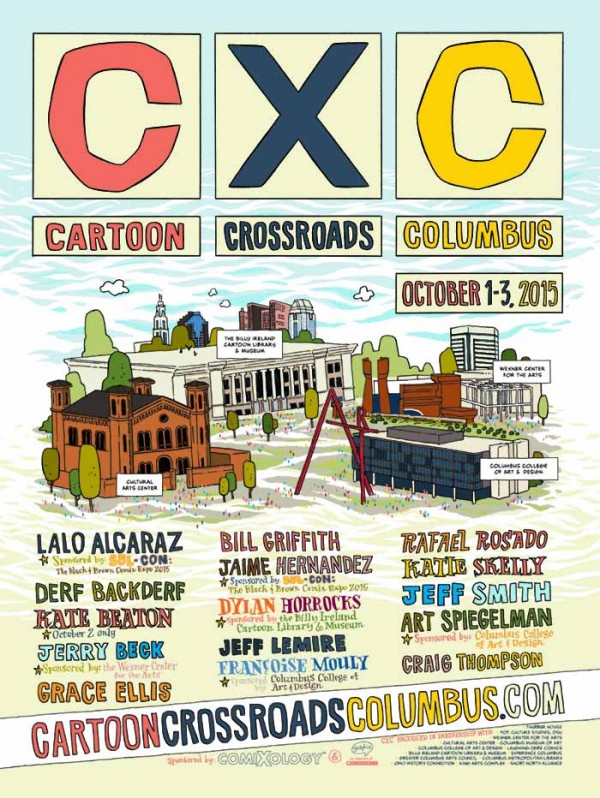
Some notes on Cartoon Crossroads Columbus, which I attended only very little of (but got an awful lot out of)

This weekend was the very first of what will hopefully be many Cartoon Crossroads Columbus conventions. If you missed it entirely this year, I'd definitely urge you to consider attending next year.

I have a kind of weird relationship with the city of Columbus, which I lived in from 2000-2010, and have only been back a handful of times in the last five years; now doing so has the same sort of surreality of returning to your old high school or college campus years after graduating. Because of that, and the fact that when CXC was first announced, this year's version was expected to be a somewhat small, trial balloon-like scrimmage of a convention, I had only planned on attending one of the three days. I decided to go on Saturday, as that was the day Kate Beaton was going to be there, and she was the first announced guest that I was most interested in seeing and hearing (and had not seen or heard previously).

Well, I regretted not better planning my trip almost immediately upon arrival. As I said, I only attended one day–four events total, which was less than half of those that occurred on that day–and they were all great. There were at least two instances where, when an event ended, I felt like running out of the room, jumping in my car, speeding the two hours and five minutes it takes me to get from my current home in northeast Ohio to Columbus (and vice versa) and leaping to my dust-covered drafting table to start making comics (This was in sharp contrast to the way my relationship with comics started that very day; I woke up at 8:30, took a quick click around the comics Internet, and was so disgusted by much of what I saw that I seriously reconsidered what I was doing with my life, exactly, and maybe just quitting writing and reading about comics altogether. The lesson? Maybe I should only read the comics Internet once a year, or attend events like CXC daily; one.)

Now, because I lived in Columbus for such a large percentage of my life, and because I haven't been there for any great length of time for so very long, I keep getting tempted to write about the city, and myself and how both have changed, which I realize isn't really of any great interest to anyone, particularly in this post. So I keep starting and re-starting this post in my head (I started this post on Saturday; I am just now posting it at 2 a.m. Monday night/Tuesday morning, though; I expect it to be riddled with typos). I'll try my best to stick to comics here, though, and do it in a lazy, bullet-point format.

But the most important thing I wanted to stress is that I attended just a fraction of the events, and even that small sub-division of the event was one I found enormously rewarding and inspirational, so I can only imagine what the entire package would be like...especially if, unlike me, you are more of a socializer (I introduced myself to one of the two people I know of only as presences online; I almost introduced myself to Tom Spurgeon a couple of times, but in each case he was talking to someone else. I've never spoken to Spurgeon, but I read his site daily, and it's like, one of the last places on the Internet devoted to comics exclusively...in addition to being well-written and a good resource of comics news. There were a couple of parties planned though, where you could presumably tell Art Spiegelman you like his vest or that he's been spelling word "mouse" wrong for years now and mingle with cartoon and comics enthusiasts and professionals).

So, bullet points:

–This was my first visit to the Billy Ireland Cartoon Library & Museum. When I was based in Columbus, I went to the Ohio State University's cartoon library exactly once, when the Wexner Center and the museum collaborated on a big Jeff Smith/Bone/cartooning exhibit (Jeff Smith: Bone and Beyond). I remember it feeling like the library was, at the time, a rather crowded hallway piled high with stuff. Now it's a nice, big, modern-looking building, named after a Columbus newspaper cartoonist who I wrote about at least once before on the blog (and who information on was incredibly hard to come by in public libraries and/or the Internet at the time).
There's a replica of Billy Ireland's signature–a shamrock–in a stone on the floor right by the entrance. There's a reading room, for research purposes. There's a big gallery, where there are currently two shows going on (What Fools These Mortals Be: The Story of Puck, Seeing The Great War and an ongoing Treasures From The Collection... exhibit), and a few classrooms, one of which (named The Will Eisner Seminar Room) was being used for a series of presentations they were calling "Talk and Teach Classroom Presentations").

–I attended the second "Talk and Teach" presentation, presented by cartoonist Katie Skelly, an emerging favorite of mine, whose work includes Nurse Nurse, Operation Margarine, a mini-comic my friend brought me back from SPX last year entitled My Pretty Vampire and a mini-comic my friend brought me back from SPX this year, Agent 9. The subject of her talk was "Influence As Education."

–I always expect cartoonists to look like their drawings, whether they are autobiographic cartoonists or not, at least until I see them (Yes, when I used to imagine "Rob Liefeld" I saw a hulking, screaming figure in spandex sitting at a drawing table, a gigantic gun leaning in the corner while he drew). Skelly therefore did not meet my mental picture at all. She did was not smoking a cigarette, wearing a leather jacket or bad-ass boots; she did not enter on a motorcyle.

–After a brief intro by OSU's Jared Gardner, mostly consisting of Skelly's bibliography, Skelly plunged into her presentation, which included a few slides, but was mostly a talk-talk. If you've read her works, you'll note that they are all rather heavily inspired and influenced by other works, mostly from other mediums. She talked a bit about the process of using influcene as it's applied to those works; for example, with Nurse Nurse, she took the "shell" of something she really liked (Barbarella), but then hollowed it out, and injected stuff she liked better, stuff that was her stuff into it, transforming it.

–Much of what she discussed is the sort of things that everyone does somewhat subconsciously, but she broke it down into a somewhat rigorous, step-by-step process, that one can apply and follow in a conscious manner: Looking at things you like and figuring out what you like about them, so you can borrow that element; looking at things you don't like and figuring out what you don't like about them, so you can avoid those elements; looking at two examples, one thing you like and one you don't, side-by-side (She chose Female Trouble and The Royal Tennenbaums) and picking out what you like about one vs. the other, to help narrow down your approach to making your own stuff.

–She recommended looking at fashion photography. Those are very powerful images specifically created to communicate a direct and convincing message to the viewer ("Buy this stuff"), and thus good examples of direct, visual communication.

–She also jokingly referred to how it's totally okay to steal from fashion photography, since they're trying to sell you a $3,000 coat or something, so to hell with them.

–She shared an anecdote about being 13 and working in her parents' newsstand and looking at the magazines, struggling to make sense of the fashion lay-outs. She would see the sequences of related images, but would always have trouble finding a "story" in what was happening between the images, that lead from one to another. At the time, she didn't know that "buy this stuff" pretty much was the story, and approached them as sorts of frustrating visual puzzles to be mulled over.

–I didn't do a headcount as I likely would have if I were covering this event for the paper I used to work for when I lived in Columbus, but it seemed like an okay crowd. We almost filled the room. It seemed to be rather equally divided to people like me (grown-up cartoon/comics enthusiasts), art teacher of one kind or another and art students, identifiable by their extreme youth and colorful fashions. Most of these were sketching. I noticed that I was probably the only person in the room without an open notebook and writing utensil. Almost everyone else, particularly the younger folks, were scribbling notes and sketches throughout the entire presentation.

–Skelly was immediately followed by Dylan Horrocks, whose presentation was on "creative blockage." The Museum's Caitlin McGurck facilitated, although once more this mostly consisted of an introduction, during which she praised Horrocks' Hicksville as an all-time great work, and noting that she and her fellow Billy Ireland employees have found a way to essentially live in a version of Eltingville (just in case you weren't already convinced they had someof the best jobs in the world). Horrocks also wrote a decent run on Batgirl (Cassandra Cain version) and one of Vertigo's several attempts to spin an ongoing out of The Books of Magic. He referred to Hunter: The Age of Magic as "Harry Potter on steroids" and Batgirl as "pretty much just steroids."

–Horrocks, who hails from New Zealand, had a rather soft-spoken voice with a hint of an accent. He didn't look much like his drawings either, but maybe a little closer to his character designs than Skelly to hers. I really liked the sound of his voice, and it made his mostly deadpan jokes all the funnier.

–He presented seven points, each illustrated with examples from his own career, which I really wished I would have taken notes on, as that would make this "report" all the more valuable. Let's see if I can remember them:

1.) You can draw

2.) You might not be able to draw the way you'd like, but you can draw.

3.) No one else can draw exactly like you.

4.) You draw with your whole body.

5.) Drawing is a collaboration.

6.) Nope, I can't do it...I forget this one...Maybe it was "draw comics"...? (See below).

7.) Enjoy.

As for five, he was referring to the fact that drawing isn't just something that takes place between your head and hand, but also involves your body, your pen, your paper, your desk, your mood, the room you're in and so on. There are innumerable factors that can impact and effect your drawing, for better or worse.

As for the final one, he pointed out that if you're not enjoying what you're doing, don't do it. It takes an incredible amount of time and energy to draw, and it shouldn't be something that makes you miserable to do. Otherwise, why are you doing it.

–He noted that he sees lots of students who, when he asks to see their work, will show him their portfolio–or, more often than not these days, open up Deviant Art or Tumblr on their phones–and they show him character drawing after character drawing. These are often great drawings, but they're not comics. And if you want to draw comics, you should draw comics, meaning you should draw image after connected image, telling stories.

–He shared some advice from a comic...that I was sure I would remember the name of and the creator of, but I do not. In it, a young girl character is upset because she wants to read a particular book that doesn't exist, so she realizes it's up to her to write it, but she doesn't think she's good enough a writer to attempt it. Her older brother advises her, "If something's worth doing, it's worth doing badly." This, like Horrock's "You can draw" bit, reminded me of what James Kochalka wrote in his Cute Manifesto. This was the first time of the day I felt like rushing home to just start making comics.

–When Horrocks opened it up for questions, I was tempted to start asking a bunch of questions about Batgirl, because I thought that would be funny, but I did not.

–I retreated to a few blocks north, looking to see the few places that hadn't been eaten, digested and transformed by the super-gentrification that's occurred in the area over the last decade–Used Kids is still there, so's Bernie's–to Buckeye Donuts, one of the places I miss most about Columbus. I drank coffee, ate doughnuts, read from a book about Bigfoot and looke dout the window at college kids rushing back and forth in the cold rain for about two hours.

–The next event I attended was one of the few ticketed events (and the only one I attended). It costs $5 to see Tom Spurgeon in conversation with Jeff Lemire–or a dollar more than most of Lemire's superhero comics cost.

–I was a little surprised to find the auditorium, the Film/Video Theater in the Wexner Center From The Arts, a one-minute walk from The Billy Ireland, wasn't fuller than it was. Lemire got his start as an indy/art/literature/non-genre cartoonist, but has since become a prolific writer of sueprhero and science-fiction comics for DC, Marvel and Valiant. I therefore expected to see a lot of folks here who might not have been interested in the other stuff, but, now that I think of it, while Lemire has written a lot of genre stuff, it's mostly been second or third-tier: pre-New 52 Superboy, New 52 Frankenstein, Agent of SHADE, Green Arrow, post-Fraction Hawkeye and so on. With a pair of X-Men-related books in the wings, Lemire's profile might rise even higher, but for whatever reason–time of day, focus of the festival–this audience was more of an Essex County than an Animal Man one.

–Lemire did not look like I imagined him to look (the protagonist of The Underwater Welder, basically), but was well-dressed, quiet, humble and handsome. Spurgeon looked almost exactly like the Sam Henderson drawing on Comics Reporter, which is awfully damn weird, as Henderson's style isn't exactly representational. That's a testament to Henderson's cartooning skills, I guess.

–Lemire did not have a Canadian accent. I'm always disappointed that Canadians aren't as exotic in real life as they seem in my mind.

–Spurgeon asked several questions about Lemire's incredible workload, which has included working on as many as eight monthly books at a time (as a writer), plus drawing. Lemire's output does seem incredible, and the number of books he writes or has written at various points was large enough that he had to count on his fingers when answering which book's he's writing at the moment, or how many he was writing at the height of his output, and so on. When an audience member asked which books Lemire had written for DC, other audience members had to chime in to remind him of a few he had written.

–Lemire seemed awfully ambivalent about a lot of the writing he did, saying he usually only has about one good story for each superhero that he's written, and would prefer to get to write that one and get out, when it comes to such assignments.

–He noted the difficulty involved in writing for corporate superheroes, and that the importance of getting a good editor. There can be two kinds: The editor that wants you to be you and write your story, and the editor who would rather be the writer themselves, and, obviously, the latter can be very difficult to work with, as everything is a struggle. (For Sweet Tooth, Lemire had three different editors; he wasn't talking about that book in particular, but the question arose because Spurgeon noted that seemed like a lot of different editors to work with on a book).

–He also noted that the way DC Comics is set up now is very writer-oriented, and that a book would first go to a writer, and then the writer might have to fight to get a good artist, as if they get a bad one, it can really sink the book. He used Andrea Sorrentino, his Green Arrow partner, as an example of a good artist he worked well with, and one he had to fight to get on that particular book. I was kind of surprised to hear that, only because I dislike Sorrentino's art so much, and find the books he's drawn (including Green Arrow with Lemire), all but unreadable.

–Regarding the number of books he writes, he said it's not a financial decision to simply take as much work as he can, and that he does in fact turn work down if he can't think of a good take on a character. There was one really big book he recently turned down, one that he thinks a lot of people would think he was crazy for turning down. Spurgeon asked what it is, and while Lemire considered for a few seconds, he eventually said he'd better not say.

–The corporate superhero books, despite some of the hassles, are easy and fun to write, Lemire said, because as a writer you get a good amount of the story already done. Like, the character already exists, is pretty well defined, and so on. He liked inheriting the pieces, and then trying to assemble them into something he found interesting. He didn't use this expression, but the way he was describing the process, I thought of it as something like a Lego kit.

–He did say he's getting close to the point where he won't take on so many superhero books and hopes to, eventually, be like Warren Ellis, where he just writes six issues of a Marvel comic every five years for fun.

–Spurgeon and he both conjured an image of Warren Ellis jumping up in bed in the middle of the night and declaring, "That's it! Karnak! I have to write Karnak for six issues!"

–Lemire is drawing a graphic novel for Scott Snyder–Scott Snyder's first original graphic novel, and his first non-genre comic–that Lemire says Snyder is writing specifically for him, and that plays to the strengths of both creators. I don't think I had heard this before, nor had I realized how rare it is for Lemire to draw for another writer, but he said he'd only done it once or twice, and the Legends of the Dark Knight 10-pager he did with Damon Lindelof.

–After that event, I power-walked the mile and half between the Wexner Center and a flower shop my friend works at in the Short North in the cold and rain to visit her, marveling at the changes in that stretch of High Street. The entire city block that the house I lived in for much of my time in Columbus–the setting of my first mini-comic–has been leveled, and is now a construction site. I stopped for bubble tea (if they sell that anywhere in Cleveland, I don't know where), to buy a new man-purse from Cousins Outdoor Army Navy Store (I bought my last one there 15 years ago, and it's just now falling apart) and to check and see if Adriatico's was still on campus (It is, thank God).

–I took advantage of some downtime to look at the museum's exhibits. Man, the drawings in the Puck exhibit were just plain amazing. Presidents Taft and Theodore Roosevelt are some of the best damn political cartooning subjects in the history of U.S. Presidents, I should think. I mean, George W. Bush and Barack Obama have big ears, but those two had everything. I particularly enjoyed the few cartoons they appeared in together. The above image is a 1910 one by Joseph Kepler Jr. entitled "Goodness Gracious I Must Have Been Dozing!" Kepler has another great one from 1912 called "Stop! Look! Listen!" in which a giant Taft sits upon a throne like a Buddha while a giant Roosevelt runs at him, head down, like The Flash; the gag is something about an irresistible force and an unmovable object.

–The final event I attended was the evening presentation, "A Conversation With Kate Beaton and Craig Thompson." This was held in Mershon Auditorium, connected to the Wexner Center. I had previously seen Ani DiFranco and Belle and Sebastian play in the venue, which is a pretty decent sized one with folding, theater-like seating.

–When I arrived, a man that turned out to be Craig Thompson was seated at a table signing books for a handful of people, while a woman who turned out to be Kate Beaton was standing at the front of a sizable line of people of all ages, clutching books. Apparently, Beaton stood and went to the line, in order to work through it faster as the time of the talk approached (from what I heard, she did sign everyone's stuff).

–Before the scheduled event, some representative of the U.S. Postal Service were there to unveil the Peanuts Christmas special forever stamps, on sale now.

Note to self: Bring your camera next year, too
–Jeff Smith conducted the talk, so it was essentially Smith, Beaton and Thompson. Those are three very different cartoonists with three very different perspectives, careers and modes of work. All three were groundbreakers of different kinds though, and it was interesting to see how they happened to be staggered in terms of where they fall in the recent history of the industry and medium.

–Kate Beaton is short. Her feet did not touch the ground when she sat in the big comfy chair, and so she scooted a coffee table in front of her to hide her shame. She did not have an accent either.

–Smith started out asking them each specific questions related to their work, and then they sort of all three started reflecting on the same subjects.

–Beaton was a very fun and funny presence, even when she wasn't talking. It was interesting to watch her face, as she tended to make very big expressions in reaction to what Smith and Thompson said. When Smith was talking about how exhausting cartooning can be, describing his process, she interjected at one point, "Wow, you guys work too hard."

–Smith said that when they were casting about for names for CXC, one they thought of and rejected early on was "Arch City Comics," as Columbus has been trying to re-brand itself with the nickname "The Arch City," which it was once referred to long ago. But after saying "Arch City Comics" out loud about ten or fifteen times, they noticed the problem with that name.

–Thompson talked a little about the creation of his Carnet de Voyage, which he drew on what was supposed to be his post-Blankets vacation. His plan was to spend a few months in Europe resting and recharging, but his European publishers co-opted his travel plans to turn them into what was essentially a three-month book tour. When he talked to his U.S. publishers about doing Carnet de Voyage, they apparently loved the idea–and solicited it almost instantly, before Thompson had even started. He ended up assembling and proof-reading it with two people who didn't speak English as a first language before sending it to the states for publication, thinking that it probably should not be published. It turned out really well though, I thought, especially given the circumstances.

–This was the second event of the day in which Warren Ellis came up. Beaton, in talking about her career trajectory, noted that he mentioned her on his blog or newsletter or whatever one day, and suddenly she had 7,000 more followers. That's all it takes to get famous in comics, a nod from Warren Ellis, they noted.

–In talking about how they each got into comics, Beaton shared an anecdote about how small her school was, and the fact that everyone there knew everyone. She recalled being in kindergarten and trying to read a Calvin and Hobbes collection there, but being told by a classmate that it was "for boys only," and she couldn't read it. Same went for Mad magazine, so she had to read Cracked instead. Because she's still friends with some of her classmates, she asked one of them if he remembered not letting her read these comics because she was a girl and he said, 'No, I was a five-year-old. But that's cool you've kept a weird grudge about it all these years.'

–Smith apparently got into comics as a young adult at Monkey's Retreat in the Short North. He didn't mention it by name; just a seedy comic shop in the Short North with a cat in the widow, some porn over here, some weird art books over there and comics in the back. Monkey's Retreat jut closed down within...what, the last two years?

–Plenty of time was left for questions. The point I found most interesting was when someone asked a general question about where the three thought comics were going, which lead to Smith reflecting on the battles he himself had seen in comics, as when he started comics–comics like Bone–could only be sold in comics shops. Librarians and book stores had to be gradually, slowly won over and, one of the last battles was with literary critics (that is, book critics outside of the comics press), which they did (and which Smith credits Blankest with). This lead to a moment where all three said they appreciated comics as a scrappier, outsider medium and, for the first time, I really found myself thinking about the fact that comics is losing, if it hasn't already lost that. Is that important to the medium? The art form? The industry? I don't know. I guess we'll see...

–As time ran out, Smith announced they would take three more questions, then added, "Well, four more, as I see the last one's a kid." Two microphones were set up on stands, and questioners had stood in the aisles before the microphones waiting to ask questions. Hearing that, a pre-teen stood up and went to stand in the other line.

–The first last kid's question was if they ever drew a character really well the first time, but then had trouble drawing it as good the second time. I was surprised to find I knew exactly what he was talking about from being his age. They each said a few encouraging words about practicing, and sympathizing with that frustrating feeling, with Thompson rather seriously saying that sometimes it takes a lot of drawings just to figure out what a character will look like, and you might have to draw them for 500 pages before you know what they look like, and then you have to go back and re-draw their faces on all the earlier pages.

"But you won't have to worry about that for a while," Beaton said.

–The last last kid, the one who stood up upon hearing Smith was making an exception for kid questions, asked the trio about Marvel's Secret Wars, but he did so without ever actually saying Secret Wars, just that Marvel was "flipping over" all their characters and starting over again.

Smith had started to say "Well, that's all we have time for," after the previous last kid's question, but Beaton had noticed this kid and said, "Wait, wait, we have one more." There was a second where I'm sure they wished they had not called on the Secret Wars kid.

Thompson asked if this had something to do with Thor being a lady, and the kid clarified yes, but that they would be doing it for all of the characters. They all struggled to answer rather charmingly. Thompson said something about continuity, which he pronounced "continue-itty." Smith said, "Well, what do you think?" And Beaton asked if they were making Wolverine a lady too, and when the kid responded that yes, actually, they were, she said "All right!" and Smith stood up, faux indignant, and ripped off his microphone, throwing it to the ground.

–Then I went back to Buckeye Donuts, bought a hummus falafel, french fries, large coffee and chocolate frosted doughnut, ate it in my car and drove two hours and five minutes back to Mentor, missing all the cool shit that went on the next day (including a tabled event where there was going to be a bunch of stuff for sale, so it's probably good I didn't go) and Smith repeating the format of Friday night's event with Art Spiegelman and Francoise Mouly about Raw, as well as spotlight talks with Grace Ellis, Jaime Hernandez, Horrocks, Thompson and Derf Backderf.

–While at the flower shop, I asked my friend if I could stay with her for the whole weekend next year. You should look into it to. Not staying with my friend–they've only got the one guest bedroom, and I've called dibs–but visiting Columbus for the weekend.

UPDATE: Spurgeon has started assembling his "Collective Memory" post of links regarding the show, which you can find here. That should provide a good source to better posts than the one you just got done reading here.

Monday, October 12, 2009

You go with the Bone One Volume Edition you find on sale, not the one you might want or wish to have at a later time

I try to avoid going into Half Price Books, the chain of used book stores that re-sell books at half their original cover price, since the last thing I need to do is bring more printed matter into my small, one-bedroom apartment, which will one day likely expode from having too many comic books compressed into too small a space. If I must go into a Half Price Books, I try my hardest not to look at the comics or graphic novels, as I'll inevitably rationalize myself into buying them ("I probably shouldn't get this Essential Tomb of Dracula Vol. 4 yet, since I don't have volumes two or three, but on the other hand, it's only nine bucks—when will I find such a great deal on it again?").

Unfortunately I recently found myself brought to a Half Price Books during one of their occasional additional 20-percent off sales, which meant everything there was then seventy percent off, and, well, I couldn't resist the pull of the graphic novel shelf.

I got three great Tarzan collections from Dark Horse (including two by Russ Manning!), three Elephant & Piggie books by the great Mo Willems (whose art on this particular series of books I not only love, but also admire and envy), and, best of all, I found a Bone: One Volume Editon, one of those two-and-a-quarter-inch-thick monster bricks-of-a-book, which puts Jeff Smith's entire epic between two covers.

I originally read Bone in the single-volume series of Cartoon Book trades borrowed from the Columbus Metropolitan Library, so I never owned it any form. There were several times I picked up a copy of the one volume edition, looked longingly at it, considered it, and put it back, figuring I'd use that $40 on comics I haven't already read yet. I kept putting purchasing it off, and then it eventually went out of print, apparently because Smith didn't want to compete with the Scholastic Books color versions of the trades when they were first being released.

But here was a copy of it for half off ($19.98 instead of $39.95!), with an additional 20-percent off on top of that! So, like $17 something, I guess...? I'd be a fool not to buy it, right?

Once I got it home, I realized that I don't care for the cover of the book, at least not compared to some of the other one-volume edition covers (This post on Smith's Boneville blog, which I linked to above, talks a bit about the various covers for the one-volume edition).
It's not all that representative of what goes on within the book and, if I didn't know a thing about Bone, I might think it was some sort of horror-genre story based on this single image.

The newer one-volume edition features this image of Fone Bone sitting upon a rock in one of the goregous landscapes that Smith has often cited as extremely influential in the creation of the comic. It's also much prettier looking.

But as Donald Rumsfeld once famously said, "As you know, you go with the Bone: One Volume Edition you have on sale for 70-percent off. It's not the Bone: One Volume Edition you might want or wish to have at a later time."

Thursday, May 21, 2009

A reminder for locals: Jeff Smith/Bone doc at the Wexner Center tomorrow night


Don't forget The Cartoonist: Jeff Smith, Bone and the Changing Face of Comics is having its world premiere tomorrow night at The Wexner Center for the Arts' film/video theater (Will there be a red carpet? I hope so!). You can find more details about it here, and read my kinda sorta review-like piece about it on Blog@Newsarama here.

I unfortunately won't be in attendance, as I'll have to be at my day job, which is, on Fridays, actually an afternoon and early evening job. But you should be there, as not only is it a movie about Jeff Smith and Bone featuring interviews with Smith and Vijaya Iyer and Steve Hamaker of Cartoon Books as well as Paul Pope, Terry Moore, Scott McCloud, Harvey Pekar and Colleen Doran, but it's also one Columbus-y movie.

Yes, that's right, Columbus-y. How Columbus-y? Well, it includes:

—Footage of the McCloud/Smith conversation at Mershon Auditorium last May and the well-attended book-signing that followed in the hallway. Scan the crowd scenes, you may be there. (I think I saw SPACE's Bob Corby, but I'm not 100% sure)

—Plenty of screen time devoted to an interview with Lucy Shelton Caswell of OSU's cartoon library, who co-curated last year's Jeff Smith: Bone and Beyond show.

—A brief, cameo appearance by Columbus creators Tom Williams and Dara Naraghi (or else two guys who look remarkably like them and also know one another and are interested in comics). They're at the 3:50 mark, Panel fans!

—The back of my head and shoulders (At the 3:52 mark! That's me! And my favorite shirt!)

—A quote from my comic book dealer at the 4:16 mark (that's him in the preview up top saying, "Whether your eight or 80, there's something n this book for you")

—Several shots inside The Laughing Ogre, which, for those of you non-locals, is my local comic shop

—Examples of Smith and his partners' animation work from their Character Builders days, which include a 60-second opening for Jack Hanna's Super Safari show, two White Castle spots and mascot/superhero Warner Cable Man

Friday, May 15, 2009

Jeff Smith on Joe Kubert's Tarzan

I was Google Image-ing to see if I could find any examples of Joe Kubert's ape drawings from his Tarzan run to use to illustrate today's post, and instead I found this: A 2006 blog post Jeff Smith wrote about Kubert's Tarzan, inspired by the Dark Horse's release of trades collecting it.

It's only a couple paragraphs long, but if you're interested in Kubert and/or his Tarzan, I'd definitely recommend giving Smith's post a read.

Smith is himself a great cartoonist, and picks up on unique elements of Kubert's work and communicates about it far, far more perceptively, efficiently and effectively than I could.

Reading it reminded me that Smith had cited Kubert and his Tarzan work as a big influence on his own comics, so I then pulled out my copy of Jeff Smith: Bone and Beyond, the catalog of the 2008 Wexner Center for the Arts gallery show of the same name, to see if he also discussed Kubert within it. And he did!

It's a little less concise than his blog post, but definitely of interest. A portion of the catalog is dedicated to a transcription of an interview between Smith and the show's curators, Lucy Shelton Caswell and Dave Filipi. In this section, the latter prompts Smith, "Just from looking at Bone there are definitely Joe Kubert influences. Can you talk about him?"

And Smith does:

[H]e didn't obsess about details, and in fact he would often leave out information. He might not even draw somebody's feet, but you always knew where the feet were. I came to appreciate that his artwork was in some ways better than the people who were drawing really perfect anatomically correct people. He engaged your imagination. I definitely brought that into my Bone work. Nothing I draw looks like Joe Kubert, but I was very conscious of how much information you had to impart because Joe knew exactly how much he needed to sell the idea completely. And I actually think that's more powerful—when you, the reader, fill in the feet. YOu do more than fill in the feet when you're doing that. You're filling in everything around the feet and behind them, and you make the world all the more real. The storytelling was really powerful. He could make an adventure story move. One minute he could have Tarzan standing there talking to someone, and you got Tarzan standing with his weight on one leg, like a real human would, instead of standing there with his hands on his hips like a superhero, and the next minute he's in the trees carrying a human being chased by gorillas, and it all looked completely real. It looked like that's really happening—and trees that are a hundred stories tall. It's just how he can make something impossible feel so plausible that you almost could feel the sunlight splashing by him and feel tree limbs under your feet.


Man, now I really want to see what a Jeff Smith Tarzan comic might look like...

Sunday, April 26, 2009

Films about P. Craig Russell and Jeff Smith at the Wexner Center next month

While it's true that Columbus, Ohio is no New York City, it's still a hell of a great comics city. In addition to the Cartoon Library and Museum at OSU, the Small Press and Alternative Comics Expo, Mid-Ohio Con, the Columbus College of Art and Design, an extremely active mini-comic and self-published comics scene, and a low-cost of living perfect for people in fields in which there's little money to be made, there's also the Wexner Center for the Arts, which I've mentioned here before in covering things like and the various Jeff Smith: Bone and Beyond related events last spring.

The Wex has a couple more cool-looking, comics-related events scheduled for next month.

On Tuesday, May 12, they'll be showing Night Music: The Art of P. Craig Russell, an 80-minute documentary about the artist by Wayne Alan Harold, and both the director and the artist will be on hand. Click here for more info, including a six-minute clip from the film, in which many of Russell's models introduce themselves.

Then on Friday, May 22, it's another event centering on the work of one of Columbus' favorite cartooning sons, Jeff Smith. Director Ken Mills will premiere The Cartoonist: Jeff Smith, Bone and the Changing Face of Comics, a 76-minute film about Smith "and his impact on the field during the past 20 years" created during last year's exhibit period. It contains interviews with Harvey Pekar, Terry Moore, Paul Pope and Scott McCloud. Again, both the director and the subject will be on hand for the event. For more info, click here.

(The images above are the Wex's postcards for the events, images of which I swiped from Smith's boneville.com blog).

Thursday, July 03, 2008

Bone and Beyond and Before Bone: The show catalogues

(Note: Apparently, one of these catalogs is now completely sold out. That’ll teach me to dilly-dally with my posts, which makes part of this somewhat less than timely. On the plus side, I may actually have a comic book that will be worth some money some day! Anyway, this is the review of the catalogs for the Jeff Smith shows I wrote up a couple weeks ago, expecting it to run at a site with higher traffic than EDILW, but apparently they weren’t interested, so I’m posting it here. Hopefully the info on the latter catalog will at least be of interest to some of those who haven’t seen it, even if now they can’t order one of their own)


The show is definitely something to see. Curated by Dave Filipi of Ohio State University’s Wexner Center for the Arts and Lucy Shelton Caswell of the OSU Cartoon Research Library, Jeff Smith: Bone and Beyond features 80 original pieces. Most of these are from Smith’s signature work, but there are also example of his original art from Shazam!: The Monster Society of Evil and RASL, plus a dozen piece of original art from Smith’s influences Charles Schulz, Carl Barks, Walt Kelly Will Eisner, E.C. Segar, George Herriman and Garry Trudeau (“Look at the dragon’s eyes,” Smith instructed an audience gathered to hear him speak about Bone when the subject of Trudeau came up).

It’s the presentation that went into it that makes it seem more special than your average gallery show of comics art, however. The Wexner Center gave over a wall near their entrance to a huge, full-color mural depicting Grandma, Rose and the Bone cousins sneaking along a rooftop. In the exhibit area itself, an entire wall is given over to a reproduction of a single panel from Bone, giving the viewers the impression of being inside a giant comics page.

(Above: The cover for the show catalogue)

While those within reasonable driving distance have been treated to a pretty extraordinary show, if you can’t come to the itself, the Wexner Center and Cartoon Research Library can always bring the show to you, with their Jeff Smith: Bone and Beyond catalog, a gorgeous twelve-by-nine-inch, 85-page hardcover book reproducing all of the art for the show.

The images are supplemented by an introduction by Caswell, in which she describes the process of going through Bone with sticky notes marking the images they felt hey had to include, and some of the difficulties in replicating the comics reading experience in a gallery show (They ultimately did so by including the original art for one entire issue) and a 21-page interview with Smith conducted by Caswell and Filipi.

Also included is a three-page essay by Neil Gaiman, which begins with the reprinting of his introduction to an old collection of Bone in which he compares Smith’s work to Herman Melville’s Moby Dick, before plunging into fresher analysis: “There. That’s what I thought when I wrote that fourteen years ago. I’m happy to say that there’s nothing in there that, with the benefit of hindsight, I’d want to retract or amend.”

And that’s followed by an essay from cartoonist and comics theorist Scott McCloud, who says he and Smith are of the same “time and place, as well as profession.”

Perhaps the most scholarly bit in the catalogue comes from Filipi, who offers a closer comparison between Bark’s duck comics and Smith’s Bone, a comparison he feels “is both appropriate and overdue.”

Bone and Beyond isn’t the only Smith and Bone-related gallery exhibit hanging at Ohio State University this summer, however, nor is its catalogue the only interesting book about Smith and Bone the institution has published.

Smaller in scope and scale, but perhaps even more interesting to Bone fans, is Jeff Smith: Before Bone, a show hosted at the Cartoon Research Library featuring the pre-Bone version of Bone, Thorn, which ran in the school’s newspaper The Lantern in the early ‘80s.

The work is, simply put, weird. It’s clearly Bone, with almost all of the characters appearing, and plot lines and specific scenes familiar from the comic book version already present, and yet Smith’s art, while head and shoulders above what one might expect from your average college newspaper strip, is still nowhere near as accomplished as it would become.

Thorn was more or less a serial adventure strip, of the kind newspapers host less and less of, although it would sometimes break off into one-off gags and side stories. Here the Doonesbury influence is easier to see, both in the structure and the staging (as well as the dragon’s Zonker-like eyes).

College kid Smith himself would occasionally appear within the strip to help out his characters, and he and they would interact with the OSU campus (school mascot Brutus Buckeye appears in one strip).

In one sequence, Smith, with sideburns, a goatee and knit cap and scarf, tries to help them fight off rat creatures; in another, Fone and Phoney get jobs in the real world outside the strip to help make ends meet.

Politics were addressed in an odd, un-Bone-ian, Pogo-like way, with Phoney Bone teaming up with a Jerry Falwell-like clown named Barely A. Foulword in a scam called Life After Death, Inc., and a Ronald Reagan-like politician character named Ronny Doodie appearing in a few strips.

This is the first time anyone’s collected Smith’s Thorn, and while it’s easy to see why Smith himself hasn’t done so, it’s certainly fascinating to see where Bone evolved from, particularly considering where it ended up.

The catalogue, sharing the name Jeff Smith: Before Bone, isn’t quite the lush production that the other catalogue is, but its contents are well worth seeking out. It’s a ten-by-eight-and-a-half, 54-page trade paperback book, featuring two strips per page.

Also included are an introduction by Smith (“When I flip through these old college comic strips, what I see are clumsy attempts to manipulate a dip pen, and sophomoric jokes. Of course, I was a sophomore, so maybe I shouldn’t be so hard on myself…And don’t worry, I get better”); a piece by his lifelong friend Jim Kammerud, who lived and worked with Smith back in his OSU days; and another piece by Caswell, who first met Smith back in those days as well, and has had an advantage of watching him grow up as an artist through eyes attuned to cartoon history.


Jeff Smith: Bone and Beyond runs through August 3 at the Wexner Center for the Arts. For more info, click here; to order a copy of the catalogue, click here. Jeff Smith: Before Bone will hang in the Cartoon Research Libarary through September 5. For more info on the show, click here; the catalogue is now sold out, but here’s the order form.

Related: Some images of the catalogues, which were so nice I didn’t want to risk bending by scanning, can be seen here.

Thursday, May 22, 2008

A papal visit


Paul Pope is not from Columbus, Ohio—he grew up in Bowling Green, near Toledo. And he doesn’t live in Columbus now—he’s based out of Manhattan. He did live he for a while, attending Ohio State University between 1988 and 1995, and on that basis I shortly after moving here that the local comics scene was always quick to try and claim him as at least partially theirs.

It’s really no wonder—Pope is easily one of the most amazing artists working in comics today, and one of the first name artists to have developed a truly global feeling style. His characters and scenery look like European than American, and his comics tend to work and read like manga; there’s slim to no chance a viewer would mistake Pope’s art for that of someone else, and no chance in hell one would mistake a Pope comic for the work of another.

Pope returned to Columbus Tuesday night to speak about his work, as part of Ohio State University’s Wexner Center for the Arts and Cartoon Research Library Jeff Smith: Bone and Beyond exhibit and its accompanying programs.

“Wow, it’s weird to be on this side of the room,” Pope said from the small stage in the Wexner Center’s Film/Video theater, as when he was there, it was to sit in the audience to hear other artists talk or to see the films the space is usually dedicated to. “And now I know why everyone drinks bottled water on stage,” he added, taking a sip from one stashed on the podium at stage left.

The screen behind him was shrunk from its usual rectangle shape to a slightly smaller square, and had a huge version of his stylized signature over a field of murky off-white with stationary, dark, bubble-like blobs. The lights were dimmed a bit, and the stage and room were rather dark, save for the spotlight on the podium, which Pope stood next to.

He wore a denim jacket over a black shirt and black shirt, and kept his hands jammed into the pockets of his tight pants when he wasn’t gesturing to the screen behind him. His ears peeked out the sides of his longish, somewhat scraggly dark hair, and he looked an awful lot like one of his own characters, something somewhat uncommon in the field.

He had taken the stage after an introduction by Bone and Beyond co-curator and the Wexner’s regular film/video curator Dave Filipi, which consisted of a brief bio: Grew up in Bowling Green, attended OSU, published THB, worked for Japanese manga publisher Kodansha, is known for comics such as Heavy Liquid, 100% and his “most-widely read work” Batman: Year 100, recently featured in a “tongue-twister” of an art book entitled PulpHope: The Art of Paul Pope, and designed a clothing line for DKNY.

Pope emerged from the projection room at the back of the theater, and made his way down the long sloping aisle as the audience of about 150 people clapped for him. We skewed a lot older than those who came to see Smith and McCloud talk about the former’s work; college-aged kids and up, probably twice as many men as women, and lots of familiar faces (well, familiar backs of the heads) from the local comics and art scenes.

“Luckily for all of us, this isn’t my first time speaking,” Pope said, explaining he was going to be showing the presentation he had prepared for “civilians” about comics, how he got into them and what he does, a presentation he gives when attending conventions all around the world.

These are often design-related, but will have in attendance people from incredible diverse fields—like filmmakers and guys writing programs for artificial intelligence programs—which occasionally had Pope asking himself what he was doing there. At least until one of those AI programmer guys told him, “Oh, I get it. You’re the analogue guy.”

“Comics is an analogue art form,” Pope said, “And they’re acquiring a level of magic because they’re hard to do. In the 21st century, as film and computers are opening up new horizons for comics, it’s really important to keep a hold of the hand-made element of comics.”

A hand-held remote changed the screen, which was apparently a slideshow of images running through his laptop atop the podium (That’s the stuff that has a level of magic to me; drawing I understand, but changing the image on the movie screen via a tiny handheld object? It’s like witchcraft to me), and he fleshed out the details Filipi had sketched out.

Pope grew up with his grandparents, and had inherited his dad’s album collection and his uncle’s comics collection, both of which had a very profound effect on him. As a kid, he watched a lot silent films on PBS and, at a very young age, “before I was even ten years old,” he got a hold of a copy of Heavy Metal magazine, which introduced him to the world of European comics artists like Moebius and those Moebius inspired. These were the artists, Pope explained, who had taken what they had learned from the U.S. underground comics of the 1960s and ‘70s, and transformed them into these crazy fantasy stories.

At a young age then, Pope began to see similarities between album art, poster art, European comics art, American comics art, and the relationship between “the iconography of rock and the iconography of comics.” (The screen, meanwhile, presented a slideshow of album covers, a Moebius page, and so on; while talking about the impact of album covers, he said “I thought this guy was really from Mars,” when a Bowie album appeared).

He proceeded using the language of rock music, comparing some comics work to cover songs.

“You shouldn’t cover The Beatles,” he said, “But if you do, you have to add something to it…You can retell the classic stories, but you have to do it in a way to make it fresh, contemporary.”

At that point, the superhero comics equivalent of The Beatles appeared on the screen: A Jack Kirby image. Specifically, it was a page from Kirby’s late-seventies minor DC work O.M.A.C., specifically a page from the first issue, including this:

“I won’t even try to explain this story, because it doesn’t make any sense,” he said, noting that the girl in the box is “essentially a sex doll,” the kind of thing you can buy today, demonstrating Kirby’s “incredibly prescient knowledge of every possible subject.” (A while back, Pope had declared the iPhone a retarded Mother Box)

He then showed his own version of the page, which you may have seen in Solo #3, wherein Pope essentially re-told O.M.A.C. #1; “my cover of Jack Kirby’s O.M.A.C. as it were.”

This was one of his “big budget comics,” since it was done for DC, and thus he got to use color, something prohibitively expensive for self-publishing. When he does something for DC, he likes to think of it as “using their studio, their engineering board,” and thus go big with color and the characters and the like.

Pope talked fast, perhaps to keep up with the slideshow, perhaps because he was delivering a speech rather than talking completely extemporaneously, but interesting ideas about the media came out of his mouth regularly; if he were a comics character, the room would have been full of dialogue bubbles, some of which with thoughts worth exploring.

Like this: “Comics and silent film have no sound, and music has no visual—I think album art puts a face or a skeleton on the music.”

Hmm…

The talk of covers then turned to a pin-up he did for Smith’s Bone, in which he took the handful of panels he thought encapsulated the whole Bone story as he saw and liked it, and drew his own versions on them, reducing Smith’s entire epic into one page. “This is my tone poem on Bone,” he said, as it appeared on the screen.

The screen then turned back to the “Paul Pope” screen that began the show, and as he brought up the subject of his “cover of The White Album,” his name morphed into his logo for Batman: Year 100. He then called up a scowling image of a scowling, Sprang-ian Batman.

“What can you say about his guy?” Pope asked. He described Year 100 as “a nightmare project” and had really burned him out on comics for awhile, due in large part because how hard it is to essentially cover Batman, a character who so many people have covered so often over the decades.

He began by trying to figure out who Batman is, which was problematic because there wasn’t just a Batman, but Batmen. As he was reading through Batman comics, he really started paying attention to the logo, and the screen behind him began displaying close-up images of the Batman logo over the years, specifically the various ones in which Batman’s face was attached to a Bat-symbol behind the word “Batman,” or the bust of Batman drawing his cape around himself was part of the equation. Who is Batman?

“He’s a shadow behind his name, he’s an enigma. The bat symbol is Batman, he’s this,” Pope said, and a detail of a panel from Frank Miller and David Mazzucchelli’s Batman: Year One appeared. In it, we see a long shot of Batman on a farway rooftop, his cape flaring around him like batwings, forming his own symbol.

(Two panels from Batman: Year One; Pope used the bottom one as a visual definition of Batman)

That’s how he began to “crack the code of Batman.” The cover of Detective Comics #27 then appeared on the screen, and Pope pointed out how Batman’s very first appearance was as that human bat-symbol shape. The screen then changed to just the image of Batman from that cover, and then a blacked-out, silhouette version of Batman from that cover, which wasn’t too far from the symbol on his chest or the logo on his comic.

(1939's Detective Comics #27, the first appearance of Batman)

From there, Pope began exploring how to turn that shape into a logo for his comic, and a series of his sketches for a Batman-shaped word Batman appeared in rapid succession, until he arrived as his final one.

He then put up his cover for the first issue of the comic, and said the art director was confused by what he turned in, asking what’s wrong with his legs.


“He doesn’t have any legs,” Pope said. “Because Batman didn’t have any legs on the cover of Detective #27. He’s got no legs, a wire, and there are pipes on the side. That’s Batman.”

Pope showed a bit from Nosferatu, of Max Schreck’s vampire rising from his coffin, and again said, “This is Batman.” That’s what inspired one of (what I thought were) the two most ingenious bits of Batman: Year 100, Batman’s fake vampire teeth:


Pope thought of them as functional as both a scare tactic, and the kind of mouthguard a boxer or athlete might wear.

The other ingenious bit? The Bat-cycle folded up and hanging in an alley like a giant, monstrous bat. Pope didn’t get into the Bat-cycle-as-bat thing, but talked a bit about his thought process behind it. Batman driving a tank around a big city struck Pope as impractical (or, as Dave Campbell once put it, “a pain in the ass.”) Pope thought instead in terms of a motorcycle, like the ones in George Lucas THX 1138, and so he came up with this:


That’s what Batman will be driving in this summer’s movie, Pope noted, except that they took the big, huge pipes off the back, and remounted them on the front as guns.

(Pope's "cover" of Mazzucchelli's panel of Batman; Pope said living among the skyscrapers of New York helped give him the perspective of cities seen from this sort of angle)

Pope then spoke briefly about PulpHope, praising publisher Chris Pitzer of AdHouse for his high quality line and how well the art book turned out (they had originally wanted to go with a more album-like 12-by-12-inch size, but settled for a 10-by-9-inch, since the perfect square didn’t suit comics art very well), and his work for DKNY.

The idea was to have him come up with “an interesting way to reinterpret camouflage,” and they gave him a “very interesting” book on the history of camouflage for reference. He ended up studying displacement patterns in nature, the way a moth or other insect’s image can make them appear invisible in the right context, and followed through with that. He said he was very pleased with how they turned out, particularly that they look “aggressively drawn,” and referred to the project more than once as “a new canvas for comics.” (Noting that he’s not the first or only cartoonist to work on a line of comics, namedropping James Jean and a few others).

“And that’s about all I brought,” Pope said, opening the room up for questions. The audience seemed a bit reluctant, with long pauses between each question.

He was asked about THB and his upcoming First Second book Battling Boy, his experience with Kodanasha and the fate of his work for them.

He compared the manga market to American mainstream television, where the audience is huge, but the control is very tight. “That’s the only way I can think to explain Pikachu,” he said, to laughs from the audience. “I got it really bad, actually. I was in Japan when Pokemon was really big there, and then I cam back to the states just when it got really big here.”

Jeff Smith, who sat in the front row with Lucy Shelton Caswell, the other curator of Bone and Beyond, raised his hand, and noted that he’d been to Pope’s studio a few times, and there were drawings everywhere. “What are all these drawings?”

Pope explained he starts everyday doing “ramp-ups,” and segued talk of his own piles and piles of random drawings around the studio to Mazzucchelli, who he noted has been working a secret project since ’95 that’s filling his space with drawings. “He’s like J.D. Salinger; he doesn’t care if it ever comes out.”

One person asked what Pope’s most personally memorable book was, and he answered Escapo, which is about when his artwork really started to feel like his own; where he felt comfortable telling the stories he really wanted to tell.

Another asked for tip on breaking into comics, and Pope said to publish something, even things published at Kinko’s are useful, because it’s the only way to show people what you can do. Like Smith and McCloud did when they were asked the same question, Pope stressed the importance of community; of finding likeminded folks to share your work with and get input and feedback from.

Asked what comics or creators he likes today, he mentioned two European artists whose names were unfamiliar to me (and thus I can’t spell ‘em; sorry), Joann Sfar, John Cassaday, Jim Woodring and Carl Barks, while offering the caveat that “it’s difficult for me to engage in comics as fiction, I don’t care about the story as long as the art is good.”

When the crowd ran out of questions, he suggested they “retire to the boudoir;” a book signing was to occur after the talk was finished. I didn’t stick around for that. I had to get home and reread Batman: Year 100.