Adam Strange/Future Quest#1 by writers Marc Andreyko and Jeff Parker, artist Steve Lieber and colorist Veronica Gandini
Here we have a relatively minor DC Comics character without his own title teaming up with one of the Hanna-Barbereboot titles (albeit one that's being canceled). It should go without saying that jet-pack-wearing, ray gun-shooting spaceman adventurer character Adam Strange is right at home with the 1960s-borne adventure cartoon characters that fill the pages of Jeff Parker and company's title starring various Hanna-Barbera adventure/superhero heroes. Created in 1958, he was spawned from the same cultural forces and pop cultural interests that inspired so many of those cartoon characters, and, if anything, one wonders if he isn't maybe too perfect for an appearance in the Future Quest milieu. There's no friction here in the way that there is, with, say, Suicide Squad/The Banana Splits or the Batman/Top Cat back-up feature that follows (which we'll get to later).
Additionally, because of the premise of Future Quest, in which mysterious portals to other times and places open on Earth, depositing a wide variety of super-characters ranging from Mightor to Space Ghost onto Team Quest and Birdman's Earth, Future Quest has a built-in excuse for any DC Comics character, no matter who or from where, to appear: Jonah Hex, Enemy Ace, The Haunted Tank, The Justice Society of America, Infinity Inc, Metamorpho, Aztek, The Legion of Superheroes, whoever.
So Andreyko and Parker have Adam Strange--the in-continuity, New 52 iteration, based on flashbacks that appear to reference his current origins and events from the recent Death of Hawkman miniseries--pop out of a portal in The Lost Valley, where Dino Boy and some agents of F.E.A.R. have been trapped by the events of Future Quest. Dr. Quest, Race Bannon, Jonny, Hadji and Bandit race there to see what came through, as do the F.E.A.R. folks, who are trying to escape the dangerous, screwed-up valley. The amnesiac Strange got bumped there in mid-zeta beam, and it takes him a while to get his bearings.
Meanwhile, there are lots of cool prehistoric creatures to run from, fight with and, in one case, befriend via snake-charming and rather generous feeding. While it's mainly a Strange/Quest crossover, Birdman appears for a few panels and Mightor and The Herculoids make cameos.
If you like Future Quest, you should like this kinda sorta epilogue to the series, and if you come for the Adam Strange, well, it's a nice introduction to some of the more likable aspects of Future Quest, the first chunk of which is currently available in trade paperback.
The back-up is an eight-page Top Cat comic which is problematically written by DC Comics Publisher Dan DiDio. Did he assign it to himself? Did someone assign it to their own boss, or their boss' boss? It's always bizarre to see DiDio get a writing credit, in a way that seeing his co-publisher Jim Lee's art appearing in a DC comic isn't, because while Lee is a proven popular commodity whose work tends to dramatically affect sales, DiDio is pretty much the opposite. The majority of his work has appeared in some sort of anthology context, and the one book he did write by himself died almost immediately upon his taking it over (his work with co-writers isn't much better).
DiDio does give himself a hell of an asset in writing Batman into the story. This is the only of the back-ups that includes a DCU co-star, but, again, are you going to say no to your boss's boss? So DiDio writes a five-page framing sequence featuring Batman and Catwoman--Batman chases Catwoman into an alley, where he finds Top Cat instead, covering for Catwoman. Batman questions the four-foot tall, anthropomorphic cat, during which time T.C. reveals his secret origin.
DiDio has basically reimagined him as a career criminal who ratted out the rest of his gang, hailing from a world very different from that of the setting of the original cartoons. It is a world of anthropomorphic cats, where Top Cat would be the equivalent of a human, rather than a regular (if talking and clothes-wearing) cat (Rather than human police officer Dibble busting T.C.'s chops, there's a panel where cat police officers bust his gang). He and Benny have journeyed to the DCU via a mad science device, which also makes this unique among the various Hanna-Barbereboot properties in that it is actually set in the DC Universe (Remember, in the lead story, Strange journeys outside the DCU to land in the world of Future Quest). These little changes basically cast T.C. as Howard The Duck.
Phil Winslade draws the feature, and he hasn't really redesigned the character in any appreciable way, other than making him much larger, and somewhat creepier, given that he is rendered so much more realistically than the flat, bright version of your parents (or grandparents) youth. Basically, Top Cat looks like a furry.
It ends, as all of the back-ups do, with the words "To Be Continued in...", which suggests a new round of Hanna-Barbereboot books on the horizon, none of which seem as promising as the ones we've already seen (And all of which, save Scooby Apocalypse, have either been canceled or are in the process of being canceled).
Booster Gold/The Flintstones #1 by writer Mark Russell, artists Rick Leonardi and Scott Hanna and colorist Steve Buccellato
This is the other special in which a DC character without a book of his own crashes into the milieu of one of the extant Hanna-Barbereboot books. Though written by regular Flintstones writer Mark Russell, it is really more of a Booster Gold story. Despite all of the panel time that The Flintstones characters enjoy, it is Booster who is our protagonists, and Fred, Barney and Wilma could easily have been played by generic characters from the distant past. Where the book really shares common ground with the modern, post-modern take on the 20th century's modern Stone Age family is in the tone. Like Russel's Flintsones book, this is social satire in a cartoon package, often quite dark, even shockingly so (Booster plays Weekend At Bernie's with a bisected corpse near the climax) and occasionally preachy.
Booster Gold, in the far-flung future of 2472, is on his way to a date in Gotham City when aliens attack. In order to save the day, Booster Gold researches the alien race on Chronopedia and uses his time machine to jump back to Bedrock 20,000 BC, the time and place of their kind's first appearance on Earth. His sudden arrival out of thin air kills the interplanetary prophet who arrived to share his advanced wisdom with the residents of Bedrock, cutting the poor sap in half...and starting the chain of events that would eventually lead to the invasion 22,500 years or so later (time travel!).
With the help of time travel and some local cave-people, he attempts to save the day, and kinda sorta does, in the process radically altering his present/our future in a way that he's pretty much the only one who can appreciate.
Russell's take on Booster Gold is pretty fun. The character seems like himself, despite appearing inn a narrative that is obviously more comedic in focus than even the Bwa-ha-ha-est of his superhero adventures, and he Russell does with time travel what he's been doing with history and American society in the pages of The Flinstones (I particularly enjoyed Booster's reaching out to other time travelers for help, all of whom seem to have chosen to inadvertently traveled to deadly, disastrous points in history).
Perhaps the scariest thing about this entire story, however? In the year 2472, people will still be dating via Tinder! I guess I should be gladdened by the knowledge that there is no way in hell I'll survive over 450 more years...
This back-up is the The Jetsons, courtesy the Harley Quinn writing team of Jimmy Palmiotti and Amanda Conner, with artist Pier Brito. I kind of hated it. It is essentially just an origin story for The Jetsons' robot maid Rosie, which is actually kind of disturbing (Spoiler alert: She is now a robot with the mind of George's mother, and thus Judy and Elroy's grandmother, implanted into it/her). She is the most drastically redesigned member of the cast--she's the creepy alien-looking thing on the cover--having lost her boxy appearance and stereotypical maid drag for a shapelier figure and lighter-colored metal placed in such a way to suggest an apron and such.
The human Jetsons all look more-or-less like realistic versions of themselves, as if Brito just cast actors to play them in a live-action adaptation. Jane wears stretch pants under her dress, and Elroy looks older and dresses less like a little kid, but that's about it.
One thing I found strange about DC's various Hanna-Barbereboot books in general--these as well as the four original ongoings--was that in making "adult" versions of these cartoons (Future Quest being the only one that's really all-ages), none of the artists involved redesigned anyone as particularly sexy. In fact, though generally drawn in more realistic faction, the 21st century reboot versions are generally less sexy, with the ladies all more demurely, conservatively dressed than their 1960s cartoon counterparts. That is especially evident here, as not only were Jane and Judy drawn as particularly attractive (um, for their milieu), they were also relatively scantily-clad for the era of television from which they were born (Same goes for Betty and Wilma, I guess, although I never found Wilma the least bit attractive, even when I was a wee child and cartoon women were the only women I really saw that I wasn't related to; her pupil-less dead eyes and the shape of her head always turned me off, whereas Betty was a stone age fox).
But anyway, rather than a futurisic version of The Flintstones, this is an end-of-life story set in the far-flung future in which we learn George uses his dead mom's brain as a maid. It is to be continued in The Jetsons, we are told.
Green Lantern/Space Ghost #1 by writers James Tynion IV and Christopher Sebela, and artist/colorist Ariel Olivetti
As with Adam Strange/Future Quest, both sides of this particular team-up fit together so naturally it's almost not even remarkable to see them sharing a book, and there's certainly none of the inherent tension of the previous book, or the one we'll discuss next. Green Lantern is a space cop who fights various forms of evil in space. Space Ghost is a space cop who fights various forms of evil in space. Neither of them has anything approaching a personality, so even having them play off one another doesn't really generate much in the way of sparks. Tynion and Sebela's story isn't bad, it's just not terrible interesting.
Both heroes receive a distress signal of sorts from the most distant edges of their universes, and they each rush to investigate. Foes of each are encountered and fought--"Agent Orange" Larfleeze and Zorak/s--and the pair end up on a rather Earth-like planet, where they proceed to duke it out, because why wouldn't they?
This planet is ruled by bad folks who have convinced the populace that there is no life at all beyond their planet, and thus when the spacemen arrive, they need to be eradicated with laser guns and mechs. So more fighting. At one point the heroes trade weapons, and I can't tell you how disappointed I was that when Space Ghost put on the Green Lantern ring he didn't receive a Green Lantern-ized costume like heroes usually do when they try GL's ring on for size. Maybe next time...?*
Ariel Olivetti's art isn't to my taste. His designs are fine, but he uses a lot of computer gimickry, dropping in photo-realistic backgrounds and robots and such that contributes to an all-around look of sterile fakery. A lot of people obviously dig this kind of art, but I like comic book art that looks drawn with pencil and ink on paper. That said, as the artist on the 2005 Space Ghost miniseries with writer Joe Kelley, Olivetti was probably a pretty ideal choice for the comic, if none of the Future Quest guys were available.
The back-up is a Ruff 'n' Reddy feature by Howard Chaykin. The cat and dog characters are obscure enough that I have actually never, ever seen a cartoon featuring them (or, if I did, it was long enough ago that I have no memory of it). I can't really speak then to what degree Chaykin reinvents them, but it's worth pointing out that it reads like a weird Howard Chaykin funny animal comic, in which the pair are professional, old time-y comedians who are down on their luck. The strongest gag, I thought, was the series of other comedians they work with, all of whom have names that lend themselves to teaming with them.
Suicide Squad/Banana Splits #1 by writer Tony Bedard, artists Ben Caldwell and Mark Morales and colorist Jeremy Lawson
This was probably the most out-there of the four books, what with there being the largest gulf in tone between the source material, and the fact that The Banana Splits was just a really, really weird show (and not even a cartoon, but an off-putting live-action one featuring people in frightening animal costumes...Liz Phair and Material issue's cover song of their theme song from the 1995 MCA anthology album Saturday Morning was pretty awesome, though!).
Writer Tony Bedard imagines the Banana Splits as a down-on-their-luck band of hybrid animal people (for whose existence no explanation is ever given) who are apparently native to the DC Universe. On their way to a gig, a misunderstanding leads to them getting busted by the cops, and they are shipped off to Belle Reve (perhaps because they are animal people? That doesn't get explained either). They don't exactly fit in there, and when Amanda Waller needs some extremely expendable Squaddies to reinforce Harley Quinn, Katana, Killer Croc and Deadshot on their rescue mission, the Splits suit-up and join the fray.
As their opponents are robots, the Splits aren't forced to kill any actual living things during the mayhem. It all leads up to a kind of forced gag, but that particular gag was perhaps the only reason a Banana Splits/Suicide Squad crossover would ever even have been a thing. Other than sheer weirdness, of course.
Caldwell's pencil art, inked by Mark Morales, is fantastic, and among the best art applied to the Suicide Squad in their 5,000 or so appearance since The New 52boot. Dude should really be drawing the regular series, or at least an arc or two of it, as the model for the current Suicide Squad series seems to be to put a different high-profile artist on each consecutive story arc.
His Harley Quinn is just right, capturing the basic look of the movie-inspired redesign with equal parts Animated Series puckishness and Suicide Squad craziness. He basically lands right in the middle of the two most pervasive versions of the character.
He gives Katana a redesign, with a more elaborate, samurai-inspired costume that is an improvement over most of her many costumes over the years, and his Deadshot is a more stripped-down and stylized version of the current costume. In fact, Caldwell's version may be the best of that particular (terrible) Deadshot costume.
The Banana Splits all look incredibly off, even wrong, though. Bingo (the monkey) is the only one who retains the strange person-in-a-furry suit look, given his over-sized head. The rest are simply animal men, and their sizes reflect which animal they are to some degree, rather than all being the same size. I don't know what the best choice for drawing The Banana Splits in a Suicide Squad comic is though, so I can't say Caldwell necessarily did it wrong, but making them realistic animal-men certainly looks and feels wrong to me. Like, even just being able to see their eyes, or Snork being an actual elephant-man instead of the weird, gray, shaggy, Cousin It-looking thing with a trunk and ears seemed un-Banana Split-like to me.
The back-up is a Snagglgepuss story, wait, I'm sorry, it's "The Snagglepuss Chronicles." It's by Mark Russell and Howard Porter and...it's a weird one. Snagglepuss is drawn as a more-or-less realistic felid of some kind, albeit a human-sized one with pink fur, creepy-looking "backwards" hind legs and a longer version of the yellow coat he sported during Laff-A-Lympics. Russell imagines him a quick-witted, controversial playwright of some sort, making his way through what appears to be the House Un-American Activities Committee hearings with a series of bon mots. Outside, he randomly meets Augie Doggie, who similarly looks weirdly realistic, and who says he wants to be a writer. Snagglepuss offers advice that does sound inspiring and, well, true, and he also flashes-back to a tragic event in his past (cameo by Peter Potamus).
I couldn't make heads or tails of this one, to be honest, and whatever joke Russell was trying to tell went over my head.
*After that weird--but surprisingly good!--2005 Space Ghost miniseries, I had spent some time thinking about Space Ghost joining the DC Universe, even if only on a temporary basis, and what that might be like. I assumed he would run into Green Lanterns. I thought it would be cool to see him as a POV character wandering around DC's Earth for a while too, maybe joining the Justice League for a while. I think the current Justice League, which has a pretty boring and incredibly static line-up these days, would really benefit from adding Space Ghost to it.
Showing posts with label chaykin. Show all posts
Saturday, April 01, 2017
Tuesday, March 26, 2013
Review: Hawkgirl: The Maw
It was so odd, so unusual and so brief that it seems a little like a dream: Did DC Comics really have Walter Simonson writing and Howard Chaykin drawing a Hawkgirl monthly series? The answer is, of course, yes; but only briefly.
It began in May of 2006, during a one-month, line-wide gimmick/promotion that, in retrospect, looks like one of several earlier attempts at a reboot that current co-publisher Dan DiDio had made on the road to fall of 2011's "New 52" reboot. This one was dubbed "One Year Later," and the idea was that after the multiverse-shaking events of Infinite Crisis, all of DC's books would jump one year ahead in time, giving creators an opportunity to do something fresh and new (and not dependent on the fallout of the just-completed crossover storyline) and readers the opportunity to jump on to any book in the line without worrying about joining a story already in progress.
For the most part, this meant new creative teams, new costumes, new team line-ups, new status quos, and so on. The Hawkman monthly received one of the most dramatic overhauls: It's title would be changed to Hawkgirl (although the numbering would start with #50, the month after Hawkman #49), it would now star Hawkgirl, the aforementioned creative team of Simonson and Chaykin would take over for the departing Justin Gray, Jimmy Palmiotti and Chris Batista, and as Hawkman's exact whereabouts would be a mystery; he was simply MIA after the events of Infinite Crisis).I read the first issue, maybe first two issues, and then abandoned it.
I remembered liking it okay, but I was trying a lot of DC comics that month, and it didn't strike me as one of the better ones. But given the rather quick cancellation of the latest Hawkman title, the New 52's The Savage Hawkman, which lasted only 20 issues, I thought I might revisit the series in trade paperback, given that it was almost as successful as the last Hawkman series, despite not starring Hawkman an not having the unprecedented PR push that The New 52 received (Hawkgirl lasted 17 issues).
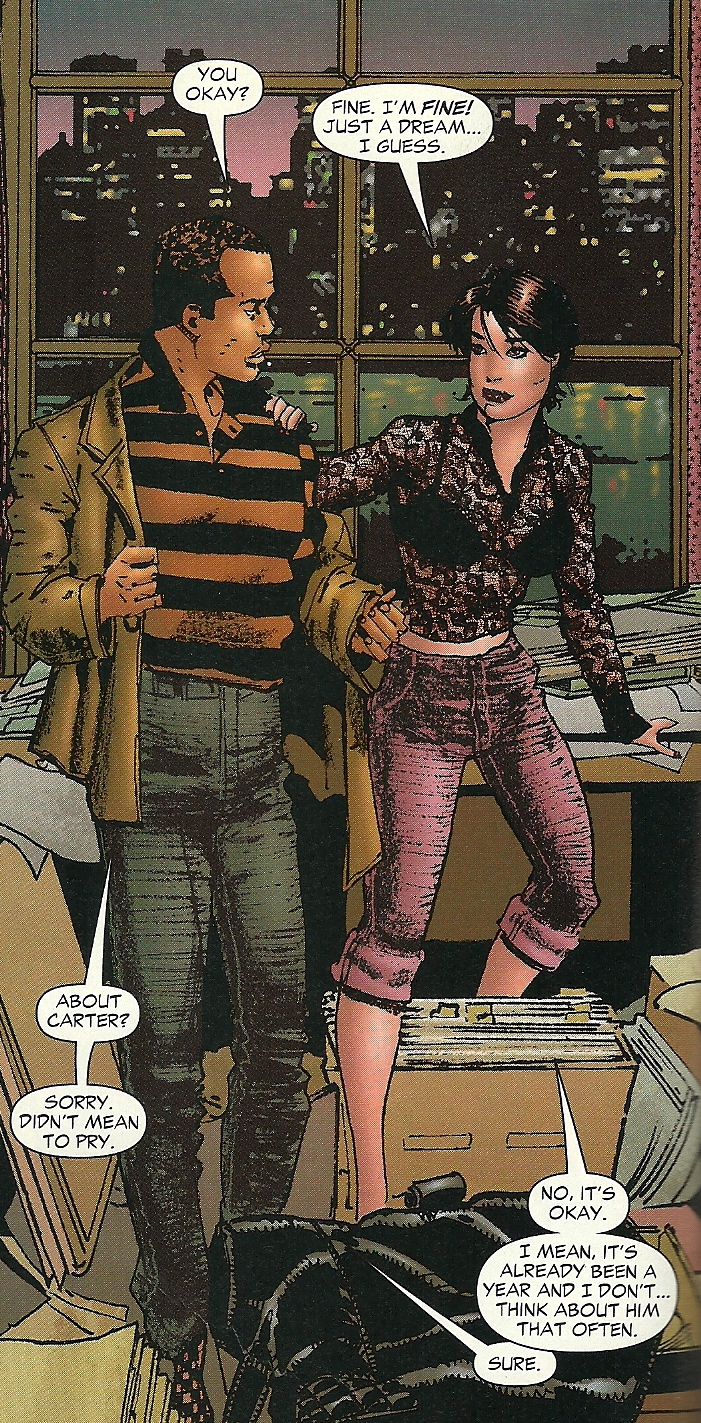
What is immediately apparent about Hawkgirl, what differentiates it from Hawkman comics before and after, and from most of what one could find on the stands in terms of super-comics in 2006 was, of course, the presence of Chaykin's artwork. His big, expressive, cartoony faces, his blocky figures often half-frozen in hulking, Kirby-like poses, his obvious delight in rendering textures to the point of rarely letting a scene go by without including black lace in it somewhere...Hawkgirl had it's own, distinct visual look and hook.
Chaykin also drew his title character with clearly visible, apparently hard nipples straining against the fabric of whatever top she was wearing almost constantly, which seems like it must have been been pretty daring in DC's pre-rating system, 2006 line—hell, it's rare one see the outline of a nipple or the shapely bulge of a superhero's crotch through a costume in the T+ or M-rated books of 2012 or '13, this despite the fact that so many panels of so many comics seem composed around a female character's mostly-exposed, clothed only in spandex or silk breasts (I'm thinking specifically of New Guardians, at the moment).
Chaykin draws Hawkgirl Kendra Saunders as a cheesecakey heroine, and it works. Simonson's narrative is as pulpy as any involving the Hawks I can recall—she battles cultists, mummies and Lovecraftian space-gods, she explores hidden temples and shares panels with Egyptian deities. She sleeps in tiny, black lace nightgowns...
...takes showers...
...sometimes has her top torn off in battle...
...and wears a uniform so form-fitting it reveals her nipples. The sexual nature of Chaykin's artwork compliments rather than conflicts with Simonson's scripts.
One could argue if that's the best direction to go in with Hawkgirl, who as a star of Justice League Unlimited was, like Green Lantern John Stewart, a better known hero than the one she was technically a derivation from, and also a potential gateway hero for young would-be DC readers, but it's not a wrong direction, either and, unlike, say, Ed Benes' run on Justice League of America around the same time, he wasn't violating the spirit of the script with cheesecake.
That script finds Kendra Saunders working at the Stonechat Museum in St. Roch, Louisiana (which is to New Orleans as Gotham City once was to New York City), which she protects by night as Hawkgirl. In both identities, she has dealings with handsome men, like a museum co-worker (the son of the institution's director) and a police detective.
Some particularly brutal killings are afflicting the city, committed by a huge warrior woman covered in ritual tattoos and wearing only brass breast petals and whatever the crotch equivalent, something weird is going on in the basement of the museum and Kendra's not getting much sleep, which makes it difficult to determine what's real and what's not.
Meanwhile, Hawkman is still lost in space somewhere, and she's torn between holding a candle for him—something that makes her uncomfortable, because they were lover's in past lives, which he remembers more clearly than she does—and the attention of that handsome detective.
The immortal bad guy who is always hounding the Hawks is hanging around, and there's a e thingee in the basement that wants to devour her.
It's pure, unambitous genre stuff, but it's successful, and it all looks really great. Without Chaykin, this could easily prove tedious—as later volumes, collecting issues from after Chaykin's short run, will demonstrate—but for this volume at least, Hawkgirl is effective pulp heroine as old school superhero. Good writing, good art, good comic.
It began in May of 2006, during a one-month, line-wide gimmick/promotion that, in retrospect, looks like one of several earlier attempts at a reboot that current co-publisher Dan DiDio had made on the road to fall of 2011's "New 52" reboot. This one was dubbed "One Year Later," and the idea was that after the multiverse-shaking events of Infinite Crisis, all of DC's books would jump one year ahead in time, giving creators an opportunity to do something fresh and new (and not dependent on the fallout of the just-completed crossover storyline) and readers the opportunity to jump on to any book in the line without worrying about joining a story already in progress.
For the most part, this meant new creative teams, new costumes, new team line-ups, new status quos, and so on. The Hawkman monthly received one of the most dramatic overhauls: It's title would be changed to Hawkgirl (although the numbering would start with #50, the month after Hawkman #49), it would now star Hawkgirl, the aforementioned creative team of Simonson and Chaykin would take over for the departing Justin Gray, Jimmy Palmiotti and Chris Batista, and as Hawkman's exact whereabouts would be a mystery; he was simply MIA after the events of Infinite Crisis).I read the first issue, maybe first two issues, and then abandoned it.
I remembered liking it okay, but I was trying a lot of DC comics that month, and it didn't strike me as one of the better ones. But given the rather quick cancellation of the latest Hawkman title, the New 52's The Savage Hawkman, which lasted only 20 issues, I thought I might revisit the series in trade paperback, given that it was almost as successful as the last Hawkman series, despite not starring Hawkman an not having the unprecedented PR push that The New 52 received (Hawkgirl lasted 17 issues).
What is immediately apparent about Hawkgirl, what differentiates it from Hawkman comics before and after, and from most of what one could find on the stands in terms of super-comics in 2006 was, of course, the presence of Chaykin's artwork. His big, expressive, cartoony faces, his blocky figures often half-frozen in hulking, Kirby-like poses, his obvious delight in rendering textures to the point of rarely letting a scene go by without including black lace in it somewhere...Hawkgirl had it's own, distinct visual look and hook.
Chaykin also drew his title character with clearly visible, apparently hard nipples straining against the fabric of whatever top she was wearing almost constantly, which seems like it must have been been pretty daring in DC's pre-rating system, 2006 line—hell, it's rare one see the outline of a nipple or the shapely bulge of a superhero's crotch through a costume in the T+ or M-rated books of 2012 or '13, this despite the fact that so many panels of so many comics seem composed around a female character's mostly-exposed, clothed only in spandex or silk breasts (I'm thinking specifically of New Guardians, at the moment).
Chaykin draws Hawkgirl Kendra Saunders as a cheesecakey heroine, and it works. Simonson's narrative is as pulpy as any involving the Hawks I can recall—she battles cultists, mummies and Lovecraftian space-gods, she explores hidden temples and shares panels with Egyptian deities. She sleeps in tiny, black lace nightgowns...
...takes showers...
...sometimes has her top torn off in battle...
...and wears a uniform so form-fitting it reveals her nipples. The sexual nature of Chaykin's artwork compliments rather than conflicts with Simonson's scripts.
One could argue if that's the best direction to go in with Hawkgirl, who as a star of Justice League Unlimited was, like Green Lantern John Stewart, a better known hero than the one she was technically a derivation from, and also a potential gateway hero for young would-be DC readers, but it's not a wrong direction, either and, unlike, say, Ed Benes' run on Justice League of America around the same time, he wasn't violating the spirit of the script with cheesecake.
That script finds Kendra Saunders working at the Stonechat Museum in St. Roch, Louisiana (which is to New Orleans as Gotham City once was to New York City), which she protects by night as Hawkgirl. In both identities, she has dealings with handsome men, like a museum co-worker (the son of the institution's director) and a police detective.
Some particularly brutal killings are afflicting the city, committed by a huge warrior woman covered in ritual tattoos and wearing only brass breast petals and whatever the crotch equivalent, something weird is going on in the basement of the museum and Kendra's not getting much sleep, which makes it difficult to determine what's real and what's not.
Meanwhile, Hawkman is still lost in space somewhere, and she's torn between holding a candle for him—something that makes her uncomfortable, because they were lover's in past lives, which he remembers more clearly than she does—and the attention of that handsome detective.
The immortal bad guy who is always hounding the Hawks is hanging around, and there's a e thingee in the basement that wants to devour her.
It's pure, unambitous genre stuff, but it's successful, and it all looks really great. Without Chaykin, this could easily prove tedious—as later volumes, collecting issues from after Chaykin's short run, will demonstrate—but for this volume at least, Hawkgirl is effective pulp heroine as old school superhero. Good writing, good art, good comic.
Friday, April 20, 2012
Jabba the what?
I've been reading Dark Horse's Star Wars Omnibus: A Long Time Ago... Vol. 1 , which collects and reprints the first chunk of Marvel's 1977-1986 Star Wars comic, and it is fascinating. It began publication while the original Star Wars was still in theaters, starting with a six-issue adaptation of the film before continuing the adventures of the characters.
In 2012, we're used to the phenomenal scale of the Star Wars saga, which spans not only seven feature films released in theaters (six live action, one computer-animated), but several TV shows, dozens of novels, scores of video games and more comic books than I'll ever read, and the back story that's developed in the past 35 years is truly staggering, long ago eclipsing the amount of information in the films themselves.
At this point, the long time ago/far, far away setting is rigorously delineated and regularly policed, and while casual audience members likely don't know and more likely still don't care, somewhere on the Internet it's written down the name of every alien race of every goofy puppet or masked figure to appear in one of the films, along with their homeworld, the language they speak and their complete biographies.
But when Marvel was producing this comic, even the big plot beats of the original trilogy were unknown, so it's quite clear that the often just off-model Darth Vader, with his glowing red eyes, is a completely different person than Luke Skywalker's missing father, or that Luke and Leia are in no way brother and sister (this volume complains another half-dozen sister-kisses). We also see a flashback to Obi-Wan Kenobi's days as a Jedi Knight, in which he looks completely different than in the second trilogy, and it's clear that these Storm Troopers aren't all clones.
Also, there's a giant green Star Wars rabbit.
It's weird to encounter these comics for the first time in 2012, on the other end of an entire life-time of Star Wars lore expansion, and to see Luke, Han and the gang referred to as "the star-warriors," or to simply to see the words "Star Wars" appearing in caption boxes in a different font than the one in the oh-so-familiar logo.
Weird, but also kind of exciting. It makes for a sort of alternate universe version of Star Wars, and the anything-goes nature of the narrative and writer/editors Roy Thomas and Archie Goodwin and their artist collaborators on-the-fly world-building seems so much more pure and organic than what one might find in the later Dark Horse produced comics, which are produced by and for an audience that are all on the same page as George Lucas in terms of what the Star Wars universe contains, and what it doesn't.
There were hints of this while reading the first couple of issues, as when I would see dialogue I'd heard some hundred or so times in the films written differently in the dialogue bubbles, like when Obi-Wan refers to the Mos Eisley cantina simply as a "wretched hive of villainy" instead of a "wretched hive of scum and villainy", but it really struck me in the second issue, where we meet this guy...
...who you won't at all recognize as Jabba the Hutt.
You know, the giant, immobile, anthropomorphic slug from Return of the Jedi...?
As you're probably aware, Lucas scripted and filmed a scene featuring Jabba for the original Star Wars film, in which he confronts Han Solo outside of the cantina. It was cut, as it should have been (because it didn't really add anything and didn't make a whole hell of a lot of sense given what had just transpired with Greedo), although Lucas restored it to the tinkered-with version of the film he released in the 90s.
When it was originally filmed, Jabba was just some overweight middle-aged dude in a shaggy vest, and the plan was to insert a stop-motion alien type into the scene later (although in the rerelease, a CGI version of his slug-like final form was placed into the scene), and apparently when Marvel was making their adapation in 1977, the scene was still there. The version of the script they were working from must not have given much, if any, detail as to what Jabba the Hutt was suposed to look like, because this is how artists Howard Chaykin and Steve Leialoha depicted him in the scene:
A bidpedal, yellow, tusk-less walrus man (Not to be confused with the actual character that used to be called Walrus Man when I was a kid, but, to prove the point I was making earlier, is now called "Ponda Baba" for some reason, and two seconds of googling tells me he is an Aqualish pirate from the world Ando, and I can learn about his life before and after his brief cameo in the first film if I want to read a dozen or so paragraphs about him, which I don't) isn't nearly as striking a design as the one Lucas and company eventually settled on. But that's one of the great pleasures of this series of comics—seeing talented and creative folks still working out what would become one of most pervasive pop culture stories of a generation (so far), trying out paths that Lucas and his filmmaking collaborators would ultimately choose not to take.
In 2012, we're used to the phenomenal scale of the Star Wars saga, which spans not only seven feature films released in theaters (six live action, one computer-animated), but several TV shows, dozens of novels, scores of video games and more comic books than I'll ever read, and the back story that's developed in the past 35 years is truly staggering, long ago eclipsing the amount of information in the films themselves.
At this point, the long time ago/far, far away setting is rigorously delineated and regularly policed, and while casual audience members likely don't know and more likely still don't care, somewhere on the Internet it's written down the name of every alien race of every goofy puppet or masked figure to appear in one of the films, along with their homeworld, the language they speak and their complete biographies.
But when Marvel was producing this comic, even the big plot beats of the original trilogy were unknown, so it's quite clear that the often just off-model Darth Vader, with his glowing red eyes, is a completely different person than Luke Skywalker's missing father, or that Luke and Leia are in no way brother and sister (this volume complains another half-dozen sister-kisses). We also see a flashback to Obi-Wan Kenobi's days as a Jedi Knight, in which he looks completely different than in the second trilogy, and it's clear that these Storm Troopers aren't all clones.
Also, there's a giant green Star Wars rabbit.
It's weird to encounter these comics for the first time in 2012, on the other end of an entire life-time of Star Wars lore expansion, and to see Luke, Han and the gang referred to as "the star-warriors," or to simply to see the words "Star Wars" appearing in caption boxes in a different font than the one in the oh-so-familiar logo.
Weird, but also kind of exciting. It makes for a sort of alternate universe version of Star Wars, and the anything-goes nature of the narrative and writer/editors Roy Thomas and Archie Goodwin and their artist collaborators on-the-fly world-building seems so much more pure and organic than what one might find in the later Dark Horse produced comics, which are produced by and for an audience that are all on the same page as George Lucas in terms of what the Star Wars universe contains, and what it doesn't.
There were hints of this while reading the first couple of issues, as when I would see dialogue I'd heard some hundred or so times in the films written differently in the dialogue bubbles, like when Obi-Wan refers to the Mos Eisley cantina simply as a "wretched hive of villainy" instead of a "wretched hive of scum and villainy", but it really struck me in the second issue, where we meet this guy...
...who you won't at all recognize as Jabba the Hutt.
You know, the giant, immobile, anthropomorphic slug from Return of the Jedi...?
As you're probably aware, Lucas scripted and filmed a scene featuring Jabba for the original Star Wars film, in which he confronts Han Solo outside of the cantina. It was cut, as it should have been (because it didn't really add anything and didn't make a whole hell of a lot of sense given what had just transpired with Greedo), although Lucas restored it to the tinkered-with version of the film he released in the 90s.
When it was originally filmed, Jabba was just some overweight middle-aged dude in a shaggy vest, and the plan was to insert a stop-motion alien type into the scene later (although in the rerelease, a CGI version of his slug-like final form was placed into the scene), and apparently when Marvel was making their adapation in 1977, the scene was still there. The version of the script they were working from must not have given much, if any, detail as to what Jabba the Hutt was suposed to look like, because this is how artists Howard Chaykin and Steve Leialoha depicted him in the scene:
A bidpedal, yellow, tusk-less walrus man (Not to be confused with the actual character that used to be called Walrus Man when I was a kid, but, to prove the point I was making earlier, is now called "Ponda Baba" for some reason, and two seconds of googling tells me he is an Aqualish pirate from the world Ando, and I can learn about his life before and after his brief cameo in the first film if I want to read a dozen or so paragraphs about him, which I don't) isn't nearly as striking a design as the one Lucas and company eventually settled on. But that's one of the great pleasures of this series of comics—seeing talented and creative folks still working out what would become one of most pervasive pop culture stories of a generation (so far), trying out paths that Lucas and his filmmaking collaborators would ultimately choose not to take.
Monday, June 25, 2007
Monday Morning Man vs. Cephalopod Moment
Just click on the images to enlarge, and thus better enjoy the best swordfight with an octopus you're likely to see today.


From Fafhrd and the Gray Mouser by Howard Chaykin and Mike Mignola (Dark Horse Comics; 2007)


From Fafhrd and the Gray Mouser by Howard Chaykin and Mike Mignola (Dark Horse Comics; 2007)
Thursday, June 07, 2007
June 7th's Meanwhile in Las Vegas...
This week's Las Vegas Weekly column features reviews of Howard Chaykin and Mike Mignola's excellent Fafhrd and the Gray Mouser trade

and Jeff Lemire's excellent Essex County Vol. 1: Tales From the Farm.

That's an awful lot of excellence, right there.
And be sure to check out the sketches and samples and Lemire's website when you get a chance.
Why?

That's why.

and Jeff Lemire's excellent Essex County Vol. 1: Tales From the Farm.

That's an awful lot of excellence, right there.
And be sure to check out the sketches and samples and Lemire's website when you get a chance.
Why?

That's why.
Labels:
barry allen,
chaykin,
lemire,
meanwhile in las vegas...,
mignola
Subscribe to:
Posts (Atom)