Showing posts with label ryan dunlavey. Show all posts

Wednesday, March 30, 2011

Some follow-ups to some recent posts

Yesterday I ran a panel from Fred Van Lente and Ryan Dunlavey’s Comic Book Comics #5, a panel which I thought offered a nice, elegant response to the “The Families of Creators Comics Published Once Ripped-off Are Greedy Evil For Pursuing Their Legal Rights And Thus Maybe Endangering My Steady Stream of Superman and X-Men Stories!” line of argumentation that seems a staple of comment threads.

One of the many, many pleasures of the pair's Comic Book Comics series has been their portrayal of comics creators, often by using their characters as stand-ins. For example, in a panel discussing Neil Gaiman and Todd McFarlane’s legal battles over Marvelman/Miracleman, Dunlavey drew Morpheus and Spawn each tugging on a different arm of the contested Marvelman character.

Sometimes they hybridize character and creator. For example, their Walt Disney usually appears as Mickey Mouse with Disney’s human face in place of Mickey’s saucer eyes and mouse snout, and their Jerry Robinson has the hairstyle and wardrobe of The Joker in some panels.

One creator they always draw more-or-less straight is Alan Moore, whose Old Testament hair and beard and intense eyes make him one of the comics creators who is every bit as visually interesting as many of the characters he has written.

In the story “1986 AD” from Comic Book Comics #5, Moore appears repeatedly, as a child selling LSD to a police bobby, as a janitor, riding upon a rocket ship with Dave Gibbons, working as a janitor and so on.

Here are two of my favorite pictures. Moore and Gibbons pursuing Moby Dick, who is cosplaying as Rorschach……and this image of Moore as a child…

**********************

In the comments to Monday’s post about IDW’s recent collection of the old DC/TSR Forgotten Realms, commenter “A Hero” pointed out this post regarding the collection on writer Jeff Grubb’s blog.

In it, Grubb talks a bit about how he found out about the collection, how it apparently came together, and his dealings with all of the parties to see if he would be getting paid anything since they were reprinting the stories he wrote.

Here’s Grubb’s recommendation for how those interested should proceed, keeping in mind that it doesn’t look like he or Rags Morales or the other creators are making any more money off the collection:

So now what? Call my horde of fans to block this horrible trammeling of a contract? Protest in the streets? Fight for creative rights? Camp out in the state capital? Call for a boycott?
Nope. Instead I’m going to recommend you BUY a copy.

…

THEN, of course, I want you to write to IDW (and Hasbro) and tell them how WONDERFUL the story and art is. And how they should (sparing no expense on their part) HIRE the talented team of Grubb and Morales, who obviously understand how the D&D universe works and are fine examples of writer and artist and a shining addition to ANY comic book line.
Is it okay if I just do it here?

Okay, here goes.


Dear IDW,

I greatly enjoyed your recent collection of the old TSR/DC Forgotten Realms comics, which I think are the best Forgotten Realms comics ever (I didn’t much care for that business with the Drow elf who has all the z’s in his name that I think Devil’ Due published a few years back).

In fact, I liked them so much, that I bought some of ‘em twice, the second time from you.

The story was wonderful. The art was also wonderful. You should totally hire the talented team of Jeff Grubb and Rags Morales, who would be a shining addition to any comic book line. Especially a fantasy comic book series, and especially a fantasy comic book series based on Dungeons & Dragons business.

I probably wouldn’t buy the books that resulted in their serially published format—Sorry, I can’t afford $4 comics on a freelance writer-about-comics’ “salary”—but I swear I’ll buy the trade collection. Probably form Amazon.com. And then I’ll write about it on the Internet, like I’ve written about this collection like eight times already.

Sincerely,

J. Caleb Mozzocco

P.S. You know what else you should do with that D&D license? A Bizarro Comics/Strange Tales-style anthology series.

P.P.S. If you want to read a pitch for a G.I. Joe miniseries in which Polly, Timber, Junkyard and Freedom team-up to save the Joes from a nefarious Cobra plot, just let me know!


Dear Hasbro,

Thank you for inventing Hulk Hands. Those things are the best.

Your pal,

J. Caleb Mozzocco

P.S. The story and art in those old DC/TSR Forgotten Realms comics IDW just collected are WONDERFUL—all caps, in bold, that’s how wonderful they are—and you should (sparing now expense) HIRE the talented team of Grubb and Morales, who obviously understand how the D&D universe works and are fine examples of writer and artist and a shining addition to ANY comic book line.


Hope that helps, Mr. Grubb!


********************

Grubb also talked about some behind-the-scenes business with those old DC/TSR comics and how they originally came about in this post on his blog. This is basically the exact sort of thing I would have liked to see in an introduction to the Forgotten Realms trade.

I didn’t pay much attention to credits back then, but it turns out Grubb wrote one of my favorite arcs on the AD&D book, the “Catspaw Quartet” four-parter in which Onyx and Timoth adventure in the sewers of Waterdeep, before launching the Forgotten Realms monthly.

Here’s how he describes the approach to the books:
Big thing about the AD&D and FR comics – these were fantasy books about characters that knew they lived in a fantastic universe. They were aware and capable of handling their situation. This wasn’t part of a “points of light” where sinister stuff lurked over the next hill. It wasn't a dark fantasy world. Those are cool, but the Realms ran off the assumption that its heroes were smart enough to know about their world.
I think that likely contributed to the generally light-hearted feel of the books. While there were some very serious issues in AD&D—slavery, betrayal and war came up a couple of times—the bulk of that series was really fun fantasy adventure.

Grubb also discusses the end of the TSR/DC alliance and the cancellation of the books. I always assumed it was because they sold poorly, which was the reason most comics get canceled. Turns out there were some poor business choices made. Now I wonder how much longer the books might have lasted on the merit of their sales alone. The books were all ended right about the time the comics market was entering into it’s crazy 1990’s speculation boom phase.


********************

I seem to have been one of the few comics readers who didn’t mind the TV Wonder Woman costume as it was first revealed all that much. Part of the reason, I think, is that the standards for live-action television superhero costumes are soooooo much lower than they are for live action movie superhero costumes.

For example, remember Smallville’s JSA costumes? Or have you seen TV Guide’s reveal of the new Blue Beetle’s costume as it will appear on Power Range—Er, Smallville?

Look at the Wonder Woman costume. Then look at the Blue Beetle costume. Then look at the Wonder Woman costume again. See, that Wonder Woman costume doesn’t look so bad anymore, does it?

Speaking of which, you can see newer, better images of the costume here. It looks tweaked here and there, like giving her back her red boots (to my dismay), and pants that look more like pants than something cobbled together from blue raspberry Fruit Roll-Ups.

I suppose I should note that the Booster Gold costume looks pretty good in that single image released, as a real-world version of his costume. It even has the little Nascar-like patches, as seen on J.G. Jones’ covers for 52.


********************
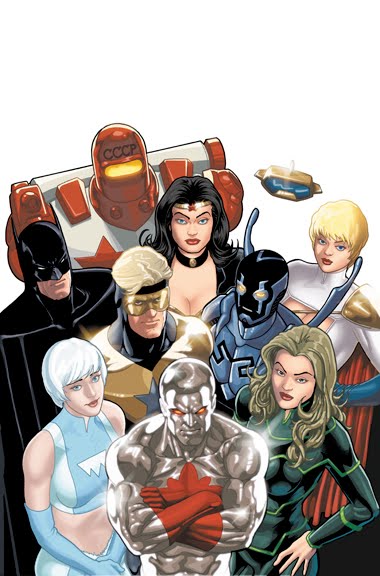
It looks like Kevin Maguire is referencing his own references of his own cover from 1987's Justice League #1 for the cover of Justice League: Generation Lost #24 (as revealed in this Source blog post on upcoming variant covers).

For some reason, DC has had Maguire, the artist best associated with the characters starring in the series, providing variant covers to JL:GL, while other artists provide the normal covers. Some of those artists and their covers have been pretty rotten, particularly right at the outset, although since first Cliff Chiang and then Dustin Nguyen took on the gig, they’ve all been pretty swell.

Still, if I had the choice, I’d almost always choose the Maguire covers. I haven’t had a choice though. I’ve been reading the series and enjoying it, largely due to the bi-weekly schedule. In retrospect though, I wonder if I maybe shouldn’t have trade-waited it, if only to be able to (presumably) get all the Maguire covers that way.

It is my strong belief that DC should hire Maguire to draw each new iteration of the Justice League line-up in that looking up at the reader as a group pose. I don’t think I’ve seen it since he did the Morrison JLA on the cover of an issue of Fanboy, though.I sure would have liked to see him do the Meltzer/Benes League, or the current Congorilla and friends League…


*******************

Speaking of covers, as I’ve mentioned before, I always enjoy reading Kelly Thompson’s “Cover Solicits in Three Sentences Or Less…” features, which she recently tweaked so that she writes them while drunk now (Here’s her latest DC column, and here’s her latest Marvel column.)

Part of the reason I like them is because they’re funny and offer a perspective I don’t normally think too much about (like whether the artist seemed to be looking at a model with fake breasts or real ones when drawing a particular cover, a topic which got much discussion in this month’s round; Hey, Kelly, if you’re reading, can we tell if the new TV Wonder Woman has fake breasts or not looking at the action shots of her running in her costume? Because if they hired an actress with fake breasts to play Wonder Woman that strikes me as kinda sad…).

Also, Thompson’s rules keep her observations very tightly focused on the cover images, whereas every time I write about the DC and Marvel solicitations I always end up getting distracted and going off on long tangents about continuity and publishing strategies.

Also also, I always notice things when I re-look at the covers in her columns that I missed the first few times I saw the cover.

For example, you know that book Fear Itself: The Fearsome Foursome, which features both Man-Thing and Howard the Duck on the cover? There are five characters on the cover!

(Also, Howard the Duck is still wearing pants? What’s the point of Marvel selling to Disney if they can’t take Howard’s Disney-mandated pants off yet? Can they at least compromise and give him shorts?)

June’s cover for Herc features the title hero battling a tentacle monster. He seems to fare differently than the ladies from Heroes For Hire did when they fought tentacle monsters:

***********************

Alan Kistler’s latest Agent of S.T.Y.L.E. column at Blog@Newsarama focused on DC’s Batwoman character. While discussing the costumes of the two Kate Kanes, Kistler mentioned the Batwoman costume from the 2003 direct-to-DVD Batman: The Animated Series movie, Mystery of The Batwoman. I rather liked that costume, in part because of how different it was from most other feminine versions of a Batman costume (It even had pink in it! Pink!)

The one it most closely resembled was, of course, the Cassandra Cain Batgirl costume. When thinking about fixes for that costume, which can look fantastic or dreadful, depending on who was drawing it, my mind would often return to this animated Batwoman’s look. I think if Cassandra’ Cain’s costume were to bend in the direction of this costume, it would retain some of it’s most appealing elements (As I’ve said before, I think that Batgirl costume, particularly as drawn by Damion Scott, featured the best aspects of both Batman and Spider-Man), while smoothing out some of the more difficult elements, like the stitching on the face and the black eye lenses in a black mask.

I don’t really understand how animated Batwoman’s mouth works—I watched it once a long time ago, and now I don’t recall where the costume came from…I think it was just fabric, with a whole cut perfectly in the shape of the mouth around the mouth, but I don’t know, maybe it was some kinda sci-fi smart cloth, nanite thingee.

Anyway, turn that Batwoman costume black, replace the pink with yellow and/or black, and give Cass back her big, goofy utility belt (Is it weird she has the biggest utility belt pouches of all the various Bat-people, but used the least amount of weapons and gadgets? Maybe they’re full of sandwiches?), and I think that would be a fine Cassandra Cain Batgirl costume that it would be very difficult for artists to not draw well.

Because I’m not computer-smart enough to just recolor existing images—and because I need something to do with my hands and the part of my brain the TV show fails to engage while I’m watching Dancing With the Stars—I drew Batgirl over and over in my sketchbook the other day.

This is a lame-o sketch of her original costume, although I think her bat-symbol is usually just an outline of yellow, not solid yellow:If you took out the stitches and gave her white eye lenses for something approaching animated Batwoman, I think you’d get something like this: Then I wondered what she’d look like if you kept Batwoman’s pink in her costume: (The pose, by the way, is swiped from Scott’s cover to Batgirl #25). Cassandra Cain isn’t exactly a pink-wearing kind of girl, but then, maybe that in itself would be a reason for her to try out some pink. Like, a self-conscious attempt to try and be more stereotypically girly…?

Before I colored those in, I got to wondering how the costume might look if instead of yellow or pink, she went with white. I suppose that would make it sort of Punisher-y, but white is such an anti-Batman color, as much as pink is, that I thought it might look interesting:(The last pose is another swipe from Scott, from the cover of Batgirl #20, featuring Batgirl and Spoiler on it. Scott is about the only artist who drew Spoiler in a way that her design actually seemed sort of cool to me).

Of course, in real-life the gloves would be caked brown around the hands, from dried blood bad guys would spit when getting punched and from the grime one gets from climbing around on Gotham City fire escapes and rooftops all night. Surely Alfred would forbid white in any Bat-costume he had to launder.

Cassandra Cain hasn’t shown up much in the comics at all lately. I heard there was an appearance in Red Robin in which she explained that she didn’t want to be Batgirl or was on sabbatical or something, but I didn’t read it—I gave up following characters a long time ago, and that’s not a book I was reading.

The last time I saw her was in Tiny Titans #33, the “all-Robin issue,” which introduced Tiny Cassandra:I suppose Tiny Titans is an unlikely place to look for DC superhero costume redesign ideas, but I kind of liked Baltazar’s version of that Batgirl costume. Not only did he simplify the stitching quite a bit to give the costume more of homemade feel (and I kinda dig the stitches-as-eyelashes bit around the eyes), but his Cassandra Cain has a skirt on.Now obviously Cassandra isn’t much of a skirt-wearer, so this Batgirl in a costume that includes a skirt no doubt seems out of character.

But then I started thinking about it, and how much harder it would be to fight in a skirt than it would be in a pair of tights.

I don’t know if many of you have read the later Dragonball comics or watched Dragonball Z, but there are a couple of parts where it’s revealed that grown-up Goku and Piccolo wear heavily-weighted costumes as part of their training, so you know they’re either getting really serious or are in over their heads in a fight when they remove their weights, so they are suddenly much faster and stronger.

So I could sort of see Cassandra Cain wearing a kick-restricting skirt as a form of self-imposed handicap, either to help her train or to artificially weaken her to make fighting more rewarding. After all, she has a body language-reading ability that borders on a superpower, and can fight as well or better than Batman and Lady Shiva (and she’s still a teenager), so day-to-day mugger and henchman-fighting is probably pretty boring for her.

If I had to assign a motivation for her current costume, I would think fighting-ability handicapping might be a good rationale. Why else wear a mask that reduces visibility, a big, long, dragging cape, and those big utility belt pockets? (Maybe they’re full of weights?).

So while it doesn’t really seem to be in character for Cassandra Cain’s Batgirl to ever rock a skirt, I think it could certainly be rationalized. Hell, high heels too!

Although under Baltazar’s pen, I assume he put her in a skirt just because it looks cute.

Tuesday, March 29, 2011

Van Lente and Dunlavey on the heirs of Siegel, Shuster and Kirby pursuing legal rights

On Sunday, Nikki Finke of Deadline Hollywood reprinted the full text of a letter the late Joanne Siegel, who passed away at the age of 93 last month, sent to Warner Brothers CEO Jeffrey Bewkes. Siegel is, most of you probably know, the wife of Superman co-creator Jerry Siegel and was, in fact the inspiration and model for Lois Lane. Along with her family and the estate of Superman's other creator, Joe Shuster, Siegel was involved in a tough, complicated series of legal battles with Warner Bros. over elements of the Superman franchise, and after a rather emotional build-up ("So I ask you to please consider—do these mean spirited tactics meet with your approval? Do you really think the families of Superman’s creators should be treated this way?"), she sums up the point of her letter thusly:
To protest harassment of us that will gain you nothing but bad blood and a continued fight.

To protest harassment of our attorney by falsely accusing him of improper conduct in an attempt to deprive us of legal counsel.

To make you aware that in reality this is a business matter and that continuing with litigation for many more years will only benefit your attorneys.
Heidi MacDonald's The Beat and Comic Book Resource's Robot 6 reprinted the contents of the letter, and when linking to it in the course of my own linkblogging at Blog@Newsarama, I referred tot he letter as "the saddest thing you'll read all day."

Well, I was wrong. I read much, much sadder things yesterday, without even having to venture into the "real" media's discussion of tragic international events. No, I simply read the comments threads on those Beat and Robot 6 posts.

If you've ever read a comment thread on any blog post dealing with the heirs of a comics creator dealing with the current owners of the intellectual properties their husbands or fathers made, then you know how miserable the sorts of things anonymous comics fans tend to spew in such arenas.

Fred Van Lente and Ryan Dunlavey's latest issue of Comic Book Comics, a history of comics presented as a comic book series, dealt with the history of Siegel and Shuster's dealings with DC over the ownership of Superman—as well as the similar difficulties that Bill Finger, Jerry Robinson and Jack Kirby had with DC/National and Marvel—and the Siegel and Shuster "story" hasn't really been completed in real life, so it doesn't really have a satisfying conclusion in their comic strip about it either (In 2008, judge Stephen G. larson ruled that the contents of Action Comics #1 revert to Siegel's heirs, and, Van Lente wrote, "The full implications of that decision are still being worked out, but it seems to be in the heirs' interest to work with the company," since, "many of the elements considered crucial to the mythos have appeared since Action #1 and are incontrovertibly owned by DC").

Van Lente and Dunlavey therefore ended their story with panel below, addressing the sorts of fan arguments against the creators and their families, reversing a creator-as-sheep, publisher-as-shepherd visual metaphor they employed throughout the story: Well said, guys.

Friday, November 13, 2009

Ryan Dunlavey's Golden Age Daredevil

Among the many cameos in this week's Comic Book Comics #4 is our old friend the Golden Age Daredevil.

The above panel is how writer Fred Van Lente and artist Ryan Dunlavey introduce and depict him (He appears in only one other panel, standing shoulder to shoulder with, I believe, Lenin and Stalin. God, I love this book).

What did the aborigines who raised him get him for his birthday? I'm betting it's a boomerang.

Tuesday, September 29, 2009

A little more on MODOK

On Sunday I mentioned a piece I had in the Erie Daily Times about Ryan Dunlavey and his MODOK:Reign Delay one-shot, the print version of the story that had previously run on Marvel.com.

As is so often the case with such articles, I asked Dunlavey a whole bunch of questions, and he gave me a whole bunch of answers, and only a relatively few fit into the allotted space. So I thought I'd post the whole Q-and-A here, particularly since I thought Dunlavey had some interesting things to say about topics that are relevant to your interests (since you're reading this on a comics blog).

My questions are in italics, Dunlavey's answers are in the normal font....


On your website, it says you freelance work in animation, graphic design and illustration…are comics your main, pay-the-bills gig, or do you do a little of everything?

I worked a series of full-time graphic design jobs for many years before going full-time freelance in 2003. I do a little of everything—I usually get 4 or 5 big jobs a year and lots of little illustration jobs on top of that. So far this year my big projects have been two flash animation jobs, this MODOK comic and re-designing a huge website. I like jumping around between different stuff, it keeps me from getting burnt out and having a wide range of skills comes in handy in this rough job market. Comics is the one thing I could do full time though.

Can you tell me a little about how MODOK: Reign Delay came about? Did you pitch the idea to Marvel, or did Marvel ask you to do something with the character? Did your Action Philosophers partner Fred Van Lente play any role?

About a year ago Marvel invited Fred and I to pitch for their original online comics line that they had just started. We didn’t know what format the comics were going to be in, but we figured we’d better do something funny, and MODOK was the obvious choice for a humorous lead. I wrote up a pitch that structured it like a sit-com, Fred revised it so it fit into the current continuity, we sent it in and it got greenlit pretty much immediately. Fred was supposed to co-plot it with me while I handled the script and the art, but then when it finally came up on the schedule Fred simply didn’t have time so I just did the whole shebang myself. I even did the coloring and the lettering—I’m greedy like that.

Can you tell me a little about the plot for the story? MODOK returns to his hometown of Erie and lives with his parents, but is there another reason why he’s in Erie, PA? Like, the proximity to Canada?

In the current Marvel Comics, The Green Goblin, Doctor Doom and some other super villains have been slowly taking over the world behind the scenes. In my story MODOK finds out about it and wants in on the action, but since he’s such a creepy, annoying loser the other bad guys don’t want anything to do with him, so they send him on the fool’s errand of conquering Erie where he can’t screw up any of their big plans.

MODOK’s such an egomaniac he actually believes his home town of Erie is an important piece in the world domination puzzle. I could have easily had it set in any other small US city like Ann Arbor or South Bend or whatever, but Erie is just a weird, funny place and from living there I knew it well enough that I thought I could get a lot of jokes out of it, and I didn’t have to do much research either.

Also, Erie’s proximity to Canada does indeed play into the plot. Even though it’s a comedy it’s still a superhero comic and I couldn’t just do 20 pages of jokes about MODOK’s giant head, at some point he was going to need a hero to fight. In the Marvel Universe heroes tend to gather in really large, metropolitain areas, and the closest big city to Erie is Toronto, which gave me the perfect excuse to use one of my favorite Marvel characters as the “villain”. (Canadian super hero “Box”, aka Maddison Jeffries, an obscure member of the X-Men) Plus the whole superhero trying to cross international borders to fight crime provided for some more gags.

Do you visit Erie very often now? Did your own experiences there, either in the past or more currently, impact the story at all? (This may be the only opportunity I have to seriously ask someone how much of themselves they put into a story about MODOK).

I have some aunts and uncles and a few cousins that still live in Erie but my immediate family doesn’t live there anymore so I don’t visit very often, maybe once every year or two. Erie’s a fine place but when I became an adult I decided it just wasn’t where I wanted to live my life. MODOK, by contrast, is thrilled about being back in Erie, where he gets free rent and his mom makes him pancakes on demand.

Marvel Comics are kind of notorious for being set either in New York City, or in made-up exotic places like Wakanda or Wundagore or Latveria or wherever, which is another neat thing about a MODOK-in-Erie story. Was the small world aspect of the Marvel Universe something you wanted to address through the setting at all?

Nope, I just thought it would be hilarious to get MODOK out of the standard sci-fi underground lairs we usually see him in—the classic fish-out-of-water situation never fails to generate the funny stuff.

This will be kind of an obvious, general question, but what’s the difference for you between writing and drawing your own story versus drawing someone else’s script?

Each has its own challenges. When I draw a story that I’m also writing there’s also a lot less words, because I know what storytelling I’m going to be able to get across with the visuals—the challenge comes from making sure I’m making writing choices that serve the story rather than just doing the easiest thing to draw. When I’m drawing someone else’s script there’s no cutting corners—I’ve got to stick with what I’ve got, and often I have to draw things I would never choose to draw on my own—this happens most often when I’m drawing non-fiction comics that I do with Fred.

You play MODOK for laughs in this story, which has been the default mode for the character for a few years now. Obviously, he’s a pretty goofy character in general, but do you have any thoughts on why MODOK has come to be viewed as such a comedic figure recently, where as other, similarly goofy characters still get played straight a lot of the time?

I have to disagree with you, I think there’s more humor in superhero comics these days then there ever has been, across the board, even with the traditionally serious characters. Spider-Man has always been funny. Batman’s various and sundry villains and teammates are always making fun of him one way or another. Deadpool is Bugs Bunny with guns. Bizarro—who do they think they’re fooling? And you have great series like Incredible Hercules and Guardians of the Galaxy and Secret Six that dole out the funny and serious moments equally.

On the flip side, even the so-called goofy characters have their serious moments—MODOK was played as a deadly, calculating, manipulative evil S.O.B. in Fred’s Super-Villain Team-Up mini and more recently in Hulk. I think that’s one of the cool things about super hero characters and comics—the writer can choose to play things straight or satirical or somewhere in between and it still works. I think because MODOK’s design is so distinctively bizarre that it makes his humorous appearances especially memorable.

When you were originally doing the story, was the thought that it would eventually be something that saw print, or was the initial thought that it would just be for online consumption? Did creating a comic for that particular format/venue affect the way you wrote and drew it, as opposed to the way you might have worked on it if it were going to be a print-only book?

No one knew what the format was going to be once the story got the go ahead—ongoing, mini-comic, one-shot, weekly web comic or whatever—so I just wrote it like a standard 22-page comic with a cliffhanger ending, like a regular first issue of a series. Just before I turned the script in Marvel decided they wanted it to be a self-contained four-part story, five pages per part—so I just edited my original 22 pages down to 17 and wrote a new ending. It made the story a lot tighter, and the jokes are pretty much non-stop throughout, so I’m really happy how it worked out. I don’t know when or why Marvel decided to also do a print edition at a later date, but that was just a nice bonus for me.

Are online comics like this the future of comics, even Marvel Comics, or do you see both electronic and paper comics existing simultaneously as they are now?

Digital is just another format, another way for people to get the comics, just as trade paperbacks were introduced as a new format for reading comic books. Comic books themselves were invented as a new way of reading comic strips, and last time I checked those were still around. The greatest thing about digital comics is that it now puts publishing as a viable option for anyone who’s willing to just put in the time to actually write and draw—the cost barriers of traditional print publishing are virtually eliminated.

But still, there sure is a lot of angst about digital comics isn’t there? Anytime I hear someone bitch about how digital comics suck because they personally don’t like to read comics on a computer screen I just roll my eyes. It’s like saying you don’t like reading in bed, you can only read in a chair—I mean, who cares about your personal reading preferences really? Those kinds of reactions to digital comics really stem from the fear that companies might decide to only do digital comics instead of print altogether, so the reader would be forced to either read their new comics in a format they don’t enjoy or not at all.

There might come a time when you’ll only be able to get new issues of lower-selling series as digital only at first but in a paperback collection at a later date, but I think that's still a ways off, and the total elimination of print is still a long, long, long way off, at least not in our lifetimes. Really, it’s just another method of getting the same stuff—comics. One of the things Fred and I have done with our self-published stuff is to offer it in as many formats as possible—single issues, trade paperbacks, PDF, iphone. We don’t see a lot of cross-over with the audiences for each format—but more formats opens us up to more potential readers. I’d really like to see publishers start releasing digital and print editions simultaneously like how you can now get movies as a DVD or a download or on-demand on the same release day. More formats, more delivery methods equals more readers and that can only help comics.

Can you tell me a little about what you have coming up or in the works? There’s a more-than-complete Action Philosophers collection coming up, I understand…is Comic Book Comics still an ongoing project as well?

Comic Book Comics is still going strong—it’s a six-issue series. My scheduling got screwed up and I fell way behind (our last issue came out in February 2009) but we’re back in October with issue #4. Issue #5 is our All-Lawsuit issue—that comes out in March 2010, and #6 is scheduled for June. The Complete Action Philosophers comes out in November 2009—it’s all nine issues of the original series with the stories re-arranged in chronological order so it’s a complete history of philosophy starting with the Pre-Socratics and going the way through to the 21st century with Jaques Derridah. We’re also doing four new stories that will only be in the big collection—I’m in the middle of drawing the Auguste Comte story right now and it’s a beaut. I’ve got a three-page Diarrhea Dog story in the next issue of Royal Flush in October, I’m doing a page for David Hopkins’ One Night Stand anthology out in December and I’ve got some more work for Marvel in the pipeline. MODOK has gotten me excited about writing comics again so I’m trying desperately to schedule some time to return to Tommy Atomic, my long-neglected web comic.

Van Lente’s writing for Marvel. You did this story for Marvel. Are Action Philosophers fans going to get to see you guys reunite on a Marvel property any time soon? Any chance of a Plato vs. Hercules story?

I’d love to work on a story with Fred. Ultimately it’ll be up to Marvel, but I would say Spider-Man vs Ayn Rand is pretty much inevitable.

Friday, February 13, 2009

The secret origin of Hal Jordan (and The Guardians):

In Fred Van Lente and Ryan Dunlavey's Comic Book Comics #3, they cover the dawning of the Silver Age of superheroes, and devote a panel to the source of Gil Kane's designs for Hal Jordan and the little blue aliens the GL worked for.

Check it out:

I did not know that. Comics really are educational!

To learn more about Julius Schwartz's DC hero revival, the fall of EC and the rise of Mad, Dr. Wertham and 1960s pop art's relationship with comics while enjoying sight gags, Dunlavey's Stan Lee and Jack Kirby caricatures and even a few dick jokes, be sure to check out the latest issue of Comic Book Comics. It's 100% Every Day Is Like Wednesday approve!