Showing posts with label jim lawson. Show all posts

Monday, July 13, 2026

Review: Jim Lawson's 1993 Dino Island

I've probably been looking for Jim Lawson's 1993, two-issue mini-series Dino Island in back issue bins for at least 25 years now...unsuccessfully. 

Lawson is, as you probably know, an alum of Kevin Eastman and Peter Laird's Mirage Studios, having drawn many issues of the original Teenage Mutant Ninja Turtles series (including the "City At War" arc) and its sister series Tales of The Teenage Mutant Ninja Turtles, written and drawn the entirety of the full-color volume 2, drawn the Laird-written volume 4 and various and sundry other TMNT works, including the newspaper comic strip, a volume of the Pallaium role-playing game and the adaptations of the characters' first two films. 

I haven't exactly kept track, but I'm pretty sure Lawson remains the most prolific artist to ever draw the characters, his page count dwarfing that of any other contender. 

I've come to appreciate Lawson's idiosyncratic work more and more as time went on, and, at some point I remembered a Mirage house ad for his Dino Island in the back of some Turtle comic or another, as it was one of the relatively few Turtle-less comics Mirage published from creators like Lawson and Michael Dooney (And, for a time, Mirage was home to Stan Sakai's Usagi Yojimbo and a spin-off, Space Usagi). All I remembered was the image of a woman atop a triceratops, and an establishing shot featuring sauropods in a pen. After reading Lawson's later Paleo: Tales From Late Cretaceous, a collection of excellent dinosaur comics seemingly inspired by, or at least made in the spirit of, Stephen Bissette's Tyrant, I really wanted to see Lawson doing a people-and-dinosaurs book.

A couple weeks ago, I got an email from Midtown Comics, telling me that books from my "wish list" were now available: Dino Island #1 and #2. To be honest, I had forgotten that I had ever even looked them up on their site or that I had added to my wish list. Hell, I forgot that I even had an account there, let alone a wish list. 

So that was a nice surprise.

Not long after, these comics, these two comics, released the same year that the original Jurassic Park film had come out, were sitting on my desk. 

Now I wouldn't be being entirely honest if I said that the 53-page story completely rewarded a 25-year wait; that's a lot of expectation to live up to, after all. But I must say that I wasn't at all disappointed, either. It was Lawson at the height of his powers, drawing a comic full of the sorts of things that Lawson seemed to like to draw: Dinosaurs, aliens, vehicles, a pretty lady. 

It also intersects with a particular interest of mine—dinosaurs, sure, but, specifically, human beings encountering dinosaurs—in what today reads to me like a very particular stylist doing a riff on "The War That Time Forgot" feature from DC's old Star Spangled War Stories series. (Which was, of course, itself a riff on classic science fiction and fantasy from the likes of Jules Verne, Arthur Conan Doyle and Edgar Rice Burroughs; in fact, shortly after seeing her first dinosaurs, the heroine of Dino Island says to herself, "Thiz place is like some kinda Edgar Rice Buroughs novel.")

I would be quite curious to learn more about the behind-the-scenes of this book. As I've said plenty of times before, I would love to know more about Mirage in general, as it seems like an important story in comics history that for some reason no one has written yet. 

This came out the same year that the first volume of TMNT ended (concluding with the epic-length "City At War" story drawn by Lawson) and the second one began...and the same year that the Teenage Mutant Ninja Turtles/Flaming Carrot Crossover (also, in part, by Lawson) launched. Three years later, TMNT would relaunch for its third volume...not at Mirage, but at Image Comics.

Lawson was, obviously, quite busy, and I'm curious why this book, the covers of which are signed "Lawson 92", ended up as a two-issue miniseries, rather than a more standard-length four-issue mini. It feels a little...well, maybe not rushed, but definitely compact, and it would easily, clearly have benefited from being given more room to breathe. There's definitely a point in the second issue where it seems Lawson could have used a double-page spread to express a sense of awe and wonder (something done quite effectively in the first issue), but he instead used a more standard sized panel on a single page, and the series could have used a bigger page count to explore the characters, who don't get much development in the fleet-moving narrative.

Also, surprisingly, the book could have used more dinosaurs...I mean, with a title like "Dino Island", one might expect a little more dinosaur content than we end up with. (As for why Lawson went with Dino Island rather than Dinosaur Island, well, the latter was apparently already taken, by a Fantagraphics-published book from 1991 that I have never even  heard of...but now want to read. Maybe I should add that to my wish list...)

While Lawson wrote and drew Dino Island, he does have a pair of collaborators here. The color is provided by Mary Woodring, who also colored that Flaming Carrot crossover, and it's lettered by Mirage's regular leterrer Steve Lavigne. Given Lawson and Lavigne's presence, it thus looks and feels like a Mirage book, despite the bright, poppy colors...I'm not sure if it's particular to Woodring or not, or perhaps the technology of the era, but, like the Flaming Carrot crossover, this book felt more colorful than most color comics to me. Of course, that might also be because I am so used to seeing Lawson's art in black and white. (I should note here that the panels below are ones I scanned from the comic using the scanner at the public library where I work, and they never seem to look quite right to me, so please be aware that the colors in the actual book are a bit better than they look here). 

The first issue opens with a full-page splash of a woman in flight gear in the cockpit of a plane, which we will later learn is a P-51D Allison, if that means anything to you guys. She's blonde, with red lips and spots of pink blush on her cheeks, and she is staring down at her instruments with a look somewhere between sadness and concern. At the top of the page, the date "October 19, 1942" is written.

We quickly learn that she's attempting a trans-Atlantic speed record but that hr instruments are behaving strangely, when she radios "Bermuda Naval." Soon, her compasses start acting up, and then she sees something that makes her say "No...", and she's bathed in a bright light. She awakens sometime later, still in her cockpit, and sees land below where there shouldn't be any.

In short order, she collides with something but doesn't see what. Given the title, we see enough of the object to realize what it is right away, even if she doesn't.

She manages to land, repair her plane, and then starts to explore, finding some strange footprints: "Wow...These are the biggest damn bird tracks I've ever seen!"

Soon, she climbs up a ridge and looks over to this fantastic double-page splash reveal...

It's a whole herd of triceratops! Peter Laird's favorite dinosaur! (And, obviously, this looks better if you're holding the book in your hands, than a scan of it does.)

She's barely taken a moment to consider how insane that image is ("I must be completely bats!") before she rescues a triceratops from a pair of raptors. It then returns the favor when they turn on her. When she spies a plane fly above, she mounts the triceratops and heads in that direction. Some miles (but just a few pages) later, there's a splash of her atop the dinosaur regarding some kind of little village built between a battleship and the coast, with a pen of dinosaurs. This is apparently the image used in that house ad I saw all those years ago.

There she meets a friendly man who she introduces herself to as Amelia (I assumed it was that Amelia, but, checking the date of her disappearance online later, I see this comic is set five years after that Amelia's. Lawson probably should have given her any other name then, really). The man then introduces her to a Captain Errouck, whose battleship is part of the settlement they've formed and named Plymouth.

In short order, the captain explains that Amelia is now part of their society, which he is completely in charge of, and he offers her their best theories about the place: They think the Bermuda Triangle is some kind of dimensional gate, and it has transported them all to an entirely different world, based on a geological clue (the rocks have no strata, it seems). A professor offers to show her "The Convincer", but that has to wait until part two...

Once again mounting her triceratops, which she has named Spike, Amelia and the professor head out...and he shows her a gigantic rectangular monolith, its gradient colors including violet, blue and green, and its size and perfect shape proving that it's no natural occurrence (This is the instance where a splash page might have been a good strategy to emphasize the bizarre nature as well as the importance of the object).

As they explore, and Ameila learns that no one has been to the top because it's too big to climb, the two red, horned therapods on the cover of the second issue attack, killing Spike. Amelia and the professor might be next, but a Jeep from the settlement arrives to rescue them, as the captain needs the professor immediately.

If the story moved fast up until now, here it starts speeding. 

The captain has a strange, humanoid alien bound to a chair in a room; it was apparently found disemboweling one of the town's sentries using tools from some sort of medical kit. The alien has a strange, vaguely mushroom-shaped head, with its eyes high atop that head, orange skin and strange-looking hands and feet (You can see its fellow alien, which looks exactly like it, in an image below.) Despite being questioned, it won't talk. 

We then jump immediately to Amelia's plan to explore the monolith, as the professor flies her over it and she parachutes to the top. Finding a disguised entrance, she journeys within, where she meets an alien identical to the first. There's a four-page conversation, in which this very chatty alien explains everything to Amelia in plain English, including the nature of the world they are in; I won't get into it here, but I will note it will sound familiar to anyone who has read a particular popular science-fiction comedy novel from England. 

After what I am assuming is a weird coloring mistake (note the purple rectangle in the first panel on the page below, overlapping and partially obscuring the dialogue balloon), this alien tells Amelia that her fellow humans must release the one they are holding, or else "the project will be abandoned."

Which, here, means the end of the world.

The professor picks Amelia up at the foot of the structure, which we now understand the nature and purpose of, on another dinosaur, but it's too late for her to plead for the release of the captive alien: "The alien's dead," they're told as soon as they arrive back at Plymouth. "Errouch was slapping him around- I think he broke his neck."

In the very next panel, a strange ovoid shape appears in the sky. In the next panel after that, it fires a green ray at Plymouth, creating a fiery explosion.  The aliens are attacking! Amelia manages to steal her confiscated plane back and get it up into the air, leading to a rather beautiful four-page plane vs. flying saucer dogfight, one that ends when she strafes the ship, and we get a close-up of a dead, shot-up alien in its strange cockpit (This one wears a green jumpsuit rather than a yellow one, and is thus presumably a different one than the one she met inside the monolith...that, or, perhaps, he changed into a different jumpsuit to pilot his craft, having gone on the attack as soon as he learned his partner had been killed). 

The time then jumps ahead two weeks, to a dour epilogue. With the aliens gone, the world is dying. The atmosphere is degrading, the plants are dying off and the dinosaurs are following them. 

Is this the end? Yes, probably. 

"Maybe," Amelia tells a man. "Or maybe this is just a transitionary period while the planet adjusts..." 

In the meantime, she advises they start building underground shelters, because "Soon it will be too hot to stay up here."

And those are the last words of the series, which ends with our heroine, all of the characters and apparently all the dinos facing almost certain death.

It's not all that unusual for stories in which modern humans discover a lost world of dinosaurs and prehistoric creatures, only for that world to "end" as they escape at the end of the adventure—think Conan Doyle's Lost World, 1933's Son of Kong, 1951's Lost Continent—but this is different, darker, as the outsider, human characters seem like they are doomed to go down with the lost world and its inhabitants. 

Dino Island is a pretty fun, old school adventure story, full of well-made and quite striking imagery. It's also an example of an auteur seemingly following his bliss, making a comic full of things he likes, the appeal of its components proving infectious to the reader. I certainly wouldn't have objected if there were two or four or 20 more issues of it. 

I'd say to look for it in any back-issue bins you may come across, but, in my experience, it probably won't be there. So, I guess you could add it to your wish list...? Or perhaps hope that IDW, who has republished so much of Mirage's output, decides to collect it at some point, maybe with Lawson's Paleo under a title like The Dinosaur Comics of Jim Lawson or something...? 

*************************

I didn't notice this until I set the comics side by side to take a picture of them, but the covers actually connect to form a single image:

**************************

The house ads in Dino Island are for a new color series of Stan Sakai's Usagi Yojimbo, the Teenage Mutant Ninja Turtles III film, an "all-new color 17 x 22 poster by Todd McFarlane" featuring his image of Michaelangelo from TMNT #50 and for an upcoming Michael Dooney superhero series called Xeno-Tech ("Some heroes are born... Some have to be made"). 

I've never seen Dooney's book in the wild, but the Grand Comics Database says it lasted four issues, and was apparently published as "Xenotech," sans the ad's hyphen. I'm not surprised it didn't catch on given all the competition for superhero comics in those glut years, but I'd still be interested in seeing what Dooney might have done with the genre (He did a couple of Turtles comics which played the characters off of more traditional superhero comics types).

There was also this page which, had I the money as a high-schooler in 1993, I would have ordered pretty much everything from it that I didn't already have:

Looking it over now, it looks like I have all of the comics listed here in one form or another, save for Mark Bode's Times Pipeline TMNT special (which has never been collected or reprinted?), Gizmo, Gizmo & Fugitoid, Bade Biker, Grunts and Space Usagi. 

Thursday, September 25, 2025

On 1993-1994's Teenage Mutant Ninja Turtles/Flaming Carrot Crossover

The very strangest thing about the second meeting between Kevin Eastman and Peter Laird's Teenage Mutant Ninja Turtles and Bob Burden's Flaming Carrot, given how unusual the characters and their comics tended to be—especially those of the Carrot, which are most often described as "absurdist" and "surreal"—is just how normal it is. 

Burden's storyline involves a freak storm, lost expeditions, mysterious jungle creatures, ancient ruins and aliens which, yeah, taken altogether might sound rather weird, but are really positively run-of-the-mill for superhero comics, of which this essentially is. It is, quite surprisingly, a perfectly ordinary superhero comic, in which one of the title characters just happens to be wearing a huge burning carrot mask and flippers.

The often more gonzo Flaming Carrot sort of fades into the large cast here—he is but one of the half-dozen or so of Burden's Mysterymen who team up with the Turtles—and he functions more-or-less like the comic relief. In perhaps his most out-there action, as his fellows gird themselves for an onslaught by the mysterious jungle creatures, the Carrot sets up a lemonade stand, complete with a wooden board for a sign and an asking price of a nickel, explaining to Michaelangelo that their opponents are probably thirsty.

Of course, because these are the Mysterymen, they almost all have an element of the weird or silly about them, even if Burden plays most of them perfectly straight, only Screwball vying with the Carrot for the comic relief role (Which he does mostly through donning silly costumes at a few points, although there is a brief appearance by his pet shoelace).

In a brief introduction on the inside cover of the first of the miniseries' fist issue, Mirage's Michael Dooley explains that this particular crossover was set in motion by Kevin Eastman years ago (Before 1991, when the Turtles appeared in Burden's Flaming Carrot Comics at Dark Horse one wonders, or was it around the same time...?) and that, at various points, the comic had been planned as a giant-sized annual, a two-part black-and-white miniseries and even a 150+ page epic before they settled on this final format, a full-color, four-part miniseries.

I wonder if any of that behind-the-scenes tinkering accounts for how relatively "normal" the comic ends up being, most of the expected silliness, toned-down as it may be, coming in the first issue, and the rest of the adventure reading more-or-less like something one could find in a DC or Marvel comic. 

I also wonder if it explains the art credits at all. Mirage stalwart Jim Lawson draws all four covers and is credited with pencils and inks on the first two issues (even though it's abundantly clear about six pages worth of that second issue aren't actually drawn by him), while Neil Vokes draws the entirety of issues three and four (and those six pages in #2). 

Meanwhile, Mary Kelleher provides the letters, and first Mary Wooding and then Eric Vincent the colors.

Before we look at the contents of the story, let's orient ourselves at where, exactly, we are in the grand scheme of things. The first issue was released in November of 1993, and the series was shipped monthly through February of 1994.

By that point, Turtlemania was in full swing, the cartoon show launching in 1987, the toy line in 1988, Archie Comics' ongoing Adventures series in 1989 (after a miniseries in '88) and the first two movies had unspooled in 1990 and 1991. 

At Mirage, the original 62-issue 1984-1993 black-and-white series launched by Eastman and Laird had just concluded, and the first issue of what would end up being the short-lived, full-color volume two had just launched, the series now being written and pencilled by Lawson (Volume two, for those who haven't read it, was just collected by IDW this year as Teenage Mutant Ninja Turtles: The Mirage Years (1993-1995)). 

As for the Carrot, he was still appearing in his own erratically published Flaming Carrot Comics at Dark Horse (issue #30 had published in December of 1992, while #31 wouldn't be released until 1994). 

When the story opens, narration boxes tell us that huge, devastating storms have wracked the Americas, and the Turtles are on some sort of relief mission with a U.S. military operative named Colonel Blade, who looks like a pretty generic army guy as Lawson draws him, save for the cavalry sword hanging by his side (Which Donatello will later get to use in battle).

They are riding in a blimp, but this doesn't seem to be the Turtle-branded blimp from the cartoon and toy line, just an ordinary blimp (As for where it came from, at one point Donatello calls it "spoils of war" from some previous, off-panel conflict with a "Mr. Cadaverous and his league of Blue Santas", which sounds rather Bob Burden-y).

As they are unloading aid in the fictional country of San Baloona, Blade is called into a meeting with an member of the American diplomatic staff, and then he and the Turtles get a new mission (Here, if the Turtles' existence isn't widely, publicly known, it's also not a complete secret, as Blade seems to have made their acquaintance somewhere earlier...remember, when it comes to the Mirage Turtles, it's often best not to think too much about continuity). 

That mission? Apparently the storms and an attendant earthquake have revealed a bizarre ancient ruin, and the last few teams that were sent to explore it had disappeared. Now, Blade, the Turtles and a generic-looking scientist are going to investigate.

Meanwhile, back in the states, various Mysterymen are sitting around in their headquarters when they get a purple alert. They too are being assigned to investigate the site the various research teams that have gone missing, an assignment that comes via a man on a monitor they seem to know, who got it from the Pentagon.

There's a brief roll call in which most of the involved Mysterymen sound off and get a little sentence-or-two explanation—The Flaming Carrot, for example, is called "a simple minded Batman"—and then they all pile into their big, triangular plane "The Wing" and head for the jungle. (The Mysterymen involved here are, in addition to the Carrot and Screwball, Mister Furious, The Spleen, The Shoveler, Mystic Hand, Bondoman, Star Shark and The Zeke, if you're curious.)

In the jungle, the Turtle team has had their first encounter with what seems to have wiped out the earlier explorers, strange little humanoid creatures that resemble children on fire, only their flame is green rather than red. They are impervious to bullets—and there are a lot of bullets being fired in this story—and when Leonardo swings a sword at one, it is only temporarily cut in half, the top half plopping neatly back on the bottom half, the creature seemingly unaffected.  

When the Mysterymen arrive at the beginning of the second issue, the Turtles fan out to receive the mysterious newcomers, and Burden actually honors the traditional superhero team-up ritual, wherein the various parties initially fight one another before discovering they are actually allies.

Here that means Raphael versus The Shoveler (who, for all intents and purposes, seems to just be a regular-looking middle-aged guy who happens to wield the legendary lost shovel of King Arthur) and Donatello versus The Mystic Hand (whose superpower is that his hands can leave his wrists to fly around under his mental command, as long as he can see them). 

Despite Raph being an actual ninja, The Shoveler defeats him in their battle, but the fights don't go on too long, as Flaming Carrot eventually emerges from the jungle to set everyone straight: "Don't you guys recognize a Teenage Mutant Ninja Turtle when ya see one?!"

They then all come up with a plan to fight and defeat the little green flame men, creating a huge bonfire and using green flares to color it green, thus attracting swarms of them, which they then gun down (They are vulnerable to gunfire, it turns out, provided you hit the right through their "heart", a little blobby bit in the middle).

Vokes takes over art chores with about six pages left to go in the second issue and draws the rest of the series. His style differs quite drastically and notably from Lawson's, although in terms of design, the character who seems to change the most is Blade, who gets bigger and burlier, his eyes squinting and a big ever-present cigar appearing.

Shortly after the start of the third issue, most of the green fire guys are killed, our heroes turning fom guns to water as a weapon when they begin to get overwhelmed (and here the Carrot's lemonade does come in handy). One fire guy is captured alive and relates its story. Apparently, they maintain the mind of the victim they consume, and so this one has that of a U.S. soldier named Sykes.

Exploring the ruins of the newly revealed city, our heroes find buildings with no doors or windows, all built of some sort of strange plastic and, eventually, a giant wolfman in some sort of suspended animation tube, which they go ahead and release. 

The wolfman is initially hostile, battling Mister Furious, until it notices they both wear Freemason rings and retreats for a bit. Meanwhile, Bondoman, Mystic Hand and The Spleen, guarding the Wing, are attacked by strange phantom-like creatures that spit some sort of freezing ray.

Ultimately, eventually, the wolfman gains the ability to speak—by consuming the captive green flame guy with Syke's mind in it—and he relates the origins of the city, which is basically a riff on the ancient aliens theory. 

He was one of its inhabitants, all of whom came from a variety of races that dwell in the sun, and their civilization eventually fell to a civil war. The city was hidden and he was put in suspended animation, but now that the city is revealed it is beckoning some bad aliens, of which the phantoms with the freeze-spit are among, and so the wolfman decides to mechanically lower the city again, thus sparing Earth from invasion.

And that's it, a double-page splash centering around Blade, with the Turtles, Flaming Carrot and the Mysterymen all gathered around him ending the story.

All in all then, a few gags aside, it's pretty much a straight superhero story, and after Vokes spells Lawson, it even looks less like a weird indie effort than a traditional, if maybe slightly more cartoony, super-comic. 

The tale's ordinariness is only accentuated when contrasted with the previous Burden written and drawn TMNT/FC crossover...or earlier Flaming Carrot comics. 

For example, the Dark Horse-published Flaming Carrot Omnibus, wherein I so recently the first crossover, opened with 1984's Flaming Carrot Comics #1, which also featured the Carrot combatting alien invaders. 

In that particular story, which was entitled "Road Hogs From Outer Space", the aliens were Martians, and they had come to Earth because long ago, before they had perfected space travel, an unscrupulous "shyster" among them had sold plots of land on Earth to his fellow Martians, the deeds for which were passed down generation to generation. After they invented space travel, these Martians came to Earth to claim that land their ancestors had bought.

These aliens could swim through the ground like humans could swim through water, they had ray guns that turn their victims' heads into balloons and they threatened to eat the feet of any human who didn't vacate their land. And, of course, they loved driving automobiles "with great enthusiasm" but had "no concept of traffic regulations." (Hence the title.)

The Carrot, fresh from the hobo encampment in which he was then living, manages to drive them off when he saunters into the alien city they have established on Earth, sat down with them and started talking. When he mentions the income tax, they take to their rockets and flee the Earth.

Perhaps that specific kind of crazy is kind of hard to maintain for too long...

Unlike so much of pre-IDW TMNT from Mirage, Image and Archie, this particular miniseries has never been collected. Based on its quality, I don't think that's necessarily a tragedy, but, had I not been around and paying enough attention to buy it upon its original release, I would certainly want to read it in trade now, out of curiosity, if nothing else.

Maybe IDW will manage to collect it along with the earlier Flaming Carrot crossover into a trade someday, though...

Tuesday, October 31, 2023

Some Kickstarter campaigns of note

I feel weird about Kickstarter, the crowd-funding site that some comics folks use to bring their projects to life, instead of going the traditional route of securing a publisher. 

I've backed a couple projects there before (some Jim Lawson comics, Mystery Science Theater 3000*) and been pleased with the results, so I'm not, like, opposed to it or anything, I just think it's weird when certain creators or certain projects show up there, given the fact that they seem like they should be the exact sorts of comics that publishers should be fighting one another to publish, rather than something that the creators have to turn to crowd-funding to produce. (That said, I suppose it just might be a weird prejudice of mine against crowd-funding as a publication model; perhaps there are reasons Kickstarter is more appealing to a creator than working with a publisher, I don't know. I didn't ask any of these creators.)

Case in point? Jeff Smith, the Eisner and Harvey-winning cartoonist extraordinaire whose resume includes Bone, RASL, Tuki: Save the Humans, Shazam! The Monster Society of Evil and Little Mouse Gets Ready, an artist who was on the pointy end of the spear of getting comic books in libraries and re-popularizing comics for kids again, is seeking to publish his early, pre-Bone (proto-Bone, in his words) college comic strip, Thorn, which used to run in the Ohio State University school paper The Lantern when Smith was a student there. (I've seen some of these in the 2008 book Before Bone, published in conjunction with his Wexner Center for the Arts show Jeff Smith: Bone and Beyond, and they're pretty fascinating to read in the context of the Bone that later saw print). 

One would think an artist of Smith's stature would have his pick of publishers, but Thorn: The Complete Proto-Bone Comic Strips 1982-1986 and Other Early Drawings is on Kickstarter. Again, maybe this is Smith's first choice, and he didn't even consider going with a publisher, but it strikes me as...wrong that a major publisher wouldn't want involved with the project, as relatively niche as it might be. 

As of this writing, there are 16 days left to go on the campaign. For $30, you can get a trade paperback version of the book, for $75 you can get a hardcover. 

If you've been a regular reader of EDILW for a long time now, you probably know my love of Kelley Jones' art knows no bounds, and little has excited me more than getting a new Kelley Jones comic, especially a new Kelley Jones Batman comic. In fact, I'm so fond of Kelley Jones that if Kelley Jones walked up to me on the street and asked me for, say, $50, I'd gladly give it to him. So obviously I was onboard with a Jones-related Kickstarter.

And this one looks like a doozy, as it also involves Dracula and cartoonist Matt Wagner (best known his Mage and Grendel, but, like Jones, he has plenty of great Batman comics to his name as well). Dracula Vol. 1—The Impaler is written by Wagner, drawn by Jones and will be the first in a series of graphic novels telling the life story of one of fiction's most famous characters. 

It seems like a perfect project for Dark Horse Comics or DC Comics, both of which have worked extensively with the creators in the past, or even Dynamite, where Wagner has been writing the adventures of other famous pop culture icons, like Zorro, The Shadow, The Spirit and the Green Hornet. Whatever though. Like I said, I would be happy to hand Jones money if he asked for it; if I got a Dracula comic by Jones and Wagner in exchange, well, who could ask for more?

As of this writing, there are 16 days left on the campaign. For $45 you get a hardcover version of the book, with either a Jones or a Wagner cover (I chose the Wagner cover, since I'd be getting all that Jones are on the inside).  

Finally, there's something that's only kinda sorta comics that is nevertheless near and dear to my heart, and was a big part in my falling in love with comic books in the first place: The old Palladium role-playing game based on Kevin Eastman and Peter Laird's original, Teenage Mutant Ninja Turtles comics, Teenage Mutant Ninja Turtles and Other Strangeness. 

I and a friend of mine had played a little Dungeons & Dragons around the time we discovered these books, which featured black-and-white illustrations by Mirage Studios artists Eastman and Jim Lawson (in addition to being based on the early, Mirage issues of TMNT, they also included some short comics from Eastman and Laird, all of which I believe have since been collected repeatedly, including by IDW). 

Palladium quickly overtook D&D in our affections, and between us we had all five of the TMNT sourcebooks, plus a few of the related After The Bomb books, which also involved mutant animal characters. We were playing these as I was buying my first TMNT comics, which brought me into a comic shop and well, here we are thirty-some years later. 

I'm delighted to see that Palladium is bringing the books back in a pair of collections, even though I have some reservations about the way they're doing it; mainly, there will be new covers and everything will be color-ized, which, in addition to never looking quite right to my eyes (I didn't care for the colorized versions of some Mirage comics that IDW has published over the  years), means the Turtles will be wearing their cartoon colors, rather than all wearing red, as in the original color covers of the original black and white covers.

Luckily, they seem to have thought of the exact sort of snob that I am, as in addition to the new, colorized versions, they're also publishing black, white and red editions: "For those who want to enjoy a blast to the past version of the books more akin to the originals, this is for you." Neat! I backed at the level that would get me those versions of the two collections, Teenage Mutant Ninja Turtles and Other Strangeness and TMNT Transdimensional Adventures. 

As of this writing, there are 28 days left in this campaign, and there's a huge swathe of options of what you can get, from $50 for the Other Strangeness Collection all the way up to special dice and miniature figures. 

This is the end of this blog post, so you can now leave EDILW and head over to Kickstarter where you can support any or all of these worthwhile projects. I hope you will; I'd like to see them all reach all their stretch goals. 


*They're currently trying to raise funds for a fourteenth season, by the way, and they're doing it here, rather than through Kickstarter this time. 

Tuesday, April 07, 2020

Caleb's one-man book club: Teenage Mutant Ninja Turtles Adventures Vol. 2

As I mentioned in the last post, the Archie Comics-published Teenage Mutant Ninja Turtles Adventures #5 is where Teenage Mutant Ninja Turtles Adventures really becomes the comic people talk about when they talk about Teenage Mutant Ninja Turtles Adventures. It is with that issue that Mirage Studios' Ryan Brown and Stephen Murphy (writing as "Dean Clarrain," which is how I'll be referring to him) come aboard as co-plotters, with Clarrian handling the scripts. This is also where the comic stops adapting scripts of the TV show, and thus begins to branch off in its own direction. As we'll see from the next handful of issues, #5-8, some of these seem like they could have been episodes of the TV cartoon, but the divergence between the two accelerates rather rapidly, and eventually Adventures becomes something of a cross between the cartoon continuity and Mirage's Tales of The Teenage Mutant Ninja Turtles.

For the purposes of this post, I'll be reading IDW Publishing's Teenage Mutant Ninja Turtles Adventures Vol. 2, published in 2012. The collection again features an original cover, this time provided by Jim Lawson, the artist who has probably drawn more panels and pages of Teenage Mutant Ninja Turtles than any other. Pictured behind the Turtles on his cover are four characters who appear in these issues, some of whom will become recurring characters in Archie's TMNT comics and their spin-offs. From left to right they are Cryin' Houn', Man Ray, Leatherhead and Wingnut.

The cover for issue #5 is by Ken Mitchroney and Dave Garcia, who continue as pencil artist and inker with this issue. It's a pretty dramatic cover, featuring without revealing the new mutant that is introduced within its pages, and also depicting Raphael and The Shredder in what appears to be actual combat, with their weapons and everything!

The issue opens on July 3 at Burroughs Aquarium in New Jersey, where the Turtles are wearing terrible disguises that make their usual trench coats and wide-brimmed hats seem effective. They're basically just wearing human clothing and hats, so I guess if someone saw them, they would just assume they were four green-skinned, nose-less hunchbacks...? At any rate, while they are marveling over a manta ray, a man who seems extremely excited about rays comes up and talks to them about how cool rays are for a little bit, how they are threatened by pollution, and then kicks them out; he apparently works there.
It may be worth noting again here that Clarrain wrote the late 1980s independent comic series Puma Blues with Michael Zulli, and in the near-future world of that book, a new species of flying manta rays played a significant role. Clarrain too, it seems, is pretty into rays.

The Turtles decide to walk back to New York City along the shoreline, unaware that just off the coast The Shredder, Bebop and Rocksteady are in a submarine shaped like an angry fish. Krang, who apparently let the two henchmutants join Shredder back on Earth after all, is having a Zoom meeting with Shredder, berating him for spilling a barrel of mutagen into the sewer, something Shredder says was actually Bebop and Rocksteady's fault.

Mutagen, of course, is the stuff that mutates humans into the last animal they touched...and, I guess, animals into anthropomorphic animals, if they had recently touched a human...? Anyway, mutagen in the sewer is how Shredder and the Krang got the Turtles in the first place, so yeah, they probably want to not spill any more of that in the sewer.

Meanwhile, the man from the aquarium pats the manta ray good night...
...and then goes off to engage in what he calls "some real work"; investigating a sewer pipe that discharges into the ocean for signs of pollution, as he suspects there are multiple violators. He's talking into a mini-cassette recorder this whole time, by the way, so there's an excuse to be talking out loud/to the reader.

In the pipe he sees a bright green gel that he touches, and then suddenly there's a rumble in the pipe and a sudden deluge of water shoots him into the sea.

You can probably guess what that gel was.

The Turtles have since doffed their disguises, and once again are nude save for their masks, as God and Eastman and Laird intended. They are frolicking on the beach when they are sighted by their foes on the submarine, who fire a torpedo. But before the torpedo can strike, large fins of some kind emerge from the water and flip it around, sending it back at the sub. The bad guys take the sub back to their secret dock in the sewers, where the Turtles manage to stumble upon it and stowaway on it, unaware that a new player already knows Shredder's plans to blow up the Statue of Liberty during the July 4th fireworks for, um, some reason, and is making moves to stop him.

After a brief tussle with Rocksteady and Bebop leads to the sub's sinking—Rocksteady's horn pierces the hull at one point—The Shredder seeks to escape, but runs right into...
...Man Ray!

After teasing the reader by showing mere snippets of the new mutant—his head in silhouette, his spade-like tail as he dives into the water, his hands in a sequence of POV images—the creators finally reveal him in this dramatic splash page. Yes, the guy from the aquarium was mutated into a pretty-ripped manta ray man. Not sure where he found a green and yellow unitard with matching boots and wristbands but hell, maybe the mutagen mutated his clothes into these new clothes...?

I wasn't sure why the character chose that particular new, mutant name for himself, but it puzzled me for years...not even a hyphen, like, say Man-Bat or Man-Wolf or Man-Thing...? It puzzled me until I got to college and learned there was a pretty prominent artist by the name of Man Ray (short for Emmanuel Radnitzky). I can only imagine how many of Clarrain and company's audience of children got the reference in 1989.

Ray and Shredder have a brief but dramatic battle beneath the sea, until Ray pulls out the tubes that are providing Shredder with oxygen and drags him to the beach. Shredder responds by kicking sand in Ray's face and running away, at which point the Turtles, who are more-or-less incidental to the plot of this issue, show up and briefly meet Ray.
He can't stay out of water long, and thus disappears beneath the waves. We'll see him again in the future, though; he's one of the several original mutant characters that are created during this series and will eventually end up forming their own super-team and getting their own comic as The Mighty Mutanimals.

Man Ray would get his own action figure in 1990...sort of. The toy version was named "Ray Filet." He seems to have had the he same origin and basic look as Man Ray (although he came packaged with plastic sidekicks/accessories Fish Stix and Scarfish). Like most TMNT characters from all other media, Man Ray eventually showed up in IDW's fifth volume of TMNT. While the spandex and color scheme leave something to be desired, I think I prefer the manta ray-man look of Archie's Man Ray to the less ray-like version that would show up in IDW's TMNT comics.


This next issue is pretty interesting, as it introduces another new mutant character into the series, but this one also existed as a toy and a character on the cartoon series...but also also existed as a Mirage Studios character before those incarnations, and he was the creation of Ryan Brown, who again plots this issue. That character is the mutant alligator Leatherhead.

Leatherheads's first appearance was in 1988's Tales of The Teenage Mutant Ninja Turtles #6, the penultimate issue of the series. Brown created the character and inked that issue, over Lawson's pencils. This original version of the character was a baby alligator that a pair of the Utrom aliens found in the New York City sewer system, and brought back to their secret headquarters in the TCRI building. Exposed to their mutagen, the same stuff that mutated Splinter and the Turtles, that alligator became an alligator-man, and worked with the Utroms until they transmatted away from Earth, leaving him all alone.

When the Turtles found him, he was being pursued by an evil big game hunter. Allying themselves with him, they let him move into their old, abandoned sewer lair.

Not long after, in 1989, Leatherhead showed up in the TMNT toy line and on the cartoon, and in both of those incarnations he was now a bad guy, allied with the Shredder against the Turtles. That's the year he also showed up in TMNT Adventures, sharing the same basic look that he did in the cartoon and toy line, but with a new and different origin from those versions, and a more complicated moral alignment. Leatherhead has actually shown up in four of the five volumes of TMNT comics (plus, obviously, this one) and on every iteration of the cartoon...at least up until the current Rise of..., which I haven't watched any of yet.

This version of the character starts out as Jess Harley, a poor man from "the bayou" who wants to get out of the crushing poverty of the area, so he steels himself to rob the hut of alleged swamp witch Mary Bones. He selects what appears to be a crystal ball, assuming it will be of some value, and then hops on a bus for New York City in order to fence it...but not before looking portentously at the alligator skin hanging on the witch's wall and the candle burning atop an alligator skull on her table.

Once in the city, he immediately notes that extreme wealth here lives side by side with extreme poverty...
...one of the many notes of a social consciousness in this comic for kids based on a cartoon primarily created to sell a toy line.

Harley is still taking in the bewildering sights when some rude, hunchbacked asshole in a wide-brimmed hat and purple coat THUMPs into him hard enough to knock the crystal ball out of his hands, sending it bouncing and rolling along the street and then down into a drain pipe. "Sorry, fella," the oddly-dressed New Yorker says, while another shouts "Hey look, there's the pizzeria!" and "Last one there's a rotten egg!" Yes, it was the badly-disguised Turtles who knock the ball out of Harley's hands and into the sewer; you would think that, considering their own origin, they'd be more careful about that sort of thing.

And what were these jerks in such a rush to do...?
There's a lot going on here.

First, check out their "disguises." I can't imagine what Leonardo's thought-process was in deciding to wear a vest over his shell. What on Earth must the human being that vest was made for have looked like, that it fits over a mutant turtle man...?

Second, I love how intense and/or angry they look while ordering their pizza...which actually sounds pretty normal right up until Michaelangelo gets to his toppings.

Third, I love the look on the lady's face throughout the sequence. The only thing that could have improved the scene would have been if the next page opened with her giving them a pepperoni and sending them on their way. (This series has yet to answer the question that has long bothered me—where on Earth do the Turtles get money for all this fucking pizza? Does Splinter collect a Social Security check for Hamato Yoshi? Does April support them? We're only on issue #6, though; hopefully they get to answering this burning question eventually.)

Anyway, while the Turtles are ordering pizza and annoying the fuck out of that poor woman, Harley finds his way into the sewer and recovers his lost crystal ball...and then discovers, standing right behind him, is the swamp witch herself, Mary Bones.

When he turns the crystal over to her, he pleads with her that he only did it for the money, to which she replies "Ah, the ubiquitous lamentation of the lost age."

Ubiquitous! Lamentation! Clarrain certainly wasn't dumbing this book down for kids!

Mary Bones then drops some exposition...
...and in a dramatic sequence uses the Turnstone to transform him into "...a Leatherhead!" And so the human Jess Harley becomes the alligator man on the cover, minus the hat and gold tooth.

After shouting "Nooooo!!" like Darth Vader, he rushes after Mary Bones, who disappears, and he ends up crashing through a wall, then falling through three stories of sewer floors and landing on a table in The Shredder's secret underground lair.

There, Shredder tricks Leatherhead into joining forces with him using a not-too-terribly-convincing story:
The three animal-men head out to bring the Turtles to justice and force them to turn Leatherhead back into a human ("Ha! Ha! Ha! I'm such a good liar!" Shredder thinks to himself), while Shredder calls Krang. Krang is watching intergalactic wrestling on his monitor—foreshadowing the next issue—when Shredder interrupts, and tells him about the Turnstone. Krang tells him that the stone is of vital importance, as not only does it contain great power and could help him regain his original body and conquer the dimension, but that this witch Mary Bones must also be a Dimension X warlord like himself.

Meanwhile, Rocksteady, Bebop and Leatherhead confront the Turtles on a bridge over an underground river, and during the battle, Leatherhead begins to question Shredder's story ("Do either of them sound like an accountant or a real estate agent?" Raphael asks Leatherhead). Realizing he's been betrayed and used, Leatherhead starts lashing his massive tail on the bridge, causing it to give out under him, and he plunges to his fate below, the Turtles and their foes separated by the now broken bridge.

As they walk away, Mary Bones appears to the Turtles, and gives them a brief, cryptic prophecy before disappearing once again. And then, we get this fantastic final panel:
Readers in 1989 would have had to wait a month to find out what that was. I can't imagine any of them would have guessed what it was. Because next issue? Next issue the series gets weird.


As soon as one opens the cover of this book, it's clear that something's different about this issue. Yeah, the cover itself is pretty weird, showing the various Turtles wearing different costumes as they fight a four-armed dog man wrestler, with one of them (It's Raphael) now suddenly jet-black. But that cover still appears to be drawn by Mitchroney.

The interiors this time? They are not. For this issue, Jim Lawson handles the pencils, and he's inked by a Gary Fields. If one looks at the faces of the Turtles, it's not immediately evident that this is Lawson's work; they have bigger, rounder eyes than he usually draws, and their faces also look rounder and more three-dimensional than the typical Lawson mutant turtle, but it's clear in the look of the other characters that this is Jim Lawson. Um, if you're familiar with Jim Lawson's work, that is. If not, this probably just looks a little weird.

Or very weird. This is the first issue of the series that really looks and feels like some sort of cross between an indie comic and a comic for kids, which is, in essence, what it is, as the folks from Mirage Studios were doing so much of the production for it, and Brown, Clarrain and Lawson? It doesn't get much more Mirage than that.

The book opens with Raphael re-capping the events of the previous two issues over the course of two pages, each evenly divided into a six-panel grid, ending with him saying, "And that's when Mike said: What's that?" (Although based on the coloring, it was Raphael himself who said "What's that?")

And then there's a splash page, revealing the "that" of the "What's that?":
That is Cudley, a "transdimensional Cowlick," which is a gigantic, sentient cow-head apparently affixed atop some sort of flying saucer that abducts people/mutant turtles by licking them up, flying through time and space and, when he reaches his destination, spitting them out: "PPA-TOOIE!"

It may be worth noting here that Ryan Brown, who co-plots this issue with Clarrain, would go on to create the Wild West C.O.W.-Boys of Moo Mesa cartoon. Brown was apparently interested in cow characters for a while.

Cudley spits the Turtles at the feet of two tree men, Stump and Sling. The larger one, Stump, continually plucks the dollar bills that grows from the branches on the head of the smaller one, Sling, and then tucks the bills in the hole in his trunk/belly.
They're wrestling promoters.

In not much more time than it took to recap the first two issues of the Brown/Clarrain run, Stump explains that the Turtles are in Stump Arena on the Stump Asteroid, and that they are chosen to compete in an Intergalactic Wrestling match. With Cudley the Cowlick the only means to return home, they have no choice to accept. The four of them will be fighting "The four-armed scourge of the Bohunkian Galaxy—Cryin' Houn'!" (He looks a bit like the sort of cartoon dog that might chase Bugs Bunny or another Looney Tunes character around...save for the fact that he has four arms. For some reason, his only dialogue are variations of the line "Mah name is Cryin' Houn'!"

Whoever wins, will face the winner of the other match, between champion Ace Duck, an Adonis-bodied yellow-colored duck-man in a Speedo (seen briefly in the previous issue, when Krang was trying to watch Intergalactic Wrestling), and Leatherhead, who we learn was saved from his fall by Cudley, off-panel.

But first, the Turtles have to put on their costumes:
That's Michealangelo, Leonardo, Raphael and Donatello, from left to right. But forget about the Turtles; check out the aliens behind them. What a glorious array of random weirdness from Lawson, particularly the top rows, where the aliens tend to be nothing more than abstract shapes with faces. The crowd rewards surveying. While there are some that look like off-model versions of, say, an Aliens xenomorph or Star Wars' R2-D2, you'll also see what appears to be a Triceraton in the audience, plus a character that looks like he might be Fluffy Brockleton from Michael Dooney's Gizmo comics.

While we're pausing, I suppose this is as good a time as any to mention that Ace Duck was a 1989 action figure from the TMNT toy-line, a duck/human hybrid accidentally created by Krang. He had blink-and-you'll miss 'em cameos in both the original cartoon and the 2012 series, and he appeared in IDW's sprawling line of TMNT comics. As for Cryin' Houn', he and Stump also reappear in the IDW continuity, in more-or-less similar roles, although their designs are less cartoonish, in keeping with the look of those comics.
The alien champions seem to have the better of the Earth-born mutant reptiles for a bit in the two fights, which are waged side-by-side in two different rings, but eventually Leatherhead gets Ace by the ankles and throws him bodily out of the ring...at the very same time that Leonardo delivers a devastating flying kick to Cryin' Houn', and the two collide mid-air in the space between the rings, collapsing in a pile, with cartoon birds orbiting their unconscious heads.

Unfortunately for Trump and King, I mean, Stump and Sling, it is at that very moment that Cudley burps, spitting out the Turtles' saliva-covered weapons. Gathering them up, they are able to renegotiate terms with the fight promoters, and Cudley licks the four of them up (Leatherhead opts to stay on the asteroid and be a space-wrestler, as on Earth he's a freak, but here he has a chance to be, in his words, a hero).

This next part is quite interesting. We see "inside" Cudley, where it's completely black, and all we can see of the Turtles are their eyes, and then he spits them out on a New York City rooftop. But he apparently spit them out in about 2089, not 1989, and this is what they see:

That was something of a surprise. And a rather depressing one, as this comic for kids showed a brief version of a terrible, possible future in 1988, and we've done precious little in the 30+ years to change that; a ruined, flooded New York City is still our possible future from climate change, melting icecaps and rising sea levels. If anything, I think the forecast has only gotten more dire; I don't know that there will be that many buildings left standing in New York City in 2088 if we don't get off fossil fuels as close to immediately as humanly possible. Hurricanes will probably bring them down at the same time the streets are flooded over.

It's quite a down note to end on, but there are only a few pages left in the book, as Cudley once more licks them up and then spits them out, this time in the right time period.


And that brings us to TMNTA #8, which I mentioned last week was the first issue of the series I had read, and as someone who missed the previous issue, it was something of a doozie of a story to walk in on, given how strangely the Turtles were dressed, as they're still wearing their wrestling costumes (although, in Raphael's case, it looks more like he was dipped in ink than wearing a costume, given that there are no seams or zippers or buttons or anything; if he's wearing head-to-toe black space-spandex, the holes for his eyeballs and mouth are so small that they fit just show, betraying no hint of green skin). Well, there's that, and the appearance of Cudley; a giant cow head that licks up and spits-out people as a form of intergalactic transportation is the kind of thing that requires a bit of explanation.

Other than those elements that carry over from the first issue, though, this issue is actually a bit like #5, in that it introduces a new mutant character that more-or-less just runs into the Turtles. Well, two mutants really, and "mutant" isn't really the right word, because even though they are animal-men, they're from a different planet, so they're technically aliens.

They are, of course, Wingnut and Screwloose. The former is the big, crazed-looking bat-man with the metal wings on the cover, while the latter is the little mosquito-man riding on his back. In addition to their role in this series and its spin-offs, they of course appear briefly in the IDW comics, and they are featured in an episode of the 2012 series, where they are a Batman and Robin like Dynamic Duo of superheroes who are brought to life. The Internet says Wingnut, or at least a character based on his design, also showed up in the original cartoon, but I either never saw that episode or have forgotten it.

Anyway, they make their first appearance in this book, where they nail Raphael on the back of the head with a rock.
And, as you can see, Mitchroney has returned to pencil, here being inked by Dan Berger.

The Turtles and Wingnut exchange a volley of words, but the Turtles can't do much of anything to stop him from hurling rocks at them, given that he can fly. They return to their lair, where Splinter is watching the news, and they find out how much of a menace Wingnut really is. A rash of rocks being thrown through skylights was a big enough story to make it onto the news, as is Wingnut's attack on the Goodyear G'Day Blimp, which he punctures with a claw to deflate.

The Turtles decide to take to their own blimp in an effort to stop Wingnut and Screwloose. Of course, Wingnut can and does pop their balloon just as easily, but luckily theirs is equipped with a detachable glider that allows them to give chase to their aerial enemy. It is now storming, and there's a brief, dramatic game of cat and mouse, in which the sky is suddenly pitch-black, and the Turtles can only catch glimpses of the pair when lighting flashes.
Eventually they get Wingnut onto a rooftop, and are able to tie him up. As he struggles, Screwloose plunges his lightning bolt-shaped proboscis into Wingnut's neck, putting him to sleep.

At this point, Screwloose explains their sad origin, and why Wingnut seems so insane.
Essentially, the bat-people and the mosquito-people of the planet Huanu, where they formed a symbiotic relationship, the former giving the latter blood in exchange for sedative bites that help them sleep. But when alien invaders lead by Dimension X Warlord Krang attacked, they killed most of the people on Huanu, including all of the females of Wingnut's species, which was apparently more than enough trauma to drive the giant bat, well, batty. They are now on Earth searching for Krang in order to avenge Huanu, and Wingnut assumes Krang must be hiding under one of those skylights. Hence smashing them with rocks.

The Turtles begin to see the two newcomers in a new light, but don't have much time to act on it, as Wingnut breaks free and flies off...only to be intercepted by Cudley, who abducts them both with his tongue, stopping long enough to explain that it was his fault that the skylight-smashing aliens arrived on Earth when they did, as he inadvertently opened a dimensional gateway when he last visited. This time he arrived to bring the Turtles back their regular clothes (or "clothes", I guess), and to take Wingnut and Screwloose to Stump Arena.

As wild and random as these last few issues have been, they will start to make sense in the next handful, at which point a bigger and clearer ongoing storyline will emerge, in which the evil of Krang and all of these new characters will factor. Next time we'll tackle Teenage Mutant Ninja Turtles Adventures Vol. 3, containing #9-#12, in which we will meet a handful of new mutant characters, a handful of new alien characters and see the introduction of another character that, like Leatherhead, first appeared in Mirage's Tales of... and would go on to appear in many subsequent cartoons and comics.

Tuesday, May 14, 2019

Some notes on IDW's Teenage Mutant Ninja Turtles: The Ultimate Collection line

Eastman's cover for Ultimate Collection Vol. 5
I was looking for a particular image from Kevin Eastman and Peter Laird's original Teenage Mutant Ninja Turtles comics the other day, and checked out one of IDW's Ultimate collections from the library and, before long, I fell into something of a rabbit hole--well, turtle hole, I guess. I ended up reading the first six volumes of the publisher's Ultimate line--there's a seventh volume, apparently just featuring covers, on the way--as well as re-reading Mirage's full-color, short-lived second volume of TMNT in comic book form.

These ultimate collections are nice-looking books, and I'd certainly like to own copies of my own some day, but I'm at the point in my life where I think I need to buy a house in order to fill it with bookshelves in order to fill those with graphic novels. My one-bedroom apartment is just about at capacity now, and I really shouldn't try to squeeze six or seven atlas-sized collections of comics I already own in several formats in here if I can avoid it.

The books are about 8.5-by-12 inches in size, so the comics within are presented at a notably larger size than usual. The many splash pages and double-page splashes of the earliest TMNT comics are basically big enough to be placed in frames and hung on walls like piece of fine art. Only the covers for the individual issues aren't blown-up within these collections, which I found to be sort of irritating (although if that seventh volume is going to be devoted to collecting the covers, maybe that was the reason why they are presented so small within).

Each collection features a new, original wraparound cover by Kevin Eastman, who is still working surprisingly closely with IDW on their fifth volume of the comic. These covers are all essentially collages of the contents of the volume. These are kind of fascinating in that they reveal the way Eastman draws the characters now, without the visual input of Peter Laird or any of the other Mirage artists he would collaborate with (like Jim Lawson and Eric Talbot, for example), and while his style hasn't changed too drastically over the last three decades or so--that is, Kevin Eastman's artwork is still immediately recognizable as Kevin Eastman's artwork--it is interesting to note those changes.
Also, it's fun to see him draw characters he had no or little input into before. So, for example, the cover for the second volume features his drawing of the Kirby character from 1986's Donatello, which Laird did much of the work on (and comparing the Kirby in the comic to that on Eastman's cover makes this clearer still), and the third volume (above) has Eastman's "cover" versions of Doctor Dome, the Domeoids and the Justice Force superheroes from 1988's TMNT #15, an Eastman-free Laird and Lawson issue.

Aside from the blown-up size and the original covers though, the comics are also all annotated by Eastman and Laird, with every issue being followed by a page or more of memories, reactions and behind-the-scenes notations from the two creators. If you've read these comics at least once before, then the ultimate collection probably provide the ideal way to re-read them, as the effect is a little like having Eastman and Laird reading along over your shoulder, and volunteering their commentary.

All of that stuff is pretty fascinating, and, I'll be honest, sometimes a little shocking. For example, when I was reading these comics as a teenager--I think 1991's TMNT #37 was the first issue I bought new at a comic shop, and after that point I started hunting for back issues while keeping up with new stuff as it was released--I had no idea the pair ever had a falling out of any kind.

They don't detail the ins and outs of their disagreements herein, although they allude to not speaking to one another or being unable to be in the same room with one another quite a bit. That was pretty surprising to hear, although I guess it explains why their collaborations dwindled to almost nothing for a while.

So after 11 issues of Teenage Mutant Ninja Turtles (and the four character-specific one-shot "micro-series" and sundry short stories)  published over the course of  three years in which the pair worked as an exceptionally entwined creative team, Teenage Mutant Ninja Turtles #12 was a Laird solo issue. TMNT #13 an Eastman solo issue (with Talbot assisting on inks). TMNT #14 was the first of many fill-in issues,  and then  #15 was Laird and Lawson, #16  was another fill-in issue and then #17 was Eastman and Talbot. It wasn't until #19-#21 that Eastman and Laird collaborated again--that was the "Return To New York" story arc--and even then it wasn't just the two of them, as Lawson and Talbot were heavily involved in those issues.

Despite the now decades-old disagreements though, the pair seem quite effusive in their praise for one another's respective skills throughout (although Laird never seems to miss an opportunity to point out when there's a typo), and neither seem too terribly eager to re-litigate their conflicts. I guess I'll wait to their biographies (And man, I do hope someone is writing their biography, and that they are both gradually working on their own autobiographies, because what a fascinating story those two lived!).

A couple of things that occurred to me while reading this volumes, and re-reading the comics within for, like, the hundredth time...

Laird's inks on Lawson's pencils over Eastman's layouts in 1989's TMNT #19
•I've talked before about the fact that one of my favorite aspects of these comics were how homemade they feel, and the fact that the particular, long-mysterious-to-me system that Eastman and Laird employed in their creation meant that each issue had a sort of alchemical style, a fusion of each of their significantly different personal styles...sometimes with those of other studio mates also transmuted into the resultant comics.

Sometimes it's quite clear who did what, and thus how each artist's style might have impacted the art--the three-chapter "Return to New York," for example, were inked by Laird, Talbot and Eastman respectively--other times, it seems like two-to-four pencils and pens were involved with every page, and a comic might have a "Mirage Studios" style rather than anyone's personal style.

The notes detail that Eastman and Laird did have a system, although it is interesting to hear them discussing the very earliest issues, particularly TMNT #1, in which neither is exactly clear on who inked a particular page, and it seems that both of them contributed pencils and inks to each page.

The system they ultimately settled on seemed to be this, according to Laird:

1.) They would initially "write" the story in conversation with one another, hammering out a plot together.
2.) Eastman would handle the layout, on which he would include rough dialogue.
3.) Laird would do finished dialogue.
4.) They would pencil the comic based on Eastman's layouts and, after the final dialogue was lettered--originally by them, later by Steve Lavigne--they would ink the art and add toning (that last bit is something I never realized was involved with the construction of these comics, and helps explain the gritty, textured look of the black and white art).
As Laird explained it, they were ideally communicating throughout the entire process, so even though layouts might have been Eastman's "job" and finished dialogue Laird's, they both had and took opportunities to address any and all concerns as they were going.

In the earliest issues especially, Laird said, they tried to make sure they each penciled and inked a piece of each page or panel, and that this would take place by the pair literally handing pages back and forth between them in order to get a true blend of their styles.

Repeatedly throughout these annotations they each note that when they would meet readers at conventions, they were always being asked about how they worked together and who did what. Comics readers in the early 1980s apparently couldn't get their heads around the idea of two writer/artists working on a comic book together as writer/artists, perhaps because so much comics production fell into either the assembly-line method established in the Golden Age (with a writer handing a script to a penciler, who handled his pencil art to an inker, who then gave the finished art to the colorist, etc) or a solo cartoonist doing everything herself.

It is an unusual method, though, one that requires pretty much constant proximity to one another--which I suppose was likely a factor in the eventual strain in their relationship.


Eastman and Laird's final page of 1984's TMNT #1
•The focus of these books is the issues of the original series that Eastman and Laird worked on, to the exclusion of all the fill-in issues. It was striking to see how many times throughout that relatively short run of comics by the pair themselves--just 38 issues total including the one-shots, out of the 62 issues that the first volume of TMNT ultimately ran--that Eastman and Laird seemed to reach natural, organic would-be, could-be endings for their series.

It's pretty common knowledge that they never really anticipated TMNT lasting longer than a single issue, and despite the fact that they both desperately wanted to succeed as comics creators, they were caught off-guard by how successful that lark featuring a silly idea and elements of parody and homage of Frank Miller's Daredevil work ended up being, and how much market demand there was for what such a weird concept.

Re-reading 1984's TMNT #1 with that thought placed in your mind, it's abundantly clear that the comic was created as a 40-page complete story unto itself. There's no cliffhanger, no dangling plot lines, no questions yet to be addressed. In those pages, the pair thoroughly introduce and explain the characters' origins (built atop the origin of Marvel's Daredevil, of course), the history of the enmity between their master and his archenemy and then there's a huge, action-packed, 10-page ninja battle ending with the death of their enemy and the resolution of the conflict that we are told was their life's mission.

Yeah, it's a pretty complete story, and it's not hard to imagine that, had it not caught the imagination of comics readers and, eventually, cartoon-watchers and toy-players-with, it might have just ended up being a strange stepping stone to other endeavors by two talented creators.

Once they committed to a second issue though, a story arc quickly emerged. In issue #2, the TMNT met their first human friend April O'Neil and their father/sensei Master Splinter went missing, all a result of villain Baxter Stockman's robotic mousers. In the following five issues, the guys move in with April and search for Splinter, unwittingly uncovering details about their origins, travelling to outer space and having a rather wild, pulpy adventure that concludes with a reunion with Splinter and the formation of a new configuration of a family, now including April.

It is very easy to imagine Eastman and Laird's TMNT ending with issue #7 then, too, as #1-#7 tell a pretty complete story that ends happily (Raphael, which came out between #2 and #3, doesn't really play into that arc at all, but is more of a side story focusing on his personality...and introducing Casey Jones, who wouldn't play a part in the series for a while yet).

After that, there are some done-in-one stories, including the Michaelangelo and Donatello one-shots, the epic 45-page TMNT #8 featuring a crossover with Dave Sim's Cerebus (and introducing Renet and Savanti Romero), and a rather Splinter-centric flashback to the Pre-Teenage Mutant Ninja Turtles in #9.

A continuing story arc reemerges in Leonardo, the most action-packed issue up until that point, as it is basically one long fight scene, which leads directly into #10, an unexpected rematch with the supposedly dead Shredder and the Foot Clan, featuring a last-minute save by Casey Jones, who at that point joins the team and their narrative on a permanent basis.
Eastman's cover for 1987's TMNT #11
TMNT #11, set at the farmhouse in Northhampton, is another natural "ending" to the story, as it has the various characters struggling to process what just happened to them in New York City, and, gradually, all making their peace with it to some extent. It has a pretty happy ending, and it's not a bad place to end the story, really, although it does suggest that our heroes have lost...at least in terms of their battle against the Foot Clan, if not at life in general.

The first time I read these comics--hell, the first 40 times I read these comics--it was in a big, fat, phone book-sized collection featuring the four micro-series and the first 11 issues of TMNT. It's easy to see why they collected them in this fashion, as they do read as a complete (even completed) unit.

Then, after a series of adventures mostly set in rural New England as opposed to New York City--the previously mentioned efforts by the then sort of split-up Eastman and Laird team of #12, #14, #15 and #17, plus fill-in issues  by Michael Dooney, Mark Martin and Mark Bode that aren't included in the ultimate collections--Eastman, Laird and their Mirage Studios partners reunite for "Return To New York." That three-issue arc really resolves our heroes' defeat at the hands of the Foot in #11. They have re-killed The Shredder, this time once and for all--the resurrected Shredder isn't quite the same one they killed in #1, of course, as is explained--and they have re-fulfilled their mission in life and are able to move on. At that stories end, the four brothers are in New York, burning the body of The Shredder, and are apparently now free to go wherever they like or do whatever they want.

Again, this too seems like a natural ending point for Eastman an Laird's TMNT narrative. And, in a way, it was. The title kept going, of course, but it would be another three years and 26 issues before Eastman and Laird returned to the book, and for the rest of the 62-issue volume they would only draw a single issue issue together and then share writing credits on 14 issues, the job of drawing the turtles now falling to Lawson, with new inker Keith Aiken, and assists from Talbot and a few others.

The end of that epic storyline would, of course, be another natural ending point--and finally was. The book ended when the 12-issue "City At War" did, only to be relaunched for an ill-starred, 12-issue, full-color run that now seems to be even more forgotten than the Image series was.


Veitch's cover for 1989's TMNT #24
•Because the focus of the ultimate collections is the Eastman and Laird issues of Eastman and Laird's Teenage Mutant Ninja Turtles, that means that many issues of the series are left out. So Dooney's #13 Martin's #16 and Bode's #18 aren't here. And none of the issues that fell between the end of "Return To New York" and  the two-part "City At War" lead-in story arc "Shades of Gray" are included here. That's a lot of TMNT, and a lot of great comics: Two more Mark Martin issues, Rick Veitch's three-issue "The River" arc and a later done-in-one, Michael Zulli's gorgeous but weird "Soul's Winter" story arc, a three-issue arc by Rich Hedden and Tom McWeedy, comics by Steve Murphy, Michael Dooney and Keith Aiken, Dan Berger, Rick Arthur, A.C. Farley, Mark Bode and, my favorites, #37 and #42 by Rick McCollum and Bill Anderson and #41 by Matt Howarth.

There is some reason to quibble with the curation of these ultimate collections.

Some of these guest comics are pretty far afield of those told by Eastman and Laird, the more "canonical" ninja turtles stories, and are best read as the Mirage equivalents of Marvel's What If...? or DC's Elseworlds or Silver Age "imaginary stories." Just before and for a long time after "Return to New York," TMNT was basically an anthology series, akin to Legends of The Dark Knight. Like LDK though, if some stories strayed too far to be considered in continuity, others fit in perfectly well with Eastman and Laird's stories. Many of the above stories are set in and around the New England farmhouse, for example, and others have the characters re-encountering characters from earlier in the series, like Renet, Savanti Romero, Romero's previously unrevealed wife and the superheroine Radical and supervillain Carnage.

By excising all of these from the ultimate collections, there is a rather strange compressing of time, and a reader doesn't get the sense that the characters were ever really lost in the wilderness, trying to figure out their next move after their defeat in #10. When Raphael starts fighting with his brothers in the first chapter of "Return," complaining about how long they have been hiding out in New England while Shredder and The Foot are alive and well in New York City, here only some 186 pages and four issues, instead of twice that.

And even less time passes between the conclusion of "Return To New York" and the beginning of "City At War"; in fact, because "Shades of Gray" is basically an unofficial first two chapters of "City At War," both of the big, Eastman and Laird-written storylines about the turtles returning to New York City to sort out matters with the Foot Clan happen back-to-back in these collections.

I don't know what, exactly, would have been a better solution, I just know the series reads very differently when presented with all of the fill-ins excised like this.

Talbot's cover for 1988's TMNT #17
That said, I thought the inclusion of #17 was somewhat surprising. That's the Eric Talbot solo issue, the bulk of which is a rather weird, random stream-of-conscious fantasy story set in in feudal Japan and starring a version of Michaelangelo....although it turns out to be a dramatization of a story Michaelangelo himself is writing. Eastman is credited as a writer on it, both in the collection and on Mirage's website, but Eastman himself seems surprised by the credit in his annotations of the issue, and doesn't remember having done enough work on the book to have deserved the credit.

Meanwhile, Eastman did contribute to the Mark Bode issues--#18, which he co-wrote and helped ink, and #32, which he helped ink--but neither of those are included herein (Those are both really fun ones, too, sending the Turtles overseas to Hong Kong, where they kinda sorta team-up with a Bruce Lee stand-in, and to Egypt, where they fight Anubis and other characters of Egyptian mythology. I really liked Bode's Turtle designs, and the way he handled dialogue, the balloons and sound effects all appearing above the panels).

I suppose both of those issues lean pretty hard away from the canonical Turtles, of course, but if the organizing principle here is the complete Eastman and Laird TMNT and co-writing #17 was enough, to qualify, well...


Splash page by Lawson and Aiken from 1992's TMNT #51
•When we get to #48 in Ultimate Collection Volume 4, Jim Lawson has become the official Teenage Mutant Ninja Turtles artist and, in fact, it is his art we will see for every issue included in the next two volumes, with the brief exception of the 42 pages of TMNT #50, in which Eastman and Laird reunite on both story and art.

I remember it being a real treat at the time the book came out--I had signed up for a subscription of the book at the time, and that was and remains the only time I ever had a subscription to a comic book series--although looking at it now, it sure is jarring to see the Lawson art get replaced by the infinitely darker, busier, more textured Eastman/Laird art, only to give way almost immediately to Lawson's more streamlined, abstract and expressive art (Confession: I used to hate Lawson's TMNT art. Now he's one of my favorite TMNT artists).
Lawsons' cover for 1987's Tales of The TMNT #2, introducing Nobody
"Shades of Gray" sticks out a bit in this curation of the series, if only because the character Nobody plays a rather significant role. A more traditional vigilante/superhero based in Springfield, he was introduced in Tales of The Teenage Mutant Ninja Turtles #2 (written by Eastman and Laird and drawn by Lawson and Ryan Brown), and, because no issues of Tales are collected here, isn't really introduced to the narrative properly, but rather just appears.

Still, those two issues--TMNT #48 and #49--are pretty important, as they include the events that kick off the splintering of the TMNT family that sets up "City At War." The first official chapter of which, #50, is silent.


Eastman and Laird's cover for 1992's TMNT #50
•"City At War" is an extremely unusual story arc for even this extremely unusual comic, lasting 12-14 issues, depending on if we count "Shades", and dwarfing the longest sustained story arcs from the book's previous 50 issues. (Remember, "Return to New York" was just three issues, albeit 40-ish page issues, and the unofficial search for Splinter arc was just about six issues).

It was also probably the most emotionally mature of the TMNT stories, with Eastman, Laird and Lawson splitting the characters up into four different units, each experiencing their own story arcs. In the case of the two human characters, their storylines are positively mundane--Casey moves away, meets a woman, falls in love and tries to settle into a normal-ish domestic relationship with her, while April moves to Los Angeles to live with her sister and start a life free of mutant ninjas and their attendant secrets.

Meanwhile, Splinter finds himself in extremely dire straits and faces death alone, and the Turtles themselves return to New York City and find themselves trying to sort out a massive gang war involving warring factions of The Foot Clan...the result of their having cut off the head of the organization when they killed Shredder for the second time.

And then there's a random New Yorker who was caught in an explosion during the Foot's initial war against itself, and we follow his recovery throughout, a somewhat frustrating element because a reader keeps expecting him to turn out to be someone important to the plot somehow, but he is instead just there to dramatize a real person who suffers during wars in general--a point that was made in the first issue, and thus didn't really need 11 more issue's worth of example.s

I recall finding the story somewhat frustrating the first time through, read in monthly installments--again, this story was a huge change from the 50 or so TMNT comics that preceded it, as they were mostly big done-in-one adventures--and even the second time through, but this time I found it pretty engrossing. I started it late at night, with the intention of reading the first few chapters, and ended up staying up late enough to read the whole thing in a fit of pure can't-put-it-down-ism, blowing way past my bedtime.

It's kind of striking how unusual the story felt for a TMNT comic, given how basic, even generic elements of April and Casey's plot lines were, and how simple what Eastman, Laird and Lawson ended up doing really was. While the A plot was basically that of the ninja turtles doing ninja turtle stuff and questioning their purpose in life more than ever, starting to come of age in a way that felt uncomfortable in the context of everything that came before, the overall purpose of the story was simply to break up the characters' extended family, send them off in different directions to learn why they are together in the first place, and then reunite them via soap opera like events and coincidences.

This storyline gave us the character Karai, who isn't too terribly well-developed here, but would play a pretty large role in TMNT mass media adaptions in the 21st century, and Shadow, who would be a recurring character in Laird's fourth volume of the TMNT title...a character with a lot of potential that I don't think ever ended up being met (Actually, I suspect there's a lot of unrealized potential in the space between the time jump of TMNT Vol. 2 #12 and TMNT Vol. 4 #1, a great deal of which was explored in Tales... Vol. 2, which ran alongside TMNT Vol. 4. (I mean, a teenage girl named Shadow raised by sports equipment-wielding vigilante Casey Jones, with four ninja masters for uncles and a fifth ninja master as her grandfather...? She'd basically be a blend of the Casey and April characters, with skills on par with the mutant ninjas).


Eastman and Laird's cover for 1987's Anything Goes #5
•Now Eastman and Laird made a lot of comics between the time 1984's TMNT #1 became a hit and when issue #62 shipped in 1993. Even if one ignores all the comics they merely had a hand in, while other Mirage Studio artists did the heavy lifting, the early days of their characters saw them contributing short stories to a variety of anthologies and original content to the Teenage Mutant Ninja Turtles and Other Strangeness role-playing games source books (which I liked better than Dungeons & Dragons back in the day; it's been a while since I looked closely at RPGs, but I remember the Palladium system being a lot easier and more intuitive than what was then the TSR Advanced Dungeons & Dragons system).

In figuring out how to collect all that stuff, IDW apparently opted to publish it all after the stories that ran in the main TMNT title (and the four one-shots). Thus, the first five volumes collect the most Eastman and/or Laird-heavy issues of TMNT, while the sixth, epilogue-like volume is stuffed with about 30 short comics of various short lengths, all produced between 1985 and 1989.

They're culled from all over, too: Back-ups from TMNT reprints, the Palladium source books, the Mirage-published anthologies like Turtle Soup, Shell Shock and Gobbledygook, a Grimjack back-up, the Fantagraphics-published Anything Goes and some benefit books.

In addition to the guys who have their name on the cover, there are comics included in here from many Mirage Studios regulars, like Lawson, Talbot, Michael Dooney and Ryan Brown, all working in various configurations in terms of who was doing what and with whom. There are also some stories by artists not as closely associated with the characters, like Stephen Bissette, who writes and draws an extremely eight-page story entitled "Turtle Dreams" (and those dreams are much scarier than the those in Matt Howarth's TMNT #41); Michael Zulli, working solo on one story and with his Puma Blues partner Steve Murphy on another; and Richard Corben, who inked a four-page Eastman-written and -penciled story that was created specifically so that Eastman could work with Corben (Zulli and Corben would both later do more TMNT, of course; the former drawing the aforementioned "Soul's Winter" arc featuring the most dramatically distinct version of the Turtles to ever appear in their own comic, and Corben collaborating with Jan Strnad on TMNT #33).

I've read many of these, but there were a few that were brand new to me, and thus quite welcome surprises. For example, there's a 10-page turtle-less Triceratons story by Laird that appeared in a Mirage anthology entitled Grunts that I had never heard of, and an Eastman and Laird collaboration entitled "Casey Jones, Private Eye" from a Mirage mini-comics project that I was similarly ignorant of. The latter's nothing special, really, and the format doesn't flatter artwork obviously created to be read much smaller, but the Triceratons story was pretty interesting, and introduces a race of humanoid bears that oppose the Triceraton Empire. I'm actually a little surprised they didn't show up in the last TMNT cartoon, given how diligently it scoured the comics for inspiration.

While the first six volumes of this series were devoted to following the canonical Turtles story of their creators as closely as possible, focusing on the work they themselves did more than the many, many comics they simply had a hand in or sanctioned, this volume really gives a good sense of what the title was like for a portion of its run, what the studio's output was like, and just how fertile the characters and concept were as a springboard, and how generous Eastman and Laird were with their creations and their work.

In a sense, this is actually a good volume to start with, as it is the one that gives the best idea of what the original Teenage Mutant Ninja Turtles comic was like and what Mirage Studios was like. I mean, it's probably a pretty lousy place to start in terms of the story of the TMNT, but it's a perfect place to get a feel for the Turtles and the guys that made them.

And to return to that aspect of the Mirage Studios comics that I mentioned earlier, regarding the who-did-what-where nature of their output, and how first Eastman and Laird and then as many as a dozen different collaborators would conceive of a flexible Mirage "house style" that slid along a particular spectrum, this is practically a text book for that, as there are so many different combinations of the Mirage Studios artists, all appearing within the same covers.

Some of these shorts absolutely fit into the "real" TMNT story, being the work of Eastman and Laird and tied closely to the events of the monthly--there are several set during their time in space, for example--others are of the sort of off-to-the side larks or riffs of Tales or the micro-series, and some need to be massaged into the narrative, but nothing herein seemed to really not fit in with the extremely broad mandate of the Mirage Studios Teenage Mutant Ninja Turtles comics which, at it's most basic was basically just, "Whatever, just so long as it has at least one teenage mutant ninja turtle in it."

Among the stories I most enjoyed reading or re-reading in the sixth volume were the Eastman/Laird Anything Goes story in which the guys go on a secret stealth mission...to see Aliens at the drive-in, which I long ago managed to find at a garage sale in Ashtabula after many summer afternoons of studying the Overstreet Price Guide for TMNT appearances; the Eastman/Laird Grimjack back-up story which I recalled similarly looking for but never actually finding; the Eastman/Corben collaboration; the Laird story "Technofear" from 1986's Gobbledygook, which featured what I guess is now vintage computer art; and Zulli and Bissette's strange versions of the characters.

I'm looking forward to the seventh volume, and am curious if there will be a volume eight or beyond. After all, for volume four, Laird did much of the writing, and, for IDW's volume five, Eastman was rather heavily involved, although IDW has plenty of collections of that already...
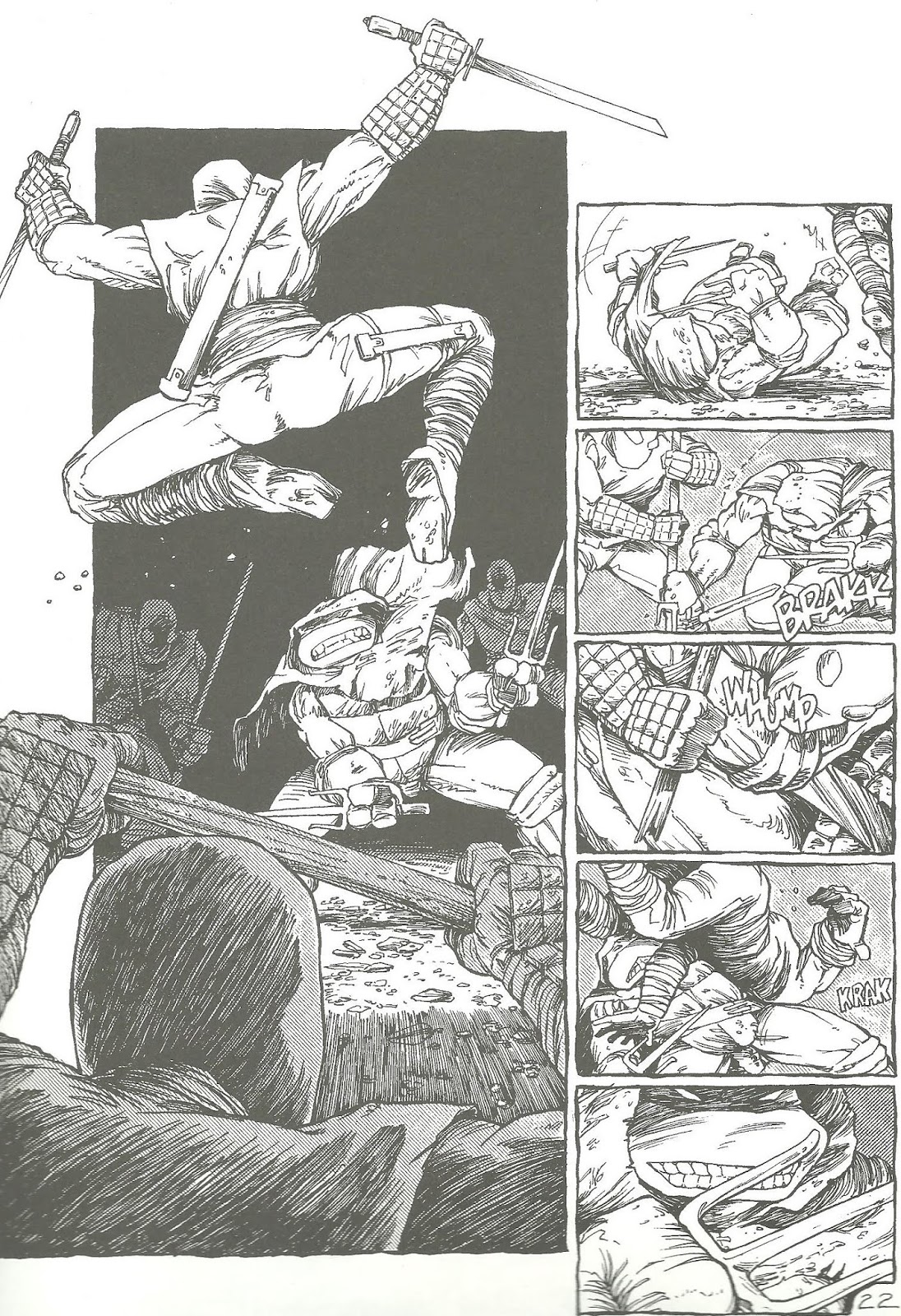
Anyway, let's meet back here to discuss volume seven once that's released, and maybe we can talk about the 12-issue TMNT series that immediately followed the conclusion of this one, since that's still pretty fresh in my head.
