Showing posts with label roy thomas. Show all posts

Monday, April 13, 2026

On the rather confusing (to me) Last Days of the Justice Society of America

My interest in the Spear of Destiny in the DC Universe recently brought me to 1986's Last Days of the Justice Society of America Special #1, a 64-page story by writer Roy Thomas, co-plotter Dann Thomas, pencil artist David Ross and inker Mike Gustovich. 

I think it's one of the more confusing DC comics I've ever read.

That's not because it's poorly written or poorly drawn...God knows I've read much worse comics from the publisher, comics that due either to the script, or the nature of the art, or some disconnect between the writing and the art were difficult or impossible to parse with any real confidence.

Rather, my confusion stems from the fact that Thomas' story contradicts what I thought I knew about Crisis on Infinite Earths, and how it affected the DC Universe shared setting. (Mostly; there's also a plot point that amounts to little more than "Because magic...!", but we'll get to that in a bit). 

Now, if Roy Thomas and I seem to have a difference of opinion on how COIE impacted the DC Universe/history/continuity, I have to assume that's a me problem, and not a Thomas one. 

I mean, he was the guy who was writing for DC Comics at the time, and this script he wrote for them presumably made it through a series of editors who knew what was what. 

Meanwhile, I read COIE once, over 25 years ago, from a trade I borrowed from the library, and never felt compelled to revisit it (Certainly DC has given me plenty of chances to do so, as they seem to be constantly reprinting it in various formats. Honestly, I found it a bit of a slog, and read it with the interest and enthusiasm of a student reading a homework assignment; I suppose I should reread it now, though, given that in the last quarter century, I've read so many more comics that I'll now know many of the players and elements far better, and recognize all the cameos).

Okay, so here's my understanding of the climax of COIE, in which multiple Earths are all collapsed into a new, single Earth. This combination essentially synthesized the various Earths, their populations (well, at least their superhero populations) and their histories into a new one, the specifics of which would be laid out in 1986's History of the DC Universe and DC books going forward (like John Byrne's Superman work, George Perez's Wonder Woman and so on). Only a handful of characters from alternate Earths who were spared (Earth-2 Superman, Superboy-Prime, etc) would remember the old Multiverse, along with Psycho-Pirate, who seems to have been driven mad in the process.

(Please correct me if I'm wrong.)

That's...not what is reflected here. All of the characters featured in this comic seem to be aware of their time on Earth-2, that there are characters who existed on both Earth-2 and Earth-1 (like Superman and Robin, for example), and the specifics of the events of the crisis, which they refer to as the crisis throughout. At various points, Hawkman and Starman even refer to it as "The Crisis on Infinite Earths". (Also, post-Crisis, should Power Girl be in this story at all?)

So that caused some friction for my brain when I was reading, but so too did making sense of the time travel elements of the plot...although that too seems to stem from my not remembering the events of COIE very clearly. 

After a prologue featuring Albert Speer visiting Adolf Hitler in his bunker near the end of the war in 1945, and a very wordy page in which the panels read rather cinematically, the readers' point-of-view moving through a cemetery on the grounds of Hall manor as if a movie camera were doing so, we find the JSoA of the time standing before a large coffin.

The roll call: Hawkman, Starman, Green Lantern, Dr. Mid-Nite, The Flash, Wildcat, Hourman, Doctor Fate, The Sandman, The Atom, Johnny Thunder, The Star-Spangled Kid and Power Girl, along with apparently unofficial members, Hawkgirl and Sandy the Golden boy. 

Chairman Hawkman is holding forth, talking about the "two fallen comrades" in the coffin before them. As he does so, he recounts other Society members who have previously died (Earth-Two Batman, Mister Terrific) or been lost in other ways (Earth-Two's Superman and Wonder Woman). Who's in the coffin? Earth-Two's Robin Dick Grayson and Huntress Helena Wayne, both of whom died during the events of the crisis. Hawkman says they will be burying them next to Helena's parents, Earth-Two's Batman and Catwoman.

So, you can see where I might be confused here, right? 

Not only was I surprised that the Justice Society all seemed to remember the events of Earth-Two (like Batman's death), but they also remembered characters plucked out of continuity when time and space were rewritten (like their Superman, Kal-L), but somehow Robin and Huntress still have bodies? And Batman and Catwoman's remains survive, still buried in their graves with their headstones, on the then-new, combined Earth? Didn't all of these characters—Earth-Two's Batman, Catwoman, Robin and Huntress—get erased from existence, so that they never were, except, perhaps, as memories held by a handful of characters...?

The team isn't just mourning the deaths of Robin and Huntress, though, but that of the Society as a whole. Hawkman says that they've decided to disband and go into retirement, as "when Earth-One, Earth-Two, and so many other Earths became one, we in turn became, in a very real sense...redundant."

In a splash page that depicts the heroes of the new DC Universe, he goes on to explain that there are other, younger heroes, "many of whom bear the same powers, even the same names we do."

I'm reading Last Days in the 2017 Last Days of The Justice Society of America trade collection, which collects it with a dozen stories that Thomas wrote for the pages of the 1986-1990 Secret Origins (one of which I've recently written about). It also includes a text piece of Thomas' from the back of the original Last Days special, headlined "An Epilegomena to 'The Last Days of the Justice Society'" (My spellcheck doesn't recognize that word, by the way). In this Thomas explains a bit why DC published the story, and it seems the publisher agreed with what Hawkman said about the redundancy of the JSoA at the time. 

It's weird to think that DC might have thought that, say, two Hawkman, Flash, Green Lanterns or Atoms would be just too many. I mean, today we have, what, three or more Flashes? Eight Earth-born Green Lanterns? Hell, just looking at the Batman franchise, don't we still have two Batmen, two Robins, three Batgirls and more sidekicks and Bat-lieutenants than I can keep track of...?

Anyway!

Hawkman, the Society's chairman, is just about to announce that the team is now officially disbanded when The Spectre arrives in a shredded cape and gloves and then collapses in their midst. 

The Spectre reaches up and touches Fate's mask, causing the mystic to reel back while screaming in pain, and then The Spectre seems to explode in a very cool image, Thomas' narration telling us that "the ectoplasmic shell men have called The Spectre can return to whence it came."

The next 15 pages or so will consist of Fate explaining to the others what The Spectre implanted in his mind, an alternate version of the events of April 1945 than those which any of them remember. 

They are attending President Franklin D. Roosevelt's funeral, when the Earth begins to shake and the sky itself rends open, Wildcat observing that "another world's tryin' to rush in!" New president Harry S. Truman arrives and tells them it's a world wide phenomenon, at which point The Spectre speaks up: The source is Berlin, and "the destiny of all the Earth hangs uneven in the balance-- --and the weight of so much as a feather may tip the scales toward survival-- or the end of all the universe!"

Hey, Hawkman has a feather! He's got a whole lot of feathers! Maybe he can help?

And so Hawkman, and the rest of the Society (here including Batman, Superman and Wonder Woman, which would seem to indicate that this is 1945 on Earth-Two, and not in the new timeline in which there is and was no Earth-Two) streak to Berlin, although the most powerful of them can only go so far. 

"If we go traipsing inside Nazi-held territory, we'll fall victim to the spell cast by Hitler's Spear of Destiny, won't we?" Johnny says, to which Green Lantern responds, "Just those of use who are especially susceptible to magic."

That's how the spear was working on the JSA circa 1986 then, at least according to Thomas: Any hero "especially susceptible to magic" who entered "Nazi-held territory" would fall under Hitler's spell and end up fighting for him. 

(Thomas' text piece at the back addresses this a bit, saying he came up with it as an explanation for why the superheroes didn't change the results of the war too much, a regular problem with superhero comics that was only magnified when it pertained to "stories set in the well-mapped past." He also says he was planning to work out an explanation for why the spear's magic only affected those most vulnerable to magic—that is, conveniently, the most powerful heroes—but didn't get around to it before Crisis made the point somewhat moot).

And so Superman, Wonder Woman, Doctor Fate, The Spectre, Green Lantern and Johnny Thunder stay behind while the ten remaining heroes moved deeper into enemy territory, many of them dying as they fought their way to Hitler's bunker (Starman, The Flash, Mister Terrific, Hourman and Doctor Mid-Nite all catch bullets in this sequence; Sandman takes a shot to the head, and then stations himself at a machine gun to provide cover fire for his allies before he himself bleeds out.)

In the bunker, they find a cackling Hilter with the spear held aloft. Fireballs pour from the sky, and then a wave of destruction pours forth, enveloping the world in fire. Hitler managed to take the whole world down with him in 1945.

So, um, why didn't the JSoA remember it happening that way? How were they still standing around on a very much not destroyed world in the 1980s? Well, here's the part I didn't really get. Apparently, during the Crisis—Thomas' text point lays out exactly which point—The Spectre's energies were flung throughout all of time and space, and the spear "drank" them up, super-charging it, and allowing Hitler to summon Ragnarok, the apocalypse of Norse mythology, ending the world. 

Still, if Hitler destroys the world in 1945, why is it still around in 1986? Well, it seems that though The Spectre's energy traveled through time, which I guess is a circle and not a line, the rip in the sky through which Ragnarok pours through happens at all times simultaneously, as no sooner has Doctor Fate explained all of this then a rip opens in the sky above them.

Now, I assumed where Thomas was going with this is that the JSoA of 1986 would end up travelling back to 1945, just before the events we just witnessed in Doctor Fate's story, enter the rip in space time and enter the Ragnarok cycle, where they would engage in an eternal battle, forever staving off the end of the world. When I started reading comics in the '90s, that's what the JSoA's status quo was, after all, and I read 1992's John Ostrander-written Armageddon: Inferno, in which the Justice Society returned from Ragnarok to the present-day DCU. 

That would make some sense of the time paradox, right? The Justice Society wouldn't remember the alternate history that Fate told them because they had prevented it from happening, just as the Earth wouldn't have actually ended in 1945, as a result of the present heroes' actions in the past. 

Well, that's not what Thomas does.

Instead, I guess we just leave it at The Spectre's powers behave how Thomas wants them to in order to tell a "last" Justice Society story that involves them fighting Hitler and the power of the spear, one that has them all ascend bodily to a sort of warrior's heaven of eternal battle, which is really not a bad "ending" for a team of superheroes, right?

Anyway, Doctor Fate takes the Society back in time to 1945, although he says they can't aid their past selves physically there, as, "No one living can see us...and we, in turn, cannot truly touch anyone or anything in this era."

Rather, once Hitler opens the rift in the sky, Fate takes them all within it, where they see the various characters of Norse mythology assembling for a final battle, one destined to end the world. The Society members are all quite conversant in Norse mythology, it seems here, and Ross' designs all lean toward the realistic, most of the gods wearing period armor, or looking like characters from opera stages, rather than something more colorful, like Jack Kirby's version of Norse mythology from Marvel's comics, or the Valkyries that Joe Staton drew in 1977's DC Special #29. 

Fate combines his magic with Green Lantern's willpower, and has the various members of the Society merge with various Asgardian gods, empowering the heroes to interact with the bad guys like Loki, Fenrir, Surtur and so on.

Over the course of some 20 pages, the heroes fight the mythological forces, dying one-by-one throughout. (That's two action sequences in which the heroes get killed in one book; I can only imagine what Geoff Johns would have done if given the opportunity to write the death scenes of so many heroes!)

Before long, of course, the heroes who died in the battle are resurrected, as are the opponents they vanquished, and the battle starts over. It can't actually be decisively won but must be fought over and over for all eternity...or for about half-dozen years, I guess, before the Justice Society is spelled by the bad guys from Armageddon: Inferno and are able to join the post-Crisis DCU. 

Not all of the Society members get stuck fighting Ragnarok forever/six years, though. Doctor Fate returns Power Girl and the Star-Spangled Kid to the present, saying that they are still so young and have too much life to live. Or maybe it's because they don't have Earth-One doppelgangers in the way that most of the others do?  (Of course, Power Girl was kinda sorta Earth-Two's answer to Earth-One's Supergirl, right? And after this appearance she would begin a long, troubled cycle of new and contradictory origins, one that I'm not entirely sure has ever been resolved definitively, but then, I don't think I've read a Power Girl story since shortly after the New 52).

Then The Spectre shows up to throw Doctor Fate out of Ragnarok too, returning him to the Earth of 1986. Like Power Girl and the Kid, there's not Doctor Fate double, either. 

So, I guess that's what became of the Justice Society after Crisis, right? 

At least until the Justice Society in Ragnarok story gets retconned, but that's a subject for another post...

Thursday, March 26, 2026

The Justice Society vs. Hitler and The Spear of Destiny, post-Crisis: On 1988's Secret Origins #31

In 1988's Secret Origins #32, the creative team retold a previous comic story, keeping the plot basically intact, the only changes being those made to realign it with then-current, post-Crisis continuity and to use more modern storytelling techniques. Well, that, and the changes that are natural when different writers and artists tackle the same story, as their various styles inevitably affect the result. 

In that particular case, it was Keith Giffen, Peter David and Eric Shanower retelling the Justice League's origin story from the pages of 1962's Justice League of America #9. (I wrote about that story in this recent post.)

The previous issue, Secret Origins #31, did the same, only for the Justice Society's origin story. In this case, the creative team consisted of Roy Thomas, Michael Bair and Bob Downs, and they were retelling a story of much more recent vintage: Paul Levitz, Joe Staton and Bob Layton's "Untold Origin of The Justice Society" from 1977's DC Special #29 (The subject of the previous post).

As with the Secret Origins retelling of the Silver Age JLoA story, it's interesting, even fascinating to read the comics back-to-back, as doing so accentuates the stylistic decisions the creators make, including how to present the events, how to stage them, how to design the characters and otherwise tweak them. I was able to do so because DC Special #29 was collected in 2006's Justice Society Vol. 1, while Thomas and company's Secret Origins #31 was collected in 2017's Last Days of the Justice Society of America, both of which my local library system still have on their shelves. 

Now, Levitz's "Untold Origin" was published pre-Crisis, and was thus set on Earth-2, and included the Golden Age Superman and Golden Age Batman in the adventure alongside the eight original members of the Justice Society. Thomas' was post-Crisis and thus set on the then still new-ish Earth with its new history. 

The most immediately apparent change then is that Superman and Batman have been eliminated from the proceedings. Batman doesn't do a whole hell of a lot in the original story, and so Thomas doesn't replace him with anyone else; instead, rather than having The Flash, Green Lantern and Batman embark on a mission to Scotland to take out the advance men for a Nazi invasion of England, Thomas simply has the first two go.

As for Superman, he has less panel-time than the Dark Knight in Levitz's story but plays a bigger role overall. He shows up at the climax to destroy a Nazi bomber before it can drop its payload on Washington, D.C. and he then grabs a Valkyrie who has targeted President Franklin Roosevelt, at which point she disappears. It is also Superman who rejects the idea of the heroes forming some kind of battalion within the U.S. armed forces and comes up with the name "Justice Society of America."

Here, Thomas has Green Lantern using his ring to destroy the bomber. The bit with the Valkyrie menacing Roosevelt goes quite differently without Superman there, which we will get to in a moment. And as for the decision to form the Justice Society, here it is The Spectre who rejects Hawkman's proposal of a "super-battalion" ("battalion" is here spelled correctly, in contrast to the same scene from DC Special #29) and then comes up with the team's name. 

Thomas also explains a few things that didn't really make sense in Levitz's story. He explains why Green Lantern and The Flash aren't able to use their powers to escape their bonds after being captured by the Nazis during their mission ("Still dizzy--from the drugs Streicher gave us--couldn't use my ring before!" Green lantern says as Doctor Fate and Hourman arrive to rescue them). He explains why Fate doesn't immediately take down Hitler upon his arrival ("For all my power, I cannot attack Hitler while he holds The Spear of Destiny--", Fate tells the others). And he explains how it is that the Nazi long-range bomber seems to get all the way across the Atlantic and over D.C. so quickly; in the original story, Levitz seemed to suggest that the superheroes battled the Valkyries the entirety of the trip, whereas here that trip is almost instantaneous, with Green Lantern remarking that the journey was made supernaturally shorter ("Hitler's spear did it!" he cries. "That's the only answer!)

The biggest change comes at the end, which the creators add several pages to. Without Superman there to stop the Valkyrie who had targeted Roosevelt—who Thomas gives a name to, Gudra—she is free to continue her attack after zapping The Atom. In fact, she succeeds in killing Roosevelt.

The heroes mourn for a panel or two, with Fate saying that even his great power has never been able "to bring a man back from the far side of death", but The Spectre says he's going to try anyway. He disappears from the White House and journeys like a humanoid comet through bizarre backgrounds, finally declaring "I have pierced the veil!"

And The Spectre finds Roosevelt in a line of humans wearing pink-ish purple robes, "wandering toward a vision of blinding light," and The Spectre then announces, "I must speak with the one who decreed that JIM CORRIGAN should walk the world, an undead SPECTRE!"

Who, exactly, was that...? Thomas was equivocal here, as was the case at that point in The Spectre's history. This is, presumably, the mysterious entity referred to as "The Voice." Indeed, The Spectre is answered by a voice, communicating with him in big, bold, red, disembodied letters that emanate red rings.

This is, presumably, God himself, although Thomas, like creators before him, doesn't come out and say this exactly, as heavily as it is implied.

The Spectre and Voice argue a bit, and when the latter refuses to allow Roosevelt to return to life, The Spectre raises his hands against The Voice. The Spectre is powerless against The Voice, of course, but, noting The Spectre's tears, The Voice proceeds to show The Spectre the future, in which Roosevelt is destined to die soon anyway, after a few years of the world at war. Giving The Spectre the choice of whether it is worth resurrecting the president or not knowing all of this, The Spectre says that is still his wish, and so Roosevelt is restored to life, everyone but The Spectre a little confused as to what just happened.

The other changes to the story are more-or-less matters of style. Thomas is, perhaps unsurprisingly, much more wordy here than Levitz was, and he fills his narration and dialogue with references to real-world history, more closely tying the events of this superhero adventure to those of 1940. He also offers quite a bit more characterization, allowing us to see more of the heroes' thoughts and to hear them engaged in more revealing dialogue, seemingly noting the momentous nature of this story, as it involves the first meetings of the various heroes who would go on to spend so much of their careers together. 

Bair and Downs' art is much more realistic than that of Staton and Layton. I'm not sure which approach I prefer, but, if pressed, I think I would choose the latter team's, as it looks so much more "comic book-y." Bair and Downs' work is much more appropriate for this version of the story, though; certainly their Roosevelt, for example, looks more like the guy I've seen picture of than Staton and Layton's more cartoony take. 

Interestingly, the artists hew quite closely to one of the previous art team's designs, like that of the big green robot in the Nazi castle that Flash and Green Lantern battle (Here Thomas gives it a German name, the "mordmaschine--or, as you Americans would say-- --THE MURDER MACHINE!"), while doing their own thing with other elements, like the Valkyries, which here wear armor and winged helmets, looking more opera than Staton's more superheroic looking versions.

Bair also draws a lot of cooler magical effects when it comes to The Spectre and Fate, and I prefer the energy orbs the latter sends to scoop up Hawkman, The Atom and The Sandman to the energy tendrils that Staton drew in the earlier story. 

Oh, and speaking of Hawkman, Bair gives him the appropriate helmet here, the one with the weird screaming bird face, with the open beak and tongue obscuring his human face.

As for the Spear of Destiny, the reason I got interested in these stories in the first place...? 

Well, as noted, Thomas has Fate explain that he can't attack Hitler while he holds the spear and, on the following page, after Hitler inadvertently summons the Valkyries, Green Lantern seems to make a move toward Hitler, but the Fuhrer shouts "Keep back, Amerikanen!", and the tip of the spear glows with pink energy and Kirby dots, a barrier of fire appearing between Hitler and the heroes.

The exact nature of its effect on the superheroes isn't delineated here then, but it is at least clear that it protects Hitler from them while he's holding it. I suppose future stories will further explain how it kept the Justice Society off the frontlines, even though here we see Doctor Fate, at least, able to enter Berlin itself, with Hourman in tow.

The particular trade I found this story in, the aforementioned Last Days of the Justice Society of America, is also filled with the title comic, and stories from the pages of Secret Origins devoted to new tellings of the origins of Golden Age heroes The Sandman, The Star-Spangled Kid and Stripesy, The Flash, Hawkman, Johnny Thunder, The Spectre, Hourman, Green Lantern, Doctor Mid-Nite, Doctor Fate and The Atom, all written by Thomas. We'll take a look at those stories in the near-ish future.

Sunday, January 05, 2020

Compare and contrast these pages from 1987's Shazam: The New Beginning and 2012's "Shazam!"

A CYNICAL BILLY BATSON RELUCTANTLY SAYS "SHAZAM" AT THE WIZARD'S INSISTENCE:


BLACK ADAM RETURNS TO THE PRESENT, MEETS SIVANA AND HOLDS HIM ALOFT BY HIS COLLAR:


BLACK ADAM FLIES SIVANA TO THE TOP OF A HIGH STRUCTURE SO THEY CAN DISCUSS THEIR ALLIANCE:


In 1987, DC Comics had writer Roy Thomas reintroduce C.C. Beck and Bill Parker's Golden Age superhero Captain Marvel to their DC Universe shared setting. This followed the 1986-1987 Crisis On Infinite Earths limited series, in which that shared setting was refreshed and recreated, with older characters being reinvented for more modern times. Thomas and co-writer Dann Thomas wrote the four-issue Shazam: The New Beginning, which was penciled and inked by Tom Mandrake and colored by Joe Orlando. In 2017 it was collected along with another Thomas-written story from the era and re-released in a hardcover format as Shazam: The New Beginning 30th Anniversary Deluxe Edition.

In 2012, DC Comics had writer Geoff Johns reintroduce Captain Marvel, now re-named "Shazam," to their DC Universe shared setting. This followed the 2011 Flashpoint miniseries, in which that shared setting was rebooted and recreated, with classic characters being reinvented for more modern times and introduced to readers as if for the very first time. Johns wrote a "Shazam" strip as a back-up in his Justice League ongoing series. It was penciled and inked by Gary Frank and colored by Brad Anderson. It was later collected into a trade paperback under the title Shazam Vol. 1 and, later, republished as Shazam: Origins. It was the basis of the 2019 film.

Interestingly, in rather broad strokes, the two miniseries, which had identical mandates, resembled one another in terms of their plots. In both, scientist Dr. Sivana frees the Wizard Shazam's first champion, Black Adam, from his centuries-old imprisonment and the two villains become allies. Meanwhile, orphan Billy Batson is given a magical word by the wizard in order to transform himself into a superhero. Both stories even end with the teasing introduction of another of Captain Marvel's most colorful villains, Mr. Mind.

Despite the similarities of the broad shape of the two Captain Marvel reintroductions, they differ quite a bit in the details (Thomas' story posited Sivana as Billy's uncle, and included versions of the pre-existent characters Uncle Dudley, Magnificus and Beautia and even Hoppy, The Marvel Bunny; Johns', meanwhile, included versions of Mary Marvel, Captain Marvel Jr., Mr. Tawky Tawny and Ibac...plus three new "lieutenant" Marvels).

Still, I was struck by the degree to which certain scenes in the Johns/Frank comic so strongly echoed scenes from the Thomas/Mandrake take. Obviously, Johns and Frank drew inspiration from their predecessors, even as their Captain Marvel/Shazam story was quite different in tone, emphasis and in so many of the particulars.

Monday, March 13, 2017

Review: Doctor Strange and the Secret Defenders

Don't be fooled by the cover, like I was!

Sure, the cover may feature a very nice, if slightly off-model, portrait-style image of Doctor Strange by Tim Sale, and yes, that is certainly the sort of thing that earns a second look. But be careful; that the date on Sale's signature indicates that he produced the image in 2015. So it was only just recently created, and by an artist who has nothing at all to do with the interior comics, which were originally produced between 1993 and 1994.

Aside from the fact that Doctor Strange is indeed in the book, this cover in no way reflects the contents. How secret are these Secret Defenders? So secret that Marvel couldn't even show them to you on the cover!

Those contents are the first 11 issues of Secret Defenders, collected under the title Doctor Strange and The... because Marvel is betting that Doctor Strange will move more books than Secret Defenders (note that the second half of the series is collected as Deadpool and The Secret Defenders*). That, or Marvel felt pressed to get as many Doctor Strange-branded books on shelves as possible as the movie premier loomed, and there weren't really a whole lot of choices for great material.

Writer Roy Thomas has a pretty strong central concept for this particular iteration of Marvel's famed "non-team," a sort of misfit, B-side answer to their Avengers franchise. Pushing the non-team further away from the team concept, this book would feature a Defenders line-up without a set, steady line-up.

Instead, original Defender Doctor Strange would begin each arc consulting his tarot deck, upon which various Marvel superheroes--generally a mixture of the popular and the odd-ball--would appear. Strange would then gather up those fairly random characters and throw them at some threat or another.

The results read a lot like Thomas was doing the same thing he had Strange doing, working from a set of cards featuring Marvel heroes, and plucking a handful at random, but I suppose it had the advantage of getting Wolverine or Spider-Man into a few issues of a Defenders comic.

Despite how solid the concept seems, the execution is, as always, everything, and, well, this is certainly a Marvel comic book circa 1993.
Thomas is paired with pencil artist Andre Coates for the first eight issues of the title collected herein, and Coates does his job just fine. There's nothing terribly noteworthy or memorable about his work, which does the job well enough. I admit I found a lot of the panels downright hilarious, but in retrospect, that had more to do with the strange costuming choices than any real deficiency on his part.

The book does get quite a bit more lively towards the end, when pencil artist Tom Grindberg comes on. His work here is...well, it's something. He draws all of his figures as big, bold behemoths that not only fill the pages, but crowd them. There's a real Mignola-like look and feel to his figure work, and his over-exaggerated musculature--his Silver Surfer and Thunderstrike have tiny heads, smaller than their any single muscle on their bodies--is so expressive that I couldn't tell if he was drawing sarcastically or not. (Vince Giarrano and Kelley Jones, two artist whose work I really like, also sometimes draw in such an exaggerated manner I sometimes wonder if they are being sarcastic or not).

There are five different stories in this collection, meaning there are five different Secret Defenders line-ups. Coates draws the first three, Grindberg the last two.

In the first, Strange gathers Wolverine, Darkhawk, Spider-Woman (Julia Carpenter version) and a Nomad I was blissfully unaware of before this story (long-haired, gun-toting Jack Monroe, who wore big, dumb wraparound sunglasses and a trench coat, his only nod to a costume being a big, dumb N-shaped belt-buckle; he had a baby on his back for most of the story, and I just sort of assumed he was a Marvel Universe answer to Lone Wolf and Cub...?). They are called on to break-up a weird-ass invasion/scheme by extradimensional beings who have disguised themselves and the stupidest looking supervillains with the worst codenames (See: Dreadlox) and were turning old hobos into teenagers, for reasons.

The even more random team of The Punisher, Namorita and Sleepwalker are convened by Strange to tackle Roadkill, a sort of zombie Hulk who drives semis that he turns into vehicles of pure-fire (He kinda Ghost Rider-izes 'em, but he does the whole truck and trailer, not just the wheels) and travels the American highways with his talking sidekick, a dead cat named Splatt. He is really a Cryptkeeper-like horror host from a TV anthology show brougth to life, and unaware of that fact. My favorite part of this story, aside from my fascination with the Sleepwalker character, is that Strange's astral projection finds The Punisher standing over the bodies of two muggers he just executed in the street, and he doesn't say anything. I'm endlessly amused by the Marvel universe's convenient ignoring of the fact that The Punisher is a deranged serial killer. Like, Spider-Man or Daredevil might argue about it or come to blows with him when they happen to see him murdering someone, but it's generally treated more like a bad habit than serious crime for which she should be put in a cell next to Taskmaster or The Hobgoblin or whoever. Strange just acts like he didn't even notice.

That's followed by the most tedious arc, a three-parter that feels like a thirty-parter in which Strange, Spider-Man, Scarlet Witch and Captain America battle Xandu, newly empowered by the Wand of Watoomb. It is perhaps noteworthy for how hands-on Strange is in this one compared to some of the others, and it reads like a Doctor Strange story with guest-stars. It is based on a bunch of older comics I hadn't read; it makes sense and everything, it's just kind of repetitive, as Thomas drags out the story longer than the false drama can sustain (Will Xandu merge Earth with The Death Dimension, kill all the heroes and become Emperor of the new realm? No, no he will not).

Cue Grindberg, who shows up to pencil a two-parter in which The Silver Surfer visits his fellow former Defender to ask him to recruit him some allies to go after Nebula (this one is also based on a bunch of other, older comics; there's a whole page full of recap panels with asterisks pointing a reader towards the issues it references). Surfer insists they be allies that Nebula has never met, so Strange provides him with iron Man understudy War Machine and Thor understudy Thunderstrike.

The final issue is written by Ron Marz, and its labeled as the third chapter of the "Starblast" crossover. I've no idea how it fits in, or what the heck that is exactly, but for the purposes of this issue-long story, it simply provides a super-fast, super-strong robot that a very, very long-haired Nova wants to fight, but he can't catch it. Strange gives him Northstar, who can catch it, but neither of them are strong enough to defeat the robot, so then Doc sends in The Incredible Hulk to punch it to pieces in a great, two-page spread.

And that is that. The issue has a coda of sorts, in which Thanos appears and will take over the book for a few issues, but those issues apparently aren't terribly marketable in 2017, so the next collection of the title is Deadpool and The Secret Defenders. The kids love Deadpool.

I still kinda like the premise of this title, and it seems to be a more-or-less evergreen one, although Marvel already has two Doctor Strange titles at the moment, so I imagine it will be a few years before they even attempted an arrival. Plus, for some reason, the market is forever rejecting Defenders books, no matter how awesome they are (I really dug that one by Matt Fraction, for example).


*Deadpool and The Secret Defenders collects issues #15-25, so the only issues of the series that remain uncollected are #12-#14, which feature a Thanos-led team that includes The Super Skrull, The Rhino, Nitro and Titanium Man. While attaching "Doctor Strange" and "Deadpool" to the title for the sake of selling the collections does indeed make some sense, it also somewhat unfortunately obscures the fact that they are collecting issues from the same series. I'll have to read Deadpool and The...before I can say whether the two volumes are distinct enough to stand on their own, or if they need to be read in sequence.

Saturday, November 17, 2012

That one time Roy Thomas almost inserted FDR/Churchill slash into All-Star Squadron

In 1982's All-Star Squadron #10, writer Roy Thomas and artists Adrian Gonzales and Jerry Ordway have President of the United States Franklin Delano Roosevelt and All-Stars The Atom and Liberty Belle about to pay a surprise visit to British Prime Minister Winston Churchill, who is staying at the White House while the two Allied leaders hammer out their plans.

"It's, er, still awfully early, Mr. President," The Atom asks, "Are you sure the Prime Minister will even be awake yet?"

Judging by the direction of the dialogue balloon's tail, it's Liberty Belle who answers, singing Churchill's praises, saying he "has a constitution as hardy as the one we wrote in 1787."

Roosevelt notice that Churchill's door is ajar, and they enter. They don't see Churchill though, and Roosevelt says, "Wait! Isn't that running bathwater I hear?"

Then, in the next panel, Churchill enters his room, naked save for a cigar , a towel and a complete lack of embarrassment:
He fixes the president with a puckish smile...
...and continues (in dialogue balloons too close to the spine to be clearly scanned): "The Prime Minister of Great Britain has nothing to conceal from the President of the United States! Now, what is on your mind, Mr. President?"

Nothing to conceal! Not even his own naked body! Yes, Mr. Roosevelt, what is on your mind*, now that you are confronted by your naked ally and his suggestive comments?

Jeez, talk about a "Special Relationship"...!


*The United Nations. The pair had been trying to think of a better name for their anti-Axis coaltion than "allies" or "The Associated Powers," and, after a sudden inspiration, FDR wanted to suggest "The United Nations" to Churchill.

Friday, October 12, 2007

Someone's been sleeping in Captain Marvel's bed...

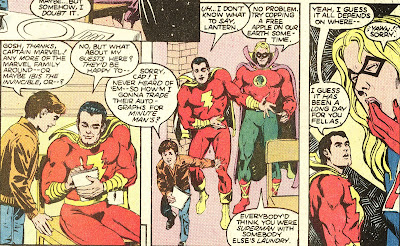
The sky turned red, killer sillouhettes ran rampant, and people were being plucked from their home times and dimensions and tossed all over—it was the Crisis, or, as those of us in Earth-Prime knew it, DC's maxiseries Crisis on Infinite Earths. Many big, important, unimagniable things occurred during that event, but perhaps none so unexpected as newlyweds Johnny Quick and Liberty Belle having sex in Billy Batson's bed.

The sordid tale was told in 1985's All-Star Squadron #52, by Roy Thomas, Dann Thomas, Arvell Jones and Alfredo Alcalla.

Green Lantern Alan Scott, Johnny Quick and Liberty Belle from Earth-2 follow their friend Firebrand II into a hole in the sky or something, and end up on Earth-S, where they find Captain Marvel engaged in battle against the shadow things.

After the new heroes help turn the tide, sending the shadow things back to their own maxiseries, they do a little meet and greet, and Alan pulls Cap aside and lets him know exaclty what's up Johhny Quick's ass.


They head for a diner, where the Earth-2 heroes are totally dissed by a young autograph hound. Libby, feeling tired, bored or perhaps just horny, issues a yawn, signaling that this team-up has gone on long enough for her tastes.


Cap takes them to Billy's apartment which is—wow, Billy has a nice pad!


Man, that's much nicer than my apartment. I guess there's some pretty decent money in being a boy broadcaster!

Cap and GL leave the newlyweds to get some sleep, while they head off to do actual superhero stuff. Mainly flying around to see if the green meteor that crashed in Earth-2, and from which Alan's Lantern was formed, also crashed on Earth-S, since he could use a recharge.

But what's this? Libby's not so tired after all!


The next time we see the young couple is this charming scene:


...freaking Billy Batson with his king-sized bed...I'm a thirty-year-old man and I've never had a king-sized bed...

Now, what's weird about this scene is that not only did Libby and Johnny avail themselves of Batson's generosity and then totally consumated their marriage in his bed, but Libby also helped herself to the kid's wardrobe, and slept in one of his trademarked longsleeved shirts. She's wearing it the next morning, which is the internationally recognized signal of I've Just Slept With This Shirt's Owner.

Man, they are some terrible house guests. They sleep in his bed, they do it in his bed, they wear his clothes...could it get any worse?


Oh yeah, Libby could accuse him of being a voyeur trying to sneak a peek at them because he happens to be outside the window of his own apartment.

The nerve of some people.

Man, I sure hope Billy changed those sheets...