Showing posts with label capullo. Show all posts

Thursday, October 23, 2025

No one ever told me that Grant Morrison wrote Spawn.

It wasn't until I was writing about the first two Batman/Spawn crossovers (here and here) for the blog that I discovered Grant Morrison had written a Spawn arc in 1993 and 1994. I was looking at what was going on in the title around the time of the crossovers, and was quite surprised to see Morrison's name in the credits, as the writer has long since become one of my favorite super-comics writers (Thanks mostly to his JLA run that started a few years later, at which point I started actively hunting down their past work while looking forward to their new work.)

I had, at that point, dropped Spawn and, after returning for the guest-writer stunt run of issues #8-11, I stopped paying attention to the series altogether. I suppose if I did know that Morrison was going to take over the book for three issues back then, it wouldn't have really moved me to spend any of the little money I had to spend on comics back then on the arc. 

At that point, I only knew Morrison as a pretty great Batman writer with a pair of graphic novels to his name, Arkham Asylum and Batman: Gothic being the only work of theirs that I had read at that point (I think; I wouldn't read his Animal Man or Doom Patrol until much later). His presence wouldn't have excited me like having the writers of Watchmen, Sandman, Cerebus and The Dark Knight Returns guest-write an issue. 

Curious if I could find the Morrison-written issues now, 31 years later, I was pleasantly surprised to find my library system had something called Spawn Compendium 1, a 1000+-page doorstop published in 2021 that collected the first 50 issues of the series (Which, in addition to an arc by Morrison, also included a second issue guest-written by Alan Moore, 1995's #37...which I also intend to write about in the near future. Sorry readers with no interest in Spawn!*).

(Oh, and if you're wondering, I did briefly consider reading and maybe reviewing my way through the whole compendium, but a flip-through convinced me I wouldn't enjoy doing so at this point. While Todd McFarlane's art has some virtues I can still appreciate, I don't really enjoy it that much, and I find many of his designs off-putting. I'm also not a fan of the coloring or the lettering, which feel very '90s to me in a bad way. Still, I think this is a pretty nice package for anyone interested in the early years of the character and comic, and I appreciated the opportunity to re-read the Dave Sim-written issue without messing with my longboxes, for example, or finding the Morrison issues and later Moore issue. If I have any complaint about the collection, it's that it doesn't reproduce the covers between issues, making navigating it a little hard and, besides, some of those covers are really great...although this one remains my favorite.)

So anyway, Grant Morrison wrote three issues of Spawn in the early '90s! How did the visionary superhero comic book writer handle one of the dark characters most emblematic of the decade? Let's find out, shall we?

Morrison wrote issues #16-18, collaborating not with McFarlane, but with pencil artist Greg Capullo, who was here making his debut on the character, inked by Dan Panosian, Art Thibert and Mark Pennington. McFarlane, who I imagine was busy drawing Spawn/Batman #1, didn't even contribute covers; those are by Capullo too. 

The story arc revolves around two different militaries' interest in Spawn. The first is the U.S. military, which Spawn apparently worked for in some capacity back when he was still Al Simmons, and was still alive (In the handful of Spawn comics I've read, Spawn/Simmons is, kinda like the '90s Wolverine, dealing with a fractured memory, so that his own history with black ops government work is mysterious even to him). 

The second is the army of Heaven, represented by warrior angels, which seems to have been a concept introduced by (now rightly canceled) guest-writer Neil Gaiman in his Spawn #9, which introduced the mostly naked angelic character Angela, over whom he and McFarlane would go on to argue about in court for years (But let's not get into that here).

The former is interested in part due to Simmons' work for them, and in part because they want to weaponize Hell, which they have learned is composed of a substance called "psychoplasm", which can be shaped by the human mind, usually to respond to its worst fears. The latter in interested as part of the eternal war between Heaven and Hell, and Spawn is a kinda sorta warrior for Hell ("Spawn" is, of course, short for "Hellspawn"); that's where he gets his magical super-powers, after all.

The first issue opens with a seven-page sequence in which a pair of soldiers are sent into a place called "Simmonsville". "Private joke," explains Jason Wynn to army officer Major Vale, who he is sort of explaining/selling the place to, in a series of narration boxes that run over the action.

That action? The soldiers enter a creepily empty small town, when out of the ground rise a pair of demons, giant, bent creatures with big bug eyes, cartoonishly wide mouths with long, lower jaws and tongues, thin arms and claw-tipped fingers. Capullo draws them as clear members of the same species as McFarlane's Violator, the first denizen of Hell introduced into the series. 

These are revealed on a two-page splash that requires one to turn the book sideways to see properly.

As Wynn explains, Simmmonsville is apparently composed of the psychoplasm Wynn was given after contacting some entities from Hell, and it is built of memories of places Simmons had lived in before. The two demons proceed to gorily kill the soldiers, one of them dragging the last surviving soldier into a nearby house, slamming the front door behind him, and then we see a fountain of blood shoot out of the chimney. 

"Cut to New York City", a narration box says, and there we see Spawn crouching on a gargoyle which is too weird looking to imagine even on a Gotham City building, as he gathers his voluminous cape dramatically behind him and rain falls. 

The narration box says that "he broods," while other narration boxes stylized so as to suggest they are Spawn's thoughts speak of various questions about his life and death, like who killed him, how it is that he has a body now and who it is that's buried in Al Simmons' grave.

He is interrupted from his brooding by a pair of young men who have cornered a homeless man in an alley. One holds a can of gasoline, the other a lighter, and the latter tells the homeless man, "We're just a couple of concerned citizens tryin' to do something about the homeless problem...We call it the 'Burn a Bum' scheme."

And yes, this is the exact same situation that Frank Miller had Spawn intervene in during Spawn/Batman #1, which would see publication a few months after this. Apparently bad guys attempting to set homeless people on fire was a regular problem Spawn had to address (Here he does so by breaking one guy's hand and sending the other one flying with an uppercut).

Meanwhile, in a mysterious skyscraper in Manhattan, two women in business suits who are apparently angels from Heaven discuss "the Earthbound Hellspawn who defeated Angela recently", and their new orders, received over the phone, "to create our own solider to destroy the creature."

These characters are, by the way, named Gabrielle and Michaela, names that are only mildly more creative for angels-posing-as-women than that of "Angela." (The former appeared in the Gaiman/McFarlane issue, #9, by the way; Angela checks in with her at her office before she begins her hunt for Spawn.)

How does Heaven go about making a soldier? Here they have a satellite, which they have apparently taken control of by possessing the astronauts stationed there (Their bald heads are split open at the top, a starburst of energy pouring out of them and forming a sort of halo, and their eyes similarly emanate light). These now speak in a special stylized font and dialogue balloons, of which there are so many in this book. 

They proceed to abduct Wynn—who has just finished a Kingpin-like workout, fighting a couple of ninjas he hired to train with—a terrifying-looking event that finds him being beamed up through the ceiling, his body seemingly liquefying in the process.

In one splash panel, he is transformed into a "soldier of light," "the elemental fire of Heaven" now burning inside him. As Capullo draws Wynn in this panel, he looks like a typical, Superman-like caped strongman character, albeit with a longer cape, and all golden yellow. In fact, he looks rather exactly like the version of the original Superman that emerges from the sun in the 853rd Century near the end of the Morrison-written DC One Million, minus the chest symbol and spit curl.

That design only lasts for that one panel though, as he gets a hilariously dumb redesign and a new name on the very next page:

Yes, he is now "ANTI-SPAWN!" and he has a goofy costume covered with crosses and spikes and honestly looks something like what have been an early sketch of McFarlane's on his way to coming up with the final Spawn design. 

You can't tell from this particular image, a result of Capullo having the character in a crouched pose, as if ducking under the huge dialogue bubble naming him, but he's wearing a belt buckle that features the Spawn emoji symbol, the one that appeared on the cover of Spawn/Batman alongside the bat-symbol, only with a red strike-through circle around it, like the Ghostbusters symbol...but for Spawn. ("Anti-Spawn" is a cooler name than "Spawnbuster" and feels more appropriately superhero melodramatic. Creating an extremely obvious evil opposite of Spawn also seems both very classic superhero comics and very Morrison-esque.)

This new character doesn't make the cover of the next issue though; that's reserved for a pretty generic Spawn-posing-in-a-sewer cover (Did Spawn readers ever have trouble telling if they've read a particular issue or not, based solely on the covers? I don't know that this was necessarily the start of that trend, but the covers I've been looking at sure seem to be rather early ones where the comic book just features a character posing, rather than any information particular to that issue. I know we've gotten tons of such potrait/post covers in the 21st century, particularly from Marvel, but I feel like it was maybe still an outlier in 1994...?)

This issue opens with the Spawn mythology's devil, "The Malbolgia" (which is how its spelled in issue #17; the next issue box at the end of #16 had promised "Malebolgia", with an "e"; I think the spelling with the "e" is the more standard one). He looks a little like a heavy metal kid's version of the devil, somewhat like the other demons, but with a big pair of horns and a mane of long, stringy, gray hair. 

Interestingly, Morrison's script doesn't call him the or a devil, but "the bad god," which is an interesting way to describe a/the devil, and calls to mind dualistic religious beliefs of earlier in the last millennium (Because the lettering in that narration box is all caps, there's no way to tell if Morrison meant to refer to him as "the bad god" with a lower-case "g", or "the bad God" with an upper-case "g", a rather significant difference, really). 

This bad god, however you spell his name, taunts Spawn for a few pages, having found the title character in a graveyard, where he just dug up his own grave and is shocked to find a skeleton in a suit within it, which he somehow recognizes as his own body, causing some existential confusion. He plucks Spawn up in a giant yellow clawed fist and then deposits him in Simmonsville, "a doorway into my realm, a gate that stands open onto Hell."

Then the angels on the satellite shoot a comet down to Simmonsville, and there, standing in a cloud of foot-obscuring smoke, crackling with energy, is Anti-Spawn, now standing at his full height and giving us a good look at his belt...and his weirdly-muscled thighs, which seem to include muscle groups previously unknown on Earth (Although this is an Image comic circa the mid-nineties, I guess, and those comics were full of such weird muscles). 

He points at Spawn and calls him out, like a professional wrestler filming a promo: "HELLSPAWN! I've come for you!"

He proceeds to shoot a beam from his fist at Spawn, hurling him through a stained-glass window, visible in a nicely-drawn background that seems unusually detailed for Capullo here, given how often the panels don't feature any backgrounds at all.

Spawn then teleports to the Bowery in New York, but Anti-Spawn follows and the fight continues. And keeps continuing into the next and final issue. 

Anti-Spawn is about to finish off Spawn, using the glowing energy blade that has sprouted from his right hand, when he's surprised by a "WHAAANG", the sound of one of the local homeless guys that Spawn hangs out with striking the back of his spiked helmet with a pipe.

The mob of assembled men wielding two-by-fours and broken bottles (one of whom looks uncannily like Harvey Pekar), tell the villain that "This is our turf and we stick together" and "You got a beef with Spawn you got a beef with all of us."

Before Anti-Spawn can make good on his promise to tear them all apart, Spawn recovers and the fight continues, Spawn ultimate destroying his new foe with a series of dumber and dumber one-liners.

"Welcome to the real world, bastard!" Spawn says, blasting his foe on either side of his head at point-blank range with green energy from his hands. Okay, that sounds fine, I guess. But he keeps going.

"Have a nice day," Spawn says, putting his fist through Anti-Spawn's head with a "TSCHH!"

And then, as Anti-Spawn screams in pain, molten light bubbling and leaking from his head wounds, gurling "I'll kill you...", Spawn responds by blasting him with green energy through the torso, and the line, "Tell me about it."

Man, shut up, Spawn. 

In the aftermath, Spawn meets a character who refers back to the events of Gaiman's issue, he then travels to Simmonsville to tear it all down by shooting it with a really big gun like the sort Cable and Rob Liefeld and Jim Lee's Image characters used to tote around and then shooting Major Vale through the eye with a pistol, as Vale seems to have had something to do with Simmons' murder (The gun in Spawn's hands seems to change type and size panel to panel in this weirdly-drawn sequence). 

And then Spawn uses his magic powers to preserve one positive memory out of those that Simmonsville was built from, and decides to store it "somewhere safe," secretly, magically giving it to his ex-wife Wanda, briefly seen in a tiny nightgown staring out her bedroom window at the rain.

She can't see him, but Spawn is lurking outside, perched in the leaf-less branches of a dead tree. 

"The window goes dark," Spawn's melodramatic narration says, and it gets even more melodramatic over the course of the arc's last two panels: 
The world goes dark.

But that's okay. I'm used to it. 

DARKNESS IS MY HOME NOW.
That last line appears over another splash page, which Capullo drew sideways, so one needs to turn the book again to see right-side up; it pictures a mask-less Spawn, the lower half of his face in darkness save for his green, almond-shaped eyes and gritted white teeth, as he seemingly leaps toward the reader, a bolt of lightning in the black sky behind him.

It's completely ridiculous, but also reads as completely sincere; over-the-top, but in a way that is appropriate for the character, the milieu and the series...or at least as I understand them from the dozen or so issues I've read. 

It's obviously not the best Morrison super-comic I've read (although it was interesting to see Morrison's depiction of angels as super-aliens here, a few years before he would introduce the angel Zauriel in a JLA arc that would prove to be one of my favorite superhero comics stories ever), but it may be the best Spawn comic I've ever read, up there with Alan Moore's Spawn #8 (which doesn't actually feature the Spawn character) and Miller's Spawn/Batman (although much of the fun of that story was the degree to which Miller made fun of Spawn and, of course, Batman). 

Though the art leaves something to be desired in several patches—the Capullo of the mid-nineties is obviously not the Capullo we've seen drawing Batman over the course of the last 15 years or so—it honors McFarlane's visual imagination and the characters and world McFarlane had been building over the previous few years. One imagines that Spawn readers of those early years wanted the art to look as much like McFarlane's as possible. 

All in all, if you're a Grant Morrison fan, I think it's well worth tracking down. 


*So I recently noticed a drastic drop in my per-post readership a few weeks ago. This is right around the time I attached new URL everydayislikewednesday.com to the blog, which had been everydayislikewednesday.blogspot.com for the last 19 years. That's also when I wrote the first Spawn-related post. Did I screw something up by messing with the address? Or does my regular readership just have no interest in Spawn at all? I guess we'll see...!

Tuesday, October 09, 2018

On Swamp Thing Halloween Horror Giant #1

I finally gave in and bought myself one of those DC Walmart exclusive 100-page giants last weekend, which, based on the number of stories The Beat has devoted to the subject, is one of the biggest stories in comics right now. This one was the Swamp Thing Halloween Horror Giant #1, which appears to be a holiday special, as opposed to the four ongoing series devoted to Superman, Batman, the Justice League and the Teen Titans. It had its own little cardboard display case set up right next to the usual one that I see on my biweely-ish trips to the Ashtabula County Walmart.

Unlike the other Walmart giants, I wasn't immediately sure I had read all of the reprint stories within this (although it turned out that I had), and I wasn't as confident that the all-new Swamp Thing story advertised on the cover would show up in a collection, as I am confident the Brian Michael Bendis-written Batman story and the Tom King-written Superman story will. And hell, it's only $5--that's significantly less than most of the magazines they shelve near check out aisles in supermarkets to entice impulse buys.

I don't want to get too deep into the logic and ethics of these things again, nor to play armchair publisher regarding them, although I think in general that extremely cheap, mostly reprint comics marketed to a mass audience of civilians is a pretty good idea, especially around holidays like Halloween and, even more so, Christmas. I remain a little baffled as to who exactly these are meant for, though. As with the Batman one I had previously read, this seemed to be geared toward an adult--or at least older teen--audience, rather than an all-ages one. There's some blood, some unnecessary swearing, a particularly gratuitous dark and an oddly out of place story from the 1970s with barely veiled drug humor (Unlike the comics DC sells to the direct market, there's no rating on this one).

And the contents are extremely haphazard, although, in general, the idea seems to be popular-ish DC characters with one foot in the world of horror and the other in the traditional world of DCU superheroics. Off the top of my head, I feel like I could come up with 100-pages of better Halloween comics to fill this thing with, and I got the sense that after the new Swampy story that kicks off the anthology and the Swamp Thing-related reprint that closes it out, the stories were chosen more for the characters featured or their ability to hit the pre-determined page count than for their quality or their accessibility to new readers or their likelihood of selling brand-new readers on particular characters, concepts or comics.

So here's what we've got.

*Swamp Thing in "Hollow" This 12-page short is the "Brand-New Swamp Thing Story! Written by Brian Azzarello and Art by Greg Capullo!" That...doesn't sound, right, and makes me suspect that story selection is hardly the only issue with editing that went into this thing. Anyway, if people who ever visit comic book shops by this, chances are this is the reason they will be buying it. The story itself is kind of simple, and echoes one that appears later in the collection, as well as dozens or even scores of other comics stories. The basic idea is that there are good monsters that fight bad monsters, and that there are places in this world where bad things from other dimensions try to enter when the veil between the worlds is weak enough, and some noble, self-sacrificing types must endlessly keep a lonely vigil for the good of all.

Swamp Thing fights a giant, eye-less, albino crocodile-monster from hell, and there's a pretty neat reveal regarding some other monsters. Azzarello does his usual cute word play, which is either clever or annoying depending on the generosity of the reader, but I imagine Capullo is the big draw here. Indeed, it's the art that sells the reveal, and it was fun seeing his big, scary Swamp Thing, which is much bigger than usual, although I did find myself a little disappointed by one of his entrances (There's a bunch of dead leaves that seem to stir from the wind, and then form into Swamp Thing, but he just looks like he always does, rather than being made out of fall leaves; I've always liked when artists tweaked his design to reflect the type of plants he made his body from in a particular appearance).

*The Enchantress and Blue Devil in "The Pumpkin Sinister" This is the first of the four shorts taken from either the 2007 DC Universe Infinite Halloween Special #1 or 2008's DCU Halloween Special #1. The premise for those was that various villains all sat around telling scary stories starring DC heroes, and so when you remove an individual story from those books and present it by itself, it doesn't quite make sense, as each includes at least a panel of a supervillain, who then serves as narrator (To be honest, DC probably could have just reprinted one of these in their entirety here behind the Swamp Thing stories, and it would have made for a smooth and more comprehensible read). The Scarecrow narrates two of them, and he also appears in them, so those mostly work, but this one is particularly weird in that the villain narrator isn't someone I recognize by sight and never gets named, and he's awkwardly introduced, so the first panel of the story seems to include a giant in goofy '90s Image Comics-style armor, sitting near a house that he dwarfs with his immense size, and then the story begins (In actuality, he's regular-sized, by the creative team of Dan DiDio and Ian Churchill weren't exactly masters of comics storytelling, and it reads much worse removed from its original context).

I actually sighed out loud when I saw this was included, as it is one of the few stories I remember from either of those specials...not because it was good, but because it was so bad. Blue Devil and The Enchantress, who were back then both co-starring in pre-Justice League Dark Justice League Dark book Shadowpact, are giving out candy to trick-or-treaters while, across town, grown-up Peanuts characters Linus and Charlie Brown have just sacrificed Snoopy in a pumpkin patch in order to raise The Great Pumpkin The Pumpkin Sinister, which Charlie Brown sics on Blue Devil because, long ago, BD kissed The Little Red-Haired Girl.

I suppose there's a way to read this in which DiDio was parodying his own direction for the DCU line, which was progressively darker, gorier and more violent, despite the fact that the characters were all created to entertain children, but it is so clumsily executed that there's no textual basis to make that argument.

*Zatanna in "Kcirt ro Taert" Get it? That's "trick or treat" spelled backwards! And Zatanna casts spells by saying words backwards! Another short from the Infinite Halloween special, this one was written by Paul Dini and arted by Dustin Nguyen. The Scarecrow's head appears at the beginning--Nguyen draws a nice Scarecrow head--and he proceeds to tell of a recent Halloween in which he tried terrorize children by putting his chemical concoctions in candy, only to have Zatanna track him down and take her revenge. Nguyen's art is nice on a panel by panel basis, but the story's flow is difficult to read, and I honestly would have had no idea what the fuck was happening at the climax if I haven't read a dozen Scarecrow stories before (So not only can I recognize him without his costume, but they all tend to end the same way). It's an unusual case of great art not quite working right.

*Superman in "Strange Cargo" The last of the Infinite Halloween shorts, this one is a pretty simple Superman vs. Zombies story by horror comic writer Steve Niles and artist Dean Ormston, as told by Poison Ivy (who only appears in the first panel). Jimmy Olsen and Lois Lane are at the docks, as they suspect Lex Luthor has just imported something illegal. They open the shipping crates to find a bunch of zombies, and when Superman arrives to fight them, he finds that they are infused with magic or Kryptonite, as they are kicking his ass. When the reporters point out that they are already dead and thus Superman doesn't have to go easy, he rallies and says, "So, they are...Well that changes everything." But rather than pulverizing them all or burning them to ash with his heat vision, he tosses them back in their shipping containers and flies them to the moon, where they are free to stagger around harmlessly. So, it changes nothing, I guess. Those two lines of dialogue really bugged me, because they have no impact on what is otherwise a pretty strong story that would demonstrate how much Superman respects life/abhors killing and violence...and that he's so powerful he never actually has to resort to it. Also, Poison Ivy's presence feels sort of random. It's frustrating because it's almost a perfect Superman story, but makes a few unfortunate unforced errors that keep it from reaching perfection.

*Batman and The Scarecrow in "The Ballad of Jonathan Crane" This is the last of the villains-telling-stories stories, and the only one from the DCU Halloween Special. Once again it's The Scarecrow's turn to tell a story--it occurs to me that there are at least 100 pages worth of solid Scarecrow short stories that DC could have easily done an all-Scarecrow Scarecrow Halloween Horror Giant #1 had they so chosen--and he basically just remixes "The Legend of Sleepy Hollow" with himself as Ichabod Crane and Batman as The Headless Horseman. I do love the latter.
Plus, you know, Batman on a horse.

In fact, I love that image so damn much that I was thinking I wouldn't mind seeing a whole Elseworlds-like tale of a Batmanified Legend of Sleepy Hollow, although I guess writer Mikey Way and artist Mateus did the whole thing in just eight pages...the page of which reveals just how it is that what looks so Elseworldsy is actually canonical.

*Aquaman and The Demon in "Night Gods" This unlikely team-up by writer J. Michael Straczynski and artist Jesus Saiz is from the 32nd issue of the 2007-2010 Brave and The Bold revival, long after the book stopped being very good (as it was the first year or so, when writer Mark Waid and artist George Perez, and then Scott Kolins, were using it to tell compelling team-up stories that served as chapters in an overarching, universe-spanning story arc). This isn't bad, though. It is basically the two unlikely allies fighting Cthullhu on the ocean floor with the same basic set-up as the Swampy story--monster hero, portal between two worlds, little-known guardians performing thankless task for an ignorant world--framed like so many of these stories as a story one character tells another. It's structured a bit like an old horror comic too, with a surprise ending that is anything but surprising. Saiz is a remarkably solid artist, and he does stately superheroics quite well, but his Demon looks a little...boring compared to so many other artists' takes on the character, and while I liked his (unnamed) Cthullhu design, in general the monsters and settings lacked the weirdness and expressionistic energy I would want in a story in which a guy who is caught in the middle of robbing a grave explains that he recently got magic gills and journeyed with Aquaman and a rhyming demon to the bottom of the ocean and watched an army of sea creatures do battle with undead aqua-zombies and Lovecraft mythos monsters.

*Batman and Robin in "Night of The Reaper!" This one is something of a Halloween classic, set as it is during the Rutland, Vermont annual Halloween parade and featuring the talents of a pretty all-star creative team: Writer Denny O'Neil and artists Neal Adams and Dick Giordano, "from an idea by Bernie Wrightson with an assist from Harlan Ellison." As you can probably guess by the credits and my use of the word "classic," it's an old one, originally appearing in Batman #237 from 1971...the year my father graduated from high school! So, it's that old.

Obviously that means the Robin in question is Dick Grayson, who, at the time, was a college student. He and some guys go to take in the parade and party scene, and one of them is stoned out of his mind from "gulping coffee and who-knows-what-else" to keep his eyes open while studying. In a strange running gag, he is obsessed with parade floats, and spends the rest of the story talking about them to anyone who will listen.

As likely happens to Dick Grayson a lot, he goes out to have fun and ends up stumbling into a strange murder plot by someone dressed as The Grim Reaper. Not The Reaper, but, like, the generic one, with a scythe. Kind of like a murderous Scooby-Doo plot. Involving Nazis. There's lots of rather strong Adams art in this fairly lengthy and substantial comic, showing off his abilities to draw incredibly realistic characters and dramatic Batman poses and action. It's also kind of neat to see so many Marvel superheroes appear in a DC Comic, as many of the revelers are dressed as superheroes from both sides of the DC/Marvel rivalry. There's at least one cameo by a comic book creator too, but I'll be damned if I can recognize who it's meant to be: I was like -7-years-old when this came out, after all.

*Swamp Thing in "The Origin of Swamp Thing!" Like the previous story, this is a decades-old story that I've read before--multiple times, actually--although I'd actually be hard-pressed to tell you where exactly I've encountered it. This is, of course, the original, eight-page Swamp Thing story by his creators Len Wein and Bernie Wrightson, from 1971's House of Secrets, the one with the famous-ish cover (not included).

Rereading it today, after spending so much time looking so closely at Kelley Jones art in the past few weeks, it is really striking how evident Wrightson's influence on Jones was. Not just in certain elements of his rendering or style, but even in the layouts and storytelling. Jones' current style and Wrightson's from later in his career don't really look all that similar, but one can see how the Wrightson of the early 1970s influenced the Jones of the 1990s.

This one seems a bit out of place in this anthology, despite starring the title character. Those last two from 1971 are kinda sorta evergreen DCU Halloween story classics, ones that standalone, whereas so much of what preceded them begs a degree of familiarity with the characters, and tend to be fairly forgettable. Like, I've read all of them before, but don't really remember doing so...only that I fucking hated that Blue Devil/Peanuts comic. Just as it would be easy to imagine a DC Halloween 100-page giant that was all Swamp Thing stories or all Scarecrow stories, it's also easy to imagine one that is all short, "classic" scary stories by some of the greatest creators in DC history from the 1970s and '80s.

For those who care--given that one of the ways in which DC was trying to sell these at the time they were announced was that they would push the comic shop locator and be a way to herd Walmart shoppers into their local comic book shops--I'll mention the ad content. There are shockingly few, given how cheap this comic is. There's just two in the interior of the book, in fact: One for DC/Vertigo's series of Alan Moore-written, Stephen Bissette and John Totleben-drawn Swamp Thing collections and the Comicshoplocator.com one featuring an image of the Trinity drawn by Jason Fabok, which I recall seeing from the last Walmart exclusives I looked at. And then the back cover has an ad for Grant Morrison and Liam Sharp's upcoming Hal Jordan book, the one which is will be about Hal's core workout, based on his abs in that image.

I'm curious to see if there will be a #2 next year, and kind of excited to see what happens in December, as I kind of love Christmas comics. I'm not sure what they would call a Christmas giant though, as I can't think of a DC super-character associated with the holiday spirit in the same way that Swamp Thing (or a dozen or so other characters) is associated with horror/scary business...

Thursday, August 17, 2017

Is there a science teacher in the house?

Before I discuss one of this week's weirdest comic books, I'm afraid I just have to get this out of my system first, if you will all indulge me.

So the above image is a single panel of Dark Nights: Metal #1, written by Scott Snyder, penciled by Greg Capullo, inked by Jonathan Glapion and colored by "FCO" Plascencia. In this panel, we see the entire Justice League flying through outer space together. Green Lantern Hal Jordan is wearing a Green Lantern Corps ring, which encases him in a force field and allows him to travel through space. Presumably, it either traps enough oxygen in there with him to allow him to breather, or it generates oxygen. It's a pretty versatile piece of super-alien technology. The three other human members of the League--Batman, The Flash and Cyborg--are similarly allowed to travel through space thanks to the ring. As you can see, they are in a ring-conjured construct in the shape of a spaceship.

The remaining three members--Superman, Wonder Woman and Aquaman--are shown flying alongside of Jordan, outside of the ship. The only thing they have to protect them from the vacuum of space is a little see-through mouth guard like thing; these likely supply them with oxygen, as well as allowing them to speak to one another.

So here's my question: Are Superman, Wonder Woman and Aquaman able to travel through a vacuum like that without dying...? Please correct me if I'm wrong, and I likely am wrong, since all I know about what happens to organisms exposed to space comes from movies, comics and mostly-forgotten comments made by barely-remembered grade school science teachers, but I thought if one was in a vacuum, the lack of oxygen and the extreme cold were only some of the things that could kill you. I thought the vacuum would also suck out all of the air inside of you, and maybe all of the liquids inside of you and maybe the organs inside of you...? It was my understanding that you would basically explode if you were in a vacuum.

Superman seems cool. While I've seen him wearing full space-suits before, I've also seen him wearing a little mask like the one above and I've also seen him flying through space with no protective wear at all. I'm assuming he's simply so strong that his body can withstand the rigors of space travel and hold itself together. The cold wouldn't be cold enough to hurt him, since almost nothing can hurt Superman. And he doesn't really need to breathe oxygen, since his body is powered by solar energy, rather than the chemical processes that keep humans alive. Also, he can fly, so propulsion shouldn't be a problem for him.

Wonder Woman though, that seems like a stretch. Sure, she's plenty strong and has a high degree of stamina and invulnerability, but it's not comparable to Superman. Even if we imagine that her demi-god powers are such that they would allow her body to keep itself functional in one piece in space, and even if we imagine that she's strong enough that the cold of space wouldn't freeze her, she still needs oxygen to breathe. Even if the mouth piece is pumping oxygen into her mouth and nose, wouldn't it just get sucked right back out of her ears and pores and so on...? Like Superman, she too can fly, so there's no problem for her there (Unlike Superman, I'm having trouble thinking of a single instance of Wonder Woman flying through space without the benefit of a ship or a giant kangaroo).

And then there's Aquaman. I know he was massively powered-up by the New 52 reboot, to the point where he is basically as strong as Golden Age Superman, but no matter how tough and how strong they say he is these days, his body can't possibly be strong enough to survive a vacuum, can it? (The excuse for his super-strength and high degree of invulnerability is that Atlanteans basically hyper-evolved to survive in their environment, so that he must be super-strong and nigh-invulnerable to survive and even flourish at depths where the pressure of the ocean would crush just about anything.) Similarly, while he is fairly immune to heat and cold, space is, like, really cold; can Aquaman really withstand the cold of space? Aquaman also needs oxygen to breathe, whether he gets it from the air or from water. Again, the mask might be giving it to him, but how's he keeping it...? Finally, Aquaman can't fly; how is he moving through space...?

Now, all of this is easy enough to no-prize away. I imagine that Green Lantern is actually projecting a field around all of them, despite the fact that we can't see it...the Lantern rings can project and construct light constructs that a comic book reader's eye can't always see. In fact, they have to be all under the influence of the ring to a certain degree, as otherwise they couldn't travel through space in that manner very far (I think it was Geoff Johns who introduced the idea of the Lanterns' rings opening wormholes to allow them to travel through deep space in an efficient manner, but maybe someone had thought of that before). So maybe there's a giant field of oxygen all around all of the heroes, and Capullo and company just didn't render it visible (It's also possible that those face masks create super-thin, sheathe-like space-suits that can't be seen by the human eye, not unlike the ones in Guardians of the Galaxy 2).

So I'm not really arguing with the panel, I just want to know what the vacuum of space does to human beings. And Superman, Wonder Woman and Aquaman.

Thanks in advance for any help you might be able to offer in setting my troubled mind at ease.

Monday, October 12, 2015

On Batman Vol. 7: Endgame

Batman Vol. 7: Endgame collects writer Scott Snyder, pencil artist Greg Capullo and inker Danny Miki's five-issue story arc of the same name, which ran from issues #35 through #40 of their ongoing monthly Batman title (plus 14 wildly divergent variant covers in a gallery in the back). Marketed, sold and told as a sort of last Batman story, or a last Joker story, or at least a last Batman versus The Joker story, it featured the unexpected (by the characters, not the readers) return of The Joker for a final, apocalyptic showdown against the Batman, one that could literally destroy Gotham City and actually begins with The Joker taking the entire Justice League off the board (A one-issue Batman vs. The Justice League story that also served the purpose of explaining why Batman didn't just call his friend Superman in to save the day at the climax...as well as presenting a cool Batman vs. The League fight, and letting Capullo draw some of the other iconic DC characters. This made up the bulk of the special issue DC and comic shops were giving away for free on last month's "Batman Day").

Constructed as a deliberate parallel of Snyder and company's own "Death of the Family," it features The Joker with a brand new joke–an elaborate "Is he telling the truth, or is he lying?" mind-fuck for Batman and the Bat-Family–and ends with the same single syllable phrase that "Death" ended with. I actually really liked the "joke" here, and the way that Synder sells it so completely, so that a reader can read it the same way Batman might–Either The Joker is telling the truth, and he's actually an extremely different character with an extremely different nature than anyone ever thought, or he's lying to mess with Batman, but doing a damn fine job of doing it and getting under Batman's skin. The way I read the ending, The Joker revealed that he didn't believe his own story (the same way it fell apart at the climax of "Death of the Family" when Batman confronted him with it), whereas Batman seemed to at least believe a part of it, although he was also clearly taunting The Joker (sorry I'm being vague; I'm trying not to spoil it too much).

I think this is somewhat undermined by the early chapters of "Endgame," however. In "Death," The Joker was convincing Batman's allies that he knew who Batman really was and who they all were, thanks to having infiltrated the Batcave during a very early battle with Batman. Batman, who knew it was impossible for an ordinary human being to infiltrate the cave in that manner–it would have involved swimming a great distances underwater, longer than anyone could hold their breath–knew The Joker was lying, but the lie nevertheless helped drive a wedge between him and his allies.

However, in "Endgame" we find out that The Joker, contrary to the events of "Death" (both the climax where the book of secrets is shown to be blank and the denoument wherein Batman told Alfred how he knew The Joker didn't know, or even care, who he really was), really does know who Batman really is.

I wanted to share a few thoughts and observations I had while reading the story, which is an extremely engaging one, that, like Snyder's best Batman stories, really sunk its hooks in me, and I couldn't stop reading once I started. I've tried to stay spoiler-lite in the above paragraphs, as I don't really believe in spoilers (I mean, you are reading someone discussing the book and all), but I'll include a warning just because it seems to be superhero comic-writing-about-etiquette: I'm going to discuss specific plot points below, so if you haven't yet read "Endgame" serially or picked up the recently-released collection, and don't want to know what occurs within its pages, don't read the rest of this post. Please come back after you have read "Endgame" though; it should still be here.

A Joker-ized Justice League vs. Batman is actually something I've thought about before, in a "Hey, that would be a cool story kind of way." Probably at least since the Joker's Last Laugh event, in which Joker uses a specialized version of his venom/gas to "Joker-ize" various villains, creating a bunch of bad-buys with his sense of humor and look (I've noted before that I really like temporary, story-specific character re-designs, as those in Blackest Night; there's something cool about seeing a very familiar costume or character in a fresh color or look).

In my mind, a Joker-ized Justice League would of course wear purple and green instead of their normal colors, but that wouldn't really work here, as the drama in that first chapter is the slow reveal of why the Justice League is suddenly trying to murder their colleague Batman for no reason, and it's only at the very end that we learn that it's The Joker behind it. Superman is the only one standing long enough to reveal other symptoms of Jokerization, including whitening skin and a rictus grin.

It was amusing to see Batman break out his Justice League Fighting Protocols here, and see that they are so different from past Justice League Fighting Protocols, like those Mark Waid helped him think up in the "Tower of Babel" story arc from Waid's JLA run, or the more recent ones from Geoff Johns' Justice League/Forever Evil (in which Batman kept a special briefcase stamped with each Leaguer's logo containing an item to take them out with.

The Joker's elaborate joke/lie here is that he's not exactly human, and is something of an immortal...or at least centuries old, and able to recover from the most grievous mortal wounds (he grew his own face back, for example). This is first revealed through a series of historical newspaper photos, in which a pale or grinning man appears at the scenes of various Gotham City tragedies: The Joker as Slender Man, I suppose. (The character explaining all of this alludes to Vandal Savage and Ra's al Ghul without naming them, although Capullo draws them; the idea is that The Joker discovered a very rare, naturally occurring substance in pre-Gotham that grants a form of immortality, and internalized it...the substance in the Lazarus pits is a degraded form of the substance).

The Joker takes it very far, even saying he had to use make-up and muscle-relaxers while The (original) Red Hood, as this new origin of his would predate his original "origin," and this explains his decades-long ability to constantly escape death, and is in keeping with Grant Morrison's conception of him as an ever-evolving villain, with a different schtick and portrayal during successive appearances.

Again, Snyder keeps it ambiguous here, with Julia Pennyworth noting that if the pictures were doctored, they were done so better than any other photo-doctoring she had seen (Which is, of course, just another way of saying they could be doctored). Batman is fairly convinced, by the climax, that The Joker is just messing with him, although he does seem to equivocate a bit during his "last" words. The Joker, for his part, doesn't seem to buy it; after suffering mortal wounds, he desperately tries to crawl to a pool of the substance, with Batman holding him back, telling him he doesn't need it, since he's internalized it (So: Either the Joker discovered this pool centuries ago, and is an immortal, infernal entity haunting and harming Gotham throughout its entire history, or he discovered this pool shortly after the end of "Death," and then used it to heal his face and wounds...and then concoct this elaborate plan).

–This story, by the way, should make whatever Geoff Johns is planning in "Darkseid War," wherein Batman learns the Joker's true identity thanks to the Moebius Chair of Metron, interesting. Assuming, of course, that Johns is planning on doing something with that revelation, other than having Batman ask, find out, and then later forget when he's inevitably separated from the chair and loses his surely temporary godhood.


–It should probably go without saying at this point, but this is one of the many, many stories that would actually have worked far better in the old, pre-New 52 DC Universe. There, Batman and The Joker had been fighting one another for what would have seemed like forever to readers (at least ten years, in-continuity, perhaps longer in various readers' "head" continuity). Here though, Batman and The Joker have only been doing their dance about seven years now, and that's if you include the Bruce Wayne/Red Hood Gang conflict from "Zero Year."

We've only seen a few Joker vs. Batman stories actually dramatized–"Death of The Family," whatever the hell Tony Daniel was doing in Detective #1, a few flashbacks in other Batman adjacent books–and we know The Killing Joke and "A Death In The Family" still happened...or at least the events in them happened, just in different ways than in the stories themselves (goddam stupid reboot; these would be two good examples of DC's new "secret" continuity, wherein stories tell us that some stories happened, but in drastically altered ways that differ from the stories you can still find, buy and read in pre-Flashpoint comics and collections). Even though the outcome of both stories was reversed. Andy Kubert even drew variant covers for issues of this story arc depicting The Joker's roles in those two stories, for what it's worth (see above).

The Penguin, Man-Bat, Killer Croc, Poison Ivy, The Mad Hatter, Clayface, Bane and Mister Freeze have all fought Batman at least three times more often than The Joker in post-reboot Batman history; The Scarecrow has probably fought Batman ten times as often as The Joker.

–What ringtone has Jim Gordon assigned to Batman on his cellphone...? Well, it includes the lyrics "I fought the law," so it is either The Bobby Fuller Four's 1966 "I Fought The Law", or The Clash's 1979 cover of it or the 1987 Dead Kennedys cover of it.

I would imagine Gordon was more of a Bobby Fuller man, but maybe in the New 52, wherein we have a younger, fitter Gordon, he's more into The Clash.

I can't imagine it's the Dead Kennedys version, although I suppose it's possible. The major difference between their version and the earlier versions–well, one difference–is that the original line of "I fought the law, and the law won" is changed to "I fought the law, and I won." Given their version's real-life inspiration, I suppose it's possible that at this point in Gordon's career–in which he just spent a long-ass time in Blackgate prison for a crime he didn't commit–he's a bit down on the justice system.

–So, were you wondering if and when DC would update goofy villain Crazy Quilt, originally created by Jack Kirby in Boy Commandos, and then later adopted by Blackhawk and Batman as a villain, into a darker, grimmer, grittier version? Wonder no more!

There were two guys named Crazy Quilt; Kirby's original one from the 1940s and a later one that surfaced in the 1970s and '80s in Gotham City. That second one had a helmet that restored his messed-up vision and shot laser beams and controlled minds and stuff, because why not?

Snyder and Capullo's reinvention of the character is about as banal as can be: He's a crazy guy who wears a quilt.
They never even use the name "Crazy Quilt," making his appearance in the comic something of an Easter Egg or inside joke. When Batman talks to Dick Grayson about him via Bat-radio, Batman refers to a Dr. Paul Dekker, and Grayson responds, "Huh. Paul Dekker? AKA--"

Batman cuts him off before Grayson can say whatever was meant to follow "AKA"–"Crazy Quilt," presumably–by saying "Yes" and continuing his explanation.

–Probably my unintentionally favorite part of the book after the introduction of Dark Crazy Quilt came during Batman's talk with Grayson.

"Joker knows who I am," Batman tells him grimly, to which Grayson responds, "It's over, then. I mean...over. There's no staving it off. No barrier to it."

Guys, I'm pretty sure everyone in the whole world knows that Batman is really Bruce Wayne now. Remember Forever Evil, when The Crime Syndicate publicly unmasked Batman ally and Gotham-based vigilante Nightwing as Bruce Wayne's ward Dick Grayson on live television, putting his driver's on the screen and everything? I know Lex Luthor is the only one who came out and said it, but how hard would it be to connect Nightwing's friend and sponsor to Batman, especially since Bruce Wayne is publicly known to fund Batman?

Still, they both act like this is a big deal, and not, like something anyone with a television set or Internet access would have put together months ago.

–As the story reaches its climax, Joker's new toxin, which essentially turns people into Joker-themed zombies, is spreading throughout the city, and he takes to the streets at the head of a big, weird parade, the various floats assembled from stolen trophies from the Batcave, and skull and skeleton-themed costumes.

As far as I can recall at the moment, this is the first and only direct allusion to the climax of the parade sequence in Batman '89; Capullo even draws a few parade balloons in a vaguely Tim Burton-designed style, like those in the Nicholson Joker's parade.

No Prince music, though.

–So Alfred Pennyworth, attempting to defend the Batcave from The Joker's infiltration, has his right hand chopped off with a meat cleaver. I...did not care for this scene, which didn't really serve any real purpose other than adding another notch in the Joker's belt of scarring Batman's allies (although Jason Todd came back to life and Barbara Gordon regained the use of her legs, so those notches aren't as deep as they were pre-New 52).

What I most dislike about the maiming, however, is the scene at the end of the book. Alfred is laying in a bed–presumably a hospital bed–two weeks after Batman/Bruce Wayne seemingly dies in a battle to the death with The Joker, and his daughter Julia mentions his hand to him.

"I know this isn't what you'd like to talk about, but your hand. They've managed to preserve it until now, but if you don't--"

Alfred cuts her off, saying "No. There's no one to mend anymore."

Okay, so he believe Batman Bruce Wayne is dead at that point. And he believe Dick Grayson, who replaced Batman as Batman II after the events of "Batman R.I.P."/Final Crisis (still in-continuity, in that kinda sorta "secret continuity" way) is dead. And Robin Damian Wayne is still dead.* Still. If Alfred really thinks the only point of having two hands is to mend the wounds of Batmen, well, he has to assume Jason Todd or Tim Drake are going to start dressing like Bats within a few weeks.

And even if he's not thinking about the fact that he's going to need to stitch up any of Gotham's vigilantes, it's a really weird, defeatist attitude for Alfred to have, no matter how depressed and defeated he must feel. Hell, maintaining that mustache is going to be rough with just one hand...

–As Batman believes the main ingredient needed to concoct a cure to The Joker's gas attack is The Joker's own spinal fluid, he prepares to storm The Joker's parade, which means taking on an army of Joker zombies (referred to as "Gigglers" by Batgirl at one point).

He assembles his allies and...that's it? Okay, so Dick Grayson is faking his death and Robin Damian is apparently actually still dead at this point, but what a paltry turn out! Where's Batwoman? Catwoman? Spoiler? Talon? (Is Talon dead? I haven't seen or heard from him in a while.) Batwing/Luke Fox? Jim Corrigan? Anyone from Batman, Inc? Tim's equally badly dressed allies?

For comparison's sake, here's who showed up to help Batman against the Final Boss in the final issue of Batman Eternal:
(If you didn't read Batman Eternal, and are wondering who the guy laying on the ground is, that's Batman; he had to make a makeshift mask after having his costume cut off of him.)

–Batman does call in some more help than the four shown in that above panel, though. He talks these guys into pitching in, too.
I liked this panel, in large part because it gave Capullo a chance to draw a healthy swathe of Batman's rogue's gallery.

It's a motley lot, to be sure, but it's easy enough to see Killer Croc, who helped Batman out in Batman Eternal, and Poison Ivy, who did a recent stint with the New 52 version of Birds of Prey, pitching in. Mister Freeze and Bane are also bad guys who aren't that bad, on the scale of Batman villain bad-ness, anyway.

The Penguin I could only really see pitching in out of self-interest, but one might expect him to have the soldiers in his organization do the actual fighting.

The Scarecrow is the only one who seems to be completely out of place here, as it's hard to imagine him lifting a finger to save Gotham City, especially if it meant risking his own life as it does.

I don't like Capullo's version of The Scarecrow here, which seems to mix the standard New 52 re-design with that of those Arkham videogames, and I kind of hate his Penguin. I don't get why so many artist draw that character simply as a little fat guy in a nice suit or tux all the time. Where's the monocle? The tophat? The umbrella? The guy is packign tons of heat, even a utility belt, but he's leaning on some kind of machine gun, rather than an umbrella-shaped machine gun? For shame, Capullo; for shame.

To be fair, at the opening of the next chapter, we do see The Penguin in the fray, fighting with an umbrella.

...

Wait, how the hell did all of these guys get out of Arkham Manor and/or Blackgate at the same time...?

Oh Batman, you are the worst crimefighter.


–"Here's the facts"...? Surely Batman would say "Here are the facts" instead, wouldn't he?


–I am enjoying the aftermath of this storyline, which you probably all know, even if you haven't been reading Batman. To fill the void left by Batman, who did die a death of sorts at the climax of "Endgame," The Gotham City Police Department hired James Gordon to wear a high-tech Batman battle-suit with dumb ears to be the new, officially-sanctioned Batman of Gotham City.

I like this because it was and is so incredibly unexpected. Rather than Dick coming back to don the suit, or Jason or Tim taking a turn, or even Julia Pennyworth (my first guess for who the new Batman would be, when DC first teased images of the robot Batman suit), Snyder went with one of Batman's oldest allies...and the least likely to ever go masked crimefighter. (Well, least likely aside from Alfred Pennyworth.)

It's outside the box, but it's outside the box in a completely unexpected way. Like, I would have imagined Superman, Aquaman, J'onn J'onnz or El Gaucho putting on a Batman suit before I would have imagined a Jim Gordon-as-Batman-by-way-of-Robocop scenario.

What you might not know if you've only paid marginal attention is that Bruce Wayne did not physically die, but came back to life...albeit with a sort of amazing amnesia. Essentially, his brain is completely different than it was before he "died." I think his wounds must have been healed by the miracle goop in the pool beneath Gotham somehow, but a side effect is that Bruce Wayne has no memory of having ever been Batman...and has lot all of his fighting and detective skills to boot.

But he got a beard in the bargain.

The result is that, as I believe Snyder has framed it a few times, a story about "What if Batman died, and Bruce Wayne came back to life?"

Not only does it mean that Snyder, Capullo and company are doing something completely different and new with Batman, but they've painted themselves into the same kind of corner that the Superman office has done with the other half of the World's Finest, by revealing Superman's secret identity to the world. It should prove incredibly challenging to un-do.

In both cases, I have to imagine they already have their outs planned, as Gordon can't be Batman forever, nor can Superman's secret identity be publicly known forever, but, as a reader, it's difficult to imagine easy solutions that are still dramatically satisfying for these problems, which is something of a feat. The characters have been around so long that there's no real tension or suspense in whether or not they'll ever die during their many dangerous adventures against deadly foes, and even if these particular situations are known to be temporary, the hows they get out of them does make for genuinely compelling questions.


*You know, I actually have no idea how Damian's resurrection must fit into this story. Damian is clearly not present in the story at all, so he is presumably still dead, or dead-ish, during the events of "Endgame." But since Batman "dies" during the "Endgame," then his resurrection story in the pages of Batman and Robin must have occurred prior to this, right? Huh. I haven't read those trades yet, so I'm not exactly sure of the hows of Damian's return to life, but I can't synch these two story arcs up.

Sunday, January 12, 2014

A few thoughts on Batman and Owlman, in light of Batman Vol. 2: City of Owls and Forever Evil

In 1964, the Justice League of America creative team of writer Gardner Fox and artist Mike Sekowsky introduced The Crime Syndicate of America, villainous counterparts to the JLA from the parallel earth of Earth-3, where the events of history were reversed in more-or-less random ways (In Earth-3's version of the Revolutionary War, for example, British colonists declared their independence from America, and so on). Therefore rather than having a team of superheroes, like the League's Earth-1 had, Earth-3 had a supervillains, who were a lot like their Justice League counterparts, but not quite (Ultraman instead of Superman, Superwoman instead of Wonder Woman, and so on).

Batman's opposite number was Owlman, who wore a blue and gray costume somewhat similar to Batman's costume, but instead of a cowl he wore what looked like a toupee made out of an owl's head.

In 1999, writer Grant Morrison and artist Frank Quitely reintroduced a new version of the "Crime Syndicate of Amerika," this one hailing from a parallel earth within the Anti-Matter Universe in their original graphic novel JLA: Earth-2. The team roster was the same, but the characters were a little more thoughtfully designed, tweaked to more closely parallel their JLA counterparts, and some of them were given fuller back stories.
One of these was, of course, Owlman, who was now revealed to be Thomas Wayne Jr., older brother to Bruce Wayne. On their world, Bruce and his mother Martha Wayne were killed in that alley, while Thomas and his father, Thomas Wayne Sr., the police commissioner, survived. Blaming his father for the death of his mother, Thomas grew up to become the criminal mastermind of Gotham City, Owlman, and went to war with his father.

Morrison, who always showed a zeal for in-story allusions and/or Easter eggs, was in fact referencing an old, Crisis On Infinite Earths-rendered apocryphal story from a 1974 issue of World's Finest by Bob Haney, Dick Dillin and Vince Colletta.

In "Wipe The Blood Off My Name!", Batman pursues "The Boomerang Killer," only to discover it is actually his older brother Thomas Wayne Jr, who was severely and permanently brain-damaged in a childhood car accident, and confined to an asylum (I guess it was a very specific type of brain damage, which causes those who suffer from it to eventually grow up to become killers?). Bruce's parents had every intention of telling him about his criminally insane older brother they put in an asylum when he was old enough to understand, of course, but then there was that whole murder in an alley thing.

Fast forward to 2011, when Scott Snyder and Greg Capullo take over the relaunched Batman. Their first year's worth of stories is dedicated to The Court of Owls, a sort of semi-legendary Illuminati pulling the strings behind everything going on in Gotham City, a secret organization so secret that even Batman didn't know they were real. In addition to naming themselves after owls, wearing ceremonial owl masks and using a lot of owl themes in their decor, they also command a small army of elite, undead assassins in owl costumes that they refer to as "Talons."

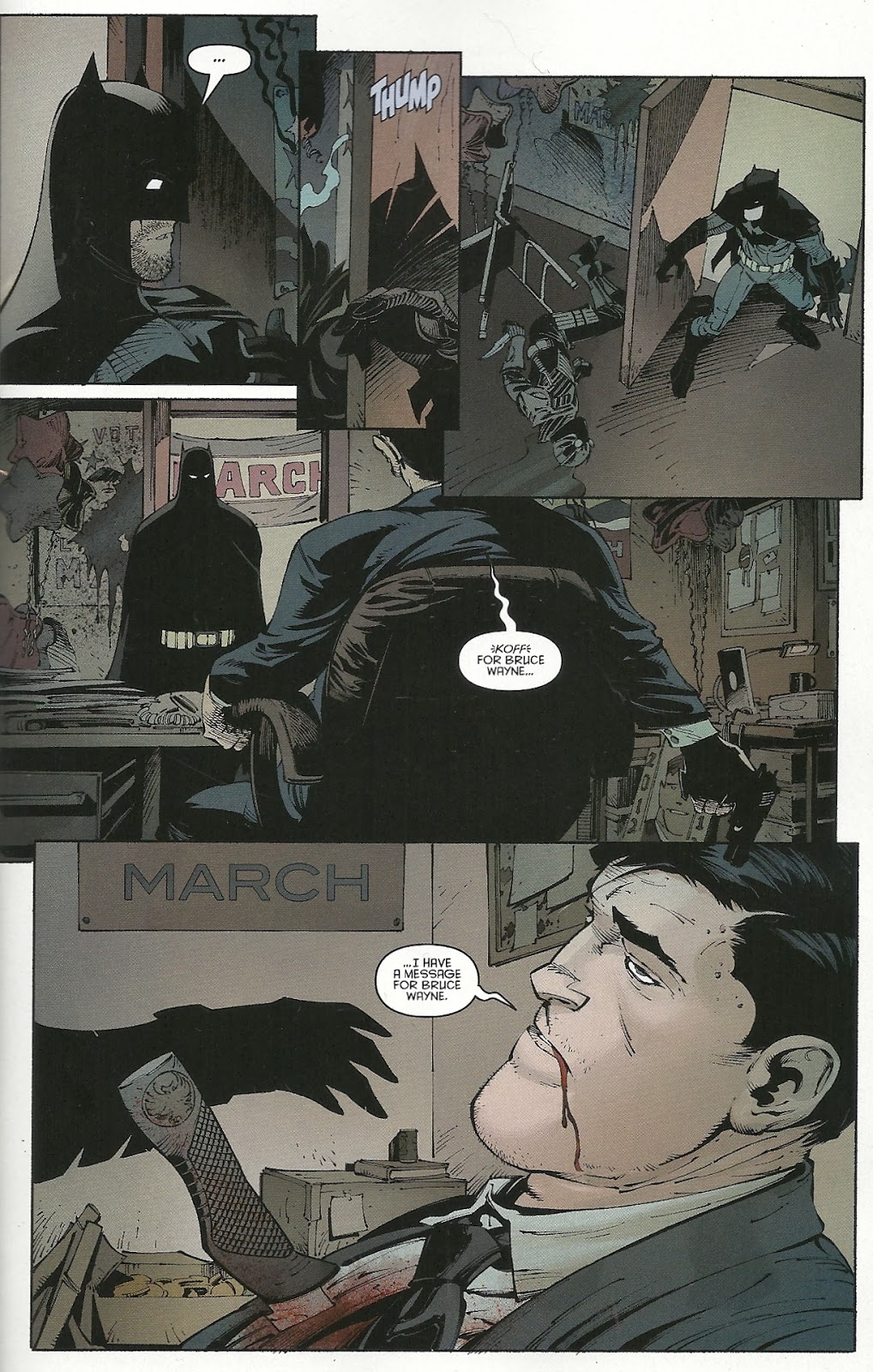
At the climax, it is revealed that among their more prominent members is mayoral candidate Lincoln March, who Capullo draws to look a lot like Bruce Wayne. And with good reason!

March claims to be Thomas Wayne Jr., Bruce Wayne's younger brother, who was still in Martha Wayne's womb when she was in a terrible car accident. Born early and severely brain-damaged, he was put in the "Willowood Home For Children" (In Haney's story, Thomas Wayne Jr. was in the "Willowood Asylum;" like Morrison then, Snyder was heavily referencing the now non-canonical early '70s story). Feeling abandoned by his parents and older brother, Wayne/March was raised by the Court of Owls to inherit the Wayne empire. That didn't quite work out, nor did his run for mayor, so he ultimately makes a play to seize control of the Court of Owls, even going so far as to give himself the Court's undead-making super-secret super-serum, the one reserved for the virtually un-killable Talons. Then he puts on a fancy new Talon suit; "Something tough and modern," he says of it, " Something to rival the Batman."
While he never goes by that name, Snyder and Capullo's March/Wayne dons a fancy owl costume and essentially becomes an owl man. (As to whether or not he actually is Thomas Wayne Jr., Bruce Wayne and Alfred Pennyworth are certain that he is not, that Bruce's brother actually died from the wounds sustained in that crash, but Bruce says he can't know with 100% certitude until he gets a DNA sample, and March/Wayne disappears during their climactic battle, in the fashion of many supervillains—presumably killed, but with no body discovered).
Then, in 2013, writer Geoff Johns re-introduced the new, New 52 version of The Crime Syndicate, who are once again from Earth-3, a parallel world where many aspects of the DC Universe is "reversed," including the fact that the heroes are villains and the villains are heroes. This Syndicate also has an Owlman, and as Johns reveals in issues of his Justice League of America, the new Owlman of Earth-3 is still Thomas Wayne Jr., now once again Bruce Wayne's older brother.

In Johns' origin story, the two Wayne children—Thomas and Bruce—conspired to kill their own parents, and, on the night when they were shot to death in the alley, Bruce had last-minute, second thoughts, so Thomas Jr., conspiring with Alfred Pennyworth, kills his mother, father and little brother. He then grows up to be Owlman.

So this is strange.

On the "real" Earth of the DC Universe, which I'll call Earth-New 52, there is a heroic Bruce Wayne defending Gotham City as the superhero Batman, and a villainous "Owlman" who is—or at least claims to be and presents a pretty good case for being—Thomas Wayne Jr.

And on Earth-3, the reversed world where good is evil and evil is good, Bruce Wayne was good (well, he was a spoiled brat who considered killing his parents, but he wasn't as evil as his brother), and a villanous Owlman who is really Thomas Wayne Jr.

In that respect, at least, the worlds aren't opposite at all. Thomas Wayne Jr./Owlman is a bad guy on both worlds, just as Bruce Wayne/Batman is a good guy (or at least not a bad guy) on both worlds.

Saturday, January 11, 2014

Hey, look! Here's a rare example of Scott Snyder and Greg Capullo sucking!


The Scott Snyder/Greg Capullo creative team has enjoyed enormous, even remarkable popularity since they started producing DC's Batman title on a monthly basis in late 2011, as part of the publisher's "New 52" line revamp. Sales of the title are still higher than they've been in a long time, and it's the publisher's best-selling book, month in and month out. It's also garnered a lot of praise, which may not mean as much to a Big Two bookkeeper, but is generally a good sign of how popular and how good a book actually is: For the most part, fans love the Snyder/Capullo Batman, and comics critics seem to like it as well.

I'm no different. As a fan and as a critic, I have to confess that it's generally a very good, very well-made comic book. Snyder's Batman hasn't been as full of big ideas as Grant Morrison's, but then, few writers inject ideas into their superhero scripts the way Morrison does; Snyder's has read the most like the "real" Batman for a long, long time now, and the writer obviously gets, likes and thinks through the character and the character's cast.

Capullo does good work, too. He's not my favorite Batman artist of all-time, nor was he even the best drawing the character in the few years since he assumed the role on the flagship (Batman, Inc's Chris Burnham and Batman and Robin's Pat Gleason are both hard pencillers to beat; hell, I think Becky Cloonan's short contributions to the trade paperback I scanned the above pages from is likely superior to Burnham's on a technical level and, subjectively, more aesthetically pleasing to me personally).

But he's definitely a good artist, and were we sitting in judgement of DC's current creative stable, dividing the goats from the lambs (to use a blasphemous metaphor), then Capullo goes with the lambs.

But the Snyder/Capullo team isn't perfect. I've been following their run primarily through trade collections, and this week I read Batman Vol. 2: The City of Owls, which is actually the second time I saw the above sequence (much of this particular trade was previously collected in Batman: Night of the Owls, a massive collection including key chapters from Batman and the many Batman spin-off comics).

There were a few examples in their first trade collection, The Court of Owls, that seemed a little off to me, but the above sequence, inked by Jonathan Glapion, is an all-around, downright poorly executed sequence. It comes from Batman #9.

Go ahead and reread it, and then we'll talk about it.

For context, Batman has just fought off a full-scale invasion of Wayne Manor and the Batcave by the undead assassins from The Court of Owls, who now know he and Bruce Wayne are the same person. The Court's assassins were meanwhile attacking prominent Gothamites all over the city, and Batman has just raced to the office of mayoral candidate Lincoln March to try and save him.

That first page has just two big, overlapping panels. In the first, we see a flying shell casing and a cloud of smoke, suggesting a gun has been fire in that panel, in that moment...but it's actually fired in the next panel, in the next moment. Capullo simply drew the cloud of gunsmoke and the shell casing fired in the second panel overlapping the first panel. In other words, the two panels overlap one another, the artwork blending together to confuse when exactly a pretty important action—March firing a gun in Batman's direction while saying "You...Bruce Wayne..."—is actually occurring.

The second page doesn't have anything quite as egregious as the first panel being slid between two planes of the second panel, but it's still not told particularly well. As is revealed in the first tier of panels, there was actually a Court assassin hiding behind the door that Batman just opened, and March was shooting at the owl, not Batman, but, if you compare the two pages (and they were on facing pages within the book), the mechanics of it don't really work out, as Batman's holding the door open, covering the assassin, up until the point at which the assassin hits the ground (and there's no hole in the door indicating March, who wouldn't have really been aiming quite correctly, shot the assassin through the door).

Oh, and he's also got a huge knife stuck in his chest, something that is mean to surprise the reader, who can't see that part of March until that reveal panel, but the only reason we can't is because on the first of those pages, Capullo covered the knife wound with another panel. It's not clear why Batman doesn't notice immediately, as he is looking directly at March when he walks in the door, and doesn't seem to be surprised by anything until he hears his secret identity spoken and a gun goes off.

Anyway, that's a terrible two pages of an otherwise good comic in an otherwise good story arc in an otherwise good run on an ongoing title.

Monday, November 25, 2013

A much longer than necessary, story-by-story review of The Joker: Death of the Family

One factor in both the creative success and, I think, the reader popularity of writer Scott Snyder’s five-part “Death of the Family” arc in Batman was its context.

After a one-issue appearance in writer/artist Tony Daniel’s  2011 Detective Comics #1, in which the new, New 52 Joker appears just long enough to have his own face removed and nailed to a wall, the character disappeared for one year, both in story time and in real-time.

Thanks to remarkable restraint on the part of Snyder and the other writers of DC’s ever-growing line of Batman comics (and, one imagines, a great deal of editorial enforcement), The Joker was a non-presence in their line for that entire year (save for flashbacks and appearances in out-of-continuity books like the digital-first Legends of the Dark Knight).

That meant that when The Joker finally did return in this storyline, it almost automatically made the storyline special, and the reader could more readily identify with Batman: This wasn’t an everydaynight threat like The Court of Owls or The Penguin or Two-Face or the Al Ghul family, this was something more rare, unique and even apocalyptic (It wasn’t all due to the fact that DC rested the character, of course, but that sure helped prime the pump).

The stories collected in Joker: Death in the Family chronicle DC’s 180-degree turn on their policy regarding Joker appearances, the strictly controlled rationing of the first year of The New 52 turning into a deluge.

If you read the storyline monthly, I imagine all these Joker appearances in all of the Batman books got very tedious very fast, and might have even ruined the experience that Snyder, artists Greg Capullo, Jock and others crafted  in the Batman title: A 100-page, novel-length, can’t-put-it-down epic, perfect for a graphic novel reading (Also hurting? The climax of Grant Morrison’s years-long run on Batman, which was playing out simultaneously in Batman Inc; the stories don’t compliment one another very well, and somewhat contradict one another, and a thing that DC was promising at the end of “Death of the Family” actually occurred in Batman Inc like a month later. More on that later).

This Joker book, on the other hand, collects every thing labeled as a crossover or a tie-in, making for a 456-page slog that oughta make anyone sick and tired of The Joker. Most of these are somewhere between lesser quality and far lesser quality than that of the Sndyer and company material from Batman…except for the bits of it that are Snyder and company’s material from Batman.

As DC did with their "Night of the Owls" crossover material, this book doesn’t collect everything, but it does collect all of the tie-ins (which will also be collected individually in collections of their home titles), plus repeats important material from the main book, Batman.

So this doesn’t replace Batman Vol. 3: Death of the Family, it’s meant to be a companion to it…although it does include some key material from Batman Vol. 3 as well.

It’s meant for completeists who trade-wait, basically. If you just want to read “Death of the Family,” then you’ll want to read Batman Vol. 3. If you just want to read “Death of the Family” and maybe follow your favorite character Batgirl, well, read Batman Vol. 3 and Batgirl Vol. 3, both sub-titled “Death of the Family.” And so on. But this book? This is really only for someone who wants way too much of what might at first seem like a good thing.

Because the book contains material taken from so many books (in addition to collecting the entirety of many issues), its broken up by character, rather than title or story arc.

Let’s take them on individually, because I am a glutton for punishment and, if you’re still reading, so are you (For a more concise, and less exhaustive exhausting review, I did cover this book in the space of a few paragraphs elsewhere already).

BATMAN

This part is taken from three issues of Detective Comics, by writer John Layman and artists Jason Fabok and Andy Clarke…or, I should say, the lead story in three issues of TEC, as TEC now has back-up stories featuring related side-stories. It seems that what Layman and company did for the “Death” crossover was to use the main story for the tie-in, and retreat into the back-ups to tell their own, ongoing story (In which The Penguin’s right-hand man decides to usurp his boss’ criminal empire, and declare himself “Emperor Penguin”).

The TEC tie-in is sort of counter-productive, and doesn’t seem to sit well next to the Batman portion of the event, unfolding in Batman.

In it, Batman is running around town dealing with various Joker wannabes, clown-themed killers, gang-bangers and idolizers who are celebrating the villain’s return by going on crime sprees of their own.

Among the legions of Joker fans is a small group of the most-accomplished and threatening of the would-be Joker acolytes, calling themselves “The League of Smiles.” They’re lead by someone calling himself “The Merrymaker” who claims to represent The Joker.

On it’s own, and de-coupled from “Death,” this would be an okay Joker story not actually featuring The Joker, but here it basically just raises logistical questions, like why Batman is dealing with this crap all by himself when he has a family of helpers who could be dealing with it while he concentrates on bringing down The Joker (The whole point of the "Death" story being that Batman now has an entire family of helpers, and whether The Joker can kill that family unit or not; in it, Batman expressly forbids them all from going after The Joker themselves), and when he finds time to do this between the panels of the story in Batman, which, frankly, keeps him pretty busy.

The designs for a few of the Leaguers are stronger than others—too many of the background characters look too much like juggalos (Am I spelling that right? It is not in my spellcheck, apparently)—although I’m not a fan of Fabok’s art. It’s very detailed, and looks like very good David Finch art (if you can imagine such a thing), or perhaps not-as-good Ethan Van Sciver art.

The origin of The Merrymaker is kind of interesting, especially when taken in relation to the overall theme of Layman’s story here, although I had a hard time accepting his fate after reading The Law of Superheroes regarding whether The Joker and his ilk should be able to avoid prison or the death penalty by being criminally insane.

Also, the whole Joker-as-inspirational figure aspect of the story does feel like something cribbed from the old Batman Beyond cartoon, and was recently explored in the new-ish Batman Beyond comic book storyline “10,000 Clowns.” Not sure if Layman’s story came out before “Clowns” or not, but the cartoon certainly established that aspect of the Joker long ago. 

CATWOMAN

This two-part story by regular Catwoman writer Ann Nocenti, pencil artist Rafa Sandoval and inker Jordi Tarragona is just a mess, although it’s a pretty good-looking mess, thanks to the fine artwork. Or, that is, the fine design and rendering chops on display in the artwork; large sections of the art border on unreadable.

I suspect that was a creative choice on the part of Sandoval and/or Nocenti, meant to reflect the crazy mind of The Joker, or the crazed state he puts Catwoman in, and/or the effects of various drugs she’s exposed to.

There are whole passages though, some of which are action scenes, that don’t make any sense in terms of size, scale and place. The Joker and Catwoman will be fighting in a panel, for example, and both bodies are just drawn on the page, not interacting in any logical way with one another or the setting they’re in; Catwoman will be perched on a ledge high above the city, and a truck will drive by and hit her. Toys change sizes and function in bizarre ways. At least two death-traps she escapes from require careful reading of the text and then re-reading of the art, so a reader can figure out what should have been drawn there in order for the scene to make sense.

It’s so hard to read, and there seems to be some breakdown in communication between the script and the art, that it’s hard to even give the story too much in the way of consideration. Basically, Catwoman falls somewhere between a Batman villain and a Batman ally, and Joker treats her accordingly: Visiting her and trying to press her into some service as he does to Harley Quinn, The Penguin and Riddler in the Jock-drawn Batman back-up stories, yet also attempting to take her out of Batman’s life in order to kill Batman’s “family.”

This could be due in large part to Catwoman’s rather confused status in The New 52, but I suspect Nocenti chooses simply to present The Joker as feeling Catwoman out, emotionally torturing her and physically trying to kill her in an attempt to figure out where she is in terms of Batman, before leaving her as they go their separate ways.

I really liked what bits of the artwork I could read, and I suppose the storyline works well enough as a time-wasting answer to the question of “Hey, how come Catwoman didn’t help Batman out during ‘Death of The Family’…?”

If that is what you’re in to.

I was surprised by three bits, the first two because they seemed needlessly provocative, the third for just being dumb.

The first was the scene in which Catwoman’s black friend shows up clutching a bucket of fried chicken (She’s only on three pages, two of which feature her eating fried chicken). I think the chicken’s only there so Catwoman can make a comment about not liking the skin, meataphorically tying in to one of the themes of this story and “Death” in general, but it feels…off to have your only black character eating a bucket of fried chicken constantly. (Also? Catwoman doesn’t seem like the sort to eat fast food-chain fried chicken; nutrition aside, I can’t imagine that grease is all that great a thing to get on a super-thief’s hands as she’s about to go to work).

The second was the inelegant way in which Catwoman phrases her realization that The Joker is even more in love with Batman than she could ever be: “He’s so blind he can’t see he just wants to be Batman’s be-yotch.”

The third? Just the disguise Catwoman wears to a meet a contact:


Er, maybe a short blonde wig and a pair of dark sunglasses might have disguised the fact that you’re Catwoman a little better than simply wearing a hood over your Catwoman costume…?

HARLEY QUINN

This section includes the two Harley Quinn bits from Batman: The Snyder/James Tynion IV/Jock back-up story in which The Joker approaches Harley and presses her into service in his plot to take down Batman, first suggesting he allow her to cut off her face with a straight razor and, when she declines, instead having her dress up as The Red Hood for him, and the Snyder/Capullo portion of Batman in which she does as The Joker asks.

These are book-ended by passages from Suicide Squad, written by Adam Glass and penciled by Fernando Dagnino, which show The Joker pre-approaching Harley for this task, and then attempting to dispose of her afterwards.

It’s unnecessary information to non-readers of Suicide Squad, and evidently only there for the anal retentive who want an explanation for, say, what Suicide Squad leader Amanda Waller might think about Harley running off to be in a Batman comic for a few pages.

It’s also, in keeping with what little of Suicide Squad I’ve read, crass and poorly-drawn.
Dagnino’s main concern seems to be getting Harley’s huge, white boobs just right, as they are in most every panel, barely contained in her tiny, ever descending corset thingee. He also spends a lot of attention on the Joker’s gross new face, but he pays less attention to things like Harley’s cape, which is there in one panel, gone in another, and then back again.

The plot of these book-ends? Harley, Captain Boomerang and Amanda Waller are at Deadshot’s funeral, when The Joker attacks everyone with a paralyzing rain that knocks everyone but Harley, dressed in a black fetish-y widow’s outfit, unconscious.

The Joker punches her in the face, then sticks a straight razor in her open mouth, playing around the inside of it with the blade as he talks to her a half-dozen panels.  Then he threatens to cut of Deadshot’s corpse’s dick if Harley doesn’t help him. She agrees.

Then we get the Batman sections.

Harley, back in her tiny Suicide Squad costume is then attacked by The Joker, and the pair have a pretty savage battle.
He strangles her with a chain, attempts to throw her in a vat of chemicals, bites off part of her ear, and sics rabid hyenas on her (These Dagnino draws as if he’s simply going by someone’s description of a hyena, rather than Google Image-d “hyena;” one takes a big, bloody bite out of Harley’s thigh, but the wound disappears in the next panel, and apparently she doesn’t get rabies from the bite).

She attempts to throw him into the same vat of chemicals, bites off part of his tongue and smashes him face-first into a boiler so hard that his face sticks to it, and he has to peel it off and re-fasten it before continuing the fight.

The Joker ultimately wins, and chains her in a room full of skeletons to starve to death, but she manages to escape, by tearing her flesh out of the shackles.

 BATGIRL

Gail Simone’s Batgirl is one of the books I’ve been most actively avoiding since the New 52-boot. I don’t think the reboot was a good idea in general, particularly since it was a sort of half-assed reboot where rather than starting over, they just changed a bunch of stuff in the characters’ histories, and didn’t tell anyone what had changed (And, of course, certain characters, titles and franchises were rebooted more thoroughly than others).

And, speaking as a fan here, I liked Barbara Gordon. I liked Oracle. I liked that she had a story, a character arc, in which she grew up and changed. I liked that there was such a prominent character in the DC Universe that was in a wheel chair. Reverting her to a teenage crime fighter in a Bat-costume, making her Female Batman Analogue #2 seemed like a supremely bad idea to me (Also, I didn’t like any of the creators involved enough to try to ignore all of that to try the book out).

But! If you were going to so thoroughly reboot Barbara Gordon’s history so that she was never Oracle, so that she was still a very young girl and so that she was still Batgirl (something she gave up being before she lost the use of her legs), then why on earth wouldn’t you also reboot the fact that The Joker once shot and paralyzed her?

The only things they kept in continuity regarding Barbara Gordon were 1). She has red hair 2.) Her dad is Police Commissioner Jim Gordon and 3.) Batman: The Killing Joke totally happened.

This got to brain blowing-up for me when Barbara mentions in the narration that not only did The Joker still shoot and paralyze her, she was paralyzed for three years, and has only been Batgirl for a year after that.

So, and I know I mentioned this on the blog before rather randomly, this means that Batgirl was only Batgirl for about a year or less before being shot, and has only been Batgirl for another year or two since. It also means she was Batgirl sometime around Year Two of Batman’s career, and also got shot by The Joker around that time.

That’s just nuts. In the previous continuity, Dick Grayson wasn’t even Robin until the third year of Batman’s career. Here Batman's got (and lost!) a Batgirl immediately. It also rather boggles the mind as to how Batgirl is, like, any good at all when it comes to like, you know, fighting and superheroing. I had spent as much time training to run 5K races by the end of my sophomore year of high school, and I wasn’t exactly Olympic material or anything, you know?

This also means that while The Killing Joke still happened, it happened very differently (Maybe Simone already wrote it, within the earlier pages of Batgirl?). I’m not sure the story—written as a sort of “last” Joker story—makes sense if it happened, like, during Year Two, as Batman and Commissioner Gordon could have only dealt with The Joker so many times by that point in their careers (Also, where was Robin in The New 52 Killing Joke? There had to be one. With four Robins in five years, Batman couldn’t have gone without one for any significant stretch of time). Batgirl couldn’t have retired from crimefighting at that point; she’d just started. And if that was four years ago and she’s in her early 20s no, did that mean she was a minor at the time? Because that’s a whole new icky aspect to an already dark, dark story.

Feh.

Anyway: This story. It’s four issues of the Batgirl monthly, all written by Simone. The first issue is drawn by Ed Benes who is, you know, Ed Benes.

The rest of them seem to be drawn by Daniel Sampere, who does one of the better Joker faces (but it’s still not as good as Patrick Gleason; that guy’s the all-around champion Joker face drawer).

Simone is picking up the Commissioner-Gordon’s-son-is-a-brilliant-serial-killer plotline that Scott Snyder started during his Detective Comics run, which The New 52 reboot cut short (and seemingly forced him to abruptly end unsatisfactorily).

In this story arc, The Joker has kidnapped Barbara’s mother as a means to lure her to him for capture, ultimately deciding he wants to marry Batgirl. James Gordon Jr. is heavily involved throughout, ultimately outwitting The Joker and temporarily saving his sister and himself—but Batgirl still ends up as she must, in The Joker’s clutches for the finale.

The story ends with a splash page featuring The Joker changed out of his repairman’s costume and into his more traditional purple suit, about to uncover a silver serving dish dripping blood, and telling Batgirl, “You simply won’t BELIEVE what I’ve got under her for YOU!” (Hey, so, uh, spoiler warning, right? You’ve all read “Death” at this point, and know what is actually under all the serving trays? What did he show to The Penguin and Two-Face in the penultimate issue of the arc? He showed them one of them, I guess, but which one? That bugs me).

In the context of this book, and taken on its own terms rather than in the greater scheme of things (i.e. all my kvetching about continuity and the fucked-up, ridiculous timeline of the Bativerse above), this is probably the average book in the collection. It’s not the best, it’s not one of the better ones, but it’s not the worst, nor one of the worse ones.

It does present a couple of problems, I think.

First, The Joker’s plan for his wife is to Boxing Helena her, although I don’t think Boxing Helena is ever mentioned. Is there another source for a story in which a dude cuts off a woman’s limbs in order to keep her that both Simone and writer/director Jennifer Chambers Lynch were alluding to independently in Batgirl and Boxing Helena, or is this an unattributed homage to the film on Simone’s part? (To be charitable in my phrasing).

And secondly, this story seems to directly contradict the ending of “Death” in Batman in two ways. (Again, spoiler warnings, okay?) So one of the ways in which The Joker metaphorically kills Batman’s family is by sowing doubt and distrust among his sidekicks. He repeatedly claims to know who they all are in their real, civilian lives, and to have all of their secrets written down in a little book he carries with him at all times.

These are, it ends up, “jokes.” He has no idea who they are (nor does he care at all), and the book is blank. Like the gag with the serving dishes, this is just a fiendish joke of his own.

But in the Batgirl arc, he shows his book to an Arkham psychologist in flashback, and it doesn’t seem to be blank.

Also, clown-masked thugs attack Barbara Gordon’s apartment, and The Joker kidnaps Barbara Gordon’s mom to apparently trap her; the script makes it sound like The Joker doesn’t know she’s Batgirl’s mom, but, at the same time, why did he kidnap her in the first place? If it was to draw someone else out, like Commissioner Gordon or Batman, it doesn’t work, and he doesn’t seem to have tried to contact them, or be disappointed to end up with Batgirl instead.  He’s just sort of hanging around a skating rink with a kidnapped Mrs. Gordon, having set a bomb and ringed the place with snipers…just in case Batgirl or someone comes for him…?

RED HOOD AND RED ROBIN

And here we get into the absolute nadir of the tie-ins, the Scott Lobdell and Fabian Nicieza-written issues of Red Hood and The Outlaws and Teen Titans that crossover with one another, featuring art by six different artists (Of whom Ale Garza is maybe my favorite, and Brett Booth is probably the biggest star).

Now Teen Titans and Red Hood are two more books I’ve avoided since the reboot, for much the same reasons as Batgirl. In addition to featuring creators I wasn’t interested in, they rebooted characters I liked into unrecognizable versions that don’t really make any sense, if you stop and think about them for, like, any seconds.

The characters are—or were—second and third-generation heroes, but there are no longer any generations in the DCU, as everything sort of happened simultaneously, so Robin III Tim Drake and the grown-up sidekick of Green Arrow Roy Harper aren’t really themselves anymore (Also, have you seen what they make poor Tim wear these days? Yikes).

Also, as with Batgirl and The Killing Joke, DC apparently decided not to reboot “A Death In The Family,” the storyline in which The Joker killed Robin II Jason Todd, who DC brought back to life many years later through a Superboy punch (I don’t know the explanation for why he’s alive in The New 52, but he was apparently still killed by The Joker and resurrected).

Reading this felt like reading a “Heroes Reborn” version of The Titans.

Here’s a plot synopsis.

The Teen Titans, in civilian clothes and calling each other by their real names (Kiran, Miguel, Cassie) discover that The Joker must have kidnapped their ally, Red Robin (These Titans are apparently Some All-Black Lady With Glowing Eyes I Didn't Catch The Name Of; Bunker, introduced with some fanfare as a gay teen, who here talks like 1980s Vibe only without the phonetic accent; Wonder Girl and Kid Flash, who is Bart Allen).

Meanwhile, Jason Todd, in his civilian identity, was hooking up with some lady he hooks up with, when The Joker stages an extremely elaborate attack in her apartment (Again, this story seems to indicate that The Joker knows Red Hood’s secret identity), and eventually captures Todd.

He fights him, and after making him run a gauntlet seemingly designed to prove without a shadow of a doubt that he totally  knows his secret identity, deposits him in a room alongside an unconscious Red Robin.

The Teen Titans and the, uh, Outlaws arrive in Gotham to look for their teammates, and Batgirl shows up to make a stupid, already outdated po culture reference…
…and offer some sort of logistical support (So this story must take place after the Batgirl one, which it follows in the collection).

The Joker has, of course, planned for the intervention of Red Hood and Red Robin’s allies, and while Kid Flash runs all over town looking for them, he’s spreading a form of Joker toxin that turns everyone it touches into a Joker, which the superheroes spend the rest of the story fighting.

In this hideout, Joker says he has kidnapped Todd and Drake’s fathers, and he makes the two former Robins fight to the death in order to save their own father (This is a fake-out. He doesn’t actually have their fathers, but reasonable facsimiles. But in order to fake them out, he must have known enough about them to know what their father’s might look like, right? So, again, this seems contrary to the end of “Death”).

The Robins figure out The Joker’s game, and Red Hood tries to shoot him to death, but The Joker anticipated that too, and then The Robins are both gassed unconscious again, and the last page features the serving tray scene we’ve already seen at the end of Batgirl.
Oh, and the weirdest part? At one point, Tim narrates that Jason is "Maybe the person who has come closest to being an actual brother in my entire life."

That's...that's a pretty extraordinary difference than the old DCU. 


NIGHTWING

This three-issue arc of Nightwing, by writers Kyle Higgins and Tom DeFalco and pencil artists Eddy Barrows and Andres Guinaldo (with a pair of inkers and a pair of colorists), seems like a conclusion to what was a major arc in the title, and seems to come so close on the heels of that arc that it seems as if the book must have changed directions rather suddenly.

The last Nightwing comics I read came in the trade Nighwing Vol. 2 and in it, Dick Grayson had decided to invest in Gotham, similar to Bruce Wayne, but without Wayne’s finances backing him, creating “Amusement Mile,” an entertainment area in which his Haly’s Circus would be housed.

The Joker scuttles those plans, killing off one of Haly’s clowns, kidnapping and Joker-izing the rest of the circus and, in the course of his fight with Nightwing, blowing the whole place to kingdom come. That seems pretty significant to the title,  but then, I haven’t read anything that’s followed, so I’m not sure to what extent the title really did change direction.

As with several of the stories above, this one features a Joker plan so elaborate that it stretches credibility in and of itself. If all he did during this night or three screwing with Batman was the stuff he pulled off in Batman, that in and of itself would have been a near miraculous bit of planning (tapestries of living victims hanging from the ceiling, recruiting The Penguin, freeing the Arkham inmates, dressing some of them up and pressing them into service, et cetera).

But in addition to that—and his elaborate traps and plans to get Batgirl, Robin, Red Robin and Red Hood—here he breaks someone out of Blackgate, kidnaps and poisons an entire circus, rigs a section of town with explosions and, digs up almost every single person at Haley’s who has died and posed their corpses on pikes just to shock Nightwing. And, unlike in Batgirl, where he had a gang, here he seems to be working alone.

Maybe the real origin of the New 52 Joker was that he was a janitor at the Central City police station, and he was mopping the floor on the other side of the shelf full of Flash chemicals the night lightning through Barry Allen into them…?

On its own, it’s a fine example of The Joker as a master-planner, Batman’s evil opposite in terms of being prepared for any eventuality and able to take down anyone, so long as he has time to plot for a victory.  But with the other half-dozen stories that occur simultaneously? It’s kind of hard to process how this event works, unless The Joker is, like, six different people.

Oh, and the fact that Joker targets everyone at Haly’s except Dick Grayson in order to get at Nightwing would seem to indicate, once again, that The Joker totally knows his secret identity, which is contradicted in the conclusion of the arc in Batman.
The art is, as it was in the previous issues of the series I read, the weakest part, and the multiple art teams for just a single arc is a good indication of why (although I’m not generally a fan of Barrows’ style, with its muscular, agonized figure work and strained, over-acting faces…even if it is somewhat appropriate here, given the number of characters wearing chemically-enforced expressions and fighting to the death).


ROBIN

This section contains the tie-in issues of Batman and Robin, by Peter Tomasi, pencil artist Patrick Gleason (only one pencil artist? Weird!) and inkers Mick Gray and Keith Champagne.

Visually, it’s by far the most accomplished work in the book, eclipsing even Greg Capullo’s chapter (Looking at sales charts, I may be in the minority here, but I think Gleason is the best Batman artist at the moment, head and shoulders above Capullo and head, shoulders and torso above the rest).

His is also the best and scariest Joker. Part of that is simply how horrifying some of The Joker’s actions with his face that Tomasi has him take are (When Robin first encounters him, Robin is hanging upside down by his ankles, and The Joker has his own face on upside down, so his eye-holes are full of teeth and his maniacal eyes are staring out of a wide mouth hole).
Much of that though is how Gleason draws the face. First, it’s thoroughly three-dimensional, with a pancake-like thickness, rather than appearing like a mummy-think, paper-like mask, as most of the other artists draw it.  There’s a tactile quality to The Joker’s flayed-off face, which makes his playing with it all the scarier.
Gleason also seems to have put more thought into what that might actually look like, so instead of having a nose structure, the face is smooth there (Having never skinned a face, I’m not sure what happens to the nose area, as there’s no bone under there, just cartilege…would the face-flayer have cut around the nose, leaving a nose hole, similar to the eye and mouth holes, or chopped it off completely? Is it possible to skin the nose itself?)

Most of the time, The Joker’s eyes aren’t visible through his eye-holes, but appear in shadow….particularly in medium or long shot.
Tomasi and Gleason include plenty of other horror elements, though. First, the setting here is a zoo, which The Joker has also taken over and filled with various traps (a giant, prop Robin’s egg, an avalanche of insects, hyena’s poisoned with Joker venom, etc). A skating rink, an abandoned church, Amusement Mile, the Gotham City Zoo, and incursions into police headquarters, Wayne Manor and Blackgate Prison…how much of the city did The Joker conquer in this crossover series…?

Gleason draws awesome animals, and fills the pages with the squicky horror of insects crawling all over. The Joker’s rotting face naturally attracts the attention of flies and, here, maggots (as the crossover progresses, flies gradually appear around The Joker, and, at its climax, Capullo and company show the face starting to turn brown rather than chalk white, as if it were rotting).

Remember feeling itchy, wriggly and repulsed during that bug-cave scene in Indiana Jones and the Temple of Doom? Imagine this then: The Joker pulls a cord, and a trapdoor opens above Robin, half-burying him in piles of insects, worms and other creepy-crawlies..

Damian and The Joker have encountered one another a couple of times during Morrison’s apparently still in-continuity issues of pre-New 52-boot Batman reboot, and those are referenced here. The two have a pretty interesting relationship, as Damian is generally written like a kid-version of the angry, violent take of Batman, albeit one who is even more angry, more violent and willing and able to kill, as he was trained to do since birth.

Knowing this, The Joker apparently presents Robin with an enemy he’d hesitate to hurt too badly: A Joker-ized Batman (who ends up not being Batman, but a reasonable enough facsimile to fool the drugged-up Damian).

He first appears emerging from the sea of bugs.
It ends as all of these chapters do, with The Joker seemingly in a life-and-death struggle with the sidekicks, before the whole thing is more-or-less called off, and the sidekick taken captive, only to awaken to The Joker offering up a gory sliver platter that readers would have safely assumed almost certainly contained the head of Alfred Pennyworth.

Oh, hey, check out Gleason’s drawing of the polar bear habitat:
As with the architecture of the parks in Gotham City (as seen in Batman/Superman #1), and its many insane-looking gargoyles, that seem to be more evidence that the reason that there are so many violently insane people in Gotham City is that all of the public space seem to have been specifically designed to drive everyone who lives there crazy.

CONCLUSION

This is Batman #17, by Snyder, Capullo and inker Jonathan Glapion, the conclusion of the core “Death of the Family” story from Batman.

It also appears in Batman: Death of The Family, and Batgirl: Death of The Family, and Batman and Robin: Death of The Family and, I imagine, every one of the trades that are coming out sub-titled “Death of the Family.” It kind of has to, in order to resolve the stories that will appear in those books, but if you’re only reading, like Batman, Batman and Robin (the two best Batman books at the moment) and pick up this The Joker volume, you’ll be buying that same issue three times. If you read more of the Batman line in trade, you’ll be buying it and reading it in each of them (I sort of talked about this phenomenon the other week).

I’ve already reviewed Batman Vol. 3 elsewhere, of which this is the climax, but I did want to reiterate that what I thought most brilliant about it (other than those cool last two pages, where The Joker leaves a goodbye message only Batman would find), was that The Joker’s ultimate attack was premised on a series of evil jokes on Batman and his family of fellow crimefighters (The contents of the platters, which we find out here actually number five, rather than just the one, and the contents of his little black bat book).

The former is somewhat perplexing in that, if The Joker still has access to his face-flayer*, he really could have done what he only pretended to do, effectively ending the lives of the characters as they know them, permanently building an unclimbable wall between them and Batman and maybe driving some of them and/or Batman crazy in the process.

I also like that Batman ultimately defeated Joker by turning his own strategy—that of the evil joke—back on The Joker. That, and that the Joker is defeated by seemingly dying—not being killed by The Batman, but falling to his apparent but certainly not actual death, his body never being found. I much prefer that sort of “ending” to a Joker story than the whole arrest and incarcerate in Arkham ending, as it forces the uncomfortable question of why doesn’t someone, anyone just kill The Joker at this point to the fore, and Arkham seems pretty silly the longer you read Batman comics, given its revolving door (If Bruce Wayne devoted his entire fortune to securing Arkham and making it impregnable, he would probably save more lives in Gotham City than he does by Batmanning).

What I didn’t like about the issue was a certain professional wrestling aspect to it; Batman seems to have been getting his ass kicked throughout the entire story arc and then, halfway through this issue, he just starts winning, because it’s time for the story to end, and he has to win (or, at least, he can’t be killed or physically lose a member of his family).

As for the metaphorical “death,” it’s a clever, coy play on The Joker’s plans, and ends ambiguously—did Batman really win? Did The Joker win? Will things ever be the same?

It was slightly clumsy in its execution though, as it makes most of the characters seem unconcerned about Alfred, who is shown to still be recovering in bed when the various family members rebuff Batman,when it’s really Batman they’re mad at. And they’re all a little too transparent. Damian’s excuse seemed especially flimsy, since unlike the others he actually lives with Batman and works with him consistently.

The other huge problem with this ending isn’t the fault of the story, but the fault of its timing in relation to the climax of Morrison’s Batman Inc, as I mentioned up top. These two stories could have used a year between them, whichever one came first, but, it ended up there was only a month between them, meaning what seemed like what was likely to happen at the end of “Death” didn’t, and the death was metaphorical; then, the very next month, someone did die.  (More on that in a bit).


EPILOGUE

The final bit of the book, before the gallery of covers, is Batman and Robin #17, by Tomasi, Gleason and Gray. It begins as a nice, night-in-the-life type of story, with Alfred meeting the Dynamic Duo in the locker room corner of the Batcave with an after-crime fighting meal, and then all three of them going off to bed.

The rest of the issue is devoted to the three characters’ dreams, with Damian haunted by a nightmare within a nightmare, and getting to enjoy a happy dream at the end, one that takes a very elegiac turn read at this point, given what happens to him next in the pages of Batman Inc.

I liked the send-off it gives Damian, and the way Tomasi and Gleason are able to touch on the stories they’ve told featuring these three characters up until this point, and to tease future directions, some of which will naturally never come to be (unless Damian is resurrected as his immortal grandfather is always being resurrected).

Additionally, the story Tomasi writes is full of cool shit for Gleason to draw, which is always a treat.


Some final Caleb thoughts…

So this  book is a little strange in the way it collects so much, and as I said, I think that, collectively, these stories all diminish the core “Death” arc, either by contradicting important elements of it, or simply by stretching a reader’s credulity well past the breaking point.

Financially, all of these tie-ins existing was probably a great idea, but I think I would have preferred it if The Joker had managed to capture the Bat-Family off-panel somehow, and, naturally, some of these tie-ins probably shouldn’t have existed at all (Catwoman and TEC certainly, and the Suicide Squad, Red Hood and The Outlaws and Teen Titans issues probably could have been toned down or trimmed so that The Joker was focused on Harley, Red Hood and Red Robin, rather than involving their extended teams…although, given that Snyder already wrote a story about how The Joker approaches Harley, I’m not sure the Suicide Squad story needed to exist at all, really. In addition to being a super-violent, poorly-made comic, it also thematically lumps her into the Bat-Family, which isn’t quite right).

The extensive targeting of characters only vaguely associated with Batman or people vaguely associated with Batman—Harley Quinn and, through her, Captain Boomerang, for example, or Red Hood and Red Robin’s teammates in the Titans and the, um, Outlaws—sort of begs questions like, “Hey, why did The Joker leave Batwoman out of it? She’s got a “Bat” right there in her name, unlike Catwoman").

Or why wasn’t Batman Inc more extensively targeted, particularly given the fact that, you know, most of them were in Gotham City at this very same time.

And that’s the biggest problem with “Death of the Family” and the conclusion of Batman Inc, the end of Morrison’s years-in-the-writing Batman story.

The events of “Death” are obviously pretty dramatic, with The Joker, as I said, conquering several square miles of Gotham City (on the downlow, apparently), publicly attacking a few big targets and killing God-knows-how-many, while managing to capture a half-dozen vigilantes and the bulter of the city’s most prominent citizen).

The events of Batman Inc’s ending are even more dramatic, with Talia al Ghul’s army setting a trap that lured most of Batman Inc into it, killing Britian’s Batman, occupying Wayne Tower and then blowing it up. Batman is outlawed in Gotham City. The skies are filled with warring Man-Bat ninjas and Batman robots (“Ro-Bats,” I think they called ‘em). Damian and Jason Todd have created new identities.

Obviously they weren’t happening simultaneously, and comic book readers are pretty adept at self-editing what they read, arranging into chronologies that makes sense to them.

That would have all been fine, were it not for the fact that a Robin dies at the end.

So immediately after the conclusion of “Death of the Family,” a storyline named for one of the most famous Batman stories of all time, the one in which The Joker kills Robin, a conclusion which seemed to promise the literal death of a character (with Alfred seemingly the most likely, but Jason Todd, Tim Drake and Damian Wayne all seeming kill off-able to a certain degree), but ended up being a metaphorical death.

Readers worried about their favorite characters could breathe a sigh of relief.

And then next month Robin Damian Wayne gets killed.

I imagine that was more frustrating to serial readers of the comics than to trade readers, but the suddenness of it, the way these two huge storylines jut right up against one another, was really driven home for me when I read Batgirl Vol. 3: Death of the Family. Only a single issue (and the short story from Young Romance) separate the reprinting of Batman #17, the conclusion of “Death”, and the issue of Batgirl in which she mourns the death of Robin (mostly on the cover, and by trying to call Nightwing on the phone, as she has her own storyline following up on “Death,” involving her brother, in-progress. We’ll talk about that later).

I don’t know what the solution would have been, really. I’ve wondered before if DC maybe should have waited a few years for a New 52 reboot, at least until Geoff Johns wrapped up his years-long Green Lantern mega-story and Morrison his Batman story. DC did take a few months off with Batman Inc, as it wasn’t one of the original New 52, but a replacement title in a later wave of new series. Perhaps if it weren’t for that, it would have wrapped up prior to “Death,” which wouldn’t have featured Damian in it at all…but I don’t know, maybe a Batman without a Robin wouldn’t have worked, as then Batman would be working more or less solo, just with a large group of ex-sidekicks…?

The timing of the two stories was obviously less than ideal, and I think hurt each of them when read in a larger context of the Batman line. But I don’t know how one fixes that, either, even with the benefit of hindsight.

Perhaps one fix might have been not to make such a big deal out of Damian’s death, and resurrect him immediately? I was really struck by how un-final his death was in Batman Inc. By the end of the story, his grave has been emptied, as has that of his mother, who surely won’t stay dead for long, and his grandfather is shown in a room full of clones of Damian and talking about inventing a new process for bringing the dead back to life.

I imagine Morrison left things as they were so that he could have his ending—he created Damian, he killed him—and let DC go whatever way they wanted to with him after that. But by having the entire line of Batman books mourn Damian, and then relaunching Batman and Robin as Batman and [Someone Helping Him Cope With Damian’s Loss], it seems like DC decided to let Damian stay dead for a while.

* Dollmaker, I think? I had no interest in reading Tony Daniel’s TEC run, but this story made me think it might be worth reading it just to read that initial Joker story, which seems like it probably should have been something to occur in Batman, rather than TEC, since Snyder followed-up on it; I imagine that that first New 52 Batman/Joker story in TEC was an example of DC’s editors kinda sorta pre-writing plots for their writers.