I have a review of the recently-released trade collection of Abigail and The Snowman. It is written and drawn by Roger Langridge, which is, of course, another way of saying "It is a very good comic book." The above panels are perhaps my favorite passage of the book, in which the snowman explains the difference between yeti and bigfoot to Abigail, and draws two completely identical pictures to help illustrate the differences between the two.
If you haven't read it yet, either as it was serially published or in its present collected form, you probably should. If you'd like to read a few hundred words of me saying so, you can do so at the GC4K blog.
Showing posts with label langridge. Show all posts
Wednesday, November 16, 2016
Monday, January 14, 2013
Meanwhile, at Good Comics For Kids...
Today at School Library Journal's Good Comics For Kids blog, I have a nice long interview with cartoonist Roger Langridge, whose work you are probably familiar with from Snarked, The Muppet Show, Thor: The Mighty Avenger and, of course, IDW's Popeye series, the release of the first collection of which occasioned the interview. You can read the piece here.
Langridge talked about the difficulty of writing Popeye's dialogue, the distinction he draws between writing Jack Kirby's Thor for Marvel and E.C. Segar's sailor for IDW and how he approaches writing for another artist. So if you only follow one of the many links I'll likely end up posting her on EDILW this week, make sure it's this one.
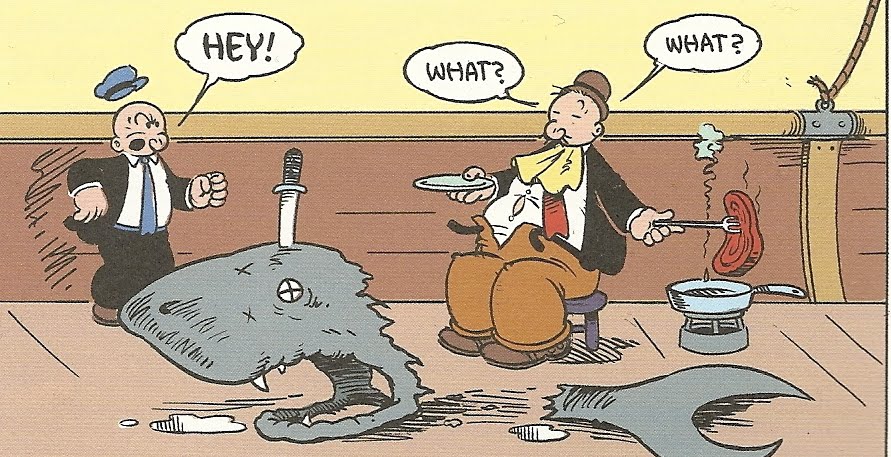
The above panel is taken from the Langridge-written Popeye #1, which was drawn by Bruce Ozella.
Langridge talked about the difficulty of writing Popeye's dialogue, the distinction he draws between writing Jack Kirby's Thor for Marvel and E.C. Segar's sailor for IDW and how he approaches writing for another artist. So if you only follow one of the many links I'll likely end up posting her on EDILW this week, make sure it's this one.
The above panel is taken from the Langridge-written Popeye #1, which was drawn by Bruce Ozella.
Friday, May 13, 2011
My two favorite gags from Robert Langridge's Muppet Show Comic Book
1.) This is from The Muppet Show Comic Book #2, collected in the tradeOn The Road, and is both written and drawn by Roger Langridge:
It's the "Too soon" I find so funny.
2.) This is from The Muppet Show Comic Book #7, and is collected in the trade Family Reunion, written by Langridge and drawn by Amy Mebberson:
The character to the left is Wormwood Soames, a Sherlock Holmes stand-in, and Fozzie's playing the part of his Watson-like assistant.
It's the "Too soon" I find so funny. 2.) This is from The Muppet Show Comic Book #7, and is collected in the trade Family Reunion, written by Langridge and drawn by Amy Mebberson:
The character to the left is Wormwood Soames, a Sherlock Holmes stand-in, and Fozzie's playing the part of his Watson-like assistant.
Saturday, October 23, 2010
Review: The Muppet Show Comic Book #11
I’ve been avoiding writing about The Muppet Show Comic Book lately, primarily because I’ve been trying not to read single issues of it and instead enjoy it in the trade collections Boom has been putting out with clockwork regularity, but also because I assume readers get bored hearing me repeat how excellent the same book is on a monthly basis.
I had to make an exception for #11 though, because how can you say no to that cover?
Beaker as Frankenstein’s monster, his dead eyes just begging me to read this issue, trade-waiting be damned!
So, um, not to bore you by repeating how excellent Roger Langridge’s Muppet Show Comic Book is or anything, but Roger Langridge’s Muppet Show Comic Book? It’s still excellent.
Langridge continues to exploit the storyline backstage, skits-on-the-stage format, here making most of the on-stage skits more-or-less integral to the backstage storyline…everything fits in this comic book in a way that is both satisfying and reassuring.
It’s a dark and stormy night at the Muppet Theatre, made all the darker by Doctor Honeydew’s latest experiment: Beaker Mark 2, a robot Beaker designed to “take the load off poor Beaker’s tired, tired shoulders." (This being Honeydew and Beaker, of course, it’s followed quickly by a Mark 3 and Mark 4).
Honeydew’s power surges (and a few unlikely coincidences) also lead to Miss Piggy sporting Elsa Lanchester hair, Gonzo getting an Igor-esque hunchback, and his chickens turning into a pitchfork-bearing mob.
On-stage, a Frankenstein’s monster Muppet serves as the guest-star, visiting Vetrinarian’s Hospital and singing a duet with Sweetums and, in one rather neat panel, appearing as part of the Frankenbop Quartet, four Frankenstein’s monsters, including Dick Breifer’s funny version of the monster* in a stealth cameo.
I’m not sure if this is Langridge’s best issue of the series so far (It’s hard to beat that first one, with the “Holy shit, I can’t believe he’s doing this!” revelation of a one-man comic-book production of the Muppet Show TV show that was both faithful and transformed, in keeping with the spirit of the corporate-controlled characters, but highly idiosyncratic…or that heart-breaking Gonzo issue), but it’s gotta be one of the better ones, and it was certainly my favorite so far (Perhaps on account of the fact that it featured so prominently my personal favorite characters).
As a loosely holiday-themed, done-in-one issue—not that there’s ever too much continuity or soap opera in these things, but some storylines do carry over from issue to issue—The Muppet Show Comic Book #11 seem like a perfect jumping on or testing-out issue. So if you’ve yet to try out Langdrige’s Muppet comics, this is an ideal one to sample. Even if you didn’t grow up with the characters and even if you don’t have much interest in them, if you’re in to great cartooning and great terrible jokes, then you should dig it.
*Speaking of which, this recently came out. I bet it’s pretty good.
I had to make an exception for #11 though, because how can you say no to that cover?
Beaker as Frankenstein’s monster, his dead eyes just begging me to read this issue, trade-waiting be damned!So, um, not to bore you by repeating how excellent Roger Langridge’s Muppet Show Comic Book is or anything, but Roger Langridge’s Muppet Show Comic Book? It’s still excellent.
Langridge continues to exploit the storyline backstage, skits-on-the-stage format, here making most of the on-stage skits more-or-less integral to the backstage storyline…everything fits in this comic book in a way that is both satisfying and reassuring.
It’s a dark and stormy night at the Muppet Theatre, made all the darker by Doctor Honeydew’s latest experiment: Beaker Mark 2, a robot Beaker designed to “take the load off poor Beaker’s tired, tired shoulders." (This being Honeydew and Beaker, of course, it’s followed quickly by a Mark 3 and Mark 4).
Honeydew’s power surges (and a few unlikely coincidences) also lead to Miss Piggy sporting Elsa Lanchester hair, Gonzo getting an Igor-esque hunchback, and his chickens turning into a pitchfork-bearing mob.
On-stage, a Frankenstein’s monster Muppet serves as the guest-star, visiting Vetrinarian’s Hospital and singing a duet with Sweetums and, in one rather neat panel, appearing as part of the Frankenbop Quartet, four Frankenstein’s monsters, including Dick Breifer’s funny version of the monster* in a stealth cameo.
I’m not sure if this is Langridge’s best issue of the series so far (It’s hard to beat that first one, with the “Holy shit, I can’t believe he’s doing this!” revelation of a one-man comic-book production of the Muppet Show TV show that was both faithful and transformed, in keeping with the spirit of the corporate-controlled characters, but highly idiosyncratic…or that heart-breaking Gonzo issue), but it’s gotta be one of the better ones, and it was certainly my favorite so far (Perhaps on account of the fact that it featured so prominently my personal favorite characters).
As a loosely holiday-themed, done-in-one issue—not that there’s ever too much continuity or soap opera in these things, but some storylines do carry over from issue to issue—The Muppet Show Comic Book #11 seem like a perfect jumping on or testing-out issue. So if you’ve yet to try out Langdrige’s Muppet comics, this is an ideal one to sample. Even if you didn’t grow up with the characters and even if you don’t have much interest in them, if you’re in to great cartooning and great terrible jokes, then you should dig it.
*Speaking of which, this recently came out. I bet it’s pretty good.
Sunday, January 10, 2010
Reviews of some recent and upcoming comics
Last Days of American Crime #1 (Radical Comics) The title of this comic book is meant to be taken somewhat literally as its premise. In the near-ish future, the U.S. government will be readying some sort of signal that will “neurologically make it impossible for anyone within its range to engage knowingly in unlawful activity.” That seems like a pretty great idea for a crime story, right? The problem is that the government in this series is doing it on the down low, which takes a great deal of the urgency out of that premise, and dulls the hook of the story quite a bit.
Well, that’s a problem. Perhaps the bigger problem with writer Rick Remender’s scripting of the first issue of this three-issue miniseries is that I only know the bit about the secret government crime-stopping signal because I read about it in the press materials for the book, and then again in an interview with Remender that ran in the back of this first issue. Reading the story itself, there’s only a passing reference to that big idea, most of the focus going to another big idea—the fact that the U.S. is about to go to a purely cash-less society will in and of itself make most forms of crime obsolete, but not before it presents a once-in-a-lifetime opportunity for a smart, tech-savvy criminal element to set itself up with an inexhaustible source of electronic wealth.
The two big ideas make almost one another redundant—in this issue at least, only one of them gets any play at all, and, remember, this is a three-issue series, so this is a 90-minute movie, Remender’s already burned through the first half hour.
The focus is on the criminal element hoping to make that one big last score. The plan is that of Graham, a rather unlikable, old-fashioned criminal type (When we first meet him, he’s about to burn a man alive). He’s so old-fashioned, he needs to recruit someone else to do the computer hacking for him, a shifty, hipster-y looking young man named Kevin Cash, and, complicating matters, is a mysterious woman who initiates some anonymous bathroom sex with Graham before later being introduced as Shelby, Kevin’s girlfriend.
You know how the news magazine’s will occasionally run big long story’s about whether America is in decline or not? Well, the milieu of Last Days is an America in which that’s no longer a question—things are bad, Robocop bad, Mexican police using lethal force to keep Americans from jumping the fence to immigrate south bad.
Artist Greg Tocchini does an excellent job of suggesting how bad the world is through his gritty, messy but still quite pretty artwork, mostly with the details in the background. It’s a nice-looking comic book, and the rocky aspects of the premise aside, Remender has written a propulsive, page-turner of a story. With two issues yet to go, there’s certainly time for Last Days to turn itself around, but even if it doesn’t, it’s not a bad bit of crime comic book-ing, and when it comes to straight genre work, “not bad” is often just as good as “good.”
Like the recent Incarnate series from Radical, Last Days is being released in 48-page, $4.99 “prestige” format, with a spine and the ads all stored up and running just in the back, segregated form the story. It’s a heck of a value, and a nice format compromise between the 22-page, stapled serial comic books and the inevitable industry standard of the trade paperback.
Lola: A Ghost Story (Oni Press) “Lola” is the Tagalog word for grandma, and preteen Jesse’s Lola has just died, prompting him to return to his parents’ home in the Philippine countryside to bury her. His Lola had a special power, a sort of mysterious second sight that allowed her to see ghosts, visions and the occasional supernatural monster. Jesse has inherited the ability, but he’s not terribly happy about it, given that the visions tend not to be a whole heck of a lot of fun and his parents, teachers and classmates don’t really believe him anyway.Writer J. Torres’ story is a low-key one, set on simmer. Our quite, withdrawn special boy hero goes about the visit, with little to no control over what happens when (as children never do in such occasions), while he learns a bit more about his Lola and legendary aspects of her childhood and abilities and deals with another dead relative, one only he can see but who never the less has a great impact on the rest of the family.
It reads quite a bit like a young adult novel, and probably makes for a pretty solid all-ages read. Torres sometimes seems to try too hard, and I found the open-ended, “I’d love to do a sequel if you guys like this” conclusion rather unsatisfying, but its otherwise a very solid story with enough going on between the supernatural imagery and the family melodrama to offer a little something for almost everyone.
Torres does a pretty great job of getting out of the way and letting Elbert Or’s accomplished art work do the heavy lifting when necessary. Or’s style is soft, round and cartoonish (like, characters only have four fingers cartoonish), all of which contributes to a sense of warmth that keeps the scarier elements of the story from overwhelming the mood. Rather than straight black and white, the book is colored in sepia tones, which no doubt help add to that sense of warmth and highlight the nostalgic aspects inherent in the returning home and coming-of-age elements in the story. (Note: This should be in shops this coming Wednesday, January 13).
The Muppet Show Comic Book #1 (Boom Kids): Boom and Roger Langridge are transitioning their Muppet Show Comic Book from a series of miniseries to an ongoing series, and this is the start of that effort (not counting the recent #0 issue). With the theater undergoing renovations, Kermit decides to take the Muppet Show on the road, and familiar routines get refit for more lo-fi, outdoor performance. For example, Electric Mayhem is now Acoustic Mayhem, Rolf’s medical drama skit is devoted to an old-timey snake oil routine and while the two cranky old hecklers who haunt the balcony aren’t around, there are two equally cranky old locals sitting on a tree branch who look and act an awful lot like ‘em. Meanwhile, Fozzie decides to strike out on his own as a street performer, and in a back-up detailing the ABC’s of this new challenge facing the sad sack stand-up, Langridge again reaches one of those occasional bits of pathos he’s been able to bring to the property. If I did my math right, this is the ninth issue of a Muppet comic scripted and drawn by Langridge, and, like the previous eight, it its amazingly fun and an impressive adaptation of one medium into another that, by all rights, shouldn’t even be possible, let alone this successful. Damn that man is good… (Note: This should be in shops this coming Wednesday, January 13)
Stumptown #2 (Oni) Greg Rucka’s portrayal of his attractive young female protagonist’s flexible sexual identity and outgoing availability is a little on the icky side, isn’t it? Last issue Rucka had his early-thirtysomething Dexedrine flirting with a mob boss’ bikini-clad daughter, seemingly making her the third lipstick lesbian comic book crime-fighter he’s currently writing (Along with Batwoman and The Question II in Detective Comics). This issue opens with her flirting with her male doctor, getting into an argument with a policeman whose marriage she broke up in the past and, upon encountering the mob daughter again, we learn that the daughter isn’t really gay (“Sorry to break your heart, but I don’t play for your team”) and that Dex is probably bi or still experimenting (“I’ve yet to figure out what team I’m on.”)That’s right boys, she’s even better than a lipstick lesbian! She’s one that might sleep with you!
That rather minor (if distracting, given Rucka’s recent body of work) business aside, Stumptown remains a rather engaging and enjoyable detective comic. Beyond her fantasy aspects, Dex is a charming enough person to spend time around, and Rucka is playing the mystery out like a real mystery novelist rather than a comics writer fooling around with the genre—introducing suspect after suspect and possible motive after possible motive, each equally likely.
I continue to enjoy Southworth’s work, even if the heavily-referenced style isn’t one I’m personally particularly fond of (I really dislike the way his cars look, but otherwise he does a pretty great job of making each panel, regardless of the amount of reference, his own). There’s some back matter in this particular issue in which the artist discusses his work which turns out to be a lot more interesting than such back matter usually is. I usually pick up a comic for the comic, not what’s in the back about the comic, but I do like reading about how artists go about meeting little challenges like, say, how to people and cars relate to one another in terms of size.
********************
I also have reviews of Jim Rugg and Brian Maruca's Afrodisiac and Josh Cotter's Driven By Lemons up at Blog@Newsarama. Click here if you'd like to read 'em.
Tuesday, April 28, 2009
Two comics reviews; one of a book that came out last week, and one of a book that comes out this week
Tales of the TMNT #57 (Mirage Publishing) Is it just me, or does Jim Lawson’s art get a little weirder with each new book he draws? Look at that cover. Look at the rigid, jagged lines on the outlines of the human characters’ limbs, the strange muscle-to-joint ratio of the figures, the bald dude’s caricature of a face, and the deep, look-at-me! blacks of the shading.I’m sure I’ve mentioned this before, as I’ve reviewed issues of Tales of The TMNT Mirage has sent me before drawn by Lawson, but I used to really dislike his art when I first started reading comics, as it was so far-removed from what I felt the “real” ninja turtles should look like (That is, like Eastman and Laird’s or, failing that, then maybe Michael Dooney’s).
His art has changed a lot since the, and my appreciation for comics art has changed even more. For example, I stopped caring what the “real” ninja turtles should look like, because hey, the ninja turtles aren’t really real-real anyway, and the question of whether or not artwork is good is a pretty different matter than whether or not the artwork is exactly how I would like it in the best of all possible worlds.
Anyway, this is another Lawson-illustrated issue of ToTMNT, illustrating a done-in-one script by Dan Berger.
That weird Lawson art looks a little weirder on the inside in black and white too. I don’t remember Lawson ever using quite so many blacks, before, but I kinda like the thick texture of all the objects and surfaces. I also really dug the fight scene at the end where the characters are splayed out in such flailing positions that it seems like someone grabbed the panels by the frames and just shook them, the combatants bouncing around within (Looking at all the hard straight lines and the bodies in motion in this scene suddenly filled me with a desire to see a Jim Lawson-drawn story featuring Captain America or OMAC or Etrigan or Black Panther or some other character known for the way Kirby made him move around the page).Am I being too complimentary of Lawson? I don’t think so, but I’d hate to lose my reputation as hard-to-please, so let me take this opportunity to point out that I hate the way Lawson always draws the turtles wearing their weapons at all times. Like, Raphael, Leonard and Donatello are all shown sitting on couches and easy chairs at one point, while their big, rigid ninja weapons are tucked into their belts. Can Raphael breathe with his sai handles pressed against his chest like that? How comfortable is it to lean back against a bo staff or pair of katana? (Perhaps the shells mitigate this). It can’t be good on the furniture.
The story opens with Michaelangelo, wearing the Ben Grimm-approved disguise of a trench coat and wide-brimmed hat, bounding over New York rooftops while being pursued by nimble gangbangers who operate under the unfortunate name of the “Madhattan Maulitia.” He’s content to just runaway, until one of them pulls a gun, which does not sit well with Michaelangelo (Wouldn’t you be pissed if you spent all that time learning to master some ancient weapon, only to find out some dudes are just going to pull a gun on you? Bringing a gun to a nunchuck fight might seem like smart thinking on the part of the gun-bringer, but it is also a dick move).
Back at a/the apartment, the four turtles argue about their living arrangements, with each of them preferring to set up shop in a different place. This leads to a lot of arguing, which is only resolved—after a big, 12-page fight scene in which all four turtles arrive dressed in their flasher costumes of trench coats and wide-brimmed hats—by Shadow pointing out that they’re being a bunch of mean babies.
It just occurred to me that although ToTMNT costs $3.25 per issue, it actually contains 28 story pages (plus the frontspiece/pin-up/introduction page), which is actually a pretty good value for that extra 36-cents. Michael Dooney provides that image, and there’s another pin-up bookending the story, this one by artist Darryl Graham. It looks like this:

Pretty cool, huh? Graham’s Raphael is so goddam cute, I’d like to read a whole story of these turtles.
The Muppet Show #2 (Boom Studios) Hey remember, when The Muppet Show #1 came out at the end of last month? People went nuts for that comic. Everybody on earth loved it, except for a few people who didn’t, but those people don’t review comics formally, they just showed up in comments section to say, “Gonzo’s nose isn’t quite right, Roger Langridge should be punched in the abdomen!” so let’s just stick with “Everybody on earth loved it.” This is the second issue of that series, and it’s also quite good. I think response will be a more muted for this one—I personally liked it a little less—largely on account of the fact that the surprise/shock of a comic book based on a decades-old live action TV puppet show inspired by the Vaudeville theater of sixty to seventy years before no longer being a factor.

That is, this time out, I expected it to be great. And I wasn’t disappointed.
The story this time is focused on Fozzie Bear, and his struggle to find comedy material that connects with his audience. He attempts doing so by looking to the past of comedy, but each attempt takes him farther and farther away from doing so. Langridge again interrupts the main narrative with Muppet Show skits (the medical soap opera starring Rolf as “Dr. Bob,” Pigs In Space), including a couple of “musical” numbers which are arranged on splash pages with characters moving across them in implied panels.
Good stuff. Again.
Subscribe to:
Posts (Atom)


