Showing posts with label mark waid. Show all posts

Monday, March 02, 2026

Isn't this the exact thing people used to argue was necessary in order to save the comics industry...?

I've been blogging about comics here at Every Day Is Like Wednesday for about 20 years now but even before that I used to read about and very occasionally talk about comics online, mostly on the DC Comics message boards and the handful of comics news sites that were around at the time. One thing I used to hear said an awful lot back then was that the one thing that could save the comics industry* would be if publishers could just get their books back in grocery stores and drugstores, where they could be seen and purchased by kids and other new readers, thus growing the market beyond those that already patronize their local comics specialty shops.

Well guess what I saw in the checkout aisle at the grocery store?

Shelved among the latest issues of People and Woman's World and, um, some books of word searches was a magazine simply entitled Justice League, the cover featuring a Jim Lee drawing of the New 52 League (note the presence of Cyborg, and Superman's lack of red briefs) and the words "Four acclaimed comic book stories by all-star writers and artists!"

I was surprised to see it there, although I suppose I shouldn't be. I had previously seen similar magazine format collections of reprints focused on Batman and Superman in the same store, although those were in the magazine section, rather than right here in the checkout aisle, where a kid could presumably spot it and ask his or her parent if they could get it.

This was for a very long time Archie Comics' whole business model, selling digest collections of their comics in grocery store check-out lines and, according to Tim Hanley's book Betty and Veronica, it was a model that helped save the publisher when the comics market was contracting and specialty shops started to replace newsstands and spinner racks as the places that people bought comics. 

Of course, this collection costs $14.99, which seems like a fairly steep price for an impulse buy, although I suppose that's about what magazines tend to cost these days. (There weren't any Archie digests on sale there to compare it to, but according to the publisher's online store, one of their upcoming digests costs $9.99 for about 100 pages). 

Comics readers will likely find that price point pretty high, though, as that's $15 for only 84 pages of comics, all of them reprints. That price is approaching trade paperback level. I mean, Justice League Unlimited Vol. 1: Into the Inferno, the latest trade paperback collection featuring the Justice League, costs $17.99, and that collects six issues, or about 120 pages.  

I did ask my sister if she would buy a $15 magazine for my nephew if he asked for it in the checkout line of the grocery store, and she said she would, as she encourages any kind of reading. Given that this is a survey of just one parent though, I can't be sure how representative she is of the average parent. 

So, what are the four acclaimed stories by all-star writers and artists collected within? A quartet of timeless, evergreen done-in-ones? Ha ha, no don't be silly. Rather, they are the first issues from four different Justice League titles from the last 30 years or so, and I couldn't discern the logic for the order in which they appear; they are neither chronological (that is, oldest to newest) nor reverse chronological (newest to oldest). 

Also, somewhat surprisingly, though the magazine is magazine-sized rather than comic book sized, the comics pages within have been blown-up or reformatted in anyway. They're at comic book page-sized, they just all have wide borders that fill up the rest of the extra space. 

Anyway, here's what $15 will get you at the grocery store...

Justice League Unlimited #1 (2025) by Mark Waid and Dan Mora This seems to be a smart, even obvious choice, as this is the first issue of the current Justice League title, one that's only about a year old at this point (DC has only published one, maybe one and a half collections of it so far, depending on how you want to count Justice League Unlimited/World's Finest: We Are Yesterday).

It introduces various plot elements that won't be resolved for a while (the mysterious villain team Inferno, for example) and it ends on a fairly potent cliffhanger (with point-of-view character Airwave confessing to the readers in a narration box that he's only joined the Justice League in order to kill them all). But, at the same time, the first half or so of the issue pretty thoroughly introduces the premise of this particular Justice League book, that of a massive, army-like super-League consisting of pretty much every superhero in the DC Universe.

The early scenes, in which Airwave arrives on the new team's new satellite Watchtower headquarters, is chock-full of appearances by various heroes, making this story a pretty strong introduction to the breadth of the DC Universe. Skimming through the book again as I pound this post out (I had previously reviewed the first trade paperback collection of the series in this column), I counted over 50 heroes appearing in some fashion, including those you might expect in a modern Justice League comic (Superman, Batman, Wonder Woman, a The Flash), some less likely candidates (Firestorm, Black Lightning, Star Sapphire, a Kid Flash) and some pretty deep cuts (Tuatara, for example; he doesn't just cameo, but is name-dropped as well, as Red Tornado sends him off on an off-panel mission with a few others). 

The issue, and the next five, are collected in the aforementioned Justice League Unlimited Vol. 1: Into the Inferno, which was then followed by Justice League Unlimited/World's Finest: We Are Yesterday. Other characters and concepts introduced in these 20 pages are followed up on in various spin-offs too, like Challengers of the Unknown, The Question: All Along the Watchtower and Justice League: The Atom Project. The JLU title is still ongoing, and the last issue to ship as of this writing seems to be #16.

I have some concerns about JLU—mainly that the book seems to offer a status quo rather than a story or stories, and, increasingly, that it's meant to serve as a bridge between various big event series like Absolute Power and DC K.O.—but in terms of quality, that first issue was solid. 

There are certainly worse creators a new DC reader could choose to follow after this series than Waid and Mora, too. The former has decades of quality series and miniseries on his resume (including various Justice League-related books), and Mora is one of the best artists drawing super-comics for DC at the moment...or drawing them for anyone else, for that matter. 

Justice League #1 (2011) by Geoff Johns, Jim Lee and Scott Williams I was a little surprised to see this one in here. Not just because this was the first chapter of The New 52 version of the Justice League's origin and the New 52 continuity has since been rebooted away (Although according to New History of the DC Universe, this story, or at least some version of it, still happened in current continuity, it just would have had to happen fairly differently). No, I was mostly surprised because it's not really much of a Justice League story. Despite the whole team appearing on the cover, the issue itself is basically just a Batman/Green Lantern team-up; the only other Leaguers to appear at all are Superman, who is one panel, and a pre-Cyborg Victor Stone, who is on a couple of pages.

This issue (and the story arc it is a part of) has been collected and recollected several times now, starting with 2012's Justice League Vol. 1: Origin (There have also been deluxe, "Absolute" and "Unwrapped" editions since). This iteration of the title would last 52 issues, with Johns writing the first 50 of them (Lee would draw two arcs, the first one and "The Villain's Journey"). 

As I was a Justice League fan, I wasn't exactly enamored with this story or this run (or the New 52 in general), which jettisoned DC comics history/continuity to offer a new "Ultimate" style reboot. 

Johns' greatest strength as a DC writer was his ability to finesse thorny continuity into things that mostly made sense, solving the storytelling problems that occurred when various writers over the decades took turns on the characters, synthesizing past, sometimes contradictory stories into something that felt natural, even intentional. The New 52 stripped him of that, of course. 

Lee is, obviously, a pretty great artist, and this arc was a decent showcase for him—although the number of splash pages in this first issue is striking and, if you happened to have bought the issue in 2011, annoying—but he's not the best character designer, and the New 52 Justice League notoriously had him redesigning some of the best and most iconic characters in history. I mean, can one really improve on Superman's costume? No, but Lee tried and, well, you can see what that looked like. (Even the costumes he left mostly alone, like Carmine Infantino's Flash costume and Gil Kane's Green Lantern costume, were given more, fussier lines.)

And, again, because The New 52 continuity is now over, I'm not sure there's a whole lot to really recommend this iteration of the Justice League book to new readers. Although if you are a Jim Lee fan, then there are at least two trade collections of him drawing a Justice League you might want to check out.

Justice League #1 (2018) by Scott Snyder, Jim Cheung and Mark Morales The Scott Snyder-written iteration of the Justice League book spun out of his Dark Nights: Metal event series and Justice League: No Justice miniseries, and his line-up seemed to be an in-comics re-creation of the that in the old Justice League cartoon series, with Hawkgirl, Martian Manhunter and Green Lantern John Stewart rejoining after pretty long absences from each. (You'll note Cyborg is on the cover, and, in this issue at least, he is presented as a member of the current team, while John is called in as a secret weapon at one point; Cyborg will pretty immediately leave this "main" league, joining the splinter team in the spin-off Justice League Odyssey, while John will essentially replace him on the team.)

In this issue, the already formed Justice League, headquartered in the Hall of Justice, fight a long-term scheme of Vandal Savage's, the heroes keeping in touch via J'onn's telepathy while they fight against Savage's armies on various mini-missions. Each is assisted by a guest-star or two—Green Arrow, Adam Strange, Plastic Man, Mister Terrific, Swamp Thing, etc.—although these do little more than cameo. While the League staves off that threat, it's actually Lex Luthor and his new (rather small) Legion of Doom that ultimately confront Savage. 

Meanwhile, a mysterious threat from beyond the Source Wall streaks like a comet towards Earth, space-time swirling "like road dust" behind it, while various other cameos look on (The 853rd Century's Justice Legion-A, Kamandi, a Monitor, The Quintessence).

Like the previous issue collected in the magazine, this issue has been collected and re-collected plenty of times; I just re-read it in a library-borrowed electronic copy of Justice League by Scott Snyder Book One The Deluxe Edition

Snyder's run, which featured a few fill-in issues from writer James Tynion IV and art from a whole bunch of different artists, lasted about 39 issues. The title continued for another 36 issues though, with writers Robert Venditti, Simon Spurrier, Jeff Loveness, Joshua Williamson, Brian Michael Bendis and the team of Andy Lanning and Ron Marz all following Snyder, some of them writing enough issues to constitute a "run", others only writing a story arc. The title was then cancelled with issue #75, as part of the lead-up to Williamsons Dark Crisis on Infinite Earths. 

I read all of the Snyder issues (and the rest of the title more sporadically), so I guess it was good enough that I never dropped it. It was well-written, and the art was never terrible (although it would have been nice if Snyder had a true, regular, consistent partner on his run). What is both noteworthy—and really weird—about Snyder's run is that it is essentially just one big, long story arc, about the Justice League fighting the Legion of Doom (Luthor, Grodd, Sinestro, Black Manta and Cheetah...The Joker, who is in this first issue, would leave almost immediately) over fundamental forces of the universe, and the direction that the universe was to take...towards justice, or towards doom. 

Snyder also introduced some cosmic beings that played into his own messing around with the nature of DC continuity and the multiverse.

It had its moments (most of them revolving around Starro and Jarro), but, seen from the remove of years, it now seems a lot like an ongoing series devoted to marking time, acting as a bridge between Snyder's Dark Nights: Metal and his Dark Nights: Death Metal. Because of that, I can't really remember the specifics of any single issue or arc within the overall narrative, nor have I ever been tempted to revisit it. 

JLA #1 (1997) By Grant Morrison, Howard Porter and John Dell The final issue collected in here is the first of the Morrison/Porter/Dell JLA, which took the then novel (if obvious) approach of re-teaming the Justice League's founders (with the legacy versions of The Flash and Green Lantern taking the places of their then-dead predecessors). It was the first time that some version of these seven heroes had starred in a Justice League title together since the early 1980s, and thus seemed pretty fresh, new and exciting then.

I do wonder how readers seeing this comic for the very first time might react to certain aspects of it. Would they know who this Kyle Rayner character was? Would they wonder at all about Aquaman's design, with the gladiator armor and harpoon hand? Or why Superman has a mullet? Or perhaps why Martian Manhunter seems so nude?

The issue opens with a UFO landing on the White House lawn. Out of it steps a golden, caped man named Protex and his superhero team The Hyperclan, who say have come to save the world and deal with all of its problems...even if they do so in a much harsher way than any Justice League ever has (At one point, they execute supervillains tied to posts with their eyebeams; Porter draws one of them to resemble Marvel's Wolverine). They are met by Superman, and he and various other heroes aren't so sure about the Hyperclan's methods or promises of quick fixes to long-term problems.

At one point, mysterious assailants assault the then-Justice League America's satellite base, knocking it out of the sky, and forcing Leaguers Metamorpho, Ice Maiden, Obsidian and Nuklon to a desperate gamble to save their own lives (Metamorpho, who transforms himself into an escape capsule, dies in the process, or at least seems to die in the process; his funeral is then held in JLA #5 but, like all superheroes, and like Morrison hints during the funeral, he will eventually get better).

In this first issue, all of the incoming Leaguers appear, except Aquaman, who will be reluctantly drafted into the brewing fight against the Hyperclan in JLA #2. Superman, Green Lantern and Wonder Woman (who was leading the previous League, the team who flee the satellite, in Justice League America, the title that JLA would replace) get the most panel time, while Martian Manhunter and Batman get the least, the latter showing up in the last five panels, and uttering "HH!" for the first time.
(I love how Potrter poses Batman there, melodramatically stalking around, gesturing like a vampire; this is pretty consistent with how then Batman artist Kelley Jones was drawing him.)

Frankly, I could talk about this title, and this particular story arc, for thousands of words, but that's probably enough for this post. 

This issue, and this arc, has also been collected and recollected over and over. If you've never read it and would like to, basically just look for any book with "JLA", "Grant Morrison" and a "1" on the cover. 

Morrison's run would last through issue #41, with maybe a half-dozen fill-in issues, and include JLA/WildC.A.T.s (did I spell that right?), original graphic novel JLA: Earth-2 and event series DC One Million.  Porter and Dell drew most of it, with fill-in artists needed here and there to meet deadlines (These include Oscar Jimenez on #8 and #9, Mark Pajarillo here and there and, surprisingly, the likes of Greg Land and Gary Frank, among a few others). 

Morrison was followed by Mark Waid and Joe Kelly on JLA, which would ultimately run 125 issues, and, after Kelly's run, the book became an anthology series with rotating creative teams until it was finally canceled in 2006 as part of the events of Infinite Crisis

I am likely prejudiced and influenced by nostalgia to some degree, as this was my first introduction to the Justice League, but Morrison and company's JLA was (and is) one of my favorite comic book runs ever; revisiting it now and then, I still think it holds up as one of the best superhero comics ever.

***********************

Previous to the comics portion of this magazine, there's a two-page introduction by a Jim McLaughlin, under the headline "Top Heroes. Top Talent." It's maybe 500-800 words, tops, and seems to do a decent enough job of offering a sort of elevator pitch to the Justice League concept and then introducing the writers, pencil artists and concepts for each of the issues included. The thesis seems to be that the idea of the Justice League was to unite the best DC characters into one book, which naturally produced the best comics by the best creators.

It's a decent piece given its brevity and I wouldn't argue with its main points, publisher boosterism aside, although I will nitpick it (I also would have attached the names Gardner Fox and Mike Sekowsky when mentioning 1960's Brave and the Bold #28). I mean, you know how wordy I am; I would struggle mightily to produce a piece that hit all these points in so few words.

The parts I found most interesting, maybe even revealing, were the ways in which McLaughlin described the writers and pencillers.

Mark Waid isn't just "one of comics' most acclaimed and award-winning scribes," but he is also "the scholar, the teacher." And Dan Mora? Well, he's "a 30-something hotshot who burst out of Costa Rica to become one of comics' most dazzling talents almost overnight." (Overnight, I guess, if you don't count his pre-DC work for the likes of Boom, although you should count it; it's also great!).

Upon relaunching the League for the New 52, Geoff Johns was "writer and executive producer of DC's The Flash TV show and Wonder Woman movies", rather than one of super-comics' most popular writers, who then had a decade of experience writing most of DC's biggest heroes, teams and events, and had even managed to make books starring less-than topline characters like Hal Jordan and the Justice Society into hits. (As for the New 52, that was "a groundbreaking slate" of comics "that grabbed both critical acclaim and massive sales success." Sales? Sure. Acclaim? Eh...the fan press sure like Scott Snyder's Batman, but I'm having trouble thinking of many—or any—critical darlings among that mess. Refresh my memory, if you do.)

Scott Snyder's run on Batman was also "groundbreaking", according to McLaughlin, and Jim Cheung is an excellent draftsman. Together, their book—which Cheung didn't last all that long on, intentionally built a lineup to "echo" that of "the smash-hit Justice League animated series."

And finally, we get to Grant Morrison, "a madman-with-a-plan writer who cut his teeth on DC Imprints books." (McLaughlin also refers to Morrison as "he" here, rather than Morrison's preferred pronoun "they", which I can definitely relate to, as EDILW readers have repeatedly had to call me out for doing so here and on Bluesky; still, it's probably embarrassing to do so in print, rather than online, where it's so easily fixed).

I found the "DC Imprints" phrase...weird. Yes, Morrison wrote some Vertigo books (And why not just say "Vertigo" instead of "DC Imprints", with a capital "I" in "Imprints"?). These included Sebastian O, The Mystery Play, Kill Your Boyfriend and Flex Mentallo. But before that, Morrison had written Animal Man and Doom Patrol (Morrison's runs on each title concluding before these books were absorbed into the new Vertigo imprint in 1993, although certainly Morrison's work helped establish the Vertigo aesthetic). And, of course, there was Morrison's earlier Batman work, the original graphic novel Arkham Asylum and the Legends of the Dark Knight arc "Gothic" (the latter of which was collected into a trade paperback, back when such collections were relatively rare). That's just the DC stuff, though; prior to that Morrison "cut his teeth" (or "their teeth") on comics in the UK, of course.

*************************

Anyway, it's nice to see that DC Comics' Justice League comic is finally taking its place in the grocery store checkout aisle, alongside such other important pieces of American pop culture, like, let's see here...

...ground beef, Sydney Sweeney's breasts and Taylor Swift and Travis Kelce's "epic" romance, I guess. 


*And by "comics industry", I think they just meant "the direct market" or "DC and Marvel as publishers that release series as floppies once a month".

Monday, February 23, 2026

Detective Chimp and Rex the Wonder Dog re-team in 1992's Green Lantern/Flash crossover "Gorilla Warfare"

While The Flash is technically Gorilla Grodd's archenemy, a couple of DC writers must have so enjoyed the match-up between the psychic super-gorilla and Rex the Wonder Dog during William Messner-Loeb's Flash run that they decided to stage a rematch a few years later. Of course, the story would unfold in a pair of issues of 1992's The Flash and Green Lantern, and so the title heroes of those books are the real stars of the story "Gorilla Warfare."

I, of course, am more interested in a pair of guest-stars, however: Rex the Wonder Dog and Bobo, the Detective Chimp. Here the pair of old animal heroes both have new jobs, working for a new top-secret government agency, one that would never actually appear again.

The story arc was collected in 2017's The Flash by Mark Waid: Book Two. Waid wrote the two Flash issues participating in the crossover, which were both pencilled by Greg Laroque and inked by Roy Richardson. As for the Green Lantern issue, these were written by Gerard Jones, pencilled by M.D. Bright and inked by Romeo Tanghal. 

Yeah, this is a Gerard Jones story. As you likely already know, Jones was a prolific and talented writer who produced plenty of Green Lantern and Justice League stories for DC Comics and co-created Prime for Malibu Comics...and then, in 2018, plead guilty to possession of child pornography and served a prison sentence. 

That fact thus complicates the reading of his past work, and it makes it hard to enjoy a fun superhero comic about gorillas and animal heroes, knowing what one knows about the darkness of the writer and his appalling crimes. He's one of the comics creators I have struggled with whether or not it was even worth engaging with his work at all at this point. I've decided to do so here in order to be complete in my following of the history of particular comic book characters, but I also wanted to make sure I noted this aspect of Jones' biography while doing so.

I certainly wouldn't buy any work from him, and I don't think DC will give anyone the opportunity to do so. This collection, which I borrowed from the library, was published between the time Jones was first arrested and when he plead guilty. I'm not sure if DC will republish it in the future or not; I just noticed the other day that 1990's Secret Origins #48, which contains an eight-page Rex the Wonder Dog origin by Jones and pencil artist Paris Cullins, is one of the few issues of that series not available on Amazon's Comixology. 

Oddly though, Rex's entry in the timeline in New History of the DC Universe is illustrated by the title panel from that comic, including Jones' writing credit:

One imagines that was a mistake that was overlooked in the editing process. 

With Jones' crimes thus acknowledged, let's try to focus on the story he and Waid told for a bit.

The first two chapters, Green Lantern #30 and Flash #69 are interesting in that they run parallel to one another, rather than occurring in strict consecutive order. 

Both open with the same scene, Justice League Europe moving into their new headquarters in an English castle, the team's new leader Green Lantern Hal Jordan spotting Flash Wally West from the air and calling out "Hey! Twinkletoes!" The pair then chat a bit, their teammates Power Girl, Crimson Fox, Elongated Man and Sue Dibny all putting in brief appearances (In the GL issue, Jones has Sue scolding Ralph, "If you paid as much attention to your step as you do to Power Girl's chest-- we might survive this experience!")

And both issues end with Flash and Green Lantern unexpectedly running into one another in an African jungle near the cloaked Gorilla City, shouting simultaneously, "What are you doing here?!"

In between those scenes, each of these issues show what their respective heroes are up to...as well as what's going on in Gorilla City.

In Green Lantern #30, the first part of the crossover, we see the young super-gorillas of Gorilla City talking politics at a cafe. Some of these are loyal to the worldview of the imprisoned criminal Grodd. And in n his cell, Gorilla Grodd receives a message from big-headed Green Lantern villain Hector Hammond and he then psychically informs his young gorilla followers, "The time is now!"

They break him out of jail, and all flee the city for the jungle. Grodd's plan, he tells his followers, is to find a nearby third chunk of a special meteorite that fell to earth; the rays of one such chunk had gifted their tribe with the brain power they now enjoyed, turning them into super-gorillas, while Hammond had long ago found the second chunk, the rays of which evolved his mind and gave him his powers...and unfortunate appearance. (Jones here seems to be ignoring the new, post-Crisis origin of Gorilla City from Secret Origins #40, in which it was a crystal aboard a crashland-ing alien spaceship that gave the gorillas their smarts; ironically, that comic was edited by Jones' co-writer here, Mark Waid.)

King Solovar immediately calls his old ally Barry Allen for help, his distress call coming through a special radio that is now housed in The Flash Museum. When the museum calls the JLE HQ looking for current Flash, he's MIA, but Hal goes to the museum in his stead.

There he's met by a mysterious blonde man with a receding hairline I did not recognize (and I imagine you won't either, if we've been reading the same old comics lately), probably because his hair is blonde instead of red. The man offers to explain everything if GL accompanies to a place in Washington D.C. where "few...people...have ever been."

Jones draws the scene out and layers on suspense. 

They go to the zoo, where this happens:

Then they take an elevator down, pass by some guard dogs and enter a room filled with desks at which sit chimpanzees working on computers. 

The man, who is psychically referred to by one of those dogs as "Sheriff", tells Green Lantern:

I don't blame you for being a little boggled, GL. I've been an aide here for years, and it still throws me. 

Welcome to the Bureau of Amplified Animals.

Where animals who've been given unnaturally high intellects--either through sports of nature or scientific experiments--have been gathered to help mankind!

This is, of course, Sheriff Chase, formerly of Oscaloosa County, Florida. And who is he an aide to,exactly? 

Who else? 

Bobo doesn't seem to have started using his middle initial or last name just yet. He's also going without his signature hat, but instead wears a vest and, perhaps most surprisingly, seems to be capable of psychic speech now. 

Like the guard dogs, he "speaks" out loud, but his dialogue bubbles lack tails, and have those little lines about them, indicating that he is communicating telepathically. How? Well, this story never offers an explanation, but as this follows "Whatever Happened to Rex the Wonder Dog?" and Secret Origins #40, we can assume it is either due to his having drank from the magical fountain of youth or because microscopic aliens had meddled with his brain back in Africa all those years ago.

Bobo and the sheriff explain that while some "amplified" animals want to work with humans, others work against them, animals like Grodd. Bobo refers to the events of Keystone City we recently read about as the first time the Bureau took on Grodd—a bit of a retcon, as it wasn't clear how or why Rex appeared then; at the time, it seemed as if Rex was working with the United States army—and so Bobo assigns GL a partner, "the one agent who's gone head to head with Grodd." 

Rex the Wonder Dog, of course. 

On their flight to Africa, Rex communicates with Hal in the same psychic fashion that Bobo had earlier, although he notes "without Major Dennis as my 'familiar' you'd never be able to pick up my thoughts." So, having Dennis—presumably Daniel Dennis, although here he is a major instead of the lieutenant colonel he was in DC Comics Presents, which I think is a demotion, isn't it?—seems to allow Rex to communicate with humans. I wonder if it is the same with Bobo, and the sheriff is his human familiar? 

And what has Flash been up to while King Solovar and Green Lantern were looking for him? (Don't they have communicators for these purposes? Or, this being 1992, beepers?) For that we check out Flash #69.

There we see that, after ogling Laroque's Power Girl, who then had a triangular cut-out in the chest of her costume rather than a circular one, and chatting with Hal, The Flash heads back to his home in the states and spends a few pages getting ready for a TV interview with Linda Park at super-speed.

On his jog over to the meet her, however, he sees Hector Hammond sitting in his flying chair and using his telekinesis to attack a bus. They fight a bit, but Hammond eventually overcomes Flash mentally, and then uses him as transportation. Using psychic reins of pink energy, Hammond forces Wally to pull him to Africa, where he's to meet Grodd and join him in harnessing the power of the third chunk of meteorite. 

That brings us to Green Lantern #31, where the heroes Flash and GL finally literally get on the same page again. The two heroes make short work of Grodd's gorillas, but Hammond takes out Hal in an amusingly brutal and embarrassing way...

...and then uses his powers to extract Grodd from his grudge match against Rex, escaping their fight with the heroes so they can instead seek out the meteorite. 
They soon find it, having essentially followined the trail of wildly mutated animals affected by the special rays. 

When the heroes catch up with them, Hammond tries to betray Grodd, as Grodd knew he would, and Grodd takes the power for himself, producing an interesting new look for himself in the process: 
Grodd then uses his new amplified powers to mutate the title heroes. Flash gets a preposterously big head, one so big he can't balance well enough to get up and run (this is likely an homage to the cover of 1968's Flash #177), while we're told that Hal has been transformed into a caveman...but he basically just looks like he now has big, weird hair and needs a shave. 

Oh, and Grodd has also turned Hammond into a bestial caveman, albeit one with a normal-sized head. 

While the now wild Hal seeks to destroy the big-headed Flash, Wally is able to defeat him through a well-aimed toss of his yellow boot—this was back when GL was powerless against the color yellow, remember—and then, using his big old brain, he is able to harness the power of the meteorite to restores himself and Hal to normal.

Not everything is normal, though. Rex can now talk out loud,  just like a human being:

To make a long story short, the trio then manages to find Gorilla City, break through its forcefield and battle the big-headed Grodd and his army of armed super-gorillas. Bobo literally parachutes in, first saving Major Dennis from the caveman-ized Hammond and then leaping on Grodd's back at a pivotal moment to save Rex who, given the respite, is then able to use the"force of mind" abilities of Grodd's that the new meteorite gave him to defeat the evil gorilla, reducing him to the intelligence of a normal gorilla.

Solovar and his people imprison the villains—Hammond still having the mind and body of a caveman with an appropriately-sized head, and Grodd with an oversized but not gigantic head, Laroque drawing him with smaller head than Bright did—and our heroes head home, Rex retaining the power of speech, but not sure how long it will last.

Well, not all of the heroes head home. Bobo, last seen being fed peeled fruit by a pair of gorilla women, says he intends to take his eight weeks of comp time in Gorilla City, among similarly intelligent apes.

And that seems to be where DC would leave Rex and Detective Chimp for a while. 

Rex wouldn't reappear until 1996's Superboy and The Ravers #1, after which point he would join the team and appear in most issues of the short-lived series (Unless, of course, you want to count Rex's one-panel cameo among the crowd of heroes in 1995's Guy Gardner: Warrior #29)

Bobo would next appear in a one-page scene in 1998's Martian Manhunter Annual #2, part of that summer's JLApe annual event story (Which I plan on revisiting in the near-ish future). (That is, unless you want to count Bobo's cameos among crowds of heroes in the just-mentioned Warrior #29 or the new "Afterschock" story in 1998's Crisis on Infinite Earths collection).

And the Bureau of Amplified Animals? Well, apparently "Gorilla Warfare" was the sole arc in which it appeared. 

Perhaps after Bobo and Rex left the government decided to shut it down...

Wednesday, February 18, 2026

Look, it's a gorilla with a machine gun! (The origins of Gorilla City and Congorilla, from 1989's Secret Origins #40)

If one is interested in the origins of one of DC Comics' ape characters, it stands to reason that one might be interested in others, so I suppose it is well worthwhile to examine the two stories that preceded the Detective Chimp origin in 1989's Secret Origins #40

These are of Gorilla City (though the cover says Gorilla Grodd, who is of course featured in the tale) and Congorilla. While both stories are quite fantastical, perhaps even more so than that of Detective Chimp, they are presented in a much more straightforward and realistic art style and with a far more serious tone.

The first story under Bill Wray's iconic cover (the text of which the Grand Comics Database attributes to editor Mark Waid, who must be the "I" in "Because I Demanded It!") is the 19-page Gorilla City/Gorilla Grodd one, entitled "Gorillas in Our Midst: The Secret Origin of Gorilla City". It is written by Cary Bates and Gary Weisman, penciled by Carmine Infantino and inked by Mike DeCarlo. 

It opens with a six-page sequence in which a mysterious white ship crashes in a lush jungle and is immediately surrounded by variously colored gorillas. They make various gorilla noises "OOGA", "CHEE" and "AH", each of which appears as a sound effect, sans dialogue balloons, and these are among the many letterer Augustin Mas fills the sequence with, other sound effects including those related to the ship itself and a crystal it contains.

The gorillas also find a tiny humanoid in the fetal position within. This flesh-covered creature looks like a human baby crossed with a Hopkinsville goblin, and it attempts to speak when pulled from the vessel, although the alien language is as unintelligible to me as it would have been to the gorillas. It's a nice visual depiction of an alien language, though; not sure who gets credit for it, DeCarlo or Mas: 
Ass for that crystal, a group of apes surround it and lay their hands on it, and then it emits rays in every direction as the apes flee, one of them apparently learning to think in English as it does so, as a thought cloud appears above the ape, containing the words, "...Ruh...Ruh...Run away...!!"

The scene then shifts to 1873 London, where a man in what is apparently an insane asylum of some kind is restrained to a chair while a reporter interviews him (As for that date, I suppose it is worth mentioning that the gorilla was only discovered and described by white scientists a few decades previous to that year, and the mountain gorilla wouldn't be officially recognized until 1902). 

The restrained man, Albert, then shares his "remarkable story" with the journalist, one so strange that it seems to have gotten him branded a mad man and confined within a madhouse. 

That story is, of course, how he and his fellow explorer and adventurer Hughes were in Africa and stumbled upon "a glorious metropolis beside which our own London pales," which Infantino draws like the sort of high-tech, fantastical city he might have drawn for Marvel's Star Wars comics, here colored all golden yellow. It was, Albert says, "a city of beasts: A city of gorillas!!"

The gorillas take them to the little humanoid from the earlier scene, which resembles a wizened baby, and it talks to them telepathically, its dialogue punctuated by nouns with dual meanings, as when it refers to itself as a "prisoner/god" of the gorillas.

It explains the story we already saw unfold and could intuit ourselves, given that the DC Universe has included a secret civilization of super-gorillas called Gorilla City since 1959. The crystal "exploded/enhanced", making the gorillas smarter, and the little alien, referred to as Mentor, further instructed the apes. Because they destroyed Mentor's ship with rocks, it is now stuck here on Earth, worshipped by but also captive to the gorillas.

Mentor further explains that, before it exploded, the crystal emitted two beams, one "straight/pure" that struck Solovar, the other "warped/dangerous". It doesn't know which gorilla the second beam struck, but readers should be able to guess pretty easily.

Solovar tells the men he wants to soon reveal the gorillas' city to the rest of the world, and perhaps the two could serve as ambassadors between the two civilizations. Mentor, meanwhile, wants them to help it escape, and bathes all of them in invisibility to do so. 

A familiar-looking gorilla with a fringe of sideburns dangling from the sides of its head has other plans, too; said gorilla, putting his fingers to his temples, seems to psychically possesses Hughes, who draws his pistol, shoots Mentor dead, and then shouts, "Death to the Mentor!! Death to Solovar!!

The gorillas witness this last bit, and administer their own gorilla justice upon the killer:
Albert manages to escape, but no one believes his tale. Given this betrayal by the first human beings to see Gorilla City, Solovar decides to cloak the city and hide it away from humanity. 

I suppose Albert would be long, long dead before The Flash Barry Allen discovers Gorilla City anew, and before the long-lived Solovar decides to finally reveal Gorilla City to the rest of the world. 

That story is followed by the 10-page "The Legend of Congorilla", a retelling of the story from 1958's Action Comics # 247, which was republished in 2004's Weird Secret Origins one-shot and which I detailed in the first and, before now, only EDILW post all about Congorilla.

This newer, 1989 origin is the work of writer Tom Joyner and artists Fred Butler and Kez Wilson. It retains the basics of the original origin. Adventurer Congo Bill receives a magical ring from his African friend Kawolo which, when rubbed, allows him and a large golden gorilla to exchange minds, which proves quite convenient when Bill finds himself trapped in a cave by rubble. 

Despite that, the story is here more complex, and involves treachery and a big gun battle, which, of course, allows Butler and Wilson to draw that panel of Congorilla with a machinegun I posted above.

Here Kawolo is murdered, and the doctor tending him gives the magic ring to Congo Bill, who has heard the story about exchanging minds with the golden gorilla, the creature being the totem of Kawolo's tribe. He's heard it, but he doesn't believe it. 

Investigating the murder with an off-panel group that is apparently the CIA, although Bill refers to them more cryptically throughout, he tells Kawolo's nephew N'Solo that the bullet that killed him had apparently come from an old Russian army rifle, of the sort being regularly smuggled to local guerilla groups. 

While the pair set out to avenge Kawolo's death, Bill asks N'Solo why he didn't inherit the ring from his uncle. He responds:
I suppose I scoffed at him once too often. My years at Oxford anglicized me. Uncle didn't approve.

He used to say, "You are more white than Congo Bill!" Ha! Ha! Uncle saw you as...an elemental force, Bill. White but with Africa's blood in your veins. He was quite poetic about it.
As it turns out, it is N'Solo who killed his uncle and he then tries to kill Bill. In this version of the story, Bill is exploring a cave, tracking the killers, and N'Solo, waiting outside the cave mouth, tosses a grenade in. The explosion doesn't kill Bill outright, but it does cause a cave in, seemingly dooming him...unless that magic ring really does work.

And we already know that it does, right?

Bill-in-the-gorilla's-body heads towards the cave entrance to free the-gorilla-in-Bill's-body, but along the way he comes across an ambush set up by the gun smugglers and gives way to his gorilla instincts...although with Bill's ability to aim a machine gun and pull a trigger, I suppose. 

After the battle, Bill is able to use the gorilla's body to free himself.
The issue, which I found on Comixology, then contains the short Detective Chimp origin we discussed the other day. It also contains what the Grand Comics Database refers to as "4 explanatory articles", devoted to the "secrets behind" the cover and each of the three origin stories.

I kind of wish Comixology included not just the comics content, but also the letters column and other material then, as the cover asks a direct question, "Why Is This Chimp Crying?" in reference to Bobo, and beneath it says, "See Letters Page For Details."

Alas, I could not do so, and thus even after reading the issue, I still don't know why that chimp is crying...

Monday, February 16, 2026

How Detective Chimp got so smart and solved his first case (at least according to 1989's Secret Origins #40)

In a previous post about Detective Chimp, we learned how it was that he and his fellow 1950s animal hero Rex the Wonder Dog gained their remarkable longevity (Spoiler: It was the Fountain of Youth). 

But how did Bobo get so smart in the first place, and when did he solve his first crime? Those questions are answered in a nine-page strip in 1989's Secret Origins #40. Interestingly, it doesn't contradict the "Whatever Happened to Rex the Wonder Dog?" back-up from 1981's DC Comics Presents #35 nor "Meet Detective Chimp!" from The Adventures of Rex the Wonder Dog #4, so all three stories would seem to be canonical. It's not until 2005's Day of Vengeance that any real revision happens in Bobo's history.

Of course, this Secret Origins story is a rather silly one, perhaps befitting a character like Detective Chimp, and its focus is thus more on being entertaining than on providing important information about the history of its star, a character who wasn't exactly appearing regularly in comics at the time.

If you want to read the story for yourself, I should note that DC has—quite unfortunately—not yet collected the 50-issue, 1986 to 1990 Secret Origins series. This particular short was collected in the 2020 DC's Greatest Detective Stories Ever Told, however, and that's where I found it. You could also resort to Amazon's Comixology too, of course.

The story is drawn by Mark Badger, who actually gets the first credit here, it is scripted by the suspicious sounding "Rusty Wells" and it is plotted by Andy Helfer (Actually, his credit reads "plot & tardiness.") 

If you've been reading comics very long, you probably know the names Mark Badger and Andy Helfer. But who is this Rusty Wells character? Well, according to comics.org, it's a pseudonym shared by the book's editors Mark Waid and Dan Raspler. 

The story opens with a spaceship approaching Earth, which the aliens in heavy spacesuits piloting it call "Sol-3." The ship is a very weird design, looking as much like abstract sculpture as it does a vehicle, and it presages the jagged, chunky, loose art that will fill these pages. Badger's art here is far from realistic, but it's also not what we generally think of when we think of "cartoony" art, either. It has a sketchy, dashed-off look to it.

These aliens are named "Y-Nad" and "K-Ram", easily unscrambled into "Andy" and "Mark", and the former alien, who continually refers to himself as "surfer on the waves of thought," is on a mission to "take a native's puny mind and alter it, enlarge it... ...so that it may contemplate its existence in this cold, empty universe."

On the second page, we see just how unusual these aliens are, when their ship flies into the open mouth of a chimpanzee: The ship is tiny, about the size of a bug.

That chimpanzee is, of course, is the one that will eventually come to be known as Detective Chimp. A page and a half later, the aliens have made their way from the chimp's stomach to its brain, and Y-Nad has done whatever he does to brains to ensmarten them (He uses a tool that looks a little like a jackhammer that emits lightning bolts).

Meanwhile, outside of the chimp's skull, somewhere in Africa, a round man with a huge gray mustache and a pith helmet named Gus is lamenting the failure of his expedition, the apparent result of a constant stream of disappearances among those he is working with. His assistant, Randolph, smiles while eating an apple and listening.

And then things suddenly start to look up for Gus, as the pair see a chimpanzee—the chimpanzee from earlier, of course—using a sharp stick to draw what looks to be a portrait of Blue Beetle on the side of a crate.

When Radolph dismisses the chimp as "a dumb animal," the chimp responds by grabbing the apple from Randolph's hand and then throwing it at his face ("THOK"), thinking his first lines of dialogue in his thought bubbles: "sigh" and "Speak for yourself, butthead."

From this point on, we're privy to the chimpanzee's thoughts. Or, I suppose I should say, Bobo's thoughts. He flees the enraged Randolph, finds a Kaye Daye mystery novel entitled Murder in the Museum and retreats to the edge of the camp to read it (Here's a bit of evidence that Waid co-scripted this story, by the way; Kaye Daye is a deep cut of a DC character, having been introduced in a 1964 issue of Batman in which she was part of the Mystery Analysts of Gotham City).  

Seeing someone dragging a body into the sparse, Doctor Seuss-looking forest and then proceeding to bury it, Bobo strides into Gus and Randolph's tent the next morning and points at Randolph, thinking "J'accuse!"

As it happens, Randolph's murder spree and motivation pretty perfectly match the plot of the mystery novel, and Bobo points this out to Gus and, when Randolph pulls a gun on him, chucks the novel into his chin, knocking him out (Luckily it was a hardcover, I suppose).

"You're coming to America with me," Gus tells Bobo. "Just wait till the world sees you!"

So, Bobo's smarts? The result of tinkering by tiny little aliens operating secretly on his brain. And the solving of his first murder mystery? Well, that seems to come down to more than a bit of luck, but, once he gets to America and partners with Sheriff Chase of Oscaloosa County, Florida, well, he'll get better and better and crime-solving, as seen in the Detective Chimp strips collected in 2023's The Detective Chimp Casebook

Monday, July 21, 2025

The End of JLA

In 1997, it seemed like a pretty radical premise for a Justice League comic book, despite how obvious it was: What if the Justice League line-up consisted of Superman, Batman, Wonder Woman, The Flash, Green Lantern, Aquaman and Martian Manhunter? 

That was, of course, the original line-up when the team debuted in 1960, the team consisting of all of the DC Comics characters with their own features at the time (give or take Green Arrow, who would join shortly thereafter). And, with lots of additions and only occasional subtractions, that was the core of the Justice League for almost 25 years. 

But by 1997, it had been a long time since all of those characters, which included the most popular as well as the most iconic of the publisher's heroes, were on the League together. The so-called "Satellite Era" came to a close in 1984, at which point the Justice League reformed into what would become known as "the Detroit League", veterans Martian Manhunter, Aquaman, Elongated Man and Zatanna teaming with new heroes Gypsy, Vibe, Vixen and Steel.

That era then gave way to what we now think of as the "JLI Era," beginning with Keith Giffen, J.M. DeMatteis and Kevin Maguire's 1987 Justice League #1. The Giffen/DeMatteis run would include several different teams and several different books, lasting some five years, after which DC would continue publishing multiple Justice League books, and their creators would mostly stick to the pool of characters that Giffen/DeMatteis used, with a few additions. 

While Batman, Superman, Wonder Woman, Flash and various Green Lanterns would sometimes join Justice League mainstay Martian Manhunter as members of these various teams, they never all served together, instead usually anchoring a line-up of lesser known characters. 

So by the time Grant Morrison must have been pitching the book that became JLA, it had been some 13 years or so since the team even resembled its original all-star line-up, an eternity in comics (which at least used to be geared toward young readers, where the turnover could sometimes be a matter of years, although this was obviously changing by the 1980s, as adult readers gradually began to become the norm, and little kids the exception).

Some of the characters might now look quite different than in the old Super Friends or Super Powers cartoons (like the long-haired, hook-handed Aquaman) and some of them had different secret identities behind their masks (The Flash was by then Wally West, of course, and Kyle Rayner had just become the new Green Lantern a few years previously), but, when Morison's JLA launched, the line-up was once again made up of DC's biggest characters, all of whom anchored their own books at that point, save for Martian Manhunter (although, thanks in large part to the popularity of JLA, he would get his first ongoing series in 1998).

Morrison was paired with pencil artist Howard Porter, who had previously drawn most of DC's characters in 1995's Underworld Unleashed, and whose style was timely without necessarily given to the excesses one might associate with the most popular superhero comics artists of the 1990s. 

It worked. Morrison swiftly transitioned from the Justice League as it stood before theey took over to their new conception, within the first issues. Morrison's new villains knocked the previous team's satellite out of the sky and forced them to make an impossible escape, which seemingly killed off Metamorpho (temporarily, of course, as Morrison would acknowledge during the character's funeral scene in an upcoming issue). Superman and the other characters quickly assembled to save the world from these villains...and then they decided to keep saving the world together.

I assume sales data was available at the time, but I didn't pay attention to it back then. I was just 20, a college student who hoped to one day write comics and hadn't yet considered writing about them instead (aside from the many, now embarrassing letters I used to send into the letter columns of the DC comics I read at the time, of course). 

The sales must have been quite healthy, though, based on how much JLA product DC would publish. There were, of course, the sorts of associated titles most popular DC Comics got at the time, annuals, Secret Files & Origins specials, 80-Page Giants and even a "gallery," a collection of pin-ups. 

But there were also a bunch of JLA-branded one-shot specials and mini-series, a pair of spin-off maxi-series (JLA: Year One and Justice League Elite) and a few original graphic novels (JLA: Earth 2, JLA: Heaven's Ladder, JLA: A League of One). 

The team also engaged in a fair amout of inter-company crossovers, seemingly commensurate with those of Superman and Batman: JLA/WildCATS, JLA Versus Predator, JLA/Witchblade, JLA/Cyberforce and, of course, the big one, JLA/Avengers

Members of the team got their own books, not only the aforementioned Martian Manhunter series, but original character Zauriel starred in a three-issue miniseries, and Plastic Man got a special and an 80-Page Giant before eventually earning his own ongoing series, his first since the 1970s. A new, android version of Hourman, introduced in the pages of Morrison's JLA, also got his own ongoing series. 

And eventually, DC added a second JLA monthly, a Legends of the Dark Knight-style anthology series featuring different creative teams on each arc, JLA: Classified

Not all of these comics were, good, of course, and while I'd like nothing more than to go through them all and give you my opinions on them sometime, my point here is just that there was a lot of JLA comics for a few years there, apparently reflecting the popularity of Morrison's "Big Seven" plus other heroes approach to the team.

I certainly loved it. 

Morrison was quite adept at coming up with challenges big enough to threaten such a big, powerful and experienced team, mixing old foes from their then nearly 40-year history with new and original villains. The writer's characterization could be limited to sketching out the relationships between the characters, but then, they all had their own books (or in Superman and Batman's case, whole lines of books) to explore their psychology and personal lives, and, as ever, he left a lot of the story implied and off the page, so that readers could fill-in any blanks with their own imaginations.

Morrison's run managed the neat trick of Silver Age-esque conflicts—lots of big, crazy ideas—filtered into the more realistic (or, this being super-comics, "realistic") aesthetic of comics at the turn of the century, constantly escalating threats (and, remember, the very first story involved saving the world), all while managing to be about something. 

Morrison's run, all with artists Porter and Dell and the occasional fill-in artist, lasted through 2000's #41, with eight fill-in issues from other writers (five penned by Mark Waid, a sixth by Waid and Devin Grayson, one by up-and-comer Mark Millar and another by J.M. DeMatteis).

Morrison was followed by Waid, who, in addition to his fill-ins on the title, had also written a sort of prequel miniseries, JLA: Midsummer's Nightmare, and the maxi-series JLA: Year One. After his first story arc, pencilled by Porter, Waid was technically paired with artist Brian Hitch, although outside of their over-sized graphic novel Heaven's Ladder, Hitch was never able to complete a single story arc, needing assists from fill-in artists to keep the book on schedule. 

Waid reduced Morrison's League, the ranks of which had swelled to a dozen heroes, to just eight, the founding seven plus Plastic Man. If I recall interviews from the time correctly, this was because Waid wasn't entirely sure which characters would survive Morrison's final arc, "World War III."

His run on the series, which began with 2000's #43 and concluded with 2002's #60 (and had only a single fill-in, a Joker: Last Laugh tie-in by writers Chuck Dixon and Scott Beatty), was more tightly focused on the characters on characterization, particularly the relationships between the characters, with one throughline being the team's decision to finally reveal their secret identities to one another in order to instill a greater degree of trust. Perhaps surprisingly, given Waid's apparent affection for DC Comics past, his run featured as many new threats (the Queen of Fables, the Cathexis and Id) as older ones (Ra's al Ghul, The White Martians).

Waid was then followed by writer Joe Kelly, coming off work on the Superman franchise, who was paired with pencil artist Doug Mahnke. Kelly's (consecutive) run ran from 2002's JLA #61 to 2004's #90 (with only a single fill-in, a Rick Veitch-written one in JLA #77). Kelly's run started with the Big Seven plus Plastic Man team, minus Aquaman, who had been temporarily killed off in the 2001 Superman event "Our Worlds At War". 

During the "Obsidian Age" arc, in which the team goes back in time, a substitute League is created, featuring Nightwing, Green Arrow Oliver Queen, Jason Blood, Hawkgirl, The Atom, Firestorm, Major Disaster and new, original character Faith and, in the wake of the story, the team would reconfigure a bit, having J'onn J'onnz, Plastic Man and the resurrected Aquaman all take leaves of absence, adding some of those characters from the substitute League plus the ancient shaman Manitou Raven to the line-up, and, finally, substituting Green Lantern John Stewart for Kyle Rayner (At the time, this last change seemed to have been made mainly to make the team resemble that of the cartoon Justice League series, although it did finally add a person of color back to the team line-up; it had been all white people since Steel disappeared somewhere between the Morrison and Waid runs.) 

The Big Seven that launched the team was now the Big Five, then, but the book was still oriented around DC's more powerful and popular characters. 

In addition to adding new characters to the mix, Kelly managed to continue the book's focus on world-ending threats like Morrison and Waid, but seemed to focus on the characters and their relationships even more than Waid had, like giving Plastic Man a son (a move I detested at the time, as it presented one of my favorite characters as a deadbeat dad, although Plastic Man does eventually decide to dedicate himself to his son during Kelly's run), having J'onn try to overcome his weakness to fire and start a relationship with new-ish Superman villain Scorch and teasing a romantic relationship between Batman and Wonder Woman that they ultimately decide not to pursue (thanks to time spent in a Martian device that shows them possible futures). 

Though Kelly's last consecutive issue was #90, he didn't exactly leave the title then. After nine issues of  what seemed like fill-ins (a three-issue arc written by Denny O'Neil, a six-part arc written by John Byrne and Chris Claremont), he returned for his final issue, #100...which lead directly to the spin-off series Justice League Elite, which featured Leaguers The Flash, Major Disaster, Manitou Raven and a returning Green Arrow joining a new version of The Elite, an Authority-analogue team that Kelly had written in his well-liked "What's So Funny About Truth, Justice and the American Way?" story in 2001's Action Comics #775 (This new JLE would again feature art by Kelly's JLA teammate Doug Mahnke).

JLA would continue publishing for another 25 issues but coupled with the nine issues of fill-ins by O'Neil and Byrne and Claremont, it was an extremely weird title, having become an anthology series in the mode of Legends of the Dark Knight...or JLA: Classified or JSA: Classified, both of which launched in 2005.

After some seven years and 90 issues of fairly tight issue-to-issue and run-to-run continuity, it was a strange, even perplexing swerve, and while the quality of these arcs varied greatly, they all seemed disconnected from one another, and, in some cases, from the goings-on of the DC Universe at that time in general. 

I would love to know what was going on behind the scenes. Some of these stories may have been specifically commissioned for the title—the Byrne/Claremont pairing, for example, was likely seen as a big deal by someone at DC, and maybe the equivalent of a Grant Morrison or Mark Waid among readers of a certain age (and fans of a certain book from a certain other publisher many years previous)—while some of them seemed like they might have been inventory stories, or proposed miniseries or one-shots that were instead folded into the main title. 

There's little to distinguish, say, the Chuck Austen/Ron Garney "Pain of the Gods" or Kurt Busiek/Garney "Syndicate Rules" from the pages of JLA from, say, the Gail Simone/Jose Luis Garcia-Lopez "The Hypothetical Woman" or the Dan Slott/Dan Jurgens "The Fourth Parallel" from JLA: Classified

After a handful of arcs that felt unmoored, JLA finally returned to DCU continuity, its final arcs being tie-ins to other goings on. Geoff Johns and Allan Heinberg wrote the five-part story arc "Crisis of Conscience," in which the modern League contends with the actions of the "Satellite Era" team (some 25 years earlier, our time) that were revealed in Brian Meltzer's ridiculous Identity Crisis miniseries. Dealing with the morality of magically (and/or psychically) altering people's brains to change behavior or keep secrets, it featured various old Leaguers and some of the modern JLA, at least those that the writers thought were around at the time (Firestorm died during Identity Crisis, and The Atom dramatically shrunk himself out of view; one could imagine that maybe Major Disaster and Manitou Dawn decided to stick with some off-page version of The Elite; and Plastic Man...? Well, they seem to have just forgotten about him entirely).

The book ended with Martian Manhunter and John Stewart as the only heroes left on the League...and then the Watchtower being destroyed and J'onn seemingly killed in a cliffhanger ending. (When it was picked up on in the pages of event series Infinite Crisis, Superman, Batman and Wonder Woman gathered to bicker in the ruins of the Watchtower; it would ultimately be revealed that it was Superboy-Prime that had destroyed the base.)

And the final arc, "World Without a Justice League", was a six-issue arc written by Bob Harras, following Green Arrow Oliver Queen as he and a few allies (Manitou Dawn, Aquaman) travel the DC Universe, meet various characters and deal with aspects of the Infinite Crisis plot, while engaging classic Justice League villain The Key.

And that was that, the end of the series.

And the end of the team...at last until 2006, when Brad Meltzer and company would launch Justice League of America, a troubled title with an incredible amount of creative team turnover that nevertheless manage to stick around for 60 issues, when it was cancelled along with the rest of the DC line to make room for The New 52. 

I've been thinking a lot about the weird final few years of JLA lately, having fallen down a bit of a rabbit hole trying to answer what I assumed was a simple question recently—When, exactly, was Plastic Man on the Justice League

While I had read the Morrison, Waid and Kelly issues of JLA (and many of their tie-ins) over and over again in the course of the last few decades (especially the Morrison ones), I had only read issues #91-120 the once...if that (I bailed on the Byrne/Claremont arc after an issue or two; having not read Marvel comics in the 1980s, their names weren't much of a draw to me personally, and I didn't care for their Justice League vs. vampires story that served as a stealth launch of a new soft-rebooted Doom Patrol). 

So I thought I might revisit these comics and, of course, write about them here. I wanted to do so in order to maybe more fairly evaluate them, now that I am so far removed from my initial disappointment in their lack of connectivity to the title that they were appearing in, and I'm curious to see how they might hold up some 20-ish years later (If I remember them correctly, some seemed designed to be more-or-less evergreen, while "Crisis of Conscience" and "World Without a Justice League" were obviously closely tied to the events of other old comic books, and thus might not make much sense if encountered for the first time in 2025).

That, then, is going to be the next series on EDILW, seven posts that each examine one of the stories published in JLA after #90, the last consecutive issue of Kelly's run.  I plan to post one each Monday, with posts on other comics on Thursdays, in the hopes that none of you get too sick of me talking about 20-year-old JLA comics.


Next: Denny O'Neil and Tan Eng Huat's "Extinction", from the pages of 2004's JLA #91-93

Tuesday, December 22, 2020

On Underworld Unleashed

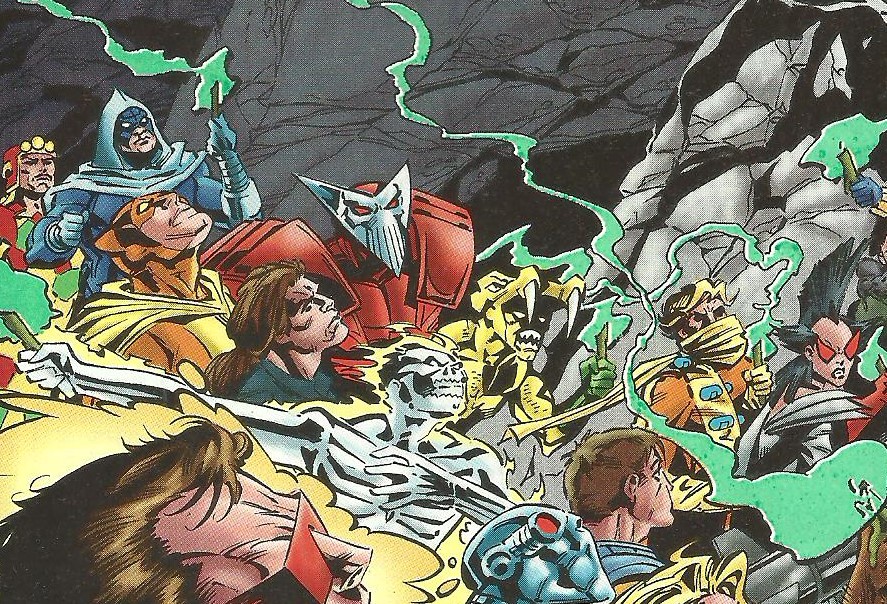
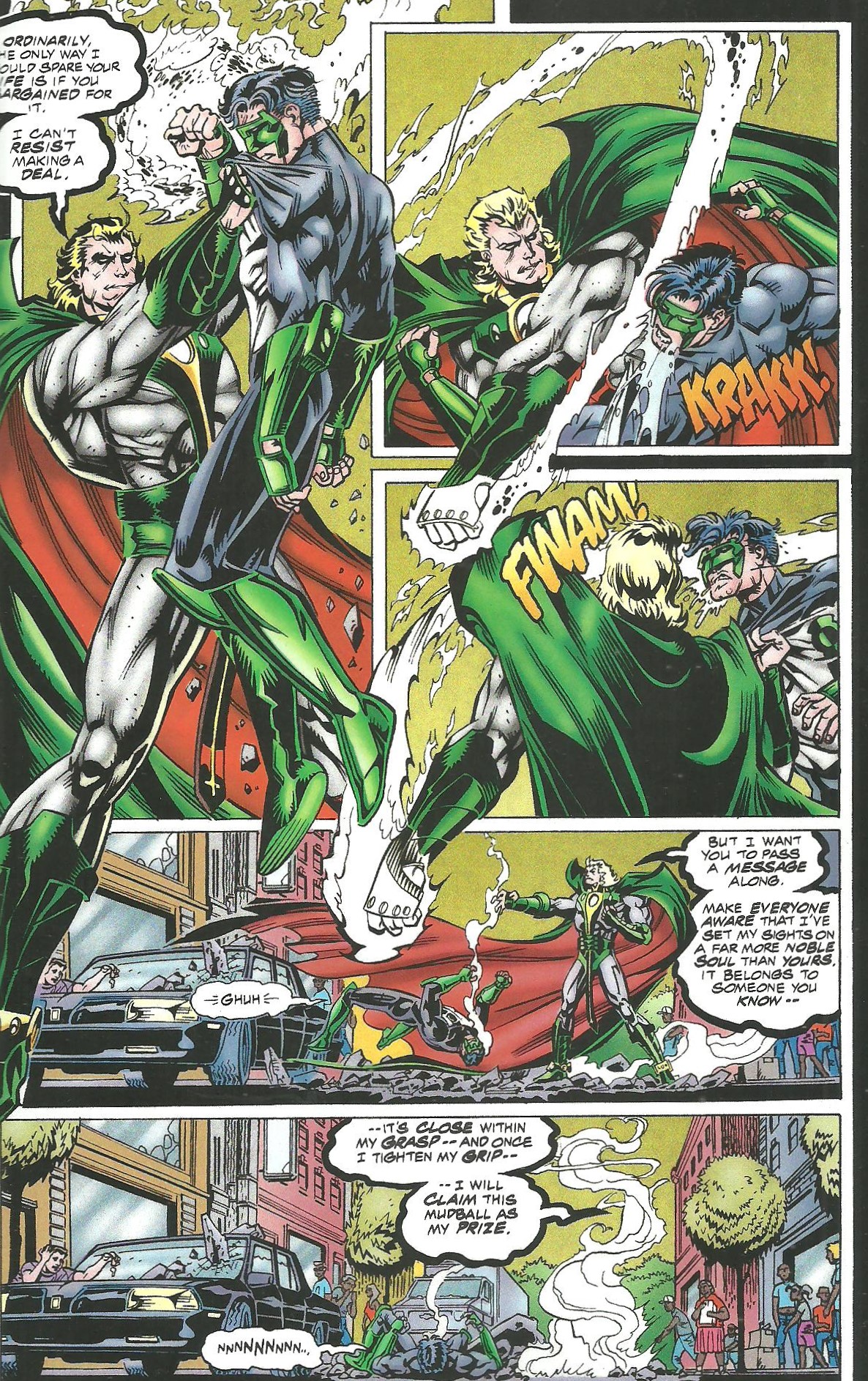
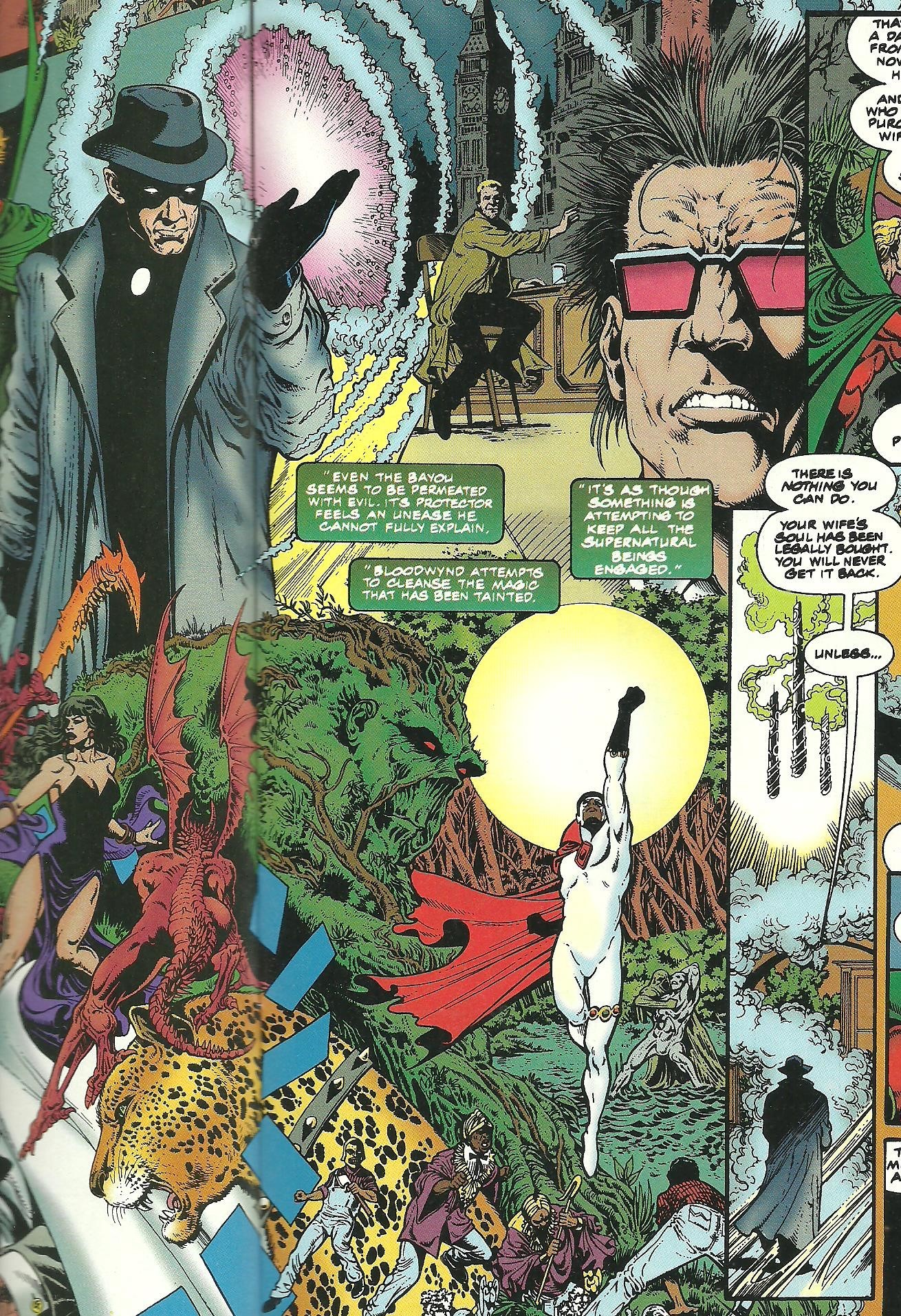
DC Comics' Underworld Unleashed was a 1995 crossover event series by writer Mark Waid, artist Howard Porter and inkers Dan Green and Dennis Janke. Though their main series was just three issues, a huge swathe of the publisher's titles tied in to the event, which ultimately took over almost 50 issues and generated a handful of one-shot specials, including the cumbersomely titled Underworld Unleashed: The Abyss—Hell's Sentinel, a favorite comic of 18-year-old Caleb. 

The premise of the series was actually a pretty clever one, even if the intentions behind it were somewhat suspect, as Waid himself noted in his 1998 afterword to the original collection of the series ("Knuckleheaded" was his exact word). Essentially, Waid took the literary and folklore staple of a deal with the devil, and he applied it to DC's superhero universe. 

A new villain named Neron gathers many of the world's supervillains together and offers them a deal: Sell him their souls and or do some other particular favor for him, and in exchange he will make them more powerful, or grant them some other wish or desire (He also approaches many heroes, tempting them like the devil tempted Jesus in the desert). DC made use of the event to redesign, refurbish or reinvent many of their villains, using it as excuse for new costumes or looks (Killer Frost, Copperhead, Major Disaster), or to take a story-telling shortcut (Lex Luthor) or to try to turn relatively lame villains into more serious threats (Killer Moth, Blockbuster).

It's easy to re-read the core, three-issue series today and see its many weaknesses, or to find fault with the intent of the event itself (Killer Moth, for example, was a far more engaging character as a goofy villain with a lame schtick than he was as the icky giant bug monster he gets turned into). But Waid does do some interesting things, like making Flash villain The Trickster the series' real protagonist, and introducing in Neron a villain whose longevity actually ended up surprising even Waid ("By and large, crossover villains are like bridesmaids' dresses, used once and then packed away forever," he writes in his afterword). 

I'd also argue this series helped introduce Howard Porter to the wider world beyond The Ray. It was only a few years after this that his seminal run on JLA with Grant Morrison and John Dell would begin, and while this is hardly his best work, it's easy to see the continuity between his work here and his work on JLA, and the beginnings of a style that is still evolving as he continues to draw DC's biggest heroes to this very day.

Actually, while I've danced around the premise, impact and plot of Underworld Unleashed, I haven't really said what the comic was actually about: Neon green ink. 

The series made copious, constant use of an almost luminescent green ink. That was the color of Neron's pupil-less eyes, the jagged bolts of energy he would shoot and the ovals on his chest plate. It was the color of the flames on the creepy black candles he gifted to various villains that, when lit, transported them to his Hell. It was the color of the souls he pulled out of his victims and either ingested or stored in a huge "soul jar." It was the color of the logo.

I don't know enough about the printing process of comics, either in 2020 or in 1995, to discuss what the deal with this ink was, but the way DC foregrounded it in the book makes me suspect that they had just discovered a new color that they thought might be the comics coloring equivalent of penicillin. In fact, the most immediately noticeable thing about Underworld Unleashed: The 25th Anniversary Edition is that it lacks the neon green color, which DC replaced with simple white throughout. 

(Two panels from Underworld Unleashed #1, as they originally appeared in 1995 vs in the 2020 collection)

I didn't actually think that was too big of a deal when reading the trade collection, but then, when I broke out my apparently 25-year-old copies of the Underworld Unleashed series, I realized just how much of that bright green color is actually in the book, and how it really did transform those pages. They were all but lit up by the eerie, sickly green color. 

Whatever one might say about Porter and Green's rendition of a bunch of '90s supervillains milling about in a generic hell in Underworld Unleashed #1, the scene reads much better when the candles in their hands and claws are all emitting a column of electric acid green rather than simple paper white. (I should probably note that whatever black magic makes the Neron neon green ink seem to glow doesn't quite transfer when scanned; if you haven't read the original series in its original, single issues, the scans I take from it don't do the green ink justice.)

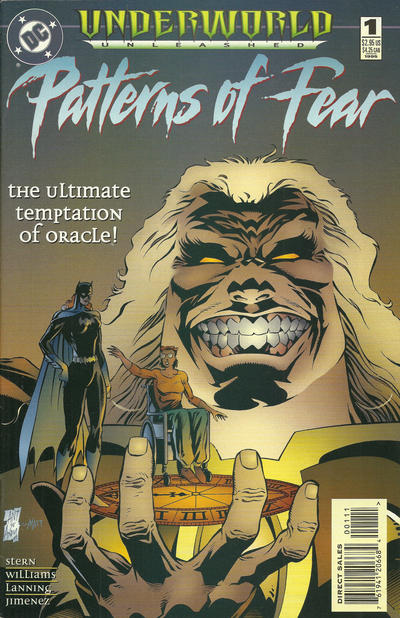
In addition to the main series, the Anniversary Edition includes four one-shots—the previously mentioned Hell's Sentinel, Underworld Unleashed: Apokolips—Dark Uprising, Underworld Unleashed: Batman—Devil's Asylum and Underworld Unleashed: Patterns of Fear—and some interesting back-matter.

In addition to Waid's afterword, there's also art from the original Underworld Unleashed trade paperback collection as well as sketches for redesigns of Mr. Freeze, Killer Frost, Shadow Thief and Killer Moth by Kelley Jones, Tom Grummett, Oscar Jimenez and Flint Henry, respectively.

Somewhat surprisingly, Tony Harris, Ray Snyder and Grant Goleash's pin-up from 1998's JLA in Crisis Secret Files #1 is also included. That was a special one-shot that featured pin-ups of each "crisis" in what was then Justice League history. The pin-up devoted to Underworld Unleashed is kind of interesting because it excises all of the characters that didn't make it into the JLA line-up except for Captain Marvel (so goodbye to Warrior, Blue Devil, The Ray, Captain Atom, Maxima and Firestorm), and replaced them all with Batman, who was actually in Gotham City  foiling a nuclear missile heist at the time at the time the other heroes were all in hell fighting demons and confronting Neron. 

Anyway, on the occasion of Underworld Unleashed's 25th Anniversary, let's take a look at the event, as it's curated in the anniversary edition. All of the scans here are from the original comics, unless otherwise noted. 


1.) So what goes on here? The Rogues—Captain Boomerang, Captain Cold, Heatwave, Mirror Master and The Weather Wizard—have all made deals with Neron, who was vouched for by their fellow Flash villain Abra Kadabra. They were promised they would be forever remembered if they just used their weapons and abilities to attack five pre-determined targets simultaneously. They do so, but end up dying in the process. (That's right; Mark Waid killed off The Flash's Rogues! So you know he was serious! It...should come as no surprise that he already had their returns planned, but he used them as a symbol of the light-hearted and goofy villains of the DC Universe, and thus they needed wiped out en masse at the beginning of this series).

From the Justice League's satellite headquarters, the heroes scramble to respond to the five explosions, and Blue Devil is the only Leaguer who seems to notice any significance to the fact that there are five points, drawing lines between them to form—a pentagram! (Although that's really all on Blue Devil; he could just have easily have drawn a circle or a pentagon to connect them.)

Meanwhile, an unseen schemer orchestrates a mass break-out of Belle Reeve supervillain prison by tempting various people associated within the prison in a variety of ways—this schemer turns out to be Neron, who invites a bunch of super-villains to visit him in Hell via magic candle. James Jesse, The Trickster, is among those who goes. There, Neron introduces a council of villains who can vouch for him as someone to be trusted and respected—Kadabra, The Joker, Lex Luthor, Circe and Doctor Polaris—and he makes his offer to power-up anyone who wants to deal with him. 

Mongul talks some smack, so Neron beats him to death in a few panels, as new villains do when they need to convince readers how powerful and serious they are  (Waid, usually a more skillful superhero writer, takes some notably lazy shortcuts here and there in this book, and now I can't help wonder if such things are cliches now because Waid popularized them back then, or if they were already cliches by the mid-1990s). 

Trickster is about to leave, like plenty of other villains do, when he realizes that there might be an angle here for him to exploit. 

In the final scene, after all of the other villains have left, there's an unexpected arrival: Blue Devil. 

 
2.) The Un-revampable Rainbow Raider. Trickster tricks his way into hell in order to meet Neron, stealing the Rainbow Raider's black candle from him. The downside of this is that it means we never get to see what a revamped, powered-up, more bad-ass Rainbow Raider might be like (Later, Neron will tell Trickster that it was never his intention to invite Raider—"Really... How well do you think a paramecium like the Rainbow Raider would fit in here?"—but that he that he had actually only given him a candle specifically to get it into Trickster's hands).

Geoff Johns, who had a habit of trying to bad-ass-ify villains in the same way that Mark Waid makes fun of in his 1998 afterword, would eventually kill off the Rainbow Raider in 2002 during his run on The Flash, replacing him at one point with "The Rainbow Raiders," a team of color-coded villains. The Raider was one many to return as a Black Lantern during Johns' Blackest Night event/crossover. 

I ended up thinking about Johns a lot during this series, not only because he would go on to write so very many of these characters himself, but because so much of the intent of this series—that is, making DC Comics IP seem more dark or serious—is what so much of Johns' career would entail.


3.) "I'm a man of wealth and taste." Well, that allusion flew right over my head when I read this at 18. The first line of dialogue clearly attributable to the Satan figure in this comic book is, "Please allow me to introduce myself," and having never listened to any Rolling Stones, a favorite band of my mom's, I was able to read that line of dialogue and not hear it in Mick Jagger's voice and enunciation. Not this time.  

4.) Joker's drink ware. Something else I didn't notice the first dozen or so times I read this book...? The skull that The Joker is drinking his umbrella drink out of isn't just any skull, but that's apparently supposed to be Jason Todd's skull. 

For whatever reason, I never noticed the tiny crowbar sticking out of it as a garnish, but once I did I realized that it's not just weirdly drawn, but that it's wearing a domino mask with white triangle eyes, like the Robins might have worn (although I don't think we see the straps of it very often; it just sort of hangs around their eyes as if affixed with spirit gum). 

Well, it's not Jason Todd's actual skull. As Neron explains to the guests on his high council at one point, before leaving them alone in his hell dimension, "this realm is responsive to your slightest desire and will provide you with whatever small comfort you wish." So The Joker apparently summoned that drink, in the same way that Circe summoned  a plate of fruit, or, later, The Joker summons a plate of Batman-shaped cookies to bite the heads off of.

Jason kinda sorta appears in this series, though. In issue #2, when Neron confronts various superheroes and tempts them with their heart's desire, he appears to Batman in a cloud of neon green ink, asking him what he would give "to have alive again the boy you let die?" 

Jason appears in a panel and asks, "Bruce...?", before Batman says no, and Jason shuffles off into the darkness.

At that point, I hadn't yet been reading comics five years, but I bet that scene was at least the tenth or twentieth I had read that reinforced what a great tragedy Jason Todd's death was, and why it was an important  part of Batman's life story, making him the superhero that he was. I would probably read another 25-50 examples before DC finally had Judd Winick resurrect Jason in an extremely unsatisfactory way in 2005 Batman story arc "Under The Hood." 


5.) We apparently just missed a were-cat version of Catman.
 Howard Porter drew Catman no less than three times during the villains-gathering-in-hell scene. Perhaps Porter just really likes the character. Or the costume. Catman doesn't appear to make a deal with Neron, though, as he doesn't reappear in the series at all after this scene concludes.

Oddly enough, the very same month that Underworld Unleashed #1 was published, Catman was appearing in a three-part Shadow of The Bat/Catwoman crossover by Alan Grant, Barry Kitson and Jim Balent entitled "The Secret of The Universe." 

Catman would eventually get a bit of a redesign (or at least a new costume) and a level-up in the pages of Gail Simone and Dave Eaglesham's  2005 Villains United, which eventually lead to Secret Six, but they merely seemed to play the character as more calm, confident and competent. And make him sexy. 

Who knew that was a route to improving villains that were widely perceived as being lame? They didn't have to be scarier or more powerful; fans just wanted them to be sexier. Simone and Eaglesham could have done for all these guys what Neron promised them, without even having to trade their souls.


6.) Big Todd McFarlane energy on Neron's cape here. There are a couple of other examples of Neron's cape being particularly big, flappy, pointy and McFarlaney later in the series, but this instance from the first issue, inked by Dan Green, is the McFarlanest. 


7.) We interrupt this crossover for a not-very-important tie-in. After the conclusion of the first issue of the miniseries, the trade paperback then includes the one-shot tie-in Underworld Unleashed: Apokolips—Dark Uprising. It...has nothing at all to do with the story, although Neron appears in it. 

Written by Paul Kupperberg, pencilled by Stefano Raffaele and inked by Steve Mitchell, it's set on Apokolips after Darkseid seems to have died, having disappeared into The Source in some other previous comics not directly referred to by any editor's notes that I saw.

Darkseid's high court of treacherous evil gods—Desaad, Granny Goodness, Doctor Bedlam, Kalibak, Virman Vundabar, Steppenwolf—all seek to replace him by doing in their rivals to the throne before they themselves can be done in. Meanwhile, a hunger dog from the Armagetto feels the seeds of rebellion growing within himself, and is able to start a little revolution when his fellows see that the Parademons and other enforcers no longer seem as concerned with policing them as usual.

Neron's relatively small role in the story is to help stir the pot among the various villains—he doesn't make a pitch to them like he did in UU #1, and no Fourth World villains appeared in that issue—but it hardly seems like the pot needs stirred at all anyway. He ultimately does aid one of them, but the reader isn't made privy to the details of that deal, and the entire issue feels more like an interruption rather than a part of the Underworld Unleashed story (the same can be said for Devil's Asylum; both seem to be included simply for the sake of completeness, but, unlike Hell's Sentinel, they don't really seem to move the story forward in any appreciable way, or get referred back to later in the series, they just show what's happening elsewhere in the DC Universe. In retrospect, it might have been more valuable to include issues like The Spectre #35 or Fate #13 or Primal Force #13 featuring Neron, Blaze or Satanus, for example).

It might have been more interesting to see Neron strike a deal with the rebellious hunger dog than to mess with Darkseid's court. But then, nothing terribly interesting seems to happen in this one-shot. Nothing looks the least bit interesting, either. Apokolips looks like a completely dull setting, one barely glimpsed in the background filled with figures. 

I skipped this tie-in in 1995, and, reading it now, I see I made the right decision. I would have preferred the 40-pages of this trade it fills go to just about any two issues of any of the many tie-ins, almost all of which seem to have more direct bearing on the storyline than this odd side-story does.  

8.) It kinda looks like Neron is bludgeoning The Ray with Blue Devil's soul  here, doesn't it? Blue Devil's task seems benign enough: Destroy an unmanned power station in California that doesn't seem to be providing power to anything critical. That's all he has to do for Neron, and in exchange he will get a successful film career. So he does it...only to find out later that doing so will cause a helicopter crash that kills his friend Marla Bloom. Who could have imagined the devil would have been such an unreliable partner?! (There's actually a pretty affecting scene in here where Blue Devil learns exactly what he's done, and just sits in an easy chair in shock in front of news of his friend's death, while his answering machine starts blowing up with messages from agents and producers wanting to work with him. It still works quite well, even though answering machines are a relic of the distant past). 

Neron leaves Trickster with his council in his hell while he runs some errands on Earth. They are in the midst of threatening his life when Trickster suggests they investigate Neron's soul jar, as it seems to be the source of his power. They do so, and The Joker and Luthor trick the other three into trapping themselves in the soul jar. That's the last we see of the World's Foulest duo, unfortunately, and I'm unclear how they get from this Point A to wherever they would show up next in the DCU as their Points B.

As to Neron's errands, he tempts Flash, Batman, Superboy and Green Lantern, all the while suggesting to them that he's after Superman's soul. For some reason, he beats the hell out of Kyle (perhaps as a bone thrown to the boneheads in H.E.A.T., which I guess was a real thing in those days), while his visits with the other heroes were mostly just to mess with their heads. There's also a montage in which we see Neron making deals—or attempting to make deals—with other heroes, but presumably we need to read the tie-in issues of The Ray to find out what happened with The Ray, and, I don't know, maybe Justice League Task Force to find out what happened with Triumph...?

After his battle with Neron, GL speaks before a gathering of heroes in the Justice League satellite, an interestingly eclectic group that includes not only members of the Justice League, Extreme Justice and the Justice League Task Force (in their matching jackets), but also Green Arrow Conner Hawke, The Huntress, Damage, Amazing Man and Black Condor. 

The heroes decide to split up, with a now pissed-off Blue Devil brandishing his candle and leading a group to hell to take the fight to Neron.

Speaking of whom, Trickster gets a glimpse of Neron's true form, and finally realizes Neron's the honest-to-God  Satan, not just some other random if powerful supervillain. Readers only get to see the shadow of Neron's true form cast on a wall, and it seems to be suggest a fairly Lovecraftian shape, a blob of writing tentacles on two legs.


9.) Literally no one does this. I once heard Paul Pope deliver a talk at the Wexner Center for the Arts in Columbus in which he discussed his work on Batman: Year 100. He showed a panel of his Batman eating a protein bar or something like that, and Batman had taken his gloves off to do so. Pope noted that in superhero comics, the heroes are constantly shown eating with their gloves on, which is something no one ever does in real life, and, ever since then, I've never been able to not notice it. 

So here's Kadabra pulling meat off of some sort of roast poultry with his gloves on. 

His white gloves!


10.) Wait, I'm still not done talking about that green ink. When Neron turns his attention to Green Lantern, he first surrounds him in a tunnel of neon green flame, which is the point in the book where the coloring change is most literally obvious, as you can see that Kyle is reacting to "green flames," but these flames are colored white in the trade collection. As the pair battle over the course of the next five pages, during which Neron tempts Kyle by saying he can bring his late girlfriend Alex back to life, they blast one another with their energy beams, and the neon green of Neron's powers is contrasted against the normal green of Kyle's force field and energy beams.
I'm not sure which looks better, when I look at them side by side—which you do need to do in real  life, since, as I've noted, the neon ink loses a degree of its luminescent quality when scanned—but I think at the climax, when Neron is punching Kyle with his green, fiery knuckles, actually looks just as cool, or maybe cooler, with the white fire of his knuckles. Something about the way the white looks atop of the black lines of his fists gives it a more present and grounded look, I think... 

However, on the page before that fight, Kyle's blasting of Neron directly in the face with a force beam from his ring draws blood from Neron, and Neron basically just flies his way straight through the beam before he grabs Kyle's ring and then punches him in the face. In the original, Neron's blood is that same color as all the other neon greens-colored stuff in the book, but here it is...not. 

It is instead white.
In the first image, there just seems to be lines all over Neron's face, but, in the second, when we get closer to the villain, we see that he is bleeding from his nose and mouth...but here the blood is white, and thus looks more like saliva or baby spit-up than the soul-blood it is apparently supposed to be.

So while it didn't strike me as such a big deal when re-reading Underworld Unleashed in the trade collection, having looked at scenes back-to-back, I think the green coloring is better than the white, and DC probably should have done something to adjust the coloring in the trade to at least suggest the coloring of the originals, if the exact quality couldn't be reproduced. 


11.) Have you heard the good news about Underworld Unleashed: Hell's Sentinel—The Abyss? It's probably hard for me to overstate how much I enjoyed this issue in 1995 and in the years immediately following. To date, when I would think about the Underworld Unleashed event, this is what I would think of, and, like so many of the first comic books I've read, I've continued to hold this one in high regard in the years that followed, even if it's been at least fifteen years, maybe longer, since I've re-read it (This came out back during my letter hack days, but if a letter to the editor regarding it that I wrote, and thus chronicling what 18-year-old Caleb thought of it in real time, exists, I can't imagine where it would have been published, if at all). 

It was my first introduction to the work of Phil Jimenez, who would eventually become a favorite artist of mine, and, re-reading it today, I notice that now the names of his collaborators are also quite well-known to me—Scott Peterson wrote it, and J. H. Williams III drew the second half of it—but at the time, I didn't know who they were, nor did their work on this book impact me the way Jimenez's did. Hell, reading this today, it still boggles my mind that this didn't turn Jimenez into the industry's next Jim Lee or something. This art is incredible.

The most noticeable thing is, of course, the level detail. Outside of maybe some of George Perez's pages from War of The Gods or some backgrounds in Dave Sim and Gerhard's Cerebus, at that time I had never seen comic book art anywhere nearly as detailed as Jimenez's art is here. It's positively baroque. It's not just that he drew every fold in Sentinel's cape, and every whorl in the tree the hero is crucified upside down upon in the first few pages, or the maniacal attention to detail in the Gotham City skyline or the scores of candles on page ten, but if you look at the designs given to the various monsters and demons he draws, it's...well, it's practically mind-boggling. 

Is it an unnecessary level of detail? Well, probably.  But I read this comic for the first time back in the days when I bought extremely few comics, which meant more often than not I would re-read them all repeatedly in the weeks and months after I read them the first time and, man, this was a comic that rewards re-reading, as there are just so many details to drink in. 

There's a splash that I'll show you a bit of later that has a good half-dozen scenes of various heroes engaged in various struggles, and not only does Jimenez seem to suggest a half-dozen interesting stories, but the way he draws the scenes, the spread has a good half-dozen issues worth of action packed into it. 

Now, beyond being my first introduction to Jimenez's work, this was also my first introduction to many of the characters who appear, and, to the concept of a "Sentinels of Magic" super-team, which never really got off the ground...at least, not until 2006's Shadowpact, followed by 2011's more to-the-point Justice League Dark, wherein the idea of a super-team of DC's magic-users finally reached fruition.

I've often considered this book the best pilot for a comic book series that never actually got around to being launched, as this was the first time I saw DC gathering a group of magicians to form a sort of occult answer to the Justice League...although now I realize that Neil Gaiman's "Trenchcoat Brigade" from the original Books of Magic miniseries pre-figured and probably inspired this book, and that was pre-figured by Alan Moore's Crisis On Infinite Earths tie-in in the pages of Swamp Thing
What made this different than those stories, though, and those that followed, was that it had Alan Scott at its center. That is, for all the magical types—here, Zatanna, Phantom Stranger, Deadman, Fate and John Corrigan—there was an honest-to-goodness, bank robber-catching, supervillain-punching superhero as the axis the team could revolve around. And not just any superhero, but one of the originals, and a founding member of the original superhero team, the Justice Society of America.

It is so easy to imagine a Sentinels of Magic monthly following Underworld Unleashed (although I think the name Hell's Sentinels would have appealed to my teenage self better), wherein once Alan escapes from Hell, he re-gathers some of his allies here, explains that they worked well together, and that while he doesn't know much about magic and hell, he does know teamwork, and  he gets them to work together.

His fish-out-of-water status is alluded to a couple times in the pages of this book, and there's at least one neat scene where we see him basically willing Fate into joining with the others to help them, as he just glares at him and shames him into helping out.
Almost all of these characters would reappear in various covens or groupings of DC's magical heroes in other crossover events and, later, in Shadowpact and Justice Leaguer Dark, but, unfortunately, the premise suggested here, of Golden Age Green Lantern-turned-Sentinel Alan Scott leading a team of occult heroes, never came to be. 


12.) So, what the Hell happened here? Alan Scott awakes from a vivid—and beautifully drawn!—nightmare to find himself and his wife Molly being attacked by sentient vines in their Gotham City bedroom. Alan, who at this point had a youthful body thanks to the influence of "the starheart" that his ring and lantern were fashioned from being integrated into his body, fights them off and then goes to patrol the city, looking for other such goings-on (He finds some).

When he returns, he finds that his wife, the former Golden Age villainess Harlequin, has had her youth restored, but seems to be a soulless husk of her former self; while he was gone, she did a deal with Neron to have her youth restored. (Aside: I honestly can't believe there has yet to be a Harlequin/Harley Quinn comic created yet. Surely someone must have  pitched it. Maybe after DC gets its continuity straightened out again, and the original Harlequin and Harley Quinn exist in the same space-time continuum again it will happen...)

Alan heads to the original JSA headquarters to start shouting for The Spectre, in the hopes that his former teammate could help him get his wife's soul back from hell. Instead, he's met by The Phantom Stranger, and together they gather some allies and then go to Hell. There they encounter some bad guys—Dementor, Blaze, Etrigan, Blackbriar Thorne—and they fight them. 

When Neron comes to find out what all the commotion in hell is about, Alan offers to hold him off while the other make their escape, and Neron captures Alan, turning him into a little necklace (a ring woulda been a better, more ironic fate, Neron; that's the difference between The Spectre and Neron though, I guess). 

And...that's it, really. It's basically a fight comic. But, as I've mentioned, it sure is a well-drawn one. 


13.) Well there's a body part you don't see every day in a superhero comics... When Alan Scott suits up and flies out to patrol Gotham City for more such supernatural happenings, he finds three young men in baseball caps brandishing a knife and fleeing a body. "You've gotta save us from that thing!" one of them screams, "We didn't think the brujeria would work!" 

The "brujeria", or witchcraft, did work, though, and it summoned some bizarre and, as Jimenez drew it, terrifying creature that looks like a blob of a dozen or so different human beings all smooshed together, its form shifting from panel to panel, at one-point growing a head that resembles Alan's own head exactly to taunt  him. 

When Sentinel sends some ring constructs to destroy it, Jimenez appears to have drawn a few naked breasts among its mass of body parts, and the nipples, in the language of today's Internet censorship, appear to be female-presenting. 


14.) Back when Swamp Thing and Constantine weren't speaking to the Justice League. When The Phantom Stranger appears to Alan and starts explaining what's going on, there's a rather bravura spread that takes up about a page and a half. The Stranger's dialogue explains what some other prominent magical characters are up to at the moment, presumably explaining why none of them appear in this book, and Jimenez dutifully draws them all: Dr. Occult, Primal Force, Madame Xanadu, Baron Winters of Night Force and the Justice League's Bloodwynd.

Jimenez also draws some unnamed characters too, though, who a reader would recognize, even though the Stranger doesn't name them: John Constanine and Swamp Thing, both then starring in long-running mature-readers books from DC's Vertigo imprint, and Mister E, who Neil Gaiman used in his initial Books of Magic miniseries, after which point he became a recurring character in various Vertigo series. 

The dialogue seems to cover these three with "It's as though something is attempting to keep all the supernatural beings engaged," but it's interesting that Jimenez can draw Swamp Thing right there on the page, but he's not referred to by name. Instead, the Stranger's narration notes, "Even the bayou seems to be permeated with evil. It's protector feels an unease he cannot fully explain."

Obviously DC was operating under some hazy rules in which certain DC-turned-Vertigo characters couldn't cross the border between the two "universes", and Jimenez and company seemed to get a little more latitude with this book than creators on others might have gotten. Phantom Stranger, for his part, appeared in many of the same Vertigo comics that Mister E did, but he headlined only a single Vertigo comic—1993's Vertigo Visions: The Phantom Stranger #1 by Alisa Kwitney and Guy Davis. That apparently wasn't enough to make him a Vertigo character, though, and he was apparently still seen as more of a DCU character than a Vertigo one (It looks like Jimenez drew the particular design from the Vertigo one-shot, though). 


15.) Wait, what's the plural form of Deadman? Deadmen or Deadmans....?
As the issue reaches its halfway point, Deadman makes his appearance, with Jimenez drawing a few panels featuring him before the baton is passed on to Williams. Jimenez's Deadman looks like Carmine Infantino's original version, or the versions drawn by Neal Adams or Jim Aparo; he's essentially a pretty buff, fit, vital human being in appearance, his white skin and pupil-less eyes the only indications that he's, you know, dead

Williams, on the other hand, drew Deadman as Kelley Jones had redesigned him in the pages of miniseries Love After Death and Exorcism, as a skeletal, rotting corpse in an ill-fitting, exaggerated costume. 
The radical shift in his design works quite well in the context of the story, though. 

When he first appears to the reader, it's after Fate notices the invisible Deadman, and the Stranger instructs Sentinel to "cast your flame above us, and all will be made clear." When Sentinel does so, Deadman appears for all of the characters—as well as the reader—to see and hear. He even mentions that "This green fire's got some kick. I haven't felt this great in a while."

On the next page, however, he follows the ad hoc team to Tannarak's Bar, where he's seen floating above them like Jones' spectral corpse version. There he uses his "power" of possessing a body. 

The overall implication is that maybe Deadman's appearance is fluid, and he looks more "dead" when he's using his ghost powers. That, or the influence of the superhero's super-powered green flame restores him to a more super hero-like build and appearance. 


16.) Williams' McCrea's Kirby's Demon. One of the real treats for me re-reading this comic in 2020 was realizing not only that the guy who drew the non-Jimenez portions was J.H. Williams III, who would go on to some renown, but that the version of The Demon he drew was essentially John McCrea's version of Etrigan from the last twenty issues of the 1990-1995 The Demon

If you squint at those images, you can actually see McCrea's design, which featured a thinner, more wiry build, longer and more exaggerated ears and horns and more gnarled, claw-like hands than the version drawn by artist Val Semeiks, who McCrea took over for on The Demon, or creator Jack Kirby.

While Williams' Demon is clearly modeled on McCrea's strung-out Dr. Seuss character version, complete with long, torn cape that looks like something between a flag and dish rag, he also draws him a bit more realistically, filling in the unlikely physique with well-rendered flesh and muscle. It actually makes the character much scarier than most versions of him, as McCrea's more exaggerated, cartoonier version is, under Williams, so well-rendered as to accentuate everything wrong about it. 

Etrigan is here allied with the bad guys in Hell and spends his scenes engaged in what is basically a street fight with Fate, a character I know almost nothing about, other than what I've read here (he starred in a 1994-1996 23-issue series that began during DC's "Zero Month," and was an attempt to create a more post-modern, "badass" version of Dr. Fate; this Fate wielding a big-ass knife and throwing ankhs made from the melted-down helm of Nabu). 

The appearance is very much in keeping with Alan Grant and Garth Ennis' take on the character, and he is finally defeated when Fate unbandages his weird-ass right arm, which is a creature of chaos or...something. By way of surrender, Etrigan reverts back to Jason Blood but, sadly, Blood and Corrigan don't get any scenes together. 


17.) The Spectre is a Harryhausen fan.
Or, at least, Williams is. When The Spectre has finally had enough of Dementor's shit, he creates a giant fist out of the ground to hold him in place and sics some two-headed vultures on him. When I originally read this, I just thought, "Huh. Two-headed vultures. Cool." Now I can't help but think of The Seventh Voyage of Sinbad


18.) Time for another interruption.
  The Abyss is immediately followed by another of the tie-in one-shots, Underworld Unleashed: Batman—Devil's Asylum, a 40-page one-shot written by Alan Grant and drawn by the unusual team of Brian Stelfreeze and Rick Burchett, the former's credit reading "storytelling" while the latter's reads "artist." This particular issue is probably worth looking at just to see what a Stelfreeze/Burchett joint looks like and reads like. I have to say, the style looks more Burchett-like, but you can definitely see Stelfreeze in some of the poses and, especially, in the Batman (Readers of this comic would have been very familiar with Stelfreeze's Batman, thanks to his run as the cover artist on Shadow of The Bat). 

Although plenty of Batman villains appear in Underworld Unleashed and its many, many tie-ins, this one is set in Arkham Asylum, and so Two-Face, The Riddler and some lesser villains all play small roles, while the likes of The Joker, Scarecrow and Mister Freeze are off  appearing elsewhere. The main villain is an original one, Kryppen, a master poisoner. He's seen making a deal with the devil in the very first pages, although the neat thing about the way Grant and company portray it, this can absolutely be read as a delusion that is all in Kryppen's head (Indeed, we see  him talking to his own shadow on the wall of his cell while he's carrying on his conversation with Neron). In other words, this book can be read own without any other knowledge of Underworld Unleashed; in fact, it doesn't necessarily even have to be read as a tie-in at all. 

Dr. Jeremiah Arkham narrates the story through his journal entry. It's a particularly tense night at the asylum, which Arkham thinks may have something to do with the electrical storm raging outside. Things get worse when another original creation of Grant's, "a small-time arsonist, a pathetic wretch who believes the ghost of Benjamin Franklin drove him to his crimes" kills himself and causes a black-out in the process.

A riot breaks out, and Kryppen makes good on his deal with the devil, poisoning everyone in the asylum, and promising Batman he will give him the antidote—but only if he consents to kill any one inmate first. Batman does not, and is able to solve the problem anyway.

Through Kryppen, then, Neron (or the devil, as he's called here almost entirely throughout) tempts Batman for a second time in this collection—as well as Arkham, whom we see briefly indulging in fantasies of ways to psychologically torture the inmates in his care in revenge for the riot, during which he has his nose broken.

Like Apokolips, this is completely unnecessary to the Underworld Unleashed plot or story, but it's a well-made book, and a pretty decent Batman story. 


19.) And one last interruption.
 Aside from the Apokolips special, the one-shot Underworld Unleashed: Patterns of Fear is the only other part of this collection I had not encountered in 1995, and was therefore reading for the first time here. It was written by Roger Stern with art by Anthony Williams and Andy Lanning, and is an interesting hybrid between a comics story and a Who's Who-type book, or, more directly, the Secret Files & Origins specials that would be commonplace at DC in the late '90s. 

There are 13-pages of comics, during which Neron appears in Oracle's clock tower headquarters and alternately terrorizes and tempts her with his powers, first appearing in a white suit before ultimately resuming his goofy-looking supervillain get-up when she uses his name.

Neron is apparently there on a fact-finding mission, to see how much Oracle and the heroes know of him and his operation, and so between pages of their banter, we see Oracle's "files" on various villains who took Neron's deal. At first these appear as computer documents with "Police composite" sketches credited to artists like Flint Henry, Tony Harris, Rick Burchett and Jimenez. Eventually, the format will shift a bit, and we'll also see news clippings and memos, a wanted poster and sticky notes of Barbara's on other villains.

All together, these account for 25 pages, and seem to account for just about every villain who took Neron's deal and appeared in the tie-ins, although there may be some missing (and there are no files on the heroes who did, like Blue Devil, The Ray or Triumph). 

In terms of the way the book flows, it's obviously somewhat awkward, as each file on each villain will take far longer to read than any handful of pages of the comics pages, and so it's a book that proceeds in fits and starts, at least if one reads it exactly as printed (It reads much better if one skips over the files the first time through, and then returns to them after the story is over). 

As for "The Ultimate Temptation of Oracle!" alluded to on the cover, it's not too difficult to figure out what that is. He offers to restore her mobility, allowing her to walk again, or even become Batgirl again. 

"In fact, I'm prepared to sweeten the deal!" Neron offers, although personally I find this a bit much. "I am willing to give you power on par with Superman! Power--and invulnerability!" In return, he asks not for her soul, but her "occasional services as my librarian."

Barbara obviously turns him down, but I've got to admit, I find this idea kind of intriguing, and certainly a more interesting way of getting Barbara out of the wheelchair and into her Batgirl costume again than what DC ultimately did in late 2011, when they just...rebooted her years as Oracle away with the New 52, and then gradually started fussing around so that maybe they still happened in some form, just not in the same way they did in the comics originally, and also she still got shot by The Joker and was temporarily paralyzed, she just got better. 

I mean, I'm glad DC didn't have Oracle do a deal with the devil—although it probably could have worked, if she managed to outsmart him in a particularly clever way that allowed her to wriggle out of having to serve him on some technicality, while enjoying her returned mobility—but then, I find the character much more engaging and valuable as Oracle than I do as Batgirl, and, were it up to me, she never would have gotten out of her chair or resumed the role of Batgirl. 

At the very least, there's a decent Elseworlds story embedded in this one-shot, or, perhaps, one of those What If...?-style one-shot Tales of The Dark Multiverse specials that DC has been publishing of late, each of which is tied to some DC crossover event like Underworld Unleashed. Of course, were it one of the Tales, it would have to go disastrously wrong, which would necessitate Oracle not being able to trick Neron and get the better of him, but even still, a Superman-strong Batgirl in 1995 Gotham whose day job is Hell's librarian would make for a pretty cool comic, I think...


20.) Well, I like it. We hear a lot about Superman's post-death hair in the '90s, and everyone's quick to crack a joke about Nightwing's mullet, but we never hear all that much about Gotham City's second most famous mullet: Barbara Gordon's. Now, that might just be because she's so rarely drawn with one, but Anthony Williams sure gave her one. 

I think it looks pretty good and, depending on how much product she uses, could actually be a pretty cool look for Babs. 


21.) The Church of James Gordon...? At one point early in their encounter, Oracle, realizing Neron was some sort of evil supernatural being, brandishes a cross. He merely plucks it from her hand: "I'm no cinema vampire that can be overcome by religious icons... ...no matter what the denomination." With those last words he transmutes the previously bare cross so that there's a tiny little version of her father, Commissioner James Gordon, crucified upon in, and calling her name.

 In the next panel, we can't see the crucified Gordon, but note the blood that starts gushing from where the nail in his wrist would be.

These comics are pretty fucked up, huh? 

I mean that as a compliment, of course. 


22.) All good things must come to an end. So must Underworld Unleashed. Well, we made it to the end of the collection! The final issue features a cover in which our heroes are almost literally being consumed by the magical green ink of Underworld Unleashed

In this final issue, the Blue Devil-lead strikeforce begins battling its way through hell in order to get to Neron. The Ray, Firestorm, Wonder Woman, Maxima, Martian Manhunter, Warrior, Green Lantern, The Flash and Captains Marvel and Atom are there at the beginning, although they gradually drop off one by one as they get closer and closer to Neron. 

Back on Earth, things are in bad shape, and the world seems to be on the verge of ending from a variety of different ways. Waid globe hops a bit, doing that list-of-atrocities bit, as well as providing panels checking in with various heroes:
At twilight in Paris, every deco gargoyle sprang to life in hopes of nourishing itself on the tourists. Only Mystek, Triumph and Gypsy defend the city of lights from darkness.

In Metropolis, the dawn brought with it famine--a ravenous hunger that could not be sated. Booster Gold and Blue Beetle face off against the storming crowds like hummingbirds against a hurricane.

 And so on.

The most sustained action on Earth involves Blockbuster, Grodd and Metallo attempting a heist of some nuclear weapons being transported through Gotham by truck, and Batman, Robin, Black Canary and Huntress showing up to foil their attempt. 

When the heroes finally make it to Neron's throne in Hell, they suddenly all turn on Captain Marvel, "an effect of the locale," as Neron explains. With the help of the Trickster, Cap is able to break the spell on the heroes and then offer Neron a deal: His soul in exchange for the release of his friends and Earth...and that's it.

Unable to not make a deal, but also unable to properly digest a soul from a deal that was "purely altruistic," Neron briefly resumes his true form of a mass of green tentacles on legs, then explodes in a huge green ink/white fireball, which sends all of the heroes back to Earth. 

In a coda, Trickster seems to be thinking of turning over a new leaf and joining the superheroes' side of the DC Universe' eternal game, as, in his words, "when I someday pass from this mortal coil, I'd better have made some friends in Heaven, 'cause after this... ...I don't dare go to Hell...


23.) This is a coincidence, I assume. Earlier this year I read Evan Dahm's The Harrowing of Hell (reviewed here), and among the denizens of his Hell are these creatures with vaguely clam-like heads that are basically all mouth. These echo the hellmouth entrance to Hell in the book.

I was therefore a little surprised to turn a page in this collection and see the heroes punching their way through monsters that look an awful lot like them:

There are some pretty obvious differences in the two designs, of course, but the similarities are kind of uncanny, too. It was enough to make me wonder if it was a coincidence, or if, perhaps, there is a common inspiration that both Porter and Dahm took for their designs of these creatures...although I doubt it. 

24.) I think this is the first time I've seen this thing Porter does, but I'm not sure. Throughout his JLA run, Porter would occasionally draw the heroes as semi-silhouettes, highlighting particular, identifying aspects of their costumes. For example, Superman's S-shield and cape might be in color, while the rest of him was all-black. It probably saved Porter a little drawing here and there, but it was also a very dramatic artistic choice, and I always thought it looked pretty cool. 

I am certain without double-checking that he did this often to the title character during his run on The Ray, as that character's powers were such that, when he was using them, he always appeared as a semi-silhouette in a field of light, suggesting a photo negative-like effect caused by his light powers. 

I'm not sure if this is the first time Porter used the effect on heroes other than The Ray, but it is certainly the first time I had seen him do so (I'd eventually read chunks of The Ray that I'd purchased from back-issue bins; I'd love to see that series completely collected, but I don't hold out much hope that it ever will be). 

Interestingly, David Marquez seems to be doing something similar on his cover for the upcoming Justice League #59.

25.)  Okay, I guess the green really is better than white. In the above scene, Neron tries to take the soul of Captain Marvel and ingest it, but is having difficulty because it was a pure soul altruistically given to him, untainted by the sorts of greedy requests that usually accompany all such deals-with-the devil. 

This is the scene scanned from the original; in the trade, everything that's green in the above page is colored white, with the exception of Neron's costume. You can see how Captain Marvel's white soul is a different color than Neron's "power," as seen in the color of his eyes, the cavities in his chest plate, and the energy emanating from his hands. 

Now, in the original series, every soul we have seen on the page, and every instance of some sort of "soul energy" had been colored that neon green, whereas Captain Marvel's soul was white, showing what a sharp contrast it was to all the other souls Neron had traded in. 

But in the collection, everything is white, and therefore there's no visual signifier that there's anything different about Cap's soul versus the corrupted ones.  

This, then, is one scene in which the decision to color the trade differently is quite noticeable, and of an overall detriment to the story. 


26.) A funny thing about Mark Waid's afterword... It is incredibly hard to read Waid's afterword—originally penned, remember, in 1998—and not read it as an indictment of an ever-present drive at DC Comics to make their light-hearted, Silver Age-borne creations darker and more serious...more often than not making them goofier in the process. This is an impulse probably best exemplified by Geoff Johns, who, during his run on The Flash, set about basically Batman-ifying the book, or heck, look what he did to various Green Lantern characters like Hector Hammond or Black Hand during his run on Green Lantern

I remember reading an interview with Johns at one of the comics "news" sites, Comic Book Resources or Newsarama, wherein the interviewer was discussing Johns' work at revamping villains, and asked how he might go about making, say, Kite-Man into a terrifying villain. Johns responded by saying perhaps his Kite-Man might make kites out if his victims' bones and skin.

I was thinking about that as I read Waid's words. For example:
Probably the single strongest creative motive governing comics over the last 10 years has been embarrassment. You know it. You've seen its ruinous effects. Knuckleheaded, well-intentioned creators ashamed of corny old characters have been, for most o f a decade, dragging half-forgotten heroes and villains kicknig and screaming into their little hardware stores of creativity. There, haunted by a guilty fear that these ancient superdoers aren't kewl enough for a generation of video game-entranced readers, said kunckleheaded creators graft big guns and armored suits and homicidal personalities and grotesque deformities onto these poor costumed naifs and thus fool themselves into thinking they're doing them a good turn by bludgeoning all the innocent charm and colorful individuality out of them.
Again, that was written in 1998, long before Johns' rise to fame at DC, where he eventually became chief creative officer, and almost 15 years before The New 52, the line-wide initiative in which the publisher decided to drag the entirety of the DC Universe into the hardware store of creativity for some knuckleheaded, if well-intentioned, bludgeoning. 

But wait, Waid gets more prophetic: 
"Oooh! Let's turn Heat Wave into a living pillar of fire." "Oh, I know! Crazy Quilt should be made up of undulating, shifting patches of human skin!" Man, I thought I was so smart. Of course any villain created before Watchmen was pathetic and needed fixing, right?

See what I mean?


26.) I imagine I'll have to hit the back-issue bins if I ever want to read the whole story.  Unless this trade collection ends up selling gangbusters, I can't imagine we'll end up getting any further Underworld Unleashed collections, although, like I said, there is a lot of it left uncollected—about 50 issues of tie-ins, according to Wikipedia.

On the off chance that we do get more Underworld Unleashed, I imagine it will be similar to the way that we got additional Zero  Hour comics collected—that is, with Batman's help. Just as there was a Batman: Zero Hour collecting all of the Bat-Family tie-ins to that crossover event series, a Batman: Underworld  Unleashed could include Detective Comics #691-692 (introducing a new Spellbinder), Batman #525 (the resurrection of Mister Freeze), Robin #23-24 (in which Killer Moth mutates into—sigh—Charaxes), Catwoman #27 (featuring Gorilla Grodd) and Azrael #10 (featuring the Jean-Paul Valley version of Batman) 

And even though Superman  himself was off-planet throughout the events of the three-issue mini-series, there are certainly enough Super-books for a Superman: Underworld Unleashed  collection (including issues of Superman, The Adventures of Superman, Superman: The Man of Tomorrow, Steel and Superboy). Also easy enough would be a  Justice League: Underworld Unleashed collection (Justice League Task Force #30, Justice League America #105-#106, Extreme Justice #10-#11, maybe issues of The Ray, Green Lantern or The Flash...although now that I am typing this, I am remembering who wrote Justice League America at the time, so I imagine we're no more likely to see those two issues get reprinted than we are to get future volumes of Wonder Woman and Justice League of America collecting Justice League America #93-113).