Showing posts with label comic shop comics. Show all posts

Sunday, June 10, 2018

Comic Shop Comics: May 23rd and May 30th

Aquaman/Jabberjaw Special #1 (DC Comics) Of the new round of DC/Hanna-Barbera crossover specials, this one seemed like the one I was going to like the most, since I have some affection for both halves of the team-up, I like the two primary creators involved and the characters fit together so perfectly that, in a sense, it's the sort of comic that writes itself...although writer Dan Abnett takes a few interesting and surprising turns in his narrative.

For the first few pages of the 30-page feature story, Abnett seems to be setting up a Jaws parody with Jabberjaw in the role of the marauding, beach-closing shark (Believe it or not, I never connected the cartoon shark's name to that of the famous movie shark who kicked off a pop culture shark craze right around the time the cartoon debuted until, like, last week or so). But being able to breathe air, walk on his fins and speak to Aquaman--out loud, and in English--makes Jabberjaw kind of easy to find, and after a little fish out of water comedy involve Jabber in modern day Amnesty Bay, Aquaman follows him through a portal to Jabber's home world, where a mad scientist has been sending giant killer sharks to attack the kinda-sorta past.

The plot is a bit more complicated than it sounds--and involves another, unbilled Hanna-Barbera property--but Abnett manages to find a linkage between the two aquatic characters to exploit--that is, Jabberjaw's constant complaining-via-catchphrase that he "don't get no respect" and Aquaman's lack of respect from the world at large--and Abnett even manages to connect the real-world reason Aquaman doesn't get the respect of his fellow Justice Leaguers to the something within the world of Jabberjaw.

Like I said, I expected to like this a lot, but I didn't expect it to be an honestly great Aquaman comic, and maybe one of the best Aquaman stories I've read since...well, I can't remember the last time I read an Aquaman comic this good, if I'm being honest. Abnett is partnered with pencil artist Paul Pelletier and inker Andrew Hennessy, and they do a pretty great job. Pelletier is an excellent superhero comics artist, and Jabberjaw is the rare Hanna-Barbera character who actually kinda works perfectly when translated into the more "realistic" house style of modern DC Comics. In fact, Jabberjaw's typical dialogue coming not out of the mouth of a cartoon character, but from the jagged, toogh-filled mouth and the blank, expression-less face of a real(-ish) great white shark may actually be funnier.

The Neptunes appear, but get short shrift, really, as they aren't really necessary to the story, since Aquaman takes their place as straightman to Jabberjaw. Pelletier's rendering of those characters isn't too terribly inspired; he basically just draws Pelletier-designed characters dressed like The Neptunes, for better or worse.

This is a real rarity among DC's weird-ass cartoon crossover stories: One I wouldn't mind seeing more of.

There are four DC/Hanna-Barbera specials in this year's suite of crossovers, and two of them have back-ups. Unlike the previous round's back-ups, which featured adult reboots of Hanna-Barbera characters that (mostly) previewed new series, these two are simply additional DC/Hanna-Barbera crossovers...just eight-pagers. Both are written by Jeff Parker and drawn by Scott Kolins.

This one features Captain Caveman. The DC characters who appear are somewhat perfunctory. The Wizard Shazam (still in his New 52 redesign) and The Spectre (drawn so that he could be in either his pre- or post-Flashpoint design), are debating whether heroism is "a relatively recent trait" developed over centuries of social evolution, or something that is inherent in humanit. The Wizard takes the latter view, and, to prove his point, he summons "an offshoot of Neanderthal" destined for death to the modern world. This caveman, of course, becomes Captain Caveman, proving Shazam right.

This version of Captain Caveman doesn't seem to have much in the way of super-powers. He's definitely super-strong, but he can't fly, and his big-ass club is devoid of Flintones-era technological gizmos. Kolins has designed him as your basic squat, muscular caveman, but with a huge head of hair and beard. In a different context, he wouldn't be recognizable as Captain Caveman. (Interestingly, the The Flash/Speed Buggy Special has a differently-designed Captain Caveman, who instead looks closer to his cartoon counterpart.) The Teen Angels kinda sorta appear, as well, although there's only two of them. There's a Dee Dee and a Taffy, but Brenda is MIA, and the other two don't really look like themselves like at all.

For added DCU-ishness, there's a one-panel came of Black Adam and Captain Marvel Shazam The Superhero Shazam Shazam and some Manhunter robots.


Batman: Prelude To The Wedding: Robin Vs. Ra's al Ghul #1 (DC) Not only was I not looking forward to this comic, I wasn't even planning on buying it. As I'm sure I've mentioned before, I found the prospect of Damian running afoul of his grandfather for the eleventh or so time a rather uninteresting prospect for a comic, particularly when it is being tied to a particularly momentous event in Batman comics history, like the upcoming marriage of Batman and Catwoman. (And while I find writer Tim Seeley and pencil artist Brad Walker to be respectable talents, neither is one whose work I am so enraptured with that I automatically buy something just because of their presence.)

I ended up picking it up, however. as this comic featured pages and pages of the sorts of things we haven't seen a whole hell of a lot of in the pages of Batman, where the wedding storyline has been playing out. Ra's is only one about five pages of the comic, and while Damian is on just about every page, he's not always dressed as Robin. Rather, this issue has plenty of pages of Damian Wayne and Selina Kyle together, doing wedding-related stuff (She takes him to a tailor to get his wedding outfit prepared, he waits up for her at the Manor while she's out for her bachelorette party).

Please correct me if I'm wrong, but I think this might be the first time we've seen the two of those characters together before...not just since the proposal and out-of-costume but, like, ever. Not only am I having trouble recalling a scene of Catwoman and this Robin together alone, I can't even think of one in which they are together in the presence of an Batman (although there must have been a crowd scene of all Batman's allies posing together near the climax of Batman and Robin Eternal or somewhere, right?). That seems...weird, really, considering that not only does Batman fight crime with both Robin and Catwoman, but that this Robin is his actual son.

Tom King, who has been writing the wedding storyline, has been writing Batman since August of 2016, and he began laying the groundwork for the 50th issue wedding as far back as #9 or so (The launch of the "I Am Suicide" story arc). So it strikes me as unusual that we don't really have a sense of how Catwoman and Damian might regard one another going into this issue.

Granted, the bulk of it is eaten up by superhero stuff. After the trip to the tailor's, Catwoman heads out for her bachelortte party (sadly, none of it is shown, and we don't even know who she went out with) while Damian suits up to...break into the arcade to play his favorite videogame. It is there that he's attack by a new foe, claiming to be the son of Catwoman and Batman, coming back to the past to...well, the symbolism is all about as broad as one might expect from a narrative form in which characters label themselves with symbols on their chests.

Things aren't, of course, what they seem, and we eventually find out that Ra's had orchestrated everything. He's still not happy that Damian defected to join Batman, and he's not all that psyched about Batman, who spurned his daughter, marrying Catwoman.

But, like I said, it's the pages of the characters in plainclothes that were the most interesting, and answered things about a Batman/Catwoman marriage I am actually interested in (or at least curious about). There's a two-page epilogue drawn by artsit Otto Schmidt in which Ra's returns to a base or lair of some kind to find out that about 15 of his ninja assassins are dead and one of them has had his eyes burned out, and reports that he was asked if they had gotten a wedding invitation before the attack. That the words "HA HA HA HA HA HA HA" are written on the wall offers a pretty good clue as to who did it, although God only knows how The Joker took out an entire room full of ninja assassins, all of whom are run through with swords. Apparently, this series of one-shots is leading into whatever The Joker's plans for the wedding are.

The artwork prior to the epilogue was all penciled by Walker, who is inked by Andrew Hennessy and Mick Gray. It's particularly good work. I didn't recognize it as Walker's at first, but after seeing his name in the credit box of the final page, it was easier to see him in the artwork. Whether it was Hennessy or Gray or both, they really transformed the work into something slicker, smoother and more polished.


Black Lightning/Hong Kong Phooey Special #1 (DC) This one was a disappointment. Writer Bryan Hill seems to rather smartly lean in to the two title characters' somewhat problematic roots, borne as they were as children's entertainment echoes of exploitation film trends of the 1970s, by setting the story in the 1970s...or, at least, Black Lightning is still wearing his original costume, with the detachable afro/mask and costume with the neckline that plunges all the way to his belt buckle.

One could scarcely ask for a better art team: Pencil artist Denys Cowan and inker Bill Sienkiewicz.

And yet, there's not much to the comic, beyond what one sees on the cover. That is, linking the Black Lightning of 1976 with a "serious" take on Hong Kong Phooey in what appears to be a weird East Meets Watts kinda deal, with great Cowan and Sienkiewicz art. Actually reading the 30-page comic under the cover doesnt' really add a whole heck of a lot.

Of the Hong Kong Phooey cartoon, Hill excises The Sarge, Spot, the number one super guy's secret identity as Penry, the mild-mannered janitor at the police station, the transforming Hong Kong Phooey Mobile, the transformation sequence, and HKP's basic incompetence, pretty much only keeping the fact that he's an anthropomorphic dog in a red gi that knows martial arts (Rosemary, the telephone operator, does appear, but she doesn't work as a dispatcher; instead she's a martial artist).

The plot? Black Lightning fights Professor Presto, a Hong Kong Phooey villain chosen seemingly at random, who is teamed up with Bronze Tiger and Cheshire, both of whom appear essentially as hired muscle (for the purposes of the story, they might as well just be Henchman #1 and Henchman #2...or maybe Henchperson #1 and Henchperson #2, I guess).

The bad guys are after an ancient Chinese scroll of kung fu magic, and so Black Lightning turns to his old friend Penry for help. Penry is a dog-man, which seems...weird, although never really remarked upon. (There is one panel in which we see a trio of animal-human hybrids in the background, during a class Rosemary is teaching, implying that there are some animal people around, but, um, that's it). Although, I guess it's worth noting that the character's dog-ishness was vague in the original cartoon, too, as he was an anthropomorphic dog in a world of human beings, and his sidekick was a house cat...who couldn't talk, but could nevertheless communicate with him via sign language and mumbling. And he was a lot smarter than Penry/Hong Kong Phooey too.

Anyway, they fight. And then it's over. And...that's it. Great art, though.

This is the other special with a Parker/Kolins back-up, this one featuring The Funky Phantom. The DCU guest-star here is Jason Blood, although "perfunctory" seems like too generous a word to describe his role in the story. He's in all of six panels, and he is there as a work-for-hire sorcerer, enlisted to conjure the spirit of Revolutionary War hero and Declaration of Independence signatory Jonathan Wellington "Muddy" Muddlemore to discuss The Second Ammendment with a Senator, the news media and a bunch of gun enthusiasts.

It's surprising in how strident it is. Not that Parker would give voice and/or hold opinions that differ so sharply from the NRA or the Republic party platform, of course, but that the DC Comics of the 21st century would be so cavalier, even relatively ballsy in publishing the story. I mean, I think it's pretty safe to assume no one picked up Black Lightning/Hong Kong Phooey Special #1 expecting to read a gun control argument.

The Funky Phantom inadvertently pokes holes in many of the arguments of the super-expansive reading of the Second Amendment, from the fact that the founding fathers were super-into it (he died before there was a constitution, let alone amendments to it), that it's less than 30 words out of a gigantic document ("That's it? WHy are you so concerend with that bit?"), that an AR-15 might be needed for hunting ("What's this contraption?"), that if the nation has an army it doesn't need a militia, the insane fantasy that leads many to believe they have a right to any kind of gun just in case they have to fight off the entire United States military for some reason and that maybe the Second Amendment just guarantees Americans' rights to the type of guns that Muddlemore used in his day.

I...don't disagree with anything in the comic, I was just surprised by it. It's a far, far cry from the cartoon, of course, but at least in this case the reason makes a degree of sense, as it's clear the variation was done with a clear purpose. The Funky Phantom is a Hanna-Barbera cartoon character that might actually make for an interesting reboot for adults, as a ghost of a founding father wanders the modern world, marveling at how it's changed. If we ever do get a Hanna-Barbereboot series featuring the character though, I would hope that the supporting cast--ghost cat in a tricorner hat and all--comes along, and mysteries are solved.

Also, it would be nice of future artists stuck a little closer to the original designs. This Funky Phantom doesn't even have whiskers!


Justice League: No Justice #3 (DC) The penultimate issue of the four-part weekly series contains an unscheduled disappearance by series artist Francis Manapul's artwork. Instead he only contributes breakdowns for the fill-in artists and he provies the main cover, this week featuring Team Breast Cancer Awareness. While perhaps unfortunate, the good news is that on hand to step in are Riley Rossmo and Marcus To. Both are pretty great artists, and, as I've stated many times before, I'm a big fan of the former (despite how tiny he draws Batman's ears). So it was a nice opportunity to see Rossmo's versions of a mess of DCU characters I hadn't previously seen him draw. I particularly liked his Luthor, his huge, scary-faced Wonder Woman and his Barbie-bodied, baby doll-headed, crazy-faced Harley. (His Etrigan is quite Kirby-esque too, although that's not generally a direction I like to see artists go with the character.)

The events of this issue are kind of surprising, particularly as regards the Leagues' efforts to save Colu, and there's a pretty great visual idea involving an Atom-powered Starro near the climax. After those perhaps unexpected twists, though, the plot goes where I suppose it must inevitably go: The quartet of giant Galactuses head for planet Earth, which the heroes seem incapable of saving.

Well, what else would one expect for the second-to-last issue of a big Justice League miniseries?


Justice League: No Justice #4 (DC) Francis Manapul returns in time for the conclusion. The Celestials The Millennium Giants The Omega Titans have arrived at Earth and are preparing to eat it, thanks to Brainiac's trap. The Leagues have failed to save Colu, can they manage to pull together and save Earth?

Yes, of course they can. The solution turns out to be very big and very crazy, and it works, although I did find myself wondering after how unquestionably into it all of the Leaguers, even Batman and Superman were, considering that it involved killing off a sentient life form, even if it was alien and incredibly remote from humanity even when compared to some of the League's most alien foes to date.

As expected, much of this miniseries was set-up for June's launch of Justice League by writer Scott Snyder, and then two more Justice League-related books by his No Justice co-writers, James Tynion and Joshua Williamson. Not only do we end with the foundation of a new iteration of the League with Martian Manhunter J'onn J'onnz as its leader (the line-up implied here consists of J'onn, Superman, Batman, Flash Barry Allen and Aquaman, who was barely in No Justice and Hawkgirl, who wasn't; we know that Wonder Woman, Cyborg and Green Lantern John Stewart will join the team too, but they're not around in the panel showing off the new Justice League).

There's also a scene of Cyborg and Starfire talking about space stuff, as part of this series involved restoring a bunch of planets that were shrunken and stored on Colu (those two will be on the League starring in Justice League Odyssey), and another of Wonder Woman consulting with Zatanna (they will be on the Justice League Dark line-up). Surprisingly, Lex Luthor's villainy is played up, as he seems to make a conscious decision to quite playing the hero and embrace the force of entropy, and, more surprisingly still, Batman calls on Black Lightning to form what sounds like a new iteration of The Outsiders ("We need a team who can keep us covered...from the Outside").

That's surprisingly in that while DC has previously announced all the League books, and that Luthor would be forming a new Legion of Doom in one of them, and the changes to the Titans books ("Nightwing has a mission," Batman tells Black Lightning, "And Robin...Robin has deiced on his own way of doing things"), there hasn't been an Outsiders book announced. I would guess that storyline will flow into Detective Comics, though, as Black Lightning is appearing in the next arc there.

So yeah, when all is said and done, No Justice seems to be setting the stage not only for the three Justice League books, but all of DC's team books. And beyond.

While I'm really only interested in Justice League and not its spin-offs or the Titans books, I confess that I am much more excited about Justice League at the end of No Justice than I was before it. June should be a pretty exciting month for DC comics...


The Man of Steel #1 (DC) After a few short, almost tease-like stories in Action Comics #1,000 and DC Nation #0, brand-new DC Comics writer Brian Michael Bendis makes his official debut with his very first, full comic book script for the publisher. The six-issue miniseries takes as its title that of John Byrne's 1986 miniseries, and while the remit here seems to be to set up the new status quo for Superman, it doesn't look like there's going to be a rebooted retelling of Superman's origins or anything, as there was with Byrne's post-Crisis series (Although something is up with Lois Lane and Jonathan Kent, and it's being played as a mystery, first teased in the DC Nation series and then again here; they are MIA and only Superman seems to know exactly why).

Each issue will have a different artist, and this first one is drawn by pencil artist Ivan Reis and inker Joe Prado, who also provide the linking covers of the series (which show the history of Superman and do not actually reflect the contents of the particular issue. So if you picked this one up hoping to see the Justice League, you're out of luck).

I confess that I both sighed and laughed when I turned the first page--a splash depicted the planet Krypton hanging in space with just three dialogue bubbles--and saw the extremely Bendisian two-page spread that filled the second and third pages of the book. A single figure is pacing before five giant floating cosmic heads, and delivering a long-winded speech of the sort that only appear in Bendis comics, with the dialgoue bubbles strung like pearls that stretch across the pages. Clearly Bendis isn't going to change his style a whit just because he's writing a DC comic for the first time (the giant floating heads are all blue and seem to be some sorts of holograms; each belongs to someone or something space-related--there's a Guardian, a character that looks a lot like Sardath from the Adam Strange comics--and it reminded me of the earlier Guardians of the Galaxy comics Bendis was writing, when all the bosses of Marvel space would convene to talk about their plans for the galaxy or whatever).

That's followed by another one-page splash. So the first four pages of the comic book consist of just three images and a few hundred words. And of course the 22-page comic book now costs $3.99; not only has Bendis changed anything much about his approach to writing comics just because he moved from one major publisher to the other, but he seems to have brought too much of Marvel with him.

That figure who is doing the talking is one we've seen before, in the Jim Lee-drawn Action #1,000 story: Rogol Zaar, who was trying so hard to kill Superman in that story, and is here petitioning hologram Mount Rushmore to let him destroy Krypton for the good of the galaxy. (They say no, which makes him sad.)

The rest of the issue is devoted to an introduction to Superman as he flies around Metropolis, being Superman. He catches Killer Moth (still not dressing like a moth) and Firefly, visiting from Gotham City, and then helps save some people from a deadly fire and put it out with his amazing super-powers. As he has previously demonstrated, despite some awkward dialogue, Bendis seems to have a good handle on Superman's attitude, writing himself as a genuinely good person who is a little in awe at humanity and feels privileged to have the abilities to help them out so much.

While saving people from a fire is a pretty standard Superman thing to do, this particular fire appears to be the beginning of an ongoing plot point, as Metropolis' new fire chief says it is part of a rash of arsons. She too appears to be a new addition to the cast, alongside the new reporter introduced in DC Nation #0.

Back at The Daily Planet, we're reminded that Lois is missing and only Clark Kent seems to know where or why, and then there's a brief, two-page flashback to what seems like a typical night at home involving Clark, Lois and Jon, when something weird happens, and the three of them look off-panel in fear at something that generates bright light and...the issue ends. (Jay Fabok draws those last two pages.)

So far then, Bendis' Superman run seems to be almost exactly what one might expect from a Bendis Superman run, both the good things and the bad things one might have expected. Overall, it's a very solidly constructed issue though, and it may just be the novelty of a creator so closely established with Marvel working on DC's one-time flagship character, but I remain excited about the future of this book and the franchise after finishing the issue. I do hope the "mystery" isn't drawn out too long, though; if it ends up being a six-issue mystery, than this seems like the sort of book that would read better in trade. On the other hand, it is being published weekly, so a drawn-out mystery is only going to last a month and a half, not half a year.

Hopefully there's no continuity rejiggering involved, as Superman has had more than enough of that in the past six or seven years now, and it hasn't much helped the quality or readability of the comics.


Saga #52 (Image Comics) This remains a great comic, and this particular issue demonstrates how well-plotted the book is, with characters bringing up rather minor points from long, long ago--things that occurred before the first issue, actually, and were only since recounted in flashback--that pay off in other ways further down the road, getting remarked upon and pondered over by characters here. Meanwhile, artist Fiona Staples continues to come up with brilliant designs for crazy creatures, like the one that almost eats a prominent member of the ensemble cast.

As for the accuracy of that cover, Petrichor and Ghus do indeed play in the water in this issue, and the former does indeed where that particular bathing suit while the latter goes nude.


Scooby-Doo Team-Up #38 (DC) I'm slightly shocked that it's taken this long for Dynomutt and The Blue Falcon to appear in this series, given how closely the characters are associated with Scooby-Doo and company. Dynomutt, Dog Wonder originally aired as part of the Scooby-Doo/Dynomutt Hour, after all, and the Mystery Inc. gang guest-starred in...let's see...three of the cartoon's sixteen episodes, and ever since Dynomutt has been pretty closely associated with Scooby-Doo (Think Scooby's All-Star Laff-A-Lympics, that one episode of Mystery Incorporated, and, most recently, the Scooby-Doo: Mask of the Blue Falcon direct-to-DVD film). In fact, it's taken so long for such an expected team-up that I had begun to wonder if maybe there wasn't some legal hang-up somewhere, as the Daring Duo were also noticeably absent from DC's recent Hanna-Barbereboot books, where they would have fit in fairly perfectly with the various Future Quest superhero characters (well, Blue Falcon would have fit in perfectly; Dynomutt not so much).

Series writer Sholly Fisch, who probably has the most fun gig at DC Comics, is here joined by artist Walter Carzon, who does a fine job (Although given how much the Scooby-Doo characters seem to have all of their poses recycled, I've begun to wonder if they are even drawn into the book at all anymore, and not just dropped-in like branded clip art). Dynomutt has called mystery solvers Scooby-Doo and the gang to Big City to help him solve a potentially supernatural mystery: Blue Falcon has begun acting so out of character, that the Dog Wonder suspects he might be possessed (Spoiler alert: He's not).

How out-of-character is he acting? Well, the character who was conceived as a parody of the TV Batman of the late 1960s has started acting like a parody of the Dark Knight Returns Batman of the late 1980s. Jumping in front of lightning bolts, narrating rather than talking (all of his dialogue appears in blue narration boxes, although the other characters can hear it, and wonder how he's talking without moving his mouth), and copiously quoting from DKR (Here's one: "THis isn't a sidewalk. It's a dog pound-- --and I'm the dogcatcher!").

I suppose it's worth noting that this line of gags isn't unique to this issue; I can remember Cartoon Network's website doing something similar in the 1990s, and echoing the changing styles of Batman in the Blue Falcon character has previously been done in the aforementioned episode of Mystery Incorporated and Mask of The Blue Falcon to various degrees. No one's gone quite so far though, or done it with the same level of specificity that Fisch does here though, perhaps because it needs to be done in Batman's home medium for it to work most effectively.

The other Batman-related gag is that the Mystery Inc kids, who are pretty familiar with Batman at this point in the series in addition to all their animated crossovers, keep pointing out how similar The Blue Falcon is to Batman, to which Dynomutt and B.F. continually respond with a perhaps over-protested ignorance: "Bat-who? Never heard of the guy."

As to what exactly is going on, it's revealed by the end of the twelfth page, and it has a rather clever result that is funny on its own, but could also be read as a bit of meta-textual commentary on the idea of making a children's character darker and more violent...and fandom's reaction to such moves. In the remaining ten pages, Fisch and Carzon wheel out just about every Blue Falcon villain that didn't appear previously in the issue, and consulting only my own fading memory rather than Wikipedia, I think they got 'em all in...or came pretty dang close to doing so). (When the Injustice League appears, Fred incredulously asks if there isn't already an Injustice League, "The one that fights the Justice League? To which the Mr. Mind-like villain The Worm replies, "We're villains! What do we care about trademark infringement!")

I happened to read this particular issue after reading the Super Sons/Dynomutt Special #1 (discussed below), and the fact that they were published pretty much on top of one another likely means I won't be the only one reading them within days of each other and being more or less forced to compare and contrast them. The juxtaposition is informative. In both cases, the writers play with Blue Falcon as a Batman analog, and it's kind of remarkable how much smarter and more self-aware the Fisch-written one geared for kids (that is, "Rated E for Everyone") than the Peter Tomasi-written one geared for grown-ups (that is, "Rated T for Teen") is. In fact, Tomasi's issue pretty much dunderheadedly commits the very sins Fisch was poking fun at. This issue of Scooby-Doo Team-Up, which was actually published first, reads like a response to the Super Sons crossover special. Taken together, though? While one is clearly far superior to the other, and manages to have its cake and eat it too, I think they make a pretty compelling argument that there should be a Dynomutt and The Blue Falcon comic set in the DC Universe. With Fisch writing.


Super Sons/Dynomutt Special #1 (DC) Structurally, writer Peter Tomasi's script for this 38-page special is a strong one, as he manages to tie the disparate elements of the book together along a particular theme. That's actually no mean feat, considering that the so-called "Super Sons" themselves are kind of an awkwardly grafted-together ongoing team-up. The thing is, as well-plotted as the story might be, it's not a very good Dynomutt and Blue Falcon story...and I question the specific theme as well (It is, in short, death, or, at least, how young Jonathan Kent first starts to come to grips with it as a part of life).

Jonathan has been dragged to Big City, which is apparently a city in the DC Universe, by his parents, who are there to attend the funeral of a guy who used to work with them at the Planet. When he goes outside for some air, he finds his friend/stalker Robin lurking in a tree, waiting for him. And then someone puts his hand, er, paw on Jon's shoulder and we get the first image of Dynomutt we see in the comic.
He's drawn to resemble a real dog dressed in a costume similar to Dynomutt's, and we see that he is badly damaged and near-death. He's lying in a pool of purple oil, his skin is torn away to reveal robot pieces all over, and his fleshy tongue and his robot eyeball are both hanging out of his head. He speaks like he was programmed by one of the animals from Grant Morrison's We3: "...friendsmell...darkpain..SKKZZZZT...need...home..."

It's a pretty damn violent image, in a pretty violent scene, in a pretty violent comic that not only earns, but is really pushing its "T for Teen" rating; this reminded me a bit of that one issue of Nightwing Tomaski wrote forever ago in which the former Boy Wonder brutally murdered much of Batman's rogue's gallery in a ultra-violent dream sequence. That this stars a cartoon character though makes it even worse. Later, near the end of the book, after Blue Falcon is killed by The Red Vulture (who here is a formerly real vulture that Blue Falcon experimented on and turned into a cyborg and is now a weird-looking cyborg zombie that wants to fucking eat our heroes like his namesake might), Dynomutt's body projects a bunch of armor and blades and spikes and he leaps at his foe: "GRRRARR! Murderer-- I'll kill--"
I was pretty surprised by the whole book. Blue Falcon and Dynomutt fit pretty easily into the DC Universe for obvious reasons, so it shouldn't take too much tinkering to integrate them. In fact, after Dynomutt appears to them, Robin explains to Superboy that "At one point, THe Blue Falcon joined Batman's international corporation of crime-fighters and fought against Leviathan and other global threats." That accompanies a panel showing Blue Falcon and Dynomutt posing alongside Batman, Guacho, Chief Man-of-Bats and other members of Batman, Inc (Two minor mistakes appear, too; Orphan Cassandra Cain appears, although she wasn't actually a part of Batman Inc, which was dissolved before she was reintroduced into the post-Flashpoint DCU, and Batman is shown wearing his current, "Rebirth" era costume, not the one he was wearing during the time Batman, Inc was extant). Given Blue Falcon's origin as a Batman parody, including him in Morrison's repurposing of an entire team of international Batman knock-offs was rather clever...in addition to making it all the simpler to introduce the characters into the narrative, as it means that Robin can just explain that he already knows them and can do a quick info-dump on them for the benefit of Jon and reader alike.

Why Tomasi and pencil artist Fernando Pasarin (here inked by Oclair Albert) felt the need to go so far in the direction of grim and gritty for this one-shot is pretty much beyond me, though. We learn the not terribly necessary (outside of Tomasi's story about Jon and death) secret origins of the characters, which involves a dog dying, and see them kinda sorta integrated into the DC Universe, only to have them kinda sorta written out. It's just a weird, weird comic, with nothing much to recommend it...beyond, of course, suggesting how easily Blue Falcon and Dynomutt could fit into the DCU if DC really wanted to put them in it. If they ever do return, though, hopefully the only aspect of this particular story DC would keep would be that Blue Falcon used to hang with Batman, Inc.

Friday, May 18, 2018

Comic Shop Comics: May 16th

Batman #47 (DC Comics) Wow, was that dark. I don't often ask this sort of thing about Batman writers, given that darkness so long suffused the character and his adventures, but, um, is current Batman writer Tom King okay? Should someone maybe check on him...?

This is the third (and hopefully final) chapter of "The Gift," an too-long story arc in which Booster Gold attempts to get Batman a "For The Man Who Has Everything"-style wedding gift by rescuing his parents in the past and then de-rescuing them later, purposely creating one of the more depressing and nightmarish alternate futures of Batman's career full of depressing nightmarish alternate futures. Seriously, this makes The Dark Knight Returns look like Batman '66.

At a single issue, complete with the "Oh shit, now what?" ending, it might have been a kind of funny "Ha ha, Booster is dimwitted" done-in-one lark (albeit a dark lark). Instead, each of the following chapters has gotten darker and darker and bloodier and bloodier, to the point where this issue ends with just about everyone from the alternate future dead, mostly shot to death, a Bruce Wayne who shoots himself in the head, a Booster Gold dead and the presumably real Batman and Catwoman looking on in grim-faced silence while the presumably real Booster Gold is traumatized and in shock, even his sassy robot companion Skeets unable to utter a quip.

Seriously, this is some Max Lord-shooting-Ted Kord-in-the-head level darkness. Bwa. Ha. Ha.


Justice League: Not Justice #2 (DC) Team Testosterone, errrr, Team Entropy takes the cover for this second issue of the series, which seems to bring us up to the point in the narrative that the DC Nation #0 short story was set around, with the characters divided into their four teams, each going about a different task on Colu, while Green Arrow awaits the threat on Earth. There's a bit of a last-page surprise entrance of an unexpected character (who actually makes a lot of sense appearing where he does, in retrospect).

As in the first issue, some panel-space is afforded to demonstrate that J'onn J'onnz is the natural leader among all these characters, presumably setting up his return to the Justice League and its new iteration.

One element I found particularly funny, although not written as a joke, is the fact with Braniac having abducted all four super-teams with their own comic book series--the Justice League, the Teen Titans, the Other Titans and the Suicide Squad--Green Arrow and Amanda Waller talk about how Earth is defenseless, having lost all its superheroes (the members of those teams who aren't on the four No Justice color-coded mini-Leagues are in stasis tubes somewhere). I mean, I'm pretty sure there's at least 100 superheroes hanging around--there's at least three wearing a Superman-like S-shield on their chests, for example--and many of them would probably love to be given something useful to do. (I doubt it will come to pass, but this would be a good time have Waller collect and rally some of those "New Age of Heroes!" heroes; banding together to fight off world-eating space giants while the A-List heroes are in outer space would be like a superhero debutante debut, you know?)


Persephone (Archaia) Loic Locatelli-Kournwsky's retelling of the Greek myth of Persephone is a fairly fascinating remix, as it diminishes Hades' role, greatly emphasizes that of Demeter, and no longer has any sort of romantic component. Those changes are probably for the better, given that she is the protagonist of the story; why then make it the story of the guy who wants to marry and/or ravish her,..?

The story is so radically changed, however, that if those names and a few of the proper names were changed, one might not necessarily recognize this as a retelling of the Persephone myth. That's in large part because it is set in a peculiar land, far removed from its ancient Greek origins. In fact, its mixture of magic and a modern, early 20th-century Europe reminded me quite a bit of Full Metal Alchemist. Locatelli-Kourwsky's gorgeous artwork is almost as Japanese in its look and feel as it is European, and it is well worth picking the book up just to drink in all that gorgeous artwork. This was an impulse buy for me, and wasn't even on my radar, but I'd encourage you to make sure its on your radar.

I hope to write about this book more later in the coming weeks.


Star Wars: Lost Stars Vol. 1 (Yen Press) Is it just me, or does anyone else find it extremely weird that Disney went and bought themselves a whole comic book company in Marvel, but whenever it comes to adapting Disney-owned properties into comics, particularly those geared at anyone other than middle-aged Marvel Zombies, they turn to other publishers? For Star Wars, that has meant IDW publishing Star Wars Adventures and that hit-or-miss-but-mostly-hit Forces of Destiny series of one-shots and, now, Yen Press publishing the translated version of a Star Wars manga.

This is the first volume of a manga adaptation of novelist Claudia Gray's 2015 young adult novel of the same name. Yusaku Komiyama handled the adaptation and the art, and Gray gets top billing for the original story. Opening just before the battle on the ice planet of Hoth at the opening of Empire Strikes Back, it stars a Rebel Alliance pilot, who defected from the Empire, and his childhood friend, who didn't, before flashing back to their childhood to show how they came to be on opposite sides of the conflict.

The characters from the original trilogy appear, occasionally just in illustrative images, as in an opening image reminding readers of the conflict, with a panel devoted to the villains of the Empire (Vader, The Emperor, Grand Moff Tarkin) and the heroes of the Rebellion (you know who). Occasionally we see Han and Chewbacca bickering atop the Millennium Falcon as they prepare to abandon the Rebellion, Leia looking worried as they do, etc.

I didn't read the book--or listen to it, as audiobooks are the way I normally consume Star Wars novels, as those have John Williams music and laser sound effects--so I can't speak to how well the adaptation element goes, but I really rather enjoyed this as a standalone manga. Plus, I kind of love seeing manga Peter Cushing, or Chewie's angry face as a semi-super-deformed manga exaggeration, or an adorable Han who looks nothing like Harrison Ford, around the edges of the main drama.

Oh, and it's got AT-ATs. I fucking love AT-ATs. I wish the films (and books, and comics) spent less time on who designed the Death Star, who built the Death Star, getting plans for the Death Star, destroying the Death Star, etc, and more time on who designed AT-ATs and their use in combat and so on.

Anyway, I'll return to this book at greater length elsewhere...

Monday, May 07, 2018

Comic Shop Comics: May 2nd

Batman #46 (DC Comics) The second chapter of Tom King, Tony Daniel and Sandu Florea's "The Gift" picks up "One Year Later"--there's a familiar-sounding jump in time--from the ending of the first chapter, to find Booster Gold bearded, bereft of Skeets (and, Skeets' time machine), talking in jittery, crazy-person dialogue and trapped in the nightmare world he created when he saved Batman's parents from being killed as part of elaborate and misguided wedding gift. It's quite a bit rougher than the first chapter.

While it's unclear what Booster has been doing for a year, other than growing his beard, he has hit on a plan to save the day by introducing Catwoman Selina Kyle to Bruce Wayne. Of course, this Selina is a criminally insane serial killer who is only able to communicate via cat noises. Nevertheless, Booster breaks her out of Arkham Asylum, says he's no good at sewing but still manages to make her a very good replica of the costume Michelle Pfeiffer wore in Batman Returns (and he gave it razor-sharp claws, for some reason), and he then takes her to Wayne Manor, where lots of different people get shot and or clawed (the injury Batman Dick Grayson received? I actually felt that while reading, so good job there, guys!).

Although the story has familiar elements of everything from It's a Wonderful Life to "For The Man Who Has Everything," it is definitely of the sort that one shouldn't think too much about, as if one starts questioning it, one will find that it grows more and more frustrating. Take for example, this alternate timeline's Batman, Dick Grayson. The idea that Dick might have grown up to be a gun-wielding, lethal vigilante without the guidance of Bruce Wayne and Batman more or less checks out, but why would Dick have adopted the name and costume of "Batman," for example...?


Bombshells United #17 (DC Comics) Oh wow, I guess the imminent ending of writer Marguerite Bennett's long-running Bombshells epic came a lot more suddenly than expected after all. The first few pages have a little boy put on his Batwoman hat and turn up the radio to hear the old-timey radio announcer explain what's going on, and it sounds like Bennett might have been making use of all the notes she had for potential, future storylines, as the announcer mentions off-panel conflicts, some featuring characters that were teased to be introduced near the beginning of the book's relaunch under it's new title:
You have stayed with us through every trouble, every crisis-- From the ghostly invasion of Japan by the spirits of the dead, and the spy called Katana who put them down! From Etta Candy's Bonbon Brigade to Cassandra Cain's Bats of Blood and Iron!...When Harley Quinn and Poison Ivy scathed The Scarecrow! When Batwoman bombarded the bullies of Bizarro World!
Aw man, I love Etta Candy, Cassandra Cain, The Scarecrow and Bizarro World! (I wonder what Bizarro Bombshells would be like? Would they be all-male and mostly straight superheroes...? Oh wait, I guess that wouldn't be the Bombshells-iverse's Bizarro World; that just be "The DC Universe," huh...?)

Aside from such mentions.--those were just some in three of the first four panels of the issue--this issue's plot moves at lightning pace. Sometime between the end of the last issue and the beginning of this one, Apokolips invaded earth, along with various alien armadas, like those of Thanagar, and other space alien threats (Brainiac, Parallax) all under the leadership of the book's surprise/out-of-left field Big Bad, Lena Luthor, whose long ago disappearance ties into the behind-the-scenes motivations of several of the major characters in the overall book's narrative. Some of these characters, and the revelations of their plots, also seem like Bennett simply trying to get them worked into the book in one form or another before the series ends (Brainiac and Edward Nygma teaming-up to black out the United States, only to have their plot foiled on the next page by the introduction of Bombshell Jesse Quick, for example).

The art, which is here all provided by Siya Oum, also looks a lot more rough and rushed than I would have liked, as just about every character that has appeared in the Bombshells books at one point or another makes at least a cameo here, but they're not all terribly recognizable, and in some cases I might actually just be projecting who I think a character is supposed to be onto a tiny, sketchy figure in the background of a panel because that's who I think should be there.


DC Nation #0 (DC) This specially-priced, so-cheap-you-have-to-buy-it issue is comprised of three short stories, each previewing a point of emphasis of the publisher's in the coming months: Batman and Catwoman's upcoming marriage in the pages of Batman, writer Brian Michael Bendis' arrival at DC and take over of the Superman line and the No Justice miniseries which leads in to a relaunch of Justice League and two supplementary Justice League books. As these stories are all told by the same creators working on the regular series in question, there's a lot of top talent being mustered here.

The strongest of the three is Tom King and Clay Mann's "Your Big Day," as it stands more-or-less completely on its own. It certainly fits within the context of the current overarching Batman narrative, but even divorced from that--like, say if you picked it up in six or ten years time--it still makes sense as a Joker-being-crazy/scary story. The Joker has broken into some poor sap's house and is holding him hostage, awaiting the arrival of the day's mail, as he is convinced that he is going to receive his invitation to Batman and Catwoman's wedding at this random man's house (So, I guess maybe The Joker does know Batman's secret identity? King has thus far not really shown us how the news of the wedding has been received--or if it has been received at all--by the world outside of Batman's immediate superhero peers. Surely the general public is going raise their collective eyebrows about the fact that Gotham's perpetually eligible bachelor Bruce Wayne, famous for his funding of Batman, is marrying master thief and one-time organized crime boss Selina Kyle, aka Batman villain Catwoman, right?).

As is so often the case with King, there's a somewhat rigid format to the story, with almost every page beginning with the word "Later..." in a narration box as the story jumps ahead in time from beat to beat of the pair's interminable--especially for the victim--waiting game. This is the second time King has written The Joker at any length, after his "War of Jokes and Riddles" story arc (which I kind of hated), and the first time he's written The Joker in a story set in the present. This Joker is pretty similar to that Joker, although instead of having lost his ability to smile and laugh, here he wears a perpetual, pained grin-turned-grimace. He still peppers his dialogue with jokes, but seems to enjoy them a bit. Mann sure makes him scary-looking, never more so than on the bottom of page five, when he's told a pretty decent joke and then stares intently at his victim, waiting for him to laugh.

The Bendis-written Superman story is perhaps most notable for its excellent artwork, provided by pencil artist Jose Luis Garcia-Lopez and inker Dexter Vines. Beyond that, it accomplishes a few modest goals, introducing a new character to the staff of the Daily Planet, and teasing a shift in the status quo and an upcoming conflict. The character is Miss Robinson Goode, and Perry White is very proud of her (but, er, shouldn't that be "Ms," Perry?), but, in the last panels of the story, we see her seated at a table talking to someone we aren't shown about how she's in and how she will soon be running the place. Her motivations are apparently pretty sinister. The bigger tease is that something has happened to Lois Lane, and she's apparently been missing for a while. Her office is empty, Perry White doesn't know where she is, no one seems to know where she is, and Perry tries to get that information out of Clark, but he insists that he doesn't know either.

That's...not a terribly compelling aspect of the books, as it seems like the Superman status quo had pretty much just changed, but I suppose it's good to know that Lois wasn't wiped out of continuity or anything. I do hope she and Jon haven't been somehow cosmically rebooted out of Superman's life, though. I suppose we'll see.

The part that actually stuck with me the most from the story--hell, the whole issue--however? That would be the fashion cape wore to her fist day at the Planet.

Finally, the Justice League story is striking in just how in medias res it is. The League has teamed with some Titans and magical types as well as a completely random assortment of supervillains (Deathstroke, Harley Quinn, Sinestro, Starro) to save Brainiac's home world from what look like Marvel's Celestials (Maybe that is what was on the other side of the Source Wall that came in after it was broken in the conclusion of Metal...the Marvel Universe). They are four in number, each representing one of the four fundamental forces of the universe, and to combat them the League has split into four teams, each devoted to one of those forces (and, weirdly, redesigning their costumes so that the characters on each "team" are wearing matching colors, that last bit of which feels a little too close to what Geoff Johns did with his emotional spectrum during his Green Lantern run).

It makes sense, which is something of an accomplishment given how weird the No Justice teams looked upon announcement, but, even more so than the Superman story, it doesn't seem like this one's going to be terribly relevant for too terribly long. And, like Bendis' contribution, I find myself wondering where this will fit in the overall story, when No Justice is collected, as it doesn't read like the beginning of the story, so much as a passage of maybe the second issue or something (I suppose this could kick off the no Justice collection, and then No Justice #1 could start with a "Two days ago" or something... As for Bendis' Superman runs, this is the second short, teasing preview, following the one that was in Action #1,000).

The art is by Jorge Jimenez, and it's not too terribly good. Perhaps owing to the compressed nature of the story--there's 21 name characters on two planets fighting battles on four or five fronts in just 10 pages--it's a little cluttered and confusing. But then, perhaps it's not the best way to judge how good Jimenez is going to be at drawing Justice League after this event wraps up, and he becomes one of that series' two primary artists.


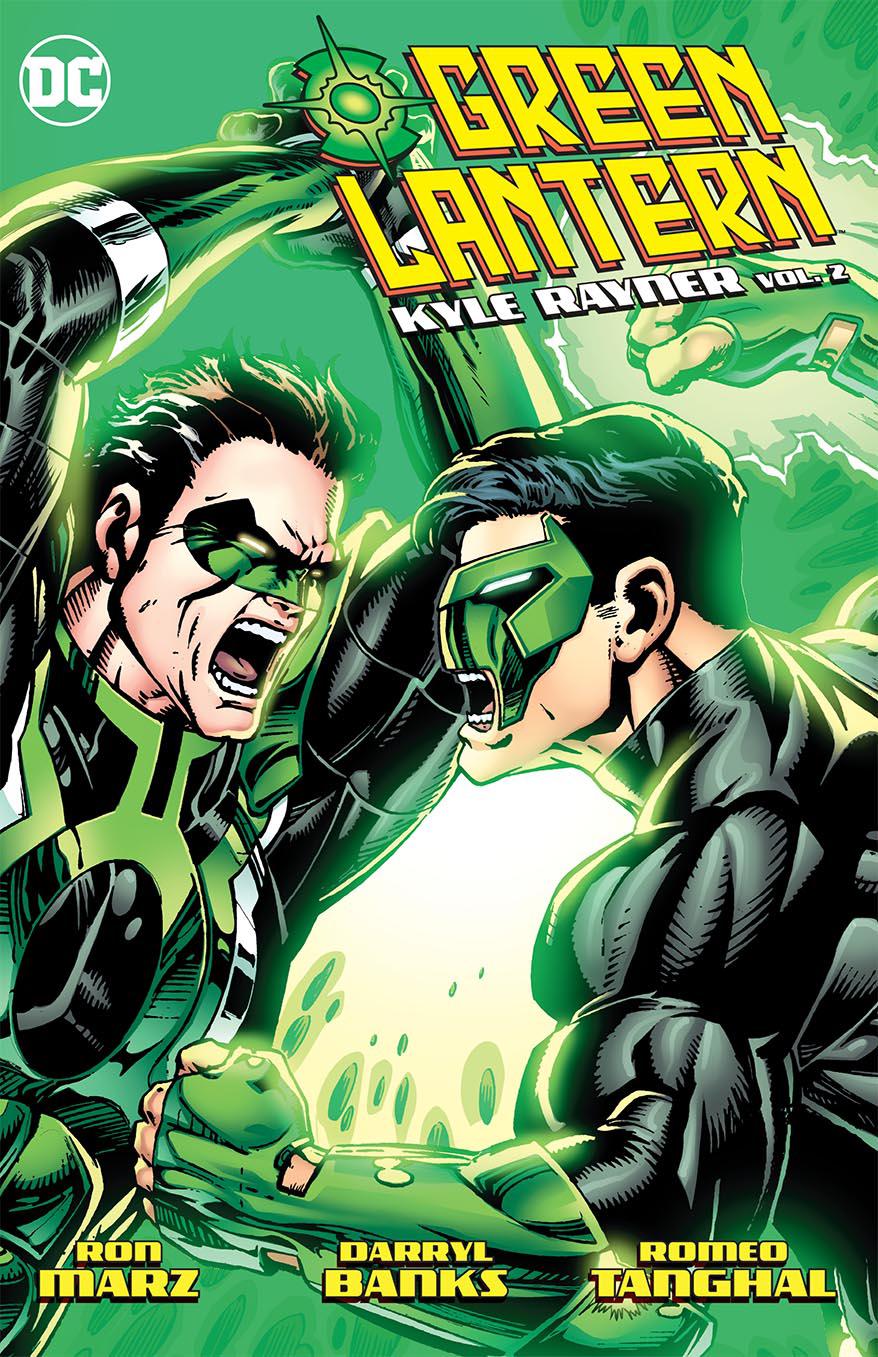
Green Lantern: Kyle Rayner Vol. 2 (DC) The second collection of the Kyle Rayner era of Green Lantern--or Ron Marz era, if you prefer--covers much of 1995 and, like the first volume, is more than complete. That is, not only does it contain the next chunk of issues from that particular volume of Green Lantern (#58-#65), but because there are a pair of crossover storylines that included issues of Green Lantern, other titles participating in those storylines are included herein as well.

So two issues of Guy Gardner: Warrior, which begin the "Capitol Punishment" three-parter that concludes in Green Lantern, are also collected in this volume, and the last storyline in the book is "The Siege of the Zi Charam,"a five-parter that began and ended in New Titans, and included an issue a piece of Darkstars, Damage and, of course, Green Lantern.

Marz writes the lion's share of these comics, although Beau Smith, Marv Wolfman, Michel Jan Friedman and Tom Joyner also contribute, scripting the books they were writing at the time. Darryl Banks and Romeo Tanghal are similarly the primary pencil artist and inker, but there are a total of 19 other artists involved, perhaps the most surprising of whom was Cully Hamner, who draws part of single issue of Green Lantern, in which his current style is only just recognizable, and I likely would have passed over it without recognizing it had I not read that issue's credit box.

This period finds Kyle Rayner getting settled into his new life in New York City, which includes membership on the Titans superhero team being lead by Arsenal Roy Harper, and a burgeoning friendship-becoming-romance with fellow Titan Darkstar Donna Troy. He's grown increasingly comfortable with his new role as a superhero, and there's another one of those teases of Hal Jordan reclaiming the mantle, only to reinforce that it's Kyle's again. That comes in a two-parter entitled "Parallax View," in which both Ganthet and Hal show up at his apartment at the same time, both asking for the ring back. While Kyle and Hal fight using green light constructs, Ganthet teleports around the DCU collecting a little ad hoc Justice League to throw at Hal: Superman, Martian Manhunter, Aquaman, Flash Wally West, the then-composite Hawkman and Green Arrow Oliver Queen (wearing the costume that Connor Hawke would be assuming shortly). That's...a lot of dudes, isn't it? Ganthet visits Black Canary, who he interrupts while admiring herself in her classic fishnet costume and saying that she doesn't care if it is sexist since she looks so good in it, but when she informs him that she's lost her sonic scream he leaves without her.

The aforementioned "Capitol Crimes" storyline is mostly a Guy Gardner one--this occurs shortly after he lost his Sinestro ring and learned that he's Vuldarian and has weird, gross new powers--that intersects with Kyle's story in that he fights Major Force, who has stuffed a woman into another refrigerator (the cliffhanger implies that it is Guy's mom, but we later find out it in Guy's mom's friend...and Guy's mom's cat!). For some reason, I had never heard of this particular woman in this particular refrigerator, so I guess that Alexandra DeWitt dying as part of Kyle's origin wasn't exactly the straw the broke the camel's back in that regard, even if it did eventually lend a name to the phenomenon.

The relationship with Donna includes a quieter issue where she helps Kyle unpack his new apartment (that's the issue that includes Hamner art), a Christmas issue set partially at the Titans HQ, a team-up in which Kyle draws the attention of Darkseid and the pair have to battle Kalibak and the aforementioned "Siege" crossover, a actually pretty weird, sci-fi story that is a natural fit for GL and Darkstar/s and the new Titans character Jarras Minion, but not so much the rest of the Titans team (here, that's Arsenal, Terra II, Mirage, Damage and the-Matrix-verison-of-Supergirl, as Impulse missed the spaceship's launch).

In addition to all of those characters, Steel puts in a brief appearance, and Kyle briefly battles Felix Faust and Doctor Polaris.

The art in this issue is mostly of the not-very-good sort, although some of the most egregious examples are the fault of the style of the time more so than just all-around poor work. I think the most striking work might have been that of Warrior artist Mitch Byrd; there are some cringey-looking panels, but his figures are always thick, somewhat squat, and don't much look like anything anyone else was drawing in these issues. In general, the Banks art was strong, and I was pleasantly surprised to see Ron Lim pencils during the "Siege" storyline.

I'm not sure how much this book will have to offer many readers who weren't at least somewhat familiar with the state of the DCU at the time--I think I had only read two issues of these Green Lantern comics, plus most of "Siege" previously from back-issue bins--given how of their time they are. That is, almost every hero who Kyle crosses paths with, particularly Guy and Donna, are in such strange and such different places than they are now that I imagine anyone coming into these collections cold would have a lot of questions.

I'm enjoying them for the most part, though, even if it is clear at a glance that these aren't exactly the best-drawn comic books DC was publishing in the mid-1990s.

Looking ahead, which is something I like to do with these collections, it looks like the next volume should contain the very first Flash team-up (the fact that Wally disliked Kyle as much as most Hal Jordan fans and only rather gradually got to the point where he begrudgingly became his friend was one of the aspects of those characters I really liked), some Underworld Unleashed business, "Hero Quest" (in which Kyle tries to force Batman, Wonder Woman and Captain Marvel to teach him something about being a hero) and maybe the first meeting and team-up with the new Green Arrow (another interesting relationship of the era of DC heroes), although given the collections inclusion of other books thus far, one never knows. I doubt we'll see any more issue of Titans though, as after "Siege" that book just had one more story arc, the five-part finale, "Meltdown."

Street Angel Goes To Juvie (Image Comics) The latest of Jim Rugg and Brian Maruca's hardcover, oversized, 9-by-12-inch Street Angel album from Image Comics (and the fourth such album, unless I missed one, which would be a terrible tragedy), finds our heroine Jesse Sanchez going deep undercover as "Shiraz Thunderbird" to juvie, aka "Alcatraz Junior." She's kinda sorta on a mission to bust someone close to a local superhero out, but she's also kind of their on vacation because, as it turns out, Street Angel fucking loves prison life. They feed her as much food as she can eat three times a day, they let her sleep in a bed, school is taught at her precise learning level and they get to watch movies once in a while!

The central gag, that Street Angel actually kinda sorta loves being in jail because prison life is infinitely easier than being a homeless little girl, never quite gets old, as Rugg and Maruca keep finding new ways to demonstrate that tension and, well, it's a pretty short comic, so it's not like any gag has too much time to wear out it's welcome. This comic contains pretty much all of the images of Jesse smiling I can remember seeing, too; eventually she gets so happy that her face looks not entirely unlike that of a smiling emoji.

As with previous books in the series, there's a ton of fun back matter, including book club discussion questions (man, I really need to start a Street Angel book club), and I particularly enjoyed the end pages, which are presented as a sort of scrap book including newspaper clippings of Jesse's adventures and various mug shots that reveal other dubious aliases, like Jenny Sandwich, Johnny Manchez and Finnley McGee.

The only bad part of the book? There's a mention of Street Angel's Dog, a Free Comic Book Day comic, and I completely forgot this Saturday was Free Comic Book Day, which means I probably missed my chance to get a copy of that.

True Believers: Kitty Pryde and Wolverine #1 (Marvel Entertainment) My sister is an elementary school teacher and a few years ago she asked if I had any kids comics I could give to her for use in her class. From what I understand, she has her own little personal library of books and now comics and graphic novels that the students in her class are allowed to pick out and read when they finish their work early or during free or down time or whatever. They are third-graders, and they seem to particularly enjoy the DC Super Hero Girls original graphic novels and the various IDW-published Star Wars-related comics I've sent their way.

I generally ignore Marvel's "True Believers" $1 reprint line, given that most of the stories that appear in them can be read in their entirety in collected form, but this week when my eyes fell on them among the new releases in my local comics shop, it occurred to me that they might make for a good source of cheap comics to send to my sister's students--after I read them myself, of course.

Kitty Pryde and Wolverine #1 seemed like a good bet, starring as it does the preeminent juvenile point-of-view character of the X-Men franchise, if not the Marvel Universe as a whole. It is, as most readers with a deeper knowledge of the X-Men and Marvel than I know, the first issue of a 1984 miniseries, written by Chris Claremont and drawn by Al Milgrom (or Allen Milgrom, here). Despite the shared billing, this issue at least is a Kitty comic, with Wolverine only appearing in a panel or two, when Kitty calls the mansion in a moment of desperation and he picks up the phone.

I liked it okay, and it was a pretty good reminder that, for all of Claremont's quirks and as sophisticated as comics storytelling has become in the decades since, the sort of first pass through of X-Men adventures were perhaps their strongest, as the franchise hadn't yet expanded horizontally into too many books, nor been passed between so many different editors and writers, so many of them quoting and homaging their own favorite stories from the Claremont era, that X-Men comics can often seem to be something between unwelcoming and impenetrable to new readers. Like, I picked this up with no knowledge of what the hell was going on in the early 1980s, and it was easy to follow. I can't say the same of the first issue of virtually any X-Men comic I can pick up these days, despite keeping at least an eye on what Marvel's been up to in that corner of their publishing line for the past, oh, 18 years or so.

That said, I suppose I should have double-checked the credits box before purchasing this, because I forgot how much verbiage Claremont comics used to bear...some of his scripts can make Brian Michael Bendis read like Raymond Carver, and this issue had more words in it than most chapter books. Aside from just how much reading it involves, the content seemed okay for third-graders, but Marvel doesn't seem to agree, as they labeled it T. So I guess I won't be passing this on, after all.

Milgrom's art is really quite great though. I really love his line work throughout this, particularly the inking on the trees in the park on the opening splash page, and the scenes involving water--a rainstorm in Tokyo, a scene set in the sewer. By the time I reached the last page, I was curious to see what happens next, so I guess the book succeeded in enticing me into reading another Marvel collection (if not buying one; that's what library's are for, after all). It just didn't seem to meet the purpose I bought it for (passing it on to a bunch of third-graders; I suppose if I wanted to get them a high-quality comic featuring Wolverine and Kitty Pryde, I'd have to look for some Wolverine: First Class back issues from Fred Van Lente and company).

Still, it wasn't anywhere nearly as inappropriate for little kids I'm not related to as...


True Believers: Wolverine--Sword Quest #1 (Marvel) I bought this for the same reason I did Kitty Pryde and Wolverine, but by the sixth panel the script started alluding to rape, and the first dozen or so pages continually do so. That's on top of all the killing, mostly accomplished by stabbing with claws and, as tastefully as it is all staged--that is, it's neither gratuitous nor gory--it adds up to something that reads way too much like an R-rated 1980s action movie to hand to a bunch of third-graders, I think, as cool as they no doubt think Wolverine is.

This is another Chris Claremont joint, the first issue of the first Wolverine ongoing series, launched in 1988. The sub-title of the True Believers edition, "Sword Quest," is just the name of the story arc, but adding it to the cover sure sold me on it. I mean, I like Wolverine just fine, and I quite naturally like both swords and quests, so why wouldn't I buy this for a $1...?

Despite not being anywhere near appropriate for the kids, this comic is perfectly appropriate for Caleb's. Again, I have no sense of what the hell was going on with the X-Men at this point, but from Wolverine's narration, the world apparently thinks they are all dead, and he works to try and keep the fact that he's not dead a secret. I suppose that explains why he's not wearing his Wolverine costume, but is instead wearing all-black, with some pain around his eyes to form something of a mask, although one imagines the wolfman hairstyle and the claws coming out of his knuckles would be a pretty good giveaway that he is, in fact, Wolverine of the X-Men, regardless of what he's wearing or how well one can see the area around his eyes.

He later adopts and even dumber disguise, when he meets someone who actually knew him. He puts on an eye-patch and a hat while in Madripoor--not sure if this is the beginning of his "Patch" identity or not--and apparently that's enough to make Lindsay McCabe not recognize him, despite the fact that he's still a pretty short guy with extremely prominent, not-at-all-in-style Civil War era sideburns.

The art is penciled by John Buscema and inked by Al Williamson, and it's pretty good stuff. There's something particularly Joe Kurbert-y about it, particularly in the first half of the book, which features a lot of modern pirates and some uniforms. There are a lot headbands, bandoliers, coats with collars and folds filled with shadows, knives and firearms, and haunted, world-weary looks.

I really dig their Wolverine. While he looks like he's wearing all-black on the cover, the costume he sports in the interiors looks more-or-less like his traditional one, sans the cowl, only the color is a light blue with darker blue and and black highlights (Of course, his hair also looks blue, not unlike the way Superman and Wonder Woman used to have blue-black hair). Their Wolverine has a magnificent mane, and in at least one splash page, he doesn't even seem to have a human head, just a too-small, mask-like face fringed by swoops of blue hair that form a sort of four-pointed star around his twisted-face scowl.

He kills so many pirates, in one scene they pile on top of him, and he somehow seems to make a human shish kebab out of them a stack of seven flailing bodies stacked atop his extended right arm, which he then hurls through the walls of a shack. When he's not in dude-killing mode, his hair seems to calm down quite a bit. For example, when he's in disguise later, his sideburns lay down flat. I'm not sure if it's intentional or not, but the implication is that Wolverine's head of hair bristles like that of a wolf when in battle...?

A lot of what is in here now seems like cliche business, with Wolverine spouting off his catchphrases, and Madripoor, the eye patch, his Canadian samurai posture, even the particular sword he's questing after, but that's only because I'm reading this in 30 years after it was originally published, and those are all elements that the scores of other Wolverine writers to follow Claremont all incorporated into their own comics over and over and over again until they became cliche.

Thursday, April 12, 2018

Comic Shop Comics: April 11th

Peter Parker: The Spectacular Spider-Man Vol. 2--Most Wanted (Marvel Entertainment) This trade collects the next four issues of writer Chip Zdarsky's new Spider-Man series, which here means issues #297-300, because Marvel. It is very much a continuation of the same story that was in the first volume, a feud between villain The Tinkerer and his brother Mason, with the former upgrading tech-based villains and the latter tech-based heroes, with Spider-Man and his kinda sorta sister Teresa caught in the middle, and it will continue into at least the next volume as well, as there's a turn in here that means Spidey and company will still be dealing with the outcome of The Tinkerer's machinations for at least a few more issues. As a superhero plot, it works just fine, and Zdarsky writes an excellent Spider-Man, although the first volume was much funnier, and contained more scenes written just for the sake of being funny and/or character work.

There's at least one pretty amazing image in here, a splash page drawn by the book's on-again, off-again artist Adam Kubert that demonstrates just how close the two brothers actually are. There's another image that should be pretty funny, but the way it's drawn and colored blunts the impact pretty severely (When Peter Parker needs to suit-up in an emergency situation, he's left with only a poorly-packed spare costume, which here means his black-and-white suit, but with the red and blue suit's gloves and mask).

I was a lot more impressed with the first volume than this second one, to the extent that I'm questioning whether this is a series I need to buy in trade or just borrow from the library. I wonder if the book might be better-served by an artist whose storytelling sensibilities are closer to Zdarsky's...and who can draw every issue of the series...?


Scooby-Doo, Where Are You? #92 (DC Comics) While I've been enjoying Scooby-Doo Team-Up immensely, it has been a long, long time since I've checked out the main Scooby-Doo comic. I decided this would be a good time to check in with it given that 1) I've been watching the second half of the first season of Be Cool, Scooby-Doo on DVD, putting me in more of a Scooby-Doo mood than usual, 2) There's not much on my comic book shop shopping list that's out this week (which has been occurring more and more lately, to the point where I will likely be revising this particular feature on my blog in the near future), and 3) That's a pretty intriguing cover, of the sort that can make a curious reader want to pick up the book just to see what exactly is going on (Even though I do find the image of Scooby-Doo wearing a mask of his own face somewhat terrifying).

The comic is still broken up into multiple stories, at least one of which is pretty clearly a reprint (although was still new to me). The cover story is written by Ivan Cohen and drawn by Walter Carzon and Horacio Ottolini. Mystery Inc are the guests of honor at "Sleuth Con International," which is basically just Comic Con for...mystery-solving, I guess. They are there for less than a page when they find that a crime has been committed--someone has stolen a collection of masks that they have pulled off of ghosts and monsters in the past. They find investigating difficult though, as they keep getting stopped by fans, so they switch clothes so they can blend in with the other cosplayers (Scooby, who has no one to change clothes with, dons a mask of his own face--Brr!).

It's a neat idea for a visual gag, but not terribly well-executed, I'm afraid. Like, Shaggy and Daphne should be swimming in Fred and Velma's clothes; Shaggy's baggy clothes should be tight-fitting on Fred, and Velma should be threatening to burst the seams of Daphne's tiny little purple number. Carzon doesn't do anything with the visuals though to make the wardrobe-swapping even noteworthy, and Cohen's story takes the path of least resistance from Point A to Point B, leaving plenty of jokes on the table. The one thing he did do that was kind of clever was putting "Old Man Carruthers", a former Scooby-Doo villain, as a reformed criminal, now exploiting the notoriety of his brush with Scooby and the gang to make a living off the convention circuit.

That's followed by a four-page story by Scott Peterson, Tim Levins and Dan Davis, a Shaggy-starring homage/parody of Edgar Allen Poe's "The Raven," perhaps appropriate given that someone dressed like Poe plays a role in the lead story (Page three of the story is actually surprisingly dark, as Shaggy begins to wonder if his friends have all died, although the dialogue never makes a direct reference to death).

Finally, there's an eight-page story by Frank Strom and Scott Neely which is pretty clearly a reprint, as the second panel contains a banner reading "2009 International Surf Open."

I suppose the comic is okay, but I think it falls into a weird area where it's definitely not all-ages, but also a kid would have to be old enough to read fairly well to get much out of it. I suspect the window in which a kid is of the right age for the book is a particularly small one. Certainly when compared to Team-Up, which is a genuinely all-ages book.

Thursday, April 05, 2018

Comic Shop Comics: April 4th

Batman #44 (DC Comics) The latest issue of Batman, drawn by both of the title's current primary artists, Joelle Jones and Mikel Janin, rather nicely illustrates both writer Tom King's strengths and weaknesses. The plot is pretty simpl, leaving it to the artists to do the heavy-lifting (as it should), while picking an interesting throughline to the Batman/Catwoman relationship over the years to focus on.

In simplest form, the plot is this: Catwoman goes shopping for a wedding dress. This being Catwoman, she does so by sneaking out of Bruce Wayne's bed in the wee hours of the night, breaking into a dress store, trying on a bunch and stealing them. Meanwhile, flashbacks demonstrate the changing nature of their relationship to one another, with their costumes being the most immediate and obvious signifiers as to which era they are supposedly occurring in (You know the cover for 2004 collection Catwoman: Nine Lives of a Feline Fatale...? In this comic, we see all but two of those costumes). Jones draws the modern scenes, and I guess one could question why the female artist has to draw the dress-shopping, but I suppose the answer is simple: Jones is the better artists, and those scenes require the most acting and nuance.

As for what the story reveals about King's weakness, it's another illustration of the showiness of his writing. He's a good writer, but he always seems to be trying to demonstrate it, or call attention to it, often by employing gimmicks where no gimmicks are needed. So, for this issue's example, every single panel in the modern day sequences have a time stamp embedded in it, letting us know exactly what time it is, as if that mattered. The first panel, for example, is an image of Bruce and Selina in bed together, his eyes closed in sleep while hers are wide open. It is, we see, 2:37 a.m. Next panel? She gets dressed. It's 2:54 a.m. And on and on until she seemingly finds the dress she likes (at 6:37 a.m., if you're wondering) until she gets back and bed and closes her eyes, eventually falling asleep at 7:46 a.m.

Not only is it distracting from the story, it also sometimes works against the story. As I mentioned on Twitter, there's this sequence:
Without the time stamps, it's pretty clear that Selina took a swig of the champagne, wiped her mouth, and proceeded with her dress shopping. But looking at the time stamps, the time that elapses between when she takes a drink and when she wipes her mouth with the back of her hand is...nine minutes? Did she very, very, very gradually chug the whole bottle over almost ten minutes? Or just stand in place, taking drink after drink, for nine minutes? It's not an important thing to think about, but the only reason I'm thinking about it at all is because King felt it necessary to tell us the precise time that every action occurs.

Not only is Jones' art super-clear in terms of moving the character through time as well as space, but even if King and the editors thought it was super-important that we know the story begins in the middle of the night and ends in the early morning, the drawn images convey that (Catwoman wakes up when her boyfriend is asleep in a bed in a darkened room, she returns to the house when Alfred is up and puttering around), as does the work of colorist Jordie Bellaire (or is it June Chung? Both are listed as colorists, but I'm assuming one was attached to each artist), who gives all of the night scenes cool, dim blues, while the scene set in the morning is warmer yellows and pinks.

Interestingly, there's no such obsession over time when it comes to the years. That is, the flashbacks don't each open with a "Five Years Ago" or "Three Years Ago" caption. I guess they couldn't. This is the sort of thing that only bothers fan-readers like me, I realize, but the general timeline laid out here is quite pre-Crisis, or, perhaps, a sort of Morrisonian post-Crisis, pre-Flashpoint timeline, where "everything happened." Catwoman's costumes and capers run the gamut from her Golden Age first appearance, to several short-lived Silver Age outfits to her Jim Balent-designed costume, the one she was wearing in King and Janin's "War of Jokes and Riddles" flashback story. Batman also has changes in his costume, but these are much more minor, and seemingly meant to reflect whatever his "new", post-Flashpoint fashion history is. His bat-symbols change slightly, and sometimes his briefs appear or disappear, even in the same scene, likely do to coloring mistakes more than anything else.

The thing is, that pre-Flashpoint continuity was pretty loudly done away with by DC, even though DC's creators still try to use it as often as possible. (Is it worth nothing that the Catwoman costume that doesn't appear is the one that she wore post-Crisis? The gray bodysuit with her super-short hair under her cowl, from Batman: Year One, the 1989 Catwoman miniseries and her pre-Balent appearances?) The company line on the current, post-Flashpoint timeline is that Batman's career is something like 5-6-years long, plus something like 3 years, with Catwoman dressed in a version of the Darwyn Cooke-designed modern costume throughout those last three or so years (The three years comes from in-story markers, like the artificially-aged ten-year-old Damian Wayne celebrating his 13th birthday in DC Universe: Rebirth; there were other markers of shorter passages of time, but that seems to be the biggest one in terms of elapsed time since The New 52 relaunch).

Since Catwoman was shown wearing the Balent-ish costume in "War of Jokes and Riddles," which not only appeared in this very comic book but was also written by the very same writer who wrote this issue, and that story was meant to take place during Batman's first year, or close to it, then that means Catwoman had five different costumes and approaches to Batman in the first...year of their respective careers? Huh. (The appearance of another character, Robin, only complicates matters further; it appears to be the post-Flashpoint Dick Grayson version of Robin, but I don't think he was around during "War," which means he debuted after, but here he's shown with a pre-"War" Catwoman, so...?!?!?!)

Long story short? The reboot was dumb, no one seems to have thought it was a good idea (not even comics creators doing high-profile work for DC Comics, like Tom King, for example), and it continues to ruin everything (The eye-rolling solution, of course, is simply that the reality-warping events at the climax of Dark Nights: Metal had several continuity-rejiggering elements, like restoring Batman's timeline to a 10-15-year length that comports more with pre-Flashpoint comics than the New 52 era, but whatever).

And while I'm nitpicking, my favorite part of this issue was page 10, where we see Catwoman wearing my favorite one of her little-seen costumes:
I love everything about this page. I always enjoy seeing Batman riding on a horse. But Batman riding a horse to chase Catwoman, who is riding a tiger as if it was a horse...? Even better!

I love the fact that Catwoman is hyping up the virtues of cats, how it is in their nature to be proud and independent, while she is literally riding on a cat as if it were a domesticated beast of burden (The only thing that would be better would be if that tiger were rolling its eyes in that last panel. I mean, if that cat were really proud and independent, wouldn't it just buck Catwoman off and make a break for it?)

I also like to imagine that in the very next panel, the tiger asks itself what it's doing, and then whirls and mauls the horse while Batman and Catwoman go flying off their respective mounts.

Also also? I kind of love the fact that this story is premised on notorious insomniac and creature of the night Batman sleeping from soundly from about 2:30 a.m. until at least almost 8 a.m. the next morning--Did crime finally take a night off, Batman?--and not waking up at any point when Catwoman slunk out of his bed and went into the city to commit crimes. With explosives.

I hate to agree with Burgess Meredith from Rocky, especially since Meredith also played an archenemy of Batman's in the 1960s, but he might have been onto something. Maybe women really do cost men their edge...?

Anyway, Batman is an excellent comic that could--and should--be a bit better still.


Bombshells United #15 (DC) Aneke draws this issue, which continues the story of the Batgirls, Bumblebee and Suicide Squad's investigation into...whatever exactly is going on with Black Canary and Oliver Queen and Hawaii. The panel of Bombshells Canary surfing was pretty amazing, and she and Batgirl lock lips at one point--during mouth-to-mouth resuscitation; don't get too excited--but other than that, this issue doesn't offer all that much that's noteworthy.


Justice League #42 (DC) Oh boy do I hate the text on these covers. Almost as big as the logo for the book, this issue contains a pair of blocks of text, saying, "WHO SHOT WONDER WOMAN? THE ANSWER WILL SHOCK YOU!" It probably won't shock you though. Mainly because she got shot last issue, and you already saw who shot her: Some random kid in Africa who took a shot at Superman and the bullets--or, it turns out, some shrapnel from the bullets--apparently bounced off the Man of Steel and into the Amazing Amazon's throat somehow, without either super-speedster being able to catch, deflect or avoid it.

Writer Priest does make a point of explaining that Wonder Woman can't deflect attacks when she doesn't know they're coming, which, okay, but it doesn't really explain why Superman didn't catch them. Or how bullet fragments pierced her skin (She is invulvernable at the moment, right?). Or why Superman, The Flash and or The Green Lanterns didn't solve that problem, like, immediately for her (There's a scene of Superman using his heat vision to do...something to her neck. I thought maybe he was destroying the bullet fragments and then cauterizing the wound, but maybe he just did one at not the other? I don't know; after he does it, she still seems to be dying.

The Flash takes her from Superman and uses his even more super super-speed to take her to...San Francisco, where he has Kid Flash Wally West (the newer Wally West, not the older Wally West) to get Raven, for some reason. We'll find out next issue if she can use her vague magic powers to save Wonder Woman's life, or if she's totally going to die!

All that business aside--and I suspect Wonder Woman was put in such peril to remove her from the thorny ethical and political issues the League finds itself faced with when The Fan plops them down in the middle of a fictional African country filled with warring tribes and a despotic ruler in a cat costume, since that is historically the sort of thing she's supposed to specialize in--this is a strong penultimate chapter of the League's difficulties in addressing real world-ish problems.

I additionally dig the beginnings of the character work Priest has managed here, particularly with the Lanterns, but also in simple differences of opinions, like Batman's blanket "no killing, EVER" in contrast to Aquaman's more pragmatic "well, sometimes you gotta kill someone" stance. It's a shame his run on the League ends next issue, honestly, as he's demonstrated a lot of potential, although the storyline is rather obviously constrained by its limited nature.

DC has announced, but not yet solicited, a too-ambitious line of Justice League books, including a new Justice League with a new line-up written by Scott Snyder (good idea) and spinning out of Dark Nights: Metal and more questionable choices: Justice League Dark written by Snyder's occasional co-writer James Tynion starring the Wonder Woman and a new iteration of the Sentinels of Magic/Shadowpact/Justice League Dark team DC keeps trying to make stick and a Justice League Odyssey book written by Justice League Vs. Suicide Squad's Joshua Williamson, which will features Cyborg and Jessica Cruz leading a grab-bag team that includes Starfire, Azrael and Darkseid.

Snyder's flagship book is going to be published bi-weekly, but carry the $3.99 price point of DC's monthly books. If Dark and Odyssey do likewise, then it looks like the publisher has set the line up to implode right out of the gate. (They've struggled with a secondary League book pretty much since the 2011 relaunch, so jumping right to a second and third seems...questionable.) Anyway, I imagine they have a plan to make the books all compliment one another pretty intricately, and that's why Snyder collaborators on past books and the upcoming No Justice series are involved, but it still strikes me as a shame to have three Justice League books, and not have Priest writing one of them.


Nightwing #42 (DC) This is a fill-in issue, a particularly evergreen-feeling done-in-one by the writing team of Jackson Lanzing and Collin Kelly, with Jorge Corona providing the artwork. Although I decided to jump off the book at the conclusion of the previous arc last issue, I was attracted to this issue because it reteamed Dick Grayson with Damian Wayne, and Corona's somewhat off-kilter art--particularly for a current DC comic--sealed the deal.

A narrator not revealed until the last page tells a story of Nightwing's battle against The Crimson Kabuki, a criminal organization in Tokyo that has captured Robin and plans to use the powerful blood of Batman and the al Ghuls for some kind of no-good. It's up to Nightwing, dressed in a nice suit over his spandex work clothes, to fight his way through a three-level tower to meet their leader atop the roof. Movie references abound in Dick's dialogue, but the action is all pretty well executed and, again, Corona's art is different enough looking from that of the previous few issues, and so much of what you'll find between the covers of most DC comics at the moment, that the book looks incredibly refreshing (and hell, a 20-page story with a beginning middle and end after what felt like a 16-part storyarc about The Judge in Bludhaven was even more refreshing).

Batman, Goliath and Batcow all make one-panel cameos.


Snotgirl #10 (Image Comics) I often feel this comic is very much not for me--that is, that I'm not it's intended audience at all--but I love Leslie Hung's artwork, and am growing to like Lottie as a character the better I get to know her. Bryan Lee O'Malley's weird soap opera plotting remains engaging, but I think I've liked this two-part arc, "The Weekend," better than the previous eight or so issues, as there's a hint of supernatural weirdness that only heightens all of the books regular attributes.