Showing posts with label the spirit. Show all posts

Sunday, April 07, 2013

Is that you, Ebony White...?

Apparently, it's supposed to be.

The sidekick of Will Eisner's comic strip crime-fighter The Spirit began his fictional life in 1940 as an outrageous African-American stereotype, and is perhaps the most embarrassing aspect of the late Eisner's legacy. When Darwyn Cooke resurrected The Spirit as a DC comic book in 2007, he divested the Ebony character of all of the negative aspects of his original characterization. When Frank Miller adapted his friend Eisner's character to film in 2008, he excised all trace of Ebony completely.

And when Ebony appeared in Brian Azzarello and Rags Morales series creating a sort of alternate universe where Batman and a few minor DC characters rubbed elbows with the likes of pulp hero Doc Savage, W.H. Hudson's Rima from Green Mansions and The Spirit, Azzarello decided Ebony would work better as a girl, apparently following logic similar to that of Frank Miller's in casting a female Robin in his seminal The Dark Knight Returns.

A grown man always hanging around a teenage boy who never wears any pants? That seems suspect. But a grown man always hanging around a teenage girl who never wears any pants? That's the stuff of potent fantasy! The same with fully-clothed teenage assistants, I suppose.

Azzarello actually explains his rationale for Ebony's sex change in promotional material that DC ran in the backs of many of their line when he and Morales' First Wave was about to start hitting comic shops in early 2010. These are included in the back of the hardcover collection of the series.
"As for the the elephant in the corner...Look, I have very strong feelings that the only way to make EBONY WHITE work is to make the character a brash girl," Azzarello wrote. "Make the character a brash girl" is underlined in red, and a big "LET'S DO IT!" appears in red at the bottom of the page; the premise of the promotion was that readers were looking at Azzarello's notebook of character proposals to his editors, who are represented by the red ink.

"Then the name and attitude (sass) fit," Azzarello concludes. "We can talk about this."

I'm not entirely sure why this might be so, as a black person essentially named "Black White" is just as unusual regardless of the gender—perhaps he meant only that more girls' names end in Y's than boys' names—and Ebony wasn't necessarily known for a "sassy" attitude as much as a collection of groan-inducing tics and schticks taken from early 20th century American "darky" humor. None of these are present in the character, who was being completely recreated especially for this story along with all the other characters, so Ebony's attitude wasn't exactly a problem.

Whatever Azzarello and company's ultimate rationale for the change, it's interesting that there was a change, as it was interesting to see the various ways in which the creators decided to try and recreate a group of decidedly old-school—even for superhero comics—characters into something for a 21st century audience. Among the other more radical reinventions were those of Rima and Black Canary.

The former becomes a topless jungle warrior who conceals her nipples behind beaded necklaces that always fall just so, speaks only in whistles and hangs out with a black jaguar who kills the opponents she doesn't spear herself (It's a portrayal DC moved towards in the mid 1970s, when Nestor Redondo, Robert Kanigher and Joe Kubert transformed her into a Sheena-like jungle girl heroine for the space of a short-lived series).
The latter never makes it into the story pages of First Wave; she either belonged to an earlier draft, appeared only in tie-ins that aren't part of this collection, or was intended for future stories that the sequel-hungry conclusion begged for, but never actually came.

"Dina Drake is a second-generation American in her late teens," Azzarello writes of his Black Canary. "She lives in Gotham's East End, which is one of the city's worst neighborhoods...over Sherwood Florist, the family business." Deeply respectful of her parents, the young woman is nevertheless "enamored with the exploits of Dc Savage" and fights crime in her neighborhood at night, wearing "a blond wig and a very sexy costume—one her parents definitely wouldn't approve of." (Let me pause to note that with a teenage Ebony and a Rima in her "late teens, early twenties," Black Canary woulda been a third scantily-clad teenage heroine in the world of First Wave; the oldest female hero is the Blackhawk pilot Jenny Cloud, who Azzarello's notes tell us is in her "late twenties.")

He ends his paragraphs on Black Canary with, "Now, doesn't this story make even more sense if Dina is of Korean, Indian, or Middle Eastern descent?" The red-penned editor agrees, underlining "Indian" and "descent." "I mean the old-world parents, the family business in a bad neighborhood. This rings so true to me..."

In red: "YES—DIYATA DASARI?"

**********************

Add caption
Seen in its already-historical context, DC's First Wave and the sub-imprint/continuitiverse it sought to establish is something of a curiosity, one of several of the more amusing publishing bumbles of the post-Paul Levitz DC Comics. It seemed a more-or-less doomed endeavor from the start, given little promotion and no real sign of priority among the rest of the publisher's goings-on (particularly compared to the New 52 reboot that was coming just as the final issues of First Wave were shipping).

It had a Batman in it, sure, but there are a lot of comics with a Batman in them, and this was a Batman, not the Batman, and DC's fans, like super-comic fans in general, want to read the comics the publishers tell them are important, the ones that "count," and this was an alternate-continuity one, a comic that most obviously did not count.

The other characters were pretty ragtag in terms of sales draw. Everyone knew The Spirit, of course, star of the critically-acclaimed, marketplace poison Darwyn Cooke series DC had just recently canceled before First Wave. Doc Savage is kind of famous, I suppose, though hardly a popular presence in our culture. Then there was a even less well-known pulp character with some kind of chameleon-esque disguise power (The Avenger, I think; the text was pretty vague); a new, infinitely less offensive version of the Blackhawks-as-international-army group of characters: and a new iteration of Hudson's 1901 jungle heroine, based on the 1975-1976 version.

Basically a League of Extraordinary Gentlemen type of concept, but without any core, organizing principle—the characters were from fiction literate and pulp, from the comic strips and the comic books. (The concept could probably work for a publisher like Dynamite and, in fact, they've been publishing lines based on lapsed-into-public domain superheroes, another based on various pulp, comic, radio and comic strip heroes interacting and, for a while, were publishing as many Green Hornet comics as Marvel publishes Spider-Man comics, but Dynamite is a small publisher operating with very different math and money than DC has to operate with).

Like a few similar efforts around the time—DC's revivals of The Red Circle characters and the THUNDER Agents—it was assumed the audience would already know and care about the characters enough to buy the books. Very little effort is put into the story itself to thoroughly introduce the characters and, in the case of Doc Savage, his Byzantine back story, which includes a half-dozen sidekicks (who, unlike the DCU Batman's army of sidekicks, lack colorful costumes to distinguish them more easily), and several not-entirely introduced villains, some of whom I knew no better at the end of the book then I did at the beginning.

In other words, the thinking seemed to be that 2010-2011's direct market would embrace such a comic book because it existed, which, sad to say, is the basic wishing-and-hoping publishing strategy of DC Comics and, to (a thankfully and) an increasingly lesser extent, Marvel (Though you look at releases like, say, Fearless Defenders and know they're just throwing books into the market to die for nothing more than the intention to crowd small publishers off the new books racks and on the slim hope they'll get an unexpected sleeper hit, too).

The creative team didn't guarantee success the way that, say, a Geoff Johns/Jim Lee or Grant Morrison/Anyone Halfway Decent creative team might have, either. Azzarello's a pretty great writer, and Rags Morales is a really great artist (and one of my personal favorites), and while it's true they do command their own fan bases within the market and can thus bring a certain, set amount of readers to any project, they don't guarantee blockbuster sales by their presence alone (This was a problem with the aforementioned Red Circle and THUNDER Agents books as well; if you're already facing an uphill battle, you really have to assemble a team strong enough to get up that hill almost on their own).

And finally and, I would guess, most damningly, DC started expanding the miniseries into a line almost immediately, before they could possibly have even gotten a sense of how many readers there actually were and how the storyline, its world and the new versions of all these characters were being received.

So 2010's Batman/Doc Savage Special #1 (by Azzarello and Phil Noto, not Morales) was followed a few months later by the first issue of First Wave by Azzarello and Morales.

The following month, when First Wave #2 hit the stands, a Doc Savage monthly and a Spirit monthly set in this new setting also launched. First Wave was a $4, over-sized monthly, and both the new Savage and Spirit books were in the $3.99-for-a-regular-length-title-story-and-short-back-up format that was pretty widespread at DC at the time, but has since mostly disappeared save for a few popular books (Savage had a Justice, Inc back-up; Spirit had a "Spirit Black-And-White" back-up, which featured stellar creative teams doing short one-offs featuring the character, akin to the back-ups that used to run in the back of the late, great Batman: Gotham Knights).

So after spending maybe $8 meeting Doc Savage and getting a feel for the new pulp-iverse in Batman/Doc Savage and First Wave #1, DC then upped the curious' commitment to $12 a month for three different over-sized books. I'm not sure what killed the First Wave-iverse—a re-prioritizing that meant not wasting resources on comics featuring characters the publisher didn't own outright, a desire to focus all attention on The New 52 DCU instead of fooling around with offshoot lines and universes—but if DC didn't grow these books and this premise to death by over-producing too quickly, that decision couldn't possibly have been healthy.

*********************

The comics themselves really aren't bad. I was curious to read much of the First Wave line (not $4-a-pop curious, but borrow-a-trade-from-the-library-years-later curious), most particularly the main series and those black-and-white Spirit shorts. The First Wave trade contained the Batman/Doc Savage special (which I'd actually read in the serially-published format; I didn't like it) and all six-issues of the First Wave series.
Savage and Batman are the two real stars. The former is basically this world's only real super-hero, and the story begins after the death of his father, as he and his team begin to reassert themselves in the world, and chase down a conspiracy involving a bunch of pulp villains, a secret society, a mad science island, a robot, genetic lizard-embiggening, and suchlike.

The latter is very much First Appearance Batman; he doesn't wear the purple gloves, but he carries a pair of .45s, guns down his foes and is more about protecting his city from crime by ridding it of criminals than saving the world (His story arc involves coming to terms with the idea of being a superhero; working with others, leaving his comfort zone to effect true good).
The Spirit is next most prominently featured, but he's more of a collection of tics than a character. He's a fun and funny character, but he's mainly there to bounce off of Savage, Batman or whoever he's sharing a panel with (In addition to making Ebony a sexy teenage girl, Azzarello makes Commissioner Dolan a corrupt cop).

The other characters play minor roles. Rima moves a maguffin from Point A to Point B. The Blackhawks are mercenaries who get tied up in the plot. The shape-changing guy shape-changes once or twice (See back-ups in Doc Savage, I guess). Black Canary never shows up.

There's a lot of plate-spinning and juggling going on with so many characters (Doc's staff doubles the cast size, and the villains double it again), and, structurally, it's a pleasing read. Azzarello fills it with cool stuff of the sort mentioned three paragraphs up, heroes and villains alike are pretty cool and he manages to make the story "about" something, even if that "something" is just "Batman's feelings" or "the world's need for heroic inspiration" or whatever. (The one thing I'd slap him on the wrist for? The fact that there is an actual, literal wave in the climax. The bad guys have built some kind of tsunami-generating device, so if you thought "First Wave" was a reference to the first wave of superheroes, well, sure, it is, but also? There's a wave in this).

A far greater treat was Morales' art which, as mentioned, I'm a fan of. This book is a particularly good showcase for his particular skill for character modeling and acting, as the dozens of mostly costume-less characters all need to look like different people for the story to read at all, and Morales accomplishes that with great gusto.

Saturday, December 27, 2008

Hey film critics, what did you guys think of Frank Miller's Spirit?

“What is most striking about The Spirit is how little pleasure it affords, in spite of its efforts to by sly, sexy, heartfelt and clever all at once. Or perhaps the movie flounders because its multiple ambitions are fundamentally at odds, like the various femmes, fatale and otherwise, who do battle for the hero’s heart.

“The 108 overstuffed, interminable minutes of “The Spirit” yield exactly two memorable moments: when one of Mr. [Samuel] Jackson’s genetically engineered minions (all played by Louis Lombardi) appears as a tiny, hopping foot with a head grafted on to it, supplying an odd, creepy morsel of Surrealism; and when Eva Mendes, playing a character called Sand Saref, sits on a copy machine and presses the button. She produces what may be the only true-to-life image in the movie, as well as the most interesting.”

—A.O. Scott, The New York Times


"The Spirit is mannered to the point of madness. There is not a trace of human emotion in it. To call the characters cardboard is to insult a useful packing material. The movie is all style—style without substance, style whirling in a senseless void.”

—Roger Ebert, The Chicago Sun-Times


“As his comics work suggests, Miller is a peerless admirer of the female form, which is to say a shameless lecher concerned primarily with exposing as much luscious female flesh as possible. As a babe-delivery system, The Spirit is a rousing success. In every other sense, it’s a pronounced failure. The hard-boiled visual style of Sin City, with its comic book compositions, noirish black-and-white, and impressionistic splashes of color, now feels shopworn. Running gags limp and scenes drag on endlessly with little sense of rhythm, shape, or momentum. Miller’s screenplay oscillates sleepily between leaden camp, stumbling slapstick, and pulpy pseudo-poetry and [Gabriel] Macht leaves a fatal charisma void in the lead role. Not even the presence of Jackson in a Nazi uniform late in the film can give this regrettable boondoggle a pulse. In comics, it took Miller decades to devolve into embarrassing self-parody. In film, he’s made that leap over the course of a single disastrous film.”

—Nathan Rabin, The Onion’s A.V. Club


“Like Ang Lee's misbegotten Hulk,The Spirit thinks the best way to bring comic-book characters to the screen is to mimic the look of those colorful panels. What Mr. Lee missed, and what eludes Mr. Miller with The Spirit, is making sure the source material's stories also make a clean transition.”

—Christian Toto, The Washington Times


“With the fanboys anxiously eying Zack Snyder's Watchmen adaptation, Frank Miller's version of The Spirit sneaks into theaters almost unnoticed on Christmas Day—good thing, too. Miller, comics-writing icon turned director, has rendered comics-industry revolutionary Will Eisner's crime fighter Denny Colt a grim shade of dull—all talk, no action, save for a few slapstick mash-ups of old Warner Bros. cartoons and Miller's own Sin City, which has the effect of turning Eisner's Technicolor comic into a gray glob of hardboiled mush.”

—Robert Wilonsky, The Village Voice


“Give Miller some credit. He didn't make the worst movie of all time. But that's about the best thing that can be said for The Spirit.”

—Peter Hartlaub, The San Francisco Chronicle


“And yet The Spirit, which Miller wrote and directed, doesn't just play like a cheap Batman knockoff, it plays like a cheap Batman knockoff that knows it's a cheap Batman knockoff and wants to be sure everybody knows it knows. A goofy parody of hard-boiled detective fiction, larded with indigestible globs of expository voiceover and clunky catchphrases, the movie preemptively mocks itself at every turn, as if trying to beat the rest of us to the punch.

“The intention is clear, but the result is dreadful. Good comic books suggest action through abstraction, but The Spirit plays like an overproduced diorama. Watching it is like watching three dimensions trying to pass themselves off as two.”

— Carina Chocano, The Washington Post


“Imagine the stark, monochromatic visuals of Miller’s Sin City as a backdrop for the campy humor of Adam West’s Batman series. Then imagine that the visuals hurt your eyes and the humor leaves you cold, and you get a sense of the The Spirit as a wearying waste.”

—Curt Holman, Creative Loafing


“Still, there's an unavoidable feeling of been-there, done-that to just about everything that shows up onscreen. Macht's weary, fatalistic take on his heroic duties is right out of the Batman mold, while Jackson's Octopus seems little more than The Joker without all the face makeup.”

—Chris Kaltenbach, The Baltimore Sun


“The story, embellished with Yiddish phrases and references to Greek mythology, could hardly matter less. Miller lavishes just as much attention on his own private fixations, which require Jackson and Johansson to dress in both samurai and SS gear.

“The Nazi stuff might make sense if the film were set in the 1940s, but the presence of computers and cell phones suggests otherwise. Miller is entitled to modernize Eisner's vision, of course, but his update is haphazard and soulless. Better to forever haunt a wartime Central City than to be trapped in The Spirit’s green-screen Nowheresville.”

—Beth Accomando, NPR's All Things Considered


“It must really hurt to kill the thing you love.”

—Ty Burr, The Boston Globe


Yeesh. I’m sorry I asked…

Friday, June 20, 2008

Jules Feiffer's Superheroes Week: An unusual metaphor applied to The Spirit

"The Spirit could even suffer defeat in the end: be outfoxed by a woman foe—stand there, his tongue making a dent in his cheek—charming in his boyish, Dennis O’Keeffe way—a comment on the ultimate ineffectuality of even super-heroes. But, of course, once a hero turns that vulnerable he loses interest to both author and readers. The Spirit, through the years, became a figurehead, the chairman of the board, presiding over eight pages of other people’s stories. An inessential do-gooder, doing a walk-on on page eight, to tie up loose strings. A masked Mary Worth."

—Jules Feiffer, The Great Comic Book Heroes

Monday, October 01, 2007

So you want to get into Darwyn Cooke’s Spirit…


I recently concluded a thorough analysis of all available sales data pertaining to the North American comic book market (I, um, spent about 90 seconds googling the sales charts), and I uncovered a shocking, appalling fact: Only about 20,000 people buy an issue of The Spirit each month.

If that seems like a lot of people to you (despite the fact that I prefaced it with the world “only,”), for comparison’s sake, it’s only one-sixth the number of people who have tuned in each month for a comic book about the Justice League’s board meetings, and one-twelfth as many who have tuned in each month to watch the Incredible Hulk punch people in the face.

And while board meetings and face-punches surely have their appeal, what makes the disparity of these numbers (as I remember them…from that thorough research mentioned two paragraphs ago) mind-boggling is the fact that whatever the merits of the Justice League and Hulk comic books, The Spirit is roughly a thousand times better. Wait, let me check my math…No! I forgot some zeroes! The Spirit is roughly one million times better than both of them…combined!

So why does it sell so poorly? Is it because everyone who buys comics except me and 19,999 other people are fools?

That’s a possible explanation. But surely there are other, less obnoxious and potentially offensive explanations (Particularly in case you aren’t currently reading The Spirit because, dear reader, I know you seem like an intelligent person with great taste and that shirt? It looks great on you).

I’m thinking that maybe, just maybe everyone wants to read The Spirit, that they harbor an innate understanding of its inherent awesomeness, but find themselves a little intimidated by the fact that the character is so long-lived and so revered, and therefore they aren’t sure where to start. I mean, DC, who now owns the character, have published like 20 over-priced archive additions of his adventures, can anyone just pick up an issue of current Spirit monthly comic book and bask in its awesomeness without first steeping themselves in arcane, nerdy knowledge?

Yes! Yes, they can! One of the great virtues of Cooke’s Spirit series, now in its tenth issue (and third-to-last issue, before Cooke leaves for greener pastures, and new creators come on), is that every single issue has been a complete, easy to read, highly accessible story.

And the latest issue, which was released just last Wednesday? It was probably the most accessible story yet. But since some of you still aren’t reading The Spirit, perhaps you need a little extra push.

So get ready to feel a firm pressure from behind dear readers, because after that interminably long and meandering introduction, Every Day Is Like Wednesday is pleased to answer all your questions in tonight's feature, which we're calling...


A BEGINNER’S GUIDE TO THE AWESOMENESS OF DARWYN COOKE’S THE SPIRIT, PARTICULARLY #10, WHICH IS ESPECIALLY AWESOME


1.) Who or what is "The Spirit," exactly?

The Spirit is a masked mystery-man crime-fighter who, despite the colorful name and the domino mask, eschewed the Superman model of superheroes, sticking closer to the model of detective novel and pulp fiction protagonists.

Young big city detective Denny Colt was “killed" by a mad scientist, and immediately came back to life in a cemetery, getting a new lease on life after his supposed death. Making his new spooky surroundings his base of operations, he added a mask to his fedora and blue suit ensemble, and began battling crime with his fists and wits.

As a character, he wasn’t all that inspired a creation—you’d have a hard time picking him out of a line-up of similarly garbed crime-fighters—but his creator was such a talent that the execution of The Spirit’s adventures gave the character a long, long life (Sixty-seven years and counting).

That creator was Will Eisner, who was perhaps the greatest thing that ever happened to comics. Eisner is widely credited with writing the first graphic novel, the first aesthetic study of comics and beating Paul Bunyan and Davy Crockett in a fistfight in 1956. Comics’ version of the Oscars are named the Eisners after him, and when he died in 2005, he left behind an unrivaled body of work, having worked in the comics industry as long as there was a comics industry.

The Spirit, Eisner’s most iconic creation, starred in a weekly newspaper comic strip and a special pull-out section for over a decade, as well as in comic book-comics. The strip only sort of a crime drama, as Eisner infused the stories with a sense of humor and a restless sense of experimentation. Unlike most hero-centric strips of the day and today, The Spirit never completely committed to a single genre, and thus stayed a lot fresher than even strips featuring more popular characters (many of whom wore capes).

The strip became known for its playful integration of the logo into title pages, its colorful character names (Bond girls have nothing on Spirit girls), and its regular guy hero, who might always get the girl and beat the bad guys, but often got his ass kicked pretty bad in the process.


2.) And who’s this Darwyn Cooke character?

Cooke is a Canadian comics writer/artist responsible for some of the most awesome comics of the 21st century (But it is early yet).

That his comics feature stripped-down, powerful designs and a highly cinematic feel is likely due in no small part to the time he spent in animation, having worked on Batman: The Animated Series, Superman: The Animated Series and Batman Beyond (this here’s all him), three series that together comprise a high point in American television animation (He also worked on a Men in Black cartoon I’ve never seen a single frame of, so I can’t vouch for it).

Much of his comics work can be a little hard to find, as it tends to be a single issue here, a miniseries there, and the occasional graphic novel.

In 2003, Cooke began an epic project entitled DC: The New Frontier, a sly meta-narrative about how the Golden Age superheroes gave way to post-war cynicism, with only the most popular surviving in a sea of men-of-action, post-superhero manly men heroes like The Challengers of the Unknown, The Blackhawks and their ilk, before the optimism of the 1960s gave birth to a new era of superheroics, the bright, happy, shiny Silver Age (Indisputably the company’s glory years).

In 2006 he took on monthly comics duties with The Spirit, a title he would both write and draw, with artist J. Bone lending inks, and Dave Stewart colors.


3.) Wait, wait, wait... If The Spirit’s adventures were only awesome originally because of Eisner, how could Eisner-free Spirit stories possibly awesome?

Hey, good question!

I wouldn’t have expected an ongoing, Eisner-less Spirit effort to be worth a damn, personally, but, as it turns out, Cooke’s Spirit revival is going to be abbreviated, lasting only about 10-12 issues (He’s on through #12, but #7 was an anthology style fill-in by three different creative teams, and I think another such fill-in is slated shortly), which now makes it seem more like an a long tribute rather than an ongoing attempt to exploit the Spirit brand (which, to be fair, currently doesn’t have all that much juice in it anyway. The character may have lasted a long time, but he's not moving action figures and DVDs the way Spider-Man or Superman are, you know?).

But Cooke and his collaborators managed to be respectful of Eisner’s creation (Will Eisner’s signature is on every cover, dotting the “i” in “Spirit”), keeping the, um, spirit of the original strip in tact while updating the elements that didn’t age so well (like wince-inducing sidekick Ebony White), and moving the whole franchise into the 21st century. A 1940s cartoon noir figure might seem out of place in a world of satellites and cell phones, but Cooke makes it all work.


4.)What’s this crap about a Spirit move?

Yeah, they’re making a movie based on The Spirit, because apparently everything that’s ever been a comic book will be turned into a movie until films based on comics stop making money. Which is really another reason you hold-outs need to get on The Spirit now; why wait until the movie comes out and everyone's talking about The Spirit? Start reading now, and get out in front of the trend. Your friends will think you're ahead of the curve, plus you'll have the background necessarry to complain online about the casting choices with the same sense of entitlement as the rest of us.

The film is currently slated for a 2009 release, and it’s being written and directed by Frank Miller, who has extremely limited film experience, although movies based on his comics have recently made several gazillion (Sin City, 300) at the box office, and that's probably the only experience he needs to be accepted by Hollywood.

If you’ve read many of Miller’s comics, particularly his more recent totally insane ones, then you’ve probably noticed that he seems like the Anti-Eisner. And maybe he is, but the dude does have mad respect for Eisner, so maybe the film won’t totally suck. (At the very least, it will have some appropriately extremely curvy women in it).


5.) So, am I up to speed now?

Hell yeah you are! Let’s take a look then at The Spirit #10, a typically great issue of Cooke’s volume of the comic, one which accentuates his ability to make the character’s adventures completely current without sacrificing any of its attributes. Cooke’s Spirit is both timely and timeless, and this one a little more so of both.


What makes it so timely? Well, Cooke uses youtube.com as a narrative device, taking the comic book panel-like square image familiar from users of the site and importing it into his comic to introduce the victims and suspect in the murder mystery.

And it’s a murder mystery that taps into the zeitgeist, dramatizing for our escapist delight the dream of all American media consumers: The brutal murders of cable television punditry.

This being Cooke doing a Einser-inspired Spirit however, these familiar faces have been simplified to cartoon character elegance, and their names scrambled into delightful little punning poems that retain their original sounds, only slightly out of order.

Of course, despite the fact that they look like real world pundits, and that they have names similar to those of real world pundits, and that they have personalities and schticks just like those of real world pundits, they are, in fact, totally not really based on any of those, so neither Cooke nor DC can be sued by the likes of Ann Coulter or Rush Limbaugh.

To make sure of that, The Spirit’s girlfriend Ellen Dolan and sidekick Ebony White (who no longer resembles the hideous, lawn jockey-looking caricature he did when Eisner first drew him in the ‘40s) visit a lawyer in the first scene to get him to sign off on the adventure...


And what does this adventure entail?

Well, Central City Police Commissioner Eustace Dolan (that's him above cajoling the supporting cast to join him in the rest of the story), TV reporter Ginger Coffee and The Spirit are investigating the spectacular murder of Dandy O'Lyon, "the left wing lesbian day-time chat monster." Upon leaving posh restaurant Fugli, O'Lyon, who can't possibly be based on Rosie O'Donnell since Rosie has brown hair and Dandy's blonde, was apparently burned to death in her car.

Who could have killed her?


Perhaps Trust Wimbag, the overweight, far-right talk radio gas bag who had recently launched into an on-air diatribe against O'Lyon?


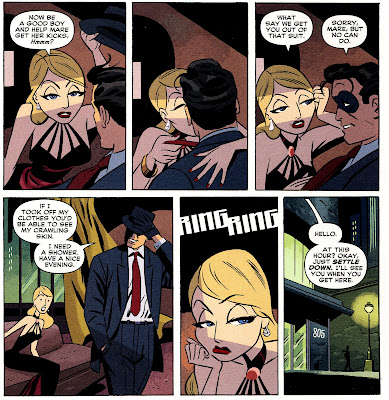
Or perhaps Mare Nolty, a skinny blonde with an incredible temper who's prone to act like a maniac in public to cynically exploit self-created controversy to boost her own Q-rating? After all, she apparnetly attempted to throttle Dandy in public recently.

Now, when you heard the words "skinny," "blonde" and "prone to act like a maniac in public to cynically exploit self-created controversy to boost her own Q-rating," you probably thought of Ann Coulter, right? Well, that can't possibly be Coulter. I mean, not only did the lawyer on page one say that any similarities between the characters and real people are completely coincidental but, well, Mare Nolty is pretty hot, and, well, Ann Coulter is, you know, Ann Coulter.

Anyway, The Spirit thinks she's a good lead, and he sneaks into her apartment to question her. He doesn't find her quite as hot as I do, though....


Hmm, maybe it is Coulter after all...


What about "The King of Cable News," the host of Wally's Report, Wally O'Bellows?


Or Stewart Flober, a pretend pundit who "pokes fun at cable news" by pretending to be an O'Bellows-like blowhard and has a habit of referring to his audiene as "Nation?"


Soon, some of these supsects begin getting bumped off, leading to a scene where familiar looking and sounding cable news personalities report on "The Cable Killer," often times just before they themselves fall victim to him (or her or them).

By the way, Mustachio Hernandez? I'm totally naming my first son that.

Cooke's not just having fun caricaturing the human caricatures that populate cable news, of course. There's also a Very Serious Message, which Rush Limb--, er, Trust Wimbag vocalizes during a car chase with the killer...


And Ginger summarizes thusly:


There, I think we all learned something from that. Not only about the corrosive effect of the punditocracy on our mediascape, but also about how awesome Darwyn Cooke's Spirit is.

Saturday, February 24, 2007

Dear Darwyn Cooke,

Please make this happen:


Thanks!

Sincerely,
Caleb

P.S. A scene featuring a bucking bronco formed from the word "crime" wouldn't be mandatory, although it would be appreciated.