Showing posts with label eric talbot. Show all posts

Tuesday, May 14, 2019

Some notes on IDW's Teenage Mutant Ninja Turtles: The Ultimate Collection line

Eastman's cover for Ultimate Collection Vol. 5
I was looking for a particular image from Kevin Eastman and Peter Laird's original Teenage Mutant Ninja Turtles comics the other day, and checked out one of IDW's Ultimate collections from the library and, before long, I fell into something of a rabbit hole--well, turtle hole, I guess. I ended up reading the first six volumes of the publisher's Ultimate line--there's a seventh volume, apparently just featuring covers, on the way--as well as re-reading Mirage's full-color, short-lived second volume of TMNT in comic book form.

These ultimate collections are nice-looking books, and I'd certainly like to own copies of my own some day, but I'm at the point in my life where I think I need to buy a house in order to fill it with bookshelves in order to fill those with graphic novels. My one-bedroom apartment is just about at capacity now, and I really shouldn't try to squeeze six or seven atlas-sized collections of comics I already own in several formats in here if I can avoid it.

The books are about 8.5-by-12 inches in size, so the comics within are presented at a notably larger size than usual. The many splash pages and double-page splashes of the earliest TMNT comics are basically big enough to be placed in frames and hung on walls like piece of fine art. Only the covers for the individual issues aren't blown-up within these collections, which I found to be sort of irritating (although if that seventh volume is going to be devoted to collecting the covers, maybe that was the reason why they are presented so small within).

Each collection features a new, original wraparound cover by Kevin Eastman, who is still working surprisingly closely with IDW on their fifth volume of the comic. These covers are all essentially collages of the contents of the volume. These are kind of fascinating in that they reveal the way Eastman draws the characters now, without the visual input of Peter Laird or any of the other Mirage artists he would collaborate with (like Jim Lawson and Eric Talbot, for example), and while his style hasn't changed too drastically over the last three decades or so--that is, Kevin Eastman's artwork is still immediately recognizable as Kevin Eastman's artwork--it is interesting to note those changes.
Also, it's fun to see him draw characters he had no or little input into before. So, for example, the cover for the second volume features his drawing of the Kirby character from 1986's Donatello, which Laird did much of the work on (and comparing the Kirby in the comic to that on Eastman's cover makes this clearer still), and the third volume (above) has Eastman's "cover" versions of Doctor Dome, the Domeoids and the Justice Force superheroes from 1988's TMNT #15, an Eastman-free Laird and Lawson issue.

Aside from the blown-up size and the original covers though, the comics are also all annotated by Eastman and Laird, with every issue being followed by a page or more of memories, reactions and behind-the-scenes notations from the two creators. If you've read these comics at least once before, then the ultimate collection probably provide the ideal way to re-read them, as the effect is a little like having Eastman and Laird reading along over your shoulder, and volunteering their commentary.

All of that stuff is pretty fascinating, and, I'll be honest, sometimes a little shocking. For example, when I was reading these comics as a teenager--I think 1991's TMNT #37 was the first issue I bought new at a comic shop, and after that point I started hunting for back issues while keeping up with new stuff as it was released--I had no idea the pair ever had a falling out of any kind.

They don't detail the ins and outs of their disagreements herein, although they allude to not speaking to one another or being unable to be in the same room with one another quite a bit. That was pretty surprising to hear, although I guess it explains why their collaborations dwindled to almost nothing for a while.

So after 11 issues of Teenage Mutant Ninja Turtles (and the four character-specific one-shot "micro-series" and sundry short stories)  published over the course of  three years in which the pair worked as an exceptionally entwined creative team, Teenage Mutant Ninja Turtles #12 was a Laird solo issue. TMNT #13 an Eastman solo issue (with Talbot assisting on inks). TMNT #14 was the first of many fill-in issues,  and then  #15 was Laird and Lawson, #16  was another fill-in issue and then #17 was Eastman and Talbot. It wasn't until #19-#21 that Eastman and Laird collaborated again--that was the "Return To New York" story arc--and even then it wasn't just the two of them, as Lawson and Talbot were heavily involved in those issues.

Despite the now decades-old disagreements though, the pair seem quite effusive in their praise for one another's respective skills throughout (although Laird never seems to miss an opportunity to point out when there's a typo), and neither seem too terribly eager to re-litigate their conflicts. I guess I'll wait to their biographies (And man, I do hope someone is writing their biography, and that they are both gradually working on their own autobiographies, because what a fascinating story those two lived!).

A couple of things that occurred to me while reading this volumes, and re-reading the comics within for, like, the hundredth time...
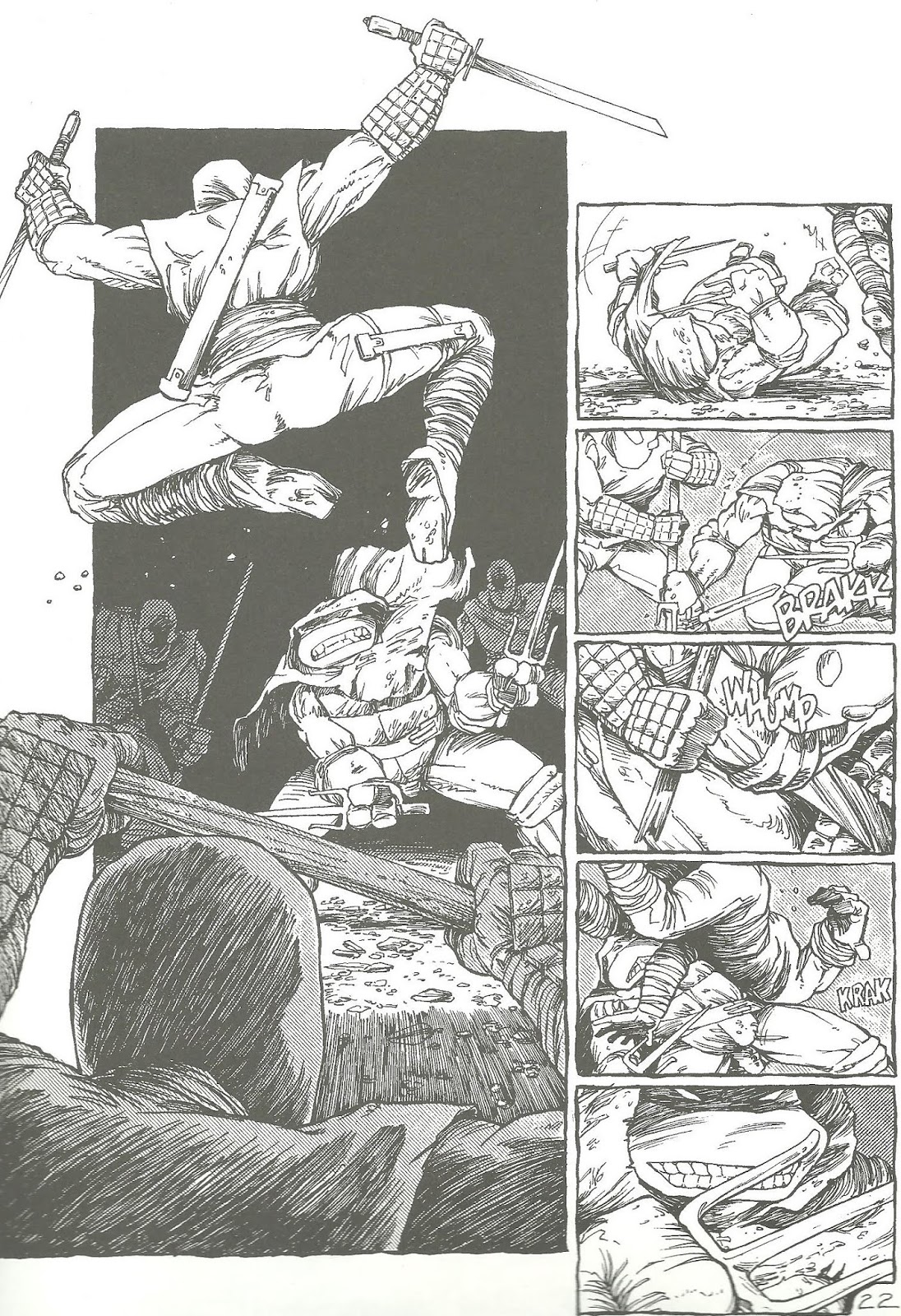

Laird's inks on Lawson's pencils over Eastman's layouts in 1989's TMNT #19
I've talked before about the fact that one of my favorite aspects of these comics were how homemade they feel, and the fact that the particular, long-mysterious-to-me system that Eastman and Laird employed in their creation meant that each issue had a sort of alchemical style, a fusion of each of their significantly different personal styles...sometimes with those of other studio mates also transmuted into the resultant comics.

Sometimes it's quite clear who did what, and thus how each artist's style might have impacted the art--the three-chapter "Return to New York," for example, were inked by Laird, Talbot and Eastman respectively--other times, it seems like two-to-four pencils and pens were involved with every page, and a comic might have a "Mirage Studios" style rather than anyone's personal style.

The notes detail that Eastman and Laird did have a system, although it is interesting to hear them discussing the very earliest issues, particularly TMNT #1, in which neither is exactly clear on who inked a particular page, and it seems that both of them contributed pencils and inks to each page.

The system they ultimately settled on seemed to be this, according to Laird:

1.) They would initially "write" the story in conversation with one another, hammering out a plot together.
2.) Eastman would handle the layout, on which he would include rough dialogue.
3.) Laird would do finished dialogue.
4.) They would pencil the comic based on Eastman's layouts and, after the final dialogue was lettered--originally by them, later by Steve Lavigne--they would ink the art and add toning (that last bit is something I never realized was involved with the construction of these comics, and helps explain the gritty, textured look of the black and white art).
As Laird explained it, they were ideally communicating throughout the entire process, so even though layouts might have been Eastman's "job" and finished dialogue Laird's, they both had and took opportunities to address any and all concerns as they were going.

In the earliest issues especially, Laird said, they tried to make sure they each penciled and inked a piece of each page or panel, and that this would take place by the pair literally handing pages back and forth between them in order to get a true blend of their styles.

Repeatedly throughout these annotations they each note that when they would meet readers at conventions, they were always being asked about how they worked together and who did what. Comics readers in the early 1980s apparently couldn't get their heads around the idea of two writer/artists working on a comic book together as writer/artists, perhaps because so much comics production fell into either the assembly-line method established in the Golden Age (with a writer handing a script to a penciler, who handled his pencil art to an inker, who then gave the finished art to the colorist, etc) or a solo cartoonist doing everything herself.

It is an unusual method, though, one that requires pretty much constant proximity to one another--which I suppose was likely a factor in the eventual strain in their relationship.


Eastman and Laird's final page of 1984's TMNT #1
•The focus of these books is the issues of the original series that Eastman and Laird worked on, to the exclusion of all the fill-in issues. It was striking to see how many times throughout that relatively short run of comics by the pair themselves--just 38 issues total including the one-shots, out of the 62 issues that the first volume of TMNT ultimately ran--that Eastman and Laird seemed to reach natural, organic would-be, could-be endings for their series.

It's pretty common knowledge that they never really anticipated TMNT lasting longer than a single issue, and despite the fact that they both desperately wanted to succeed as comics creators, they were caught off-guard by how successful that lark featuring a silly idea and elements of parody and homage of Frank Miller's Daredevil work ended up being, and how much market demand there was for what such a weird concept.

Re-reading 1984's TMNT #1 with that thought placed in your mind, it's abundantly clear that the comic was created as a 40-page complete story unto itself. There's no cliffhanger, no dangling plot lines, no questions yet to be addressed. In those pages, the pair thoroughly introduce and explain the characters' origins (built atop the origin of Marvel's Daredevil, of course), the history of the enmity between their master and his archenemy and then there's a huge, action-packed, 10-page ninja battle ending with the death of their enemy and the resolution of the conflict that we are told was their life's mission.

Yeah, it's a pretty complete story, and it's not hard to imagine that, had it not caught the imagination of comics readers and, eventually, cartoon-watchers and toy-players-with, it might have just ended up being a strange stepping stone to other endeavors by two talented creators.

Once they committed to a second issue though, a story arc quickly emerged. In issue #2, the TMNT met their first human friend April O'Neil and their father/sensei Master Splinter went missing, all a result of villain Baxter Stockman's robotic mousers. In the following five issues, the guys move in with April and search for Splinter, unwittingly uncovering details about their origins, travelling to outer space and having a rather wild, pulpy adventure that concludes with a reunion with Splinter and the formation of a new configuration of a family, now including April.

It is very easy to imagine Eastman and Laird's TMNT ending with issue #7 then, too, as #1-#7 tell a pretty complete story that ends happily (Raphael, which came out between #2 and #3, doesn't really play into that arc at all, but is more of a side story focusing on his personality...and introducing Casey Jones, who wouldn't play a part in the series for a while yet).

After that, there are some done-in-one stories, including the Michaelangelo and Donatello one-shots, the epic 45-page TMNT #8 featuring a crossover with Dave Sim's Cerebus (and introducing Renet and Savanti Romero), and a rather Splinter-centric flashback to the Pre-Teenage Mutant Ninja Turtles in #9.

A continuing story arc reemerges in Leonardo, the most action-packed issue up until that point, as it is basically one long fight scene, which leads directly into #10, an unexpected rematch with the supposedly dead Shredder and the Foot Clan, featuring a last-minute save by Casey Jones, who at that point joins the team and their narrative on a permanent basis.
Eastman's cover for 1987's TMNT #11
TMNT #11, set at the farmhouse in Northhampton, is another natural "ending" to the story, as it has the various characters struggling to process what just happened to them in New York City, and, gradually, all making their peace with it to some extent. It has a pretty happy ending, and it's not a bad place to end the story, really, although it does suggest that our heroes have lost...at least in terms of their battle against the Foot Clan, if not at life in general.

The first time I read these comics--hell, the first 40 times I read these comics--it was in a big, fat, phone book-sized collection featuring the four micro-series and the first 11 issues of TMNT. It's easy to see why they collected them in this fashion, as they do read as a complete (even completed) unit.

Then, after a series of adventures mostly set in rural New England as opposed to New York City--the previously mentioned efforts by the then sort of split-up Eastman and Laird team of #12, #14, #15 and #17, plus fill-in issues  by Michael Dooney, Mark Martin and Mark Bode that aren't included in the ultimate collections--Eastman, Laird and their Mirage Studios partners reunite for "Return To New York." That three-issue arc really resolves our heroes' defeat at the hands of the Foot in #11. They have re-killed The Shredder, this time once and for all--the resurrected Shredder isn't quite the same one they killed in #1, of course, as is explained--and they have re-fulfilled their mission in life and are able to move on. At that stories end, the four brothers are in New York, burning the body of The Shredder, and are apparently now free to go wherever they like or do whatever they want.

Again, this too seems like a natural ending point for Eastman an Laird's TMNT narrative. And, in a way, it was. The title kept going, of course, but it would be another three years and 26 issues before Eastman and Laird returned to the book, and for the rest of the 62-issue volume they would only draw a single issue issue together and then share writing credits on 14 issues, the job of drawing the turtles now falling to Lawson, with new inker Keith Aiken, and assists from Talbot and a few others.

The end of that epic storyline would, of course, be another natural ending point--and finally was. The book ended when the 12-issue "City At War" did, only to be relaunched for an ill-starred, 12-issue, full-color run that now seems to be even more forgotten than the Image series was.


Veitch's cover for 1989's TMNT #24
•Because the focus of the ultimate collections is the Eastman and Laird issues of Eastman and Laird's Teenage Mutant Ninja Turtles, that means that many issues of the series are left out. So Dooney's #13 Martin's #16 and Bode's #18 aren't here. And none of the issues that fell between the end of "Return To New York" and  the two-part "City At War" lead-in story arc "Shades of Gray" are included here. That's a lot of TMNT, and a lot of great comics: Two more Mark Martin issues, Rick Veitch's three-issue "The River" arc and a later done-in-one, Michael Zulli's gorgeous but weird "Soul's Winter" story arc, a three-issue arc by Rich Hedden and Tom McWeedy, comics by Steve Murphy, Michael Dooney and Keith Aiken, Dan Berger, Rick Arthur, A.C. Farley, Mark Bode and, my favorites, #37 and #42 by Rick McCollum and Bill Anderson and #41 by Matt Howarth.

There is some reason to quibble with the curation of these ultimate collections.

Some of these guest comics are pretty far afield of those told by Eastman and Laird, the more "canonical" ninja turtles stories, and are best read as the Mirage equivalents of Marvel's What If...? or DC's Elseworlds or Silver Age "imaginary stories." Just before and for a long time after "Return to New York," TMNT was basically an anthology series, akin to Legends of The Dark Knight. Like LDK though, if some stories strayed too far to be considered in continuity, others fit in perfectly well with Eastman and Laird's stories. Many of the above stories are set in and around the New England farmhouse, for example, and others have the characters re-encountering characters from earlier in the series, like Renet, Savanti Romero, Romero's previously unrevealed wife and the superheroine Radical and supervillain Carnage.

By excising all of these from the ultimate collections, there is a rather strange compressing of time, and a reader doesn't get the sense that the characters were ever really lost in the wilderness, trying to figure out their next move after their defeat in #10. When Raphael starts fighting with his brothers in the first chapter of "Return," complaining about how long they have been hiding out in New England while Shredder and The Foot are alive and well in New York City, here only some 186 pages and four issues, instead of twice that.

And even less time passes between the conclusion of "Return To New York" and the beginning of "City At War"; in fact, because "Shades of Gray" is basically an unofficial first two chapters of "City At War," both of the big, Eastman and Laird-written storylines about the turtles returning to New York City to sort out matters with the Foot Clan happen back-to-back in these collections.

I don't know what, exactly, would have been a better solution, I just know the series reads very differently when presented with all of the fill-ins excised like this.

Talbot's cover for 1988's TMNT #17
That said, I thought the inclusion of #17 was somewhat surprising. That's the Eric Talbot solo issue, the bulk of which is a rather weird, random stream-of-conscious fantasy story set in in feudal Japan and starring a version of Michaelangelo....although it turns out to be a dramatization of a story Michaelangelo himself is writing. Eastman is credited as a writer on it, both in the collection and on Mirage's website, but Eastman himself seems surprised by the credit in his annotations of the issue, and doesn't remember having done enough work on the book to have deserved the credit.

Meanwhile, Eastman did contribute to the Mark Bode issues--#18, which he co-wrote and helped ink, and #32, which he helped ink--but neither of those are included herein (Those are both really fun ones, too, sending the Turtles overseas to Hong Kong, where they kinda sorta team-up with a Bruce Lee stand-in, and to Egypt, where they fight Anubis and other characters of Egyptian mythology. I really liked Bode's Turtle designs, and the way he handled dialogue, the balloons and sound effects all appearing above the panels).

I suppose both of those issues lean pretty hard away from the canonical Turtles, of course, but if the organizing principle here is the complete Eastman and Laird TMNT and co-writing #17 was enough, to qualify, well...


Splash page by Lawson and Aiken from 1992's TMNT #51
•When we get to #48 in Ultimate Collection Volume 4, Jim Lawson has become the official Teenage Mutant Ninja Turtles artist and, in fact, it is his art we will see for every issue included in the next two volumes, with the brief exception of the 42 pages of TMNT #50, in which Eastman and Laird reunite on both story and art.

I remember it being a real treat at the time the book came out--I had signed up for a subscription of the book at the time, and that was and remains the only time I ever had a subscription to a comic book series--although looking at it now, it sure is jarring to see the Lawson art get replaced by the infinitely darker, busier, more textured Eastman/Laird art, only to give way almost immediately to Lawson's more streamlined, abstract and expressive art (Confession: I used to hate Lawson's TMNT art. Now he's one of my favorite TMNT artists).
Lawsons' cover for 1987's Tales of The TMNT #2, introducing Nobody
"Shades of Gray" sticks out a bit in this curation of the series, if only because the character Nobody plays a rather significant role. A more traditional vigilante/superhero based in Springfield, he was introduced in Tales of The Teenage Mutant Ninja Turtles #2 (written by Eastman and Laird and drawn by Lawson and Ryan Brown), and, because no issues of Tales are collected here, isn't really introduced to the narrative properly, but rather just appears.

Still, those two issues--TMNT #48 and #49--are pretty important, as they include the events that kick off the splintering of the TMNT family that sets up "City At War." The first official chapter of which, #50, is silent.


Eastman and Laird's cover for 1992's TMNT #50
•"City At War" is an extremely unusual story arc for even this extremely unusual comic, lasting 12-14 issues, depending on if we count "Shades", and dwarfing the longest sustained story arcs from the book's previous 50 issues. (Remember, "Return to New York" was just three issues, albeit 40-ish page issues, and the unofficial search for Splinter arc was just about six issues).

It was also probably the most emotionally mature of the TMNT stories, with Eastman, Laird and Lawson splitting the characters up into four different units, each experiencing their own story arcs. In the case of the two human characters, their storylines are positively mundane--Casey moves away, meets a woman, falls in love and tries to settle into a normal-ish domestic relationship with her, while April moves to Los Angeles to live with her sister and start a life free of mutant ninjas and their attendant secrets.

Meanwhile, Splinter finds himself in extremely dire straits and faces death alone, and the Turtles themselves return to New York City and find themselves trying to sort out a massive gang war involving warring factions of The Foot Clan...the result of their having cut off the head of the organization when they killed Shredder for the second time.

And then there's a random New Yorker who was caught in an explosion during the Foot's initial war against itself, and we follow his recovery throughout, a somewhat frustrating element because a reader keeps expecting him to turn out to be someone important to the plot somehow, but he is instead just there to dramatize a real person who suffers during wars in general--a point that was made in the first issue, and thus didn't really need 11 more issue's worth of example.s

I recall finding the story somewhat frustrating the first time through, read in monthly installments--again, this story was a huge change from the 50 or so TMNT comics that preceded it, as they were mostly big done-in-one adventures--and even the second time through, but this time I found it pretty engrossing. I started it late at night, with the intention of reading the first few chapters, and ended up staying up late enough to read the whole thing in a fit of pure can't-put-it-down-ism, blowing way past my bedtime.

It's kind of striking how unusual the story felt for a TMNT comic, given how basic, even generic elements of April and Casey's plot lines were, and how simple what Eastman, Laird and Lawson ended up doing really was. While the A plot was basically that of the ninja turtles doing ninja turtle stuff and questioning their purpose in life more than ever, starting to come of age in a way that felt uncomfortable in the context of everything that came before, the overall purpose of the story was simply to break up the characters' extended family, send them off in different directions to learn why they are together in the first place, and then reunite them via soap opera like events and coincidences.

This storyline gave us the character Karai, who isn't too terribly well-developed here, but would play a pretty large role in TMNT mass media adaptions in the 21st century, and Shadow, who would be a recurring character in Laird's fourth volume of the TMNT title...a character with a lot of potential that I don't think ever ended up being met (Actually, I suspect there's a lot of unrealized potential in the space between the time jump of TMNT Vol. 2 #12 and TMNT Vol. 4 #1, a great deal of which was explored in Tales... Vol. 2, which ran alongside TMNT Vol. 4. (I mean, a teenage girl named Shadow raised by sports equipment-wielding vigilante Casey Jones, with four ninja masters for uncles and a fifth ninja master as her grandfather...? She'd basically be a blend of the Casey and April characters, with skills on par with the mutant ninjas).


Eastman and Laird's cover for 1987's Anything Goes #5
•Now Eastman and Laird made a lot of comics between the time 1984's TMNT #1 became a hit and when issue #62 shipped in 1993. Even if one ignores all the comics they merely had a hand in, while other Mirage Studio artists did the heavy lifting, the early days of their characters saw them contributing short stories to a variety of anthologies and original content to the Teenage Mutant Ninja Turtles and Other Strangeness role-playing games source books (which I liked better than Dungeons & Dragons back in the day; it's been a while since I looked closely at RPGs, but I remember the Palladium system being a lot easier and more intuitive than what was then the TSR Advanced Dungeons & Dragons system).

In figuring out how to collect all that stuff, IDW apparently opted to publish it all after the stories that ran in the main TMNT title (and the four one-shots). Thus, the first five volumes collect the most Eastman and/or Laird-heavy issues of TMNT, while the sixth, epilogue-like volume is stuffed with about 30 short comics of various short lengths, all produced between 1985 and 1989.

They're culled from all over, too: Back-ups from TMNT reprints, the Palladium source books, the Mirage-published anthologies like Turtle Soup, Shell Shock and Gobbledygook, a Grimjack back-up, the Fantagraphics-published Anything Goes and some benefit books.

In addition to the guys who have their name on the cover, there are comics included in here from many Mirage Studios regulars, like Lawson, Talbot, Michael Dooney and Ryan Brown, all working in various configurations in terms of who was doing what and with whom. There are also some stories by artists not as closely associated with the characters, like Stephen Bissette, who writes and draws an extremely eight-page story entitled "Turtle Dreams" (and those dreams are much scarier than the those in Matt Howarth's TMNT #41); Michael Zulli, working solo on one story and with his Puma Blues partner Steve Murphy on another; and Richard Corben, who inked a four-page Eastman-written and -penciled story that was created specifically so that Eastman could work with Corben (Zulli and Corben would both later do more TMNT, of course; the former drawing the aforementioned "Soul's Winter" arc featuring the most dramatically distinct version of the Turtles to ever appear in their own comic, and Corben collaborating with Jan Strnad on TMNT #33).

I've read many of these, but there were a few that were brand new to me, and thus quite welcome surprises. For example, there's a 10-page turtle-less Triceratons story by Laird that appeared in a Mirage anthology entitled Grunts that I had never heard of, and an Eastman and Laird collaboration entitled "Casey Jones, Private Eye" from a Mirage mini-comics project that I was similarly ignorant of. The latter's nothing special, really, and the format doesn't flatter artwork obviously created to be read much smaller, but the Triceratons story was pretty interesting, and introduces a race of humanoid bears that oppose the Triceraton Empire. I'm actually a little surprised they didn't show up in the last TMNT cartoon, given how diligently it scoured the comics for inspiration.

While the first six volumes of this series were devoted to following the canonical Turtles story of their creators as closely as possible, focusing on the work they themselves did more than the many, many comics they simply had a hand in or sanctioned, this volume really gives a good sense of what the title was like for a portion of its run, what the studio's output was like, and just how fertile the characters and concept were as a springboard, and how generous Eastman and Laird were with their creations and their work.

In a sense, this is actually a good volume to start with, as it is the one that gives the best idea of what the original Teenage Mutant Ninja Turtles comic was like and what Mirage Studios was like. I mean, it's probably a pretty lousy place to start in terms of the story of the TMNT, but it's a perfect place to get a feel for the Turtles and the guys that made them.

And to return to that aspect of the Mirage Studios comics that I mentioned earlier, regarding the who-did-what-where nature of their output, and how first Eastman and Laird and then as many as a dozen different collaborators would conceive of a flexible Mirage "house style" that slid along a particular spectrum, this is practically a text book for that, as there are so many different combinations of the Mirage Studios artists, all appearing within the same covers.

Some of these shorts absolutely fit into the "real" TMNT story, being the work of Eastman and Laird and tied closely to the events of the monthly--there are several set during their time in space, for example--others are of the sort of off-to-the side larks or riffs of Tales or the micro-series, and some need to be massaged into the narrative, but nothing herein seemed to really not fit in with the extremely broad mandate of the Mirage Studios Teenage Mutant Ninja Turtles comics which, at it's most basic was basically just, "Whatever, just so long as it has at least one teenage mutant ninja turtle in it."

Among the stories I most enjoyed reading or re-reading in the sixth volume were the Eastman/Laird Anything Goes story in which the guys go on a secret stealth mission...to see Aliens at the drive-in, which I long ago managed to find at a garage sale in Ashtabula after many summer afternoons of studying the Overstreet Price Guide for TMNT appearances; the Eastman/Laird Grimjack back-up story which I recalled similarly looking for but never actually finding; the Eastman/Corben collaboration; the Laird story "Technofear" from 1986's Gobbledygook, which featured what I guess is now vintage computer art; and Zulli and Bissette's strange versions of the characters.

I'm looking forward to the seventh volume, and am curious if there will be a volume eight or beyond. After all, for volume four, Laird did much of the writing, and, for IDW's volume five, Eastman was rather heavily involved, although IDW has plenty of collections of that already...

Anyway, let's meet back here to discuss volume seven once that's released, and maybe we can talk about the 12-issue TMNT series that immediately followed the conclusion of this one, since that's still pretty fresh in my head.

Monday, November 10, 2014

Review: Tales of The TMNT #7

The cover for the seventh issue of Tales of The TMNT is a pretty perfect one in that it tells you exactly what you can expect to find underneath it: Teenage Muntant Ninja Turtle Raphael and teenage girl Shadow fighting werewolves.

The story begins on the rather lovely Michael Dooney-drawn frontspiece, featuring Shadow—the adopted daughter of Casey Jones and April O'Neil, born to Casey's girlfriend Gabrielle in "City At War"—reading a diary she wrote five years ago, when she was a younger, apparently angrier and jerkier teenager (according to her own narration).

The story, "Darkness Weaves," is the story of Shadow's last night as a New Yorker, and it's the work of Steve Murphy, Jim Lawson and Eric Talbot. Murphy writes the script and Lawson handles the pencil art, while Talbot contributes to both, co-plotting the story with Murphy and inking Lawson's pencils. (As I've mentioned before, one thing I really like about the old Mirage comics is the way they are so often created by a group of creators who function a little like a rock band, everyone contributing to everything, just in different capacities or degrees of involvement. Even after Kevin Eastman left, and even on this sister book to the Peter Laird-written TMNT Vol. 4, you see the same small stable of Mirage studio mates working on many of the issues together as a group).

So it's a good five years or so ago, and Casey and April have gone on vacation, leaving Shadow in the care of her grandfather and uncles, Splinter and the Turtles. She's watching videos of her favorite singer Lilith—whose lyrics consists of bad, "dark" poetry in a font I hate—until midnight, at which point she attempts to sneak out of the sewer lair she's staying in. Raphael busts her however, and after some fun banter—I really like the idea of the now older, wiser Raph trying to parent his best friend's almost-grown daughter—she gets sent back to bed.
She eventually manages to ditch Raphael and meet her friend Sloane in the city, where Lilith happens to be playing. Raph trails her to the show, where no one seems all that surprised that the entire audience is female. Hell, even the two security guards are female. After another lame song, Lilith uses some ceremonial-looking knives to cut herself and fill a fancy chalice with her own blood.

It gets passed around for her fans to drink, while a skylight overhead opens, letting the moonlight in and, well, you've seen the cover already, so you can probably guess what happens to the girls who drink her blood.

Luckily for Shadow, she notices everyone turning into werewolves around her before drinking.
That dialogue in the second panel is the best.
Together she and Raph fight some werewolves and, before they can become completely overwhelmed, Shadow's other three uncles arrive.

In the ensuing fight, Shadow accidentally stabs Sloane with a sai, seemingly killing her (although, it wasn't silver...would that work...?), recognizing her mistake only when she hears Sloane say "frig," her favorite swear word, and apparently the only one that appears in the Turtles comics without being represented by a grawlix.

Lilith, herself a werewolf recognizable from the others only by her ankh necklace, swears vengeance against Shadow, and so Shadow is exiled to the Norhthampton farmhouse for her own safety, Splinter relocating there in order to raise her (And that's where we find the pair of them at the opening of TMNT volume four).
The very last panel includes a question mark after the words "The End," and the answer is, of course, no: 2007 miniseries Raphael: Bad Moon Rising by Bill Moulage, Jim Lawson and Eric Talbot would pick up where this issue left off, not unlike Leonardo: Blind Sight spun out of Tales #5 (Bad Moon Rising, by the way, features cover art by TMNT fan and EDILW favorite Ross Campbell; I know IDW is using their own rebooted continuity for their TMNT comics, but man, how great would a series set in the Mirage continuity and featuring the adventures of teenage ninja Shadow and her mutant turtle uncles by Ross Campbell be...?).

As straightforward as the plot and script for Tales #7 may be, it has some witty moments.
And the art is great. Lawson's work may be an acquired taste for some, but I've long ago acquired it and, as I've been working my way through Tales issue by issue, I've noticed that, perhaps because Lawson was drawing the TMNT series at the time (and/or that he's drawn the bulk of all the TMNT comics published), his contributions to the series seem some how more real or official than some of those by other artists.

This issue has little in the way of shading or toning, making for a particularly stark black and white type of black-and-white, more appropriate than usual given the faux goth nature of Lilith as performer, and the supernatural goings-on. While I would have loved to see what this issue might have looked like had it been penciled by Talbot as well (or by Eastman, whose Splinter always looked like more of a scary werewolf than a rat to me), I liked all the thick black he brings to the table drawing board.

There are several scenes in which Raphael appears more as white lines on a black shadow than vice versa...
...which looks particularly compelling when applied to Lawsons rough-hewn, semi-simplistic design for the ninja turtles.

Monday, November 03, 2014

Briefly on IDW's Tales of The Teenage Mutant Ninja Turtles Vol. 3

As I've been reading and reviewing my way through volume 2 of Mirage's Tales of The Teenage Mutant Ninja Turtles series, I figured it was time to check in with IDW's reprint program of the same comics. They have been collecting both volumes of Mirage's old Tales comics—the seven-issue, 1987-1989 volume one and the 70-issue, 2004-2010 volume two—in a single series of colorized trade paperbacks. Their first two collections covered the entire first volume of Tales, while this third collection features the first four issues of the second volume.

As with the previous Tales collections, this one features a new cover by artist Jim Lawson, who drew two of the five stories within (the "Seeds of Destruction" story from #2 and the six-page "The Grape" back-up from #4), and the cover scheme is basically the same as all previous Tales collections, with the various heroes (here, just the Turtles and Splinter) fighting the various bad-guys (one of the worm guys from #1, the Foot mystic from #2, the worm/shark/octopus/Oroku Saki monster from #3 and #4) in a single scene.

There are two changes of note from the original comics being collected.

First, the logo on the cover of this collection is that of the original Tales series, complete with the "Eastman and Laird's" being prominently featured as part of the logo, whereas the issues in this collection all bore the Tales of The TMNT logo, eschewing including the names of the creators and using the "TMNT" acronym, which was more prominently featured in the Turtles title this volume of Tales was tied into (I like the original logo much better, just from a simple design point-of-view).

Also, as with almost all of IDW's TMNT reprints, this collection is colorized...and no one gets a byline for doing the coloring. A Ronda Pattison gets a "cover colors by" credit, but that's it.

In the past, I've noted some strange, usually bad choices made in the colorizing process, but this volume didn't seem to have anything too egregious. The worm men in the first issue are all a fleshy, peach color, similar to that of earthworms, whereas I likely would have went with something closer to white, to reflect their centuries of living in a sunless underground cavern. And the hybrid ex-Shredder monster in "The Worms of Madness" is colored a golden brown, rather than the shark-gray I imagined him to be while reading the black-and-white original story. But these aren't mistakes, just matters of personal preference, I suppose.

This was the only panel that really jumped out at me during a flip-through as being too terribly off:
That's a panel from #3, the first half of "The Worms of Madness" by Steve Murphy, Rick Remender and John Beatty. It's a "cover" panel of one from Teenage Mutant Ninja Turtles #21, the final issue of the three-part "Return to New York" storyline in which the Turtles finally defeat the back-from-the-dead Shredder, whose helmet is always colored either gray or silver. Here, it's red and gold with a silver face plate, for some reason.

Oh, and there's a weird mistake in this Eric Talbot fronstpiece from the same issue. Check out the point of the sai in Raphael's left hand:
Not sure what that is, but I imagine it was supposed to be taken out before this went to press.

Tuesday, October 14, 2014

Review: Tales of The TMNT #3-#4

The “Worms of Madness” story arc running through these two 2004 issues of Tales of The TMNT, the first multi-issue arc in the series, is at this point probably more interesting for who made it then the events that occur within it, although the events are a pretty big deal within TMNT continuity. The "worms" of the title are those that the Foot Clan mystics fed the remains of Oroku Saki, The Shredder, in order to “resurrect” him as an intelligent worm colony that thought it was The Shredder (That was, remember, The Shredder that attacked the Turtles and family in 1987's TMNT #10, and who they fought in the “Return To New York” story arc in 1989's #19-#21).

While "Worms" was scripted by Tales editor Steve Murphy, he co-plotted it with Rick Remender, who also penciled the story (with John Beatty providing thick, generous inks to those pencils). In 2014, chances are that a lot of comics readers know Rememnder only as a comics writer, given his various high-profile works for Marvel, including The Punisher, Uncanny X-Force, Captain America, Uncanny Avengers and the publisher's next big crossover/event series, Axis.

But here he is co-plotting a really rather minor story for a relatively little book in 2004, and providing the artwork for it.
Talbot
The “Let me tell you a story” fronstpieces for the two issues are drawn by Eric Talbot and Scott Cohn, and feature a stitched-up Raphael with monster-fighting gear and a trying-to-outswim-a-shark Michelangelo, respectively. The story is set at the very end of “Return To New York,” with Rememnder and Beatty re-drawing the panel where Leonardo beheads “The Shredder” and the Turtles then burn his corpse on a raft pushed out into the river.

Meanwhile, an unseen Foot mystic narrates:
Pretty good narration, particularly the last two boxes.

I personally try not to think about the way the Turtles must smell—"the stench of human waste that clings to them like rancid yolk"—but yeah, spending the first decade and a half of their lives in the sewers of New York, they’ve gotta have a pretty terrible smell soaked into their bandanas and weapons and skins. Is there a secret ninja technique that allows a ninja to make his scent invisible as they sneak around? Because no matter how perfect they might be fading away, into the night, surely you would be able to smell them coming and going, right?

At the edge of the river, this mystic casts a spell to return the worms to life…sort of. Saki’s severed head is dragged through the black water by the dozen or so worms that emerge from his dead, open mouth. Until a shark eats it. And, at some point, the shark must have had some octopus. Because, another spell and another week later, The Shredder returns again...sort of.
The hybrid, amalgamated abomination makes short work of the Turtles—like, three pages short—before capturing Splinter and taking off.

Which is probably as good a time as any to ask: What the hell are the Turtles and Splinter even doing in the sewers of New York a week after their final battle with The Shredder and The Foot?

Splinter didn’t accompany them during their “Return To New York,” but stayed behind with Casey and April at the farmhouse. And, when we next saw the Turtles, it was...okay, well it was a few issues of Mark Martin's crazy stories, seemingly set before the events of #10 or "Return," but after that, in Rick Veitch's "The River" and so on, they’ve returned to the countryside. According to Murphy and Remender’s story, they followed their battle with “Shredder” and the Foot by returning to their old sewer lair to watch The Simpsons, and then hung around for a week, at some point being joined by Splinter...?
In the second installment, it’s revealed that the Shredder-monster did more than just beat-up the Turtles, it also somehow inverted their personalities, so that Raphael is a coward, Leonardo a completely irresponsible goof ball and Donatello is dumb. Michelangelo alone is unaffected, but it was unclear if that was simply because his irresponsible behavior was reversed too, and, while the others were worse off, he was simply made more responsible (In the earliest scene of this issue, Leonardo is razzing him with the same words he was taunting Leo in the previous chapter).

Mikey manages to find a spell in one of Splinter’s mystical books, summons a four-armed monkey god thing, and this being restores their personalities, teleporting the quartet to where the Foot mystic and the Shredder monster are, the rooftop of a factory on the edge of the river under a huge full moon—good place for a Teenage Mutant Ninja Turtle battle.
This time, the battle goes in their favor, although it’s hard to discern a story reason, beyond the fact that this is the second issue of a two-part story. The monster gets bludgeoned and stabbed and eventually achieves self-awareness, realizing it is not The Shredder, but still lashing out at the mystic, the pair of them falling into the water and presumably dying.

Death seems to take for The Shredder worms this time around, while the mystic is transformed into a half-human, half-shark creature, “A new form of hate.”

Not the best story, and the wonky continuity doesn’t help—particularly because this is a story premised on being built atop existing TMNT continuity—but it was a real pleasure seeing Remender and Beatty’s art applied to characters so often drawn by so many different artists (Like Batman, the Teenage Mutant Ninja Turtles are characters I enjoy seeing drawn over and over by different artists, just to see the choices they make, and how truly flexible and fluid the initial designs have proven over the decades).

Both of these issues feature back-up stories as well. The back-up in #3 is by German writer Peter Liehr and German artist Peter Schaaff. Entitled simply “Green,” it’s a five-page, nothing-much of a story, in which narration boxes semi-meditate on the meaning of the title word as it applies to the goings-on, which are a fairly generic urban vigilante story staple: Attractive young woman running through an alley at night gets mugged by gang and is then saved by the hero.
Here that hero is Donatello, although it could be any of the Turtles. Or any one in green, I guess. It’s mostly of interest for Schaaf’s striking artwork, which defines places and characters in the simplest of terms (“New York," for example, is defined by the black outline of three tall buildings and sagull in flight) and the peculiar cartoonishness of the character designs.

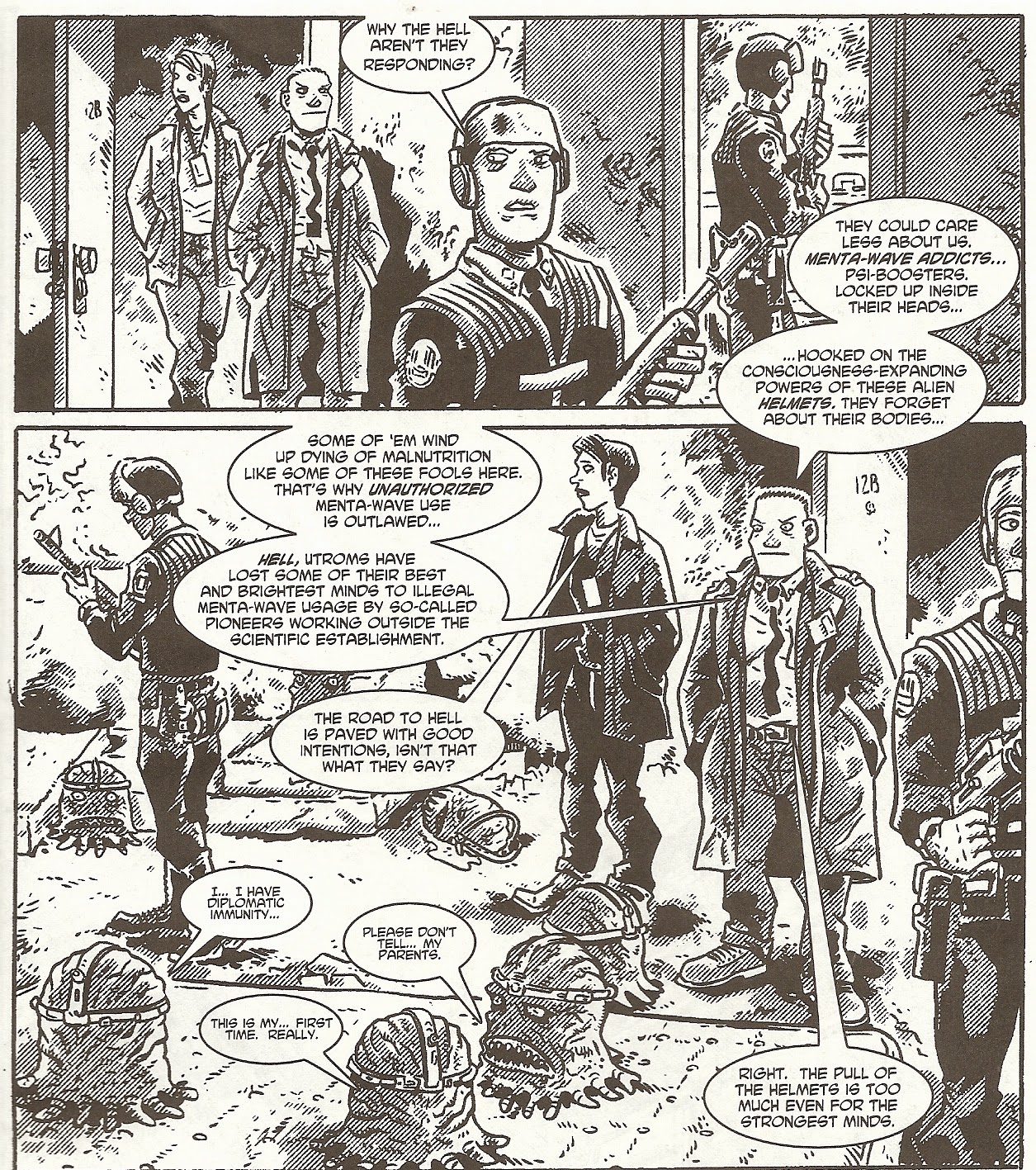
The six-page back-up in #4 is produced by a more conventional TMNT team and is set firmly in continuity, but isn’t quite as interesting. Entitled “The Grape” and set in post-Utrom NYC, it’s written by Murphy, penciled by Jim Lawson and inked and lettered by Eric Talbot. In it, a police squad raids a crack den full of Utroms, although instead of crack they are all addicted to “menta-wave" alien helmets that expand their consciousnesses in a variety of ways, a side-effect of which leaves them so locked-up in their own minds that they can forget about their bodies, and die in their menta-wave dens.
Members of the New York Police Department fighting crime involving aliens like the Utroms is a pretty interesting premise—Law and Order: TMNT—but Murphy over-narrates, and has one of the officers over-explain on a page that beats out many of Bendis’ for too much verbiage. There’s an interesting twist at the end, as there always should be in such short stories, but I preferred the more simple, more elegantly communicated work of the German creators in the previous issue (The events of this Utrom-focused back-up will come into play in future back-ups, however).

Monday, October 13, 2014

Review: Tales of The TMNT #2

For Tales of The TMNT's second issue, writer/editor Steve Murphy is joined by the then-regular TMNT pencil artist Jim Lawson (whose speed and efficiency must be really rather astounding) and inker Eric Talbot. Peter Laird provides the drawing for the frontspiece, a lovely image of Leonardo meditating by a stream in the country, surrounded by curious animals, as well as the lettering for the book.
This issue, entitled rather eye-rollingly as "Seeds of Destruction" (a bad joke that will become apparent as you read), was originally conceived, Murphy writes in his introduction, as a pitch for a by-then-canceled comic book (from Dreamwave) based on the then-ongoing, 2003-launched Teenage Mutant Ninja Turtles animated series, where he hoped it would be called "In The Realm of the Super-senses" and be a "full-color manga style" comic.

I'm pretty curious as to what that might have looked like, given how well it fit within the black-and-white Mirage aesthetic. Lawson's artwork here looks slightly more exaggerated and refined than it did in the TMNT title, with more stark image-making and fewer details cluttering up the planes of imagery, while Talbot's inks are very heavy, making for a truly black and white book. That is, it's all black on white, no gray, or suggested shades or tones.

The story begins with Donatello and Raphael returning to the sewer lair from a junkyard scavenging trip to find Michelangelo and Leonardo staring at Master Splinter, who is in a trance, levitating a foot above his pillow.

The story then flashes back a bit, and explains what's up. Splinter was attacked by an evil presence in the lair, one capable of throwing stones and shuriken at him. He retreats to some old books to study and prepare himself for warfare on the astral plane, where he engages his attacker—a mystic warrior member of the Foot Clan—and the adversaries engage in an Eastern mystic version of a sorcerer's duel where their astral forms transform in a series of attacks and counter-attacks.
Master Splinter obviously proves to be the master over his opponent, but Murphy stresses that it is but a single battle in an ongoing campaign, as the mystic attacker is an initiate facing his final ordeal. A trio of other Foot mystics, who will reappear later in the series, take his life as recompense for his failure, and ominously state that they too will attack Splinter some day.

From Dooney's frontspiece to the very last panel, the art in this particular issue is all super-strong. Lawson does some really neat work with the panels on the first page, using bolts of lightning as panel borders as the "camera" gradually zooms in on the mystic challenger, seated atop the roof of a building during a storm.

This struck me as a strange, though:
I don't know why, maybe because the Turtles are always nude save for belts and bandanas, but I was kinda shocked to see Michelangelo wearing pajamas. I guess I just assumed he slept in the nude, the same way he does, um, everything else.

Tuesday, October 07, 2014

On Teenage Mutant Ninja Turtles Vol. 4

In 1993 Kevin Eastman, Peter Laird and Mirage Studios relaunched their seminal Teenage Mutant Ninja Turtles comic book series as a full-color series with a new number #1, a regular creative team (Jim Lawson penciling and writing, others helping him on inks) and a television-like ongoing, serial narrative. As discussed previously, Teenage Mutant Ninja Turtles volume 2 lasted only 12 issue, and Mirage seemingly suddenly ceased to be a comics-producing concern in 1995.

As for the Turtles, they moved into a new black-and-white comic with a new #1 at Image Comics. The series, Teenage Mutant Ninja Turtles vol. 3, was written by Gary Carlson, drawn by Frank Fosco, and featured covers by Image's Erik Larsen. It lasted just 23 issues before being canceled in 1999, due to poor sales (according to Mirage's website).

After that strange interlude, a series which saw the main characters often injured and mutilated in various ways that forced radical changes in costume and appearance, the Turtles came home to a new and rejuvenated Mirage in 2001, with the launch of Teenage Mutant Ninja Turtles vol. 4 (The new logo reading "TMNT" in big, bold letters, while the words the acronym stood for ran in much smaller font below it).

I admit that I didn't really give he new series much of a chance when it was originally being released on a bi-monthly schedule; I read maybe the first seven issues before deciding to drop it and maybe pick it up in trade someday. I never did pick it up in trade—I don't know if they ever actually collected any of it in trade—but I did just buy a huge chunk of it in back issue form (#1-8, #10-13, #15, #16, #18, #19, #21 and #22).

The book was a rather strange beast. It was a Mirage Turtles comic through and through, but perhaps because of the time period when it was being produced (and who I was and what my relationship with comics was at the time), it no longer seemed quite as weird or unusual, as indie or underground, as the first volume of Turtles comics from Mirage (and, to a lesser extent, the second volume).

It was black and white like the original comics, but it told an ongoing narrative, with no breaks for story arcs the way most superhero comics (and comics from superhhero publishers) are told—it wasn't being written for the trade, but was a comic book created in spite of trades. And, in that arc-less-ness, it also resembled TMNT Vol. 2.

It was a pretty nice all-around package, of the sort it's hard to think of any other books quite like it. Each issues cost $2.95 and the page count could vary rather widely, but was generally in the neighborhood of at least 32 pages (one notable exception was #10, which was sixty pages long, and thus cost $3.95). (The flexible page count really allowed every book to function as a distinct story unit of its own, and to let the scenes really breathe visually; while it's true on one hand that strict page counts force a sort of creativity and economy from creators, the opposite is also true, and it was refreshing to see scenes paced as leisurely as so many in this volume are. The third issue, for example, where something pretty momentous happens, is 48-pages long, but the price doesn't jump from $2.95).

There were never any ads in any of the books save house ads in the backs of the books, and they generally had very substantial letters columns that stretched over several pages, with Peter Laird answering the mail, sometimes at rather great length.

Yes, Peter Laird. And that was the other odd thing about the book: It was very much a Mirage comic, save for one glaring, obvious omission. Laird was quite heavily involved with the book, more heavily involved than at any time since the earlier issues of the first volume of TMNT comics. He wrote every issue, he handled the letting, he inked the art, and he also handled the toning (although, as the book progressed, the toning would disappear in favor of more stark black and white art).

The rest of the creators involved were as familiar to readers of Mirage comics as Laird was. Jim Lawson handled all the penciling once again and, with the exception of the first cover, each cover was painted by Michael Dooney, taken from a blown-up piece of Lawson's art in the interior pages. Soon, Eric Talbot would join the regular team as an inker, and Dan Berger's name appeared as production assistant.

The only name missing was Kevin Eastman, which I suppose I have mixed feelings about. On the one hand, it's interesting to see what a Peter Laird Teenage Mutant Ninja Turtles comic would look like without Eastman, but it also seemed to be missing something...at least, to a certain extent. Eastman is so ingrained in the DNA of the characters that even when he's not there and actively contributing, he's still there, in the same way that when various creators would take on Eastman and Laird's characters during the artists showcase periods of the first volume (#16-18, #22-47), the Teenage Mutant Ninja Turtles still felt like Eastman and Laird's Teenage Mutant Ninja Turtles (I will say that the Eastmanless-ness of this volume seems much less wrong now that IDW has begun publishing a fifth volume of the series, as Eastman has been involved in that series, while Laird has not; in a sense then, we've now seen what each creator might do with their characters were the other not there actively contributing).

That's all behind the scenes stuff, of course. On the pages themselves, perhaps the most interesting creative choice of all was, beyond how much of himself and his longtime collaborators Laird poured into the book, was to pick up right where he, Eastman and Lawson had left off with the characters...but with the 15 years that had elapsed factored in.

So Volume 4 is continued from Vols. 1 and 2 (Volume 3, the Image Comics volume, is ignored, Laird explains, not because he didn't like it, but because it diverged so far from "his" Turtles, and it made more sense for him to continue the story he and Eastman had begun telling). But it is set in 2001, meaning that there was some 15 years or so that had passed in the characters' lives since the final issue of Volume 2 shipped.

Unlike all those superhero characters the Turtles have shared comic shop shelf space with over the years then, they were aging and had aged in real-time; the Teenage Mutant Ninja Turtles were no longer teenagers, but in their early 30s (Not that the title would be changed to reflect that, although perhaps that had something to do with the emphasis of "TMNT" over what the acronym stands for on the new logo). This meant that Shadow, Casey and April's adopted baby, was now a teenager herself. It meant that all of the characters were much more grown-up, and the four brothers had a greater, fuller sense of themselves; each seemed more of an individual, and older and wiser (Even Raphael's angst and anger are dialed down).

And, of course, there was a decade and a half of untold stories to be built on or referred back to. Not too long after the launch of this volume, a sister title Tales of the TMNT would launch, and many of those comics would focus on filling-in adventures from the missing years (I'm working my way through that series now; you can expect a bunch of posts on it in the near future).
Laird and Lawson's first issue is filled with rather deliberate call-backs to the first issue of the original volume, with the Turtles facing down a New York City street gang, some of their poses and dialogue directly echoing their first fight against the Purple Dragons in 1984's original outing.

The four of them live in a sewer lair in New York City, Casey and April are still together and trying to have a baby of their own together, and teenage Shadow lives at the farm house with her "grandfather" Splinter. Karai and The Foot Clan are still around, but have gone more-or-less "straight" now, and serve as ninja security contractors.

Laird presents a very big paradigm and premise shifting event almost immediately in the new series, however (In fact, the first pages of the first issue begin teasing it). The Utroms, the squishy-looking, tentacled aliens that look like brains whose chemical waste was the chemical that mutated the turtles and Splinter, return very openly, very publicly to Earth.
The scenes of alien ships arriving outside of New York City, and a rapt world watching the events unfold on television, had a very 9/11 feel to them, and, intentional or not, those televised events similarly altered that world forever: Actually, while the scenes of the characters reacting felt like 9/11, the changes wrought on the fictional New York City were obviously much bigger.
With alien visitors quickly becoming a part of every day life in New York, the Turtles are free to walk the streets openly.

Laird builds on past events quite a bit: There are Metalhead and other members of Justice Force from 1988's TMNT #15, mention of Baxter Stockman injecting April in vol. 2, talk of Triceratons, Renet makes a couple of appearances. He also engages in a great deal of world-building, which includes a passel of superheroes, a superhero hospital named for Jack Kirby, and some Kirby-esque alien life forms later on. One need not know who all these characters are, or be completely familiar with all of their past appearances, to make sense of the story at hand, however. It's enough to know that there's this make-shift family group of sorts—four mutant ninja turtles, their father/sensei mutant rat and three human beings—that have lived all kinds of wild and crazy adventures, and for whom nothing is out of the ordinary.
In fact, Laird even intentionally plays up the fact that one need not know everything about everything in one of the bigger events of the series. When one of the main characters die, the funeral is attended by familiar characters from throughout the various series...plus a few new ones created just for the scene that Laird explains in a later letter column he hopes to introduce in a flashback story in Tales at some point.

As the series progresses, the four turtles start to go their own ways, or at least get their own story arcs. Donatello joins the Utroms on an exploratory mission of a "lost world" in South America, where they find intelligent raptors that talk like Gollum and maybe the most bizarre design Lawson or Laird have ever come up with for alien creatures.

Leonardo finds himself working with The Foot.

Raphael gets attacked by some kind of vampire and mutates into a bestial, mostrous form.

And as for Michelangelo? (Yeah, here it is "Michelangelo" rather than "Michaelangelo"; Laird changed the spelling of his name, saying he did so to correct the mistaken misspelling back in 1984 that had since stuck). He is a sort of Earth tour guide for visiting aliens, since he looks alien but is actually an Earth native, and he gets involved with the weirdest plot of all...

As I mentioned, I'm missing large chunks of this particular volume, and the last one I read was #22, so I don't know exactly how it all ended, or if it did get a proper ending before it was canceled, the Turtles sold to Nickelodeon, and IDW's Volume 5—a hard reboot of the characters and their story—was launched. (If not, it would be cool if IDW hired Laird and Lawson to write the "end" of their story in a miniseries or original graphic novel at some point).

But I really liked what I read. These comics won't be the ones Peter Laird is remembered for simply because of the impact of his earliest work on the comics industry and pop culture in general, but these comics feature some of his strongest writing, and the artwork may represent the best of Lawson's non-Paleo artwork. But with Lawson it's really hard to say, as I tend to think that whenever I encounter new work of his. That huge chunk of Tales of the TMNT I've also recently acquired? Lawson does some downright stellar artwork in that too, particularly #5, which read like a response to that classic G.I. Joe #21, the "Silent Interlude" story, only dealing with a different sense.

At this point in my comics-reading career, I don't really have any interest in collecting comics as much as reading them, which is generally easy enough to accomplish, thanks to the current ubiquity of trade paperbacks and collections of all kind, but this is a series I'm going to continue looking in long-boxes at comics shops and shows for, because there's a lot of the story I still haven't read, and that is, apparently, the only way to read it.

Monday, September 15, 2014

On Teenage Mutant Ninja Turtles Vol. 2

The comics industry of 1993, it goes without saying, was a much different one than that of 2014. In fact, it was likely almost as different from today's as it was from 1984's, which is the industry that Kevin Eastman and Peter Laird launched their Teenage Mutant Ninja Turtles comic series into, coming up with a surprise hit that had myriad, unpredictable consequences, not the least of which was making that unlikely collection of nouns into a household name.

Looking back from the year 2014, it's difficult to tell, or even guess or theorize as to what exactly went wrong with Eastman, Laird and their Mirage Studios' second volume of Teenage Mutant Ninja Turtles, a full-color series that launched in the wake of the 13-part "City At War" storyline that brought the first volume, which ran for 63 issues over almost a decade, to a close.

Sure, it had new #1 issue (generally thought of as a good thing, even to this day), and yes, it was now in full color for the first time ever (Certain Turtles specials and reprint projects aside). The logo was new-ish, but it was the same one that had been adorning Mirage's TMNT book since "City At War" kicked off with the fiftieth issue. The creative team hadn't really changed at all since "City At War"; Jim Lawson was still drawing and writing it (Eastman and Laird were apparently overseeing he storyline closely, but didn't get writing credits). Jason Tumjin Minor was still inking it, when other Mirage regulars like Eric Talbot weren't.

Heck, "City" cover artist A.C. Farley even provided the first cover, although after that cover duties were taken over by Peter Laird and Kevin Eastman, who would really be the ideal artists to draw covers for a Teenage Mutant Ninja Turtles comic, no?

And, like the last year or so of the first volume (and the fourth volume, that would follow almost a decade later, in 2001), there weren't really discrete story arcs with beginnings, middle and ends, but rather,t he storyline just kept going on in an old-school, truly serial fashion.

So why did the second volume of Eastman and Laird's TMNT last only 13 issues, the same length as "City At War"...?

I have no idea, and I wonder if it might not have had more to do with external forces than any particular rejection of the book by the comics market of 1993-1995, or any sort of creative exhaustion of the concept.

Reading it all at once for the first time though, I can tell you that it was not very good. Of the three Mirage-produced volumes of the series, it is probably the weakest, but I'm guessing it was something more akin to external forces that cut the series short, based on the fact that Lawson really seemed to be setting up future directions for the characters, as the four title characters were starting to go their own ways, even finding new places to live, before they were quite quickly brought back together to resolve all of the dangling plotlines in a rather abrupt fashion.

The series begins more-or-less where the last ended. Donatello, who broke his leg in the climactic fight with the Foot Clan in "City At War," is living in a cave in rural Massachusetts with Splinter. The other three Turtles are living in New York City, in the basement of the new apartment building owned by April and Casey, who are living together as a couple and raising Shadow, the baby Casey adopted from his dead lover Gabrielle, as their own.

This first issue—the one with the striking, wraparound Farley painting of the Turtles racing through a dimly-lit sewer for a cover—is entitled "Memories of the Future," and serves as a sort of dreamy preview of the series, consisting almost entirely of scenes of the cast between disturbing visions and dreams, some of which presage events to come in the following 12 issues, some of which ultimately go nowhere—perhaps because plans changed, or perhaps because the book ended earlier than intended.

Splinter dreams of himself bloody and beaten at the feet of one of the Turtles, whose right hand is stained in blood. When he and Donatello meditate on it further, Don sees himself in Japan in the future, but he can't imagine why he was there; "To bury me," Splinter tells him.

Casey dreams of a big, monstrous verson of himself in a black hockey mask; a sort of Casey Jones-specific grim reaper.
April has a nightmare of her old, evil boss Baxter Stockman rescuing her from marauding Mousers.

Raphael is running around the sewers, where he encounters a giant rat. Leonardo is strapped to a table, a blue (Blue? I always thought they were orange) Triceraton and an alien injecting him with a shot. And Michalengelo? He was watches TV.

Though the creative team doesn't change too significantly throughout the rest of the series—Talbot will occasionally ink, colorist Eric Vincent will occasionally get assistance from "Altered Earth,"—this is for whatever reason the best-looking book of the volume. Perhaps it owes to the fact that there was the greatest lead-time, given even the apparently always-fast Lawson time to linger over the pages longer than usual, or perhaps it owes simply to the fact that story and plot are almost incidental to the issue, making for a greater emphasis on visuals.

For whatever reason, the story of the second volume begins in earnest in the next issue.

The Turtles start to go their own ways, with Raphael deciding to move out (he finds a nice abandoned storage attic atop a cathedral, but never actually gets to move in), Leonardo returning to the sewer lair (where he has an adventure of his own featuring a gigantic, monstrous, almost Gamera-sized snapping turtle and a fish-creature akin to those from TMNT #28 and/or the syndicated newspaper comic strip. Michelangelo, for his part, plans to stay in the basement apartment, close to Shadow.
The main villain of this volume is the mad robotocist and Mouser inventor Baxter Stockman, not seen since the first handful of issues of volume one (The current IDW series, and the cartoon shows, made much greater use of the character). He has apparently been held all this time at a secret Defense Advanced Research Projects Agency facility, where he built himself an incredibly powerful robot body...and then cut his own brain out and installed it into the body. From there, he headed towards New York City, to finally get his revenge on April and the Turtles.

Federal agents and a mysterious bald guy are, understandably, interested.

Stockman's revenge on April involves jabbing her with a syringe full of...something (it would take ten years for that to resolve itself in Vol. 4), but the battle with the Turtles is a bit more traditional, involving guns and rockets on rooftops.

The three Turtles are eventually joined in the battle by Donatello and their Massachusetts vigilante friend Nobody (now sporting a very '90s costume, one which replaces the cape with a bunch of pouches and makes him look more like an off-model Snake Eyes than a logo-less or branding-free Moon Knight or Batman type vigilante).
The good guys win, and Stockman's robot body (and the human brain inside it) are eventually completely destroyed, but not before Stockman can hurl Raph off a rooftop.

He survives, but ends up being taken by...someone.

The final few issues of the series deal with the Turtles and their friends—Nobody, Casey, and a mysterious bald psychic fellow who is able to deus ex machina them the location of Raph—arriving in the Nevada desert to infiltrate the DARPA facility and free him.

It turns out Raphael's being kept with a veritable menagerie of various aliens, including an off-model Aliens alien and a Triceraton (orange again). Despite the number of ninjas in the group, their entrance is very loud generates a great deal of attention, meaning they will have to try and fight their way out. Making matters worse, the Triceraton proves somewhat treacherous, and he has a ship full of allies not too far away, ones who would rather attack Earth in a kamikaze, world-ending fashion than admit defeat.

So what begins as an action-packed infiltration scene eventually transforms into a save-the-world type scenario.
Suffice it to say, nobody dies—well, Nobody dies, but nobody other than Nobody dies—the world is saved, and their new psychic friend even manages to put everyone back together with little memory of what actually happened. In the final scene, Leonardo awakes as if from a dream, and Casey has no memory of what just occurred. (I think it worth noting here too that the interior art really rallies in the last few issues, when Lawson begins inking his own work, and a great deal of detail returns to the pencil art that wasn't there in some of the previous issues).

I had mentioned that the book wasn't very good, but what, precisely, was wrong with it? Well, the little editorial-like introductions to the issues often signed by Peter Laird, and what commentary I've read from he and Eastman elsewhere indicated that with "City At War" and this volume they wanted to reassert control over the lives and stories of their characters, as the book had become more-or-less an anthology title for much of what occurred between #12 and #47 of the original series, with different creators offering wildly different takes and tones, some of which clearly didn't fit within anything resembling a greater continuity (Michael Zulli's three-issue arc, for example), even if they were awesome comics.

It's true, of course, but then, even when Eastman and Laird were doing pretty much everything themselves on the title, in the first dozen issues or so, it didn't exactly read like an ongoing storyline with a long-term plot or consistent direction. The characters were introduced, their origin told, they met their archenemy and killed him—end issue #1. The next few issues, they met a human friend in April, fought some robots, the end. They went into outer-space for a few issues. They travelled back in time—or to another comic book's universe—to meet and fight alongside Dave Sim's Cerebus the Aardvark, for one issue.

The series, from the beginning, was one that occurred more-or-less in fits and starts, with little in the way of issue-to-issue continuity. I think Rick Veitch's three-issue "The River" run was about as long as any storyline Eastman and Laird produced before "City At War." The Turtles characters, at least in the Mirage books, seemed to be a group of character that, collectively or individually (remember, key points of their history—the introduction of Casey Jones, the return of the Foot Clan and "The Shredder"—occurred in single-issue "micro-series) had weird stuff happen to them, quite often at something approaching random.

That's what made "City At War" seem so unusual and, I suppose, Volume Two so strange. It's another 13-part story arc, featuring characters that only quite rarely had story arcs, and almost never of that length, rather full of call-backs to earlier continuity which, again, isn't something that was too often encountered in Turtles comics.

Could that have been what went wrong? I don't know. Read all at once like this, the plot holds together fairly well, despite the few paths suggested and abandoned, but I imagine it was incredibly frustrating when read on its original monthly—or bi-monthly, I suppose—schedule, when the free-form, punctuation-free, endless narrative would likely seem to meander quite a bit (particularly at a time in comics when, if "writing for the trade" hadn't yet emerged as an everywhere-you-look phenomenon, at the very least story arcs were the dominant form of serial comics storytelling. Also,t hat weird first issue where nothing really happened that wasn't a dream likely didn't help get anyone too excited about issue #2, two months hence).

Personally, I enjoyed the plotting just fine (this time around), but there was little-to-no character development, which seemed rather strange given the big events in the characters' lives, like the four brothers being separated for the first time, or April and one-time practically insane vigilante Casey Jones being in a relationship with one another and trying to raise an orphaned child. Perhaps it's silly to want more out of a comic book called Teenage Mutant Ninja Turtles, but I felt like the plot and sophistication of the comics-making might have grown as I grew, but the storytelling hadn't...certainly not enough to justify scrapping the book Teenage Mutant Ninja Turtles had become before "City" in an attempt to recapture a book it never really was, whether that was what it's original creators intended it to be or not.

I additionally found it a little weird that Splinter never reappears after the first issue, April has almost nothing at all to do for the entirety of the series and Casey goes mask-less and bat-less throughout, even when fighting, as in one instance where he attacks some federal agents...
and in the assault on DARPA plot that fills the last few issues, wherein he spend the entire time brainwashed into thinking he's Arnold Schwarzenegger.

"I planted a suggestion in Casey's brain that he was the world's best assault team leader," the mysterious bald psychic man says, by way of explaining some of Casey's action heroics.
I don't think color helped much, although I did appreciate the look of it in the first and final issues (Color on Lawson art is, I realized, something I've very, very rarely seen). The color on the covers tends to look pretty sickly though, which I think may have been more a result of the coloring technology of the time period than any sort of misapplication. Comics coloring was moving in leaps and bounds at that time period, and a lot of ugly-looking comics resulted. I like Laird's art, I like Eastman's art, I like the way their collaborative art looks, but a lot of these covers are pretty terrible-looking.


************************

Most of the issues contain back-up stories of varying degrees of quality. The first of these is "I.M.P." It's a three-part story by Eric Talbot and Lawson about a little black cat with white "socks" of fur trying to escape a high-security facility and doing so, despite all the guns fired at it.
A much longer one is the seven-part "Bog: Swamp Demon" by writer Ryan Brown and artists Matt Roach, which features a Swamp Thing/Man-Thing/Heap-like swamp creature, albeit one with a decidedly more supernatural and demonic twist. The Bernie Wrightson-like art features a "star" who looks more-or-less like your standard muck man from the neck down, but has a horrifying skull-like visage (atop of his head is actually see white skull peeking up out of the dark green skin), and a crown of gnarled branches emanating from its head.
The writing and art are very reminiscent of 1970s horror comics from superhero publishers, as Bog deals with his own tragic origin, fighting a human serial killer that isn't actually human, and plenty of other monsters and demons, including Satan himself.

The story is a little hard to follow, and not helped any by the fact that its chapters are printed out of order. The coloring shifts from dark and muddy at the beginning, to sharp and clear at the end, making it a lot easier to appreciate Roach's artwork.

I was tempted to devote a whole blog post to Bog, if only to provide more swamp monster content for comics retailer, blogger and muck-encrusted mockery of a man enthusiast Mike Sterling, but it sounds like he may be pretty busy in the near future.