Showing posts with label timothy green II. Show all posts

Wednesday, October 02, 2013

Review: Annihilators: Earthfall

Last week I wondered about the packaging of the Dan Abnett and Andy Lanning-written Annihilators miniseries, which was serially published with the title feature drawn by Tan Eng Huat and a Rocket Raccoon/Groot back-up story drawn by Timothy Green II.

In that original format, perhaps the pairing of the stories made sense, as Annihilators followed Abnett and Lanning's canceled Guardians of the Galaxy series, and these two features each captured a component of that: The straight-faced cosmic superhero-flavored space opera, and the funny, off-beat characters appearing in an unlikely grouping.

For the trade paperback collection, they just put "Annihilators" on the trade and featured that team on the cover, with a little, diagonal strip of text in the lower right corner reading "Plus Rocket Raccoon and Groot!" The book was essentially a trade version of a flip-book, only without the flipping; the title story ended about half-way through, and then the unannounced back-up fills up the remainder of hte pages.

For the second Annihilators trade paperback collection, Marvel tried out a different, even worse strategy: Re-printing the comics exactly as they appeared when originally published. So you read one 20-page chapter of "Annihilators: Earthfall" by Abnett, Lanning, Huat and kinker Andrew Hennessy, then five-pages of Rocket and Groot in "Batteries Not Included" by Abnett, Lanning, Green and inker Victor Olazaba, and repeat until you hit page 100 and the back matter.

So if the first book seemed to contain a Trojan second half (for the casual reader like me who didn't already know the contents, anyway), this one features two unrelated stories constantly interrupting one another.

Me, I probably would have put the Annihilators stories together in a trade entitled Annihilators and the two Rocket Raccon and Groot stories together in a second trade entitled Rocket Raccoon and Groot, but what do I know? I just read the damn things. There's probably a reason Marvel is hiding the stories of the two most popular characters in these trades, the two that will be beating all of the Annihilators (save The Silver Surfer) to the big screen (Actually, I think I woulda called that second trade Guardians of the Galaxy: Rocket Raccoon and Groot).

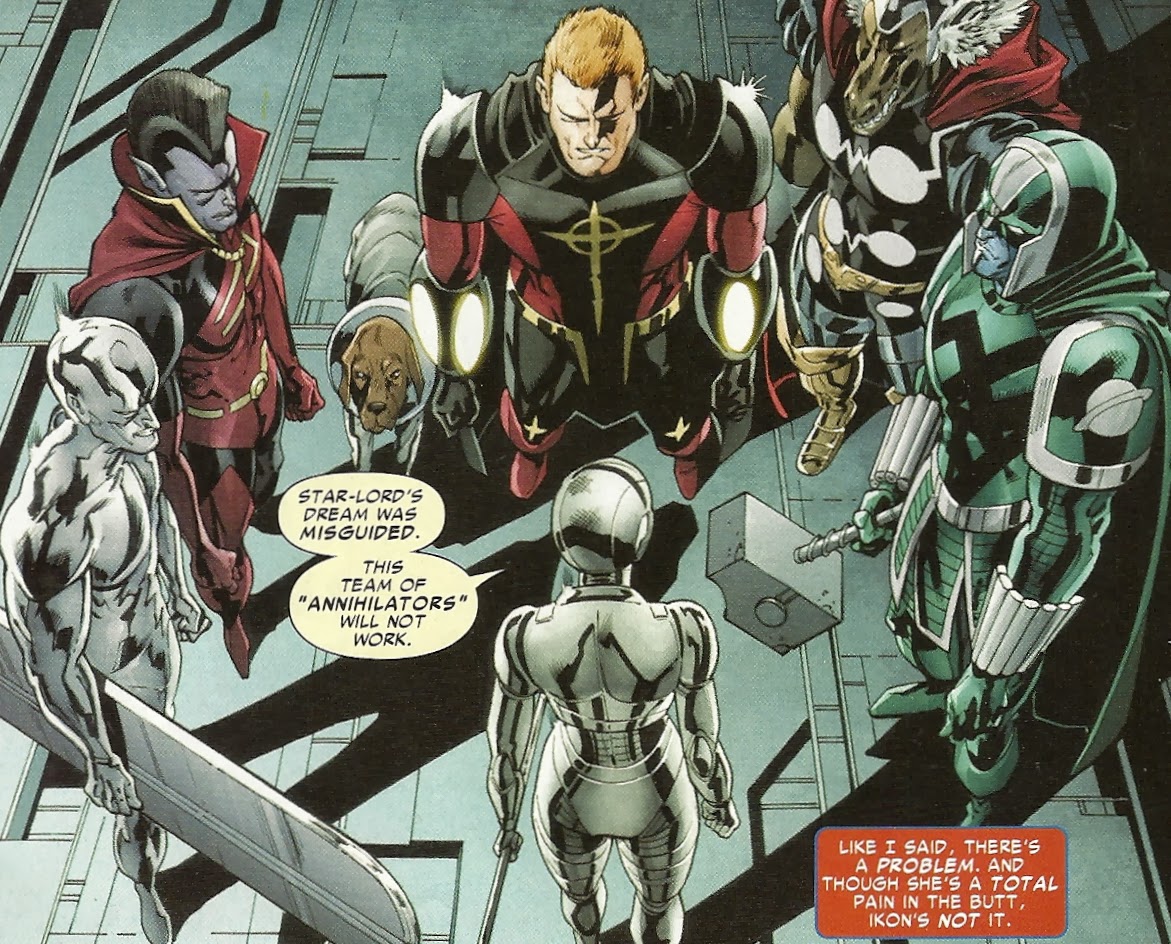
The title story takes the team of outer space super-guys—Quasar, Gladiator, Beta Ray Bill, Ronan The Accuser and Ikon, Spaceknight—from their usual jurisdiction of outer space to Earth (hence the name of the comic), hot on the heels of an enemy force encountered in the canceled Guardians of the Galaxy series that Abnett and Lanning's Annihilators minis followed.

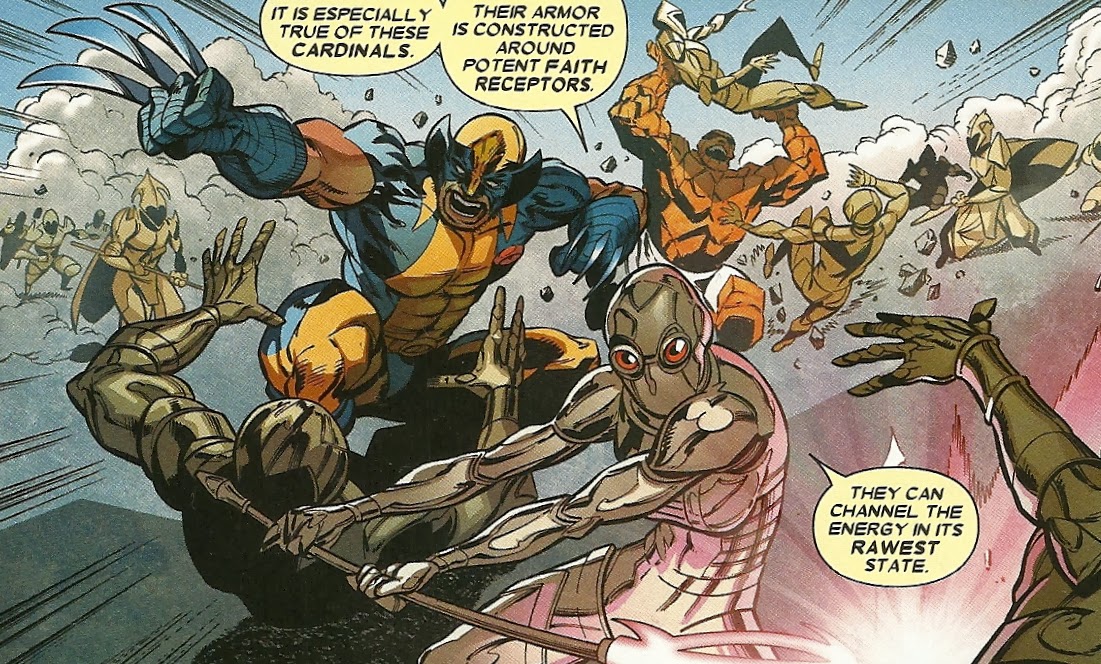
Because that enemy, The Universal Church of Truth, is collaborating with human beings in a planned, religious community, and because they can and do disguise themselves as human, it looks like a bunch of alien invaders (some of whom, it should be noted, have repeatedly come into conflict with Earth heroes) have landed and just started wrecking a city. The Avengers—Captain America, Iron Man, Ms. Marvel, Red Hulk, The Thing, Valkyrie (?) and, of course, Spider-Man and Wolverine—arrive and start fighting them before anyone gives anyone else a chance to explain themselves, because this is the Marvel Universe (In the 1960s, the fight and team-up formula resulted from first meetings of weird-looking super-powered beings meeting for the first time, now whole teams of people who know each other at least as well as players on rival sports teams do, regularly repeat the pattern because, um,  because Avengers Vs. X-Men sells better than The Only Difference Between Avengers And X-Men At This Point Is The Spelling Really probably would).

The main problem with this story is the same one that plagued the previous Annihilators story. There are too many characters to give them all enough to do, or even identify anything unique about themselves in contrast to their peers. The title team fares a bit better, as The Silver Surfer is gone and Gladiator, who had little to do in the previous series, has much more to do here. Of the title characters, Ikon seems to have the least to do, but that's fine; at least they're taking turns.
Okay, most of those guys can fly or survive a great fall (and are assuming appropriate action poses), but what, exactly, is Captain America doing? Is he floating down or what? 
The Avengers seem more-or-less randomly assembled, with Captain America the only one really necessary in terms of plot or conflict-driving. Most of them are merely there for a functional reason: Spider-Man to tell a joke or two, Iron Man to do science stuff, Wolverine to boost sales a tiny big. The rest are more-or-less wallpaper, offering characters for Huat to draw during fight scenes (The Avengers hold their own remarkably well, and that might be why some of these particular Avengers were chosen; otherwise, The Annihilators really should be able to, um, annihilate pretty much any Avengers assemblage, shouldn't they?).

As for the conflict, the one driving the plot is that the space bad guy has embedded his personality first into a group of children, where he feels safe from any heroes killing him to get rid of him, and then he spreads himself into some 30% of the American population, if I've got that number right (I may be mistaking it for the infection rate of the Senegal Flu in SST: Deathflight, which I watched between reading this comic and writing this review; anyway, it's a lot more than most of the characters feel comfortable killing).

Then the characters can bicker about how many Earthling's its acceptable to kill in order to save the many (which is also the conflict at the climax of SST: Deathflight!); Cap says none, Ronan says a ton, others fall in between, there's some argument for Quasar regarding the difference between collateral damage on alien worlds vs. on Earth (In Ronan's defense, the Avengers go kill-crazy against Skrulls occasionally, with little regard for collateral damage when that damage doesn't involve human life).

The conundrum that Abnett and Lanning have their villain cook up is a clever one, and the inter-character conflict regarding their ethical decisions is compelling (much more so than the fights, which all seem sorta rigged to keep The Avengers in the game). They do a fine job continuing to fine-tune the purpose of this team and what sets them apart from others in the Marvel Universe.

Although I can't help but wonder if they actually last. Marvel's doing some space stuff now in Infinity, and I imagine some of these characters show up—are the Annihilators still a team? They also relaunched Guardians of the Galaxy, which starred the team that the Annihilators were supposed to replace, did the Guardians thus replace their replacements? (I don't know; I read most of these things in trade now, so I'm quite a way's behind most of the Marvel Universe's goings-on).

The Rocket/Groot story again features the superior artwork, but is an all-around inferior story—both to this volume's title story, and to the Rocket/Groot story in the previous volume. It's a story I've read a few times already, with the protagonists swapped out for new ones. It's a Mojo story, which is basically all one needs to know to know almost everything about it.

I was pleasantly surprised by the return of the Timely Inc. Shipment Processing and Analysis Device from the previous storyline, though:
And the Build-A-Groot colelctor's figure, a piece of which is available with each of the various Rocket Raccoon variant figures like Camo-Attack Rocket Raccoon and Sea-Ops Rocket Raccoon, is a toy I actually wouldn't mind owning.
*********************
By the way, this story apparently takes place during the time the Fantastic Four characters were all wearing white instead of their regular blue, and, for Ben Grimm, that meant a pair of white shorts:
Is it just me, or does it look like he's adventuring in his underwear? I know he's often worn a costume consisting of just shorts, often ones that are much shorter than these shorts, but when they're white shorts, they just look so much more underwear-like than when they're blue or black.

Sunday, September 22, 2013

Review: Annihilators

This trade paperback collects a 2011 miniseries by writers Dan Abnett and Andy Lanning, the writing team that took the reigns from Keith Giffen to build-up, tend and generally cultivate Marvel's various space characters and concepts to the point that not only was that little corner of the Marvel Universe suddenly and surprisingly fresh and interesting again, but successful enough that Marvel Studios' first new, post-Avengers team movie was and is going to be a Guardians of The Galaxy movie, of all things.

This was the first of two Annihilators miniseries, which came after the conclusion and cancellation of Abnett and Lanning's 25-issue, 2008-2010 volume of Guaridans of The Galaxy (a super-team spun out of the 2007 Giffen-written Annihilation: Conquest—Starlord miniseries) but before Brian Michael Bendis assumed stewardship of the Hollywood-bound characters in Avengers Assemble and then his own volume of a Guardians of The Galaxy ongoing.

Interestingly, each issue of this initial Annhilators series was actually split into two sections, leading off with the title story featuring a new super-team of "Alpha-Plus" cosmic heroes, penciled by Tan Eng Huat and inked by Victor Olazaba, and a back-up story featuring Rocket Raccoon and Groot, the fan-favorite funny characters from Guardians. Aside from sharing writing teams and picking up after the events of past stories in which the Guardians team was disbanded following the "deaths" of several key players who have long since gotten better, the stories don't really have anythign to do with one another, and don't really seem to belong at all in the same trade.

In fact, their being married into the same trade like this seems to do a disservice to them both. By title and appearance, this looks like a collection of Annihilators, not of a Groot and Rocket Raccoon story (There is a little green diagonal strip across the lower corner of the book, reading "Plus Rocket Raccoon and Groot!", for whatever that's worth), and you'd only find them in here if you'd already picked up and started flipping through or reading a book that looks on its cover to be a pretty generic superhero book starring some pretty obscure Marvel characters (Silver Surfer is probably the best-known of that bunch, right?). I didn't know they were in here until I neared the end of what I assumed was the first of a handful of Annihilators story arcs only to be confronted with an awesome Mike Mignola image of the pair.
So this is basically a flip-book that doesn't actually flip, and features only one cover. I'm not sure what a better solution might have been, beyond publishing these as two, much slimmer trade collections of their own  (The Annihilators story, at least, could have been held to include in the second Annihilators trade...although maybe Rocket and Groot are in there, too? I don't know).

The Annihilators story is the weaker of the two, and I say that not simply because I am a fan of raccoons wielding firearms or weird Kirby monsters. Rather, there is not a whole lot of variation of characters in terms of power-levels, powers or even personalities, and the premise of their team's formation doesn't seem like one capable of maintaining it's own narrative momentum for long; rather, they seem like they would be the guest-stars in other people's comics. It reads very much like the first arc of a monthly series that would be canceled before it could have two or three more arcs.

Our narrator and main protagonist is Earthman Wendel Vaughan, who goes by the name Quantum, wears "the awesomely powerful quantum bands," dresses vaguely like a Marvel Captain Marvel of some sort, and whom I have never heard of nor do I know anything about. He's the character with the most personality and the strongest character arc, going from feeling gun-shy in the presence of his supremely powerful compatriots and over-humbled by his role as "Protector of the Universe."

As for his team, they consist of The Silver Surfer, Beta-Ray Bill, Gladiator and Ronan The Accuser. Into their circle comes Ikon, a female Spaceknight from the place that Rom Spaceknight came from, apparently having similar powers, weaponry and armor (she basically looks like a "sexy" Rom; that is, Rom with a wasp-waist, bib boobs and wide-hips—Yes, a sexy lady version of Rom is as weird-looking as it sounds).
The team is station in Knowhere, the former base of the Guardians, and hanging out with Cosmo, the telepathic talking Russian space dog in a cute little dog space suit (and whose breed seems to vary form panel to panel, under Huat's loose and expressive line-work). They are called "The Annihilators," because, it is explained that they are so powerful they comprise an existential threat to any enemies of the universe—try to hurt it, and you won't just get slapped on the wrist or beaten up or killed, you'll be annihilated (That's the in-story explanation, anyway; personally, I think it has more to do with the fact that all the previous space opera stuff featuring these characters that Giffen, Abnett and Lanning were spearheading were called Annihilation: Something-or-other).

After fighting her way onto the team Ikon, and an escaped villain with incredible powers allowing him to surgically cut space, draw the team into a big, crazy interplanetary conflict involving Spaceknights, Dire Wraiths and even some Skrulls. Planets and suns are moved around, fights are had. I thought it was pretty good escapism, as I know very little about any of these characters and care even less about them, but I remained more than engaged enough to real all the way through and even find myself curious about what happens next.

As I mentioned, the team seems to have a very limited shelf-life, as it read a little bit like a Justice League where everyone is Superman, and it was hard to suspend one's disbelief to regard the things being treated as threats as threats (In one scene, for example, the characters seem worried they'll be defeated by Immortus' "Army of the Ages," which meant they were fighting World War II vets, Native American warriors armed with bow and arrows, Roman Centurions, vikings and cavemen. Yeah, Huat threw in some menacing-looking robots and a Frost Giant, but, for the most part, it looked like a horde the U.S. Army could probably handle, and not something that should worry anyone capable of moving a planet.

It doesn't help that little of them have very little to do, aside from fight hordes of monsters and such, and use cosmic powers in vague, comic book science-y ways. I'm having trouble remembering if Gladiator, for example, even had any lines (He did, but nothing more substantial then things like "Quasar! Contain the giant while I pull the Surfer out of this mob! We must stand together!" and "Look out-- --NGHH!" and so on). 

Huat has tuned down the idiosyncratic weirdness that once brought him to this reader's attention in the first place (two, maybe three Doom Patrol reboots ago), that, or perhaps Olazaba's inks and June Chung's colors knocked it into more Marvel-ous shape. At any rate, while the forms, figures and motion are all more-or-less played perfectly straight now, there's still an accent of edginess, a touch of anxious energy to the proceedings.

And then we get to the really good part, "Rocket Raccoon and Groot: Root and Branch, Tooth and Claw," drawn by Timothy Green II, who drew the aforementioned Starlord miniseries.

I can't imagine the page counts vary all that much between the two stories, but the "back-up" feature reads much longer and more substantial, perhaps due to the simple fact that there is more dialogue and plotting going, on, and one doesn't need to use double-page spreads for the sorts of fighting and action (of which there is a significant amount) that goes on in this story versus the half-dozen cosmic superheroes versus hordes battles that went on in the Annihilators story.

After the Guardians were disbanded, Rocket got a job working in the mail room at space corporation Timely Inc (get it?), a job he earned in part due to the "workplace morale scheme," as his boss explains. "You helped meet our quote of cute sentient animals. You make the Timely Inc. office environment a more cheerful place so as to uplift the people who do actual work.

When someone sends a gun-wielding a killer clown puppet made of sentient wood after him, however, Raccoon leaves his job with a stolen, hand-held computer/package scanning device (which provides a great deal of exposition and becomes Rocket's side kick), trying to figure out who might try to kill him in such a manner. He seeks out experts in sentient wood, and finds his buddy Groot on Planet-X.

From there, they return to Half-World, Rocket's homeworld, although his memories of the place have been severely tampered with, for his own good and the good of all of Half-World. From what I've read of the recently released Rocket Raccoon: Tales From Half-World (repackaging the 1985 Bill Mantlo/Mike Mignola Rocket miniseries), there seems to be a rather significant retcon involved, although the general characters and their role in the universe—caring for the insane housed on their asylum planet—hasn't changed.

Reunited with old allies and temporarily resuming his old duty as warden and security chief for an asylum world, Rocket and Groot must save the day, in the process reminding themselves that the galaxy still needs guarding it, whether they're doing it while wearing matching uniforms and hanging out with Starlord or not.

Abnett and Lanning seem much more comfortable in this story, somewhat surprisingly, and they achieve a nice balance of action, superhero thrills and comedy, with that comedy coming organically form the characters and extrapolations of what the world surrounding such characters must be like.
Green's art remains pretty incredible. It's highly-detailed, but his sense of design veers far from what one might term realistic, with his Rocket veering pretty far from on-model raccoon to super-cute funny animal. He's particularly good at action scenes, during which Rocket jumps and spins around like a cartwheeling, furry shuriken, and he's excellent at drawing bullet-holes exploding into walls and heads (The heads of wooden clown puppets, not living, breathing, bleeding creatures).
I'm not sure who Bendis has drawing Guardians for him month-in and month-out now (I know it started with Steve McNiven and that Kevin Maguire has at least one issue coming up), but I'd love to see Green get to spend more time with these characters. As the artist of that Starlord miniseries, he deserves as much of the credit as Giffen, Abentt and Lanning into turning Guardians of The Galaxy into a thing, you know?