Showing posts with label kyle rayner. Show all posts

Wednesday, February 05, 2025

DC Versus Marvel Omnibus Pt. 10: Green Lantern/Silver Surfer: Unholy Alliances #1

Although it was the ninth DC/Marvel crossover overall, 1995's Green Lantern/Silver Surfer: Unholy Alliances was the very first to suggest that the DC Universe and the Marvel Universe were two different, separate, distinct and (usually) inviolable universes. 

That status quo now seems obvious, even intuitive. It not only offers in-story rationales for why DC and Marvel characters don't interact with one another constantly, but it's in keeping with both publishers' decades-old concepts of alternate universes, parallel dimensions and a multiverse to imagine that their two respective lines of comics were each set in their own universes.  

DC traditionally cataloged alternate worlds with a letter or number system that was originated by writer Gardner Fox in his Silver Age Flash stories, beginning with Earth-Two and then expanding to Earth-Three, Earth-X, et cetera. Marvel had its own system, introduced to the public by Alan Moore in a 1983 Captain Britain comic, one that gave universes their own numerical designation, with the Marvel Universe being Earth-616.

For a comics reader, it was easy enough to think of the Justice League someday visiting Earth-616 in the same way they used to regularly visit Earth-2. 

Obviously, none of the previous DC/Marvel crossovers acknowledged this premise, though, with each of the first eight just sort of assuming that DC and Marvel characters belonged in the same universe and could thus meet one another if they just visited one another's home cities. Even if that did raise a niggling question in the back of a certain kind of reader's mind (A question both Jim Shooter and Chris Claremont acknowledged in the scripts for the crossovers they had written, with first Spider-Man and then the Teen Titans' Cyborg noting how strange it is that they have never crossed paths with the other publisher's characters before).

That was almost certainly the way to go, too, particularly given most of the characters involved in those crossovers so far. I can't imagine that any of those comics would have benefited had their writers taken a few pages to acknowledge some concept of a multiverse and then figure out some way to get Spider-Man from Earth-616 to Batman's Earth-1 Gotham City or whatever.

The biggest DC/Marvel crossover of all time, 1996's four-issue DC Versus Marvel miniseries, was on its way though, and the very premise of that crossover revolved around the fact that the DC Universe and Marvel Universe were two separate realities. 

It's not entirely clear to me now to what extent Green Lantern/Silver Surfer writer Ron Marz—one of the two writers of the upcoming DC Versus Marvel series—was laying the groundwork for that event comic when he penned this one, or to what extent a story in which the DC and Marvel Universes are separate realities just seemed obvious and natural to him in the story he was telling here.

Obviously, there was some degree of foreshadowing of the next year's big crossover in Green Lantern/Silver Surfer, though, as Marz devotes three panels on the last page of Unholy Alliances to a mysterious cardboard box on a New York City street which starts to emanate strange light—which would have meant nothing to that book's readers at the time, but, after having read DC Versus Marvel, it's clear bit of foreshadowing. The scene includes a line of portentous narration, of the sort readers would have been trained to know promised a sequel or continuation of some sort. 

"Still," Green Lantern Kyle Rayner thinks to himself. "Just between us... ...I'm glad it's over."

(So obvious is the connection between Unholy Alliances and DC Versus Marvel that DC, who published this omnibus, included an ad for the still upcoming DC Versus Marvel: The Amalgam Age Omnibus, which contains DC Versus Marvel, directly after the last page of this Surfer/GL crossover.)

Given the cosmic nature of the various characters involved in Unholy Alliances, it seems an easy enough one to deal with the DC Universe-and-Marvel Universe-as-separate-dimensions concept; these are characters who regularly travel through time, space and other dimensions, ones who have been involved in battles to re-write their respective realities in the past (And quite recent past, for some of the DC characters featured herein).

One interesting aspect of Marz's exploration of the concept in this script, and its basis for DC Versus Marvel, is that the later story would establish a new character, jointly owned by both DC and Marvel, whose superpower was the ability to traverse between the two universes and thus provide an ongoing means for future crossovers. 

However, while some future crossovers took advantage of that and acknowledged the Two Universes premise, others just ignored it completely and continued with the original idea of just having the publishers' characters already extant in the same universe. (Wikipedia's page on the DC Multiverse lists a "Crossover Earth" or an "Earth-7642" where the DC/Marvel comics take place, giving them their own universe separate from either the main DC Universe or Marvel Universe. That is, of course, another option for those who are concerned with such things, I guess.) 

Marz's suitability for writing this particular project went far beyond the fact that he was going to be co-writing DC Versus Marvel, though. He was, at the time, the regular writer of DC's Green Lantern and Marvel's Silver Surfer, so the publishers could have hardly asked for a more ideal writer for the crossover. 

The rest of the creative team consisted of pencil artist Darryl Banks, Marz's partner on Green Lantern (and Kyle Rayner's co-creator) and veteran inker Terry Austin.

Somewhere out in deep space, The Silver Surfer comes across a caped figure standing atop a destroyed planet as corpses float about him. When the Surfer confronts the stranger, we see that it is Hank Henshaw, the Cyborg Superman of "Reign of the Supermen," now in his red and black look. He introduces himself simply as "Cyborg," and the pair immediately fight, letterer Chris Eliopoulos providing a big "BRAKKADOOM!" that dwarfs the battling figures in the panel where they clash. 

Meanwhile, on Earth, the style of narration boxes shifts to let us know we are now hearing freelance artist Kyle Rayner's thoughts as he works at his drafting table on a logo design, only to be forced to change into Green Lantern when Marvel character Terrax appears to pick a fight with him, mentioning his desire to conquer "This universe."

Both fights are broken up when new players appear. 

In space, it's Parallax, the identity Hal Jordan took after going mad during the Marz-written "Emerald Twilight," here rather fresh off his plot to destroy and remake the DC Universe in the pages of the previous year's Zero Hour. And on earth, it's Thanos, wearing his classic costume and sitting on a flying chair. The two newcomers rather quickly dispatch of the secondary bad guys. 

Marz will jump back and forth between the two settings regularly, building a neatly organized parallel narrative. After some conversation, it's made clear that Cyborg and Parallax have come to the Silver Surfer's reality (the latter chasing the former), and that Thanos (and Terrax) had similarly come to Green Lantern's reality, through a rift between the dimensions. 

Parallax convinces the Silver Surfer to lend him part of his power cosmic, giving him the might he needs to complete his mission of restoring the destroyed Coast City, although he starts by restoring to life the dead planet and its inhabitants from the first page.

And Thanos convinces Kyle that he has constructed a super-weapon to stop Hal Jordan, who he claims threatens both universes. In order to operate the weapon, though, he needs Kyle to journey with him to the center of the universe, put his arm in an elaborate machine, and use his ring to channel the "almost limitless ambient energies of Oa", which Kyle had recently destroyed during a fight with Hal. It was Oa's destruction that apparently created the rift between the two universes in the first place. (Thanos being Thanos, however, he really just wants to use all that energy to destroy existence, a plot he reveals to Kyle just as soon as he gets what he wants from him.)

And so that's where the subtitle comes from, as both heroes rather naively decide to ally themselves with cosmic supervillains from the opposite universe, each of the title characters being rather easily talked into taking part in their schemes. 

And the Surfer is also pretty easily manipulated into fighting Kyle, but I guess seeing him standing side-by-side with Thanos is enough to convince the Surfer that Kyle's a bad guy.

This leads to a pretty awesome double-page splash, in which Banks and Austin draw the two heroes posed in opposition to one another, in a poster-quality image. 

Thanos tells Parallax that he's harnessed all that energy "in order to destroy everything that exists." Hal, eyes glowing with the power cosmic, responds, "And I finally have enough power to recreate it. Our goals, it would seem, are at odds."

And so they fight too, so spectacularly that it catches the Surfer's attention and he and Kyle are able to put aside their differences and intervene, ultimately putting all of the vast energies that have gone to Thanos and Parallax back where they belong and sealing the rift.

"Perhaps we'll meet again," The Surfer says over his shoulder as he heads towards the closing rift, while Kyle responds, "Meet again? Oh yeah, like that's really gonna happen." Another nod to the upcoming DC Versus Marvel on Marz's part? 

Now, if you're wondering who would win in a fight between Green Lantern Kyle Rayner and the Silver Surfer, well, the four panels devoted to their fight following that double-page splash here are pretty inconclusive, but,—spoiler alert!—they would be forced into combat with one another in the pages of DC Versus Marvel, and the Surfer would be victorious. Theirs was one of the fights that was determined by writers Marz and Peter David and not by fan vote, as the more high-profile matchups were. 

So yes, Kyle Rayner would end up meeting the Surfer again rather soon after the events of their crossover.

So too will we, as it turns out that the Surfer is one of the stars of the very next DC/Marvel collaboration.


Next: 1996's Silver Surfer/Superman #1...not DC Versus Marvel, which was technically the next DC/Marvel crossover, preceding Silver Surfer/Superman. As it's collected in a different omnibus, the DC Versus Marvel: The Amalgam Age Omnibus, we'll get to that after we finish reviewing all of the contents of the DC Versus Marvel Omnibus and start in on the second omnibus. 


Sunday, March 25, 2018

On a few collections of DC comics from the '90s: Aquaman, Green Lantern, Robin and Superboy

Aquaman By Peter David Book One

Peter David started writing Aquaman almost as soon as the previous ongoing series had ended. The thirteenth and final issue of the Shaun McLaughlin-scripted series shipped in 1992, while Peter David's four-part miniseries, Aquaman: Time and Tide, was released in 1993, paving the way for David's ongoing series, which began in 1994.

So hardly any time at all had really passed between the end of one series and the start of another, and yet reading David's Aquaman, it felt more like an entire age had passed, he so completely reinvented the character. His Arthur Curry--whose real Atlantean name Orin is used more and more--is a brooding, grumpy, self-pitying misanthrope, a former king more or less forced to continue his career as a superhero, because no one will leave him alone.

It is the visual shift that occurs in the early issues of Aquaman that are best-remembered, though. This is when Aquaman grew his hair long and grew a beard--it's more or less impossible to imagine Jason Momoa having been cast to play Aquaman in the Warner Bros live-action movies without this run of Aquaman comics having been published--and it's when he lost his left hand in perhaps the most ironic fashion imaginable, replacing it with a harpoon. By the end of this first collection of David's run on the character, he is wearing his new costume, too, his makeover complete.

The visual changes were all quite intentional, signalling not only a break with the character's clean-cut, Silver Age past, but an attempt by David, as he has his protagonist explaining within the scripts, to come up with an iconic symbol of his own, in the form of a weapon...specifically a weapon that surface-dwellers used against the creatures of the sea, repurposed and turned back on them by the sea's greatest defender.

Say what you will about the darker, more bad-ass take on Aquaman, it certainly worked. The series was the longest-running one Aquaman has ever had (David left after the 46th issue, but it continued under writers Erik Larsen and then Dan Jurgens, making it all the way to 75 issues). It was also, in my opinion, the best. This is the version of Aquaman that appeared throughout Grant Morrison's JLA, and has been around ever since...to a degree. During the New 52, Geoff Johns reasserted the character's original, Silver Age origins over those of David, Robert Loren Fleming and other Aquaman writers of the 1980s--in addition to upping his power levels to Golden Age Superman levels--but otherwise kept much of the character's chip-on-his-shoulder surliness.

Much of the strength of David's run came from neither reinventing the wheel--this isn't the self-conscious, revisionist, "Ultimate Aquaman" of Johns' more recent run, for example--nor jettisoning continuity, but rather of picking the character up where he was last left, giving him something new and life-changing to deal with (not the hand thing, so much as his discovery of The Atlantis Chronicles and coming to terms with what he learned in them), while fashioning for him interesting adventures dependent on interpersonal drama and as much mythology as superheroics. David never fell into the trap of recycling Aquaman's rogue's gallery--in this volume, Ocean Master and Black Manta both only appear briefly, and in flashbacks or dream sequences--or thinking of him as a reactive superhero who had to deal with, like, sea-going crime.

There was also a great deal of rewarding long-term plotting, some of which you can see here, as the events of Time and Tide inform those of the first year or so worth of the ongoing, as well as just good old-fashioned, shared-setting comic book scripting. The first issue of Aquaman I read monthly was #26, although I was easily coaxed into the series by well-executed guest appearances, each of which felt organic to an ongoing narrative, while also doing the job of drawing eyeballs to the book (For example, in this volume, Aquaman fights Superboy in one issue, and Lobo in another; the former is there because his turf is Hawaii, where there happens to be a pretty big naval base that Aquaman has business with, while the latter comes to Earth in order to avenge some dolphins, the only thing he cares about in the universe).

It also helped that David had a hell of a creative partner in Martin Egeland, the pencil artist who draws the bulk of this collection. I really liked Egeland in the 1990s, and his work remains pretty solid today, too. His characters are all quite expressive, and though he is prone to the excesses of the era--and there's an image or two where the muscles get out of control  and one shouldn't look too long at them or one will wonder why said pages were ever even allowed to go to print--there's a nice, fluid grace to the characters' implied movements. There are some incredibly dynamic scenes of Aquaman and Aqualad swimming, leaping and, in one memorable image, sort of skipping along a tunnel.

Looking back form 2018, I see a bit of Todd McFarlane in Egeland's style, although his fundamentals seem far better than McFarlane's ever were. (Does anyone know whatever happened to Egeland? I searched the name on comics.org after finishing this volume, and found relatively little beyond Aquaman and some superhero work from that time. Did he quit comics, or is Egeland a pseudonym, or...?).

This Book One collection begins with Time and Tide, which was drawn by pencil artist Kirk Jarvinen and inker Brad Vancata. The premise of the series was that Aquaman had retreated to his Aquacave in an attempt to continue the Atlantis Chronicles by writing about his own life, leading to a series of flashbacks. The first issue depict his first encounter with a superhero--The Flash Barry Allen--at the dawn of the Silver Age.

The second is devoted to his childhood, in which he is rescued from Mercy Reef as an infant by Porm, a friendly dolphin, who raises him as her own among her pod. It's a very Tarzan of The Apes sequence, and, in fact David takes quite a bit of inspiration from Tarzan in his portrayal of Aquaman, who he sees as something of an Atlantean answer to Lord Greystoke.

In the third, he is a teenager, and visits an Inuit village in Alaska, where he befriends--and inadvertently makes a baby with--a young woman named Kako. He also fights a polar bear and the first of the mythological deities he'll face during David's run.

And finally, in the fourth, we see Aquaman and Aqualad at the height of their Silver Age status quo, as they encounter Ocean Master who, at that point, is just another supervillain to Aquaman.

When Aquaman begins, Garth pulls Aquaman out of his cave--where he's sprawled like Conan on a throne of coral--to help him investigate a downed nuclear submarine for the US Navy. It turns out to be a trap set by new, short-lived villain Charybdis, who has already captured a minor DC aquatic adventurer, Dolphin. It's in this battle with Charybdis that Aquaman ultimately loses his hand.

After he's slightly healed--or at least has managed to affix a harpoon to the stump--he and his new running crew head to Pearl Harbor in order to get answers about the trap the Navy sent them into, where they have to fight Superboy (whose Spider-Man-like fight chatter makes him a better fit for David than Aquaman, whose jokes sometimes feel out of character). Before they get their answers, they are sent to Japan in order to rescue Porm, and there meet Lobo.

The last four issues of the collection are an arc of sorts in which Aquaman returns to Kako's village with Dolphin, only to discover the son he never knew he sired--Koryak, who will become a supporting character in the series--and a group of Fourth World villains, The Deep Six. Meanwhile, Garth goes off on a mission of his own, to follow a lead that he thinks might indicate that his late girlfriend Tula (or Aquagirl, as you and I know her) is still alive, meeting Letifos, who will play a role in the Tempest miniseries. It's during these issues that Jim Calafiore's work appears for the first time; he's just there to fill-in for an issue or so, but he will eventually take over as the series' primary artist...to the detriment of the series, if you ask me.

This collection, which includes 13 issues altogether, also includes a new introduction from Peter David, in which he describes how he approached the series and how he tried to sell it. I was glad to read it; as I always say, all trade collections should have introductions. If they don't deserve introductions, then maybe they don't deserve to be collected at all, you know?


Green Lantern: Kyle Rayner Vol. 1

I was a fan of the Kyle Rayner version of Green Lantern, DC's sole Green Lantern for much of the 1990s and the one that was featured in the Grant Morrison, Mark Waid and Joe Kelly runs on JLA. I could go on at some length about the virtues of the character versus that of his predecessor, Hal Jordan, but the two main things that attracted me to the character was that 1) he was new and debuted around the time I started paying attention to the DC Universe outside of Gotham City and 2) a coffee-obsessed, twenty-something, freelance artist based in New York City was a lot more appealing to me than a middle-aged, former test pilot-turned-space cop from a blandly generic imaginary city.

I never quite understood the vehemence with which so many Hal Jordan fans hated the change at the time. Of course, the very first issue of Green Lantern I read was 1996's Green Lantern #76, which featured Kyle Rayner soaring through the sky above Gotham City, the bat-signal in the background. This was the first issue in the three-part "Hero Quest," in which the green Green Lantern went from city to city seeking some form of guidance from his more established peers: Batman and Robin in Gotham, then Captain Marvel in Fawcett and, finally, Wonder Woman in Gateway (He had already met Superman, The Flash, Donna Troy and the Titans in his adventures).

That issue, for what it's worth, was a good 20 issues of Green Lantern into Kyle's career, plus Zero Hour and several issues of New Titans and whatever other appearance he made in his first two years or so wearing the ring. While I read earlier issues too, I did so out of back-issue bins, meaning out of order. I had never read Kyle Rayner's first year or so as Green Lantern in the way it was meant to be read, the way it was published. DC is making that possible though, collecting his adventures into Green Lantern: Kyle Rayner, which begins with his very first appearance...that means three issues of "Emerald Twilight," in which Hal Jordan was still officially the Green Lantern of the title.

These issues are rough. It's not until #57, when Kyle moves to New York City, that the book starts to feel like the Green Lantern I knew, and thought the book was; that's a good six issues into his time as Green Lantern. Writer Ron Marz is the poor guy who had the job of turning stalwart Silver Age hero Hal Jordan into a cosmic-scale villain, doing away with the Green Lantern Corps and The Guardians of the Universe and all the trappings of the franchise from the past few decades and introducing a new character--in just three issues.

He doesn't do as good a job in the space allotted as I always assumed he had done, but then, I think Dan Jurgens also did a lot of the work in (retroactively) justifying Hal Jordan's heel turn in the pages of Zero Hour. I guess I had just filled in the blanks in my imagination, or imagined that they were filled in in the pages of Green Lantern.

So the book begins with "Emerald Twilight." The first issue, penciled by Bill Willingham and inked by Romeo Tanghal and Robert Campanella, is really quite good. In the crater that was Coast City, utterly destroyed in the events of "Reign of The Supermen," Hal uses his wish-granting ring in an attempt to bring it back...although this mostly amounts to his conjuring holograms or hard-light constructs of it as he remembered it, and having conversations with his loved ones...though he's essentially just talking to himself through the medium of his ring. Anyway, it's all handled pretty well; I've always thought having your city completely erased from existence, including just about everyone you know except your friends from work (with "work" being "the Justice League" and "The Green Lantern Coprs") is as good as any other contrivance to drive a fictional character mad more-or-less overnight.

In the last few pages of part one, the Guardians tell Hal to quit fucking around and come back to Oa. Pissed at them, them streaks off to comply, while Kyle makes his first appearance; seeing Hal in the distance, he thinks he sees a shooting star.

The next two chapters? Things get dicey. (Visually, as well as in the story. Part two is penciled by a Fred Haynes, in a very '90s style with lots of splashes. Darryl Banks, who draws much of the rest of the book and is the artist most closely associated with Kyle, comes on during the third chapter)

During the second chapter, Hal is confronted by a series of allies from the Corps, each trying and failing to either calm him down or beat him up, as at this point it's pretty clear his trip to Oa isn't going to be a friendly one. He fights and defeats eight Lanterns, stealing each ring and adding them to his own fingers, increasing his power as he collects rings. When he gets to Oa, he's faced with Killowog. He tells Killowog that he didn't kill any of the Lanterns, but left them with enough power to survive. The two of them fight though, and The Guardians play their last, desperate attempt to stop Hal: They release Sinestro, newly empowered with a GLC power ring.

The bulk of the last issue is a fight to the death between Hal and Sinestro, with our hero breaking his archenemies neck and then killing Kilowog and destroying the main power battery and, apparently, The Guardians...?

In the last pages, the lone surviving Guardian, Ganthet, meets Kyle Rayner in an LA alley, seemingly at random, and hands him the last power ring in the universe, then disappears forever or so.

And the torch is thus passed.

Regarding "Emerald Twilight," what surprised me most is how few Lanterns Hal actually faces. It was my understanding that he killed the entire Green Lantern Corps which would have meant some 3600 Lanterns, right? Although I have absolutely no idea what was going on in Green Lantern comics just prior to this storyline, so maybe there were only a handful of Lanterns left at that point...? Or did destroying the battery somehow kill everyone? I have no idea.

Things stay rough for the next five issues, the first of Kyle's career. These issue's are pretty notorious, mostly because of what happens to Kyle's girlfriend, Alex DeWitt--this is the storyline from which the term "women in refrigerators" came from. And while it doesn't read any better in 2018, I do now wonder if perhaps this story wasn't a sort of necessary evil? Like, if it wasn't so egregious that it served as a sort of straw-that-broke-the-camel's back, drawing so much attention to the trope, giving it a name, that it was easier for other creators to avoid in the future? (Not that the phenomenon of killing off or visiting violence upon the female loved ones of male heroes as a way to motivate their actions went away afterwards, of course, but it's always easier to address a problem once that problem has been named.)

I'm also a little curious about how on-the-fly these decisions were made (This comic book series at this time in comic book history is a nexus for so many aspects of the mainstream comics industry and fandom that followed, that I think there could probably be a book written about it). The Kyle Rayner that seems to be getting introduced in the first few issues is a completely different one then the one who emerges a few issues later. When we first meet Kyle, he's a slacker in LA with a girlfriend trying to break into news photography, making for yet another superhero-with-a-media girlfriend pairing (Superboy, introduced just before Kyle, would also get a media girlfriend, in the form of Tana Moon).

She is killed off-panel and infamously stuffed inside of a refrigerator within issues of her first appearance, however, and after Kyle contemplates killing her killer in an act of vengeance, he ultimately leaves the city to begin a new life, at which point what would emerge as steady aspects of his turn as the main Green Lantern would emerge: His job, his city, his landlord, his relationships with super-women (First Donna Troy, then Jennifer-Lynn "Jade" Hayden). It makes me wonder if the sharp change in direction was intended to be subversive, or if Marz was making it up as he was going along, reacting to input from his editors.

In the middle of all that, DCU events intervene. Kyle briefly meets long-haired Superman and teams up with him against Mongul, the guy responsible for Coast City's destruction in the first place. Directly after Alex's death, Kyle finds Green Lantern Alan Scott--or perhaps he was Sentinel Alan Scott at that point?--waiting for him in his dark apartment, wanting to recruit him into helping with the whole Zero Hour thing (He does, but you have to read Zero Hour for that; here Scott does give Kyle a quick history of the Green Lantern Corps, told across four very full pages).

In Green Lantern #0, which seems to follow immediately on the heels of Zero Hour, Kyle and Hal battle on Oa, and there's a pretty interesting fake-out where it seems like Kyle might return the ring and legacy back to Hal, as if maybe his time as Green Lantern was meant to be more story-line specific, like when Jean-Paul Valley replaced Bruce Wayne as Batman, rather than when Wally West replaced Barry Allen as the Flash.

The collection includes two issues of New Titans, part of a crossover with that series that initiated Kyle's brief stint as a Titan (This era of Titans comics weren't all that great, but that was honestly my favorite line-up of Titans, with the possible exception of the Devin Grayson-written team), and the first issue of REBELS '94.

I suspect the next volume will be when the series starts to get pretty good, but these issues are all still intensely interesting, particularly from the perspective of what was going on with DC comics in the early 1990s, and various trends that were waxing and waning. Knowing how things have changed since only make some elements of these comics even more interesting too. For example, it's easy to imagine a young Geoff Johns reading these comics and getting pissed off, daydreaming about one day being able to undo all of the changes Ron Marz wrought.

And young Geoff Johns' dream came true!


Robin Vol. 5: War of The Dragons

One problem with these complete packages of particular series is evident from the first pages of the fifth issue of Chuck Dixon and company's long, healthy run on the Tim Drake version of Robin. This particular collection covers Robin #14-22, Robin Annual #3 and Detective Comics #685 and #686. Robin #14 was part of the four-part "Troika" story that introduced Batman's then-new costume and ran through the four main Batman books of the time. Actually, Robin #14 was the fourth part of it, so this collection opens with the conclusion of a story; it's beginning and middle somewhere else, probably uncollected (The solution, I suppose, would have been to either stick the first three chapters in here, or just collect "Troika" as its own, 90-ish page trade).

There's another multi-book arc collected in this trade, the title one, but the two Detective Comics chapters of "War of The Dragons" are included, perhaps because that entire arc was written by Dixon, who was then writing 'Tec as well as Robin, or because of how Robin-y that story was, as the warring dragons were King Snake, Lynx and The Ghost Dragons, the villains from the very first Robin mini-series.

So after the opening, in which Robin must try and hold his own against The KGBeast, there's a two-part story penciled by Tom Grummett featuring Batman, The Spoiler and Cluemaster; the three-part "War" featuring art by penciller Steve Lieber and inkers Klaus Janson and Enrique Villagran (Huntress and Nightwing put in guest-appearances, and The Silver Monkey is introduced) and then the volume contains the transition from Grummett to new pencil artist, the late, great Mike Wieringo, which accompanies a series of extremely well-made shorter one and two-issue stories, which are something of a relief after the relative chaos of the Bat-family titles up to that point, with their years worth of inter-book crossover epics.

The unfortunately also late, but also great Mike Parobeck and Stan Woch draw "The Mouse That Ate Gotham," in which Robin meets an unlikely foe that causes chaos by attacking key points of key infrastructure. Ringo then takes over as penciler for a two-parter involving the return of The General (a badly bowlderized version of whom has been appearing off and on in the James Tynion-written Detective), which is followed by a second two-parter, this one sending Tim undercover to infiltrate a ninja-themed summer camp in order to stop a string of robberies by faux ninja second-story men (and women).

The final chunk of the book is the third Robin annual, one of 1994's Elseworlds-themed annuals. In this one, Batman is a samurai in feudal Japan, and Robin is his orphaned apprentice, who must try to complete his final mission after Batman is killed off. There are a clan of cat-eared female ninja , but beyond those Batmanly touches, it is mostly just a pastiche of samurai flicks. Villagran handles the art.

Reading and/or re-reading all these comics today--the annual, The Mouse and the ninja camp stories were the only ones I hadn't read when they were originally published--what seems most striking to me is how much effort Dixon put in to trying to make the teenage characters seem semi-realistic as crime-fighters. Batman was very protective of Robin, and Tim had to be very careful about who he fought and how, so as not to risk his life needlessly; when he confronted someone like The KGBeast, it stuck out as a dramatic moment because it was so relatively rare. In this volume, for example, he mostly deals with younger opponents, and/or the sorts of crimes that might not necessarily warrant Batman's undivided attention.

Dixon's Spoiler is as different from Tynion's Spoiler as his Tim Drake is; rather than hyper-competent, she's very much an amateur and work-in-progress, and it's a lot more fun to see her arguing with the Dynamic Duo, as, on the one hand, she's totally right to call Batman and Robin out for being sanctimonious jerks to her, but, on the other hand, they're proven right that she's really not ready to be a crimefighter (as when Robin takes two in the chest due to her recklessness, for example; thank God for Kevlar!)

I was also struck by how much The General--a ridiculously brilliant and mature military strategist who just so happens to still be a little kid--seems like a precursor to Damian, right down to his look. Here he basically looks like Damian with a different haircut. All of which kind of makes me want to read a comic featuring the current Robin and the original version of The General, although I suppose the New 52 reboot and Tynion's version of The General would make that impossible-ish.

Robin was in pretty great hands with Grummett handling the art for so much of the first year or so of the book, but Ringo was pretty much born to draw the character, and it is great to see the energy he pours into these early issues. I can remember being a teenager and finding myself much more excited about the book when Ringo's art started appearing under the covers. My esteem for all of these artists have only grown in the years since then, but yeah, there's a pretty clear line in the book's look as Grummett gave way to Ringo.

Looking ahead, it looks like the next dozen or so issues will contain the "Underworld Unleashed" tie-in (during which Killer Moth becomes Charaxes, something I recall hating and writing a letter to the editor about), a few issues of "Contagion" and probably "Legacy" tie-ins, and guest-appearances by Green Arrow Conner Hawke and Wildcat.


Superboy Book 1: Trouble In Paradise

DC begins its perhaps belated collection of the 1994-2002, 100-issue Superboy series with this 270-page, 11-issue trade paperback. The particular Superboy in question is, of course, the '90s one, the clone who was introduced in the post-"Death of Superman" 1993 storyline "The Reign of The Supermen" and then graduated to his own title, by his creators writer Karl Kesel and artist Tom Grummett.

This volume makes for some curious reading, as it starts off with what appears to be four issues of a very solid ongoing comic book series, then detours into four issues of almost impossible to make sense of crossovers, before getting back on track for a few issues.

Kesel writes all 11 of the issues included herein, and Grummett pencils most of them, usually inked by Doug Hazelwood. As for those first four issues, they are most remarkable in for how quickly they establish a premise for the series, which needed a pretty dramatic form of differentiation from the then-four Superman monthlies, and how quickly the creators start filling out Superboy's cast with new characters.

That differentiation turned out to be geographic, as Superboy, his manager Rex Leech, his manager's teenage daughter Roxy Leech, and Superboy's Cadmus-appointed chaperone Dubbilex, a psychic "DNAlien", arrive in Hawaii for the next leg of their "Superboy National Tour," an attempt to turn a buck on Superboy merch, and they more or less decide to stay...in large part because Superboy's crush Tana Moon has relocated there from Metropolis, where she firstmet and was covering Superboy for a time.

We immediately meet Sidearm, a low-level bad guy whose gimmick is a couple extra robot arm attachments; Silversword, the curator of a Hawaiian cultural museum who comes into the possession of a super-powered "animetal"; The Scavenger, a collector of mystical and super-powered artifacts (not to be confused with the Aquaman villain of the same name) and, of course, Knockout, a super-powered stripper who develops a sort of Batman/Catwoman sort of relationship with the Teen of Steel. In the first issue we also meet Sam Makoa, a federal agent working on the islands to combat villainous organization the Silicon Dragons.

Again, all of those new characters appear in just the first 80 or so pages. Then things get a little messy. This is a problem with all of these collections. On the one hand, if the goal is to make them complete collections, then naturally they should include all of the issues of the series. On the other hand, because comics of the time so frequently included crossovers to other books--and Superboy, like Robin, would find this happening a lot, as in addition to line-wide crossovers like Zero Hour, it would also participate in the family-specific crossovers--that means including random chapters of larger stories that sometimes don't make much sense when read alone.

So by the fourth issue, Superboy is showing signs of the "clone plague," and heads to Metropolis to participate in "The Fall of Metropolis" crossover in the Superman books (there is no participating issue of Superboy though; he just heads off to Metropolis in one issue, and then the story picks up with Superboy cured).

Then there are two issues from "World Collide," the 14-part, 1994 Superman family/Milestone crossover that ran through seven different titles, and a one-shot. The third and eighth parts appear here, and they don't really make much sense at all read like this; the first of these is mostly intelligible, involving Superboy and Superman fighting The Parasite in the ruins of Metropolis, but the latter finds the storyline in full-swing. Superman and The Blood Syndicate are dealing with the results of a towering, omnipotent giant's attack on one side of a dimensional rift between the DCU's Metropolis and Milestone's Dakota, while Superboy teams up with Static and Rocket to tackle the giant head-on. There's some nice interaction between The Kid and his fellow teen heroes from the Milestone-iverse, but plot-wise? It reads a lot like the eighth issue of a 14-issue storyline. (I'm not sure what the market for it would be, but if DC's going to go ahead and publish these little slices of it, they might as well release "Worlds Collide" as a trade paperback of its own.)

And then we get two issues of Zero Hour tie-ins. As I've noted before, as tie-ins to line-wide crossovers, the Zero Hour tie-ins are generally pretty easy to read on their own, as most of them deal not with the plot mechanics of the main miniseries per se, but with the fall-out of those mechanics, which mainly means a standalone story in which the title character must deal with time going crazy. Those issues were then immediately followed by loose, thematic tie-ins--#0 issues recapping the heroes' origin stories and setting up future storylines. They were, essentially, jumping-on point comics.

For the tie-in, Kesel and Hazelwood introduce Superboy to the original Superboy; pre-Crisis Clark Kent when he was a boy. That Superboy arrives in Smallville, Kansas just as a plane carrying Dubbilex and our Superboy crashlands outside of town, and his Smallville occasionally appears and overwrites modern Smallville. It's a pretty great comic, really, and includes my favorite page in this whole book. Clark is confronted with the modern Superboy, and then walks off panel saying "Excuse me. I'll be right back." Just as our Superboy turns to the adult Lana Lang to ask what's up with Clark, he comes streaking back on to the scene, now in his Superboy costume, and clocks his modern incarnation. It's a wonder that guy even had a secret identity so long...

For the zero issue, Superboy has a rematch with Sidearm, and then he and Tana Moon spend some time with vacationing Metropolis super-scientist Emil Hamilton, who runs tests on Superboy as his origin is retold...including his first encoutner with Sidearm, from Metropolis on his first night outside of Cadmus. This is the issue in which Superboy acquires his special sunglasses--the first bit of tinkering with what would prove to be a very flexible costume--which gives him X-Ray vision, as well as approximating other Superman powers (Remember, at this point, Superboy was a clone whose sole super-power was tactile telekenisis, which he used to approximate Superman's strength, speed, invulnerability and flight, but didn't grant him Superman's various visions; Geoff Johns would later retcon the character to be an actual clone of Superman, with all of Superman's powers).

It is there that the series resumes the momentum Kesel had planned for it, free of crossovers. The final two issues collected herein introduce King Shark, one of the characters most formidable and, perhaps, longest-lived villains (although Kurt Busiek, Gail Simone and others would rather radically change his personality and, ultimately, his design, in the next decade or so), and a shape-changing character named B.E.M., who can transform into monsters based on whatever the last thing he touched was. These two issues were penciled by Humberto Ramos, whose style was a sharp departure from that of Grummett's, and was, at this point in his career at least, still rather rough. Ramos would get a lot better rather quickly though, and would eventually become a favorite of mine.

These comics are now almost 25 years old, and it certainly shows. The art, particularly that of Grummett, aged quite nicely...if anything, it looks better today, compared to what you might see in too many other DC Comics on the shelves at the moment (seriously, compare this to the insides of the New 52 Superboy or Teen Titans, originally starring a new version of this character, for example). The costume design, well, that's another matter. Superboy's fashion choices look downright bizarre now, and if you scan the covers of the series on comics.org, you'll see him gradually adopting differing costume elements as artists try to find something less 1994 for him to wear. Other than the main character, though, most of the other new characters look more or less timeless; certainly compared to the Milestone heroes, almost all of whom look as early 1990s as super-characters can look (Even poor Icon, who should have a pretty iconic costume, has that weird thing going on around his eyes).

Kesel's use of slang--and Superboy was very much in the constantly chattering, Spider-Man mold of quipping superhero--is dated to the point where it can be kind of crige-worthy, although, perhaps ironically, we are now so far removed from 1994 that it's easy to assume that maybe that's just how people all talked back then...? Like, when I read Silver Age Stan Lee-written comics, I just assume every one in the 1960s talked like, say Benjamin Grimm and Johnny Storm, you know?

Somewhat intriguingly, this collection is more thoroughly designed than the others in this post. While the figure of Superboy on the cover is re-purposed from Grummett and Hazelwood's image from Superboy #1, the background of that image is removed, the figure is enlarged so that his extremities extend beyond the borders of the space, and even the logo has been redesigned. There's a sort of Trapper Keeper aesthetic to the collection, which is...well, which is appropriate.

I had previously only read two of these 11 issues--Superboy #1 and Superboy #0; my comics budget was a lot more limited in 1994 than it is now--and I enjoyed this book immensely. I do hope DC continues collecting Superboy. Looking ahead, it appears that the next 11 issues includes "Watery Grave," a Suicide Squad story, in which Superboy, Knockout, King Shark and Sidearm work alongside Captain Boomerang and Deadshot, and, depending on whether or not they include Superboy Annual #1, guest-appearances by New Blood Loose Cannon, Green Lantern Kyle Rayner and maybe The Legion of Super-Heroes.

Tuesday, October 07, 2014

Green Lantern franchise's "Godhead" arc seems to be off to a good start.

I've frankly been rather surprised by the state of DC's Green Lantern line since the departure of Geoff Johns in 2013, which of course came after about eight years of Johns helming a franchise that grew up around the success of his Green Lantern: Rebirth and his run on the subsequent Green Lantern monthly.

When Johns left the then four-book franchise, so too did all the other creators, and DC had some of it's then-expected PR pratfalling regarding some of the new creators (Remember Joshua Fialkov being announced as the writer for both Green Lantern Corps and Red Lanterns and, within a matter of weeks, leaving over creative differences?). I haven't followed the line that closely since—I used to read Green Lantern monthly, and Peter Tomasi and Patrick Gleason's Green Lantern Corps in trade—but I generally check out the beginnings of each crossover story, and, creatively at least, the franchise seems pretty healthy.

There aren't any writers of Johns' star status in the stable, nor any artists I personally like as much as pencil artists Doug Mahnke and Gleason, but the books never look that bad and, surprisingly, the writers have been quite emulative of the types of stories that Johns and the previous crew of writers used to tell: Big, sweeping, cosmic space stories involving the variously-colored Lantern corps that occasionally (alright, usually) take over all the books to serve in chapters of one big mega-story.

Fans of the characters or concepts who didn't care for the way Johns and company handled the book were probably dismayed that their style of Green Lantern story persisted even after they left, but the franchise did not go in any particularly new directions. It's still set almost entirely in space—in fact, Green Lantern's Green Lantern Hal Jordan is now based in space, and isn't even in the Justice League any more*—big crazy changes are a constant (Kyle Rayner is believed dead! Guy Gardner's mustache is insane!) and all the colors of the rainbow are always involved.

You'd have to ask a Green Lantern fan how exactly this stay-the-course course has been received. Sales have been slipping, but the franchise is still the same size. When it was announced that Larfleeze (the book starring the "Orange Lantern") was to be canceled, a new Sinestro book was put on the schedule immediately, and, for a month or two, the franchise swelled to six books as the last few issues of Larfleeze shipped.**

As for "Godhead"—which, yes, does indeed have a pretty dumb name—there's a pretty good chance that this is a storyline that could interest regular DC readers and DCU watchers who don't normally read any Lantern titles. It features the universe's many Lantern characters coming into conflict with the New 52 version of the New Gods, but that in and of itself isn't much of a selling point (Me, I thought that was a weird move, as no one writer seems to be in control of the New Gods in the current, rebooted universe; they pop up almost at random in many unconnected titles).

Rather, it seems like it will have more than a little to do with...whatever DC's up to with its Multiverse now (See the last few pages of Forever Evil, the last page of Superman: Doomed #2, Booster Gold: Futures End #52, and, Futures End and Earth 2: Worlds End for more). The plot involves Highfather and The New Gods, who see themselves as a vast army protecting the Multiverse from the forces of Darkseid, seeking an ultimate weapon with which they will be able to defeat the evil god should he ever find the Anti-Life Equation (So, an Anti-Anti-Life Equation, I guess).

Metron and Highfather think they've found it in the main DCU Universe of the New 52 version of the Multiverse (What Earth are we on now? I've just been calling it Earth-New 52; is it Earth-1 or Earth-O or New Earth or what?), a notable universe because this is where seven individuals repelled Darkseid five or six years ago in the first arc of Justice League (and they did so much, much more violently in that animated direct-to-DVD movie, Justice League: War. Did you see that? Holy shit man, there was swearing! And Barry Allen took a crowbar to pry out one of Darkseid's eyeballs!).

Also, the Source Wall has appeared in previous Green Lantern crossover epic "Lights Out" (and, more recently, in Futures End: Green Lantern #1).

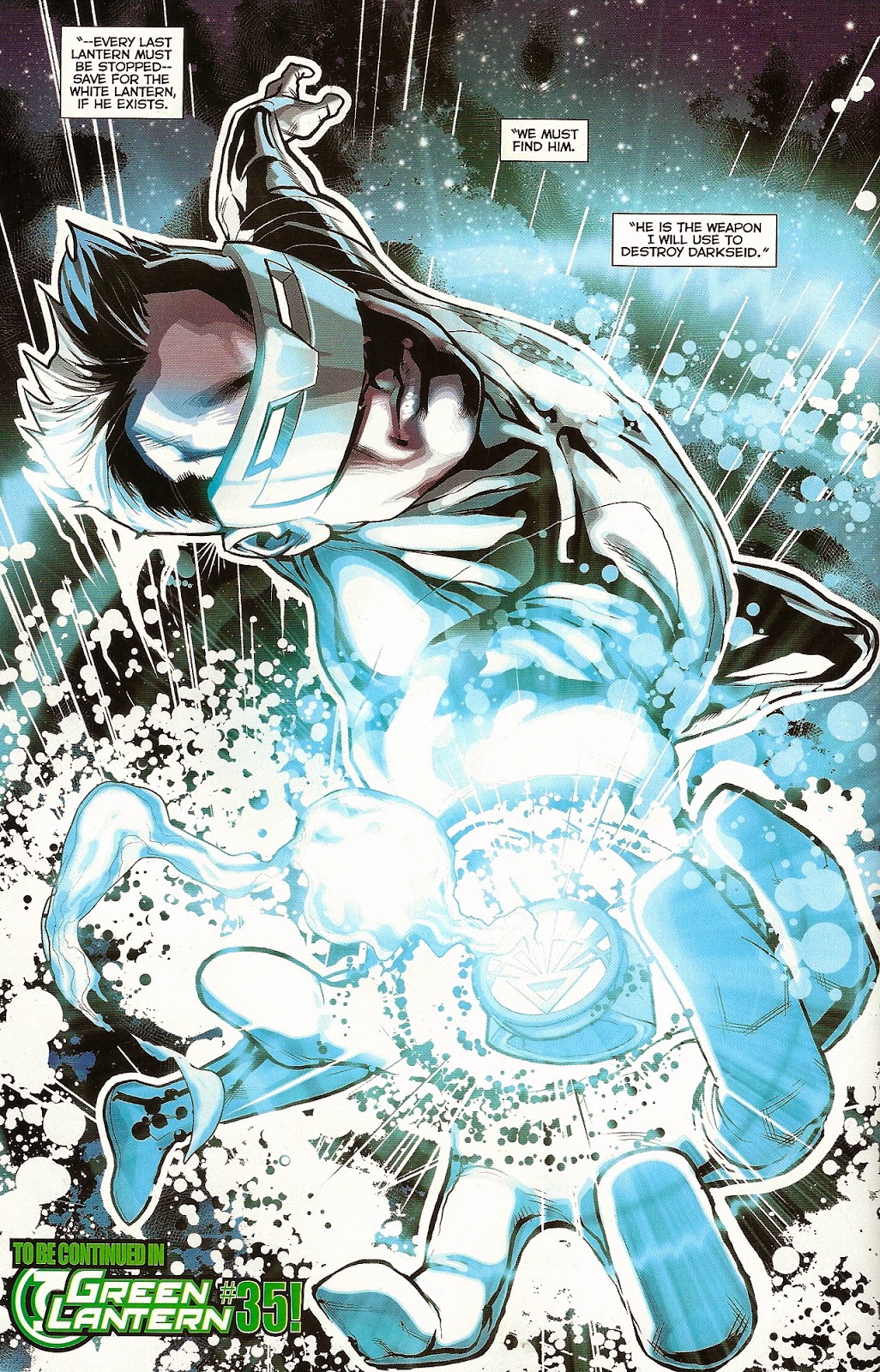
The ultimate weapon the New Gods have their eyes on? The White Light of Creation/Life that comes from unifying the whole rainbow of rings, currently held by White Lantern Kyle Rayner, who was able to travel to the other side of the Source Wall and back.

So, to put it as simply as possible, it's The New Gods vs. The Lanterns, for ring-power.

The story kicks off in Green Lanterns/New Gods: Godhead #1, a 38-page, $4.99*** special written and drawn by just about every one. Look how Hal Jordan recoils in horror at the list of credits he's faced with!
Don't worry, Hal! Most of those are writers; it looks like all the Lantern writers collaborated on the story, while Van Jensen and Justin Jordan wrote the script for this issue. There are only ("only"...?) five artists involved in drawing the damned thing, and none of them have a remarkable enough style that there's any visual whiplash involved. I'd actually have trouble pointing out who drew what, although I think I'm pretty certain which pages are Ethan Van Sciver's and which are Pete Woods' pages.

By the way, the text-heavy cover featuring a pull-quote from the book's dialogue is apparently the cover design for the whole she-bang, based on the fact that the second part—labeled on the cover as "Act I, Part 2," is similar in design. I can't say I like the design, but it is distinctive, and thus I imagine it will pop off the comics racks, differentiating the books from their neighbors. It's also funny; the "Act I, Part 2" is Green Lantern #35, and it also features a character reacting in horror to the credits:
As for Godhead #1, it begins with a recap of the New 52 New Gods, who are an awful lot like Jack Kirby's original conception in a lot of ways, but quite different in design (Also, the good guys are total assholes, too).

If you've read Wonder Woman, you've already met Orion and Highfather and visited New Genesis, here a floating city orbiting a ruined planet destroyed in the war between the gods. If you've read Justice League, you've already met Darkseid and his new, weird football player design. I always thought he was scarier in a mini-dress than in shoulder pads, but what do I know?
There's a four-panel DCU creation story (still involving the giant hand), a two-page summary of New God history/mythology and then a fancy four-page fold out of The Source Wall, before which stand Highfather and Metron (well, stand and sit, respectively).

Highfather, like Commissioner Gordon, looks much younger and more virile in The New 52 than in the...old, pre-New 52 comics. He still has an Amish or Lincoln style beard, but it's now dark and clipped short. Rather than a robe, he wears military-style armor that looks a lot like Imperiex's, and instead of the cane/staff he used to carry, he now wields a megarod-esque mace, more suitable for hitting.

Metron looks pretty much like he always has, but he's got some circuit boards or something in his face...?

They chitchat about the rings and Darkseid and The Multiverse and such before deciding to make a super-weapon out of the rings, with Highfather dispatching various New Gods to take a ring from each Corps, a feat they accomplish quite quickly. In general, it takes about a page to steal a ring from, say, a Star Sapphire or Larfleeze, while the Sinestro Corps and Green Lantern Corps put up a bit more fight.

Here's a panel of Hal Jordan getting his stupid ring construct smashed by Orion:
Hal's shaft has no hold over Orion.
Highfather stuffs all the rings into a new mega-mace that his super-blacksmith makes for him, and then visits a planet in the hopes of hyper-evolving everyone that lives there into gods. Instead, it turns all the space goat-people that live there into monsters, and Highfather sighs and is like, "Well, we'll have to destroy this planet and everyone on it."

It's decided that they miscalculated, and can't make their own white light, but need the white ring that Kyle Rayner is posing with on the last page, apparently recreating the creation story scene from the second panel.
Coincidence?

And if you found that intriguing, or just happen to read Green Lantern, it's on to part 2 of Act I of "Godhead," by writer Robert Venditti, pencil artist Billy Tan and three inkers.

These are the opening panels:
Just in case you weren't sure if you were reading a DC Comic or not. And don't worry, dismemberment fans! That scene of a ripped-off arm floating through space, tumbling away from its former owner is set "Soon;" the story will then jump back in time so you get to see the arm getting torn off as well!

Hal Jordan and his Green Lantern bros are on Mogo, the Alan Moore-created sentient planet GL that DC has gotten a ridiculous amount of mileage out of, who is slowly dying or losing sentience or whatever, because the GL ring Orion took was Mogo's ring (Oh, and the GL Corps are based on Mogo now. Did you know that? Well, they are). They are staring intently at computer screens and freaking out a little when they hear that the New Gods got the whole ring collection super-fast and made a weapon out of them and then destroyed a palent with 84.6 billion people on it.

That's right. The New Gods of New Genesis, the good guys in the New Genesis/Apokolips conflict, killed 84.6 billion people testing a weapon. So it will be kind of hard to root for Highfather, Orion and Lightray in the future, then.

The Green Lantern Corps confront the New Gods at the Source Wall, and Hal Jordan gets punched in the face:
And that's really all I want from a Green Lantern comic.

And then Highfather's stormtroopers chop up the Lanterns' ring constructs with their magic spear things, and Green Lantern The Wolfman gets his arm chopped off while a bunch of other Lanterns are likewise stabbed, cut and dismembered.
Metron tracks the White Lantern Ring and then Boom Tubes to New Genesis, and the decimated Lanterns decide to "rendezvous" on the last place anyone would look for them, Sinestro's planet...although the next issue—Part 3 of Act I, I guess—is actually Green Lantern Corps #35 rather than an issue of Sinestro.

So years after Johns left, DC is still producing Green Lantern epics, just the way Johns and company wrote them, and just the way you (likely) like them (if you liked the Johns ones).

How closely does the new class of Green Lantern writers follow the Johns template? Close enough that the good guys are still mostly a bunch of unlikeable assholes, and arms can be expected to regularly be removed.

Huzzah...?


*DC really needs to put one of their many Earthling GLs on the League roster, preferably John Stewart at this point, but Simon Baz works fine too. I suppose whichever Lantern they end up using in the eventual Justice League movie—John or Hal—will eventually re-join the Justice League. In the meantime, Johns seems to have replaced the team's need for a character with a green power ring by adding a new Power Ring to the ranks.

**I'm actually curious to see if and when the Green Lantern line takes a note from the Batman line and cancels its lower-selling books in order to launch a Batman Eternal-style weekly series. As has been the case with their many crossovers, the Green Lantern line is pretty much written as a weekly-ish book many months anyway, so it would hardly effect the storytelling. But I don't know, perhaps there are readers who read Red Lanterns every month and stubbornly refuse to follow the rest of the line, even if every couple of issues the book is subsumed into a crossover.

***Still a dollar less than DC is considering charging for Batman, by far its best-selling title, and maybe the only title posting such huge numbers based solely on the quality of the work of the creative team, rather than gimmicks and market massaging. I guess they're thinking if they sell over 100,000 copies of the book a month, and they raise the price from $3.99 (which I thought was a ridiculously inflated price as is) to $4.99, they can make an extra $100,0000 every month? If that logic is sound, maybe they should charge $51.99 for each issue of Batman and make each issue 1,040 pages, with the rest of the DCU line being back-up stories to the Batman cover feature....?

Thursday, October 24, 2013

Oh Red Lanterns, you may be weird, unpleasant and poorly-drawn...

...but I just can't seem to bring myself to dislike you either, thanks to images like these.

Monday, March 18, 2013

Review: Green Lantern: New Guardians Vol. 1: The Ring Bearer

I just don’t understand the impulse.

The New 52 reboot did away with the tertiary Green Lantern title, Green Lantern: Emerald Warriors, and replaced it with this new series, starring Green Lantern Kyle Rayner and the lieutenants of each of the variously colored Lantern corps. Together they form a loose-knit team to investigate a disturbance that affects each of their respective armies.

The first issue opens with a rather heavily revised version of Kyle Rayner’s origin story.

Originally, he was out dancing in an era-specific NIN shirt, and he stumbles out of the club and into an alley…only to be faced with the last surviving Guardian, Ganthet, who promptly handed the young Earthling the very last Green Lantern ring in existence and then disappeared, leaving Kyle on his own to figure out what the hell was going on.
Here the book opens with Ganthet emerging from a pile of dead Guardians, prone Green Lanterns in the background. He forges one last Green Lantern ring and then heads to Earth to distribute it.

Kyle’s out for drinks and nachos with some friends, quietly sketching, and, when he has to go to the bathroom and finds a line, he heads out to the alley, where Ganthet presents him with the ring and flies him up into the sky, where he starts to instruct Kyle on the GLC and making light constructions with a ring…something Kyle’s already pretty much mastered, simply by being an artist.
A turn of the page takes us to “The Present Day,” so apparently the origin was the past, although not marked as such.

And in that present day, the variously colored Corps all still exist, as do specific characters within them, and specific events from all of the various just-rebooted Green Lantern series, all of which cause continuity problems if you think about them (For example, how did Blackest Night and Brightest Day happen, if various participants didn’t exist, or exist in the same form, how long has Kyle even been a Green Lantern if Hal Jordan has only bee one for five years, etc).

All of which is a rather long way of saying this is a book that both reboots continuity and doesn’t reboot continuity, simultaneously, while leaving fairly important information vague.

(As to why Ganthet is seemingly the only survivor of an attack on Oa, and why Kyle is the only Green Lantern at the start of the book but one of scores of Green Lanterns later in the book, long-time readers will know that Hal Jordan went mad—and/or was possessed by Parallax, the avatar of fear, the Sinestro Corps’ part of the emotional spectrum—and murdered everybody else. Either that happened or it didn’t; the first volume of this book doesn’t say, but at some point something killed everyone but Ganthet, and then everyone got better or...something. At this point, one can only assume "Emerald Night," Green Lantern: Rebirth and all that jazz still happened somehow.)

And that’s what I don’t quite get. If things were fine as they were, why reboot them? And if they weren't and needed rebooted, why keep so much of it un-rebooted?

As a first volume, this introduces readers to how Kyle came to be a Green Lantern—kinda—and then skips ahead some years, keeping those years worth of stories as the foundation for this new story, serving neither audience—new readers or pre-existing Green Lantern readers—particularly well.

Much more importantly, however, is the fact that the comic isn’t very good.

In large part that has to do with pencil artist Tyler Kirkham and inker Batt's artwork, which is of the prevalent WildStorm/Original Image revival style that defines the New 52 (Harvey Toliabo penciled parts of second and third issues collected here, which is about the point many New 52 books needed fill-in artists to help meet deadlines, presumably because of the last-minute nature of the sudden decision to reboot). Kirkham's art is flashy and emotive, but the layouts are rather haphazard and somewhat messy and, whether by writer Tony Bedard's design or not, the narrative is dominated by gigantic splash pages that don’t show anything much worth seeing that big (Generally a character or two appearing for the first time, or someone shooting an energy beam of one sort of another at someone else).
There’s not a whole lot of original design work here, as all of the costumes are imported from the old DCU, with the exception of the Star Sapphire get-ups, which have more material and show (slightly) less skin. (It’s still pretty dumb-looking though; there’s a zipper, but no actually zipping part, as if she’s wearing a costume with a broken zipper. Realistic covering is applied with exacting attention to her breasts, which, of course, don’t seem to be anatomically correct, missing an important piece. But, from this one panel below, they seem to be able to talk...?)
The main antagonist, Invictus, is an original design, but not all that original a one, looking like a rather generic superhero hulk with light effects (In fact, on first flip-through, I wondered if it was supposed to be Grayven).
The plot? A ring from each of the Corps, even an orange ring (of which there is only one), flies to Kyle on Earth. Prominent members of most of the relevant Corps—Blue Lantern Saint Walker, Sinestro Corpsmen Arkillo, Red Lantern Bleez, Indigo Tribesman Munk and Star Sapphire Fatality—all come at Kyle, thinking he stole the rings.

He goes to Oa, the rest on his heels, where the rather surprising person behind the unusual ring activity attacks The Guardians, and these “New Guardians” are sent by this manipulator to investigate an unusual structure, an artificial solar system entering the universe through a white black hole.

By collection’s end, the titular team has kinda sorta started to come together, faced off against the new Invictus character, and, in the last panel, is given a new, seemingly impossible-for-Kyle-to-meet challenge (morally impossible, not physically, as it involves killing someone; if this were the New 52 Justice League though, that probably wouldn't be a problem).

It’s not a terrible comic, and probably only of slightly lesser quality than the previous tertiary Green Lantern comic series, but it’s a…weird experience. Whereas the main Green Lantern series completely ignored the reboot, this one reads an awful lot like the main Batman book, where foundational elements were tweaked and recent history left unaltered. A sort of half-assed reboot, basically.

As a new reader, I likely would have found it completely bewildering. As someone somewhat familiar with the Green Lantern franchise already, it was mildly frustrating, in both its premise and its lowered level of quality.

Wednesday, July 04, 2012

Pre-New 52 review: War of The Green Lanterns: Aftermath

Well, this is the exact point at which the creators as well as the editors and executives must have found out that DC Entertainment would be scrapping the DC Universe as it existed prior to Flashpoint and re-jigerring it with the New 52boot; the evidence is all over the comics contained in this collection.

First, Geoff Johns opted out of participating all together; rather than shipping an issue of his Green Lantern in August of 2011, DC shipped two issues of War of the Green Lanterns: Aftermath by writer Tony Bedard. They are collected in this 200-page volume, along with the last three issues of Green Lantern Corps (two of which are also by Bedard, one of which is by Scott Kolins), and the last three issues of Green Lantern: Emerald Warriors, which were written by Peter Tomasi.

On the cover, you'll note Bedard and Tomasi are the two creators credited, and in such a manner that it looks as if Tomasi was the artist of a Bedard-written story. As it turns out, the reason they didn't credit the artists is simply because there are way too goddam many of them.

Here then is Exhibit B in the prosecution's case that these few months worth of Green Latnern comics demonstrates that everyone stopped giving a fuck at this point, and were getting ready to start over with the New 52 versions of these titles: There are 21 different artists credited with working on this book, which breaks down to about one for every ten pages. If they were split evenly into pencilers and inkers, that wouldn't be so bad, as it would be about one creative team per issue (although that is still an awful lot of art teams), but that is not the case...many of the issues herein are split between multiple art teams.

It is, to put it as generously as possible, a complete fucking mess, visually. There are some decent artists involved, I like the work of a lot of some of these guys, and don't mind the work of some of the others, but the whole thing looks hurried, lazy and hacky, and none of the settings or characters are drawn by the same artists long enough to ever establish any sort of implied reality or consistency. It looks like a jam book, drawn by guys without access to character design sheets, prior copies of the book or even the ability to see what their fellow artists are drawing.

How big is Killowog? Four-feet-tall? Fourteen? Fifty? Whatever. What are Green Lantern costumes made out of? Polished jade stones, spandex, paint? Whatever. How big is Salaak's head in relationship to his body? Eh, who cares? I've read a handful of comics featuring the Green Lantern who is a big gray rock guy kinda like The Thing but not, and I still can't tell if he has a chin or if his mouth is embedded in his neck; everyone draws that fucking guy's head different.

Additionally, the chapters pretty baldly contradict one another, something I would charitably put down to the fact that the collection is arranged by series rather by the order in which the books are published, but the fact remains several of them are quite clearly pulled-out-of-the drawer fill-in issues, being published to fill space and kill time before the reboot, not because they have anything at all to do with the Aftermath of the War of the Green Lanterns.

Here, let's take 'em one by one.

Aftermath #1, by Bedard and two art teams, Miguel Sepulveda, inking himself, and Tyler Kikham and Batt: This is a straightforward recap of where every one was left at the end of the "War" story, with a lot of added yelling at each other. Hal's on Earth, ring-less. Mogo's dead, forming a ring of debris around Oa. Sinestro's a Green Lantern. Everyone's pissed about Sinestro wearing a ring. Everyone's pissed at John for killing Mogo. Kyle Rayner and his girlfriend are fighting because...eh, they kinda gloss over that.

Sepulvda's art work, which he either colored or was colored by a different of the five credited colorist than the one who colored the second half of this issue, is super-effects heavy, with his characters having rather posed, photo reference-y looks about them, and strange tetures permeating everything, and photos of shrubbery, police cars and night skies dropped in behind and around the drawn art.

Kirkham and Batt's, by contrast, is very comic book-y, looking flat and drawn the way a superhero comic book's art should and, more importantly, looking more like the rest of the Green Lantern comics than Sepulveda's weird-ass art. If you are drawing, say, a tiny, big-headed blue space man in a robe who floats, you can only go so "realistic" with the depiction before it just looks dumb; Sepulveda draws Ganthet like a regular sized human being kneeling, his robe covering his legs.

Aftermath #2, by Bedard, pencil artists Ransom Getty and Andy Smith, and, good God, eight different inkers: Everyone is still mad at everyone! In this issue, some of the tough guy Green Lanterns decide to get Sinestro's daughter Soranik Natu to help them storm the Guardians' citadel and slot Sinestro. Her boyfriend, Kyle Rayner, decides to stop them by beating them all up, and she and him fight each other for a little bit before the Guardians call a big meeting in which they tell the various Lanterns to stop being a bunch of jerks and go back to work. Kyle is sent back to Earth, but before he goes, he an da few others haul Mogo's remains off and throw them into the sun that orbits Oa.

GLC #61, by Bedard and the art team of Daniel HDR and Keith Champagne: This reads a bit like a fill-in issue, although it was obviously written after the events of "War" were decided. It's a stand-alone story in which one of the GLs recruited at random by the mind-controlled Mogo (Er, none of this makes any sense at all if you didn't read the comics, does it?), decides she want to keep her ring, and reaches out to John Stewart, who everyone else is shunning, on account of his having killed Mogo. They go on an adventure together, broker piece between a race of capitalist insect people and socialist plant people, and she learns a very valuable lesson. Stewart flies past the remains of Mogo at the climax and looks sad; the remains that were just removed and disposed of in the previous chapter.

GLC #62, by Bedard, HDR and Champagne: This is another stand-alone, done-in-one, featuring Kyle and Soranik. The Star Sapphire Miri hatches a dumb plot in order to bring them back together—she attacks an innocent planet in the hopes that their fighting alongside one another to defeat her will rekindle their love—they manage to work together, but then Kyle blurts out that when he looked into a magic love gem that was supposed to reveal to them the loves of their lives, he lied and told Sora he saw her face in it, when he had actually seen his dead girlfriend Jade (who has since been resurrected). They are totally broken up now!

GLC #63, by writer Scot Kolins, and four different art teams, each of whom draw a different "chapter" of this chapter, focusing on a different character. Robot Alpha Lantern Boodika is having a five-page crisis of faith, two funny-looking Lanterns who are supposed to work as prison guards abandon their post to go visit their even funnier-looking fellow Lantern, who is suffering from PTSD. Kyle Rayner, who was ordered to return to Earth about 100 pages ago, is trying to eat a hamburger in the cafeteria and gets in a big fight with some racist aliens. Then the Guardians are like, "Hey, quit having emotional problems and go back to work everyone!" and they all fly away in a two-page spread. That's the end of GLC, until it was rebooted the following month with a new #1, and the new creative team of Tomasi and Pasarin.

The remainder of the book contains three stand-alone Guy Gardner stories taken from the last three issues of Emerald Warriors: Nothing have much of anything to do with "War," or one another and, in fact, they seem to contradict one another. In the first, Guy is on his way back to Earth for "some R and R" and negotiates extending it after completing his mission before taking it on, but he's there for two more issues. All three read like fill-in issues, and as to why they appear here at all, I imagine it's simply because there was nowhere else to put them. The first Emerald Warriors arc filled a single trade, the next few issues were every third chapter of "War," and that left only three issues to collect...not enough to fill their own trade.

So here's what's left...

Green Lantern: Emerald Warriors #11, by Tomasi and the great Bernard Chang: Guy intervenes to save an interstellar diplomat, is betrayed and loses his ring, but beats up the bad guy in gets his ring back.

GL:EW #12, by Tomasi, Chris Batista and John Dell: A giant space monster is attacking Green Lantern precinct houses and eating Green Lanterns, so the Guardians ask Guy to recruit a bunch of badass Green Lanterns to go kill it. They do. It's a cool monster design, and some of the Green Lanterns were kinda cool; one looks a lot like one of the Dinosaucers.

GL: EW #13, by Tomasi, Ron Frenz, Dell and Marc Deering: This is a Batman team-up, powered by nostalgia for the Giffen/DeMatteis era of Justice League comics. There's a murder on a high-tech space station, and Batman and Guy converge there to solve the mystery. They do.

And that's the end of this book, and of the Pre-New 52 Green Lantern franchise.

Pre-New 52 review: Green Lantern: War of the Green Lanterns

This hefty, 240-page hardcover collects the early 2011 storyline that ran through all three of the DC's Green Lantern titles at the time, and which, in retrospect, ended up being the climax of writer and franchise-runner Geoff Johns' six-year run on the character and concept prior to "The New 52" reboot/relaunch (A few more issues of the secondary Green Lantern titles would be published, and collected in another trade I'll discuss tomorrow, but they were merely exercises in schedule-filling; the "story" ends with a bang here...although Johns would actually keep telling his part of the story after the relaunch, having apparently earned some sort of reboot-proof pass).

Although each successive chapter of the ten-part storyline (plus a prologue!) appears in a different issue of one of the three Green Lantern books—Green Lantern, Green Lantern Corps and Green Lantern: Emerald Warriors—and each chapter's creative team depends on which book it falls in (Geoff Johns and Doug Mahnke, Tony Bedard and Tyler Kirkham and Peter Tomasi and Fernando Pasarin are the three writer/penciler pairings on the three books), it's all one, long story.

I had previously read five of the eleven chapters of this story, as I read Green Lantern but not the other two titles, as it was serially published; I was able to follow it remarkably well like that, thanks, in part, to the fact that each book focused on their primary star or stars up until the end of the storyline, in which all of the heroes unite together. It also helped, I imagine, that the story is so simple.

Provided, of course, you know the basics of modern Green Lantern lore, which Johns has made pretty sure most DC readers were familiar with over the course of spearheading the Blackest Night storyline/event.

Krona, a blue alien who rebelled against his fellow blue alien Guardians of the Galaxy one billion years ago, has been traveling the universe and collecting "The Entities," the god-like avatar/mascots of the seven colored emotions of "The Emotional Spectrum" that each of the variously colored Corps use as their power source. These are all monsters that look vagueley like H.R. Giger-designed Pokemon, with names that sound like refjected '90s X-Men: There's Ion, the green whale thing of willpower; Parallax, the yellow bug-dragon of fear, Ophidian, the orange snake of Avarice, and so on.

Krona sticks six of the seven monsters into the Guardians of the Universe, turning them into his possessed servants, and he sticks Parallax into the Green Lanterns' central power battery on Oa, which gives all of the Green Lantern costumes yellow highlights, and turn them into Krona's slaves.

The only ones spared are the four Earth Green Lanterns—Hal Jordan, Guy Gardner, John Stewart and Kyle Rayner—who are immune to Parallax-infection due to prior exposure. But they can't use their rings, so they choose differently-colored rings from the different Corps, and must take on the remaining 7,196 Green Lanterns, plus Krona and the Entity-possessed Guardians, as Sinestro Corpsman Hal Jordan, Red Lantern Guy Gardner, Indigo Tribesman John Stewart and Blue Lantern Kyle Rayner.

And poor John Stewart has to look like an idiot doing it.
I've made fun of Stewart's appearance in this storyline before; but oh man, it's even worse when you read the whole story.

Putting aside the aesthetic nightmare of his costume, putting aside the fact that the one black guy is the Lantern who has to join the Indigo Tribe, even putting aside the fact that no one uses the pink, love-powered Star Sapphire ring because they don't want to wear the skimpy costumes that comes with it,
the fact remains that he's a compassion-powered superhero who wears an army guy uniform and carries a compassion sniper rifle.

I'm afraid that's one element that is well on the "stupid" side of the awesome/stupid balancing act that is Geoff Johns' Green Lantern comics.

Okay, that probably took too many paragraphs to convince you that it's a very simple story. Let me try again. It boils down to this: Villain attacks Green Lanterns, all of the Green Lanterns fight, our heroes come to their sense and get new costumes and powers, they beat the bad guy. It's got all the complexity of a Power Rangers episode, although there's plenty of nuance and texture for those primed to enjoy it.

Me, I like seeing the new costume designs (even if John Stewarts' hurt my eyes and stomach), the possessed-Guardians designs, and all those colors on every page.
It was also a great pleasure seeing the four human Lanterns working together as a team. Despite the fact that they're all members of GL Corps, we only very, very rarely see the four of them interacting; Green Lantern: Rebirth and "The Sinestro Corps War" being the only examples I can think of. Generally Johns has Hal Jordan working solo, and various pairings of the remaining three show up in GLC.

I missed a few things by reading roughly every third chapter the first time I encountered this story. One was the not-too-subtle image of...well, of this, which Tucker Stone pointed out when it was first released.
Stone was right. There is exactly zero context for that panel. In the panel preceding it, we see Guy Gardner lighting a signal fire in the shape of the Green Lantern symbol with his ring. In the panel after it, we see Guy Gardner in the middle-distance, complaining about the weather and regarding a trio of alien animals that look like koala-headed rhinos with polar bear fur.

The other is a pretty big plot point, I guess: John Stewart kills Mogo.

Mogo is, of course, the Green Lantern who is also a planet created by Watchmen creators Alan Moore and Dave Gibbons for a short, one-off sci-fi twist story entitled "Mogo Doesn't Socialize" in 198-fucking-five. (One of the many, many, many things that makes me want to scream about this whole DC/Moore/Before Watchmen thing is the way the publisher has been continually, constantly exploiting every little bread crumb Moore gifted them with decades ago. Mogo is a joke character, yet at this point he's had more appearances than dozens of characters created to anchor their own books, and even appeared in the last Batman cartoon series).

After Geoff Johns' rejuvenation of the fallow Green Lantern Corps concept, Mogo was given a big role in the new structure, as an entity that is responsible for guiding the semi-sentient Green Lantern rings throughout the universe; sending them along their way to wroth recruits.

In this story, which of course features the required stupid fucking joke about whether or not Mogo socializes, Krona is using Mogo to send rings out like crazy, swelling the ranks of his mind-controlled army. John Stewart, the guy with the compassion powers, decides the only way to stop Krona is to put a compassion-bullet in Oa's planet brain, killing/destroying him, over the objections of Kyle.

This is weird, because...

1). John Stewart once destroyed a whole inhabited planet, in Cosmic Odyssey. How many planets are you allowed to destroy before they kick you out of the Green Lanterns...? (Actually, there probably isn't a limit; Hal destroyed all of existence in Zero Hour, and they let him back in the Corps).

2.) It quite obviously wasn't the only way to stop Mogo and Krona, since Krona was mind-controlling Mogo and, a few pages later, Hal and Guy are able to break Krona's mental control over all of the Lanterns. Of course, by that point, Mogo was already dead.

3.) I hate when superheroes find themselves in these "I have to do something shitty for the greater good" stories, because a good superhero should be able to find the third of two options—seeing only two options is a pretty limited way of looking at anything, really—and it's always an artificial reason. Stewart was only faced with that decision because the writers wanted to put him in that situation, and he couldn't come up with a non-dumb solution because either the writers couldn't come up with a non-dumb solution themselves, or because they wanted him to kill Mogo in order to follow up in a later storyline.
Anyway, Ugh.

That aside, it's a pretty good read, and the three writers' voices all mesh very well. The artwork could be more consistent in style—there are large gaps between the styles of Mahnke, Kirkham and Pasarin, plus that of prologue artist Ed Benes—but each of them do a pretty decent job (Mahnke's chapters are by far the prettiest looking, though).

At the conclusion, there are a few pretty big cliffhangers, including Hal Jordan being kicked off the team for killing Krona and Sinestro becoming a Green Lantern, which I know Johns has followed up on in the re-booted Green Lantern, and that made me somewhat curious about the other Green Lantern titles in the post-reboot DCU (Is Mogo still dead? Is everyone still pissed at John Stewart for totally killing him?)

And as with what Johns was doing in Brightest Day, it was clear that he was continuing to build towards future stories, rather than wrapping up the old DCU in order to make a brand-new one (this seems to be wear talk of a post-Green Lantern, "Third Army" to serve the Guardians first comes up).

One thing haunts me, though. At one point, Krona decides that since the Guardians of the Universe suck so bad at their jobs, because they try to run the universe without opening themselves to any emotions, he should make the four emotion-feeling Earth-born GLs the new Guardians, and he even captures Hal and Guy, dresses them in Guardian red robes and covers them with "ancient evolving bandages" that apparently turns people into giant-headed, tiny-bodied Guardians.

It really sucks that Mahnke didn't get to draw Hal, Guy, John and Kyle with giant, wized heads and tiny little floating bodies in robes. For a cover, if for nothing else.

Oh well, maybe I'll win the lottery and can commission Mahnke to draw that for me someday...

Anyway! This is a pretty good Green Lantern story arc, and I for one would like to see all four Green Lanterns get together more often than every few years.

Come back tomorrow night, when I'll waste a chunk of my Fourth of July holiday discussing War of the Green Lanterns: Aftermath, which is so horrible it makes War of the Green Lanterns seem like the complete works of Shakespeare, as illustrated by Michelangelo, on the ceiling of the Vatican.