Showing posts with label tynion. Show all posts

Saturday, December 11, 2021

A little bit more on Guillem March's Joker Vol. 1...

1.) Guillem March draws several "cover" images of panels and scenes from The Killing Joke. Because writer James Tynion IV and artist Guillem March's The Joker is about the title character but uses former commissioner James Gordon as its protagonist, the book revolves quite a bit around the relationship between the two character, particularly the villains many and varied attacks on Gordon and his family over the years.

Naturally, Alan Moore and Brian Bolland's 1988 Batman: The Killing Joke is therefore repeatedly referenced, being not only one of the most widely-read and influential Joker stories, but also because it was specifically about The Joker's attempt to drive Gordon "mad", in part by attacking and torturing his daughter, Barbara Gordon. 

The Joker Vol. 1 is very much a comic book in conversation with other comic books, particularly The Killing Joke, but there are other conversations happening as well (like, for example, Tynion seemingly criticizing the climax of Tom King's run on Batman by having The Joker offer his professional criticism on how best to hurt Batman to Bane, as previously mentioned in my review of the book). 

Because the events of The Killing Joke are so often referenced, we get the opportunity to see March draw scenes from that storyline in his own style, and, from a certain perspective, it is certainly interesting to see how March does so, having to be clear in what he's referencing while also making the imagery his own.

Above is a scene from the first issue of The Joker, offering a pretty direct "cover" version of a Bolland image of the Joker, right down to mimicking the pose.

Bolland
It's fascinating to compare the two images, to see what March considered important to keep and what he felt free to change. 

March's Joker looks less...happy, his lips contorted in a smile, but his teeth forming more of a grimace and the rest of his face looking angry. There's also a highly textured cragginess about The Joker's face as March draws it, with seemingly every ince of it spider-webbed with contorting muscles. 

In general, I think March's Joker owes more to that of Jim Aparo than to Bolland's.

2.) I think March is the best artist who is currently drawing Batman on a regular basis. Don't get me wrong. I still think Norm Breyfogle drew the ultimate version of the character, and Kelley Jones' version is still my favorite version, and I still think Jones is the greatest living Batman artist (although there's much to be said for Tim Sale, too). But among all the artists who draw the character regularly, or even semi-regularly? March has my vote.

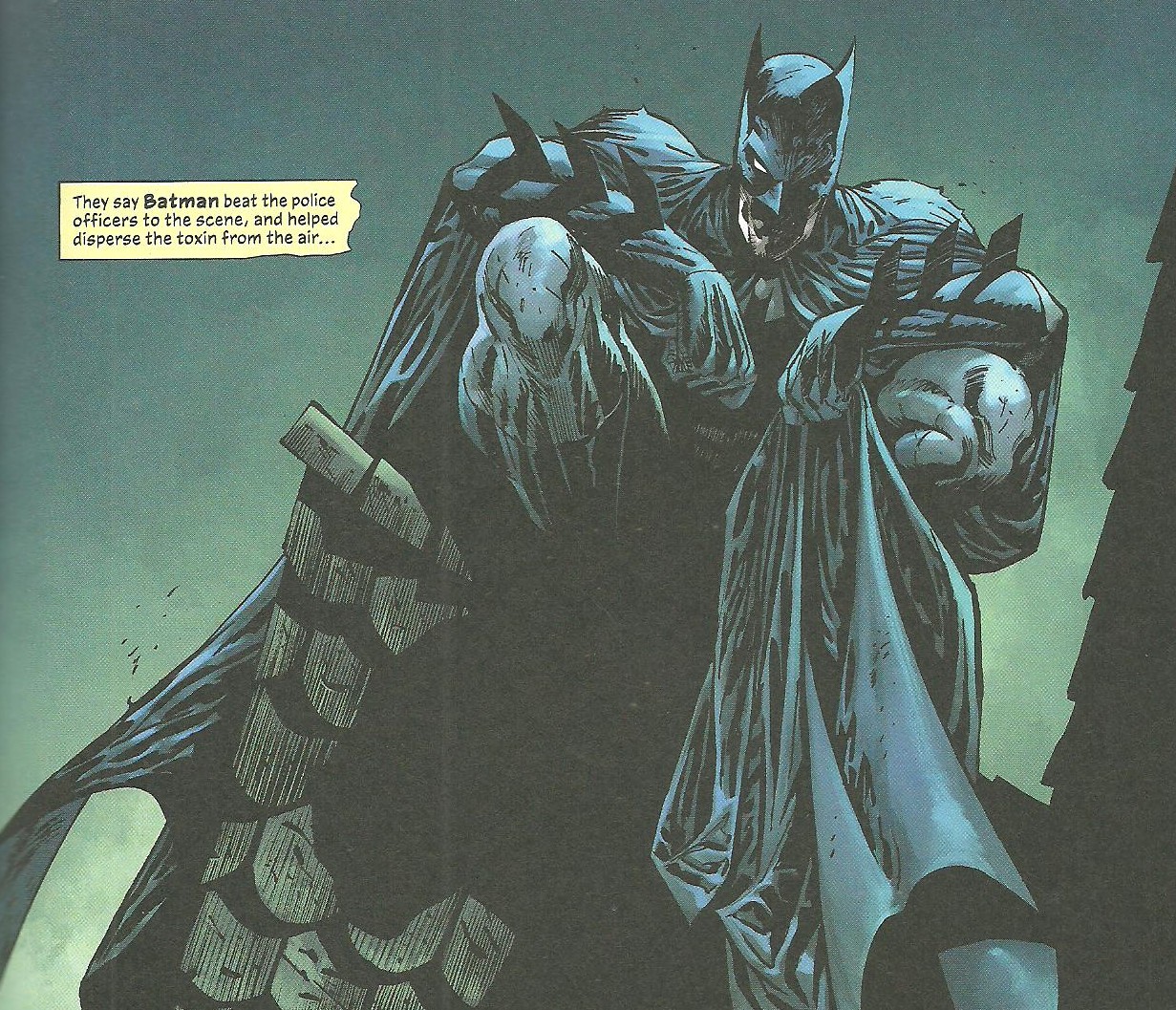
Batman doesn't appear as often as one might expect in The Joker, his appearances in the first collected volume mostly clustered around the beginning as the premise of the series is set up, but here's his first appearance in the book, crouching like a gargoyle on a bit of Gotham architecture, as is his wont. 

It's a pretty nice image of Batman doing something extremely Batman-ly, in which he looks quite causal doing it, as if it's just an everyday part of his job, which I suppose it is. March has the ability to find the right balance, I think, between Batman as a real flesh-and-blood human being and a bigger-than-life, almost cartoonish creature of the night. (Note the musculature of his legs and shoulders on the one hand, and the blank eyes, too-big cape and the bleeding-into-shadow on the other hand.) That is, in my mind at least, exactly how Batman should appear. 

3.) Look at this scary-ass Joker. Gordon's narration makes much of the fact that he basically sees The Joker every time he closes his eye, and that the character seems to haunt him. The artwork shows several examples of this, but March isn't content just to draw phantom Jokers leering at Gordon through windows or above his bed while he sleeps.

When Gordon visits the grave of his son, we're presented with this nightmare version of The Joker, with multiple limbs, faces and facial features, like the character is boiling. 

It certainly drives home the extent to which terrifying imagery has permeated Gordon's life, that such visions of The Joker are basically just background noise for him now.

4.) March draws a good Batgirl, too.
 So I've repeatedly talked about how I think Breyfogle's Batman was the ultimate version of the character, as he drew Batman as a thoroughly human, athletic figure—in peak physical condition, sure, but still recognizably human—that wore the Batman persona, as from the neck up his face was constantly transforming into angry white triangle eyes and bared teeth over a field of black, and his billowing cape forming the shape of bat-wings or an angry, jagged cloud, or trailing him like a comet. 

I haven't seen much of March's Batgirl, but he does something similar with her here, and I think his depiction of the Cassandra Cain version of the character is exactly right: A female silhouette, a too-big, billowing, expressive cape, a cartoon bat from the neck up. He even has her oversized utility-belt pouches flopping while she's in action, just as her co-creator Damion Scott used to draw her. 

5.) Here's another scary-ass Joker. Relatively late in the first volume, Gordon and other characters are caught in a blast of what The Joker calls a nerve gas, which obviously influences the way Gordon sees and experiences The Joker. 

Note the multiple visions of him in the same panel, which seems to echo the earlier vision Gordon had of him, and  how March is able to exaggerate some of the character's features in the lower panel of the page, despite how exaggerated his design for the character—and, indeed, pretty much everyone's design for the character—already is.

In this story, The Joker's right eye has been replaced with a glass eye, Harley Quinn having shot his eye out at the climax of "The Joker War" story arc, and March makes good use of it throughout as just one more weird and off-putting detail of the character's face. In theat final image, it positively bulges out like it's about to pop. 

Monday, July 19, 2021

A little more on Batman Vol. 3: Ghost Stories

I know I already discussed Batman Vol. 3: Ghost Stories in a previous post, but I had a few other things I wanted to say about it. Specifically, eleven more things. 


Guillem March
1.) This is a legitimately awesome image. 
 Pages two and three of the collection are given over to a two-page spread in which Batman and Robin swing over Gotham City, and between the panels in which writer James Tynion IV and artist Guillem March are beginning to tell their story. 

It's a pretty great image, and one which would seem to date to the time shortly after Tim Drake first became Robin but before "Knightfall", given Batman's still-blue suit. This is a time period in which Norm Breyfogle would have most likely been the artist to be drawing Batman and Robin together, and March does a pretty great early-to-mid-nineties version of the Dynamic Duo. Like Breyfogle, he has an admirable balance of realism and exaggeration in his Batman design, who is lithe and athletic here. He's also notably younger and happier looking then the bigger, bulkier, gruffer and more intimidating version of the character that March draws in the scenes set in the present. 

March just doesn't get as much credit for being as awesome of a Batman artist as he is, if you ask me. 


March
2.) I could look at pictures of Batman kicking Grifter in the face all day. For reasons I don't understand and can't even imagine, Lucius Fox has hired a bodyguard, and the bodyguard he settled on is Cole Cash, AKA Grifter from Jim Lee's early '90s super-team WildCATS (and various attempts to revive them in the decades that have followed).

Batman goes to visit Fox, but that necessitates a three-page fight scene in which Grifter tries to violently stop Batman from doing so, using his fists, knives and, ultimately, a hidden gun, which is how the confrontation ends, with Grifter apparently winning the fight. (It ends with Grifter holding a gun to Batman's forehead, at which point Fox arrives and breaks it up).

It's a credit to Tynion and March's storytelling skills that they actually made Grifter vs. Batman look like a decent fight, as it should really only take Batman about a panel to dismantle Grifter, by flipping his stupid face mask up over his eyes and punching him in the mouth, or grabbing his stupid face mask and pulling him into his fist repeatedly by it like one of those old balls on a string toys, or pulling his stupid face mask all the way down over his throat and choking him with it.

Basically, that stupid face mask looks like a real liability in a fight. And is stupid.

You know, I don't think I care for that Grifter character, which is why images of Batman kicking him in the face might prove so satisfying. 

There's also a pretty great panel in which Batman punches Grifter so hard in the stomach that he lifts him bodily off the ground a few feet.

The scene did make me want to revisit Grant Morrison and Val Semeiks' 1997 JLA/WildCATS crossover though, which I remember liking quite a bit at the time, despite not knowing/caring anything at all about the WildCATS.


March
3.) No one gives dirtier dirty looks than Batman. Check out the expression March draws on Batman as he gives a parting warning/threat to Grifter. He manages to frown and snarl at the same time, shooting daggers from his eyes that could gut someone like a fish.
 

Jorge Jimenez
4.) I'm not so sure about this Ghost-Maker character. The two most important elements of a superhero character, because they are the two most immediate elements, are their name and their costume. I don't really like either in the case of Ghost-Maker.

I've been operating under the assumption that the name "Ghost-Maker" refers to the fact that the character kills his foes, thus making ghosts. It's a dumb name, but it's dumb in a funny way, and I think it's a fine name for a character like, say, The Punisher, where there should be some remove between the reader and the goals and motivations of the character.

It seems somewhat frustrating though because so much of the character's background seems to suggest that the character's name should be The Ghost or Ghost, and I'm not entirely sure why it isn't, aside from the fact that maybe the old Dark Horse superhero (who teamed-up with Batgirl once!) has that name. 
Ryan Benjamin
See, Ghost-Maker has so hidden his identity and presence in the world that it's almost as if he doesn't exist...like a ghost! His special technology, with which he can even hide from Oracle, is called "Ghost-Net." So "Ghost" or "The Ghost" really seem like the way to go, no? 

If that's too generic, then one might consider an adjective, like The Gay Ghost or The Grim Ghost, no? Or even a color. The White Ghost is sort of a redundant name, and I understand why they went with white as the costume color, as it so sharply, visually contrasts with Batman's costume, but perhaps The Silver Ghost or The Red Ghost or The Crimson Ghost would have worked, while also allowing for a strong visual contrast (The Gray Ghost, obviously, was taken).

Then there's the costume. I don't necessarily hate it, but I'm not terribly fond of it, particularly the baggy pants and the mask, which, as I mentioned before, keeps making me think of a cartoon duck under it. I think the face is just a little busy. Something opaque and feature-less, like the original Red Hood costume (or the one that Jason Todd sported during Batman and Robin) or something reflective like Cobra Commander sometimes wore would have worked better; as is, the two little lights, the various black and white panels and the varying degrees of opacity and reflectiveness just look like too much to me. 

Although, I suppose, the busy-ness, like the color scheme, may be part of the point; his costume is as complicated and busy as Batman's is simple and iconic...? 

I liked Ghost-Maker's costume even less as I read on, as he appears in various flashbacks where earlier iterations of his costume that I actually liked quite a bit more. 

Carlo Pagulayan and Danny Miki
6.) See? The above costume is one that Ghost-Maker is wearing when he approaches young Bruce Wayne during the time the two were crisscrossing the world, seeking various masters to train under as they sought to become perfect crimefighters. During their first meeting, Ghost-Maker was wearing street clothes with the mask pictured above. This time he seems to have settled on an early version of an entire costume.

This one's not perfect, but I greatly prefer how much more simple and paired down it is. I also like the Netflix's Daredevil-esque mask more than the complicated face plate he wears in the present. 

Pagulayan and Miki
He'll appear in a later flashback wearing a slightly altered version of that costume, havin now added a hood, which adds to his ghostliness, and a pair of gloves. Of all the Ghost-Maker costumes in the book, I think I like this one the best. 


March
7.) Harley Quinn agrees with me. Ghost-Maker is a dumb name. 


March
8.) Is this the first time Guillem March has drawn Batgirl Cassandra Cain? Just curious. I think it might be, unless Cassandra appeared in Gotham City Sirens at some point. I would certainly be interested in seeing more of his version of Cassandra, given the strength of his take on Batman. Cassandra reappears later in the book, alongside her fellow Batgirl, Stephanie Brown, but she's drawn by Bengal and Pagulayan and Miki in those panels. 


March
9.) Wait, he killed how many people?
 Here is where Tynion loses me with the Clownhunter character, who is otherwise one of those creations who perfectly balances awesome with stupid to equal out as a good super-comic character. According to Ghost-Maker here, Bao has killed 24 people. 24! A full two-dozen! 

That presents a pair of problems for the character.

First, it seems like a way too high number. I mean, we see Bao kill his very first clown in the pages of this very collection, as his origin story is recounted in the quite-excellent Batman Annual #5 (written by Tynion and drawn by James Stokoe). He hits a Joker henchmen with his bat-bat (a batarang-embedded in or tied to a baseball bat), and then sets him aflame using the Molotov cocktail the clown was preparing to throw at Bao's building. 

Fine. But the other 23? That's... a lot of people for an ordinary 17-year-old with no special skills and no training or any equipment to take out in a matter of days; like, The Punisher kills criminals right and left, but he's a highly-trained and experienced jungle fighter with an arsenal so big it once had its own comic book series. Bao's sole experience at committing acts of violence against others seems to be playing fighting video games. That, and he's pretty motivated. And that's it. 

I know "realism" isn't something one should go into super-comics expecting a lot of, but, with Batman comics especially, I need them to at least not be so far-fetched that I can't convince myself to suspend my disbelief.

Secondly, that is such a high body count that it seems preposterous that Batman wouldn't bust Bao. Had he killed one, maybe a couple of Joker's followers in self-defense, that would be one thing (Although the very name "Clownhunter" implies that he's actively stalking clowns to murder). But Bao has committed 24 acts of premeditated murder. 

In this comic, in the very panels following the one posted above, Batman tells Ghost-Maker that throwing the kid in prison wouldn't help, as he would only continue to kill Joker's henchmen from the inside (and likely with the help of Blackgate prison guards), and that, besides, the kid's only 17, and was traumatized by seeing The Joker kill his parents in front of him.

None of those lines of argumentation sound much like Batman. I mean, remember when he used to give Huntress shit for being too rough with the criminals she pursued? Or how he took down Jean-Paul Valley because he was so brutal and reckless that he might, theoretically, someday kill someone? It's hard to square that Batman, the one for whom life is so sacred he refuses to ever kill unrepentant mass-murderers and monsters like The Joker or Killer Croc or whoever, with one who is willing to let Clownhunter go free after he's killed more than two-dozen people. 


March
10.) Wildcat!
I so missed the Golden Age during DC's decade or so of The New 52—when they were trying to operate under the understanding that there was no Golden Age, and superheroes "started" about five years ago when the Justice League formed—that just seeing any acknowledgement of any Golden Age heroes thrills me now. Like, I genuinely got excited to see a brief montage featuring young Bruce Wayne and various mentors, with Wildcat Ted Grant among them (as well as Zatara, in the previous panel).

Of possible note here is that Wildcat appear to be a white guy, as per usual, but in the Stargirl Spring Break Special #1, the Wildcat that appeared among the various JSA line-ups on the final splash page appeared to be a Black guy. 


???
11.) Does Ra's al Ghul know about this? At the climax of "Ghost Stories" Batman sword-fights Ghost-Maker...while shirtless. Is...he allowed to do that? I thought he only got in shirtless sword fights with Ra's al Ghul. 

Tuesday, January 12, 2021

A little more on "Their Dark Designs" (mostly just nitpicking and Kelley Jones covers)

I wrote a kinda sorta review of Batman: Their Dark Designs—kinda sorta reviews being my specialty at EDILW!in the previous post, but I had a lot more to say about it than I had room to do so in that particular format. Although I can't say I had a lot more of any real worth to say about it, as I mostly just noticed a lot of allusions to '90s Batman comics and some buggy continuity. But I thought I'd put it all down in a separate post because why not? If you have a copy of the collection handy, feel free to follow along...!


Tony S. Daniel and Danny Miki
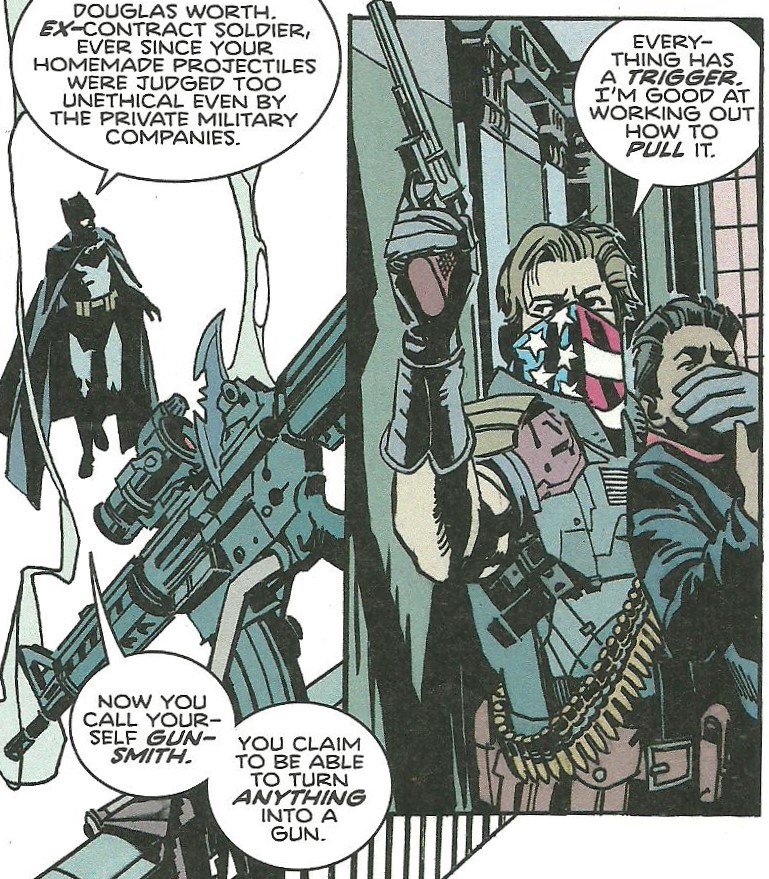
1.) Gunsmith, not Gunhawk. When I first saw the above panel, I assumed that Chuck Dixon and Graham Nolan's gun-toting villain with an American flag bandana had gotten a more menacing design update by artist Tony S. Daniel, but this is, in fact, Gunsmith, not Gunhawk, the villain I was thinking of.

Gunhawk was an original creation of the Dixon/Nolan team, and he first appeared in 1994's Detective Comics #674, during Jean-Paul Valley's brief stint as Batman. Gunhawk's costume was sort of mess, pairing green and black spandex with a target-like icon suggestive of Deadshot's, a visor like Cyclops' and, most memorably for me, an American flag bandana worn over his head. He had a partner/girlfriend named—sigh—Gunbunny.

Kelley Jones
As minor a character as he is, you may have run into him lately, as I have. He returned in 'Tec #708-#710, "The Death Lottery," a story arc that was recently collected in Batman: Knight Out (reviewed in the previous post). He also appeared during Dixon and Nolan's 2017 maxiseries Bane: Conquest

Gunsmith appeared for the first time in Batman #85, making him one of several original characters that writer James Tynion IV and company introduce in "Their Dark Designs" (along with Mr. Teeth, The Underbroker and, of course, The Designer).

Like Gunhawk, Gunsmith seems to be another generic-ish mercenary, a former member of the U.S. military turned killer-for-hire. But Batman Secret Files #3, collected in Batman: Their Dark Designs, features an eight-page story by writer Dan Watters and artist John Paul Leon that fleshes the character out a bit.
John Paul Leon
It doesn't take up much space, all of two panels, but that there's enough to make the character into an individual character with a gimmick of sorts, and that's enough to make him a decent Batman villain. And a better one than Gunhawk, I would say, but 'hawk still has more appearances to his name. I guess we'll see if any other creators choose to use Gunsmith, or if Tynion himself chooses to return to him. Certainly the character's association with guns, not just the fact that he uses them but that he likes, thinks and talks about them so much, makes him an interesting foil for Batman. At least he was for those eight pages of Batman Secret Files #3


Daniel and Miki
2.) "The movie is insane and so epic and is probably rated R...There's one scene where Batman drops an F-Bomb." The above panel follows five panels in which Deathstroke and Batman fight, the former talking the entire time. Since Tynion wrote a grawlix, we can assume that Batman did not say "Shut the hell up and fight me," as "hell" and "damn" are the swear words Batman uses the most often, and are A-OK to print in DC's DC Universe, Rated T-for-Teen comics. "Shut the hell up and fight me" is the most natural-sounding thing Batman could say in that panel, by the way.

No, since it's a grawlix, it has to be a stronger word than "hell" or "damn" (not that "Shut the damn up and fight me" makes sense anyway). And since "Shut the shit up" doesn't make sense, I guess we can only assume that Batman said "Shut the fuck up and fight me," which, damn, that doesn't sound like something Batman would say, does it...? 


Daniel and Miki
3.) Imagine watching The Lego Batman Movie and thinking that is the one thing from it that the Batman comics could use more of.
 Early in the story arc, Batman calls Lucius Fox, who is hard-at-work in subbasement 13 of "The Wayne Enterprises Tricorner Yards Campus," known as "The Hibernaculum," and the two have a very exposition-y discussion about this new "autonomous factory floor, capable of printing and assembling machine parts at short notice," and the new vehicle Batman asked him to build there this morning.

We see the bowels of the new vehicle under construction, and an ominous bat shape that Fox calls "a bit terrifying," but there's a bit of suspense as to what it actually is. Fox provides some clues during the conversation, when Batman asks if it will do what he needs it to: "It'll run easy enough... It'll be able to scuttle up walls, pounce and track your targets." 

That's right, it will scuttle.

Batman refers to the in-progress vehicle as "The Nightclimber,"  but it's pretty obvious that Tynion, Daniel and company are just introducing The Lego Batman Movie's Scuttler into the DCU for some reason.* 

We only see it in action briefly near the climax of Batman #85, the first chapter of the arc, as it scuttles up the side of a building in a sequence that echoes Batman climbing atop a building earlier in the issue, and it then transforms into a bat-plane and takes off; it will spend the rest of the arc in this bat-plane mode. There are a couple of story reasons why a new vehicle is introduced, including demonstrating Batman's abilities as a designer who is always creating new things, to illustrate the role faith plays in his mission, and to give him something to collaborate with Fox on, but the main reason seems to be that Tynion thought The Scuttler was pretty cool. He just didn't like the name. 


Guillem March
4.) For someone who doesn't like to kill, Batman sure seems to have attempted to kill that lady. Batman is famous for his refusal to ever kill a foe, no matter how terrible a monster that foe might be, no matter how many innocent lives might be saved if he decides to take one guilty life. The rationales will shift as regularly as the context, but the existence of that line Batman never crosses is a constant (At least in the comics and most mass-media extrapolations, the first cycle of Batman films being outliers in the fact that Batman does kill in those). 

It seems to me, though, that what really keeps Batman from killing people is luck as much as anything else. I mean, he's a big guy, he's decked out head-to-toe in body armor, and dude is always dropping on top of people, flying kicking them, throwing them around, punching them with his gauntlets, throwing pieces of sharp metal at their heads...statistically speaking, it seems like Batman would almost have to accidentally break someone's neck or fracture a skull every couple of months, you know?

This arc contains a particularly egregious example, in which the only thing that spares his opponent would seem to be that the writer decided she she shouldn't die from her injuries. 

Batman gives chase to the assassin Cheshire on some sort of crazy urban luge that he ejects out of  The Scuttler Nightclimber, rides down the sheer face of a sky scraper and than pilots along the city streets, pursuing her motorcycle. She eventually decides to backflip off of her bike, land high-heels first onto his chest and stick  her poison-tipped finger nails into the sides of his face. 

When she asks if he has any last words, he replies, "Brace yourself," and steers her directly into an oncoming semi.

The assassin survives being hit by a truck that had to be driving at least 35 miles an hour one way, while she sped at it spine-first at God-knows-how-many-miles an hour the Bat-Street Luge travels. It doesn't even knock her out! She's scuffed up pretty good, and is bleeding from the nose and mouth after getting hit by a truck, but she's still talking to Batman afterwards. 

That Cheshire is one tough broad, apparently. 


March
5.) I confess to loving the "Penguin going to war" imagery. Seemingly the first of the villains to recognize what's going on, The Penguin decides to act immediately, stuffing a whole bunch of deadly truck umbrellas into what I imagine is something between a golf bag and a wearable umbrella stand. 

The character has so long been portrayed as a more-or-less legitimate business man style realistic gangster, one who poses as a nightclub owner while committing more mundane crimes like arms-dealing, blackmail and gun-running, as opposed to the sorts of spectacular terrorist attacks that the various Arkham inmate villains so regularly engage in (or the bird-themed crime that he used to engage in so regularly before the 1990s). 

I think that makes The Penguin one of the more interesting of the main Batman villains, and I personally find him a bit more fascinating than others in that he's one of the oldest and greatest Batman villains, but, if we can assign the fictional character motivations of his own, he seems to have intentionally chosen to be a B-grade villain and just settle for making a lot of money, rather than destroying Gotham City, killing Batman or ruling the world like The Joker, Ra's Al Ghul, Bane, Two-Face, The Scarecrow and even The Riddler (who's had an interesting career path over the last 30 years, having both retired and gone straight). 

In fact, it's so him to do any sort of "hands-on" villainy that when he does engage in it, it can be presented as something of an occasion. I'm thinking of Doug Moench, Kelley Jones and John Beatty's 1997 Batman #548 and #549, for example, or the point in Batman Eternal where he decides to take fighting a rival into his own hands, regardless of legal peril it puts him in. 
Jones
Anyway, March's imagery of a Penguin with an entire arsenal of gimmick umbrellas strapped on his back, attacking and kidnapping a team of the world's deadliest assassins lead by Deathstroke, The Terminator is at once awesome and ridiculous, and manages to show the character in a particularly bad-ass light.

I like The Penguin that is too clever to do crazy shit all the time and has to plea insanity to stay out of the electric chair or keep a needle out of his arm (or however they perform capital punishment in whatever state Gotham City is in), but I also like that he's not afraid to pick up a bumbershooter and mix it up with the likes of Batman or Deathstroke every once in a great while. 


Jorge Jimenez
6.) Honestly, I expected a guy calling himself The Designer to be better designed. It's not that the Designer's costume is terrible, really, it's just kind of all-over-the-place in terms of theme, giving him a sort of incoherent fashion sense. His boots and beaded necklaces say "pirate," his camouflage pants say "modern soldier", his fur-lined cape says "aristocrat", his military medals say "dictator cosplay"...he's got a big, medieval-looking sword, shoulder pads that wouldn't look out of place on a football field or an Image Comics cover from 1993, and his face is concealed by a feature-less mask, baring only the fancy "D" for Designer.

It...almost kinda sorta works, but it seems a bit much, and I think there's too much tension between the mask and the clothes, what the character does (design crimes) and what he looks like (a modern riff on Marvel's Baron Zemo). Much of his costume looks like what one might expect The General to wear when he grew up. 

Now, I'm not sure what the character should look like, as he's presented as something of a cypher character, an archetype with no real personality, history or weight. He's a villain we know nothing about who fights a hero we know nothing about, a character who enters this narrative as a sort of urban legend-come-to-life, a bogeyman character that Gotham's villains swap stories about, and he is here mainly to design a perfect crime spree involving four of Batman's greatest villains. 

In that regard, perhaps the military accessories make sense, to the extent that "military" evokes "strategy", but  I don't know, it just felt a bit messy to me. And again, the dude's name is "The Designer"; I know he designs crimes not costumes, but I really expect a villain with a name like that to be one of the better-dressed villains, you know...? 


Jimenez
7.) Catwoman is wearing the wrong costume, but she's wearing the wrong costume consistently.
I know that continuity has gone out the window, but that doesn't mean it can't still bug me when it's wrong! When we flash back to the meeting between The Designer and the four villains that made up "Underworld United" in the 1966 Batman movie (and yes, Tynion does drop that name to refer to the quartet collectively at one point), the time period is what would have been sometime during or shortly after Year Three, given the fact that Batman was working with Robin at that point. At least, that was when Robin debuted in the post-Crisis, pre-Flashpoint timeline. Post-Flashpoint, Robin Dick Grayson started working with Batman almost immediately, probably during his first year (remember, the entirety of Dick, Jason and Tim's tenures as Robins were all supposedly set during a single five-year period on the New 52's hyper-compressed timeline). 

Dick is shown wearing  his New 52 Robin costume, which would seem to orient this post-Flashpoint, during the New 52 timeline...which Death Metal and its various continuity rejiggering follow-ups seems to be radically revising anyway (The artists should probably not commit to a particular Robin costume then, but simply dray him in silhouette with an "R" symbol, to keep the imagery canonical as DC's history shifts so much around stories like this).  

While The Joker, Riddler and Penguin costumes are all more-or-less timeless, being basically just suits you could have customized by any Gotham tailor with sufficiently colorful fabric on  hand, Catwoman is wearing the purple costume she wore during the first volume of her own ongoing series, launched in 1993. So she's outfitted as she would have been around Year Nine or Year Ten of the pre-Flashpoint timeline (If this were set around Year Three of that timeline, she should be wearing a costume similar to that in Batman: The Long Halloween or Dark Victory).

However, in the (terrible) "War of Jokes and Riddles" story arc of Tom King's Batman run, also set closer to The New 52's Year One, Catwoman was similarly attired, so while her early '90s costume will evoke a relatively late period in Batman history to anyone whose been reading these dang things or a couple of decades (and/or keeps up with the trades), it seems that at least she's been wearing the wrong costume consistently, and that is her post-Flashpoint "Year One" costume. (And I have to assume this story is catering to readers who have been reading Batman comics for a few decades, otherwise Tynion's allusions would be more like appropriations.)

Just as it might have been better not to draw Robin with a costume marrying the panel to a particular continuity if things are in the process of shifting, maybe they should have given Catwoman either a brand-new costume (she does change costumes a lot), or some sort of hybrid one, like the won she wore in Batman/Catwoman: Trail of The Gun**, which fused her early, gray color scheme and her '80s costume's tail with the basic design of the purple '90s costume 


March
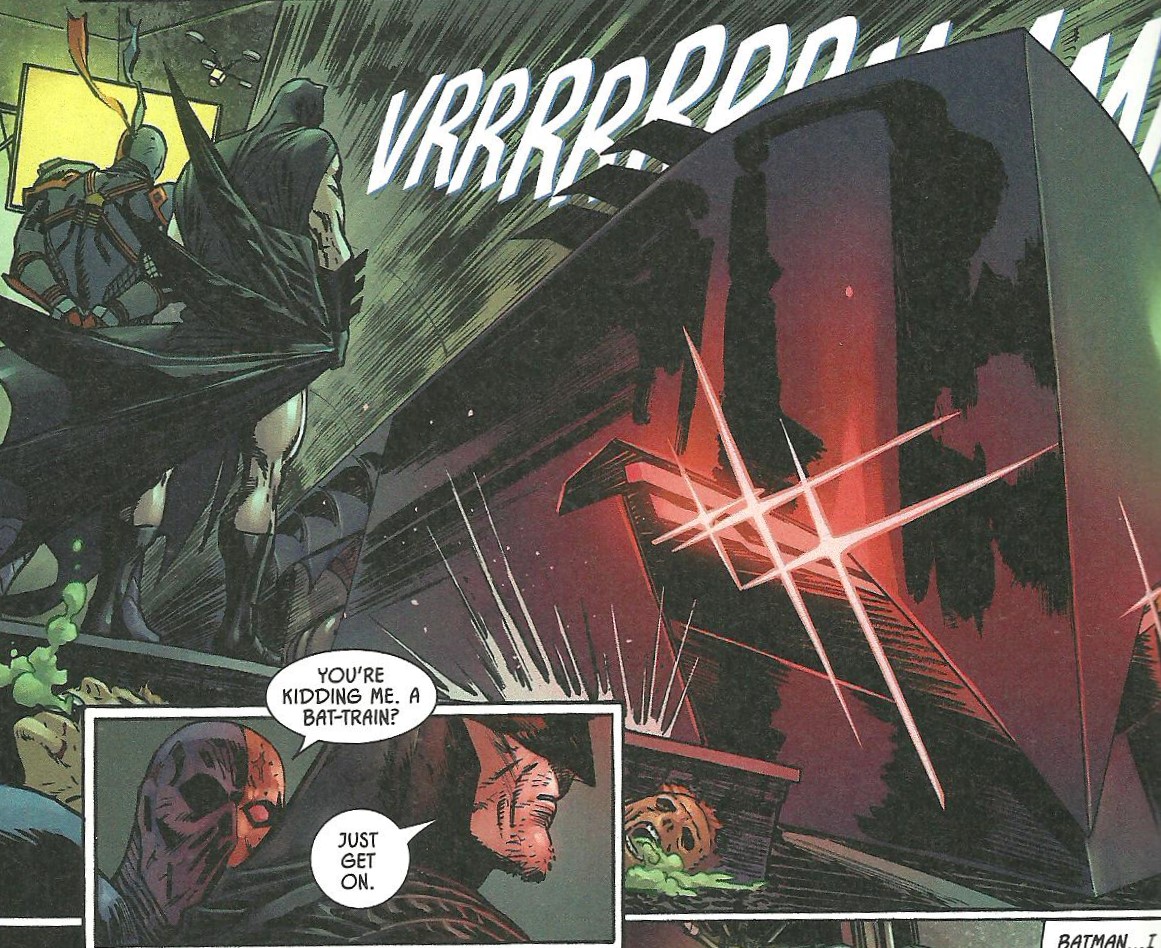
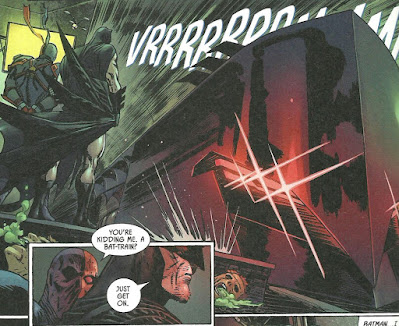
8.) I sincerely hope Tynion buys all of Dixon's drinks at comics conventions. Late in the arc, Batman is fighting Deathstroke atop the Nightclimber and they fall off into the street, just as The Riddler is launching his Designer-designed attack. Batman orders Deathstroke down the nearest subway station, when up pulls...The Bat-Train!

Like most of the new vehicles and gadgets that appear in this arc, the Bat-Train, as Deathstroke calls it, doesn't get much panel-time, and we only see one real exterior shot of it and one interior shot, as the pair take it to The Riddler's location. 

This isn't the first time Batman has had his own special form of rail travel, of course. 1993's Detective Comics #667, by Chuck Dixon and Graham Nolan, introduced the Bat-Subway Rocket. The invention of Harold, it was basically a rail-mounted Batmobile that was meant to take the Dark Knight directly into the city from the Batcave, using abandoned subway lines and rocket engines.
Jones didn't put it on the cover, but I'm gonna post his cover anyway. 
Bruce Wayne suffered his career-ending injury at the hands of Bane before ride the Subway rocket, but both Jean-Paul Valley and Dick Grayson made use of it during their short stints as temporary, replacement Batmen. (It would have been an ideal way for Teen Wonder Tim Drake to get into town without having to ask Alfred for rides, but Dixon gave the 15-year-old an early driver's license, since his father's paralysis meant he was needed to drive him around, so Tim used his own Robinmobile, The Redbird, instead of the Rocket.)

As for the Bat-Train, it is bigger, scarier and more intimidating than the blue Subway Rocket, although it's not entirely clear why Batman would need a train-sized form of rail conveyance, rather than the Batmobile-sized Rocket. I guess he's got so many sidekicks and partners now, the Bat-Train would be a good way to get them all from the Batcave to the city...


March
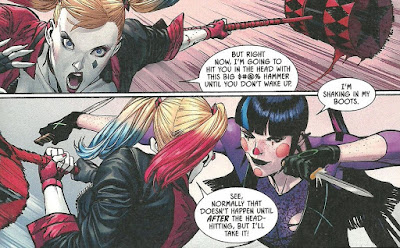
8.) I would think "big-ass" or "big fucking" would be more appropriate ways to refer to that hammer. Instead, based on the number of characters in the grawlix, I can only assume that what Harley says in this panel is "But right now, I'm going to hit you in the head with this big fuck hammer until you wake up," and man, that doesn't sound right....

March
9.) But back to continuity...
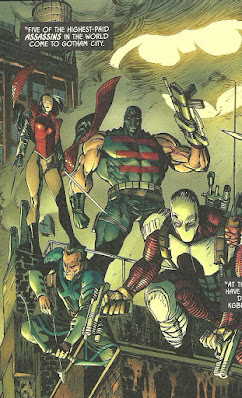
When Batman finally confronts The Designer, he explains what he deduced about his plan. When it comes to the part about "five of the highest-paid assassins in the world" coming to town, Batman notes they would have been different assassins at the time. One of them would have been The KGBeast, ho is pictured with his gun-hand. Of course, back then, when Dick was still Robin, Batman had yet to fight KGBeast, who appeared in 1988's "Ten Nights Of The Beast," well after Dick had become Nightwing and Jason Todd and been killed, but shortly before Tim began training to be Robin and...aw, DC doesn't care about continuity, why do I...?


*That reason being that he liked it a whole lot, I guess. The same reason I assume Tom King is writing The Phantasm character from Mask of The Phantasm into the DCU in the pages of his Batman/Catwoman series. And the same reason that if 17-year-old Caleb were writing a Teen Titans revival in 1994, he would have included  Alan Grant and Vince Giarrano's The Human Flea from Shadow of The Bat #11-12 on the line-up along with Robin, Superboy, The Ray, Damage and Anima. 🤷


**If you haven't read Trail of The Gun, don't worry about it. I remember liking it okay, but now I can't remember any details at all, so it didn't exactly make a lasting impression. It was drawn by Ethan Van Sciver though, so you definitely don't want to expose yourself to that guy's work.

Sunday, December 20, 2020

Before taking over Detective Comics...

Before taking over Detective Comics in 2021, Mariko Tamaki wrote prose novels Cover Me, Fake ID and Saving Montgomery Sole and four Lumberjanes prose novel spin-offs; wrote original graphic novels for mainstream audiences Skim (Groundwood Books; 2008), This One Summer (First Second; 2014) and Laura Dean Keeps Breaking Up With Me (First Second; 2019); wrote comics miniseries Supergirl: Being Super and original graphic novels Emiko Superstar and  Harley Quinn: Breaking Glass for DC Comics; wrote ongoing series X-23 and Hulk and mini-series Spider-Man & Venom: Double Trouble for Marvel Comics. Her other comics credits have included Teenage Mutant Ninja Turtles: Casey and April, Tomb Raider, Wonder Woman and Archie and Katy Keene, among others. 

Before taking over Detective Comics in 2016, James Tynion IV wrote fill-in issues, arcs and annuals of Batman during Scott Sndyer's run on the title; wrote a short-lived Talon ongoing series spinning-out of Snyder's "Court of Owls" Batman arc, co-wrote Batman Eternal and Batman and Robin Eternal with Scott Snyder and others, wrote a 13-issue run on John Constatine: Hellblazer and had a short run on Red Hood and The Outlaws, all for DC Comics. His other comics writing credits prior to his Detective run included two X-Men-related issues for Marvel,  a short story in a 2014 IDW horror anthology and two comics for publisher Thrillbent.

Thursday, September 12, 2019

Is it just me, or does it seem like the DC Universe has gotten kind of...small?

Ever since the closing pages of Dark Nights: Metal, writer Scott Snyder and his frequent co-writer James Tynion IV have been telling a very big story in the pages of the miniseries No Justice and the ongoing Justice League, which is already on issue #31 or so, thanks to the twice-monthly publishing schedule.

The storyand it has essentially been just one storyhas encompassed all of existence, stretching as far back as before the beginning of time, and involving an entire multiverse of multiverses. Part of Jack Kirby's Source Wall broke, unmooring the local multiverse, and releasing Perpetua, a mother of the god-like Monitor, Anti-Monitor and World Forger (the last of whom is a new addition to DC's cosmology).

We're told that in the creation before this creation, Perpetua has made another reality, but her sons rebelled against her and made this existence instead. Now Lex Luthor and his Legion of Doom have taken up fighting for Perpetua and the forces of the abstract concept of doom, warring against the Justice League who, of course, are fighting for the abstract concept of justice. During the course of their battles, the DC Universe seems to be in a slow-boiling process of being remade once again, presumably ultimately undoing the last grand remaking, 2011's Flashpoint, which gave us the current New 52 version of the shared DC Universe setting (which, of course, encompasses not just a single universe, but a multiverse...or multiverses).

The Justice League itself isn't too terribly big at the moment. The core team consists of 9-13 characters, depending on whether or not you want to count Jarro and very recent additions like The World Forger, The Monitor and Shane (that's Martian Manhunter and Hawkgirl's son from a now non-existent future). There are also two ancillary teams, the ones that star in Justice League Odyssey and Justice League Dark; the former never appear in the pages of Justice League, the latter fill up crowd scenes and appear in the backgrounds in the Hall of Justice.

As the now years-long storyline reaches what appears to be a climax in the current "Justice/Doom War" story arc, much has been made of the Justice League recruiting "everyone," an entire army consisting of every available hero. Meanwhile, Luthor has been doing the same with the villains, part of the "Year of The Villain" storyline/branding event in which a newly reborn Luthor approaches various villains with transformative gifts that make them more powerful than ever.

The above page is the sixth page from Justice League #30, by Snyder, Tynion and artist Jorge Jimenez. After Starman has briefed the assembled heroes on what is going to happen in the upcoming Legion/League warthe League is all killed, but not as brutally as one might expect from a modern DC comicthe core League gives the assembled heroes a kinda sorta pep talk about their plan to stave off their seemingly fated defeat.

Here's the thing though. For an image of all of DC's superheroes assembled as a sort of Justice army, the page seemed kind of...small to me.

Part of that might be because Snyder and Tynion have already revealed this particular beat to readers a few times. They Tynion-written portion of DC's Year of The Villain Special #1 featured a two-page spread in which Francs Manapul draws pretty  much the exact same group of heroes, and Justice League #26 featured a sequence in which Hawkgirl and Mera walked around the Hall, checking in on these recruits as they prepped for the war.

But there just don't seem to be very many superheroes here. There are some members of Justice League Dark (Zatanna, Man-Bat, Swamp Thing and his beard), some Teen Titans (Robin, Red Arrow, Kid Flash), some non-teen Titans (Donna Troy, Kyle Rayner, Raven, Beast Boy, Steel, Miss Martian), The Terriffics (Mister Terrific, Plastic Man, Metamorpho and Phantom Girl), a random handful of various heroes appearing in comics throughout the current DC line (Batgirl, Supergirl, Captain Marvel "Shazam," Hawkman, Black Lightning, Jericho) and another, smaller handful of book-less characters (Firestorm, Animal Man, Ted Kord, Simon Baz, Guy Gardner) and that's it. All together, that's only between 25-30 supeheroes one can identify in the image, plus a bunch of indistinguishable blobs in the background and, remember, another nine or ten heroes off-panel on a sort of stage giving a presentation.

As someone who can just barely hold a pencil, I certainly am in no position to blame Jiminez for not filling the page with more heroes, and getting everyone in the latest edition of those encyclopedias of characters DC publishes into that panel, but I was really struck by how small it made the DC Universe of the moment seem.

I mean, I'm pretty sure you could get 30 superheroes if you took all the active members of the teams during the early '90s, when there were three Leagues with their own titles (America, Europe/International and Task Force). Or had they used the "everyone who was ever a Leaguer" rubric of the reserves evidenced in Mark Millar's JLA #27 from 1997. Hell, I bet if Batman called up all of his sidekicks, allies and affiliated teamsThe Outsiders, Birds of Prey and Batman, Inc/The Club of Heroeshe alone could have filled that room to bursting.

Now, I know there are a lot more DC heroes out there, and that they're probably not available to appear in this story for their own story reasons. Noticeably absent, for example, is supposedly active Justice Leaguer Cyborg, and his entire Odyssey team (presumably because they are off in space doing space stuff; they haven't appeared in the series since the earliest issues). That's probably why Hal Jordan and Adam Strange and a few others aren't there, as well. Tim Drake and the Young Justice team are all MIA, probably because they're still out-of-universe doing whatever they're doing in the pages of Young Justice. I haven't read Heroes In Crisis yet, but I assume if Ted Kord is elbowing Guy Gardner instead of Booster Gold, that means he's dead-ish, or at least lost in time? Same with The Flash Wally West...?

But where are The Metal Men? Or the rest of The Shazam Family? What of all those Dark Matter/New Age of Heroes heroes...did none of them stick around after ignominious cancellation of their titles? Is it notable that Arsenal isn't there, or that Nightwing or Batwoman or Huntress aren't? Does Red Tornado exist anymore, and/or is he currently alive? Elongated Man? Fire and Ice? Hawk and Dove? Blue Devil? The other Steel, John Henry Irons? Vibe? Frankenstein? O.M.A.C.? Any Doctor Fates around anymore? No more Power Girls? Are we totally done with Wildstorm characters existing in the DCU, even Midnighter and Apollo? What about new characters introduced in the wake of Flashpoint, like Skitter and Bunker and Talon and those guys with weird names in Stormwatch...?

The longer I lingered on this image, the more I realized that the DCU got awfully small after Flashpoint. Not only did it wipe out the JSA and their fellow Golden Agers, and the various future heroes (although both the JSA and Legion of Super-Heroes are on their way back, of course; the former appearing on the last page of this very issue), but the reboot lead to the de-creation of huge swathes of heroes and other characters, many of whom would of course be recreated, but even many of those exist in weird liminal states, where they seem to have been re-rebooted or re-recreated since their initial New 52 reintroductions (like Black Lightning, for example) and others I know have appeared in some form, but lost track of.

And then, of course, there are heroes I know DC has reintroduced in new forms since The New 52 effort and the other branding exercises that followed it, but those characters apparently failed to catch on...and failed so badly they apparently can't even fill in crowd scenes like this (I'm thinking here of the new Ragman, or The Ray, or The Human Bomb or National Comics' Rose and Thorn, Eternity, Madame X and Looker;  I'm sure there are more).

Honestly, I'd have trouble filling a room with DC superheroes that I know have both been re-introduced since Flashpoint and haven't been killed or otherwise jettisoned from usage in an event story like this. Of course, this could very likely be just me, as I am not following the Wednesday by Wednesday exploits of DC's stables of heroes as closely as I used to, and therefore I've lost track of pretty much all of the heroes not appearing in Justice League or the Batman titles.

So maybe the DC Universe hasn't gotten small, it just feels small to me. I don't know; I'd be interested in hearing the opinions of others on the matter.

A few pages later in the very same issue, we see an echo of this page, when Luthor gestures towards his newly recruited Legion of Doom, consisting of about 25 villains, only about 15 of whom I can name...although these are mostly redesigned, presumably because of the gifts they accepted from Luthor.

The Legion has been awfully small since the start of the series, originally consisting of just six villains, the archenemies of each of the "Big Seven" Leaguers, minus Martian Manhunter. They've since lost two and gained one, so the League has always outnumbered the Legion (The original Legion, the one from Challenge of The Super-Friends, boasted 13 members; the most appropriate number for a group of villains).

They too seems like a rather small number of bad guys, especially when contrasted with the all-the-bad-guys-teamed-up premise of Forever Evil, but that image didn't make me reflect upon the possible contraction of the DC Universe in quite the same way, as for almost every successful superhero, there are always going to be dozens of bad guys. I mean, you could fill up a splash page with Green Lantern, Aquaman or Wonder Woman villains, let alone Batman, The Flash and Superman, who boast incredibly large rogues galleries.

Friday, May 11, 2018

Comic Shop Comics: May 9th

Justice League: No Justice #1 (DC Comics) It can be difficult to experience a new comic book in a vacuum, without going into it with thoughts, guesses and opinions based not only on what knows about the characters and creators, but also what one has been seeing for months in solicitations or online discussion. For me, it's impossible, even as I pay less and less attention to comics "news" sites. So I've been thinking about this weird-looking weekly miniseries for awhile now, which seemed premised as a sort of Most-Star Squadron, with members of the Justice Leagues teaming with members of the Teen Titans and some villains and other heroes to form color-coded squads with weird names like "Team Mystery" and "Team Wonder."

The short preview story that appeared in last week's DC Nation #0 was so in medias res that it didn't little to clear anything up, just showing those teams in action as they battled their way across Brainiac's homeworld of Colu that it didn't really reveal anything other than what was in the solicitations (except, perhaps, how artist Jorge Jimenez would be drawing some of the characters appearing in the upcoming Justice League relaunch).

Well now we get some clarity, as the event actually kicks-off. It is being co-written by Scott Snyder, James Tynion and Joshua Williamson. Snyder is to be expected, as he wrote Dark Nights: Metal, which was essentially a Batman-centric Justice League story, and was slated to be writing Justice League upon relaunch (Which excited me to no end, as Metal was one of the best League stories since at least the post-Flashpoint reboot). As for Tynion and Williamson, the former of whom co-writes with Snyder a lot and the latter of whom wrote Justice League Vs. Suicide Squad, their presence made a lot more sense upon the announcement of two new Justice League series, Justice League Dark by Tynion and Justice League Odyssey by Williamson. The artist for this issue, and the whole series, is Francis Manapul, who previously drew parts of Geoff Johns' climactic "Darkseid War," and classed the joint up considerably when he did so.

The book opens with the Green Lantern Corps gathering around the Source Wall, with Hal, John, Guy and Kyle in the center, and all but Kyle getting a few lines. Interestingly, Guy and John both seem to blame Hal and, as Guy puts it, "your friends on the Justice League" for breaking the wall at the end of Metal. Indeed, Metal's epilogue set up the upcoming Justice League by positing that with the Source Wall broken, things from the other side could no access and threaten the DC Universe, and it would be up to the League to stop those new threats (I found Kyle's silence, which isn't dwelt upon, interesting as well. I may be misremembering, as I haven't read Green Lantern or any Lantern books with any regularity since Johns left the franchise, but didn't one of the books contain a storyline in which Kyle was able to travel to the other side of the Source Wall and come back...? Something that was always thought to be impossible-ish...?)

Next is a neat two-page spread of 21 tight panels, jumping from three different battles to Amanda Waller in front of red computer screens flashing "Crisis Alert." It appears that Brainiac has launched simultaneous attacks on all four--are there really just the four now?--of DC's super-teams, The Suicide Squad, The Titans, The Teen Titans and, of course, The Justice League (but not Batman's "of America" team, which is apparently already out of business, even though two of its non-Batman members show up on two of the Teams). Brainiac "wins" within a matter of pages, and various characters awake in his spaceship, all of them now dressed in different versions of their regular costumes (I was, as I've said, disappointed; the costumes are essentially similar to their original ones, just with more lines in unusual places, a few light-up discs attached and the tint of their coloration skewed weirdly; personally, I think I might have preferred these temporary costumes be differently-colored versions of their regular costumes. For example, if Cyborg's redesign was consistent throughout the others. But whatever...I am assuming I'll get used to these in a few more pages, and then everyone will go back to their old costumes by the fourth issue).

The seemingly random nature of the assembled characters is at least explained in-story: Brainiac realizes the potential of Earth's superheroes, but he thinks they "waste it in comfortable formations" based on bonds their "fragile emotions" have engendered among them. So he defeated all the world's defenders to a) prove his point and b) abduct the heroes he needs. He has then formed them into the teams that make victory against the new threat most probable.

As an aside here, it's fun to think of who he plucked and from where. Most of the current Justice League's line-up was taken, while Aquaman was the only one left on Earth (The League's Lanterns, Simon Baz and Jessica Cruz, weren't present in the fight with Brainiac, nor at the Source Wall with the GLC). From the Teen Titans, he took Robin, Beast Boy, Raven and Starfire; again, most of the line-up. From the Suicide Squad he took only Harley Quinn. And from The Titans, the grown-up sidekicks plus Omen, he took...no one. Huh. I guess he beat them all up just for fun. Then there are all the random characters: Martian Manhunter, Zatanna, Doctor Fate (although I don't know which one, there have been three or four since Flashpoint), Lobo, The Demon Etrigan and The Atom (Choi, it looks like). And then the villains: Lex Luthor, Deathstroke, Sinestro and, most randomly, Starro, fresh from his star (fish) turn in Metal.

In the real world, it will be interesting to see the rationale for these characters as the stories develop. Certainly some are likely just there for fun (Starro) or their popularity (Harley, maybe Deathstroke), and others to the ground work for the upcoming League line-ups, but a lot of the above characters do not appear to be on the new League line-ups (For example, one might expect to see Fate or Etrigan on Justice League Dark after this series, but only Wonder Woman and Zatanna from this event are). Further, the solicitation for the fourth issue mentions that "some heroes will be lost forever," so I suppose it's quite possible that some of these folks are here to act as cannon fodder.

As for what Brainiac needs them for, and why he's re-dressed them all, it appears that the hole in the Source Wall allowed Marvel's Celestials The Millennium Giants The Omega Titans to enter the universe, where they will begin eating planets Galactus style, deciding which of them gets to eat which planet based by the dominant fundamental force in that planet: Entropy, Mystery, Wisdom and Wonder. Brainiac's plan to abduct a bunch of super-people, break them into ideal teams, outfit them with nodes that imbue them with the appropriate energy to match the four forces of the four planet-eaters and thwart them; to ensure the Justice League's cooperation, he set it up so that Earth will be the Galactuses next stop if they eat Colu.

It seems like a decent plan but it all goes to hell in time for the cliffhanger ending, as a scene from Justice League Vs. Suicide Squad comes into play and Brainiac is unexpectedly removed from the equation.

By banding all these diverse characters together (and by diverse I mean from various places; there are three times green-skinned people as there are brown-skinned people among the assembled characters, and as many orange-skinned, pink-skinned or giant, psychic starfish as there are Earthlings of color), this issue has the feel of an crisis-style event comic, with characters from different corners of the DCU all bumping into one another (sometimes literally), arguing and discussing their pasts and futures, together and apart.

So there's a lot of exciting stuff going on here, perhaps particularly for DC Comics fans--I've no idea what this reads like to someone not already soaking in the DCU--and the artwork is perfect. I could ask for more--better costume design, a more representative cast--but I'm satisfied with what I got, and am looking forward to the rest of the month.