Showing posts with label armchair editing. Show all posts

Sunday, May 22, 2011

Warning: I'm going to talk at very great length about the next Justice League line-up

A few weeks ago, DC’s year-long bi-weekly series Brightest Day, which brought long-time Justice Leaguers Aquaman, Martian Manhunter, Hawkman and Firestorm back from the dead and gave them slight redesigns and adjusted status quos, came to a close with its 24th and final issue.

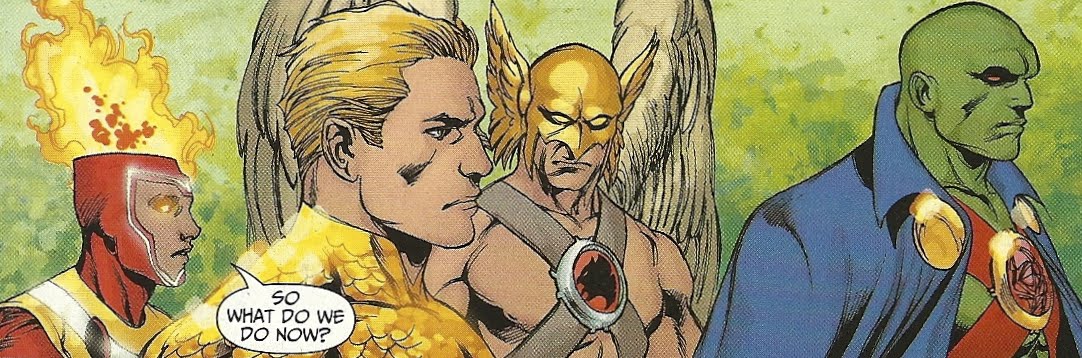
Around the same time, DC’s other year-long bi-weekly series, Justice League: Generation Lost also came to an end—it also tweaked some former Justice Leaguers’ costumes, powers and origins, and gave them a new status quo (see the very last panel of the series, above).

Meanwhile, Superman’s year-long exile in outer space doing New Krypton stuff and his seems-like-ten-years-long walk around America, a story arc so dull the guy who thought of it checked out halfway through to do more interesting things, is coming to a close, and DC’s letting Superman star in Action Comics again for the first time since 2009.

And Wonder Woman is similarly coming to the end of her J. Michael Straczynski-driven unavailability, and Batman Bruce Wayne has, of course, been alive and returned to the mainstream, present-day DC Universe for quite some time now.

So what’s up with the Justice League of America right now?

The team’s current monthly comic is up to its 56th issue, although during those past 56 issues the roster never really seemed to settle down to something stable for more than an arc or two. After a rough start, writer James Robinson and DC finally have seemed to be able to stabilize the team, using a roster consisting mainly of younger and mostly female versions of the classic Big Seven line-up plus a few Robinson favorites.

It’s a decent line-up, for the most part, but it’s starting to feel wrong with all these other Justice Leaguers now hanging around the DC Universe not being on the Justice League.

One night earlier this week, while I lay in awake in the darkness of my bedroom, waiting for sleep to come, I was thinking about this. Sleep was slow coming that night, so I probably spent a good hour or more lying there in my bed, thinking about the Justice League. Yes, sometimes I the state of the Justice League line-up keeps me up at night, what of it?

What I was mostly thinking was this: If I were, I don’t know, Jim Lee, Geoff Johns and Dan DiDio, and all of me sat down to reinvent the Justice League for a hit series right now—Like, right now, Sunday, May 22—what might that Justice League look like?
As a refresher, here are the pools of Justice Leaguers we’re dealing with:

1.) Blackest Night/Brightest Day returnees Martian Manhunter, Aquaman, Hawkman and the new Firestorm (Original Firestorm component Ronnie Raymond fused with Firestorm II component Jason Rusch), plus some other characters newly returned to the spotlight and roles of prominence in the DCU.

2.) Justice League: Generation Lost stars set to appear in an upcoming (but still unsolicited) Justice League International series Booster Gold, Fire, Ice, Captain Atom, Blue Beetle III and the new Rocket Red, and maybe Power Girl, who was hanging around a lot near the end (as were Batman Bruce Wayne and Wonder Woman).

3.) The current, official Justice League of America at the moment, Batman Dick Grayson, Supergirl, Donna Troy, Jade, Jesse Quick, Congorilla and Starman Mikaal Tomas, and maybe Blue Lantern Saint Walker (I quit reading it when Brett Booth took over). So then here’s the League I’d put together right now. Note this isn’t, like, my favorite or ideal League or anything (for one thing, Plastic Man and Captain Marvel aren't on it), it's just what I’d put together if I were DC looking at the pieces as they currently stand and with the idea of putting together what would hopefully be a top ten book and the publisher’s undisputed, must-read flagship team title.

SUPERMAN: Back on Earth and done walking around like a chump, there’s no good in-story or real-world reason not to have DC’s flagship character and perennial JLA character and the DCU’s natural leader back on the team. He left in spring of 2009, by the way, due to the goings-on in his own books, and has since just popped up as an occasional guest-star, as in Len Wein and Tom Derenick’s JLA vs. The Royal Flush Gang fill-in arc, and during one of Robinson and Mark Bagley’s stories, to give his personal seal of approval to the current line-up.

BATMAN DICK GRAYSON: While Bruce Wayne is back from being time-lost and considered dead at the end of 2008-2009 series Final Crisis, and while he’s only starring in a couple Batman books, writer Grant Morrison continues to have big plans for him, plans best isolated from the month-to-month business of a million other guest-appearances. In-story, he’s also busy building his own Justice Leaguer, or perhaps his own Global Guardians, with his international Batman Inc venture.

Additionally, I think that, within the stories, Bruce Wayne, Dick Grayson and all of their peers would agree that Grayson is a more natural leader, a better team player and easier to be around than Bruce, and if they’re going to have two Batmen for a while, why not have Dick’s Batman be the JLA’s Batman for a while longer?

It would also have more dramatic possibilities than just putting the regular old Batman back on the team, as we’ve got to see Dick lead a few different incarnations of the Justice League so far, but they’ve all been second-stringer Leagues. It would be fun to see him working with or butting heads with the likes of J’onn J’onnz, Aquaman, Wonder Woman and other, older heroes who know him better as a sidekick.

Bruce could and should show-up whenever he’s needed by the characters or creators—Geoff Johns has used the Bruce Wayne Batman instead of the Dick Grayson a few times for “League business” already, consulting with Superman at the climax of Brightest Day or offering the League’s help to Hal Jordan in the “New Guardians” arc of Green Lantern—but I think I’d have Dick be the dude dressed like a bat who’s sitting in the silver chair with a bat-symbol on the back at the League’s official meeting table.

WONDER WOMAN: Like the other points of the Trinity, she left the League in spring of 2009, although the reasons why weren’t very clear or easy to understand (She wasn’t temporarily bumped out of present DCU continuity by JMS’ story until August of 2010. The JMS status quo is coming to an end, which would presumably put her back into play with the rest of the DCU. Donna Troy, a thoroughly unlikable character who’s hard to explain to people, is currently filling Wonder Woman’s role on the team. From the earlier parts of Robinson’s run, it seemed like he was very much writing her as a fill-in Wonder Woman, so it would be nice to have the real one back in the League.

MARTIAN MANHUNTER: What else is J’onn going to do? Given his activity with the Justice League since at least Crisis on Infinite Earths, it’s usually strange to have J’onn in the DCU and not on some Justice League or other. J’onn has been dead for about a year or two, killed early on in Final Crisis, but he hasn’t actually been on the JLA since the “Crisis of Conscience” arc in JLA #115-#119 way back in 2005. (2005!!!)

I believe he didn’t rejoin the Brad Meltzer-assembled team due to whatever nonsense he was doing following Infinite Crisis—he absorbed too much of Black Adams’ pissy attitude while fighting him in World War III, and then was involved in some government experience in a crappy miniseries, maybe?—but he’s got a new lease on life now, and, following the end of Brightest Day, is more committed to preserving Earth than ever.

So why wouldn’t he be on the team that saves the world every day, the team he founded and spent more time on than just about anyone else?

AQUAMAN: Like J’onn, Aquaman left the team in 2005 in the same story, and never rejoined—he mutated, lost his memory, died and came back to life. Geoff Johns and Ivan Reis are apparently launching a new Aquaman comic, which is probably the best thing DC can do in an attempt to make the character marketable again, but it wouldn’t hurt to put him back on the Justice League. That’s the place most comics readers met him, and the place where he belongs if the idea is to keep him among the top tier of DC superheroes. Also like J’onn, in-story, he founded the team, spent an awful lot of time on it, and doesn’t have another, alternate home book (aside from the Johns-written project, which may not last all that long).

GREEN LANTERNS HAL JORDAN AND JOHN STEWART: I don’t really like Hal Jordan as a character and, despite his co-founder status and the amount of time he spent with the league pre-Crisis, I don’t think he really fits in with the team as well as John Stewart or Kyle Rayner do (In fact, Hal’s not playing well with others and dealing with structure have become an inherent part of his characterization of late).

That said, it seems completely insane to not have the only DC superhero with a movie out this year, the DC superhero with the best-selling comic and the most visible DC hero on the Justice League—especially since he’s a rather natural fit on the team.

I think it would also help keep Hal Jordan more involved with Earth and standard superheroing in general. Lately it seems like all he does is deal with Lantern intrigue in space, and he doesn’t do things, like, go on dates with his supposed girlfriend or fight supervillains or anything anymore.

However, those are mostly real-world reasons. In-story, John Stewart is a better Green Lantern to have on the League. Especially since he hardly ever shows up in Green Lantern…and he’s also the Green Lanterns a lot of folks expect to be on the League, thanks to the cartoon series. And there’s the fact that he’s black, and the JLA needs more color. It’s 2011, green and blue skin or golden gorilla hair don’t count as diversity anymore.

So I’d put both of them on the official roster, leaving it to the particular story to dictate which of them shows up for which mission or whatever. And when something really big is going on, they can both be there.

Hal Jordan hadn’t been on any Justice League for years, due to the fact that he was dead for so long, but he joined the Trinity-led League at the start of the Meltzer/Benes run in 2006. John, meanwhile, left around the time of “Crisis of Conscience.” In 2007, Hal bowed out and gave his slot to John, but John’s membership didn’t last any longer than Dwayne McDuffie’s run on the title. After the aforementioned Wein/Derenick 2009 fill-in and a Blackest Night tie-in arc, John disappeared from the book. Hal briefly rejoined for about four issues at the beginning of the James Robinson/Mark Bagley run in spring of 2010, and then he too disappeared.

Jade has been filling in as the team’s Person Who Controls Green-Colored Energy ever since.

THE FLASH: I honestly don’t care which, Barry Allen or Wally West, but I’m baffled why neither of them is on the League at the moment. I can see DC wanting to keep Barry confined to his own title for a while after his return so that writer Geoff Johns might want to keep Barry Allen in the Flash title only for a while so that he can clearly establish the new old Flash's status quo, new personality and particular take, but, if that is the case, I can’t guess why Wally West isn’t on the League instead.

Basically, there are two dudes named the Flash with identical powers and nearly identical costumes (they tweaked Wally’s Flash costume to better distinguish it from Barry’s during Flash: Rebirth) who have both spent years and years on the Justice League, but currently neither is on the Justice League.

I think either would be fine for use on the team. Barry would be interesting because it’s been so very long since he’s been on the Justice League—decades, our time—while Wally has a personality. Barry’s the prime, “head” Flash, and thus seems deserving to be among The World’s Greatest Heroes for being the original legacy Flash, although if Barry is going to be headlining the next Flash monthly comic, then it would make sense for the book-less Wally to get a part in the JLA cast.

At any rate, both are preferable to Jesse Quick, the former Titan who left the Justice Society of America to serve on the JLA as their speedster.

Wally’s place on the team has been uncertain for a long time now. He left around the time of “Crisis of Conscience,” briefly appeared early in the Meltzer/Benes run before officially joining around #12 in 2007, disappeared for awhile, recommitted in 2008’s #20 and then disappeared again a few months later.

There’s our Big Seven, with Dick in for Bruce, John sharing Hal’s spot and the identity of the guy in red pajamas left undetermined due to ambivalence of me and I assume most readers. But seven is the most boring number! Let’s make this League huge and exciting!

HAWKMAN: I never really cared for this guy, and like his current Conan-dressed-like-Hawkman characterization even less, although it can be occasionally hilarious (I seriously love that scene of him literally striding through pools of blood in Brightest Day). Oh, and some of his Golden Age headgear was funny.

I’m sticking him here because I’m assuming he’s going to be on the next League line-up, based on where his story left of at the end of Brightest Day. Ditto the next dude on the list.

FIRESTORM: Since his story strand ended with a cliffhanger, I assume DC already knows where he’s going next, and I have to imagine it’s a post-Flashpoint Justice League (along with Hawkman, Aquaman and Martian Manhunter).

The original Firestorm had a kind of Kitty Pryde function when he first joined the Justice League, as a younger, point-of-view character, and now that he’s formed by two different people combining, the character again has a new learning curve that hanging out with the Justice League solve.

Like John Stewart, he’d also provide much-needed color to the team. The superhero is now formed by Jason Rusch and Ronnie Raymond combining; the former’s black and the latter’s white. What color Firestorm’s skin is changes from appearance to appearance, and is sometimes hard to tell because the coloring and art on the Firestorm sequences in Brightest Day were so poorly done. It would be nice if their Firestorm identity had black skin though.

Firestorm has been on a couple different Justice Leagues, including the Satellite Era team and the one featured in Extreme Justice. His last stint on the League was a brief one, between JLA #69-#89 or so (2003-2004).

CONGORILLA: The former big game hunter whose mind is trapped in the body of a giant golden gorilla didn’t officially join the team until around JLoA #41 in spring of 2010, after having an adventure that intersected with that of some other Justice Leaguer ins Justice League: Cry For Justice (don’t read it). Around that time he also gained superpowers, including the ability to grow to various bigger sizes, a power apparently inspired by Cry artist Mauro Cascioli’s inability to maintain the character’s scale in relation to other characters.

Unlike much of the current line-up, Congorilla doesn’t duplicate the powers of another, more popular Justice Leaguer. And since he just got there, it would be a shame to kick him out so soon.

STARMAN: Alien Mikaal Tomas appeared in a single 1976 issue of 1st Issue Special, until writer James Robinson made him a fairly major part of the cast of his critically acclaimed 1994-2001 series Starman. He joined the Justice League at the same time as Congorilla (although he did have a very brief, single-issue stint on Superman’s short-lived Justice League of Aliens). Also like Congorilla, he just got on the League, doesn’t duplicate any more popular characters who make sense being on the team more than him and seems League-worthy, so why not leave him around? Additionally, keeping Congorilla and Starman help validate the current team to a certain extent–that is, they weren’t just a time-wasting, lark of a line-up to keep a JLA comic on the stands until the rest of the line could reorganize itself enough to allow for the “real” Justice League to return.

MERA: I don’t think Aquaman’s on-again, off-again wife Mera has ever actually been a member of the Justice League, not even an honorary one, but she’s certainly appeared in the book and rubbed shoulders with the characters for a long time.

Starting with Blackest Night, Geoff Johns devoted a great deal of attention on the character, transforming her from simply the love interest of a hero into a hero in her own right. After Blackest Night, she appeared alongside Aquaman throughout Brightest Day as his partner.

Why not now have her join the Justice League alongside her husband? Her powers are pretty different than his, so it’s not like there would just be two Aquamen on the team all of a sudden, and her addition would be a fresh one, opening up possibilities for lots of different types of character interactions. The best Justice League line-ups, in my opinion, are the ones that mix the biggest, best-loved characters with new (to the League) characters.

Additionally, Mera is a woman, which would help keep the League from sliding into a default, A Bunch of White Guys and Wonder Woman mode.

DEADMAN: After being alive for a year serving the White Lantern, poor old Deadman got killed again and returned to (almost) the exact same status quo he had at the beginning of Brightest Day. That seems kind of lame. I assume he’ll have some more stuff to do in Brightest Day Aftermath: The Search for Swamp Thing, but maybe this would be a good opportunity to put him in a new, more superheroic role for a while? Like membership on the Justice League (whom he’s worked with repeatedly, but never earned official membership from).

Of course, the fact that he’s a ghost who can’t bee seen or heard by anyone unless he’s possessing the body of a living person could make serving on a team kind of complicated. Unless…

HAWK AND DOVE: Bird theme aside, I think they fit in with the superheroes of The Justice League moreso than the vigilantes of Birds of Prey. Hawk is a totally asshole, which could make for some interesting interaction with the rest of the team (depending on whether or not Hawkman is on the team; two assholes named after Hawks might be too many on a single superhero team), and Dove is another woman whose kinda sorta pacifism could bring an interesting perspective to the team. Of course, the main reason to put them there would be so that Dove could translate for Deadman, as she is apparently the only person who can see and hear him at the moment.

SWAMP THING: If you’re going to put him in the DC Universe again, why not really put him in the DC Universe? He’s probably the least likely character on this list to actually ever make it on the team, but I think he fits my personal criteria for League membership just fine, and his role in Brightest Day cemented his centrality to the DCU of the moment.

Additionally, this is for all intents and purposes a brand-new Swamp Thing, one without the memories and personality of the Alan Moore-written Swamp Thing, so there’s no reason he can’t be a more superheroic swamp monster.

I don’t know that he would necessarily have to show up for meetings or have monitor duty, but I think putting him on the Justice League would be an exciting, bold move.

Finally, I would officially make BOOSTER GOLD, FIRE, ICE, BLUE BEETLE, ROCKET RED and CAPTAIN ATOM members of the Justice League, even if they appear in their own Justice League International monthly comic instead of Justice League of America. They could function as their own team-within-a-team, or their own distinct sub- or side-League, and still have JLA membership, appearing alongside the other Leaguers and in the main Justice League book as needed. Not every member of the team needs to be in every single issue, after all.

That gives us a pretty big, and pretty exciting, Justice League, stocked with A-List heroes, the folks you expect to see when you open up a comic book called Justice League of America, a bunch of surprise character you wouldn’t expect to see and a some emerging characters who would benefit from the shared esteem of being around all those other heroes.

That’s the Justice League I’d put together tonight, if I were the person at DC in charge of putting together the new Justice League.

Wait a minute. While that is a big League, consisting of 23 superheroes (unless I miscounted), and while there are some hints of diversity there—including five female Leaguers—it’s still a pretty white team, isn’t it? There are more aliens (Martian Manunter, Starman, Superman) and former human beings (Deadman, Swamp Thing, Congorilla) than black folk, of which we’d only have part-time John Stewart and Firestorm, who is actually only half-black.

That’s why I would include some combination of STEEL, BLACK LIGHTNING, CYBORG and VIXEN. All four have been members, and all four left under mysterious (and, frankly, dubious) reasons, and could easily be brought back at the drop of a hat.

No in-story rationale was ever given for Steel’s disappearance from the team. He joined the League in 1998’s JLA #16 and was on the team through 2000’s JLA #42 and JLA: Heaven’s Ladder. When Grant Morrison left the title and Mark Waid replaced him, Steel was simply no longer there (I recall reading that Waid would have used him, as he did in Heaven’s Ladder, but had believed that Steel and a few others weren’t going to survive Morrison’s final arc, “World War III”). No in-story eason for Steel leaving and never rejoining the team was ever given to my knowledge, although he would appear as a guest-star here or there.

Black Lightning never officially joined the Justice League until the current volume of Justice League of America, around 2006 or 2007. His tenure was ridiculously short though. He was gone by 2009, apparently to star in The Outsiders. The title has since been canceled, so it’s not like Black Lightning the character has another book to be appearing in. If the idea is to keep him on The Outsdiers in-story, there’s no reason he can’t also be on the League is there? They have teleporters, after all, and in a JLA with a roster of almost 30 heroes, it’s not like they’d need Black Lightning on every mission.

Poor Cyborg was there even less time. He joined the team in JLoA #41, and was gone by #44. He did appear in some back-up strips in JLoA for awhile, during which he was offered a job at STAR labs. I’m not sure if that is why he disappeared from the team or not (If so, he’s lazy; Superman holds down a full-time job and can be on the Justice League. And jeez, can you imagine how busy Batman Bruce Wayne and Aquaman and Wonder Woman must be?). I don’t see why Cyborg can’t be on the League now, especially since he’s not appearing anywhere else, and there’s no Titans book with a line-up that needs him at the moment.

Finally Vixen had a healthy run on the team back in the ‘80s during the Detroit era League, but rejoined the team at the same time Black Lightning did. She lasted just a few issues longer than he did though, deciding to leave during the Blackest Night tie-in arc that ran in 2009’s JLoA #38-40, after the damage she sustained in Cry. Broken bones heal though.

So I think that’s the League I’d put together right now, if it were my job to do so. Maybe only a third to a half of those characters would ever actually appear in each story arc, unless there were arcs so big a whole army of Justice Leaguers were needed, though, with some of them being only part-timers (Hal and John Stewart) or getting their own League book (the JLI stars).

I’m quite curious to see DC’s post Flashpoint plans, as it does seem like JLoA is going to be canceled and relaunched, almost definitely with a new roster hewing closely to the Big Seven formula. I wonder what line-up they’ll ultimately choose will be, whether J’onn will appear in the main book or in JLI and who will be writing and drawing it.

They screwed up the last book pretty badly by launching it with a poor creative team, including a writer who was only around long enough to write two story arcs (“The Tornado’s Path” and “The Lightning Saga”) and two one-issue stories (JLoA #11 and #12) and an artist who was an unfortunate combination of ill-suited to the material, not very good and unable to keep a deadline.

Saturday, August 14, 2010

Some rather rambling thoughts on Action Comics Weekly #601 (and Action Comics Weekly in general)

I was pretty excited to find a big stack of issues of Action Comics Weekly in a fifty-cent bin in a used bookstore.

Well, I’m pretty much always excited to find issues of anything in a fifty-cent bin, but I found this find particularly exciting because it was one of those comics I’ve long been curious about, but never had the opportunity to read (I was…11 and in the fifth grade, and still a few years away from being at all interested in comic books when these were first being published).

Part of the reason I was so curious about the book was simply that it seemed like a lot of very interesting creators, many of whom would go on to still better and bigger things, were involved with its creation.

And part of it was that it was often mentioned as DC’s only real antecedent to the weekly series 52, of which I was a huge fan, and the publisher has of late really dedicated themselves to the weekly format, a format which I think has a lot of virtues for the publisher, given how much of their focus is now on selling comics to weekly readers.

And some small part of it was simply that, as someone who observes the industry rather closely now, I’m always fascinated to see how much it’s changed over the decades.

So as far as I can tell, in 1988, just after Action Comics celebrated the release of its 600th issue, DC radically altered the format of the book. They kept the numbering, but added the word “Weekly” to the title, and then published it on a schedule that reflected the new title. Rather than being the Superman book it had been for decades, it was now an oversized anthology book, with Superman getting just two pages, in this issue at least.

There were five other features, each getting eight pages a piece…which, come to think of it, only adds up to 42 pages, while the cover boasts “48 Pages Every Week.” Huh.

Anyway, after Superman the biggest “name” feature was Green Lantern (Hal Jordan), whose book had just recently been canceled. The other characters in this initial issue were Blackhawk, Deadman, Secret Six and Wild Dog, a then only one-year-old character.

James Owsley and Gil Kane handled Green Lantern, while Roger Stern and Curt Swan did Superman, which meant the two biggest name characters in the book were being drawn by the artists perhaps most associated with them as their defining artists.

As for the other writers and artists involved, Wild Dog creators Max Collins and Terry Beatty handled that strip, Martin Pasko and Dan Spiegle did the Secret Six one, Mike Baron and Dan Jurgens (inked by Tony DeZuniga, a pretty great-looking combination) did Deadman, while the Backhawk strip was by Mike Grell, Rick Burchett and Pablo Marcos.

I’m not sure if Action Comics Weekly was ultimately regarded as a success by DC or not. It lasted some 42 issues, at which point the title returned to a shorter, monthly Superman book. That’s less than a year on the schedule, but still an awful lot of comics.

My first thought when I started reading it was whether or not such a book would be possible today. DC and Marvel’s anthology projects generally sell pretty poorly in the direct market, and neither company seems terribly gung ho about attempting such books on anything other than a short-term, limited basis.

Additionally, this was being sold for just $1.50. In 1988, that was twice the price of a regular issue of a DC super-comic, but you could get it for $2 and still have enough change left over for two games of Ms. Pac-Man. What would a 48-page weekly comic book cost now? If they simply doubled the price, we’d be looking at $5.99, although I think $4.99 would be do-able for DC. At five or six bucks a week though, that sure seems to be asking an awful lot of readers, $20-$24 a month, or somewhere in the neighborhood of $260 or $312 a year. Would that fly with today’s DC customers?

The individual features would change throughout the 42 issues, with the exception of the Superman strip and I think the Green Lantern strip, but I was struck by the fact that only three of the features in the first issue are straightforward superhero stories.

Wild Dog sort of skirts the edges of the superhero genre, but, in this first chapter anyway, seemed more like a crime thriller than anything else. Blackhawk was a war feature, although here it seems to be more of a period adventure strip than superheroics or straightforward war, and I’m not sure what to make of the Secret Six; this feature seems to be transitioning them from the war genre into something espionagey or maybe quasi-superhero…they don’t have the dumb costumes shown on the cover by the time the first story ends.

If DC did attempt a weekly like Action Comics Weekly today, I have to imagine the content would be a lot different. Maybe Superman and Green Lantern would still be around, but I can’t really imagine any of the others from this issue—certainly there wouldn’t be such a new, “young” character as Wild Dog (I can’t even think of a brand-new DCU character not derived from another character that was created in 2009, let alone one that seems primed to carry a solo strip).

Theoretically, I’d like to see DC publish something like this today because, theoretically, I would love to read 48 (or 42; whatever) pages of new DC super-comics every single week, but for the amount of money such a book would cost, it would have to be 48 really great pages, and I don’t have a lot of confidence that they could put together the exact sort of package I personally would like to read…and even if they could, would it be something that could continue to make money for 42 issues, let alone 52? Or more.

Probably not. I think there’s a possible advantage to doing so though, beyond providing me with the sort of comic I’d theoretically like to see. One way in which the market has changed since 1988 is that comics are published not only to be sold as serial comic books, but also as bound collections, so most everything DC publishes is eventually going to be sold to at least two different audiences. And what one of those audiences embraces, another might not.

So an Action Comics Weekly style anthology would provide a way to get enough material to publish trade collections of something that might sell well in trade, but wouldn’t be able to sell enough copies month-to-month to carry an ongoing. Like, imagine Magog trades were beloved by critics, and a big seller to youth library collections, but it wasn’t feasible to publish the monthly because, seriously, who wants a Magog comic book? Well, maybe Magog can’t carry a book, but he can fill eight pages of a weekly anthology long enough to generate the page count necessary for a new trade.

I thought that was the idea of some of DC’s back-ups, like Blue Beetle in Booster Gold, as I know Blue Beetle trades were popular with youth librarians (and then there was the added benefit of publishing something for Hispanic readers to identify with, or younger kids to identify with, or to keep the IP alive while DC tried to sell a live-action TV show, whatever), but the Blue Beetle back-up evaporated, so who knows.

Man, I’m really off track now, aren’t I?

Anyway, Action Comics Weekly—it looks pretty cool, and wouldn’t it be neat if DC could publish something like this today, and if they did, that it turned out awesome? (If this subject fascinates you as it does me, I’d like to hear your thoughts on what features a 2011 Action Comics Weekly should feature, and why).

I wasn’t planning on reviewing every single issue of Action Comics I bought from that fifty-cent bin, despite my habit of compulsively reviewing almost every single comic book I read on my blog, so, in lieu of that, here are some things I noticed about Action Comics Weekly #601.


SOME THINGS I NOTICED ABOUT ACTION COMICS WEEKLY #601


Blackhawk looks eerily like a tiny little Superman standing on Superman's shoulder in this cover by Dave Gibbons, doesn't he?


By 21st century DC Comics standards, the violence is shocking in how restrained it is. In the Green Lantern strip, Hal Jordan's sometimes girlfriend, sometimes evil villain Carol Ferris/Star Sapphire has come looking for Hal to do him in, but the only one home is Katma Tui, so she gets killed—"hacked to pieces," in John Stewart's words—instead.

This was a good half-dozen years or so before the murder of Green Lantern Kyle Rayner's girlfriend, the event from which we got the term "women in refrigerators," but this is certainly an example of a character being "fridged,' or killed to provide a little tragedy to motivate the protagonist. It's the sort of thing we've seen waaayyyy to frequently in DC super-comics over the past decade or so, but I can't imagine such a scene being presented like this today. Where's the blood? Where's the gore? Where are the torn-off clothes? The bone shards? The organs?

This is a scene in which a character gets brutally murdered, but it's as if the murder is being presented as merely a plot point to move the story forward, rather than something to provide sensational, gross-out imagery.

Weird.

Also, note how much Star Sapphire's costume has changed in the past 20 years:


I was most surprised by the Superman strip, which I didn't realize was only two pages long until I actually read an issue of the series. Not only is it very short, but it's laid out so that the two-page spread functions as a single, uninterrupted lay-out. You can't tell from the terrible, just-there-because-I-ran-images-to-illustrate-my-other-observations scan there, but there are three tiers of panels, all of which read right to left horizontally, just as the title of the strip does, ignoring the gutter.

Due to the short length and the somewhat unusual use of the space, this actually ended up reminding me quite a bit of Wednesday Comics, where each strip was give a single, huge page every week (although the number of panels varied from strip to strip, so in effect those single pages could be anywhere form one to four pages worth of "normal" comics).

I understand the Superman strip was an attempt to homage or at least replicate the feel of old Superman newspaper strips, so I guess Stern and Swan's strip here was drawing inspiration from the same place that Wednesday Comics was, but it's sort of neat to see a kind of quasi-proto-Wednesday Comics strip in a DC weekly from over 20 years ago.


Wow, look at all those words! I'm not sure exactly what Mike Gold is talking about in the ten thousand or so words of his that fill the space which will, presumably, feature letters from readers in later issues. I'm not sure, because I hate to read words that aren't in dialogue bubbles or little yellow boxes floating along the top of comic book panels.

I skimmed it though, and I believe he's talking about the new format of the book and introducing the various features and creators.

In those pre-Internet days, I guess it made sense that editors had to take advantage of such pages in comics to communicate to readers and fans, but that looks like a book's worth of words compared to what you find in the back of DC comics today (I should note that the above is the first of two-pages from Gold talking about...whatever he's talking about. Comics, probably). What's the average length of a DC Nation column, do you think? 250 words, if that? Heck, they don't even have "Next Issue" boxes in DC comics any more...


After reading one whole issue of Action Comics Weekly, my favorite features so far is the Blackhawk one, based on the smooth, clean artwork and the leisurely, not-much-like-anything-else-in-the-comic story. Also, one-eighth of it is devoted to Blackhawk being a comics critic.

**********************

Ha ha, I used the prefix "quasi-" twice in a single post. Man, I suck...

So, those were some thoughts on ACW #601; thoughts on future issues to appear here in the future.

Tuesday, January 05, 2010

Wow, people really like this David Finch character.

I was sort of surprised to see this announcement regarding Marvel artist signing an exclusive deal with DC on the latter publisher's The Source blog today. Not because the fact that Finch would work with the company is any big shock or anything—not the way that, say, Brian Michael Bendis or John Romita Jr. inking an exclusive would be—but rather I was surprised that DC would want Finch or that anyone would think it was at all exciting news.

That just goes to show how little I actually know though. DC obviously trumpeted the move, and the comments thread regarding the announcement at Blog@Newsarama, my online home away from my online home, currently has over 30 comments, the overwhelming majority of which are extremely positive. Blog@ readers seem super-excited, and most of them are simply saying different variations of "Great news!" or listing the books and characters they'd like to see him on.

I don't like Finch's work at all, personally. He can clearly draw, but I can't remember ever being particularly struck with how well he told a story or depicted something in particular, and when I think of his work, all that comes to mind are his boring, static covers in which identical-looking, way-to-muscle-y people pose and grimace. In other words, it is completely generic superhero art, mainly differentiated by the fact that its usually colored really murkily.

But hey, that's me. I'm certainly not Evan Everyfan or anything over here.

I think what I find most perplexing about the announcement is the perception that Finch is some sort of a get. I was looking over his credits earlier today, in preparation for another (hopefully more thoughtful and better-written) post on the subject than this one and it was striking that he's an artist whose popularity is almost impossible to quantify.

He's got some monster hits to his name. He did "Avengers Disassembled" and the first story arc or so of New Avengers with Brian Michael Bendis. But were those stories popular because of Finch's art, or because of Bendis, and the novelty/outrage factor involved with radically changing the direction of Marvel's Avengers franchise? He drew Ultimatum and an issue of that Crying Superheroes series (Captain America: American Son—Spider-Man Has a Sad or whatever) with Jeph Loeb, and those sold pretty darn well, but was that because of Finch's artwork, the superstar status of Loeb or, again, the fact that they dealt with big events?

Other than a run on Ultimate X-Men, some Moon Knight and some work on Marvel's ill-conceived post-9/11 emergency workers-are-the-real-heroes series, that's about all Finch has done at Marvel, beyond a shitload of variant covers. UXM was in decline and that The Call stuff and Moon Knight didn't stick around long.

Sales aren't everything of course, but they've gotta be a big part of the equation for DC when they're thinking of handing out exclusives, right? The announcement also mentioned he'd be writing as well as drawing a project for DC, so maybe the exclusive was contingent on him having the best Batman and The Club of Heroes* pitch anyone at DC had ever seen.

I just can't get over the fact that DC is pumped enough about the guy's work to hire him in such a manner (and announce it as if it were big news), and to see so many DC fans so excited to see Finch on a new Aquaman monthly or taking over JLoA. Not to be too negative or anything—ha, too late!—but it seems more likely to me that DC just acquired someone to draw a miniseries and do variant covers for them.

At any rate, congratulations and good luck to Mr. Finch. With any luck, no one at DC will ask him to draw an enormous fat man eating the intestines out of a dying woman or anything like that.


*Seriously, how is it that there's an Outsiders books, two Titans books and two JSA books, but no book devoted to a superhero team consisting solely of Batmen? It'll be like printing money, DC!

Sunday, December 27, 2009

Have I ever mentioned that sometimes I just don't get DC?

Last week, Comicbookresources.com’s Kiel Phegley spoke with DC Executive Editor Dan DiDio about the current state of the publisher’s “co-feature” program (That’s “back-ups” to you and I).

He was happy with “the fact that everything didn't crash and burn when we added the extra pages in and put them out with a higher price point” (Not that that’s a low bar for success or anything), and that readers seemed to regard them as extra value for their extra dollar (DC’s main rival, Marvel, has simply been adding a $1 to the price of many comics, sometimes having reprint back-ups or cardstock covers and, more recently, back-ups of their own, in attempts to add value for that extra buck).

I was kind of excited about the prospect of the co-features when they were first announced, and remembered hearing that one of the selling points from DiDio’s perspective was that they would allow DC to snag a very busy artist or writer who might not have the time (or interest) to work on 22 pages of a Metal Men or Blue Beetle comic every month, but could work in eight pages a month no problem.

There are a lot of what seem like virtues to the program too, including keeping characters in the public’s eye, testing them out for possible future exploitation perhaps chief among them.

Given the fact that one of the first characters to get a co-feature strip was Blue Beetle, I assumed that a large part of the idea was that the back-ups would allow DC to continue to generate new material for trade paperback collections, without having to take the same amount of risk on a monthly. Blue Beetle, for example, didn’t do so hot as a serial monthly comic in the direct market, but did much better as a trade, at least as one being sold to libraries.

Manhunter was another book that DC seemed to really want to keep publishing, even though the direct market couldn’t support it, so I assumed maybe Manhunter trades did better than other trades, and the back-up was a way to build up material for future volumes.

But among the changes DiDio announced were that both Blue Beetle and Manhunter would be leaving their home books.

Since trades collecting the strips from their brief time as co-features haven’t been solicited yet, DC can’t have data on whether or not their remains interest in the Blue Beetle and Manhunter trades, so that apparently wasn’t the thinking after all.

See? I don’t know what DC’s thinking…in this case, it’s certainly not what I thought they were thinking.

According to Phegley’s article, Green Arrow, Booster Gold and Doom Patrol would lose their co-features and become $2.99 books (or, in the case of DP, would become canceled…although DiDio didn’t say that. I’m just guessing).

Action, Adventure Comics and Streets of Gotham would remain $3.99, 30-page books, although they’d get new back-ups (So Captain Atom, The Legion of Super-Heroes and Manhunter were ending…although Legion was getting promoted to lead feature in Adventure).

And team books JLoA, Teen Titans and JSA All-Stars would all be $3.99, 30-page books—some months having back-ups featuring characters from those teams, sometimes simply having a 30-page lead feature and no back-up.

The only “evidence” I can offer on how well any of the co-features actually worked is, of course, anecdotal, and the only anecdotal evidence I can offer with any authority is my own.

I know they certainly got me to try new books that I otherwise might not have (Doom Patrol, Streets of Gotham) and to pick up a book I had previously dropped (Booster Gold). On the other hand, at least one caused me to drop a book (Detective Comics), as paying an extra buck for content I didn’t like made a pretty convincing Hey, why not just start waiting for the trade? argument.

I’m not currently reading any books with co-features, assuming the co-feature I liked the best (Metal Men) would eventually get a trade of its own and, again, that would be cheaper than paying $4 a month just to read eight pages of a comic.

I wonder about the somewhat chaotic nature of the changes though, with the page-counts and price points of some comics fluctuating so much. It certainly seems to be one more instance of DC not knowing what it’s doing, or at least giving the impression that the publisher is flailing and making its decisions by the seat of its collective pants (whether it actually is or not).

For example, Green Arrow was canceled and re-launched as Green Arrow/Black Canary after the two superheroes were married. Then its price was increased by $1 and it’s title changed back to Green Arrow, with a Black Canary back-up. Now it’s price is going to be decreased $1, and it will be back to being Green Arrow with no-co feature. In other words, the title is right where it was a few years ago after a rapid succession of format, title and price changes.

Booster Gold similarly went from $2.99 for 22-pages to $3.99 for 30-pages (with a Blue Beetle back-up) and will soon return to a $2.99 for 22-pages all Booster Gold comic.

Will fans and readers accept fluctuating price points like that, given how dramatic they are? Each change in price and format seems like a potential jumping-off point (as does changing co-features, I suppose), so I wonder if DC should go out of its way to provide such natural instances for their readers to re-evaluate their purchasing habits.

Regardless, I’m excited to at least see what the next round of back-ups will include. The last solicitation for Warlord makes it sound like the title would be ending but Warlord stories would continue, and other low-selling, about-to-be-canceled books seem like good candidates for back-ups. Personally, I’m going to keep my fingers crossed for a Kelley Jones illustrated Ragman in the back of Streets of Gotham and a Stephen DeStefano Plastic Man in the back of JLoA…

Sunday, October 04, 2009

Eighteen thoughts about Superman and Batman vs. Vampires and Werewolves

—I’m fascinated by the title of this miniseries. There’s an admirable obviousness and, yes, a certain amount of stupidity to it, but it’s the sort of stupidity that is at least leaning in the direction of awesomeness (See All-Star Batman and Robin and Geoff Johns’ Green Lantern for examples of DC comics that have achieved a perfect balance of stupid and awesome).


—Additionally, I’m extremely curious how the title for this project came about. Its construction mirrors that of 2007 series Superman and Batman Versus Aliens and Predator, a of quadruple franchise crossover that possibly did extremely well for DC in trade paperback (I know the trade collection made it onto a Young Adult Library Services Association list of recommended books for teens, for example).

So I suppose it’s possible DC saw that the S&BvA&P trade did unexpectedly well in certain markets and they wanted to replicate that particular formula, but rather than teaming up with Dark Horse Comics again, they decided to pit their Superman and Batman team against public domain adversaries. Instead of choosing, I don’t know, Dracula and Mr. Darcy or Moby Dick and the Headless Horseman they went with two popular species of monster in the generic.

If that wasn’t the case, then I find this project’s existence as a six-issue miniseries a little harder to guess at. Remember, DC already has a Superman/Batman team-up book, in which the two heroes team-up to fight various adversaries about once a month, give or take a shipping delay.

That book is also almost completely divorced from DCU continuity—the stories probably technically all “count” in that they’re not “imaginary stories” or anything, but they rarely reflect what’s going on in a given month or even year within the Batman and Superman titles—so why put this story out under that odd title as a standalone miniseries, instead of as an arc of Superman/Batman?

I was curious enough to look up what sales data was available, and according to The Beat’s monthly sales analysis, the story would have certainly sold more comics as part of Superman/Batman.

According to The Beat, the first issue of Superman and Batman Vs. Vampires and Werewolves sold 27,825 units, and the declined to just 17,273 by the sixth issue. During the same October to December of 2008 period, Superman/Batman only shipped two issues, missing the November ship date. These sold 48,187 and 45,968 units, respectively. So if Superman/Batman pushed back the start of the four-part “Super/Bat” story arc a couple months to accommodate a six-part, bi-weekly “Vs. Vampires and Werewolves” arc, they would have sold a hell of a lot more issues.

Alternately, I wonder if this might have sold better if it was just branded as a Batman book or a JLA book. Batman is the main character, and there are just about enough Leaguers to hold up the weight of JLA branding (Batman, Superman, Wonder Woman, Green Arrow, Nightwing and Jason Blood/The Demon…throw in a few cameos for cover and it’s a JLA story if you want to call it one). In fall of 2008, Batman and Justice League of America were DC’s #2 and #3 best-selling comics.


—One more thing about the title and I’ll shut up about it, I swear. It’s also somewhat curious given the story within. As I mentioned, there are a lot of other superheroes involved, and while Superman gets more panel-time than any of them who aren’t Batman, a new character introduced in the series gets a lot more than he does, and that character and Batman are the only ones present in all six issues. That character, by the way, is a vampire, and there’s a werewolf character that also allies itself with Superman and Batman. So really, this thing is more like Superman and Batman and A Vampire and A Werewolf (and Some Other Superheroes) vs. Vampires and Werewolves and Lovecraftian Monsters (and a Mad Scientist, if You Want to Count Him Too).


—Writer Kevin VanHook and artist Tom Mandrake have the ideal last names to work on horror comics. The names “Van Hook” and “Mandrake” look simply perfect on a spine with the words “vampires” and “werewolves” on it.


—I love Tom Mandrake. Love love love love love him. He’s one of the first comics artists I knew by name and whose work I could tell at a glance. I think his work on The Spectre and Martian Manhunter is underrated, and he’s fantastically well-suited for horror stories.


—Wait, when I said I loved Tom Mandrake above, you know I meant his artwork, right? Because I don’t even know Tom Mandrake, let alone know him well enough to be in love with him.


—I kind of hate the cover of the trade (and the first issue of the series) though. That’s a great werewolf face, and a pretty good vampire face, and there’s nothing wrong with his Superman or Batman, but, I don’t know, this just seems kind of lame for some reason. Maybe I’d like it better if the split vampire/werewolf face were green, and it was supposed to be Composite Dracula or something…


—I was happy to see this trade contains an introduction. I love introductions in trade collections of serialized comics, and I think they should be pretty much mandatory. This may be in large part simple nostalgia on my part, for a time when trade collections were much, much rarer and almost always accompanied by an introduction that argued, at least in part and usually even subconsciously, why the comics in question were even being given a spine, collected between two covers and sold outside of comic shops in the first place.

The fact that trade collections are now so common we don’t see introductions as often is a good sign, demonstrating how much more accepted comics are now then they were in the late eighties and early nineties. But I don’t think it hurts for someone to have to spend a few paragraphs explaining what’s so special about what you’re about to read, you know? Also, it’s just a little value added, so if you are buying a story twice (as serial comics and then as a collection), or are paying a little extra for a hardcover or whatever, you’re getting something extra. (Original graphic novels, on the other hand, probably shouldn’t have introductions, as they need to stand on their own in a way that, say, Superman/Batman #45-#49 might not need to).


—This introduction is by John Landis, director of An American Werewolf in London, making him a good “get” for a comic featuring werewolves.


—Unfortunately, Landis premises part of his intro on Superman’s vulnerability to magic, which Landis suspects might be VanHook’s original invention.

Superman can be weakened and even defeated by Kryptonite, but I discovered in Keven VanHook’s new story that Superman can also be affected by “magic.” Exactly how one defines “magic” can also be broadly defined. Whether or not this “magical effect” on Superman’s powers has been long established or not really does not matter.

Come on, Landis!


—The lettering in this book is huge. Like, gigantic. I think it’s because that instead of bolding and italicizing the stress words in sentences—a peculiarity of DC superhero comics that has long bugged me—letterers Steve Wands and Travis Landham use all-caps on the stress words, so that the narration boxes seem to take up more space than they might actually take up.

And there’s a lot of narration in this thing. Not an ungodly Brad Meltzer amount, and VanHook avoids that irritating Batman and Superman narrating about one another constantly strategy that Jeph Loeb used on Superman/Batman, but there is a narrator in this book, and that means narration boxes getting between my eyes and Tom Mandrake’s lines.


—There are a lot of guest-stars in this, as I mentioned above. Wonder Woman, Nightwing, Green Arrow, Jason Blood/Etrigan, The Demon and Dr. Kirk Langstrom/Man-Bat. That’s not a bad thing in and of itself. I certainly enjoyed seeing Mandrake’s GA for what may have been the first time, and he does a mean Man-Bat too, in a rather cool scene in which Man-Bat fights some werewolves and rips off one’s head (And it takes a pretty good artist to be able to draw a were-bat fighting a werewolf and keep the character’s distinct in close-up).

It’s kind of odd how the characters who aren’t Batman seem to come and go, though. Wonder Woman is in the first issue—appearing well before Superman, who doesn’t enter the story until the last page of the second issue—and she fights a vampire, then completely disappears from the story. Her only other mention is Batman mentioning that she called him to tell him about the vampire.

Nightwing similarly appears, fights a monster, hands it over to Batman and takes off. I didn’t really get a sense of why most of the characters were there and where they went, and found myself distracted by it in a couple of instances. In general, I got the impression that certain Justice Leaguers were always dumping their work on Batman’s lap.

I liked Nightwing’s exit though, as it just made him look like a big wussy. He chases down and KOs a werewolf, brings it back to the Batcave for Batman to examine, talks some shop with his boss for a bit, and then when Batman is ready to take on the source of all the vampire and werewolf activity, Nightwing thinks of something more pressing he needs to do:
Ha ha, whatever Nightwing! I’ve read your comic, you never have things to take care of.

—I like page 13, in which Mandrake frames Batman by the jaws of his mechanical dinosaur:


—The mad scientist seeking to pierce the veil between the world of the living and the dead and accidentally brings Lovecraftian monsters to Earth in the process is named Dr. Herbert Combs. Like Dr. Herbert West, the lead character in Re-Animator, the movie based on the H.P. Lovecraft short story, and Jeffrey Combs, the actor who played him. Get it?

Actually, I probably would have thought that was clever when I first started reading Batman comics….maybe it would have even turned me on to the work of Lovecraft and/or stupid/awesome 1980s horror movies earlier…but now it seems over-obvious. (On the other hand, I suppose complaining about an over-obvious character name in a comic entitled Superman and Batman vs. Vampires and Werewolves is kind of silly of me, huh?)


—In one panel, Batman kicks a demon frog-like fetus creature monster thing so hard in the stomach that a shower of its organs pour out the other side,
and in the very next panel Batman flying kicks its head off.


—Mandrake draws pretty cool Lovecraftian horrors:


—Superman, Batman and Green Arrow all kill the hell out of vampires and werewolves in this. It’s established early on that the monsters are essentially already dead, but it’s still weird to watch Superman and Batman slaughtering their enemies. GA’s killed before, I think, but Superman and Batman?

Even with the caveat that their opponents are already technically dead, it’s somewhat strange to see either of these heroes using lethal force, given the extraordinary lengths each goes to preserve life, in Batman’s case usually going to completely insane lengths (i.e. not only not killing The Joker, but usually going out of his way to save the mass murderer’s life whenever it’s endangered).

It’s made even stranger given that Superman spends the majority of his time in the story trying to save a kid who is infected by the synthetic vampirism disease from going all the way vampire. His reluctance to take a life that might be saved—no matter how slim the chances of success—is a part of the story.

I think pitting these two particular heroes against foes that can only be stopped with lethal force raises some extremely interesting questions about who the characters are and why they behave the way they do. This isnt' a story exploring issues like what constitutes life and where Batman, Superman and their allies draw the line between life and not-life, between killing that’s acceptable and killing that's unacceptable. I’d be a lot more excited to read such a story, though.

I should note that the fact that they can’t get around killing their enemies seems like something of a failure on their part to me. Is it impossible to stop vampires and werewolves without killing them? Is searching for a cure completely hopeless? Maybe, but then isn’t that what Batman and Superman are all about? Finding a way to do the impossible?

And at the end of the day, it’s VanHook manipulating what’s happening on the page. They can find a cure if he can think of one for them to discover; they can take out vampires and werewolves without ending their lives or un-deaths as long as VanHook let’s them, you know?

But perhaps that’s something for a different story.


—I’ve seen Mandrake’s Etrigan before, so it wasn’t a great surprise to see how cool his version of the character is or anything, but wow, I love his Etrigan:
Look at the paws on him!

And that’s 18 thoughts about Superman and Batman vs. Vampires and Werewolves.

Tuesday, August 04, 2009

Sometimes I really don't get DC Comics (Pt. 2)

Late last night my fellow Blog@ contributor David Pepose linked to this interview on Isn't It Cool News, the ugliest designed website on the Internet. There's a sort Q and A between DC Comics' Senior Vice President/Executive Editor Dan DiDio and an anonymous person using the name of a DC character as his or her (or its?) pseudonym.

"Bug" is the questioner, "DD" is DiDio:

BUG: I know you have to go and that you’ve already revealed a lot of stuff here at the Con, but do you have any scoops you can share with AICN?

DD: Yeah, I’ll give you a scoop. I’ll give you a spoiler. You know what, I had so much fun writing METAL MEN that I’m actually going to be taking over a monthly title coming up at the end of the year.


Okay, let's set aside questions of how talented a writer Dan DiDio might be for a moment. To be perfectly honest, I don't even have a strong opinion on the matter. I've read the Superboy issues he co-wrote, and while they weren't great comics, they didn't cause me to drop the book or anything. I've been reading his Metal Men strip in Wednesday Comics, and that's been fine; again, not brilliant, but not bad (there are certainly worse scripted strips in Wednesday Comics). I read a short Blue Devil story/It's The Great Pumpkin, Charlie Brown parody he wrote for one of DC's Halloween specials and that was godawful. And that's it. Aside from DC Nation columns, that is the sum total of all Dan DiDio writing I've read.

So from what I've read, I can only say DiDio seems capable of writing serviceable comics scripts.

But again, let's forget about that for a second, that's not what confuses me about DiDio writing an ongoing comic for DC.

No, what confuses me is that Dan DiDio is probably the most unpopular person in mainstream comics, the only person rivaling his unpopularity being Marvel Comics' Editor-in-Chief Joe Quesada.

It's just the nature of the job really. When you're the person in charge (or even perceived as in charge) of managing a decades-old fictional superhero universe patronized almost exclusively by change-resistant, entitled, lifelong fans who feel a certain degree of ownership over the characters they don't actually have any control of (none of which I necessarily mean as an insult; that description certainly applies to me), then you're going to be unpopular. Hell you're going to be disliked, hated even.

Every little change that goes on in that universe is going to be laid at your feet, particularly the bad changes, or the things people don't like. Was it Dan DiDio's idea to kill off Ted Kord, have Sue Dibny raped and killed, bring Jason Todd back to life, not give Stephanie Brown a memorial case in the Batcave, de-reboot DC's post-Crisis continuity (and then re-de-reboot it), publish Countdown, make Dwayne McDuffie's life miserable, kick Superman out of his books for a year and keep Judd Winick employed? Sure, some of those might have been DiDio's ideas, or at least ideas he okayed,but not everything that goes wrong in the DC Universe or DC Comics is necessarily his fault, it's just that since the buck stops with him, that he's the guy who has to go out and sit in the dunk tank all the time, he's who gets the blame, deserved or not.

And all the good stuff that goes on at DC? Well, it's usually assumed that that's all because of the particular writer or artist, and DiDio doesn't even get credit for not stopping it from seeing publication (while he does get blame for not stopping the bad stuff).

So, the point is, deserved or not, DiDio is one of the most hated people in mainstream comics.

Now, what sells mainstream comics to fans today? A couple of things. The character or title, to a certain degree. The perception of importance, as in the case of certain event comics involving crossovers or character deaths, resurrections or mantle-passings. And the credits—who's writing and who's drawing.

Decades ago, like, before the mid-70s, I imagine, it was the characters that sold the comics, but now that the readership is mostly adult and thoroughly understands that not only are comics made by particular people, but how they're made, that's not always the case—in fact, I imagine it's rare.

For example, if people used to read Disney duck comics because they were Disney duck comics, and to be particularly excited when they got "the good duck artist," now they would look past the publisher and title and look to see if it was a Carl Barks comic or not.

Grant Morrison, Geoff Johns, Mark Millar, Brian Michael Bendis, Ed Brubaker, Warren Ellis, Jeff Parker, fans read their comics because they see their names on them, not because they can't wait to see what Booster Gold or The Hood or Spider Woman are up to these days. And, likewise, people avoid comics by writer's whom they don't like.

And the people who buy DC Comics? They do not care for this Dan DiDio character. So putting his name on a book seems like stamping a "Do Not Buy" on it, and I can't imagine why he or anyone at DC would think this was a good way to sell comics (Joe Quesada, while being similarly hated, is in a different situation I think, because he had a long-ish career as a fairly popular artist before he assumed the EIC spot at Marvel, and started becoming the focus of fan hatred. Additionally, I think there's a general perception that editing is closer to writing than it is to drawing, that a person's editorial work might reflect one's writing more than one's ability to draw. Hence comments from Quesada fans like, "I might hate every single decision he's made since he became editor in chief, but he draws a really cool Spider-Man" or whatever).

To parse the scoop that DiDio gave "Ambush Bug," he says he'll "be taking over a monthly title," which means he'll be writing an existing one.

What might that be? I'm not sure. The most obvious one would have been Teen Titans which he was editing (and seemingly rather aggressively when it came to story suggestions, given the merry-go-round of writers since he took over), but then DC just named a new writer, Felicia D. Henderson, who is something of a "get" (Of course, if she was starting in the fall and leaving by the end of the year, that wouldn't be all that unusual for Teen Titans; Adam Beechen was the "regular" writer for somewhere between one and three issues). Adventure Comics, a new book starring Superboy and The Legion of Superheroes might also be a good bet; it's going to be written by Geoff Johns, but Johns' services are always needed elsewhere, so maybe he's planning on getting it started and then leaving it to someone else, a la Booster Gold.

I guess we'll see, but unless it's a book featuring a very popular character and DiDio's teamed with a very popular artist—Batman with Jim Lee?—I can't imagine it not doing more harm than good.


********************

It just occurred to me that a Dan DiDo/Joe Quesada comic book done for charity would be a really cool project.

Saturday, November 22, 2008

Don't let the door hit your carapace on the way out: Way too many words on Blue Beetle and the singles I read and don't read


I’ve been thinking about the current DC/Marvel direct market sales model a lot lately, due to the fact that the companies both seem to be flirting with drastic price increases on their single issues—Marvel has started charging an extra dollar for not only their mature readers Max books, but also their “Marvel Knights” continuity-light books and new miniseries, while DC recently charged an extra dollar for a 23-page one-shot—and the recent failure of a particularly resilient ongoing of DC’s.

You’ve probably already heard that DC Comics' Blue Beetle has been cancelled, right?

This is actually a surprise to me, at least it is this week.

When they first announced a brand-new Blue Beetle comic starring a brand new Blue Beetle in 2006 or so, I just kind of assumed it would be cancelled within a year, 18 months tops. That's just logic: Take a mildly unpopular character unable to sustain his own title, kill him off and give his name, costume and powers to a brand-new version of the character, and you've done the neat trick of finding a way to make an unpopular character even less popular by alienating the 15 to 45 fans they actually still had (See the quick cancellations of Aquaman: Sword of Atlantisstarring Aquaman II and Firestorm starring Firestorm II for good examples of this phenomenon).

Hell, I had no interest in the title after reading the character's first few appearances, and I'll read pretty much anything. It wasn't until the steady drumbeat of online praise got so overwhelming that I eventually tried out an issue and found out that, hey, after a rocky start, this title actually kind of kicks ass (The John Rogers solo-written issues, from the Blue Beetle/Lonar team-up through #25, were all pretty great super-comics).

At that point, I still wouldn't have been surprised at all if DC pulled the plug. The book didn't seem to be selling all that well, and Rogers—i.e. the reason the book was any good—was leaving. But DC planned to soldier on with it. Surely it must be selling somewhere, right?

That somewhere, I guessed, was libraries. Whether it was the fact that the new Blue Beetle was Hispanic or a teen or that he was a superhero in a book that wasn't total shit, teen librarians seemed to dig Blue Beetle. The first two volumes were on a YALSA (Young Adult Library Services Association ) best of the year list, and it was one of the few DC superhero books on the shelves in the teen section of one of the libraries I go to (not Columbus Metropolitan Library, which seems to get almost everything in trade—everything except Uncle Sam and The Freedom Fighters, those bastards—but a smaller, suburban library).

So that must be where Blue Beetle is finding its market, I thought. Maybe it's doing respectably enough in trades that it offsets the relatively low sales of the singles (This is supposedly the case with the low-selling but still-not-cancelled Jonah Hex and pretty much every Vertigo book). Once I realized that, I didn't expect the book to be cancelled any more.

And then they cancelled it.

And the timing of the decision was, in keeping with most decisions at DC Comics these days, completely hilarious. It was the same week that the cartoon watching kids of the world were introduced to this version of Blue Beetle via a new Batman cartoon, Batman: The Brave and the Bold and, even if they aren't going to be storming their local comics shops one Wednesday a month for a new Blue Beetle adventure, I'm sure more plugged-in teen librarians are going to be ordering more Blue Beetle trades, and kids are going to be a lot more likely to have their eyes caught by trades on the shelves of their local libraries and big box bookstores their parents take them to.

Would a higher Q rating for Blue Beetle III have helped move more single issues and trades? Maybe. Enough to make it a bestseller all of a sudden? God, no. But it sure wouldn’t have hurt. (I don’t think the cancellation is necessarily a dumb move by DC, or a missed opportunity, it’s just kind of ironic coming when it did).

Now I suppose I should apologize to the Blue Beetle fans, as the cancellation is actually kinda sorta my fault. Or at least partially. I dropped the book after #26. That was June’s gimmicky (almost) all-Spanish issue, written by Jai Nitz. I liked it quite a bit, but DC was slow too slow to replace Rogers, following his final issue with that fill-in by Nitz and then two more fill-in issues by Will “Wrote Amazons Attack” Pfeifer before finally getting around to the actual next “regular” writer Matt Sturges, whose plans for the series included…Dr. Polaris II.

The couple month lag wass a real momentum killer, and it gave readers (like me!) a chance to get used to not reading Blue Beetle during a natural jumping-off point. By the time the new writer started writing, I had not only gotten into the habit of not reading Blue Beetle, but I had gotten a sense of where the title would be going in the near future, and it didn’t seem to be anywhere particularly creative (Dr. Polaris was a Magneto knock-off killed in a Geoff Johns companywide crossover series just to demonstrate how totally serious the story was, so Sturges was planning on using a legacy version of a knock-off whose knocking-off was demonstrative of everything tired about DC Comics).

While not giving readers months to consider dropping titles between runs seems kind of logical, DC seems to do this pretty often—I’ve also dropped Booster Gold and Brave and the Bold when the titles went into four-to-six-month stalling mode.

Well, with another low-selling DC super-title biting the dust, and the fear of a $3.99 industry average haunting me, I thought I’d take a closer look at what I’m still reading in single issues, and whether I’d keep reading ‘em at four bucks a pop or not.

I doubt this is of all that much value to anyone as, like, a case study or anything, as I’m only a single reader and maybe not that representative of the average DC and Marvel super-comic consumer. But I am a example, someone who goes to the shop every Wednesday to buy a handful of superhero comics to read that evening. And I find myself getting increasingly selective of what I buy, due to general destitution (the first sentence of the “About Me” paragraph in the upper right hand corner should explain why I’m not exactly rolling in disposable income), and what I read in single issues versus the usually cheaper trade format (even when prices of the trades are the same as that of the price of the individual books they collect added up, Amazon discounts will shave some cost off, and the well-stocked local libraries make reading a lot of trades free).

So here’s my system of storing comics. The regular, ongoing series I read each have their own little stacks on these bookshelves, in some cases grouped by character or franchise (Green Lantern Coprs, miniseries and specials are in the Green Lantern stack, for example).
(Above: My piles of series I'm currently reading; not pictured, a coupla more piles)

Miniseries or new series I’m just trying out are all in a big miscellaneous stack. When I drop a title, or when it’s canceled, they go into longboxes or huge pile of books that need to be put in longboxes some day).
(Above: I decided a better use of my time would be to photograph the stacks of comics I need to organize and post that picture on the Internet, rather than organize them. There an equal number of comics in a cardboard box shoved underneath that desk by the way, supporting the album leaning up against it)

This week I poked around these stacks, and wrote some thoughts on the books I’m still reading in singles…

So these are the comics I still read in single issues…

Action Comics I like Superman as a character in general, and am quite enamored of his whole corner of the DCU—the supporting cast, the villains, the settings—but I'm a fair-weather fan. I follow the creators and/or the direction of Superman comics, so I'll read them for an arc or a run, drop them, pick 'em up again, and so on.

I think the Superman franchise was one of the few that came out of the "One Year Later" jump in good shape, and probably the only one that maintained its quality since then (The hiring-of-Adam Kubert-mistake and the subsequent Chris Kent continuity fuck-up aside). I've been reading Action monthly since OYL, save for the last few chapters of the Richard Donner/Geoff Johns/Kubert arc.

Superman As with Action, I've been reading this monthly since OYL, and it's been the better of the two Superman books, in my opinion. I kind of hope James Robinson's rumored (by Rich Johnston) fall-out with DC was simply baseless gossip, as I'm interested in where Robinson's taking the title. He gets Superman's voice kind of weird sometimes, but he's obviously been laying a lot of groundwork for a big, long-term story plan and, more importantly, he uses Krypto the Superdog a lot.

Batman I hate, hate, hate, hate, hate Tony Daniel's artwork. It's just awful stuff, and every page of it I see surprises me anew that this is the guy drawing Batman. I can stand in my comics shop, scan the shelves of DC books, and pick out just about any of them that features vastly superior art better suited for DC's flagship book featuring its flagship hero (The guy doing JLoA and the guy doing Teen Titans are probably the only two that I think might not be an improvement over Daniel). Still, Grant Morrison scripting, and telling probably the most interesting Batman story I've read since, I don't know, "Lonely Place of Dying," maybe...?

Like Superman books, the Batman franchise is one I'm generally interested in, but only read when I like the creative team. The Moench/Jones/Beatty run was the last time I read Batman regularly month-in and month-out for any length of time. I've been reading Batman since the OYL direction-shift though, only for Morrison's script at this point (I skipped a few non-Morrison fill-ins).

Daniel's art is so bad though, I'm really on the fence about continuing. I may end up dropping this after the Denny O'Neil and Neil Gaiman stunt arcs, depending on the post-"Batman R.I.P." direction and who will be responsible for it. (Any of the likely candidates to take over being Batman if Bruce Wayne "dies" sound pretty boring to me, but even if no curveballs are thrown—like The Knight or Chief Man-of-Bats becoming the New Batman—if Morrison and someone who can draw a comic are involved, I might stick around).

Green Lantern I really despise Hal Jordan. I used to dislike him because he was just an exceptionally boring empty set of tights, but after Geoff Johns started writing him, I came to dislike him because he seems like such a dick. Cocky, mean and dumb, Johns has made him into a toned-down version of the Giffen/DeMatteis Guy Gardner, only John plays the asshole with a ring characterization straight rather than for laughs.

I think that's a good thing by the way—Johns has given Hal Jordan a personality, even if he's not the sort of person I would want to be around in real life, or even think is particularly heroic sometimes. That, coupled with the fact that Johns is more of a comics script builder than an comics storyteller, would seem like reason enough to have dropped this book long ago, and yet I'm still reading.

It's not always good, but it's never that bad, and Johns seems to have been afforded his pick of DC artists (or at least, he never gets stuck with a bum one), and the fact that he's writing most of the rest of the DCU means that GL always seems particularly plugged into the shared setting. It's one of the DCU-iest DC titles, if that makes any sense.

Justice Society of America I've been reading this for longer than Geoff Johns has been writing it now, when it was first launched by James Robinson as a JLA-like book. The current storyline—all 20 chapters and counting of it—is pretty damn tedious, and I'm not quite convinced that the sequel to Kingdom Come needs to exist nor needs to involve the Justice Society, but this seems like the only competent DC team title at the moment. A writer who gets the characters and seems to be telling his own stories rather than working off a memo from company execs? Check. An artist/s who can draw well, stay on-model, serves the story and know the difference between drawing a comic and drawing three pin-ups per page? Check. A coherent, seemingly long-term plan or direction, rather than a string of event stories alluding to other event stories? Check. I can't say that about JLoA, The Titans, Teen Titans or Batman and The Outsiders. All of which makes JSoA seem like a masterpiece, even if it's just pretty okay most of the time.

The Secret Six Writer Gail Simone sometimes tries a little too hard when it comes to infusing her stories with humor, but there's a lot of humor that's inherent to this group of characters that come across organically, and the Nicola Scott/Doug Hazelwood art team just really know their stuff. I suppose there will come a point where this book might really get on my nerves, as Simone's super-long run on Birds of Prey did in its last year or so, but three issues I'm still liking this and looking forward to the next issue.

Trinity I'm not sure what the right word for this 52-part limited series is...it's going to have a lot more issues than a lot of cancelled series ever get, but it's so big that even the word "maxi-series" doesn't seem quite big enough. Visually, this is probably the strongest of DC's three weekly series. As for the story, it has the same grand scale as 52 and does a lot of the connection-drawing and idea-generating that 52 did so well, although those ideas usually aren't as grand as those in 52. It's almost always a good read though, and I'm going to be sad to see it end, in large part because it's a nice place to read about characters you like whose own books are so bad you can't stand them anymore (For me personally, the JLA, Wonder Woman and Flash, although Trinity also gives plenty of panel-time to book-less second-stringers like John Stewart, Hawkman and Firestorm II). While this won't be around too much longer, a DC weekly of this caliber quality would be exactly the sort of book I'd keep reading in single issues in the event of all $2.99 books becoming $3.99 books (In fact, it might be the only kind of book I'd keep reading then).

Tiny Titans I had no intention of reading more than an issue of this just out of curiosity, but it is really cute and really funny, and my curiosity's been replaced with affection. If it were printed on slicker paper and DC started charging more for it (right now it's only $2.25), I might drop it, but other than that I can't see stopping reading it any time soon.

The Incredible Hercules I'm running out of ways to say how much I dig this book; suffice it to say it's my favorite ongoing monthly super-comic. An issue has yet to pass that I didn't love, I usually laugh out loud—or at least giggle—at least once an issue, and it's solidly entertaining from the recap page through the cliffhanger ending. And as fun as it is, it's not mind-less fun—there's actually stories being told in here, character development and everything. It would probably be possible for me to trade-wait this book, but man, it would be hard.

Avengers: The Initiative The only Marvel Universe Avengers title I'm still reading, having dropped Brian Michael Bendis' New and Mighty books when they stopped having anything at all to do with the Avengers, and became Secret Invasion: Front Line and Brian Michael Bendis' Secret Invasion Outtake-O-Rama. The plots have generally tied in to whatever big things going on in the Marvel Universe at the time—it launched out of Civil War, got involved with World War Hulk, is currently detailing the Secret Invasion hero vs. Skrull war that SI sort of suggests is going on—but writers Dan Slott and Christos Gage manage to tell their own stories using their own sprawling cast of characters using those events as backdrops. So rather than interruptions, the tie-ins seem essential to the plot. This could change when Slott leaves the book, but at the moment The Initiative really feels like the "spine of the Marvel Universe," the only book you really need to read to know what's going on universe-wide.

More importantly, though, it's one of the few super-comics that seems to be adding something to its fictional universe, rather than subtracting things: Slott, Gage and company not only dust off minor Marvels by the handful to use, they are continually inventing new characters to inject into company's expansive character catalogue. There's something terribly exciting about this. It's not just the drama of knowing that Cloud-9 or Trauma could get killed or turn out to be Skrulls or traitors or get married or join religious cults or go to jail for cocaine possession or whatever because the company isn't as heavily invested in them as they are in Iron Man, Spider-Man and Captain America, but the vitality inherent in a stream of new character creation. It gives the sense that the Marvel Universe is still expanding rather than contracting as opposed to the DC Universe, where "new" characters too often means Blue Beetle II or The Question dying so Blue Beelte III and Question II can take over.

Ultimate Spider-Man Sometimes it's hard to believe that the guy who writes all those shitty Avengers comics and crossovers is the same guy who writes this engaging teen melodrama/superhero coming-of-age story, that rare corporate owned superhero comic that does and continues to do everything right in terms of being new reader friendly/potentially appealing to people who don't already read new superhero comics every Wednesday, as they have for the last 10-20 years.

Brian Michael Bendis' bad habit of decompression is sometimes still in full effect with the book (moreso in the first 50 issues than the last 75 or so), but when Mark Bagley was cranking these things out every three weeks, it didn't seem to matter so much. On a few occasions I've been tempted to drop the singles—during weaker arcs like the Deadpool/X-Men crossover and a couple of the Goblin stories, and when Bagley passed the torch to Stuart Immonen—in part because of the book's consistency. After a certain point, it became clear that this would continue to be pretty consistent in terms of quality, and that it would always be collected (a few years ago, that every series would eventually be collected wasn't a certainty, and I think there was a stronger motivation to buy riskier, more random titles like, say, Uncle Sam and The Freedom Fighters or The Omega Men miniseries, because it seemed reasonable that if the monthlies tanked, they wouldn't be trade-collected).

I can never quite bring myself to drop this though, as much as I'd prefer to have a shelf full of it in trade instead of the unwieldly stacks of singles I've amassed of it at this point.

Wolverine First Class God, I hate the X-Men. I've tried and tried to read X-Men comics from all eras and by all kinds of different creators, but it almost always seems like I'm trying to read a book in a different language or something. And yet this is a whole lot of fun, thanks mostly to writer Fred Van Lente following Jeff Parker's X-Men: First Class example of telling short, all-ages stories more concerned with entertaining the reader than winning a theoretical argument over whether comics are serious or mature enough for adults. The wait between trade collections of this title wouldn't necessarily drive me crazy, so this is one I could pretty painlessly stop reading singles of some day, but the done-in-one formula—which all but two stories in the short run have adhered to—makes the single-issue reading experience preferable to a trade.

Marvel Adventures Avengers This title is Marvel's best-kept secret. The line-up is essentially the A-List of Marvel's superheroes—the Avengers as Marvel's JLA—and more often-than-not writer Jeff Parker managed to turn it into a comedy book somewhere along the way. Parker left for a while (and I dropped it for a while), but he's come and gone since, sometimes with Paul Tobin in tow. The last issue was Tobin solo, but Tobin's style is quite close to Parker's.

This would be relatively easy to drop and read in trade—I read the rest of the Marvel Adventures line in trade, as the digests often end up being cheaper than the singles (and are easier to store).

Captain Britain and MI13 I'm on the fence with this title; I've passed it by on a few occasions now, although I go back and get the back issues on slow weeks. I recently dropped Nightwing, Invincible Iron Man, Green Lantern Corps, Runaways and Guardians of the Galaxy; if I need to make any more cuts to my monthly purchases, this one will probably be it. It seems like it will just fine in trade, and while the first two story arcs have been entertaining enough, there’s no real urgency about them.

These are the limited series I’m currently reading in singles: Age of The Sentry, The Twelve, Avengers/Invaders (I hope Ross and company’s next Marvel project is a Twelve/Invaders crossover), Secret Invasion (I really should have known better after House of M; I thought Bendis had changed), Batman: Gotham After Midnight (I’ll read anything by Kelley Jones), Ambush Bug: Year None, Vixen: Return of the Lion, Final Crisis (The most disappointing Grant Morrison comic since his Authority and WildC.A.T.s relaunches!), Final Crisis: Legion of Three Worlds (I’ll read anything by Perez)

And these are the comics with weird schedules I get in singles whenever they come out: All-Star Batman and Robin, The Boy Wonder, Billy Batson and the Magic of Shazam!, Special Forces (Kyle Baker), Rasl, Comic Book Comics, Johnny Hiro, Superior Showcase, Doc Frankenstein and Shaolin Cowboy (Whatever happened to these Burly Man series, by the way…?)