Showing posts with label batman and robin. Show all posts
Wednesday, June 13, 2018
Sunday, July 07, 2013
Some not-terribly-organized thoughts on Batman and Robin Vol. 2: Pearl
—Yes, according to the cover and the fine print, this second collection of the New 52 iteration of writer Peter Tomasi and (nominal) artist Patrick Gleason's Batman and Robin series is just called Pearl rather than The Pearl or even A Pearl Sounds weird to me, too.
—I was really struck by how good the first volume of this new series, Born to Kill, turned out to be; it was one of the better of the New 52 books I had sampled, and seemed to fin in perfectly well with what was going on—in terms of plotting and overall quality—in the main, Batman A-books, Grant Morrison and Chris Burnham's Batman Inc and Scott Snyder and Greg Capullo's Batman.
I was therefore rather surprised with how relatively poor the quality of this second volume, which collects the next six issues of the series, plus September 2012's #0 issue. It was still mostly competent, mostly professional work, but the scripting lacked the tight thematic and plotting focus of the previous volume, and the by-committee art was rushed, slap-dash and poorly blended.
When I closed the back cover, I was having a hard time recalling the last time I had seen such a severe drop in quality between two volumes of the same book by the same creative team (although the art end of the creative team expanded quite a bit in this second volume).
—The most obvious change between the first and second volumes was, of course, in the art teams. Pencil artist Patrick Gleason manage to draw all eight of the issues collected in Born To Kill (with just two inkers involved, a feat perhaps accomplished because the Tomasi/Gleason team was announced to be taking over the title before the reboot was announced and, after a single story arc, disappeared for a bit while fill-in teams finished out the rest of the pre-New 52 run of the book, perhaps giving Gleason a lot of lead time to get art in the can).
This volume has three times as many artists involved: There are nine art credits. Four of them are pencil artists, with styles as diverse as that of Gleason, Andy Clarke and a Tomas Giorello, and there are a full five inkers, including Tom Nguyen and Mick Gray, who worked on the first volume, plus several others.
That's an awful lot of artists involved to draw just 140 pages over the course of seven months, and the book's editor didn't do a very good job of deploying them strategically or even finding artists who draw very similarly, or are willing or able to ape Gleason and Nguyen convincingly. The art styles just shift radically from page to page—not even scene to scene—like poorly edited sweatshop work.
—The other obvious difference between this volume and the first is that there are a lot of tie-ins to other Batman stories and other goings-on in the DC Universe, some as subtle to call-backs and references to events in Batman Inc (Damian being "grounded" from Robin-ing while there's a huge bounty on his head, for example), others official-type tie-ins where the issue serves as a non-essential chapter to a big, Snyder-inspired crossover with the flagship Batman title.
—So, for example, the book opens with the #0 issue (which was actually published fifth of the seven books collected here), the issue that came out during last year's "Zero Month," when each New 52 title presented a specially-labeled issue revealing the origin (or, in Batman's case, some aspect of the origin) of the lead character or characters. Tomasi and company give us Damian Wayne's origin, which is something Grant Morrison already covered about as clearly and thoroughly as it needed to be covered already, back when he first introduced Damian, but Tomasi at least finds a new angle for it, presents a lot of new information, and Gleason provides some fairly incredible images of giant Man-Bat monster men.
And these rather striking images, of course:
(Here's the infant Damian striking a pose similar to that of the baby on the cover of Nirvana's Nevermind and already sporting a Bert-like crop of hair)
(And here's toddler Damian after discovering a cape and cowl in his mom's hope chest)
Curiously, Tomasi introduces the concept that once a year, on his birthday, Damian and his mother Talia would engage in a rather brutal sparring match and, if Damian won, she promised to reveal the identity of his father to her. We see six such birthday battles on-panel, and before the first, Damian's old enough to be talking, so much be either a very advanced four-year-old or an extremely advanced three-year-old. While he does gestate in some sort of sci-fi exterior womb thing, there's no mention of any kind of hyper-aging or anything, and even if there were, he ages naturally for six years, and Talia wouldn't have gotten any DNA from Batman until at least a few years into his career. The story, then, seems to pretty directly contradict DC's New 52 five-year-time line (plus maybe a few extra years for Batman).
I just can't figure out how this Batman hasn't been Batman for at least a good 14 or 15 years if he has a ten-year-old son.
—There's another single issue that ties into the "Night of the Owls" portion of Snyder's Batman run, in which The Court of Owls apparently activates their undead assassins—The Talons—and sends them after prominent Gotham citizens, with only Batman and his small army of 28 sidekicks to try and save the day.
In this one, Damian must save a general from a Talon, and does so. It's basically a context-less fight, with a weird portion near the end where the Talon gives a two-page, eight panel monologue to his intended victim about how he must kill him in order to remove any obstacles to a Revolutionary War Era land deal...? I'm still catching up on Snyder's Batman, but from the first volume (Batman Vol. 1: The Court of Owls), I got the impression that they had a much more sinister master plan that had nothing to do with real estate contracts.
—The last two issues of the collection tie-in to Snyder's Joker-centric "Death of The Family" story arc in Batman, but rather obliquely. After finally getting back to the business the first volume concerned itself with—Batman trying to be a good father to his son as well as a good mentor hero to his sidekick—the title characters run afoul of a mysterious plot involving cannibalism and behavior-modifying drugs, which ends up being the work of The Joker (The next issue, Batman and Robin #15, would be the first of the series labeled as a "Death of The Family" tie-in; this is more of a prelude to a tie-in, I guess).
—That then leaves just three issues of this collection not tying in to a a Batman story arc of DC promotional event. It's entitled "Terminus," and the villain conflict is that a character facing some sort of terminal illness he keeps at bay with super-science has recruited a bunch of not-very-interesting villains who have somehow had their bodies hideously altered by an encounter with Batman (Bootface, for example, was firing a blowtorch at Batman when the Dark Knight kicked him in the face, resulting with a permanent impression of Batman's sole on his face, and so on).
His master plan is to fire a WMD missile of some sort that will cover all of Gotham with some sort of ill-defined biological weapon. There were several evocations big and small to the Christopher Nolan's Dark Knight movies, from Batman firing the pointy-bits of his gauntlets, to buildings exploding and leaving flaming bat-symbols in them to Batman trying to direct a doomsday weapon out over the water instead of the city (curiously, the bomb goes off in the water—which should wreak absolute havoc with Gotham City, irreparably poisoning a huge portion of its harbor and doing God knows what to the Atlantic Ocean, right...?)
Oddly enough, it also reminded me a bit of Batman: The Brave and The Bold, as when Batman slides underneath the Batmobile and emerges on the other side, wearing a big robot battle-suit.
—The interesting part of this story arc isn't the villains or the threat, but the psychodrama involving Damian. He calls a meeting of the former Robins—Dick "Nightwing" Grayson, Jason "Red Hood" Todd and Tim "Red Robin" Drake—and announces that at some point in the future, he's going to attack each of them, kick their asses and take something of value from each of them as a trophy.
—Seeing all four characters in the same images at the same time really reinforced my belief that Nightwing should still be wearing blue, not red.
I understand why they put him in red, as he's a former Robin and that's a Robin color (and I imagine the reason George Perez originally put Nightwing in so much blue was because he had grown out of Robin and into a more Batman-like character, and blue was Batman's color back then), although the red, abstract bird shape calls to mind Chris O'Donnell's Robin costume from the Joel Schumacher Batman films, which is something that probably shouldn't ever be called to mind.
The main reason I think Nightwing should have kept his blue on black costume, however, is simply because there is so goddam much red and black between these characters now:
(The cover for Batman and Robin #10, sans the lettering and logos)
(A panel from Batman and Robin #12)
—Tie-ins to "Night of the Owls" and "Death of the Family" and participation in Zero Month and talk of the goings-on in Batman Inc aren't the only references to other titles seen in this volume, however. There's also quite a bit of discussion of some plot from Teen Titans, which was probably the saddest and most unfortunate part of the entire volume, as it forced poor Patrick Gleason (and or whichever of the other eight artists involved with this volume) to have to draw that hideous Red Robin costume for several pages, and it forced poor Tomasi to have to use the name "Fist Point" repeatedly.
Apparently, there is a bad guy in the pages of the New 52 Teen Titans named Fist Point, which is an even dumber name than Nightfist, a character Garth Ennis and John McCrea created in the '90s to make fun of stupid '90s characters (Joke character Nightfist boasts a character design some 10,000 times better than that of serious character Fist Point, too).
Thursday, June 19, 2008
Jules Feiffer's Superheroes Week: On boy companions, and the gayness of the Dynamic Duo
Here's what Jules Feiffer had to say about sidekicks in The Great Comic Book Heroes:
"I couldn’t stand boy companions. If the theory behind Robin the Boy Wonder, Roy the Superboy, The Sandman's Sandy, The Shield's Rusty, The Human Torch's Toro, The Green Arrow's Speedy was to give young readers a character with whom to identify if failed dismally in my case. The super grownups were the ones I identified with. They were versions of me in the future. There was still time to prepare. But Robin the Boy Wonder was my own age. One need only look at him to see he could fight better, swing from a rope better, play ball better, eat better, and live better—for while I lived in the east Bronx, Robin lived in a mansion, and while I was trying, somehow, to please my mother—and getting it all wrong—Robin was rescuing Batman and getting the gold medals…
"He was obviously an 'A' student, the center of every circle, the one picked for greatness in the crowd—God, how I hated him. You can imagine how pleased I was when, years later, I heard he was a fag… "
Feiffer was kidding, of course. He goes on to bring up Frederic Wertham's Seduction of the Innocent, quoting an oft-quoted passage about how Batman and Robin's lifestyle was "like a wish dream of two homosexuals living together."
Feiffer doesn't agree, despite the fact that the young Feiffer had no real love for Robin. Wrote Feiffer: “Batman and Robin were no more or less queer than were their youngish readers, many of whom palled around together, didn’t trust girls, played games that had lots of bodily contact, and from similar surface evidence were more or less queer."
Sunday, April 06, 2008
I know Batman and Robin aren't gay, but...
"Isn't it good for gay kids to have a role model like the Dark Knight? And the element of causality is worth keeping in mind: Batman didn't make readers gay; gayness made Batman attractive to readers."
—Jeet Heer, "The Caped Crusader"
Friday, November 30, 2007
"Yiiii!"

Look Mr. Checkered Suit-Wearing Gangster, I'm sure seeing trophies grow in size and come to life and attack you is a pretty trippy, freaked out,perhaps even horrifying sight, even for a hardened Gotham criminal who's seen it all like yourself. But good God man, try to have a little dignity! I mean, "Yiiii?" What kind of gangster says "Yiiii?" Couldn't you have gone with a more manly "Arrghh!" or even a less high-pitched "Aiieee?"
And way to call retreat the second you see a living golf trophy knock your gun out of your hand. It's, like, six inches high and it's already used up all it's ammunition—you could probably take it in a fight. But no, you have to panic and tell your boys to scram the second things get crazy, and what happens? You all run straight into other growing, living trophies.
And that's why you're sitting in jail, and all of the gold at the Gotham Trophy Shop remains un-robbed. Coward.
Wednesday, November 28, 2007
Robin, Agalmatophiliac
When Batman and Batwoman go out of town, leaving their teenage sidekicks alone and unsupervised, Bat-Girl immediately throws herself at Robin.
Despite the fact that he's a red-blooded teenage boy, and the fact that young Betty Kane is a pretty teenage girl, Robin rebuffs her.

Another woman, Robin? Who could it possibly be? You and Bat-Girl have so much in common! You both fight crime in Gotham City in masks, red and green costumes and bare legs, alongside grown-ups dressed like giant bats. Is there really another girl out there more perfect for you than Bat-Girl? Who?

A statue, Robin? Really?
(Above panels from the story "Bat-Mite Meets Bat-Girl" in 1961's Batman #144, by Bill Finger, Sheldon Moldoff and Charles Paris)
Labels:
bat-girl,
batman and robin,
moldoff,
wertham was right
Saturday, November 24, 2007
Chief Man-of-the-Bats: Year One
Recently Batman writer Grant Morrison was joined by artist J.H. Williams III for a three-part arc spanning Batman #667-669. Williams was kinda sorta filling in for the title’s alleged “regular” artist Andy Kubert, who apparently can’t do more than a handful of issues per year, and the story itself was something of a departure for Morrison, who, in the course of the previous year, had been focused on telling a story about Batman’s son.
Despite the tangential nature of the storyline, it turned out to be the best story of Morrison’s stint on the title. Not simply because he finally had an artist who could visually match his constant allusions to comics past.
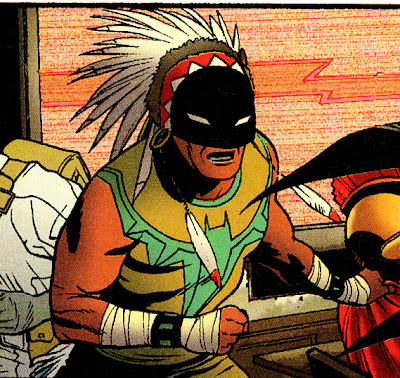
Mostly because it guest-starred this guy:

That’s Great Eagle, also known as Dr. John Eagle, who, when he’s wearing the headdress and and Bat-shirt, answers to the name Chief Man-of-the-Bats.
As you’d expect a guy who dresses like that and goes around calling himself "Chief Man-of-the-Bats," Eagle is a talented, confident, tough guy who doesn’t much care what you think of his costume or codename.
Here he is about to perform emergency surgery on fellow hero and Batman admirer The Knight, who has a small barbed time bomb in his stomach…

When another fellow hero and Batman admirer The Musketeer walks in and sees him standing over The Knight with a bloody knife, Eagle must pause to punch out The Musketeer, and then he immediately gets back to work…

Finally successful, he’s calm, cool and collected while surveying the results. The bomb goes off in the next panel, but naturally he, his patient and The Musketeer all escape the blast unscathed. As this page proves, he’s very Batman-like in his competence and demeanor, as well as his fashion taste.
And later, when his son and sidekick Red Raven (formerly Little Raven) is caught in a complicated deathtrap designed to kill him, Robin and the Knight’s sidekick The Squire, the chief wades in and grabs weights meant to torture two people, one in each hand…

Chief Man-of-the-Bats is, clearly, a total bad-ass.
But he’s not perfect, he has his weaknesses, like any man. For example, he can’t help but live up to the negative Native American stereotypes:

He makes up for it by being an inveterate litterer, though.
Anyway, if you’re anything like me (and the fact that not only are you reading my blog, but have got this far into a post, is indicative that you are), then you think Chief Man-of-Bats totally rules, and would like nothing more to read more Chief Man-of-Bats comics; hell, maybe even a Club of Heroes ongoing series (It’s not like it could be any worse than Superman/Batman or Batman and the Outsiders).
Well, until that glorious day comes, we can only look backward for more Man-of-the-Bats action, and the place to start is his first appearance.
Batman and Robin first met the chief and his sidekick in 1954’s Batman #86, by France Herron and Sheldon “Not Actually Bob Kane” Moldoff, in a story called “Batman—Indian Chief!”
Here’s the cover:

Now, you may think, “Batman—Indian Chief?” Why would Batman be an Indian Chief? That’s kind of weird, isn’t it?
Well, back in the 20th century, there was actually a great shortage of Indian chiefs in America, and Indians, who all lived lives exactly like the Indians you see in old Westerns, were bereft of leadership.
To help fill the void, America’s superheroes came to the rescue. In addition to Batman, other do-gooders who donned headdresses to become Indian Chiefs included
Superman,
Captain Marvel,
and Rex the Wonder Dog. Of course, Rex was only an honorary Indian chief. Because making a dog, even one as wonderful as Rex, an actual Indian chief? That’s just silly.
Anyway, Batman and Robin are flying the Batplane back home one day, when they see a strange sight…

Robin peers through the binoculars only to see a boy that looks exactly like him, dressed exactly like him (save for a headband with two feathers on his head) riding a horse.
Curious, they decide to investigate, and within just two panels find a cave with a canoe decorated with a bat-symbol parked right outside it, and they stroll right in.
Batman's reaction to seeing a Native American version of himself in a cave mirrors my own reaction:

WHAT?
Great Eagle tells Batman and Robin of his origin, and his current predicatment:

It should be noted that this Black Elk is not, in fact, the famous Sioux holy man of Black Elk Speaks fame, but a local villain who robs people at arrow point.
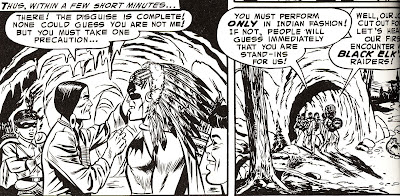
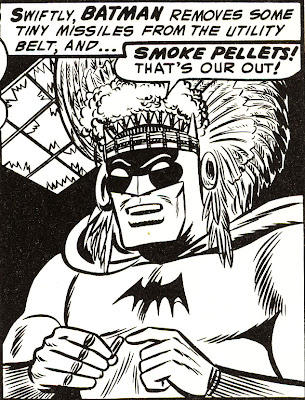
Since Eagle can’t go after him as Man-of-the-Bats without risking his secret identity, Batman decides to stand in for him, wearing some make-up on his lantern jaw to appear to be a Native American (I was relieved at this point to be reading a black and white copy, so I couldn’t see how red that make up was).

Now why Batman takes a disguised Robin with him instead of Little Raven, who would be far better-suited to prompt Batman to act like his dad, I don’t know.
Finding Black Elk seems easy enough, as the villain and his men shoot out the tires of an armored truck with their arrows and proceed to rob it, at which point our disguised heroes swoop in:

But the bad guys make their escape when a fire in the burning armored car spreads. Now Batman and Robin must track them. Robin keeps trying to get Batman to go after them in the Batplane, but the Dark Knight resists, pointing out that “We’ve got to handle this like Indians!.”
And in the 1954, what respectable Native American would ever board a giant, metal eagle that the White Man called "an airplane," which was probably powered by black magic.
Eventually, Batman picks up their trail, which heads back to an old mine. This the same group that Batman and Robin were totally whipping when last they met, despite being badly outnumbered, but now the caped crusaders find themselves geting the worst of it. They take shelter in a building, and are pinned down by Black Elk's bowmen.
Their only hope?

Smoke signals, of course! These naturally bring Great Eagle and his allies…

With the tables now effectively turned, Black Elk and his mob are quickly defeated. And thus the day, and Great Eagle’s secret identity, are saved, thanks to Batman and Robin.
Ah, those sure were simpler times, weren't they? Back then, Batman was always happy to run into a fellow crime-buster doing good works in his name. Nowadays, he totally would have sued the hell out of Great Eagle for copyright infringement. Not that he needed the money, of course, but just the principle of the thing, you know?
Despite the tangential nature of the storyline, it turned out to be the best story of Morrison’s stint on the title. Not simply because he finally had an artist who could visually match his constant allusions to comics past.
Mostly because it guest-starred this guy:
That’s Great Eagle, also known as Dr. John Eagle, who, when he’s wearing the headdress and and Bat-shirt, answers to the name Chief Man-of-the-Bats.
As you’d expect a guy who dresses like that and goes around calling himself "Chief Man-of-the-Bats," Eagle is a talented, confident, tough guy who doesn’t much care what you think of his costume or codename.
Here he is about to perform emergency surgery on fellow hero and Batman admirer The Knight, who has a small barbed time bomb in his stomach…
When another fellow hero and Batman admirer The Musketeer walks in and sees him standing over The Knight with a bloody knife, Eagle must pause to punch out The Musketeer, and then he immediately gets back to work…
Finally successful, he’s calm, cool and collected while surveying the results. The bomb goes off in the next panel, but naturally he, his patient and The Musketeer all escape the blast unscathed. As this page proves, he’s very Batman-like in his competence and demeanor, as well as his fashion taste.
And later, when his son and sidekick Red Raven (formerly Little Raven) is caught in a complicated deathtrap designed to kill him, Robin and the Knight’s sidekick The Squire, the chief wades in and grabs weights meant to torture two people, one in each hand…
Chief Man-of-the-Bats is, clearly, a total bad-ass.
But he’s not perfect, he has his weaknesses, like any man. For example, he can’t help but live up to the negative Native American stereotypes:
He makes up for it by being an inveterate litterer, though.
Anyway, if you’re anything like me (and the fact that not only are you reading my blog, but have got this far into a post, is indicative that you are), then you think Chief Man-of-Bats totally rules, and would like nothing more to read more Chief Man-of-Bats comics; hell, maybe even a Club of Heroes ongoing series (It’s not like it could be any worse than Superman/Batman or Batman and the Outsiders).
Well, until that glorious day comes, we can only look backward for more Man-of-the-Bats action, and the place to start is his first appearance.
Batman and Robin first met the chief and his sidekick in 1954’s Batman #86, by France Herron and Sheldon “Not Actually Bob Kane” Moldoff, in a story called “Batman—Indian Chief!”
Here’s the cover:

Now, you may think, “Batman—Indian Chief?” Why would Batman be an Indian Chief? That’s kind of weird, isn’t it?
Well, back in the 20th century, there was actually a great shortage of Indian chiefs in America, and Indians, who all lived lives exactly like the Indians you see in old Westerns, were bereft of leadership.
To help fill the void, America’s superheroes came to the rescue. In addition to Batman, other do-gooders who donned headdresses to become Indian Chiefs included
Superman,
Captain Marvel,
and Rex the Wonder Dog. Of course, Rex was only an honorary Indian chief. Because making a dog, even one as wonderful as Rex, an actual Indian chief? That’s just silly.Anyway, Batman and Robin are flying the Batplane back home one day, when they see a strange sight…
Robin peers through the binoculars only to see a boy that looks exactly like him, dressed exactly like him (save for a headband with two feathers on his head) riding a horse.
Curious, they decide to investigate, and within just two panels find a cave with a canoe decorated with a bat-symbol parked right outside it, and they stroll right in.
Batman's reaction to seeing a Native American version of himself in a cave mirrors my own reaction:
WHAT?
Great Eagle tells Batman and Robin of his origin, and his current predicatment:
It should be noted that this Black Elk is not, in fact, the famous Sioux holy man of Black Elk Speaks fame, but a local villain who robs people at arrow point.
Since Eagle can’t go after him as Man-of-the-Bats without risking his secret identity, Batman decides to stand in for him, wearing some make-up on his lantern jaw to appear to be a Native American (I was relieved at this point to be reading a black and white copy, so I couldn’t see how red that make up was).
Now why Batman takes a disguised Robin with him instead of Little Raven, who would be far better-suited to prompt Batman to act like his dad, I don’t know.
Finding Black Elk seems easy enough, as the villain and his men shoot out the tires of an armored truck with their arrows and proceed to rob it, at which point our disguised heroes swoop in:
But the bad guys make their escape when a fire in the burning armored car spreads. Now Batman and Robin must track them. Robin keeps trying to get Batman to go after them in the Batplane, but the Dark Knight resists, pointing out that “We’ve got to handle this like Indians!.”
And in the 1954, what respectable Native American would ever board a giant, metal eagle that the White Man called "an airplane," which was probably powered by black magic.
Eventually, Batman picks up their trail, which heads back to an old mine. This the same group that Batman and Robin were totally whipping when last they met, despite being badly outnumbered, but now the caped crusaders find themselves geting the worst of it. They take shelter in a building, and are pinned down by Black Elk's bowmen.
Their only hope?
Smoke signals, of course! These naturally bring Great Eagle and his allies…
With the tables now effectively turned, Black Elk and his mob are quickly defeated. And thus the day, and Great Eagle’s secret identity, are saved, thanks to Batman and Robin.
Ah, those sure were simpler times, weren't they? Back then, Batman was always happy to run into a fellow crime-buster doing good works in his name. Nowadays, he totally would have sued the hell out of Great Eagle for copyright infringement. Not that he needed the money, of course, but just the principle of the thing, you know?
Subscribe to:
Posts (Atom)