Showing posts with label manapul. Show all posts

Friday, May 11, 2018

Comic Shop Comics: May 9th

Justice League: No Justice #1 (DC Comics) It can be difficult to experience a new comic book in a vacuum, without going into it with thoughts, guesses and opinions based not only on what knows about the characters and creators, but also what one has been seeing for months in solicitations or online discussion. For me, it's impossible, even as I pay less and less attention to comics "news" sites. So I've been thinking about this weird-looking weekly miniseries for awhile now, which seemed premised as a sort of Most-Star Squadron, with members of the Justice Leagues teaming with members of the Teen Titans and some villains and other heroes to form color-coded squads with weird names like "Team Mystery" and "Team Wonder."

The short preview story that appeared in last week's DC Nation #0 was so in medias res that it didn't little to clear anything up, just showing those teams in action as they battled their way across Brainiac's homeworld of Colu that it didn't really reveal anything other than what was in the solicitations (except, perhaps, how artist Jorge Jimenez would be drawing some of the characters appearing in the upcoming Justice League relaunch).

Well now we get some clarity, as the event actually kicks-off. It is being co-written by Scott Snyder, James Tynion and Joshua Williamson. Snyder is to be expected, as he wrote Dark Nights: Metal, which was essentially a Batman-centric Justice League story, and was slated to be writing Justice League upon relaunch (Which excited me to no end, as Metal was one of the best League stories since at least the post-Flashpoint reboot). As for Tynion and Williamson, the former of whom co-writes with Snyder a lot and the latter of whom wrote Justice League Vs. Suicide Squad, their presence made a lot more sense upon the announcement of two new Justice League series, Justice League Dark by Tynion and Justice League Odyssey by Williamson. The artist for this issue, and the whole series, is Francis Manapul, who previously drew parts of Geoff Johns' climactic "Darkseid War," and classed the joint up considerably when he did so.

The book opens with the Green Lantern Corps gathering around the Source Wall, with Hal, John, Guy and Kyle in the center, and all but Kyle getting a few lines. Interestingly, Guy and John both seem to blame Hal and, as Guy puts it, "your friends on the Justice League" for breaking the wall at the end of Metal. Indeed, Metal's epilogue set up the upcoming Justice League by positing that with the Source Wall broken, things from the other side could no access and threaten the DC Universe, and it would be up to the League to stop those new threats (I found Kyle's silence, which isn't dwelt upon, interesting as well. I may be misremembering, as I haven't read Green Lantern or any Lantern books with any regularity since Johns left the franchise, but didn't one of the books contain a storyline in which Kyle was able to travel to the other side of the Source Wall and come back...? Something that was always thought to be impossible-ish...?)

Next is a neat two-page spread of 21 tight panels, jumping from three different battles to Amanda Waller in front of red computer screens flashing "Crisis Alert." It appears that Brainiac has launched simultaneous attacks on all four--are there really just the four now?--of DC's super-teams, The Suicide Squad, The Titans, The Teen Titans and, of course, The Justice League (but not Batman's "of America" team, which is apparently already out of business, even though two of its non-Batman members show up on two of the Teams). Brainiac "wins" within a matter of pages, and various characters awake in his spaceship, all of them now dressed in different versions of their regular costumes (I was, as I've said, disappointed; the costumes are essentially similar to their original ones, just with more lines in unusual places, a few light-up discs attached and the tint of their coloration skewed weirdly; personally, I think I might have preferred these temporary costumes be differently-colored versions of their regular costumes. For example, if Cyborg's redesign was consistent throughout the others. But whatever...I am assuming I'll get used to these in a few more pages, and then everyone will go back to their old costumes by the fourth issue).

The seemingly random nature of the assembled characters is at least explained in-story: Brainiac realizes the potential of Earth's superheroes, but he thinks they "waste it in comfortable formations" based on bonds their "fragile emotions" have engendered among them. So he defeated all the world's defenders to a) prove his point and b) abduct the heroes he needs. He has then formed them into the teams that make victory against the new threat most probable.

As an aside here, it's fun to think of who he plucked and from where. Most of the current Justice League's line-up was taken, while Aquaman was the only one left on Earth (The League's Lanterns, Simon Baz and Jessica Cruz, weren't present in the fight with Brainiac, nor at the Source Wall with the GLC). From the Teen Titans, he took Robin, Beast Boy, Raven and Starfire; again, most of the line-up. From the Suicide Squad he took only Harley Quinn. And from The Titans, the grown-up sidekicks plus Omen, he took...no one. Huh. I guess he beat them all up just for fun. Then there are all the random characters: Martian Manhunter, Zatanna, Doctor Fate (although I don't know which one, there have been three or four since Flashpoint), Lobo, The Demon Etrigan and The Atom (Choi, it looks like). And then the villains: Lex Luthor, Deathstroke, Sinestro and, most randomly, Starro, fresh from his star (fish) turn in Metal.

In the real world, it will be interesting to see the rationale for these characters as the stories develop. Certainly some are likely just there for fun (Starro) or their popularity (Harley, maybe Deathstroke), and others to the ground work for the upcoming League line-ups, but a lot of the above characters do not appear to be on the new League line-ups (For example, one might expect to see Fate or Etrigan on Justice League Dark after this series, but only Wonder Woman and Zatanna from this event are). Further, the solicitation for the fourth issue mentions that "some heroes will be lost forever," so I suppose it's quite possible that some of these folks are here to act as cannon fodder.

As for what Brainiac needs them for, and why he's re-dressed them all, it appears that the hole in the Source Wall allowed Marvel's Celestials The Millennium Giants The Omega Titans to enter the universe, where they will begin eating planets Galactus style, deciding which of them gets to eat which planet based by the dominant fundamental force in that planet: Entropy, Mystery, Wisdom and Wonder. Brainiac's plan to abduct a bunch of super-people, break them into ideal teams, outfit them with nodes that imbue them with the appropriate energy to match the four forces of the four planet-eaters and thwart them; to ensure the Justice League's cooperation, he set it up so that Earth will be the Galactuses next stop if they eat Colu.

It seems like a decent plan but it all goes to hell in time for the cliffhanger ending, as a scene from Justice League Vs. Suicide Squad comes into play and Brainiac is unexpectedly removed from the equation.

By banding all these diverse characters together (and by diverse I mean from various places; there are three times green-skinned people as there are brown-skinned people among the assembled characters, and as many orange-skinned, pink-skinned or giant, psychic starfish as there are Earthlings of color), this issue has the feel of an crisis-style event comic, with characters from different corners of the DCU all bumping into one another (sometimes literally), arguing and discussing their pasts and futures, together and apart.

So there's a lot of exciting stuff going on here, perhaps particularly for DC Comics fans--I've no idea what this reads like to someone not already soaking in the DCU--and the artwork is perfect. I could ask for more--better costume design, a more representative cast--but I'm satisfied with what I got, and am looking forward to the rest of the month.

Monday, September 26, 2016

Afterbirth: DC's "Rebirth" initiative, week 17

Cyborg #1 by John Semper Jr., Paul Pelletier, Tony Kordos, Scott Hanna and Guy Major

I found the first issue of the new, second volume of a Cyborg ongoing solo series to be surprisingly strong...although I must confess that was in large part because of how low I set the bar after the rather dull and predictable Cyborg: Rebirth #1, which simply ran through his origin one more time and introduced yet another iteration of the whether robots have souls or not issue (As I said at the time, it struck me that comic book writers only tell such stories about robots, cyborgs, androids, synthezoids and other artificial people, when really it's a pretty fundamental human concern. I worry about that kind of thing, and the only metal in my body is a filling where a cavity used to be).

After two pages of foreshadowing the threat that appears on the last two pages to engage Cyborg in a fight, the issue opens with Cyborg stopping some (relatively) petty crooks, then having an elaborate diagnostic run by his father and his friend Sarah at STAR Labs, and then she takes him out for ice cream and jazz music.

If this marks the end of his newfound worry whether he is a real human being with a real soul who has a bunch of robot parts, or if he is an elaborate machine that thinks it has a soul, then it would be a fairly satisfying conclusion to that conflict, even if the scene in which he rediscovers his soul could be viewed as rather trite, depending on how cynical vs. how generous a reader wants to be (It involves a blind jazz musician named Blue, who would stand out as a magical negro type if this comic weren't mostly populated with black folks).

To pencil artist Paul Pelletier's credit, he manages to sell Cyborg's discovery of his soul or humanity–or at least his realization that he can appreciate improvisational live jazz–really well with a few drawings and shifts in facial expression. He likewise handles all other aspects of the book pretty well.

As for the villain that picks the fight with Cyborg, after being awoken by the other villain, the one revealed at the end of the Rebirth special, it's yet one more instance of the Dan DiDio Era, worst-of-both-worlds approach to continuity. It's Kilg%re, a Flash villain from 1987 who played a role in the JLI-era Justice League comics and hasn't been heard from since.

Semper Jr. resurrects the character here, where so far it is simply a big scary robot, but if that name or history is at all attractive to you, then you've been reading DC comics rather voraciously for decades now, and are unlikely to be too terribly interested in the re-booted New 52 universe and this Cyborg comic, and if you're attracted to the NEw 52 universe because it's young, fresh continuity, then you're not really going to feel anything when a writer name-drops a minor 30-year-old character.

Kilg%re, it should go without saying, is a pretty bottom-of-the-barrel antagonist, so it's not like there is some core, timeless element to it that a rebooted version of it can accentuate to the degree that even a rebooted version of, say, Ultraman (evil Superman from an alternate, opposite reality) or Kite Man (guy who commits crimes, with kites!) might possess.

Nice art though and, as I said, I was actively worrying this would be much worse than it actually was.


Trinity #1 by Francis Manapul

One thing I've been curious about for a while now is where, when and with whom the term "trinity" originated in reference to Superman, Batman and Wonder Woman. I know Matt Wagner's awkwardly titled 2003 miniseries Batman/Superman/Wonder Woman: Trinity is the first time the three shared a book with that word in the title (a title later used for the excellent but underrated Kurt Busiek-written 2008 weekly series and now this new monthly), but I have to imagine the term pre-dates Wagner's series.

I suspect that the idea of the trio as the three greatest heroes in the DC Universe is a fannish concept, and it certainly figured in the epilogue of 1996's Kingdom Come by fans-turned-pros Mark Waid and Alex Ross. You'll recall the series ending with the three of them having lunch together, and deciding to raise Wonder Woman and Superman's child together, as a trio of parents.

It certainly seems like a rather millennial idea. In the Golden Age Batman and Superman (and Robin) shared a book, while Wonder Woman was part of the Justice Society. In the Silver Age, Batman and Superman (and Robin) continued to pal around, and were only occasional members of the Justice League, which was originally essentially all of DC's Greatest Superheroes Who Aren't Batman and Superman (and Robin)! And if by the Bronze Age Wonder Woman was seen as a peer to the World's Finest, 1985-1986's Crisis On Infinite Earths scuttled all that by re-introducing Wonder Woman into the rebooted DC Universe as a newcomer whose career was beginning something like 10 years later than the careers of the World's Finest (causing no end of problems for poor Wonder Girl, and necessitating her replacement in Justice League history with Black Canary).

Because these characters really do have a life of their own to some degree, the idea of Wonder Woman as Batman and Superman's peer rather than a sort of superhero ingenue gradually gained gravity as the years passed, so that by the time of the continuity re-shuffling of Infinite Crisis/52, she was again a Justice League founder.

As I mentioned the other day, there's something of a flaw at the foundation of the new Trinity series, though, at least on a conceptual level. In the post-Flashpoint continuity realignment, Superman, Batman and Wonder Woman all began their careers around the same time, all met one another almost simultaneously and all founded the Justice League together. However the Superman that is starring in Trinity is not their Superman; he's the pre-Flashpoint one, so what we have here are The New 52 Batman and Wonder Woman, who have known one another and worked together for a good 5-8 years, teaming with an older, wiser Superman from a different reality, who they have just met.

Francis Manapul, who writes, draws and colors this issue, has chosen to embrace this peculiarity to DC
s trinity, premising this first issue on Lois Lane (also from the pre-Flashpoint DCU, her New 52 counterpart having been conveniently killed off shortly after New 52 Superman died) inviting this universe's Batman and Wonder Woman over to their Hamilton County farmhouse for a surprise dinner. Her thinking being that her husband, now going as "Clark White," needs friends. So she turned to this dimension's versions of his two best friends from their home universe.

It's all a lot more complicated than it needs to be, and is unfortunately going to be something that is more-or-less constantly being referred to, as there will always be a wedge between Superman and the other points of the trinity...probably. The mysterious Mr. Oz, who doesn't appear here, has repeatedly mentioned in other books that things aren't exactly what they seem with the Supermen.

So In this issue, Manapul introduces us to the trinity in double-page splash lay-outs, as Wonder Woman and Batman converge on the White farmhouse to have dinner with Clark, Lois and their son Jonathan (who accidentally blasts the visitors with heat-vision). Their basic relationships are established pretty quickly, and Manapul writes off a further New 52 complication to the idea of these three as best superfriends (the fact that New 52 Wonder Woman and New 52 Superman were an item).

There are some cute moments, including Batman being forced to wear plaid after Jon accidentally heat-visions his shirt off, and Wonder Woman bringing a wild boar to dinner (Jesus Diana, just bring a bottle of wine; you expect Lois to clean, cure and cook that thing in order to feed her family of three? You better hope they have a meat cooler somewhere on the farm). As to where it's all going, there's some coy allusions to Jack and the Beanstalk, and it ends with the three heroes looking into a mirror where a young Clark Kent is looking back at them, his father behind him.

It's a pretty classic, pretty effective "What the heck is going on? Find out next issue!" ending, really. While there's nothing wrong with the writing, the book's great strength is Manapul's artwork. He's one of the best artists DC has working for them these days, his design style looks like a compromise between that of Cliff Chiang and Time Sale, and his coloring is particularly effective at the sunset, bucolic world of the rural parts of the DC Universe (as he ably demonstrated during his too-short run on Adventure Comics with Geoff Johns (I'd heartily recommend their Superboy: The Boy of Steel collection, if you haven't read it yet).

I'm not entirely sure of where the book is going, and what might keep it going after this initial outing. With a small, focused Justice League team–just these three and five other characters–it seems somewhat odd to have a comic book starring half the Justice League (I'd kind of like to see Aquaman force Flash, Cyborg and the Green Lanterns to hang out with him once a month or so, and they can all get together and kvetch about the "Trinity" who are too cool to hang out with them unless the world is ending and they need their help).

Given Manapul's artwork though, this should be a particularly easy "Rebirth" book to keep an eye on.

Sunday, January 03, 2016

Justice League: The Darkseid War: Superman #1

Previously, in "The Darkseid War"...

Justice League #41 ("The Darkseid War" Pt. 1)

Justice League #42 ("The Darkseid War" Pt. 2)

Justice League #43 ("The Darkseid War" Pt. 3)

Justice League #44 ("The Darkseid War" Pt. 4)

Justice League #45 ("The Darkseid War" Pt. 5)

Justice League: The Darkseid War: Batman #1


The second of the character-specific one-shot tie-ins to the Geoff Johns-written "Darkseid War" story arc in Justice League, JL:TDW:S follows Superman, the newly named "God of Strength," who ascended when Luthor dropped him into an Apokloliptian fire pit in order to recharge his cells and therefore restore his waning power.

Superman flew out at full-power, but badly changed. Not only did he now talk in New New God font, he also had a weird photo-negative look and he was a monstrous douchebag, beating up Luthor, tearing his power-armor off and abandoning him on the alien planet.

This is what happened next, as told by writer Francis Manapul (who is drawing the current "Act II" of "The Darkseid War" arc and providing the nice-looking covers for all of these one-shots), and drawn by artist Bong Dazo.

COVER

See what I mean, that is a nice-looking cover. There you see Superman's new look. Honestly, it's not a great one, but Superman has had so many costume changes over the years, what are you going to do? Even if you just looked at all of the "Superman gone bad" costumes, there are probably a few dozen of those, since "Superman gone bad" is one of the, like, three default Supeman stories that everyone seems so interested in writing. This photo-negative thing might be about all that's left (I don't know; maybe Superman-goes-goth?).

I think the idea with the photo-negative thing is to present him as changed by being charged with the "negative" energy of Apokolips rather than the positive energy of Earth's sun, which sort of works, I guess, at least in terms of visuals reflecting a story point  (As for Superman being able to be charged by the fire pits, I was taken aback by that, as I didn't think they counted as a form of solar/stellar energ).

The look does strike me as a little derivative though, as a Spider-Man villain of rather recent vintage has the same basic look, and it's kind of weird when characters in this particular comic just see Superman and say "Hey, a new costume" without commenting on the fact that he looks completely bizarre and unnatural, his skin and clothes all blending together in a pure, absence of color. Have you ever looked closely at the negative of a photo of yourself or a loved one and been a little freaked out? Imagine one of those at full-size, walking around and talking. Brrr...!

Anyway, Manapul does a great work with it on this particular cover. The all-white background helps the imagery pop, and this is markedly different than the over-crowded cover imagery of all the "Darkseid War" business that has been published thus far (including the ones with Manapul covers). There's a Kirby-inspired design element, but it's used smartly and sparingly, to highlight an aspect of the image.

This is pretty reflective of the contents as well, as Superman is torn between helping and not helping the people of Metropolis from a deadly alien ooze issue, and he does regard a bird within.

PAGE 1

A little black box catches us up on the events of "Darkseid War" ("In the wake of Darkseid's death, several members of the Justice LEague have gained the power of Gods–but at what price to their humanity? Blah blah blah"). Meanwhile, Perry White lets us know that Superman hasn't been seen for days, and no one knows where he is, while talking to Jimmy Olsen. Three-fourths of the people in the background and foreground are staring at the screens of smart phones.

PAGES 2-3

A double-page spread of Negative Superman, punching a big alien robot monster thing in the face high above the surface of the earth, big chunks of metal coming off, and its neck stretching to the breaking point. In narration, Superman complains about how every time he tries to come home to Earth, he's attacked by someone or something trying to make a name for themselves by taking him down, but they shouldn't test him, as he's Superman and all.

In the lower left-hand corner of the spread is th title of the story, "God of Steel," and the credits.

PAGES 4-7

While Perry and Jimmy debate how best to cover Superman's absence in the paper, apparently not realizing that they don't have to write every story in their paper about Superman every day, Superman is flying towards Metropolis like a meteor, the alien monster guy thing beneath he and his fists. They land with a KRRRAAAASSHH! that throws the Daily Planet-eers to the ground and opens up a huge hole in the side of the Planet building.

Superman tears a diminutive alien out of the suit, for that's what the big metal monster thing was, and talks some trash to it ("You're not worthy to fight Superman"). He tosses the little guy over his shoulder, while bystanders ask Superman if that's him or not, and if he's not going to take the alien to jail or not.

Superman dismisses them, saying the little guy will leave of his own accord "if he knows what's healthy for him," and then tells the bystanders to get out of his way, as he's hungry.
The alien yells at Superman, and while the dialogue is generic, it's written backwards, so it looks alien, but is also easily decipherable. Neat touch.

He does as Superman predicts, taking off in a little escape orb.

PAGES 8-9

Superman enters Melvin's Diner, and steals a piece of pie right out of a guy at the counter's hand at super-speed.

"Bring me apple pie," he says, in his new font.

I like how in discussing the new Superman, one of the ladies says that the new costume is "So much sexier!" Are you crazy lady? Look at his face! It's A) Obviously not a costume and B) Freaky as hell.

But maybe I shouldn't judge. Everyone's got their own kinks, right? Maybe she's into photo-negatives. Maybe she looks at photo-negatives of old pornographic films. I don't know who she is.

On the next page, Melvin and a waitress make small talk with Superman, the former offering him some advice and the latter asking for a favor, but Superman doesn't have time for their shit today.

"I said give me my pie!" he screams, pounding his fist on the counter top. Now, he didn't actually say that; he said "Bring me apple pie." But having seen Superman scream and pound his fist on the counter, no one is really about to point that out to him.
One neat thing that's noticeable on this particular page is that Superman seems to start leaking or emanating anti-solar energy now, as little glowing Kirby dots hover around his angry face in one panel of this page.

PAGES 10-11

Back at the Planet, Jimmy helps Perry to his feet, while the latter wonders why Superman is acting off. And just what the black, oily-looking substance that is slowly covering everything in the city might be. When Jimmy hears one of the smart phone people say something about pie aloud, he realizes where exactly Superman must be, since they are pals and all.

He puts on his dorky bike helmet and bikes as fast as he can to Melvin's, while the black ooze continues to cover buildings and people and cars. He gets hit by a car, but is okay–because he wore a helmet! Let that be a lesson to you, kids!

PAGES 12-15

Jimmy and the new New New God version of Superman have an intense heart-to-heart.

Jimmy bursts into the now abandoned diner, where Superman is eating his pie, and starts talking excitedly to his old pal. Superman throws Jimmy out the window. When a few tendrils of ooze start to grab at Jimmy, Superman notes yet again that "he's not human," and when Jimmy uses the word "help" in a sentence, Superman floats away from his pie to tell Jimmy off.

"Help! Help! That's all I hear," Superman says. "It drives me insane! Why can't you help yourselves?" He insists he's only back on Earth "for the one thing I enjoy on this planet" (pie) and Jimmy gives him a long, tearful speech about what a good person Superman is and why he loves Earth and Metropolis before the goo completely covers him and finally shuts him up.

PAGES 16-17

A two-page spread, in which Superman floats high above the now silenced Olsen, and regards the city, which is full of people, crashed cars and buildings all in the process of being wrapped up by the seemingly sentient, inky whatever-it-is.

PAGE 18

Superman stands on a gargoyle (Hey, that's Batman's thing!) and looks at the skyline, noting that nothing is moving in the city, save a pigeon that briefly alights on the shoulder.

He's conflicted by the presences of the pigeon, and then his eyes return to "normal" while the rest of him is all negative-y, in a really rather freaky-looking visual.

PAGES 19-21

Superman traces the source of the smothering black ooze back to the abandoned alien battle-suit; apparently it was a farewell gift from the defeated foe he let flee. He rationalizes his way to saving the day: "<i>I'm stronger than any weapon. That's why I'll do this. That's why I'll save the city.</i>"

And how does Superman knock the the paralyzing black substance off of the entire city of Metropolis...? A blast of arctic breath to freeze the whole thing solid, and then a super-punch that shatters all of the ice ("SMAAASSSSHHHHHH").

What happens to the goo when the ice melts...? It doesn't matter, there's only one page left!

PAGE 22

Having realized that Superman is still "in there," Jimmy is quite excited, and returns to the office, where Perry has already printed a new edition of the paper...? (Headline: "A New Hope" ). Superman admits to himself that he needs help, which is, of course, the first step in dealing with a problem, and flies off, thinking that bad things are on the immediate horizon. And they are! "The Darkseid War" is, after all, still in-progress!

Friday, November 27, 2015

Let us all give thanks for Dark Knight III: The Master Race #1, as its infinite variant covers have

provided us with so many images of that which is best in comics, Batman on a horse!


These Batmen on horses were created by Jason Fabok, Aaron Lopresti, Bill Sienkiewicz, Tony Harris and Francis Manapul, respectively.

Monday, November 23, 2015

Review: Justice League #45 ("The Darkseid War" Pt. 5)

Don't worry; that's just The Flash talking not...that one TV character who used to say that line a lot.

Previously, in "The Darkseid War"...

Justice League #41 ("The Darkseid War" Pt. 1)

Justice League #42 ("The Darkseid War" Pt. 2)

Justice League #43 ("The Darkseid War" Pt. 3)

Justice League #44 ("The Darkseid War" Pt. 4)

The first casualty of "The Darkseid War" is artist Jason Fabok, who drew his last chapter last month, the fourth issue of the story arc (and the one with the first major in-story casualty). He is replaced this month by the excellent Francis Manapul, working with his long-time collaborator Brian Buccellato (who co-colors Manapul's art).

As jarring as it can be when artists are switched out mid-story arc like this, DC does seem to have been somewhat methodical about this move, as this issue is the beginning of "Act Two" of "The Darkseid War," picking up after the death of Darkseid last issue.

Manapul coming on board gives Justice League something the title hasn't really had yet: Good art. So far, everyone whose drawn the title has been popular, and, in all honesty, some of them have had a great deal of talent, but none have been as all-around good at telling a story visually in the comics medium as Manapul is. Thus far, Justice League has been a showcase for DC's star artists, some of whom are also fairly good at drawing comic books (Ivan Reis springs most immediately to mind), but none of whom would really generate cartwheels from a harsh critic of the form.

THE COVER

Here's a pretty good example of Manapul's strength. There are once again some rather random-looking shapes on the cover, but, for the first time, it's quite clear that they aren't that random, but are meant to suggest the shapes of Jack Kirby's design work. This one, in fact, looks to be based on the Greek letter "omega," associated with Darkseid, with Kirby's god of evil blocking out part of the omega's arc.

The images, on the other hand, are pretty much random: There's Wonder Woman, wearing a different costume than she's worn throughout "Darkseid War," with a pair of axes; there's Mister Miracle, trapped in some sort of elaborate super-shackle restraints; there's Darkseid looming up behind him.

The colors are pretty nice; I like the way Wonder Woman's red top seems to glow, and how the blank white of the letter/shapes contrasts so strongly with everything around them, so that they seem to glow even brighter than Wondy's luminescent armor.

PAGES 1-3

A very deliberate, very dramatic opening to this next phase of the fairly huge story arc. The first page features three horizontal panels. The first of these is solid black, with a little "PING" sound effect. The second black with what appears to be red blood splattered upon it. The third black with even more blood splatter, and and a tail-less dialogue balloon: "Something is very, very wrong."

The second page is a splash, the whole page solid black save for a big red omega symbol dripping blood. The title and credits appear beneath it, informing us that we have no entered "ACT TWO" of "The Darkseid War."

The third page has four horizontal panels, each a close-up of a different characters face. Batmetron steeples his fintertips and says "Darkseid" in New New God font. Photo Negative Superman, here looking like he's made of hollow ruby and lit within, saying "Is" in New New God font. A panel of Darkseid, his stone face smashed open and leaking pink energy and Kirby dots, as if he were a piece of pottery thrown to the ground, saying nothing (because he's dead). And then a close-up of Wonder Woman's face, looking down and saying "Dead." It's raining behind her, and she starts to narrate about gods and stuff, as she's done off and on throughout the story. It's not important; you could lose her narration and you wouldn't lose anything in terms of story-telling.

PAGES 4-5

A double-page splash; clearly all these splashes were in the story so far because writer Geoff Johns was putting them there, not because previous artist Jason Fabok was asking for them.

Here we see the broken, lava-leaking body of Darkseid in the immediate foreground, with Mister Miracle kneeling just above him, his little flying discs now enlarged so that he can kneel upon them while still floating, rather than just standing on them to whiz around on.

The Leaguers who were at the site of the battle are still lined-up behind him. Power Ring (who clearly survived trying to push Darkseid and The Anti-Monitor apart after all), Steve Trevor, Wonder Woman (wearing her "Darkseid War" costume, rather than the costume on the cover; her right wrist-band, which was destroyed in a previous issue, is back), Cyborg and Captain Marvel Shazam.

Miracle's Mother Box confirms that Darkseid is indeed dead, while Shazam fills us in on the fact that The Anti-Monitor and his forces (Grail and a bunch of Shadow Demons) disappeared.

From off-panel, the white print on a black, red-encircled dialogue balloon that indicates a New New God is speaking asks, "Did I do that?" the inflection perfectly capturing that of a catch-phrase from an old TV show I wish I had never seen so I would not be thinking of it now while reading about the death of Darkseid.

PAGE 6

The speaker is shown; it's The Flash, now in his new Black Racer hybrid form, floating high above the ground. As we saw last issue, The Flash did do that. After Darkseid summoned death itself, his ultimate weapon, The Anti-Monitor fused it with The Flash, and then shot The Flash through Darkseid, killing him.

Mister Miracle tries to parse things to make The Flash feel better, telling him that it wasn't The Flash who killed Darkseid, but The Black Racer.

Flash doesn't seem too terribly troubled. He summons a scythe made out of lightning, akin to the one he was holding las tissue, and announces that he doesn't want to "escape" death, but control it. There's an extreme close -up of his eyes, and text announces his new role in the series: "The Flash: God of Death."
You know, "The Flash" isn't a very good name for a god of death. Maybe he should still go by The Black Racer? Or at least The Black Flash?

The basic format of this last panel will repeat a few times in the following pages, as four more Justice Leaguers will officially be promoted to New Godhood, although we've already seen two of them ascend in previous chapters.


PAGES 7-9

Back on Apokolis, Photo Negative Superman continues to be a Super-dick to Lex Luthor. He informs his arch-enemy that Darkseid is dead, sorta, and while Luthor tries to tell him that the energy from the Fire Pits threaten to destroy his cells, Superman's all like "Whatevs." He tears off Luthor's power armor, threatens him that if he ever returns to Earth he will end up like his armor and then flies off, leaving beat-up Luthor to his fate.

At the bottom of page eight, there' sa close up of Photo Negative Superman's eyes, with the words "SUPERMAN: God of Strength."

I find this idea of the Justice Leaguers ascending to godhood in order to form a new pantheon a good one, but by tying the concept to the New Gods, and making them New New Gods raises some questions. In particular, it seems curious that they are being given particular roles–god of this, god of that–when the New Gods themselves never really had such roles assigned to them.

PAGES 10-11

There's no caption to announce it, but we're back on Qward, where Bat-Mobius and Green Lantern Hal Jordan were investigating the origin of The Anti-Monitor, and discovered that he was a dude named Mobius who fused with The Anti-Life Equation itself (which he announced while killing Darkseid).

Manapul and his co-colorist Brian Buccellato are doing a hell of a job on this issue. I like how the white of Hal's boots and gloves glow in the establishing shot; remember, Hal's costume is simply a hard-light construct. Treating it as such in a live-action movie may look hella-dumb, but it can look kinda cool when the right artists render it as such in a comic book.
Batman announces the death of Darkseid, and that they can give up their investigation, while a panel announce him as "The God of Knowledge." Hal disagrees, but upon touching the chair gets a scary vision of a bunch of New 52 Parademons. Batman tells GL the premise of his upcoming tie-in one-shot: "Without Darkseid, The Parademons are without their leader...and like the insects they are, they're drawn to...the brightest light in the universe."

Batman then Boom Tubes away, leaving GL to tend to the events on Oa (see Justice League: The Darkseid War: Green Lantern #1 for how that all pans out).

PAGES 12-15

Back on Apokolips, some Mad Max looking people throw a bunch of Lobo hooks around Luthor. One takes off her hood and scarf to reveal a lady with short red hair who introduces herself as "Ardora...Leader of The Forgotten People.."
That name will likely sound familiar to long-time DC fans with very good memories. Like Geoff Johns, for example.

Introduced in a 1983 Superman comic by Edmond Hamilton, Cary Bates and Curt Swan, the original Ardora hailed from the planet Lexor, where Superman was regarded as an evil villain and Lex Luthor was regarded as the greatest hero. In fact, in pre-Crisis continuity, she would even marry Lex and have a child with him.

That was like a half-dozen continuity reboots ago, however, so this Ardora is, for all intents and purposes, a brand-new character, albeit a bit of an Easter Egg for the Geoff Johns-types in the reading audience.

New 52 Ardora says a few dialogue balloons about a great hero from a place called Metropolis that sounds an awful lot like she's talking about Superman, but when she asks Luthor "Are you this man?" Luthor naturally responds in the affirmative.

PAGE 16

Power Ring tries to talk sense to The Black Racer/Flash, and he starts arguing with himself; he speaks in a New God dialogue bubble about how awesome death is, but then a normal black type on white bubble voice, that of Barry Allen, chimes in with "This isn't right." Barry's voice tells The Black Racer that he's going to try and outrun death. Can he do it?! See Justice League: The Darkseid War: The Flash #1 to find out!

PAGE 17

But wait, there are still more New New Gods to come! Shazam is in the middle of a sentence when he starts leaking lightning, and variously colored and shaped tailless dialogue balloons appear around him, saying cryptic things, like "HE WILL BE MY VESSEL." and "He will burn, like all Martians."

A close up of his eyes is accompanied by the words "SHAZAM: God of Gods."

That...well, I'm pretty sure it's meant to mean that his sphere of influence is gods in the same way that, say, Ares' sphere of influence is war or Thor's is storms, but it sounds like he's the chief god, the god that other gods worship. Kind of like how Jesus is the king of kings, you know?

He bolts too, and Wonder Woman is in the middle of telling the few that are left that they need to split up and follow them both when a voice from off-panel announces the fact that Darkseid's posse is apparently still hanging out, and have just been, like, really quite for the last few pages.

PAGE 18

It's Kalibak and Krew! "You have problems of your own," the blinded giant says, while Kanto, Lashina and Steppenwolf pose behind him on this splash page.

PAGES 19-22

Luthor is hooked up to some big Kirby machines by Ardora, who explains that when Darkseid died his Omega Effect was unleashed, and return to Apokolips, where they planned to contain it in Luthor. THere's a three panel break to show Griff, Myrina Black and Grail posing together and regarding a big energy Easter egg decorated by horned demons. "He's becoming Mobius," Black says of The Anti-Monitor. "And then I will get what I want," Grail answers cryptically.

And Luthor announces that "Darkseid is Dead," in New New God font, "Long live LEX LUTHOR."

On page 22, a splash page, Luthor is revealed to now have gray skin, black eyes with bright red pupils and a bit of cragginess around the eyes and lips. He looks like a Darkseid-ized Luthor, basically.
He's a New New God too, although his role is a bit more unexpected than that of the others: "Lex Luthor: God of Apokolips."

Oh snap! What happens next? A bunch of character-specific one-shots, that's what!

Saturday, October 06, 2012

Wednesday Comics vs. The New 52: The Flash

Police scientist Barry Allen uses his fantastic super-speed powers to protect his city, his world and time itself from the machinations of super-intelligent, giant gorilla mad scientist Gorilla Grodd—but can he save the day and his relationship with Iris West? By Karl Kerschl and Brenden Fletcher.


Police scientist Barry Allen uses his fantastic super-speed powers to protect his city from the new villain Mob Rule. By Francis Manapul and Brian Buccellato.

Thursday, May 03, 2012

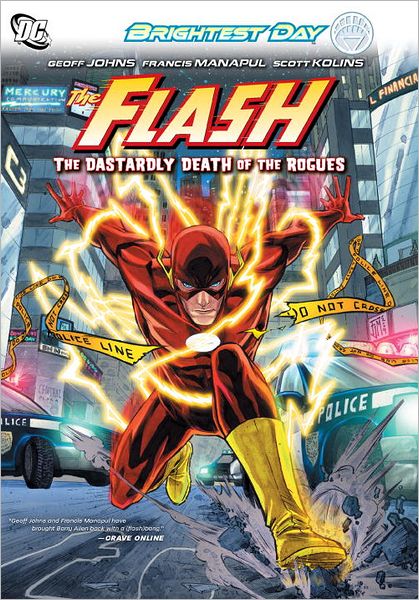
Pre-New 52 review: The Flash Vol. 1: The Dastardly Death of The Rogues

It may just be a coincidence that Geoff Johns seems to do his best writing when working with artist Francis Manapul, perhaps Manapul is simply the artist he chooses to work with when doing his lighter, brighter, less decadent and deconstructionist superhero work, but the fact remains: The Flash: The Dastardly Death of The Rogues is among Johns’ better comics in a good long while, on par with his brief run with Manapul on the Superboy character.

The bulk of this collection contains the title story, which began in the post-Flash: Rebirth Flash #1 from 2010.

With the various plot and continuity gymnastics done in Rebirth, and thus already well out of the way, Johns and Manapul are free to focus on the title character as a traditional superhero, and put him in the middle of a traditional superhero narrative, one distinguished by it’s old-fashioned, Silver Age-infused plot and Manapul’s beautiful, suggestive artwork, which is full of pretty and clever ways of depicting The Flash’s universally-undestood superpower. Speed is cool, and super-speed is super-cool.

Johns introduces us to Barry Allen, medical examiner for the Central City Police Department, and his significant other, reporter Iris Allen. We meet the police procedural supporting cast at Barry’s work, and Johns spends time establishing the unique character and “feel” of Central City, something he’s done with the settings of each series he’s written.

While Allen is considered a dated and old-fashioned character—because he is—Johns has him texting Iris constantly throughout the story, and it works surprisingly well. Of course The Flash texts, while running or fighting, because he’s so fast he can easily take the time fire off a message.

The plot is a typically Flash one, in fact, it's more typically Flash than it is Geoff Johns, which is kind of striking when one considers how long Johns wrote The (Wally West) Flash, with a few sub-plots involving building up the character’s new status quo and cast occurring around its edges.

A body is found dressed like Mirror Master, but it’s not the Mirror Master Barry Allen knows. Badge-holding time-cops with the costumes and powers of various Flash rogues appear and explain that it was actually Mirror Monarch, a good guy from their era, and that The Flash is the murderer, so they’ve come to arrest him before he can commit the crime.

This, of course, leads to a lot of running around and fighting, as Flash tries to solve two murders to keep two innocent men from being punished for crimes they didn’t commit: One is the case he’s working on in his day job, and the other, of course, is the one he's being preemptively arrested for. Meanwhile, the present era’s rogues show up to let the futuristic good guy “rogues” know how they feel about copycats, and to use a seret weapon developed by the original Mirror Master in the off-chance that original Flash Barry Allen should ever return form the dead: A giant mirror reading “In Case The Flash Returns Break Glass.”

It all ties together neatly, and the only real rough edges to the story are those involving Captain Boomerang, as there’s a Brightest Day tie-in that seems to come completely out of nowhere. If one encountered it in the comic book as it was originally, serially published, it likely would have made sense, as it tied into the then-current Brightest Day biweekly series, and similar, seemingly random events were occurring throughout the DC Universe line of books at the time, but, at this point, it just seems weird and out of place, akin to Captain Boomerang’s suddenly developing a new and awfully convenient superpower (Which he also does in the course of this volume).

As an extremely high-quality DC book from 2010-2011, its another strong example of the DC Universe and line of books not being broken, but heading for a fix anyway.

In addition to the title story, this volume contains Flash #7, which featured a story a spotlighting Captain Boomerang, his origin, history and the story from the previous six issues as he experienced it, featuring artwork by Scott Kolins, and Flash Secret Files & Origins 2010 #1, also drawn by Kolins, featuring an overly precious recounting of Barry’s childhood, a later trauma and his current angsting about it, relieved by an appearance by the extended Flash Family (introduced in Rebirth and discarded in the New 52 reboot), with a somewhat clever last-panel reveal.

Despite the relatively high quality of this series, it would only last five more issues, at which point the entire DC Universe/line of books would be rebooted during. Johns left the character at that point, in order to write Justice League and Aquaman, while Manapul remained as artist and writer, colorist Brian Buccellato joining him as co-writer.

I haven't read any issues of the new series yet, but from what I've heard, it's been very good, and among the better of the new New 52 books. Having not read it yet, I can't say how much the set-up has changed—the fact that Johns put so much work into setting up a book for what seemed like a long haul only to have the work discarded a year later seems to speak to how sudden the decision to reboot was—but, at the very least, Iris and Barry's marriage was editorially annulled, Jim Lee added a chin strap to The Flash's costume and characters like Jay Garrick and Wally West no longer exist.

Sunday, June 26, 2011

Trades I Waited For (Part 1): Superboy: The Boy of Steel

Here’s a pretty good example of what, precisely, is so scary about DC Comics’ plan to relaunch their entire line of comics later this year, a plan that involves an ambitious digital strategy, an increase in production of titles, redesigns of all of their characters and a reboot of their fictional history.

As a whole, the publisher hasn’t been very good at planning very far ahead (Grant Morrison’s Batman comics and Geoff Johns’ five-year Green Lantern run aside), and over the past half decade or so has shown an increasing tendency to change its collective mind quickly, and often change direction suddenly.

The comics collected in the trade Superboy: The Boy of Steel were originally produced and published in 2009 and 2010, which might conceivably seem like a long time ago to someone who deals with superhero comics as monthly serials (and I think that’s fine for DC to focus on that side of their business over trade readers, honestly), the trade was just published in May of this year. A month and a few days ago.

Since the first of these Superboy comics from Adventure Comics was published, the $3.99/32 page title changed it’s numbering and focus, losing the Superboy feature and Legion of Super-Heroes back-up to become a secondary Legion book, a back up-less $2.99/22 page book.

Since the first of these Superboy comics was published, DC launched a new Superboy title with the same premise (Superman’s resurrected teenage clone moves in with his namesake’s recently widowed mother and super dog in Smallville in order to learn the lessons the original Superman did), but an entirely new creative team of Jeff Lemire and Pier Gallo. And they announced that same new title’s cancellation (with August’s #11) and a new Superboy title with another new creative team and a (seemingly) radical new direction.

And, finally, since the first of these Superboy comics was published, their creative team Geoff Johns and Francis Manapul moved on to an entirely different title—another volume of The Flash—which has, of course, also been canceled and set to relaunch with a slightly different creative team (Johns is leaving, Manapul is staying and getting anew partner).

When I originally finished reading this collection a few weeks ago and was thinking of whether it was something to blog about or not, I was planning on at least asking readers for advice on what to read next. See, I really enjoyed this and knew DC had continued to publish more stories about these characters by different combinations of creators, but I wasn’t sure what came next (There was some Blackest Night stuff in Adventure Comics which I assume got trade-collected somewhere, and then the Lemire Superboy).

Now reading more seems like a somewhat quixotic venture. There isn’t really any more just like this, and what little there is similar to this has been scrapped by its publishers as something not worth pursuing, comics brush that needs cleared in order to plant something new and better.

That’s a shame. I really rather liked this book.

It gets off to a perhaps needlessly rocky start. There’s a one-page prose summary of Superboy’s biography—his debut, the discovery of his retconned origins, his death and his resurrection—followed by the “Origins & Omens” back-up from 2009’s Adventure Comics #0. Do you remember those? I had honestly forgotten them until I saw this one.

They were short six-page stories that ran in the back of all of DC’s super-comics just before the launch of Blackest Night. They were all essentially the same story. Evil, scarred Guardian of the Universe Scar looks in The Book of The Black, a giant black book in a framing sequence, and then the focus shifts to a recounting of an origin story, with some ominous hints about the near future sprinkled in. Here it’s Lex Luthor’s origin and then-current status quo—captured by Lois Lane’s dad in order to build Kryptonian genocide machines for a war with New Krypton—with the hint being the imminent return to life of the then-dead Superboy.

I can understand why they stuck it in here, for completeness’ sake, but it seems needlessly confusing, as it only serves to bring up something from the Green Lantern books and Superman books that have nothing to do with the contents of the trade. Like, if someone wanted to know a good Superboy comic and asked me for a recommendation, I’d probably pick this—but I could see them giving up after six pages. (Including everything, even the unimportant stuff, by the way, seems to cater to the trade audience instead of the monthly audience, which, as I stated before, is often DC’s focus; it doesn’t hurt to create content exclusively for your monthlies to help incentivize readers buying it…even if that content is, like these six pages, kinda lame).

Not that I have much room to talk about a reader un-friendly beginnings. I did just spend the first 800 words or so on what was intended to be a review of Superboy: The Boy of Steel on a tangent of sorts.

Anyway, after the clunky first few pages, Boy of Steel is smooth sailing all the way through: It’s pretty great super-comics, and despite the fact that they were culled from parts of Adventure Comics and at least one Superman special, despite the references to past Teen Titans stories and at least one scene that goes nowhere (I know it actually goes to the Legion back-up, but since those aren’t part of this collection, it seems to go nowhere) it actually holds together and forms a structurally sound, completely pleasingly complete story with a beginning, middle and end.

The Geoff Johns who shows up here is the gentle, good-humored, character-focused Geoff Johns whose work is often over-shadowed by the more popular Geoff Johns. This is the Geoff Johns who co-wrote Booster Gold, Stars and STRIPE and the occasional, quieter “downtime” issues of JSA and Teen Titans.

The story he’s telling is remarkably accessible, with a sturdy enough, hooky structure to hand a graphic novel on. Superboy, cloned from DNA taken from the worlds’ greatest superhero and the world’s greatest villain (Lex Luthor, if you don’t follow these things as closely as most of us here), is worried he might end up taking after his bad dad instead of his good one. So he keeps a little journal checklist, to compare his behavior to, checking off all of the Superman things he does (“Went to Smallville High,” “Joined a team of super-heroes) and all of the Luthor things he does (“Lied to Superman.”)

While working his way through the list, Superboy acclimates himself to his new life and picks up a new supporting cast (with a particularly prominent role given to Krypto The Super-Dog) while reuniting with his closest friends, in big scenes that were intended to serve as fan service (in the Western comics sense). So Superboy and his best friend Robin-turned-Red Robin share a moment, and Superboy and his ex-girlfriend Wonder Girl share a few moments and, at the climax, he gathers together with his little super-clique. Along the way, he crosses paths with both of his genetic fathers, and Johns gives Luthor a particularly nice—if nasty—character defining scene in the issue with perhaps the most fun cover.

I’m curious about how effective Johns’ scripting might have been were he not working with Manapul and colorist collaborator Brian Buccellato.

Manapul is quite skilled at evoking the youth of the main character and the many teens in the series, which has long been one of the greatest and most obvious deficiencies among many of the artists who have drawn these Teen Titans, as they usually look, dress and “act” like adults.

Because of Manapul’s smooth but effectively expressive art, and Buccellato’s colors, the entire book has an extremely painterly feel to it, and most of the scenes—particularly the many in Smallville—seem to be occurring either at night, dawn or dusk. This is a very moody comic, unusually moody for a mainstream superhero comic, actually, but the mood isn’t a dark or brooding one, it’s nostalgic, elegiac.

I can’t say enough good things about Manapul’s work as seen in this book, and particularly his Krypto. I’ve always been a fan of the super-dog, so perhaps I was a particularly easy sell, but Manapul’s Krypto is maybe the best one I’ve seen this side of Crisis On Infinite Earths, and I love the way he depicts the dog’s emotions and that Geoff Johns (who often seems like the avatar of superhero decadence), gave him such a sweet, important and realistic role in the book.

DC makes a lot of strange decisions, and changes their minds about those decisions frequently and without warning, but this, at least, is one comic strip they got quite right.

...

Let’s look at some art, okay?

Here’s about half half of a double-page spread, from the first full story in the book: The other half is a cornfield stretching diagonally back into the horizon. That’s really a hell of a splash page, and a rare one in which the space isn’t wasted and actually serves the story.

Manapul’s Krypto often reminded me of Jill Thompson’s Beast of Burden work, particularly in the scene where Superboy investigates Luthor’s old Smallville home and he and Krypto find Superman.

This was my first favorite panel featuring Krypto, though: Finally, here’s a nice image of Tim Drake:There’s a scene where Superboy asks Tim to take off his Red Robin cowl, and it was pretty amazing how vastly his visual appearance seemed to improve without the cowl on (Although, as noted before, Manapul drew him like an actual teenager, so Manapul’s Red Robin looked superior to a lot of other artists’ version of the character).

I think if they would have ditched the cowl for a little red or black domino mask and maybe tweaked the Hawkman-like harness, Tim might actually look cool as Red Robin. Instead they went with this.