Showing posts with label bagley. Show all posts

Wednesday, January 29, 2025

DC Versus Marvel Omnibus Pt. 9: Spider-Man and Batman #1

By the fall of 1995, DC and Marvel had collaborated on about a half dozen crossover comics, and yet somehow two of their most popular had yet to meet: Batman and Spider-Man.

They would rectify that the 48-page one-shot Spider-Man and Batman #1 and, if you're wondering why Marvel's webslinger gets top-billing, just wait; they will re-team two years later in another one-shot, this one titled Batman & Spider-Man #1.

These two make for a much more drastic contrast than did Superman and Spider-Man, who teamed-up in the publishers' first two crossovers, both aesthetically and as characters. Additionally, although Spidey obviously out-powers Batman by a great deal, the pair tend to be engaged in adventures of a similar scale in their solo adventures, tackling villains from a wide and recurring rogues gallery in defense of their home cities, rather than being regularly involved in globe-trotting, space travel or world-saving. 

Doing the honors for this particular outing was writer J.M DeMatteis and pencil artist Mark Bagley, the latter inked by Scott Hana and Mark Farmer.

DeMatteis was no stranger to either character. He had written runs on both The Spectacular Spider-Man and The Amazing Spider-Man and, while he had less experience with Batman, he did write the 1995 "Going Sane" arc of Legends of the Dark Knight and had of course written the Caped Crusader during his five-year run with Keith Giffen on DC's Justice League titles. 

Bagley, meanwhile, was and is primarily known as a Spider-Man artist. By 1995 he had drawn The Amazing Spider-Man, Venom: Lethal Protector, contributed to the "Maximum Carnage" and "Clone Saga" stories and co-created popular symbiote-derived villain Carnage. He had never drawn Batman before this particular assignment, though.

Their story "Disordered Minds", which gets a "Stan Lee Presents" atop it on the title pages, zeroes in on two commonalities between the two heroes.

First, both were victims of gun violence. 

Young Bruce Wayne's parents were, of course, shot to death before his eyes when he was still a child, the inciting incident that led him to devote himself to crime-fighting and ultimately become Batman. Meanwhile, shortly after a teenage Peter Parker gained his miraculous spider-powers, his beloved Uncle Ben was gunned down by a burglar. The event was made more tragic still when Parker realized the gunman was someone he had seen committing a crime earlier and could have stopped, but he had decided not to intervene. This too led to Spider-Man becoming a superhero.

DeMatteis replays both events as nightmares awakening first Peter Parker and then Bruce Wayne in the first pages of the book, in four-page sequences that repeat beat for beat for each hero, with each of them talking briefly to the loved one who shares their secret upon awakening (Mary Jane Watson for Peter, Alfred Pennyworth for Bruce), and then suiting up and going into action in their city, their superheroic figures revealed in a splash page by Bagley and company. 

I should here perhaps pause to note how weird it was for me seeing Bagley's adult versions of Peter Parker and MJ. Of course, I wasn't reading Spider-Man comics in the '90s; I'm sure they looked perfectly natural to Spider-Man fans in 1995. 

Me, my first exposure to Bagley's Spider-Man characters was from 2000's Ultimate Spider-Man, and I became quite familiar with his teenage version of the characters over the course of his long seven-year, 111-issue run with writer Brian Michael Bendis. So it was pretty jarring to see a tall, well-muscled (maybe over-muscled?) Peter Parker, with his John Romita Sr. hairstyle growing out into an almost-mullet, and an equally big, big-haired MJ. 

Even Bagley's Spidey looked a bit off to me, with more pronounced musculature and a head that, well, fit his body, rather than having the slightly-too big, extremely round, almost bug-like head of Bagley's Ultimate Spider-Man.

As for Bagley's Batman, it's fine. As mentioned previously, the character was by this time wearing his all-black, briefless costume, the one he'd wear from roughly the end of "KnightsEnd" and the beginning of "No Man's Land."

He's bigger, blockier and more imposing a figure than Spider-Man, although they are rarely standing side by side. Usually they are in action, and, even when they're talking to one another, Spider-Man might be clinging to a wall in a crouched position or jumping around. Bagley gives his Batman the big, pointy ears and the billowing black cape that were popular at the time. 

The other commonality between the two heroes that DeMatteis organizes his story around is the fact that they both have totally insane, unrepentant mass murderers in their respective rogues' galleries. Batman, of course, has The Joker (making his fourth appearance in the Omnibus), while Spider-Man has Carnage.

The latter is, in this story, being held in some sort of high-tech cage in the Ravencroft Institute, while psychotherapist Ashley Kafka tries to get through to him, with Spider-Man on hand in case anything goes wrong. Something does, of course, but a new player thinks she has a permanent solution to Carnage's bloodthirstiness. 

That player is Cassandra Briar, who has developed a "bio-technic cure for insanity", which involves implanting a computer chip in the subject's brain, a sort of high-tech lobotomy. It seems to work on Carnage, the symbiote seemingly withdrawing and going dormant within human host Cletus Kasady.

The next killer on her list is, obviously, The Joker. (Oddly, The Joker being temporarily cured of his insanity was also the premise of DeMatteis' LDK arc). It works just as well on the Clown Prince of Crime.

After Briar holds a Gotham City press conference showing off the now docile serial killers, Kasady suddenly reverts to his Carnage form, attacks her and kidnaps The Joker. Apparently his symbiote counteracted the implant right away, and he was just playing possum the whole time in a bid to get to meet and team-up with The Joker, whose body count he has long admired.

Batman and Spider-Man are both there when Carnage strikes, the former rather amusingly revealing himself by shedding a disguise he wore over his full costume, cape, pointy-eared cowl and all. Still, Carnage gets away, The Joker in tow. He'll soon use his symbiote powers to remove The Joker's chip, restoring him to his normal self as well.

Batman and Spider-Man don't get along at first, of course, with Batman rebuffing Spidey's offer to help with his usual lines about not wanting another hero operating in his city or getting in his way. (They don't come to blows though, so there's no answer as to who would win in a fight, Batman or Spider-Man...but it would probably be the super-powered Spider-Man, huh?).

After some time apart, Batman realizes his own rigorous research of Kasady is no substitute for Spider-Man's first-hand experience with the killer, and he relents and decides to team-up with the wallcrawler, even ferrying him about in the passenger seat of the Batmobile (Spidey makes a joke about how all the big heroes turn to him for help, saying "I keep waiting for Superman to call," which is perhaps funny given their team-ups in earlier crossovers, although those pre-Crisis comics likely weren't considered canonical in 1995.)

Meanwhile, Carnage and The Joker's relationship has the opposite trajectory. Carnage is eager to, as he says, "hook up with" The Joker, shaking his hand and enthusing, "You get the joke!...That life is utterly meaningless...totally absurd -- and madness is the only sane response!" But the two quickly realize they have different approaches to killing; The Joker suggests an elaborate mass-poisoning plot, while Carnage prefers violent, gory and immediate killing.

The Joker tells him, "I always thought of myself as the Orson Welles of crime and chaos" while dismissing Carnage as a David Hasselhoff, later revising his assessment to sub-Dolph Lundgren (These aren't the only celebrity names DeMatteis drops in the dialogue; earlier, he has Spider-Man say, "Kasady's more in love with the sound of his voice than Rush Limbaugh!"). They quickly turn on one another.

Their conflict doesn't last long, however, as Batman and Spider-Man arrive almost immediately—at just 48-pages, there's not a lot of time for the story to do anything other than rush forward—to take them down, with each trading archenemies. Batman (somewhat improbably, perhaps) defeats Carnage, simply beating him into unconsciousness, never having to resort to a gadget or gimmick. And Spider-Man corners The Joker and contemplates killing him as Batman has seemed to do in their every encounter since "A Death in the Family," but he ultimately just punches him out.

And that is that. 

Fast-paced, straightforward, and with little in the way of an agenda aside from getting the two heroes and their two villains in the same story, it's an effective, if not terribly ambitious, entry in the now steadily humming ongoing DC/Marvel collaboration. 

During a two-page denouement, the two characters shake hands and then pose for a last-page splash, while DeMatteis' melodramatic narration tells us that, "Under the light of the Gotham moon, a friendship is born -- and even if these men never meet again... ...it is a friendship that will survive... And thrive... ...as long as the legends of Spider-Man and The Batman... endure."

They will, of course, meet again, as was previously mentioned. That wouldn't be for a couple more years though and, in the meantime, DC and Marvel would produce two more crossover specials—oddly, both featuring the Silver Surfer—as well as their big crossover event series, 1996's DC Versus Marvel.


Next: 1996's Green Lantern/Silver Surfer: Unholy Alliances #1


Saturday, October 15, 2016

These are some of the Marvel collections I've read lately:

All-New X-Men: Inevitable Vol. 1–The Ghosts of Cyclops

Some eight months or so have passed since the end of the previous volume of All-New X-Men, and something very dramatic has happened involving Cyclops, The Inhumans and the Terrigen Mists during that time–something that lead to Cyclops' death and the whole world hating and fearing him all over again.

That gap, and the mysterious events that occurred during it, have allowed writer Dennis Hopeless to begin his new volume of the title somewhat in media res. The first half of this six-issue collection is essentially a putting-the-team-together story, while the second half sets up their new status quo and sets them against some classic X-Men villains.

Hopeless has inherited not only the title, but also most of the cast of Brian Michael Bendis' series: The original five X-Men, who were pulled from the past to the present in order to try and talk sense to grown-up Cyclops, and not only did they fail, but they all got stuck here.

Of those five, Teen Jean is MIA (she's appearing in Jeff Lemire's Extraordinary X-Men, which is by far the less interesting and entertaining of the two books, at least in my opinion). Teen Iceman is hanging out in Austin, Texas. Teen Angel is still dating Laura, former X-23 and current All-New Wolverine, and they are hanging out in Vail, Colorado. Teen Beast is driving around the country in a VW bus-pulled camper called The Nerd Wagon, which has a Bamf-powered engine that allows them to teleport as need be. For reasons never made clear, recent Jean Grey School graduates Evan and Idie are with him (All that Teen Beast and friends would seem to have in common with these two X-teens are their relative ages; they never really hung out with them in the previous volume of All-New X-Men or in Wolverine and The X-Men).

Those two really stick out because, unlike Laura, who was part of Bendis' team, they are new, seemingly random additions, and Hopeless hasn't made much of a case for either of them being needed here. Idie at least brings some diversity to the otherwise all-white, mostly male team, but Evan? Well, I suspect he's here because the next collection will feature an Apocalypse-related cross-over, but I guess that remains to be seen.

Oh, and what of Teen Cyclops? Well, he's half laying low, dodging his friends and any attention, given the fact that his grown-up self went on to do...something pretty bad (And he'd already conquered the world and killed Charles Xavier in Avengers Vs. X-Men, becoming a wanted terrorist). But he's also tracking some new gang of mutants calling themselves "The Ghosts of Cyclops"; they don masks reminiscent of Cyke's last mask, speechify and basically just knock around tables and commit petty crime.

Teen Cyclops obviously takes that pretty personally, and sets about trying to take them down solo. He does pretty well too, given that they are just a group of untrained college kids with no real idea what they are doing, but he gets in over his head enough that the rest of the team unites to help him and, eventually, make him realize that he needs them after all.

From there, they become a more-or-less normal supehero team, teleporting all over the world to save people from natural disasters and the like. In Paris they run into The Blob, here given a fun, funny motivation for a life of crime, and Hopeless toys with the idea that their old enemy has had years to become a better, more experienced fighter, one used to trading blows with the more powerful adult versions of the X-Men, while they are still essentially "Year One" era teenagers who have yet to log many hours in the Danger Room (This is perhaps somewhat undercut by the idea that the X-Teens have been here a good long while now and should have gotten used to the idea of not underestimating the modern versions of losers from their past, and the presence of Laura and Angel's Black Vortex power upgrade).

The volume ends with a cliffhanger, as Toad too is in Paris, and attacks and kidnaps one of these X-Men, which seems to be in sharp contrast to the more benign Toad of Jason Aaron's Wolverine and The X-Men but, again, who knows what happened during the eight-month gap.

Hopeless seems very much dedicated to the idea of an old-school, classic superhero team comic here, as is readily apparent by the fact that he's not writing for the trade, as there's a three-issue arc and another that is at least four issues long, only the first three chapters of which appear here.

Additionally, each of the characters has a sub-plot of some sort that isn't bound to the particular story arc, but continues as a through line in all of these issues, and will likely to continue to do so. The most prominent of these is probably the tension between Angel and Wolverine; All-New Wolverine seems intent on taking point in any and all dangerous situations in a way that is reckless to the point of seeming insane. As when she throws herself off a cliff to beat Angel to the bottom of the hill while skiing. For fun.

Obviously, Angel has a hard time watching his girlfriend constantly taking bullets and setting herself on fire, and more than once vomits at the violence she subjects herself to, on the belief that her healing factor will help her recover from anything. Having also recently read the first collection of All-New Wolverine (and the annual, which was fun and funny), this portrayal seems somewhat at odds with how she appears in her own book, but, as with all of the sub-plots, it's a story-in-progress.

Hopeless is lucky enough to be working with pencil artist Mark Bagley (inked here by Andrew Hennessy), and not only has Bagley's career made him pretty much the ideal candidate for a Marvel comic featuring teen heroes and/or classic, old-school superheroics, but he's one of the few artists who is fast enough that he doesn't need fill-in artists to help him make a monthly, or even a more-than-monthly schedule, so that this collection is all Bagley and Hennessy, from start to finish.

I'm not sure why the book is called All-New X-Men: Inevitable on the spine and in the fine print but not the actual covers of the actual comics, but I suppose at the very least it will help separate it from the other collections of All-New X-Men with the same volume numbers on the spines of the collections.

Of the three books featuring X-Men teams Marvel is currently publishing, this is my favorite, and the one I would recommend, on the strength of its relative quality and its distancing itself from any X-Men mega-plot involving M-Pox and Inhumans and whatnot (The third, Uncanny X-Men, is drawn by Greg Land, so I didn't even bother looking at that one, nor will I).

Daredevil: Back In Black Vol. 2–Supersonic

So different was this second collection of Charles Soule's Daredevil run that I actually had to check the spine a few times to make sure that this was, indeed, the second volume of the series I had previously read, rather than the third. While that first volume read like a graphic novel, this one reads like a few chapters of one, and is different enough from that last volume that it honestly felt like I had missed a half-dozen issues or so.

Right from the first issue–or the cover, actually–we find ourselves in familiar, over-played Daredevil territory, with Elektra. In a two-part story, drawn not by Ron Garney, but Matteo Buffagani, Elektra attempts to kill Daredevil because she thinks he has done something with her daughter, who may or may not be Matt Murdock's. Matt, like the reader, didn't even know she had a daughter, and, it turns out, she didn't–it was some sorta mind control business to get her to kill Daredevil.

Blindspot, Daredevil's new sidekick introduced last volume, appears but briefly. Long enough to slow down a killing blow from Elektra, and get his arm broken for his effort. He later appears in a page set at Night Nurse's clinic. (Yay! Night Nurse!). With the post-Secret Wars Daredevil having his secret identity back, he and Elektra are on some particularly weird footing, as he knows she used to know, and now she doesn't, which he realizes puts her in sort of a horrible spot (She thought she was cheating on him...with himself). Soule commits a fairly cardinal sin of these sorts of soft reboot/continuity-altering shenanigans: If you have to deal with them at all, for God's sake, don't dwell on them. The next two issues, he dwells on them some more, however.

In those, drawn by Goran Sudzuka rather than Ron Garney, Matt goes to Macau to use his powers to win a ton of money at poker in a casino, which is all part of an elaborate–but fun to read!–plan to get to stay at a particular floor of a hotel, close enough to a briefcase full of something mysterious he needs, that has something to do with the Elektra story (He later says what is in the case, but it seems like he may have been lying). Spider-Man shows up for this story, as in the Peter Parker version, and Spidey knows something's not quite right with Daredevil, but he can't put his finger on it. Because Spidey too used to know Daredevil's secret identity, and know doesn't, and so there is still more talk of this (and a fun little game of keep-away as Spidey tries to press the issue).

This is actually the first time I've read a story featuring the new, post-Secret Wars Spidey and I'm not sure how I feel about that glowing costume. It's looked just fine on the Alex Ross-painted covers I've seen, but looks kind of weird and awkward here.

And that is that. Rounding out the collection if Daredevil Annual #1, which features a 20-page lead story written by Soule and a 10-page back-up by an entirely different creative team. They are unrelated to one another, an unrelated to the four issues of the main series that preceded them.

The longer, Soule-written story is a team-up with Echo in which they encounter a new form of Klaw, who spreads himself like an infection, transforming anyone who hears him into sound wave people. Echo, being deaf, is conveniently immune. She goes to Daredevil and the Emergency Broadcast System for help. It's a fine little story, mostly notable for artist Vanessa R. Del Rey's squiggly artwork and dramatic, elaborate lay-outs (My favorite part is a minor, silly detail, in which Echo seems to stop and take the time to tie feathers into the bandages she wraps around her forearms for absolutely no reason other than the fact that it's kinda sorta her costume; it's not like she dons a mask or any sort of identity-concealing, practical gear.

The 10-pager that closes out the volume is by writer Roger McKenzie and artist Ben Torres, and functions as a kinda sorta origin story for some dumb villain named Gladiator with circular saw blades mounted on his forearms. Torres only rarely seems to draw them in motion, which seems like it defeats the purpose of having such blades mounted on your forearms. It's not a bad story, but it's not a good one either; one imagines we'll be seeing the character in the future, as otherwise this is just kind of a head-scratching page-filler that helps justify using the Echo story in an annual instead of holding it as a fill-in issue.

So no Garney, almost no Blindspot, no complete story and predictable Daredevil enemies and allies–aside from the new costume and color scheme, this second collection was almost nothing that the first volume was, and suffered accordingly.

E Is For Extinction: Warzones

There is a sort of almost essential element of pointlessness to all of Marvel's 2015 Secret Wars tie-ins, which were almost all "What If...?"-style miniseries meant to kill time and fill slots in the publishing schedule, but that pointlessness could be insidious, as it could make one wonder what about these random, non-canonical miniseries was really any more pointless than any other super-comic? The whole endeavor, as much fun and as well-made as many of these series were, brought with it a sort of existentialist dread.

This one's a good example.

Its writers Chris Burnham and Dennis Culver and artist Ramon Villalobos doing an extended riff on Grant Morrison and Frank Quitely's 2001 relaunch of the X-Men franchise, taking as its title that of New X-Men's first story arc. A decade and a half later, that three-year Morrison run (Quitely didn't stick around for much of it), seems stronger now than it was then, and then it was like a punch in the face (Here I might suggest you go read Paul O'Brien's review of this collection, as he is the best writer about the X-Men I know of, and does a far better job of contextualizing New X-Men in franchise history than I ever could).

But what's the point of it, other than to remind readers how great Morrison and Quitely's run was? To pull out old costumes and concepts, point at them and say, "This was cool, wasn't it?" To maybe try and condense the broad themes and storytelling models of that series into just 80 pages?

I'm not sure there is one. I'll be damned if it wasn't fun to revisit that era and its concepts, anyway.

Zagging where New X-Men zigged, Charles Xavier shoots himself in the head with two guns to get Cassandra Nova out of his head. Why two guns? Because that makes an artful, X-shaped blood splatter on the blank wall in one of those big, clean, Quitely-like settings.

From there, we jump ahead an undisclosed amount of years into the future ("X Years Later," naturally). Now Magneto  has opened "The Atom Institute," and he leads a new team of New X-Men: Beak, Angel, Glob, Quentin Quire, Basilisk, The Stepford Cuckoos, Dust, Ernst and Martha. Meanwhile, the surviving "old" New X-Men–Cyclops, Wolverine, Emma Frost and Beast–struggle with their fading powers and feelings of irrelevance. They are here cast as the Neanderthals, and Magneto's students as the homo sapiens in the evolutionary metaphor that Morrison pursued.

The U-Men, District X, Xorn, evil white Beast, the Phoenix business, Wolverine killing Jean Grey, plus all those other characters previously mentioned, plus the costumes and colors and concepts of New X-Men...this is the comic book equivalent of a cover song, maybe a concept album full of covers from another band. It works. But it makes me feel weird though, as I contemplate meaning vis a vis superhero comics books.

Included in the back, in large part to give this enough pages to be collected into a trade, is the first issue of Morrison and Quitely's New X-Men run. In part, this is a smart move, as it provides a great bridge. Like what you just got done reading? Well, here's the first issue of the run that inspired it. Like that? Then you, my friend, need to invest in some trades.

On the other hand, it underscores how different Villalobos art actually is from Quitely's, something that's not as readily apparent when you're not looking at them side by side. DC should get Villalobos to do his Quitely impression for some Superman and Batman and Robin books.

Power Man and Iron Fist Vol. 1: The Boys are Back In Town

Well this was a blast.

David Walker and Sanford Greene reunite the original Heroes For Hire for...well, for no reason, really. Mostly because Iron Fist wants to re-team with his best friend Luke Cage to have adventures together all the time again, but Luke's grown-up and has a wife (Jessica Jones) and kid (Danielle) to take care of.

The pair meet to pick up their old Heroes For Hire secretary or administrative assistant (depending on who you ask) when she's released from prison, take her out for dinner and help her recover a necklace of her grandmother's that fell into the hands of a notorious Marvel gangster.

It turns out to be a lot less simple than that, as their friend turns out to be in cahoots with bad guy Black Mariah (this version quite different than the corrupt politician version on Netfliex's Luke Cage) and the necklace turning out to be the fabled street magic artifact The Supersoul Stone. Suddenly, a bunch of minor Marvel villains of the mostly silly variety are gunning for Luke and Danny.

While the plot is played pretty straight, Walker seems to have taken some delight in rounding up off-beat characters to throw at his heroes, some of whom only make cameos. The dialogue is quick and clever in buddy cop movie fashion, with much of the tension coming not from any kind of racial dynamic, but because of the fact that the heroes are in such different places in their lives and, while they enjoy one another's company and have history, they aren't exactly on the same page any more.

Regarding racial dynamics, Walker touches on it with the whole idea of "street magic" and the Supersoul Stone, something that Luke insists everyone in Harlem has grown-up hearing about, but which rich white guys Iron Fist and even the Sorcerer Supreme himself Doctor Strange have never even heard of ("There are as many forms of the mystical arts as there are martial arts, and no practitioner of either can master all," Strange tells them, "Nor are all worthy of mastering.")

Luckily neighborhood magician Senor Magico is there to set them straight.

Greene's art, like Walker's dialogue and character choices, tends towards the light. His Cage is pretty much a walking sight gag, drawn as enormous, almost elaphantine in size, and generally stuck in small spaces, like a booth at the Excelsior diner or a tiny rental car that Jessica forces him to get when she needs the family car one day.

This is the kind of book where Ruby Tuesday and Gorilla-Man (not to be confused with Gorilla Man) are as likely to show up as Tombstone or Jessica Jones, where you can find a character referring to Strange as a "pendejo" or hear the words "Fistball Special" and jokes about how hard it is to brand something with the word "fist." I loved it.

It's the kind of comic that, had it been published 15-years ago, would have been relegated to a "street-level" comic, but here it's really more "neighborhood level," and while there is crime and violence in it, it's all cartoonish enough that it lacks the sort of grit and grime that it would have had back in the days of the Marvel Knights imprint. Rather, this books is spiritually closer to something like Ms. Marvel, All-New Wolverine or Spider-Woman (Jessica Drew actually  gets an amusing cameo, rooting for Luke's shirt to get ripped off during a fight), with one foot in the "funny" side of Marvel's funny book line (Howard The Duck, Unbeatable Squirrel Girl, Patsy Walker, etc) and one foot in the serious side of the line (Daredevil, the X-Men and Avengers books, etc).

That story about the Supersoul Stone fills up four-fifths of this collection, while Flaviano replaces Greene for the fifth issue, a done-in-one story. Centered around radio personality Jimbo's show, "The Yo, Jimbo Show," it's essentially a sort of Rashomon deal in which various callers and witnesses discuss the apparently reunited Power Man and Iron Fist team's battle against Manslaughter Marsdale. It culminates with Luke and Danny joining Jimbo inside the studio to set the record straight, and Marsdale coming there for revenge.

Flaviano's style is distinct from that of Greene's, but it has a similar flavor, and he sticks with the Cage-as-a-giant visual motif that leads to so many great visual gags, as in a panel here where one witness claims that Cage has the power of flight.

Also, in this issue Danny builds "a modified version of the Fantastic Four's Fantasticar" using instructions he found on the Internet. He intends to call it The Power-Fist Mobile, but Cage refuses to let him call anything "Power-Fist," so Danny settles for The Fist Mobile (The Fistasticar seems more natural to me, given its origins, but whatever).

Finally, I did want to mention Jessica Jones' role in this story, as I've heard some grumbling on the Internet that here she seems to be reduced to the role of nagging wife, like a character on a 1960s sitcom getting mad at her husband for going bowling with the guys instead of staying around the house with her and the family (Here's a pretty thorough piece on that, with lots of looks at Greene's great art). I don't want to say this reading isn't valid, and it was probably more striking if these comics were being read serially, where one might see just one scene with Jessica arguing with Cage about not wearing one of his nice shirts out since it was just going to get destroyed anyway every month or so. Especially since this series started coming out when Netflix's Jessica Jones was presenting a version of the character much closer to that from Brian Michael Bendis and Michal Gaydos' Alias series than to her post-Alias portrayal  (which was also mostly written by Bendis, but in the context of his variou Avengers comics).

Read now, though, and all in one sitting, her apperances didn't strike me as those of a wet blanket or nagging wife so much as the supporting character she serves as in this series. While she is usually angry and trashing Luke and/or Danny, that's Jessica's character in a nutshell, right? Angry and talking shit all the time? She's presented as the person Cage would rather be with than out getting into fights with his immature bachelor friend, and many of the jokes featuring her are among the stronger ones (Like why Luke has started saying "Fiddle faddle" now, and why she can swear as much as she wants, and how Luke can tell she likes Danny).

Her role is certainly smaller than that of Luke or Danny, but then, this is Power Man and Iron Fist, not Power Man and Iron Fist and Jewel, or Jessica Jones' Husband, Power Man and Power Man's Pal, Iron Fist, you know? Her relative lack of panel-time in the first five issues of a series starring her husband and his friend seems as natural as, say, Alfred seeming like all he does is serve Batman food and sass him. Jessica is here, like Alfred in Batman comics, a supporting character.

Perhaps the release of her own series, now entitled Jessica Jones for closer association with the TV show, will salve the irritation some fans of hers have felt at her small role here. I am curious to see how this book and Jessica Jones will read next to one another; I've only flipped through the first issue of Jessica Jones, but stylistically and tonally they are polar opposites and, of course, Gaydos' art is all dark and photo-referenced, so it seems to be set on an entirely different planet than Power Man and Iron Fist is.

Star Wars Vol. 3: Rebel Jail

This is the first of the collections of the Marvel's main Star Wars title that I didn't purchase for myself, more so because I had missed its release than because I was dissatisfied with volume two. I just noticed it on the shelves of the library one day, realized I missed it and supposed that meant I should maybe just start reading the trades from the library instead of buying them for my home bookshelves. Now that I have read it, I'm actually kind of glad I missed it at the comics shop. It's not very good, certainly not when compared to the previous two volumes and Vader Down.

Jason Aaron continues to write the series, and while his scripting is still relatively strong, the collection suffers a bit from two main problems. First is simply one of structure. The title comes from a four-issue arc that is the center of the trade, illustrated by pencil artist Leinil Yu and inker Gerry Alanguilan (whose somewhat bland take on the characters and world of Star Wars might make for a third main problem, actually). It's sandwiched between Star Wars Annual #1, by writer Kieron Gillen and artist Angel Unzueta, and another Younger Kenobi On Tattoine solo story written by Aaron and drawn by Mike Mayhew.

"Rebel Jail" features an antagonist leading a strike force of droids to a secret jail where the Rebellion keeps its worst prisoners, an antagonist who hides his face, says he sympathizes with Leia and wants her to win the war, but that he also wants to teach her that she needs to be completely ruthless, as he's seen the true evil of the Empire. His plan is to execute all of the prisoners in their cells, and to more or less force Leia to join him in doing so, or die.

Who is this mysterious character? Well, it's completely obvious in context. The annual, which immediately precedes "Rebel Jail," introduces us to rebel spy working deep undercover as an administrator on Coruscant. When he has to break cover to try to rescue some high-level prisoners and assassinate Emperor Palpatine, he learns just how evil Palpatine is ("I'm not even the same species of monster") and takes a blast of force lightning to the face. He survives, but just barely, and with a new appreciation of how Palpatine's complete lack of morals actually gives him a strategic advantage.

So when one turns the pages and sees this helmeted, masked character telling Leia he knows her, he felt betrayed by her, she needs to toughen up and so on, it's not difficult to imagine who it is. Aaron nevertheless presents it as some sort of suspenseful mystery to be drawn out.

The other problem? The early issues of the series were in part so successful because they focused on the core group of heroes from the first three films working together, as opposed to focusing on new, minor characters like so much of the expanded universe material has. Here the band is pretty thoroughly broken up.

Leia gets the majority of the focus, and here she is teamed with new character Sana and other new character Dr. Aphra, Darth Vader's new ally from the pages of Darth Vader (which I also gave up on buying, but that because I didn't like the art and found it unpleasant to read). When the prison gets attacked, Leia and Sana forge an uneasy alliance with Aphra (who turns out to have been Sana's former lover? Ha ha, take that Star Wars bros! This arc stars all ladies, two of of them "of color" and also lesbians!).

Luke and Han are off on their own side mission. Charged with buying supplies, Han loses all of the money gambling and so they are forced to try smuggling to earn back the money. Their scenes are all played strictly as comedy, making for a sharp and grating contrast to the more deadly serious business in the prison which, remember, is all about morality, war, crime and punishment and suchlike. Their plot line eventually intersects with that of Leia and the ladies, but not until the final issue, during which they are mostly unconscious.

The droids get even less panel-time; Aaron writes a funny bit in which C3-PO thinks he engages in fisticuffs, but its not particularly well-drawn. And as for Chewbacca, he's completely MIA; I am assuming this story is set during the events of his own (pretty damn good) miniseries, which I covered here.

So that thing that made the first volume so exciting? The heroes of the original Star Wars trilogy vs. the villain of the original Star Wars trilogy, a sort of high-quality, paper expansion from Episode IV in the manner of the original Marvel Star Wars comics, only with the level of care and respect that the material rates in 2016 vs. 1977? That's no longer here. The quality is, mostly (Yu's not as strong as John Cassady or Stuart Immonen, at least not with this material), and so this reads an awful lot like the sort of Star Wars comics that Dark Horse was producing right before they lost the license, specifically the later issues of the Brian Wood-written one.

As for the Kenobi story, it is as lovely looking as previous Mayhew/Star Wars comics...and about as dull, as really, there's only so much Aaron seems able to do with the "Kenobi just kinda hangs around on Tatooine for like 20 years" set-up, particularly in these only occasional, 20-ish page installments. It does look like he's setting something up for the next installment though, that will tie-in to the future/present a bit, but I was a little surprised by how uninteresting these Kenobi stories are, especially considering how awesome John Jackson Miller's prose novel Star Wars: Kenobi, which is set in this same basic time period, is. I wonder if Marvel should maybe just hire Miller for the Kenobi issues...?

Finally, it just now occurred to me as I was putting the cover into this post how bad a cover it is for this particular volume. As I said, Leia stars in the title story arc, which accounts for a good 80 or so of the 130 story pages in this collection, and yet it's those two goofballs from the comedy relief interludes that are on the cover. Probably on account of the fact that they are dudes.

Star Wars: Darth Vader Vol. 3–The Sho-Torun War

The third-ish collection of Kieron Gillen's Darth Vader series (depending on how you want to place Vader Down in the timeline) consists of Star Wars: Darth Vader: Annual #1 and issues #16-#19 of the Darth Vader ongoing. Structurally then, it is akin to the Star Wars collection just discussed, leading off with an annual (drawn by Leinil Yu and inker Gerry Alanguilan) that serves as the first chapter of a story arc in the monthly series, still being drawn by Salvador Larroca (not a fan, although, as stated in previous volumes, he does well enough here, given how many characters have frozen metal faces, and how much of each page is technologically-driven set-dressing).

Vader is on a "diplomatic" mission to the titular planet, an important mining planet with an elaborate court culture that is toying with rebelling against the Empire. That makes it the sort of diplomatic mission that is perfectly-suited to an emotionless invincible robot space wizard like Vader. He basically kills a whole bunch of people (with some help from his droids; Triple-Zero's completely un-subtle attempts to encourage the court to drink the poison he's slipped into their drinks is particularly charming), and installs his own preferred puppet, giving her a damn cold reminder of what happens when planets piss off The Empire. And I mean that literally; he presents her with a gift that she could probably use as a paper weight or a conversation piece, but also performs the function of letting her and anyone who sees it know The Empire is totally cool with killing on a planetary scale.

Yu does a pretty great job on the art in this issue, and is particularly effective of portraying Vader as the kind of cool, never riled customer who just walks calmly through all kinds of terrible dangers, occasionally parrying a blaster bolt with his light saber or casually waving his arm to call upon The Force to fuck some shit up for him.

"The Shu-Torun War" begins in earnest after that, as Vader must return to the planet with a bunch of Stormtroopers and AT-ATs to aid his puppet leader in putting down a rebellion by the many mining barons who aren't down with this new world order. It's a pretty good Darth Vader story, playing him off of various other characters from The Emperor, to some of his surviving rivals that Palpatine set up for him in the first volume (his presentation of one of them to The Emperor is pretty cool), to a sassier-than-usual Triple-Zero, to his ally on Shu-Torun.

Gillen and Larocca also devise a pretty great set-piece in the war, involving giant, tower-sized drill-ships that fly through solid ground like rocket-ships. It's the sort of inventive scene that punctuated the first six films, but was missing from the seventh.

Monday, May 02, 2016

Review: Ultimate End

Jonathan Hickman's years-long Secret Wars storyline involving a gradual-but-accelerating collapse of the multiverse reached its final act, the end of his two Avengers books and the beginning of the Secret Wars miniseries, with two remaining universes about to collapse into one another. These were, of course, the "real" Marvel Universe, the shared-setting of the vast majority of Marvel's comics, and the Ultimate Universe, the shared setting of the long-struggling Ultimate line of comics.

The five-issue Ultimate End miniseries, reuniting Ultimate Spider-Man's original creative team of Brian Michael Bendis and Mark Bagley, was to be the final (one might even say "ultimate) story of the Ultimate Universe. I had assumed, completely incorrectly, as it turned out, that it would focus on how various characters in the Ultimate Unvierse were dealing with the multiversal "incursions" (Ultimate Reed Richards is a major player in Hickman's storyline), or, perhaps, it might detail the final battle between the Ultimate universe and the Marvel universe, or, at the very least, it might detail how the stars of the Ultimate universe spend their last days.

No dice, it turns out.

Instead, Ultimate End is just one more story of a "domain" of Battleworld, the patchwork, temporary Marvel universe created by Doctor Doom to save (and seize control over) what was left of the multiverse. If you've read any Secret Wars tie-ins, then you know what that means: It basically allows for an anything-goes, What If... story, generally using the title of a very popular past event as a title. Here the What If... is a particularly awkward one: What If...The Ultimate Universe and the Marvel Universe Characters All Lived In The Same City and Stopped Being Polite and Started Getting Real?

It actually took me much of the first issue/chapter to understand that this labored construct of a premise was the premise, and even then, the longer one thinks about it, the less sense it makes, at least within the greater construct of Secret Wars. With the now god-like Doom having re-created the world in his image, in all of the other tie-ins (and Secret Wars itself, of course), the sometimes bizarre set-ups are the way it has always been as far as anyone other than Doom and Doctor Strange knows, but here the characters all seem to be aware of the merging of their universes from the very start (we literally see Marvel Tony Stark appearing out of nowhere before Ultimate Tony Stark)...but to also be inherently aware of the "rules" of Battleworld. Different characters show different levels of comfort and familiarity with the set-up, and it varies from scene to scene.

In short, I wasn't convinced that Bendis himself knew exactly how Secret Wars and Battleworld were supposed to work, which lead to a lot of shoulder shrugging and disbelief re-suspension while I was reading.

So all of the characters seem to be semi-organized into their own respective factions, and to be somewhere between confused and freaked out by their dopplegangers. They also all seem to remember their own past lives, and to be aware of the fact that they come from different universes. Marvel Universe Spider-Man, for example, remembers his interactions with Ultimate characters, and goes to visit Ultimate Aunt May and Ultimate Gwen Stacy, the three of them all aware that they don't belong to one another, but are very similar to the ones they do. When The Punishers meet, the Marvel Punisher is convinced the Ultimate Punisher is a Skrull, for some reason, despite the fact that there seems to be at least two of every other character running around. And so on.

The two Tony Starks, who are convinced that the other had something to do with the current state of affairs (due to the fact that Ultimate Tony bought a tear between the universes from Ultimate Amadeus Cho previously), eventually call a truce and start working together to figure out what the deal is, exactly.

Meanwhile, stuff happens! The All-New Ultimates get speaking parts! Ultimate Hulk fights Marvel Hulk! Ultimate Punisher escapes prison, and decides to kill all the super-people! Ultimate Nick Fury decides to arrest Marvel Bruce Banner, which annoys Marvel Tony Stark! Everyone fights!

As usual, Bendis is strong on scenes and weak on plot. There are a couple of neat running gags, like the fact that every one in the Ultimate Universe knows that Spider-Man is Peter Parker, and keeps saying it out loud, and I always like the way Bendis writes Spider-Man dialogue (I may have even snickered when he told the Sam Jackson-inspired Fury how good he was at yelling).

There seems to be a chapter missing in here, as the book's through line seems to involve the Ultimate Punisher, but it doesn't actually go anywhere. (By the way, Utlimate Punisher kills his own Marvel equivalent by throwing a knife into his heart faster than Marvel Punisher can pull a trigger, which I call bullshit on; surely the older, more experienced Punisher would come out on top of a Punisher vs. Punisher fight, right?) When the two factions of heroes go to war in the final chapters, they do so for the most spurious of reasons, and the decision to return to their respective corners and fight it out is missing. In one scene, the two Tony Starks come to different conclusions regarding what to do with their findings (One wants to present them to Doom, the other does not), in the next the two armies of superheroes are slugging it out, presumably over this very issue.

Ultimate Spider-Man II Miles Morales, missing througout most of the series, swings in, explains Secret Wars to the characters, and then they all go off to fight in the climax of Secret Wars, this "domain" fading to white and Miles waking up in the Marvel Universe.

And that's it.

Again, the individual scenes are all okay, but they don't really hold together, with certain things getting quite a bit of build-up and leading to nothing (The Punisher), while other things have no build-up and turn out to be important (Miles). Of all the Secret Wars tie-ins I've read so far, this seems to be the one that stands on its own the most poorly, for two contradictory reasons: First, it ties in fairly closely to the main Secret Wars series (at least in regards to the comings and goings of certain characters, and the resolution) and, secondly, it seems to be in complete violation of the "rules" of Secret War/Battleworld throughout.

As for a final farewell to the Ultimate Universe, it's extremely lacking. Aside from the characters from the Ultimate Universe I mentioned, none of the others really get speaking parts--I think Ultimate Cap may get a line or two--and none of them really get proper endings to their stories. That has been a major failing of the Ultimate line in general, though. Despite the fact that the limited nature (by sales as well as by conception, as after so many years it would begin to suffer the same problems that lead to its creation) of the line meant Marvel could have done Cerebus-style, beginning-to-end stories of the like that Spider-Man, The X-Men and The Fantastic Four will never, ever get in the "real" Marvel Universe, Bendis and his Ultimate handlers generally just "ended" various Utlimate characters' stories by suddenly and violently killing them.

Just looking at the cover of the trade (the cover of the first issue of the series) there are a large handful of characters I don't recognize at all, and they don't really appear in any greater depth within (there's a character referred to as "Ben" who looks Human Torch-ish, for example. Ultimate Ben Grimm? Ultimate Ben Urich? Ultimate Uncle Ben's ghost? I don't know!).

Nor do Bendis and Bagley even provide the most shallow, surface-level thrills one might want from a meeting between the two universes. Namely, who would win in a fight? The two Hulks fight, but mostly off-panel. The two Punishers fight, but that entire confrontation lasts for less than a page. If you've spent years wondering which Hulk was the strongest one there is, or who the better Iron Man is, or how badly "Do you think this A stands for France?" asshole Cap take out former Falcon Captain America, or whatever, you won't find out here (It occurs to me that this series really could have used the sort of nothing-but-fights Vs tie-in that Avengers Vs. X-Men got).

Ultimately a disappointment, I suppose this is actually a fitting final story for Marvel's Ultimate Universe, which became increasingly disappointing after the departure of Mark Millar, and the Ultimate line basically consisted of Brian Michael Bendis' Spider-Man book, and constant attempts to reinvent the other characters until the line reached the point that Marvel could do away with the whole thing by simply moving Bendis' Spider-Man into their main line.

Tuesday, January 07, 2014

Review: Fantastic Four Vol. 2: Road Trip

I was pretty excited when they originally announced the "Marvel NOW!" plans for the Fantastic Four books: Writer Matt Fraction handling the plotting and scripting for Fantastic Four, featuring the original team taking children Franklin and Valeria Richards on a field trip through time and space as penciled by Mark Bagley, and FF, featuring a fun, fill-in Fantastic Four taking over teaching the Future Foundation kids while the First Family are away, drawn by EDILW-favorite Mike Allred.

One writer I like on a two books full of characters I like, one drawn by an artist I like pretty well, the other drawn by one of my all-time favorite comics artists.

Well, after a somewhat problematic first issue, and a few more not-so-good issues, I dropped the Fantastic Four book, figuring I'd check it out again later in trade, and simply stuck with the generally excellent FF, which featured the wild, fun, funny spirit of old Fantastic Four comics, and even featured art that seemed more in line with what I expect from the old World's Greatest Comics Magazine, even if the cast of characters were completely different...but similar in some ways. The villains, locations, supporting cast members of the Fantastic Four were all to be found in FF, not Fantastic Four.

As to what I didn't really care for in the Fantastic Four title proper those first few issues, I would have a hard time defining it exactly, at first, but the tales seemed a little lifeless, bloodless and uneventful. Big things were happening, of course, in one issue, they land on a planet that is a sort of lure for a titanic space predator, for example, but it read more like a plot outline for a comic book than an actual comic book story.

The characters all behaved like they should, but they seemed to be play-acting themselves, like under-contract actors who have been at it too long, delivering catch phrases and going through the motions for a pay check.

Unfortunately, reading the title in a different format—a free, six-issue trade in one sitting vs. serially published, $3 issues about once a month or so—didn't really improve the reading experience. The book still seemed to be missing...something, despite being generally well-plotted, full of incident and full of cosmic super-science adventures. I'm actually having a hard time putting my finger on it, which makes me wonder if it's the book or if it's me, but I don't really feel any connection to the characters.

Reed Richards remains the remote scientist always so lost in thought and so far removed from his own emotions that he irritates and alienates his loved ones; here he's concocted a cosmic field trip as a cover for the search to a cure for a mysterious disease that seems to be killing him and will, perhaps, also infect the remaining Fantastic three. Sue Storm is the bad-ass grizzly mom and uber-mother, long-suffering from her husband's poor social skills and aware of the secrets he thinks he keeps. Johnny and Ben bicker and play pranks on one another, but their few interactions here seem forced and unfunny; Ben is struggling with feelings and his own medical problem he is trying to keep secret (The fact that, at least in one panel, he semi-reverts into his evil hammer-possessed form from the Fraction-written Fear Itself might present a clue that his problem differs from that of Reed's).  The kids talk like little kids, albeit ones with minds like their father and some ill-defined powers of their own.

The Bagley-drawn five issues (inked mostly by Mark Farmer, although Andrew Hennessey and Joe Rubinstein each ink an issue apiece) feature a done-in-one issue where the family visits a planet that worships them and, in particular, Sue (thanks to some screwing around with a time machine that Reed does) and he decides to tell Sue about the problem with his powers; another where they visit Ancient Rome in time to witness the death of Julius Caesar, and meet the "pink cloud alien" that replaced Caesar (which will become a character in FF); two issues where they go to witness the Big Bang and end up having to deal with Blastaar (one of my favorite names to type) both there and at the end of time; and, finally, an issue in which Ben Grimm decides to spend his one day a year in human form on Yancy Street, circa the 1940s or so—and he ends up Thing-ing out before it's all over.

It's all drawn well enough, and written competently, but there don't really seem to be much in the way of new ideas, at least not in terms of riffing on the characters in new ways or from different angles. It just seemed to be going through the motions.

Now, this volume does contain Fantastic Four #5AU, a Fantastic Four tie-in issue to the Age of   Ultron crossover series; rather than publishing a miniseries or allowing the Age of Ultron storyline to "take over" the monthly ongoings for an issue, Marvel decided to publish extra issues of many monthlies, with one of them devoted to the event series tie-in. So Marvel published both Fantastic Four #5, drawn by regular artist Mark Bagley and continuing Fraction's story from the monthly series, and something entitled and numbered as Fantastic Four #5AU, a second fifth issue of the series, tying-in to Age of Ultron.

Yeah, I don't really get it either. Surely Fantastic Four: Age of Ultron #1 or Age of Ultron: Fantastic Four #1 would have worked just as well, right?

That issue, drawn by Andrew Araujo in a more detailed, more illustratorly style, featured the grown-ups leaving the kids alone so they could answer a distress call on Earth, which is being overrun by golden-colored Ultron robots. They leave holographic goodbyes to the children, and then fight to their deaths on Earth, and the comic alternates between the kids watching a character's hologram message, to that member of the Fantastic Four getting killed by Ultrons, with only Invisible Woman surviving (It's my understanding she plays a decent-sized role in the Age of Ultron series proper, teaming up with Wolverine at one point, which is nice, but the way it plays out is that her survival mainly relies on each of the male character heroically giving his life to save her and the others one at a time).

The most interesting idea emerges in this story: Ben's hologram confesses to the children that he thinks he might have been responsible for creating Doctor Doom. Near the end of the collection, Fraction picks up on that idea, as both children remember the events of that night as a dream, while I assume whatever happens during Age of Ultron mostly un-happens, as it was a possible alternate future dystopia kind of story.

I do want to see where Fraction goes with that particular idea, and to see if or how the book changes when Fraction leaves the scripting duties to Karl Kesel (as he left the scripting of FF to Lee Allred in order to focus on other, bigger and likely more lucrative Marvel comics).  But as of the tenth issue of this series I really expected to really like, I remain oddly, surprisingly disappointed.

Monday, May 27, 2013

Review: Avengers Assemble

I chuckled to myself reading the first page of Avengers Assemble, the hardcover collection containing the first eight issues of Brian Michael Bendis, Mark Bagley and Danny Miki's May 2012-launched ongoing monthly of the same name. The first page consists of nothing save a bald guy monologue-ing directly at the reader.
While it seemed like Bendis was maybe making fun of himself—that, or he simply has no sense of irony and didn't realize what he was doing—the book ended up reading like one of the least Brian Michael Bendis-y Brian Michael Bendis books I've ever read. Large sections of it seemed remarkably old-timey, a result, I thought, at least for the first half, of Bendis consciously reaching out to newer, younger readers, perhaps particularly ones lured to the book by it's obvious attempts to reel in fans of last summer's movie, or even of the cartoon series whose name it bears. I can't recall ever reading such a straightforward superhero comic, of the sort that could have come out in the 1990s or 1980s, by Bendis, even during the time when he and Bagley were collaborating on a comic with exactly that remit (Mighty Avengers).

Unexpectedly, the writer whose work it most reminded me of was that of Geoff Johns. It's big, action-packed and just dumb enough around the edges that certain elements can be perceived as either over-the-top awesome or ridiculously juvenile, depending on what angle you view them from and how generous to the writer you want to be. It's dependent on a pretty good working knowledge of the universe's continuity/history, so rather than reinventing the characters as he usually does (often willy-nilly, and to the annoyance of many long-time Marvel readers and fans), Bendis plays the characters all straight and plucks characters, objects and events straight from past Marvel comics, unaltered.

Most Johns-ian of all, however, is the tendency of Bendis throughout this story arc to build beats around big moments, generally the promise of a big fight to come on a last-page splash page, and/or the arrival of a new and perhaps unexpected player or turn of events on a cliffhanging splash page ending, one that will mean more to well-read fans than to newcomers. So the third issue ends with the arrival of Thanos, for example, the fourth with the arrival of the Guardians of The Galaxy.
I've read more of Johns' writing in single issues than in trades, so I'm used to the look and effect of these big, "Oh shit!" moments he tries to end most of his comics on. Bendis is generally bad at endings, moreso with story arcs and miniseries than single issues, but they rarely end with punctuation, let alone exclamation points. I imagine his Johns-like scripting of this series would have proven extremely annoying to readers reading this book as it was serially published, as they were paying $3.99 a pop for comics that were between 20 and 21 pages apiece, pages mostly filled with big, space-wasting splashes. I can't imagine any single chapter takes longer than five minutes to read, even if you read slowly, pausing to scrutinize the lines of Miki-on-Bagley artwork.

As a trade, it reads fine, however—those big, splashy chapter-ending moments like a regular beat of mini-climaxes, cymbal crashes or guitar solos. It was a fast, fleet, action-packed read, almost devoid of Bendis' normal tics, and the sort of comic even his harshest critics might like, in large part because it's so un-Bendisy.

In addition to reading differently serially and as a collection, the book's existence certainly looks different now, in the spring of 2013, than it did last year. Then it was the third Bendis-written Avengers title (following New Avengers and plain, old, adjective-less Avengers), and an obviously cynically produced attempt to cash in on the potential audience the just then debuting movie might entice.

The line-up is that of the movie, and one that doesn't really make much sense without a writer massaging a narrative around it (That is, the plot clearly starts with a particular line-up, and then works backwards to find excuses to get those six Avengers in the same room for eight issues). Ironically, the sheer number of Avengers titles extant at the time made that easier, as if you combined the line-ups from all of the Avengers titles, there was a pretty large pool to work from. Captain America, Iron Man and Thor were in The Avengers' Avengers, and Black Widow and Hawkeye were in Secret Avengers so only The Hulk needed shoe-horned in, and the prevalence of Avengers in the Marvel Universe at the time was sort of driven home by the fact that The Hulk is so often referred to in this comic not as The Hulk, but a Hulk.

Additionally, this was the debut of Hawkeye's movie-inspired new costume. The villain of the piece was Thanos, who starred in the teasing, stinger ending of the Avengers movie, which everyone would have seen and known by the time he shows up in this, and The Guardians of the Galaxy were to be the stars of the next big Marvel Comics-inspired movie, something that was first rumored and then confirmed during the months this book unfolded.

Apparently, the potential audience driven from the movie to this comic book, the most new-reader friendly of the many Avengers titles of spring and summer 2012, never really materialized (at least not in the direct market), and the direct market was loathe to embrace this title. It's initial sales were astronomical (goosed, no doubt, by variant cover schemes, including a few of those popular ones where particular shops could have their shop named on the cover of the comic if they ordered enough), but dropped steadily and quickly.

Looked back on today, the book looks an awful lot like a bridge one, between Bendis' long tenure on the Avengers titles and his work on the just-launched Guardians of the Galaxy title. Here we see Bendis writing the Guardians for the first time (after their relatively long-time association with writers Keith Giffen, Dan Abnett and Andy Lanning), and Iron Man Tony Stark flirting with the idea of joining them in outer space, something that would occur in Bendis' Guardians monthly.

It also reads more like a miniseries than an ongoing, and one wonders after the way Bendis constructed it; did he pitch a miniseries, while Marvel wanted to make it ongoing, and just decided to keep it going after Bendis arc ended? Because after the eighth issue, the last chapter of this collection, Avengers Assemble continued in the capable hands of writer Kelly Sue DeConnick and artist Stefano Caselli (I'm trade-waiting their run, so I haven't seen any of it yet, but I know sales have been fairly dismal, something I imagine is due both to their inheriting the perception of the book as a non-essential read directed toward newcomers rather than hardcore Marvel fans who have a half-dozen other, more relevant Avengers titles to follow every month, and the difficulty of continuing to sell this particular grouping of characters as a distinct unit deserving of its own book in the crowded Avengers pack).

So the bald guy Bendising at the reader on the first page is the leader of the latest new version of Marvel's Zodiac, this one a team of super-villains each of which is imbued with the power of a particular symbol of the zodiac (Taurus is a big strong minotaur-looking guy, Aquarius is made out of water, etc.) They are pursuing various artifacts of cosmic power on Earth, at the behest of their master, who gave them their extraordinary powers (It's Thanos, as you've already guessed).

One of those objects is being transported via an army caravan commanded by a General Whedon (Ha ha ha! Get it? Whedon? Like the guy who directed the movie?) that is passing by The Hulk, and thus The Hulk gets involved. The other quintent of Avengers are in two groups; Cap, Iron Man and Thor are Avengers-ing, while Black Widow and Hawkeye are Secret Avengers-ing.

Unsure of who he can trust, Captain America refuses to let them contact any more Avengers, which is the excuse for these six starring in this story arc (Later, most of the other active Avengers will appear, at least in cameos, when these Avengers join the Guardians of the Galaxy in outer space and leave everyone else in charge of defending Earth).

The first half of the story consists of The Avengers versus the new Zodiac, with Bendis writing them surprisingly movie-like, particularly Iron Man, who quips and wisecracks at Spider-Man levels and seems...off from Bendis' usual serious version of the character. Once Thanos arrives to collect his cosmic prize and the Guardians follow him, the Guardians and Avengers head out into space to fight aliens (The Badoon) and foil Thanos' plan, which involves...killing a bunch of cosmic Marvel entities that look familiar, but who I'm not all that up on.

It's probably the best Bendis-written Marvel Comic that doesn't have the words "Ultimate" and/or "Spider-Man" anywhere in the title, at least that I've read. It's also the sort of old-school superheroes posing, fighting and operatically emoting comic book story that Bagley excels at, making for a rather rare instance of Bendis using the artist he's working with extremely well, rather than, you know, just having him storyboard conversations.

I think this would work just fine as a comic book for younger readers (like, teens) and newer readers with a curiosity or casual interest in the Avengers inspired by that movie. And for fans of decent superhero comics in general who aren't too terribly concerned with the ongoing mega-plots of the Marvel Universe and the dark, serious espionage thriller style that has dominated so much of the publisher's superhero output since Bendis's purview expanded beyond the Ulimate imprint and into the main Marvel Universe over a decade ago.

Now, let's look at a few particular panels, shall we...?

Okay, so first: Can Hulk do this?
Is it do-able because Thor was touching the hammer when he grabbed it...? Because he lets go during the KRAKAKOOM panel, but maybe by that point it was all gravity?

Also, why didn't Hulk say, "Thor stop hitting Thor's self!" while doing that...?

Here's a page of Black Widow threatening to torture information out of a criminal exercising his constitutional right to remain silent:
That's not cool. I mean, I guess it shows some restraint in that she merely threatens to take a knife, a blowtorch and some tools to his flesh in order to get him to talk instead of actually doing it and all, but, I don't know. I don't have much tolerance for "heroes" torturing villains in comic books anymore. Not when there are fairly regular discussions and arguments about whether or not the United States should be suspending legal protection of suspected criminals or terrorists and whether or not it's permissible to torture certain groups of suspected, unconvicted criminals.

While hardened spy Black Widow is doing that, paragon of virtue Captain America, who represents America's ideals rather than her reality, is right outside the door, either tacitly condoning her behavior or simply ignorant of it. So too is Tony Stark, who is supposedly one of the smartest men in the whole world but doesn't ask any questions when Black Widow walks out of the interrogation room with a bag full of torture implements having broken the suspect who Cap had just failed to get to talk.

Here's Rocket Raccoon, pointing his gun at an alien soldier and threatening him to talk or be shot. The alien complies (I kinda like the way they handle alien language dialogue in this chapter, by the way, translating it like sub-titles in the lower right-hand corner of each panel):
As you can see, he sufficiently frightens the alien, and gets him to talk. But then he goes ahead and murders the then-helpless captive anyway:
As with Black Widow's threat of torture, that's more villain behavior than hero behavior.

Here's a scene Bendis and Bagley wished happened in the movie, so we could see Scarlett Johansson in a state of undress:

Oh hey, no wonder Cap didn't scold Black Widow about threatening to torture that guy:

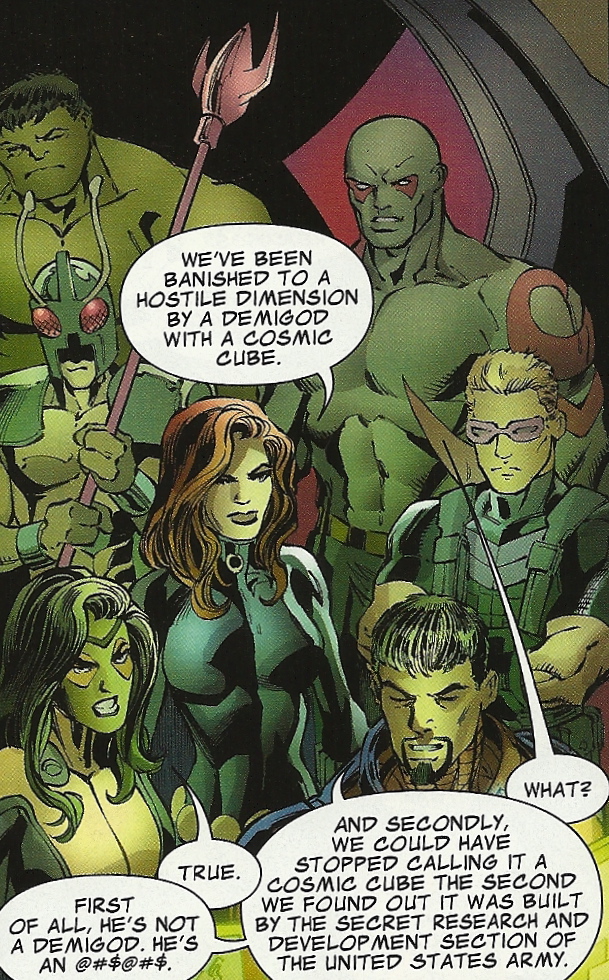
Finally, here's a rare (for this book, anyway) instance of Tony Stark Bendis-swearing:
What does he call Thanos? What can an "@#$@#$" be...? Well, we know it's a six-letter word, and the the second three letters are the same as the first three letters. What's a three-letter swear word...? Ass, right? That's all I can think of. So Tony says that Thanos isn't a demigod, he's an assass...?

Wait, that can't be right. Because they use the word "ass" in an earlier chapter, when the bald villain mentions having the power to kick Thor's ass. (Also, they'd be using both the "#" and the "$" to stand in for the same letter if it was "ass," and that doesn't make sense).

Okay, I give up: What's a three-letter swear word that isn't ass...?

Anyway, other than those scenes in which Black Widow, Rocket and Cap act like total @#$@#$s, I rather liked this one.

Thursday, November 15, 2012

Meanwhile, at Robot 6...

I wrote a few million more words about Fantastic Four #1, in the context of the book as part of Marvel's "Marvel NOW!" initiative. You can go read those millions of words here, if that's the sort of thing you're into.

Reading through the comments that were posted so far, I see that someone noticed a pretty dramatic error in the script: When diagnosing a mysterious injury, Reed "Mr. Fantastic" Richards says that it looks like the unstable molecules that gifted the Fantastic Four with their powers are starting to break down, and may ultimately kill them. In actuality, the FF's "unstable molecules" refers to the material that their costumes are made out of, and was long ago given as an explanation as to how their costumes can stretch, and turn invisible and appear and disappear when one flames on and off, I guess. The Fantastic Four themselves are not made out of unstable molecules.

Makes me feel extra silly for worrying about when dinosaurs became extinct in the Marvel Universe but missing that. But I guess I shouldn't feel too bad about it; I'm just some guy critiquing the book, it's not like I was paid a large amount of money to write the story or edit the book or anything...

Sunday, July 29, 2012

Pre-New 52 review: Justice League of America: Dark Things

Although the trade collection unambiguously declares this a Justice League story, it actually ran in both Justice League of America (#44-48) and Justice Society of America (#41 and #42, preceding the story covered in last night's post by about eight issues), and is very much a JLA/JSA team-up in the tradition of the old, annual convergences of the Satellite Era league and Earth-Two's Justice Society. Although it may not be immediately recognizable as such, given the fact that this version of the Justice League was then fairly new, and made up of characters one wouldn't normally associate with that team: Batman Dick Grayson, Donna Troy, Congorilla and Starman II Mikaal Tomas (with Supergirl, Jesse Quick and Jade joining by the end of this particular story arc, giving this Justice League lieutenant, and mostly female, versions of Batman, Wonder Woman, Superman, The Flash and Green Lantern).

Despite spanning seven consecutive issues of two simultaneously published titles, the whole shebang is by the same creative team of writer James Robinson and pencil artist Mark Bagley, seemingly the only pencil artist left in superhero comics capable of drawing at least 22-pages a month. Reading this right after something like JSoA: Monument Point, it seems like a remarkable feat that a monthly (or more) comic book story could have consistent art by the very same artist, and makes the story seem so much better by comparison to...just about every similar trade available.

Just as Blackest Night took its title from Green Lantern Hal Jordan's oath ("In brightest day, in blackest night/No evil shall escape my sight"), the title of this particular story comes from Golden Age Green Lantern Alan Scott's shorter, less elegant oath ("And I shall shed my light over dark evil, for the dark things cannot stand the light— The Light of the Green Lantern!"). It's a complicated (almost extremely so) affair, in terms of plotting, although, on the most basic level, it's also superhero universe toy box comics at their most fundamental—writers and artists picking whatever toys they want to team up and make fight until all the fights are fought and then the story can end.

There are a lot of characters involved. Beyond the four-to-seven Justice Leaguers, there's the huge roster of the Justice Society (which, when this was published in 2010, still occupied two books); there's villain Felix Faust's hero son Faust, who shows up to play the magic guy role on the team; there's the Shiloh Norman, Seven Soldiers version of Mister Miracle ("I'll be that seventh soldier who'll get you in there," he cheesily tells the six heroes attempting to storm the bad guy stronghold); there's Miss Martian, who is playing the generic psychic role that J'onn J'onnz would normally play, but maybe Robinson wasn't allowed to use the recently resurrected Martian Manhunter yet; and then there's Green Lantern Kyle Rayner, who shows up mainly because he had a relationship with two of the super-ladies involved and...well, that's the only reason I can think of why he's there (Well, actually, he's there on Green Lantern Corps business, since the villain of the piece is linked to Green Lantern history, but he comes solo, sans any partners, which seems off).

The nature of the plot also allows Robinson and Bagley to play with a bunch of other characters, many of whom appear only in one-panel cameos or in short fight sequences, like Etrigan the Demon, The Shade and Klarion the Witch Boy. Reading, I was curious how much of the plotting was actually driven by Robinson simply asking Bagley who he wanted to draw, as he they go pretty damn deep into the DC character catalog, and a Danger Room training sequence at the beginning serves no purpose other than to put a bunch of villains on a page. After the year-long Trinity with Kurt Busiek, this story arc and his short-ish run on JLoA, I'm pretty sure that if Bagley didn't get to draw every single DC character, he at least got to draw his favorite 200 or so.

So, the plot.

Recently resurrected (See Blackest Night) Jade crash-lands on earth, encased in a big green crystal she tells us is actually the Starheart, the source of her father Alan Scott's Green Lantern powers (which DC readers will know, and exposition will remind us, is all of the wild or chaotic "magic" in the DC Universe given form by the order and science-obsessed Guardians of the Universe; a chunk of it was used to make Alan Scott's lantern and ring). The four-man JLA and Etrigan, The Demon converge on the meteorite and fight.

Meanwhile, Alan Scott and his son Obsidian's comatose bodies are drawn to the site, the JSA in pursuit, while Faust arrives to dump info: The Starheart's presence on earth is driving all of the world's magic users and elemental-based super-types crazy, possessing them and causing them to wreck shit ("elemental" is here a broad term, which provides Robinson and Bagley and excuse to pick whoever they want to fight, like the solar-powered Power Girl vs. the solar-powerd Supergirl, for example).

The Starheart ultimately possesses Alan Scott, who then goes to the moon, builds a big citadel out of his Green Lantern energy, which is patrolled by an army of energy constructs, and the score or so of heroes must figure out where he is, storm his castle, subdue his constructs, and figure out how to get the Starheart out of him without killing him. While also fighting seemingly random characters chosen from Who's Who in the DC Universe, like Naiad, Hougan, Blue Devil and so on.

It's not bad super-comics, really, particularly if you already know and care about a lot of these characters and their histories and relationships, although it's not hard to imagine readers who don't know or care about them finding it impenetrable. There's a Crisis worth of characters in here, and while Robinson manages to utilize most of the Leaguers and the main JSA characters, giving them each something to do specific to their power- or skill-sets, there are a lot of characters who appear for pretty artificial reasons (like Mister Miracle, who is there because of traps, which the omnipotent Starheart set for some reason), and plenty of other characters appear as little more than background noise, with no dialogue, introduction or reason to be there (Basically, all of the JSA All-Stars).

Additionally, Robinson was working in the Meltzer-established mode for this book, in which every character constantly narrates, which means large passages of it read like a Chris Claremont X-Men comic, only instead of thought bubbles, which are of course passe, everyone gets their own narration box, which is "dressed" like them.

Most of the information conveyed is there only to provide color that could just as easily be accomplished through dialogue or implied through action, or is completely useless.

Take, for example, Donna's and Starman's thoughts on fighting Power Girl:
Would putting "Have T--" and "So Fast, C--" in a thought bubble or dialogue balloon really have hurt? Or leaving them out entirely, what would that have lost, exactly? What is gained, by having them there, aside from adding a layer of unnecessary information to a panel?

While that's a cherry-picked example of how useless some of the information Robinson chooses to convey in this manner are, check out these examples, which border on self-parody:
Other than that, though, it's all pretty decent, provided prior familiarity. The story moves along at a fast, occasionally break-neck speed, and the panel lay-outs help keep that pace going; Robinson and Bagley use splash pages right, to emphasize big moments in the story, and find fairly inventive ways to spread images across spreads without wasting all of that space. There are times when the narrative moves left to right across the spread of two pages, instead of staying on a single page before moving to the next.

Bagley's style is about as different from George Perez's as you can get, but, like Perez, he excels at drawing crowds of heroes either standing around or doing heroic things, and he does a pretty fine job at distinguishing characters from one another, no easy feat given the abstraction of his character design (compared to Perez's). A lesser artist, or an artist who simply didn't possess Bagley's particular virtues, could easily have been broken by the story, but he not only survives it, he sells it on every page.

So, where did everybody go from here a few months later, when "The New 52" hit...?

Well, let's see...

JLoA lasted another few story arcs, "Omgea" drawn by Bagley and then artist Brett Booth joined Robinson to finish the book's run with a shitty "Return of Doomsday" tie-in and a "Rise of Eclipso" arc (which I haven't read yet, although it looks like Bagley didn't actually finish drawing it, based on the cover credits). It was relaunched with a new "Year One" type story by Chief Creative Officer Geoff Johns and Co-Publisher Jim Lee, to massive sales (and thudding critical reception; I read the first four issues, and they were some awful, awful comics).

JSoA lasted two more trades' worth of story arcs, Super Town (which I haven't read yet) and Monument Point (again, discussed last night). It and all of its characters, save Mister Terrific, were wiped out of the DCU, and are just now starting to be reintroduced in the book Earth 2, which sets them in an alternate universe parallel to the DCU, a la the Silver Age/Bronze Age conception of the team.

Robinson was MIA for a bit in the New 52, with DC releasing a Shade series he wrote that seems to be set in...both the pre-reboot DCU and the New 52iverse...? I don't know. Then his Earth 2 debuted, and he also penned the first issue of a Masters of the Universe miniseries for some reason, that DC is publishing for some reason.

Bagley left DC to return to Marvel, where he re-joined Brian Michael Bendis for some boring-looking movie-pitch comic that doesn't seem to play to his strengths, and Avengers Assemble, which probably does, but who knows...$4 for 20-to-22 pages of Bendis and Bagley and a bunch of ads for Spider-Man candy, fishing rods and bedding? No thanks.

Let's end on a positive note though, shall we...?

I like the way Bagley draws Wildcat costume, with droopy ears and whiskers:
Looks a little like he was caught in the rain. Also, it looks hairy, which would probably make for a pretty scary encounter. Like, guy in a cape dressed like a giant bat swooping out of the shadows on you? Yeah, that's scary.

Unshaven guy in a hairy cat suit running out of an alley or jumping off a motorcycle throwing punches at you? That's give-up-a-life-of-crime-immediately terrifying.

At one point in the story, siblings Jade and Obsidian become one being, an unspoken, creepy desire of Obsidian's that tended to radiate off the pages in a lot of their old comics appearances. They look kinda cool like that, though:
Particularly when in action: