A Big Guy Took My Ball! (Hyperion; 2013): Either I don't do these posts often enough, or Mo Willems is just too prolific, because it seems like every time I do one of these, there's at least one of Willems' books included. Wait, what am I saying—Willems? Too prolific? Impossible! I could probably read Willems books all day every day, especially entries in his Elephant & Piggie series of starter reading books, which feature some of the all-around best cartooning you'll find pretty much anywhere you look for high-quality cartooning. I mean, just look at the cover, and the way the illustration tells so much of the story that the title does and doesn't; Gerald and Piggie's postures and expressions tell you their exact reactions to the incident and how they intend to cope with the conflict, and the whole thing looks like it was drawn with a well-sharpened black Crayola crayon!
The fine-print summary on the first page sort spoils the entire story, which I will strive not to do, as the species and specific identity of that "big guy" are quite a surprise, and the main narrative pleasure of this entry in Willems' long-running series. Suffice it to say that the big guy isn't just big in comparison to the rather diminutive Piggie, he's also big in comparison to Gerald who is, remember, an elephant ("That is a BIG guy," Gerald tells Piggie, "You did not say how big he was. He is very BIG").
So what kind of animal is that much bigger than an elephant? Well, the options are limited, and it's neat to see Willems draw this new animal in his series, and to see it sharing page space with Gerald and Piggie, who Willems must render very, very small. I also like the way the big guy's dialogue is all in large font, all-caps.
There's likely a lesson in here about getting along with others who are different from you, not judging books by their covers (metaphorically; you can literally judge this very good book by its very good cover) and sharing and playing together. If you're still young enough to need those lessons. For the rest of us, its instructive in the same way most Willems books are—as an example of world-class cartooning, a demonstration of how one can tell a great story for an audience of any age and for a lesson on the effectiveness of timing in comedy.
The Boy Who Cried Bigfoot (Simon & Schuster; 2013): This book written and illustrated by artist Scott Magoon (Whose name you may recall from reviews of his excellent Spoon and its sorta sequel Chopsticks, both with writer Amy Krouse Rosenthal, which I've reviewed here before; or maybe from the many other books he's written and/or illustrated that I have not reviewed here before).
Its inspiration comes, of course, from the story of the boy who cries wolf, only this boy, Ben, cries the name of a much a more exotic mammal than that of wolf.
Magoon sets most of the story at the edge of a little wood, where Ben and his little dog set up shop. Ben repeatedly cries "Bigfoot!" (sometimes in big, hairy lettering) and his family and neighbors and passersby come to the edge of the wood to see the imaginary Bigfoot, and Ben continues to do things to drum up interest and belief in his tales of Bigfoot, including hoaxing footprints.
As with the boy who cried wolf, Bigfoot eventually does show up, but at a point at which no one believes Ben. Rather than eating all his sheep or killing the boy like the wolf did—the wolf did kill and eat the boy too, right? It's been a while since I've read or had that story read to me—he just steals Ben's bike and dog (Naturally "Bigfoot is stealing My Bike! And my dog!" didn't bring anyone running).
It imparts pretty much the same story as its inspiration, with the same lesson, only with less violence, less aspersions cast toward any poor wolves and with the added benefit of Bigfoot, whose inclusion in pretty much any story of any kind generally improves it. I really like Magoon's artwork, and it's nice to see it applied to some human characters, the natural world and, of course, to the title character, who fits a nice, cartoony, child-friendly version of the most popular descriptions of the legendary beast.
I'd be really interested to hear what a real Bigfooter or enthusiast or believer thought of the book, and if they found the parallels between them and Ben that Magoon suggests as innocent, amusing coincidences, or as jibes (I'm assuming it's the former, as Magoon seems to have a place in his heart for such cryptid creatures; he's previously illustrated a book about the Loch Ness Monster too).
Cat Secrets (HarperCollins; 2011): Like Jon Stone's classic Grover-starring The Monster at the End of This Book or the aformentioned Mo Willems' Don't Let the Pigeon Drive the Bus, Jef Czekaj (of Grampa and Julie: Shark Hunters fame, comics people) has his protagonist directly address the reader in a story that is almost purely participatory and which is about the conversation between character and reader more than anything else.
Here, a trio of cats are about to open up and read or discuss the contents of a big, red, locked book entitled Cat Secrets, but before they do, they have to make sure no one other than cats are reading the book the reader is holding in their hands. To do this, they present a small battery of tests to prove that they are actually cats, the surprise final test being "taking a cat nap."
Apparently, then, this book is really one meant to be read to a small child right before they (probably reluctantly) go to take a nap. That's kind of brilliant, actually, and I do wonder if it would work. Probably the first time, but I wonder how many kids will request the book they know leads directly to a nap the second time.
Cheetah Can't Lose (HarperCollins; 2013): This book by EDILW favorite Bob Shea stars an arrogant cheetah and his two little kitten friends, who have organized a very special series of competitions for the day of "The Big Race."
"Which big race?" Cheetah asks the little orange and blue kittens, whose dialogue appears in blue and orange type, or when they both say the same thing at the same time, in words that alternate blue and orange capital letters, "The one I always win because I am big and fast and you always lose because you are little and cats? That big race?"
The cats have "lots of races so everyone can win," but Cheetah sees it as an opportunity for him to win them all...and he does! But some of them are pie-eating and ice-cream eating races, and some have prizes like "special winner shoes"/cardboard boxes, so by the time comes for the actual big race, the good old-fashioned who-can-run-the-fastest race, Cheetah's not really in any shape or dressed properly to beat anyone, whether he's the fastest land animal on earth or not.
Luckily, absolutely no lessons are learned—well, other than maybe an implied lesson about brains being as important as size and speed, or to not be too arrogant or too much of braggart—and Cheetah remains Cheetah throughout, suffering no real comeuppance that he's even aware of. There's a twist following the twist, making it a doubly charming story.
Chu's Day (HarperCollins; 2013): Neil Gaiman is another writer who apparently writes a lot faster than I can read, and while a decade or two ago I read every word he wrote for public consumption, now I'll quite often come across a book of his that I had no idea even existed until I found it in my hands.
Such is the case with Chu's Day, which Gaiman wrote and artist Adam Rex (responsible for the incredibly illustrated Frankenstein Takes the Cake and Frankenstein Makes a Sandwich, among a bunch of other stuff) illustrated. Chu is the name of a little panda in a world of gorgeously-rendered anthropomorphic animal.
While the title is a kinda clever play on Tuesday, I'm afraid the joke of Chu's name is of much older, less amusing and potentially even offensive vintage. See, Chu is quite a prodigious sneezer, to the extent that he wears a little old-fashioned aviator's helmet and goggles, which he securely places over his little eyes when he begins to "aah- aaah-" before a sneeze.
That's right: He's named Chu, as in "Ah Chu"...although the "Ah" is never assigned to him explicitly in the book.
The story is, as the title says, of his day, which includes going to a series of three places with his parents, being exposed to a potential sneeze-trigger, and managing to stifle two of the three sneezes, the third of which meets the promise of the first line of the story: "When Chu sneezed, bad things happened."
It is, of course, beautifully illustrated, and, as a guy who works in a library, I really appreciated the two-page spread of what the library looks like...
...right down to the little details like the animal ears and snout on the figure in the "library" pictogram and the fact that while the card catalog cabinet is still there, it is now manned—moused?—by mice with computers.
I particularly liked the ladder on wheels though. My dream library job entails one where I get to climb up and down such a ladder.
The lame old Asian stereotype gag of Chu's name aside, the story is a decent one, but is rather disappointing, knowing it's source. Gaiman is a great writer, one of the best, in more than one medium, and this is, from him, a rather pedestrian effort.
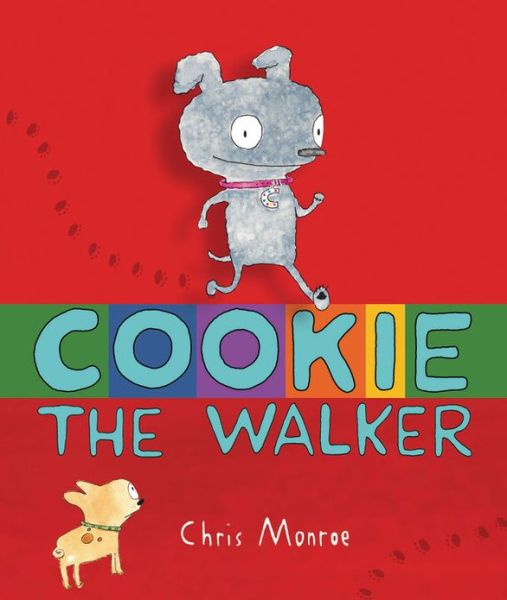
Cookie The Walker (Carolrhoda Books; 2012): Another new book from another favorite maker of children's books, this one's from writer/artist Chris Monroe (Sneaky Sheep, the Monkey With a Toolbelt series), and is one of her better books (Of interest to comics readers perhaps is the fact that this, like her previous works, are told in large part in comics, with panels and dialogue balloons and everything).
Our star is Cookie, a dog who walks, but not on all four legs. As she explains to her friend Kevin on page two, it is not uncomfortable at all, "And it's very handy!" On her hind legs, Cookie can reach the candy dish, look out the window, get herself ice cubes from the ice maker on the fridge door, and more.
What's more, people really seem to like looking at her walking on two legs ("It is pretty cute I guess...")
Soon, her walking on two legs draws the attention of a famous dog trainer, and Cookie gets a job, which brings with it fame and treats. One gig leads to another—a dog show, the circus, reality TV—and the more famous she gets, the more treats she gets, but all that fame and all those treats come at a great price, as she misses aspects of her life before she became Cookie The Walker, something Kevin reminds her of whenever he comes to visit.
Will Cookie throw it all away to walk on all four-legs again? That's the drama of the story, which is wonderfully illustrated with thin, slightly wiggly lines and delicate water-colors. Monroe excels at montages, and filling them either with a great deal or detail, or simply funny little riffs. Here's a page in which we see Cookie as "a big TV star," appearing in various generic reality TV roles:
I particularly like the ghost-hunting one.
Cookie The Walker is another great book from a great maker of great books. If you're only going to read one book discussed in this post, well, that's a silly and arbitrary rule to follow, but this might be the one you should choose to read.
Well this one, more maybe this next one...
The Dark (Little, Brown and Company; 2013): Writer Lemony Snicket teams with artist Jon Klassen (I Want My Hat Back) for a dream-team collaboration. The subject matter? One close to the heart of all children everywhere, as close to their little hearts as that which chills them. One of Snicket's better (and probably most serious) children's books, he writes about the relationship between a little boy named Laszlo and the dark, which lives in Laszlo's basement (although it is often nearby, in corners and closets and, of course, at night, it leaves the basement to spread itself all over the house).
Snicket quite elegantly writes every single, simple line, and he does so in such a way that most of them can have two meanings, so that what he writes is, in one way, quite literally true, but also sounds semi-mythological (like everything does in childhood).
Klassen's art pulls off a very neat trick, depicting Laszlo and the dark's house as "a big place with a creaky roof...and several sets of stairs" as a place unmoored from a particular temporal or geographical setting (this could be your house, and probably is), and of depicting the same locations within the house during the day and during the night, in the dark, in the light, and the dimness in between, transforming them as the dark transforms things, usually for the worse when you're a child. The words are arranged just so on many of the pages, the lettering itself shifting from black to white (depending on whether the page is light or dark, for a sort of perfection of impact (the line "it did," for example).
It's rare to read a book as an adult that speaks so directly and eloquently to the little kid you used to be. It's rarer still for me to read a book, wish I would have read it when I was a little kid and spend very much time at all wondering how that book and that act of reading it might have changed me for the better.
Hen Hears Gossip (Greenwillow Books; 2008): This picture book written by Megan McDonald is essentially a game of telephone framed as gossip being spread across the barnyard. Hen, who loves gossip, hears Cow and Pig talking, and tries to overhear their news. When she (mis)hears it, she runs to her fellow barnyard birds (apparently, the birds all gossip and hear worse than the mammals; I guess the latter may be because they lack exterior ears?), and the news is changed to something increasingly ridiculous, until it comes back as something insulting to Hen herself. The birds then trace the gossip back to its source, investigating each spurious claim (like the cat grew a horn, for example), until they find the truth.
It's a cute "gossip is bad" sort of story, one that offers a lesson that's probably as important to folks that work at libraries as it will prove amusing to little kids who visit libraries for picture books, elevated further by artist Joung Un Kim's delightful artwork, which seems to be assembled of mostly-painted over, re-used papers and cut-up shapes of wallpaper, so type-written words or the music from sheet music will appear along the edges or show through the art. Here are some examples, clipped from the pages and thus, unfortunately, alienated from their context.
I like it a lot. I also like the way she draws some the bipedal characters, like Duck's posture in this image:
The Kindhearted Crocodile (Holiday House; 2008): Writer Lucia Panzieri and artist AntonGionata Ferrari collaborate on a large, sharp-toothed, ferocious-looking crocodile who had a very kind heart (as is noted in the title) and whose dream in life was to become a family pet, like a goldfish or a puppy. Unfortunately for the crocodile, families tended to prefer goldfish and puppies to keeping one of the world's largest and most dangerous predators around the house, so he had to hatch a plan so weird it kinda blew my mind, and I'm still trying to figure out exactly how it worked.
The crocodile snuck into a family's house at night through the pages of an innocent-looking picture book called The Kindhearted Crocodile (Hey! That's this book!) and proved how helpful he would be by picking up, washing the dishes and suchlike. Curious to see who the mysterious, night-time housemaid was, exactly, the family hid, and were surprised when rather than the expected elf or goblin, a crocodile crawled out of a book to do the housework again.
The kids were immediately cool with the croc, as they knew him from his book, The Kindhearted Crocodile, but what was the story of that book, if it deviated so much from the story of the story book, which features the book itself in a pivotal role so very early on? And is the premise that there's only one such book, rather than a bunch? Because, otherwise, would the crocodile be able to crawl out of any copy of The Kindhearted Crocodile? If so, why didn't he crawl out of my copy? While I don't have any toys lying around that need picked up, I pretty much always have dirty dishes that need doing and laundry in need of folding, and I sure wouldn't object to a large reptile bringing me toast and jam and a cup of coffee every morning. What's the deal, crocodile? (And did he aks Panzieri and Ferrari to put him in this book, as a means of sneaking into the family or familes' homes...?
So many questions!
No question it's a great looking book though. Ferrari has a slightly sketchy style and composes figures with sharp, bold, energetic lines. The coloring isn't exactly haphazard, but it's not exact, either, and the crocodile's skin color changes like that of a chameleon, usually some form of speckled green, but sometimes he adopts very un-crocodilian colors, particularly when doing something domestic.
There are a few night scenes which are colored almost all black (the only color being the characters), while the lines the make up the house and furniture are drawn in white (and the color of type is white as well). It's a great-looking book.
The Little Matador (Hyperion; 2008): Writer/artist Julian Hector tells a simple tale of a little boy from a proud family of matadors (boo!), who had a secret passion for drawing that he hid from his parents, who expected him to grow up and carry on in the family business (so much so that they dressed him up like he was in the ring, like, every day; his dad similarly dressed like a matador dresses for work in every image, while his mom just dresses like a fancy Spanish lady—are ladies not allowed to fight bulls? Not that anyone should fight bulls, really). What he likes to draw best is, of course, animals.
I hesitate to say anything more about the plot, but it is, in one way, an echo to Munro Leaf's The Story of Ferdinand, only from the perspective of a bullfighter who doesn't want to fight bulls, rather than that of a bull who doesn't want to fight bullfighters.
Hector's artwork doesn't look much like that in the story of Ferdinand, of course, being much simpler and more abstract, and with very warm colors.
Otter and Odder: A Love Story (Candlewick Press; 2012) How's this for a Romeo and Juliet story? One day Otter, an otter, is looking for food and seems to find it when he finds a fish, but when he looks into the fish's eyes, he begins to fall in love, and asks the fish her name; she says "Gurgle," which he takes to be "Myrtle," and while she was simply looking not to be food, when she looked into Otter's eyes, she fell in love, too.
"Impossible," Otter tells himself, "I am in love with my food source."
Naturally, complications arise, although they mostly consist of otter society gossip and Myrtle's pleading with her otter not to eat her friends and family. Despondent, he swims off until he meets a wise beaver, who offers him an apple, which Otter refuses, asking Beaver if he's ever eaten a fish: "No," said Beaver, "but I suppose I might if I ever fell in love with an apple."
I suppose you can guess where writer James Howe's story goes from there, the writing is simple, but also clever and rather elegant, with almost every word chosen for usage being a word that really counts. After a few complications, it does finally reach a "happily ever after," presumably because neither Otter nor Myrtle want children.
The most striking aspect of the book is artist Chris Raschka's artwork, which is of a very studied, child-like look, in which the fish are triangle-on-oval simple, and the otter's head and body are a figure eight, his tail another, smaller figure eight. The entire thing looks done in crayon, as as if by a child (although the consistency of the imagery and design from page-to-page would make that fairly impossible. Even more simple shapes are used for backgrounds and animals without speaking parts.
That Is Not a Good Idea! (Balzer and Bray; 2013): Hey, it's Mo Willems again!
This non-Gerald & Piggie, pigeon-free* book from Willems is told in a form inspired by a silent movie, a particularly odd choice for a children's book, but then, getting that particular reference isn't necessarily necessary when it comes to enjoying the plot of the book, which revolves around a big, shocking (no seriously; I was genuinely shocked) ending.
A page of art, starring a well-dressed fox and a goose, will be followed by dialogue in an old-timey font, the white text atop a black, silent movie-style title card. The artwork featuring the goose and fox is in full-color, deviating somewhat from the illusion of a silent movie.
As the male fox courts the female goose, inviting her back for a walk in the woods, and then back to his place, and then for soup, a group of goslings, which Willems draws like yellow tennis balls with beaks, dot eyes and triangle wings, yell back at the movie, variations of the title.
For example, when the fox asks the goose, "Would you care to continue our walk into the deep, dark woods?" and the goose replies, "Sounds fun!", Willems will shows us a two-page spread of the goslings, one of them shouting "That is REALLY not a good idea!" at the "screen," as if they're watching the movie the fox and goose are starring in. Kinda like people watching a horror movie and yelling to the protagonist not to go into the basement alone.
The ending is something of a surprise, although there are actually a couple of surprises all braided together into it, none of which I should even think about spoiling here.
Suffice it to say that this is a new Mo Willems picture book, and it's hard to imagine anyone needing much more information than that to know if this is a book for them or not.
This Is Not My Hat (Candlewick Press; 2012): I Want My Hat Back's Jon Klassen further establishes himself as the number one creator of picture books about small animals stealing hats from larger animals. The differences between this book about hat theft in the animal kingdom are many.
First, it's told from the perspective of the thief, rather than the victim. Second, it takes place under water, the cast including only the thief (a fish), the victim (a much bigger fish) and a witness (a crab). And third, the hat is a little, blue derby rather than a little red, conical hat.
Like, I Want, it is very funny, and Klassen does an incredible job of showing big or slight shifts in emotion with slight variations of the drawings of the characters, as when the large fish, for example, wakes up, realizes his hat is missing and we see his immediate reaction.
I'm glad Klassen won the Caldecott for this, because he's a great artist and a funny writer and desrves all the medals he can get, but boy does it's placement really transform that cover, as not it looks like the hat-thieving fish is fleeing not the scene of the crime, somewhere in the deep, black, mysterious ocean, but is instead fleeing the Caldecott medal. Did he steal the Caldecott's hat...?!
*Save for the now customary, half-hidden cameo, of course
Showing posts with label chris monroe. Show all posts
Sunday, July 21, 2013
Saturday, March 03, 2012
Some picture books of note:
Sarah Dyer’s book about a bat named Batty trying to fit in with the other animals at the zoo is refreshingly disorienting, as you can tell simply from the cover, on which her name is upside down. Actually, Batty and the title are upside down in the picture, but the cover is right side up.
The images on the pages will either appear upside down or right side up, depending on whose point of view Dyer is showing us the images from—the reader’s own point-of-view, or Batty’s (the text similarly gets turned upside down at times, and the text on the back cover and back cover flap is also upside down.
Batty isn’t the most popular animal at the zoo, we’re told, as “All he can do is hang upside down.” Determined to become as popular as the other animals, Batty flies from exhibit to exhibit, seeing what the other animals are doing, and trying to fit in.
Each mini-adventure begins with a two-page spread of Batty taking in the animals’ activities—the penguins play water sports, the lions tan and lounge—followed by another two-page spread in which Batty attempts to join them and finds a reason why he can’t—he doesn’t like the gorillas searching his fur for fleas, the exotic birds are too loud for his sensitive ears—and so on.
After sadly flapping back to his home enclosure, Batty learns there is something he can do other than hanging upside down, something that results in one being rather popular.
Dyer’s artwork has a lovely homemade, almost primitive or folksy look to it, although that tone belies the skill that went into the designs and “acting” of the characters.
The illustrations are done with pencils and pastels, although some of them look like figures were cut out from one type of paper and put atop another type of paper. (I’d show you an example, but the fine print is extra-pissy sounding about anyone transmitting any images for any reason).
Dyer draws great animals, especially tapirs, who only make a cameo. You can see her lions, fleas and a monkey and a gorilla here.
Alex Beard’s picture book is a depressing one, from it’s opening lines to the educational information about African wildlife in the back.
Those opening lines are these:
On the banks of the Mburu River in Africa, Crocodile lay in the sun.
He opened his eyes and began to cry.
Isn’t that the worst? When you wake up and begin your day by crying? Poor crocodile. What’s his deal, exactly? It’s severe depression, right? That would be my diagnosis.
Rhino and Tickbird also want to know why Crocodile is crying but, afraid to ask him themselves (since crocodiles are such dangerous predators), they decide to ask a Gold Eagle, which is very rare in Africa these days.
The Gold Eagle doesn’t know either, but he suggests that perhaps Crocodile is crying because he misses the huge herd of elephants that used to live in Africa, and suggests the pair ask an elephant, “if you can find an elephant.”
Because elephants are so relatively rare now, it takes them a while to track one down, but they eventually do, and the pattern repeats over and over: Each new animal doesn’t know, but suggests that it may be because Crocodile misses some pleasurable aspect of some indigenous wildlife which is disappearing, and suggests to Rhino and Tickbird that they find one of those disappearing animals and asks one of those animals.
Finally, after learning of all sorts of wonderful animals that aren’t around much, and how it’s getting harder for the animals to be themselves these days, as a last resort, Rhino breaks down and just asks Crocodile, at which point Beard teaches us another new and less depressing fact about an African animal, and offers a refreshingly unexpected end to a story that grew wearyingly predictable.
Unfortunately, Beard walks back the finality of that ending in a two-page coda that shares space with Beard’s author’s note.
I liked his art work, which despite being somewhat flat and lacking in the sorts of textures or highly-idiosyncratic design sensibilities I’m usually most attracted to, does boast a noticeable African art influence, and thus looks a bit like a compromise between storybook naturalism and African art renderings of the animals.
The subject matter is depressing as hell, but merely because it reflects the reality of the dire straights so many animal species—even the big, beautiful, well-known animals scientists refer to as “charismatic megafauna” are in today—not because of any inherent weakness in the story.
It includes a two-page glossary of animals, in which each of the many animals encountered in the story are shown in photograph (allowing a careful reader to easily examine the choices Beard made in transmitting them into his style) and given a paragraph explaining a bit about them and how their behavior and depiction in the story lines up with their real behavior. Almost all of them are either endangered, or their populations are dwindling enough that there’s cause for concern.
A share of the proceeds from Crocodile’s Tears goes to the Shompole Community Trust, an animal preserve in Kenya that the Maasai people oversee. I saw that note on the inside cover flap after borrowing the book (for free) from the library, and thus my reading it didn’t help the preserve or the animals that live in and around it in any way, shape or form, and so I learn that, once again, I am a jerk.
(I similarly felt like a jerk when I ordered the War Child Presents Heroes album through inter-library loan because I wanted to hear The Like’s cover of Elvis Costello’s You Belong To Me, only to discover the album benefited children affected by war, and I probably shoulda just bought it, because I a too am pro-child and anti-war. I like The Like; that’s a decent anthology too…all covers of songs from great, older artists by mostly pretty good younger ones, like Scissor Sisters covering Roxy Music’s “Do The Strand” and The Yeah Yeah Yeahs covering The Ramones, Beck Dylan, Peaches The Stoooges and so on).
This is a children’s picture book by Charise Mericle Harper, the lady responsible for the popular Fashion Kitty books, which I didn’t realize when I first picked it up, because I wasn’t looking at the author’s name on the cover, only at the super-cute cupcake on the cover and thinking, “What a cute cupcake!” and “Boy, I sure would like to eat a cupcake…”
This is the story of Cupcake, a cupcake. “After a special coat of icing,” he became Vanilla Cupcake, and met his new brothers and sisters, seven different cupcakes with different flavors and elaborate decorations.
At the end of a party, Vanilla Cupcake is the only one left on the table, and he’s pretty bummed out because nobody picked him (I guess he doesn’t know that the other were picked to be eaten alive and then slowly digested).
A little green Candle sees Vanilla Cupcake crying, and can relate to his angst over being “not fancy…just plain and white and ordinary.”You see, there’s a whole bunch of fancy and elaborate candles these days too.
Candle decides the thing Cupcake needs is a very special topping, and so he sets about finding various things in the kitchen to put on top of Cupcake in the hopes of finding the right topping. You can probably guess what the most special topping could be, one that could solve both Cupcake’s and Candle’s problems…but that’s because you’re smart, and Candle is not, and so the book humorously ends without Candle ever arriving on that idea.
There are recipes for “Deliciously Plain Vanilla Cupcakes” and “Deliciously Plain Buttercream frosting.”
You might want to ask your mom to help you make them. And you’ll definitely want to ask your mom to then bring me a couple, as I was serious about wanting that cupcake in the first paragraph.
I find picture books like this one fascinating. Though it looks like a picture book on the outside, with its hardcover and large size, on the inside it’s a straight-up comic book. Not any sort of prose/comics fusion, it’s just a comic book—there’s not a single image that doesn’t appear in a panel, with most pages being divided into traditional comic book page grids, there’s not a single word of narration that doesn’t appear in a narration box atop a panel, and there’s not a single line of dialogue that takes place outside of a dialogue bubble.
It’s a comic book that sells for the price of a picture book…and boasts the durability of a picture book.It’s written by first-time author Laura Murray, a teacher from Toronto who based this story on a real event that occurred in her classroom. It’s drawn by Mike Lowery, who is responsible for the charming illustrations in the rather charming Ribbit Rabbit.
The story is a sort of riff on the classic story of the Gingerbread Man (of which there are so many among modern children’s picture books that I’ve lost count of them). Here it’s not the Gingerbread man who’s being chased, however; he’s doing the chasing—the grade school class who made him have disappeared (they actually just went to recess) and he bolts out to find them.
Between meeting the gym teacher, school nurse, janitor and principal, he declares variations of, “I’ll run and I’ll run, as fast as I can. I can catch them! I’m their Gingerbread Man!”
I imagine kids will dig the story a little more than I did, but I absolutely loved Lowery’s art, and it had little to do with the fact that he illustrated this thing as if it were his own personal mini-comic, save with “traditional screen printing, and digital color.” (The artwork looks as if it were drawn with an old-school ink pen, the lines assured but uncertain, as if made without the benefit of a straight-edge, and the color looks like it was applied with imprecise watercolor painting—I guess that’s simply an affectation of the artwork, but it’s a rather accomplished affectation).
Do take some time to poke around his website; there’s a lot of great art on it.
Plus, of special interest to those of us with affection for the medium of comics and a love of Batman, is a nine-page comic strip entitled “Batman: Fighting and Stuff” that he did:
It’s stuff like this that makes me lament the fact that DC didn’t follow their hardcover Bizarro anthologies with a monthly, 24-page Bizarro Comics monthly, featuring three, eight-page-comics from artists like this telling stories like these.This book was recommended to me by a person who had previously had it recommended to her, and now I’m going to recommend it to you.
It’s written and illustrated by Jon Klassen, the artist responsible for illustrating the charming Cats’ Night Out (discussed in this previous post on picture books).
It is the story of a bear, a bear who had a hat. This bear has lost his hat, and, as the title says, he wants his hat back.
Making wonderful use of white space, Klassen draws the bear standing on its hind legs in a void, a few flecks of dirt and rocks and some weeds signifying the ground he’s standing upon. The look on his face is the same you see on the cover—blank, guileless, emotionless.
On the facing page is the bear’s dialogue.
Short, declarative and to the point—not a word wasted.
Suck on that, Ernest Hemingway. The bear’s search goes like this: He asks a woodland creature if that creature has seen his hat, and the creature says no.
Klassen draws the bear over in the same pose, with the same expression, standing in front of various animals asking about his hat (A fox, a rabbit, a turtle, etc.)
Depressed at his failure to locate his hat, he lies on his back, and thinks sad thoughts, until he has a moment or realization—a moment that will come to him long after readers, even very young ones, will have solved the mystery of the bear’s missing hat.
Klassen’s illustration of this moment of epiphany is spectacularly effective—suddenly, the white page turns red, the bear’s blank eyes widen slightly, and he’s sitting straight up, having bolted upright from a prone position in the time it takes you to turn the page.
What happens next is surprising, not only in its implication violence (of the natural predator/prey variety), which one rarely sees in modern children’s picture books, but in the subtle way Klassen tells us what happens without actually showing it, and then the second climax which calls back to an early gag. This book’s a masterpiece, if that’s not too strong a word for a simple, funny picture book about a bear that wants his hat back.
This is Daniel Roode’s sequel to his 2011 book Little Bea, which starred a poorly-named bee, who is actually quite large (for a bee).
The plot is almost identical to that of Bear in Long Underwear, save for the long underwear sub-plot. Bea and her woodland animal friends—most of them are even from the same species that appeared in Bear, although Little Bea doesn’t hang out with any sasquatches—look outside one day, see that it’s snowing, and go out and play in the snow. Sledding, skating, snow angles, snowball fights, snowman-building, hot chocolate—the works.
That’s actually the whole story. Little Bea and her friends play in the snow. Who cares? I care.
And why do I care? Because look at how goddam cute these animals are!

I could eat Roode’s bear and fawn, they’re so goddam cute.
A Penguin Story (HarperCollins; 2009)Antoinette Portis' Penguin Story is all about color, and the lack thereof.
Her protagonist, Edna, is a penguin, and accustomed to a life of just three colors: White, like the snow and ice and faces and bellies of her fellow penguins, black, like the night sky and the backs and limbs of her fellow penguins, and blue, like the ocean and the sky.
"There must be something else," Edna thinks and, one day, she sets out on a quest "for something that's not white, not black, not blue."
Eventually she finds it.
Edna discovers orange when she comes across the camp of some scientists, and leads her whole community back to meet them and revel in orange. Eventually they leave, gifting Edna with an orange glove, and this satisfies Edna and her penguin fiends. But Edna can't help but wonder, if there's this, what else can there be?
Portis' super-simple artwork exaggerates the monotony of the Antarctic palette, her penguins resembling slightly elongated gumdrops, the back half black and the front half white, with only two dot eyes, a tiny black beak, tiny stick figure-like feet, and wing and tail fins. They're so simple, they consist of only one big curved line, one to three little curved lines (depending on the angle), six straight lines and two dots. They're cute as the dickens, and the limited detail of their faces allows for rather dramatic emotions to be projected upon them, the simple, declarative texts suggesting what mush be going through Edna's head, behind her rather blank face.
Portis is best known for her Not A Box, something of a modern classic. A Penguin Story deserves to be one too.
Author Chris Monroe seems especially adept at selling picture books—to me. The combination of her titles and cover images seem to be all it takes to get me to pick up on of her books, and take it home to read as soon as possible.
Monroe is the author of Monkey With a Tool Belt (and Monkey With a Tool Belt and the Noisy Problem) which featured an ingeniously awesome and suggestive, even portentous title, accompanied by a drawing showing the very same, an image as awesome and suggestive/portentous as the words in the title.
Here's another: Sneaky Sheep, with a cover image showing two sheep so sneaky they're barely even on the cover.
This is at least a good a book as either of the Monkey With a Tool Belts, although it's probably narratively stronger than either, and simpler in conception and execution. And, as with those books, Monroe proves to be an incredible cartoonist—she draws very well, packing a great deal of emotion and suggested tension and drama into her fairly simple designs, and her drawing are funny.
The title characters here are Rocky and Blossom, a pair of little sheep who live among their flock in a meadow on the mountain. Unlike their 147 peers, Rocky and Blossom don't like staying in the meadow, and would rather explore...especially the high meadow, way on top of their mountain.
They're tended by a cheerful sheep dog named Murphy, who never lets any sheep leave the meadow. Being sneaky, Rocky and Blossom are constantly attempting to elude Murphy and make their way to the other meadow, but he always catches them and returns them safely.
When they finally do elude him, near the climax of the book, they learn one of the many good reasons they're not supposed to leave their own meadow when a wolf approaches them.
Here Monroe is quite masterful at pairing her words and pictures, so that the text may say something rather simple if suggestive, and the images will riff on that suggestion into a dozen or so jokes, most of which are funnier the more you think about them.
For example, there's a two-page spread in which the text reads only:
Murphy would shake his head.
Murphy knew a few things about Rocky and Blossom.
They had been known to make some bad decisions over the years.
Here's the right half of the spread, illustrating some of their bad decisions:
The acing page shows them doing things like running with the bulls and skating on a skateboard ramp clearly marked "Helmets Required" without any helmets on. All of the expressions Monroe draws on her sheep are pretty funny, but I especially like their sneaky faces:
In addition to the somewhat vague, nebulous interrelation between verbal and visual components that picture books share with comic books, Sneaky Sheep borrows direct, concrete comics elements from time to time, putting the characters' dialogue in dialogue bubbles (the lettering of which seems to be done in Monroe's own hand, while there's a all-caps, mechanical font on the narration), and comic-like panels. Some pages are divided into panels and, on some, Rocky and Blossom run in, out and around those panels in their sneakiness.
I liked her Monkey books an awful lot, but I like this book even more. I was initially attracted to this book by the mournful cover, in which a sad-looking spork regards his own reflection in the surface of a shiny toaster—given the title, I could even guess at the nature of Spork's conflict, and why he felt the way he did.
And guess, correctly, it turned out.
"Spork was neither spoon nor fork," writer Kyo Maclear's text tells us on the first pages, "but a bit of both."
It turns out that Spork was the result of a mixed marriage (his mom was a spoon and his dad was a fork), which means the book is an exploration of a rather bluntly stated extended metaphor for biracial children...and/or any kids torn between two different cultures or groups, that doesn't feel they really fit in with either.
Check it out:
In his kitchen, forks were forks and spoons were spoons. Cutlery customs were followed closely. Mixing was uncommon. Naturally, there were rule breakers: knives who loved chopsticks, tongs who married forks. But such families were unusual.
Those lines fall on the second half of a two-page spread, in which we see various anthropomorphic dinnerware strolling around contentedly, spoons with spoons and forks with forks, with a few oddballs, like a smiling tea cup and tea pot watching the passersby, and the aforementioned knife and chopstick couple. He is a butter knife, with tiny little lets and arms extending from his handle, the design of which resembles a pin-stripe suit, while his face is high up on the curve of the knife. His cheeks are rose, and he's looking up at his beloved, of whom we only see the bottom parts of her long, long legs, which end in tiny little high heel shoes, the ribbing on her sides resembling fishnet stockings. It's a rather provocative image; as a set of chopsticks, she is literally all legs, but with her tops disappearing off the top of the page, the knife seems to be looking up her skirt...if she had a skirt, or anything at all between where her "legs" terminate, instead of just empty space.
The artwork is by Isabelle Arsenault, and she designs a rather remarkable community of silverware people, with a great variety of individual designs. No two spoons or forks look alike.Don't feel too badly for poor Spork, though. As this is a picture book for children, things eventually work out okay. One day "a messy thing" arrived in the kitchen, and this horrible messy thing could use neither spoon nor fork properly, and it drove every member of each tribe away in terror (It is gradually revealed that the messy thing is a human baby).
The only utensil the baby can use properly is, as you've no doubt already guessed, Spork: "Just a bit round. Just a bit pointy. Just right."
The tale and the message are as charming as Arsenault's artwork, and I was rather unsurprised to reach the creators' biographies on the inside back flap and discover writer Maclear is "The daughter of a British father and a Japanese mother," and that "she conceived the story of this mixed utensil with her husband to commemorate the birth of their first son."
Subscribe to:
Posts (Atom)