Showing posts with label quesada. Show all posts

Tuesday, August 07, 2012

Did you know 50-year-old Joe Quesada somehow co-created the Golden Age Ray...? (And other thoughts that occurred to me while watching the second season of Batman: The Brave and The Bold on DVD)

I was watching Cartoon Network's Batman: The Brave and The Bold online for awhile, and occasionally blogging/raving about it here on EDILW, because it was pretty much the greatest thing ever.

At some point, they quit putting new shows up on Cartoon Network's website for a while (I don't have cable), probably between seasons, and I quit looking for them. A few weeks ago, I took a two-DVD collection of the second half of Season Two home from the library. I wasn't planning on writing about it at all, as I felt pretty confident that I had said "This is awesome!" and "This is greatest thing ever!" in as many different ways as I possibly could.

So I was just sketching there with the DVD playing on my laptop in the background when "The Last Patrol!" came on, a pretty amazing episode about The Doom Patrol that was ridiculously packed with Easter Eggs. It opens with a sort of documentary on The Doom Patrol putting their careers in the context of the episode, which is set after their retirement, and during the voice over, the animators recreate all those crazy old Doom Patrol covers.
The plot involves Batman trying to round-up the DP and reunite them in time to stop a threat from their archenemy, who is sending their greatest foes to pick them off one by one. Negative Man is working in a carnival sideshow, and posters in the background features the likes of Beast Boy (drawn in the style of Bob Brown) and Flex Mentallo. His assailant shrugs off a long coat and approaches him, leveling a threat, and then suddenly he grows to giant size, one of his arms turns into a tree trunk, the other turns to crysal, and a giant pink dinosaur grew out of his face.

I dropped my pencil, seized a pen and a scrap of paper and scibbled, Holy Motherfucking goddam shit!
It was the Animal-Vegetable-Mineral Man! And my God, did his powers look freaky when translated into animation! Jeez; you take those old Arnold Drake-conceived, Bruno Premiani and company illustrated ideas and and just add motion to 'em and...well, wow.

Those 40+-year-old ideas and drawings were just, like, sitting there waiting for "transmedia" adaptation.

Here's what else I scribbled while watching that episode:
Theremin music!
What better instrument for the Doom Patrol?
Action chair!
There's a particularly hilarious story in the Showcase Presents: Doom Patrol Vol. 1 collection about The Chief taking on villains without the help of his teammates, using only his fabulous "action chair," which is basically just his wheelchair tricked out with a bunch of ludicrous weapons. His chair in this episode is just...amazing. The shit that chair can do! Niles Caulder could take down just about anyone with that chair of his, it's packing so much firepower!
Bat Gyro!
(Also known as the Whirly-Bat. Batman totally rides it in this episode).
Words I never thought I would see in the credits of a television show: "Henry Rollins as Robot Man"
I ended up taking notes on two more episodes. The first of these was "Cry Freedom Fighters!", in which Uncle Sam recruits Plastic Man and Batman to help him and the Freedom Fighters bring democracy to Qward, after Sam stops some disguised Weaponers from interfering with an Earth election.
Tough guy Doll Man
The Doll Man in this is presented as a real bruiser; a gruff and tough brawler. It's an amusing portrayal, but it's also one that works. You know how some short guys compensate (or overcompensate) for their lack of height by being angry, mean and/or tough? Well Doll Man's only a few inches high, and his name is Doll Man.

Plastic Man is used as the point-of-view character in this, and, upon first being introduced to Doll Man, he says, "Ha ha ha! His name is Doll Man!"
There's an awesome bit near the climax where they show Doll Man chopping a dude down with punches. He punches him in first one kneecap, then the other, and as the poor fool's falling, having had both of kneecaps punched out, Doll Man catches him on the chin with his fist.
Ray as Flying Flash

firecracker punches

Phantom Lady's powers

how good these guys work in animation
Like the Doom Patrol and their foes, it's amazing how perfect these characters are for animation (even more amazing really, considering how old these guys are; they all predate the DP characters by a good 20 years, when animation was still relatively new, and something seen only in movie theaters, not in every American home every day).

The Ray, in his Golden Age costume, has super-speed and flies, and is sometimes depicted simply as an unbroken yellow line zooming across the screen. Whenever Sam punches someone, there's an explosion of Fourth of July firecrackers, and or the background disappears into a field of stars and/or stripes. Phantom Lady's phantom powers are depicted just as they were in the 1970s Freedom Fighter series. All of the sound effects on their powers are great; one of the many things this show has gotten so, so right is the sound of various superpowers, like the sound of Plastic Man moving.
Peter Pan clap if you love fairies moment!
This Uncle Sam's powers are reflective of the patriotism around him, and he's in pretty bad shape on an alien planet where no one's heard of Uncle Sam or America. Plas helps save the day by teaching the natives a terribly butchered version of "Yankee Doodle Dandy" after a pretty garbled history lesson, and to rally Sam, he leads them in a sing-a-long, the lyrics appearing along the bottom of the screen, so viewers at home can sing along, brining Sam back to butt-kicking life.
Holy fuck! He Captain Americanizes Batman!
One feature of this show I've often noted is that at the climax Batman almost always transforms in some way. In this episode, Sam transfers his patriotic powers to Batman, and, for the span of a fight scene, we see Batman as he might have looked were he designed to be a star-spangled patriotic hero, rather than a dark knight in a bat costume.
Credits Jack Harris & Joe Quesada w/ creating The Ray
I generally watch the credits of this show pretty closely, to see who voices the various characters and which characters get pulled out to have their creators cited, and who those creators are.

I was pretty shocked to see the above though, as The Ray was created by Will Eisner and Lou Fine in 1940, 22 years before Quesada was born. Quesada was the artist who drew writer Jack Harris' 1992 miniseries that featured The Ray II, Ray Terrill, son of the original Ray.

So Harris and Quesada created a Ray, but the Ray in this episode wears the Eisner/Fine costume, not the Quesada one, and his secret identity isn't mentioned at all. The original was Happy Terrill; this one's never called anything other than "The Ray" or "Ray," which I guess could conceivably mean it's The Ray II wearing The Ray I's costume, but...that's still a stretch. After all, when we talk about who created Green Lantern, we always credit Martin Nodell, who created the original, not John Broome and Gil Kane, who created the Hal Jordan version.

Finally, there was "The Malicious Mr. Mind!" which, get this, was Episode #52!

In this episode, Dr. Sivana's Monster Society of Evil is taken over by Mr. Mind, who tricks the MSoE into helping him build a growth ray that turns him from the original C.C. Beck worm with glasses and a radio around his neck into a giant monster reminiscent of his evolved form in 52. During the course of the conflict with the Marvel Family, Batman gets hit with an age-reduction ray, that has him rapidly de-aging out of existence, so he fights alongside the Marvel Family as first a teenager, then a kid, than a baby.

It's awesome.

I wrote...
Bubbles!
Tara Strong, the voice actress who played Bubbles in The Powerpuff Girls, provides Batman's toddler voice. It is exactly like her Bubbles voice.
Child psychology!
Batman's strategy of reuniting the feuding Marvel Family is brilliant; it was hilarious and heart-breaking at the same time.
Mr. Mind's mouth doesn't move when he talks.
This makes sense, since his voice comes out of his radio collar, but I never thought about it, because no one's mouths move in comics, really. It was pretty disconcerting to see his gritted-teeth smile while words emanated from him, though.

Anyway, Batman: The Brave and The Bold is awesome. It's the greatest thing ever. These are just three episodes I felt compelled to take notes on in case I wanted to blog about 'em later, but there wasn't a bad one in the bunch, really.

Saturday, October 01, 2011

Supergods: Not quite an industry tell-all, but closer than usual

One thing American politics has over American comics is that the former publishes many more and much more interesting books and memoirs. The political book market is a curious one, as it seems to exist primarily for participants to cash in on their experiences by telling their side of the story (which, in some cases, turns out to be a story of historical significance), revealing just enough new, gossipy, insider details to justify the political media paying attention for a week, which in turn justifies the book's existence, and then everyone forgets about the particular books forever, because they are all terrible and full of lies anyway.

Comics doesn't generate these sorts of books. Not simply because so many fewer people care about comics than they do about politics, not simply because there's so much less money involved, not simply because the comics media is a tiny fraction of the political media, and thus relatively few books about comics exist at all, but instead because no one ever really leaves comics, and it is thus, even if there was enough interest in comics memoirs from creators and industry leaders to regularly generate them, it would be all but impossible to get anyone to offer up any bridge-burning gossip or name-calling.
A prominent writer, artist or editor leaving one company (say, Marvel), would just end up across the street at the other (say, DC Comics) and probably, a few years later, they would end up back at the former company. If, hypothetically, former Marvel Editor-in-Chief Jim Shooter used to subsist on a diet of live puppies and kittens and bather every night in a tub filled with the tears of Marvel freelancers, most of the editorial staff whose job it was to procure live animals and gather those tears wouldn't share that information widely, for fear that they would have a reputation for talking out of turn and become unhireable.

When someone leaves a job in comics, they generally take another job in comics, unlike politics, where leaving, say, a presidential administration generally leads to sitting on a few boards somewhere and maybe lobbying. It's not like you're ever going to have to work with Colin Powell or Condoleeza Rice again, so go ahead and write about what a bunch of babies they were.

I don't really read many of those sorts of political memoirs, but I always enjoyed the way they receive coverage, particularly from places like online magazine Slate, which would pore through them looking for the newsworthy/salacious bits to air in articles with headlines like "We Read Slimy John Edwards' Stupid, Self-Serving Book (So You Don't Have To)" (Note: I said with headlines like; that is not an actual headline).

As you may have heard, superstar comics writer Grant Morrison recently wrote a book, and I recently read it.

There are several strands to the book, and they sometimes intersect a bit awkwardly, but one of those strands is Morrison's career in comics, and thus many familiar names appear in the book, either as subjects or as characters, and Morrison reveals his thoughts and opinions on many of them. Mark Waid is nice...and smart! Glenn Fabry once drunkenly bit Karen Berger on the ass! Peter Milligan used to drink a whole lot with Morrison! Jill Thompson is striking looking! Warren Ellis was thin, eager and brainy as a teenager! Alan Moore is hairy!

Relatively little of it is along the lines of "Colin and Condi are sissies and I would have bombed Iraq two years earlier if it weren't for them," but it is rare, even refreshing to hear even this much talk of comics behind the scenes, and to hear even mildly unflattering opinions shared.

I thought I'd try to put together one of those Slate style "We Read Supergods (So You Don't Have To)" articles for fun, but you should read Supergods—it's much more engaging, educational and fun to read than, say, Donald Rumsfeld or Presidents Bush or Clinton's books.

I should note at the outset that the two creators who receive the most discussion in the book are Alan Moore and Mark Millar. Morrison rarely goes into any great detail, but he clearly has very complicated relationships with both men, and both are so important to comics today that Morrison couldn't have written this book without discussing them.

Morrison writes at considerable length about Marvelman/Miracleman and Watchmen, offering a fairly brilliant review of the latter before launching into its weaknesses. Both seemed to have dramatic impact on Morrison, as they showed the end of one particular road of superheroes, and necessitated him trying different directions for superheroes. Moore shows up as a writer glimpsed from afar though, not a character.

Millar's work is similarly dissected, particularly Wanted, The Ultimates and Civil War, with some discussion also given to The Authority and Kick-Ass. Millar appears as a character though, and is in many anecdotes, as Morrison and he were apparently besties and collaborators for years before...something happened, which isn't really explained at any length.

I whole book could probably be written about Morrison, Millar and Moore, and the way their work and relationships have effected mainstream comics and the mainstream's acceptance of comics in the last few decades (and influenced one another's work). Morrison talks about both men so often (Millar appears on 26 pages, Moore on 30, according to the index). I didn't really bother looking for good, juicy quotes to share; read Supergods to read his thoughts on them...and their impact on his work.

As for Morrison on some other topics of note to you, dear reader, please, read on...


On Bill Jemas:

—"By this time, I was coming into regular conflict with Marvel’s new fire-brand publisher Bill Jemas over the direction and execution of my stories. He’d been brought in to modernize along with Joe Quesada as EIC, and we’d all started out on the same page. But slowly I began to feel that misunderstood the fasion aspect of mainstream hero books and their need to constantly change with the times.

"The old war between groovy Marvel and stuffy Brand Echh intensified into playground name calling. Jemas expertly manipulated the Internet crowd, stirring up controversy to draw attention to his books. He referred publicly and disparagingly to “AOLComics” and called his DC rival Paul Levitz “Lol Pevitz” over and over in interviews and inflammatory press statements, as if repetition could eventually make it funny…Levitz, who had elected, in old-DC style, to play the role of gray-templed gentleman, resolutely ignored the ruffians hurling their excreta at his drawing room window, but quietly placed his tormenters on a DC blacklist. "


On Dan DiDio:

—"Dan was the same age as I, but bearlike and gregarious, with a Brooklyn tenor I loved to imitate when he wasn’t around. I liked Dan immediately and appreciated the respect he was showing my work, after Bill Jemas’ growing disinterest. "


On Joe Quesada:

—"I liked Joe a lot…"


On Brian Michael Bendis:

—“[Stan Lee and Steve Ditko’s origin of Spider-Man] was perfectly composed in just eleven pages. (When writer Brian Michael Bendis was called on to update and retell the Spider-Man origin for a new generation of readers in 2000, it took six twenty-two-page issues to tell the same story in the “decompressed” screenplay style of twenty-first-century comics)”

—“A recent Marvel Comics event series entitled Secret Invasion was a direct sequel to The Kree-Skrull War but without any of the dazzling narrative tricks that made the original so remarkable.”

—“Bendis came from the independent comics scene and, influenced by playwright David Mamet rather than Stan Lee, he made alarmingly convincing dialogue the focus of his style and broke the rules of comic-book storytelling by having characters exchange multiple balloons in a single panel. His dialogue had a call-and-response rhythm that captured each voice perfectly, like the strains in a chorus, and soon he was Marvel Comics’s premier writer, dominating the sales charts for the next ten years with no sign yet of slowing down. When Bendis committed to a title, it was like swans mating, with ten-year-runs on his pet books”

—“Marvel parried with its own events. Civil War, as I’ve already discussed, was the best of them. But Brian Bendis also contributed the lukewarm House of M, and Secret Invasion—his sequel to the Kree-Skrull war in which the aliens won, Earth was conquered, and some slightly hamfisted attempt to compare Skrulls to radical Islamists were made, borrowed wholesale from TV’s Battlestar Galactica"


On Allen Heinberg:

—"Screenwriters, tried-and-tested storytellers from a more glamorous medium, were the only strangers admitted into the comics field during this time of withdrawal and consolidation…Unsurprisingly they didn’t write comics quite as well or with the same freewheeling abandon as the pople who did it for a living, and few lingered beyond their first unimpressive checks…Allan Heinberg’s short but effervescent burst on 2006’s nineteen-millionths Wonder Woman revamp was another rare exception, but the writer, who’d worked on the youth drama The O.C., couldn’t stand the poisonous atmosphere of comics fandom and made a swift, quite exit after a promising start, leaving the field once more to the diehards.”

[Ah, so it wasn’t Allen Heinberg that quit comics, it was us readers that drove him out of the field. What could have made comics fandom seem poisonous to a writer who was widely and greatly celebrated for his rather uninspired “I’ll take The Avengers, and make teenagers out of those IPs!” and supported to ludicrous, money-leaving-on-the-table-lengths by Marvel? Surely his inability to meet a deadline might have had something to do with it...?]


On Alan Moore and Frank Miller’s influence on the post-Watchmen/Dark Knight Returns supercomic:

—“Take out Moore’s passion, his excellece as a wordsmith, and his formal obsessions, and save only his cynicism, his gleeful cruelty, and his need to expose the potentially wounded sexuality of carton characters, and you had the germ of a strain of superhero-porn comics. Unlike Watchmen, which was written for a wide mainstream audience, the new superhero comics were pitched at fans in the direct market, who were tired of all the old tricks and craved shock-thereapy versions of their old favorites."

—“Elmintae Millers’ talent as a cartoonist and satirist, his skill as an action storyteller, and leave only his reactionary 'bastard' heroes—all those psychologically damaged sociopaths in trench coats, jackboots, and stubble—and you had the new model superhero in the late-eighties American style."


On his old enemy, the Internet:

—"Soon film studios were afraid to move without the approval of the raging Internet masses. They represented only the most minuscule fraction of a percentage of the popular audience that gave a shit, but they were very remarkably, superhumanly angry, like the great head of Oz, and so very persistent that they could easily appear in the imagination as an all-conquering army of mean-spirited, judgmental fogies.

"…Too many businesspeople who should have known better began to take seriously the ravings of misinformed, often barely literate malcontents who took revenge on the curel world by dismissing everything that came their way with the same jaded, geriatric 'Meh.'"

—"It is, of course, telling that I’ve never met any reader at a comic convention who behaved the way many do online, suggesting that the Internet monster is a defensive configuration, like the fan of spikes a tiny fish erects when it feels threatened."


On Mark Millar’s radical, pioneering exploration of why nobody’s ever done a “real” superhero before his Kick-Ass:

—"Back in 1940, Ma Hunkel, the Red Tornado, was the first attempt to dpecit a 'real-life' superhero in comics. Not a spaceman from Krypton, not a billionaire playboy with a grudge, Ma had no powers except for her formidable washerwoman build. She wore a homemade costume to dish out local justice in the stairwells and alleyways of the Lower East Side in some aborginal memory of the early DC universe…

"...Seventy years after Ma Hunkel, sixteen-year-old Dave Lizewski, the hero of Mark Millar and John Romita Jr.’s Kick-Ass, asked the question 'WHY DOES EVERYONE WANT TO BE PARIS HILTON BUT NOBODY WANTS TO BE A SUPERHERO?' Leaving aside the cynical response that nobody in their right minds wanted to be Paris Hilton, Dave’s question had already been answered by a handful of brave souls, real people in the real world who dress up in capes and masks to patrol the streets and keep people safe. You can read all about them online if you type 'real world superheroes' into a search engine."


On The Red Bee:

—“The race to create superheroes with fresh gimmicks crashed headlong into one spectacular dead end with the Red Bee…[Richard] Raleigh was clever enough to have invented his own 'sting gun,' which shot effective knockout darts. He could have simply loaded up his sting gun, stopped right there, and still made a perfectly serviceable Golden Age mystery man called the Red Bee. But for Rick Raleigh, only one thing guaranteed his crucial edge over the violent underbelly of society: the hive of trained crime-fighting bees he kept confined in the buckle of his belt…until crime reared its snout. Ever eager to be set free in the cause of justice, the lead bee and chief offensive weapon in Raleigh’s apian arsenal was somewhat endearingly named Michael.”

—“If it seems ridiculous, it’s because it is. But there was something else goin on here: a radical eenchantment of the mundane. As the creators of the superheroes pitched their nets ever wider in search of fresh and original gimmicks, they touched more and more of the everyday world with childlike wonder dust. Bees could be special…Boring gym equipment could become the lethal arsenal of the criminal knon as Sportsmaster….In the world of the superheroes, everything had value, potential, mystery. Any person, thing or object could be drafted into service in the struggle against darkness and evil—remade as a weapon or a warrior or a superhero. Even a little bee named Michael—after God’s own avenging angel—could pitch in to win the battle against wickeness.”

Wednesday, March 09, 2011

Sunday, October 03, 2010

Hey, here are some links you can click on.

GOD, I HOPE THERE'S A COMIC BOOK TIE-IN: In a world where Star Wars Transformers exist, I suppose DC Universe Classics Vs. Masters of the Universe Classics two-packs shouldn’t really surprise me as much as they do, especially considering the fact that Superman and He-Man have already shared ideaspace at least once.

Even still, seeing these struck me as a little on the odd side. As someone who grew up playing with He-Man toys (and that awful, awful cartoon and even worse live-action movie) and, to a much lesser extent, the Super Powers toys (and sundry Super Friends cartoons) I felt my nostalgia muscles twitch when I did see these.

Will there be more? Wonder Woman Vs. Teela? Animal Man Vs. Beast Man? Dr. Destiny Vs. Skeletor? Red Tornado Vs. Sy-Klone? Swamp Thing Vs. Moss Man? Snapper Carr Vs. Orko? Clark Kent Vs. Prince Adam? Scarecrow Vs. Scare Glow? The Red Bee Vs. Buzz-Off?!

I don’t know. But I kinda hope so. And I hope it leads to a DCU Vs. MOTU crossover comic book that’s at least as good as the 1996 based-on-a-toy-line Total Justice series. If there are editors sitting around DC right now thinking, “Hey, we should really do a comic book miniseries based on these toys, but who on earth could we get to write it?” I would just like to state for the record that I still know and care way more about the various Masters of the Universe characters way more than I should, and I would be happy to script such a project for a salary consisting entirely of a five-dollar bill and some action figures—opened packaging is not a concern. (Via Comics Alliance, from whom I also swiped the image above).


OH HEY SPEAKING OF MOTU CROSSOVERS...: This sure looks like something everyone in America should own.


THE OTHER SUBBY: One of the many intriguing never-quite-made-it heroes included in the Fantagraphics-published 2009 book Supermen!: The First Wave of Comic Book Heroes 1936-1941 (reviewed here) was Sub-Zero, a red and blue-garbed hero with ice powers. Well, if you read the Sub-Zero story in Supermen! and decided you’d like to read more of his adventures, Steven Thompson shares one here. The best part, I think, is the portion of a panel posted above, in which SZ and his sidekick, an Eskimo kid named Freezum who talks in a…rather unfortunate way, are just sitting on a train in their funny costumes. Unlike Batman and The Green Hornet, they apparently couldn’t afford their own ride.

This pose by the villain was somewhat amusing, too:Those old super-comics didn’t go in much for subtlety, did they? (Via Comics Reporter)


SPEAKING OF GOLDEN AGE ALSO-RANS: Here’s the origin story of the other Cat-Man, thanks to Adam Barnett, who posted it at his site. (I forget where I got this link, but I assume it was either Comics Reporter or Journalista!, so I’ll just link to ‘em both).


I'LL SECOND THAT RECOMMENDATION: Writing for Comics Should Be Good, Brian Cronin talks up 1997’s Batman Plus #1, in which Devin Grayson, Rodolfo Damaggio and Robert Campanella teamed the Dark Knight up with Arsenal.

I really liked that comic.

It was one of the first times when I thought to myself, “Hey, wait, this Devin Grayson person’s a pretty great comics writer, isn’t she?” and I think it was probably the first time I realized that Arsenal/Roy Harper had a great deal of potential as a character. Grayson used the shorthand of defining Harper by his relationships to other characters—disgruntled ex-sidekick of the (then-)deceased Green Arrow, lifelong friend and rival with Robin/Nightwing Dick Grayson, very little experience with Batman except from a distance at big superhero crises—but it was characterization, and Grayson got an awful lot done in one little one-shot.

It was what she accomplished here and, later (and perhaps to lesser extents) in Arsenal, JLA/Titans and The Titans that made more recent changes to Harper’s character under writer Brad Meltzer (in JLoA) and James Robinson (in Cry For Justice) and others so unfortunate, as lately DC has reversed many of the changes Roy Harper has experienced over the last few decades to make him distinct from Green Arrow in order to make him more like Green Arrow. (And now I guess they’re doing another 180 degrees, changing his name back to Arsenal, his costume to something less Arrow-y and reinstating his “super-aim” powers instead of just super-archery powers).

Also, this happened in a Roy Harper comic recently:I didn’t read all of the 1997 Plus books, but I really liked all of the ones I did read, as was rather enamored with the concept (a team-up between two characters that don’t team-up very often—or ever—focusing on their relationships). If you ever see any in back-issue bins, I’d recommend Robin Plus #1 (featuring Impulse, by Mark Waid, Brian Augustyn, John Royle and Rob Leigh, under a great Mike Wieringo/John Dell cover), Flash Plus #1 (a Nightwing team-up by Mark Waid, Brian Augustyn and Eduardo Barretto), Superboy Plus #1 (a Captain Marvel Jr. team-up by Ron Marz and Andy Smith) and, to a lesser extent, Green Lantern Plus #1 (Featuring GL Kyle Rayner and The Ray II, by Ron Marz, Scott Kolins and John Lowe).

There was a second round of Plus books all written by Len Kaminsky and teaming a popular-ish DC super-character up with a member of his monster rock band cast from the short-lived Scare Tactics series, but of the couple I read, I remember them being fairly unremarkable…with the exception of the Daniel Brereton covers:
Pretty nice, huh?


THIS GUY LOOKS PRETTY COOL: I’ve mentioned before my fascination with “new” old superheroes whom I only know from a cover or an image, as they tend to exist only in one’s imagination. Well, here’s another one to add to the list. How is it that Alex Ross hasn’t painted this guy on the cover of a Dynamite Entertainment book yet…?

These are the only covers I can find on Comics.org and, since I don’t know anything about this dude, maybe it's actually all of the covers featuring him...?
A cursory bit of Internet research has revealed relatively little. He was created by artist Adrian Dingle (who also created Nelvana of the Northern Lights, reportedly the first comic book superheroine)and The Penguin eventually had his named changed to The Blue Raven, in order to avoid confusion with Batman's villain.


A HEARTFELT THANK YOU TO CHRIS SIMS: I was planning on writing a long-ish post about the new DC superhero-themed boxes of Hostess snack cakes, but invincible super-blogger and ally of comics Chris Sims beat me to it in this great article at Comics Alliance, in which he rates “the Justice League of Snack Cakes.”

I’m glad he did; my article wouldn’t have been anywhere nearly as amusing as his was, and I now I don’t feel the need to eat a few boxes of Hostess snack cakes just for the sake of a blog post.

It’s times like these that I really miss When Fangirls Attack. I am honestly curious if there isn’t someone out there on the Internet who thinks it’s a terrible shame that Wonder Woman doesn’t have her own snack cake while traditional second-stringers The Flash and Green Lantern do. Something something Ho-Hos something.


TWO RETCONS DON'T MAKE A RIGHT: If you care about things like Spider-Man’s marital status, chances are you’ve already seen this quote from Joe Quesada (and/or the article it came from), about how the retconned “One Moment In Time” story arc he wrote in Amazing Spider-Man retconned the retconning story from the “One More Day” story arc so that it never actually happened, despite the fact that the desired results were achieved.

Tom Spurgeon responded on his blog by noting, “I've been reading comics since 1973 and I didn't understand one word of that quote.” I didn’t understand it either, but I did read through the comments section in the hopes that someone there would explain it to me, and I’m afraid it still makes no sense. Perhaps you have to read “One Moment In Time” (something I have no interest in attempting) to see how it undoes the cause of the retcon without undoing the effects, but it sure seems to just create a paradox to me.


I HAVEN'T READ JUSTICE LEAGUE OF AMERICA #49 YET: But Tucker Stone’s theory on how that book got inked amused me. Actually, most of his Comics of the Weak column amused me, as it usually does. That Tucker Stone sure is an amusing son of a gun.


IF YOU CLICK ON JUST ONE LINK TO AN ANIMATED GIF OF GHOST RIDEE TODAY: Make it this one. The gang at Panel do a regular feature called “Character Wednesday” where they all draw the same comic book character, and a few Wednesdays ago it was Ghost Rider. There are some pretty swell results, but Steve Black’s three-image sequence of Johnny Blaze or Danny Ketch or whoever transforming is pretty incredible. You can check out the archives for the feature here.


BY THE WAY, HAVE I MENTIONED MY NEW SELF-PUBLISHED COMIC BOOK YET? Oh, yeah, that’s right. Well, I haven’t mentioned it today yet, have I? Okay, well now I have. Well, have you ordered a copy yet? I think you should. (If you want). Remember, there are worse comics you could buy.


What? Are you still reading? Did you expect more links? Jeez, wasn't that enough? Okay, fine—more linkblogging can be found in this morning's installment of Linkarama@Newsarama, my thrice-weekly feature on Blog@Newsarama, so you can try there if you like.

Tuesday, August 04, 2009

Sometimes I really don't get DC Comics (Pt. 2)

Late last night my fellow Blog@ contributor David Pepose linked to this interview on Isn't It Cool News, the ugliest designed website on the Internet. There's a sort Q and A between DC Comics' Senior Vice President/Executive Editor Dan DiDio and an anonymous person using the name of a DC character as his or her (or its?) pseudonym.

"Bug" is the questioner, "DD" is DiDio:

BUG: I know you have to go and that you’ve already revealed a lot of stuff here at the Con, but do you have any scoops you can share with AICN?

DD: Yeah, I’ll give you a scoop. I’ll give you a spoiler. You know what, I had so much fun writing METAL MEN that I’m actually going to be taking over a monthly title coming up at the end of the year.


Okay, let's set aside questions of how talented a writer Dan DiDio might be for a moment. To be perfectly honest, I don't even have a strong opinion on the matter. I've read the Superboy issues he co-wrote, and while they weren't great comics, they didn't cause me to drop the book or anything. I've been reading his Metal Men strip in Wednesday Comics, and that's been fine; again, not brilliant, but not bad (there are certainly worse scripted strips in Wednesday Comics). I read a short Blue Devil story/It's The Great Pumpkin, Charlie Brown parody he wrote for one of DC's Halloween specials and that was godawful. And that's it. Aside from DC Nation columns, that is the sum total of all Dan DiDio writing I've read.

So from what I've read, I can only say DiDio seems capable of writing serviceable comics scripts.

But again, let's forget about that for a second, that's not what confuses me about DiDio writing an ongoing comic for DC.

No, what confuses me is that Dan DiDio is probably the most unpopular person in mainstream comics, the only person rivaling his unpopularity being Marvel Comics' Editor-in-Chief Joe Quesada.

It's just the nature of the job really. When you're the person in charge (or even perceived as in charge) of managing a decades-old fictional superhero universe patronized almost exclusively by change-resistant, entitled, lifelong fans who feel a certain degree of ownership over the characters they don't actually have any control of (none of which I necessarily mean as an insult; that description certainly applies to me), then you're going to be unpopular. Hell you're going to be disliked, hated even.

Every little change that goes on in that universe is going to be laid at your feet, particularly the bad changes, or the things people don't like. Was it Dan DiDio's idea to kill off Ted Kord, have Sue Dibny raped and killed, bring Jason Todd back to life, not give Stephanie Brown a memorial case in the Batcave, de-reboot DC's post-Crisis continuity (and then re-de-reboot it), publish Countdown, make Dwayne McDuffie's life miserable, kick Superman out of his books for a year and keep Judd Winick employed? Sure, some of those might have been DiDio's ideas, or at least ideas he okayed,but not everything that goes wrong in the DC Universe or DC Comics is necessarily his fault, it's just that since the buck stops with him, that he's the guy who has to go out and sit in the dunk tank all the time, he's who gets the blame, deserved or not.

And all the good stuff that goes on at DC? Well, it's usually assumed that that's all because of the particular writer or artist, and DiDio doesn't even get credit for not stopping it from seeing publication (while he does get blame for not stopping the bad stuff).

So, the point is, deserved or not, DiDio is one of the most hated people in mainstream comics.

Now, what sells mainstream comics to fans today? A couple of things. The character or title, to a certain degree. The perception of importance, as in the case of certain event comics involving crossovers or character deaths, resurrections or mantle-passings. And the credits—who's writing and who's drawing.

Decades ago, like, before the mid-70s, I imagine, it was the characters that sold the comics, but now that the readership is mostly adult and thoroughly understands that not only are comics made by particular people, but how they're made, that's not always the case—in fact, I imagine it's rare.

For example, if people used to read Disney duck comics because they were Disney duck comics, and to be particularly excited when they got "the good duck artist," now they would look past the publisher and title and look to see if it was a Carl Barks comic or not.

Grant Morrison, Geoff Johns, Mark Millar, Brian Michael Bendis, Ed Brubaker, Warren Ellis, Jeff Parker, fans read their comics because they see their names on them, not because they can't wait to see what Booster Gold or The Hood or Spider Woman are up to these days. And, likewise, people avoid comics by writer's whom they don't like.

And the people who buy DC Comics? They do not care for this Dan DiDio character. So putting his name on a book seems like stamping a "Do Not Buy" on it, and I can't imagine why he or anyone at DC would think this was a good way to sell comics (Joe Quesada, while being similarly hated, is in a different situation I think, because he had a long-ish career as a fairly popular artist before he assumed the EIC spot at Marvel, and started becoming the focus of fan hatred. Additionally, I think there's a general perception that editing is closer to writing than it is to drawing, that a person's editorial work might reflect one's writing more than one's ability to draw. Hence comments from Quesada fans like, "I might hate every single decision he's made since he became editor in chief, but he draws a really cool Spider-Man" or whatever).

To parse the scoop that DiDio gave "Ambush Bug," he says he'll "be taking over a monthly title," which means he'll be writing an existing one.

What might that be? I'm not sure. The most obvious one would have been Teen Titans which he was editing (and seemingly rather aggressively when it came to story suggestions, given the merry-go-round of writers since he took over), but then DC just named a new writer, Felicia D. Henderson, who is something of a "get" (Of course, if she was starting in the fall and leaving by the end of the year, that wouldn't be all that unusual for Teen Titans; Adam Beechen was the "regular" writer for somewhere between one and three issues). Adventure Comics, a new book starring Superboy and The Legion of Superheroes might also be a good bet; it's going to be written by Geoff Johns, but Johns' services are always needed elsewhere, so maybe he's planning on getting it started and then leaving it to someone else, a la Booster Gold.

I guess we'll see, but unless it's a book featuring a very popular character and DiDio's teamed with a very popular artist—Batman with Jim Lee?—I can't imagine it not doing more harm than good.


********************

It just occurred to me that a Dan DiDo/Joe Quesada comic book done for charity would be a really cool project.

Monday, July 27, 2009

"The biggest news of Comic Con International in San Diego was revealed moments ago and jaws are still on the floor"


So the biggest superhero news to come out of this year's San Diego Comic Con International was, what, that Joe Quesada drew a crappy picture of Marvelman that some colorists finised on a computer for him, and he's unlikely to get sued by Todd McFarlane or Neil Gaiman or anyone for doing so?

When I first saw the headlines about the announcement, I caught my breath, as the legal tangle surrounding Marvelman was so tangled I assumed I wouldn't ever be able to read those damn books...or at least not until I was a very old man. Had Marvel somehow managed to untangle it all, and to have done so on the down-low to the extent that no one even noticed until their announcement?

And then I read the actual press release, which actually doesn't say much of anything about anything. Only that Marvel bought the rights to the character from creator Mick Anglo. But then, last I knew, he's only one of the people claiming the rights to various Marvelman comics stories, and he wasn't even the most likely victor in the struggle for "the good stuff" (i.e. the superhero deconstructionist stuff by Alan Moore and Gaiman, the stuff people talk about when they talk about Marvelman).

Other than that, the only news in the initial announcement was that Marvel was "talking to" Alan Moore, Neil Gaiman and Mark Buckingham, and that more news would follow at some point in the future.

It's hard to get too excited about the announcement that there might be an exciting announcement at some point in the future.

For now then, the "big news" regarding Marvel and Marvelman is simply that the company is selling that ugly Quesada image as a 24-by-36 inch, $9 poster, and that they are selling Marvelman logo T shirts for $20 through their website.

Saturday, May 23, 2009

Not trying to be a jerk or beat a dead horse or anything, but...

Okay, in one of his Cup O' Joe columns Marvel EIC Joe Quesada was asked about the Marvel Divas #1 cover by J. Scott Campbell, in which the pin-up and cover artist draws the four leads in-costume with identical bodies and expressions; a background-less image that seems to have little to do with the interior of the book, and is aesthetically quite different than the work of the series artist,Tonci Zonjic.

A fan submitted this question for Quesada to answer:

About the "hating" on Marvel Divas, let's call it what it really is—criticizing how sexist this book appears to be. If Marvel produces comics that are offensive to female readers, why shouldn't people "hate" on it? Why would I want to support a company that produces offensive, sexist material? Why shouldn’t everyone speak out against it? While the book hasn't come out yet, what has been released so far is blatantly sexist. But what troubles me the most is that Marvel thinks people want to read this, and this constitutes strong female characterization. Does Marvel actually want to attract female readers or is the whole point that Marvel Comics are only for guys?


You can read Quesada's entire 700-word answer at the link above. I already mentioned the nonsensical logic of saying, "If you’re Marvel reader and truly feel we’re sexist, then why are you reading our books? Now, perhaps you’re not a Marvel reader, then if that’s the case, I’m not quite sure what you’re criticizing if you don’t read our books?"

And I've also expressed my incredulity of his not only liking Pink, but publicly admitting so.

Reading through Marvel's solicitations for their August books the other day, I noticed something odd, based on Quesda's answer to this fan question, so I'd like to parse his statement a little further.

First, there's this:

You haven’t read a lick of this story yet!

Please, I can buy you saying that you’re cautiously pessimistic based upon what you’ve heard so far, but to throw around allegations like that is completely unfair, not just to Marvel or myself, but to the creators and editors who are working on this book.


Creative types and defensive fans make arguments like this pretty frequently. Yes, it is completely unfair to judge a book by its cover. On the other hand, what's so unfair about judging a book cover by itself? That's what's going on here. Sure, people are inferring certain attitudes at Marvel, from evil and misogyny to innocent cluelessness or being out-of-touch with potential demographics the company could be exploiting. But that aside, there is a lot of criticism leveled at the cover image as a standalone image itself, and that's certainly valid.

Is it sexist? I dunno. After that one Heroes for Hire cover, it's actually hard to think of any Marvel cover as comparatively sexist or exploitive (That is, no matter what the image may be, you can always say, "Well, it's not as bad as the tentacle rape one"). It's not a very good cover though, from a technical stand point, and I think it's generally uncool to to use cover artists whose styles are so different from that of the interior artists.

But at the end of the day, who gives a shit? This is a book that was never going to sell more than 20,000 copies. Maybe putting a "hot" cover artist like Campbell on it bumps that up to 25,000, and the "is it sexist?" controversy knocks it back down to 24,000. It's a tempest in a tea pot, but that's only because the comic book direct market is itself a teapot.

Anyway, this is the part that inspired the post:

The cold hard reality of publishing and trying to sell our books to as many people as possible, so here’s an example of what happens more often than you may think here at Marvel. From time to time, we’ll be launching a title that doesn’t focus very heavily on the super heroic. From time to time I’ll get a cover sketch and it doesn’t have a costumed hero or villain on the cover, what we internally refer to as a “quiet cover.” On those occasions, more often than not, I ask my editors to direct their cover artist to give me at least a first issue cover with the characters in costume. Why? Because it will help launch a book that will most likely have trouble latching onto a large audience. We want to give every title the best possible chance to be successful. Marvel Divas is no different and that’s why you’re seeing our strong female leads in their super hero personas.


...then there's the part where he says he likes Pink and that she uses sex to try and sell her CDs (do people buy CDs anymore...?)....


Comics are no different and as much a part of the entertainment business as any other medium, and the cold hard truth is that if we were to launch Marvel Divas with a “quiet cover,” I guarantee you the book would be canceled before it hits the shelves. That’s it in a nutshell, I could sugar coat it for you and give you a million other reasons that would sound plausible, but that’s not what I do.


It is cool that Quesada spent 700 words taking the question I guess, even if all the answers don't really add up to anything. (As a miniseries, this thing is canceled before it hits the shelves anyway, and if they can't a Captain Britain series starring Blade and Dracula above cancellation levels, I have a hard time believing a book starring four unpopular characters is going to sell above cancellation levels).

But regarding the "quiet cover," with the characters out of costume? Covers of women in clothes other than superhero comics doing something other than posing in a field of blank space, surrounded in a ring of fire? Those are to be avoided? Because these are all Marvel covers from August:


It might be unfair to compare all of these as if each of them is the exact equivalent of Marvel Divas #1. Some of these have "hot" artists like Greg Land and Campbell drawing them; the Mary Jane covers are selling sex so if that is the beginning and end of your problem with the Divas cover, it still holds true; MJ is, if not more popular than the Divas cast, is at least starring in a very popular superhero's book, and Marvel has made her the pole around which abig, controversial plot is revolving; Pride and Prejudice is expected to sell like crap anyway and is only being published to make back some money before publishing a trade and so on.

Still, quiet covers with gals in street clothes, just kinda of sitting or standing there not being superheroic. And all from one month; you can look backwards and find a tone of examples of quiet covers on Mary Jane/Spider-Man Loves Mary Jane or Runaways.

I can't think of any reason why Marvel Divas couldn't feature a cover exactly like the Campbell image of MJ, only with Felicia Hardy instead of MJ in it, you know?

Okay, I'll shut up about all this now.

Monday, April 27, 2009

Marjane Satrapi's Azrael

Pantheon just re-released Marjane Satrapi's 2006 Chicken With Plums in softcover, which gave me the opportunity (well, excuse really) to re-read it. I was happy to find that I liked it every bit as much as I did the first time I read it, as that means I must have been pretty on-the-nose when I reviewed it for the first time (That review no longer exists, due the paper it appeared in having redesigned their site, but I did re-review it this weekend at Blog@, and you can read it here if you like).

Chicken With Plums is named for protagonist Nasser Ali Khan's favorite dish, something he fantasizes about and has offered to him during the eight days he lies in his bed, waiting for death to claim him once he's decided he would rather die than live in his present circumstance. It's a really good comic and you should totally read it if you haven't already; I think Persepolis is probably more important and significant, but Chicken With Plums is my favorite of Satrapi's books.

During the main character's eight day ordeal, he is visited by many people, some of whom are as real as he is, and some of who are more fantastical. One of them is Azrael.

You know Azrael right?
He's Jean-Paul Valley, an assassin created created by The Sacred Order of Saint Dumas through gene-splicing and brainwashing who temporarily took over the mantle of Batman for a few months. He was created by longtime Batman writer and editor Denny O'Neil and a young artist named Joe Quesada in 1992.

Wouldn't Marjane Satrapi drawing a Joe Quesada character creation cirica 1992 be fantastic?

I imagine it would look like this:

(Only Satrapi would have made the legs the same size as one another, and proportionate to the rest of the body).

Well, as it turns out, there's another Azrael aside from the Batman supporting character and Gargamel's cat on The Smurfs. There's also the Middle Eastern angel of death. Go figure.

It is, of course, the angel of death version that appears in Chicken With Plums, so Satrapi's Azrael actually looks like this: That's Azrael on the left, looking intently at a mourner.

He visits Nasser Ali Khan on the sixth day, and tells the dying man a story about another man who had seen him without instantly dying:


It's a nice scene in a nice story.

I still wouldn't mind seeing Satrapi draw a Quesada character someday though. Maybe Ash...?

Thursday, March 13, 2008

The week in links

—The phenomenally talented artist Dave Stevens, best known for creating The Rocketeer has passed away. As usual, Tom Spurgeon has one of the better obituaries, as well as a collection of other remembrances and tributes.


—For lighter Comics Reporter reading this week, I highly recommend Spurgeon’s hilarious take on Superman Confidential #8-#9. Don’t expect to see this blurbed on the back of any future trade collections of the highly maligned third Superman monthly…

“Confidential to Superman: your comics made me sad.”

—Tom Spurgeon, Comicsreporter.com


—Spurgeon has also noted more than once in the past week that while prose publishing has seen so many fake memoir scandals of late, it’s kind of odd that there hasn’t been a comics-related one, considering how popular the autobio comics genre has gotten.

It is a shame that so many prose memoirists have been able to trick their way into book deals lately. It must be frustrating be a publisher, thinking you’ve got some great story, only to learn later you’ve been had.

I’m sympathetic to their plight. And, in fact, I’d like to help. Any publishers in the reading audience who’d like to take a look at my manuscript From White Horse to the White House on the Back of a White Horse With a Single Horn, shoot me an email. It’s the touching—and 100% true!—story of how I overcame my heroine addiction one day when I went to shoot up, and accidentally injected my vein with the horn of a unicorn, which then carried me on its back to then President George H.W. Bush, who nursed me back to health and helped me overcome my addiction, which is how I became the first comics blogger/astronaut.


—I was pretty disappointed to see Heidi MacDonald, Publisher Weekly’s comics blogger (who is both one of the few professional comics bloggers and, according to Entertainment Weekly, the source of one of Internet’s greatest websites) report the PR on Marvel EIC Joe Quesada’s MySpace availability and then follow it up with an unsourced and, as far as I know, untrue rumor.

She wrote: “Cup o’ Joe was long a regular feature at Newsarama, but word on the street has it that Marvel and the comics news giant had a falling out over a broken embargo.”

As is pointed out in her comments section, although it goes uncorrected, “Cup o’ Joe” isn’t the regular feature at Newsarama in which Quesada took and answered questions; that feature was called “Joe Fridays;” “Cup o’ Joe” is what his convention panels usually go by.

“Word on the street” isn’t a terribly solid source, and it’s disappointing coming from MacDonald, since it would take about five minutes of her time to shoot Newsarama and Marvel’s PR folks a couple of emails asking about it, and then reporting what they said, even if it ended up just being “Newsarama declined to comment, and Marvel said the decision to start the feature on MySpace had nothing to do with previous features at Newsarama or anywhere else” or whatever they come up with.

Without the bare minimum effort, what good does the rumor relaying do? None I can think of, particularly when, on its face, it seems so wildly unlikely to be true. After all, “Joe Fridays” hasn’t been on Newsarama for a good six months now, and it was originally discontinued because Quesada was busy drawing “One More Day” on top of his usual duties (for several weeks, other editors filled in for Quesada, until the feature petered off completely).

What harm does reporting untrue, unsourced rumors do? Well, a lot of people read The Beat, so when MacDonald makes a mistake, a lot of people are subjected to it, whether its something small like a misspelling or mixing up a centaur and a Cyclops, or something like relaying a rumor.

For example, MacDonald posted the bit asserting a connection between Quesada on MySpace and Quesada on Newsarama on Tuesday morning, and it was then cited elsewhere.

Johanna Draper Carlson also posted the Marvel PR on the new MySpace feature, and, after having some fun at the wording of the original release, she repeats and links back to what MacDonald said, with the words, “Heidi has the rumor that ‘Marvel and the comics news giant had a falling out over a broken embargo.’” So there’s the rumor reported twice; this time it’s third hand, and still unsourced (and, like I said, untrue; if the two entites had a falling out, you can’t tell by looking at their coverage; a few hours before Carlson’s post, Tom Brevoort was on Newsarama talking about Civil War).

She follows her rumor repetition with both an astute observation (“Newsarama preaches to the converted, but MySpace provides the not-yet-customers who might be convinced to start buying those hip comic things”) and a bizarre statement she doesn’t support, and I don’t think can be supported (Newsarama is “no longer the big kid on the online block.”)

The next day, Spurgeon briefly mentions “some superhero board chatter” regarding Quesada moving the feature from Newsarama to MySpcace. Of course, he does so with healthy skepticism:

Marvel doesn't have a history of making strong distinctions between types of press, so I don't automatically see this as some sort of dismissal of hardcore comics culture, as much as it's probably just a feature that interested its new home whereas other potential features didn't. There are also rumors that Newsarama and Marvel are semi-feuding and that this new venue for Quesada is a result of that frostier than usual relationship. That could be true—for all anyone tells me anything these two entities could be wearing straw hats and overalls and firing buckshot at one another in convention parking lots —but in this case it seems to me that this is the kind of move that might have been done no matter what the relationship is like right now.

But he still links back to Carlson.

So, to recap, MacDonald posts a rumor. Carlson posts a link to MacDonald’s post about a rumor. And then, even while striking a suspicious note, Spurgeon posts a link to Carlson’s link to MacDonald’s rumor.

So how many posts does it need before it becomes Internet conventional wisdom, if it isn’t already?

(Disclaimer: Yes, I do contribute reviews to ShotgunReviews.com/Newsarama.com partner column “Best Shots @ Newsarama.com. So take the above with the appropriate grain of salt. But I don’t get paid for my contributions to ‘rama, so that grain of salt should be a pretty small one).


—ICV2.com columnist and fellow Ohioan Steve Bennett has a piece about the rumor of DC insisting on speedier pencillers (as originally relayed by Rich Johnston’s Comicbookresources.com column).

In Bennett’s story, he mentions the manga studio system, in which a single manga-ka usually gets credit for their often weekly work, despite the fact that they have plenty of assistants.

Which got me thinking: Why does the studio system seem to work so much better in Japan on manga than in the U.S. in mainstream comics? No matter how many folks work on a manga, it always looks like the work of one artists. But take a U.S. comic like, say, Countdown, in which multiple pencillers and inkers work, and there’s little to no consistency from artist to artist, and no attempt to disguise the fact. (So as not to pick on Countdown, I should note that any time there are multiple artists, even just inkers, on an American super-comic, the transition from creator to creator is often quite obvious; take that recent issue of Wonder Woman, the one Johnston cited as one of the post-New Rule books, in which Ron Randall split the work with the Dodsons).

Are all Japanese manga artists just better than all American super-comics writers? Or do American editors simply not insist on the sorts of visual consistency you see in manga franchises, or…what, exactly?


—Not too long ago, Panel-ist and Columbusite Tony Goins posted something on the group’s group blog about his comics collection (sorry, I can’t find the link right now), and he illustrated the post with this image:


I love that image, for a couple reasons. Not least of which, is that it reminds me of my favorite Justice League cover:


(The elephant has a flail...that it's holding with its trunk! I can't wait for this issue to get Showcase-ed. Between posting, I'm pacing around my apartment, looking at my watch, waiting for it to get Showcase-ed)

And then there’s the whole, you know, animals in body armor fighting thing. I’ve never heard of this Brute Force series, but it looks awesome. (Here’s what Scott Shaw has to say about one-fourth of the series).

Just based on the covers, it looks a little like We3 meets Captain Planet. Hmm…hey, Marvel Max editors, I just got a great idea for a new series!


—There’s just no making a live-action Hulk look good, is there? The casting and the acting in the trailer for The Incredible Hulk film look decent, but man, The Abomination and Hulk just look awful. I’m still looking forward to it though. I didn’t mind the original much, although I think it could have used another 45 minutes to end in a way that made sense, but I’m assuming this one will have a great deal more smashing, hopefully more liberally spread out throughout the run time.

I woulda preferred The Leader over The Abomination, but I realize I may be the only person in the whole world with that preference. Wendigo would be nice too, if only because some shaggy fur would better hide how rubbery the big muscle-bound CGI flesh of your Hulks and Abomination types looks. But maybe they’re saving him for a Hulk/Wolverine crossover movie.


—Speaking of trailers, I can’t believe it took this long to make a Jet Li/Jackie Chan movie. I do hope it’s better than the last, oh, couple dozen Jackie Chan movies…


—It’s time again for Marc-Oliver Frisch’s reporting of the numbers for DC sales at The Beat.

What jumps out at me? Well, DC had only a single title selling at 90K plus, and that’s JLoA, sales of which I expect to see shrink significantly more over the next few months, as there’s one or two more Salvation Run tie-ins left to go before the title’s “writer” Dwany McDuffie gets all 22 pages back to himself.

The next highest selling book was Countdown, which has fallen all the way down to 68,099, meaning it’s not only selling less than 52, but its now down to selling 2/3 of the worst issues of 52.

All in all, it seems like a bunch of bad news for DC, but for me? The worst news is that Shadowpact is getting cancelled, with its last charted issue moving 16,014. I actually won’t miss Shadowpact (I tried it for a half-dozen issue, and did not care for it), but if it’s being cancelled at that level, how long for this world is Blue Beetle, which charted at 14,961 (and which is losing its writer).

Oliver Infinity Inc. is at 13,951 already (that’s only the fifth issue on the chart), and All-New Atom, which also recently lost its original writer, is at 13,861.

I was pleased to see Amy Wolfram, Karl Kerschl and company’s Teen Titans: Year One mini doing not much worse than the inferior Teen Titans parent book (43, 057 vs. TT’s 55, 376; that’s dynamite for an origin story set in the Silver Age by a pretty much unknown writer, isn’t it?)

Oh, and Judd Winick’s bizarre Captain Marvel revamp, which changes just about every single aspect of the franchise in unusual and, to my tastes, unpleasant ways, has dropped from the 50,621 it debuted with all the way down to 24,606. For comparison’s sake, Jeff Smith’s revamp, which stayed truer to the spirit of the original Golden Age concept while making some still sizable alterations, sold 37,970 and only dropped to 28,712 by number four. And I think it’s fairly safe to say the Smith trade will outsell the hell out of the Winick one.


—While Tim O’Neil has an interesting take on the Watchmen movie adaptation (“It's not enough to say that Hollywood is missing the point, because they always miss the point, it's their job to miss the point. They don't make money if they don't miss the point.”), The Comics Journal’s Dirk Deppey tried to talk sense to all of us who have complained about them (including yours truly):

Can I just point out one thing to everyone? With the possible exception of Rorschach, the original costumes from Alan Moore and Dave Gibbons’ Watchmen would look really fucking stupid on grown adults projected onto a big screen — you know, the way the Daredevil costume looked really fucking stupid on Ben Affleck? Of course they’re being modified for the film version. They need to be modified. Calm down.

I don’t disagree that they may need some modification (I fully expect Dr. Manhattan’s modesty to be covered, for example), and
I like the theory that maybe, just maybe the film version is meant to comment on the film medium as applied to superheroes in the same way that the comic version is meant to comment on the comic medium as applied to the superhero genre, but I need to take exception to the Daredevil example Deppey used.

The costume Affleck wore was not the one from the comics; it was a deep maroon combination between a Batman movie-like costume, biker gear, and a couch my grandparents threw away in 1979. It was substantially different than the tight red body stocking of the comics.

In fact, now that I think about it, comic book movies almost always vastly redesign superhero costumes when they put them on the screen, don’t they. Other than the original Superman movie cycle, I’m having trouble thinking of a film costume that resembles the comic book one closely. Maybe The Punisher or Ghost Rider…?


—Wow, Valerie D’Orzaio is mean. A recent multi-topic blog entry mentioning in passing longtime Justice Leaguer Beatriz “Fire” Da Costa and two-year (our time) Justice Leaguer Faith as a wrong and a right way to portray Latina women in the DCU (I didn’t even know Faith was Latina) leads to one of those epic Occasional Superheroine comments threads with lots of fighting.

In the comments, a poster asks D’Orazio, "Are you capable of responding to an argument without a personal insult?"

She responds:

If you come on my blog with a pissy complaining attitude, with nothing positive to say, then expect to reap what you sow. You are not a not a "darling" to be coddled and apologized to when you come on here doing the equivalent of wiping your muddy feet on my floor. Got that? You don't like what I write? Don't come on here and whine about it like a 13-year-old. Go read another f**king blog. See if they tolerate your negativity. I owe you NO respect when you disrespect this blog. It isn't a democracy, where you can come in here and bitch and insult me and my intelligence and I'm going to bend over backwards to make sure your rights as a debater are preserved. Got that? And if you don't like it, please please please take you and your self-righteous whiny comments elsewhere. I won't feel hurt. You can even blog about how unfair I am. I mean, I won't link to you to give you more exposure, but you are free to do it. So please go, and f**k you. Really, I had enough of s**ts like you and the negativity you drag into this realm like a stinking sack of crap. Take it to the other boards.

Again: Wow.

Anyway, the result is that she’ll be moderating comments in the future, which sure seems like an awful lot of work as compared to, say, just ignoring comments she doesn’t like (and deleting any that seem crazy-offensive). But I suppose if it spares her readers from future “I owe you NO respect when you disrespect this blog” lectures, than it’s a good thing.

(UPDATE: On the downside, she can now call former fellow "Best Shots @ Newsarama.com" contributor and former prolific Newsarama poster Kevin Huxford a crazy person she fears will attack her at cons, and he can't respond, nor can anyone who wants to say that's not cool.)


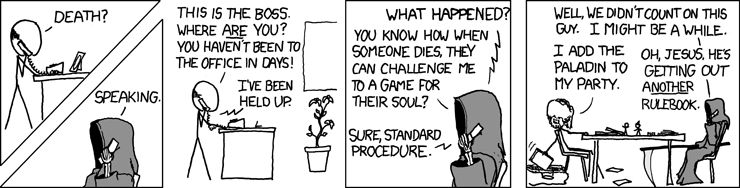
—Some more on Gygax:

This strip is hilarious; by pulling that move on Death, you could essentially earn your self eternal life, with the downside being you have to play Dungeons & Dragons the rest of your life.

I’m not one to laught out loud when reading the Internet alone in my apartment, but the final bit of The Onion’s “American Voices” response to Gygax's death sure got me.

Finally, a rather thought-provoking piece from Slate about the moral underpinnings of the D&D experience points system, which promotes greed and violence as the only ways to advance in the fictional world. It’s been so long since I’ve played, I can’t personally recall, but that does sound right. I spent more time playing Palladium games than TSR ones during my role-playing years, and I thought in that system the game master awarded points based on things like how well players adhered to their alignments…?

Heh. I haven’t used the word “alignment” to refer to anything other than my car in years…


—The image on the left horrifies me:


It’s even scarier when you’re walking through a grocery story and you turn a corner and BAM! He’s all up in your grill in his rabbit snout costume. Where are his ears? Who dresses up as a rabbit from the eyes down? What the hell Pillsbury?