This week at Good Comics For Kids I have a review of Fred's Cast Away on the Letter A, the first offering on Toon Books' new sub-imprint Toon Graphics, and the first of their planned collection of the late French cartoonist Frederic Otohn Aristedes's adventures starring the young man Philomen.
And at Robot 6 I have a review of Gene Luen Yang and Sonny Liew's The Shadow Hero, which turned out a hell of a superhero comic, a great use of the genre to make broader points, a typical Yang comic in its successful synthesis of a variety of tones, a nice meditation on the identity issues that dominate much of Yang's writing and an excellent showcase for the remarkable skills of artist Sonny Liew.
What I did not have this week is a post on Every Day Is Like Wednesday last night.. That's because I went to the shop for the first time in three weeks yesterday, and good God did I get a huge haul of comics, including several graphic novels. I did get them all read before going to bed last night, but I didn't write about 'em yet. So expect a "Comic Shop Comics" column...tomorrow night, if everything goes according to plan.
Showing posts with label liew. Show all posts
Showing posts with label liew. Show all posts
Thursday, July 24, 2014


Sunday, April 19, 2009
The neat freak's dirty mouth
Tommy Kovac and Sonny Liew's Wonderland, which I mentioned here and reviewed here yesterday, features some comic book swearing in it, and employs a different strategy for depicting foul language in a comic than a few of the others we've talked about here before, so I thought it might be worth discussing.
If you haven't read Wonderland, either in its original six-issue miniseries format from SLG, or its current hardcover collection from Disney Press, it stars Mary Ann, the White Rabbit's housemaid (who he originally mistook Alice for in the book and movie). Like most of those in Wonderland, she's rather mad, and her particular form of madness revolves around cleanliness. Terms like "obsessive-compulsive disorder" and "neat freak" don't seem to adequately describe the depth of her emotions when it comes to dirt and disorder of any kind.
In the first issue, for example, the sight of a small red jam stain on her clean white apron moves her to snatch the Queen of Hearts' scepter from her and bring it crashing down on the tyrant's head. So it's no surprise that a mess can bring her to swear.
The first time she curses, it's when she's in the process of falling down a well. She bumps her head on the side of it, eliciting a loud "THUD" and a plain old run-of-the-mill cartoon curse:

The well she falls into isn't a water well, however, it's a treacle well. Once covered in treacle, and being pawed at by a trio of treacle-encrusted old ladies, she again snaps:
 What's she saying exactly? I don't know, but it must be bad! It's the verbal equivalent of skulls of various shapes and sizes, a few lightning bolts and a black streak. I like this sort of comic-book swearing, as it is so far divorced from "real" swearing that it could really be anything, and the panel isn't really inviting the reader to suss out the real-world equivalent from the clues or context, the way, say, Brian Michael Bendis Avengers swearing does.
All the reader knows is that Mary Ann is completely freaking out, and using language so inappropriate that it can't be rendered into English. It gets worse in the next panel, when she drops English modifiers like "befouled," "bloody" and "blasted":

That seems like a good solution to the problem of how to have comic book characters swear without actually having them swear: Long chains of unique images with negative connotations, but no specific translation.
Friday, April 17, 2009
This is my favorite panel from Tommy Kovac and Sonny Liew's Wonderland:

Yeah! Decapitate those two! They are unnecessarily annoying, what with the honking hips and beeping bellies. In fact, those fuckers shouldn't have even been in Disney's Alice and Wonderland; it's not like it was Through the Looking Glass movie. Death to the Tweedles!
Actually, that panel is only my favorite panel at the moment, but that will likely change, as there are so many good panels in it. It's one of the books I'm reviewing at Blog@Newsarama this weekend; you can read my review here if you like.
Monday, August 11, 2008
A few words about every single story in Flight Vol. 5

“The Broken Path” by Michael Gagne
The table of contents doesn’t mention it, but the title page is labeled “Michael Gagne’s The Saga of Rex.” I’ve long thought the only thing worse than a set of chronicles was a saga. But as far as self-proclaimed sagas go, this one isn’t so bad.
This is the continuing story of that little fox on an alien planet that has been in the last few Flight collections, the one who picked up a jagged crystal shard that resembles a unicorn-like horn in his forehead. With so much time between Flights, I lose track of the particular narrative beats of this story, but it is nice looking, and it’s perfectly legible, despite the complete lack of words.
“Delilah Dirk and the Aqueduct” by Tony Cliff
This is a pretty charming action adventure story, with a dash of character comedy thrown in. The titular “International Mistress of Swordmanship” and her servant/sidekick/love interest (?) Mr. Selim crash their airship near an aqueduct, and have to escape an army.
It’s very well done, but seems sort of context free, like a middle chapter of a longer story that lacks a beginning or ending.
“The Dragon” by Reagan Lodge
See above, only replace Delilah Dirk and Mr. Selim with an anthropomorphic fox and the army with a mech-like battle suit thing. It looks nice and works well, but isn’t really grounded in anything bigger than itself.
“Beisbol 2” by Richard Pose
I’m not a fan of baseball—in fact, I don’t really like anything about it and never have. But for some reason, I do enjoy reading comics about it.
This was one of my favorite stories in the collection, perhaps in large part because it’s a standalone story that feels complete (despite the title). It’s about a little boy having his faith in the sport shattered and renewed in the space of a single game, thanks to his favorite player “The Bopper” turning out to be an arrogant jerk and a rookie from Cuba turning out to be a really cool guy.
I should also note that I really liked the coloring in this story. It’s very simple and basic, and doesn’t have all the fancy gradations and lighting effects of so many of the stories here. That stuff can look great, of course, but I really like the pure comic book-ishness of a red baseball uniform on a man standing on green grass under a blue sky.
“The Courier” by Kazu Kibiushi
Anthology editor and cover artist Kibiushi’s short story is about an urban messenger in a futuristic city. Unlike the guy on the covers, he doesn’t ride a giant bird. Beautifully illustrated and well told, but it doesn’t really say or do anything beyond looking nice.
“Malinky Robot” by Sonny Liew
I’m a big fan of the work of artist Sonny Liew (My Faith In Frankie, Wonderland, Re-gifters), so I am perhaps biased towards liking his contribution.
Especially since this story, in which two little humanoids meet a robot and express their disappointment in it, thinking it more of an appliance than the sort of robot their used to (like Transformers and Astro Boy, which gives Liew the opportunity to draw off-brand analogues of famous robots), repeatedly uses a phrase that I find absolutely hilarious: “I am a robot.”

See, in college I lived with someone who had a blue-and-gold macaw, and one of the phrases I taught it to say was “I am a robot,” which kind of chagrined her, as she was trying to teach it to speak, like, useful phrases used in communication, rather than just random dumb phrases like “I am a robot!” (His voice sounded robotic to me, which is why I taught it to him.)

“Worry Dolls” by JP Ahonen
A down-on-his-luck, out-of-work actor is having a rough time of things, and a loved one gives him a set of worry dolls to help him out. When he falls asleep, the dolls come to life, crawl in his ears, and try to clean the worries out of his brain, but his medication interferes with the usual worry doll routine, and they end up driving a sleep-walking dude around town. Amusing and well illustrated, but I was a little let down by the doll design; they’re cute, but they don’t look particularly worry doll-like.
“Igloo Head and Tree Head In Disguise” by Scott Campbell
There’s no real reason Scott Campbell’s “-Head” strips, in which humanoid blobs are named for the objects atop their heads, should be funny at all, let alone still funny, but I’ll be damned if this one didn’t crack me up even more than the last one I read. I guess it’s all in the execution…?
“Evidence” by Graham Annable
I don’t want to say anything about this story and risk ruining such an effective gag. But since this is a Graham Annable story, you don’t really need me to say anything, do you? And if you haven’t read any of Annable’s work, I think you’re probably wasting your time reading my blog at the moment; why are you reading me going on and on when you could be reading Grickle comics?
“N” by Phil Craven
A ninja fights a bunch of other ninjas to save a girl. And they are all super-cute, with big heads and ninja outfits that look like footy pajamas.
“The Changeling” by Sarah Mensinga
A fairly straightforward story about the folk belief in fairy changelings, only with a bit of a twist; Mensinga’s animation background is clear in work, which features panels that look a bit like film stills.
“Mountains” by Matthew Bernier
This is by far the weirdest story in the book. There are some really nice drawings of sea monsters in it.
“Big Dome: Flowers for Mama” by Paul Rivoche
I didn’t much care for this one, which is far wordier than much of the rest of the stories within. Rivoche draws some fantastic contraptions though, and his story is one of the more comic book-iest in terms of its coloring.
“The Chosen One” by Dave Roman
EDILW favorite Dave Roman (Astronaut Elementary, Teen Boat) contributes a very funny story about some woodland creatures who tell a young boy he is the chosen one and send him on a quest.
This is my favorite panel in the whole book:

“Ha, of course!” I shouted to myself when I read that. As a child, it always confused me that rabbits didn’t make a sound like all the other animals children know about.
“Jellaby: Lost” by Kean Soo
Oh hey, it’s a Jellaby story. I was kinda surprised to see the mute, big-headed purple dragonsaur guy in this volume, as I was pretty sure he (and Soo) had graduated into their own books, but I was glad to see him here. It just wouldn’t be Flight without him, you know?
“Two Kids” by Bannister and Grimaldi
Two kids meet in the woods; one is lost on purpose, the other on accident. It’s a surprisingly complete story, which stands up just fine on it’s own. And I was all set to hate it too, based on the fact that its creators only have one name apiece…
“Scenes In Which The Earth Stops Spinning And Everyone Flies Into A Wall” by Ryan North and John Marz
The title kind of says it all. The earth stops spinning, which means there’s no gravity and everyone goes flying, the results ranging from funny to sweet, depending on who goes flying and what they were about to do before the earth stopped spinning. Marz’s art is really incredible; nice, loose, super-cartoony designs and a brilliantly idiosyncratic color scheme that’s pure pleasure to look at. This is, like, my favorite story in this volume.
“Timecat” by Joey Weiser
Joe Weiser (The Ride Home) tells the story of Timecat, a cat with the power to travel forward in time simply by thinking hard enough. He’s hungry and wants fed, but his master won’t give him any food for a few hours. Lucky for him, by thinking really hard for a few minutes, and then checking the clock, he realizes he has moved forward in time—but only a few minutes.
It’s a really great gag, and Weiser plays it to the hilt.
“Voyage” by Kness and Made
An attractive polar bear walks around, floats to post-apocalyptic New York City, and then floats back to the arctic. Something about global warming, I guess?
“On The Importance of Space Travel” by Svetlana Chmakova
Wait, did I already call another story my favorite one? Because this is my favorite. Or my other favorite.
Anyway, Dramacon’s Svetlana Chmakova tells a rather darling little grade school melodrama about a weird little girl who tells her class she’s a princess from the planet Pluto and the little boy who teases her.
The post-script reads “In loving memory of Pluto…we still think you are cool.”
“Seasons: Frank and Frank” by Chris Appelhans
A little boy with a big head and a big rectangular bear with no head collect caterpillars in a cardboard tube, leave it alone for a long time, and then find it again.
Appelhans’ sparse style makes this story stand out quite dramatically from the rest of those in the book, with his simple black and white drawings filling four panels per page until the very last page, in which the format is broken dramatically and effectively.
The big weird looking bear running around with finger-guns pretending to shoot his little human friend makes me smile.
Saturday, December 01, 2007
Minx in review
 (I said Minx, not minks, dammit!)
Well, it took me most of the year, but I finally read all of DC's Minx titles that I was interested in (passing on only Kimmie66 and Confessions of a Blabbermouth, the former of which has a premise that doesn't make me want to drop $9.99, and the latter of which got some pretty harsh reviews that also make it seem a poor way to spend a ten dollar bill).
There was a lot of talk inside the comics industry and the comics blabosphere when DC's girl-focused Minx line was first launched and announced, spurred on by the somewhat clumsy roll out (Karen Berger saying girls don't read comics when she meant girls don't read DC comics), the predominance of men making these comics geared towards girls (only two female creators involved in the first seven books announced), and the difficulty DC had in defining a line that ended up simply being young adult graphic novels.
Oddly, conversation seemed to die down once the books themselves started rolling out, with only the occasional review and creator interview appearing, and less of the ranting and raving associated with the announcement persisted. Did the books themselves shut up the critics, or did the critics just not bother to read any?
I haven't seen much discussion on them online, anyway—although Johanna Draper Carlson just put up something—but then that could be part and parcel to the fact that they are books aimed for an audience outside the regular comics audience...and manga audience...and even bookstore/art comics audiences, meaning, to a certain degree, we’re not supposed to talk about them. It could also be because they're damn hard for most of us to judge, let alone talk about.
Obviously, I don't have any data about how well they're selling, in the direct market or the library/bookstore market (where they're likely to do much, much, much, much, much better), nor much interest in looking what data is publicly available up. And, as a 30-year-old man and regular comics reader, I'm horribly ill suited to say if something is a book a girl would like or something a non-comics reader would like, and this is a line intended for girls who don’t already read comic books, according to DC.
So keep in mind all I can really do is offer educated guesses and not terribly valuable opinions. At any rate, here are my thoughts on the Minx line, presented in the order I've read the books. Good As Lily is the only one I bought off the rack at my shop the Wednesday it came out; I read the other three within the past few weeks, having found multiple copies of each at a local Half-Priced Books (Does that mean they're not selling well? Or just that a couple people in my neighborhood bought some and decided they never wanted to read them again?).
 GOOD AS LILY
# of former girls involved: 0
# of former boys involved: 2
Who are they, and what have they done before?: Writer and cover artist Derek Kirk Kim wrote and drew the excellent graphic novel Same Difference and Other Stories. Artist Jesse Hamm makes his mainstream debut with this book, although he's produced minicomics, webcomics and appeared in a few anthologies.
What's it about?: On her 18th birthday, high school senior and drama enthusiast Grace gets a magic piñata that somehow summons different versions of herself from different ages—6, 29 and 70—and she tries to keep them secret from her family while making it through her day to day life, which includes putting on a play, a crush on her drama teacher, and a crush from her longtime platonic friend.
Palpability to manga readers: Hamm's art isn't very manga-esque. Many of the characters are Asian, though, and some of the plotlines, and the something-wacky-happens-to-otherwise-normal-person set-up, will be fairly familiar to anyone who's spent much time reading manga.
Girliness: Mild to strong.
Is it any good?: Yeah, it's pretty great. There was some mild disconnect from how different Grace and her different selves look on the cover (drawn by Kim) and throughout the story, drawn by Hamm, but I really enjoyed Hamm's art, and look forward to seeing more from him in the future. Kim juggles the various Graces pretty well, and while they make for the story's hook, they are really just other characters, with the actual conflicts focusing on Grace's relationship with her family and her friends and her self, the selves helping and hurting her attempts to solve her problems. It doesn't quite work like clockwork, but there's some real emotion in this, and I found myself alternately laughing and getting choked up.
Will it hit its target audience?: Yeah, I think it's more or less a direct hit.

RE-GIFTERS
# of former girls involved: 0
# of former boys involved: 3
Who are they, and what have they done before?: Writer Mike Carey has written many mainstream serial comics I have not read, including Lucifer, X-Men, Ultimate Fantastic Four, Crossing Midnight, plus some that I have read (Spellbinders, Voodoo Child). Penciller Sonnie Liew drew Slave Labor Graphics' Return To Wonderland and wrote and drew Malinky Robot. Inker Marc Hempel pencilled The Sandman arc "The Kindly Ones" and has written and drawn many very awesome comics, including Gregory. The entire creative team previously produced My Faith in Frankie, a Vertigo miniseries collected into a Minx-like digest-sized trade.
What's it about?: Korean-American high-schooler Dixie is training for the national hapkido championship, but is thrown off-balance by fellow student and school cute boy Adam, whom she tries to impress with an expensive birthday present. Teen melodramedy ensues as the tries to win the championship and his heart and stay out of trouble with her parents and local bullies.
Palpability to manga readers: Strong. The teen romance, bully/bullier, and competition elements are all of the sort present in a lot of manga and manhwa. Liew's pencil style and sense of design is pretty unique, not falling into more representational or cartoony Western design or manga-like Eastern design, but having a sketchy, doodley quality that is more akin to what you'd see in children's picture books, illustration work and (in a few characters) political cartooning than sequential art.
Girliness: Mild
Is it any good?: Yes, it's very good. I'm a fan of Liew and Hempel individually and together, and Carey's written things I liked and things I didn't, so my expectations were kind of mixed going in, but I was really impressed. This is certainly the strongest of the Minx books in terms of book design (it resembles an actual wrapped gift, with the main character looking like a tag on it), and there are some really strong characters, both in their visual design and their story realization. Not only are the leads strong, but even the most minor of characters are unique— I loved Dixie's little twin brothers, for example, and cracked a smile every time they appeared. The story is constructed in that sort of perfectly pleasing way in which a great deal of seemingly diverse elements are introduced, and are all pulled together and resolved at once.
Will it hit its target audience?: Hard to say. I think the story will certainly prove appealing to new readers, but I wonder if Liew's style might be a bit of a turn-off to comics virgins. Despite the strength of his storytelling, it doesn't really look like anything that someone who's never really read comics before would be familiar with, and I wonder if it would repel them, or even just have a higher learning curve.
 CLUBBING
# of former girls involved: 0
# of former boys involved: 2
Who are they, and what have they done before?: Writer Andi Watson wrote and drew Glister, Slow News Day, Breakfast After Noon, Geisha, Skeleton Key and many other comics I don't like as much. Artist Josh Howard wrote and drew Dead @17 and Black Harvest, plus a few other things too.
What's it about?: Charlotte "Lottie" Brook is a goth London teenager who gets caught with a fake ID trying to get into a club and, as punishment, gets sent out to the countryside to live with her grandparents and work at their country club for the summer. There it becomes something of a fish-out-of-water comedy, but also a murder mystery, and Lottie tries to solve the weird goings on of her household and the village. Oh, and then it gets all Lovecrafty for, like, 12 pages.
Palpability to manga readers: Pretty palpable. Howard's art is strong influenced by manga, particularly in the character design of the females, but it tends to be even flatter and more abstract. In other words, it looks particularly manga-influenced to people who don't read a lot of manga; definitely influenced by manga-influenced art, if that makes sense.
Girliness: Mild. The protagonist likes clothes and talks about shopping a lot—girls like shopping and clothes, right? That said, all of those clothes are really, really small, and Howard's art seems to appeal more to boys and men than girls, I would think.
Is it any good?: I really like Howard's art style, to the point where he's one of the artists whom I read just about anything by, no matter how bad, just to look at the pictures. And Watson does a good job on Lottie's slang-filled voice, which is definitely unique. But this definitely feels like the first draft rather than a finished product, as it veers and lurches between genres at random. I think every review I've read mentions how out of left field the supernatural element actually is, so I was expecting an unexpected element and wasn't caught off guard by it, but, yeah, you probably want to foreshadow something like that somewhere. I mean, Scooby-Doo foreshadowed its monsters in every episode, and none of those were even real. Of the Minx books I read, this was by far the weakest.
Will it hit its target audience?: Maybe.
Anything else to add?: Yeah, you know, Josh Howard would have been a great artist on DC's current volume of Supergirl comics, wouldn't he? He's really good at belly shirts and micro-skirts, and he's much better at anatomy at drawing cute girls than pretty much anybody who DC actually hired for that gig.
Back on topic, why does DC mention Howard's Dead@17 being "Wizard magazine's pick as the #1 independent book to watch in 2005" on the back of the book (and on the online solicitation). I assume Wizard readers/peole who care what Wizard says about comics/anyone who even knows what Wizard is are well outside the target audience for Minx books.
Finally, this book also has the absolute worst cover. That image of white junior high girls at a school dance or whatever above the title? Nothing remotely like that occurs in this book. The club Lottie goes to is a goth club where everyone goes all out in their goth costumes. Also, that picture looks terrible juxtaposed against the Howard girl in a photo environment right below it (That juxtaposition does work pretty well, though, visually accentuating the culture clash that's the subject of the story—she's a two-dimensional comic book heroine in a three-dimensional photograph world!)
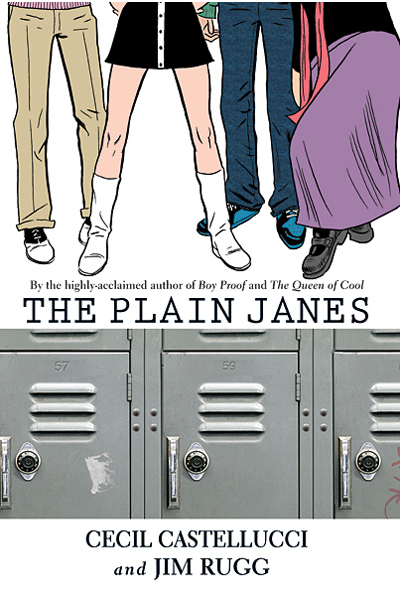 THE PLAIN JANES
# of former girls involved: 1
# of former boys involved: 1
Who are they, and what have they done before?: Writer Cecil Castellucci is a prose novelist responsible for The Queen of Cool, Beige, and Boy Proof (none of which I've read). Artist Jim Rugg is responsible for (too) short-lived series Street Angel, one of the coolest comics in like ever, and has had short peices in a variet of pretty goon anthologies, like Project: Superior
What's it about?: A bomb attack in New York City stand-in Metro City transforms life for protatonist Jane and her family, who move to a suburb. Inspired by a sketchbook from a fellow victim of the attack, Jane decides to devote her life to art, forsaking the popular girls at her new school and forming an all-girl art gang with the three girls at the outcast, all of whom are coincidentally named Jane. The P.L.A.I.N. Janes' anonymous art attacks stoke (unattributed) post-9/11 fears of terrorism, causing a rift between the adults and teens in the small town.
Palpability to manga readers: Other than the digest format and black and white art, there's nothing particularly manga-esque about it. Some of the situations repeat what you'd find in shojo comics, but this book visually has more in common with Western art comics than Japanese pop imports.
Girliness: Mild to strong.
Is it any good?: The art is absolutely perfect. Rugg does his expected strong job, but I think this may be his best work I've seen. He finds a perfect balance between representational and subtle cartoonish exaggeration, turning in a series of character designs that are all distinct, realistic and highly pleasing to the eye.
The story is similarly well constructed, and Castellucci doesn't show any of the weakness typical of some prose writers doing their first comics (telling more of the story through the words than the pictures, using too many words, an omniscient narrator who checks in with various voices, etc.). Some of it struck me as pretty unrealistic in a way that originally grated on me—why use "Metro City" instead of New York? Why use a cafe bombing more typical of the Israeli/Palestinian conflict than 9/11 itself to address post-9/11 fear in our culture?—but that lack of realism coupled with other more highly manufactured elements lends the whole story a sort of fairy tale feel, as if that unreality is quite intentional.
Perhaps Castellucci is consciously telling a half-fable about the conflict of art vs. fear in modern America. I think the story could still be told if she were more direct in her address of issues, without sacrificing the more escapist, entertaining elements. The ending is pretty sudden, and leaves one of the main conflicts—the romantic one—completely unresolved, with a good character seeming to suffer punishment for his goodness, making for a pretty unsatsifying ending to an otherwise quite satisfying story.
Word at Comicsworthreading is that there's a sequel planned for the future, but there's no "to be continued" or official indication of this in the book istelf. If this were manga or an ongoing series from Oni, it would have had a "Volume 1" on the spine to indicate that it would presumably continue at some point, but not so. (Something for DC/Minx to think about in future printings, though).
Will it hit its target audience?: Yes, dead on.
Subscribe to:
Posts (Atom)
