Showing posts with label bob shea. Show all posts

Tuesday, January 03, 2017

Some picture books of note:

Are We There, Yeti? (Simon & Schuster*; 2015): This debut picture book from artist Ashlyn Anstee is one more in the ever increasing number of books for children featuring yeti, bigfoot, sasquatch and other hairy humanoids of their ilk. The title and cover image layout the entire story, which hangs on the squishing together of the phrase "Are we there yet?" with the yeti, and Anstee accomplishes this by having a yeti be the driver of small children.

"This is Yeti," Anstee introduces us to Yeti on the first page, and the large, white, roughly man-shaped creatures waves hello. "He drives our bus," reads the next page, as we see Yeti striding toward a tiny, round school bus with a half-dozen children and a teacher or chaperone already aboard.

When they ask where they are going, Yeti only says that it is a surprise, and so begins a 16-page drive through various settings–city, beach, mountains–populated by an Akira Toriyama-like mixture of people, anthropomorphic animals and regular animals, each illustration fairly packed with funny little details for readers to tease out.

The entire way, the children ask the titular question, until about the halfway point of the book, when they arrive at a remote cave in a snowy environment. Where are they? Based on the squat, child-sized Yeti-like creatures that come out of the cave, it would appear they are either at a yeti school or else at Yeti's own home, playing with his own children.

Anstee finds several other places in which to swap in "Yeti" for "yet," and that pleasant enough joke is able to sustain the short story, and give her an opportunity to draw and paint fun stuff, like the not-so-abominable snowmen and dogs wearing shorts at the beach and a tree sloth piloting a biplane over a mountain while llamas look on.

Anstee works in animation, and it is apparent from the energy that permeates her drawings, and the dynamic sense of motion in them, as well as the super-simple, studiously cartoonish designs.

Dinosaur Christmas (Scholastic; 2011): Writer Jerry Pallotta and artist Howard McWilliam have seemingly attempted to construct a two-great-things-that-go-great-together type of book, by adding dinosaurs and Christmas together and seeing how that might work out.

Not too terribly well, really.

The book is premised on Santa Claus' extensive answer to a question on a post card from a little girl: "Dear Santa, What did you use to pull your sleigh before you had reindeer?"

The answer is, you guessed it, dinosaurs.

Now as all of us who are not creationists know, human beings and dinosaurs never co-existed. The last of the dinosaurs were extinct a good 65 million years or so before the first human-like primates started getting up and walking around on their hind legs, and there was absolutely no crossover–give or take a Mokele-mbembe or ropen. So if you want to think about this, this picture book is going to demand some difficult questions of you.

Is Santa Claus human, and, if so, how is it that he existed so many tens of millions of years before the rest of his species? If not, why does he so closely resemble humanity, and is it merely a coincidence that humankind would evolve to so closely resemble Santa Claus?

If Santa Claus is not human, what exactly is this immortal, unchanging being? Is he God, or a god? Is he an angel of some sort, created by God in his image, in the same way that man and woman would be so many years later?

What was his function back then? We see that he's dressed as he always is. What tiny mammals did he skin to create that fur-trim on his coat, I wonder, and how many did it take to do it? What type of skin was used to create the leather of his boots and belt? And did he invent eye-glasses? Apparently so. Perhaps Santa Claus was some sort of Promethean figure, a semi-divine go-between that brought culture to humanity, millions upon millions of years after he was around, tying various species of dinosaurs to his sleigh.

We see too that Santa lives somewhere snowy, in a wooden house, with electric lamps and lights and a Christmas tree, as well as a phonagram and wrapping paper and bells. So many piece of modern technology, created and employed by Santa long before mammals had crawled out from under the shadows of the dinosaurs that ruled the Earth!

I am not entirely sure pine trees existed at this point, although I am 100% definitely sure that Christmas–from the Old English words for "Christ" and "mass"–didn't exist yet. Hell, Christ didn't exist yet! Well, he did according to the Gospel of John–"In the beginning there was the Word, and the World was with God, and the Word was God"–but whatever your personal beliefs regarding the divinity of the man named Jesus who was revered as the Christ and put the Christ in Christianity, he didn't walk the Earth until the so-called Common Era. We used to divide time by when Jesus came onto the scene–Before Christ and Anno Domini, "The Year of Our Lord"–and clearly Christ wasn't around 65 million years B.C.

And remember, what did Santa Claus use these dinosaurs for? Why, to pull his sleigh of course. And why did he need his sleigh pulled? To deliver presents. But to whom? There are no human beings seen in the illustrations, although there is an intriguing spread showing a pair of Apatosaurus delivering gifts, one of them to a cave built high in a cliff wall and decorated with a mail box, Christmas tree, wreath, Christmas lights and a lamp. Did humans live within, or some other sort of Christmas-celebrating, gift-appreciating creature, perhaps of the same nature as Santa himself?

So many questions.

The bulk of Pallotta's story consists of Santa telling the little girl–and through her the reader–all of the various types of dinosaurs he had attempted to pull his sleigh over the years, each of which proved problematic in one fashion or another: The Pterosaurs (which aren't dinosaurs, I know) flew too high, the Velocirapters wouldn't stop fidgeting and slashing at one another, the Triceratops were too slow.

There is no element of danger in Santa's dealings with the dinosaurs, although Pallotta and McWilliam occasionally suggest it, only to then immediately deflate that suggestion, when dealing with large predators. The Giganotosaurus was too fast and the Tyrannosaurus rexes wouldn't stop licking Santa, like over-sized dogs...tasting him, perhaps?

By book's end, Santa has adopted the reindeer, although it doesn't seem to be simply because they are ideal for his purposes: "Today the dinosaurs are gone," Santa says. Gone from his gift-giving operation, or extinct? Perhaps just the former, as Santa does say he sometimes misses the good old days, and McWilliam's last picture is of Santa and many of the 14 different types of dinosaurs (or 13 plus Pterosaurs, if you insist) all peeking in the sleeping little girl's window with him.

Seems like an okay holiday book for little kids who are interested in dinosaurs. Provided the little kids in question aren't the type to ask about evolution or theology or cultural history while reading or being read to, of course.

Fall Ball (Henry Holt; 2013): This book is by Peter McCarty, the author/illustrator of a few books I've read and really loved, like Jeremy Draws a Monster, The Monster Returns and Henry In Love, plus a few other books I have never read.

There's not much to it. Some kids ride the bus home from school, they all play football for a page or two until dark, and then they all get called home. One of them, Bobby, eats a piece of pie and then watches football on TV with his parents.

And, um, that's the whole story.

It's certainly not as strong as the three other McCarty books I mentioned, and its main pleasure is in McCarty's design work and and line work. His children are all somewhat football shaped themselves; big, half-oval, egg-like heads the size of their bodies tapering into tiny little legs and tinier still feet. They've got blank, dot eyes and little noses and mouths, and little arms ending in littler hands, which seem to be in a constant state of flailing.

In fact, the children themselves all seem to float and fall like leaves throughout the book. Sometimes literally, as when the school bus goes over a hill and they seem to achieve some kind of zero G state, or when they play football or run through a giant pile of leaves.

I really like McCarty's delicate little lines, applied in a technique that looks a bit like pointilism, only with lines instead of points, as well as his use of color, with the children and many other figures all having a sort of essential, core whiteness, like that of the page, and then color is applied around the edges of them and of their accessories.

The dog, Sparky, is maybe the best example of this, as he's a white, dog-shaped blob with lines all around his edges and extremities suggesting fur and three dimensions, the only color inside those lines being on his eyes and nose.

This is by far my least favorite of McCarty's books that I've read, but even then it's a lot of fun to look at, so good is his art.

Green Lizards Vs. Red Rectangles (Scholastic; 2015): This weird-looking picture book is the work of writer/artist Steve Antony of Please, Mr. Panda fame. I was immediately attracted by the absurd title, which makes the central conflict of Dr. Seuss' The Butter Battle Book seem entirely reasonable. I mean, the green lizards are clearly sentient--the one on the cover has even put up his dukes so as to fight a red rectangle--but the red rectangles aren't, like, anthropomorphic red rectangles. They are literally just red rectangles.

"The GREEN LIZARDS and the RED RECTANGLES were at war," Antony begins his story, over an image of a bunch of little green lizards packed tightly together in a long formation, facing off against a group of red rectangles in some sort of strange battle alignment.

It was a stand-off, as the Red Rectangles were smart (a scene of the Green Lizards toppling a huge rectangle shows other rectangles arranged as dominoes, so that the last of them will fall upon the lizards from behind), but the Green Lizards were strong.

What are they fighting for? That's what a little green lizard asks at one point, only to get squashed by a big red rectangle. The fighting goes one and one until someone declares "Enough is enough," and they decide to live together in peace, via solution which explains why Antony chose rectangles as the enemies of these lizards. The colors are for contrast, of course, and while the straight, sharp lines and angles of the rectangles are in stark contrast to the wiggly, round lines of the lizards, it's the way in which a symbiotic relationship is formed that offers the real explanation.

I won't spoil it here, but it's clever and cute. It's a pretty simple idea, really, and Antony has that one idea upon which to power the whole book, but it's a strong enough idea to bear the weight. Additionally, this is the sort of story that could really only be told in this particular format--that of the picture book--which is generally a good indication of a picture book's quality.

The Happiest Book Ever! (Hyperion; 2016): Hooray, a Bob Shea book! This offering from one of my favorite kids book's authors is a fairly meta one. The cover is covered in happy things, that Shea takes an extra step further to make even happier. So, for example, there's not just cake, but dancing cake. The sun shining in the the sky? It has a new haircut and snazzy glasses. That giraffe with two ice cream cones? One is for you? (This pattern repeats inside as well; there's a cute whale, for example, but it's not just any whale, it's "a whale with good news".)

Inside, each spread features a simple face, the face of the book, on the right-hand page. It's made simply of two large dot eyes, a smaller dot nose, and a brad, red, curvy smiling pair of lips. Beneath this face, runs the book's dialogue: "Whaddya say we make this the HAPPIEST BOOK EVER?...Let's meet some of my happy, happy friends!"

On the first spread, the left page, the one facing "the book," is a blank field of black. On the next, as the book begins introducing friends, they will appear on the left page, beginning with a frog, which is just a black and white photograph of a frog, and the dancing cake seen on the cover.

The book is a little disappointed that the frog doesn't seem happier, and keeps introducing more and more happy friends, like "a Flyin' Lion" (a lion that flies, obviously) or "Waffle Turtle and syrup!" (A turtle whose body is a waffle). Book gradually gets irritated with frog's apparent lack of happiness and calls on the reader to help, asking them to tell the frog some frog jokes (available in the back) or to shake the book. Eventually, the book loses its shit, and causes the frog to leave, which annoys all the happy friends, who are significantly less happy. Can the reader, and The Book, set things right? Probably!

It's an overall cute idea, with lot of cute little throwaway gags that come in the form of happy friends, all drawn with a dashed-off sincerity that make them look almost sketch-like. The way Shea controls these incidental characters' reactions to the book and The Book are pretty damn impressive as well. Highly recommended.

Henry Hyena, Why Won't You Laugh? (Aladdin; 2015): Writer Doug Jantzen's presents a sing-songy story told in rhyming couplets about a little hyena who has stopped doing what hyenas are best known for: Constantly laughing.

It starts:
A funny thing happened today at the zoo. Young Henry Hyena began to feel blue.

Now this kind of thing is really quite rare for hyenas always laugh without care.
Jantzen's story continues, telling us of all the things hyenas laugh at, which essentially amounts to every other animal that lives in the zoo. Sometimes they laugh at the simple misfortunes of the other animals, sometimes they laugh at their own pranks pulled at the expense of the other animals and sometimes they just laugh at the way the other animals look or act.

If you study the artwork, by Jean Claude, you can see that a hyena that stops laughing at them probably isn't of very great concern to the other animals. The monkey looks pretty pissed at the hyenas, the storks look embarrassed and Claude fills in some visual gags demonstrating the hyenas' treatment of other animals, even when the words don't point it out, like one image of a hyena holding out his hand to keep a joey wearing boxing gloves at bay while it tries to take a swing at him.

Henry consults the doctor, Dr. Long, who is a giraffe–because Jantzen apparently then needed a word to rhyme with "laugh"–and appears to serve as the zoo therapist. Henry lays on the sort of chair you only see in therapists' offices in film comedies and New Yorker cartoons (I've been to a few therapists, a few psychologists and one psychiatrist, and none of them had one of those sweet reclining bed chair thingees, which might explain why I was never completely cured).

It quickly becomes clear that the reason Henry isn't laughing is that Henry, unlike his peers, isn't a huge asshole. (Or, as Dr. Long puts it, "It's not that you're sick, and you're far from a fool. You've just learned that laughing at others is cruel.") That is the moral of the story.

So Henry puts on a tie and delivers a presentation to his fellow hyenas, and suggest they maybe stop being such assholes. In the following sequence, we see the hyenas playing nicely with the other animals, being helpful and even helping atone from some of their earlier pranks (by knitting the llama a new pair of socks, after they cut holes in its previous pair of pairs).

"Being nice was really the best way to play" is a fine moral for a children's book, although I was a little unconvinced by the ending, which naturally necessitates Henry laughing again, as we are told only that "Young Henry joined in and smiled with delight as all of the animals joked throughout the night. They had so much fun and before it was through, Henry's laugh was the loudest of all at the zoo."

I guess I'd need to hear these animal jokes to see if they were really funny or not, but while it might be nice to knit socks and deliver muffins to your neighbors, it's not really funny, is it?

Claude's art is really quite nice, and was the main reason I picked the book up and brought it home...the initial hook, however, being to learn the answer to the question in the title.

The animals are all generally rather plump, with highly expressive little faces that pretty clearly convey their emotions, be they sad or happy ones. Look at the frowning face of the slightly potato-shaped Henry on the cover; that's one heartbreaking illustration of an unhappy hyena.

Given their proportions, most of Claude's animals look like toy stuffed animals, and thus are perfectly depicted for the youngest of readers. The colors are quite bright and often unlikely in their appearances. While there may be a lot of blacks, browns and yellows in the coloration of many of the animals, the plants, backgrounds and objects are full of brilliant purples, blues, greens, reds and complex colors that lean closer to pastels than primaries. Even some of the animals boast unnatural but bright and candy-like coloring, like the purple and lavender llama and the bright turquoise elephant.

I Really Like Slop! (Hyperion; 2015): It has apparently been a rather long time since I've done one of these posts, as I usually do them just infrequently enough that a new Mo Willems Elephant & Piggie book shows up in each installment. But this time, there are three Elephant & Piggie books, and this is the first of them, alphabetically speaking (Next is I Will Take A Nap!, which do not cover here. It is, predictably, very good though, and contains a neat twist).

By my count, this is Willems' seventeen-thousandth Elephant & Piggie book, and it is here he finally addresses the subject of a pig's relationship to slop. "Eating slop is part of pig culture," Piggie explains to Gerald, when she walks by him holding a steaming bowl of neon green slop, surrounded by cartoon flies.

Like all of the books in the line, this is one long scene, brilliantly comedically acted by the two cartoon characters Willems has perfectly perfected by this point in their careers.

The two pass by one another, and Gerald reacts strongly to the very smell of slop. After an extended discussion about slop, and whether or not Gerald would like to try the foul-smelling concoction or not (Best part? When Gerald quietly asks about the flies, and Piggie responds "The flies are how you know it is ripe!" and one of flies says, in a little, balloon-less bit of font, "Yeah, man!").

When Gerald responds with a very big "NO WAY!" to the prospect of eating slop, and sees how crestfallen Piggie is, he then consents to try a very, very small taste of slop, which results in him turning colors and flopping around like a gigantic fish while Piggie doesn't even seem to notice that he looks like he has been possessed by the elephants from the nightmarish "Pink Elephants on Parade" number in Dumbo ("Do you know how I get that 'old shoe' taste? Old shoes!").

One could read a moral about trying new things into the story–it's certainly there–but beyond that, Willems' main focus seems to be once again demonstrating the affection between the two characters (How much does Gerald care about Piggie? Enough to taste slop!), and, of course, the humor of the scene, which ends with a nice, unexpected punch line.

I'll Wait, Mr. Panda (Scholastic; 2016): The old maxim that the original is always better than the sequel applies to children's picture books with greater certitude than it does feature films. It can be so difficult to come up with a winning hit book that when an author does just that, they will often (too often) attempt to replicate that success by turning their book into a series. Some concepts can handle a sequel or two or three, but more often than not, the original premise just isn't sustainable. If you have spent much time around picture books, I'm sure you can think of plenty of examples of sequels or series that work and sequels or series that do not (for a good example of a series that does within this very post, check out We Found A Hat below).

Steve Antony's I'll Wait, Mr. Panda, which follows 2014's Please, Mr. Panda, is, I am afraid, an example of a sequel that just doesn't work, even though it does retain many of the pleasures of the original. That original, you remember, was about a big, fat, grumpy looking panda bear who wandered around with a box of doughnuts, wearing a little paper hat with the word "Doughnuts" on it in script, offering a doughnut to various animals, all of which were, like him, black and white in their coloration. When they would answer in the affirmative, he would refuse them all, saying he had changed his mind. When the final animal, a ring-tailed lemur, says "please," Mr. Panda awards him all of the doughnuts–you see, he was just waiting for an animal polite enough to say "Yes, please" rather than just some variation of "Yes" or "I'll take one."

Based then on what we know, what is the premise of I'll Wait, Mr. Panda? That patience, like politeness, is a virtue seems to be a good guess.

In this book, Antony's gigantic, giant Panda is now wearing a tiny little chef's hat and a brightly-colored apron, decorated with the very sorts of brightly-colored doughnuts he was trying to give away in the previous book. In his massive paws he holds a wooden spoon and a bowl. On the first spread, he is approached by a particularly fuzzy looking alpaca (or is it a vicuna, perhaps? Or a llama?) and asked, "What are you making, Mr. Panda?"

"Wait and see," Mr. Panda replies. "It's a surprise."

The alpaca says it will not wait, and leaves. Meanwhile, a tiny little penguin, with a yellow beak, appears and says the title of the book quietly.

And that is the basic pattern. A different animal appears–a giant anteater in the company of some ants, a bunch of white bunny rabbits, a crane-like bird–and asks or guesses what Mr. Panda might be making and, when he tells them they must wait because it is a surprise, they haughtily say something negative about waiting and leave.

Only the penguin continues to wait and, like the lemur who was rewarded in the original, the penguin earns the surprise: A gigantic doughnut that is even bigger than Mr. Panda, covered with chocolate frosting and massive sprinkles, each about the size of the penguin's own beak. Mr. Panda walks away, and the penguin rolls his prize away, hopefully to share with a few dozen other penguins, as there is no way he will be able to eat it before it goes stale.

I have questions, beyond how Mr. Panda made such a big doughnut and where he acquired such huge sprinkles. My main question though is why on earth Mr. Panda, who we know from Please, Mr. Panda, doesn't even like doughnuts, would devote himself to making a doughnut of any kind, let alone a giant one, and why he has an apron decorated with doughnuts if, again, he doesn't like doughnuts.

Antony's artwork is again excellent, and his Mr. Panda design itself is funny, but this sequel lacks the mysterious, suspenseful tension of the original–in which a reader couldn't tell why Mr. Panda was wandering around offering doughnuts and then rescinding his offer. Here the only suspense is in regards to what Mr. Panda was making, and he himself states that it is as a surprise that the characters (and reader) must wait to learn. That's neither as organic nor as intense as trying to make sense of his strange behavior in the original.

Great art, though.

Monster & Son (Chronicle Books; 2016): I found writer David LaRochelle's words to be fairly uninteresting, although they are necessary in order to provide something on which illustrator Joey Chou can hang his images of famous monsters and their sons. Those words are presented in rhyming couplets, one line per two-page spread, beginning with "You woke me with a monstrous roar, my brave and fearless on, / and led the way that filled our day with rough and rowdy fun." LaRochelle takes us through a day in the life of a father and son, as they spend the entire day together, with a dozen more lines.

Each line runs over a long, rectangular, horizontal image of a famous monster and the monsters son or, in the case of the Wolfman, sons. A few monsters fall into fairly generic types, like the four-eyed monsters with tails who have sheets draped over them as they hide in your closet making noises, or a pair of skeletons playing catch with the father's rib bone in the graveyard, or the sea serpents or bigfoot/sasquatches (note the father eating the poor campers' rear tire as if it were a large doughnut).

Most appear to be taken directly from movies: You see King Kong and son on the cover, and there are appearances by Godzilla, Frankenstein and The Creature from the Black Lagoon. There are some large snow monsters playing in the Arctic, with the inward curved horns of a Star Wars Wampa, the vampire is of the distinct variety popularized by Bela Lugosi's portrayal in the 1931 Dracula, and there are even a pair of cyclops' with the distinct singular horn and goat legs of the one Ray Harryhausen made for 1958's The 7th Voyage of Sinbad (the pair are shown watching a trio of flying saucers descend on the city, perhaps an allusion to Harryhausen's Earth Vs. The Flying Saucers), and then there's the dragon, which looks exactly like the one Maleficent transforms to at the climax of 1959's Sleeping Beauty and is engaged in fiery battle with a knight who looks remarkably like the one from the same film, while a blonde princess in a pink dress looks angrily on from the tower (There is, of course, a "son" here, a smaller dragon with the same basic design hovering around in the background, and now I realize that perhaps this isn't the story of a day in the life of a father and son, but simply a parent and son. While many of the monsters are unequivocally male, most are more ambiguous, and this particular dragon is obviously female).

Beyond the fun of seeing Chou translate all of these famous monsters into his flat, blocky, cartoony, design-heavy style, my favorite part of the book is probably the human reactions tot he monsters. As the focus is on the monsters, they always look to be happy or at least content, clearly enjoying themselves. There are plenty of humans visible in many images though, and they generally look pretty pissed-off. The princess has a finger raised while waiting in the tower to be saved from the laughing dragons, and while I imagine she's meant to be wagging her index finger in a scolding gesture, it's not hard to imagine she's flicking everyone off.

The bigfoot have treed a few campers, who have the downward sloping diagonal lines of angry eyebrows above their dot eyes, the same expression on the faces of the poor people whose boats are swamped by the gamboling sea serpents. Less frequently occurring are looks of fear, like that of the helicopter pilot The Son of Kong seems to be using as a sort of improvised teddy bear.

I'd highly recommend this one to any monster fans, even if only to flip-through.

Tek: The Modern Cave Boy (Little, Brown and Company; 2016): The best part of this book is by far its format, cover and overall design. That may sound like a backhanded compliment regarding the content, created by Mutts' Patrick McDonnell, but it is not intended to. The format and design are pretty brilliant, while the story itself is not that great.

The cover image posted above won't properly convey the degree to which the book is designed to resemble a tablet, so if you find yourself in a library or bookstore in the near future, I'd suggest you look for this book if only to hold it and look it over. It's designed to resemble a tablet, complete with a fake button in the center along the bottom, and extremely thick covers to give it the size, shape and feel of a tablet. Additionally, the edges of all the pages are black, so if you were holding the book from any angle, it would look like a fake tablet.

I have honestly never read a picture book (or, um, anything) on a tablet, so I'm not entirely sure how well this replicates that experience, but I imagine pretty well. Open the cover, and your'e presented with a password similar to that on Apple devices. A few pages intimating the experience of navigating through a device in, the story begins, each page featuring a block of large text in a little white box, and a picture in a box below it, the art McDonnell's familiar, slightly scratchy inklines, here colored with watercolor. Along the top you'll see a battery icon and another letting you know the book is connected to Wi-Fi.

Neat gag, all around.

The story is that of Tek, a cave boy who lived "Once upon a time, way, way back, a long time ago, or maybe yesterday."

Tek stays in his room in his cave all day, playing with his electronic devices: His phone, his tablet and his game box.

"You should have never invented the Internet," Tek's mom grunts to Tek's dad.

I guess this is supposed to be a central gag to the book, that a cave boy is obsessed with modern technology that didn't even exist when I or Patrick McDonnell were his age, let alone in prehistoric times. I can sort of almost see how this tension could be a source of humor, but I didn't get it. The tension of setting and conflict never struck me as particularly funny, and I probably spent as much time asking myself stupid questions (Where did Tek get his tech? Why is he the only one who uses any of it?) and trying to figure out what McDonnell was going for than I did appreciating any aspect of that tension.

All of the jokes that did land with me were basically just McDonnell drawing funny faces on his characters, or sight gags like a fish evolving into a saber-toothed house cat in a single image (Or perhaps it is five different animals, all instantaneously evolving in rapid succession, as they march out of the water, single-file...?)

Also complicating things, these cave people co-exist with dinosaurs, which, five years ago I would have thought was all in good fun, but given what I now know about how many people seem to think human beings and dinosaurs did co-exist, it actually alarms me a little when I see stories about this sort of thing, even when they are clearly light-hearted and meant either as fantasy or jest.

So Tek won't leave the cave or peel his eyes from his screens, and he's missing out on stuff, like hanging out with his friend Larry, a gigantic bipedal alligator with a basketball. Finally, a nearby volcano named Big Poppa solves the problem by erupting, sending Tek, his cave and his devices flying into the air...and away from each other.

The format then changes, as Tek is disconnected, and then resembles that of a traditional story book, losing the look of a faux tablet. Tek, you will not be surprised to learn, sees how awesome the outside world is and all the awesome stuff in it, and he gains a new appreciation for all the stuff he had been ignoring. He leaves his gadgets behind to embrace a gadget-less lifestyle of playing basketball with giant alligators and looking at the stars.

It's a treat to see McDonnell draw dinosaurs, mammoths and cave-people, particularly the vaguely Alley Oop-faced title character, but there's little to the story beyond a simple "electronic devices are bad" message, despite how effective the format, the art and a few of the gags are (I liked the use of the emoticons, for example, or the names Tek gives the dinosaurs whose real names he never bothered to learn).

(Another thing I thought about while reading this? Roger Corman's 1958 Teenage Caveman, starring a young Robert Vaughan**. The twist of that movie is that while it appears to be set back in caveman times, it is actually set in the far-flung future, after we destroyed our world in a nuclear war or whatever and history essentially re-set itself. I didn't spoil that for you, did I? It was featured in an episode of Mystery Science Theater 3000, so I just assumed you had already seen it at least a half-dozen times. If you haven't, don't; it's terrible. The movie. Not the MST3K episode, which is obviously the best way to watch it. Anyway, I imagined that perhaps Tek and his family lived in the post-apocalyptic future, after President Trump*** initiated a nuclear war with North Korea and China for saying mean things about him, and history started over, only Tek had found a secret cache of early 21st century gadgetry.)

The Thank You Book (Hyperion; 2016): It is my understanding that this 25th entry into Mo Willems' Elephant & Piggie library is the last Elephant & Piggie book, and given how fast and with such regularity that Willems has put out these books, that seems a little hard to believe. That said, this certainly reads like their last book.

The very simple plot is that Piggie and Gerald are sitting contentedly together one day, and Piggie, thinking about how much she has to be thankful for, decides and immediately announces that she will thank "Everyone who is important to me!" A surprised Gerald is doubtful she will be able to pull it off, and insists that she will forget someone.

The bulk of the longer-than-usual book then finds Piggie thanking every single character who has appeared in any of the previous 24 books, no matter how minor, with Gerald following along, continually reminding her that she's going to forget someone. Among those who get thanks is Willems' Pigeon, who Piggie thanks for never giving up, and who she apologizes to, "I am sorry you do not get to be in our books." The Pigeon makes eye contact with the reader while shaking Piggie's hand, and says "That's what you think" (He does, after all, appear in the end pages of most of the books, as if he snuck in and tried to hide).

Gerald is right; Piggie does forget to thank someone. Two someones, in fact, and the most important someones.

It's not the strongest of the books by far, although the pay-offs are both effective. But then, it's more of a victory lap of an installment, and it made me immediately want to re-read all the others, so I could place which characters appeared in which books, as not all of them are as memorable as, say, the snake (Can I Play Too?) or the whale (A Big Guy Took My Ball).

Thank You and Good Night (Little, Brown and Company; 2015): This book is another from cartoonist Patrick McDonnell, probably best known for his newspaper comic strip Mutts, which remains by far the best-drawn strip on most still-extant funny pages. McDonnell is no stranger to picture books, either–he won a Caldecott for Me...Jane–but he seems to have been gradually transitioning into the new (but comics-adjacent) media. While he's drawn almost ten picture books now, half of them have starred characters from Mutts.

Thank You and Good Night does not, but Mutts readers will recognize McDonnell's particular way of drawing people and songbirds, among other clues to the identity of the artist.

The story is a pretty simple one. Maggie, a little girl, is helping Clement, a more little still anthropomorphic rabbit, put on his pajamas. The doorbell rings, and a tiny elephant and tiny bear, also in pajamas are there: These are Clement's friends, Jean and Alan Alexander. They are here for a sleepover.

The trio do various sleepover activities, usual and unusual, and eventually get ready for bed. Once they're tucked in, Maggie asks them all to name what they were thankful for, and, of course, they have a lot to be thankful for. When she too climbs into bed, the life-like little animals have reverted into stuffed animals, suggesting the entire book was Maggie's play with her three little stuffed animal friends.

It's pretty darling, and the naming of things they are thankful for is prayer-like without being a prayer; you'd have to ask a particularly devout parent, but I thought it did a nice job of being religious or spiritual without doing so overtly; that section is offered in the spirit of prayer, if the animals don't exactly recite a verbal prayer, if that makes sense.

And, of course, it's McDonnell, so the art work is perfect. It's all perfectly chosen and seemingly-dashed off lines and soft watercolors, applied not to the cats and dogs that are his usual subjects, but the little animals that look as human as they do animalistic. The story is cute, but nothing momentous. But the art? The art couldn't be better.

Tooth Fairy (Child's Play; 1985): Audrey Wood's book about the Tooth Fairy is probably the most terrifying Tooth Fairy story I've ever experienced in any media, far scarier than dumb old Darkness Falls (the 2003 horror film starring Emma Caufield of Beverly Hills, 90210...although I suppose you guys all know her better from Buffy, huh?).

Writer/illustrator Audrey Wood uses a very comic book-inspired sort of lay out, with each page functioning as a panel, and some of the pages divided into actual panels. The dialogue appears beneath each picture, with the context being all that is used to clue readers in to who is doing the talking; there are no quotation marks or saids.

Brother and sister Matthew and Jessica are getting ready for bed when Matthew's loose tooth falls out. His mother comes in and tells him about the Tooth Fairy, who flies around every night with "her basket of goodies" and, if you put your tooth under your pillow, "she will swap it for some treasure."

I only ever got coins, maybe some dollars. Certainly no "treasure." But "treasure," according to the illustration, seems to be mean "toys," varying from marbles and balloons to dice and dolls. Also, fruit. And a unicorn figurine made from a busted, leaky mold, based on how rough that unicorn looks.

Jessica is jealous, and so concocts a plan to score her own treasure. She takes a kernel of corn, paints it white and puts it under her pillow, and then stuff gets pretty fucked up. In the middle of the night, the children find themselves shrunken down to a tiny size, dwarfed by their teddy bears, which now look like they are several stories high compared to the diminutive children.

The tooth fairy appears and whisks the children away to "the Tooth Fairy's Palace."

It is horrifying.

"Bridges, walls, towers, all made of teeth," she explains. "Every night, we Tooth Elves build a little more."

That's right, it is a city composed entirely of human teeth. Matthew's tooth doesn't go into the building material, but is placed on a pedestal in the Hall of Perfect Teeth.

Jessica's, which has some yellow showing through, is taken to The Tooth Dungeons, wear smiling yellow robots have whole wheel barrows full of human teeth, and are busily cleaning imperfect teeth with a vat of boiling green acid (?), a conveyor belt and tooth brushes as big as themselves.

Jessica's faux tooth is thrown into the vat, and an alarm is set off. The robots' smiles disappear, their eyes turn red and they turn on Jessica: "Your tooth is fake. We must put you in jail."

They pursue the children and the Tooth Fairy, who apparently has no control over these automatons, with their arms outstretched and grasping. The visitors escape, and the children slide down a slide also made entirely out of human teeth and wake up safe and sound and full-sized in their bed.

Matthew has earned treasure, an apple, a peppermint stick, a ball, a toy car and a yellow blob, and he offers to share with Jessica.

The nightmare of a castle built of teeth and scary robots is over. For now!

Woods' art is fairly rough and amateurish, but seemingly constructed that way on purpose. It is an affected style, rather than a lack of talent. I didn't care for the designs at all, which seemed very much of their era, and the humans all looked kind of off and weird to me. Everything else is pretty much pure, unadulterated nightmare fuel.

The book comes with a song on the inside front cover, and some dialogue in a play-like lay-out between Matthew and Jessica on the back cover.

We Found A Hat (Candlewick Press; 2016): Jon Klassen returns to the subject matter he is best known for, animals and their powerful desires to wear hats, with We Found A Hat, which follows I Want My Hat Back and This Is Not My Hat and makes Klassen's stories of animals and hats into a trilogy.

While the first two hat books dealt with the theft of hats and were resolved violently through what was likely murder and/or predation (off-page, of course), this one is much more morally complex, despite being told as always with Klassen's short, almost abrupt, but perfectly communicated lines of dialogue and being the story of two turtles who find a hat.

The book opens with the two turtles, nearly identical save for the designs of their shells, on either side of a white cowboy hat. "We found a hat," they say. "We found it together." They take turns trying on the hat, and decide it looks good on both of them (It doesn't though, which is one of the effective jokes of the book; it, being a human hat, doesn't fit them at all, and just covers their heads completely.

"But there is only one hat," they say, "And there are two of us."

And so you see the dilemma.

While the turtles, who talk to one another as well as to the reader, decide that the only thing to do is leave the hat where they found it, and forget that it even exists, one of them has a harder time of letting it go than the other–and the other knows its companion well enough to know what is in its mind, despite what it might say. How can the pair resolve the desire to wear the hat? Must one betray its fellow?

Sure, I guess they could take turns wearing the hat, although that's too simple, and the idea isn't ever broached. It's not a very funny solution, after all. And I suppose I should note that neither turtle kills the other, perhaps because unlike the conflicts in Klassen's other two animals and hats books, these two are both of the same species, rather than having a predator/prey relationship with one another.

I will only say that the solution is as surprising as it is funny, and that this book is just as good as Klassen's previous two, even if it is a more complex one, broken into chapters, even. As in those previous stories, much of the humor comes from the deadpan performances of the animal characters, and Klassen's incredible ability to demonstrate dramatic shifts in emotion by a simple movement of the pupil, or slight change in the shape of the eye.

Visually, Klassen's a master storyteller, and the hat trilogy is a masterpiece.


*A publisher you may understandably want to threaten to boycott if they really do follow through with their recently announced plans to reward an Internet troll so troll-ish he was banned from Twitter with a quarter-million dollar book deal.

**Woah. Did you know that Larry Clark of Kids fame also made a movie entitled "Teenage Caveman," and that it was written by comic book writer Christos Gage? I didn't! It doesn't appear to be a remake, at least not based on what little I just gleaned from IMDb, but I'll see if I can track it down and let you know for sure later.

***That joke was written before November. It's not really funny any longer.

Sunday, April 13, 2014

Some picture books of note:

Buddy and The Bunnies In: Don't Play With Your Food (Hyperion; 2014): This typically delightful new Bob Shea book shares a little in common with his previous works Cheetah Can't Lose, in which the big guy is tricked by some much smaller, much cuter guys, and the Dinosaur books, as monster protagonist Buddy shares the bean shape of Dinosaur, as well as some of Dinosaur's enthusiastic growling, roaring disposition.

Buddy is a big, angry, hungry, furry, orange, striped monster, first seen on the end pages, running through the forest, knocking down trees and roaring "Rahhhhh!" He proceeds to run and roar through the title page and indica and into the story itself, yelling "Outta my way, trees!" and "Dry up, lake!" and so on at everything he passes. He eventually stops when he finds a trio of little white bunnies, each shaped like mittens with two thumbs, with ears, faces and cotton tails attached, playing checkers. Buddy tells him that he's going to eat them.

The bunnies are bummed out, as they were just about to make cupcakes.

Now Buddy may be a monster, but he's not a monster: He lets the bunnies make their cupcakes first, deciding to eat the bunnies for dessert, and he plays hide-and-seek with them while the cupcakes bake. When the cupcakes are ready, Buddy eats nine of them, and is then too full to eat the rabbits.

He returns the next day to eat the now five little white bunnies, but they again have another, more fun activity planned, and Buddy joins them, failing to eat them once again.

This goes on for several days: Buddy shows up to eat the bunnies, but the bunnies change his mind through some form of distraction. On the third day, Buddy starts to notice there are more bunnies each time he arrives. This isn't integral to the story, but makes for a pretty funny riff on the fact that rabbits are always multiplying.

You can probably guess the resolution, as it's the title of the book. When the bunnies have run out of tricks and Buddy is ready to finally eat them, they happily tell him that he's not supposed to play with his food, which is what he's been doing for days! This makes Buddy realize that the bunnies must not be his food after all, and thus no one gets eaten. (Well, no one that isn't a cupcake, anyway.)

So it's a little like the story of Shahrazad, only with playing substituted for storytelling. As with Dinosaur Vs. Bedtime, I imagine this is a particularly fun story to tell to children one-or-one or in largish groups, given that it involves lots of yelling and roaring.

And as with the last few books of Shea's of read, including Unicorn Thinks He's Pretty Great, it's full of beautifully, deceptively simply-rendered looking art, super-cute designs, remarkable cartooning and brilliant colors that make every page look like something that should be hanging on one's wall, rather than just lying there between the covers of a book, where visitors will have a harder time seeing those pages.

Buster, The Very Shy Dog (Houghton Mifflin; 1999): I'm pretty sure there's a saying about judging books by their covers, but I'm equally sure it's meant as a metaphor in which books represent people, and that in actuality it's generally not that bad an idea to judge books by their covers. Certainly one can judge picture books by their covers, right?

I'm going to say yes, and Buster, The Very Shy Dog is my example of why this is okay.

It was the cover that got me to pick this book and take it home. I liked the juxtaposition of the title with the image, in which we see a dog so shy that he seems a little anxious to even be on the cover of a book about himself, and is sort of cautiously sneaking onto it, and only then because there appears to be some cake and ice cream there to coax him onto the cover.

It's a cute, funny drawing by writer/artist Lisze Bechtold. And what do you know, the book, like the cover, is full of cute, funny drawings!

The book contains a trio of super-short stories starring Buster, the new addition to a family that already has a dog who is his opposite in ever way, in her personality as well as in her visual depiction. Plus, they had three cats. These other pets were not shy, they were bossy.

The first is "Buster's First Party," in which there is a birthday party at their house, which makes it exceptionally hard for Buster to find a place to hide, as he usually does.
Eventually he finds a little girl who is sitting by herself, not having any fun at all, and he slowly approaches her and puts his head on her lap.

That's followed by "Buster and Phoebe," about Busther's relationship with the older, bolder Phoebe, in which Buster discovers the one thing he's actually better than at Phoebe, something he demonstrated in the previous story: He's a good listener.

And finally there's "Buster and Phoebe Meet the Garbage Bandit," in which the two dogs team-up to find out who it is that is disturbing the family's garbage cans every night (Not to brag or anything, but I solved the mystery by the time I read the title and saw the garbage cans: It's totally raccoons.

Like a good comic, Buster derives its comedic power and/or charm from the interplay between the words and images, the latter of which often illustrate a particular example of what the words say, without the words having to spell it all out.


A Child’s Book of Angels (Barefoot Books; 2000): I’m not entirely sure who this book is for, and/or what age of child would most appreciate it. I would have been interested at about any point in my life before the onset of adulthood, I guess, for the same reasons I was interested in mythology, demonology and any and all writings about fairies and monsters: The sense of a large body of ancient but new-to-me knowledge, the system of order and classifications.

In fact, that’s why I picked it up and brought it home, even though now that I’m an adult and these areas of knowledge seem less forbidden, less secret, less occult to me: On a flip-through, I saw a listing of the classic order of angels, something that used to fascinate me as a little kid, when angels were just angels, and I didn’t know there were different kinds. You know, Seraphim, Cherubim, Thrones, Dominions, etc.

The book is written Joanna Crosse and rather lavishly—I’d even say overly—illustrated by artist Olwyn Whelan.

It’s awfully, even surprisingly New Age-y. The story, which is really just a framework upon which Crosse can lay out a bunch of information about angels, is that Matt, a young boy who suffers from nightmares, is talking to his mom about guardian angels before bed one night. He wishes he could see at meet his guardian angel and, no sooner does his mom turn out the lights, then he does: The angel Muriel is sitting on his bed, and takes him on a flight around the universe, introducing him to various angels of various kinds and functions.

They start with an explanation of the zodiac and its angels, and then move on to astrological signs. From there, it’s planetary angels, and then the aforementioned hierarchy, and a sort of animism, in which every thing has an angel of its own, from seasons and healing, to birth and death, to cities and houses, to plants and animals. Of these, Crosse includes “Devas,” who work hand in hand with “Many helpers, such as fairies, elves, brownies, sylphs and ondines.”

The book is also surprisingly non-committal about any religious articles of faith, as when Muriel answers Matt’s question about where the stars and planets come from with, “Nobody really knows”…surely this angel has read or had access to a science textbook right? Or could at least commit to a “God created them.” Or split the difference with “Some say this, others say that.” Teach the controversy, Muriel! (Not that there is a controversy; if there are all these angels, there’s gotta be a God, right? And God can be the author of the creation of the stars and planets, whether its described as magic or a scientific process).

Muriel never talks about God, but does say Creator-with-a-capital-“C” once. When discussing death, there’s a rather New Age-y passage about shedding the heavy overcoat of life and “all dying leads to new life,” and a “next cycle of existence.”

Reading, I was pretty constantly curious about Crosse’s sources, and she does helpfully include a two-page listing of 17 sources, but not in a rigorous, instance-by-instance way, and they all seem like secondary, tertiary or even further removed sources, with names like An Angel a Week, A Dictionary of Angels, Encyclopedia of Angels and so forth (and some titles that sound like they would only be found on the bookshelves of a New Age store, like Working with Angels, Fairies and Nature Spirits and The Crystal Healer).

Each page is packed with extremely colorful artwork, much of it quite elaborate in design, with borders around the pages and detailed patterns on the angels’ robes. It was flat and suggestive of ancient artwork, but fully-painted with gradiated shades of water-colors; I don’t now if the term “baroque Tomie de Paolo” means anything to anyone but me, but that’s what I thought while looking at many of the pages.

Clever Cat (Alfred A. Knopf; 2000): Peter Collington's book is a rather humorous story, but it's also a fable of sorts, premised as an explanation for why cats seem so lazy and why they are so helpless, relying on their human owners for just about everything—all while examining exactly what makes a cat clever or not. His highly realistic, painted art really sells the humor, as his cats look so much like real cats, so when the protagonist, Tibs, begins exhibiting human-like behavior, the absurdity is underscored. (I didn't care for many of his humans though, simply because they seemed so representational).

Tibs is a pretty typical cat, waiting every morning outside his front door for one of the humans he lives with to let him in, and then standing in the middle of the hall, waiting to be noticed and fed breakfast. Finally, after every other family member rushes past, late for school or work, Mrs. Ford notice hims and says, "Why can't you feed yourself,you great fat lump? You always make me late."

Sick of always waiting for the humans to feed him, and perhaps taking Mrs. Ford's words to heart, one day he climbs up to the cupboard, takes down a can of cat food, opens it with a an opener and standing on his hind legs, eats it from a plate and spoon.

Impressed with how clever Tibs is, Mrs. Ford gives him his own front door key and, the day after that, a cash card, as she forgot to buy him cat food, but he seems clever enough to go buy his own.

The neighbors see Tibs walking home on his hind legs, carrying two cans of cat food, a house key and a cash card in his front paws, and remark that they wish they had a clever cat like Tibs, rather than the lazy cats they have, who just lay there sunning themselves. Those cats simply wink at each other: Perhaps they know something the reader doesn't?

Tibs gradually becomes more and more a cat of the world, dining in cafes, going to the movies and so on.
Eventually, the Fords take the cash card back and sit him down for a talk. Since becoming clever, Tibs has also become expensive, so they tell him he needs to get a job, and pay rent. He gets a job as a waiter at the cafe he likes, and he soon finds himself living exactly like a human: Working long, hard hours, and turning over most of the money he earns for rent and bills, so that he's left with only enough money to buy himself cat food to eat.
Arriving late for work one day, he loses his job, and the Fords aren't happy (There's an illustration of the scene where he's told that he must find a new job immediately by his masters-turned-landlords that is both hilarious and heartbreaking, as he covers his eyes with his little cat paws while showers of tears pour out of them).

Then he notices all those other cats dozing in the sun, and realizes what it is exactly that makes a cat clever. And so he plays dumb again, and goes back to his life of leisure, where his only problem was having to wait for someone else to feed him.

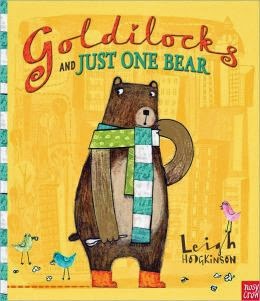
Goldilocks and Just One Bear (Candlewick Press; 2011): Leigh Hodgkinsons' riff on Goldilocks and the Three Bears starts out as a pretty simple reversal of the classic story, with a bear—wearing boots and a scarf—getting so lost that he soon finds himself no longer in the woods, but in a noisy, scary, confusing big city. He flees the street to find refuge, and ends up in an apartment in the Snooty Towers building. He's hungry and tired, and looks for something to eat and somewhere to rest, where he repeats Goldilocks' patterns in the home of the three bears—sort of.

"This porridge is too soupy," he says while dipping his spoon in the fish bowl. "This porridge is too crunchy," he says while spooning up cat food from the dish on the floor labeled "Le Chat."

When he dozes off in a just-right bed, three blonde human beings come home—a daddy person, a mommy person and al little person. Mid-way through the human family's freak out, the book takes a rather unexpected twist, when (spoiler warning!) the bear thinks the blond mommy person looks a little familiar to him, and the blond mommy person thinks the whole accidentally wrecking-the-joint sceneario seems familiar to her:
"Baby Bear?" said the mommy person.

"Goldilocks?" said the bear.
And so it was that the grown-up Goldilocks and the grown-up Baby Bear were reunited under strangely coincidental circumstances. After the family serves the bear some porridge, they send him on his way, with a map back tot he woods.

Hodgkinson's art is extreely charming, flat, simple and rough in design, but very busy and very colorful, with an almost collage-like quality to the juxtaposition of coloring and textures in the various objects in the fuller panels.

I'm a Frog! (Hyperion; 2013): The first thing one notices about Mo Willems' latest Elephant & Piggie book is the uncharacteristic contraction in the title, the I'm in I'm a Frog! rather than an I am. Perhaps due to their being books for starting readers, these rarely if ever have the characters speaking in contractions, which was, for me at least, at first somewhat off-putting, but the grand, emphatic way in which the characters spoke eventually became part of the humor (Scanning the list of other Elephant & Piggie titles at the back of the book—19 already!—I see one other has had a contraction in the title, Let's Go for a Drive!, while I Am Invited to a Party!, I Will Surprise My Friend and others eschew contraction opportunities).

So the plot of this one is that Gerald the elephant is surprised one day when Piggie hops over to him ribbit-ing and, when he questions her behavior, she explains that she is a frog (Contrary to her name, her appearance and what Gerald knows of her).

She explains that she's pretending to be a frog, and most of the book is taken up by her trying to explain the concept of pretending to Gerald, who is hearing it for the first time (contrary to the events of some other books, but whatevs, let's not nitpick continuity in standalone starter reader books; that's much more fun with superhero comics).

There's a nice, sharp bit where Gerald seems somewhat alarmed by the concept of pretending. "You can just go out and pretend to be something you are not!?" he asks, and, when Piggie assures him that everyone pretends, he follows up with, "Even grown-up people?"

Piggie looks out at the reader, her eyes narrowed and one eyebrow raised, as she says out of the side of her mouth, "All the time." Gerald, follows her gaze, looking at the reader, a single eyebrow raised in curiosity.

The concept of pretending eventually makes sense to Gerald, and he joins in, in one of those neat little almost-twist endings Willems excels at in these books. But the grown-ups diss is probably the the most noteworthy aspect of the book, a little bit of fourth-wall breaking meta-commentary of the sort that permeates We Are in a Book!.

Lines That Wiggle (Blue Apple Books; 2009): This book written by Candace Whitman and drawn by Steve Wilson is on a subject integral to art: Lines. The verbal component is pretty simple, a sing-songy, rhyming delineation of various types of lines. "Lines that wiggle, lines that bend, wavy lines from end to end," and so on.

Each page is a sort of standalone, poster or print-like image with brilliant bright colors of a limited variety per page; there's little texture or depth or detail, but the subject matter is fun, funny and of particular subjects of great interest to me. Mostly monsters really; in addition to the monster eating spaghetti on the front cover, there's a giant black monster sitting atop a rainbow, a giant monstrous foot that makes a school bus detour around it, and a trio of Bigfoot monsters captured in a net:
There's a giant octopus, a mummy, a horse wearing a cowboy boots, and a big, bipedal cat walking a bunch of little daschunds on leashes. In fact, there isn't a page in the book that I wouldn't like to see in poster form, hanging on a wall.
Each page features a shiny, slightly raised line, that runs across the page, and is integrated into the art, allowing one to follow the lines with the finger as well as the eyes. I don't know if its meant to be an art book or not, but it can certainly be read as one: Both as a collection of great, individual art images by Steve Wilson, and as a sort of basic how-to guide, in terms of identifying and classifying that basic component of drawings. "Lines are everywhere you look," Whitman concludes, "so find some lines not in this book!"

Little Owl's Orange Scarf (Alfred A. Knopf; 2012): Tatyana Feeney introduces us to Little Owl, a little owly who lives with his mom in a tree in Central Park. After we learn a little bit about Little Owl and his likes, we learn something that he doesn't like, his new orange scarf that his mom had made him. Not only was it orange and itchy, it was very, very long (so long, that it extends across three pages when we first see it).

Little Owl tries very hard to lose his scarf, and he finally succeeds on a class field trip to the zoo.
I love this image of his mom calling the zoo, as it is the only instance where some object or item that the owls have or use is of human rather than owl proportions.

So Little Owl's mom has to make him a new scarf, so this time they work on it together, which makes for a nice bonding experience, and also means that Little Owl gets to add his own input, meaning he gets a scarf he like: Blue, and appropriate in length. (And there's a neat revelation of how he finally managed to get rid of his too-long orange scarf on the last page).

Feeney's art work is wonderfuly simple, seemingly done with sparse pencil lines on white pages, with just very sparse bits of blue, orange and grey coloring throughout (For example, their little triangle beaks are orange, Little Owl has a few blue feathers, while his mother has a few gray feathers, and so on).

The lettering isn't hand-lettered, but it is big and blocky, and blue in color, looking as if it were (mechanically) filled in with blue lines, as if the artist were coloring in the white space of the block letters.

It's a really beautiful-looking book, the simplicity of Feeney's art only accentuating that beauty.

The 108th Sheep (Tiger Tales; 2007): This gorgeous republication of a 2006 British book by artist Ayano Imai concerns the practice of counting sheep to fall asleep, as the cover no doubt suggests.

The main character is a little girl named Emma who can't fall asleep, and drinking warm milk and reading didn't do anything to help. She finally turns to counting sheep, and one by one a big, fluffy sheep—each shaped a bit like a lop-sided egg, with a little black head and weird, realistic sheep eyes and tiny black sheep legs sprouting from the orb of wool—appears and leaps over the high headboard of her bed. Each is stamped with a red number, making counting all the easier, and even this doesn't work as she hoped, as she gets all the way up to 107 without dropping off:
"There goes 106," she said. "And there's 107. And now here comes..."

There was a thud, and Emma's bed shook slightly.

The 108th sheep did not appear.
Not-so-hot at high-jumping, the 108th sheep can't make it over the headboard, which is a big problem for everyone: I guess they can't jump out of order, and the sheep can't go to sleep until they finish their job and, for that to happen, 108 has to get over the headboard.

Emma and the sheep collaborate on different methods for helping 108 get over, which Imai draws without explaining each, letting the pictures handle the explanations for her, and Emma ultimately comes up with a solution that find her and the 100+ sheep all curled up snugly and asleep in her bedroom.

The book is a big, square one, far too big to fit on my scanner, and the pages are of a wonderful texture that a more knowledgeable writer about books could probably name to you, but all I can say is that each page was full of little grooves, and it felt a bit like wall paper to me.

Imai's artwork is all in pencil, with the quite delicate individual lines all clearly visible. Each cream-colored page has a red-paneled border in the middle, with the picture appearing within that panel. These are black and white and a little bit of red; or, actually, they are paper-white and pencil-gray, with the numbers on the sheep appearing in the same deep red as the panel borders, and a slightly lighter red coloring Emmas's rosey cheeks.

It's quite a beautiful-looking book, from the art to its format and construction, and the story it tells is pretty charming.

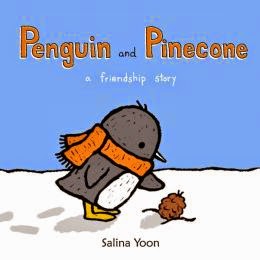
Penguin and Pinecone: A Friendship Story (Walker & Company; 2012): Salina Yoon's penguin character, Penguin, finds a pinecone in the snow one day. Penguin has never seen or met a pinceonce before, and doesn't know what it is, but he recognizes it as cold, so he sits down and knits it a little orange scarf like the one he wears. They happily play together, until Pinecone sneezes, and Penguin's Grandpa tells him that the pinecone, Pinecone, belongs in the forest, and so Penguin takes his friend to a pine forest and leaves it there.

Later, Penguin returns to find that his friend has grown up into a big, strong pine tree, easily identifiable by the orange scarf tied around its upper branches. They hang out and play in Pinecone's home turf for a while, but that environment is no better for Penguin than the snowy Antarctic was for Pinecone, so Penguin leaves.

There's a little overly direct moral at the end—"When you give love...it grows"—but it's accompanied by a very neat image of a whole forest of pinetrees, many of them wearing little pieces of winter clothing, to designate them as pinecones that befriended penguins (when Penguin first returns home, he accidentally brought a new pinecone with him, and a female penguin befriends it; on that last page, we see a tree wearing a boot around its trunk and a bow atop its boughs that match her own boots and bow).

The artwork, as you can tell by that on the cover, is darling.

Penguin on Vacation (Walker Books; 2013): Salina Yoon's Penguin returns to make a new friend in this book, in which he decides he needs a vacation ("Snow again?", he asks, comic book style). For a change of pace, he decides he wants to go somewhere tropical, so he leaves his scarf with his grandpa, packs a suitcase, and rides a gradually melting ice floe to a tropical beach.

He quickly discovers that the environment is pretty foreign to him, and his normal activities can't be replicated in a sandy environment. Then Penguin makes a new friend, Crab, who teaches him how to have fun at the beach.

Eventually, Penguin needs to go home, so he sits on his luckily buoyant suitcase, and Crab stows away, saying "I need a vacation too!" So Penguin gives Crab a little green scarf and matching mittens, and he shows him how to enjoy the snow and ice. It's pretty similar to Penguin and Pinecone in its cultural exchange, and just as cute.

Santa and the Three Bears (Boyds Mill Press; 2000): I read this, and I'm writing these few paragraphs about it, after I read the next book discussed in this post, despite the fact that this beat it to market by some 13 years. Despite coming first, it is a less elegant and less obvious admixture of the story of Goldilocks and the Three Bears with the story of Santa Claus. Here, the three bears-a papa, mama and baby polar bear—intrude upon Santa's house while he's away on Christmas Eve, doing his thing, and Mrs. Claus and the Claus' three elf helpers have gone out to get a Christmas tree.

The bears wreak havoc in Santa's cottage, but make restitution after Mrs. Claus finds them all sleeping in the Claus' bed—she puts them to work, fixing the damage they caused.

Writer Dominic Catalano presents a rather rustic Santa, unmoored somewhat in time—sometime after the invention of the electric Christmas lights—giving the book a classic feel, and his Santa and Mrs. are decidedly elfin in their own appearance, with long, pointy ears and noses.

Santa Claus and the Three Bears (Harper Collins; 2013): Writer Maria Modugno has come up with a pretty simple idea for a story, a Christmas twist on a fairy tale classic that pretty much tells its whole story right there in the title.

Modugno doesn't even mash up A Visit From St. Nicholas and Goldilocks and The Three Bears so much as she subtracts the little blonde from the latter, and adds Santa Claus to replace her. The other major tweaks of the story are to change the species of bear from the more generic brown bear to polar bears, and to holiday up the details.

So it's the night before Christmas and the three bears—big Papa Bear, middle-size Mama Bear and wee little Baby Bear—are getting ready for the holiday, decorating the house, putting up the tree and baking. When they sit down for their Christmas pudding, they realize it's too hot to eat, so instead of putting ice cubes in it like sensible bears, they decide to go for a walk to look at the Christmas lights in the neighborhood.

Meanwhile, Santa comes down the chimney, tries the three bowls of pudding, sits in the three chairs and, tuckered out after all that work, tries all three beds. The Bear family returns to find him sleeping in Baby Bear's bed, but rather than running off, as the little girl trespasser generally does, he gives them each a present, in a flip-flopped size order, so that Baby Bear gets the great big present, Papa Bear gets a little present and Mama Bear gets a medium-sized one.

The illustrations are provided by Jane and Brooke Dyer, and really make the book. Their polar bear family is a highly civilized one, obviously, as they live in a house with furniture and all, but theirs is still a rather rustic life, with Papa Bear having a big, stiff chair made from thick birch branches, for example, and their decorations being all-natural: garlands of holly and berries, and icicles that Papa Bear carries in a back-basket and somehow attaches to the house. Their Santa is similarly old-school, looking like the fat, little, old elf described by Clement Clark Moore, rather than a more modern, post Coke advertisement Santa Claus.

No word on what the bears thought when they watched those eight nine delicious-looking reindeer flying away into the night, but I imagine it was something along the lines of "Mmm, reindeer"...

Santa’s New Suit (HarperCollins; 2000): Writer/artist Laura Rader’s charming Christmas picture book opens a week before Christmas, with Santa Claus looking into a closet and deciding he doesn’t have a thing to wear (We’ve all been there, I suppose).

Not only is it full of nothing but identical red suits with white fur trim and matching hats, they all show signs of some serious wear-and-tear. I suppose centuries of around-the-world winter night flights and going up and down millions of chimneys will do that.

“I need a change,” he announces to Mrs. Claus, and tells her that he’s going to go buy a new suit. After a brief sequence in town where he visits various stores, he finds what he’s looking for at a store named The Snappy Dude.
Unfortunately, no one seems as enamored of the new suit as Santa, with typical reactions at the North Pole being “Oh my!” and “Egads” and “Yikes!” It doesn’t work outside the arctic circle either, as no one recognizes Santa without his trademark suit, which I suppose is as much as a uniform at this point as anything else. Obviously, things turn out as one might expect, and by Christmas Eve Santa Claus is back in his more familiar outfit.

The message is perhaps a negative one if you think too deeply about it—for Santa, clothes really do make the man, and he finds himself bound to the status quo, beset on all sides by peer pressure to dress to others’ expectations of him—but that’s probably just a thirtysomething’s too-close reading of the book, which is really much more focused on the humor of presenting a very familiar figure with an extreme change, and exploring the ways in which the world might react.

Snowy Valentine (Harper; 2012): You know David Petersen as the creator of the winning comic Mouse Guard (and the drawer of occasional covers for books like Teenage Mutant Ninja Turtles, Fraggle Rock and The Muppets), did you know he's also responsible for at least one children's picture book?

Well, he is.

Though the cute, anthropomorphic woodland creatures on the cover of this book are rabbits rather than mice, it's immediately and abundantly clear that this is the work of the same artist.

The story, which Petersen has conceived and written as well as drawn, is so simple that to say too much about it at all is to risk ruining it. On a snowy Valentines Day morning, Jasper Bunny sets out from his home atop a hill, intent on thinking of the perfect gift with which to express his feelings for his wife, Lilly. He decided to visit his neighbors for ideas.

He visits the Porcupines and The Frogs, stops by a flower cart run by Everett (A raccoon), wind sup in some trouble when Teagan Fox invites him in to his den to brainstorm, and has a brief chat with a cardinal before returning home. Metaphorically, the journey itself proves his love for Lilly and, in its doing, he inadvertently created a big, unmistakable, visual sign of his love for her.

Rather than the medieval setting of his Mouse Guard comics, these animals seem to live in a more modern period in the past, perhaps a comfortable, Victorian village in Europe or perhaps the United States. In the setting, realistic rendering of human-like animals, and their dress and manners, Petersen's book evokes the work of Beatrix Potter. I have to assume that Petersen's wife Julia, for whom he made the book (the dust jacket says) was quite pleased with her Valentine's gift that year.

Tea Rex (Viking; 2013): Get it? Tea Rex? Like a T-Rex, but here the "T" refers to the beverage, and is not an abbreviation for "Tyrannosaurus"...?

Well, I laughed.

There's not much more to the joke than what Molly Idle has put right there on the cover: The clever play of words, the huge dinosaur sat awkwardly but gamely with two little kids at a children's tea party, but that's actually plenty.

Inside, Idle's words are instructional in nature, explaining how one is to host a tea party:

When hosting an afternoon tea for a special friend—greet your guest at the door. Lead him through to the parlor. Introduce him to your other guests—and offer him a comfortable chair.

And so on. The images feature the little girl hosting the tea, Cordelia, and her more little still brother or friend, going through each of these steps with their guest, a very polite Tyrannosaurus who wears a little polkadot bowtie and carries a tiny hat with his tail.

The difficulty of doing each of these things when a dinosaur is involved is illustrated, and is often in sharp contrast to the quiet, polite tone of the writing. For example, the words "Lead him through to the parlor" appear on a two-page spread in which the dinosaur strains and sturggles to fifth through the door, while Cordelis pulls on one of his little arms, and her friend or brother pulls on her shawl.

A few pages later, the instructions "Take Turns making small talk..." lead off a four-page sequence in which 1) Cordelia babbles on about the weather and her begonias while the boy looks bored and the dinosaur points at his watch, 2) The little boy says "Ta-daaa!" as he hangs a spoon from his nose, and 3) the T-Rex says "ROAAAAAR!" and and blows everyone off the pages.

It's delightful.

Yeti, Turn out the Light! (Chronicle Books; 2013): Next to the last two Shea books, this is probably my favorite picture book that I've read in quite a long while, not simply because it features a Yeti as its protagonist or because artist Wednesday Kirwan (who obviously had pretty cool parents) had produced such wonderful artwork, contrasting the bestial reputation of the maybe-real-but-probably-not monster with a mundane, domestic setting and drawing some of the cutest woodland creatures imaginable.

No, what I really like about it is the look on the Yeti's face. That's not anger; that's just the face the Yeti always makes, no matter what he's doing.
On the first page, we see the Yeti standing on a cliff, holding a large stick, shielding his eyes from the sun as he looks out over an idyllic valley, where a pair of deer drink from a stream. The rhyming narration tells us that the Yeti's day is just about over, so he returns to his home, carrying the stick over his shoulder (no idea what he does with that stick all day). That home in the side of a cliff, and accessible by a bright red door, complete with a door knob, keyhole and hinges—hard to believe Bigfooters have been unable to find any sasquatches or yeti,given such a tell-tale sign to where they might live. Why, it couldn't be any easier to spot, not unless he put out a welcome mat and erected a mailbox reading "Yeti" on it.

After he eats dinner and flosses and crawls into bed, Yeti is already to drift off to sleep, when suddenly he sees strange, scary shadows on the wall. He turns on his beside lamp only to discover that they are....
...adorable bunny rabbits.

They join him in bed, but on on the next page, another strange shadow appears, scaring Yeti and the bunnies, and yet again it turns out to be an adorable set of woodland creatures, so arranged that their shadows look scary in the dark. This happens a few more times and, eventually, Yeti kicks all the animals out, and everyone goes to sleep in their respective homes.

I'm not a big fan of the rhyming storybook, but writers Greg Long and Chris Edmundson do an okay job of it here, and it was somewhat inspired to make the child-like character easily frightened at bedtime be a monster himself, and for basing a whole book around the common childhood phenomenon of turning the least threatening objects into monstrous things when the lights go out.

But mostly what I admire about this is Kirwan's art. And her Yeti face and expressions, which change very, very little from emotion to emotion.