Showing posts with label judge dredd. Show all posts

Tuesday, September 09, 2014

The Batman/Judge Dredd Collection Part 4, Die Laughing

The fourth and final of the Batman/Judge Dredd pairings, and the climax of DC Comics and 2000 AD's 2012 collection of those stories, was 1998's Die Laughing, which was, appropriately, the biggest of the four stories. Not just in scale—featuring as it did The Joker teaming up with Judge Death and the other Dark Judges to slaughter 10,000 trapped civilians—but also in size. While the first three Batman/Dredd books that John Wagner and Alan Grant wrote were single-issue affairs, Die Laughing ran for 90 pages spread across two issues.

Like two-thirds of the previous outtings, this one was fully painted, featuring art by Glenn Fabry, Jim Murray and Jason Brashill, and the narrative included scenes in both Gotham City and Mega-City One, and villains and characters from both Batman and Dredd's regular milieus.

Die Laughing opens with a five-page sequence set in Gotham. Fabry's red-eyed Batman has tracked down The Joker, who is outfitted in a green suit and matching fedora, both covered in a pattern of red lips (not his best suit, honestly). The Joker has just gotten his hands on the Dimension Jump Belt from 1991's Judgement on Gotham crossover, and he uses it to escape from Batman.

But something goes wrong. The belt malfunction sends The Joker's intangible spirit to Mega-City One, leaving his now all-gray, semi-lifeless body in Gotham. That will prove rather important to the story.

Meanwhile, in Mega-City One, there are two big news stories dominating the airwaves. One is that the huge, 10,000-strong "Seventh Day Hedonists" cult is preparing to seal its members eternally in "The Megasphere," where they plan to spend the rest of their days in their hedonistic pursuits, completely separated from the outside world.

The other is that Mega-City One's judges are preparing to transfer the evil, incorporeal beings known as The Dark Judges—Judge Death from Judgement, and his fellows Judge Fear, Judge Fire and Judge Mortis—to a special, hidden tomb where they will never be heard from again. They are eacb encased in "glasseen crystals," which are promptly stolen by a new master criminal on the scene:
The Dark Judges are freed, and they strike a deal with The Joker: He provides them with new bodies, and they will make him immortal, although the manner of his immortality isn't quite what he had in mind, as he becomes the fifth Dark Judge, Judge Joker.
Their wicked plan involves having Judge Mortis possess Chief Judge Herriman and ordering the arrest of first Judge Anderson (who is, remember, capable of finding and capturing the Dark Judges in her own brain, at least temporarily) and, later, Dredd. Anderson manages to escapes to Gotham City in order to find the expert in defeating The Joker.

Some exposition and fight scenes later, and the stage is set for a big action scene, as Batman and Dredd ride those massive Lawgiver motorcycles to the Megasphere, where the Dark Judges plan to seal themselves in with the Hedonists, who they can kill at their leisure, free of all interference from the law.
The entire second half of the story is specifically designed to be completely over-the-top, with completely insane visuals that make Judge Dredd and Batman look like the most normal and vanilla of elements in the story.

Each of the Dark Judges has a striking appearance and manner of killing. We've already met Judge Death, of course. Judge Fear wears a special helmet which disguises his true face, so horrible it scares those who look upon it to death:
Did Judge Fear steal this gag from Beetlejuice, or vice versa?

Judge Fire, is, perhaps self-explanatorily, a constantly burning, skeletal judge, who kills with fire:

Judge Mortis has steer's skull for a head, and kills via corruption; one of the running visual gags in the book is the way his infection of Judge Herriman causes his host to gradually rot until he's practically falling apart:

And as for the new Judge Joker?
The sound of his laugh can now cause heads to explode.

Batman and Dredd must race through the Megasphere—filled with strange rooms to cater to bizarre fetishes and hobbies that make for wild set-pieces, and peopled by cartoonish characters in all manner of strange costumes—destroying the Dark Judges' host bodies and capturing their spirits in different, inventive and, occasionally, slightly silly ways.

As for Judge Joker, Dredd blasts his host body to pieces until The Joker's spirit jumps ship...landing bak in his own body, already strapped to a chair in Arkham Asylum.

As with all superhero crossovers then, Die Laughing featured incredibly high stakes, but ended pretty much where it began, with nothing really changing...unless you count Dredd and Batman hating one another less then they did during their first meeting as change.

In terms of highlighting particular aspects of each of the stars and their home comics, and fitting them together in interesting ways, this turned out to be a really rather perfect crossover story. The fact that Grant and Wagner spent literally years building up to it, with the story calling back to both Judgement and Vendetta in Gotham, only made it more so. It's easy to imagine that, with some tinkering, this could have served as the only Batman/Dredd crossover story, and served rather well.

But the fact that Grant and Wagner gradually introduced the threats, with one Dark Judge proving a challenge in the first story, and that menace multiplied by five in this one, and gradually built up a relationship between the two title characters and (to a lesser extent, Batman and Anderson) really helped get this one over as a big story with a real sense of occasion.

It therefore almost seems too bad that the collection keeps going after Die Laughing ends.

As previously noted, The Batman/Judge Dredd Collection includes not only all four Batman/Judge Dredd stories, but also 1995 one-shot Lobo/Judge Dredd: Psycho-Bikers Vs. The Mutants From Hell, which does not feature Batman, but does feature another Grant and Wagner-written Dredd story in which the Judge meets a character from Batman's home universe.
It is not very good, but then, Lobo comics are a pretty acquired taste. A dumb, ultra-violent space-biker/bounty hunter, my favorite stories featuring the character have been the ones that find their humor in making fun of the character, and/or feature the work of artists I like quite a bit, like Doug Mahnke, Simon Bisley, Kevin O'Neill or even Vince Giarrano.

I like the work Val Semeiks, who pencils this story, quite a bit too, and his pencils look great under John Dell's inks, but, eh, this isn't really my kind of thing, and probably isn't helped any by coming after four far superior stories.

Lobo has been hired to serve as the body guard of a children's entertainer (in space), who turns out to actually be a shape-changing mutant from Mega-City One who is impersonating the children's entertainer, who is dead. When the mutant's fellow mutants show up to kill him, he escapes back to Mega-City One, and Lobo follows.

The mutant's brother is trying to acquire a pair of special rings that give him incredible powers, with which he hopes to start a mutant revolution. Lobo ends up fighting them alongside Mean Machine and Dredd.

There's a lot of shooting and fighting and, when all is said and done, Dredd and the less-bad bad guys win.

There's not much to it, but Semeiks draws a mean Mean Machine...
...a nice stereotypically-proportioned comic book babe...
...and a pretty awesome flying space motorcycle...
...which actually looks space-worthy.

Sunday, July 13, 2014

The Batman/Judge Dredd Collection, Part 3: The Ultimate Riddle

As mentioned in the last installment, 1995's Batman/Judge Dredd: The Ultimate Riddle seems to have been the result of some sort of scheduling issue, perhaps with the artists or with some unguessable outside factor. The story is not so inspired that one imagines writers John Wagner and Alan Grant having a brilliant Riddler story they wanted to tell, and decided to tell it before they got to a more proper, epic conclusion to the their stories of the two crimefighters clashing, and it exists in an almost Elseworlds-like corner of the Batman line, so it's not like editorial pressures should have been a factor.

Whatever the reason, readers of Vendetta in Gotham were told to expect Die Laughing in 1994, but instead got no Dredd/Batman team-ups in that year, and then got The Ultimate Riddle the following year. And whatever the ultimate origins of Ultimate Riddle, it brought painted artwork back into the fold, with artist Carl Critchlow handling the majority of the book (31 pages) and Dermot Power handling the rest (13 pages).
The story begins with Batman receiving a clue from The Riddler, and chasing the villain down, before a strange green light zaps them both, and they find themselves sharing one of many hanging cages in a dark room. In one of them is Judge Dredd, and the felon he was pursuing before being zapped there, someone he refers to as "The Creep," but who appears to be a The Creep and not the The Creep. Other warriors from other places are in the other cages; most of these have convincing enough names and looks that I suspected some of them might have been pulled from Judge Dredd's home comics, but a quick Internet search doesn't show any other appearances for Mekarnos Mandroid, Brutalix, Living Nightmare, Sauron-Dos or Gulagg of Gnulp anywhere else. There is one other character from the DC Universe...sorta. This is Yanok, who is a member of the Khund race of aliens in the DCU.
They've all been gathered by a mysterious, weird-looking figure with a magical wand calling himself "Emperor Xero." Upon his arrival, The Riddler immediately demands he be paid for luring Batman into a trap, and Xero responds by killing The Riddler dead. On page 9. If that seems like a pretty quick exit for The Riddler in a prestige format Batman book with the word "Riddle" in the title—and it sure seemed like it to me—don't worry; all is not what it seems.

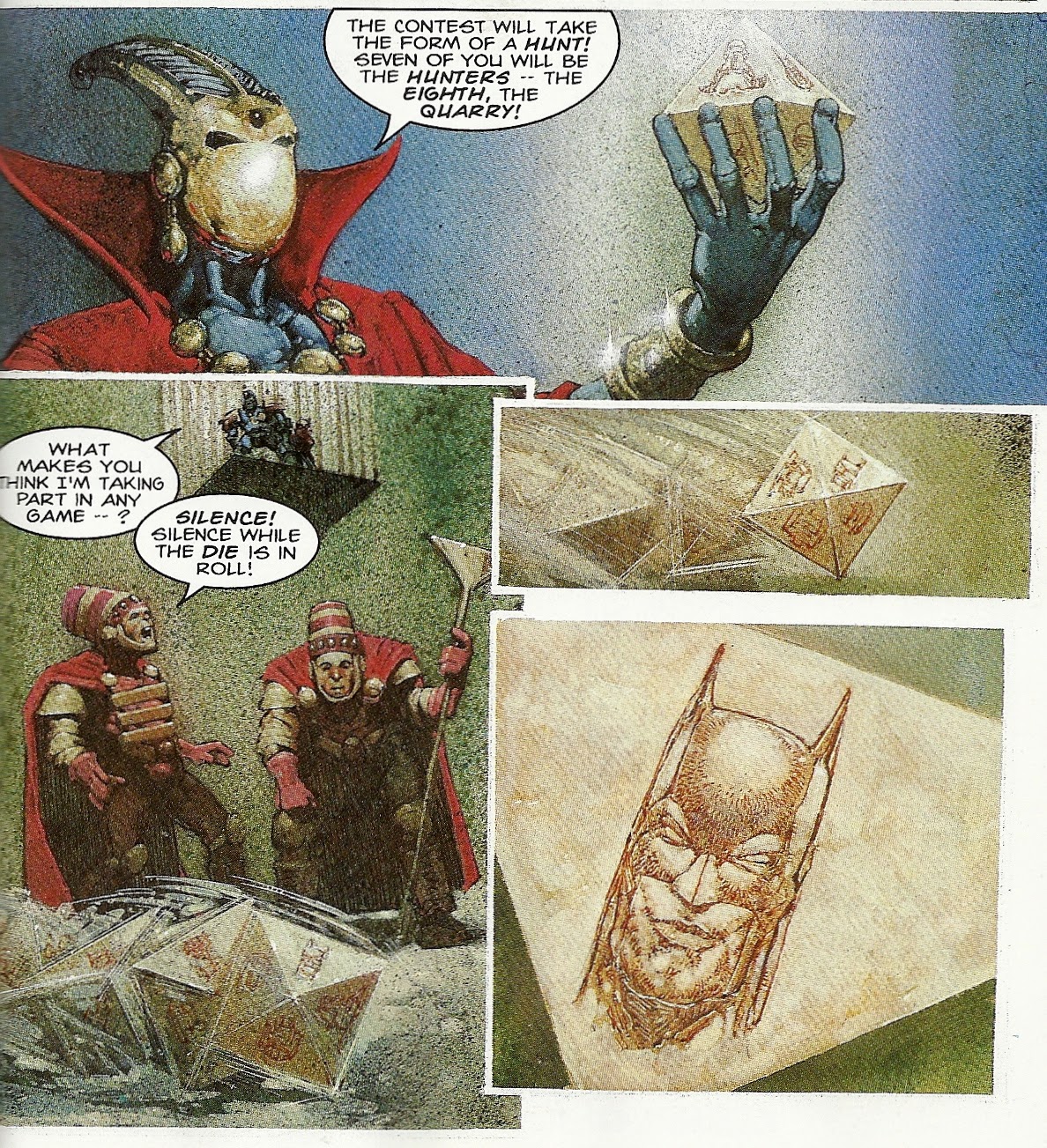
Xero has gathered these gladiators to play a game of his own amusement. He produces a giant, eight-sided Dungeons & Dragons die to roll to choose the "quarry." It will be the task of the other seven to hunt and kill the quarry, and whoever successfully does so will be set free; the others will all be killed.
The die lands on Batman, and Xero teleports the eight players into a bizarre urban environment—one with even stranger and more sinister gargoyles than even Gotham City—from whence the hunt can commence.
Obviously Batman wants no part of the game, as his role is to either be killed or to kill Dredd and the other six hunters. And while Dredd isn't as adverse to killing as Batman, he shouts at Xero, "I kill for no man's entertainment!" (No, Joe? What about for the entertainment of your many readers?).

The other six have no moral qualms about killing Batman, Dredd or each other. The entire middle act of the book features a sort of violent game of hide-and-seek involving the various characters, with Batman and Dredd kinda sorta teaming up as they battle the various villains, who come in such forms as an S&M minotaur, an android with a gatling gun for one hand and a rocket launcher for the other and a humanoid lizard, all the while bickering over Dredd's quickness to kill (Batman even gets pissed when Dredd puts a bullet in bull-man Brutalix's knee-cap, instead of just leaving him tied up with a bat-rope to a pillar, punching the good judge hard enough to summon blood spray and put him on his ass).

The Living Nightmare has some kind of psychic nightmare powers, which he uses on Batman, summoning up some of his wort fears, which gives Power the opportunity to do a neat inside-Batman's-mind splash page of the sort that Simon Bisley painted in Judgement on Gotham:
He puts in a lot more villains. Notably missing is Catwoman, who was in Batman's mind in Judgement and, among the additions, is the then rather new Bane (who was only two years old at the time).

Now, to spoil the ending, so don't read on if you don't want to know what's-what with the story, it turns out Batman and Dredd are the only players left standing and/or breathing at the end, and, Batman manages to figure out The Riddler's riddle from page 2 just in time to unmask Xero.

This whole thing was an elaborate ruse built by a super sci-fi power scepter that appeared in front of The Riddler.
So that makes The Ultimate Riddle maybe the weirdest of DC's Zero Hour crossovers; so weird it wasn't even labeled as such! (You know, DC could really do with some trade paperback collections of Zero Hour tie-ins. A lot of those ones where time is messed up are really rather good; certainly there were enough solid Batman ones to fill a decent-sized trade paperback).

I was thinking about it after reading this, and I couldn't recall any other occasions in which Alan Grant had written The Riddler, who was more-or-less in some sort of semi-retirement for a large chunk of the 1990s (Maybe everyone liked Neil Gaiman's "last" Riddler story in 1989's Secret Origins Special #1 so much that no one much felt like writing new Riddler stories for a while, with the possible exception of Peter Milligan in "Dark Knight, Dark City"...?). At any rate, he's one of the few Batman rogues I can't think of an example of Grant writing during his long collaboration with Norm Breyfogle, although maybe he did and I'm just having trouble remembering. But Riddler's stated motivation of always wanting to kill Batman seems a little...off to me.

After an intense showdown with an interesting result, The Riddler is wounded and Batman gets his hands on the scepter, their ticket out of here, as Dredd puts it, adding, "Any idea how it works?"

"If Riddler can figure it out, we can," Batman says.

And so this story seems to have a little in common with the first crossover, being once again fully-painted, and a bit more in common with the second (featuring just a single Batman villain and no Dredd villains save the perp he was in the middle of strip-searching when they were zapped here, taking place partially in Gotham and not at all in Mega-City One).

It's not until the next—and final—Dredd/Batman crossover that the series will again combine the settings, supporting characters and villains of both franchises. And what a big, epic story that will be, boasting a length somewhere in the area of double that of the first three, and featuring The Joker and all four Dark Judges...

Monday, July 07, 2014

The Batman/Judge Dredd Collection Part 2, Vendetta In Gotham

Batman and Judge Dredd would cross paths again two years later, in 1993's Vendetta In Gotham, an all-around smaller story that brought with it a smaller sense of occasion. The artist this time around was Cam Kennedy, who had at that point done plenty of work for 2000 AD and had rather recently drawn Batman in 1992's Batman#447-448, written by John Wagner, and featuring a pair of the neatest Batman covers I can remember (by Tom Taggart).


Kennedy is, of course, one hell of an artist, and his contrast between the two lead characters is striking, visually emphasizing their differences and conflict. Kennedy's Dredd is lean, and what little there is of him seems to be all chin and muscle, his armor standing out so as to almost seem ill-fitting. Batman, on the other hand, is huge, made to look bigger, longer and wider by the billowing cape with it's rectanglular shoulders and his pointy ears and other jagged edges.

Kennedy, like Bisley, also excelled at mixing straight and silly character designs into the same space, and making them all seem as if they belonged.

As good an artist ass Kennedy is however, he's here working in pencil and ink, rather than paint, so even at a glance, this looks and looked more like a "regular" comic book than something more prestigious (Not even the Mike Mignola cover is painted).

The book is set entirely in Gotham City, with no trips or check-ins with Mega-City One (as in the original crossover), and there's only a single, minor villain from Batman's rogues gallery, with no corresponding villain from Dredd's world (or any supporting characters from Dredd's world, like Judge Anderson in the original).

That villain, incidentally is The Ventriloquist, which I suppose at this point I have to refer to as the original Ventriloquist, as writers Paul Dini and Gail Simone went on to invent their own versions of the character. The Ventriloquist might seem an extremely unlikely choice for an inter-company crossover story like this, but given that he was the creation of writers John Wagner and Alan Grant (along with artist Norm Breyfogle), it becomes less surprising to see him appearing in this Wagner/Grant-scripted story.

Batman's main antagonist, after all, is Dredd himself this time around.

The story this time? Batman just finishes foiling the getaway of some thieves, when Dredd appears on his Lawmaster motorcycle directly in front of a sign welcoming him to Gotham. He checks his watch, and goes after Batman, blowing a wheel off the Batmobile and starting a fight. Dredd takes off all his weapons, locks them in his bike and tells Batman he's here to administer his punishment—accumulated during their previous encounter—via a single man-to-man beating. Batman wants no part of it, and tries to resist fighting for a while, but a seesaw to the groin has a way of triggering a flight-or-fight response.
After a 45-minute fight that moves from a playground, to the top of an elevated train, to the river below—and some of which is depicted in a pretty neat 12-panel page of the two combatants punching each other in front of the full moon in semi-silhouette—Dredd calls it off and explains what he was up to by handing Batman tomorrow's front page, in which the headline story is Batman's death while trying to thwart a bombing (Mega-City One isn't just in another dimension from Gotham City, it's also in the future).
See, while all this fighting was going on Scarface and The Ventriloquist were hatching a plot to kill the son of a senator who is in a children's play. The plan involved swiping the doll carried by the girl playing Goldilocks, replacing it with a disguised Scarface packed with explosives and then detonating him at the right time. If Batman was too busy fighting Dredd across town, he wouldn't be able to get himself killed in the explosion, even if it did mean some children would die.
Obviously Batman doesn't subscribe to the same ends-justify-the-means philosophy as Dredd's Justice Department, so he races to try and stop the bomb from going off in the time that remains. Dredd goes in pursuit, and, thanks to an unexpected malfunction and the intervention of not one but two heroes, The Ventriloquist and Scarface are unable to complete their plan, meaning no one dies (the newspaper headline in Batman's hand being instantly rewritten from "BATMAN DEAD" to "BATMAN SAVES THE SHOW").

As to why Dredd went to so much trouble in order just to save his life, given the fact that the two aren't exactly besties, Dredd explains: "One of our Psis had a premonition. It seems Mega-City One is going to be needing you...there's going to be one almighty disaster...and you and I are going to be in the thick of it!"
From the next issue box in the last panel, in which Kennedy's inky Batman hunches on a gargoyle, his cape falling like a waterfall of ink, it looks like the plan was for that almighty disaster to come in 1994, as it reads "Judgement 3: Die Laughing! will be out next year!"

Plans obviously changed, as the next Batman/Judge Dredd team-up was actually The Ultimate Riddle, and that came out not in 1994 but 1995. As for Die Laughting, it would be released until 1998, five years later.

The Batman/Judge Dredd Collection Part 1, Judgment on Gotham

One of the first comic books I ever read, probably among the first dozen at the most, was the 1991 "prestige format" special Batman/Judge Dredd: Judgement On Gotham, a fully-painted, seemingly once-in-a-lifetime meeting between the most prominent and popular American superhero (who just had a major motion picture in theaters a few years ago, and had another one due the following year) and a character I was told was his British equivalent. That sure sounded like something to read!

It was one of my earlier exposures to comic book Batman, my first exposure to Batman villain The Scarecrow and, of course, my very first exposure to Judge Dredd and the members of his supporting cast that appeared within the story: Psychic fellow officer of the law Judge Anderson, archenemy Judge Death, and less-arch eneemy Mean Machine Angel.

I loved it, although re-reading it many years later, I see that I missed a lot of elements of it, particularly the fact that Dredd and the comics world that emanates around him isn't meant to be a straight one in the manner that Batman and his Gotham are. If Batman comics were usually meant to be read as serious, Judge Dredd comics weren't necessarily meant to be un-serious, but they were often written, drawn and intended with tongue-in-cheek, with parodic elements, with jokes. Not that it mattered to 14-year-old Caleb, who was mainly entranced by the art of Simon Bisley, who presented an exaggerated, heavy metal album cover world of Gotham City and Mega-City One, with garish, cartoony characters covered in realistically rendered muscles, flesh and textures. It looked like Dave McKean's Arkham Asylum, but read like a regular Batman comic from the era (Thanks, in large part, to the fact that it was written by John Wagner and Alan Grant, a writing team with plenty of Dredd and Batman experience; Wagner, of course, was Dredd's co-creator, and while he and Grant started out co-writing Batman comics for DC; Grant later went solo, becoming one of the more prolific and longer-tenured Batman writers).

I suppose Bisley's images of a topless Anderson didn't hurt...
Nor did a rather bravura splash page in which Bisely illustrates what Anderson sees when she takes a peak in Batman's head:

This, remember, was among my earliest exposure to DC Comics' Batman, and the suggestive painting of a strange, scary, brightly-colored world seen in that splash went a long way toward selling me on Batman comics. If that image was representative, what was I missing by not reading Batman comics...?

(It's interesting to look at again now, after having read hundreds of the damn things. The Joker, Penguin and Catwoman are all prominent; dig The Joker's bottle-green suit and Catwoman's peculiar costume, which echoes Batman's own, particularly as drawn by Bisley in this book). There's Judge Dredd and Judge Death, so recently on his mind. There's Robin, whose 1988/1989 death Batman was still rather pointedly mourning. There's a repeat of the shooting death of the Waynes, and a monster at crashing through glass, as in Frank Miller and David Mazzucchelli's version of Batman's origin. There's Judges Death and Dredd, obviously quite fresh in Batman's mind. There's a couple of nasty-looking guys in the upper-right hand corner that could be Batman villains of some sort, the one on the right looks a bit like Clayface III, but given Bisley's style of goon, it is likely just a random bad guy. The character I'm most intrigued by is the one just below that pair, who looks like Wildcat with a cooler, more articulated mask than he's usually given. I'm not sure if that's meant to be Catman, as he doesn't at all resemble the character as he appeared in a 1990 Alan Grant-written encounter with Batman, or Wildcat, who he does closely resemble but who at that point wasn't conceived of as having played any real role in Batman's life. I'm assuming its just Bisley's version of Catman, drawn from his own memory or imagination, or just his response to a script calling for the drawing of "a bunch of weird, dramatic, traumatic Batman stuff" as he saw fit. Cool drawing though).

As much as I liked the book, and as much as it served as a gateway into the world of Batman comics (and DC superhero comics in general), I never read the three sequels. Each of these was also written by Alan Grant and John Wagner, but none of them were painted by Simon Bisley (the major draw of the first one for me) and, by 1995 the very words "Judge Dredd" caused me to recoil in terror, having seen a movie by that title that...didn't really help sell that particular brand to me.

It is now 2014, of course, and in the (jeez) 23 years since Judgment On Gotham, there have been seven more Batman films, one more Judge Dredd film and I've read hundreds and hundreds of comics, including plenty of Judge Dredd comics (though still nowhere near as many as I have Batman comics) and learned the names and work of almost all of these other guys who made all of these other Batman/Dredd crossovers.

So remembering Judgment On Gotham the other day, I thought it was well past time I read all those sequels, and thought I'd see if they had ever all been collected and, naturally enough in our Golden Age of Collections, they have been!

In 2012 DC published The Batman/Judge Dredd Collection, featuring all four of the two characters' crossovers, with Lobo/Judge Dredd: Psycho-Bikers Vs. The Mutants From Hell thrown in as a sort of epilogue; despite its complete lack of Batman, it does feature Dredd crossing paths with a DC Universe character, and it is written by Grant and Wagner.

The collection is rather recent in vintage, coming after the New 52 reboot and after the intro of the new new DC Comics logo (which "2000 AD" appears directly beneath) in the upper right corner. They used Mike Mignola's cover for the Vendetta in Gotham, the second Dredd/Batman get-together, and the only one in this book that isn't painted (save the Lobo cover). I woulda used the Judgment cover, which both came first and looks a bit more prestigious, but I suppose Mignola is a bigger name than Bisley, and one that's moved more trades from the shelves of US book stores and comic shops over the years. On the right, all of the titles of the stories are listed (note how you can determine the particular Batman villains used in the final stories based solely on their titles), and, in a column on the left, the creators, with Wagner and Grant getting top-billing, followed by artists Simon Bisley, Glenn Fabry and, surprising to me at least, Val Semeiks (who only contributes the Lobo story) and then Cam Kennedy, who I would have thought a bigger name than Semeiks.

The tone of the collection seems to hew closer to that of 2000 AD than DC Comics, with the dust jacket issuing such warnings from the "Justice Department" as Warning: Explosive Contents—Handle With Care and Contains excitement levels that may cause unexpected side effects.

I considered reviewing the whole she-bang in one interminably long post, interminably long posts being, of course, the only kind of long posts I do here at EDILW, but I figured I would split them up, story by story, in part to make the piece more reader-friendly and, in greater part, so that I could kill the better part of a week reviewing a single book.

So let's start with 1991's Wagner, Grant and Bisley production, Judgment on Gotham.

The book opens with what must be one of the weirdest openings to any Bamtan comic I've read, the familiar Bat-symbol slowly morphing, over the course of four panels, into two people making out, and then we see a monster's POV sequence as the main villain of the piece sneaks up on his first victims:
Also, there's honest-to-God nudity in a DC comic!

Batman, who Bisley draws to look sort of like Kelley Jones' Batman—extremely long, horn-like ears, huge cape constantly curling its serrated edges like it has a life of its own, muscles bulging through the costume as if it were bodypaint rather than body armor, exaggerated emotion in every expression—but with the careful, painterly detail of Brian Bolland's Batman, hears the screams and reacts. He arrives to find the ghoulish Judge Death, a lisping creature with his own personal dialogue bubble style who "Jjjudgges" every living thing he comes across, plunging his bony claws into the victims, sentencing them to death, and then facing off against a few Gotham police officers.

After a brief melee in which Batman first impales Death upon a wrought-iron fence ("Impaled! I didn't mean to kill it--!") and then incinerates him in an accidental explosion involving stray gunfire at a gas station, Batman examines the corpse of Judge Death after its spirit flies away, screaming "Jjudggmenttt will be carried out ALLLL WILLL DIEEEEEEEeeeeeee", and our hero finds a strange belt, which—FAZZZT!—teleports him to Mega-City One.

There he meets Mean Machine Angel and after a fight that leads to Batman saving Angel from plummeting to his death, Judge Dredd assumes the pair to be in cahoots. Angel escapes using the "D-belt" device that allows for travel from the pages of 2000 AD publications into the DC Universe, leaving Batman to meet Judge Dredd.
He doesn't get along with this particular lawman nearly as well as he does Commissioner Gordon.

Unarmed and un-masked, Batman's being interrogated by Dredd and risking a fifteen year sentence just for the weapons in his utility belt, when Anderson arrives. After exposition explaining what the hell Judge Death is exactly—one of four extra-dimensional "Dark Judges" that believes since all crime is committed by the living, all life must be eradicated to prevent crime—Dredd and Anderson argue over whether they should journey back to Gotham with Batman to save the city and capture Death, or throw Batman in a cell and then throw away the key.

I loved and still love this scene where Batman punches Dredd in the face:
I'm not sure if this is what Grant, Wagner and Bisley intended, but it reads like Batman gets so angry and desperate to save Gotham that he's able to snap the ropes binding him to a chair and punch dread hard enough to shatter his visor and knock him on his knees, all in one single, fluid motion.

"Make it twenty!" is a pretty good, Hollywood action movie-like line, too. I think I'd rather watch a Batman V. Dredd: Punching and More Punching than a Batman V. Superman: Dawn of Justice movie...

Back in Gotham, the now ghost-like Death is seeking a new host body, and happens across Batman villain The Scarecrow in a morgue. In retrospect, I find it curious that Wagner and Grant chose to use The Scarecrow as their Batman villain, in large part because, in 1991, The Scarecrow not only wasn't Batman's archenemy, he might not have even made the top-ten list of most readers.

The two strike a deal and, before long, The Scarecrow and his henchman are providing a new host body for Death and doing their level best to come up with a costume that vaguely resembles the one he was wearing.
In Mega-City One, Anderson and Batman strike a deal of their own, which involves Anderson breaking Batman out and escaping with him back to Gotham, with Dredd hot on their heels.

It all culminates at a heavy metal concert in Robinson Park, where Scarecrow and Judge Death are drawn because of the huge crowd's number of potential victims. Mean Machine Angel is drawn there because he hears the band's name—Living Death—and assumes it refers to Judge Death, who stole the D-Belt from him and with whom he now has a score to settle. And Batman and the Judges show up because, well, that's where the bad guys are.

After a brief musical performance by Judge Death—a parody of the Rolling Stones' "Sympathy for the Devil," which I hadn't recognized as a teenager because I hadn't actually heard
any Rolling Stones songs as far as I knew at that point—everyone fights, and the good guys win.

Bisley gives both of the title heroes pretty bad-ass splash pages:


Dredd wants to take Batman back to Mega-City One with him in order to serve his time, but Anderson intervenes, convincing Dredd to back off for now, and he complies, noting of Batman once the Dark Knight is well out of earshot, "Bit of a tough guy."

Wagner and Grant naturally get the voices of their heroes and villains just right, and Dredd and Batman make particularly good foils for one another. Despite the fact that both are crime-fighters, the fact that Batman is a vigilante with a perhaps-unusual-given-his-vigilantism faith in the 20th century's legal system and Dredd is a completely uncompromising police officer, judge and jury all in one is more than enough to keep them bickering for as many pages as their publishers will allow them to share.

Re-reading this now, I'm also struck by how well the tones of the two strips match-up. The Batman side of things might be slightly more humorous than usual (The Scarecrow's fear gas comes out of a spray can labeled "Fear-O-Sol, Guaranteed Ozone Unfriendly" for example, and there's that awesome scene where Scarecrow shows Judge Death that which he fears the most), but, for the most part, the gag elements come from the Gothamites reacting to the invading characters. The sober, serious Batman more than once refers to the denizens of the Dredd strip as madmen.

But, as I said earlier the greatest attribute this story had, at least as far as I was concerned, was Bisley's art.

There's not a whole lot of difference between his Mega-City One and his Gotham in terms of lighting and texture, but his Gotham is certainly more cartoony and futuristic-looking than usual. There are collage elements used in providing signage, the cops tool around in a big, silver sports car and carry Cable-sized pistols, and most are extremely exaggerated in build and/or design, wearing out-sized blue hats.

I particularly like Bisley's Death when the character is incorporeal, at which point he has his regular head and sometimes hands, but otherwise looks like a rather filthy specter, composed of fluid, flowing ectoplasm.
The effect of his trying to enter other characters, like The Scarecrow here, is similarly neat.
And Bisley's portrayal of the "D-jumps," when characters move from one dimension to another, are pretty cool:
I sure have aged since the last time I read this story, but, surprisingly, it doesn't seem to have done likewise.