Showing posts with label rags morales. Show all posts

Tuesday, March 10, 2015

Review: New Avengers Vol: 3: Other Worlds and New Avengers Vol. 4: A Perfect World

I've been catching up with Jonathan Hickman's run on the Avengers books—Avengers, featuring the official line-up of Marvel's premier superhero team, and New Avengers, featuring The Illuminati—and I can't begin to tell you how much I've been enjoying the story, particularly this chunk of it, collected in these two collections (11 issues of New Avengers, from #13-#32).

In fact, that was me attempting to begin to tell you how much I've been enjoying it. See? I didn't do that very well at all.

When Brian Michael Bendis first came up with the idea for The Illuminati of the Marvel Universe, its make-up consisted of some of the most influential good guys in the fictional shared universe, all secretly teaming up behind-the-scenes in order to run the world without anyone outside of the group, including their respective teammates and those in their respective spheres of influence, finding out. Generally, they were engaged in pretty murky stuff, the blowback of which usually caused as many huge problems as the group solved, problems that would need a big event story/line-wide crossover to deal with: Shooting The Hulk into space lead to World War Hulk, for example, while destroying a Skrull ship full of Skrulls lead to Secret Invasion, and so on.

The current version of The Illuminati, which has been starring in this book, apparently named New Avengers because that is a more salable title than The Illuminati, consists of Mister Fantastic Reed Richards, Iron Man Tony Stark, Dr. Stephen Strange, Namor, The Black Panther, Black Bolt and Henry "The Beast" McCoy, who has taken his dead mentor Charles Xavier's chair on the team (and Beast is actually a better fit; he may be less of a cunning, scheming bastard than Xavier could be, but he's also another super-genius, able to finish sentences of guys like Richards and Stark).

The single conflict the team has been engaged in since its reformation in the Hickman-written title—aside from interpersonal conflicts, like Black Panther's vow to kill Namor and Namor's not really giving a fuck about The Black Panther, because he's Namor, The Sub-Mariner, "Imperius Rex!!!!"—has been the one of the "incursions."

If you haven't been reading—and you should start doing so immediately; this review will still be here when you're done—here's what that involves. "Everything dies," Reed Richards explains the problem at the beginning of the series (that's actually the title of the first volume, and a phrase one reads over and over and over again in Hickman's books), and everyone accepts that, but Richards refuses to accept the death of the world, the universe and/or the multiverse at an artificially accelerated rate, which seems to be exactly what is currently happening.

The deal is that alternate Earths regularly appear in the skies above other Earths; if the two Earths collide, then both they and their entire universes are destroyed. If one of the two Earths is destroyed, then both universes are spared, at the staggering cost of an entire world.

This puts The Illuminati in something of a spot, as they have to not only solve the problem behind the incursions, but repeatedly stop them from occurring to their own Earth, which, of course, means choosing to destroy a world (and the billions and billions of lives upon it), in order to save their own universe, as well as an alternate universe. And it's not a one-time problem; the incursions are chronic and will keep happening until our protagonists can figure out what exactly is wrong with the Multiverse that is leading to the incursions and then how to fix it.

Theoretically, the math is easy: Kill billions to save trillions and trillions and trillions of others. In practice, it's an awful lot harder than that. The team, made-up of some characters of already rather murky moral alignment (see Civil War, for example) has been dreading the moment when they actually have to choose to destroy a world in order to save two universes, but they have been preparing to do so, stockpiling world-destroying bombs and other weapons, interrogating extra-dimensional prisoner The Black Swan for more information and, thus far, having been lucky enough not to have to pull the trigger to actually end a world. The incursions they have so far faced were all able to be averted by one means or another (The first one, for example, they prevent by using The Inifinity Gauntlet, although that destroyed the Infinity gems in the process).

In the issues collected in these two volumes, their luck runs out, and they are all forced with the impossible choice they've been preparing to make.

While the series has been incredibly consistent, and consistent with Hickman's other, related series—Avengers and Infinity, basically–the art has been less so, for the simple fact that it's easier and less time-consuming to write a comic book script than it is to draw one. So these eleven issues feature the work of four different primary artists, all of whom are good, even great artists, but none of whose style quite blends with that of the others: Simone Bianchi, Rags Morales, Valerio Schiti and Kev Walker (I suppose it helps, however, that there's a lot of jumping around in the Multiverse so, for example, in Bianchi's issues, he draws multiple Illuminati teams on multiple Earths, each with slightly different make-ups).

Bianchi is the first at bat, drawing the first three of these 11 issues. These show the parallel events on different worlds, and how those groups of Illuminati stave off, or attempt to stave off their own incursions. They begin with Reed Richards delivering his "Everything dies" speech, but the groups are slightly different. One Illuminati has two Black Panthers (T'Challa and Shuri) on it, as well as Magneto, not-dead Professor X and not-dead-from-cancer Captain Mar-Vell, for example; another has Hank Pym, Dr. Doom, two Captains Britain and Emma Frost joining constant members like Reed and Stark.

During these Bianchi issues, the Swan instructs the super-geniuses in the group to try and build some sort of way to monitor the Multiverse, which they figure out how to do pretty quickly, and they thus are able to start viewing incursions occurring between other universes that do not involve their own, to see how the potentially infinite versions of themselves solver or, more typically, fail to solve the problem.

Dr. Strange, meanwhile, goes about trying to solve the problem in his own way: Selling his soul to a supernatural entity in exchange for power enough to stop the incursions. Bianchi was an excellent choice for these issues, as he draws pretty good goat-headed creatures and other scary shit.

It's through the monitoring device, however, that our heroes discover a world where they find The Justice League, who, being the Justice League, are, of course, able to avert these apocalyptic incursions, and to do so repeatedly (three times, in fact).
Morales
Morales draws the first batch of these issues, as is probably appropriate, given his history with the DC stable of characters. So Superman (solar-powered, spit-curled, caped strongman "Sun God"), Batman (powerless human being garbed as a dark knight, "The Rider"), The Flash (super-speedster dressed in red and yellow with a lightning bolt motif to her costume, "Boundless"), Martian Manhunter (green-skinned, shape-changing alien "The Jovian"), Green Lantern (flying, light and energy empowered Doctor Spectrum, the Green Lantern analogue from The Squadron Supreme, and the only pre-exising member of The Society) and Dr. Fate (caped and helmed magic-user, "The Norn") are a seemingly unbeatable team, refusing to back down from the impossible problem of the incursions, and triumphing repeatedly.

And then The Illumanti sees something they probably wish they hadn't. Their monitor allows them to see the recent past or future, and they glimpse themselves, in conflict with The Justice League.
Namor, Hulk and Strange? I prefer to think of this as New Defenders, rather than New Avengers.
That takes us into Vol. 4, A Perfect World, in which the events of Avengers Vol. 5: Adapt or Die (Bruce Banner being brought into The Illuminati) and Avengers Vol. 6: Infinite Avengers (Captain America and the rest of Stark's The Avengers finding out about The Illuminati and vowing to take them down) occurred. So the tension is amped up even further.

Not only are they now forced into the position they've been dreading—to destroy a world in order to save their own universe, as well as that world's surrounding universe—they also have to deal with The Justice League in order to do so, and Captain America and The Avengers are going to be coming for them pretty much any minute now.

After an issue spent preparing for the encounter with The Justice League, the new Illuminati meet them on their Earth, and try to figure out how the hell they're going to save both worlds and both universes in a very short period of time or, if that's impossible, which world they'll destroy and how to save the must people (Like, do they evacuate the Justice League's world and move as many inhabitants as possible to Earth-616, or vice versa, or...?).

Tensions are high, especially when the League figure out that The Illuminati happen to have a bomb ready to blow up their world, just in case, and Namor ultimately decides for everyone by hurling a trident at Batman The Rider.
Schiti
And then things get bananas, for four straight issue, each one getting crazier and crazier, ultimately unbelievably so (to the point where I suspect that Secret Wars may very well have a reset button of some sort attached, even if it involves a soft continuity reboot, as one of The Illuminati apparently goes about as far to the dark side as one can go; like, Hitler didn't kill as many people as he does bad).

So, spoilers. Obviously.

After Namor starts the fight, there's no longer any chance of the two teams working together, so they are forced to fight to the death—of one of their worlds, probably. Strange unleashes what he earned while trying to sell his soul, a big-ass Lovecraft-esque, black tendril monster able to push the worlds apart and decimate the Justice League—only Sun God survives it's touch, but he's in a bad way, and Doc Spectrum is off-planet by then—but it's just not enough.

So the time comes to push the button that destroys the other world, and the trigger mechanism is passed from character to character, none of whom can bring themselves to actually use the doomsday device they created. The inconceivably hard choice, even though it sounds easy on paper, or as a hypothetical, is just too much for any of them to actually go through with.

Except, of course, for Namor, who pushes the button as soon as he grabs the trigger mechanism.

The others go from shock to being pretty damned pissed off about it, and Panther seems angry enough to punch Namor...not too surprising, as Panther's ghost dads have been telling him to kill Namor for months now.

And, after a few rounds of fighting, Namor tells The Panther about what he did during Infinity: He told Thaos' forces that the Infinity Gems were hidden in Wakanda, thus bringing destruction to Wakanda (In retalliation for a Wakandian attack on Atlantis, which was in retalliation for Namor's attack during Avengers Vs. X-Men, etc).

Black Pantehr obviously loses his shit, and the two kings fight for reals until The Hulk and the others break them up.

I like this part:
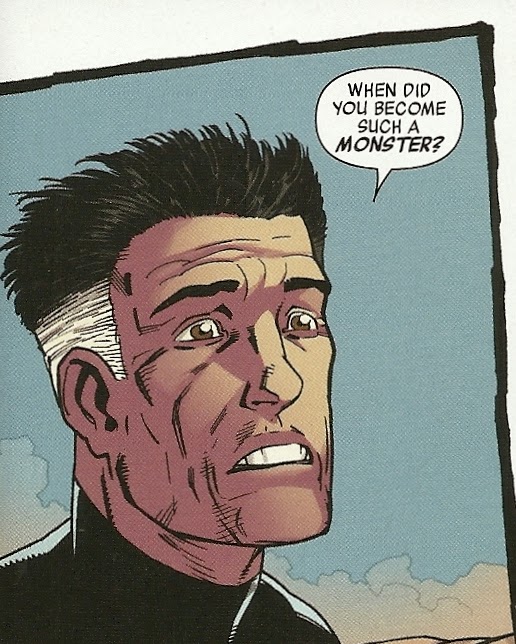
Walker
Um, I don't know, 1939...? Did Reed not read the story where Namor basically beat just beat up New York City and then threw the Empire State Building at a lady holding a baby? (To be fair to Namor, here's his defense: "How dare any of you put yourself--your damned morals--above the lives of every living thing? Thre truth is, you people aren't worth that...and neither am I. Our lives are a pittance." I think that's a large part of what makes Hickman's storyline so compelling. All of the characters are all always right...and always wrong.)

So they've killed a group of all-around decent superheroes, destroyed an alternate world in order to save themselves and another universe and Namor told The Panther about how he kinda sorta sicced an evil alien's invading army on his people and how he can kill them whenever he wants and so they kick Namor out of the club and they realize that when it comes right down to it, none of them is actually strong or cold enough to do the very thing they've spent months preparing to do.

It can't get any worse, can it?

Of course! The last panel of that second-to-last issue shows Reed's incrusion alarm going off: In less than 8 hours, they have to face the exact same dillemma all over again!

In the final issue, thoroughly demoralized and finally realizing that despite the weapons they have to destroy worlds, they can't bring themselves to use them, the members go about preparing for the end of their lives and the end of the world in various, personal ways.

It's a rather elegant issue, which Kev Walker draws quite well, offering some downright poignant scenes, as well as some that are pretty alarming (Is Stark preparing to kill himself?).

But when the doomsday clock runs down, nothing happens. And when they try to figure out why not, Blackbolt asks an obvious question: "Where's Namor?"

Oh, you know, just starting his own Illuminati, one which makes his post-Secret Invasion villainous Illuminati look downright pedestrian:
Walker
Holy shit, Namor just destroyed a second world in an eight-hour period, and is apparently prepared to keep on ending worlds.

So, um, where do we go from here?

I honestly have no idea, which makes this Hickman's Avengers comics even more exciting. I kind of wish I had never even heard of Secret Wars, as it certainly seems to suggest a solution to the incursion problem, which otherwise I wouldn't have thought possible from what we've seen in the books so far, and the "heroes" of New Avengers just keep digging themselves deeper and deeper into holes.

Now, for example, they've got the unsolveable incursion issue to deal with, they also have The Avengers gunning for them (I guess? Or did Captain America's old man-ification give them a stay of fight execution?) and a Namor/Thanos team-up team to fight.

*********************

It's not all fighting, doom, dread and apocalypse in New Avengers, however. As I said, there are some pretty poignant scenes in here, and even a few funny ones. I particularly liked the emergence of sassy Namor during these issues.
Namor sasses Sun God, in a sequence drawn by Schiti
********************

New Avengers #17 was published in April of 2014, almost a year ago now, right? In January of this year, DC published Superman #38, which the publisher publicized as being the first occurrence of a brand-new power for Superman, "super flare." How does it work?

Well, essentially Superman releases all of the solar energy his cells have stored up at once, in the form of a gigantic explosion of energy with a devastating effect.

It also has the side-effect of completely draining Superman, and rendering him powerless while he recharges.
Morales
It's also basically what Sun God does in a scene in New Avengers #17, by Hickman and Morales. When fighting the Mapmakers—nigh invincible, super-adapting machine intelligences—during an incursion, Sun God takes them all out by flying above them and releasing a huge burst of solar energy that destroys everything around him, save his teammates huddled under a forcefield.

Now I'm not accusing Geoff Johns or anyone at DC of lifting the idea from this issue or anything. These sorts of overlaps occur pretty much constantly in DC and Marvel's respective, cross-pollinating superhero lines. And, it's well worth noting, Sun God and his whole team are not-even-veiled analogues to DC's Superman and The Justice League.

I'm just noting how odd it was to see Sun God apparently win the battle using Superman's brand-new power, is all.

***********************

And on that subject, check out the term The Black Priests use to refer to the apparent future smooshing together of various worlds from The Multiverse in New Avengers #13, drawn by Bianchi:
Bianchi
"Convergence," huh?

***********************

I was maybe halfway through Vol. 3 before I realized that one of the more unlikely characters I could imagine being involved in these sorts of cosmic matters and apocalyptic decision-making has been hanging around for some time now, and is thus at least tacitly complicit in everything The Illuminati does:
Bianchi
Like Blackbolt's brother Maximus The Mad, Lockjaw has been hanging out in The Illuminati's secret headquarters in Necropolis!

Forget what The Avengers, X-Men and Fantastic Four are going to think when they find out about all this, what are The Pet Avengers going to think?!

Sunday, October 12, 2014

Review: Avengers World Vol. 1: A.I.M.pire

Marvel’s Avengers line is now so big and full of so many books—five as of the last round of solicitations—that I’m not sure where each book falls in the hierarchy of official Avengers title. Jonathan Hickman’s Avengers and his New Avengers seem to be the A-books at this very moment, with one featuring the real, official Avengers, the other the behind-the-scenes, not-really-Avengers The Illuminati, although the books share at least one character (Iron Man), and have kinda sorta intersected (in Infinity).

So I think that would make Avengers World , which was co-written by Hickman and featuring his cast from the pages of Avengers, the B-title…but just the B-title to the A-title of Avengers, as there seem to be other B-titles, like Uncanny Avengers (Although Uncanny Avengers seems to be the book that’s generating the next big Marvel crossover/event series Axis, which will replace it on the schedule this fall, so maybe Uncanny Avengers is the new A-title…? Hickman should make a chart of the importance of various Avengers titles, given that he’s so in to making charts).

Anyway, this ongoing monthly series takes its name from the first story arc of Hickman's Avengers—and the sub-title of the first Avengers collection—for maximum confusification. This collection, A.I.M.pire (Or, Advanced Idea Mechanics-pire, which loses some of its kick when de-acronymized) opens with a weird short story from the incredibly ridiculously-entitled promotional book, All-New Marvel Now Point One #1. In that, which is written by Nick Spencer, Hickman's co-writer for the rest of the issues appearing in this collection, Captain America Steve Rogers, who ran SHIELD after Norman Osborn’s HAMMER was disbanded, has a meeting with Maria Hill, who is maybe back to being the head of SHIELD again, although I could have sworn one of the two Nick Furys was doing that now (I could use a chart of this too, actually).

They decide that they should maybe work together more, which is kind of a weird conversation, given how many Avengers work regularly with SHIELD and/or have run the organization in the past few years, and, no sooner do they shake on it, then threats start pouring in from all over the world, just as they did in the first few issues of Hickman’s Avengers title.

There’s something incredibly, awesomely insane doing on in Madripoor! Wolverine, Black Widow, Falcon, Shang-Chi—check it out! There’s an abandoned city and weird mystical box thing in Italy, leading to a city of the dead! Get on that, Hawkeye, Spider-Woman, Nightmask and Starbrand! A.I.M.’s island fortress is hyper-evolving, growing in size and architectural and biodiversity sophistication at an impossible rate! You’re up, Smasher, Sunspot and Cannonball!

It eventually starts to coalesce, at least a bit, as some of the threats seem somewhat related, but the book nevertheless carries Hickman’s Morrison’s JLA-style of hyperbolic, apocalyptic world threatening—Madripoor, for example, is revealed to be a city built atop the head of a gigantic dragon, which has just been awoken and is now ready to run amok—and the idea of The Avengers as an army of superheroes under Captain America’s command, splitting up to stamp out fires (forest fires, really) all over the world whenever and wherever they flare up.

Because Hickman’s Avengers book was and is so plot-heavy, and its cast so large, he hasn’t had a whole lot of time to explore the characters, who often appear as remote plot elements or background filler more than characters. For the most part, that isn’t a bad thing in the context of the book. Many of those characters have their own books and appear in so many others—Cap, Iron Man, Thor, Hulk, Captain Marvel, Wolverine, Hawkeye, Black Widow—that Hickman doesn’t really need to waste the space on them in the book.

But here there’s a bit more room, and so Spencer and Hickman give us not only more of the sorts of scenes found in Avengers, but longer, character-focused scenes, like Shang-Chi narrating his life-and-death battle with Gorgon, or Smasher remembering more of her childhood during her confrontation with the A.I.M. leadership, or Starbrand re-living the nightmarish aspects of his own origin.

In a very palpable way, this book reads like more of the same of Avengers, which is either a good thing—if you like what you’re reading in Avengers—or a bad thing, if you don’t. Where it differs is that the plot seems slightly less urgent, and there’s a little more room for the characters to breathe, and the dialogue, likely owing to Spencer, is a bit snappier and a bit funnier.

The art was unremarkable, but unremarkable in a good way. Rags Moreales, one of my favorite super-comics artists, draws the prologue from that goofy one-shot, while Stefano Caselli—whose past Avengers experience includes chunks of Avengers Assemble and Avengers: The Initiative draws the five issue of Avengers World proper.

I liked it well enough, but neither artist did anything particularly remarkable with what amounted to work-for-hire jobs. As with a lot of the publisher’s team books of late, particularly since they started accelerating the schedules of their monthlies, this book seemed more like a writer’s book than an artist’s book, or book where the two contributing components develop style, personality and tone in equal measures.

Sunday, September 21, 2014

Wonder Woman's costume changes in Wonder Woman: Futures End #1 and Superman/Wonder Woman: Futures End #1:


That's gotta be about as many as your average female pop singer during the course of a concert, right? The first two panels are penciled by Rags Morales, and rest by Bart Sears.

Sunday, April 07, 2013

Is that you, Ebony White...?

Apparently, it's supposed to be.

The sidekick of Will Eisner's comic strip crime-fighter The Spirit began his fictional life in 1940 as an outrageous African-American stereotype, and is perhaps the most embarrassing aspect of the late Eisner's legacy. When Darwyn Cooke resurrected The Spirit as a DC comic book in 2007, he divested the Ebony character of all of the negative aspects of his original characterization. When Frank Miller adapted his friend Eisner's character to film in 2008, he excised all trace of Ebony completely.

And when Ebony appeared in Brian Azzarello and Rags Morales series creating a sort of alternate universe where Batman and a few minor DC characters rubbed elbows with the likes of pulp hero Doc Savage, W.H. Hudson's Rima from Green Mansions and The Spirit, Azzarello decided Ebony would work better as a girl, apparently following logic similar to that of Frank Miller's in casting a female Robin in his seminal The Dark Knight Returns.

A grown man always hanging around a teenage boy who never wears any pants? That seems suspect. But a grown man always hanging around a teenage girl who never wears any pants? That's the stuff of potent fantasy! The same with fully-clothed teenage assistants, I suppose.

Azzarello actually explains his rationale for Ebony's sex change in promotional material that DC ran in the backs of many of their line when he and Morales' First Wave was about to start hitting comic shops in early 2010. These are included in the back of the hardcover collection of the series.
"As for the the elephant in the corner...Look, I have very strong feelings that the only way to make EBONY WHITE work is to make the character a brash girl," Azzarello wrote. "Make the character a brash girl" is underlined in red, and a big "LET'S DO IT!" appears in red at the bottom of the page; the premise of the promotion was that readers were looking at Azzarello's notebook of character proposals to his editors, who are represented by the red ink.

"Then the name and attitude (sass) fit," Azzarello concludes. "We can talk about this."

I'm not entirely sure why this might be so, as a black person essentially named "Black White" is just as unusual regardless of the gender—perhaps he meant only that more girls' names end in Y's than boys' names—and Ebony wasn't necessarily known for a "sassy" attitude as much as a collection of groan-inducing tics and schticks taken from early 20th century American "darky" humor. None of these are present in the character, who was being completely recreated especially for this story along with all the other characters, so Ebony's attitude wasn't exactly a problem.

Whatever Azzarello and company's ultimate rationale for the change, it's interesting that there was a change, as it was interesting to see the various ways in which the creators decided to try and recreate a group of decidedly old-school—even for superhero comics—characters into something for a 21st century audience. Among the other more radical reinventions were those of Rima and Black Canary.

The former becomes a topless jungle warrior who conceals her nipples behind beaded necklaces that always fall just so, speaks only in whistles and hangs out with a black jaguar who kills the opponents she doesn't spear herself (It's a portrayal DC moved towards in the mid 1970s, when Nestor Redondo, Robert Kanigher and Joe Kubert transformed her into a Sheena-like jungle girl heroine for the space of a short-lived series).
The latter never makes it into the story pages of First Wave; she either belonged to an earlier draft, appeared only in tie-ins that aren't part of this collection, or was intended for future stories that the sequel-hungry conclusion begged for, but never actually came.

"Dina Drake is a second-generation American in her late teens," Azzarello writes of his Black Canary. "She lives in Gotham's East End, which is one of the city's worst neighborhoods...over Sherwood Florist, the family business." Deeply respectful of her parents, the young woman is nevertheless "enamored with the exploits of Dc Savage" and fights crime in her neighborhood at night, wearing "a blond wig and a very sexy costume—one her parents definitely wouldn't approve of." (Let me pause to note that with a teenage Ebony and a Rima in her "late teens, early twenties," Black Canary woulda been a third scantily-clad teenage heroine in the world of First Wave; the oldest female hero is the Blackhawk pilot Jenny Cloud, who Azzarello's notes tell us is in her "late twenties.")

He ends his paragraphs on Black Canary with, "Now, doesn't this story make even more sense if Dina is of Korean, Indian, or Middle Eastern descent?" The red-penned editor agrees, underlining "Indian" and "descent." "I mean the old-world parents, the family business in a bad neighborhood. This rings so true to me..."

In red: "YES—DIYATA DASARI?"

**********************

Add caption
Seen in its already-historical context, DC's First Wave and the sub-imprint/continuitiverse it sought to establish is something of a curiosity, one of several of the more amusing publishing bumbles of the post-Paul Levitz DC Comics. It seemed a more-or-less doomed endeavor from the start, given little promotion and no real sign of priority among the rest of the publisher's goings-on (particularly compared to the New 52 reboot that was coming just as the final issues of First Wave were shipping).

It had a Batman in it, sure, but there are a lot of comics with a Batman in them, and this was a Batman, not the Batman, and DC's fans, like super-comic fans in general, want to read the comics the publishers tell them are important, the ones that "count," and this was an alternate-continuity one, a comic that most obviously did not count.

The other characters were pretty ragtag in terms of sales draw. Everyone knew The Spirit, of course, star of the critically-acclaimed, marketplace poison Darwyn Cooke series DC had just recently canceled before First Wave. Doc Savage is kind of famous, I suppose, though hardly a popular presence in our culture. Then there was a even less well-known pulp character with some kind of chameleon-esque disguise power (The Avenger, I think; the text was pretty vague); a new, infinitely less offensive version of the Blackhawks-as-international-army group of characters: and a new iteration of Hudson's 1901 jungle heroine, based on the 1975-1976 version.

Basically a League of Extraordinary Gentlemen type of concept, but without any core, organizing principle—the characters were from fiction literate and pulp, from the comic strips and the comic books. (The concept could probably work for a publisher like Dynamite and, in fact, they've been publishing lines based on lapsed-into-public domain superheroes, another based on various pulp, comic, radio and comic strip heroes interacting and, for a while, were publishing as many Green Hornet comics as Marvel publishes Spider-Man comics, but Dynamite is a small publisher operating with very different math and money than DC has to operate with).

Like a few similar efforts around the time—DC's revivals of The Red Circle characters and the THUNDER Agents—it was assumed the audience would already know and care about the characters enough to buy the books. Very little effort is put into the story itself to thoroughly introduce the characters and, in the case of Doc Savage, his Byzantine back story, which includes a half-dozen sidekicks (who, unlike the DCU Batman's army of sidekicks, lack colorful costumes to distinguish them more easily), and several not-entirely introduced villains, some of whom I knew no better at the end of the book then I did at the beginning.

In other words, the thinking seemed to be that 2010-2011's direct market would embrace such a comic book because it existed, which, sad to say, is the basic wishing-and-hoping publishing strategy of DC Comics and, to (a thankfully and) an increasingly lesser extent, Marvel (Though you look at releases like, say, Fearless Defenders and know they're just throwing books into the market to die for nothing more than the intention to crowd small publishers off the new books racks and on the slim hope they'll get an unexpected sleeper hit, too).

The creative team didn't guarantee success the way that, say, a Geoff Johns/Jim Lee or Grant Morrison/Anyone Halfway Decent creative team might have, either. Azzarello's a pretty great writer, and Rags Morales is a really great artist (and one of my personal favorites), and while it's true they do command their own fan bases within the market and can thus bring a certain, set amount of readers to any project, they don't guarantee blockbuster sales by their presence alone (This was a problem with the aforementioned Red Circle and THUNDER Agents books as well; if you're already facing an uphill battle, you really have to assemble a team strong enough to get up that hill almost on their own).

And finally and, I would guess, most damningly, DC started expanding the miniseries into a line almost immediately, before they could possibly have even gotten a sense of how many readers there actually were and how the storyline, its world and the new versions of all these characters were being received.

So 2010's Batman/Doc Savage Special #1 (by Azzarello and Phil Noto, not Morales) was followed a few months later by the first issue of First Wave by Azzarello and Morales.

The following month, when First Wave #2 hit the stands, a Doc Savage monthly and a Spirit monthly set in this new setting also launched. First Wave was a $4, over-sized monthly, and both the new Savage and Spirit books were in the $3.99-for-a-regular-length-title-story-and-short-back-up format that was pretty widespread at DC at the time, but has since mostly disappeared save for a few popular books (Savage had a Justice, Inc back-up; Spirit had a "Spirit Black-And-White" back-up, which featured stellar creative teams doing short one-offs featuring the character, akin to the back-ups that used to run in the back of the late, great Batman: Gotham Knights).

So after spending maybe $8 meeting Doc Savage and getting a feel for the new pulp-iverse in Batman/Doc Savage and First Wave #1, DC then upped the curious' commitment to $12 a month for three different over-sized books. I'm not sure what killed the First Wave-iverse—a re-prioritizing that meant not wasting resources on comics featuring characters the publisher didn't own outright, a desire to focus all attention on The New 52 DCU instead of fooling around with offshoot lines and universes—but if DC didn't grow these books and this premise to death by over-producing too quickly, that decision couldn't possibly have been healthy.

*********************

The comics themselves really aren't bad. I was curious to read much of the First Wave line (not $4-a-pop curious, but borrow-a-trade-from-the-library-years-later curious), most particularly the main series and those black-and-white Spirit shorts. The First Wave trade contained the Batman/Doc Savage special (which I'd actually read in the serially-published format; I didn't like it) and all six-issues of the First Wave series.
Savage and Batman are the two real stars. The former is basically this world's only real super-hero, and the story begins after the death of his father, as he and his team begin to reassert themselves in the world, and chase down a conspiracy involving a bunch of pulp villains, a secret society, a mad science island, a robot, genetic lizard-embiggening, and suchlike.

The latter is very much First Appearance Batman; he doesn't wear the purple gloves, but he carries a pair of .45s, guns down his foes and is more about protecting his city from crime by ridding it of criminals than saving the world (His story arc involves coming to terms with the idea of being a superhero; working with others, leaving his comfort zone to effect true good).
The Spirit is next most prominently featured, but he's more of a collection of tics than a character. He's a fun and funny character, but he's mainly there to bounce off of Savage, Batman or whoever he's sharing a panel with (In addition to making Ebony a sexy teenage girl, Azzarello makes Commissioner Dolan a corrupt cop).

The other characters play minor roles. Rima moves a maguffin from Point A to Point B. The Blackhawks are mercenaries who get tied up in the plot. The shape-changing guy shape-changes once or twice (See back-ups in Doc Savage, I guess). Black Canary never shows up.

There's a lot of plate-spinning and juggling going on with so many characters (Doc's staff doubles the cast size, and the villains double it again), and, structurally, it's a pleasing read. Azzarello fills it with cool stuff of the sort mentioned three paragraphs up, heroes and villains alike are pretty cool and he manages to make the story "about" something, even if that "something" is just "Batman's feelings" or "the world's need for heroic inspiration" or whatever. (The one thing I'd slap him on the wrist for? The fact that there is an actual, literal wave in the climax. The bad guys have built some kind of tsunami-generating device, so if you thought "First Wave" was a reference to the first wave of superheroes, well, sure, it is, but also? There's a wave in this).

A far greater treat was Morales' art which, as mentioned, I'm a fan of. This book is a particularly good showcase for his particular skill for character modeling and acting, as the dozens of mostly costume-less characters all need to look like different people for the story to read at all, and Morales accomplishes that with great gusto.

Tuesday, February 12, 2013

Review: Action Comics Vol. 1: Superman and The Men of Steel

Action Comics was perhaps the most notable of the DC Comics that were rebooted and relaunched in fall of 2011 for two reasons: First, it was the oldest comic book, and giving it a new #1 issue would require dialing the numbers all the way back from #904, and, secondly, there was no other book was paired with a more perfect-seeming creator than its marriage to the popular, imaginative, ambitious forward-thinking, writer/Superman priest Grant Morrison. If any of the 52 new "New 52" books were to meet their goal of reinventing the publisher's staid stable of characters for a new generation of new readers, then certainly the pairing of Superman and Grant Morrison would be the one to do it, right? We are talking about the writer who produced all those amazing scenes featuring Superman in his JLA run, who wrote perhaps the very best Superman story in All-Star Superman and whose Final Crisis was filled with such imagery as Superman singing away the ultimate evil.

Morrison's collaborator for the project was artist Rags Morales, one of my own personal long-time favorite comics artists (his work on Forgotten Realms was among the first I saw when I started reading comics that really struck me) whose work had only grown more refined over the years.

Still, I waited for the trade. There was something of an economic component to that decision, as Action Comics was being sold at a $3.99/30-page price-point—I don't mind paying more for more content occasionally, but $4 still strikes me as a silly price to pay for a serially published comic book when a more permanent, bound format is only a few months away. Mostly my decision to wait had to do with the fact that I was so certain I would enjoy a book written by one of my favorite super-comics writers and drawn by one of my favorite super-comics artists featuring one of my favorite superheroes that I didn't feel a need to try out the first 20-some pages to see how it turned out.

I just recently read Action Comics Vol. 1: Superman and The Men of Steel, a hardcover collection of the first eight issues of the rebooted Action Comics.

I wasn't too terribly disappointed.

*****************

What was most notable about Morrison and Morales' take on Superman is the degree to which they rebooted the character, and the fact that Morrison went for a stripped-down, purified, best-of-all-eras remix approach like he did with All-Star Superman, but made different choices than the ones he had previously made, so the resultant take seems to be similar in approach to All-Star, but completely, dramatically different.

The book opens, after all, with Superman wearing a homemade costume consisting of a Superman t-shirt, a towel-like red cape (it's actually the indestructible cloth he was swaddled in as a baby), a pair of jeans and a pair of work boots—it's Superman as Superman as a child playing Superman. But since this is a "Year One" approach, a re-telling of his origin story as the first superhuman in the world (in that respect, it covers the exact same ground as J. Michael Straczynski's dreadful and dour looking Earth One: Superman original graphic novels), Superman is basically inventing the act of playing Superman.

Morrison writes it as a sort of New Age Golden Age, with Superman's powers and, as is so often the case in Morrison's writing, he metatextualizes the story, so that changes that occurred to the Superman mythos in its first few decades due simply to Jerry Siegel, Joe Shuster and the first few creators to work on the character continually tinkering with him are here internalized and made part of the story.

So this Superman's costume is a work in progress, his powers are a work in progress (they are, essentially, exactly what they are upon his first appearance: He can't fly, but he can leap; he's not indestructible, but nothing short of an exploding shell can hurt him), and his relationship to his allies, his enemies, even his exact mission, methods and moral code are seemingly still in the works.

Morrison's Superman is young, brash, dangerous and vulnerable, and at least two of those are qualities DC executives have been talking about restoring to their characters for years now.

In the first issue, he's threatening the life of a rich, powerful and corrupt businessman in the tried-and-true pretend-to-murder style of Batman tossing a crook off a ledge simply to catch them. He cockily references off-panel actions he also performed in the first issue of the original first issue of Action Comics. He's pursued by the police and the military. Lex Luthor is after him. He's a crusading journalist. He's disguised as Clark Kent, here affected not only by a pair of glasses, but big, baggy clothes that hide his physique and an extreme case of behead (In All-Star, artist Frank Quitely evoked the Superman-to-Clark transformation through the character's posture and body language, so Clark looked like a big, clumsy ox of an oaf). Bullets bounce off him. He outraces speeding cars on foot and, in a climactic scene, he stops a speeding train by standing in front of it and pushing in the opposite direction.

*********************

Things start to fall apart by the second issue, and for all the false-starts, overnight creative team changes and angry disavowals by outgoing writers, I think there is no surer sign that something is deeply fucked up at DC Comics than this fact: They rebooted their flagship title starring their flagship character for the first time since 1939, and they didn't bother to get all of their ducks in a row to guarantee a single story arc got drawn by a single artist.

By the second issue, Brent Anderson is drawing portions of the story, and while he's a great artist with a style not discordantly dissimilar to Morales', it's different enough that the characters don't look like they do when Morales draws them. Given that these are the first appearances of these new versions of the characters, it would probably have been beneficial to have on artist draw the first, say, three scenes in which Lois Lane appears, for example.

By issue #3, a third artists is employed—this one is Gene Ha, and he only draws a dream sequence/buried memory set on Krypton, excusing the shift in style. The remainder of the first story arc is drawn by Morales, Anderson and Brad Walker. All are good artists, but the blend isn't so good—it basically scans like Morales doing a terrible job. The table of contents lists five inkers and three colorists; I'm not sure who did what where, but it's an all-around shoddy job, paradoxically made all the shoddier by how accomplished some of the participants are.

The worst bit comes at the climax of the story, when the Morales-lead melange gives way on the final five pages to an artist whose style looks nothing like that on the previous pages, whose Clark Kent has shifted design to resemble artist Gary Frank's Christopher Reeve's inspired design, and who draws the last image in the story—a close-up of Superman's Chicletty grin as he buzzes the reader's POV in a splash page.

In this respect, Morrison's Superman run mirrors his run on the various Bat-titles: A great story full of a lot of promise, done in completely by poor art...and/or poor planning and editing that resulted in a mess of artists coming, going and drawing a few pages here and there. It doesn't matter how strong the script is if the art part of the equation is half-assed. Essentially, they just cancel each other out.

This is a great comic if you can read past the art, if you can redraw it in your imagination while reading, but that's more work than a reader should have to do in 2011, 2012 or 2013. Especially if they're paying $4 for each chapter.

Those aren't the only artists involved, either. Andy Kubert draws two whole issues himself, and these are far enough removed from the main narrative that the style-shift doesn't derail anything (they're set in the past and future, mostly, save for a scene or two featuring characters from the future lurking in a darkened Fortress of Solitude in the present).

The original comics contained back-up stories starring various characters from the main, Morrison/Morales/All Those Other Guys stories, and these feature more artists still. Flipping through the book, the impression one gets is of a jam-book, rather than a graphic novel.

********************

As I said, the story is significantly different enough that it appears all-new, or at least an all-new arrangement of familiar elements: They probably could have (maybe should have) pushed this material as the YA market cracking Earth One stuff.

I was struck by how much it seemed like a paper version of the Superman movie Morrison would like to make, mostly because of how many elements of Superman comics he wrangles into a single, three-act narrative structure.

Here's the synopsis: After the death of his parents, Clark Kent has moved to Metropolis where he lives in a shitty apartment like movie Peter Parker, and works as a muckraking investigative journalist for The Daily Star (the closest thing to a friend he has being Jimmy Olsen, the Daily Planet photographer assigned to Lois Lane). Donning a homemade costume, he fights crime and is pursued as a criminal for it, until the powers that be can stand it no longer. General Sam Lane, father of Lois, and special consultant genius Lex Luthor set up a trap to capture Superman.

They do, and poke, prod and torture him a while. Meanwhile, Brainiac, the being responsible for the destruction of Krypton, comes to Earth. It shrinks Metropolis, puts it in a bottle and adds it to its collection. It's up to Superman to save the day, along the way discovering the secrets of his own origins and convincing himself and the world at large that he really is a hero. The only thing missing is a love story between Superman and Lois.

So Morrison packs in Superman, Jimmy, Lois, Lex Luthor, General Lane, Brainiac, Metallo, Dr. John Henry Irons (who becomes Steel in a back-up), life on pre-explosion Krypton and the Bottled City of Kandor. Not bad for a six-issue story arc. I think a version of Mr. Mxyzptlk might be introduced here too—there are actually a couple of candidates for visitors from the 5th dimension—but neither are revealed as such in this first story arc.

**********************

Of those, I think Morrison does a pretty good job with most of them. Jimmy, Lois and General Lane seem to be the same as they have been in the comics since the John Byrne reboot. Metallo is given a past romantic history with Lois, which makes his story a little more relevant to that of the other characters (he's basically a soldier who volunteers to get roboticized in order to fight Superman and impress Lois).

Brainiac is sufficiently alien and spooky; in fact, I don't think we see "him" at all, just various robot puppets and programs.

I don't think I've seen enough of this Luthor to really get judge him. Morrison's previously written great Luthors in JLA, where he was the ingenius corporate mastermind with a hobby in supervillainy, and All-Star, where he was the traditional renegade scientist.

Here he looks younger and slightly paunchy, and swills power drinks constantly, which seems to a visual signifier that he's a much younger and much douchier Lex than we usually see. As is so often the case with modern Luthors, his motivation for being anti-Superman is a sort of zealous humanism bordering on or spilling over into xenophobia, although Morrison gives him a pretty cool speech to justify his wanting to eliminate the strange visitor from another world as quickly as possible:
The Brown tree snake. Introduced to the U.S. territory of Guam right after World War Two. Caused Dozens of indigenous birds and reptile species to become extinct.

The cane toad, sent to Australia as a pest control agent, decimated local biodiversity.

Non-native strains will destroy entire ecologies given the opportunity.
I'll buy that.

I'm not entirely sure what I think about this new Steel, either. I'm glad he still exists, but I don't think this version is quite as impressive as the one that originally emerged during the "Death of Superman" cycle of stories.

That Steel had his life saved by Superman, who told him to do something with that life if he really wanted to thank him. After witnessing Superman give his own life to save Metropolis from Doomsday, Dr. John Henry Irons decided to stand-up and do the impossible: To become Superman. Like Batman, he was just a normal, every day guy who, through his own smarts and force of will, turned himself into a superhuman and ultimately joined the fraternity of demigods that patrolled and protected the DC Universe.

He also had a cool costume, resembling a literal man of steel with a big sledgehammer-tipped staff and a striking red cape.

This Irons is working on the same project under Lane that hired Luthor and ultimately made Metallo; he had his Steel suit already made and waiting in a hidden closet in case he ever needed it (which doesn't quite ring true, given this is a world without a concept of a superhero yet).
He's still inspired by Superman to do good, but in a piteous way: Watching Luthor and the military torture Superman, he resigns, not wanting to be party to it any longer. When Metallo and Brainiac being to wreak havoc in Metropolis, he suits up.

That suit is rather unremarkable. There's no cape, obviously, but there also isn't any kind of mask either. He's just a dude in a metal suit with jet-boots and hammer. The mess of metal coiling that forms his muscles are kind of cool (they're left-over from an earlier Steel design), but he looks kinda...wrong without a helmet or face mask of any kind, especially given the stuff he gets up to. I'm not sure I understand how a genius would create a suit of super-armor that covers everything except the part of the body that needs the most protection.

*********************

Artwork aside, this read quite well in trade. Something Morrison talks about in both his prose book Supergods and the back-matter of this collection is how action-packed the first Superman story of Siegel and Shuster's in Action Comics #1 was, how their Superman ran and leapt from set-piece to set-piece in a breathless, relentless story.

Morrison sort of mimics that, but he can't do it in a single issue, so there are starts and stops between these set-pieces, he does it in the first storyline though, so read in a trade like this, he accomplishes an effect similar to that one he describes as something he admired; he also does a good job of escalating those threats, as the story opens with him jumping to the top of a building to fight bodyguards and the police and ends with him having to jump into outer space to fight a planet-destroying robot menace.

It must have been horribly frustrating to read as it was originally, serially published however.

Something I didn't realize until just now, when I sat down to write this and looked it up in order to untangle the art credits, was that the first story arc was originally published out of order.

The book opens with a six-issue story arc containing the characters and events I've mentioned above, but DC published the first four parts in Action Comics #1-4, then, in Action Comics #5-#6 they published a two-part story illustrated by Andy Kubert set after the events of the incomplete first story arc (it's a Legion of Super-Heroes team-up, and the "present" is set after the events of Action Comics #8, although the distant past is also covered). Then the first story arc finishes up in Action #7 and #8. This collection publishes the story in the correct order: #1, #2, #3, #4, #7, #8, #5, #6.

Additionally, while this is Superman's "Year One" style origin, the story of who the new Superman is and how he came to be, how he got his powers, how he got his costume, where he came from and how he found his place in the world, DC was simultaneously publishing Superman stories set after this.

So while it took eight months to tell Superman's first story, Superman was appearing fully-formed and with all of his powers and his final costume in JLA #1 (published before Action #1) and in Superman #1-#8 (all also set after Action #8)...and I'm sure he was appearing in other books, as well. I remember seeing him in Justice League Dark #1. I heard he was in Swamp Thing #1. I'm pretty sure he was in the first issue of Supergirl.

Surely that sucked a lot of the drama and excitement out of this storyline purporting to be the story of Superman. Rather than starting over from scratch, it must have read like a choppy flashback to readers who were widely sampling the rest of The New 52 ("Fun" fact: Before Morrison, Morales and company could even finish their origin of the new Superman, sister title Superman was already on its second creative team, with the writing team of Dan Jurgens and Keith Giffen taking over for the quite-frustrated George Perez, and Jurgens handling pencils).

*********************

The Kubert-drawn two-parter is probably a more Morrisonian story than the one that precedes it in this collection; it's certainly the sort of story that reads like a comic book more so than a comic book version of a blockbuster movie.

It opens on Krypton (and here we meet the saber-toothed Krypto who totally isn't dead like DC announced, but is actually in the Phantom Zone) and shows Superbaby being rocketed to safety...in a story narrated by the rocket.

Then villains from the future travel back in time to the present to steal the Kryptonite engine from the sentient rocket, these villains being The Anti-Superman Army, composed of the likes of The Kryptonite Men, the robotic Terra-Man and The Little Man (whom this story really made me think is a Mxyzptlk), who are hiding out in a microscopic HQ inside Superman's brain. The Legion of Super-Heroes and a future Superman, from a point in their history where it's Cosmic Man, instead of Boy, travel back to the present in order to thwart the villains and save the rocket ship. Via telepathy and rocket-delivered narration, we see a bit of Superman's childhood in Smallville, including meeting his dad and discovering that he was Superboy (although it's not clear if he was publicly Superboy or not).

**********************

Also included in this collection, grouped all togetherafter issues #5 and #6, are the back-up stories that appeared in each issue. These are written by Sholly Fisch, a really great writer who has done some truly incredible writing for DC's canceled Batman: The Brave and the Bold comics, and drawn by Brad Walker or Chriscross, the latter of whom is working in a stripped-down style that, as colored by Jose Villarrubia, looks like the work of an entirely different artist than the Chriscross you might imagine.

These are "Hearts of Steel" and "Meanwhile..." in which Steel battles Metallo and deals with fall-out form Brainiac's city-napping (and it's revealed that Nat still exists in the New 52 too), "Baby Steps" in which we see Superbaby's arrival on earth from the perspective of the Kents (who are Baptists) and, finally, "The Last Day," in which Clark's Smallville friends Lana Lang and Pete Ross see him off to Metropolis.

They area all good stories, well-told, but I don't think they quite work in relation to the main story. If they were collected as printed, between each chapter of the main storyline, they'd be annoying asides and digressions, and yet they also expand on the stories somewhat; for example, in at least one instance the main narrative references events in the back-ups that a collection reader wouldn't have even seen at that point.

I'm not really sure the best way to handle collecting these, beyond maybe saving them all up for a collection published separately at some point.

Ideally, DC wouldn't be doing them at all, but would just be publishing the main comic for $2.99, but I imagine there is some economic reason that the publisher wants to sell $4 comics, and adding 10-page back-ups by creators who come a little cheaper than those making the first 2/3 of each issue is better than simply going the Marvel route, and making a $3.99/20-page book.

******************

Look at this:
That's the miniaturized Glenmorgan trapped in one of Brainiac's bottles seeing the hand of the full-sized Superman reaching into bottle to grab the contents of that truck. Look at how he's looking at the hand in the next panel. Damn, that's some good comics-making right there.

*******************
It's probably worth noting that the villain of this piece, Brainiac, is an insidious collector whose life's ambition is to preserve and file cultures on his list—in "mint condition," no less—and the nature of his conflict with Superman is that the superhero refuses to lay down and be collected in eternal stasis, but instead continues to fight against collection, to move, to change to live.

When rattling off the list of names by which he is known on other worlds, he gives a telling detail that made me snicker upon first read:
We are the colony of the Collector of Worlds. We know everything there is to know.

On Yod-Colu we began as C.O.M.P.U.T.O.

On Noma they called us Pnumenoid...On Krypton--where you were born--we were Braniac 1.0.

On Earth--We were Internet.
That's right, comic book readers who use the Internet! We're the true villains! Again.

*********************

I've really, really hated Superman's new Jim Lee-designed costume. Just hated everything about it.

In this story, we learn exactly where it came from. It's some kind of super-sciencey Kryptonian garment that starts out white and...conforms, somehow, to the user, which changes its color. It's a pretty neat scene, even if it doesn't really explain why it has to look like armor (The artists who draw it here, it should be noticed, don't make it look like the solid metal that Jim Lee's renderings make it look like).

At one point, Superman grabs a space artifact, and his costume chameleons into the Golden Age Starman's costume.
Is that allowed, now that the Golden Age has been severed from the DC Universe...?

Tuesday, August 02, 2011

This is Rags Morales' cover for Action Comics #1:

Like the original cover for the original volume of Action Comics, it depicts a vaguely scary, rather alien Superman lifting an impossibly heavy object over his head.

It also shows off the new, temporary Superman costume, comprised of a t-shirt, jeans, work boots and a red towel wrapped around his neck. This is the new version of Superman that writer Grant Morrison has been referring to as a blue-collar, Bruce Springsteen, folk hero version of Superman.

There will, of course, be a variant cover to the issue, and it is also being drawn by Morales:I like artist Rags Morales quite a bit, and these are both very strong images, particularly the first one. In the second, it looks like he was really emphasizing the word "action", with Superman bounding away from pursuing police officer, bullets bouncing off his hobo pants.

But in both cases, they just don't quite say "Action Comics #1" to me.

Something's...missing. Although I can't quite put my finger on...

...Wait.

I've got it. Yeah, that's much better.

Monday, March 28, 2011

Some rather rambling thoughts on Dungeons & Dragons: Forgotten Realms Classics Vol. 1

Comic books and role-playing games have long been hobbies that are closely linked to one another. I always assumed that the reasons for this were simply that a) they’re both kind of nerdy or geeky (whichever adjective you prefer) pursuits, and thus there was a natural overlap between the nerds or geeks who liked one or the other, creating a group that liked both, and b) since neither a shop devoted solely to the sale of comic books nor a shop devoted to the sale of role-playing games materials was ever the easiest small business to keep afloat, particularly in smaller towns, hybrid shops selling both became commonplace.

Thinking about role-playing games and comics lately, as reading IDW’s trade collection of the old DC/TSR 1989-1991 Forgotten Realms comic series has got me doing, I realized there’s another commonality between certain types of comics and certain types of RPGs: The concept of an elaborate, shared, fictional universe setting that is more-or-less always under construction.

Those certain types of comics are, of course, superhero comics, with their DC and Marvel Universes, and the newer, smaller, similar universes that other publishers have launched over the years. And those certain types of RPGs are basically any of a certain size or longevity.

In both cases, settings, characters, histories and rules of some sort are shared between the units of the stories set in those settings, and a place that can be visited by users is created.

One such “universe” is, of course, Forgotten Realms, which was originally created by Ed Greenwood when he was a childe, and which he gradually developed and fleshed out and introduced to Dungeons & Dragons players through Greenwood’s magazine articles.

Over the decades, the Realms setting has appeared in scores of official RPG supplements and what must be well over a hundred prose novels at this point.

The Forgotten Realms comic was set in that world, giving writer Jeff Grubb—who had himself wrote plenty of those prose novels—a pre-made world to send his cast of a half-dozen or so adventurers journeying through.

Of those, one of them was previously introduced in a Michael Fleisher written arc of Advanced Dungeons & Dragons, the first of DC/TSR’s line of comics, while the others were original to the Forgotten Realms comic. They all fell into easily identifiable types to anyone with even a passing familiarity with fantasy role-playing.

There were a couple of humans, an elf, a Halfling and a dwarf (sort of), and of these there was a magic user, a paladin, a cleric, a fighter, a thief and so on. The premise was that this group of characters, from all over the Realms, were the crew of a magical ship called The Realms Master. It would teleport from body of water to body of water, while its wizard captain sought out dangerous and powerful magical artifacts to dispose of (or make use of), before they fell into the wrong hands.

In other words, each story arc was a different quest, and Grubb had built in a few plot elements to keep a rapid-fire succession of quests plausible and easy to write about (None of the hundreds of pages of walking that one might find in The Lord of The Rings, then).

In addition to the monsters and magic and setting and culture of the Forgotten Realms “universe,” Grubb also made use of characters from the games and novels, who would basically have guest-appearances in the comic.

In the first two story arcs, “The Hand of Vaprak” and “The Dragonreach Saga,” which account for the contents of the IDW collection, Greenwood’s Merlin/Gandalf-like Elminster the Mage appears as a mostly behind-the-scenes, manipulator of events interested in the outcome of the events (in both of these arcs, our heroes are involved in quests that, if they fail, would mean the destruction of the Realms). Elminster’s ally Lord Mourngrym puts in a few appearances in those stories.

In the first arc, Alias and Dragonbait from the Grubb-co-written novel Azure Bonds team-up with our heroes. I only read a couple of the Forgotten Realms novels as a teenager, and Azure Bonds wasn’t one of them, but I remember the cover quite vividly for, um, some reason:In the late eighties, early nineties, I didn’t read the Forgotten Realms comics regularly; I read the annual, a crossover with the cast of the AD&D comic I did read regularly, and over the years tried finding all the back-issues. I own and have read about five or so of the eight issues collected in this volume, but I bought it anyway because I’d much rather have the whole series in trade then continue to assemble it in back-issues, which are inaccessibly buried in my miserable comics midden.

Some thoughts, in no particular order…

1.) I hope IDW’s committed to collecting the whole shebang. The whole series is only 25 issues long, plus an annual and a bit of material from a TSR Worlds annual, so I imagine they could probably finish the series off with two more collections, depending on where they want to include the annual material (IDW’s also collecting Advanced Dungeons & Dragons).

2.) I love the names of the characters Grubb comes up with: Priam Agrivar, Foxilon Cardluck, Dwalimar Omen, Ishi Barasume, Vartan Hai Sylvar. You could probably offer pretty good guesses about the character’s races and roles based merely on their names.

There are a few duds, though.

The aforementioned dwarf on the crew doesn’t look dwarven or female at all—her soul is trapped in the body of an iron golem, so she’s essentially a big iron dude with a lame name, Minder. (She presumably had a more dwarven name at some point; I never read the issue that explained what her whole deal is, although I believe that would appear in a second volume of a series of collections).

A woman with wings, whose race I don’t recall, is introduced later in the series. She’s simply named Jasmine.

3.) Dwalimar Omen has one of the coolest haircuts in the history of comics. Here are some scans of it from various angles:As you can hopefully see from those images, the top, back and sides are a sort of perfect orb afro, with the front cut away a bit to reveal his face. It is basically a completely insane haircut, one that I would imagine would take daily visits to a hairstylists to keep up using today’s modern haircutting technology, and yet the electric hair clippers had yet to be invented in this world.

So how does Omen get his hair did? Magic obviously, since he is a wizard. A wizard with a magical hairstyle, that he maintains magically.

4.) Beyond my affection and nostalgia for the setting and the RPGs that inspired it, the main reason I like this series so much is Rags Morales’ art. Morales has been a favorite of mine, and this book is an excellent showcase for his work, although as you can probably tell just form looking at a few of the images above that this is rather early work for him, and his style would evolve and sharpen quite a bit over the course of the 20 years to follow.

Rereading these stories though, it’s abundantly clear that Morales had already mastered “acting” through his characters in his art, and was quite adept at action and fleshing out fully-realized panels. The degree of background detail work in here puts that of most superhero comics of the 21st century to shame. Few things about the state of mainstream comics depress me more than seeing something from 20 or 30 years ago and realize that what used to be the norm in level of skill or quality has now become rare exceptions—one likes to think mainstream, direct market comics are getting better and better as the writing, the audience and the technology becomes more sophisticated, but that sadly isn’t always the case.

5.) Check out this crazy splash page Morales drew; I remember being confused by it when I first read it, and it took me a few seconds to figure it out again this time as well:That’s Priam Agrivar’s point-of-view as he looks up at some allies who have gathered around him to see if he was okay, having briefly lost consciousness. Apparently, he opened his right eye first, and Morales chose to draw the scene as if we were looking out from deep inside Agrivar’s skull.

I don’t know how successful the image is, but it’s certainly a strange one.

6.) It also occurred to me how rare art like this is these days. Morales is still drawing, and he’s gotten better and better ever since, but one never sees new art presented like this, with no special effects like lens flares and light-boxed or Photoshopped settings, no painted-by-computers gradations of colors, hell, even white gutters and borders between panels are something of a rarity these days.

It was…refreshing to read a comic assembled in the old-fashioned, pre-Computers-Doing-Everything fashion, even if it meant the colors were occasionally garish or unsubtle. Too many comics today, wrote Old Man Caleb, seem way too overproduced, which only draws attention to any deficiencies they might have in their story or the quality of the design and rendering at the heart of the artwork, underneath all the coloring effects.

I don’t necessarily want to say this looks cheap, but it doesn’t look overproduced at all, either.

7.)The collection includes the covers, which were naturally originally branded with publisher DC's logo, as well as that of then-Forgotten Realms and D&D owner TSR. IDW basically just whited 'em out. Here's what they look like:

8.) The only complaint I have about the collection was the lack of any sort of introduction or afterword. As I've said before, I really, really, really like those in a collection.

In this case, I would have liked to see something from Grubb or Morales about the experience and maybe how it fit into their careers, or maybe someone of some sort of authority sort of of explaining the reason why these older, minor comics are considered worthy of being collected and represented. Other than than their collection of the old Marvel G.I. Joe comics, I haven't yet read very many of IDW's "rescue" collections, but the publisher certainly seems quite devoted to finding older comic books from the '80s and '90s and re-presenting them for the modern graphic novel audience. I would have liked a little context for this collection's existence, I guess.

But then, I just like that little something extra in a collection format.

9.) If you're at all interested in fantasy or sword and sorcery comics, I'd recommend this as an especially fun, lighthearted example of the genre, with pretty great art. Plus, the more of you who buy it, the more likely it is IDW will collect the rest of the series, and maybe even Dragonlance and Spelljammer, the other two DC/TSR books, neither of which I've read any of before.