Both were among the superstars of mainstream superhero comics in the1980s, thanks, in large part, to their popular work at competitor Marvel Comics throughout the decade.
Claremont had a 17-year stint on Marvel's X-Men characters, spanning 1975 to 1992, during which time he created many of the franchise's characters, popularized others and delivered most of what are now considered the team's classic and most influential stories.
Byrne, meanwhile, had lengthy and well-regarded runs on Uncanny X-Men, Fantastic Four, The Sensational She-Hulk and X-Men spin-off Alpha Flight. Teamed with Claremont for a time on the X-Men, he drew some of those classic and influential stories, like "The Dark Phoenix Saga" and "Days of Future Past."
Byrne also did plenty of pivotal work by DC, of course, most notably recreating the Superman franchise for the modern, post-Crisis market. He also drew the crossover series Legends, served as writer/artist for a rather lengthy run on Wonder Woman and spent a few years on New Gods/Jack Kirby's Fourth World, as well as drawing and writing another event crossover miniseries, Genesis. He also had some big Elseworlds projects and a pair of inventive DC/Marvel crossovers on his resume.
Claremont's DC output up to that point, meanwhile, wasn't exactly remarkable. He created and wrote the 1995-1998 series Sovreign Seven, penned a 1997 Superman and Wonder Woman Elseworlds miniseries and contributed a 10-page Fire story to an issue of anthology title Showcase '96. Oh, and Claremont also penned a six-issue JLA miniseries in 2003, JLA: Scary Monsters, although I confess that, at this point, all I remember of it are Arthur Adams' covers.
Still, it's easy to imagine someone at DC thinking Byrne and Claremont reuniting for a Justice League story would be a big deal, and that the creative team, rounded out by inker Jerry Ordway, would be as significant a draw as some of the past big-name creators on the title, like Grant Morrison, Mark Waid, Bryan Hitch and Howard Porter. (And hey, maybe it was a draw...for any older readers who remembered the X-Men of the early '80s, anyway. In my late 20s at the time, I had barely read anything from either man, and I had considered their appearance in the pages of JLA at that particular juncture to be a particularly weird move).
Their story was "The Tenth Circle", which ran from JLA #94-99. Byrne and Claremont shared writing credits on the six-part story, while Byrne penciled it and Ordway inked it.
It wasn't merely a matter of one of the most popular X-Men creative teams reuniting on a Justice League story, though, it was also a sort of stealth pilot for a new Doom Patrol series by Byrne (Although it's admittedly far less stealth at this point, over 20 years later; the final cover from the arc, depicting the JLA and the Doom Patrol together, was the one DC used for its first collection in 2005's JLA Vol. 15) .
Launching a new Doom Patrol out of the pages of JLA probably made some sense at the time too, as DC had in the recent-ish past used the JLA to help launch other super-team books. The 1998 JLA/Titans miniseries lead directly to a new Titans, that same year's miniseries JLA: World Without Grown-Ups immediately preceded the launch of Young Justice and 1999 JLA arc "Crisis Times Five" reunited a new version of the Justice Society, presaging the launch of JSA the month after it concluded (albeit with some significant line-up changes).
Of course, the difference between all of those launches and this Doom Patrol launch was that Byrne and Claremont were here introducing the Doom Patrol of The Chief Niles Caulder, Robotman Cliff Steele, Negative Man Larry Trainor and Elasti-Girl Rita Farr as if they were brand-new characters being introduced here for the first time.
This, then, was to be a reboot of the then 40-year-old team, one completely unconnected to the sorts of space/time/continuity crises that DC usually organized such reboots around, not unlike the one DC did with Supergirl in the pages of Superman/Batman that year (Unlike Supergirl, though, the Doom Patrol's recent history wasn't anywhere near as weird and convoluted, nor had it drifted so far from their original conception as the post-Crisis Supergirl had; the Doom Patrol's last title was canceled just a year previously).
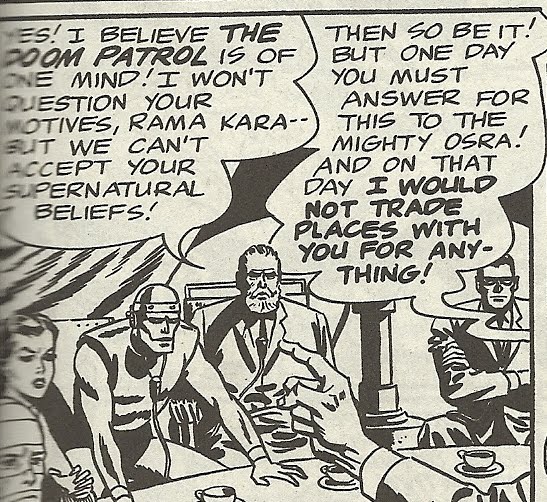
(And yes, admittedly it is kind of clever to put some of the X-Men's most famous creators on a story featuring the Doom Patrol, who, like Marvel's merry mutants, also debuted in 1963 and featured a wheelchair bound older man leading a team of super-powered outsiders branded as freaks by mainstream society. Interestingly, there's even a panel where Caulder uses what looks like some sort of Cerebro unit.)
So there was a lot going on in this particular story, and I don't think it all quite seemed to come together in a way that was particularly satisfying.
In addition to telling a superhero story big enough to give each member of a sizable Justice League something to do (In addition to the "Big Seven" minus Aquaman, the team in this story also consists of The Atom, Faith and Manitou Raven), the creators also have to introduce the quartet of misfit heroes from the Doom Patrol, and they also set about introducing some new characters who would ultimately join them in the new Doom Patrol title.
The title of the story refers to the name of a group of extra-dimensional vampires, monsters that were banished from this plane of existence by Wonder Woman's mom and the other Amazons centuries ago. They currently have a representative on Earth, a vampire with an extraordinarily bad haircut and the extremely unlikely name of Crucifer.
He lives in a castle brought over from Europe brick by brick, and commands a small band of loyal vampires, and a group of more loyal still acolytes in cloaks and hoods; these latter he is able to subjugate via mind-control, which seems to be most effective when he bites someone...but doesn't turn them all the way into vampires.
After a few chance encounters with Crucifer and his followers, the League realizes that there is a rash of child kidnappings across the county, the victims all seeming to possess the metagene and relatively minor super-powers (if this were the Marvel universe, we could call such people "mutants"), and so the heroes begin to investigate.
Also investigating are a mysterious group based in an old Spanish fortress in the Florida Keys, a group we will gradually learn are meant to be a new, rebooted version of the original Doom Patrol (They all get something of a makeover, the most dramatic being Trainor; rather than the traditional bandages wrapping his face up like that of a mummy, he here has what looks like some kind of leather fetish mask on, and when he releases "The Negative Man," rather than the familiar streaking silhouette with an electric yellow aura, the powerful energy form now appears as a black flying skeleton in a bluish aura).
A great deal of attention is paid to a couple of kids working for Crucifer, a girl named Nudge who possesses some form of low-level mind-control and has a close relationship with a four-armed gorilla named Grunt (which is, later in the story, referred to by Caulder as a "mega-primate"), and Vortex, a boy with the power to emit some kind of powerful energy blast from his mouth, powerful enough to break through one of Green Lantern's constructs and knock him on his ass.
Meanwhile, Manitou Raven, who we see at the opening of the story, his magical telling stones and a swarm of bats presaging some upcoming disaster, has gone missing. When The Atom searches the stones for clues to his whereabouts, he ends up shrinking down to investigate them in person and then falling through some sort of dimensional portal and into a bizarre, alien microscopic world, the inhabitants of which regard visitors from our world as a god. The Atom will spend most of the arc there, and how that connects to the rest of the story isn't even suggested until the very end, making his part of the adventure feel oddly grafted-on.
Frustrating the League's efforts is the fact that, after Nudge brings a mind-controlled Superman back to the castle, Crucifer bites him on the neck, and the vampire is thus able to mentally dominate the Man of Steel (This is in rather sharp contrast with 2002's Superman #180 by Jeph Loeb and Ian Churchill, where in Dracula tries to bite Superman's neck and recoils as he burns; Superman being a "living solar battery" meaning that his blood was suffused with "the power of daylight").
Under Crucifer's command, Superman acts as something of a double agent, at one point kidnapping Faith (who will spend most of the arc kidnapped actually, tied to a chair in Crucifer's castle) and fighting Wonder Woman a couple of times. Crucifer even seems to kill Wonder Woman at one point, impaling her on a sword, but, thanks to the Amazons' purple ray, she gets better.

It will prove no surprise that the League eventually wins the day, our heroes storming the still-forming Doom Patrol's HQ and then teaming up with them to take on Crucifer's forces, dispatching the dumb-looking but seemingly unkillable vampire in a neat way, a sort of superhero comics twist on an element from folklore, wherein other immortals achieve their invulnerable status by hiding their hearts outside of their bodies.
I thought Byrne and Claremont did a decent job with all of the Justice League characters, at least the ones they spent the most time juggling, and while we don't get nearly as much of the Doom Patrol, they mostly all felt like themselves (Caulder seemed a little cooler and, well, douchier than his Silver Age self, but then, he had been trending that way since Grant Morrison's Doom Patrol, hadn't he?).
Byrne had drawn most of these characters before—and, in the cases of Superman and Wonder Woman, he had drawn them a lot—although I still thought it fun to see what, say, his turn-of-the-century Batman, or Atom, or John Stewart might look like.
And, after reading the arc to completion, I even kind of developed a love/hate feeling toward Crucifer, who is in many ways your stereotypical old horror movie vampire, but so much so (and with such a ridiculous hairstyle), that he comes around to almost being kind of...neat?
The story ends with a great two-panel sequence, wherein Batman makes a deadpan joke and turns away, and we get a silent panel showing the League's shocked reaction, the Dark Knight betraying just the slightest hint of a smile. That was pretty great.
As the last issue is winding down, Faith assures Nudge how well she fought against Crucifer and says, "I'd like to help teach you," while Vortex expresses and interest in joining Nudge and Grunt with the Doom Patrol.
"I'm intrigued by all three of you," Caulder says, adding, "Faith, as well...if you're interested!"
They all join the departing Farr, Trainor and Steele on a teleportation platform, Robotman telling the League, "You guys ever need backup, we're there! Just call on the-- --DOOM PATROL!"
It's kind of curious that Faith leaves with Doom Patrol, as she was created by Joe Kelly specifically for his JLA run, and while she lasted some 30 issues or so in the title, she was never too terribly distinct a character, neither in her ambiguous powers, nor her personality, nor her history.
I really can't imagine what Byrne might have saw in her, aside from the fact that with Kelley's run on JLA ending and Kelly not using her on the upcoming Justice League Elite, she was available, and perhaps Byrne wanted to use her as a sort of bridge character to the Doom Patrol...? (At any rate, she would only appear twice more time in the pages of JLA; she's among the Leaguers in Kelly, Doug Mahnke and company's JLA #100, wherein Kelly has her say in an aside, "Think stickin' with the Doom Patrol for now is best..." and later, during Kurt Busiek and Ron Garney's "Syndicate Rules" arc, she's among the heroes recruited to help the League deal with twin threats from the anti-matter universe.)
She actually didn't stay with Byrne's Doom Patrol much longer, though, leaving the book and the team with issue #5.
As for Byrne's Doom Patrol, which he wrote and penciled while Doug Hazelwood inked the majority of the series, it only lasted 18 issues, the final one shipping in January of 2006. All in all, then, it didn't even last as long as the 22 issues of the 2001-2003 John Arcudi/Tan Eng Huat series hat it followed (and, of course, rebooted), and only about as half as long as Sovereign Seven.
If you missed it the first time around and are curious about it after reading this post, "The Tenth Circle" was collected multiple times, including in the aforementioned JLA Vol. 15 from 2005, 2016's JLA Vol. 8 and 2020's Doom Patrol by John Byrne: The Complete Series. While the Doom Patrol business now sticks out oddly, the rest of the book is fairly evergreen, and fans of Byrne's art especially should find plenty to enjoy in it.
Next: Joe Kelly, Doug Mahnke and Tom Nguyen's "Elitism" from 2004's JLA #100.